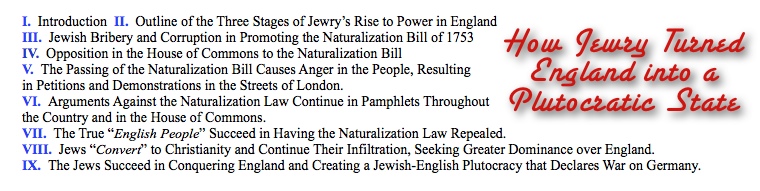
One Man’s Journey To ‘Holocaust Denial’

One Man’s Journey To


Holocaust Denial’ 


by Prof. Ray Goodwin


Barnes Review Oct, 2007


 One Man’s Journey To ‘Holocaust Denial’ 01


This is the famous entrance to the concentration camp Auschwitz-Birkenau, or Auschwitz II (shown from inside the camp), that in the “official Holocaust literature” is known as a death camp where today it is claimed over a million people were gassed. Toward the end of the war trains did enter through this gate. The official story states that at the end of the line there was a ramp where internees went through the “selection process.” For those ordered to go to one side it meant immediate gassing, while those ordered to go to the other side it meant being worked to death. At one time the death figure stood at around 4 million but then was reduced to 1-1.5 million. Even this figure creates problems when considering the logistics of gassing and then burning such a large number of people. Anyone can do a calculation as to how long it would take to cremate that many people. Go to your local crematorium and view a cremation, then note how long it took to cremate one body. — Dr. Fredrick Töben


HOW DOES ONE GO FROM BELIEVING the world is flat to accepting that it is really round? How does one cast off decades of what is assumed to be “gospel” and develop an entirely opposite worldview? And how does a layman resist and overcome the calumny associated with the acceptance and espousing of a very different and unpopular viewpoint? After all, many honest academics and others have lost their jobs and had their livelihoods ruined because they dared to openly question the “holocaust of the Jews” story. Unlike all other historical events, this is one that has been deemed “beyond question” and “beyond debate.” Who has deemed it so and why? That is what you need to know, that you might understand just why this subject is so sacred and unapproachable by honest research.


The following account is an attempt by one who dared to be like Dorothy of Kansas and decided to stymie the fear of a booming voice of “Oz” and to pull back the curtain—and reveal that the tremendous voice and godlike image that had all the people in fear was not a god at all, but a little old white- haired man with a megaphone.


This writer presents this paper, first written in 1991 and just recently updated, in hopes that our laymen will take up the cause for truth and to show that one does not have to be a man of letters or a “scholar” to discover what turns out to be a simple truth. The enemy knows they can pretty much control the scholars and their voices; what they fear is the lay people starting to question their pronouncements, especially in numbers. Hopefully the personal experience cited herein will be a helpful guide and something with which you may “arm yourself” for future questioning of the purveyors of a despicable, costly and cowardly myth.


Borrowing an acronym—FEAR—I urge you to apply it to any account of the supposed extermination campaign waged against the Jews by National Socialist Germany. “False Evidence Appearing Real” (FEAR) is the hallmark of all the tales of “eyewitnesses” and “survivors” in the holocaust industry. For too long, these accusations and libel have gone unchallenged and accepted at face value. Come on, folks. This is not an individual, but an entire nation, that has been charged and convicted of mass murder and has never been allowed to defend itself. Put yourself, as an individual, in that position: You know you are innocent. Every piece of forensic, scientific and demographic evidence exonerates you, but you are not allowed to use it. You are already judged as guilty before the trial even starts. That reminds some of us Texans of old Judge Roy Bean, when asked by a captured suspect:


Are you gonna give me a fair trial?

Bean replied:

Yeah, we’ll give you a fair trial, then we’re gonna hang you.


As you read this article, I hope you will think of and ask the questions of your accuser that would be asked if you were on trial for such a heinous crime. And do not accept anything but a legitimate answer in return—no evasiveness, no emotional outbursts or name-calling. Every one of the people who allege this crime of genocide should be forced to back it up, and I do not mean with mislabeled and phony photographs and statements “from a friend of a friend whose brother-in-law said. …” Those who show a tattooed number as proof of extermination have only shown you a tattoo that proves one thing — that they have a tattoo. In other words, folks, hold these plaintiffs to the same judicial standards as you would any other accuser. The burden of proof is on them, and they have not given one shred of legitimate proof, excepting that expressed in the above acronym — FEAR.


————————————–

One Man’s Journey To ‘Holocaust Denial’ 02

Auschwitz Plaque Reflects New Information—But Few Take Notice


The plaque shown on the left above is an old plaque from the Auschwitz-Birkenau WWII prison camp. It reads:

Four million people suffered and died at the hands of the Nazi murderers between the years 1940 and 1945.

Realizing that maintaining the 4 million number was becoming untenable, the Auschwitz authorities changed the plaque to the one shown above, on the right. It reads:

Forever let this place be a cry of despair and a warning to humanity where the Nazis murdered about one and a half million men, women and children, mainly Jews.”

Although this change in information should have been heralded around the world, becoming the impetus for correcting the historical record in regard to the holocaust in textbooks, museums, college classes etc, no one (but Revisionists) seemed to care. In fact, the holocaust lobby, in an act of unbelievable chutzpa, began touting the figure of 9-11 million killed in German-run WWII work camps during their media blitz against those in attendance at the Iran Holocaust Conference, December 2006.

————————————–


They show a picture of a knife and say, “This knife killed 24 people.” Remember — all they have shown anyone is a picture of a knife. Their words must be proved to be true — otherwise, all their huffing and puffing is merely loud, empty talk. (Besides, knives don’t kill people. People kill people.)


Just about any good lawyer worth his salt could tear them apart in any legitimate courtroom, where witnesses are duly sworn in and are forced to answer truthfully. The problem for those of us trying to right this wrong is finding that legitimate courtroom. One does not have much of a chance when the judge is part of the prosecution and knows his career is over if he dares allow an honest pursuit of justice.


Use the information herein to hold their feet to the fire — and that includes the millions of duped “average Joes” who have bought into this exterminationist thesis. This is not merely a debate over history, people—this is a war; and truth has been the big loser so far. The resultant turmoil and suffering do not bode well for the very existence of mankind.


THE SEARCH BEGINS


I began my questioning and search for truth regarding the much-ballyhooed “holocaust” in 1974. Like nearly every American, I accepted at face value the claims of “survivors,” [1] the videos and photos shown on television and the very regular pronouncements from the media, dais and pulpit about the “horrible extermination campaign” conducted against Jews by Hitler’s Germany. What spurred me to question the details of this unspeakable crime? Answer: reading a paper titled Did Six Million Really Die?; my work experience in a chemical plant and the handling of hydrogen cyanide; and reading the accounts of “survivors” from the postwar trials which essentially established the legend of mass extermination that came to be termed the “holocaust.”


The first thing I did as a seeker of truth was to get a definition of “holocaust,” which was and is readily available in countless books on the subject. That definition comprises;

the planned and activated extermination of members of the Jewish race, numbering some 6 million, by National Socialist Germany primarily through the use of Zyklon B (a commercial preparation containing hydrogen cyanide) at various camps during World War II.

With this definition forming the guidelines, I began my quest.


Those who have challenged the establishment viewpoint are known as “Revisionists,” and their position on the subject is: there was no attempt by National Socialist Germany to exterminate any ethnic group, such as the Jews in this case, nor did 6 million die, nor were any Jews subjected to homicidal gassing.


Revisionists agree that many deaths occurred in the camps due to disease, starvation and the horrid conditions of war, but gas chambers (much less “gas ovens,” whatever that means) for homicidal purposes, were non-existent. [2]


Those who accept the conventional view as true are designated as “exterminationists” by Revisionists.


What jumped out at this researcher immediately upon closer examination of the stories of extermination were the many credible arguments against such a program, as advanced by Revisionists. The technical and physical impossibilities of the claims of alleged gassings and cremations as espoused by “eyewitnesses” at the postwar trials immediately fly in the face of scientific fact. Unfortunately, such claims were not allowed to be questioned by the defense, nor those witnesses allowed to be cross-examined. Before an analysis of such claims, a chronological background on the origins of “denial” is necessary for a proper understanding of Revisionist contentions.


In 1961, Prof. Paul Rassinier of France became the first author to refute the accuracy of claims of genocide in print. (Francis P. Yockey’s Imperium, published in 1948, did cast doubt upon the claims, but did not deal directly with the subject.) Rassinier, a socialist and member  of the French resistance, had been captured and interned in the prison work camps of Buchenwald and Dora-Mittelbau. Liberated in 1945, he returned to France as an invalid and was shortly very puzzled, then outraged, at the claims of “genocide” and gas chambers, particularly regarding the two camps where he had been a prisoner.


He had seen no evidence of any such activities as an inmate there (and Rassinier certainly had no love for the Germans). His initial work on the extermination of the Jews, The Lie of Ulysses, followed in 1964 by his The Drama of the European Jews, called into question the “holocaust” legend.


——————

“This detailed demographic study offers evidence that the vast majority of the “exterminated” Jews did indeed survive, being absorbed primarily into the Soviet Union, Palestine and the U.S.”

——————


The year 1976 featured the appearance of a thorough and well-documented Revisionist treatise by Dr. Arthur R. Butz of Northwestern University. The Hoax of the 20th Century dissected the extermination claims from pre-war and post war population statistics; the crucial role played by the Allied trials and their extreme importance in implanting the legend were also addressed by Butz:


. . . [I]t is a fact that without the evidence generated at these trials, there would be no significant evidence that the program of killing Jews ever existed at all. . . . If the trials had not been held, a person claiming the existence of an extermination program could not, if challenged, produce any evidence for this save a few books . . . whose claims are just as unsupported as his original claim.


Thus the problem that had been involved in deciding whether or not to try mass murder; unlike the usual murder case, there was legitimate and very solid doubt that the deed had been committed at all.


This may surprise the reader who regards the tale of Jewish extermination as a near certainty; such is simply not the case. There are many considerations supporting this view and some are so simple that they may surprise the reader even further. The simplest valid reason for being skeptical about the extermination claim is also the simplest conceivable reason; at the end of the war they were still there.” (Butz, page 10)


Adding credence to the claims made by Butz is a 1983 publication by Walter N. Sanning entitled The Dissolution of Eastern European Jewry. This detailed demographic study offers evidence that the vast majority of the “exterminated” Jews did indeed survive, being absorbed primarily into the Soviet Union, Palestine and the United States. Professor Sanning challenges the exterminationist school of thought:


The purpose of this analysis was not to investigate the content of truth in the ‘holocaust’ story, but to outline the extent and the direction of the Jewish population movement before, during and after World War II.”


If the developments as traced here are in conflict with the taboos of contemporary historians, it is their (emphasis added) task to reconsider an untenable position.


In his booklet, The Holocaust—120 Questions and Answers, Dr. Charles E. Weber does a masterful job of provoking thought while keeping his approach simple and plainspoken. This 1983 publication addresses a myriad of issues related to the holocaust legend and reminds the reader from the outset that the funding available to those who disseminate material from the exterminationist viewpoint far outweighs the minute resources available to the Revisionist (page 8). This is, of course, a major factor in the relative obscurity of Revisionist research and scientific conclusions on the issue.


One of the most definitive books on the conduct of “war crime” trials, The Auschwitz Myth, by Dr. Wilhelm Staeglich, gives one insight into the show trial and political nature of Allied courtroom procedures. This 1986 publication stresses the absence of proper judicial standards and the appalling way in which the search for truth was impeded rather than furthered by the court. Not many are aware that “eyewitnesses” were not allowed to be cross-examined by the defense, nor were they ever subjected to enforcement of the perjury oath. Additionally, Staeglich says “witnesses” traveled from court to court making the same unchallenged claims, saying they had been at each camp.


By October of 1990, the Revisionist assault on the legend had come full circle with the admission by England’s leading historian and authority on World War II, David Irving, that he was now convinced of the fraudulent nature of the entire extermination thesis (Battleship Auschwitz, 498-9) and would include a statement to this effect in new editions of his previously published books.


—————

One Man’s Journey To ‘Holocaust Denial’ 03

PROFESSOR RAY GOODWIN

Truth over political correctness.

—————-


TECHNICAL ASPECTS


According to Revisionist investigation, none of the alleged “gas chambers” had ventilation or exhaust systems capable of handling the gassing of inmates. The square footage in all of the “chambers” would allow for a hypothetical total of 123,976 gassings in all the years of the supposed “genocide” program (The Leuchter Report, 14). In September of 1989, the Russians released the Auschwitz Death Books (the Germans were meticulous record keepers). They showed a death toll of 74,000 at that camp from all causes (Irving, 500).


Confessions from Germans, obtained by torture, “eyewitness” testimony and exterminationist historians put the number gassed at Auschwitz alone at 4 million. This massive contradiction deserves further examination in the interest of historical truth. This figure has now been revised downward, to just over a million, thanks to the fear of Revisionist discoveries and publishings. Notably, however, that reduction did nothing regarding the claim of 6 million dead.


On August 19, 1960, the director of the prestigious Institute for Contemporary History in Munich, Dr. Martin Broszat, announced to his amazed countrymen that there had never been a “gas chamber” in the entirety of the German Reich, but only a few in other places, namely in occupied Poland (Robert Faurrison, The Problem of the Gas Chambers, 107-108). This announcement flew in the face of those who swore to mass killings in German camps, but that was never brought up, of course.


Broszat has never provided an explanation for this contention. Professor Robert Faurrison of France asks:

1. How does Dr. Broszat know that the “gas chambers” in the Old Reich were frauds?

2. Why did he say that the “gas chambers” in Poland are genuine?

3. Why do the proofs and certainties and eyewitness accounts concerning the concentration camps in the west suddenly have no value, while these same criteria still remain true for the camps in Poland (108)?


Think about those questions.


As the exterminationists themselves have since abandoned the claims of the use of gas chambers in Germany proper, primary attention will now be devoted to the main camps in Poland, which would be Majdanek and Auschwitz-Birkenau. Pertinent to this, however, is the confession regarding the German camp of Bergen-Belsen. Two of the pillars upon which rest the claims of the exterminationist historians and the “survivors” and “eyewitnesses” are the confessions of Kurt Gerstein and Rudolf Hoess. Gerstein, one-time commandant of Bergen-Belsen, states in his confession that 700 to 800 people went into each of the four chambers each time the gassings took place. The size of each room varies slightly, but worked out in terms of occupant per square meter (approximately a square 3 feet by 3 feet), and according to those “eyewitnesses,” those rooms would have had a minimum of 30 to a maximum of 40 individuals in each square meter (Felderer, 170). I ask you, dear reader, to draw on the ground a square of 3 feet by 3 feet. Then imagine just how many people you could cram into that square. Thirty? Forty? I don’t think so. Revisionist Ditlieb Felderer concludes:


In spite of all the absurdities, impossibilities, erroneous and contradictory figures, the ‘Gerstein Statement’ continues to maintain its supremacy in exterminationist lore. Perhaps this is just as well, from a cynical Revisionist viewpoint, for few things could better illustrate the mythical nature of the ‘holocaust’ than this very item.” (Felderer, 172)


Rudolf Hoess, one of three successive commanding officers at Auschwitz, was the only one to leave a confession. His description of the actual gassing procedures is remarkably short and vague, just as all other “eyewitness” accounts are vague, brief and full of contradictions on many points. As described by Hoess: one-half hour after having released the gas, the Germans would open the door and turn on the fan and immediately begin to remove the bodies. Hoess added that the crew in charge would remove the 2,000 [!] bodies and begin transporting them to the crematory ovens while eating and smoking. (Quoted in Faurrison, The Mechanics, 24) This confession implies that it is possible to enter an area saturated with hydrogen cyanide (HCN, Zyklon B) while taking no precautions for self-protection and bare-handedly grasp 2,000 cadavers contaminated with a lethal dose of the gas. The air pockets between the bodies heaped on top of one another would have been filled with HCN.


This “confession” lacks plausibility and even common sense (many “survivors” and “eyewitnesses” swore to the same impossibility in court), and is in accord with Revisionist claims that it is a fabrication extracted by torture. Yet, testimony by these claimants at Nuremberg and other postwar trials was readily accepted into the record, not allowed to be challenged and believed as “gospel” by Allied judges anxious to do their duty for “humanity.” And countless German military personnel, not guilty of any such crime, were executed on the basis of these claims by “survivors” that were not allowed to be questioned or cross-examined.


———–


One Man’s Journey To ‘Holocaust Denial’ 04


Above, inmates are given the important task of making rifles for the German war effort at the Dachau prison labor camp. One would expect that the prisoners used for this task would have prior job experience with factory work, foundry work or woodworking. As different camps produced different products (Auschwitz producing, for instance, synthetic rubber, medicine and arms), inmates with particular skills would have been put to work where their skills were best suited. Recalcitrant workers, habitual criminals, murderers and other troublemakers would have been dealt with sternly. However, in 1943, Heinrich Himmler himself ordered that no guard could strike a prison labor camp inmate without fear of severe punishment—and this included death.

—————-


It was this particular part of my reading that drew me to examine and challenge those claims. I was an employee of E.I. DuPont at that time and worked in a huge chemical plant, having experience working around HCN. Allow me to cite the DuPont Company Material Safety Data Sheet (MSDS) on hydrogen cyanide (the primary element of Zyklon B), as of January 14, 1991.

HCN is described as unstable with heat and extremely flammable. It is a fast acting poison and could be fatal if inhaled, swallowed, or absorbed through the skin.

(Remember the “eyewitness” accounts of SS men “smoking and eating,” wearing NO protective equipment, while dragging gassed Jews out by the hair).


The MSDS adds that in most cases cyanide poisoning causes a deceptively healthy pink to red skin color and that skin permeation can occur in amounts capable of producing systemic toxicity. The user is cautioned to use the gas only in closed systems and with ventilation adequate to keep vapor concentrations below exposure limits. Warnings are given to evacuate the area immediately if HCN fumes are detected and to don protective clothing before re-entry. The minimum personal protective equipment recommended is goggles and rubber gloves, and the user should have at hand rubber suits and boots, a full-body chemical suit and a self-contained breathing air supply. DuPont also warns that with eye or skin contact, one should immediately;


flush the eyes with plenty of water, remove contaminated clothing, including shoes, and wash the skin.


Skin absorption can occur from cyanide dust, solutions, or HCN vapor (MSDS, 3-10).


Therefore, the abundance of technical and physical impossibilities inherent in the confessions becomes apparent upon examination of the sites and the dimensions of the so-called gas chambers. The technical problems inherent in any plan to gas millions of people would have necessitated meetings of experts and the issuance of plans, instructions and safety equipment. no evidence that any of this was ever done by the National Socialist government has ever been found (Faurisson, The Mechanics, 29). Remember too, that passes would not have been granted to Germans in the camps, nor their families allowed to visit; prisoners who had served their sentences would not have been released or allowed to return to their respective countries, or the “extermination program” would have been revealed to the whole world. The fact is, there was nothing sinister to reveal at all.


Faurrison concludes his article with what he regards as the criteria of false evidence regarding the gas chambers. He avers that all of the statements, as vague and inconsistent as they may be, agree on one thing: the crew responsible for removing the bodies entered the site either “immediately” or “a few moments” after the deaths of the victims. Calling this a physical impossibility, he states:


I contend that this point alone constitutes the cornerstone of the false evidence, because this is a physical impossibility. If you encounter a person who believes in the existence of the ‘gas chambers,’ ask him how, in his opinion, the thousands of cadavers were removed to make room for the next batch (The Mechanics, 30).”


Perhaps the most severe blow to the extermination thesis was delivered in 1988 with the publication of The Leuchter Report: The End of a Myth. The author’s treatise is a report on the technical aspects of the alleged execution chambers at Auschwitz, Birkenau and Majdanek, Poland, using comparisons with American prison gas chamber designs and operations.


————-

“Leuchter states that many complicated problems must be considered in the design of an execution gas chamber. A mistake may, and probably will, cause death or injury to anyone outside the chamber.”

————


In states that use lethal gas for capital punishment, stringent rules and procedures must be met. All lighting and electrical hardware must be explosion-proof (none of the rooms designated as “gas chambers” had this feature). If you come home in the evening and open your home and smell gas, the one thing you know not to do is flip a light switch. The spark can cause an explosion.


The chamber is operated under a vacuum so that any leak would be inward. An eminent authority on capital executions, Leuchter states that many complicated problems must be considered in the design of an execution gas chamber. A mistake may, and probably will, cause death or injury to anyone outside the chamber (Leuchter, 6). This expert says that an area of nine square feet is the minimum required for gas circulation around the occupant of any gas chamber. As the floor area for the Auschwitz Krema 1gas chamber” is 844 square feet, allowance for gas circulation means that a maximum of 94 people could fit into this room at one time for execution. “Eyewitness testimony” places 600 people at a time in this room (Leuchter, 11). Remember—no questioning or cross examination was allowed in the courts. How would you, as the accused, feel about your defense attorneys being so handicapped with YOUR life on the line?


The tourist attractions shown to the public as “gas chambers” in all the camps examined by Leuchter have no gasketed doors or windows, and very few have vents; the inside walls of the structures are not sealed to prevent leakage or absorption of the gas, so that the exposed, porous brick and mortar would accumulate HCN and be dangerous to humans for several years. The fact that these rooms identified as “gas chambers” are located right next to the crematories also would make them a prime source for explosion and fire. Very poor planning by those super-efficient German killers, indeed. Leuchter found that Krema 1 has floor drains connected to the main sewer of the camp. This would allow the heavier-than-air deadly HCN to get into every building at the facility, resulting in the deaths of the guards and commandant. The “gas chambers” here, as in all the camps, are too small to contain the numbers claimed. The doors to these rooms all open inward (another poor design consideration by those supposedly so efficient in mass slaughter; it would be quite difficult to push such a door open against the piles of bodies after a gassing). Also, enough leakage of the deadly gas would have occurred in all of the gas chambers to have killed the administering technicians (Leuchter, 9).


Leuchter’s strongest forensic evidence is the samples of brick, mortar, concrete and sediment taken by his team from the three Polish camps. HCN and its compounds are very residual— they hang around for decades. Leuchter took 31 samples at the alleged gas chambers, and a control sample was taken from delousing facility No. 1 at Birkenau. The control sample, from the delousing chamber where clothing was treated to rid it of disease-causing lice, showed a very heavy cyanide content of 1,050 milligrams per kilogram of brick. This is consistent with the use of Zyklon B as a delousing agent in that chamber.


However, of the other 31 samples, from the supposed gas chambers, 17 had no measurable trace of HCN, and the other 14 were all under 8 milligrams—consistent with those locations having been deloused at some time. This scientific analysis supports the evidence that these facilities could not have been execution gas chambers. Of course, “eyewitness testimony” by those deemed incapable of lying was responsible for the death sentences given German camp personnel there as well as the camps in Germany proper, where the non-existence of homicidal gas chambers has been admitted even by the exterminationists. No charges of perjury, or suggestions of redress to the survivors of the wrongly and vindictively executed Germans, have ever been proffered by the moralistic proponents of the extermination thesis.


Investigation of the cremations of the alleged gassing victims evinces the same degree of impossibility and contradiction. I took a tour of a modern crematory near my home city, interviewed the experienced technician and learned what it takes to dispose of one body. I asked not only how much time, how much fuel, what temperature and how much residue is left, but the possibility of multiple cremations in one oven. Rarely considered is the fact that the oven must undergo a cooling down period before the ashes and bits of bone remaining may be removed. Those remnants fill a normal size shoebox. What I learned from this personal research was that none of the descriptions in the accusations made by “survivors” of the holocaust was even remotely possible—except, perhaps, in their own minds.


Four million shoeboxes of ashes would have made quite a mound at Auschwitz. Where is it? The 60 pounds of coal/coke used by the Germans to cremate one body also leaves residue—and if one multiplies that 60 pounds by the supposed 4 million bodies—where did Germany get the 240 million pounds of coal, and how did they get it to Auschwitz?


————–


The Infamous ‘Ovens

One Man’s Journey To ‘Holocaust Denial’ 05

Above are pictured crematory ovens from three of the most well-known German-run WWII prison labor camps. The top oven is from Dacahau, the middle from Buchenwald and the bottom from Majdanek. They appear to be standard-sized one-cadaver-at- a-time funeral home cremation ovens. How in the world the Nazis could have incinerated so many millions of corpses in these small ovens is still unknown. Auschwitz had the most ovens, a large bank of them completed in 1943 (see below). Still they appear incapable of holding more than one or two cadavers at a time. Again, the unattainable logistics of the “holocaust” myth stand as proof that it is a fraud.


One Man’s Journey To ‘Holocaust Denial’ 06

—————–


As to the time required to cremate all those bodies (four hours for each)—Leuchter says (p. 10) that the capability of all the ovens at the entirety of Auschwitz could realistically cremate 207 bodies in 24 hours. If there were 4 million, and the 69 crematoria there worked around the clock with no shutdown time for cleaning (an impossibility), the Germans would have still been cremating bodies until something like June of 1972.


Please, Mr. “Survivor,” Mr. “Eyewitness,” explain this. Oh— you say that the bodies were mass-cremated, in that well-cited 50-foot long, 10-foot deep pit the awful Germans dug. Facts: Auschwitz was built on swamp-like land; the water table there is four feet deep. That’s right—once you reach that depth, water begins to seep into the hole you are digging. Ten-foot deep trench? Sure.


Additionally—what fuel did they use in that pit? It doesn’t matter—a high-enough temperature to cremate a human body cannot be reached in an open pit. Once again—you accusers—explain this: Where are the tons of incompletely burnt “cremains”?


I distinctly remember watching another of the myriad of “specials” on the “holocaust” made in 1985, titled A Painful Reminder. This was aired on the Discovery Channel out of Houston, and included the standard claims of “gassings” made by the interviewed “survivors.” It was clearly stated on the program that 279,000 bodies per month (over 9,000 per day) were being cremated [at Auschwitz] in a continuous, round-the-clock operation. These phony witnesses were trying to make the numbers fit the story.


Remember—German military and concentration camp personnel were executed on the basis of such unquestioned and unchallenged testimony. Leuchter’s own conclusion about his forensic examination there:

After reviewing all of the material and inspecting all the sites at Auschwitz, Birkenau and Majdanek, your author finds the evidence overwhelming:

There were no execution gas chambers at any of these locations. It is the best engineering opinion of this author that the alleged gas chambers at the inspected sites could not have been, or now be, utilized or seriously considered to function as execution gas chambers.”


Imagine what such testimony, had it been allowed at the show trials after the war, would have done to these witnesses for hire who traveled from court to court to spout the same lies. They knew, of course, that challenging their lies would not be allowed, nor would any cross-examination by the defense. They know this today, as well, and still make those claims before Americans in schoolrooms and elsewhere. Consideration must be given to the numbers game played by the exterminationists and Jews as well. In brief—according to the study by Prof. Sanning as well as information from the Encyclopedia Britannica, the total number of Jews that were ever under the control of the German military was 4 million. Today, you have at least 3.7 million drawing reparations as “survivors” and “victims.” Please, I may not be a math major, but somehow I just cannot get 6 million dead Jews out of that, nor even a half a million.


THE HOLOCAUST INDUSTRY


Why the paradoxical reaction of Jews to Revisionist contentions that Jews were not the victims of extermination, but survived the war? One would think that debunking of the myths would elicit a joyful response, especially from those who have believed for decades that their people were the victims of genocide. Consider these three probable reasons:


(1) the holocaust is a huge financial business with obscene profits and enormous amounts of gullible sympathy;


(2) the Palestinian issue; and


(3) the immense power and influence exercised by Zionists and other Jews upon the governments and media of the world, especially upon American foreign and domestic policy.


Most Americans are unaware of the billions paid to individual Jews as well as to Israel, a nation that did not even exist at the time of the alleged genocide. The amount paid yearly to all these “victims” is based upon the now legendary “6 million” figure and, as these reparations are still ongoing, any reduction in that number would be intolerable to the recipients of such largess.


In essence, should Revisionist findings be accurate and accepted as such, the goose that lays these golden eggs for Jewish coffers would disappear. And those folks who have been forced to bear the guilt and pay this extortion for all these decades just might be a little upset over what has been done to them.


Israel was established in 1948 due in large part to the overwhelming sympathy generated by these ridiculous accusations of genocide. The Zionists were given the land of the Palestinians by the British as a homeland for the Jewish state. The Palestinians thus became as victimized as the Germans by this massive lie, as they have been a homeless, tortured people since then. They are indeed the real victims of not just the repressive Zionists, but an uninformed and misinformed world that does not want to hear of their grief and suffering— a world with little sympathy toward righting a decades-old injustice.


As the U.S. government and all facets of the media played the key role in establishing the legend of genocide, this is why both institutions turn their backs upon Revisionist findings. And it is also why they ignore attacks upon Revisionists and Palestinians alike. Both also continue an ever-increasing effort to propagate the extermination thesis. Several states have made “holocaust education” mandatory in their schools; U.S. taxpayer funds are used to fund “holocaust” museums and other tributes. No political lobby in the United States plays a more influential role in electing or defeating political candidates as do Jewish political action committees. These are all factors in maintaining the “holocaust” legend and explaining the silence of politicians on the subject. Jewish organizations are constantly pressuring all levels of government to adopt legislation that makes questioning or doubting the holocaust a crime punishable by heavy fine and imprisonment. Their efforts have been successful in many foreign countries and are making headway here in the United States, despite our sacred Constitution and the absolute protection of free speech and free thought it should provide us.


“If Revisionists are indeed “flat-Earth” fools, and exterminationists and the Jews are holding all the aces—of what then are they afraid?”


Why would key members of the U.S. government have participated for so many years in perpetuating and supporting the legend? Besides self-aggrandizement, of course, obliteration by contrast is the likely reason. Without the genocide claim to use against Germany, several aspects of the initiation and conduct of the war by the Roosevelt administration would have come under scrutiny and could have caused widespread popular unrest in this country. The dubious story of the “surprise” attack on Pearl Harbor, the cover up of the Soviet massacre of the Polish officer corps at Katyn (and the blaming of it on the Germans), Operation Keelhaul, [3] the barbaric saturation bombings of non-military targets, and the orgy of rape and pillage engaged in by the Soviets, the Allies and resistance forces, could most justifiably be labeled “war crimes.


——————–


A Financial Holocaust Burns U.S. Taxpayers


Is “holocaust guilt” the reason American taxpayers get burned for $5 billion every year in aid to Israel without complaining?

According to the American-Israeli Cooperative Enterprise, from 1949 to 2001 the generous American taxpayer gave Israel a total of $94,966,300,000. That would be over $100 billion during 1949-2002, or about $2 billion per year; but by now it is up to about $5 billion a year, for a total of at least $130 billion so far. Not widely known is that most of this aid violates the law. For example, the Arms Export Control Act stipulates that U.S.-supplied weapons be used only for “legitimate self-defense,” not for bombing helpless Palestinian or Lebanese civilians and not to destabilize the entire region and the world. Also, taxpayer aid to Israel is different from that to any other country in three ways.


First, since 1982, U.S. aid to Israel has been transferred in one huge lump sum at the beginning of each fiscal year, which immediately begins to collect interest in U.S. banks. Aid to other lands is disbursed in quarterly installments.


Second, Israel is not required to account for the money. Most countries receive aid for very specific purposes and must account for how it is spent. Israel is allowed to place U.S. aid into its general fund, effectively eliminating any distinctions between types of aid. Therefore, U.S. taxpayers are helping to fund an illegal occupation, the expansion of colonial-settlement projects, and gross human rights violations against the Palestinian civilian population.


A third difference is the sheer amount of aid the U.S. gives away to Israel, unparalleled in the history of U.S. foreign policy. Israel usually rakes in roughly one third of the entire foreign aid budget, despite the fact that Israel comprises less than 0.1% of the world’s population and already has one of the world’s higher per capita incomes. If U.S. taxpayers knew this and became aware that the holocaust was the most lucrative lie in history, would they so willingly hand over their hard earned cash to Israel?


—————————


But with the genocide claim against the Germans, all of these actions, as well as the decision by FDR, Churchill and Stalin before the end of the war to carve Germany and Europe up for the Soviets, are “justified.” After all, any nation that would conduct genocide, especially against Jews, deserves every form of destruction and punishment it got.


The veracity of Revisionist claims may only be properly evaluated if they receive a hearing. But such a hearing is vociferously opposed by Jews and their lackeys in government and media. Their only answer to our research is personal attacks, including brutal beatings (Faurrison), destroying livelihoods (Leuchter and others) and imprisonment (Rudolf, Zuendel and others). One has to wonder — if Revisionists are indeed “flat-Earth” fools, and the Jews and exterminationists are holding all the aces—of what then are they afraid?


PERSONAL CONCLUSIONS


If this author comes across as angry about this issue, that is because I am certainly angry. After examining the issue from more than one side, seeing the forensic and scientific evidence offered by the Revisionists, and in essence giving them a hearing that was not allowed at the shameful postwar courts, I easily came to the conclusion that this whole “holocaust” is nothing more than a “holo-hoax,” and deserves to be exposed for what it has been all along—an extortion crime of the worst degree. I even learned in my search that this same claim of genocide and of millions dead was floated by the Zionists after World War I, but it was immediately recognized for the lie that it was, and given short shrift.


I am also angry about the personal attacks upon legitimate scholars who question this historical non-event, the beatings, destruction of property, and the impunity with which such thugs operate in my country. The kowtowing by politicians, media people, clergy and academia to these arrogant frauds is a disgrace. I, for one, have put my foot down. No more unchallenged fairy tales by “survivors,” as long as I am able to speak out.


If your community is like mine, it is visited on occasion by one or another of the millions of “holocaust survivors,” who speak in our churches and our schools about the suffering they endured at the hands of those evil Germans, while the world stood by and did nothing. I do not know about you, but I am way past being tired of their totally baseless whining, lies and extortion.


Certainly, a number of Jews did suffer the depredations of war—but no more so than various other peoples. Those responsible for the executions and extortion payments in the form of reparations should be made to face the music of perjury trials, at the very minimum. When they cry that they lost their entire family—well, many people lost their entire families in that war, and Jews deserve no more (and no less) sympathy than anyone else, if they are telling the truth. I will admit, however, that it is quite difficult to feel sympathy for the legions of lying vampires who rake in tons of extortion money off the labor of falsely accused people every year. The German nation should be exonerated of this despicably assigned “guilt,” and the historical record must be set straight. It is past time to get in the faces of these liars, and put them to the test with honest questioning. They will not engage in debate, unless they can turn the debate away from the intellectual and logical to the emotional—which they will do every time.


They know that in any debate between logic and emotion, logic loses every time. Thus their personal attacks upon those who question them, and the inevitable name-calling — “Nazi,” “anti-Semite” and worse.


ENDNOTES:


1. When heard by the average American, the words “survivor” and “holocaust” are almost completely associated with the German extermination camp myth.


2. Were “gas ovens” supposed to both gas the Jews to death and then cremate their bodies? That would be an interesting example of German efficiency, but probably would be impossible.


3. Operation Keelhaul was the plan to ship a million nationalist Russians back to the Soviet Union after they had been given sanctuary in the West. (Many helped in the war effort.) Stalin executed those he deemed enemies and shipped hundreds of thousands off to the gulags, never to return. The East Came West by Peter Huxley-Blythe is the best book on the story. Softcover, 225 pages, $20 minus 10% for TBR subscribers. Add $3 S&H inside the U.S. Available from TBR BOOK CLUB, P.O. Box 15877, Washington, D.C. 20003. Call toll free 1-877-773-9077 to charge.


BIBLIOGRAPHY:


Butz, Arthur R., The Hoax of the 20th Century, Richmond, Surrey, England, Historical Review Press, 1976.

DuPont Material Safety Data Sheet (Hydrogen Cyanide): Hazardous Materials Manual, 1991 Ed.

Faurrison, Robert, “The Mechanics of Gassing, Journal of Historical Review, 1.1 (1980), 23-30.

Faurrison, Robert, “The Problem of the ‘Gas Chambers’.Journal of Historical Review, 1.2 (1980), p. 1.

Felderer, Ditlieb, “Auschwitz Notebook.Journal of Historical Review, 1.2 (1980), 169-172.

Irving, David, “Battleship Auschwitz.” Journal of Historical Review, 10.4 (1990), pp. 491-508.

Leuchter, Fred A., The Leuchter Report: The End of a Myth, Toronto, Samisdat Publishers, Ltd., 1988.

Sanning, Walter N., The Dissolution of Eastern European Jewry, Torrance, Ca., Institute for Historical Review, 1983.

Staeglich, Dr. Wilhelm, The Auschwitz Myth, English translation from the German original, Der Auschwitz Mythos. Torrance, Ca., Institute for Historical Review, 1986.

Weber, Dr. Charles E., The Holocaust—120 Questions and Answers, Torrance, Ca., Institute for Historical Review, 1983.


—————-


About the Author


A native-born Texan, Revisionist RAY GOODWIN is a retired instructor of American history on the college level in Victoria, Texas. He has given multiple addresses to the Sons of Confederate Veterans organizations in San Antonio, Austin, Corpus Christi and Victoria. He has done research on various historical subjects, and has had book reviews and articles published on them. Prof. Goodwin crafted the lead article for the July/August 2007 issue of TBR, focusing on bias in academia and the case of Nat Turner.

—————


Recommended Books on the Holocaust


Auschwitz: The Final Count. Edited by Vivian Bird. The diminished numbers of inmates who died at Auschwitz from all causes can no longer be disputed. Monographs on Zyklon B, Auschwitz from a man who was stationed there and the killing ability of the Auschwitz gas chambers. Plus more experts. #67, softcover, 120 pages, $13.


The Myth of the Six Million. Edited by Willis A. Carto. By Dr. David L. Hoggan. The most concise book on the holocaust and one that almost never came to be printed. All you need to know about the holocaust to realize it’s a hoax. #446, softcover, 160 pages, $13.


The Holocaust Industry. By Norman Finkelstein—The author, who is Jewish, is one of the Anti-Defamation League’s “Top 10 Most Dangerous Men.” A professor, this brave Jew was denied tenure for speaking up about the use of the holocaust a a guilt-driven moneymaking machine. #220S, softcover, 150 pages, $13.


The Giant With Feet of Clay. Juergen Graf, an intrepid Swiss scholar, makes a devastating case against Raul Hilberg’s standard work on the holocaust, The Destruction of the European Jews. Scholarly, dispassionately written, it is a devastating account of purposeful historical misinformation and outright falsehoods in regard to the internment of Jews and others by the Nazis. #252, softcover, 128 pages, $11.


The Hoax of the 20th Century. Arthur Butz’s seminal Revisionist work is the epitomé of holocaust study and the most widely read book on the subject. In 502 pages of penetrating study and lucid commentary, Butz gives the reader a graduate course on the subject. This is a book you must have if you want a clear picture of the biggest cover-up of our age. #385, softcover, 502 pages, $25.


The Rudolf Report by Germar Rudolf. A follow-up to the Leuchter Report about alleged gas chambers at Auschwitz plus additional updates and clarifications. The author, a scientist and publisher is now rotting in a German prison for his “politically incorrect” conclusions about the holocaust. #378, 455 pages, softcover, $30.


Concentration Camp Stutthof by Juergen Graf and Carlo Mattogno. New, important discoveries. The authors, Revisionist historians, lay to rest the allegations concerning this camp. Meticulously researched. #379, 122 pages, softcover, $15.


Concentration Camp Majdanek by Juergen Graf and Carlo Mattogno. Blockbuster. Historical-technical study with on-site physical research in addition to primary sources disprove allegations that the camp was used as an extermination center. #380, 326 pages, softcover, $25.


The First Holocaust: Jewish Fundraising Campaigns With Holocaust Claims During and After WWI. By Don Heddesheimer. The author shows that the 6 million figure dates back to Jewish fundraising campaigns that started during the FIRST World War and reached their peak in the mid-1920s. Although this exaggerated Zionist propaganda of “mass extermination” began to slow down in the 1930s, it never completely ceased and received powerful new momentum in the 1940s, resulting in the entry of the 6 million figure


———————————————


PDF of original Barnes Review article: One Man’s Journey To ‘Holocaust Denial’


Version History


Version 3: Oct 30, 2017 — Improved formatting.

Version 2: Jul 4, 2015 — Improved formatting. Added PDF of original Barnes Review article.
 

Version 1: Published Jan 24, 2014 – Text and some pics added.
Posted in Holocaust, Jews, Revisionism | Tagged | Leave a comment

Into the Darkness : Chapter 15: Socialized Health

Into the Darkness : An Uncensored Report from Inside the Third Reich at War 

by Lothrop Stoddard

Stoddard

1940

Chapter 15: Socialized Health

The treatment given a tuberculous patient is partly determined by his social worth. If he is a valuable citizen and his case is curable, no expense is spared. If he is adjudged incurable, he is kept comfortable, of course, but no special effort is made to prolong slightly an existence which will benefit neither the community nor himself. Germany can nourish only a certain amount of human life at a given time. We National Socialists are in duty bound to foster individuals of social and biological value.

It was the official in charge of the Tuberculosis Section of the Public Health Service headquarters who spoke. He was an earnest young man with reflective eyes and a precise manner of speech. His was only one of many departments devoted to the combating of every notable Germanic ill, from cancer to flat feet. Here the myriad strands of a nationwide organization head up in a big building near Nollendorfplatz.

I had become accustomed to elaborate publicity methods in all the national headquarters of Governmental or Party institutions, but I think this one deserves the prize. The whole building was one series of exhibits, while the detailed educational literature was all­inclusive. As usual, I was given a liberal sampling, sent next day to my hotel. They went to swell a collection of data which filled a hand­trunk by the time I left Germany.

I have that public health literature spread out before me as I write. There are some twenty pamphlets, dealing with general or special topics, including a detailed bibliography of the best books available in the entire field. Some of the pamphlets are illustrated with cuts and diagrams. I note especially the one dealing with foot troubles, which contains a whole series of exercises. Then there are several single­sheet “dodgers.” Here is one entitled: Advice to Pregnant Women. This consists of a series of wood­ cuts. First, the things she should do: Sponge­bath on arising; take a quiet walk; wear proper clothes ­ as indicated; brush her teeth before retiring; take a good sleep in a comfortable bed. Now the don’ts: heavy lifting; high reaching; bending long over the washtub; bending low to get into that bottom drawer; standing too long a time; drinking and smoking; wearing high­heeled shoes; getting shaken up ­ as on a motorcycle; finally, losing one’s temper. At the bottom of the sheet, proper articles of diet are visualized. Others in this pictorial series cover matters like Preparation for Motherhood, and Care of the Baby.

The pamphlets deal with all sorts of things. Here are several on specific diseases ­ tuberculosis, cancer, foot troubles, infantile paralysis, venereal diseases, and so forth. There are several more on sex ­ the best ages for begetting children; advice to parents on handling children during adolescence; advice to youths and maidens ­ these last preaching strict morality, though from a patriotic rather than a religious basis. Lastly, there are a few miscellaneous topics, including diet, exercise, and avoidance of liquor and tobacco. All these are inexpensively gotten up for mass distribution.

Before I started on my tour of investigation, the general director, Dr. Eckhard, had given me a general background discussion, as Germans always do. He stated that the general theory and structure of the German public health system goes back to Bismarck’s day. The outstanding development under the Third Reich is thoroughgoing co­ordination of various departments and organizations. Structurally, therefore, no great changes have taken place except the establishment since 1933 of a complete system of cancer centers throughout Germany. It is in the spirit and tempo of the Public Health Service that we discover the vital difference between the present and former times. The Nazi attitude, subordinating the individual to the collective good, is well expressed in the remarks of Dr. Eckhard’s subordinate with which this chapter began.

Dr. Schramm, the eminent surgeon whom I met at my first dinner­party in Berlin, undertook to continue my education in Public Health. One of the points he stressed was the good general level of health, due largely to the health ­insurance law by which even the poorest are assured full medical treatment. People are urged to seek medical advice periodically or for any worrisome symptom, and since it costs them nothing personally, they do it gladly. All medical men are legally bound to give a certain portion of their time to insured patients; patients have the right to choose the doctor or surgeon they wish to consult, and they even have the right to be sent to the private hospitals of such medical men, if he customarily sends his patients to those institutions. Dr. Schramm took me to the hospital of which he was chief surgeon. It was a fairly large private institution, with about 150 beds. Some wards were for insured patients. I spoke with several of them. They were all workingmen. Their health insurance allowed them up to one year’s hospitalization, with pocket money. After that, if not cured, I was told they were taken care of out of the public health funds indefinitely. Incidentally, Dr. Schramm informed me that cotton is so short in wartime Germany that absorbent cotton has become scarce. It is now saved for vital uses. Ordinary dressings are made of paper, and appear to serve quite well.

Another interesting point I learned was the progress made in the fight against venereal diseases. Anyone infected must at once consult a doctor, under heavy legal penalties. Since he or she can get free treatment and choose the doctor, they are glad to comply. Privacy for the case is assured by having the doctor send in a report to the health authorities bearing a number, the name and address of the patient remaining in his files. But if the patient does not come regularly or fails to comply with directions, the doctor discloses the patient’s identity and coercive measures are taken. Anyone spreading infection is punished by a sentence of at least six months in jail. This sentence is mandatory. Wealth and social position are of no avail. The result of all this is a sharp drop in social disease rates. Fresh syphilitic infections have become rare. There is still considerable gonorrhea, but much is hoped from the new treatment with sulfanilamide. The war has thus far not notably affected the situation. Soldiers are so well trained in prophylaxis and are subject to such heavy punishment for carelessness that there has been scant spread of venereal disease by them.

I spent an instructive morning visiting an accident and out­ patient clinic, to see how that aspect of public health was handled. This clinic was maintained for workingmen; all of them, of course, insured. The approach was not prepossessing. It was on the fourth floor of a dingy warehouse­like building, and was reached by a freight elevator. Once inside, however, I was astonished at the completeness and modernity of the equipment. X­Ray and Roentgen­ Ray machines, sun ­ and violet­ray lamps, mechanical and hand massage, up­to­date operating­room ­ everything seemed to be there. An American woman, the wife of a bone specialist, who accompanied me, was frankly astounded at what we saw. She knew about such matters, and she told me that she had never seen anything professionally finer at home. Perhaps the most significant point was the cheapness with which the clinic was conducted. I was shown the cost­sheets, and found that the average charge made for patients to their associations was less than one dollar per day.

Another important aspect of public health is housing. The officials concerned with this phase showed me several new developments, from inexpensive workingmen’s apartments, through single and double­house settlements, to upper­middle­ class “model villages,” all on the outskirts of Berlin. However, I wasn’t satisfied with what was officially shown me, surmising that everything would be the best of its kind. So I got a foreign journalist who knew about such matters to steer me around the poorest quarters. I was on the hunt for slums.

My colleague told me I wouldn’t find anything very bad, because Berlin had no real slums, as most countries reckon them. But he promised to show me the worst there were, and we spent the greater part of a day poking about. Our starting point was Alexanderplatz, formerly a very tough district and a Communist stronghold. Today, it is a humdrum traffic and shopping center. The worst section nearby has been almost entirely rebuilt with municipal apartment houses for working­men. They are plainly and simply built, and the rents are very cheap. The heart of this extensive development is Horst Wessel Platz, named after the famous Nazi hero and martyr who was murdered by Communists in an old tenement (now torn down) which faced the present square.

After that we radiated in easterly segments; some of the oldest tenement sections drab and dreary, especially in the gray light of a cloudy autumn day. But none of them were run­down, and no dirt or rubbish was to be seen. My colleague informed me that the Nazi Government has forced landowners to clean up and repair even the oldest tenements. This was originally started as part of a compulsory “make­work” program during the early years of the Nazi regime. In some tenement courtyards I saw small, shed like buildings (somewhat like the “alley dwellings” of Washington, D. C.) which once had evidently been lived in. However, such structures have all been condemned as living quarters. So are all cellar tenements. The general impression I got from these workingmen’s quarters was that of a rather low average standard of living, yet above the squalor line.

The nearest to slumlike conditions I discovered was in and about the Grenadierstrasse. There the very poorest class lives, including many foreigners and a considerable number of Jews. The tenements look sordid, with few clean curtains or flowers in the windows, as was the case nearly everywhere else. Many of the passers­by looked as sordid as their abodes. The Jews, understandably, had a fear ­ridden, sullen air. I tried to find out whether ghetto conditions existed, in the sense that Jews were concentrated in certain tenements. Apparently this is not the case. In one tenement, where I saw nothing but Jews about, I asked a postwoman just going in to deliver mail if this were a purely Jewish place. With the frank callousness one so often encounters, she answered disdainfully:

Ach, nein. Jews, Gypsies, all sorts of trash live here!

Germany’s coldly efficient system of public health is strikingly shown by the scientifically notable sanitary job it has done in Poland. Although none of us foreign journalists were allowed to visit the Polish zone, I was fortunate in having a long conversation with almost the only foreigner who was permitted to go there. This man was Dr. Junod, a Swiss and a high official of the International Red Cross. Dr. Junod is an expert judge of sanitary conditions, with many years of service in the Red Cross and long experience in the Ethiopian and Spanish Civil wars. He visited Warsaw, Poland’s shattered capital city, about mid ­November.

He told me that what the German health authorities had done to Warsaw since its capture in late September was a miracle of scientific efficiency. Though the houses were still largely in ruins, the streets were immaculate ­ he did not see even bits of waste paper blowing about. The water and lighting systems had been restored and the population generally inoculated against typhoid. The prostitutes had been listed and were carefully examined at frequent intervals. Most striking of all, the urban masses, habitually filthy and verminous, had been deloused wholesale. The delousing stations parted a man from his clothes,  both going through different cleansing processes. These were so nicely synchronized that the naked individual usually met his garments at the other end ­ both clean and freed from local inhabitants. The clothes were dry, since they had been subjected to a blast of hot air which desiccated them almost immediately.

About the more important aspects of the lives of the people through whose city those unlittered streets ran, I was able to gather little.

Nevertheless, the result of this intensive health campaign was an utter transformation of public hygiene in the short space of two months. Thereby a great peril had been averted. Sanitary conditions immediately following the German conquest were so bad that, unless heroic measures had been speedily taken, mass epidemics would have been inevitable. This would have endangered not only German ­occupied Poland but Germany itself. If such epidemics had spread into the Reich, the consequences might have been catastrophic, for the habitually cleanly Germans have no such partial immunity to filth diseases such as typhus as the Poles have acquired through having been chronically exposed to them. It was clearly not for the Poles,  therefore, but for the benefit of the invaders that this miracle of sanitary science had been invoked.

 
———————————-
 
 
Chapter 2: Berlin Blackout
Chapter 3: Getting on with the Job
Chapter 4: Junketing Through Germany
Chapter 5: This Detested War
Chapter 6: Vienna and Bratislava
Chapter 7: Iron Rations
Chapter 8: A Berlin Lady Goes to Market
Chapter 9: The Battle of the Land
Chapter 10: The Labor Front
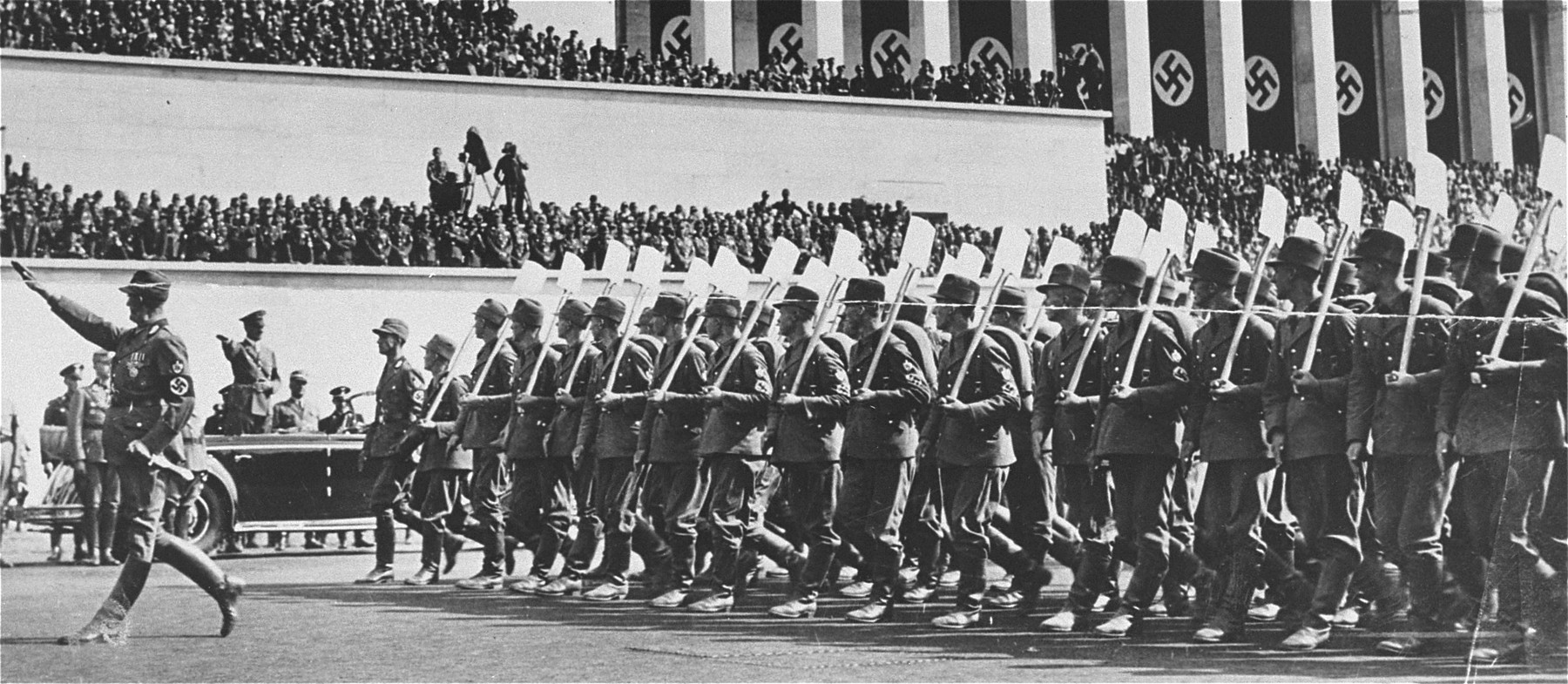
Chapter 11: The Army of the Spade
Chapter 12: Hitler Youth
Chapter 13: Women of the Third Reich
Chapter 14: Behind the Winter­Help
Chapter 15: Socialized Health
Chapter 16: In a Eugenics Court
Chapter 17: I See Hitler
Chapter 18: Mid­Winter Berlin
Chapter 19: Berlin to Budapest
Chapter 20: The Party
Chapter 21: The Totalitarian State
Chapter 22: Closed Doors
Chapter 23: Out of the Shadow
 

 ———————————-

PDF of this post (click to download or view):  Into the Darkness – Chap 15


Version History
 
Version 3: Nov 27, 2014 – Added PDF of post.


Version 2: Wed, Feb 5, 2014. Added Chapter links.
Version 1: Published Jan 24, 2014 – Text added.
Posted in Bk - Into the Darkness - Stoddard | Tagged , | 3 Comments

Into the Darkness : Chapter 14: Behind the Winter-Help


Into the Darkness:


An Uncensored Report from


Inside the Third Reich at War


by Lothrop Stoddard


Chapter 14: Behind the Winter-Help


As the damp chill of the north European autumn deepens into dark, cold winter, there appear increasingly the manifold activities of the Winterhilf ­ in plain English, the Winter­Help. Once a fortnight, every city, town, and village in the Reich seethes with brown­ shirted Storm Troopers carrying red­painted cannisters. These are the Winter ­Help collection­ boxes. The Brown­ Shirts go everywhere. You cannot sit in a restaurant or beer­hall but what, sooner or later, a pair of them will work through the place, rattling their cannisters ostentatiously in the faces of customers. And I never saw a German formally refuse to drop in his mite, even though the contribution might have been less than the equivalent of one American cent.


During these periodic money ­raising campaigns, all sorts of dodges are employed. On busy street ­corners comedians, singers, musicians, sailors, gather a crowd by some amusing skit, at the close of which the Brown­ Shirts collect. People buy tiny badges to show they have contributed ­ badges good only for that particular campaign. One time they may be an artificial flower; next time a miniature dagger, and so forth. The Winter­ Help campaign series reaches its climax shortly before Christmas in the so­called Day of National Solidarity. On that notable occasion the Big Guns of the Nazi Party sally forth with their collection boxes to do their bit. I am told that it is considered quite an honor to drop an offering into the cannister wielded by so redoubtable a personage as, say, Hermann Goering.


These collection ­box campaigns have been going on every winter since the Nazis came to power. So has another picturesque feature ­ the Winter­ Help Lottery.


The sale of these lottery tickets is not restricted to certain periods; it goes on continuously through the entire autumn and winter season. They are sold by men in rather attractive uniforms with red ­banded caps and dove­gray capes. Like the Brown­ Shirts, these lottery­ vendors cover every public place, even the best hotels.


The tickets are enclosed in tightly sealed orange envelopes stacked in rows on a little tray. The vendor approaches you, salutes politely, and offers his wares. Should you wish to buy, you pick an envelope at random and pay him fifty pfennigs ­ half a Reichsmark, which is worth somewhat over ten cents. Unlike his Brown ­Shirt colleagues, the vendor is not insistent and the public does not feel constrained to buy.


There’s a good feature about this Winter ­Help Lottery ­ you know right away if you haven’t won. So purchasers promptly tear open the envelope and take out their folded ticket. Nearly always they are confronted with a large blue Nicht, which means “No” and shows they haven’t a chance. Needless to say, that’s what I drew when I tried my luck. But plenty of persons seem to play the lottery often. In gay restaurants it’s quite a game for a whole group of diners to buy envelopes and greet each loser with peals of laughter ­ the vendor standing by and enjoying the fun.


However, buyers aren’t always losers. In the first place, out of the 6,000,000 tickets which form a series there are nearly 350,000 which carry small prizes called “premiums” ranging from 1 to 100 Marks. These minor premiums are paid by the vendor on the spot. Above these come the “prizes,” which range all the way up to a 5,000 ­Mark Grand Prize. However, those prizes are not paid offhand. What you get is the right to a prize­winning number in the lottery drawing which will be held three months hence. The prizes and premiums total an even 1,000,000 Marks. The cost of the tickets is 3,000,000 Marks. Since the lottery vendors are all volunteer workers who give their services and get no commission, the net “take” of the Winter ­Help from several lottery ­series sold during the season totals a handsome sum.


Still other money­making devices exist, the best ­known of them being the One ­Dish Plan. Each month during the autumn and winter a certain Sunday is set apart as the sacrificial day. On that Sunday, every patriotic German is supposed to contribute to the Winter ­Help the cash difference between the cost of a normal Sunday dinner and that of a single ­course meal. In all public eating places nothing else is served during the noon hours, so foreigners also must comply. The cost is trifling for the meal itself, but I should hate to have it as a steady diet, consisting as it does of a plateful of stewed onions, cabbage, and potatoes, graced by a lone miniature meat­ball compounded of the cheapest grade of hamburger. In private homes families are not legally compelled to restrict themselves to one­ course meals. They can actually eat as they choose. But they are practically compelled to contribute their cash offering in any case. A Brown­ Shirt always appears at the door, and the offering is assessed on tariff­rates proportionate to the family’s social status and known living­ standards.


The foreigner doesn’t learn that last item unless he happens to have German friends who tell him things. All he usually knows about is the box­ collections, the lottery vendors, and the sad experience of a one ­dish lunch in a restaurant or hotel. He may learn that annual contributions to the Winter­Help average well over 400,000,000 Reichsmarks ­ nearly $200,000,000 at the official rate of exchange. The foreigner may marvel that so prodigious a sum could be raised by the methods he has observed. As a matter of fact, it isn’t. Most of the money comes in through a carefully worked­ out schedule of contributions assessed on corporations, business firms, and individuals from the wealthiest down to all but the poorest peasants and laborers.


Your Nazi acquaintances probably won’t mention this to you. If they do, they will almost certainly tell you these are merely patriotic suggestions for voluntary contributions, properly graded. Technically, they are telling the truth, since Winter­Help offerings are legally “voluntary.” In the first days of the Nazi regime, quite a few persons took this literally and refused to contribute. That, however, was likely to be followed by unpleasant consequences; so prescribed sharing has become well­ nigh universal.


Here, again, we encounter what I have already stated to be a cardinal aspect of Nazi Germany ­ the fact that what the foreigner sees and casually learns may be only a slight indication of what goes on behind the scenes.


So much for the way Winter ­Help funds are raised. How are they spent? That is a controversial point. Nazis assure you that these huge sums are efficiently managed and all go for the purposes intended by the donors. They point out that most of the work is done by unpaid volunteers, so the administrative overhead should be small. This may be true, but there is no way of checking such assertions because no detailed, audited balance­ sheets are published. Some foreign observers tell you that Winter ­Help funds have been diverted to other purposes, much as the still vaster Labor Front funds are presumed to have been, according to some assertions by foreign critics of the Nazi regime.


I do not know where the truth lies in this matter, so I merely raise the point in order to make a balanced picture. From what I actually saw and learned, it seems to me that much of the Winter­  Help funds is actually spent on the poor and needy, and that the institution does a lot of good in many ways. So let us take a look at the Winter ­Help to see what it is, how it works, and what it accomplishes.


The Winter ­Help began in the autumn of 1933 ­ the first year of the Nazi regime. It was a terrible time, with over 7,000,000 registered unemployed and 17,000,000 in dire need. This latter figure included both unemployed and unemployables, especially the aged and the very young. The previous winter, the last under the Weimar Republic, had been grim. The Government dole had, to be sure, enabled the poor to keep body and soul together, but that was about all; and the outlook for the coming winter was equally gloomy.


Then the Fuehrer spoke. His word was:


“No one shall suffer from hunger and cold!”


So Hitler announced a new organization, run by the Party, to be known as the Winter ­Help. It was not a substitute for Government aid; it was an addition to that aid, designed to bridge the gap between the low minimum of State charity and a somewhat more tolerable standard of life. The aim was to provide coal and garments sufficient to keep a household fairly warm and decently clothed; to supply a bit more food; to distribute Christmas dinners, trees, and children’s toys at the beloved Yuletide. It even promised to step in and relieve unexpected accidents and misfortunes for which the victims were in no wise to blame.


That very first season, the Winter ­Help “delivered the goods.” The Party got behind it to the last man, woman, and child. Over a million volunteer workers donated their services. Vast amounts of food, fuel, and clothing were mobilized and distributed. The hearts of the poor were cheered ­ and warmed towards the new regime. That was the intention; for the Winter ­Help was officially described as:


“The instrument which enables us to make the most comprehensive appeal to the spirit of national solidarity.”


In short, an extremely effective form of domestic propaganda.


The more I studied the Winter­ Help, the more it appeared to me as an amazing cross between the Salvation Army and Tammany Hall. It would be unfair to put down the whole business as just cold­blooded politics. All the good­will mobilized, the unselfish effort donated, the goods distributed to deserving persons ­ those things are real, no matter what the attendant political motive. Think what it means to numberless “forgotten men” ­ and women, to be thereby lifted a bit above the squalor line; to have their drab lives unexpectedly brightened, especially at Christmas time. Perhaps all the poor do not share equally in those benefits; perhaps good Party members get the best of what’s going, while ex­Communists are often overlooked. Nevertheless, so many poor people get something that the effect on popular feeling is great and cumulative. And the tendency must be toward winning the good­will of the populace for the Nazi regime. It is the little things that count in getting and holding popular favor. Tammany in New York learned that long ago; and the Nazis are as clever and far more efficient than Tammany ever dreamed of being.


What we may term the Tammany ­Salvation­ Army technique comes out in everything the Winter Help does. Picture to yourselves a typical case. A Winter ­Help volunteer enters a sordid tenement dwelling in the poorest section of Berlin’s East End. He or she brings the family a basket of food, a packet of clothing, a tiny Christmas tree, or fuel tickets good at the nearest coal­dealer’s.


“Good morning!” is the cheery opening. “I bring you this with the Fuehrer’s Greetings!”


Then comes a bit of friendly chat. On leaving, the visitor extends an arm in salute with the inevitable: Heil Hitler! Is it not well ­nigh inevitable that the answering “Heil” comes spontaneously from grateful hearts? Such is the Winter­ Help and what it signifies. Now let us go on to consider the even larger social­service organization of which the Winter ­Help is itself organically a part. This vast institution bears the appalling title of Nationalsozialistischevolkswohlfahrt! Broken down into plain English, that Teutonic jawbreaker means National Socialist People’s Welfare. It’s even too much for the Germans, so they always speak of it as NSV.


NSV, though essentially a Party enterprise, is technically a voluntary organization supported by nearly 11,000,000 members who pay dues with a minimum of one Reichsmark per month. It has over 1,000,000 active workers, of whom only about 20,000 are paid, these being trained social ­service specialists in various lines. The vast majority of NSV workers contribute their spare time, and they do it generously ­ many of them as much as three hours per day. Like everything else in Nazi Germany, NSV is elaborately organized from a supreme head­center in Berlin down through regional, provincial, and local sub­centers until it reaches the ultimate unit ­ the so­called “block” of forty or fifty families. There can be no doubt that NSV is generally popular; otherwise it would be difficult to conceive of 11,000,000 persons paying regular dues and over 1,000,000 contributing so generously of their time the year round. Mere compulsion could not bring that about. What, then, is the reason? The answer to that query involves an understanding of a social set­up and attitude toward life which is radically different from ours. First of all we should realize that NSV, like its Winter ­Help affiliate, is not a substitute for Governmental assistance to the poor and needy. In Germany, total destitution has long been rare, thanks to the system of social welfare begun under the old Empire more than half a century ago, and extended under both the Weimar Republic and the present Nazi regime. Most Germans are thus legally protected against dire poverty and downright starvation. NSV supplements State aid in various ways. And it does so, not in our sense of “charity,” but as a duty which the socialized nation, the almost mystical Gemeinschaft, owes to each of its members.


Another important point to be understood is that, despite all the assistance which it gives to the poor and weak, NSV is even more interested in helping the fit and strong to be fitter and stronger. It seeks to energize the individual by making him constantly feel that he is organically part of the whole nation, and that he literally has the whole nation behind him ­ so long as he in turn does his duty and seeks to serve the nation of which he is an integral part.


In the Nazi social ­service system, the Winter ­Help has specialized functions. It is concerned chiefly with the relief of temporary difficulties and transient weaknesses or breakdowns of morale. NSV takes care of the long pull and deals with social problems which are solvable only in the remote future.


One of the axioms of National Socialism is that the family, rather than the individual, is the true unit of society. For this reason, NSV tries in various ways to integrate individuals into healthy, prosperous, fruitful families. Hence its special efforts for the welfare of mothers and children. Its largest and most important section is that known as Mutter und Kind. The size of this special organization can be visualized when we learn that it has some 26,000 offices covering every part of the Reich, with medical staffs and assisted by about 230,000 matrons of homes, kindergarten governesses, communal sisters, and nurses. Their activities are manifold, though their aim is not clinical; rather is it investigative and educational. Mother­ and­ Child stations are neither hospitals nor sanatoria. When bad conditions are detected, they are turned over to hospitals or State charities. But mothers by the million have visited these stations, or station agents have visited mothers in their homes. For instance, all infants up to the age of two years are medically examined and the parents are given advice as to proper care and feeding. Through affiliated organizations, the stations complete their preventive and educational work by enabling mothers and children most in need to have special care, take vacations, go to kindergartens, and so forth.


A striking instance of the meticulous way in which NSV seeks to foster the public health is its special subsection called Bettenaktion. Medical research has established the fact that nothing is more important to health and personal efficiency than good, restful sleep. Subsection “Bed ­Action” sees to it that each individual has his own bed ­ and a comfortable, sanitary one, at that. In the past few years, it is officially stated that fully 1,000,000 beds have been distributed free of charge to persons unable to pay for them.


Another important field of service is the raising to normal status of distressed or depressed areas. Certain remote regions, such as the mountainous districts of Lower Bavaria and the Eiffel hill­ country in the Rhine­land, were chronically impoverished and unable to improve their condition out of their own meager resources. NSV pours aid of all kinds into these abnormal districts until today, according to official accounts, some of them have been quite transformed.


Like the other quasi­ public institutions of the Third Reich, NSV gets out a tremendous volume of educative literature about its own activities. Booklets, pamphlets, illustrated sheets, and small charts are printed and distributed wholesale to the general public, either free or at very slight expense. Its Berlin headquarters maintains a permanent exhibition including large illuminated wall­maps, colored charts, miniature models, and a stereopticon lecture lasting nearly an hour. Its foreign relations representative,  Erich Haasemann showed me through, explained in detail, and invited me to visit some of its Berlin activities. The most interesting of these was its distribution center, which I visited next morning.


This center is housed in a rambling old building several stories high in the market district near Alexanderplatz. It is thus handy to the working ­class quarters.


Here needy persons come with their distribution­ certificates ­ a sort of chit enabling them to get required articles, both clothing and furniture. They get these chits on recommendation from their Blokwart, the official who looks after each block of forty families. Incidentally, there are nearly 450,000 such units in Greater Berlin.


The Blokwart makes it his business to know intimately the circumstances of each family in his unit. He visits them frequently in their homes, and to him they make known their troubles and requests for aid. Here is how it works: an outdoor laborer needs a new sheepskin ­lined jacket. He shows his old one to the Blokwart, who sees it is no longer serviceable.


“That’s right,” says the Blokwart, “you’ve got to have a new jacket if you’re going to be efficient on that job of yours these cold winter days. For you to get sick and perhaps land in the hospital would be bad business for the nation. So here you are. Go and pick one out at the center tomorrow after working hours.”


Down goes our working man, presents his chit, and is shown to the proper department, where hundreds of jackets, of all sizes, hang on long racks. Like all lines, they are in somewhat different styles and in diverse colors. This is to avoid uniformity in appearance. That aids morale by satisfying personal tastes and heightening the wearer’s self­ respect. If all NSV recipients were dressed alike, they would have a depressingly “institutional” look. It is really extraordinary how such psychological factors have been carefully thought out! I roamed around that warehouse for an hour, looking at huge stocks of everything from clothes and shoes to beds and baby ­carriages. Everything seemed to be of good quality, well­ made, and of surprisingly tasteful appearance. I was asked to note that there were full lines of everything, including even the most unusual “out sizes” which might not even be made commercially, much less carried in ordinary store stocks. For instance, I was shown a pair of boots so huge that it did not seem possible a human being could have such big feet. Nevertheless, I was told that a few did exist. Those persons were known. So NSV was prepared for them.


NSV does not manufacture its own supplies. They are bought in the open market, but they must be made by local manufacturers. Prices are thus not strictly competitive ­ at least, on a national scale. The idea is to spread work and keep local money at home.


These are only the high­lights of a subject with many ramifications. However, they may suffice to give a general idea of the importance of NSV in the Nazi scheme of things and in its hold upon the people. Such social services tend to win popular support for the Nazi regime and reconcile the masses to conditions which otherwise might breed discontent and even revolutionary unrest.


———————————-


See Also:


Book Reviews

Chapter 1: The Shadow

Chapter 2: Berlin Blackout

Chapter 3: Getting on with the Job

Chapter 4: Junketing Through Germany

Chapter 5: This Detested War

Chapter 6: Vienna and Bratislava

Chapter 7: Iron Rations

Chapter 8: A Berlin Lady Goes to Market

Chapter 9: The Battle of the Land

Chapter 10: The Labor Front

Chapter 11: The Army of the Spade

Chapter 12: Hitler Youth

Chapter 13: Women of the Third Reich

Chapter 14: Behind the Winter­Help

Chapter 15: Socialized Health

Chapter 16: In a Eugenics Court

Chapter 17: I See Hitler

Chapter 18: Mid­Winter Berlin

Chapter 19: Berlin to Budapest

Chapter 20: The Party

Chapter 21: The Totalitarian State

Chapter 22: Closed Doors

Chapter 23: Out of the Shadow


———————————-


PDF of this post (click to download or view): Into the Darkness – Chap 14


Version History


Version 7: May 25, 2022 – Re-uploaded images and PDF. Improved formatting.
 

Version 3: Nov 27, 2014 – Added PDF of post.


Version 2: Wed, Feb 5, 2014. Added Chapter links.


Version 1: Published Jan 24, 2014 – Text added.

Posted in Bk - Into the Darkness - Stoddard, Lothrop Stoddard, National Socialism, National Socialism - Philosphy | Tagged , | 3 Comments

Into the Darkness : Chapter 13: Women of the Third Reich


Into the Darkness:


An Uncensored Report from


Inside the Third Reich at War


by Lothrop Stoddard


Chapter 13: Women of the Third Reich


The leader of the women’s wing of the Nazi regime is Frau Gertrud Scholtz-Klink, [1] who set forth that aspect of the Third Reich in an interview she gave me. This conversation came as the climax to several studies I had made of various women’s activities under the guidance of purposeful lady subordinates. Those manifold activities are managed by the Reichsfrauenfuehrung, a compound word which means the Directing Center of German Women’s organizations. The combined membership of these societies totals fully 16,000,000. From this central point in Berlin, directive guidance reaches out to every portion of the Reich.


It was a bitter mid-winter afternoon when I hopped from my taxi and scurried for the entrance of national headquarters, an extensive building situated in Berlin’s West End. The air was full of driving snow whipped by a high wind. I was glad to find shelter in the warm entrance hall, though I could scarcely make my way through a litter of hand luggage and a crowd of women bundled up as though for a trip to the Arctic regions. I was later informed that they were a party of trained nurses and social workers bound for Poland where they would care for a convoy of German-speaking immigrants being repatriated from the Russian-occupied zone. Mute testimony, this, of the multifarious activities of the Reichsfrauenfuehrung, alike in peace and in war.


[Image] Gertrud Scholtz-Klink later known as Maria Stuckebrock (9 Feb,1902 – 24 Mar, 1999) was a fervent NSDAP member and leader of the National Socialist Women’s League (NS-Frauenschaft) [2] in NS Germany.


A dynamic lady, whose mother is an American, Dr. Marta Unger soon appeared and guided me up stairs and through corridors to her chief’s outer office. Presently we were admitted to the inner sanctum, a pleasant reception-room, tastefully furnished. As we entered, the famous women’s leader stood awaiting us.


Frau Scholtz-Klink was rather a surprise to me. I had often seen pictures of her, but they were not good likenesses. She must photograph badly, for they all made her out to be a serious, aloof person well into middle life. When you actually meet her, the first impression she makes on you is one of youthful energy. She was then just thirty-six. A compact woman of medium height, she walks to meet you with an easy, swinging gait and gives you a firm handshake. She is quite informal and as she warms to her subject, her face lights up beneath its crown of abundant blonde hair wound about her head in Marguerite braids. She never gets too serious and laughs easily.


I started the conversation by telling her some of the organizational activities I had seen, and asked her what was the basic idea on which they were conducted. Unhesitatingly, she answered:


“Encouraging initiative. You can’t just command women. You should give them guiding principles of action. Then, within this framework, let them function with the thought that they themselves are the creators and fulfillers of those ideas.”


This rather surprised me, and I told her so, remarking that in America there is a widespread impression that woman’s position is less free in National Socialist Germany than it was under the Weimar Republic, and that this is especially true regarding women’s professional opportunities and political rights.


Frau Scholtz-Klink smiled, nodded understandingly, and came back with the quick retort:


“That depends on what you mean by political rights. We believe that anyone, man or woman, thinks politically who puts the people’s welfare ahead of personal advantage. What does it matter if five or six women are members of Parliament, as was the case in the Weimar regime? We think it vastly more important that, today, sixteen million women are enrolled in our organization and that half a million women leaders have a weighty voice in everything which concerns women and children, from the Central Government and the Party down to the smallest village.” “How about professional opportunities,” I put in. “Are German women still in the universities and in lines like higher scientific work?” “They certainly are,” she replied, “and we are glad to see them there. It is true that when we first came to power seven years ago, some National Socialists were opposed to this because they had been prejudiced by the exaggerately feminist types of women who were so prominent under the Weimar Republic. Today, however, this prejudice has practically vanished. If occasionally we run across some man with an anti-feminist chip on his shoulder, we just laugh about him and consider him a funny old has-been out of touch with the times.” “That’s interesting,” I ventured.

“But it’s easy to understand,” rejoined Frau Scholtz-Klink, “when you recall our basic attitude and policy. Unlike many women’s organizations elsewhere, we don’t fight for what is often called ‘women’s rights.’ Instead, we work hand-in-hand with our menfolk for common aims and purposes. We think that rivalry and hostility between the sexes are as foolish and mutually harmful as they are scientifically unsound. Men and women have somewhat different capacities, but these should always be regarded as complementing and supplementing each other — organic parts of a larger and essentially harmonious whole.” “Then woman’s part in the Third Reich, while consciously feminine, is not feminist?” was my next query.

“Precisely,” she nodded. “We consider it absolutely vital that members of a woman’s organization always remain womanly and do not lose touch with their male colleagues. How long do you think I could stand it if I were shut up here with several hundred woman all the time? Why, I wouldn’t stay here three days! No, no, I can assure you our organization isn’t run like a nunnery. We foregather frequently with our masculine collaborators in informal meetings where we chat and joke together over our weightiest problems.” “Tell me a bit more about your organization,” I suggested.


Frau Scholtz-Klink thought for a moment; then proceeded:


“We National Socialist women didn’t start out with any cut-and-dried program or preconceived theories. When we came to power seven years ago, our country was in terrible shape and we had very little to work with. So we began in the simplest way, busying ourselves with immediate human needs. All the elaborate structure you see today has been a natural evolution — a spontaneous growth.” “How about your outstanding personalities?” I inquired.

Smilingly she shook her head. “We distinctly play down the personalities,” she deprecated. “In our opinion, thinking of person implies that one is not thinking of principle. Take me, for example. I assure you that I really don’t care whether, fifty years hence, when our present goal has been splendidly attained, people remember just who it was that started the ball rolling and helped it on its way.” “What are your relations with women’s organizations in other lands?” I queried.

“We are not internationalists as the term is often used abroad,” Frau Scholtz-Klink answered. “We concern ourselves primarily with our own problems. Of course we are only too glad to be in contact with women from other countries. Indeed, we have a fine guest-house here in Berlin where women visitors can come and stay as long as they like, seeing and studying all we do. If they approve, so much the better. We have no patents. In this sense, therefore, I believe we have a most effective women’s organization. But we have not yet seen our way clear to joining the International Women’s Council.”


Behind that official statement of the viewpoint of Nazi womanhood lies one of the most interesting stories in the evolution of the Third Reich.


Under the old Empire, conservative views prevailed in the field of domestic relations. The man was very much the head of his family. Woman fulfilled her traditional role of wife and mother. Kaiser Wilhelm described woman’s sphere as bounded by the:


“Three K’s, Kinder, Kueche, Kirche — children, kitchen, church.”


Most of his subjects apparently agreed with him. Some sharp dissent there was, and it was not legally repressed. But these dissenters were a relatively small minority.


When the Empire perished, domestic relations were in a turmoil. Liberal and radical ideas on woman’s status became common, all markedly individualistic in character. Women were given the ballot and went actively into politics. Advanced feminist types appeared, intent on developing their personalities and seeking careers outside the home. The “emancipated” woman seemed to be setting the tone.


These radical trends might have survived in an atmosphere of political stability and economic prosperity. But the times were neither stable nor prosperous. When the world depression hit Germany at the close of the 1920’s, conditions became desperate. In this chaotic atmosphere, National Socialism waxed strong and finally prevailed.


One of the first tasks of the Nazi revolution was to sweep away all the new ideas concerning domestic relations. Adolf Hitler had pronounced views on the subject. In one of his campaign pronouncements he stated:


“There is no fight for man which is not also a fight for woman, and no fight for woman which is not also a fight for man. We know no men’s rights or women’s rights. We recognize only one right for both sexes: a right which is also a duty — to live, work, and fight together for the nation.”


[Image] Frau Scholtz-Klink at the podium giving a speech [3]


In this forthright attitude, Hitler apparently had a large section of German women on his side. From the very start of the Nazi movement, women took a prominent part and were numbered among the Fuehrer’s most devoted followers. These women declared they wanted neither “equality” nor “women’s rights.” What they were after was a home. For the mass of German women, “emancipation” had meant little except hard work at meager wages, and the idea went completely sour with them when economic depression made countless unemployed men dependent upon their womenfolk. Thus, any program which promised confidently to change this abnormal situation could count on enthusiastic support from many women as well as from men.


That was just what National Socialism did promise with its pledge to re-establish the traditional order of domestic relations. It painted an alluring picture of a regime of manly men and womanly women — the manly men as provider and fighter; the womanly woman as wife, mother, and guardian of the domestic hearth.


According to Nazi economic theory, woman’s natural career is marriage. By following the delusive path of Liberal-Marxist materialism, said Hitler, woman herself had been the chief victim. Having invaded business, industry, and the professions, women threw men out of jobs and became their competitors instead of their helpmeets and companions. In so doing, women not only robbed themselves of their crowning happiness (a home and children) but also became largely responsible for the economic crisis which ultimately left women financially worse off than before. When both men and women turned into producers, there were not enough consumers left to consume what they produced.


[Image] Gertrud Scholtz-Klink with Adolf Hitler


That was the Nazi theory. And it caught on like wildfire. Nazi women orators denounced the Weimar regime as having degraded German womanhood into “parasites, pacifists, and prostitutes.” It was these feminine zealots who converted their sisters wholesale. The “Woman’s Front” of the Nazi movement soon became one of its most influential branches. And the interesting point is that it was run by the women themselves.


The activities of this Woman’s Front are complex and far-reaching. They overlap into many fields which we have already surveyed, such as the feminine sectors of the Labor Service and the Hitler Youth, together with phases of the great social-service enterprise known as NSV, which we will describe in the next chapter.


Its earliest enterprise was the Muetterdienst, or Mothers’ Service — a network of adult schools giving courses of instruction in infant care, general hygiene, home nursing, cooking, sewing, and the beautification of the home itself. Permanent quarters are established in all cities and large towns, while itinerant teachers conduct courses in villages and the remotest countryside. The system has now reached throughout the Reich, and several million women have passed through this domestic education — an intensive course with classes limited to twenty-five persons, since instruction takes the form, not of theoretical lectures, but of practical teaching by actual demonstration in which the pupils take part. Alongside these courses for housewives are others for prospective brides.


Most foreign observers agreed that this domestic education has helped many German women to be better wives and mothers. I myself investigated the large Mother School established in Wedding, a Berlin suburb inhabited by working folk. This institution also serves as a sort of normal school where teachers are trained. I met and talked with the members of the current class, drawn from all parts of Germany. They appeared to be earnest, capable young women, well chosen for their future jobs.


Another major field of service is in industry, where trained “confidence women” actually work in factories, stores, and offices employing much female labor. These women are thus in personal touch with working conditions. Naturally, such women are the best sort of propagandists for the Party and its ideas. Still other fields of activity might be described if space permitted in a general survey like this. At least half a million women are actively engaged in these various lines of endeavor.


This, of course, is the answer which Frau Scholtz-Klink and her colleagues make to the charge that National Socialism has driven women out of public life. They claim that it has changed the nature of those activities to more fruitful channels. As a matter of fact, the whole economic trend in the Third Reich, by transforming mass unemployment into an acute labor shortage, has driven women into all sorts of activities outside the home circle — which is certainly not what Hitler promised his feminine followers. It is estimated that nearly 12,000,000 women were gainfully employed in the Reich when war broke out, and that figure will undoubtedly be vastly exceeded as men are continually mobilized for war service. Yet, in these new developments, it is probable that the Nazi attitude and policy will remain basically unaltered.


———————————-


Footnotes:


[1] Gertrud Scholtz-Klink later known as Maria Stuckebrock (9 February 1902 – 24 March 1999) was a fervent NSDAP member and leader of the National Socialist Women’s League (NS-Frauenschaft) in NS Germany.


She married a factory worker at the age of eighteen and had six children before he died.


Scholtz-Klink joined the NS Party and by 1929 became leader of the women’s section in Berlin. In 1932, Scholtz-Klink married Guenther Scholtz, a country doctor (divorced in 1938).


When Adolf Hitler came to power in 1933, he appointed Scholtz-Klink as Reich’s Women’s Führerin and head of the NS Women’s League. A good orator, her main task was to promote male superiority, the joys of home labour and the importance of child-bearing. In one speech, she pointed out that;


“the mission of woman is to minister in the home and in her profession to the needs of life from the first to last moment of man’s existence.”


Despite her own position, Scholtz-Klink spoke against the participation of women in politics, and took the female politicians in Germany of the Weimar Republic as a bad example, saying, “Anyone who has seen the Communist and Social Democratic women scream on the street and the parliament, realize that such an activity is not something which is done by a true woman”. She claimed that for a woman to be involved in politics, she would either have to “become like a man”, which would “shame her sex”, or “behave like a woman”, which would prevent her from achieving anything.


In July 1936, Scholtz-Klink was appointed as head of the Woman’s Bureau in the German Labor Front, with the responsibility of persuading women to work for the benefit of the Nazi government. In 1938, she argued that;


“the German woman must work and work, physically and mentally she must renounce luxury and pleasure”.


Scholtz-Klink was usually left out of the more important meetings in the male-dominated society of the Third Reich, and was considered to be a figurehead. She did, however, have the influence over women in the party as Hitler had over everyone else.


[Image] The combined families of Scholtz-Klink and her third husband August Heissmeyer


By 1940, Scholtz-Klink was married to her third husband SS-Obergruppenführer August Heissmeyer, and made frequent trips to visit women at Political Concentration Camps.


Post-war life


At the end of World War II Scholtz-Klink and Heissmeyer fled from the Battle of Berlin. After the fall of the Third Reich, in the summer of 1945, she was briefly detained in a Soviet prisoner of war camp near Magdeburg, but escaped shortly after. With the assistance of Princess Pauline of Württemberg, she and her third husband went into hiding in Bebenhausen near Tübingen. They spent the subsequent three years under the aliases of Heinrich and Maria Stuckebrock.


On 28 February 1948, the couple were identified and arrested. A French military court sentenced Scholtz-Klink to 18 months in prison on the charge of forging documents. In May 1950, a review of her sentence classified her as the “main culprit” and sentenced her to additional 30 months. In addition, the court imposed a fine and banned her from political and trade union activity, journalism and teaching for ten years.


After her release from prison in 1953, Sholtz-Klink settled back in Bebenhausen.


In her 1978 book Die Frau im Dritten Reich (“The Woman in the Third Reich”), Scholtz-Klink demonstrated her continuing support for the National Socialist ideology. She once again upheld her position on National Socialism in her interview with historian Claudia Koonz in the early 1980s.


She died on 24 March 1999 in Bebenhausen, Germany.


Source: http://en.wikipedia.org/wiki/Gertrud_Scholtz-Klink


[2] The National Socialist Women’s League (German: Nationalsozialistische Frauenschaft, abbreviated “NS-Frauenschaft”) was the women’s wing of the NS Party. It was founded in October 1931 as a fusion of several nationalist and National Socialist women’s associations.


The Frauenschaft was subordinated to the national party leadership (Reichsleitung); girls and young women were the purview of the Bund Deutscher Mädel (BDM). From February 1934 to the end of World War II in 1945, the NS-Frauenschaft was led by Reich’s Women’s Leader (Reichsfrauenführerin) Gertrud Scholtz-Klink (1902–1999). It put out a biweekly magazine, the NS-Frauen-Warte.


Its activities included instruction in the use of German-manufactured products, such as butter and rayon, in place of imported ones, as part of the self-sufficiency program, and classes for brides and schoolgirls. During wartime, it also provided refreshments at train stations, collected scrap metal and other materials, ran cookery and other classes, and allocated the domestics conscripted in the east to large families. Propaganda organizations depended on it as the primary spreader of propaganda to women.


The NS-Frauenschaft reached a total membership of 2 million by 1938, the equivalent of 40% of total party membership.


The German National Socialist Women’s League Children’s Group was known as “Kinderschar”.

Source: http://en.wikipedia.org/wiki/National_Socialist_Women’s_League


[3] Speech given by:

FRAU GERTRUD SCHOLTZ-KLINK

Reich Women’s Leader


When National Socialism became the ruling power in Germany (1933), we women realized that it was our duty to contribute our share to the Leader’s reconstruction programme side by side with men. We did not say much about it, but started to work at once. Our first concern was to help all those mothers who had suffered great hardships during the War and the post-war period and all those other women who — as mothers — have now to adjust themselves to the demands of the new age.


Acting in accordance with the recognition of these facts, we first created the Reich Mothers’ Service (Reichsmütterdienst), the functions of which are set forth in Article I of the regulations governing it:


The training of mothers is animated by the spirit of national solidarity and by the conviction that they can be of very great service to the nation and the State. The object of such training is to develop the physical and intellectual efficiency of mothers, to make them appreciate the great duties incumbent upon them, to instruct them in the upbringing and education of their children, and to qualify them for their domestic and economic tasks.


In order to provide such training, several courses of instruction have been drawn up, each of which deals with one particular subject only, e.g., infant care, general hygiene, sick nursing at home, children’s education, cooking, sewing, etc. These courses are fixtures in all towns with a population exceeding 50,000, whilst itinerant teachers conduct similar ones in the smaller towns and in the country. Every German woman over 18 can join them, irrespective of her religious, political or other views. The maximum number of members has been limited to 25 for each course, because the instruction given does not consist of theoretical lectures, but takes the form of practical teaching to working groups, where questions will be asked and answered.


Since the establishment of the Reichsmütterdienst, i.e., between April 1st, 1934, and October 1st, 1937, some 1,179,000 married and unmarried women have been thus instructed in 56,400 courses, conducted by over 3,000 teachers of whom about 1,200 are employed full-time, whilst the remaining 2,300 (also possessing the necessary qualifications) act in an honorary capacity or in that of part-time instructresses.


Our next concern was with those millions of German women who, day after day, attend to their heavy duties in factories. We look upon it as most important to make them realise that they, too, are the representatives of their nation. They, too, must take pride in their work and must be able to say:


“I have a useful duty to fulfil; and the work I do is an essential part of the work performed by the whole nation.”


With this end in view, we have created the Women’s Section of the German Labour Front (Frauenamt der Deutschen Arbeitsfront), which has now a membership of over 8,000,000. Foreign critics have frequently stated that German women have no chance of earning their livelihood by working in industrial or other undertakings. I therefore take this opportunity of emphasising that more than 11,500,000 women are employed in the various professions and occupations; the Women’s Section of the German Labour Front attending to their interests. Moreover, we are of the opinion that a woman will always find it possible to secure paid employment provided that she is strong enough to do the work demanded of her. This applies to women workers of all categories, irrespective of whether the work is of the physical or intellectual kind. It is therefore the business of the Frauenamt to ensure that women are not employed in any capacity that might prove detrimental to their womanhood and to give them all the protection to which they are specifically entitled.


In order to translate these ideas into practice, the Frauenamt has proceeded to appoint a “social industrial woman worker” (soziale Betriebsarbeiterin) for every undertaking in which a considerable number of women are employed. The functions to be exercised by these Betriebsarbeiterinnen are of a general and a special kind. They have to see to it that all women employed in the same undertaking look upon their own interests as identical with those of the latter and that a proper spirit of comradeship grows up among them.


They are assisted in their task by the works’ leader and the confidential council, and they are in a position to gain the confidence of the other women workers because all of them are comrades of one another. They have to prevent strife, jealousy, and irresponsible talk from poisoning the social atmosphere of the works, to help those of their fellow-workers who may be oppressed by domestic worries, and to assist in rendering the conditions of work as dignified as possible. To that end, they have to furnish the works’ leader with suggestions for any measures that may be required to adapt the processes of work – in conformity with the technical peculiarities of the undertaking – to the natural capacities of women. Finally, they have to assist in the transfer of women workers to other places of employment, in the task of making the aspect of the working premises as pleasing as possible, etc.


This enumeration of their functions shows that they must not only be experienced social workers, but must also be familiar with the actual work. For this latter reason, they are required to devote several months to such work before they are appointed to the post of social workers. During that time they receive the same wages as the other women workers and are subject to the same regulations as they. Similar arrangements, although on a more modest scale, are made in connection with smaller works, i.e., those where the number of women workers is less than 200.


Special care is devoted by our organisation to married women workers with children and to those expecting to be confined. In this domain of social work we provide assistance, in conjunction with the National Socialist Welfare Organisation (N.S. Volkswohlfahrt), exceeding the standards set by the existing legislation. Such supplementary assistance consists in money, food, linen, etc.


I must not omit to add a few words in reference to the women students who spend part of their holidays for the benefit of those women workers — notably those who have large families — who are in need of a week’s relaxation in addition to their regular holidays. The students generously attend to the factory work of these women during their absence; and as they demand no wages, the workers suffer no pecuniary loss whatever. In many instances, free quarters are provided for the students by the National Socialist Women’s Organisation (N.S. Frauenschaft), whilst the Welfare Organisation grants special facilities to the women on holiday, such as additional food parcels, board and lodging in one of their mothers’ hostels and so on. During the first few years of the operation of the scheme, the students relieved the workers to the extent of 57,700 days’ work. Large numbers of letters are received by us every day, in which workers and students alike tell us how grateful they are for their unforgettable experience. Works’ leaders, too, continually inform us of the beneficial results achieved.


After completing the inauguration of the above schemes, we continued our work in a different direction, i.e., by organising ourselves. We have now co-ordinated the previously existing women’s associations and thus created the German Women’s Association (Deutsches Frauenwerk), which is sub-divided into sections along the lines laid down by the N.S. Frauenschaft.


The Deutsches Frauenwerk consists, apart from the Mothers’ Service already mentioned, of the following sections: National and domestic economy; cultural and educational matters; assistance, and a foreign section. In addition, there are four large administrative departments, viz., general administration; finances; organisation and staff; the Press and propaganda matters, which latter also deals with the radio, films, and exhibitions.


In the section for national and domestic economy, women and girls are trained to apply the principles of national solidarity. They are taught that, in every household, the mother is responsible for the health of the whole family by providing good food and by generally exercising her duties with skill and efficiency.


The cultural and educational section makes the nation’s cultural assets available to women; women artists are assisted in their work, and particular attention is paid to the achievements of women in the realm of science.


The assistance section deals with the work done by female nurses, the Red Cross, and the air defence society.


The foreign section establishes contact with women’s associations abroad, supplies information to foreigners, exchanges experiences with foreign organisations, makes arrangements for seeing the institutions in connection with the work of the Deutsches Frauenwerk, etc.


All these groups are under the general direction of the N.S. Frauenschaft, which may therefore be regarded as the leading organisation, whilst the Deutsches Frauenwerk and the Frauenamt der Deutschen Arbeitsfront constitute the joint foundation for the work done by women throughout the country.


Foreigners have repeatedly asked me about the kind of compulsion exercised to make women take part in all this work. I wish to assure inquirers that we know of no compulsion whatever. Those who want to join us, must do so absolutely voluntarily; and I can only say that all of them are joyfully devoted to their work.


Let me conclude by quoting a remark which I made on the occasion of the Women’s Congress held at the time of the Nuremberg party rally (1935):


“All the work done by us as a matter of course, which is now so comprehensive that we cannot any longer describe it in detail, is only a means to an end. It is the expression of the determination of German women to assist in solving the great problems of our age. A spirit of comradeship animates all of us; and our devotion to our nation guides all our efforts.”


—————————

Source: http://nseuropa.wordpress.com/2012/11/11/the-place-of-women-in-the-new-germany/


———————————-


Book Reviews

Chapter 1: The Shadow

Chapter 2: Berlin Blackout

Chapter 3: Getting on with the Job

Chapter 4: Junketing Through Germany

Chapter 5: This Detested War

Chapter 6: Vienna and Bratislava

Chapter 7: Iron Rations

Chapter 8: A Berlin Lady Goes to Market

Chapter 9: The Battle of the Land

Chapter 10: The Labor Front

Chapter 11: The Army of the Spade

Chapter 12: Hitler Youth

Chapter 13: Women of the Third Reich

Chapter 14: Behind the Winter­Help

Chapter 15: Socialized Health

Chapter 16: In a Eugenics Court

Chapter 17: I See Hitler

Chapter 18: Mid­Winter Berlin

Chapter 19: Berlin to Budapest

Chapter 20: The Party

Chapter 21: The Totalitarian State

Chapter 22: Closed Doors

Chapter 23: Out of the Shadow


===========================


PDF of this post. Click to view or download (0.8MB). >>Into the Darkness – Chap 13 – Ver 2


Knowledge is Power in Our Struggle for Racial Survival


(Information that should be shared with as many of our people as possible — do your part to counter Jewish control of the mainstream media — pass it on and spread the word) … Val Koinen


———————————-


PDF of this post (click to download or view):  Into the Darkness – Chap 13 – Ver 2


Version History


Version 7: May 13, 2022 – Re-uploaded images and PDF. Improved formatting.
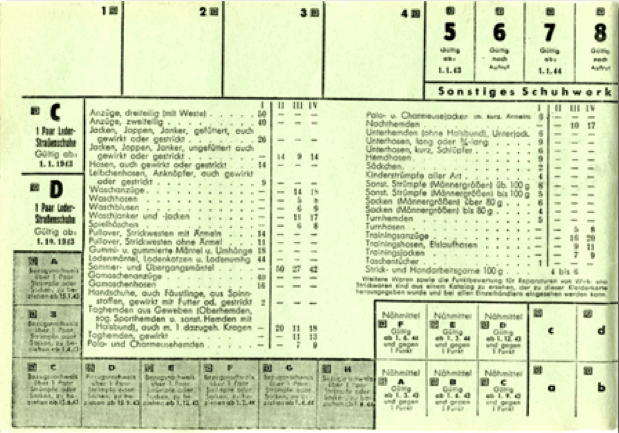
 

Version 6: Nov 28, 2014. Added PDF file (Ver 2) of this post.


Version 5: Nov 27, 2014 – Added PDF of post


Version 4: Aug 31, 2014. Formatted text.


Version 3: Aug 30, 2014. Added images and footnotes. Added PDF download.


Version 2: Wed, Feb 5, 2014. Added Chapter links.


Version 1: Published Jan 24, 2014 – Text added.

Posted in Bk - Into the Darkness - Stoddard, Lothrop Stoddard, National Socialism, National Socialism - Philosphy, NS - Role of Women, Third Reich, White Nationalism, WW II | Tagged , , , | 9 Comments

Into the Darkness : Chapter 12: Hitler Youth


Into the Darkness:


An Uncensored Report from


Inside the Third Reich at War


by Lothrop Stoddard


Chapter 12: Hitler Youth


During the autumn and winter months spent in Berlin I would occasionally see groups of boys on the streets clad in simple blue uniforms. Once or twice they had their arms filled with old newspapers ­ a patriotic chore to which they had been assigned. More often I would see them helping extract contributions for the Winter­Help, a charity collection scheme that I will later describe.


Those are perhaps the only glimpses the casual foreign visitor gets of the extraordinary system whereby National Socialism is molding the rising generation according to its imperious will. Like many other things in the Third Reich, what you see on the surface is only a small part of what lies behind. Outwardly, Nazi Germany even in wartime does not look startlingly different from the Germany of former days. The same ordered neatness and cleanliness prevail, and you may live there a long time without having a single dramatic incident occur before your eyes. All this is apt to fool you, until you dig below that impeccable surface. Then you begin to learn and to understand the radical transformation of life and thought that is taking place.


These blue­clad boys, between 10 and 14 years old, represent the first link in a chain of evolution which begins with the unformed child and ends with the uniformed man, indelibly stamped with the Nazi brand.


[Image] Members of the Hitler Youth (Hitler Jugend) in 1933.


Their official title is Jungvolk ­ best translated as Hitler Youngsters. Like everything else in the Third Reich, they are organized from basic groups of ten right up to National Headquarters. However, their duties and training are elementary, as befits their tender years. The system does not get into full swing until these boys enter the Hitler Youth, where they remain until their nineteenth year. Thence they go into the National Labor Service, which we have already described. After that comes military service, which lasts at least two years more. Such is the arduous apprenticeship which the male German must undergo.


The German girl passes through a formative period similar in character and of about the same length. From 10 to 14 she is a Young ­Maiden; after that she is a Hitler Maid until she is 21. During the latter years of her Maid­hood she is apt to be enrolled in the young women’s branch of the Labor Service, but of course she has no military service to undergo.


The combined male and female membership of the Hitler Youth in all its stages aggregates a total of well over 7,000,000, highly organized in every respect. That, I imagine, is the largest single youth organization in the world.


[Image] German poster for the Bund Deutscher Mädel. (The League of German Girls or League of German Maidens, was the girl’s wing of the overall Nazi party youth movement, the Hitler Youth. It was the only female youth organization in Nazi Germany. Initially the League consisted of two sections: the Jungmädel, for girls ages 10 to 14, and the League proper for girls ages 14 to 18.)


Adolf Hitler always stressed the necessity for any proselyting movement to gain and retain a firm hold on the rising generation. At the very start of his movement he organized a small youth group, though this was shattered like every other phase of his first effort after the disastrous Beer­Hall Putsch of 1923. However, with the re­founding of the Party two years later, a youth section was promptly started and made rapid headway under a series of able leaders, of whom Baidur von Schirach is the most famous. Before an interview could be arranged for me, the leader of the Hitler Youth had made his dramatic gesture of volunteering for army service and promptly departed for the Western Front.


[Image] Baldur Benedikt von Schirach at a Nuremburg rally with the Hitler Youth.


To gain youth’s allegiance, the Nazi regime has evolved a system which enlists the interest and loyalty of the rising generation. Its core is the local Home ­ a. well ­appointed boys’ clubhouse where the youngster meets his fellows in an atmosphere of comradeship supervised by carefully chosen leaders. Every Wednesday, the boys and girls gather in their respective Homes for their regular Home­Evening. The leader conducts the meeting according to a program prepared in advance at National Headquarters. Throughout Germany, the same songs are sung and the same subjects discussed. Then the radio is switched on, and all listen to a program entitled “Young Germany’s Hour,” which begins at 8.15 P.M. and is broadcast by all stations. On some other week­ day evening the youngsters gather a second time for a program devoted to games and sports. It is interesting to note that there is no military drill or use of arms in these physical exercises. Unlike the Balilla and Sons of the Wolf, the corresponding youth units of Fascist Italy, there are no miniature rifles or other warlike paraphernalia. The Nazis believe that imposing military training at this early age would be a psychological mistake.


To develop loyalty and maintain interest in their organization, a whole round of activities and special events has been devised. On New Year’s Day the Supreme Youth Leader makes an address to all his followers over the radio. In late January Young Germany honors the memory of its symbolic martyr, a fifteen­year­old Hitler Youth named Herbert Norkus, murdered by Communists during the years of strife before the Nazis came to power.


[Image] Herbert Norkus [1]


From February to April a series of competitions takes place to determine who among them possess those qualities of leadership which qualify them to be appointed to minor offices in the organization. The Fuehrer’s birthday, April 20th, is a great celebration, on which Hitler Youngsters who have attained their fourteenth year pass into the ranks of Hitler Youth. On May 1st, winners of special competitions throughout Germany are received by the Fuehrer himself. From June to August millions of Hitler boys and girls go vacationing in their Youth Camps or on hiking tours, and nationwide sport competitions take place. The highlight of this period is the annual Party Day at Nuremberg, when chosen detachments of Hitler Youth of both sexes travel thither from the remotest parts of the Reich to parade proudly before the Fuehrer and receive the applause of assembled Nazidom. This is also the day when those youths who have completed their eighteenth year formally graduate into the adult ranks of the Party. The autumn months are enlivened by various activities, especially participation in the Winter Help charity drives. It is easy to see how this continuous round of stimulating, pleasurable activities tends to center interest and loyalty around the organizational Home and all that it signifies.


[Image] Hitler Youth members


How has all this modified the individual boy’s and girl’s relations to those other aspects of life ­ family, church, and school? Complex adjustments are inevitable, for we must remember that, however pleasurable they may be, Hitler Youth activities are duties which must be complied with and with which no one may interfere. In the first years of the Nazi regime I am told that this sudden shift of youthful loyalties provoked frequent domestic conflicts and caused many personal tragedies. Great numbers of non­Nazi parents were recalcitrant at seeing their children placed in an atmosphere which sapped their authority and tended to make boys and girls flout the teachings of their elders. The traditional German family is patriarchal, and many fathers objected to the claims of the Youth Home on personal grounds even when they had no strong objections to the Nazi regime as such. In many cases, this conflict of loyalties went so far that boys and girls denounced their own parents to the authorities for what the children had been taught to consider unpatriotic speech or conduct.


[Image] The League of German Maidens. Bund Deutscher Madel or BDM was the girls’s wing of the Nazi Party youth movement.


Today, I understand that such extreme conflicts are rare. The Nazi regime broke parental resistance as systematically as it did opposition of every kind; so the most rebellious fathers and mothers have been weeded out by concentration camps or lesser penalties. The average parent now accepts the situation as inevitable, even if he or she does not at heart wholly approve. Indeed, I was told by foreign observers that a large proportion of German parents, including of course all Party members, now assent willingly to an institution which teaches their children good personal habits, promotes their health, and brightens their young lives in many ways.


[Image] Adolf Hitler salutes his Hitler Youth. Senior Nazis wanted the movement to forge close ties with the Boy Scouts [2]


Far more serious has been the conflict with the churches. Both the Protestant and Roman Catholic confessions possessed strong youth organizations. The Nazi Government, in accordance with its policy of all­ round co­ordination, insisted that these confessional groups be merged in the Hitler Youth. This raised a storm of protest from pious church folk, who deemed the Youth Homes, with their absence of denominational teaching, little short of godless, while priests and pastors encouraged and backed the protests of their parishioners. Here, again, very many distressing incidents took place. Protestant opposition has apparently lessened with the years, though a recalcitrant minority still exists. The Roman Church, however, has maintained its traditional objection to membership of its young people in non­ Catholic organizations. This is one of the main reasons for the deep­ going conflict between the Roman Church and the Nazi State which has existed from the start and which is by no means settled.


The uncompromising Nazi attitude is set forth in the following official statement:


“The socialist conception of the Third Reich demands of each individual the unconditional subordination of his individual being to the socialist expression of his people. This socialist existence has one form of expression as far as the youth of Germany is concerned: namely, the Hitler Youth. Every youth association outside the Hitler Youth transgresses against the spirit of the community which is the spirit of the State.”


That policy has been carried out by a combination of legal action and official pressure which most Roman Catholic parents have been unable to resist. The result has been the liquidation not only of the Catholic youth organizations but of most of the parochial schools as well. But I was told that a vast deal of suppressed heart burning persists.


The Nazification of the public schools presented no such difficulties because they formed part of the State itself. The Nazis have made few formal changes in the educational system they inherited from the previous regime, but its spirit and emphasis have been profoundly altered.


Bernhard Rust, Reich Minister of Education, thus characterizes the former system:


“Although the intellectual capacities of young persons had been excellently trained and although they were thoroughly qualified for their vocations in after­life, the importance of knowledge for knowledge’s sake had been over­ estimated, whilst physical education and the training of the will had been neglected…. Furthermore, excessive importance had been attached to the individual as such. It was almost forgotten that each individual is at the same time a member of a racial community, and that it is only in that capacity that he can perfect his powers to their fullest extent, while it is his duty to work for the community good.”


Dr. Rust then continues his argument for the Nazi idea of education by asserting:


“All forms of instruction have one aim ­ the shaping of the National Socialist human. But each form has its special tasks. The school is, in the main, determined by the fact that it educates by means of lessons…. In the past there has been a tendency towards cramming into pupils’  heads every new addition to learning, but restrictions are now imposed upon that tendency. It is not necessary to teach everything that is interesting or otherwise worth knowing.”


Dr. Rust’s somewhat restrictive view of formal education is in exact accordance with Adolf Hitler’s dictum, when he wrote in Mein Kampf that one should;


“not cumber the brain with a lot of useless knowledge, ninety­ five per cent of which it has no use for and hence proceeds to jettison.”


[Image] Dr. Bernhard Rust (30 September 1883 in Hanover – 8 May 1945) was Minister of Science, Education and National Culture (Reichserziehungsminister) in NS Germany. . During World War I he reached the rank of lieutenant and was awarded the Iron Cross for bravery.


In the same volume, Hitler also proposed “to cut down instruction so that it deals solely with essentials.” Among those essentials, the Third Reich emphasizes Nazi ideas and bodily development through sport. We have already seen several ways in which these aims are furthered, but even in the restricted sphere of the school they occupy a prominent part in the curriculum. The amount of time there devoted to the acquirement of what we may call book ­learning is relatively less than that of former days.


Emphasis on bodily development has undoubtedly produced some good results. No foreign visitor to the Third Reich can fail to note the high average level of health and strength in the rising generation. At the same time, some foreign investigators have criticized the new system as being out of balance.


One of the most interesting of these criticisms is contained in the report of a British educational mission which visited Germany in 1937. Its report raises the query whether athleticism is not being fostered at the expense of mental development. Noting signs of nervous strain among German school children and members of the Hitler Youth, taught to regard the body as a machine which must be kept at the highest pitch of efficiency whilst the mind must at the same time be attuned to maximum receptivity to Nazi ideas, these British educators were led to wonder whether the ultimate outcome might not be “Mens insana in corpore sano!” This joint emphasis upon athletics and Nazi ideology reaches its height in certain special institutions which the Third Reich has added to the regular educational system. These are the Adolf Hitler Schools and the National­ Socialist­ Order Castles.


The Hitler Schools are designed to train what Nazis term “a new aristocracy” from whose ranks shall be drawn the future leaders of the Third Reich. In their choosing, the wealth or social position of parents is supposed to play no part. The candidates are selected from twelve­ year­ old boys, physically perfect and of sound Germanic stock, who have shown special aptitude in school and in the Hitler Youth. It goes without saying that the one indispensable aptitude is a record of unflagging zeal for Nazi ideas.


Those selected youngsters are a favored group. According to the plan, they are to pass six years in fine educational institutions where they receive every advantage, entirely at Government expense. Thereafter they are scheduled to pass into the regular Labor Service and do their military duty. After those tasks come three years of civilian life, earning their living or starting a profession in the ordinary way.


Then, at the age of twenty­ five, they are to reassemble. By a second process of selection, the most eligible thousand (from the Party viewpoint) are picked for the Nazi Order of Knighthood ­ the post­graduate School of Leadership. In stately castles reminiscent of the medieval fortresses of the Teutonic Knights, they will pass four years of intensive training, wherein physical and ideological attainments are brought to the highest pitch of perfection. This elite thousand will then graduate, to take up their lifework of guiding and governing the Third Reich.


The reader will note that I have spoken of this grandiose conception in the future tense. That is because it was started only two years before the war, which has at least temporarily shelved the daring experiment. As far as I could learn, the Hitler Schools are closed. I visited one in Northern Oldenburg. It was architecturally impressive ­ but it was occupied by soldiers. The castles are likewise empty, the knights having all gone into military service.


Like about everything else in the Third Reich, its youth system is dependent upon the outcome of the life­ and­ death struggle wherein it is engaged.


———————————-


Footnotes:


[1]  On 24 January 1932, 15-year-old Herbert Norkus and other Hitler Youth members were distributing leaflets advertising an upcoming Nazi rally. The group was confronted by Communists. Norkus fought them off and ran to a nearby house for help. A man answered and slammed the door in his face, presumably because he saw the other boys. Norkus was then stabbed six times by the pursuing Communists. He banged on another door, which was answered by a woman who tried to get him to a hospital. However, he died on arrival.


Writer Karl Aloys Schenzinger made Norkus into a role model for the Hitler Youth in a popular Nazi novel, Der Hitlerjunge Quex (1932). In 1933, it was made into a film directed by Hans Steinhoff, with Heinrich George in a leading role as the boy’s father. The novel was required reading for all members of the Hitler Youth.


A German Navy school ship called the Herbert Norkus was named in his honor, but it was never completed because of the war. Many schools, streets and squares were also named after him during the Nazi period.


[2]  http://www.theaustralian.com.au/news/latest-news/lord-baden-powell-offered-hitler-youth-hand-of-friendship/story-fn3dxity-1225838462256


MARCH 09, 2010


THE founder of the Boy Scouts founder held friendly talks with senior Nazis about forming closer ties with the Hitler Youth and was even invited to meet Adolf Hitler, newly released security files show.


Lord Baden-Powell, who started the Scouts in 1907, held talks with German ambassador Joachim von Ribbentrop and Hitler Youth chief of staff Hartmann Lauterbacher on November 19, 1937.


Lauterbacher, then 28, was in Britain to foster closer relations with the Boy Scout movement and Ribbentrop invited Baden-Powell to tea with the Hitler Youth leader, declassified MI5 Security Service files revealed.


A letter from Lord Baden-Powell to Ribbentrop the day after the meeting showed how he felt about the talks.


“I am grateful for the kind conversation you accorded me which opened my eyes to the feeling of your country towards Britain, which I may say reciprocates exactly the feeling which I have for Germany,” Lord Baden-Powell wrote.

“I sincerely hope that we shall be able, in the near future, to give expression to it through the youth on both sides, and I will at once consult my headquarters officers and see what suggestions they can put forward.”


In a report on the meeting, Baden-Powell described Ribbentrop as “earnest” and “charming”.


He wrote:


“I had a long talk with the ambassador, who was very insistent that the true peace between the two nations will depend on the youth being brought up on friendly terms together in forgetfulness of past differences.”

“He sees in the Scout movement a very powerful agency for helping to bring this about if we can get into closer touch with the Jugend (Youth) movement in Germany.”

“To help this he suggested that if possible we should send one or two men to meet their leaders in Germany and talk matters over and, especially, he would like me to go and see Hitler after I am back from Africa.”


He went on:


“I told him that I was fully in favour of anything that would bring about a better understanding between our nations, and hoped to have further talks with him when I return from Africa.”


———————————-


Book Reviews

Chapter 1: The Shadow

Chapter 2: Berlin Blackout

Chapter 3: Getting on with the Job

Chapter 4: Junketing Through Germany

Chapter 5: This Detested War

Chapter 6: Vienna and Bratislava

Chapter 7: Iron Rations

Chapter 8: A Berlin Lady Goes to Market

Chapter 9: The Battle of the Land

Chapter 10: The Labor Front

Chapter 11: The Army of the Spade

Chapter 12: Hitler Youth

Chapter 13: Women of the Third Reich

Chapter 14: Behind the Winter­Help

Chapter 15: Socialized Health

Chapter 16: In a Eugenics Court

Chapter 17: I See Hitler

Chapter 18: Mid­Winter Berlin

Chapter 19: Berlin to Budapest

Chapter 20: The Party

Chapter 21: The Totalitarian State

Chapter 22: Closed Doors

Chapter 23: Out of the Shadow


———————————-


PDF of this post (click to download or view): Into the Darkness – Chap 12 – Ver 2


Version History


Version 7: May 11, 2022 – Re-uploaded images and PDF. Improved formatting.
 

Version 6: Jun 17, 2015. Formatting changes.


Version 5: Nov 28, 2014. Added PDF file (Ver 2) of this post.


Version 4: Nov 27, 2014 – Added updated PDF of post.


Version 3: Jun 21, 2014. Added PDF file of this chapter for download. Added images to text.

Version 2: Wed, Feb 5, 2014. Added Chapter links.


Version 1: Published Jan 22 2014 – Text added.

Posted in Baden-Powell, Bk - Into the Darkness - Stoddard, Hitler Youth, Hitler Youth - Bund Deutscher Madel, Lothrop Stoddard, National Socialism, National Socialism - Philosphy, NS - Baldur Benedikt von Schirach, NS - Dr Bernhard Rust, Third Reich | Tagged , | 5 Comments

Into the Darkness : Chapter 11: The Army of the Spade


Into the Darkness:


An Uncensored Report from


Inside the Third Reich at War


by Lothrop Stoddard


Chapter 11: The Army of the Spade


One cold winter morning I approached an extensive building on the outskirts of Berlin. Near the entrance I observed a large banner stretched upon the wall. It was red with a central circle of white, within which was a symbolic black spade from whose short handle sprouted twin wheat­ears. Below the banner was inscribed this saying by Frederick the Great:


“Whoever makes two stalks of grain to grow where formerly there was only one, can claim to have done more for his nation than a military genius who has won a great battle.”


That was my introduction to a study of the National Labor Service ­ what Germans call Arbeitsdienst. It is an outstanding feature of the Third Reich, variously interpreted by foreign observers. You hear good words for it, especially as it is applied to young men. But its extension to Germany’s young womanhood is by no means so favorably regarded.


The Nazis did not invent the idea. It grew up spontaneously during the Weimar Republic, when various organizations established camps for unemployed youths to take them off the streets and put them to useful work, especially in the country on land­reclamation and forest projects. When the full tide of economic depression hit Germany, the Weimar regime tried to co­ordinate these groups into an officially controlled organization. Membership, however, was voluntary. The aim was a temporary one, to cope with an economic emergency. In both spirit and method, this first Labor Service closely resembled the C.C.C. organization set up under our “New Deal.” However, it was not so unified or efficiently run as ours.


When the Nazis came to power in 1933, they took over this rather dubious experiment and soon transformed it along characteristic lines. In fact, they were already operating a small labor service corps of their own, commanded by Colonel Konstantin Hierl, who was destined to develop the movement to its present scope. This soldierly ­looking man, with close ­clipped mustache and precise mouth, seems to be one of those efficient organizers whom National Socialism has produced.


Colonel Konstantin Hierl


In describing the National Labor Service, two things should be kept in mind. First, what we have already stressed with other Nazi innovations ­ the wide distinction between theory and practice. The picture which Nazi spokesmen paint for you may be very far indeed from what is actually in operation. Sometimes they admit this; but they then point out that their regime is only seven years old and has functioned during a period of growing stress and strain culminating in a great foreign war. Under such exceptional circumstances they claim that the fair­minded foreign investigator should keep this in mind, and should neither condemn the idea itself nor deny its feasibility in more favorable times, A second point to be remembered is the unfavorable trend in the working of Nazi institutions which set in with their ruthless concentration on the Four Year Plan for national self­ sufficiency under the imminent threat of war, and which has been further accentuated since the outbreak of war itself. This is notably true of the National Labor Service. In the early years of the Nazi regime, it resembled the ideal far more closely than it has done in recent years or than it does today.


With these qualifications, let’s take a look at the theoretical set­ up, as it is described to you at Labor Service Headquarters and set forth in its abundant propagandist literature.
The plan for this National Labor Service combines severely practical aims with high ideals. Become compulsory and universal, it took the entire annual “class” of twenty­ year­ old youths and set them to productive tasks designed to conserve and expand Germany’s natural resources, especially her food supply.


The idealistic side of the story is thus expressed by Colonel Hierl: “The Labor Service restores the soul­contact between work and the worker, destroyed by a materialistic philosophy.” The ideal is emphasized in the Service motto: Arbeit Edelt ­ “Work Ennobles.” Members of the Service are termed “Soldiers of Labor.” Collectively, it is known as The Army of the Spade. This army numbers approximately 400,000, normally housed in about 2,000 camps scattered throughout Germany.


The Labor Service is designed to accomplish “national tasks” useful to the German people as a whole.


By this is meant such matters as drainage projects, reclamation of waste or marginal lands, reforestation, and similar works which otherwise would be done neither by private nor public enterprise because normal wages and working conditions would make it too expensive. The Labor Army is not intended to compete with ordinary labor.


RAD squad, 1940

(Reichsarbeitsdienst (translated to Reich Labour Service, abbreviated RAD)


These young labor soldiers are not supposed to be “sweated” in their tasks, since that would tend to make them hate the very labor which they are taught to honor. The idea is not to overstrain them. Neither are speed and material efficiency deemed primary considerations. When I was shown the tools used by the Labor Service, it was carefully explained to me that all of them must be such as are merely helpful adjuncts to manual labor. Spades, axes, mattocks, and many other implements were there, some specially invented as the result of practical experience. But they were all tools, subordinate to the laborer himself. The Labor Service does not officially favor the use of mechanism like tractors, where man is a mere guider of the machine. The psychology aspect of work done by the Labor Service is thereby emphasized.


There is certainly enough to be done. Labor Service surveys estimate that there is work of this sort for 500,000 men for twenty years. At Berlin headquarters all this is graphically set forth on an immense wall­map, where at a glance you can see both what is planned and what has already been done. The war has interrupted many if not most pending projects, but much has been completed, particularly important drainage works along the Baltic and North Sea coasts, together with moorland reclamations in various regions.


According to official statements, Labor Service detachments rarely exceed two hundred men. In peacetime, they are usually housed in wooden barracks much like our C.C.C. camps. The dormitories are furnished with mattress beds, and each man has his individual locker, chair, and small table. The camp­unit centers in a larger barrack containing a big combined dining and social room, together with kitchen, larder, and officers’ quarters.


The normal, peacetime working day is spent as follows: Reveille in summer at 5.00 A.M.; in winter at 6.00 A.M. Ten minutes of setting­up exercises follow. Then an hour for washing, dressing,  bed­making, clean­up, and early breakfast. Then flag parade and orders for the day.


The day’s work takes up seven hours, including time taken for marching to and from work, and thirty minutes for breakfast. Dinner in summer is served at 1.30 P.M.; in winter at 2.30. An hour’s rest is normally taken after dinner. The afternoons are devoted to bodily and mental training. Sports, games, and marching exercises take place on alternate days and last one hour. After that, daily instruction is given in home politics, German history, current affairs, and subjects of special interest to the Labor Service. Needless to say, all lessons are intensely propagandist and serve to implant the Nazi point of view.


Supper is served at 7.00 P.M. After that, the evening hours of leisure begin, spent according to individual inclination except twice weekly, when all join in community singing, attendance at lectures, or seeing motion pictures ­ further bits of propaganda. Camp tattoo and lights­out end the day at 10.00 P.M.


Such is the official program of the labor school through which more than 2,000,000 young men have passed in the last seven years. Of course it is designed primarily to make loyal Nazis, and it has undoubtedly played a large part in molding the thought and outlook of the younger generation. Nevertheless, from what I could gather, the Labor Service has been popular with both the men themselves and the general population. I was told by Germans and foreigners alike that, in parades or Party demonstrations, the Labor Battalions, in their warm earth­brown uniforms and with their gleaming spades, were always greeted by loud applause.


What I have been describing is the peacetime scene. Today, one rarely sees those brown­uniformed youths, either at work or on parade. An omnivorous war­machine has caught up these disciplined labor forces and has drafted them for military tasks. Most of them are now concentrated either behind the West­Wall or in Poland. I was told that, in the Polish campaign, the Labor Battalions were invaluable. Going in right behind the troops, they did yeoman service in clean­up operations. Naturally, under stress of war, the normal peacetime schedule of work and life I depicted has given place to a sterner and more strenuous regimen. To all intents and purposes, those boys are “in the army now.” I heard few criticisms of the Labor Service for young men even in quarters strongly anti­-Nazi in most respects. However, I encountered much criticism of the young women’s branch of the service, in some instances rising to severe condemnation. In Nazi eyes, since a national labor service should be truly universal,  Germany’s young womanhood is logically included in the general scheme. In practice, however, labor service for women was not generalized until the outbreak of the present war. At first, service was voluntary, and the number enrolled annually did not average much over 15,000.


The basic idea behind the Women’s Labor Service is the same as that for their brothers. Girls of all social classes live and work together, learning the value and dignity of labor ­ and of course becoming ardent Nazis in the process. Their surroundings and the types of work they do, however, differ markedly from those of their brothers in the Army of the Spade.


Though these girls wear a brown uniform, it is of feminine cut, quite like that of our Girl Scouts. Beyond flag drill, there are few military features, the goal being to turn out housewives and mothers; not potential female soldiers. The camps are relatively small, averaging thirty­five girls. They also tend to be less barrack­like in aspect, and camp life is concerned largely with domestic training in all its branches.


Outside of their camp curriculum, Labor Service girls have various duties. Some of these are in the line of social service. Many girls are assigned to help overworked mothers by tending their children. To this end, some camps are established near industrial areas to aid the wives of factory workers. Such camps sometimes run kindergartens. Country children are similarly looked after by Service girls, especially in harvest time when the peasant mothers must be away in the fields.


However, Labor Service girls have been increasingly assigned directly and almost exclusively to regular farm work. Every morning they leave camp for farmsteads in the neighborhood, doing whatever the peasant or his wife may direct and returning to camp only toward nightfall. All that time they are entirely without supervision by their camp guardians and are in a rough, hard environment, associating with peasants who are apt to be coarse and uncouth, and who frequently may be drunken and immoral. I was told of distressing instances where girls had been overworked, ill­treated, insulted, and even seduced, so that they returned to their homes with child. Those are the dark aspects which seem to be inevitable in a system like this.


Yet it is precisely this phase of the Women’s Labor Service which the war has greatly accentuated. Since the outbreak of war, national service for young women is being so rapidly extended that it may soon become well­nigh universal in fact as well as in name. Shortly after hostilities broke out, 60,000 girls were mustered for the Labor Corps, in addition to 40,000 already in service. New barracks were hastily built to accommodate these recruits, and I understand that girl conscription has proceeded as fast as they could be effectively mobilized. Most of them were frankly destined for farm work as replacements for peasants called to the colors.


All this is merely part of the general process which has turned the Third Reich into a vast Modern Sparta, wherein every able­ bodied man or woman, youth or maiden, is part of a gigantic war­machine. We have already noted the decree giving the Government authority to send anyone anywhere on any sort of duty.


The implications of this decree are limitless. I recall a chat I had with a man in Bremen on this very point. I asked whether the virtual paralysis of that great port­city by the British blockade would not result in widespread unemployment and a difficult local situation. The man looked at me in genuine surprise.


“Of course not,” he answered. “If, say, half the people here have no local work to do, they’ll just be shifted elsewhere to other jobs. You understand,” he concluded, “we Germans are all soldiers today, no matter whether we are in or out of uniform.”


That is the spirit you encounter everywhere in this New Sparta.


———————————


Book Reviews

Chapter 1: The Shadow

Chapter 2: Berlin Blackout

Chapter 3: Getting on with the Job

Chapter 4: Junketing Through Germany

Chapter 5: This Detested War

Chapter 6: Vienna and Bratislava

Chapter 7: Iron Rations

Chapter 8: A Berlin Lady Goes to Market

Chapter 9: The Battle of the Land

Chapter 10: The Labor Front

Chapter 11: The Army of the Spade

Chapter 12: Hitler Youth

Chapter 13: Women of the Third Reich

Chapter 14: Behind the Winter­Help

Chapter 15: Socialized Health

Chapter 16: In a Eugenics Court

Chapter 17: I See Hitler

Chapter 18: Mid­Winter Berlin

Chapter 19: Berlin to Budapest

Chapter 20: The Party

Chapter 21: The Totalitarian State

Chapter 22: Closed Doors

Chapter 23: Out of the Shadow


———————————-


PDF of this post (click to download or view): Into the Darkness – Chap 11


Version History


Version 5: May 10, 2022 – Re-uploaded Images and PDF. Improved formatting.


Version 4: Nov 27, 2014 – Added PDF of post.


Version 3: Wed, Feb 5, 2014. Added Chapter links.


Version 2: Mon, Jan 27 2014 – Two images added.


Version 1: Published Jan 22 2014 – Text added.

Posted in Bk - Into the Darkness - Stoddard, Germany, Lothrop Stoddard, National Socialism, National Socialism - Philosphy, Third Reich | Tagged , | 5 Comments

Into the Darkness : Chapter 10: The Labor Front

Into the Darkness : An Uncensored Report from Inside the Third Reich at War 

Stoddard

by Lothrop Stoddard

1940


Chapter 10: The Labor Front

The Third Reich’s whole economic life is what Nazis frankly call a Wehrwirtschaft ­ an economy run on military lines. That is why they use military terms to describe its various activities. Having observed the Battle of the Land, let us now survey the industrial sector, known as the Labor Front.

Before attempting this survey, however, one point should be emphatically made which applies not only here but also in subsequent chapters dealing with institutional aspects of the Third Reich. In each case a well­rounded presentation would have involved prolonged first­hand investigation and extensive research. This was obviously impossible during a three months’ stay in Germany. The best I could do was a limited amount of personal observation plus discussions with officials and a study of available data. These were checked as far as possible with qualified foreign students and observers, but I am aware that the results are not conclusive. Nazi spokesmen present the official case with inadequate rebuttal or full disclosure of the other side of the story. The upshot is a more or less unbalanced treatment which can be legitimately criticized.

All this I know and deplore. But I could see no practical alternative. To have confined myself solely to my own observations and impressions would have meant a series of fragmentary sketches which would have been intelligible only to readers who already had considerable knowledge of the subjects touched upon. These subjects are so little known to the general public in America that most readers would presumably have obtained neither a connected picture of wartime Germany nor a background against which matters specifically treated could be viewed.

One of the first acts of the Nazi regime was to dissolve the old labor unions and merge them into a single organization under state control. This, however, was not a mere Nazi “One Big Union.” Precisely as the Nazis did in agriculture, so they here co­ ordinated everybody connected with industry into a huge vertical trust. The lowliest workingman and the biggest manufacturer became (at least technically) fellow­members of the new Labor Front. And the white­collar workers were likewise in the same boat.

Here, as elsewhere, we note the underlying principle of the Third Reich ­ the classless State mobilized for collective aims in accordance with the slogan: Gemeinnutz vor Eigennutz ­ “The common weal above individual advantage.” In short, everything and everybody subordinated to the advancement of a regime which is in some respects a cross between modern Guild Socialism and the craft guilds of the Middle Ages. The feudal note is clear. Employers are termed “leaders“; employees became “followers” or “retainers.” Both are adjured to cherish mutual loyalty and duty. Their personal dignity is emphasized by “Courts of Honor.” Strikes, lockouts, and arbitrary “hire­ nd ­fire” are alike prohibited. The final arbiters in this curious set­up are “Trustees of Labor,” who can discipline or discharge anyone, even “leaders.” Needless to say, these Trustees are Party members. They see to it that the whole Labor Front functions efficiently in full accordance with the general policies laid down by the Nazi Government.

Such is the theory. How has it worked out in practice? First let us try to visualize the Labor Front. This huge organization, embracing the entire structure of German industry, has nearly 30,000,000 members. Membership is compulsory. So are the dues, individually moderate but aggregating a vast fund, expended as the leadership sees fit. The leader is, of course, Dr. Robert Ley, whom we saw haranguing the Duesseldorf workers. A florid, dynamic man with compelling gray eyes, he apparently cannot modulate his voice, for my ear­drums literally ached after a long conversation I had with him.

On the whole, we can say of the Labor Front what we said of the Food Estate ­ it worked out most advantageously for its members during the early years of the Nazi regime. Its outstanding success was the triumph over mass unemployment. When the Nazis came to power in 1933, Germany had 7,000,000 unemployed. In proportion to total populations, this was worse than in the lowest  depth of our depression at about the same time. The drastic measures of the Nazi regime, repellant though they are to our ideals, not only rapidly did away with unemployment but presently brought about a growing labor shortage. Germany was working full­time. Real wages did not make so good a showing. They had risen only slightly; so the individual work­ingman was financially not much better off than he had been in 1933 ­ if he then had a job. However, all the former unemployed now did have jobs. Also, the Nazi apologists were careful to point out to me, the workers had gained certain advantages, such as the Strength through Joy benefits, which we will examine later on.

The year 1937 is a turning­point in the status of German labor. By that time the famous Four Year Plan had got well into its stride. The Third Reich had embarked upon an aggressive foreign policy which made war at least likely, if not certain. Wehrwirtschaft thus became a genuine war­economy. To prepare for all contingencies, labor and capital were regimented as ruthlessly as was agriculture. The results were as grim as they were inevitable. In the summer of 1938, a Government decree obligated all able­bodied men and women for short­term service to meet “nationally urgent tasks.” Almost at the same time, another decree fixed maximum wages and salaries. Labor was not only tied to its present jobs but could be taken from them and sent anywhere the Government might think fit. The principle of the eight­hour day was discarded for a ten­hour day, with a maximum of fourteen hours in exceptional cases. Restrictions on the labor of women and children were also relaxed.

When the war actually came a year later, this draconic program was pushed to its logical conclusion. In wartime Germany today, labor is everywhere working at the limit of its capacity. Indeed the limit of human endurance seems to have been **page torn**ped. Although such matters cannot there be discussed in print, Germany is full of rumors concerning a falling­ off of production in many lines. The main reasons seems to be sheer overstrain, but there is doubtless a considerable amount of calculated “ca’ canny.” We here come to the highly controversial subject of popular discontent against the Nazi regime. Even shirking by workingmen is treated as “sabotage” and may be punished by death; so no German admits opposition to anything unless he has full confidence in the one to whom he speaks. Resident journalists sometimes have good lines of information; but even they seldom get specific for fear of betraying German informants into a concentration camp or worse. It is thus very difficult for the temporary observer to assess accurately the amount of opposition which today exists.

The nearest I came to first­hand acquaintance with militant unrest was one evening when a journalistic colleague took me to a beer hall in a poor quarter east of Alexanderplatz. The clientele looked sordid and semi­criminal. My colleague introduced me to one hard­looking citizen who, when asked how he stood politically, answered sourly: “Sure I’m a Nazi ­ oh, yeah? Phuuugh!” He made that last remark by breathing hard against the back of his hand pressed against his lips, which resulted in a loud “Bronx cheer.” Also he made no effort to lower his voice; so his words were overheard by sitters at nearby tables ­ who grinned appreciatively.

However, I hesitate to generalize from this incident and a few other matters along the same line, any more than I would be apt to deduce an impending revolution in America from frequenting tough joints around Union Square, New York. I do think that genuine unrest exists in Germany today ­ far more than any Nazi spokesman would care to admit. But I do not believe that it is either as widespread or as deep­seated as we in America are led to believe. Many of the older trades­unionists have presumably never reconciled themselves to the new order of things, yet I found scant evidence that the younger generation shared their idealistic attitude.

The reason for this lack of idealistic roots to such militant opposition as exists is because Nazism has offered the workers certain popular appeals ­ some psychological, others tangible, still others evoked by the old lure of “bread and circuses.” In the first place, the Labor Front promised working­men greater security and self­respect. The employing class under both the Empire and the Weimar Republic tended to be arrogant, hard­ handed plutocrats. A Statute which stressed the dignity of labor, set up Courts of Honor, and was run by State Trustees who often cracked down on big industrialists might give the average workingman an emotional glow that partly offset low wages and strict regimentation. This was especially true in the first years of the Nazi regime.

Furthermore, the Labor Front has done something to improve working conditions along the most advanced lines. This phase of its activities is known as Schoenheit der Arbeit ­ “The Beautification of Labor.” A minority of employers had voluntarily begun the movement under the Weimar Republic and even under the Empire, replacing ugly, dreary factories by more cheerful and more healthful surroundings. However, too many of the old type remained, depressing the worker by dirt, smoke, bad lighting, worse plumbing, and no fit place for luncheon or rest periods. Few owners of such factories seem to have had the vision or the money to realize that the worker’s efficiency would be notably heightened by cleaner and cheerier surroundings. The Labor Front swept away many such abuses. Employers were compelled to clean house, and were lent part of the money needed to do so. Factories were either remodeled or scrapped while new ones were erected, scientifically built to give the workers a maximum of light and air. These new factories were set in park­like grounds, wherein workers could spend their rest periods or on which they could look while working instead of having to gaze at a blank wall or a sordid shed. Tasteful rest­ rooms, lunch­rooms where hot meals are served, up-­to-­date washroom facilities ­ these are the new order of the day. I can vouch for these matters, because I ate good (if simple) meals and inspected the other improvements in several factories during my stay in Germany. Especially was I minutely shown the locker­ rooms, swimming ­pools, shower­baths, and toilets. Coming from plumbing ­conscious America, I found few novelties. But their eager pride in such matters made me realize how recent they must have been. Of course I was shown the best. I do not know their percentage to the total number of factories.

One interesting feature was the competitions between factories for model championships. I recall one factory which had gained that honor the summer previous. A special swastika banner symbolized the triumph ­ and it must be re­earned each year if it is not to go elsewhere. I was shown photographs of the presentation ceremonies, and of the subsequent jollification when all hands, from executives down, went off in chartered buses to a picnic at a nearby amusement place.

An even more important, and certainly a more publicized method of winning the masses to National Socialism is that known as Kraft durch Freude ­ “Strength through Joy.” This is the most gigantic scheme of organized, state­directed entertainment that the world has ever seen. It includes a wide variety of activities, from “highbrow” art and music to popular amusement, travel, and sport. Every member of the Labor Front can participate, from high ­paid executives to day laborers; from women secretaries to servant girls. Conversely, no one outside the Labor Front can share its benefits.

The theory behind the experiment is thus explained by Dr. Ley: “Work entails physical and nervous strain liable to leave a feeling of bodily and mental exhaustion which cannot be eradicated by merely going to rest. Mind and body require new nourishment. Since during the hours of labor a maximum of effort and attention is demanded of the worker, it is essential that during his leisure hours the best of everything should be offered him in the shape of spiritual, intellectual, and physical recreation, in order to maintain, or if necessary restore, the joy of life and work.” As he put it to me: “The more work we give men to do, the more enjoyment we must give them too.” With typical German thoroughness, every form of recreation has been organized. When we read of palatial “K.d.F.” liners gliding through Norwegian fjords or special trains discharging thousands of trippers at sea beaches or inland beauty spots, we are apt to think of K.d.F. as a glorified tourist agency. These long vacations are, however, only high spots for relatively small numbers of workers in a program which goes on in every industrial locality throughout the year. The smallest town is apt to have its little amateur K.d.F. orchestra, gymnasium, sports field, and hiking club.

To the individualist Anglo­Saxon, all this regimented “leisure to order” may not sound particularly attractive. “To order” it certainly is, and the Nazis make no bones about it. K.d.F. is not merely a privilege; it is a duty as well. Says Dr. Ley: “We do not intend to leave it to the individual to decide whether he desires,  or does not desire, a holiday. It has become compulsory.” Again, even here, we detect the military note. One of Dr. Ley’s best­ known publications is a pamphlet entitled: “A People Conquers Joy.” However, these aspects are not specifically Nazi; they reflect the average German’s faith in organization and his acquiescence in state direction and control. There seems to be no doubt that Kraft durch Freude is generally popular and that it is prized as the outstanding benefit which the industrial masses have gained from the Nazi regime.

———————————-
Chapter 2: Berlin Blackout
Chapter 3: Getting on with the Job
Chapter 4: Junketing Through Germany
Chapter 5: This Detested War
Chapter 6: Vienna and Bratislava
Chapter 7: Iron Rations
Chapter 8: A Berlin Lady Goes to Market
Chapter 9: The Battle of the Land
Chapter 10: The Labor Front
Chapter 11: The Army of the Spade
Chapter 12: Hitler Youth
Chapter 13: Women of the Third Reich
Chapter 14: Behind the Winter­Help
Chapter 15: Socialized Health
Chapter 16: In a Eugenics Court
Chapter 17: I See Hitler
Chapter 18: Mid­Winter Berlin
Chapter 19: Berlin to Budapest
Chapter 20: The Party
Chapter 21: The Totalitarian State
Chapter 22: Closed Doors
Chapter 23: Out of the Shadow

 ———————————-

PDF of this post (click to download or view):  Into the Darkness – Chap 10
Version History
Version 3: Nov 27, 2014 – Added PDF of post
Version 2: Wed, Feb 5, 2014. Added Chapter links.
Version 1: Published Jan 22 2014 – Text only.
Posted in Bk - Into the Darkness - Stoddard | Tagged , | 1 Comment

Into the Darkness : Chapter 9: The Battle of the Land


Into the Darkness:


An Uncensored Report from


Inside the Third Reich at War


by Lothrop Stoddard


Chapter 9: The Battle of the Land


The peasant is the life­spring of our Reich and our race.” Thus did Walther Darre, Minister of Agriculture and Food Supply, concisely state the Nazi attitude toward the land and those who work it. Blut und Boden! “Blood and Soil!” That is one of National Socialism’s key slogans.


Nowhere has this revolutionary regime undertaken more daring and original experiments than upon the land itself. Of that I was aware when I came to Germany, so I was anxious to study this challenging phase of German life by first­hand observation.


Walter Richard Darre, Minister of Agriculture and Food Supply

(In office from 29th June 1933 to 23rd May 1942)


The Minister was more than willing to assist. This big, energetic, good­looking man is one of the most interesting personalities among the Nazi leaders. As his name indicates, he descends from Huguenot ancestors who came to Germany three centuries ago. Furthermore, as I have stated, he was born in the Argentine. The son of a wealthy German resident, he spent his early life in South America. He is well qualified for his job, since he is an expert on agriculture and stock­breeding.


I have already quoted Dr. Darre on the food­card system now in operation. However, in our conversations, he repeatedly emphasized that this was merely part of a much larger organic whole which far transcended the war. Here is how he summarized National Socialism’s agricultural aim and policy:


“When we came to power in 1933, one of our chief endeavors was to save German agriculture from impending ruin. However, our agricultural program went far beyond mere economic considerations. It was based on the idea that no nation can truly prosper without a sound rural population. It is not enough that the farmers shall be tolerably well­off; they should also be aware of their place in the national life and be able to fulfill it.

Here are the three big factors in the problem: First, to assure an ample food supply; second, to safeguard the future by a healthy population increase; third, to develop a distinctive national culture deeply rooted in the soil. This ideal logically implies an aim which goes far beyond what is usually known as an agrarian policy.”


These factors were dealt with by three important pieces of legislation passed shortly after the Nazis came to power. They were: (1) The National Food Estate; (2) The Hereditary Farmlands Law; (3) The Market Control Statute.


The Food Estate is a gigantic quasi­public corporation embracing in its membership not only all persons immediately on the land but also everyone connected with the production and distribution of foodstuffs. Large landowners, small peasants, agricultural laborers, millers, bakers, canners, middlemen, right down to local butchers and grocers ­ they are one and all included in this huge vertical trust. The aim is to bring all these group interests,  previously working largely at cross­purposes, into a harmonious, co­ordinated whole, concerned especially with problems of production and distribution. The Market Control Statute links all this with the consumer. The aim here is a thoroughgoing, balanced economic structure based on the principle known as the “just price.” Everybody is supposed to make a profit, but none are to be out of line with the others. Furthermore, the ultimate consumer is to be protected from profiteering.


The Hereditary Farmlands Law revives the old Teutonic concept that the landowner is intimately linked to the land. It is officially stated that:


“The idea engendered by Roman law that land was so much merchandise to be bought and sold at will is profoundly repugnant to German feelings. To us, soil is something sacred; the peasant and his land belong inseparably together.”


Emphasis is thus laid on the Bauer, imperfectly translated by our word peasant. The German Bauer is an independent landowner, self­ respecting and proud of the name. We can best visualize him as like the old English yeoman.


This is the class which National Socialism seeks to foster by making peasant holdings hereditary; keeping the farm in the family, and keeping it intact by having it descend through the oldest son. That was the old Teutonic method, which still prevails by custom in parts of Germany. Over 700,000 of these hereditary farm holdings have now been established. They cannot be sold or mortgaged; neither can a creditor seize the crop for the owner’s personal debt. To qualify as a hereditary peasant, however, a man must be of German blood and be able to manage his property. Title to the land is thus not absolute; it is rather functional in character.


This type of peasant is most numerous in Northwestern Germany. In the eastern provinces, great estates predominate. In Southern Germany, on the contrary, where farms have customarily been divided among all the children, holdings tend to be too small. The Nazis consider either extreme economically and socially unsound. They therefore seek to split up the big estates into moderate­sized peasant farmsteads, and combine small parcels into normal units. They are not trying to rush things, but considerable progress has been made along both lines.


As usual, the Nazis have tried to enlist psychology in their agricultural endeavors. The Bauer’s traditional pride is flattered in many ways. He is extolled as the Third Reich’s “nobility of the soil“; the vital well­spring of national life. Everything is done to encourage his corporate spirit, from reviving costumes and folk­ dances to an annual Peasant Congress and a gigantic festival on the historic Bueckeberg. The Nazis frankly admit that mere planning and regulation from above, no matter how efficient, will not attain the desired goal ­ a flourishing agriculture which will feed the whole nation. Not unless the rural population is inspired to do its utmost will the experiment succeed. It is this psychological aspect which Nazi spokesmen have in mind when they speak of the Inner Front. As Darre told me:


“We saw from the first that we could not reach our goal through state action alone. We needed the help of the organized farmers to put it over.”


Such was the theory. How was it working out in practice? “See for yourself,” said Dr. Darre. He thereupon proposed that I make an investigation trip through what he considered the most instructive region ­ rural Westphalia and Oldenburg. There I would see in successful operation an agricultural system and way of life basically unchanged since the Middle Ages. It was upon this system, adapted to modern conditions, that the National Socialist Government had framed its land laws, which it intends ultimately to extend throughout the Reich. I would thus see a sort of working model for a hoped­for future.


A few days after this conversation I left Berlin for the projected tour, accompanied by one of the Minister’s right­hand men. He was Dr. Friedrich Sohn, a leading agronomist who had also studied agricultural conditions in America and had done special work in the Brookings Institution at Washington. He could thus compare German and American agriculture in a most useful way. As usual, an elaborate schedule had been drawn up for a comprehensive survey, with many stops to visit farms, large and small, and ample time to chat with the owners, look over their livestock, and examine methods of cultivation. A shy man, Dr. Sohn handed me the typewritten schedule rather anxiously.


“This means that we’ll be going every day from dawn till after dark,” he said with a deprecating smile.


I assured him that was all right with me, as I wanted to make the most of this trip. This cheered him up no end. Germans really like hard work, and they seem always delighted when a foreigner is willing to hit the same pace.


We left Berlin by train just after lunch and journeyed westward via Hanover to Minden, where we were to spend the first night. We arrived after dark. The railway station is some distance from the town itself, so we had to rustle our bags through the misting rain to a waiting tram almost tiny enough to pose for a model of the famous Toonerville Trolley. On our way, we nearly ran over a drunk who had chosen the space between the rails for his couch. The motorman heaved the sleeper impatiently to the roadside and kept on, reporting the incident to a policeman on post as we entered town.


We stopped at a little hotel decorated in the plush splendor of the 1870’s. They dine early in the provinces, so when we got to the dining­room it was almost empty except for one large Stammtisch in a far corner. About that table sat a dozen big, blond men smoking fat cigars and drinking from generous steins of beer. Our meal confirmed what I had already heard about the less stringent food regulations in the small towns. It was a meatless day, but I rejoiced to see egg dishes on the menu. I hastened to order fried eggs, “sunny side up,” and got two big beauties. The fresh yolks beamed at me from the blue­bordered plate. Those were the first eggs I had seen in Germany since the Press junket; but those had been rather “off the record” while these were evidently a matter of course. I was still more astonished to see a nice piece of fried ham nestling beside the eggs, while the next instant my waiter placed a pat of butter on the table, with no request for my food­card. I looked inquiringly at Dr. Sohn. “Out here they don’t bother much about such matters,” he smiled.


After dinner, the head of the local Bauernschaft, or Peasants’  Organization, came to pay his respects and talk over the trip planned for the next day. Like most of these officials, he was an obvious countryman. The Bauernschaft is really run by “dirt farmers.” We breakfasted early and entered the motor car ordered for us just as the late autumn dawn was breaking. It was a small sedan, through the windows of which I caught charming glimpses of historic Minden with its crooked streets and gabled houses. The day was cold and cloudy. By the time we had reached our first scheduled stop, I was somewhat chilled. This was the town of Enger, where we were to do a bit of sightseeing ­ but with a practical purpose.


Here is the burial place of Widukind, the legendary Saxon chieftain who for so long withstood the might of Charlemagne. The Nazis have glorified Widukind as a popular hero, defending primitive Germanism and the old gods against Karl the Great who is described as a Latinized Teuton seeking to impose upon the Saxons the yoke of a revived Roman Empire and an equally alien Roman faith. That, at least, is the thesis of the handsome little booklet given me when I visited the new Widukind Memorial, half museum and half shrine.


The booklet also states that, long after the Saxon nobles had lost heart and given up the fight, the tribal masses stood by their patriot hero to the death. Perchance the intent is to suggest a primeval Fuehrer? We were now well into rural Westphalia, and our investigations had begun. But before relating details, let me sketch in the background. The districts I was to visit all lie in what is undoubtedly the most Teutonic part of Germany. From Westphalia northward to the North Sea Coast and the Holstein peninsula to the Danish border stretches the region which can perhaps best be called Old Saxon­Land. This region should not be confused with the modern province of Saxony, which is far to the southward and has no historical connection. What I refer to as Old Saxon­Land is the primeval home of those Teutonic tribes some of whom migrated oversea and conquered Britain.


It is interesting to note that the old blood still shows in the present population. A large proportion of the peasantry have long heads and faces, ruddy blond complexions, and frames which, though tall and muscular, are seldom rotund or thickset. Such persons could very easily pass for English rural types. Some of them, indeed, with different clothes and haircuts,  would look quite like old­stock Americans.


For the American visitor, the general aspect of this region has a familiar look. In other parts of Germany the rural population lives in villages. Old Saxon­Land, however, is throughout a country of detached farms. Each family lives on its own holding, entirely separate from its neighbors. This, indeed, typifies the traditional spirit of the folk. The Old Saxons have been, and for the most part still are, independent land­holders. There are relatively few large estates held by noblemen. The region is predominantly inhabited by a landowning peasantry.


Within itself, this peasantry varies considerably in economic and social standing. At the top stand large farms of two hundred acres or more, while the smallest holdings are only a few acres. Most of the large farms are worked, not by temporary hired labor, but by tenant farmers. The relations of these tenants to their proprietors are highly personal and are regulated by contracts and customs going back to ancient times. Some tenant holdings have been in the same family for generations.


The agricultural system and way of life in Old Saxon­Land cannot be understood unless we realize that these people, no matter what the size of their holdings, all feel themselves to be fellow­peasants. Even the wealthy owner of many acres and proprietor to several tenants is very much of a dirt farmer. He probably has been away to school and possesses a good education. Nevertheless, he works with his hands, wears farm clothes and wooden shoes, and is just as close to the soil as anyone else. He has no wish to be a nobleman or even a “squire” in the English sense.


However, he has a deep though unobtrusive pride in himself and his place in the world. With good reason, too; for in many cases his forebears have been leaders in the local community since time immemorial. One big farm I visited, which had been in the same family for over five centuries, had been continuously cultivated with scant change in boundaries ever since the year 960 A.D. ­ more than a hundred years before the Norman Conquest of England! The quiet dignity and mellow beauty of these old farmsteads must be seen to be appreciated.


They consist of a number of buildings ranged about a courtyard, whence their German name of Hof. They are always built of timbered red brick, though the timber patterns differ from one district to another. As you enter the courtyard, you have directly in front of you the main building ­ an impressive structure with high­pitched roof running down to within a few feet of the ground. This building is very long; sometimes well over a hundred feet. It houses both the master­farmer and his animals.  When you enter the great doorway you find cows and horses stalled on either side. Only the malodorous pigs are today usually relegated to other quarters, though formerly they lived there too.


At the rear of the farmstead are the family living­quarters. In olden days there was no partition between, so the master­farmer could survey his livestock directly from his great bed and watch the work going on. Today, the living­quarters are walled off from the barn itself, though with handy access through one or more doors. Back of the living­quarters lies a moderate­sized pleasure garden, filled with shrubs and flowerbeds, and usually walled in by high hedges. Here the family take their ease on summer evenings.


The smaller farmsteads are built on precisely the same lines as the great Hofs, though everything is on a lesser scale. In the old tenant farmsteads conditions are decidedly primitive. The living­ quarters are not merely under the same roof; they are right in with the animals. Yet even here I found no filth or squalor. The air might be pungent with the smell of cows and horses, but the rooms were always neat and clean.


Maier Johann awaited me as my motor car drove in through the outer gate of the farmstead and stopped in the middle of the wide courtyard. The yard was surrounded by buildings of timbered brick. Indeed, the yard itself was paved with brick, liberally coated with sticky black soil tracked in by wagons, men, and animals. My host stood in the great doorway of his Hof, his ancestral abode.


Maier Johann is a wealthy man, as wealth is reckoned in those parts. He owns over two hundred acres of rich land, most of it under crops though with some pasture and woodland. His ancestors have owned it for nearly eight hundred years. From the first glance it is clear that he is a good manager. Everything is well kept up.


The front of the Hof is a sight in itself. From the high­pitched roof to the ground, this front is elaborately carved, and those old carvings are painted in many colors. From them you learn that the present Hof was built in the year 1757. There is a curious mixture of pious Christian texts and symbols coming down from heathen times ­ sun, moon, stars, the signs of fertility, and black ravens for good luck. On the massive oak timbers of the doorway, wide and high enough for hay wagons to drive in, are carved and painted the Norse Trees of Life, together with symbolic serpents to guard the humans and animals dwelling inside from evil spirits that might seek to intrude.


My host is a Maier. That is not a family name. It denotes his rank, and has the same significance as the original meaning of our word “mayor” ­ leading man in a community. The farmstead is thus a Maierhof. But he is not merely a Maier, he is a Sattelmaier. That means a leading man on a fully­caparisoned horse; in short, a man­at­arms, who ranked next to a knight in Feudal times. It is the very tip­top of the peasant hierarchy. Only a few Sattelmaiers are to be found in this countryside.


When a Sattelmaier dies, the bells in the parish church toll for an hour in a special way. The coffin containing the deceased is taken to the church in a wagon lined with straw and drawn by six horses. Behind the wagon paces the dead man’s favorite steed, led by the oldest of his tenant farmers. During the funeral service, the horse looks in through the open church door, and he also inspects the grave while his master is laid to rest. On such occasions the whole countryside turns out to pay final honors.


These curious ceremonies have not been described merely to make a quaint story; they typify the spirit of this conservative yet virile folk. The proudest Sattelmaier is neither nobleman nor squire. He is a peasant ­ a master­peasant, if you will, yet still a peasant ­ the first among basic equals.


Of this, Maier Johann was a good example. He knew I was coming to see him, but he had made no attempt to “dress up.” So he met me clad in an old hunting­cap, heavy farm clothes, and wooden shoes flecked with mud from work about the stables. A tall, fair man, ruddy from a life spent in the open, he led me through the doorway into the long barnlike Hof, lined with cow­ stalls on one side and horse­stalls on the other. The brick floor was partly covered by a pile of hay from the loft above and heaps of green fodder. The loft flooring was supported by massive oak beams two feet thick, hand­hewn and dark with age.


At the far end of the barn was a wooden partition, walling off the living­quarters. Into these we passed through a low door, and I found myself in a hall stretching the width of the Hof. This hall contained several pieces of massive furniture, obviously family heirlooms and elaborately carved. The doors and wainscoting were carved in similar fashion.


On the walls hung several portraits of army officers. My host explained. “This,” said he, pointing to the framed sketch of a bearded man in a hussar uniform, “is an ancestor of mine who was killed in the Danish War of the 1800’s.” He pointed again:


“Here is a relative who fell before Paris in 1871.”

Again: “This is my uncle, killed in the World War.”


He made no mention of an excellent likeness of himself in officer’s field­gray. The earlier portraits were especially interesting to anyone who recalls the caste spirit of the old Prussian Army. They revealed perhaps better than aught else the peculiar social status of the Sattelmaier ­ a master­peasant who was nevertheless eligible to a commission alongside noblemen and gentlemen.


One other portrait hung on the wall: a painting of a very old man with shrewd blue eyes twinkling behind features withered like a red apple. My host smiled almost tenderly. “A Heuerling,” he answered my unspoken question.


“One of our tenant farmers. He died last winter at the age of ninety­four.”


Maier Johann was the only Sattelmaier I visited. But he was merely a somewhat wealthier and more prominent specimen of a generalized type. The other master­peasants with whom I stopped were very similar in appearance and character, and their homes were much the same. All of them appeared to be capable, practical men, naturally intelligent and with a fair measure of education; yet never “citified” and always in closest touch with the earth which nourished them. Their homes were free from pretentiousness or cheap modernity; their farms were models of careful husbandry ­ a good, sound breed.


As might be expected, their hospitality was as ample as it was unaffected. Most of all do I remember the country breakfasts ­ those European “second breakfasts” which are eaten in the middle of the forenoon. Picture me seated in an old room with carved wainscoting and beamed ceiling, heated by a tall tiled stove. Around a long table sit big brawny men and buxom women, eating heartily of the food with which the board is laden. Those viands may sound simple to American readers in our fortunate land of plenty, but to me, fresh from strictly rationed Berlin, they were luxuries indeed. In Berlin my butter ration was about an ounce per day; here was a stack of butter nearly as big as your head! Platters of smoked Westphalian ham and varied sausages, flanked by piles of rye bread and pumpernickel. Best of all, a big platter of hard­boiled eggs fresh from the nest. No food­ cards for the folk who produce Germany’s food! The one thing lacking was coffee, for no one in Germany has coffee except invalids, wounded men in hospital, and soldiers at the front. But there were cups of strong meat bouillon, and later on small yet potent glasses of schnapps or brandy to wash down the meal. Then German cigars, mild and quite good, were passed around, and we sat back to chat amid a haze of blue tobacco smoke.


It was hard to leave those cordial hosts and their kindly hospitality. Always with regret did I quit the cozy living­room, walk down the long vista of the barn, climb into my waiting car, and wave farewells until the motor had passed out of the Hof gates and taken once more to the road.


One of the outstanding features of the agricultural system of northwestern Germany is the tenant farmer. In that region he is called a Heuerling. This is the German variant of our old English word “hireling.” With us, the word has come to have a bad meaning. It signifies a man who has sold himself into some unworthy or criminal service. In German, however, it means simply a hired man, and in Northwestern Germany it applies especially to a peculiar sort of tenancy.


The Heuerling is not a casual or seasonal agricultural laborer. In Northwest Germany, landless, floating farm labor is little in evidence. Only since the outbreak of the present war with the consequent enrollment of many young peasants as soldiers has such labor been much needed. For centuries, the Heuerling has supplied the basic answer. The nearest thing we have to him in America is the “hired man” in rural New England, who is usually a farm fixture, often for life.


The New England hired man, however, is ordinarily a bachelor, living under the same roof with his employer and virtually part of the immediate family. The Heuerling has a house of his own, together with a small tract of land which he can work in his spare time. His home is a miniature farmstead. Like the spacious Hof of the proprietor, it shelters family and animals under one roof ­ and in the closest proximity. Those animals are supplied to him by the proprietor as part of the tenancy contract ­ at least one milch cow and several pigs, to say nothing of poultry. The Heuerling also gets a cash wage. In return for all this he is bound to give the master­peasant who employs him most of his time. A large farm of two hundred acres may have five or six of these tenant households within its borders.


I suppose that this system, like every other, has its share of abuses. But from all the evidence I could gather, it seems to work satisfactorily. In the first place, the system is very ancient, and tenancies are made in accordance with long­established custom and precedent. Even more important, there is no class distinction involved. As already remarked, all these folk feel themselves to be fellow­peasants, and they actually work side by side. Their basic social equality is revealed by the way they always speak to one another in the second person singular ­ the German Du, which implies close familiarity. Another favorable sign is the way these tenancies are cherished. Some tenant farmsteads I visited had been in the same family for generations. Certainly, all the Heuerlings I met and talked with appeared to be upstanding men ­ simple and good­natured, if you will, yet not a type to be browbeaten or ill­used. The whole system is intensely personal in its relationships. In fact, it is quite feudal, still infused with the spirit of medieval times.


The best example of the quaintly feudal loyalty which the Heuerling entertains toward his master­peasant employer is one which came to my attention during a visit to a certain large farmstead. The owner had died suddenly about a year before, leaving a widow, a son only sixteen years old, and a still younger daughter. The management of the farm was immediately taken over by the most capable of the Heuerlings in conjunction with the widow, and this joint regency was working so successfully that there seemed to be no danger that the farm would run down before the heir was old enough to take matters into his own hands.


The most vivid recollection I have of a Heuerling’s home is one I visited late one afternoon. Darkness had already fallen as my motor struggled up a muddy, rutty lane and finally stopped before a small farmstead redolent of age. The gatelike doorway opened to our knock and I found myself in a curious house­barn interior where a cow gazed tranquilly from its stall into a tiny kitchen across the way, and where chickens roosted in surprising places. This strange household was dimly lit by a few oil lamps which threw a mellow sheen on beams and walls nearly three centuries old.


The Heuerling, a hale old man and his equally hale wife, greeted me without the slightest trace of self­consciousness. I had come at a good moment, he said, for he had something interesting to show me ­ the pig he had long been fattening and which he had slaughtered that very morning. Visibly swelling with pride, he led me to the rear of the house, and I mentally agreed that his pride was justified, for it was certainly a mammoth porker. As the great carcass, immaculately dressed, swung gently from a beam in the ceiling, it bulked enormous in the dim light. I was told it weighed nearly five hundred pounds, and I do not think the man exaggerated.


Such, briefly, is the old Heuerling system, and the homes and human types it produces. It is interesting to note that the German Government is actively fostering this system and seeks to extend it further afield, with such modifications as new circumstances call for. Wherever a large or middle­sized farm needs more regular labor, the Government offers to loan the proprietor about two­fifths of the cost of building a Heuerling house, the loan to be repaid over a considerable term of years. Such houses as I saw were not of the old type. They were severely practical two­story affairs, with no room for animals, though with ample cellar space for storing vegetables and preserves. Built solidly of brick, tile, and concrete, they appear to be fireproof throughout. Except for a small kitchen­garden plot they have no land attached to them, but I am told that the proprietor is bound to furnish certain amounts of meat and other foodstuffs. Rental contracts run for a year. The terms vary according to the kind of employment. One man whose home I inspected was a professional milker, brought down from Friesland. He naturally has no time for anything but his cows, so his contract calls for an almost wholly cash wage.


This young man and his sturdy little wife were un­disguisedly proud of the new home they had just furnished. The furniture, though plain, looked of good quality. They told me that most of it had been paid for out of the l,000­Mark ($400) loan which the Government will make to any healthy young couple at the time of their marriage. It is to be repaid in small installments, but one­ fourth of it is canceled every time a baby is born. So a prolific couple should not have to repay very much.


The Government seeks in every way to tie these new settlers to the land and make them into Heuerlings of the old school. One of the most striking inducements which it offers is a sort of long­ service bonus. After a man has served satisfactorily for five successive years, the Government offers to make him a gift of from 600 to 800 Marks if he will sign a five­year contract with his employer. Although these attempts to extend and modernize an age­old system have been inaugurated too recently to yield much evidence as to their success, they constitute an interesting experiment in agricultural labor relations.


How are the Nazis faring in their Battle of the Land? That is a complex question, hard to answer. Personally, I examined in detail only one sector of the “agricultural front,” and was presumably shown the best of that. However, we have some definite information, and I supplemented this by discussions with Germans and qualified foreign students of the problem.


The Third Reich does not seem to be in any immediate danger of actual starvation from the British blockade. At present rations, there is enough grain, meat, potatoes, and other stock vegetables including beet sugar to last for at least two years.


[Footnote: This was written on the basis of what I could learn in Germany down to my departure in January, 1940. I have since had information that the record cold during the winter months froze and spoiled vast amounts of stored potatoes and other vegetables. This point and its possible effects are discussed in Chapter 22.]


The German grain crop for 1938 was 27,430,000 tons ­ about 2,000,000 tons over normal consumption. The amount of the grain reserve is secret; but it is known to be very large. Estimates range from twelve to eighteen months. Also, Germany can import grain in quantity from Hungary and other parts of Central Europe; possibly also from Russia, especially as time goes on.


The last German potato crop was 56,300,000 tons, of which less than one­third is needed for human consumption, despite the wartime shift to a potato diet.


The balance goes chiefly for feeding pigs and distillation into alcohol, used largely for commercial purposes and for mixing with motor fuels. There is an abundance of sugar beets, likewise an excellent animal feed. Cabbage, turnips, and other vegetables are all in satisfactory shape.


Germany has a growing number of hogs ­ a vital source of fat as well as of meat. Hogs do well on a diet of sugar beets and potatoes. The last hog census for Greater Germany showed 28,613,000 porkers, an increase of no less than 53 per cent over December, 1938. Cattle herds number almost 20,000,000. Even under the worst conditions, that should furnish a lot of milk, and of meat at the present ration ­ one pound per week per person.


That is the bright side of the picture, from the German point of view. But we have already discussed the dark side ­ a crucial lack of fats and other shortages which result in an unbalanced diet injurious to health and strength over a period of time. The German people is today on iron rations. They cannot be notably reduced without disaster. Can they be maintained for years at their present level? The answer to that question depends on certain long­range factors, especially the efficiency of the present agricultural system and the temper of the farming population. The Nazi regime has established a highly complex economic structure with fixed prices all along the line. Agriculture has been basically socialized. To be sure, the peasant owns his land and has been protected against heavy loss, but he is no longer a free agent. He must grow what he is told and sell at established rates. He is virtually tied to the soil and his initiative is narrowly circumscribed. Economic security has been coupled with rigid state control.


For the first few years of the Nazi regime, the peasant probably gained on balance. But with the introduction of the Four Year Plan toward the close of 1936, agriculture ceased to be the White­Haired Boy. An intensive rearmament program coupled with colossal reconstruction projects had first call on both capital and labor. This imposed serious handicaps upon agriculture, which the war tends to intensify. One of these is a farm­labor shortage. At the annual Peasant Congress in December, 1938, Minister Darre admitted that there were 400,000 fewer workers on the land than when the Nazis came to power, and the deficit is probably much larger than that figure. Furthermore, we must remember that this is only part of a general shortage of labor in every phase of Germany’s economic life. The Government is striving to overcome this by compulsory labor service for young men and women, and it has promised that 1,000,000 Poles would be imported to work on German farms. It remains to be seen how efficient such amateur or conscript labor will be as compared with seasoned farm workers.


Recently the Government raised the prices of milk and butter as avowed incentives to the farming population. No such disturbance of its nicely balanced price system would have been made if the need for such action had not been urgent.


The Battle of the Land thus goes forward. What the outcome will be, only time can tell.


———————————-


Book Reviews

Chapter 1: The Shadow

Chapter 2: Berlin Blackout

Chapter 3: Getting on with the Job

Chapter 4: Junketing Through Germany

Chapter 5: This Detested War

Chapter 6: Vienna and Bratislava

Chapter 7: Iron Rations

Chapter 8: A Berlin Lady Goes to Market

Chapter 9: The Battle of the Land

Chapter 10: The Labor Front

Chapter 11: The Army of the Spade

Chapter 12: Hitler Youth

Chapter 13: Women of the Third Reich

Chapter 14: Behind the Winter­Help

Chapter 15: Socialized Health

Chapter 16: In a Eugenics Court

Chapter 17: I See Hitler

Chapter 18: Mid­Winter Berlin

Chapter 19: Berlin to Budapest

Chapter 20: The Party

Chapter 21: The Totalitarian State

Chapter 22: Closed Doors

Chapter 23: Out of the Shadow


—————————


PDF of this post (click to download or view): Into the Darkness – Chap 09


Version History


Version 5: May 8, 2022 – Re-uploaded images and PDF. Improved formatting.


Version 4: Nov 27, 2014 – Added PDF of post.


Version 3: Wed, Feb 5, 2014. Added Chapter links.


Version 2: Mon, Jan 27, 2014 – Quoted text italicized. Image of Richard Darre added.


Version 1: Published May 11 2013 – Text and some pics added.

Posted in Bk - Into the Darkness - Stoddard, Lothrop Stoddard, National Socialism, National Socialism - Philosphy, Third Reich | Tagged , | 4 Comments

Into the Darkness : Chapter 8: A Berlin Lady Goes to Market


Into the Darkness:


An Uncensored Report from


Inside the Third Reich at War


by Lothrop Stoddard


Chapter 8: A Berlin Lady Goes to Market


If we are really to understand conditions in strange lands, it’s well to get down to cases. So let me tell the tale of the housewife in wartime Germany. She is a composite lady, the combined result of several studies I made into the daily life of families living in Berlin. Two of them had kept house in America. In that way I got intelligent comparisons between German and American standards. All these families are financially well­off; able to pay for everything they really need. I chose such families deliberately, because I wanted to eliminate the factor of financial worry from the picture. What I tried to find out was how, and to what extent, the everyday life of these Berlin homes is affected by wartime conditions.


On the day in question our composite lady sallies forth to do her marketing in the middle of the forenoon. This is her regular market day, and she should have started earlier, but couldn’t because of home work due to lack of servants. She goes at once to a nearby grocery. Of course she is a regular customer there, as she is with her butcher and other tradespeople. That is the only way she can cope with the food­card situation.


Let’s follow her in and take a look around the place. The first thing that strikes our American eye is the meagerness of the stock. In part, this impression is due to the fact that there are no canned goods on display. They are all being kept off the market until green vegetables and autumn fruits are exhausted. Then the Government will release canned goods for public sale to bridge the gap until the next fruit and vegetable crops are available. We should also understand that, in Germany, grocery stores are more specialized than ours. They sell chiefly staple food and dairy products, together with lines such as jams and jellies, condiments, smoked meats, and light table wines. Still, the stock is not large and the store is a small place, though with several clerks ­ all women.


As she enters the store, Milady catches the eye of the head clerk and gets immediate service. That’s a bit of good luck, for the woman is much quicker than the others, which means a saving of precious time. As soon as she reaches the counter, Milady opens a pocketbook containing several compartments, each bulging with folded papers of various colors. These are food­cards­sheets of paper about a foot square, on which are printed many coupons that can be torn or cut off, stamped, or punched, as the case requires.


Let us assume that this lady shops for a good­sized family ­ say, herself, husband, and four children. Each of these six individuals needs seven food cards; so Milady has to carry forty­two cards with her whenever she goes to market. I may add that she has still other cards at home ­ clothing cards for each member of the family, and special milk cards if any of her children are young. But, as Kipling would say, that is another story.


Let’s take a look at those cards as Milady unfolds them and lays them on the counter. That’s what everybody has to do in Germany before one can even start buying anything. The saleswoman has to make sure the customer hasn’t exceeded her quota, while the customer has to find out if what she wants is in stock that day. In big cities like Berlin there are, as I have said, many temporary shortages of foodstuffs. In the smaller towns there is no such trouble.


The cards are now spread out. First the bread card. This covers not only baked bread but also flour of various kinds. No difficulty here; the bread ration is ample. Secondly the sugar card, which includes jams, jellies, etc. Again no trouble. Thanks to a big sugar­beet crop, this is well taken care of. Now the meat card. This is chiefly for the butcher; but Milady happens to want a bit of sausage and smoked ham, so she uses it in the grocery store. The saleswoman informs her that she is getting the last of the ham, because it has been decreed a luxury, so farmers have been ordered not to smoke any more for the delicatessen trade.


Now the fat card. Here we run into a sore spot. Germany is short on fats; so butter, margarine, and lard are very strictly rationed. However, Milady does pretty well here, because she has three young children, who rate much more fats than do adults. Incidentally, they get some chocolate, reserved for child consumption. Next comes the soap card ­ another sore point which we will investigate when Milady gets home. Now the adult milk card. Grown­ups rate only skimmed milk, which, to my American taste, is an unpleasant substance that I never use. Neither, apparently, do Germans except for cooking or sparingly in their imitation coffee or tea. Last comes a card entitled Naermittel, best translated by our word “victuals.” It’s a sort of catch­all, covering a wide variety of rationed items ranging from macaroni and noodles to packaged cereals, Ersatz tea and coffee, and certain kinds of game.


We can now understand what a prolonged huddle Milady goes into with the saleswoman. Each food­card has to be taken up separately, since quotas vary for adults, half­grown children and small children. When a quota is calculated to the last gram, that particular card is punched, stamped, or snipped, and another card is investigated. The varied rations are jotted down on a slip of paper for adding up when the list is completed. As before stated, all this rigamarole has nothing to do with price. It’s just a preliminary canter to find out how much bread, butter, lard, sugar, or other foodstuffs the buyer is entitled to. Only when that has been ascertained are the actual prices of the goods figured out and written down on another slip.


Let’s try to translate those prices into our money. After considerable investigation, I reckon the purchasing power of German currency to Germans at a trifle over four Reichsmarks to the dollar, thus making the Reichsmark roughly equivalent to our quarter. On that basis, staple groceries average only a trifle higher than they do in America. Some items, especially bread, are cheaper. Fats are distinctly higher. Butter, for instance, is over fifty cents a pound. However, German housewives have the satisfaction of knowing that these prices are fixed by law and cannot be raised except by a new official edict.


By this time Milady’s purchases have been duly assembled on the counter. Only when strictly necessary are they sparingly wrapped in paper, because paper is scarce. String is even scarcer, so it is seldom used. Instead of paper bags, the goods are placed in containers which look like sections of fish­nets. These mesh bags must be furnished by the customer, who is supposed likewise to carry away the purchases under a general “cash and carry” rule. However, should they be too heavy and bulky, the store will usually oblige a regular customer by sending along one of the women clerks, if she can find a moment to spare.


The most notable aspect of Berlin marketing is the time it takes.  Often, a bill of goods coming to only a few dollars will keep saleswoman and customer engrossed for a full hour. When our synthetic lady leaves the shop, the business is over so far as she is concerned. Not so with the grocery store. Those coupons from Milady’s food­cards go to swell multicolored piles which have to be sorted out, pasted on big sheets of paper, and fully accounted for before they are turned over to the food­control authorities. These jigsaw­puzzle economics are usually done after business hours and sometimes last far into the night.


However, our Berlin lady is too busy with her own affairs to think about the extra work she has made for grocery clerks. Laden with her fish­net bags, she deposits them at her apartment and hurries off to do more marketing at a nearby butcher’s shop. Luck is with her when she notes a good line of meats on display, for meat distribution is uncertain. Luck is with her again when she points to a badge worn in her coat lapel and marches to the counter ahead of a line of waiting customers. That badge shows she is the mother of at least four offspring. She is thus Kinderreich – rich in children. A Kinderreich matron has many privileges, among them the right to immediate attention at any store; the theory being that she should be helped to save time for her family duties in every way. It certainly comes in handy this morning, for Milady is very anxious to get home, where she is already long overdue.


Her meat purchases are soon made. Veal cutlet at 45 cents a pound, and some pork chops at 30 cents. Then a quick dash to the vegetable market a couple of blocks away where she doesn’t need food­cards. But of the limited oranges and lemons there aren’t any for sale today.


At last Milady can go home. She is anxious to see how the washing is progressing and how her younger children are getting on. Both those worries are due to a crowning ill ­ lack of a servant.


Ah!” the reader may exclaim, “here is one familiar feature in wartime Berlin.” In the larger sense, however, you’d be wrong. While Germany had a shortage of competent servants even before the war, wartime conditions have intensified this shortage into an acute famine. It is no longer a question of money. No matter how good wages one may be willing to pay, servants are often unobtainable at any price.


Here’s how it happened. The instant war broke out, the Government “froze” domestic service. No servant could thenceforth leave her employer except for self­evident reasons like non­payment of wages or genuine mistreatment. Neither could the servant demand a raise. That regulation prevented “servant­ stealing” by wealthier employers and a consequent skyrocketing of wage scales.


This was fine if you happened to have a city­bred servant or one that was middle­aged. However, Berlin servants, particularly the general­housework variety, are apt to be young women from the country. Of course the Government had them all ticketed. So, when mobilization called the young peasants to the colors, their sisters were summoned back from domestic service to remedy a labor shortage on the farms.


Let us suppose that our Berlin lady’s general­housework maid was thus taken away from her a couple of months after war broke out. She went promptly to an official employment agency to see what could be done. The woman in charge smiled at her sadly. “My dear lady,” she remarked, “we already have so many cases like yours ahead of you that I can’t give you much hope.” So there was our good housewife, left single­handed with a sizeable apartment, a hard­working professional or business husband, and four children to care for. Certainly a tough break for a well ­to ­do woman who has always had competent servants.


However, since our Berlin lady is a German, she has presumably had a thorough domestic training before her marriage, that being the custom even for girls of wealthy families. So she knows how, not merely to superintend her household, but actually to do the work herself. Furthermore, since she has young children, she has first call on whatever domestic service there is to be had. That is another of her Kinderreich privileges. So we may assume that, by the time our story opens, she has been able to get the temporary services of a part­time woman to come in, say, a couple of days a week to do the washing and heavy cleaning.


Furthermore, being Kinderreich, she is almost sure that her servant problem will be solved with the spring. Next April ist, multitudes of young girls will graduate from school. Those girls are thereupon subject to a year’s Dienst, which means National Service. On the one hand, they can go into Hilfsdienst, which usually means domestic service in a family with young children. That is where our Berlin lady comes in. She is virtually certain to get one of those girl recruits. For city girls, especially, such tasks may be more congenial than Arbeitsdienst, which means work on the farm.


There are no exemptions from this compulsory service. Rich or poor, all are alike subject. During my stay in Berlin, I dined one night with some aristocratic and wealthy Germans who introduced me to their charming daughter, just returned from getting in the potato crop on a farm a hundred miles from Berlin.


As far as the servant problem is concerned, our Berlin lady’s first war­winter will presumably be the hardest, and if she is a strong, healthy young matron she probably won’t be much the worse for it. Still, it isn’t easy. She has to be up early and get breakfast for six. The husband is at the office all day, while the older children take their lunches with them and don’t get back from school until mid­afternoon. Her younger children are the hardest problem. They can’t be left alone, so Milady is tied to her home except on the days when her part­time servant is there. Those are the precious hours she takes for marketing and other necessary shopping. She gives the youngsters an airing when she can, but the little tots do lack outdoor exercise.


Let us now see what Milady does when she gets home from market and takes her purchases to the kitchen. That kitchen will almost certainly have a gas or electric stove and other modern conveniences. But it will probably lack American specialties like an electric icer or a washing­machine. And right there we touch upon another very sore point in wartime Germany’s domestic life. That point is soap.


We have already noted how short Germany is in butter, lard, and kindred products. But this shortage goes beyond edible fats. It applies to soap ­products as well. Nowhere are Germans more strictly rationed. Each person gets only one cake of toilet soap per month. The precious object is about as large as what we call a guest­cake size, and it has to do the individual not only for face and hands but for the bath as well.


The same strict rationing applies to laundry soap and powder. Furthermore, the fat content of both is so low that, though it takes the dirt out, the clothes are apt to look a bit gray. And bleaches must be used sparingly, since they tend to wear out clothes. That is why most families have their washing done at home instead of sending it out to commercial laundries. Incidentally, when the washing is done, the sudsy water is not thrown away. It is carefully saved for washing floors or other heavy cleaning.


Let us assume that Milady finds the washing going well and that the little ones haven’t got into too much mischief during her absence. It’s now about time for her to get lunch. The children’s meal brings up the interesting point of juvenile milk. Only children get “whole” milk in Germany today. They are issued special milk cards and are rationed according to age. Infants up to three years get one liter per day ­ a trifle over a quart. Children between three and six years get half a liter, and those between seven and fourteen one­quarter liter ­ half a pint. Thereafter they are considered adults and can have only skimmed milk. Those juvenile milk quotas seem pretty stiff, but they are the winter ration. I understand that they are substantially increased when the cows are turned out to grass in the spring. I may add that I have tasted children’s milk and found it good ­ fully equal to what we in America know as Grade B.


When luncheon is over, disposal of the scraps introduces us to another notable feature in wartime Germany’s domestic economy. Every family is in duty bound not to waste anything. So each German kitchen has a covered pail into which goes all garbage that can be served to pigs. This pail is taken downstairs and dumped into a large container which is collected every day. Meat bones are usually taken by the children to school as a little patriotic chore.


What we in America call “trash” must be carefully segregated into the following categories: (1) newspapers, magazines, or other clean paper; (2) rags; (3) bottles; (4) old metal; (5) broken furniture or about anything else that is thrown away. City collectors come around for this segregated trash at regular intervals. There are no private junk dealers. An all­ seeing paternal state attends to even this petty salvage. Wartime Germany overlooks no details.


———————————-


Book Reviews
Chapter 1: The Shadow

Chapter 2: Berlin Blackout

Chapter 3: Getting on with the Job

Chapter 4: Junketing Through Germany

Chapter 5: This Detested War

Chapter 6: Vienna and Bratislava

Chapter 7: Iron Rations

Chapter 8: A Berlin Lady Goes to Market

Chapter 9: The Battle of the Land

Chapter 10: The Labor Front

Chapter 11: The Army of the Spade

Chapter 12: Hitler Youth

Chapter 13: Women of the Third Reich

Chapter 14: Behind the Winter­Help

Chapter 15: Socialized Health

Chapter 16: In a Eugenics Court

Chapter 17: I See Hitler

Chapter 18: Mid­Winter Berlin

Chapter 19: Berlin to Budapest

Chapter 20: The Party

Chapter 21: The Totalitarian State

Chapter 22: Closed Doors

Chapter 23: Out of the Shadow


 ———————————-


PDF of this post (click to download or view): Into the Darkness – Chap 08


Version History


Version 5: May 6, 2022 – Re-uploaded Images and PDF. Improved formatting.


Version 4: Nov 27, 2014 – Added PDF of post.


Version 3: Wed, Feb 5, 2014. Added Chapter links.


Version 2: Mon, Jan 27, 2014. Quoted text italicized.


Version 1: Published May 11 2013 – Text and some pics added.

Posted in Bk - Into the Darkness - Stoddard, Lothrop Stoddard, Third Reich | Tagged , | 3 Comments

Into the Darkness : Chapter 7: Iron Rations


Into the Darkness:


An Uncensored Report from


Inside the Third Reich at War


by Lothrop Stoddard


Chapter 7: Iron Rations


No intelligent foreigner can be in Germany a week without asking himself: “How do these people stand it?” When he has been there a month, he says: “How long can they stand it?” After three months, his verdict will probably be: “I guess they’ll stand it a long time.” Those, at any rate, were my reactions. And, from conversations with many foreign residents in Germany, I believe they are typical ones. Let me explain how this mental evolution came about.


Germany is today a fortress under siege by the British naval blockade. Even where the Reich has apparently unhampered sally­ports through neutral neighbors, its freedom is relative; for the neutrals in turn feel the pressure of British sea­power in whatever may aid England’s arch­enemy. In the World War, Germany collapsed through this strangling grip. To avoid a similar fate, the Nazi Government has developed an amazingly elaborate system of rationing which extends to the smallest details.


The foreign visitor to wartime Germany encounters this all­ pervading system the instant he crosses the border, when the frontier inspector hands him a few bread, meat, and butter coupons nicely calculated to avert hunger till he reaches his destination. Thereafter he receives full sets of coupons (collectively termed “food­cards“) enabling him to buy specified amounts of eatables. As already related, the quality depends on the prices he is willing to pay; also he can purchase certain high­ priced luxuries, such as game which (with the exception of venison) is card­free. But, no matter how great his wealth, he cannot get more coupons than are legally allotted him. Except under special circumstances, he gets the same treatment as the average citizen of the Reich. Germans or foreigners, they all “eat out of the same [official] dish.” Offhand, one would be apt to think that such severe restrictions would produce a thriving bootleg trade. As a matter of fact, underhand trading does exist. But it is relatively small and very much undercover, because German law punishes the buyer equally with the seller, and sentences can be imposed up to ten years at hard labor. For most persons, therefore, the risk is too great.


[Image] German food-card coupons.


Legal differences in rationing there are. These, however, are based, not on wealth or influence, but on age and occupation. Infants and small children get special foods to safeguard their health and growth. At the other end of the scale are two favored classes known as “heavy” and “heaviest” workers ­ persons engaged in specially strenuous or hazardous labor. These classifications are prized almost more than higher wages in laboring circles. The most appreciated favor handed us newspaper correspondents by the Propaganda Ministry was when it had us classified as heavy workers. Thereby we were entitled to draw an extra food­card allotment amounting to nearly fifty per cent above normal.


What, you may ask, is normal? The answer is that the allotment varies somewhat from month to month; and, interestingly enough, it tends to rise. For various reasons, the Government determined to start in with wartime restrictions as severe as the people could presumably stand without immediate injury to their health and without arousing too much discontent. The official calculation was that slight additions to the allotment from time to time would produce marked improvement in popular morale. This was certainly true, as I myself can testify. I shall not soon forget how much brighter the world looked when my microscopic butter ration was increased by nearly a pat a day. The difference totaled only a few ounces per month, but the psychological effect was great indeed.


Here is a table of the principal items of rationed foodstuffs for the month of December, 1939. The reader can easily translate them into ounces by remembering that 1,000 grams equals 2.2 pounds. Normal rations which could be bought per head, per week, were:


Item                        Grams

Butter                       125

Margarine                 80

Sugar                        250

Eggs                        1 egg

Meat                        500

Lard                         62.5

Marmalade              100

Cheese                    62.5


Bread, flour, and other grain products are likewise rationed, but the allotments are so large that the rationing is chiefly to avoid waste. Nobody except a tremendous eater could begin to consume his bread ration while I was in Germany. That is because the Reich is amply supplied in this respect, due to abundant harvests in recent years with consequent large carry­ overs. Potatoes and vegetables generally are unrationed. So are fruits, though these are scarce and of mediocre quality, judged by American standards. Tropical fruits, even oranges, tangerines, and lemons, are rarely seen. I understand that most of these come from Southern Italy. Mondays and Fridays are fish days. Wartime Germany’s fish supply now comes mainly from the Baltic, which is not in the active war zone.


It takes only a glance at the table just given to spot the weak point in Germany’s food supply ­ ­edible fats. This danger point has long been realized, and the Government has done its best to remedy the deficiency, both by increasing domestic production and by imports from abroad. Despite these efforts, however, Germany’s domestic fat production averaged only 56 per cent of her consumption in the years just before the war. In anticipation of the war danger, the Nazi Government has undoubtedly laid up large emergency fat reserves. As far back as the autumn of 1938, Hermann Goering announced at the annual Party Congress at Nuremberg that the Reich had a 7 1/2 months’ fat supply in storage, while trade statistics indicate that this figure should be even larger today. Germany can, and does, import much fat, together with meat and dairy products, from its Continental neighbors. This trade is, of course, not stopped by the British blockade. Still, the fat shortage remains; and in a long war it will be apt to get more acute.


Certainly, the present regulation diet is out of balance. There is an obvious deficiency, not only of fats, but also of foods rich in protein, mineral salts, and vitamins, such as fruit, green vegetables, and dairy products, especially milk and eggs. The present diet contains far too much starch, as the writer can emphatically testify, since he gained twelve pounds during a stay in Germany of less than four months, although his weight had not varied half that much in years. And he met many other persons, both foreigners and Germans, who were having similar experiences. When healthy, well­balanced individuals react that way, there must be something wrong with the dietary picture. Unless remedied, it cannot fail to produce bad results on the general population in the long run.


However, if the food ration can be kept at its present level, the bad results will be so gradual that they should not notably lower the average German’s strength and efficiency until after a long lapse of time. When the war broke out the German people were reasonably healthy. Yet this health standard had been maintained on a diet which, in American eyes, must seem meager and monotonous. For many years, most Germans have been restricted in their consumption of fats and dairy products. The war is thus not a sudden change from plenty to scarcity, but a relatively slight intensification of chronic shortages. I discussed food conditions with working­men, and they said that, if they could get their full foodcard allotments, they fared about the same as before the war. These statements checked with what competent foreign observers told me. The winter diet of the working classes has always been potatoes, bread, and cabbage, together with some fish, less meat, and even less fats. They hadn’t the money to buy anything better. It is the upper and middle classes who have been hit hardest by war rationing, and it is among them that you hear the loudest complaints.


Those upper and middle class folk certainly mecker vociferously over the food situation, but their complaints are mingled with a somewhat sour sense of humor. Here is a typical food joke which was current in winter Berlin:


“Recipe for a good meal: Take your meat card. Wrap it in your egg card, and fry it in your butter or fat card until brown. Then take your potato card, cover with your flour card, and cook over your coal card until done. For dessert, stir up your milk and sugar cards; then dunk in your coffee card. After this, wash your hands with your soap card, drying them with your cloth card. That should make you feel fine!”


These complaints, however, are for the most part mere emotional kicks at hard conditions which cannot be helped. They do not imply condemnation of the rationing system, as such. The German people have poignant memories of the terrible starvation years during the World War, and they are willing to undergo almost anything rather than see mass ­starvation come back again. The Government claims that it has devised a starvation­ proof system including not merely the foodcards but also the complete “rationalization” of agriculture, with fixed prices all the way from producer to consumer. Before the farmer starts his spring planting, he knows that everything he raises will be bought at a figure which should normally enable him to make a slight profit. At the other end of the scale, when the housewife goes to market, she knows that the storekeeper cannot charge her more than the Government permits. The food regulations today in force assure to the poorest German the basic necessities of life while the richest cannot get much more than his share. So long as the German people believe that the system will enable them to keep above the hunger­line, there seems to be scant likelihood of a popular revolt over food alone.


What the system means was explained by Walther Darre, Minister of Agriculture and in supreme charge of the food situation, when he said to me:


“Our foodcards constitute merely the last link in an economic chain which we were forging long before the war. This chain extends from farm grower to consumer, with stable prices all along the line. The food­card is the final act of the whole carefully ­worked­out process, ensuring to each citizen his share of food, no matter what the size of his income. In the World War, food­cards were a sign of want. They were started only when a dangerous scarcity already existed. This time, foodcards, started the very first day of the war, are a symbol of strength.”


[Image] Richard Walther Darré (born Ricardo Walther Oscar Darré, best known as Walther Darre; born July 14, 1895 in Belgrano, Buenos Aires, Argentina; died September 5, 1953 in Munich) was the German Minister of Agriculture (Reichsbauernführer) during the National-Socialist era.


Herr Darre’s statement has a two­fold significance. It shows both the economic advantages of wartime rationing and its steadying effect on the popular state of mind. This second aspect is perhaps the more important. In the World War, the old Imperial German Government did practically nothing to control food conditions during the first two years of the struggle. The result was a vast deal of hoarding, profiteering, and a general skyrocketing of prices. Rich families laid in big stocks while poor men went hungry. These obvious injustices did more than anything else to rouse popular resentment and promote revolutionary unrest. It is well known that civilian morale broke down long before that of the soldiers at the front. Also, this civilian breakdown ultimately infected the armies in the field.  The Nazi leaders are keenly aware of all this and are determined that it shall not happen again.


Nevertheless, the task is great and the struggle complex. Another sector of the gigantic battle against the British blockade is the clothing situation. The Government tackled this problem as promptly as it did the question of food. From the very start, clothes were strictly rationed. At first, this was done by the Bezugschein method. As already explained, a Bezugschein is an official permit enabling the holder to purchase a specific article. Accordingly, if a man or woman needed an addition to the wardrobe, he or she had to go to the Permit station established in their particular neighborhood and state the case. The officials in charge, being themselves local people, usually had a good idea of the applicant’s honesty and reliability. With a good reputation, permission was generally granted at once, though the applicant often had to wait in line a long time before his turn came. In doubtful or suspicious cases, however, the applicant was told to return with his old coat, suit, shoes, even shirt or underwear, to prove it was really worn out. In extreme cases his house might even be searched to make sure he was not trying to hoard.


[Image] Clothing card


This makeshift system obviously involved great loss of time, caused many hardships, and produced much popular irritation. It also did not give a sufficiently clear picture of popular needs. With characteristic German thoroughness, the Government made a searching study of the problem. Its answer was the clothing cards issued in the late autumn of 1939. There are different cards for men, women, boys, and girls. Thereby the Government intends to regulate both production and consumption in an efficient and predictable way.


The woman’s clothing card was issued first, and I still recall the impression it made on me when I puzzled over the announcement of it which was published in the morning papers. To me, its complexities seemed almost like an exercise in higher mathematics. Like the food­cards, it is based on the coupon method. The left­hand side of the clothing card contains a list of articles available, together with the number of coupons required for permission to purchase each article; for, as already explained in relation to food­cards, they are really little Permits which have nothing to do with price. The quality of the article purchased depends on the buyer’s pocketbook.


The right­hand side of the clothing card contains the precious coupons ­ and here American women readers of this book are due for a shock. There are only one hundred of these coupons, popularly known as “points,” and they must last the feminine holder of the card for an entire twelve­month, starting from November. A hundred points may sound like quite a lot, but just wait until we note how fast they can go and how little they mean! One handkerchief takes one point. A brassiere takes four points; a set of “undies” 12; a slip 15; and so on up to a warm winter suit, which sets the lady back no less than 45 points ­ almost one­ half of her whole clothing allowance for the year.


The most poignant item is hosiery. On her card the German woman is allowed a “normal” ration of four pair of stockings per year ­ each pair taking four points. If she insists, she can get an additional two pair; but in that case she is penalized by having to give up eight points apiece for her temerity.


A paternal Government sees to it that she shall not rush frantically out to the nearest store and get all her clothing ration at once. The points are “staggered.” One ­third of the total are available immediately; but the next ten can’t be used before January 1st; then twenty on March 1st; and other twenties in May and August respectively. Clothing cards are personal. They cannot be transferred, and coupons detached from the card have no value. Any attempt at cheating is punished by a loo­point fine, which leaves the culprit unable to buy anything for a whole year! The meticulous way in which this system has been worked out shows in the smallest details. Even thread and darning­ yarn are exactly rationed. There is a wide difference between various kinds of textiles; woolen articles, which are admittedly scarce, call for nearly twice as many points as do articles of the same sort but made of different materials. An attempt is likewise made to differentiate between articles of such prime necessity that they are worn by rich and poor alike, and those worn chiefly by persons in comfortable circumstances. The former articles take less points than the latter, though the differential is not great.


Men are even more drastically rationed than their womenfolk. Meinherr must part with 8 of his 100 points for each pair of socks, 27 to 35 points for a full­ length set of underwear, and a devastating 60 points for a business suit. No wonder that he was pleased last Christmastide when the Government announced a “present” in the shape of its gracious permission to buy a card­ free necktie. Milady was simultaneously gratified by the right to purchase a pair of stockings without losing any of her points.


It should be noted that these cards do not cover a number of important items such as overcoats or cloaks, boots and shoes, bedclothing, and household linen. Clothing for infants and very young children is likewise not covered by the card system, though boys and girls have cards similar to those issued to adults. All cardless items must be obtained by the Permit method previously described.


To any American above our poverty­ line, the severity of this clothes rationing will presumably seem little short of appalling. It certainly appalled many Germans with whom I discussed the matter. This was especially true of the women, some of whom threw up their hands in despair at the grim prospect while others asserted vehemently that feminine discontent would reach such proportions that the Government would be forced to relent before they reached the rags-­and­tatters stage. Ardent Nazis tended to minimize the hardships ­ at least, in my presence. They reminded me that Germans are thrifty souls who wear their best clothes sparingly, with second ­ or even third­best apparel for ordinary use. Thus, most persons are apt to have a clothing reserve which can be stretched over this emergency period. Nazi ladies laughingly predicted that next summer’s hosiery would all be in brown shades ­ the brown of sun­tanned bare legs. Still, I detected a melancholy ring to their most patriotic sallies.


Resident foreigners are issued the same clothing cards as Germans. Transients have none, the assumption being that they need none for a short stay. The wise foreigner will equip himself in advance with everything needful. I certainly did, down even to shoe polish, having been informed that, owing to lack of grease, the Ersatz mixtures now used in the Reich were hard on leather. I thus personally suffered no inconvenience, though I was continually haunted by the thought that I might lose something or that my shirts might not stand the wear of wartime German laundries. But woe to the traveler who enters Germany short on clothing! He cannot buy even a pocket handkerchief by ordinary methods. I saw some harrowing sights during my stay in the Reich. One instance was that of an American lady who arrived at the Adlon from Southern Italy minus her baggage, which had gone astray. She had nothing with her but the lightest summer shoes. The rain and chill of autumn soon gave her such a heavy cold that she could not go out until she had proper footwear. She had to enlist the good offices of the American Embassy to have a special Bezugschein issued to her without delay.


Restrictions on food and clothing are merely the outstanding aspects of everyday life in Germany, which is Spartan throughout. Possession of cards is no guarantee that the articles covered by them can always be bought. In the big cities, especially, many temporary shortages occur, due chiefly to faulty transportation or distribution. Shopping involves much delay, especially through having to stand in line before being waited on. Articles technically card­free are effectively rationed because they must all be bought in small quantities; so even persons with plenty of money can never get much ahead of their immediate needs. Also, one is never sure of being able to buy anything, because it may suddenly be temporarily or even permanently sold out. To a foreigner, this sort of existence soon becomes maddening. So he is apt to fancy that it must be equally unendurable to Germans, and he may therefore conclude that they cannot stand it much longer.


Such generalizations, however, are unsound. The Germans have been through a lengthy and bitter schooling in adversity. They have not known a really normal life since the World War broke out in July, 1914. That fateful summertide was twenty­six years ago. For more than a quarter­century the Germans have experienced about every sort of vicissitude ­ war, inflation, an unsound boom, deflation, civil strife, the Nazi Revolution, and now war again. No German man or woman under twenty­six years of age was even born into what we would call a normal national life or has had any personal experience of it unless they have been abroad.


No German under forty has more than childhood recollections of the “good old times.” This historical background should always be kept in mind if we are to judge correctly German reactions to their surroundings. We see here a people so accustomed to do without things or to get them only with difficulty and in limited amounts that they are used to it. Therefore Germans take lightly or never think about many matters which, to Americans especially, are irritations and grievances. We thus encounter two standards of living and attitudes toward daily life which differ from each other so profoundly that they cannot easily be compared.


In this connection we should remember another point ­ the factor of war psychology. Nearly all Germans have come to feel that they are in for a life ­and ­death struggle. They believe that defeat in this war would spell something like the destruction of their nationhood. They therefore bear cheerfully, through patriotic emotion, privations which, to the resident foreigner with nothing at stake, are personally meaningless and therefore exasperating.


[Image] Ersatz coffee packaging, 250 grams


I cannot illustrate this matter better than by citing a conversation I had one day with a German acquaintance. In the course of our chat I remarked how much I missed coffee.


“I used to be quite a coffee drinker too,” he answered, “and at first I also found it hard. But I realized that, by doing without coffee imports, we Germans strengthen our economic situation and thereby help beat the English. You know, that thought was so satisfying that it overcame my desire for coffee. So now I am not only reconciled to our Ersatz but I actually enjoy drinking it and have no wish to go back to real coffee, even if I were given a supply.”


From similar remarks heard on many occasions, I am sure that he was sincere and that he typified an important aspect of the national state of mind.


———————————-


Book Reviews
Chapter 1: The Shadow

Chapter 2: Berlin Blackout

Chapter 3: Getting on with the Job

Chapter 4: Junketing Through Germany

Chapter 5: This Detested War

Chapter 6: Vienna and Bratislava

Chapter 7: Iron Rations

Chapter 8: A Berlin Lady Goes to Market

Chapter 9: The Battle of the Land

Chapter 10: The Labor Front

Chapter 11: The Army of the Spade

Chapter 12: Hitler Youth

Chapter 13: Women of the Third Reich

Chapter 14: Behind the Winter­Help

Chapter 15: Socialized Health

Chapter 16: In a Eugenics Court

Chapter 17: I See Hitler

Chapter 18: Mid­Winter Berlin

Chapter 19: Berlin to Budapest

Chapter 20: The Party

Chapter 21: The Totalitarian State

Chapter 22: Closed Doors

Chapter 23: Out of the Shadow


 ———————————-

.

Into the Darkness: Chapter 7 (PDF – 0.7 MB). >> Into the Darkness – Chap 07 – Ver 2

.


Version History


Version 8: May 5, 2022. Re-uploaded images and PDF for katana17.com version.


Version 7: Jun 17, 2015. Formatting changes.


Version 6: Nov 28, 2014. Added newer PDF file (Ver 2) of this post.


Version 5: Nov 27, 2014 – Added revised PDF (Ver 2), formating.


Version 4: Mon, Jun 23, 2014. Added PDF file of this chapter for download. Added 4 images to text.


Version 3: Wed, Feb 5, 2014. Added Chapter links.


Version 2: Mon, Jan 27, 2014. Quoted text italicized.


Version 1: Published May 11 2013 – Text and some pics added.

Posted in Bk - Into the Darkness - Stoddard | Tagged , | 10 Comments