
Kenny Ko Interviews Germar Rudolf
“Dissecting the Holocaust”
Tue, May 5, 2026
[In this video Germar Rudolf discusses the fatal faults of the “Holocaust” narrative. Germar, a German-trained chemist, recounts shifting from research at the Max Planck Institute to forensic investigations of Holocaust claims after reading the 1988 Leuchter Report. He says his own studies echoed Leuchter’s conclusions, European courts refuse expert evidence challenging the mainstream narrative, and details legal prosecutions in Germany that led to eventual prison, exile in the UK, a move to the US, denied asylum, deportation, later return, and ongoing legal and immigration setbacks.
Over the years he has published a now massive 54-volume “Holocaust Handbooks” series, and an encyclopedia on the “Holocaust”, that is unmatched in mainstream studies. Many victim testimonies given were contradictory and postwar Soviet/Polish authorities standardized the fraudulent gas-chamber narrative. He discusses how diesel exhaust as claimed for Treblinka was completely unsuitable for mass killing, Treblinka archaeology doesn’t match alleged burial volumes, Aktion Reinhardt camps served transit roles, and Auschwitz deaths mainly stemmed from typhus, etc. He criticizes laws criminalizing historical dissent, early (school age) Holocaust education as traumatizing anti-German/White propaganda.
– KATANA]
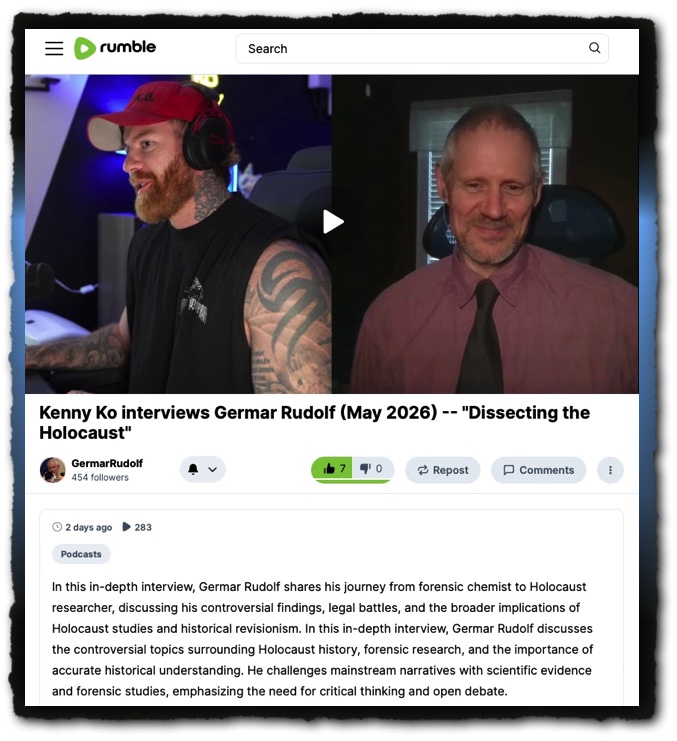
https://rumble.com/v79ggew-kenny-ko-interviews-germar-rudolf-may-2026-dissecting-the-holocaust.html?e9s=src_v1_upp_a
https://rumble.com/user/GermarRudolf?e9s=src_v1_cbl
https://holocausthandbooks.com
https://holocaustencyclopedia.com
https://holocaustacademy.com
https://codoh.com
Published on Tue, May 5, 2026
Description
_____________
Following Transcript Quality = 5 Stars
1 Star — Poor quality with many errors, contains nonsense text 2 Stars — Low quality with many errors, some nonsense text. 3 Stars — Medium quality with some errors. 4 Stars — Good quality with only a few errors. 5 Stars — High quality with few to no errors.
NOTE: Readers can help improve the quality of this transcript by putting corrections in the Comment/Leave a Reply section. Don’t be just a consumer, contribute to the cause, however small. Thanks.
TRANSCRIPT
(Words: 18,797 – Duration: 101 mins)
Kenny Ko: What is up, guys? Welcome back to Kenny Cancelled. I have a very special guest today. It is Germar Rudolf, who many of you may know, and many of you may yet to know, but I’m sure you will be happy to hear his story for a like-minded cause. Germar, thank you once again for taking the time to join the podcast and chat with me. I’ve been looking forward to this just because I’ve wanted to pick your brains on some of the stuff that I believe happened during the “Holocaust” and other certain events throughout history.
I’ll allow you to take the mic, introduce yourself for maybe the people who don’t know much about you as of yet.
Germar Rudolf: Yeah, well, thank you first of all for having me. A little bit about my background. I’m a German citizen. I grew up in West Germany. I had a kind of normal lower middle-class upbringing and ended up going to university studying chemistry, graduated from Bonn University, then moved on for postgrad studies for a PhD, got a position at a Max Planck Institute for Solid State Research to work on a PhD there.
And while I was doing that research, I became curious and interested in applying my knowledge as a forensic chemist, which I had developed during my graduate studies, to a field that is a little bit exotic—that is to say, history. I stumbled over an expert report that had been submitted in 1988 during a Canadian trial against a German immigrant who had been quote, unquote, “denying the Holocaust”. That expert report was written by the—back then—the only existing expert in execution technologies in the United States. Since we have the death penalty here in several states, there need to be people who can design and equip and maintain that kind of equipment.
So he was asked in that trial to come up with his expert opinion of whether or not the homicidal gas chambers that are said to have existed at the Auschwitz and Majdanek camps could have existed. He did that and he came to the conclusion:
“No, that wouldn’t have worked!”
Caused quite a brouhaha. I learned about it a year later. At the time when I was just graduating and then doing my fledgling PhD studies. I dipped my feet into that field and tried to find out a little bit more because I got a copy of that expert report from Fred Leuchter, from that American expert, and I was not satisfied. It didn’t live up to my expectations and I wanted to do a better job. And then I found actually a legal team who would finance that. So I got expenses paid—didn’t get anything paid but reimbursement for my expenses.
But that was good enough for me. I was personally curious about what was going on. And I eventually submitted an expert report that was introduced—or, I should say, the defense lawyers in seven or eight defense cases in Germany, Switzerland, Austria, more so than Germany actually—tried to introduce it. The courts turned it down in these cases. German courts don’t accept any evidence that challenges the mainstream narrative.
But anyway, that was my introduction into the topic. My conclusions basically were: Leuchter had it basically right, even though he jumped a little bit to conclusions that were not well founded. But I managed to do a lot of research and back it up.
And while this all was going on—doing my PhD studies, doing this forensic work, investigations and appearing in court as an expert witness who was always turned down—I realized, well, Auschwitz, the question of whether or not there were homicidal gas chambers and whether forensic chemistry can elucidate any of the questions of whether it happened or not and if there are any traces, is only a very minor aspect of the Holocaust, which is a big issue. It’s three years, a whole continent, hundreds if not thousands of crime locations. And what can you deduct from thinking to have resolved one tiny issue about one alleged murder location in this context?
So I figured the area is bigger. I want to know more. I want to wrap my head around everything. And I was reaching out to other people. I was planning on doing an anthology, a collection of—I think it was initially—15 contributions by various authors from all over the world who were looking into other aspects of the Holocaust. And we eventually published that book. While that was being prepared, German authorities also…
Kenny Ko: Sorry to interrupt, just for the people that are watching, what was the name of the book?
[04:12]
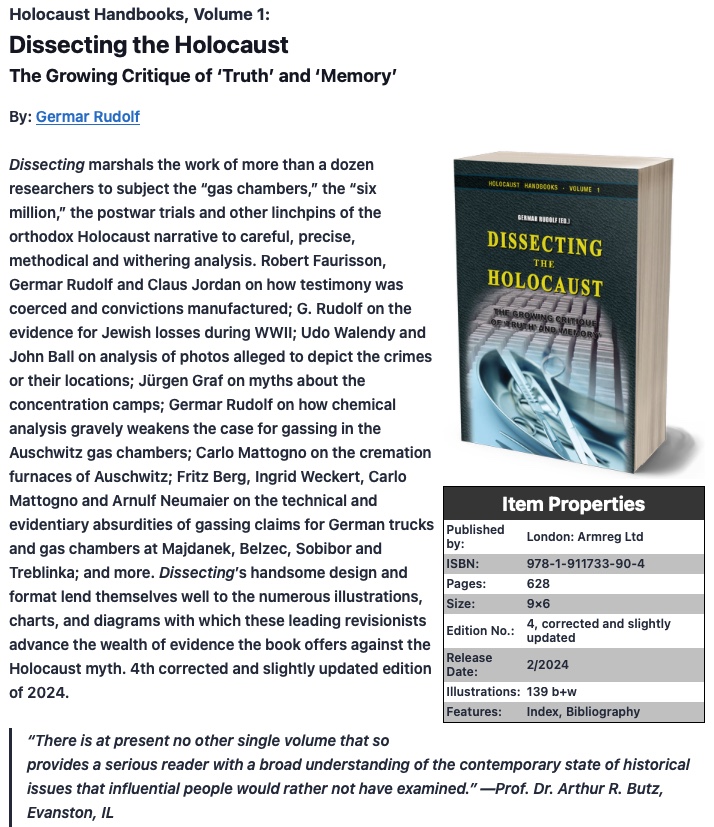
Germar Rudolf: Well, it appeared in an English translation in 2,000 for the first time. And it’s called Dissecting the Holocaust. Now all the books and the research that I have pursued and published ever since, over the past 35 years, can all be accessed free of charge as ebooks on the website called Holocausthandbooks.com. So if anyone’s interested in actually following up and finding out what this is all about, you can go there and find it out.
So that was volume one of the Holocaust Handbooks, Dissecting the Holocaust. This anthology has more contributions now. The updated last edition is just two years old, I think. And volume two of it was actually— is now—an updated, expanded edition of my original forensic research into the question of whether or not there were homicidal gas chambers at Auschwitz. That’s volume two.
And as I mentioned, there are now 54 volumes, plus we have a range of documentaries and some other, more summary books—they’re called Holocaust Pocketbooks. All of this stuff is available free of charge on HolocaustHandbooks.com. You’ll find links there where you can also purchase hard copies which are not free of charge, of course; they cost to produce and mail.
So the authorities were going after me. I had by 1990, I think, five court cases pending, five criminal investigations pending, in addition to my original trial for my forensic research. As I mentioned, introducing that evidence gets impossible in German court cases.
And then they went a step further, actually putting me on trial for it, for my forensic research, and denied me then the right to defend myself by proving that I’m correct. Because that is “contesting the mainstream narrative” again; you’re not allowed to commit that crime in a courtroom, so you’re not allowed to defend your views. They actually later turned it into an actual crime to even file a motion to introduce evidence proving that my dissenting views—or anyone’s dissenting views for that matter—are correct, declared that a crime, and they would prosecute defendants or primarily defense lawyers who would file such motions, and convicted them.
So defense in Germany in these cases is illegal! It’s kind of absurd—a Kafkaesque situation. I had to go through this in my own trial. Eventually I decided I’m not putting up with this. I was sentenced to 14 months for my forensic research, but I didn’t have to serve time immediately because the appeal was pending. And when more and more criminal investigations were filed by the prosecutors for the various books and journal articles that I was working on, I had published, I decided to leave.
So I went into exile and in 1996 lived in England for three years, until a journalist there published a hit piece on me demanding that I be extradited to Germany. And then British Parliament even had a session where I was discussed. And so the situation got tricky there.
I had used the three years in England to expand my publishing activities. At that point I was a little bit hemmed in, couldn’t do active research anymore because I was kind of living under an assumed identity and couldn’t travel. But I was giving other researchers a platform; they could submit stuff to me, I would publish it online and in print, initially only in the German language.
But then I slowly started to get into doing stuff in English, which of course—if something in this modern world, with the lingua franca being English, does not exist in English—it basically doesn’t exist at all! You have to do stuff in English for it to be recognized and noticed by the world. Now my English initially when I came to England was pretty bad. But the three years helped me to get up to speed. And when things were heating up in England, I decided to leave. In late 1999 I came to this country and after a while applied for political asylum here.
Now I expanded then in this country to do what I had done before only in German, also in English, which down the road ended up with these 54 volumes plus all the other stuff.
However, there was a little bit of a bump in the road because America has waged two wars against Germany to make them do what they do—suppress historical dissent. So they were not willing to give me political asylum, even though the immigration judge who reviewed my case said multiple times during the hearing that:
“This is the best documented asylum case he’s ever seen!”
But the immigration judge is not a judge in the legal sense. He’s actually an employee of, back then, the State Department, and later it was the Department of Homeland Security. And he has to follow orders given by the administration, and they said:
“Deport him!”
And eventually that’s what happened. By that time, however, I had married a US citizen. The marriage had been recognized and I had been granted an immigrant visa. I had the documents that:
“Your immigrant visa for a Green Card is granted.”
And at that moment—when that certificate, this confirmation, was issued—I was arrested and deported. So just before getting to the counter to get my actual Green Card, they arrested me and deported me back to Germany.
Now Germany had an axe to grind because by that time I had published a further 20 books in the German language. And they had an arrest warrant out not only for the 14 months that I had to spend from before, but also for the 21 books that I had published and been selling in the time ever since I had left Germany.
Kenny Ko: So my question, and I’m sure the audience too, what’s the crime that they charged you with?
Germar Rudolf: Incitement to hate.
Kenny Ko: Exposing the truth?
[09:40]
Germar Rudolf: No, the crimes—they didn’t invent these new laws. They had been on the books, similar laws, ever since Frederick the Great! Believe it or not, Frederick the Great had a massive immigration policy because after the Thirty Years’ War, Prussia/Brandenburg was devastated and was depopulated to a large degree. And he wanted French Huguenots and Protestants who were persecuted in France to come to Prussia. So he invited them by the tens and hundreds of thousands. I don’t know the exact figures, but the Prussian subjects of Frederick the Great were not happy about this massive influx of immigrants from a different culture. So no different situation than today—people being not happy about mass immigration. And there was a lot of polemics going on. Frederick the Great issued a law: You can’t stir up the people against minorities—particularly non-German, non-Prussian minorities back then.
So that law has developed over time. It became part of Germany in 1871, when Prussia kind of merged into Germany and Germany took over the Prussian laws more or less. And that’s been on the books ever since. As a matter of fact, in 1936, I think, under National Socialism, a German Catholic priest by the name of Rupert Mayer was indicted by the Third Reich judiciary for inciting the masses and stirring up the masses, because he was preaching in his church against National Socialist policies. He was sent to a concentration camp for a few months. So he was kind of persecuted for the same—and prosecuted for the same—offense that I have been prosecuted for.
The group that is protected by this law depends on whatever the zeitgeist demands as a specially protected group. Under Frederick the Great, it was the French immigrants; under the National Socialists, it was the government and the National Socialists that wanted special protection. And nowadays it’s immigrants and jews and Zionists that have this special protection. So it’s a vaster, or more numerous, group of special interest groups that have special protection nowadays.
So that was stirring up the people—inciting to hatred—back then. They still have “inciting to racial hatred.” They have taken that term out because “races” don’t exist, as you know. It’s politically incorrect to assume that.
And then also “disparaging the commemoration of the dead” and “insults.” Insult is on still-living jewish witnesses—insult them by insinuating that they could not have told the truth! And disparaging the commemoration of the dead is just all the victims that died—you deny that they even existed as victims, and so on. So there are four laws I was actually tried under back then. They did not yet have a special law for, quote-unquote, “denying the Holocaust”. They introduced that in 1994, kind of as a result also of my activities that unfolded back in the years, and all the rest of it.
Anyway, I ended up being deported to Germany, put on trial there, got another 30 months for only two of the nine books I was indicted for. Twenty-one were in the arrest, 19 were in the indictment. And for two of them I got convicted to 30 months. Had it been 21, that could have gotten nasty. If you get one year or so for each one of them, you do the math. Because eventually I got 50 months for the two books—the two publications—they booked me for eventually.
So 44 months later, I was out. And the US authorities said—they eventually denied my political asylum. The case had still not been resolved by the time I was deported. So I was whisked away, not only in violation because I was rightfully married to a US citizen. And US law says you can adjust status if you have a clean record.
And what I was convicted for in Germany was not recognized as a crime here in the United States. It’s First Amendment stuff. So from the US perspective, I had a clean record, should have been allowed to adjust status to permanent legal residence, but they deported me. Plus, it’s a violation of the Fifth Amendment, the right of anyone physically present in the United States to have due process.
Now, if in the middle of a hearing and procedure in front of a federal court, you arrest a defendant and throw him out of the country— which is exactly the reason why the case is pending; you want to prevent being deported—that’s the whole reason of the case, whether it’s political asylum or just withholding from deportation. Both of these cases we had filed for. Deporting me in the middle of it is a violation of the Fifth Amendment. Supreme Court didn’t take the case. That’s the way how they prevent not adjudicating a case that is unpleasant to them.
So I was back in Germany and then had to fight my way back to get my immigrant visa, even though I had already been granted it; it wasn’t issued physically yet. And then I was outside of the country already, so I needed one to be able to get back. The US authorities weren’t adjudicating the application. They just said:
“It’s too complicated. We can’t decide whether we’ll ever be able to adjudicate it.”
In other words, they were stonewalling. I had to litigate against them, force them to a decision. Fortunately, I got a judge in the Chicago federal court who kind of sided with me. For once, something went my way. He is an immigrant judge from Syria. No, I think from Syria. Not quite sure. Anyway, from the Middle East. So he evidently saw through what’s going on here, and he rubber-stamped every motion that we filed in kind of lightning speed. For legal considerations, federal courts take months for things to be decided, but he was taking days.
And then in August, 2011, after two years of waiting and litigating after having gotten out of prison in Germany, I was back in the United States. So I’ve been in the country ever since. The Germans keep doing what they’re doing, issuing arrest warrants or Europe-wide arrest warrants. And they stopped issuing me a passport because they want to catch me, but I don’t need a passport.
So I have no intention of leaving the country.
[15:21]
Kenny Ko: I was going to say, do you ever plan on leaving the United States now?
Germar Rudolf: No, I can’t. I have no passport. I’ve tried to adjust to become a citizen. But no matter what your background is, you have no right to become a US citizen. That’s a discretionary act of the people of the United States, represented by the government. And I applied for it, but they were stonewalling that case too, not adjudicating it.
And then eventually a cop framed me for something that didn’t happen. Early in the morning—talking about fitness—I was doing triathlons early in the morning for four years. Some neighbor in the neighborhood didn’t like that I was working out in the park there, doing calisthenics, and going in the river to swim, and ride a bicycle.
Kenny Ko: Were they jewish?
Germar Rudolf: No, it’s just—I don’t know the neighbor. It’s just a riverfront property. And he went to work every morning and he saw me once in a while, and he was calling the cops for years! Cops were checking on me for years! I didn’t realize what was going on really, but I couldn’t do anything. They got pissed. They got called for years and years—six years or so—every other morning in the summertime when this guy saw me. He wasn’t happy about me working out in the park area there.
Kenny Ko: Wait, why did he dislike you so much, or what was his issue? Did he know your work or something?
Germar Rudolf: No, no, I don’t know.
Kenny Ko: Interesting!
Germar Rudolf: I have never contacted the guy. I don’t know anything. I know from a cop that eventually talked to me about this, that there is, they say:
“A man in the neighborhood, he calls anonymously.”
Nobody can call the police anonymously! So that was just a claim made up in order not to have to reveal to me who that is because they think some people may take revenge for the perpetrator. I know where he lives. I know his daily routine because I was there for 10 years, every morning from April to September/October, and I know his daily routine—what time he gets up, where his bedroom is, what he does next, when he goes to the kitchen, does his breakfast, and which TV channels he watches, until he gets in his car and leaves for work. That’s the routine. I’ve been there for 10 years. I know the routine of that neighborhood.
Anyway, the cops realized they can’t get the guy to stop complaining and they can’t do anything against me because it’s legal to be there! That’s a famous fishing, motor-boat, recreational area.
And so the guy just said he was going to make up a claim that I was doing indecent exposure there, which wasn’t true. But you have only a cop and yourself at four o’clock, at a dark, vacated park, nobody there. And the guy makes up a story and then he contradicts himself. That’s interesting. Because in the preliminary hearing he makes up a completely wild story. And I couldn’t believe it, what he was telling. And then by the time the trial came, the prosecution had realized that the case was physically impossible. The claims he made couldn’t have been. It was not visible what he was claiming. It was just physically impossible. So they completely changed the story.
And if you have that situation that a witness—and that’s only one witness—completely changes the story, that’s automatic proof of perjury.
So I have that actually published, both transcripts, and everyone can look at it. You see that a cop’s committing perjury on the behest and on instruction, I would assume, of the prosecution. Because the prosecutor doing the trial showed a photo of the scene, taken from the place where the cop said he saw things. And you could see the things he described in the preliminary time were impossible. The prosecutor must have realized that. And then they told the cop that and he changed his story.
I requested after that from three law firms, three lawyers: :
“What do we do about it? I want to file a criminal complaint against the cop for perjury.”
And the answer is:
“They framed you the first time—if you are right that they framed you—and the prosecutor actually was the one working with the cop to get that accomplished. Your criminal complaint against the cop for perjury would come on the desk of the very prosecutor that has framed you in the first place. What do you think is going to happen? You get a second framing so fast you can’t blink an eye! And if you have two of these cases hanging, as an immigrant, you get deported from this country automatically!”
And that’s what’s going on. So my attempt to get citizenship was stonewalled. They weren’t deciding it, but the moment I was convicted and the conviction was upheld in the appeal—which was kind of absurd too—they instantly denied my citizenship application because I have a criminal record. Now you see what’s going on. And the appeal, the argument was:
“Wait a minute. If a guy with a searchlight goes in a park at night, completely black, and looks around and then happens to find a person with pants down, as he claims, what do you call a person who’s doing that?”
Kenny Ko: A streaker, I guess, or flasher.
Germar Rudolf: Peeping Tom!
Kenny Ko: Yeah.
[20:03]
Germar Rudolf: Yeah. So if you give that guy a police badge, what do you call that? Still a peeping Tom!
So the argument wasn’t made that way. But basically, a crime of indecent exposure requires that somebody has been indecently exposed to someone of the public. A police officer who is going around with searchlights is not a person of the public. It doesn’t count. So therefore, the crime has not been committed, because as we all know, it was completely dark and it was vacated. Even if it were true—which it isn’t—but if it were true that I was there with my pants down, it cannot have been a crime because nobody was around. And the Appeals Court said:
“Well, it doesn’t matter. From now on, we say anyone who has the pants down anywhere in public, whether anyone is around or not, commits indecent exposure.”
Which means that every person in the world that ever lived has committed indecent exposure! If you were ever in nature and had a pee or did your business—which happens to us sometimes—it’s automatic indecent exposure.
Kenny Ko: They might be looking for me. I probably have over 50 charges against me here!
Germar Rudolf: Right! So legal professionals after that appeal decision said:
“This is impossible! This is completely untenable case law you’ve created here. Now, everyone has committed indecent exposure. Indecent exposure requires the intentional act to expose your genitals to someone in public who does not consent!”
If you’re in a nudist area, that’s not, because you have consent there, right? But if it’s not in a nudist area, you don’t get consent, then that’s a crime. But if there’s no one around, there’s no exposure. So later they actually reverted that by simply ignoring the case law. And every case that’s been adjudicated in Pennsylvania ever since still goes after the old law because the new case law is complete bullshit! But it shows you what was going on—trying to prevent me from getting citizenship, to have something, and to go to extreme lengths, to ridiculous lengths!
And I suspect that they got to my defense lawyer, because my defense lawyer threw me under the bus. I had all the evidence showing that this thing cannot happen. And of course we had him nailed when he contradicted himself—perjury. And my defense lawyer refused to defend me, refused to introduce any evidence.
So this is the curious thing about America. You have the First Amendment when you are outside the courtroom, you can speak your mind. If you’re inside the courtroom in a penal case and you’re the defendant, you don’t have First Amendment rights. You depend—you can speak out only if you go—if you’re defended by a lawyer, of course—you can speak about the case only if you go into the witness stand and then you can only answer to specific questions that you are asked. My defense lawyer, I had given him 10 questions I wanted him to ask me, and then develop the case and introduce all the evidence. And then I get into the witness stand and he doesn’t ask any of the questions! Only one:
“What did happen that morning?”
Which was complete bullshit because that didn’t allow me to introduce any of the evidence showing that I was working out, that I have a history of working out, and introduce images of my clothing, and so forth.
Anyway, the issue is, of course, now I don’t have citizenship and I have this criminal conviction. And the lawyers then said:
“Get the hell out of there! The best is to remove yourself from Pennsylvania—not just from this county—most certainly stay away from that county because they have you on their list there, and move!”
So that’s what I eventually did.
Kenny Ko: So where’d you move to from there?
Germar Rudolf: I’m in upstate New York now.
Kenny Ko: Okay. And you’ve been there since?
Germar Rudolf: Well, you know, it was my marriage that fell apart. That’s been in decline ever since. You know, if you have been forcibly separated for six years, that doesn’t bode well for any marriage. And my wife suffered more than I during that time of separation because it wasn’t her battle and she had to be a single mother raising our daughter all by herself. She was stressed out and not happy.
And then of course, I wouldn’t stop doing what I was doing. Coming back, slowly getting my feet back into things—that is not conducive to marital bliss. Plus, which I found later, the family and friends evidently were undermining the marriage from behind the scenes, unbeknownst to me, to one degree or another. So that wasn’t a good situation.
Anyway, eventually, when all this unraveled, I left and lived with friends first until my marriage issues were resolved—getting through divorce and splitting up assets and so forth. Until you know what you have, you don’t want to make any moves. So when that was settled, I could actually get my own life back. And that happened a couple of years ago.
Now I’ve used that time well. Fifty-four volumes of hard-hitting research accessible at HolocaustHandbooks.com, unparalleled in the world when it comes to the depth and the scale and scope. For instance, if we look at Auschwitz, which is the most iconic crime scene of the Holocaust—whatever happened there—I mean, it was nasty even from a revisionist perspective, from a skeptical perspective: 135, 500 documented cases of deceased inmates. That’s a huge number.
[25:04]
Kenny Ko: Because I do want to pick your brain heavily on your research and what you found. One question I wanted, and I’m sure a lot of people have it: How’d you go from your PhD field—what you thought you were going to pursue—into so passionately looking into the events surrounding the Holocaust and the World War II time frame? What kind of sparked your interest, I guess, to want to navigate that?
Germar Rudolf: I had an interest in German history, just not that topic because it’s an unpleasant topic—modern German history, kind of circumnavigating the Holocaust, ever since, I would say, ever since I started studying at university, it was a kind of a private hobby. I knew about the importance of the topic when it comes to the German psyche, if you want to put it that way, because it weighs heavily on Germans, on their self-confidence as a nation, as an identity. But you kind of take it for granted. It’s cast in stone. It’s inevitable to have to deal with it. So it never crossed my mind to challenge the narrative, let’s say it that way.
But I refuse to accept that two wrongs make a right, that one evil can balance out another one. So using what happened in the past—whatever it is—as justification to commit other injustices, whether it’s against my own people and country after the Second World War or in subsequent issues that have come up more recently. Like we look at what’s going on in Gaza or the various wars that Israel is waging—that made me aware that it has relevance, political relevance; still not a way of challenging it.
But once I did stumble over arguments that I could verify—or refute, for that matter—the toxicological and forensic research that Fred Leuchter in the United States had done, I said:
“Well, I have to look into this is a question, a topic that has huge implications politically.”
Back then I thought only in German dimensions. I was kind of still in the German box. In the meantime, I’m more cosmopolitan, I see the larger picture. But it was enough for me to say:
“I want to find out!”
And the real motivator that got me going is to realize during my time as an expert witness how the system breaks all the rules it claims to defend. It claims to be at the core of its values—be it free speech, be it freedom of science, be it the rule of law. As an expert witness in court—when you are in Germany—the German procedural rules say if an expert witness is already in court, he is an expert at what he is supposed to testify for, he is able to testify, and the testimony is relevant to the case that’s being handled by the court, then he has to be heard. There’s no way of turning them down because there’s no effort for the court to get the expert—he’s already in the court—yet still they violated that law, in every one of the seven or eight cases I was summoned to testify!
And the panic that I saw in some cases in the eyes of the judges—because they knew they needed to violate the law; they are the criminals in that case. One of them ran out, called some superior—there is no superior of a judge—but evidently called probably the capital or whatever, some higher court to find out:
“Do I get backing from the higher courts if I violate the procedural rules here?”
And evidently the decision later on by the German Supreme Court:
“Yes, we’ve always done it, we will always keep doing it. That’s the way we have to do it!”
Bunch of horseshit! Excuse my English.
Kenny Ko: Hey, you can use whatever language you want. They put you through absolute hell! And first, I wanted to say too, thank you for all you have done, by the way. And also, sorry that you’ve been put through so much. But it just shows that the truth will always prevail. And we need people like you. Honestly, from the bottom of my heart, thank you for doing what you did, sacrificing what you have in order to get this information out to the masses.
[28:49]
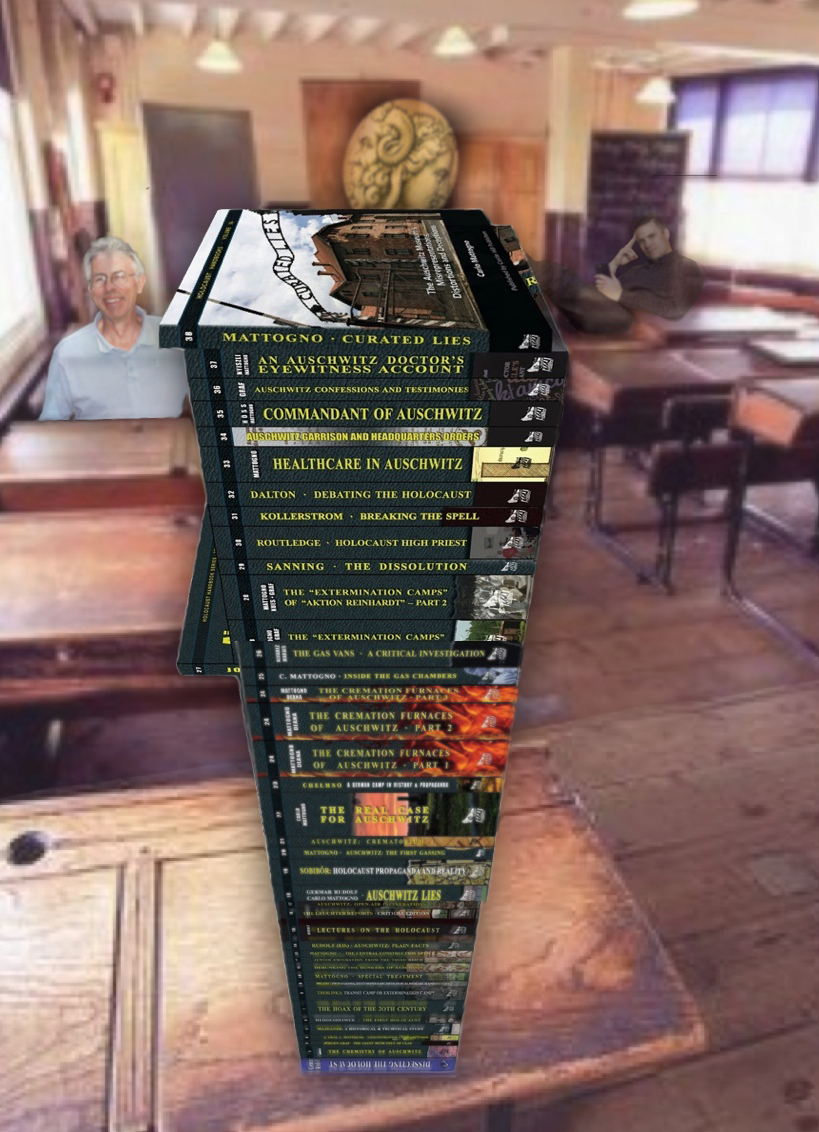
Germar Rudolf: Yeah, that is the stage I’m in right now, actually. I was getting to that. Fifty-four volumes of hard-hitting archival and forensic research—too much to wrap your head around. If you want to read it all, it takes you years and by the time you get to the end, you have already forgotten the beginning. And the same was for me.
I mean, I’ve published all this stuff in German, in English, I’ve republished it in many, many editions. So I’m the one who actually has that stuff on his fingertips and should have the best knowledge of where to find what. But I couldn’t! I was forgetting stuff. And I had a hard time finding arguments, finding evidence, finding sources. So I decided eventually we need to write an encyclopedia.
And that’s what I’ve done. After my marriage fell apart—the depression, it put me into separation from my kids, from my home—I used that time, work therapy, to sit down. Within five months, I wrote an entire encyclopedia. Normally that’s a collective work of many scholars. Now I’ve been in the unique situation of having assembled this research for 35 years, having published it in several languages and republished it over and over again! I also was in charge for many years of the periodicals that were publishing papers on it.
So I have it all on my hard drive, kind of in my head. If not I, who else could do it? And I’ve worked with one additional scholar, a Professor of the humanities who helped me. I had some experience in contributing to scholarly works like that, encyclopedias. It’s not something you do every day. I’m most certainly not writing one cover to cover.
But I know that having, say, 200 scholars contributing—each several, or one contribution, one entry—to an encyclopedia is actually a much bigger challenge to get because it’s not economically viable. You don’t make money with this. It’s an honor for a scholar to be listed as a contributor to an encyclopedia because then he’s the top of the field in this particular entry that he is writing about, and to get people actually to do it.
And then you have a problem of synchronizing things because there’s overlap between entries and cross-referencing. And if you have everyone writing their own style, writing their own opinion, they sometimes don’t even agree on things. It’s a nightmare to co-ordinate that and to get that actually to go together—to have, first of all, everyone submitting their stuff, and then coordinating, synchronizing, streamlining it. And then the ego gets in the way where nobody wants to budge and they have different points of view. It can be a nightmare!

Now if you have just one guy writing it with one supporting it was actually a much faster job. But I required these 35 years of background in the entire field. And having published—covered—the entire field. HolocaustEncyclopedia.com is freely accessible for everyone. We update it, we expand it as it is needed. You can also get hard copies there in various languages. By now we have it in German, French and Spanish on top of it. And I’m currently working—and that’s what you interrupted me with, …
Kenny Ko: Sorry about that!
Germar Rudolf: Arabic translation. No, I appreciate that because I want to get the message out. The work is there. It is completely silenced and swept under the carpet by the mainstream. Any work on the Holocaust over the past, 20 years that does not at least consider the work we have done cannot be called scholarly! Scholarly means even if you disagree with a scholar, if it’s a considerable work—and 54 volumes is a considerable amount of work—then you have to at least say:
“Well, this work is there and I disagree with this for this and this reason.”
And that’s it! If you completely ignore it and you pretend it doesn’t even exist, that means you’re a dogmatist, you’re not a scholar anymore. And that’s the situation we have in the field of Holocaust studies—have had now for the past, 20 years plus. But this is only the scholarly issue; we’re talking about suppression. I frame it in a certain way to make clear what’s going on. History at gunpoint! Writing of history at gunpoint! That’s what we have in the Western world—have had ever since. The first country to introduce a law that basically puts historians under the threat of imprisonment was Israel. Surprise! In ’85 or ’86.
Kenny Ko: I wonder why that is!
[32:53]
Germar Rudolf: Yeah, so that was coming up with the John Demjanjuk show trial that started shortly after, to make sure that nobody gets any funny ideas of challenging the show trial they were about to pull off. So in that context that has to be seen.
And then the next one was France. And by now we are up to 28 countries who formally have declared it illegal. But there are many more if you look at those who informally prosecute it. Most of the Arab countries actually throw people in prison if they dissent publicly, not because they want to, but because they are basically in the pockets of the United States and the Europeans. They are all bankrupt states, most of them, except for the really oil-rich countries. When we’re talking about Jordan and Egypt, the two examples that come to my mind, or even Lebanon—they’re in debt and they get bailed out financially by Europe and by the United States over and over again! So they are basically corrupted. They should have an interest in free discussion of the topic because it impacts their region massively these days. But they suppress it too. In South America, there are a number of countries which suppress it.
So it has come to the point that over the years many mainstream historians have gotten in touch with me—privately, of course, and some of them anonymously. They just create a Gmail account and get in touch and don’t tell who they are, but by the amount of assistance they have provided—giving us archival material that we don’t have access to because many archives now are closed to us. You have to identify yourself before you can get in. And we can’t do that; we’d get arrested. More and more archival material is being put online. So that will hopefully— we’ll see it.
Anyway, these historians give us massive amounts of information from archives that we can’t access, and therefore we know they know what they’re doing. They are professionals.
Kenny Ko: Right.
Germar Rudolf: And I hear from them the fact that they work from behind this kind of a firewall to prevent any leak who they are and that they’re helping.
But also of those who actually have contacted me, I had one of Germany’s most prolific historians, Professor Werner Maser—may not mean much to you, but he has written on modern German history and the World War II era. Many books, many of them were translated in many languages. So he was one of the leading scholars in the field from a German point of view. One of these days he called me! When I was in the United States shortly before my deportation, complaining to me about the dictator-style conditions in Germany and that historians are constantly afraid and can’t write anymore what they want to do.
And I had a number of these encounters with half a dozen mainstream historians. These are the ones who stick their neck out and risk getting in touch with me. You can figure out how many more there are who will not say anything and just toe the party line quietly or stay out of this area entirely. One of the leading Polish historians on the Auschwitz matter, Wacław Długoborski [sp], who was an Auschwitz inmate himself—he became the curator of the history department of the Auschwitz Museum after the war for many decades—said in 1998 in an interview why Polish historians from the Auschwitz Museum for decades until the collapse of the Soviet Union had spread false, exaggerated victim numbers even though they admit that they knew better:
“Why did you lie?”
He said:
“Well, we were put under pressure in the Eastern Bloc. We would have faced disciplinary measures had we not toed the party line.”
That was 1998, that he had this interview. And that was the same year Poland introduced a law making it up to three years imprisonment to challenge the current narrative. So back in the communist days they were facing disciplinary measures—which is on a professional level, administrative stuff, like you get demoted, you get removed from that position and then have to go somewhere else or whatever. But not criminal proceedings! Now we have criminal proceedings. Poland is finally Democratic—and democracy, as you know, is when two wolves and a lamb decide what’s for dinner!
So that’s the situation when it comes to this topic—democracy and dictatorship are not mutually exclusive concepts. If you’re a democracy, the majority decides to dictate to the minority what they can think and say. That’s a Democratic dictatorship! And that’s what we have in these 28 countries.
Kenny Ko: Thank you—Canada included! [clapping] By the way, a lot of people don’t understand democracy or how it operates.
[37:14]
Germar Rudolf: Yeah, if it’s not guardrailed strictly by inalienable civil rights and the right of self-determination—I throw in there for the sake of being complete—then democracy is a lynch mob! That’s just a nice way of saying lynch mob. So in a democracy, a majority should never be allowed to take away essential civil rights—human rights—from minorities, no matter what. But that’s what you see here. So be that as it may—got a little bit sidetracked with this here! Yeah, so Długoborski says:
“We acted under coercion. That’s why we lied!”
At a time when the Polish government jacked up the coercion that they are threatening.
So if they lied before, and they agreed and admitted that they have lied because of coercion, and the coercion has increased—now it’s even worse! Why would you believe them now, the story they tell now? Historians the world over when it comes to this topic all act under coercion! Usually only those people get into the field on the mainstream who are ideologically charged. You see a hyper over-representation of jews in that field—no surprise. And you see people with left-leaning ideologies. So Antifa kind of attitudes—no surprise there too. A lot of the quote, unquote, “evidence” that we have for the mainstream Holocaust narrative was produced, skewed and faked and forged and fabricated by communist Eastern Europe.
When you look at the six camps where mass extermination is said to have happened—that’s Auschwitz, Belzec, Chelmno, Majdanek, Sobibor and Treblinka—and the Einsatzgruppen mass murders, gas vans, mass murders etc., that are said to have happened behind the Soviet front. All this is on former Soviet territories. So for 40 years it was behind the Iron Curtain. And the evidence that was presented in the Nuremberg trials and in many trials thereafter was produced in those countries in those years.
Can you believe them? I wouldn’t take anything at face value that comes from these countries! Does everything have to be a lie? No, of course not. We have to discern critically, with tools of source criticizm, to figure out what is true and what is not. Forensics. There are a lot of tools that historians have— forensic historians in particular. And in the encyclopedia, with all these crime locations, claimed crime locations, they have entries in there and they go through what the documents say, what the forensic research—if any was done—says, and what forensic research should be done to clarify any issues that we still have a lot of the fields have never been researched in a way that they should have.
You probably have heard of the mass murders at Katyn and Vinnytsa. So the Soviets and the Germans divided up Poland in 1939. And the Soviets arrested some 20,000 people of the upper society of Poland that came under their control. And after a year of detention they executed them—or not even a year—in various mass graves. The Germans in ’43 found two of them and made a big fuss about it. But they did not do the forensic examination of these graves all by themselves. They actually invited experts from all over the world, from neutral countries and even from countries they had occupied, and let them do the research or at least partake in that research.
And that is the way you should do it. The Soviets after the war—already during the war—did nothing like that! They had a commission that was actually re-examining the Katyn mass graves and blamed it on the Germans with an expert report—complete fake! And the same commission, with the same people, discovered more and more mass graves of German atrocities all over Soviet Russia and claimed outrageous numbers of people killed. On the face of it, obvious exaggerations.
What should have been done is somebody go in there and do the actual Katyn, German-style, independent, international forensic examinations. For instance, it happened in Cambodia—massive atrocities, auto-genocide if you wish. They called it a politicide. The intention was not to wipe off an ethnic group—that was not the intention of the Khmer Rouge. The intention was political ideology of an extreme degree. Mass graves of up to 2 million people. So up to one third of the Cambodian population was murdered there. And they had intensive forensic efforts to exhume those mass graves and to count the victims—an absolutely atrocious job when we’re talking about well north of 1 million human beings that were eventually found. Similar thing you had with the Kosovo mass murders that are said to have happened in the Kosovo War, 1999 and thereafter.
So this is the way it should be done. It’s never been done in the context of what we are looking at here. And the longer it takes to do it, the less likely it is that things can be clarified. Who are these victims? Who has killed them? It gets more and more problematic because Soviet territory is drenched in blood. We’re talking about 1 to 2 million jews presumably killed by German execution squads in this area. We’re talking an area that has seen the Holodomor, that has seen wars with millions of victims and mass graves of war casualties and prisoners of war, the mass executions that the NKVD, the Cheka, has done in the early years—particularly of the Bolshevik Revolution and the reign of Lenin and Stalin. It’s all in those soils there.
So wherever you dig, you’ll find bones. We’re talking north of 10 million, potentially, that are not jews murdered by Germans. Who talks about them? There’s a single focus only on that! But the Soviet Union never had an interest in clarifying any of it. They didn’t want anyone to dig in their soil because what you would find most likely is victims of Lenin and Stalin and so forth, rather than jewish victims of German units. And after the collapse of the Soviet Union, nothing changed really. There were a few attempts of Western scholars to excavate mass graves in Ukraine, which has a more neutral stance now since it’s independent. They have an interest in documenting Soviet atrocities—any kind of atrocities.
However, those research efforts into claimed German massacres of jewish civilians were again not done forensically. They were done with the background of public attention and commemoration culture. Locate a mass grave—don’t disturb it. It’s kind of the pressure from jewish groups. A jewish grave is not supposed to be disturbed. That’s against certain interpretations of jewish law. That doesn’t hold up in other crime cases.
But in that case they are adamant. Don’t rock the boat—meaning don’t investigate who these people are and how many there are and how they died. Just find the mass grave and put a memorial on top of it, and that’s the end of it. And so that’s kind of what happened, which is unfortunate.
Massacres did happen. There’s plenty of documentation and some good forensic evidence in a few cases where this can be found, and anything else would be a surprise. As I just mentioned, the Bolshevik Revolution, the predominance of people with jewish background in the early leadership of the Soviet Union and the early leading figures of the Cheka and the NKVD is well documented.
Kenny Ko: Also in America why do you think there’s such a heavy focus on the Holocaust and not the Holodomor, or the Bolshevik Revolution? Like why is it such a matter of the emphasis on one?
[44:43]
Germar Rudolf: Two reasons. First of all, you have of course mightily influential pressure groups. As you know, the Cambodians have a massive pressure group that can impose a memory/commemoration culture of the Cambodian genocide in this country? No, they don’t! The Ukrainians have somewhat of an immigrant group. They don’t have political clout.
Jews most certainly in this country have a lot of political clout, to put it mildly. And that’s the entry to imposing that kind of commemorative culture upon a host nation that has originally nothing to do with it. The United States has neither contributed nor assisted, nor was it in any way the victim of anything that concerns the Holocaust.
So why is it here?
Kenny Ko: And also why is there Holocaust museums in the United States?
Germar Rudolf: The other issue is, of course, you need to have a justification for the suffering of the sick. This has been portrayed in general as the “Good War”. The painting of a black-and-white image of absolute evil against absolute good. The Democratic countries fighting absolute evil in the shape of Adolf Hitler and his cronies. This is a narrative that finds its ultimate confirmation in the Holocaust. Even though the Second World War—when it broke out—there was no Holocaust going on. When it was escalating in 1940, there was still no Holocaust going on. When it was then completely getting off the rails with the invasion of the USSR, there was still no Holocaust going on! It is supposed to have started then, within the first half-year or first year of the war against the Soviet Union, step by step on various levels.
So the Second World War in itself—its initiation and its expansion and becoming global—had nothing to do with the Holocaust at all!
But it’s a convenient tool for people to say:
“Yeah, we fought absolute evil!”
In hindsight more than back then. And my reaction to that usually is, I’m not defending a dictatorship that tramples human rights into the dust. And that was National Socialist Germany. As I just mentioned a Catholic priest was sent for a few months to a concentration camp in the Third Reich for speaking out against oppressive policies.
Had I been alive and kicking in those years with my attitude to stand up against injustice, I may have ended up in a concentration camp as well. I don’t want to have a government of the Third Reich style when it comes to their disregard for the rule of law and for human rights.
But on the other hand, any government that allies itself with Stalin cannot claim to fight a good war! The Second World War breaks out in 1939 by Stalin and Hitler both dividing up Poland. So they are both evil at that point and have started the whole mess.
Hitler at that point, when you look at the Third Reich death toll of civilians who had become a victim of the regime, you can amount it to roughly a thousand people—people dying in concentration camps, not too many, but already some dying there who probably wouldn’t have died otherwise. You have the November of ’38 pogrom against jews where roughly 100 jews died. And you had the internal strife of the Röhm Putsch in ’34 where several dozen people were killed.
So we’re talking about a thousand people roughly that were victims of that regime. Not necessarily murder all of them, but some of them most definitely, or just gross negligence and so forth.
At the same time you have the Stalinist regime, which at that point—we can discuss whether it was 5 million, 10 million or 20 million by the time the Second World War broke out—but we are talking about four or five orders of magnitude more victims on the account of Stalin than Hitler!
So why would you pick the side of Stalin? I’m not saying you should have picked the side of Hitler. You should have stayed out of it altogether! If you have an interest—you consider both evil, okay? Make sure that they are well balanced and they start fighting each other and grind each other down and destroy each other. And at the end that both of them are kaput! That would have been a good strategy. Then you wouldn’t have to deal with the mess that we had for the entire Cold War.
And now with the conflict with Ukraine and all the rest of it—if Russia had been just as exhausted as Germany would have been and then brought to the point where it collapses internally and becomes reasonable; or Germany collapsed and became reasonable to some degree.
So anyway, with all this said, during the 1920s in Europe, German jewish organizations were ringing the alarm bell. In the ’20s, Germany itself was kind of unstable. There were a lot of attempts by Left-wing radical groups and communists to destabilize the country and have a revolution of the Soviet style. While at the same time in Europe they were observing very closely—and particularly in Germany—what was going on in the Soviet Union with the massacres happening, the Holodomor being one, but in general, the absolute atrocities on an order of magnitude that was unimaginable in the history of mankind. And seeing in the early 1920s that a lot of it is done by people with a predominantly jewish background. And people were seeing that. So jewish groups in Germany were saying:
“Well, this is bad—what’s going on there. The massacres in the millions—and it’s going to get blamed on jews! So the revolution that Trotsky and the Bronsteins are implementing now is going to end up with a backlash of massive retaliation. And during that coming Holocaust, the Goldsteins and the Goldbergs are going to suffer.”
So that was a prediction, I think in 1925 or something, by a German jewish organization. And it was kind of a prophecy. Eventual collision between Nazi Germany and Soviet Russia was a counter-revolutionary war against the initially predominantly jewish-Bolshevik Revolution. Now, by the time Stalin was in power and the Second World War broke out, Stalin had kind of cleansed his own ranks from predominantly jewish people.
When you look at the internally recorded ethnic consistency of the NKVD back then, you see that from ’34,’35 onward, the percentage in the higher echelons of that organization went down when it comes to jews—from 40% that they were at that time down to only, I think, 4% within a few years. You see an anti-Jewish cleansing of the entire political apparatus that Stalin put in place.
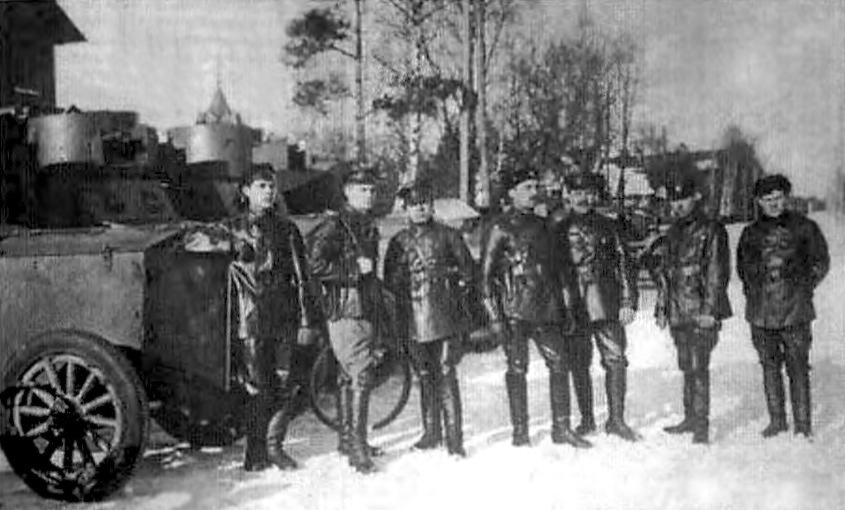
[Image: the mostly jewish CHEKA secret police]
Now of course Germany—Third Reich Germany—didn’t know that; it’s something that came out later. But in the view of Third Reich Germany, that was the embodiment of evil—looking at the millions of people massacred, impersonated by people with jewish background on purpose. Because these people were, in the classic sense, not jews anymore in a religious sense, but they had that background. So massacres were inevitable. They started already when the German army went into Russia. The Soviets, were retreating massively! And they— the local population, particularly in Ukraine—had suffered so much. They were the main battlefield of the Bolshevik Revolution.
See: The Other Holocaust — the Terror Famine in Ukraine
And then you had the Holodomor—the attempt of the Russians to break Ukrainian will of independence. What’s going on right now was nothing new. They have been through that for the past hundred years. They’ve been through it repeatedly. So the poor Ukrainians, they get it over and over and over again in history.
So by that time the Germans move in, the Ukrainians take matters in their own hands. They have massive pogroms directed against officials and against anything jewish. I know from personal account of Otto Strema [sp]. He used to be a major general in the Third Reich and he went into Russia in 1941 himself—that he stopped pogroms. So certain German units were turning a blind eye to it. Some units were encouraging it, others were stopping it, depending on the mood of the command or whatever was going on. But it was going on. And then Ukrainians collaborated in a large degree with whatever suppression and possibly massacres happened afterwards.
That was the backlash of 20 years of Bolshevik massacres that killed north of 10 million, mostly Christians, in Russia! If you see that in the context of the greater historical picture, it’s not a justification. As I mentioned initially, two wrongs don’t make a right. That goes on so many levels.
So whatever wrong the Bolsheviks had done is no justification for massacring every jew in sight. And many jews who lived in Russia had nothing to do with the Bolshevik massacres. But it makes things understandable.
And ultimately, why do we do history? Because we want to understand, we want to learn the Right, the correct lesson. And if you don’t get the story straight, you’re not going to learn the correct lesson. It’s an ever-escalating sequence of massacres, one justified by the other. And we need to see that, see that we all have blood on our hands when it comes to identifiable groups. That’s one with me. We—I don’t mean individually—but Germans have done bad things. Americans—the carpet bombing and throwing nuclear bombs on Japan—there were war crimes, there were atrocities, there were massacres. So destroying basically all of Central Europe and all of Japan.
So you need to understand that we need to find a way out of the circle of violence, to learn the correct lesson here. And it is sure not the correct lesson to learn from the Holocaust to teach jews now, already from the cradle—I’m exaggerating, but I think in 2014 they introduced a law in Israel that Holocaust education is now ready to start in elementary school. Elementary school kids in every country in the world— to any, not just elementary—but it is illegal to expose any children to chainsaw massacres and other fiction horror movies for good reason. It should be just as illegal to expose them to gas chamber massacre movies like Schindler’s List or whatever, which is shown to them at an age when they’re heavily impressionable.
Kenny Ko: Right.
Germar Rudolf: Because it is even more traumatizing if you show them a chainsaw massacre:
“Oh, that’s just fiction, it’s just made up!”
But it’s bad enough. And I have an adopted son who has been exposed to that prior to his placement—his biological parents had shown him these things. And I know what effect it can have. It should be illegal.
And if you tell them:
“Oh, this really happened—something like that—and it can happen again and it can happen to you, and the same people who did that are still around and they’re in your back. Yesteryear there were the Germans. Yesteryear there were the Ukrainians; right now they are the Palestinians in Gaza or the Persians in Iran!”
And that justifies then the next massacre. So if teaching about historical massacres is used to justify or gloss over the next massacre, we learn the completely wrong lesson! And that’s what this country, with its support of whatever Israel does! And in particular, jews and Israel, Zionists in the vast majority have been learning because of what we experienced, presumably because it was so unprecedented:
“It was without logic, without rhyme and reason, without any historical nexus whatsoever! We have to be aware it can happen anytime and therefore pre-emptively we need to lash out at someone as soon as someone looks askance—under every rock a goy can hide who may want to stuff you into the gas chamber—be aware of it jew! So if anyone ever makes the wrong move, kill them pre-emptively!”
“Rise and Kill” is actually a book that was written in this context. And that’s what we see in Gaza. And that’s what we hopefully will not see now in South Lebanon. Detraumatizing jews, but also detraumatizing Germans. They have had a similar lesson to learn that leads them to genocide-suicidal tendencies of wanting to give up because they are so evil, historically speaking, that the best they can do is just disappear. So with broken self-confidence they need detraumatizing, but jews need detraumatizing. If you have a heavy trauma as an individual—and the same applies for ethnic or religious communities, whichever way you want to frame it—you need to understand where the trauma is coming from. But then you need to prevent yourself from being constantly exposed to the same triggers. Overcoming trauma—and I had my own trauma: If you’re torn from your family twice and your family’s been destroyed twice and you’re thrown into prison for scientific research you have done—it is traumatizing.
And sometimes when people ask me, tell me a little bit more about the story, sometimes I say no. The jewish attitude of “always remember”, and I translate that as “wallowing in your own suffering of the past as an ethnic group” is exactly the wrong way. You can’t overcome trauma if you wallow in it all the time. You need to move forward. The rock climbers say, don’t look backward.
And I couldn’t lead a normal life. You know, I know the US authorities—there are strong groups in this country who want to have me deported again, frame me again, or even in this administration, they just arrest anyone they don’t like and deport them even if they have green cards. They have tried that—they could come after me. So I’m constantly in an ejector seat and I have lived that way over the past 35 years and I can’t be constantly reminded of that. I’m trying to have some normalcy. If you’re in this situation, normalcy is what keeps you sane.
And if you constantly wallow in it just destroys you! And turns you into a psychopath or at least a sociopath. And that’s what we see with the approval ratings among average Israelis about what’s going on in Gaza.
In fact, fully aware that massacres happen on the magnitude that they are happening, that genocide is being committed on the scale as it is described in the Book of Joshua, of the conquest of the Holy Land, where God has ordered the jews to kill everyone in the Holy Land and take the land. That’s kind of what they are reenacting and get the consent of the majority!
What kind of mental conditioning must these people have gone through to get to the point to have no empathy whatsoever and to have these attitudes? And the answer to this is Holocaust indoctrination from childhood!
Kenny Ko: That’s a great point!
[58:36]
Germar Rudolf: So it needs to stop. And it is, I think, good news for jews to realize the nightmare they’re living under that turns them into these sociopath/psychopaths almost as a nation or as an ethnic or religious group—whichever way you want to frame it. The nightmare of this uniqueness, the icon of which is the gas chamber, is a nightmare! You need to wake up! Yeah, jews were targeted during the Second World War. And it has a historical reason—it was not justified, but there is reason behind it, but not to the extent and with the means that you think there’s one picture that I show sometimes to people of a group of jews from Israel that have been taken on a tour to Poland—because tours, traumatizing tours of jews into former German concentration camps or the former so-called “extermination camps” on Polish territory are organized regularly. They go there to, … It fulfills the same role as in the past the rabbis had with ghetto jews in shtetel * in Eastern Europe—to make them afraid of the Gentiles outside the ghetto, so that they would stay in the ghetto and would stay together as a herd. And these kinds of traumatization serve the same purpose.
[* Shtetl or shtetel is a Yiddish term for small towns with predominantly Ashkenazi Jewish populations which existed in Eastern Europe before the Holocaust. The term is used in the context of pre-Second World War European Jewish societies as communities within the surrounding non-Jewish populace, and thus bears certain connotations of discrimination. Shtetls were mainly found in the areas that constituted the 19th-century Pale of Settlement in the Russian Empire, as well as in Congress Poland, Austrian Galicia and Bukovina, the Kingdom of Romania and the Kingdom of Hungary-Source: Wikipedia]
And beyond that, leads to these sociopathic tendencies. They go into a gas chamber at the Majdanek camp, or what is depicted to them as a gas chamber—was until several years ago. And they reenact a gassing scene. How traumatizing that must be for young people after all the indoctrination they had already! Now it turns out the Majdanek Museum later says:
“Oh, okay, we lied. That wasn’t a gas chamber. That was one of these things that we had to drop.”
In 2005 they made that major revision. Over the years dropped the claimed death toll from 2 million down to only 78,000—not even 4%—and scrapped seven of the originally claimed homicidal gas chambers.
So a lot of the enactment that jews had done was completely done in places that were fumigation chambers—closed disinfestation chambers—no homicidal gas chambers at all!
Now we skeptics knew that a long time ago and published that. It’s good news—it didn’t happen! And the two remaining gas chambers that they claim—it didn’t happen either. Yeah, massacres happened; happened all over the war. The jews weren’t the only victims. If they get themselves into the line of massacres and genocides that have happened during and after the Second World War—get down from your attitude of being unique! Unique victims feel uniquely entitled not only for recognition, but also for blank checks, …
Kenny Ko: For reparations.
Germar Rudolf: For lashing out, for repression, for pre-emptive lashing out against whoever is in their way. And this is bad! They need to stop! And the way of doing it is realizing the story has been blown out of proportion and is used to traumatize you need to downgrade it to the real size, which is still bad enough, but not extraordinary. And it just is one link in the chain of human atrocities and catastrophes that have happened. The good news, …
Kenny Ko: Based on your findings of doing the forensic research, for instance at Auschwitz, and of course I know I’ve looked into the Treblinka forensic studies of ’99 from Australian researchers—do you believe that gas chambers were actually used to exterminate the jews in any regard?
[1:01:49]
Germar Rudolf: No! Gas chambers, … I have actually written a book that you can find as an ebook on HolocaustHandbooks.com. It’s titled Nazi Gas Chambers: The Roots of the Story. After doing 35 years of research on several levels and writing the Encyclopedia, finally when I wrote it, I had to get an overview and had to connect all the pieces and interconnect everything so that it all fits together. And I started to connect dots that I hadn’t seen before and started to realize who has created that story. After the war primarily jewish witnesses—or witnesses with jewish background, I should say—testified and attested to the existence and use of homicidal gas chambers. Which is no surprise because they were the primary targets for persecution of the National Socialist regime and therefore would of course make up the main body of the witnesses.
However, if you look at the claims they made, they were completely disorganized, contradictory. You can say it’s a testimonial chaos and anarchy! Nothing made sense, nothing was disallowed. Whatever claim you can come up with, you find testimonies. This story was streamlined during the postwar years, 1945, 1946, 1947. And I document in that book what the original chaotic claims were—made no sense whatsoever! You could find the absolute most ridiculous claims about anything! And how then step by step, by whom and for what reasons and with which methods the narrative was created.
Basically created out of whole cloth, invented out of thin air! And the actors, as I mentioned before—primarily they were actors of the Soviet communist bloc. All these six camps were in Poland.
So we’re talking about just four Polish individuals who streamlined. They were—three of them—investigative judges who were interrogating all these witnesses, faced complete chaos:
“What are we going to do?”
And eventually they agreed on one method, threw everything else out—or in one case actually threw out all the witnesses because none of them made sense—and replaced it with something they copied over from a different camp. So it’s all neatly documented there. It was an operation that was done under the auspices of the Soviet Union—of the Stalinist regime—and the new Stalinist authorities that had been imposed upon Poland after the war, and with the help of, just as I mentioned, fleeing Polish scholars—one historian and three investigative judges. So, no! We know from one particular case that is so elucidating that logic tells you it can’t be anything to it.
And I’ll give you a quick rundown of that. Josef Kramer was an SS officer who ran, in the earlier war years, a concentration camp in Alsace-Lorraine. And then later he was transferred over to Auschwitz, ran a camp there for part of the camp for a time, and at the end of the war ended up in Bergen-Belsen, which is an infamous camp too because of the typhus epidemic that caused tens of thousands of victims there, as the British found and filmed the mountains of dead inmates.
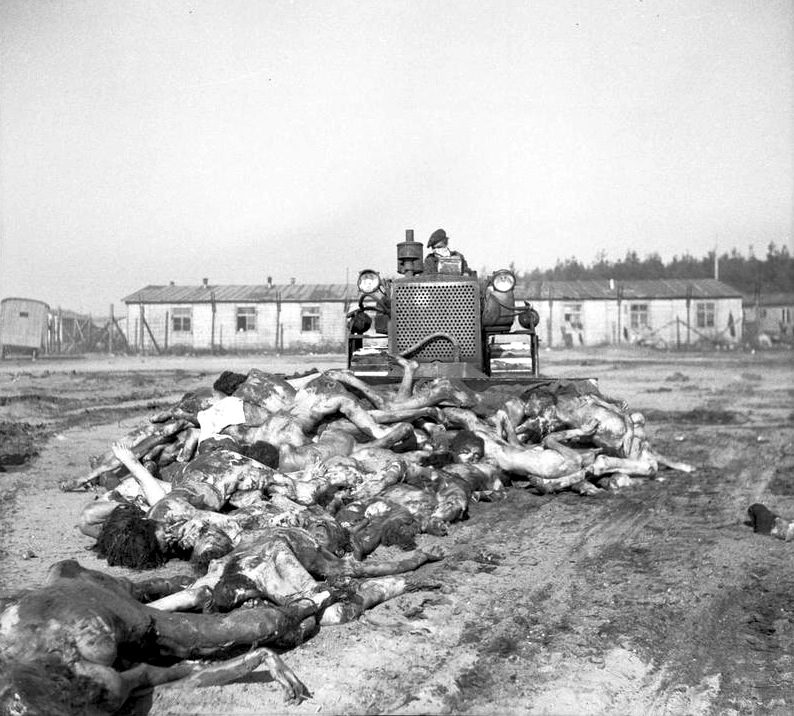
[Image: British army bulldozer at Bergen Belsen being used to move bodies]
Now he was put on trial there and he was made—after torture, we have actually accounts of how he was tortured—he claimed that in Natzweiler, in the camp in Alsace-Lorraine, he rigged a little room and did a test gassing. And the way he describes it is absolutely ridiculous from a technical and toxicological point of view. Makes no sense!
However, that is supposed to have happened at a time when massive gassing operations are said to have been ongoing in the Third Reich already for years. So had it happened, Kramer, who had experience in various camps, would have known how to do it! But they have him testify to something completely ludicrous that makes no sense at all!
Kenny Ko: So you think that was through means of torture, …
Germar Rudolf: Yes!
Kenny Ko: And essentially getting him to confess to something that was never done?
[1:05:31]
Germar Rudolf: Yeah, exactly! Now we have proof that it was never done because he was made to testify that this gassing happened with a number of Auschwitz inmates that had been transferred to it in 1943, I think, to that camp in order for their skeletons to be used in a skeleton collection at the Strasbourg University—rather macabre claim. At the Strasbourg Anatomical Institute they found corpse parts with tattooed numbers and they figured these are some of the victims that were transferred from Auschwitz. So there seems to be some truth to it. We don’t know what exactly!
But then they made forensic investigations of those inmates. Did they die of the poison that Kramer said he used? That investigation— forensic investigation by a French scholar—conducted in 1946, as I’m not mistaken, disappeared in archives for many years, and only in 2018, I think, was it finally released by the French authorities, and the result is negative. No, it didn’t happen!
Of course they’re dead. They died somehow, but not with gassing with hydrogen cyanide.
So the whole thing is clear to have been made up. And on the face of the absurd claims of how it’s supposed to have happened—which is technically impossible—it was clear that it can’t have happened. But had Kramer had any idea of post-application in Auschwitz and wherever else he was of such massacres, he would have known what to say and so would the French have. So it’s clear the whole story is made up.
Also it’s one of, I would say, the only clear-cut cases where we know from forensic testing of the actual claimed victims—no, it didn’t happen. They have been executed, but not that way. No gas chambers! That doesn’t mean that people didn’t die. I just mentioned in Auschwitz we have documented cases of 135, 500 people dying. Most of them of disease. Typhus epidemic was raging in that camp for one and a half years—and they had dysentery, other issues.
And so the biggest death toll of any recorded, documented case in Third Reich German history— all the other camps did not come close to that in itself is a humanitarian disaster! Putting people who are snatched from their homes without due process, without anything, and putting them in camps and exposing them to conditions where they have to die like flies may not be outright murder, but it is manslaughter with gross negligence at least—and 135, 500 cases in that camp alone. And that’s something that Third Reich leadership, …
Kenny Ko: Do you believe the amount of deaths was due to the Allied powers cutting off supply routes and whatnot into Germany?
Germar Rudolf: In some of the Western camps at the end of the war, ye! When we’re talking about Bergen-Belsen and the amount of corpses there, that was due to force majeure, if you wanted. But still, somebody put these people in the camps. Unless they were hardened criminals or some people who justly were in there—POWs would have been in a war; that’s legal to put POWs in camps—and they would have succumbed to the same circumstances. And some of them did. But if you take civilians—Jewish or otherwise—without due process* and just deport them and put them in these camps, you can’t evade responsibility.
[* This is a weak argument as the jews were considered a security threat to the war effort, just as Japanese were put in camps in the USA, Germans and Italians in Australia, etc.]
When it comes to Auschwitz, no—the typhus epidemic there broke out in 1942 and got under control only in late 1943. So there were no mass bombing raids disrupting supply lines in the eastern part of Europe at that time, at all! What we do have there, however—we have evidence of the Polish underground spreading typhus germs, typhus-infectious lice, in hundreds of cases on purpose! So it stands to reason that they had some impact, were quote, unquote, “successful” with this kind of underground biological warfare, and made sure that German attempts at wiping out the disease in order to have camp inmates fit for labor and work for their war efforts would be undermined in one way or another. Now that’s war. You can look at it which way you want; the Polish underground killed mainly their own compatriots with that, because they were mostly the inmates in those camps.
I mean, there were other East Europeans. But anyway, people who were just as oppressed and occupied as the Poles were. And so it should undermine some part of the German war effort. Whether that’s morally justifiable—this is a different issue.
But again, it was the Germans who deported jews by the millions without due process just because they belong to a group—and that this shouldn’t be acceptable.
Kenny Ko: Another question I did have for you is—because of the non-gassing of jews and them fabricating the story—why do you think they would have chosen that means if it would have been so hard to prove, of course, through forensic studies and people could have come years later to see that the story was untrue? Why did they choose the route of gassing essentially? Or what do you think your opinion on that would be?
[1:10:19]
Germar Rudolf: Again, it is kind of laid out in my book Nazi Gas Chambers. If you look at the Nuremberg Trials, when the story hadn’t coalesced yet, they were claiming for Treblinka steam chambers; they were claiming for Belzec electrocution; Sobibor hadn’t settled yet—they were claiming there mainly chlorine as gas. Auschwitz had Zyklon B. So as I just mentioned, chaotic testimonies about what happened there at the Nuremberg Trial hadn’t settled in yet. It’s completely contradictory that we then eventually agreed—or the Polish scholars agreed—on engine exhaust gas in some of the camps and Zyklon B in Auschwitz. It’s a long story. It starts already in the First World War. I would say. The absolute horror of gas warfare is what people were most afraid of in the interwar period—that if another war breaks out, this is going to erupt again and it’s going to get much nastier than during the First World War.
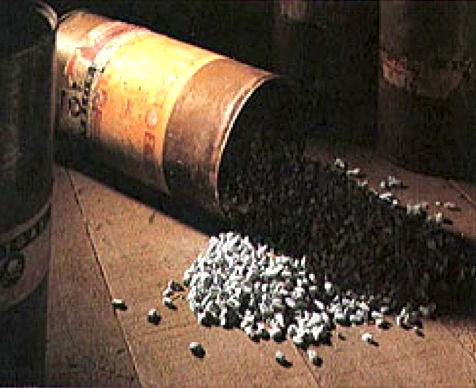
So the first stories we have coming out of Auschwitz are actually claims by the underground that the Germans are testing war gases on Russian POWs. It was completely made up, but that was how things started—on that level—and developed from there. Zyklon B was of course used in camps because it’s an insecticide to fight lice. As we just mentioned, epidemics broke out—always break out in war. It’s almost inevitable. In many, many wars in the history of mankind, epidemics have caused more victims, particularly in the civilian population, than the war itself. And to some degree that’s true for World War II. Zyklon B is a convenient item that can— even though originally it’s a benign thing to preserve the life of the inmates by fighting epidemics— be twisted around and be seen as evidence for evil things if it has been used for homicide. You see that on various levels, that things that have the ability for dual interpretation—both benign as well as evil—have been used by the Allies. There is evidence that there was Zyklon B. Therefore they twist the story and say:
“You used it for homicide! Because there was so much sold and shipped to Auschwitz. You can’t explain that possibly with disinfestation—you must have committed mass murder!”
That’s actually the reasoning that was done by the Allies.
When you look at the actual record—Auschwitz being such a huge camp, the hundreds of thousands of inmates that were led through that camp, the huge size of it and the epidemic lice problems they had—it perfectly justified the amount of Zyklon B they received. As a matter of fact, they didn’t have enough to combat the epidemics, evidently. But it gives the opportunity for propagandists then to twist it into something that it was not.
And the same with the fact that there were crematoria. Crematoria are also a thing that can fire up the imagination of people. Back then, cremation wasn’t quite as common as it is now. And funerals by fire had been illegal in most European countries—in Christian countries, I should say—because of opposition from the Catholic Church and also a lot of Protestant churches, to the effect that it was just illegal by state law. And that was rescinded only starting in the early 20th century, step by step.
And by the time the Second World War was on, it was still not a widespread method, particularly in Eastern Europe. The imagination that people get burned, whether they’re dead or not, is just a horrifying imagination. A lot of people still—they want to be interred, they don’t want to be cremated—because the feeling is, my body is getting burned. It doesn’t sound right.
So that’s a convenient way for black propaganda to latch onto their fear and turn the hygienic way of disposing of the victims of mass epidemics and mass casualties into something evil that looks like mass murder. “Gas ovens”—the combination of the two—which is a term that shouldn’t exist because the oven, the furnace, and the gas for killing are two separate things.
But it’s this imagination, the merging of these two horrific things, that gives black propaganda a perfect opportunity—proving that many of these German camps had crematoria, and therefore mass murder must have been committed there. And this is just fallacious reasoning, but it was an opportunity that the victorious powers seized and they had the total power to ram this narrative down the throat of the general public. And they succeeded with it.
Kenny Ko: Right.
And another opinion I wanted of yours is, of course, Treblinka, which I think is one of the more interesting ones due to the revisions and everything that were done once the forensic studies and stuff started to happen. I just wanted your overall input on Treblinka as well.
[1:15:00]
Germar Rudolf: Treblinka is one of the three camps—in the more narrow sense—said to have been pure extermination camps, close to the demarcation line that separated the German-occupied area of Poland from what the Soviet Union gobbled up after the division in ’39 and which used to be Soviet up to 1921. Poland had just gained them— border stations, if you wish.
The revisionist take is that they were transit camps for jews who were sent east. Now the mainstream said they were pure extermination camps. Jews were sent there just to be killed in gas chambers. And as I just mentioned, the initial story for Treblinka was actually steam. That was the predominant claim. How murder was, …
Kenny Ko: I thought it was diesel—or was it steam?
Germar Rudolf: Diesel is the narrative that became predominant starting in ’46,’47. Back during the war it was steam. There’s an official government report of the Polish government in exile from 15th of November 1942 that explicitly says it was steam. Very detailed, describing the camp and anything that’s going on—allegedly based on witness accounts. So it’s so detailed that it is either a fictitious story made up well, or it had a lot of witness claims to it. Be that as it may, steam was the thing. And the steam is also how it was entered at the International Military Tribunal there. Well, there’s a little bit of— they introduced two. One of them said steam and the other one said:
“Well, steam, vacuum, electrocution, gas, whatever.”
So as I mentioned, anything goes. The shift to engine exhaust gas happened after the war and it was kind of ongoing when the International Military Tribunal was unfolding. It didn’t find entrance really in the documentation there. But you find it, as I mentioned, in the interrogation protocols that were going on, particularly in Poland. And one key event was a German high-ranking official—high-ranking not by military grade, but by the importance in the context of what we’re talking about—that’s Kurt Gerstein. He has been an officer in charge of the SS Office for Hygienic Technologies and in particular there for disinfestation. He was the man who was overseeing the delivery of gas chambers and Zyklon B and other disinfestants to the various camps—gas chambers in terms of fumigation chambers.
So at the end of the war, when the gas chamber propaganda took off and Zyklon B appeared as a mass murder instrument at the Majdanek and Auschwitz camps—Majdanek already in July 1944; it was the first camp to be overrun by the Soviets— and then in January in Auschwitz as well—January ’45—Gerstein was sitting in his office in Berlin and knew that he’s toast! Because he is the one who was in charge of supplying all these camps with the technical means and the disinfestants and the Zyklon B to do whatever they have been doing. So he eventually flees from Berlin, surrenders in his hometown in southwest Germany to the French authorities, and writes a report where it says:
“Well, yes, I have been in charge of that Zyklon B. And I was actually ordered to drive to one of these camps—to Treblinka—to change the murder method from diesel engine exhaust to Zyklon B. And I didn’t do it because I convinced the guy that, keep your diesel, Zyklon B is no good. And he kind of destroyed it.”
Now why did he do that? He had to depict himself to the authorities as a secret resistor, who would actually destroy the Zyklon B and would make sure that the Zyklon B never reaches the camp—and his account is full of it—that he actually intercepted and made sure that it disappears and that it doesn’t get used and that it gets used for disinfestation at a different place after all.
So it was an attempt for him, because on the scale of evil of the Third Reich depicted by the mainstream, you have of course Adolf Hitler, Himmler and so forth. And then you have Adolf Eichmann who deployed all the people to the camp. You have Kurt Gerstein who supplied them with this poison gas and the technical means for applying the poison gas. And then you have the local camp commander. So Kurt Gerstein should have been right up there with Adolf Eichmann—and he knew it.
So he makes up this story:
“Oh, Zyklon B, I was resisting, I was making sure it doesn’t get there. And instead this stuff actually wasn’t happening with Zyklon B. It was diesel engines. So Zyklon B wasn’t even used. And I made sure the switch to Zyklon B didn’t happen!”
A big lie! Mainstream historians nowadays have completely discredited him. The testimonies he made are full of complete absurdities and insanities and historical lies!
What has been found out is that he actually embezzled, in today’s money, worth more than $100,000 of funding for Zyklon B purchases and had made a luxurious life during the war for himself. Had people go to Paris, get exotic food items and so forth. And he even stole a painting from a jewish estate that was found in his estate later. So he was corrupt, he was a thief, and he knew he’s on the chopping block and he made up this wild story.
Now this wild story he tells to the French authorities; the French authorities wrap it up, they interrogate him and they figure out that he’s probably lying because the stuff he’s saying makes no sense. But they convey this message:
“Oh, diesel exhaust is said to have happened. We have this high-ranking, top-notch Nazi official who tells us all about how this is supposed to have happened!”
And they communicate that to the Poles and in late 1945 send the whole set of documents to the Polish authorities. And that’s when you see the Polish authorities suddenly switching from electrocution, from steam, from vacuum and all the rest to diesel engine—or engine exhaust. And they throw out everything else and rewrite—1946,’47—the stories of Sobibor, Treblinka and Belzec. They don’t even commit necessarily to diesel, but definitely engine exhaust. In decades thereafter, mainstream historians, when it comes to Belzec – and based on Gerstein – and Treblinka, they say then:
“Okay, it was diesel exhaust!”
Now diesel exhaust doesn’t have the toxicity needed to commit that kind of mass murder. Diesel engines run on a vast excess of oxygen and so oxygen comes out the tailpipe too, and very little carbon monoxide, which is the lethal part. Tests made with small mammals show that it takes many hours—under worst-case scenario conditions—to kill those little mammals. Humans are usually a little bit less susceptible to this kind of toxin, so it takes even longer. So we’re talking about many, many hours that it would have taken.
[1:21:24]
German engineers knew engines! If you look at who has invented all these engines, you find out the Germans were the center of engine invention. They knew the toxicology and they had even better methods at hand. They had the producer gas generators, because they were cut off from petroleum supplies during the war. Mainly they switched their truck fleet, their buses and even some tanks over to producer gas, which is basically: You take coal, coke or wood and restrict the oxygen supply and make it a little wet. Then it burns incompletely and the gas that comes out is very rich in carbon monoxide, which you then can funnel into the engine and use as fuel. They had hundreds of thousands of them. And the top-notch officials of the Third Reich—Hitler, Himmler, Heydrich—everyone was promoting it to get out from underneath the dependency on liquid petroleum products.
And German engineers knew about this technology. It is so rich in carbon monoxide, up to 30% and more, that it’s very quickly lethal. It was everywhere, mass-produced, deployed everywhere, particularly in the transport region. So jews were transported—probably some of them—in vehicles with this kind of producer gas technology. There’s no record anywhere that anyone was ever murdered with this. It was well known. Even this technology was used at times before the invention of Zyklon B to kill vermin! Insects are not susceptible to it. It works only for mammals, but to kill mice and rats. So, known that it is a good method to kill—never used.
So the Germans had that and then they are supposed to have settled for the worst possible solution—that doesn’t work: Diesel! No, didn’t happen. In the meantime, mainstream historians have shifted the goalposts again. First they were at steam, then they moved on to diesel. Now they figured out—after the research we’ve done and pointed it out for decades—diesel doesn’t work:
“Okay, it wasn’t diesel; it was gasoline engines!”
So how long does it take for people to stop believing these mainstream historians if they keep shifting the goalposts, here as well? So much about the technological background. The forensic investigations that were conducted over the years—the Soviets did one, and the Poles after the war,’45,’46. The Poles were doing some excavations but didn’t find the mass graves or leftovers of mass graves that witnesses claimed were there. Then we had a preliminary, somewhat superficial, ground-penetrating radar analysis by an Australian engineer back in 1999, and he’s never published his research because he got cold feet with this.
And then we had a British team of forensic archaeologists starting research in 2011—2011, 2012, if I’m not mistaken. And they had preliminary conclusions published in a series of BBC interviews and then in a documentary that they made about Treblinka. But the scientific publication of the actual research results has never been released to this day. And we suspect the reason for that is that they didn’t find what they’re supposed to have found.
The claim is that in Treblinka at least 700,000 victims were initially buried in mass graves. And you can roughly calculate what kind of earth volume you need to bury that many people. You can have a theoretical maximum of, say, 10 people per cubic meter.
But more realistically, if you’re looking at all the mass graves that have ever been disinterred—where victims of National Socialist massacres have been found, or even other circumstances like the Katyn massacre, like mass graves in Bergen-Belsen that the British dug at the end of the war, or mass graves in Hamburg from the Allied air raids—the 40,000 German civilians that died there were put to rest—so we know roughly what kind of a density these mass graves have. And you don’t get up to 10 per cubic meter; it’s lower than that.
But even if you were to do that, the amount of disturbed soil that the ground-penetrating radar research found by this British team doesn’t come anywhere close to what should have been found—certainly in the order of magnitude of 10 or 20% or so. I don’t remember exactly the number. But anyway—way too little! And we are talking about just indications of disturbed ground—that doesn’t mean there were mass graves. Because we know the Soviets did excavations in the area and they didn’t find any. No. So did the Poles—and they didn’t find anything. So they definitely disturbed the soil on a massive scale with these excavations they did. But these are not mass graves.
And then the civilian population in the area did wild diggings after the war because there was the rumor running around that the jews had left treasures behind. Whatever jewelry or money they were taking with them—some of it fell on the ground, was buried secretly, or whatever. So civilians were digging up the whole place. There’s actually a Polish report that describes the area kind of like a moonscape with craters. Evidently Soviet soldiers had joined in the frenzy of trying to discover jewish gold by using munitions they had and blowing some artillery shells or whatever to quickly, quote-unquote, “excavate” areas. So there were craters of ordnance that had exploded. Some of it has exposed a few bones here and there, but not to the degree that you would expect for a massacre of that size.
But anyway, all these disturbances of the soils—some of them may intersect with actual former mass graves, who knows? But some of them may not so we don’t really know from ground-penetrating radar what we are looking at. You would have to actually do a whole-scale excavation to figure out what is there.
Now, as I mentioned earlier, jewish authorities disagree with the disturbance of jewish graves. So they prevent anyone from looking.
Kenny Ko: Did they lay pave stones or something over the area of Treblinka?
[1:27:11]
Germar Rudolf: Yes, I think in the 1960s they paved over a large area where it is said to have happened—whatever that is—with concrete. And they have a lot of rocks erected there as monuments. So ground-penetrating radar, depending on the technology, can look through that.
And it’s also not completely covered, so there are areas where it’s not so that wouldn’t completely prevent you. It makes it a little bit more difficult, but it does not completely prevent you from using that technology.
Similar in Belzec, however—there they did do core drillings. So it shows you if there’s a will you can do more than just non-invasive methods. You can use mildly invasive methods. And the jews agreed to that they found there as well disturbed ground—way less than is needed, even under the worst-case scenario. So if the jews that were deported—of which we know; we have the records— so and so many jews were deported to these camps—not all of them, only a minority of them in the worst-case scenario—can have ended up in the ground there, according to the data we have for now.
Where did the rest go? We know the claims—how the murder is supposed to have happened—can’t work. We know that the claims of how the traces of the mass murder were made to disappear—all those mass graves are said to have been excavated eventually, in the course of mainly 1943, and burned on huge pyres. The claims made there are technically unfeasible for open-Air incinerations. The amount of wood and labor force and space that would have been needed—and time that would have been needed for that makes it completely incompatible with the claims.
So this is just a convenient and very anti-scientific way of explaining why the evidence isn’t there:
“Oh, because the evidence was destroyed!”
The absence of evidence doesn’t prove what you’re claiming. And when you are adding another claim on top of it, which you can’t prove either—that something was destroyed:
“I don’t have evidence you killed my wife.”
“Where’s your evidence?”
“You destroyed the evidence. So you have committed two crimes—you killed my wife and you destroyed the evidence.”
So you have to go to jail two times. That’s the way the argument goes here. And that’s ridiculous! With that kind of attitude you can prove every crime.
Kenny Ko: Right.
Germar Rudolf: That’s not the way it works. That’s not how science works. That’s not how law should work. Which isn’t to say that criminals do not try, and sometimes succeed to some degree or another, to actually make traces of their crimes disappear. Of course it does happen, but that doesn’t alleviate you from the duty to prove that something like that did happen.
And by the way, if you have 700,000 corpses in the ground and you have no technical means other than wooden logs and a lighter to make them disappear—they don’t disappear tracelessly. There’s just no way in heaven! So things need to be there! Will anyone ever look, with the attitude societies have now? No! By the time that may have changed—down the road in decades or centuries to come—I don’t know whether it will still have any way of succeeding.
But then again, technology—hundreds of years down the road, who knows. Forensic archaeology can find out amazing things about human settlements and human graves that are thousands or even tens of thousands of years old. So who knows what we can find out in future.
So there’s a lot of things to be done that mainstream doesn’t want to do.
Actually, the lead scientist who did the British archaeological research in Treblinka is going to have a lecture at the US Holocaust Memorial Museum upcoming in a few weeks, I think. And we guys are actually considering going there—but a little bit of a logistical challenge, and it’s a risk because if you start asking inconvenient questions, you don’t know what happens, because you’re going into the midst of people who get very angry. If you challenge—just challenge. Not even say:
“Well, it’s wrong.”
Just ask inconvenient questions. Then all kinds of shit can hit the fan.
So let’s see whether that’s something we can pull off.
Kenny Ko: Right.
[1:30:56]
Germar Rudolf: So this is Treblinka. The Achilles’ heel of Holocaust skeptics in this regard is, of course, we don’t— we know that many of them can’t possibly have ended up in the ground, and they can’t have been made to disappear with these fires either. So where are they? Where’s our answer to the question—where are they? We do have anecdotal evidence of people who have claimed—witnesses during the projects launched in the 1980s to get as many survivor testimonies on tape, on record—quite a few witnesses have testified that their trains full of jews were transited through Treblinka, through Sobibor, through Belzec. We have actually a paper about that— it kind of goes through them and lists how many we have—that shows yes, these camps did operate as transit camps. That doesn’t mean they operated only as transit camps, but they definitely did serve to some degree and had the ability to serve that purpose, because there are plenty of witnesses that say:
“We were transited through there.”
Now, unfortunately, I have experience with getting transited through situations like that, because when I was in Germany spending time, I was several times relocated to different prisons. And sometimes you get through the transit section of another prison on the way to your final destination.
Kenny Ko: Right.
Germar Rudolf: And I know from experience, I remember having been through a transit camp, but I can’t remember the name of it because you’re there only for a few hours, a few days, depending. In my case, it was even six days. Actually, it was long.
In the case of Bełżec/Treblinka, people say they were there only a few hours, or a day or so. why would you remember the name? How likely is it that a train full of 5,000 people or 10,000 or 1,000 people—whatever the train may have had, how many people in it that have been in this place that’s completely remote, unknown back then, completely unknown name of a little, tiny settlement, not even a village in the deep backwoods of Eastern Poland—why would you remember that name? So that some of these witnesses do remember. And they were not alone. They were not brought there individually in a car. No, they were in a train full of people who were all transited through there.
So you can extrapolate—if you find 10 witnesses who say that, 100 may have forgotten the name and will never have thought of it. And maybe 10,000 never testified anywhere.
Kenny Ko: Very interesting.
Germar Rudolf: And then we have, of course, records of resettlement actually having happened. That is the official narrative that you find in the documentation—resettling the jews to the east—because Germany thought they were having the Soviet Union close to its collapse after the ’41 onslaught, and then in ’42—which we’re retreating still deep—the whole thing turned around only in Stalingrad, 1942, 1943.
Kenny Ko: I think that was the turning point in the war.
Germar Rudolf: Right. That’s when the Germans knew it’s not working. And that’s when all these camps were shut down—no transit anymore.
So you have a historical coincidence there. Yeah, coincidence that points to—yeah, in late ’41 and throughout ’42, they thought they can ship those jews to the east, have them work there, have them resettle there, because they’re going to control the area. The Soviet Union is going to collapse. We’re going to reign until the Bering Strait. That didn’t happen.
And then in late ’42, early ’43, when things were clear, these camps all got shut down.
So what happened to the jews that were resettled to the east? I’m sure we have a number of documents saying as soon as they get unloaded, the local German authorities—they can’t handle them. They are stretched thin with all the limited resources they have in a war. We have no camps, we have no nothing here. These jews, they run all over the place. They run into the woods. So they join the partisans right away. And then we have a major partisan problem. They are fighting us.
So one of these local commanders says:
“If you don’t announce ahead that we’re going to have these jews coming and if you don’t give us the means to actually accommodate them somewhere, the next train that comes unannounced, we’re just going to shoot all these people. Because if we don’t, they join the partisans right away and then they are going to come back and kill us!”
So he was ordered to stop this nonsense and to find accommodations for them and make sure that they all get settled there. That’s what was going on. Massacres did happen in this situation of local commanders saying:
“I can’t handle these jews. What are you guys doing? They are joining the partisans!”
And so some of them got killed ahead of time. Some of them joined the partisans, got killed in that process. Some of them survived. There’s actually one report saying that the Russians, at the end of the war—the Soviets—overran a camp where Germans had concentrated many of them, and the Soviets ran into them. There were jews that had been deported from Western Europe. So there they were. And that was only one case that was reported. Maybe there were more. So some of them got overrun by the Soviets. They may or may not have let them pass.
The number of people in Europe who were displaced persons—that includes jews, but not just jews. Eastern Europeans were fleeing from the Red Army advancing. The Germans were being ethnically cleansed all over the place. End-of-war and post-war Europe was a mess where people by the millions were moving Left and Right. How many jews who had been pushed this way and that ended up in displaced person camps that eventually led to them immigrating to Israel—what was to become Israel—obviously a lot of them to the United States, which stopped counting jews or registering the religious affiliation of people somewhere in the early stages of the war actually— and to other countries—is not 100% recorded. So there are a number of fates that these people will have had.
And another nasty one could be that a lot of these jews, if they were fit to work, were made to work for fortifications, improving infrastructure. You see that in Ukraine now in the war—each fall and spring they have a mud problem. And they had that back in the Second World War too. The roads back there were in worse shape.
So they had a lot of these jewish labor columns improve the roads so that the German supply runs could actually go to the front. And these jews, if they were ever overrun by the Red Army, had collaborated with the Germans—with the German war effort. Stalin didn’t have any mercy for these people. They didn’t really do it voluntarily for the Germans and were forced laborers. But Stalin didn’t give a rat’s arse! If you surrender as a Soviet soldier and become a prisoner of war, Stalin would kill you! A similar situation you have actually right now with what’s going on in Ukraine.
And if you are a civilian, you surrender to the German authorities and you work for them rather than fight to your death, then I’m going to kill you! So yeah, people were deported to Siberia. Even if they were concentration camp inmates, forced laborers whatsoever—not all of them, but I’m sure some of them were.
So there’s a whole broad variety of things that can have happened to these people. Some of them led to their death, some of them led to them immigrating and being just fine. So we will, at the end of the day—with history being obscured by the Eastern Bloc having been obscured for 40 years, and the Western powers not having too much of an interest in clarifying this issue, of diversifying historical data, historical viewpoints, historical interpretations; and then of course keeping that narrative as it is because it’s supportive of the post-war order and the powers, the pecking order, so to say—the chances of us ever finding out exactly what happened to these people will not be improving.
And Russia nowadays—after the collapse of the Soviet Union—they haven’t been cooperative either. Initially, yes, we could actually get access. A lot of the material that we’ve published is based on documentary resources that we found in archives that had been hidden from Western researchers up to the collapse of the Soviet Union.
But then, mainly on pressure of the German government, these Eastern archives closed their Gates again to independent researchers. You now need university or government accreditation before they let you in. So much about freedom of science and scholarship.
So that’s where we are with this. Is that a good answer for your Treblinka question?
[1:38:50]
Kenny Ko: Those were great answers all around, I must say.
And actually we just hit around the two-hour mark. I would definitely be down to do a part 2 diving into some more with you, without a doubt. Before we wrap up, I also of course want to thank you, Germar, for not only standing up and doing this for the masses and the future generations to get this information—continuing down that journey and seeking the truth! Because I think it is a core fundamental part, like you said, with history, to learn lessons. And if we don’t have the history correct, how are we supposed to learn lessons moving forward?
So is there anything you want to close with? I know you already said, of course, where people can find a lot of your writings and of course the free and then also the purchasable versions. But any social medias or anything you would like to tell the people?
Germar Rudolf: Well, the easy way, if you want to get in touch with me or follow me—I have it here on the screen. My website, my personal website, is GermarRudolf.com. It also has links there to all the things that I mentioned: To the Holocaust Handbooks, the encyclopedia. We have a Holocaust Academy where we teach the ropes of Holocaust skepticism. And we have actually a HoloCast—a podcast—where I elaborate on these things. The Holocaust 101 from a skeptical point of view, and 102, and the rest of it. Links to the free speech lobby group that I’m involved in, the Committee for Open Debate on the Holocaust—CODOH.com. You’ll find links there to that, to our stores where you can purchase the books, and social media links you can find on that website too. My channel on X, which is basically what I focus on. The rest is too much censorious and you get thrown out.
Kenny Ko: I get that. Blanket censorship is a little out of control! But you guys that are watching, make sure to leave a like on the video. Go show him some support for what he has been through for all of us to obtain this knowledge and understanding and evidence, and through the forensic studies. Leave in the comments down below what you guys think of all of this, or any future topics—if we do a part two—that you guys would like Germar to discuss or cover for you.
And once again, Germar, thank you once again for your time. I appreciate you sitting down and having this conversation with me.
Germar Rudolf: Yeah, much appreciated.
Kenny Ko: Of course. Have a good one.
Germar Rudolf: You too.
============================================
Rumble Comments
(Comments as of 5/8/2026 = )
==========================
See Also

Joel Davis – Mark Collett vs Greg Johnson – The Ukraine Debate – Oct 17, 2022 – Transcript
Mark Collett – Patriotic Weekly Review – with Joel Davis – Apr 27, 2023 – Transcript
Joel Davis – On Australian Nationalism with Matthew Grant – Dec 17, 2022 – Transcript
Joel Davis – The White Australia Policy with Matthew Grant – Jul 27, 2023 – Transcript
Joel Davis – The Vibe Has Shifted and the Paradigm is Shifting – Jun 13, 2024 – Transcript
Slightly Offensive – Is America (& the West) Over? – Guest – Joel Davis – May 31, 2024 – Transcript

Joel Davis – Polarisation Phases – with Blair & Tom – Jun 20, 2024 – Transcript
Joel Davis – Trump Inevitable, Blair Censored, Paedo Freaks Destroyed – Jul 19, 2024 – Transcript
Joel Davis – When Will Enough Be Enough? – Jul 25, 2024 – Transcript
Joel Davis – Mass Deportations Now! – Aug 1, 2024 – Transcript

Joel Davis – Activist Reflections with Jacob Hersant – Aug 18, 2024 – Transcript
Joel Davis – Analysing the Implications of the Pajeet Hate Surge – Aug 29, 2024 – Transcript
Joel Davis – WWII Revisionism Re-enters the Mainstream – Sep 6, 2024 – Transcript

Joel Davis – One Nation – Ineptitude or Controlled Opposition? – Nov 4, 2024 – Transcript
Joel Davis – ZOG Sends in the Fun Police, Donald Trump White Power – Nov 7, 2024 – Transcript
Joel Davis – The Enemy is Weaker Than You Think – Nov 14, 2024 – Transcript
Joel Davis – “It’s Not About Race” – Nov 21, 2024 – Transcript
Mark Collett – Patriotic Weekly Review – with Thomas Sewell – Mar 19, 2025 – Transcript
Mark Collett – Can National Socialism Be Resurrected? – with Joel Davis – Mar 23, 2025 – Transcript
Joel Davis – So Much Has Happened, But We’re Only Just Getting Started – Apr 11, 2025 – Transcript

Joel Davis – What Did the Anzacs Fight For? – Apr 24, 2025 – Transcript
Australians Vs. the Agenda with Joel Davis – Apr 28, 2025 – Transcript
Joel Davis – Defiance – May 16, 2025 – Transcript
Joel Davis – Symbolic Victory – May 30, 2025 – Transcript
Joel Davis – Tactical N-Word – Jun 6, 2025 – Transcript
Joel Davis – The Chink Question – Jul 4, 2025 – Transcript
Joel Davis – The Chink Question – Jul 4, 2025 – Transcript
Joel Davis – Zionist (Paedophile) Occupied Government – Jul 17, 2025 – Transcript
Joel Davis – Another Week of Political Drama – Jul 27, 2025 – Transcript
Joel Davis – The Goonright Pipeline – with Mark Collett – Aug 6, 2025 – Transcript
Thomas Sewell – Masters of Our Own Destiny – Aug 10, 2025 – Transcript
Jacob Hersant – Speech at NSN, Victoria – Aug 10, 2025 – Transcript
Joel Davis – The Fire Rises – Aug 22, 2025 – Transcript
Mark Collett – Patriotic Weekly Review – with Thomas Sewell – Aug 27, 2025 – Transcript
Blair Cottrell – The March for Australia – A National Immune Response – Aug 27, 2025 – Transcript
Blair Cottrell – Australians Unite to Stop Immigration – Aug 31, 2025 – Transcript
Joel Davis – Patriots in Control of the Streets – Aug 29, 2025 – Transcript
Thomas Sewell’s Speech at the March for Australia Rally in Melbourne – Aug 31, 2025 – Transcript
Joel Davis – Reflections on the March for Australia – Sep 7, 2025 – Transcript
Joel Davis – The Only Solution to Antifascism is Fascism – Sep 14, 2025 – Transcript
The Offaly Offensive – Tim Lutze – Part 1 – Sep 20, 2025 – Transcript
The Offaly Offensive – Tim Lutze – Part 2 – Sep 27, 2025 – Transcript
Joel Davis – Ain’t No Party Like the White Australia Party – Oct 5, 2025 – Transcript
The Offaly Offensive – Blair Cottrell – Part 1 – Oct 12, 2025 – Transcript
The Offaly Offensive – Blair Cottrell – Part 2 – Oct 17, 2025 – Transcript
Counter-Currents Radio No. 629 – Joel Davis and the NS Question – Mar 26, 2025 – Transcript
Joel Davis – NSN Conference Speech – Aug 10, 2025 – Transcript
Joel Davis – Patriots Against the Political Police – Nov 4, 2025 – Transcript
Mark Collett – Patriotic Weekly Review – with Thomas Sewell – Nov 27, 2025 – Transcript
Red Ice TV – Bondi Beach Shooting & White Australia with Thomas Sewell – Dec 17, 2025 – Transcript
Blair Cottrell – The Joel Davis Situation – Jan 9, 2026 – Transcript
Blair Cottrell – Blair Stream – Dec 7, 2025 – Transcript
Jacob Hersant – Explanation of the Hate and Extremism Bill – Jan 16, 2026 – Transcript

The World’s First Anti-Holocaust Convention — Instauration Dec, 1979
An Open Letter to New Jersey’s Governor
Misha: Surviving with Wolves or …
Bradley Smith’s Smith Report # 1
The Liberation of the Camps: Facts vs. Lies

Powers and Principalities XI – Ewen Cameron, MK-Ultra, Holocaust Revisionism — TRANSCRIPT
Tales of the Holohoax – A Historian’s Assessment – Part 1
The Holocaust Lie — Made in America
Probing the Holocaust: The Horror Explained — TRANSCRIPT
Jim Rizoli Interviews Prof Robert Faurisson, Oct 2015 — TRANSCRIPT
Holocaust Eyewitnesses: Is the Testimony Reliable?
Alain Soral – My Homage to Robert Faurisson, Oct 2018 — TRANSCRIPT
Inside Auschwitz – You’ve never seen THIS before! — TRANSCRIPT

Amazion Bans 100s of Holocaust Revisionist Books!
AUSCHWITZ – A Personal Account by Thies Christophersen
Jim Rizoli Interviews Bradley Smith — TRANSCRIPT
London Forum – Alfred Schaefer – Psychological Warfare – TRANSCRIPT
The Realist Report Interviews Eric Hunt — TRANSCRIPT
Red Ice Radio: Nicholas Kollerstrom — TRANSCRIPT
The Realist Report with Carolyn Yeager on Johnson vs Anglin debate — TRANSCRIPT

Mark Collett — It’s Okay To Be White — TRANSCRIPT
Mark Collett — Christmas Adverts – Multicultural Propaganda — TRANSCRIPT
Mark Collett — What We Must Do To Win — TRANSCRIPT
Mark Collett — Assad Didn’t Do It – Faked Syrian Gas Attack — TRANSCRIPT
Mark Collett — The Plot to Flood Europe with 200 Million Africans — TRANSCRIPT
Mark Collett — The jewish Question Explained in Four Minutes — TRANSCRIPT
Mark Collett at The Scandza Forum, Copenhagen – Oct 12, 2019 — Transcript
Patriotic Weekly Review – with Blair Cottrell – Dec 4, 2019 — TRANSCRIPT
Dangerfield – Talking Tough with Mark Collett – Mar 28, 2020 — Transcript
Mark Collett – Sam Melia Sentencing – with Laura Towler – Mar 1, 2024 – Transcript
Joe Marsh – Sam Melia Going into Court Before He was Sentenced – Mar 1, 2024 – Transcript

911 – The Jews Had Me Fooled: A Jewish Engineered Pearl Harbor
Organized jewry Did 9/11 — The 16th Anniversary, 2017
Know More News — Christopher Bollyn, The Man Who Solved 9/11 — TRANSCRIPT
The Realist Report with Christopher Bollyn – Sep 2018 — TRANSCRIPT
Guns and Butter interviews Christopher Bollyn — The War on Terror – Dec 18, 2019 — Transcript
AE911Truth – Exposing Those Who Covered up the Crime of the Century – May 28, 2023 – Transcript
============================================
PDF Download
Total words in transcript = 18,797
- Total words in post = xxx
- Total images = xx
- Total A4 pages = xxx
Use your browser to download/export a PDF of this post.
Version History
Version 5: Wed, May 27, 2026 — Transcript now complete = 101/101 mins. Transcript Quality = 5/5.
Version 4: Tue, May 26, 2026 — Transcript completed = 81/101 mins. Transcript Quality = 5/5.
Version 3: Wed, May 20, 2026 — Transcript completed = 70/101 mins. Transcript Quality = 5/5. Added more images, links.
Version 2: Tue, May 19, 2026 — Transcript completed = 59/101 mins. Transcript Quality = 5/5.
Version 1: Fri, May 15, 2026 — Published post. Transcript completed = 29/101 mins. Transcript Quality = 5/5. Includes Rumble comments ().