The World Conquerors — Part 1: The Oldest “Nazism” in the World

[NOTE: Louis Marschalko was a Christian and as such his book reflects that. The purpose of posting his work is not to endorse his religious views but rather to present his study on the jews and their supremacist agenda of world conquest – KATANA]


The World


Conquerors


The Real War Criminals


by

Louis Marschalko


Part 1


Amazon Reviews


amazon.com

http://www.amazon.com/The-World-Conquerors-Louis-Marschalko/

9 of 14 people found the following review helpful

5 What a tremendous aid in understanding world events today.

By timothy k. price on December 25, 2013

This is a book that has to be read. Some people will protest and call it “anti-simetic” but this is not true.

A large tribe of people will deluge this site with protests against the book. Pay no attention to them. Read this book.

Showing 1 of 1 comments

Latimer the Cat 1 year ago

“What a tremendous aid in understanding world events today.”

Of course. Like it or not, today is a reflection of yesterday. Isn’t that why revisionist (real) history publishing was banned under the post 1917 judaic/communist incursion of Russia? Isn’t that why the other side of the coin (the NSDAP view) of what’s taught as WWII is never taught here in America even after 70+ years after the conflict?


8 of 12 people found the following review helpful

5 Must read

By john bebekon March 2, 2013

One of the most informative books I have read.If you want a unsanatised version of events,then this is the book.

Louis Marschalko tell’s it like it happened,and is still happening today.


11 of 14 people found the following review helpful

5 Truth Before It’s Time

By john thamesscholar1” on February 25, 2013

Long before the Holocaust denying Institute for Historical Review appeared on the scene, Louis Marschalko, a Hungarian, wrote a definitive expose of the six million myth in the context of a book exposing world-wide Jewish conspiracy. Remember, the book was published in English in the late 1950’s and got everything right long before its time. Although there are a few mangled quotations and slight errors of fact, Marschalko saw through the fog of propganda long before organized revisionism appeared on the scene. It is a remarkable book – and one still worth reading if you can find it.


19 of 23 people found the following review helpful

5 The Clearness of Marschalko.

By Paul Wasa on May 12, 2010

Mr. Marschalko does a good job in exposing the poisoning mind of the Jews worldwide.

He’s very well documented and has a very clear insight on things gone by. He analyzes the 2nd World War regarding the Jews and draws the most logical conclusions.

A book not only worth of being read, but I should say “a must” for younger people, who know nothing about WWII but from Jewish books and Jewish propaganda films, most of them untrue or biassed.

Paul Wasa.

Honest Critic 4 months ago

agreed… good read… goes hand in hand with a Greater Miracle of the Lost Ten Tribes Discovered and Fearless and Godly Pioneers for the Truth (which also gives a short bio. on Marshalko)… read it before you dismiss it.


31 of 34 people found the following review helpful

4 Controversial, but interesting

By S. Swink on August 27, 2007

Louis Marschalko – a Hungarian nationalist – published this book book in 1958. “The World Conquerors,” surveys the worldwide advance of communism from a decidedly Catholic perspective. The author’s argument is that communism is a worldwide movement, promoted everywhere by the same worldwide, transnational force.

In four chapters relating to WWII, “The Real Victors of the Second World War”, “Revenge is Ours”, “New Purim and Nuremberg”, and “What Has Become of Six Million Jews?”, Marschalko proves himself a one-man Institute for Historical Review.


Good Morning from the Zundelsite


Copyright (c) 1997 – Ingrid A. Rimland

September 23, 1997


In a book review published with permission from Granata Communications, below I give you yet another excellent summary of a classic:


Louis Marschalko’s book, “The World Conquerors,” first published in 1958, is more timely now than ever. It is one of those volumes whose prophesies lies in fulfillment.


Written by a Hungarian nationalist, it surveys the worldwide advance of communism as the unfolding of the scheme of the notorious “Protocols of the Learned Elders of Zion”.


The book’s thesis is expounded in its first chapter. Entitled “The Oldest Nazism in the World”, Marschalko shows the bolshevism of the Old Testament. The Fuehrership of Moses laid the foundation for all that has come since.


Although not a study of organized religion, the author’s side comments show astounding clarity. The Catholic perspective of Mr. Marschalko underlies his opposition to “The World Conquerors” he exposes: Christianity as the antithesis of Judaism, Protestantism as a reversion to the barbarism of the Old Testament, the ancient worship of the Golden Calf as the basis for emerging capitalism.


The rest of the book piles fact upon fact to make its case. The Jewish background of communism is thoroughly explored. Much of the material is familiar. However, a very valuable survey of communism in South America is included. This reinforces the author’s argument that communism is a worldwide movement, promoted everywhere by the same worldwide, transnational force.


Moving on, Marschalko examines the real nature of the German National Socialist regime. Its achievements are noted, as well as the real reasons for the war. Hitler’s Germany had to be destroyed if the program of the “Protocols” were to be fulfilled.


The author provides much information on the persecution of the Germans in Poland at the time when such claims were almost universally dismissed as propaganda.


The section on World War II and its aftermath is astounding Revisionism ahead of its time. In four chapters, “The Real Victors of the Second World War”, “Revenge is Ours”, “New Purim and Nuremberg”, and “What Has Become of Six Million Jews?”, Marschalko proves himself a one-man Institute for Historical Review.


The Jewish staffing and orchestration of the Nuremberg Trial, the east-west collaboration in the hounding of “war criminals”, the real fate of the fabled Six Million, the setting up of Jewish persecution as the moral standard of the post war era, all are devastatingly analyzed to show the vested interests at work.


Even the well-informed reader will be amazed at the cohesion and extent of the Jewish revenge which was taken post-1945 in Europe. Each of these chapters can and should be expanded into full length books. Until that happens, these four chapters may be taken as a primer on the subject.


The rest of the book covers the post war era of the Cold War up to the date of publication, 1958. The Jewish involvement in the atomic bomb treason, the Hungarian uprising of 1956 and the efforts of the Jewish media to cover up anti-communist exposures by Senator Joseph McCarthy and others confirm the blackout on truth by “The World Conquerors”.


Particularly valuable is the voluminous evidence presented on the post-war Jewish control of the Soviet Union. Marschalko convincingly argues that the deportation of Western Russia’s Jews ahead of the Nazi invasion created a second Iron Curtain. The Jews were concentrated in the Soviet arms production factories behind the Ural Mountains. This allowed them to retain a key grip on power while denuding the western provinces where Jews were never popular.


The United Nations is also exposed as a front for Jews. A voluminous list of Jews in key positions is appended. In reviewing the evidence, it is difficult to conclude anything other than that the shoe fits.


If there is no Jewish conspiracy at work, the world has been treated to amazing coincidence. A better explanation is that Louis Marschalko is right. His presentation is logically lucid and well documented. It is also easily read and easily understood. A short book of only 296 pages, it is hardly all-inclusive. But as a statement of the essential facts, it has stood the test of time. It summarizes the facts and points the student in the proper direction for further research.


(Copyright 1958, reprinted 1983. Translated from the Hungarian by A. Suranyi. No Library of Congress #. No ISBN.)


Thought for the Day:

There are persons, too, who see not the full extent of the evil which threatens them; they solace themselves with hopes that the enemy, if he succeed, will be merciful.

It is the madness of folly, to expect mercy from those who have refused to do justice; and even mercy, where conquest is the object, is only a trick of war; the cunning of the fox is as murderous as the violence of the wolf, and we ought to guard equally against both.

(Thomas Paine)


The World


Conquerors


The Real War Criminals


by

Louis Marschalko

1958

English translation by A. Suranyi

Publisher: Britons Publishing Society, London


CONTENTS


CHAPTER


Introduction

1. The oldest “Nazism” in the World

2. The Meaning of Christ’s Resistance

3. World Domination in Three Stages

4. Millionaire Bankers Back Bolshevism

5. A Movement Maligned

6. The Real War Criminals

7. Why Hitler Had to Go

8. The Real Victors of the Second World War

9. “Revenge is Ours”.

10. New Purim and Nuremberg

11. What Has Become of Six Million Jews?

12. Spiritual and Economic Persecution

13. Biological Class-warfare Against All Nations

14. The Jews Have the Atom Bomb

15. The Betrayal of America

16. The Fulfilment of the Protocols and the Farewell Letter of a Hungarian Martyr

17. The Key Positions of Jewish World-Power

18. Secret Powers

19. The Hungarian Freedom Revolt

Epilogue


Dedication


To the memory of the Nationalist Martyrs


and victims of Bolshevism

About the Author


Louis Marschalkó


http: //en.metapedia.org/wiki/LouisMarschalko

Louis Marschalko (September 11, 1903 — May 20, 1968) was a Hungarian nationalist writer and author of The World Conquerors (1958).


His father was a secondary school teacher, his mother a musician.


He started to work for nationalistic newspapers. He lived in Debrecen until 1936, when he moved to Budapest. He wrote the booklet Who Betrayed Hungary in 1918-19. The booklet was banned after 1945, as anti-judaic and anti-semitic, even though the author had no influence to the fact that over 90% of the betrayers and Bolsheviks were Jews. He opened the eyes of the Hungarian readers with that book, since only few knew, that most the betrayers were Jews. Jews in Europe generally hide their Jewishness in the public.


He did not come home 1945, but had to remain in Munich, since otherwise the Bolshevists for sure had killed him. He wanted to emigrate to the USA, but having spent some months on Ellis Island in New York, the American immigration authorities refused his immigration application due to Jewish influences. He returned to Munich and worked as a simple worker, and wrote his books and articles at night.


Since Jews (Martin Himler and others) who betrayed Hungary and caused lot of suffering in Hungary, appeared after the Second World War in Europe as American officers in CIC uniforms, and gathered East-European patriots and delivered them to sure death under the Bolshevistic regime of their race-companions, wrote some scandalous smear books about Hungary and Hungarians, he wrote about the role of Jews in Hungary and in the world. (Conquestors of the Country, Conquestors of the World). He was also co-author of the book “Accusing Gallows” that described the tragic destiny of the last legal Hungarian administration. His book “Conquestors of the World” was published three times in the USA, but he did not receive any royalties.


He died in Munich, 1968. On his grave there are the words:

For God, our country and freedom, forever”.


[Inside dustcover]


The Second World War was said to have been waged for “the rights of small nations,” but the author, like countless other Hungarians, is literally “on the run from Communism.” He has been living in exile since 1945 because of his anti-communist views, Although he was never a member of any party, the Communist regime of Hungary, with typical effrontery, demanded that the U.S.A. authorities “hand Louis Marschalko over as a war criminal.” A former special correspondent of two leading newspapers in pre-Communist Hungary, Marshalko is a brilliant novelist, playwright and poet and has many hundreds of articles to his credit. World Conquerors expresses some of the bitterness and contempt of millions of enslaved Europeans for the rulers of the “victorious nations.” It shows that by being urged to throw off the German yoke, the central European nations were tricked into becoming satellites of the Soviet.


World Conquerors indicts the real war criminals. It gives horrifying glimpses of the agony behind the Iron Curtain and describes the plot to extend the slave system to the Western world. Thousands of copies of the Hungarian edition have been sold and this English translation is published to warn the West. It is written by one who is a firm friend of the English-speaking people but an implacable foe of their vacillating and corrupt governments.


Introduction


For more than a century, under various pretexts, a battle has been waged for power over the nations. The exercise of power has become the supreme aim of many people. Bankers, politicians, clergymen, trade union leaders and Communist Party secretaries are all on the hunt for power. The storm troops of the dictatorships are no longer shouting the old Socialist slogans. They declare openly and trumpet brutally “Power is what we want”. And the so-called Democratic parties, though trying to keep it a secret, have also in their hearts actually adopted the dictatorial battle-cry, “Power is what we want”. Power, like possession of the magician’s wand, has become their obsession in life and it does not matter how it is achieved, whether through Conservative or Labour parties or through the Christian churches.


The structure of modern society with its overpopulation has as a consequence developed the idolatory of power. The golden calf has been taken off its pedestal and has by now become a secondary emblem only. The gold, the wealth and all parts of the symbolic sacred animal of Capitalism can be apportioned, distributed or sold by anyone who has the power to do so, as if it were meat in a butcher’s shop. The Church aims to attain power by controlling the human soul, the Marxist through the autocracy and omnipotence of material means, the banker by his gold or by holding in his hand the control of the Press, the Bolshevist by the sheer brutality of the tommy-gun. But all parties, groups, sects, democracies, dictatorships and churches have one thing in common: they all want power. And this is quite understandable, as power often appears to be absolute, more even than all the gold in Fort Knox. For if that gold were evenly distributed among all the people on earth the share per head would be so small that it would hardly be worth anything.


But power over empires, states, societies and continents is infinite. It can be distributed like the five loaves and two fishes apportioned by Christ. It secures ministerial posts, episcopal positions and benefits, senior ranks in the police force, party secretaryships as well as other major and minor offices. But only for those who are the followers of power or who belong to the organisation of the bosses holding power. Included are those belonging to the following the party leader, trade unions, boss, dictator or bankers; those who are members of some democratic union. Christian trade unions or, of course, any of the masonic lodges.


So it is quite understandable that in these days nearly every slogan and school of thought is directed at one thing only — the seizure of power. “Let us pray” say the churches, but behind their words it is not always Christ’s kingdom that is built, but the worldly power of some high priests engaged in double-entry book-keeping. “Freedom” shout the Communists to their bamboozled Party members and followers but as a background to this empty slogan loom the torture chamber, gaol [jail],  detention camp and the gloomy hovels of Siberian slave-labourers. Here we find side by side the misery of exploitation and the power and wealth of the privileged Communist ruling classes. “Democracy” is the slogan proclaimed throughout the Western world, but it is well known that the voting system here does not represent the power of the people, but merely screens the mysterious influence and hidden rule exercised by secret cliques.


Behind these false facades is hidden the substance of the most satanic dream of the world conquerors — to become the masters of the whole world! How can this ambitious goal, the dream and aim of Caesars, dictators, bankers and trade union potentates ever since Ezra and Moses and through Alexander the Great to Stalin, be achieved? Conventional armies have become obsolete for furthering this purpose. The hydrogen bomb might wipe out both parties. Both parties can be attacked by rockets. Such a conquest is now impracticable, so the plan is to conquer the world by “peaceful” means, such as by the cheque book, by Unesco [United Nations Educational, Scientific, and Cultural Organization],  by re-education, by a new moral code and by peace-propaganda. From this idea Lenin developed and built up his diabolic strategic system to seize and expand power, and this system under the name of Bolshevism has proved until now to be irresistible everywhere where people were unaware of the details of this power-technique.


The supposedly cultured world failed to realise, however, that Lenin’s Bolshevism was a component only, such as were also Marxism, Freemasonry and Capitalism itself. For there existed another more thorough, universal and gigantic scheme which had been working already for over a century and a half, its aim by now very nearly accomplished. On the basis of ancient doctrines this latter scheme was not going to conquer global power for any of the “isms”, parties, sects, churches, professional organisations or social classes, but exclusively — for one nation only.


The plans for Lenin’s system were to some degree rough and superficial. Their greater weakness was akin to that of a general who lets the enemy know in advance the point oI attack and the strength of his forces and the tactics he intends to employ. Whereas, the other, the great fundamental plan, proved much more effective because, similarly to historically successful military operations, it has carefully guarded its secrets from outsiders and indeed often from initiated persons also. Its greatest asset was that it appeared much more general than, for example, the schemes of the trade union leaders limited to the class struggle, or the tactics of church leaders restricted to the spiritual level.


It was perfect and absolute Totalitarianism.


This planning, even to-day, does not attempt to capture global power by means of any particular movement or political system but through the simultaneous use of all creeds, churches, materialisms, political doctrines and patterns of power. It wishes to get built into all positions, movements, churches, masonic lodges and trade unions. It wants to take possession of all key positions in the most opposing movements, in the churches, parties and trade unions. It desires to hold in its hand both Bolshevism and capitalism, materialism and idealism, to capture or hire spiritually all writers, artists, politicians and the mob. It aims at not being visible anywhere, but at being present everywhere and at directing and controlling everything. To divide and rule! To march detached but at a given moment to assault united.


Anybody now surveying the world and world affairs may well realise that this plan has already taken shape. The atomic fission of human society has achieved perfect success. Mankind is divided not only by the natural God-created races and nations. Even the nations are split up now. East and West Germany are divided, as are also North and South Korea. China, Indo-China and Trieste, are split up or separated while Europe is divided by the Iron Curtain. Populations are split up and divided into white and coloured persons, capitalists and Bolsheviks, employers and employees, moneyed classes and working classes, Catholics and Protestants, suppressors and suppressed, victors and vanquished. But, as we will see later, all this chaos, disorder and division is directed by the same iron will, by the same secret force acting according to the interest of the leaders of a single race of 15 million people. They are to be found behind the well-padded doors of world capitalism as well as behind the thick walls of the Kremlin. It is they who instigate enraged crowds to strike and demonstrate while at the same time giving wage rises and promoting inflation. They attack Christianity while acting simultaneously as trustees of the gold and other assets representing the earthly power of the churches “whose kingdom is not of this world”. They are the atom scientists and the anti-atom humanists; they are the masters and the murderers of the Communist secret police, yet at the same time they condemn the murders of the nations in UNO [United Nations Organization]. They are the arch- enemy of patriotic ideals; they preach against the sovereignty of states and against racial discrimination, while all the time representing a racial nationalism of a vehemence so far unknown to have ever reigned over the nations of the earth.


Our globe with all its Continents — either openly or secretly — is already dominated by this Jewish nationalism. By using certain methods this fact can be demonstrated just as the presence of atomic radiation can be demonstrated by the aid of a geiger counter. For instance, should any nation, state, press or politician, parliament or any other person commit any act not forbidden by law or by the moral code against another state, class or person, then in this sublime age of democracy everything is free and permitted without risk. But should anyone commit the same act against Jewry or even against one Jew, the Jews will wipe off from the face of the earth this offending entity, whether it be an individual or a great nation. This will be effected, if necessary, by the atomic bomb or by the victorious Red Army or by the aid of any of the “democratic” constitutions, perhaps by the use of terror prisons or the cheque book or tommy-gun.


Amongst many other things this invisible seizure of power owed its success to mis apprehension and oversight on the part of anti Jewish people during the last century. They regarded the Jew as an internationalist, which is not the real reason for opposing him. On the other hand, one could not justify his behaviour in destroying his fellow-men any the easier because his motives were based on race, creed, or birth, which, in fact, is what does motivate them. So we are convinced that it is our God-granted right and human duty to fight against the reign of terror exercised on a supernational level by a small fanatical nationalist minority which has subjugated the world and driven mankind far along the road to total extinction.


By the flash of the atomic bomb we should see at last that we are living in a false, dishonest, deceitful world-order, in a disorganised society on the eve of a universal catastrophe. This Satanic tribal nationalism holds world power in its grasp. It holds the hydrogen bomb, and in its mad blindness could destroy the whole of the globe and, with it, humanity. Is all this a bad dream or a nightmare? To answer this question we must learn more about this tribal nationalism and its tactics. Then we shall see that the nightmare will resolve itself into reality and fact.

http: //educate-yourself.org/cn/worldconquererchapter1.shtml


Chapter One


The Oldest “Nazism” in the World


.. and ye shall possess greater nations and mightier than yourselves” — Deut. xi, 23.


Without a detailed study at the Old Testament, i, e. Torah, we can neither find the solution to those Jewish aspirations bent on capturing world power nor understand the events of the present day. Those who are not intimate with the first five books of the Old Testament, i.e., the Pentateuch, might readily conceive doubts that any such Jewish intentions exist at all, and they will usually dismiss any references thereto as “anti-Semitic” delusions. Such people are unable to realise that Jewry is standing on the threshold of total world domination.


Since the end of the Second World War and the defeat of German National Socialism they will label anybody a Nazi who dares to refer to these appalling facts; he will be accused of preparing a new dictatorship and, perhaps, planning another massacre. By making the word “Jew” taboo they are suppressing the freedom to express one’s opinion and thoughts and at the same time making sure that people all over the world will not be able to see clearly in the moment of danger. The accusation of Nazism is handy, cheap and popular! The so-called man in the street knows as much about National Socialism as the big Jewish press organs find fit for him to know and, therefore, in his ignorance he considers Jewry a “persecuted race” and to him the mere utterance of the word “Jew” represents “anti-Semitism”.


[Page 11]


So having his mind poisoned by propaganda, the man in the street, is disinclined to realise that everything which he now curses and condemns in German National Socialism, those principles for which its leaders were hanged in Nuremberg in the name of “world-conscience,” have existed for the last three to four thousand years. During the “Fuhrership” of Moses, everything was the same in the totalitarian regime of JAHVE. The Jewish race-protection laws of those days and Jewish tribal nationalism have survived to outlive the leader of German National Socialism himself. For the conception of racial superiority, together with its religious and political culture are not Hitlerian inventions. When Hitler, Goebbels and Rosenberg availed themselves of a racial conception they were doing nothing else but using against Jewry the weapons of Jewry. Everything that world-Jewry, under the disguise of the flag of the Allied Powers condemned, was actually of its own make and device. Jewry actually hanged itself at Nuremberg. For the laws relating to and establishing racial segregation were first published in the books of the prophet Ezra and Nehemiah, and not in the Rassenschutz-Gesetz (Race Protection Act) of Nuremberg. The first concentration camps were devised not by Heinrich Himmler but by King Solomon. The motto of total “annihilation” and total “extermination” of the defeated enemy first appeared in the orders of Moses, the Jewish Fuhrer.


Hitler only proclaimed that the Germans are a superior race to the Jews. On this point Moses went to far greater extremes in announcing that Jewry is of direct divine origin and the chosen people of God and, consequently, sacred. Each and every Jew is personally sacred and he who offends a Jew, offends God Himself! This is tacitly held even to-day in the opinion of Jewry. What else is this if not the most exaggerated Chauvinistic form of racial Totalitarianism? It is quite clear that this haughty and ancient consciousness of racial excellence and sanctity remain very much alive up to the present day, when we see Jewry protesting against the trial of an indicted Jew before any Gentile court, for when they regard and treat an affront against one Jew as an affront against the whole of Jewry. According to the four-thousand-year-old standards of Jewish nationalism, any insult against a Jew is a direct insult against God and a crime against the sacred seed of Abraham.


[Page 12]


The first and most important commandment of Moses, the great state administrator, is designed to safeguard racial purity. The ever-recurring motif of the Old Testament is this order of Moses, who, before the conquest of the promised land, points at the neighbouring peoples and then says to the children of Israel:

… Thou shalt make no covenant with them, nor show mercy unto them. Neither shalt thou make marriages with them; thy daughter thou shall not give unto his son, nor his daughter shalt take unto thy son,” (Deut. vii. 2-3.)


Four thousand years later, German National Socialism had the same object in view when marriage, friendship and commercial activities with Jews were forbidden by the Nuremberg laws.


The judges put forward by the Jews in the Nuremberg show trials could not emphasise enough in the name of “world conscience,” that the German racial laws were barbaric. But at the same time these judges were unaware that by their sentence it was the Jews themselves they were condemning. For when the Jews returned from Babylonian captivity

… they separated from Israel all the mixed multitude,” (Nehemiah xiii. 3.)


And the diary of the “Nazi” prophet continues:

In those days also saw I Jews that had married wives of Ashdod, of Ammon, and of Moab, and their children spake half in the speech of Ashdod, and could not speak in the Jews’ language, but according to the language of each people, and I contended with them, and cursed them, and smote certain of them, and plucked off their hair and made them swear by God, saying, ye shall not give your daughters unto their sons, nor take their daughters unto your sons, or for yourselves …” (Nehemiah xiii. 23-25.)


Nehemiah, the prophet of the race protection laws of those ancient times, nevertheless only curses and beats up those corrupting racial purity whilst Ezra acts with much more vigour and energy. He tells us in his book that the Jews have taken wives among the daughters of the Canaanites, Hittites, Jebusites, Ammonites, Moabites, Egyptians and Ammorite according to the abominations of these people, and that therefore the holy seed was mingled with the people of those lands. (Ezra ix. 1, 2, 12.)


[Page 13]


Ezra orders the polluters of Jewish racial purity to come to Jerusalem and he exposes and denounces them in his book and quoting the divine law, demands that they shall dismiss their non-Jewish wives — and there were among them wives who had borne sons already — relates the Old Testament. It does not matter! All have to perish who desecrated the holy seed, mothers as well as half-caste children. In the theocratic state, the racial God-Fuhrership will not tolerate mothers of foreign origin or cross-bred children. The prophets cannot foresee that two thousand years later in Mr. Sulzberger’s New York Times this same “lack of toleration”, will be stamped and condemned as deadly sin against God when the laws of Ezra and Nehemiah are applied against the Jews themselves. The “Christian” churches teaching and preaching the Old Testament, brand the Hitlerian laws of Nuremberg as “ungodly” and yet show full and pious understanding towards the ruling of the new Israeli parliament when, in 1953, it banned marriage between Jew and Gentile.


Such racial discrimination might appear to be a dark superstition, a heresy. Nevertheless, the Jewish laws regard racial purity as a commandment of the utmost importance:

An Ammonite or Moabite shall not enter into the congregation of the Lord; even to their tenth generation shall they not enter into the congregation of the Lord forever.” (Deut xxiii. 3.)


The later descendants of the Jews took this commandment of Moses so seriously that, according to Houston Stewart Chamberlain, Jewish girls who had evidently become pregnant by Gentile men were sent away to other communities, where the expectant mothers, together with their children were killed. American Jewish rabbis as recently as 1949, issued decrees banning intermarriage between Jews and Gentiles.


The magic of the sanctity of the “holy seed”, the consciousness of being the master-race, burns in the Old Testament with the fierce glow of the most fanatical nationalism of all times. The Jews killed and destroyed the non-Jewish peoples of ancient times in obedience to the religious and national laws of the God-Fuhrership and when we think of the Nuremberg trials of the modern “war criminals” it makes us realise how much more the Jewish kings and prophets of old deserved condemnation on the very same score. But the so-called Christian churches condemn nothing, yet continue teaching Gentile children that most pornographic and bloodthirsty book — the Old Testament. The so-called Jewish holy books on the other hand clearly boast of revenge, relating most macabre accounts of the slaying and extermination of entire nations. They proclaim the slaughter of the innocents, including even babies if they are non-Jewish, as the fulfillment of the highest national duty and as a deed most pleasing to God.


[Page 14]


…thou shalt smite them, and utterly destroy them; thou shalt make no Covenant with them, nor show mercy unto them.” (Deut. vii. 2.)


The Judean master-race is at liberty to commit crime, according to Torah and the prophets the slaying and destruction of other races and peoples is not only a religious duty but an absolute right of the Jewish nation and this right includes the prerogative of ruling over others.


The prophet Isaiah already depicts this coming world-power in resplendent and brilliant colours, as follows:

Thus saith the Lord God: Behold, I will lift up mine hand to the Gentiles, and set up my standard to the people: and thy shall bring thy sons in their arms, and tby daughters shall be carried upon their shoulders. And kings shall be thy nursing fathers, and their queens thy nursing mothers; they shall bow down to thee with their face toward Ine earth, and lick up the dust of thy feet….” (Isaiah xlix. 22. 23.)

And the sons of strangers shall build up thy walls, and their kings shall minister unto thee. Therefore thy gates shall be open continually; they shall not be shut day nor night; that men may bring unto thee the forces of the Gentiles. and that their kings may be brought. For the nation and kingdom that will not serve thee shall perish; yea, those nations shall be utterly wasted… Thou shalt also suck the milk of the Gentiles. and shalt suck the breasts of kings…” (Isaiah Ix. 10- 12. 16.)


Not only on the ground of racial prejudice, but on the basis of direct divine commandment, the Jews feel themselves entitled to subjugate strangers and to treat as slaves all those who fall into their power.

And Solomon numbered all the strangers that were in the land of Israel.. and he set three score and ten thousand of them to be bearers of burdens and four score thousand to be hewers in the mountain…” (11 Chronicles ii. 17-18.)


[Page 15]


After Moses’ race-protection “Nuremberg Laws”, after the racial segregation and world-power mania of Ezra and Nehemiah, we now see the first. concentration camp and slave labour establishment in which foreigners work for the master-race. They are related as an accomplished fact without ever being condemned by a humanitarian court. The schemes of the Soviet terror chamber. and the forced labour camps of the Kaganovitch Empire were conceived in the land of Israel.


It is the Old Testament and not Mein Kampf that must be studied in order to see that the gas-chamber made world famous by the Sulzberger Press [New York Times] was actually the invention of the chosen people. The prophet Samuel tells us how the “humanitarian” race in the ecstatic rapture of victory dealt with its defeated enemies:

And he brought forth the people that were therein (in the Ammonite city of Rabbah — translator) and put them under saws and under harrows of iron and under axes of iron, and made them pass through the brick kiln; and thus did he unto all the cities of the children of Ammon. So David and all the people returned unto Jerusalem.” (11 Samuel xii, 31.)


The first concentration camp, the first gas chamber (a brick-kiln) in the world were in the land of Israel. And the first ghetto was established in Jerusalem and not in Europe. “The Jew shaped his own fate!” wrote Houston Stewart Chamberlain referring to these things.


This Jewish tribal nationalism which created the race-protecting laws, the ghettos, the concentration camps and the gas chambers of ancient times. never died out. It continued slaying and killing neighbouring peoples and races. Whenever it was defeated it arose again! It chanted the melancholic sounds of its irredentism by the waters of Babylon during the Captivity and after the liberation it began to build the New Jerusalem with the vehemence of a revived nationalism. It bad suffered but was awaiting the new Messiah, the Jewish nationalist. deliverer and political leader, the new Fuhrer, who would place world power over all the nations in the hands of Jewry.


[Page 16]


Jewry has never abandoned this grandiose national dream. During the Zionist Congress of 1897 at Basle [Switzerland],  Dr. Mandelstein, Professor of the University of Kiev, in the course of his speech opening the conference on August 29th, emphatically stated that:

The Jews will use all their influence and power to prevent the rise and prosperity of all other nations and are resolved to adhere to their historic hopes, i.e., to the conquest of world power”. (Le Temps, September 3rd, 1897.)


By such fanatical nationalism the first ghetto was established in Jerusalem and the complete separation from non Jews accomplished. (Joel, Chapter iii. 17.) It was promised that Jehovah, the celestial Fuhrer would dwell in Jerusalem forever and that all non-Jewish people would be excluded from God’s presence. It is taught by the Jewish Rabbis that all non-Jewish people must be excluded from sharing the new world or taking any part in it; they can only be tolerated as a despised herd. (Traktar, Gitlin, Fol. 57, Babylonian Talmud.)


Jewish tribal nationalism faced the most perilous times in its history following the birth of Christ. This was, or could have been, a fatal moment in the history of Jewry. It was also a bitter disappointment


The Jews were shocked to learn that He was not the Messiah they were awaiting. He was no nationalist liberator, to rid them of the Roman soldiers. He was anti-nationalist, or, as He would be called to day, an international rebel — One who, in the temple, dared to kick over the merchants’ wares, to overthrow the desks of the money-changers and to evict the representatives and agents of the local money authorities. It was just as if a determined McCarthyist were to raid the New York Stock Exchange with a whip in his hand. This new prophet did not believe in the racial superiority of Jewry, but in the brotherhood of all mankind. According to the standards of Jewry His racial origin is highly doubtful and open to suspicion, because He came from Galilee, and in Jerusalem everybody could recognise His disciples by their Galilean dialect. In the streets of Jerusalem this Master and His disciples preached against the doctrines expounded by the most powerful authorities on the Jewish Chauvinistic way of life and on Jewish nationalism, i.e., they preached against the Sanhedrin and against the Pharisees, Scribes and Sadducees.


This Master and His disciples did not believe in a separate tribal alliance between God and the Jews. In contradiction to the tenets of the Chief Rabbis, Peter, the fisherman from Galilee, tells Cornelius the captain and centurion of the Roman Empire that “all nations” are pleasing to God which fear Him and act righteously. These disciples teach in the name of the Lord Jesus that Romans, Jews and Greeks are all human beings and that there is no exclusive deliverance reserved for any single nation that there is no special Messiah for Jews only, that there is no racial superiority for the followers of Jehovah as all are human beings, children of the one and only God.


[Page 17]


He told them that He was the deliverer not only of the Jews but of all mankind and that He was not prepared to accept the supremacy and rule of any master-race. Therefore, He had to be crucified.


Crucify Him!” they shouted to the Roman governor, who — an opportunist state official similar to the eternally shameful figure of the public prosecutor of Nuremberg — faced the mob’s concentrated hatred in confusion of spirit. “Crucify Him” — after all, this Messiah might well prove not to be the descendant of the Holy Seed of Abraham.


[Image] Houston Stewart Chamberlain (9 September 1855 – 9 January 1927) was an English author of books on political philosophy, natural science and son-in-law of the German composer Richard Wagner; he is described in the Oxford Dictionary of National Biography as a “racialist writer“.He later became a German citizen.


Houston Stewart Chamberlain in his book entitled Die Grundlagen des neunzehnten Jahrhunderts (The Foundations of the Nineteenth Century) deduces clearly the fatal consequences attending Jewry’s entry into world history and is the earliest author to discover that Christ, insofar as racial descent is concerned, was not a Jew. Chamberlain was the first author who came to the conclusion that the name of Galilee itself is actually “Gelil haggoyim”, meaning “heathen or Gentile Land” where non-Jewish settlers lived. They were easily distinguished by their dialect.

The possibility that Christ was not a Jew and that there was not a drop of Jewish blood in His veins is so great that it nearly equals to certainty”, he writes in the book quoted above — Volume I, page 256.


The question “Was Christ a Jew?” is posed by Ferenc Zajthy, the Hungarian historian, in his monumental book Hungarian Millennia in which he proves that the Jews themselves doubted Christ’s Jewish descent. Zajthy points out that in the seventh century B.C. Shalmaneser drove the whole population of Galilee into captivity in chains and that not a single Jew was left there. The Scythian pastoral tribes who subsequently settled into the home of the displaced population adopted the Jewish creed with its religious teachings, but, as the Jews themselves termed it, they were “under Jewish. laws” only. The Jews never accepted them as true descendants of Abraham’s Holy Seed.


[Page 18]


… Search. and look: for out of Galilee ariseth no prophet.” (John vii, 52) the Jews told the apostles.


Prophets can arise from Jewish racial communities only.


The ancient Jewish. laws protected Jewish. individuals to the utmost, and the death sentence could only be pronounced on a “estih” i.e., on a person who tried to persuade Jews to abandon their creed or who attempted to cause a rift in their racial unity. Ferenc Zajthy describes how, according to the ancient Jewish laws and customs, the way of escape was all the time kept open for even such a person when under the death sentence. On the way leading to the place of execution observers were posted at every hundred steps. The observers’ duty was to report if any new witnesses gave a sign by raising their arm that they were willing to come forward and testify in order to save the life of the condemned. In the case of any new witnesses coming forward the laws ordered new trials to be held or an amnesty to be granted.


It is peculiar, though under the circumstances quite natural, that in the procession following Jesus to the Cross, no witness volunteered to testify and save Him. Among those who received Him on Maundy Thursday with jubilant festivities not one raised his hand. Nor did any of those who heard His teachings and saw His miracles. No witness volunteered to save Him. And here we have the decisive forward. Because, according to the laws of the Jewish state, re-trial was permissible for the descendants of Abraham’s holy seed only. From this right the Goyim, the Gentiles, the strangers, the descendants of those of all non-Jewish blood were excluded, as well as those who came under the jurisdiction of the Jewish laws but were not Jews racially. So excluded were the hated Galileans, the Cushians and the Huvilains that, according to the Jewish laws, they were to be pressed under the water and drowned by any wayfarer, happening to pass who should see them struggling in the water.


We Christians accept the theory of the Immaculate Conception, i.e., the tenet that Christ was, in fact, the son of God and thus be has no raciality. But in this case it is even more certain that Christ’s divine origin, whole personality and teachings represented a power revolution against the tribal Chauvinism of the Jews.


[Page 19]


‘The Christian Middle Ages (labelled the Dark Ages by the propaganda of Jewish intellectuals) were very much aware of the importance of Christ’s resistance against Jewish tribal nationalism. We will have the opportunity later to show how this Christian clear-sightedness became more confused after the French Revolution and the Jewish emancipation. From that time until the present day the artificial befogging and obscuration of all Christian ideals has been in progress, and by now the darkness is so impenetrable that many movements and lines of thought confuse Christianity and Judaism. Even worse than this, some Christian priests in their ceremonial are adopting that fanatical hatred which is a characteristic feature of Jewish Rabbis (e.g. the prayer of the American Protestant padres read out before the dropping of the atom bombs on Hiroshima and Nagasaki).


The nationalism convicted at Nuremberg lived only twenty years. But Moses’ Mein Kampf with its dogma of racial nationalism was preserved and diligently studied by Jewry throughout many thousands of years. The intensity of this ancient nationalism has never abated, not even during the times of “Galuth”, i.e., homelessness. After the Babylonian captivity, Jews and members of Diaspora from the Roman Empire settled around Alexandria. They were all free Roman citizens and “liberal-minded” people and still continued sending considerable annual gifts to the temple of Jerusalem. After the Dispersion (Diaspora) the flame of this nationalism became more intense and vehement. Seven hundred years ago, Moseban Majemon, one of the most brilliant writers of Jewish Script, gives us yet another description in Mischneh Torah. In resplendent colours, of the possibilities of the Messiah’s arrival and of the attainment of world power by his nation.

The world became familiar with those things pertaining to the Messiah and to Torah,” he wrote, continuing: “These things became known in far-away lands and amongst many uncircumcised peoples. The Christians were conversant with many things though formerly the Messiah was known by Israel alone.


[Page 20]


Maimonides also admits that Christianity made the world familiar with the Old Testament, i.e., with Torah, but adds that its interpretation was erroneous and that the errors will be evident at the arrival of Jewry’s political Messiah who, as leader of Jewry’s armed power, will subjugate the non Jewish nations of the world and will exterminate, together with their women and children, all those who refuse to accept the laws of Noah. (Jewry and Christianity, by Canon Lipot Huber, p. 141.)


During Galuth, Jewish nationalism became transformed into a religious irredentism, with Torah and Talmud acting as its Mein Kampf. The Mosaic Mein Kampf is preserved everywhere and kept in the Torah shrine of even the smallest village. This national Creed was copied again and again by scribes on papyri. their eyes tired and inflamed by the work, through the letters of which the language of the lost land was learned by children and practised by adults. The Temple was destroyed but the national way of life never ceased to exist. That religious nationalism which, together with Torah in days of old pervaded the land, spread to every place on earth where Jews were living. And this nationalist teaching prescribed not only the rules of life, the form of prayers, the quality of clothing, methods of general hygiene, and dietary regulations, but also shaped and developed the nationalist ideology. Torah remained the same in Belz, Frankfurt or New York as anywhere else. Jewry, dispersed, took refuge from the world in their own reserved ghetto, fortifying their spirit by the study of Torah and Talmud.


One of the greatest mistakes of the “anti-Semites” was to regard the Jew as an internationalist. The Jew was never an internationalist, but the conscious representative of a tribal nationalism that sought domination over all the other nations on earth. He lived in various lands, occupied positions of different social levels but fundamentally remained a Jew.


During the preparatory sittings of the Sanhedrin summoned by Napoleon in 1806, Rabbi Solomon Lippman Cerfberr said:

We have forgotten whose descendants we are. We are neither ‘German’ nor ‘Portuguese’ Jews. However dispersed all over the globe we may be, we still remain the same nation.


[Page 21]


Doctor Leopold Kahn summed up these sentiments when speaking about Zionism in a Jewish school at Pozsony (Bratislava) in 1901 —

Jews will never be assimilated and will never adopt the customs or morals of strangers. The Jew will remain a Jew under all circumstances.


This venerable Rabbi was right. Jews lived in different countries, occupying different social levels, but remained everywhere Jews. If a Jew took off his kaftan and enjoyed forbidden foods, dressed in tails or a dinner jacket, he yet remained a representative of the same creed, the same blood relationship and the same nationalism. Perhaps be might not be living literally up to the words of his religious rites, but his racial consciousness and awareness of racial obligations remained unchanged, whether on the Papal Throne, in the Soviet Politbureau or in the State Department at Washington. The Jewish author David Moccata writes in his book The Jews in Spain and in Portugal that for generations Jews lived in Spain disguised, intermingling with all the social classes but occupying all the key positions of the state, especially those in the Church.


Jews can always argue that there is such a thing as assimilation. They point at Jews who assumed the language and customs of their adopted countries, married Christian women and became statesmen of Christian empires. But they cannot refute the fact that the Jew who apparently becomes a true Englishman or true German or a most excellent Polish patriot still remains consciously a Jew (and the state of the world to-day bears evidence of this fact), consequently his allegiance lasts only so long as it does not clash with his Jewish origin.


Another extremely efficient weapon of the Jew is his ability, like the chameleon, to assume the colours of his habitat. In France he merges into the background of the local environment, as he does in Hungary, in England and everywhere else. But although he tries to appear an Englishman in England and a Yankee in America, this is a disguise only and calculated for defence as well as for conquest. In New York and Brooklyn, where outside of Russia itself the largest crowds of Russian Jews and Polish Jews live, one rarely sees a Jew wearing a kaftan or a beard. Relatives waste no time giving a good shave to the new immigrant; they know only too well that beards and earlocks provoke “anti-semitism”. They sense that any open appearance of Jewish nationalism would arouse opposition among their hosts. The Protocols of the Elders of Zion warn them of this.

Secrecy is the foundation of our power.


Therefore in Soviet Russia, the Jew is either a Bolshevik revolutionary in strict adherence to the party line, or an officer of the secret police with a sub-machine gun, in America a Yankee-like banker, and in France a radical patriot. Of course, he must also be a party member in Soviet Russia and probably a Democratic elector in New York.


[Page 22]


But, whatever political convictions they profess, whatever nationality they may have assumed, they always remain Jews at heart, following the craving of their Jewish nationalism. Sometimes, appropriately enough, it happens that the Jewish aims coincide with the aspirations of their adopted countries. But, in fact, they never accept the authority of any “stranger”, obeying the Mosaic law,

… thou mayest not set a stranger over thee, which is not thy brother” (Deut. xvil. 15). i.e., who is not a member of the Jewish race.


With the development of civilisation, this adaptation to environment became more complete. This was best seen in the professions, such as the stage, the films and journalism. The film industry in Hollywood was once regarded as the national industry of America. Those who directed this industry occasionally made good American films. But under cover of the “stars and stripes” they attempted to inculcate a Jewish mentality and a spirit of false values into the American masses, and as we will see later, it was from this Hollywood camouflage that the hundred anti-American Bolshevik film stars emerged. The Bolshevik Jew in his attempt to conquer world power threw away his mask.


It was consistent with the nature of a four-thousand-year-old Nationalism that Jews should endure persecution, mockery and contempt. But the more they suffered, the stronger their belief grew that the time would come when they would be the masters of all peoples. Thus, Jewry tolerated even anti-Judaism. Often they themselves failed to understand why they were persecuted, derided and sometimes even murdered. For the Jew felt that he was God’s creature the same as any other human being, even though “anti-Semites” might doubt it. So he was often insulted and humiliated and labelled a swindler and ridiculed and cartooned. Most people, apparently, remained unaware that his objectionable activities served a higher nationalism — that typical Old Testament sort of nationalism which is irreconcilable towards all other peoples and which aims at the subjugation of all nations. The relationship between the nationalism of the Old Testament and German National Socialism may be compared to that of earth and sky. German National Socialism was ready and willing to co-operate with other peoples. It was hostile to one race only — Jewry. Whereas the Jewish type of “Nazism” is hostile to all races and to all non-Jewish social and ruling castes.


[Page 23]


Generations in the ghetto taught the Jews that those racial laws which kept them together as a nation could also enable them to become the masters of all nations. To this, apart from modern developments, there was added another favourable racial feature — their indisputable talents and high intelligence. Jewish writers, artists, business men and bankers — regardless of the methods adopted — were reaping the highest awards of Western civilisation. For the small Jews, left behind in this race, all the successes were Jewish successes, all the achievements were Jewish achievements. Not only the Press but the most simple Jew revered Disraeli, the great “English” statesman, together with Heine, the great “German” poet and Marx, the most capricious international revolutionary. What is this if not the conscious splendour of an unrivalled nationalism or extreme “Nazism”? A nationalism that brooks successful apostasy and is unwilling to execute even a criminal if it knows that he also is a descendant of the seed of Abraham, a nationalism that encourages the successful apostate to return to the fold which he had rejected.


And so we nearly always find Jews making headway all over the world, either as poets, bankers, English Conservatives or Portuguese revolutionaries, all believing they are predestined to reign over the peoples of the earth. So far they have succeeded in everything. It is clear, therefore, that the tenets laid down in Torah, the Talmudical principles and the Jewish secret institutions created during the Middle Ages are still effective instruments serving towards the achievement of world power.

It is our vocation to rule the world,” proclaims this aggressive minority. “Either as American banker or as Soviet Commissar we form but one nation.


[Page 24]


It is the chief purpose of this book to show that Capitalism and Bolshevism, the two great ruling systems of our modern age, are not two opposing movements but that they rather present two different forms of expression of the same Jewish ambition to obtain world power. One of them, possibly, is more cautious than the other, nevertheless, both are the same. The attempt to bring about a conflict between Capitalism and Bolshevism is therefore a most terrible deception. The enmity directed towards Christians and Arabs proceeds from both these systems. The “man in the street” as the symbol of the uneducated and uninformed masses, may think that the capitalist world will be able “to fix” Bolshevism all right but the true fact is that the latter is nothing else but an extension of the former. Bolshevism is the offspring of Capitalism or, perhaps, it is the result of the blunders of Capitalism. Bolshevism is the adopted child of the Jewish Liberal capitalist system. Those who try to find some difference or contradiction between the two systems must never forget that in Hitlerian National Socialism, the big German capitalist entertained the most friendly relations with German socialist workers. Why therefore could not the Jewish Bernard Baruch have been on the best possible terms with Lazar Kaganovitch or even with the small Communist leader of Brooklyn?

We are one nation”, stated Theodore Herzl, the founder of Zionism. “We are neither American Jews nor Soviet Jews, but only Jews!


By the turn of the last century, having regard to the results achieved, it appeared as if the unity of the holy seed and its calling to win world power had begun to crystallise into reality. This was visualised in the imagination of the Jewish authors, poets, bankers, socialist revolutionaries and Communist apostles. A world-conquering nationalism had arrived. The “anti-Semites” themselves failed to notice and evaluate this development, and the events of 1945 had to transpire before a realisation came concerning the indisputable mental and racial unity of “capitalist democracy”, on the one hand and of Soviet “peoples’ democracy” on the other. It is hardly necessary to remark that this realisation was attained by an exceedingly small minority. The anti-Semites saw and understood the Jewish “racial solidarity”, the “dishonest business methods” and the “Judaisation” of their own countries only. Meanwhile, what was considered by some to be a “Jewish crime” was a virtue in the estimation of Jewish nationalism. The racial consciousness of the master race, i.e., Mosaic nationalism, attained its present form by the end of the 19th century. Its slogan forged for Bolsheviks and bankers alike was:

Let us march independently and be victorious together!


[Page 25]


So the world conquerors began their march and set out to subjugate the globe and to become rulers of all nations.


—————————————————————-


Click link to go to >>

The World Conquerors — Part 1: The Oldest “Nazism” in the World

The World Conquerors — Part 2: The Meaning of Christ’s Resistance

The World Conquerors — Part 3: World Domination in Three Stages

The World Conquerors — Part 4: Millionaire Bankers Back Bolshevism

The World Conquerors — Part 5: A Movement Maligned

The World Conquerors — Part 6: The Real War Criminals

The World Conquerors — Part 7: Why Hitler Had to Go

The World Conquerors — Part 8: The Real Victors of the Second World War

The World Conquerors — Part 9: “Revenge Is Ours”

The World Conquerors — Part 10: New Purim and Nuremberg

The World Conquerors — Part 11: What Has Become of Six Million Jews?

The World Conquerors — Part 12: Spiritual and Economic Persecution

The World Conquerors — Part 13: Biological Class Warfare Against All Nations

The World Conquerors — Part 14: The Jews Have the Atom Bomb

The World Conquerors — Part 15: The Betrayal of America

The World Conquerors — Part 16: The Fulfilment of the Protocols and the Farewell Letter of a Hungarian Martyr

The World Conquerors — Part 17: The Key Positions of Jewish World Power

The World Conquerors — Part 18: Secret Powers

The World Conquerors — Part 19 (last): The Hungarian Freedom Revolt; Epilogue


PDF of this post. Click to view or download (1.0 MB) >> The World Conquerors – Part 1


Version History


Version 4: Jan 18, 2020 — Re-uploaded images and PDF for katana17.com/wp/ version.


Version 3: Jan 7, 2017 — Improved formatting.


Version 2: Apr 21, 2015 — Added PDF, fixed a couple of typos.


Version 1: Published Apr 20, 2015
Posted in America, Bk - The World Conquerors, Europe, Germany, Holodomor, Jews, Jews - Naming, Propaganda - Anti-German, Race, WW II | 7 Comments

The Plum Cake

The Plum Cake

By John Weir/Wear


[In this short article by John Weir (Wear), first published in The Revisionist, a journal published from 1999 to 2005 by Bradley R. Smith (founder of CODOH) an issue in itself fatal to the whole “Holocaust” narrative is discussed, namely where is the “Hitler order” to kill all the jews?

As Weir argues it simply never existed because there never was any plan or order, either in writing or given orally, to kill all the jews! If there had been even a secret oral order it would have generated an avalanche of paper work from subordinates seeking clear confirmation for why they need to kill all the jews! That doesn’t exist.

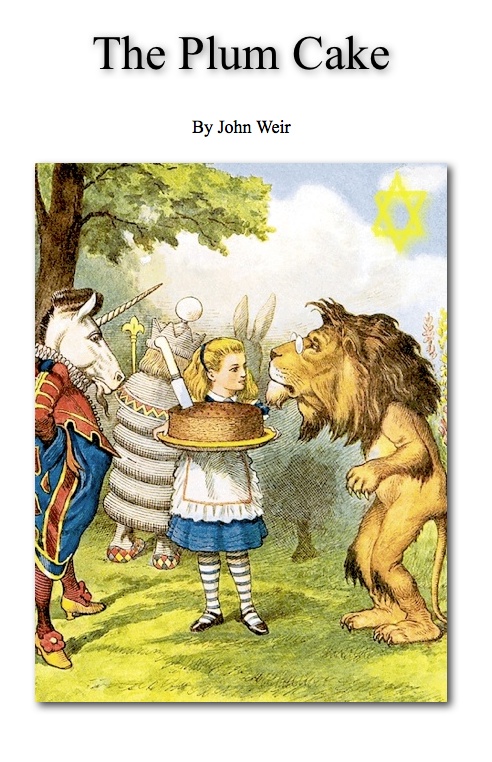
Wear likens it to the circular reasoning logic of Alice in Wonderland where she has to distribute the plum cake pieces before she has cut it into pieces.

The Holocaust story-tellers start with “fact” that the “Holocaust” occurred and then reason backwards that there therefore had to have been a plan and an order somewhere!

What is a fact is that diabolical lies have been told against Germans, and Whites in general, to justify the ongoing White Genocide agenda now being carried out.

– KATANA]


Since the end of World War II a search has continued, and for many has ended with the quarry having eluded its hunters. Some believe what they seek never existed in physical form, but existed nonetheless. It is vitally important that it existed during the war though it has never been located by those chasing it ever since Germany’s defeat. Though no one has seen it, circumstances dictate that it must exist. The fabulous item assumed, but never seen, is the order to commence the extermination of Jews.


The logic behind the assumption of a “Hitler order” is that since there was a Nazi program to exterminate Jews, it must have been ordered by someone; and the someone with authority to do it in Nazi Germany was Adolf Hitler. But no such order has ever been found. This being the case, the order must have either been destroyed or issued orally and never committed to paper. Or so the argument goes.


[Image] Michael Shermer author of Denying History


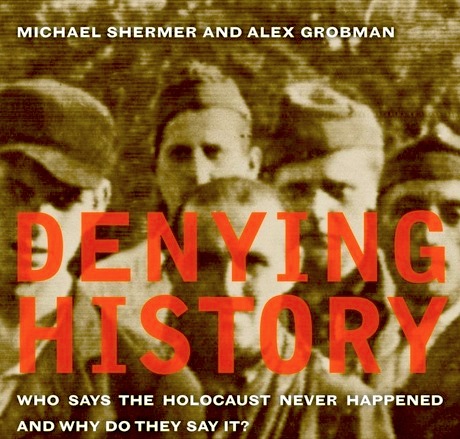
Michael Shermer in his Holotome, Denying History goes into a long, convoluted explanation as to why Hitler resorted to ordering the murder of Europe’s Jews without committing the elusive order to paper: It seems he had been pressured by various religious and political organizations into suspending his euthanasia program and didn’t want to be embarrassed again by having his signature on a piece of paper in case the same should happen with the “Final Solution.


[Image] Michael Shermer’s Denying History


This explanation for an oral Hitler order is speculative. It also explains nothing since the pressure that was brought to bear to end the killing of disabled Germans had little to do with the fact that the order was written. If no paper order existed, relatives of the victims would still have brought pressure to have it stopped. And Hitler would have still been the logical focus for that pressure — a paper order bearing his signature would have made no difference.


Countering the need for Hitler to avoid embarrassment would have been the need for those carrying out the order to have a copy of it. An order is more than an command to do something. It confers the authority to a subordinate to fulfill the instructions given him by his superior. It also identifies who is responsible for the order along the chain of command and whether this person has the authority to issue it.


A German housewife during the war needed papers in the form of coupons in order to purchase butter or almost anything else. When she had run out of coupons she could not buy any more butter. People needed papers when traveling, or working. Nazi Germany was a top-down bureaucracy where paperwork was needed to do nearly everything. When anyone wanted to do something out of the ordinary, permission would have to be requested from the proper authorities who would then issue the proper papers granting permission. Yet this pattern is broken with the extermination of the Jews and no viable explanation as to why this is the case has ever been offered.


Written orders to kill Jews under Nazi control would have to have been issued. There is no way around it since issuing an oral command would have created its own consequences. Such consequences would have been as obvious in the historical record as any written order. For example, any time someone with any authority passed through Auschwitz or Treblinka or any of the “extermination camps” he would have asked what the meaning of the pyres piled high with dead bodies was. Such a visitor would ask to see the order which granted the camp administration the power and authority to wantonly kill camp inmates. When those in charge could not produce such documentation, because the order was oral, the requester would naturally have written to Berlin to request confirmation. Berlin would have to respond. One would expect to find hundreds of such letters if the extermination camps were operating on oral authorization. These queries and requests for verification would have produced a paper trail which would have survived the war since copies of this correspondence would have proliferated as they made their way through the Nazi bureaucracy in duplicate and triplicate.


One line of argument used to explain the void in documents relating to the Holocaust is that the order to kill the Jews along with other documents relating to the extermination program were destroyed by the Nazis in order to hide their crimes. This too is unlikely since it would have been nearly impossible to keep track of all of these documents. In addition, Allied intelligence agents had infiltrated the Nazi government and were intercepting coded German communications. The enemies of the Nazi Germany would have leaked these to the Allies long before the end of the war. Those implementing the orders would have had a strong incentive not to destroy these orders since these could be used in their defense in the event of their prosecution for war crimes.


For these and other reasons the “verbal command from Hitler” explanation is not credible. Rather it is an example of circular logic. Like Alice’s plum cake in Through the Looking Glass which she had to distribute before she could cut it, one has to start with the conclusion that there was a Nazi policy to exterminate the Jews before determining that a Hitler order must exist: There was an extermination program therefore there was an order to initiate it. Since no order has been found, an explanation for why the order is missing was created as a substitute to support the conclusion of an extermination program which was really assumed in the first place.


Such thinking is clearly backwards. Since no order has been found, [2]and one would be needed to initiate an extermination program as government policy, logic dictates that there was no extermination program. Our conclusion must follow our premise. Holocaust authors like Michael Shermer argue that evidence for the extermination program comes by way of a missing Hitler order. That the order was either given orally or destroyed can be concluded since the extermination program existed. Refusing our piece of plum cake, revisionists simply note that no order was issued because it would have been located if such an order existed. Since none has been found, the conclusion is inescapable:


There was no policy to exterminate Jews by the Nazi government.


Source: The Revisionist, Codoh Series, No. 4, 2001, pp.

http://vho.org/tr/2001/4/tr08plumcake.html


________________________


Notes


[1] From Through the Looking Glass Chapter VII:

http://www.bragi.com/classics/c/lc1832/tlg07.shtml

I’m sure I don’t know,’ the Lion growled out as he lay down again. ‘There was too much dust to see anything. What a time the Monster is, cutting up that cake!

Alice had seated herself on the bank of a little brook, with the great dish on her knees, and was sawing away diligently with the knife. ‘It’s very provoking!’ she said, in reply to the Lion (she was getting quite used to being called ‘the Monster’). ‘I’ve cut several slices already, but they always join on again!

You don’t know how to manage Looking-glass cakes,’ the Unicorn remarked. ‘Hand it round first, and cut it afterwards.

This sounded nonsense, but Alice very obediently got up, and carried the dish round, and the cake divided itself into three pieces as she did so. ‘Now cut it up,’ said the Lion, as she returned to her place with the empty dish.

I say, this isn’t fair!’ cried the Unicorn, as Alice sat with the knife in her hand, very much puzzled how to begin. ‘The Monster has given the Lion twice as much as me!

She’s kept none for herself, anyhow,’ said the Lion. ‘Do you like plum-cake, Monster?


[2] The long lost (but now found) Hitler order [Ver 2]


[Image – click to enlarge] Could this be the long lost Hitler order??


The Daily Fail (a highly reputable British newspaper, sometimes known as the Daily Mail) reports that this document was reportedly found by Moshie Goldberg, a diamond dealer and ex-arms dealer now residing in Tel Aviv, in the back pocket of a dreaded, yet recently dead, SS officer, as Berlin fell in 1945. He swears on a stack of bibles on its authenticity.


Experts, from prestigious universities, after rigorous analysis funded by the Weaselberg Foundation believe this could be the the actual original document that sent at least six million Jews to their doom! The greatest crime ever committed in the history of mankind!


Questions as to why it was written in English were waved aside, by an expert historian, Sir Trevor Raper, as baloney and disgustingly anti-semitic.


“The evil Nazis were well advanced in their plans to invade Britain as part of their diabolical scheme to conquer the entire world. The Nazi hierarchy were busy learning English, as Great Britain was the nation that had already conquered most of the entire world. As such Hitler himself was learning English and setting an example by issuing all orders in English, inadvertently creating so much confusion, that it caused them to lose the war!

It [English] was one of our greatest secret weapons.

If it wasn’t for the valiant and heroic efforts of the British people, and the Allies, we would be all be speaking German today, and ironically, all the Germans would be speaking English!”


Source: katana


===============================================


See Also:


The World’s First Anti-Holocaust Convention — Instauration Dec, 1979

An Open Letter to New Jersey’s Governor

Historians or Hoaxers?

House of Orwell

Misha: Surviving with Wolves or …

Bradley Smith’s Smith Report # 1

The Liberation of the Camps: Facts vs. Lies

The Plum Cake


Auschwitz: Myths and Facts

Powers and Principalities XI – Ewen Cameron, MK-Ultra, Holocaust Revisionism — TRANSCRIPT

Tales of the Holohoax – A Historian’s Assessment – Part 1

The Holocaust Lie — Made in America

Probing the Holocaust: The Horror Explained — TRANSCRIPT

Jim Rizoli Interviews Prof Robert Faurisson, Oct 2015 — TRANSCRIPT

Holocaust Eyewitnesses: Is the Testimony Reliable?

Alain Soral – My Homage to Robert Faurisson, Oct 2018 — TRANSCRIPT

Inside Auschwitz – You’ve never seen THIS before! — TRANSCRIPT


Amazion Bans 100s of Holocaust Revisionist Books!

AUSCHWITZ – A Personal Account by Thies Christophersen

Jim Rizoli Interviews Bradley Smith — TRANSCRIPT

London Forum – Alfred Schaefer – Psychological Warfare – TRANSCRIPT

The Realist Report Interviews Eric Hunt — TRANSCRIPT

Red Ice Radio – Germar Rudolf – Persecution of Revisionists & Demographic Disaster – Part 1— TRANSCRIPT

Red Ice Radio: Nicholas Kollerstrom — TRANSCRIPT

Red Ice TV – Ingrid Carlqvist – Scandal in Sweden When Ingrid Questions the Unquestionable — TRANSCRIPT

The Realist Report with Carolyn Yeager on Johnson vs Anglin debate — TRANSCRIPT


============================================


PDF of this post. Click to view or download (1.2 MB). >> The Plum Cake – Ver 3


Version History


Version 8: Sep 17, 2023 — Added my Intro.


Version 7: Feb 15, 2023 — Updated image links.


Version 6: Jan 27, 2020 — Added See Also links.


Version 5: Oct 7, 2019 — Re-uploaded images and PDF for katana17.com/wp/ version.


Version 4: Sep 12, 2018 – Improved formatting.


Version 3: May 1, 2015 – Edited footnote [2]. Added PDF Ver 3.


Version 2: Apr 30, 2015 – Added to footnote [2]. Added PDF Ver 2.


Version 1: Published Apr 18, 2015

Posted in America, anti-White, Bradley Smith, Brainwashing, gas chambers, Germany, Hitler, Hitler Order, Holocaust, Holohoax, International Finance, Israel, Jew World Order, Jewish Problem/Question, Jews, Jews - Lying, jews — persecution by, John Wear, Media - jewish domination, National Socialism, Poland, Propaganda - Anti-German, Revisionism, The International Jew, Third Reich, White genocide, WW I, WW II | 5 Comments

The Bizarre Story of Kristallnacht – Part 2 (last)

  The Bizarre Story of Kristallnacht


Crystal Night” 1938:


The Great Anti-German Spectacle


PART 2 (last)


Paper Presented to the


Sixth International Revisionist Conference


By Ingrid Weckert


[Image] Ingrid Weckert


CONTENTS


PART 1

Introduction

The Story We Are Given

German-Jewish Relations Prior to “Crystal Night”

The Haavara Agreement

National Socialist Ethical Standards

What Really Happened During “Crystal Night”

The Grynszpan Story

Who Could the Provocateurs Have Been?

PART 2

Munich on the Ninth of November

What Was Goebbels Doing?

Orders to Stop the Pogrom

How Did the SA Get Involved Despite the Orders From Its Own Leaders?

The Fine Imposed on the Jews

The Consequences of “Crystal Night”

Conclusion

Notes

FAIR USE NOTICE

Additional Notes

Version History & Notes


Munich on the Ninth of November

top


While all this was happening across the Reich, a special annual commemoration was being held in Munich. Fifteen years earlier, on 9 November 1923, a movement led by Adolf Hitler, Erich von Ludendorff (a leading First World War General), and two major figures in the Bavarian government tried to depose the legal government and take responsibility themselves as a new national government. The uprising or putsch was put down and 16 rebels were shot down next to the Feldherrnhalle, a famous old monument building in central Munich. Accordingly, the 9th of November had been commemorated every year since 1933 as the memorial day for the martyred heroes of the National Socialist movement. Adolf Hitler and the Party veterans, as well as all of the Gauleiters (regional Party leaders) met every year in Munich for the occasion. Hitler would usually deliver a speech to a select audience of Party veterans at the famous Buergerbraeukeller restaurant on the evening of the 8th.


[Image] The famous Buergerbraeukeller restaurant.


On the morning of the 9th Hitler and his veteran comrades would reenact the 1923 “March to the Feldherrnhalle.” On the evening of the 9th the Fuehrer always held an informal dinner at the Old Town Hall (“Alte Rathaus”) with old comrades as well as all the Gauleiters. At midnight young men who were about to enter the SS and the SA were sworn in at the Feldherrnhalle.


Continue reading

Posted in America, Germany, International Finance, Israel, Jews, Kristallnacht - Crystal Night, Kristalnacht, National Socialism, Poland, Propaganda - Anti-German, Revisionism, The International Jew, Third Reich, WW I, WW II | 1 Comment

The Bizarre Story of Kristallnacht – Part 1

  The Bizarre Story of Kristallnacht


Crystal Night” 1938:


The Great Anti-German Spectacle


PART 1


Paper Presented to the


Sixth International Revisionist Conference


By Ingrid Weckert


[Image] Ingrid Weckert


CONTENTS

PART 1

Introduction

The Story We Are Given

German-Jewish Relations Prior to “Crystal Night”

The Haavara Agreement

National Socialist Ethical Standards

What Really Happened During “Crystal Night”

The Grynszpan Story

Who Could the Provocateurs Have Been?

PART 2

Munich on the Ninth of November

What Was Goebbels Doing?

Orders to Stop the Pogrom

The Fine Imposed on the Jews

The Consequences of “Crystal Night

Conclusion

Notes

FAIR USE NOTICE

Additional Notes

Version History & Notes


Introduction

top


Crystal Night” is the name that’s been given to the night of 9-10 November 1938. In almost all large German cities and some smaller ones that night, store windows of Jewish shops were broken, Jewish houses and apartments were destroyed, and synagogues were demolished and set on fire. Many Jews were arrested, some were beaten, and some were even killed. The “Reich Crystal Night” (Reichskristallnacht) was one of the most shameful events of National Socialist Germany. Although the Jews suffered initially, the greatest harm was ultimately done to Germany and the German people. Even people who are sympathetic to National Socialism cannot understand how this event could have happened. Julius Streicher, the so-called “number one Jew baiter [1] for example, was shocked when he first learned about the demonstrations and destruction the next morning. The all-important question is: Who was responsible for the incident? It is generally accepted, especially by contemporary historians, that the Nazi gang organized and carried out the pogrom, and that the chief instigator was Propaganda Minister Dr. Joseph Goebbels.


[Image] Kristallnacht, shop damage in Magdeburg


The truth of the matter is that Adolf Hitler was so disgusted by the incident that he forbade anyone from discussing the matter in his presence. Dr. Goebbels complained that he would now have to explain this terrible affair to the German people and the world, and that he simply did not know what kind of credible explanation to give. If he had actually been responsible for the Crystal Night, he surely would have had a well- prepared explanation. The explanation he gave on the morning of the 10th was extremely unconvincing and was generally not believed by the German public.


[Image] A New York Times headline.


During my study of this subject, which resulted in my book on the Crystal Night, Feuerzeichen, I found many facts which do not agree with the generally accepted thesis. On the contrary, the evidence which I have found gives a completely different picture.


The Story We Are Given

top


The generally accepted sequence of events, according to most writers on the subject, is this: In early October 1938 the Polish government announced that all Polish passports would become invalid at the end of the month unless they received a special stamp before then, obtainable only in Poland. This measure was meant to rid Poland effectively for all time of all Polish Jews living in foreign countries, most of whom were in Germany. Many of the approximately 70,000 Polish Jews living in the Reich at the time had arrived after the First World War. Of course, the German government now feared that it would have to permanently accept these 70,000 Jews. The German government tried to negotiate this issue with the Poles, but they flatly refused.


On 28 October, just two days before the deadline, German police rounded up between 15,000 and 17,000 Polish Jews, mostly adult males, from across the Reich and transported them to the German-Polish border. The deportees traveled in regular German passenger trains with more than adequate space. Contrary to some claims, they were not crammed into cattle cars. The deportees were well provided with food and medical care. Red Cross personnel and medical doctors accompanied them on the trains. [2]


The Polish border officials were surprised when the first trainloads arrived at the border, and they let the Jews enter Poland. At about the same time, the Polish government was deporting German Jews back to Germany. The next day, 29 October, the Polish and German governments suddenly agreed to stop the deportations of their respective Jewish populations to each other’s countries. The deportations were completely halted that night.


Continue reading

Posted in America, Germany, International Finance, Israel, Jews, National Socialism, Poland, Propaganda - Anti-German, Revisionism, The International Jew, Third Reich, WW I, WW II | 3 Comments

The Liberation of the Camps: Facts vs. Lies

The Liberation of the Camps:


Facts vs. Lies


The Journal of Historical Review


July-August 1995 (Vol. 15, no. 4)


By Theodore J. O’Keefe


[Image] American troops guarding the main entrance to Dachau just after liberation, 1945


Earlier this year [1995] countless newspaper and magazine feature articles and special television broadcasts recalled the liberation 50 years ago by American, British and Soviet troops of German concentration camps. As the following essay shows, many of these retrospective articles and reports grossly distort reality. 


Nothing has been more effective in establishing the authenticity of the Holocaust story in the minds of Americans than the terrible scenes US troops discovered when they entered German concentration camps at the close of World War II.


[Image] Display shows two shrunken heads [taken from a museum], pieces of tattooed skin and lamp [actually made from goat skin]


At Dachau, Buchenwald, Dora, Mauthausen, and other work and detention camps, horrified US infantrymen encountered heaps of dead and dying inmates, emaciated and diseased. Survivors told them hair-raising stories of torture and slaughter, and backed up their claims by showing the GIs crematory ovens, alleged execution gas chambers, supposed implements of torture, and even shrunken heads and lampshades, gloves, and handbags purportedly made from skin flayed from dead inmates.


[Add. Image] Map of concentration camps in US/Brit/French post-war zones.


[Add. Image] Map of concentration camps in Soviet post-war zone.


US government authorities, mindful that many Americans who remembered the atrocity stories fed them during World War I still doubted the Allied propaganda directed against the Hitler regime, resolved to “document” what the GIs had found in the camps. Prominent newsmen and politicians were flown in to see the harrowing evidence, while the US Army Signal Corps filmed and photographed the scenes for posterity. Famous journalist Edward R. Murrow reported, in tones of horror, but no longer of disbelief, what he had been told and shown, and Dachau and Buchenwald were branded on the hearts and minds of the American populace as names of infamy unmatched in the sad and bloody history of this planet. [20]


Continue reading

Posted in Auschwitz, Bergen-Belsen, Buchenwald, Dachau, Deception, Dr. Charles Larson, Germany, Holocaust, Holohoax, Ilse Koch, Jews, Jews - Lying, National Socialism, Nuremberg, Nuremberg Trials, Propaganda - Anti-German, Revisionism, The International Jew, Third Reich, typhus, WW II, Zyklon B | 7 Comments

Red Ice Radio: Nicholas Kollerstrom — ATTENTION READERS

ATTENTION READERS!

 [NOTE: This was a “Sticky Post” — new posts will appear below this post.]

The transcript of the Nick Kollerstrom interview by Red Ice Radio is now complete!

Special thanks to commenter Monad for helping out in completing the task.

KATANA


Progress Chart - Red Ice Transcription1202


 Please click here to go to the post:

>>> Red Ice Radio: Nicholas Kollerstrom  — TRANSCRIPT

Version 11:  May 6, 2015 – added new progress bar (now 130 mins). Transcript is now complete

Version 10:  Apr 29, 2015 – added new progress bar (now 120 mins — with thanks to commenter Monad).

Version 9:  Apr 26, 2015 – added new progress bar (now 110 mins — with thanks to commenter Monad).

Version 8:  Apr 25, 2015 – added new progress bar (now 100 mins).

Version 7:  Apr 22, 2015 – added new progress bar (now 95 mins — with thanks to commenter Monad).

Version 6:  Apr 21, 2015 – added new progress bar (now 90 mins).

Version 5:  Apr 16, 2015 – added new progress bar (now 85 mins).

Version 4:  Apr 15, 2015 – added new progress bar (now 80 mins).

Version 3:  Apr 9, 2015 – added new progress bar (now 75 mins — with thanks to commenter Monad).

Version 2:  Apr 6, 2015 – added progress bar (now 65 mins).

Version 1: Published Apr 5, 2015.

Posted in Holocaust, Holohoax, Jews | Leave a comment

Onward Christian Soldiers – Part 15: England; Europe; Epilogue (last)


Onward Christian Soldiers 

[Part 15 (last)]


Note

This new version of Onward Christian Soldiers that I’ve compiled consists of the original contents published by Noontide Press in 1982 plus the “missing” text that, for reasons explained below, was in the Swedish version published in 1942.

I’ve also included some supplementary texts here giving the history of the missing parts of Day’s book. Also book reviews by Revilo Oliver and Amazon readers (see Part 1).

KATANA


Contents


Maps of Northern Europe & the Baltic States

THE REST OF DONALD DAY by Paul Knutson — 1984

EDITORIAL NOTE by Liberty Bell

The Resurrection of Donald Day — A review by Revilo P. Oliver. The Liberty Bell — January 1983

TWO KINDS OF COURAGE by Revilo P. Oliver. The Liberty Bell — October 1986

AMAZON REVIEWS

__________________

ONWARD CHRISTIAN SOLDIERS

Chapter

Introduction

Permit Me To Introduce Myself * (all new)

1 Why I did not go Home *………………………………. 1

2 The United States  *………………………………………. 7

3 Latvia  ………………………………………………………… 21

4 Meet the Bolsheviks  *………………………………….. 41

5 Alliance with the Bear  *……………………………….. 53

6 Poland  ……………………………………………………….. 63

7 Trips  ………………………………………………………….. 85

8 The Downfall of Democracy * ………………………. 93

9 Jews  …………………………………………………………… 101

10 Russia  *………………………………………………………. 115

11 Lithuania * ………………………………………………….. 131

12 Danzig  ……………………………………………………….. 145

13 Estonia  ……………………………………………………….. 151

14 Sweden  ………………………………………………………. 159

15 Norway  ………………………………………………………. 169

16 Finland  ………………………………………………………. 183

17 England  *……………………………………………………. 197

18 Europe  *…………………………………………………….. 201

19 Epilogue  *…………………………………………………… 204

Index of Names  ………………………………………………….. 205

* Contains new material (dark blue text) missing from original Noontide edition.

MAP

of Northern Europe 1920s (click to enlarge in new window)

MAP

of Baltic States 1920s (click to enlarge in new window)


LIBERTY BELL PUBLICATIONS

June 1984

THE REST OF

DONALD DAY

by

Paul Knutson

Donald Day, who had been for many years the foreign correspondent of the Chicago Tribune in northern Europe, wrote a record of his observations, Onward, Christian Soldiers, in 1942. His English text was first published as a book in 1982. It was printed by William Morrison and appeared under the imprint of the Noontide Press of Torrance, California, As Professor Oliver pointed out in his review of that book in Liberty Bell for January, 1983, the text had been copied, with some omissions and minor changes, from an anonymously issued mimeographed transcription of a defective carbon copy of the author’s manuscript, which had been brought to the United States in someway, despite the vigilance of Franklin Roosevelt’s surreptitious thought-police.

That was not the first publication of Day’s book. A Swedish translation, Framat Krististridsman, was published by Europa Edition in Stockholm in 1944. (That paper cover, printed in red, green, and black, is reproduced in black-and-white on the following page.)


Copies of this book still survive in Sweden and are even found in some public libraries. There may still be a copy in the Library of Congress, where, however, it was catalogued and buried among the very numerous books of a different Donald Day, a very prolific writer who midwifed the autobiography of Will Rogers and produced book after book on such various subjects as American humorists, the folk-lore of the Southwest, the tourist-attractions of Texas, and probably anything for which he saw a market, including a mendacious screed entitled Franklin D. Roosevelt’s Own Story. By a supreme irony, the Library concealed Framat Kristi stridsman in its catalogue by placing it between the other Day’s Evolution of Love and his propaganda piece for the unspeakably vile monster whose millions of victims included one of the last honest journalists.

The Swedish translation contains some long and important passages that do not appear in the book published in California and are not found in the mimeographed copy. By translating these back into English, I can restore Donald Day’s meaning, but, of course, I cannot hope to reproduce exactly the words and style of his original manuscript. I can also restore from the Swedish the deficiencies of the mimeographed transcript.

It seems impossible to determine now whether the parts of Day’s work that are preserved only in the Swedish were deleted by him to shorten his text when he sent a typewritten copy to the United States or were added by him before he turned his manuscript over to the Swedish translator at about the same time. At all events, the Swedish now alone provides us with some significant parts of bay‘s book and many Americans will want to have Day’s Work complete and entire.

For the convenience of the reader, I have, by arrangement with the publisher of Liberty Bell, included corrections of the printed English text where it departs, through negligence or misunderstanding, from the mimeographed text from which it was copied. I have passed over obvious typographical errors in the printed book, and omitted small and relatively unimportant corrections. For example, near the end of p. 44 of the printed book, the sentence should read, “All reported that the officials of the Cheka, later known as the GPU and NKVD, were Jews.

Day did not use footnotes, so the reader will understand what all the footnotes [indicated by the symbol *] on the following pages are my own explanations of the text.

The supplements below are arranged in the order of pages of the printed book, as shown by the note in the small type that precedes each section, The three sources are discriminated typographically thus; Italics show what is copied from the printed text to give continuity.

Ordinary Roman type is used for what is in the mimeographed copy but was omitted from the printed version. This, of course, is precisely what Day wrote in English.

What I have translated back from the Swedish appears in this style of type. These passages, as I have said, convey Day’s meaning without necessarily restoring exactly the words he used in his English original, from which the Swedish version was made.

*****


Editorial Note


Liberty Bell

With the foregoing supplements, we have at last as accurate a text of Donald Day’s Onward, Christian Soldiers as we are likely to have, barring the remote possibility that the manuscript Day gave to his Swedish translator may yet be discovered.

The Swedish translation is pedestrian, as indeed is Day’s English style, but a comparison of the Swedish with the extant parts of the English assures me of the translator’s general competence. In one passage, which we have only in the Swedish, in which Day reports his refusal to become a well-paid and dignified member of our Diplomatic Service with a “little Morgenthau” as an “adviser” to tell him what to do, the translator was evidently confused by the irony of some English phrase such as “executive for a Jew” and reversed Day’s obvious meaning;, this was corrected in the foregoing text.

The mimeographed version is evidently a transcription from Day’s carbon copy, with only such errors as only the most expert typists can entirely avoid. There is, however, one very odd error in the mimeographed version corresponding to our printed page 4 above; it reads “the Great Rocky mountains of the border of Tennessee and North Carolina.” That is geographically absurd, of course, and the Swedish (stora Rijkiga Bergen) shows that Day wrote “Great Smoky mountains,” as we have, printed above. It is probably only a coincidence that the Swedish word for “Smoky” could have suggested, to a person who knew no Swedish, the error made by the typist in California who copied Day’s carbon copy.

When Day relies on his recollection of what he was told years before, his memory is sometimes faulty, and we have naturally made no changes in what he wrote. He makes an obvious error on our page 4, where he says that the Cherokees were driven from their lands and moved to Indian Territory “toward the end of the last century.” Actually, the expulsion of the Cherokee Nation by an American army took place in 1838. The Cherokees, by the way, were the most nearly civilized of all the Indian tribes in the territory that is now the United States and Canada, and it is true that their expulsion from the lands that had been guaranteed to them by treaty inflicted great hardships on them: they lost most of their property, including their negro slaves, and large numbers of them perished as they were quite brutally herded from the Appalachians almost half way across the continent to what is now the southern border of Arkansas.

Ethnologists who have made intensive studies of the Indians of North America (e.g., Peter Farb) regard Sequoyah (Sequoia) as perhaps “the greatest intellect the Indians produced.” He was the son of a Cherokee woman by an unidentified white trader, and, growing up with the mother’s people, regarded himself as a Cherokee. He, however, was an exception to what Day says about half-breeds. Day may have been confused about the date of the expulsion because a few of the Cherokees succeeded in hiding from the perquisition in the wilds of the Great Smokies and were eventually given the small reservation they now occupy east of Bryson City in the toe of North Carolina. There was some agitation about them “near the end of the last century.

The circumstances in which Day’s carbon copy was smuggled into the United States remain obscure. When the mimeographed transcription was made and first issued, it contained a prefatory page on which an anonymous writer said,

It is my understanding that this book was published in; 1942, and then merely made an appearance at the book-sellers, when all copies were immediately withdrawn and destroyed without a single copy escaping the book-burners, I was also told that Mr. Day died shortly after this incident.

The page was presumably withdrawn when its author learned that Day was still alive at that time and an exile in Helsinki, since the Jews who rule the United States would not permit him to return to his native land.

It is curious that the man who made the transcription, which did effectively preserve Day’s work for the future, and who was evidently a resident of California, had heard a somewhat less plausible version of the rumor that was current in Washington in 1943. (See the review by Professor Oliver in Liberty Bell, January 1983, p. 27). It is quite possible that the source of both rumors was an effort by the apparatus of the great War Criminal in the White House to prevent the publication of the Swedish translation, which, as Day tells us in the last item in our supplements, was delayed in the press for two years by a “paper shortage” and it is noteworthy that the paper for it was finally obtained in Finland, not Sweden,* Until the book was finally published in 1944, the enemies of mankind could have imagined that their pressures on Sweden had effectively prevented Day’s exposure of one phase of their activity from ever appearing in print.

[* Day’s book was published by Europa Edition in Stockholm, which, however, had to have the printing done by Mercators Tryckeri in Helsinki. Although copies of the Swedish book have been preserved, Day’s work would not now be generally known — and would be supposed lost by Americans who heard of it — if the anonymous gentleman in California had not issued his mimeographed transcription.]

_______________________


KATANA — The Liberty Bell article continues with a list of text to be added or amended to the Noontide edition. All these changes (indicated by the dark blue text) have been entered in this expanded version of Onward Christian Soldiers.


Word Totals for the Additional Text

Introduction – –

Permit Me To Introduce Myself – 5,738 (all new)

Chapter 1 – 23

Chapter 2 – 307

Chapter 3 – –

Chapter 4 – 653

Chapter 5 – 1,225

Chapter 6 – –

Chapter 7 – –

Chapter 8 – 408

Chapter 9 – –

Chapter 10 – 907

Chapter 11 – 6

Chapter 12 – –

Chapter 13 – –

Chapter 14 – –

Chapter 15 – –

Chapter 16 – –

Chapter 17 – 2,167

Chapter 18 – 1,179

Chapter 19 – 89

Total words in original = 85,311

Total additional words = 12,702

_______________

Total words in expanded version = 98,013


ONWARD


CHRISTIAN


SOLDIERS


1920-1942: Propaganda, Censorship

and One Man’s Struggle to Herald the Truth

Suppressed reports of a 20-year Chicago Tribune

correspondent in eastern Europe from 1921

Donald Day

With an introduction by Walter Trohan,

former chief of the Tribune’s Washington bureau

THE NOONTIDE PRESS


Chapter 17


England


In the winter of 1927, John Steele, chief of The Tribune’s London Bureau, asked me to accompany him to the foreign office as one of the officials there had expressed a desire to meet me. I recognized the flattery and wondered what I had done to merit such attentions.

We were received by Sir George Clark, a typical tall, lean Englishman, whose growth had not been stunted by lack of food in his youth. Sir George conversed with Steele about various matters and I patiently waited. As he seemed to have no questions for me, I became the questioner. I asked if the British government would not some day contemplate a more active participation in Baltic affairs since the governments of Estonia, Latvia and Lithuania, as so far as I knew, also those of Finland and Sweden, would like nothing more than to have Great Britain declare the Baltic a neutral sea.

Sir George was almost brusk in his reply:

Those small countries have no permanence. They are here today and gone tomorrow. There can never be a question of Great Britain guaranteeing the status quo in the Baltic and it is not in her interest to do so.

I replied that the Baltic states would hear that with deep regret, since they all based their hopes on Great Britain, which they encouraged in every possible way through their foreign trade.

I then asked about England’s policy toward the Soviet government, and mentioned a series of articles by a member of the Communist International that had appeared in Moscow’s Izvestia. Those articles described in detail the plans by which Sun Yat Sen intended to begin a new campaign against British interests in China with support from the Communist International. I had found them sufficiently significant to have them translated and sent to my newspaper.

[Image] Sun Yat Sen

Sir George said that he knew of the articles in question, but that the British government did not attach much importance to the Communist International or the plans of the Soviet government.

Mr. Day you are too close to Moscow in Riga to obtain a proper perspective,  he said.

The English government’s primary aim in China is to do business. The primary concern of the Chinese is also to do business. Neither Sun Yat Sen nor the Communist International will be able to hinder us from doing business with each other. The Communist International’s operations are of very little interest to us.

Viewed from London these matters look different than they do from Riga.

That ended my conversation with Sir George Clark and I never learned why he wished to meet me. As we were leaving the Foreign Office, 1 asked John Steele whether Sir George was considered to be a capable diplomat. Steele assured me that he was one of the best and had a brilliant career ahead.

I replied that I had been brought up with a great respect for England, since my father always loved and admired England above all countries with the exception of our own. From what I had heard about England, I had formed the opinion that British diplomacy was so far-sighted and complex that many things which seemed contradictory and confusing in the policies of the moment, would turn out, years in the future, in accordance with the British governments’ designs.

I added that I was grateful for our visit, since it had totally shattered that illusion.* it had shown me that the principal objective of British policies was profit, and, more specifically, instant profit. I advised John to watch developments in China and to remember the Communist International’s program and predictions. And Sun Yat Sen, before he died a few years later, did succeed in thwarting a large part of the commercial relations Sir George had so confidently anticipated.

[*We have every reason to believe that. Day was right in identifying the monumental stupidity exhibited by Sir George Clark as representing the views of his superiors in the government of Stanley Baldwin, whom many believe to have been no more than a blockhead when he engineered the abdication of King Edward VIII, who, whatever his capacities, would have been an obstacle to the Jews’ plans for a crusade against Germany and the race that Germany represented. Some Englishmen claim to know indications that Edward’s infatuation with the American divorcee was merely a pretext for an abdication to which he consented when he saw that the British ruling class was so corrupted that a suicidal war against Germany could not be averted. Others, seemingly as well informed, believe Edward was not much more intelligent than Baldwin.]

[Page 198]

The respect for the British government which I had lost on this journey to London was never regained. I still love England when I look at my bookcase, but when I contemplate her government I have a quite different feeling. In 1934, when I visited my headquarters back home, I was offered a position in the London bureau. That appointment would have brought higher wages and opportunities to travel home more often. I declined.

My visit to the Foreign Office may seem but a trivial incident. It is a succession or culmination of such incidents that influence opinion. My conversation with Sir George revealed at least that English diplomacy was not so competent as I had thought.

I was disappointed, but not so bitterly as were the Reiter Choir during their visit to England. They were among the best choral singers in northern Europe, because the Latvians, like most people, love to sing. Theodore Reiter accepted an invitation to take his choir to Wales, where there is an ancient tradition of choral music. Most of the Latvian singers could speak English. Many had studied at the English Institute in Riga. They had that profound respect and very warm admiration for England that is so clearly evident in all the Baltic countries.

[Image] London slum

I spoke with members of the choir when they returned. They were deeply shocked by what they had observed in Cardiff and other cities in Wales. The inhabitants’ frightful poverty and the general misery in that coal district, where the coal mining and processing works were shut down while England was buying cheap coal from Poland, caused the Latvian singers to lose respect for England. Upon their return to Riga, many of the same group felt that a revolution in Britain was inevitable. They were deeply shaken to find in Britain a grinding poverty that had’ no counterpart in the Baltic lands. Reiter’s choir had travelled through many countries in Europe and given concerts in most of the European capitals. They were thus in a position to make comparisons. If small countries like Latvia were able to feed and shelter their people properly, they wondered why so much suffering and degradation should be found in the world’s richest and most powerful nation.

Another aspect of life in the British ghettos that impressed the choir unfavorably was the prevalence of alcoholism among women of the working class. It was a common sight to find dozens of baby buggies standing outside the pubs, while the women sat inside, drinking gin and beer. Nothing like that could, be seen in European countries. They could not find any excuse for such conduct, which they considered unpardonable. But the disappointment of this small group of Latvians was the exception.

One of the invisible factors that the English certainly counted on, when they wholly and unreservedly entered into the Jewish plan to marshal Europe for an attack on Germany, was the distinctly high prestige Englishmen enjoyed in Europe.

People did more than admire and respect England. Many really loved England. Like other love this love is also blind to reason. And one of the most difficult things which the Germans have had to contend with was this love for John Bull, that fat old man whose round chubby nose revealed he liked to acquire other people’s property and keep it for himself.

The fat old man had plenty of money. He was popular because he liked to give other folks books and films that showed how high-minded and noble he had been in his youth, and how dignified, honest, and respectable he was in his old age.

[Image] John Bull and his bulldog.

It did not matter that an examination of his earlier life revealed that he had been a robber and an arrant knave, and that in his later years he had become a Pharisaical hypocrite. He was encompassed by the splendor and prestige of wealth. When he spoke, his voice commanded the attention of millions of adults, who listened with the same rapt attention with which children listen to fairy tales.

The fat old man lived on an island. He had many visitors who came to admire him. Now and then he would go travelling. He dared not misbehave at home, so when he wanted to cut loose from his inhibitions, he would take a short trip to Paris. There he could do whatsoever he wished, because he always had lots of money with him on his travels. He would also make longer journeys. These usually concerned his possessions in various parts of the world or were for the purpose of transacting business affairs that would make his home life more abundant.

In his youth, middle-age, and even until 1914, this man kept himself well informed. He paid handsomely for intelligence and maintained diplomats, agents, and journalists in foreign lands who kept him informed of what was happening in the world. As with most rich people, the primary objective of this man’s life was to acquire more money and greater power. He also refused to leave any of his property to another person, whoever that might be. He owed America a large debt, but refused to turn over his islands or other possessions in the western hemisphere as payment of his debts from the [first] World War. He had, moreover, seized Germany’s colonies, which were to be governed as mandated territories until it was time to return them, but that time never came. When Germany finally asked for their return, he said he could not return them because he had transferred those mandates to his dependents, mainly South Africa and Australia.

When he saw that Germany was rapidly becoming so powerful that she would be in a position to repeat her demands with such strength behind her words that he would be forced to listen, he decided to take action. That was one of the main reasons for his decision to go to war all over again. Just as in the previous war, he was confident that everyone loved him so much they would be willing to serve his purposes in his new war. He accordingly made many generous promises and the war began precisely as he wanted it.

But it turned out that he had been badly misinformed. His diplomats, in their inimitable, arrogant, and self-serving fashion, blundered again and again. His foreign correspondents and agents, many of whom were Jews, sent him bedizened reports that turned out to be false and misleading.

The favorite publication of this old man was, and is, a humorous weekly called Punch. There is many a true word spoken in jest as the following poem, published on page 198 in the 21 August 1940 issue of Punch exemplifies.


THE RETURN OF THE NATIVE

By A.P.H.

Our crude Victorian Papas

Were fond of giving loud hurrahs

For Nelson, Blake and Hood;

And, not content with such displays

They added then the horrid phrase

The foreigner’s no good,”

While quite unable to dismiss

The simple tale of Genesis

They never understood

Why Adam, first upon the earth,

Was not of honest British birth,

And therefore no damned good.

And when from their well-ordered home

They went to Paris or to Rome

(As in those days one could),

Each morning reinforced and warmed

The mournful view already formed

The foreigner’s NO GOOD.

Such sentiments of course amaze

In these humane, enlightened days

Of general brotherhood;

But really, when one looks about,

There does intrude a tiny doubt

Are foreigners much good?

At all events, the nation’s tone

Is brighter now that we’re alone,

And have not left the wood,

Than when our friends were quite a queue,

Perhaps we still accept the view —

The foreigner’s no good.


In English usage, the word ‘native’ (infoding)* has a derogatory meaning and is applied to all creatures that are not English.

[* In the text, the word “native” is in English and is followed by the Swedish definition, which should have reminded Day that infodingsratt is the normal Swedish term for “the rights of citizens,” i.e., of persons who are bom in the nation of which they are members, a nation, properly speaking, being composed of persons who are united by belonging to the same race, subrace, and ethnic group and so presumably have a common descent from remote ancestors. The incomprehension that Day shows here is amazing and goes far beyond the obvious fact that in neither Britain nor the United States do expressions such as “to speak French like, a native” carry a pejorative connotation. In the title of the English verses, he has not only missed the allusion to Hardy’s well-known novel, but failed to see that the “native” meant is precisely the Englishman who is said to be reverting to his inborn prejudice against foreigners.

Day’s polemic against Britain is unfair, but understandable. He wrote under the stress of a strong and even justifiable emotion, excited by the terrible war that Britain had officially forced on the world and for which she, as a nation, must bear the gravaman of guilt. Although that war was, of course, contrived by the Jews and incited by the intrigues of a half-English traitor, Churchill, and the loathsome creature that then befouled the White House, the two conspirators had natives of both countries as conscious accomplices in their ghastly crime, and it was Great Britain that officially began the war by attacking Germany.]

In Stockholm I was recently astonished to read in an English-Swedish grammar published in London that a little study of the book would enable an English tourist in Sweden “to converse with and make himself understood by the natives.” This distinction places the Swedes in a category beneath Englishmen. The Englishman is more than conceited, he is stupid, and takes the liberty of looking down upon a Swede, although the Swede has a far higher standard of living than the English, has an equally proud and perhaps more honorable history, and equally high or higher level of culture.

This attitude, which as I can attest from my own experience, is very widespread, has prevented the Englishman from gaining a proper understanding of other nations. In general, he was glad to leave others in peace so long as they did not own something he wanted, or so long as his own interests were not affected. But when they were, at that very moment one could not but pity the natives, whether they were the wild mountain tribes on the frontiers of India, who were the first human beings to b.e subjected to death and destruction by high-explosive bombs from British planes during the years following the [first] World War, or the somewhat more civilized Poles, who were made to start a war with Germany by British promises, or the perhaps over-civilized Norwegian King, Haakon, who owed his declaration of war against Germany to promises of help from England. Promises emanating from Downing Street or the White House are not worth a bit more than those from the Kremlin.

The English often hit upon clever propaganda. One of their ideals that sounds good is contained in the expression, “Live and let live.” That ideal can be translated as “Live, but let me live better than you, my good man.

[The chapter ends here. Everything that appears in the printed book on p. 199 after the verses, “The Return of the Native,” is obviously out of place, probably because a page or two of the carbon copy was displaced when the mimeographed text was transcribed. It appears with some expansion in the following chapter, which it seems best to print in its entirety. A large part of this chapter is preserved only in the Swedish, and where this overlaps the English text, there are quite a few points at which it is difficult to decide whether the Swedish translation is somewhat free or shows stylistic revisions made by Day himself. Where there is a choice, I have preferred to adhere to the printed English text in what follows.]

[Page 199]

I can report with perfect truth that the average American does not like England any more than he likes Cuba. The average American, since the close of the first world war, has applauded the idea of never again interfering in a war in Europe. The average American knows that his country, before it suddenly found itself at war, was in a cultural, social and economic mess; involved in the worst crisis in America’s short history.

The average American has always regarded the government as his servant and now, he has suddenly discovered, it has become his boss. It is doubtful if the government will be his servant again.

In judging this pessimist type of mentality, I gain the impression that very many Europeans have the same idea of America that America has of Europe. Only the European’s ideas are favorable while the American’s ideas are unfavorable. However, the morale of Europe is higher than the morale of the United States. These pessimists I have mentioned are few and far between. Some of them are just liberals with a dynamic sentimentality and a static reason.

•  •  •  •

The great part of this book consists in pages from my memory. It contains my experiences and impressions and my opinions. I am fortunate in possessing many friends whose views do not coincide with my own. To them I make no apologies. If a man is to be judged by his enemies as well as his friends I can point with pride to quite a host of ill wishers.

Chapter 18


Europe


Europe will win. Yet again, she is winning the fight for her survival.* In Europe’s battle for survival, all have suffered and almost all have made sacrifices. And to Europe’s credit must be said that those who have not are few. Danger has welded Europe together. Even those great groups of people who were formerly united, ** and who still persist, in some countries, to defend class rights and privileges are beginning to see that Europe cannot exist half slave and half free, and that moral, spiritual, cultural and economic bankruptcy of one country will only lead to catastrophe for others.

A new conception of life is arising. In the future the nations of Europe are going, first of all, to think of themselves as Europeans with a common heritage of European culture. This culture is too great and rich for one nation to claim as its own. All have made their contributions, some large, some small. But Europe and its future belongs to the Europeans, not to outside forces. And the victory approaches that will provide a defense for their culture.

The outlook for the future is no longer obscured by the miasmas of communism, social democracy, liberalism and other -isms so assiduously cultivated and subsidized by Judaism in its battle for a living space which comprises the entire world, — a battle that is desperate and imperils the whole world.

[Image – click to enlarge] Map of Europe between the World Wars.

The globe is being divided up all over again. Europe will belong to the Europeans: that is the most definite result of the war up to now. Asia will belong to the Asiatics, and America to the Americans. Whether the Nordic Americans will succeed in regaining and maintaining control of their heritage, or whether they will remain under a cultural and spiritual Jewish materialist hegemony is a question the future will decide.

[*It must be remembered that Day wrote in 1942, when the great German victories seemed to assure a bright future for our race.

** The reference, of course, is to the European nobility, which transcended national boundaries and intermarried, as did royalty, from country to country, thus feeling a unity that separated them from the lower classes everywhere.]

Africa’s destiny is now in flux.

We do not know whether that side of the war will end in a compromise that may perhaps create a new battlefield for another war in the future. But Africa must belong to Europe, and finally shall.

It is only natural that one race would become the leader in Europe.

There is a conception that geographical conditions shape and mold men and nations. Geography and nature can do much, but if this were the case the shape of men’s heads should be just as uniform as the shape of their hands and feet. We are all more or less biological accidents, conceived and born in the same manner. But science tells us mankind is divided into many races. We don’t all come from the same Adam.

And history shows us northern Europe is the home of the TeutonicNordic race. The Oxford English Dictionary defines the terms thus;*

Teuton: A German; in extended ethnic .sense, any member of the races of peoples speaking a Germanic, or Teutonic, language.” And “Teutonic,” as applied to language, is defined as “Of or pertaining to the group of languages allied to the German (including Gothic, Scandinavian, Low German, and English), forming one of the great branches of the Indo-European, Indo-Germanic, or Aryan family.

This is the race which founded and is responsible for what we call western civilization. Branches of this race, the so-called Anglo-Saxons, have in the space of one generation come under the control of the Jewish race who, with the revolution of 1917, gained control of the Slav race in Russia. The Jews are now trying to destroy Western culture and to enslave the Nordic-Teutonic race.

[* The Swedish is a condensation which I have expanded by quoting directly from the large Oxford Dictionary. To complete the definition, we may add,

Nordic: Of or pertaining to or characteristic of the people of Northern Europe or the type to which Deniker assigns them.

The reference is to Joseph Deniker, the French anthropologist whose manual, Les races de I’Europe (Paris, 1908), provided, on the basis of extensive anthropometric research, the standard racial classification of Europeans that is generally accepted. Europeans (excluding, of course, Jews and other alien races that have infiltrated the Continent) are all Aryan, and Nordics are therefore a branch of the Aryan race as a whole.]

That is the real and true war which is now being fought. It is not a war between countries, such as Germany, Finland, Italy, Russia, England and the United States. These are merely family names. The real war is between the Jews and the Teutonic-Nordic race. The latter are beginning to realize what their fate would be if the Jews should win this war.

German topography has molded the Germans into a race of keen observers. They have been surrounded by other people for hundreds of years. Every German can tell the difference between the French, Dutch, Lithuanian, Polish, Russian, Czech, Slovak, Hungarian, Croatian, Serbian, and Italian peoples. Some of the peoples are branches of the Nordic-Teutonic race; others are Slavs, and still others belong to the Mediterranean race. The Germans, through their close personal contact with these many peoples, stand in the best position to understand their several national ambitions, aspirations, and racial sensibilities. Even as did the vanguard of the Nordic-Teutonic race, many of these, peoples repeatedly fought victorious battles for their existence.

Their innate racial capacities produced leaders in times of peril.

Today this peril is imminent.

Some old friends, among them Scandinavians and Germans, have confided to me their pessimistic belief that European culture will succumb in the present war. This apprehension has always surprised me when expressed by a mature and educated person.*

In viewing the United States, lam afraid Europeans are prone to judge my country by standards existing in their own. In doing that, they are making a mistake. If the United States had the same social structure as Germany, Finland, or Sweden, I would even then have my doubts about the outcome of the present war. If the United States has great strength, it also has great weaknesses.

The most noteworthy is this: America has no military class that can provide the people with military leaders. I know that not even during the course of the previous war was the United States able to produce military leaders who could bear comparison with any one of five hundred military men from Finland, It is just as impossible to turn out a competent officer in a few months of intensive training as it is to turn out a competent physician in the same period of time.

[* How pathetic Day’s indefatigable optimism sounds today, when Aryans, throughout the world, cringe at the feet of their Jewish masters and acquiesce in the liquidation of their race, hoping only to cadge a few counterfeit dollars in the meantime!]

Another of America’s great weaknesses is this: America lacks a sufficiently large class of civil servants with the old and sound traditions of honor, loyalty, and competent diligence, such as exists in the three aforementioned countries and others. The American bureaucracy born under the Roosevelt administration is a corrupt and inefficient growth following the traditions of former days when political appointees did everything they could to improve their material circumstances under the political regime which appointed them because of the knowledge they would lose these lucrative posts under a new president.

America’s third great weakness is this: The United States never dreamed of conquering and ruling the world* before the Roosevelt Trust established itself in the White House. Just how far the average American is attracted by this strange-tasting medicine of Roosevelt has yet to be revealed, for the average American is inarticulate. From everything I know about my own country I can at least report that real Americans are not at all pleased to find themselves as allies and supporters of Bolshevism, because these Americans are Christians.

I can report with perfect truth that the average American does not like England any more than he likes Cuba.*** The average American, since the close of the First World War, has applauded the idea of never again interfering in a war in Europe.

The average American knows that his country, before it suddenly found itself dragged into this war, was in a cultural, social, and economic mess, involved in the worst crisis in America’s short history.

[*This may sound strange today, when few remember that in 1939-45 there was a current in American thought which expected that the United States, still a nation, would profit by the World War to establish a hegemony over the whole world and an Imperium Americanum modelled on the great Roman Empire.

** The reader should again remember that this was written in 1942, before the Christianity of the West had been almost entirely subverted and reclaimed by the Jews, becoming again an instrument of their purpose to make the entire globe what Canaan was in the tradition transmitted by their Bible.

*** Remember that when this was written, Cuba was just an insignificant, but perpetually troublesome, island off the coast of Florida. It was not until 1959 that the aliens who have taken over control of the United States, with the cooperation of their Aryan hirelings and “Liberal” nitwits, installed a Communist dictatorship in Cuba. Many simple-minded persons still like to imagine that their rulers in Washington are “anti-Communist.”]

The average American has been indulgent toward political corruption. As a matter of fact, political corruption had come to be considered inseparable from politics, on both the local and national levels. The average American has always regarded the government as his servant, and now he has suddenly discovered it has become his boss. It is doubtful whether the government will become his servant again. Which will be the master depends on the American himself. He can either demand the same efficient service from government that he requires of his hospital, or he may become apathetic and submissive, like the slaves under the terror-regime that is inspired and directed by Jews. If another alternative should exist, the average American must find it. And with the knowledge I have of my countrymen, I anxiously await the day when Americans will regain control over the government of the United States.

In. judging the pessimistic type of mentality, with which I now and then come into contact, I gain the impression that very many Europeans have the same idea of America that America has of Europe. Only the European’s ideas are favorable, while American’s ideas are unfavorable. Altogether too many people have viewed international developments and their guiding principles through Jewish eyeglasses.

However, the morale of Europe is higher than the morale of the United States. Just as the stone-steady Finns observe Russia through eyes that have the experience of hundreds of years behind them, so the other nations quietly observe the furious efforts of Europe’s enemies to find the chink in her armor through which they can administer the death-blow. Those pessimists whom I have mentioned are few and far between. Some of them are just Liberals with a dynamic sentimentality and a static reason.

* * * * *

My career as a correspondent ended because I found myself unable to become a soothsayer. I have remained in Europe because I prefer to tight with all my power against the Bolsheviks rather than tight for them. It is a deep disappointment to me that the Finnish government did not accept my services as a volunteer. That compelled me to write this book. The fact I am today a political refugee is not pleasant. Today many of us are clinging to the past. But if we are to hold to any of our beliefs then let us continue to think that stealing is dishonest and lying dishonorable, for that is what separates through the centuries the Christian from the Jew. It is we, who are fighting for Europe today, that have the right to sing,

ONWARD, CHRISTIAN SOLDIERS.


[Page 203]


Chapter 19


Epilogue

This book was written during the winter of 1942-43. I have been told that a paper shortage prevented publication.*

In the meantime, I have looked over it again. Persons who read the manuscript suggested I delete a portion of it. I decided not to. It was remarked that I had criticized certain countries and had not made any criticism of Germany with whom my country is now at war. This deserves a word of explanation.

During my stay in Europe I had opportunities to become The Chicago Tribune’s Berlin correspondent. I refused this post because I thought I was doing more good for my newspaper and my country in reporting events in Russia and I knew that many forces were interested in closing The Tribune bureau in Riga.

I have written about the countries and events which I “covered” for The Tribune. Most of the material contained in this book has already appeared in there.

I also feel that in fighting the Jewish-Bolshevik regime of Russia that Germany is performing a service for Western civilization which will be properly appreciated and recognized in the future. Of course there are unpleasant features of Germany’s war for survival. I only need to mention Mr. Himmler. But when somebody mentions this I ask them to remember that Beria is still commissar of the GPU in Soviet Russia and that this terrorist organization has been functioning in Russia and abroad since 1921 whereas the German counter-organization only appeared a few years ago. I further ask them to remember that it is impossible to fight a forest fire with a fire engine and that the only way Germany can defend herself and Europe against the GPU is through the use of severe and stern measures.

In conclusion permit me to repeat what I have already written in this book: that those who are fighting against Bolshevism are gaining in honor. As for those who are fighting for the Bolsheviks, well, let us hope that history will be very, very charitable.

[* I.e., until 1944. The “paper shortage” was in Sweden, one of the leading paper-exporting countries of the world. Do your nostrils detect the characteristic stench of Jewry? In the Swedish text, the passage in the middle of the fourth paragraph on p, 204, “I only need mention Mr. Himmler … only appeared a few years ago,” does not appear.]


—————————— END ——————————


Index of Names


Adamic, Louis, 96

Aitken, Max, 121

Akel, M., 157

Akulov, 38, 118

Alving, Babro, 165

Anine, Valdemer, 47

Aralov, 121

Aschberg, Olaf, 3

Barons, Kristian, 153

Beaverbrook, Lord, 121

Beck, 72, 79, 80, 82, 94

Beckmann, Lief, 178

Belisha, Hore, 166, 167

Benjamin, Janis, 31

Berg, Major, 165

Berger, Rabbi Elmer, 130

Berija, 38, 118, 206

Bersunsch, Alfred, 49

Bihlmans, Alfred, 49

Boisen 180

Bontoli, Mon., 140

Brown, W.B., 44

Budding, General, 147

Budrys, 133, 134, 135

Bullit, 46, 75, 76, 77

Chaiton, 43

Chalatov, 123

Chamberlain, 126, 127

Clark, George, 199

Chicherin, M., 45

Christensen, 180

Churchill, 11, 99, 111, 175, 192

Clayton, John, 68

Clemenceau, 105

Cooper, 127, 128

Corohkovaija, 45

Cudahy, John, 75, 76, 77, 94, 95, 146

Czech, John, 103

Day. Mrs., 50, 127

Dewey, Charles, 69

Dimsa, 56, 58, 59

Djerjinski, Felix, 38, 117. 118

Dored, John, 133, 134, 145

Dubin, Rabbi, 35, 102

Duranty, Walter, 48, 111, 126

Eden, 71, 72

Edmundson, Robert, 103, 107

Erkko, Eljas, 188

Estes, 44

Fagin, Victor, 154, 155

Farson, Negley, 129

Filipowicz, 78

Flick, 44

Florinski, M., 46

Ford, Henry, 23

Forrester, General, 182

Forster, 60

Freud, 106

Fry, 135

Gadman, S. Parks, 161

Galvanauskas, E., 137

Ganetzski, 43

George, King, 11

George, Lloyd, l05

Gibbons, Floyd, 125

Gide, Andre, 110

Gieck, Lewish, 4

Godye, G.E.R., 129

Goring, 58, 95

Green, 2

Gurdusz, 71, 72, 73, 74

Gustav, King, 31, 157

Haakon, King, 177

Hansson, Per Albin, 175

Haynes, 195

Himler, 206

Hitler, 11, l05, 139, 140

Hohenthal, Arno, 193

Hughes, Charles E., 46

Jagoda, 38, 117, 118

Johnson, Herschel, 2

Johnson, Hugh, 9

Jurgenberg, Earl, 50

Kaija, 160, 161

Kalimantiano, 44

Kalp, Bronis, 96

Kaminev, 72

Kennard, Sir Howard, 81, 82

Kennedy, 95

Kertushka, Bereze, 33

Khalatov, Artemic 8, 109, 110, 111

Kirckenstein, 31

Kirov, 121

Kissels, Janis, 32, 35, 36

Klecgkowski, Stefan, 78

Knox, 9

Kock, Erich, 56, 57, 58, 59

Kolehmainen, Hannes, 186, 193

Krassi, 121

Kwiatkowski, 80, 82

Kwick, John, 94

Lacis, Willy, 31

Laidoner, Johann, 78, 162

Lane, 75

Le Lara, Donald, 81

Lenin, 118, 121. 173

Leonard, 183

Leopold, King, 95

Liebrecht, 31

Lilienthal, Dr., 130

Lincoln, Abraham, 6

Lindenauer, 139

Litinov, Maxim, 1, 3, 4, 44

Lomonossov, 122

Lubianski, 145

Lyons, 126

Lyons, Mrs., 127

MacDonald, James G., 101, 102

Mannerheim, 193

Markov, 43

Marshall, 43

Martelius. Martill, 176

Martens, Ludwig, 159

Matthews, Shailer, 161

Marx, Karl, 106

McCormick, Colonel, 1, 2, 4, 5, 47, 48, 50, 68, 74, 75, 75, 77, 94, 98, 126, 137

Meierhold, 176

Meirovica, Siegfried, 25, 26

Melchet, Lord, 102

Menherin, Moshe, 130

Menshinski, 38, 117, 118

Morgenthau, Henry, 188

Moscicki, 80, 82

Munters, Suma, 34, 35

Munters, Wilhem, 34, 35

Napoleon, 8, 162

Noel, Leon, 81, 82

Nowinski, Mike, 71, 73, 74, 77

Nurok, Rabbi, 102

Nuorteva, 43

Obarski, Michael, 95

Ostrowski, 68

Paderewski, Ignace, 78

Pappe, Pan, 146

Passikivi, 188

Patterson, J.M., 137

Pattinger, 44

Pemberton, 71

Piats, Konstantine, 151, 152, 155

Piip, 153

Pilsudski, 68, 69, 78, 80, 81, 82, 132

Pitte, Count, 155

Podder, General, 156

Pommers, John Archbishop, 51

Porter, 139

Potocki, 77

Procope, 188

Redfern, Gilbert, 70

Riddledaic, Lord, 166

Rod, Oruulf, 176, 179

[Page 205]

Roosevelt, F. D. 2, 6, 9, 12, 75, 77, 95, 96, 97, 99, 103, 111, 167, 175, 187, 192, 195, 204

Rosenman, Samuel, 167, 187

Rubenstein, 102

Rydz-Smigly, 81, 82

Ryti, Risto, 188

Sabeth, Albert, 108

Sabeth, Joseph, 108

Sahn, Dr., 29

Salter, 153, 154

Schnorre, Dr. Rabbi, 102

Scholl, 3

[Page 206]

Schultz, Alexander, 155, 156

Schultz, Sigrid, 56

Shadanov, l54

Shaw, George Bernard, 109

Sikorski, Ladislaw, 78, 79, 80, 82

Smetana, 36, 134, 140

Smetana, Madame, 140

Sonnenterg, 145

Stalin, 72, 102, 118, 173, 192

Stecklov, 72

Steele, John, 47, 71, 199

Sterling, 176

Stimson, 9

Stolpin, 121

Stone, Timothy, 161

Super, Paul, 66

Svhoenfeldt, Arthur, 4

Szapiro, Jerzy, 70, 71, 74

Trotski, Leon, 117, 121

Tubelis, 143

Ulmanis Karl, 22, 32, 33, 34, 35, 38, 151

Umanskt, 49

Uritzski, 121

Vignribs, 59

von Alfthan, Dr., 99

Von Hindenburg, 69

Von Ribbentrop, 58, 59

Waldemaras, Augustinas, 98, 140, 141, 142

Waldemaras, Madame, 142

Ward, Manny, 195

Washington, George, 6

Weinstein, Gregory, 43, 45

White, Prof., 147

Wiley. John C., 34

Wilson, Woodrow, 97

Wise, Stephan Rabbi, 102

Witos, Vincent, 78

Wytasch, 180, 182

Yezhov. 38, 118

Zagurski, 80

Zaleski, August, 80, 82, 141, 142

Zang, Joel, 74

Zarinsch, 51

Zellgowski, 132

Zimviev, 72


_______________________


NOTES


* Images (maps, photos, etc.) have also been added that were not part of the original Noontide edition.


__________________

Knowledge is Power in Our Struggle for Racial Survival


(Information that should be shared with as many of our people as possible — do your part to counter Jewish control of the mainstream media — pass it on and spread the word) … Val Koinen at KOINEN’S CORNER


Click to go to >> OCS – Part 1: Reviews; Background Information

Click to go to >> OCS – Part 2: Introduction; Permit Me to Introduce Myself

Click to go to >> OCS – Part 3: Why I Did Not Go Home; The U.S.

Click to go to >> OCS – Part 4: Lativa

Click to go to >> OCS – Part 5: Meet the Bolsheviks

Click to go to >> OCS – Part 6: Alliance With the Bear

Click to go to >> OCS – Part 7: Poland

Click to go to >> OCS – Part 8: Trips; The Downfall of Democracy

Click to go to >> OCS – Part 9: Jews

Click to go to >> OCS – Part 10: Russia

Click to go to >> OCS – Part 11: Lithuania

Click to go to >> OCS – Part 12: Danzig; Lithuania

Click to go to >> OCS – Part 13: Sweden; Norway

Click to go to >> OCS – Part 14: Finland

Click to go to >> OCS – Part 15 (last) : England; Europe; Epilogue; Index of Names


PDF of this blog post. Click to view or download (3.0 MB).

>>Onward Christian Soldiers by Donald Day – Part 15


Click to download PDF of complete book (9.0 MB)

>> Onward Christian Soldiers by Donald Day – Expanded


Version History

Version 2: Dec 8, 2019 — Re-uploaded images and PDF for katana17.com/wp/ version


Version 1: Published Apr 4, 2015

Posted in Baltic States, Bk - Onward Christian Soldiers, Britain, Communism, Donald Day, England, Estonia, Europe, Finland, Germany, International Finance, Jews, Latvia, National Socialism, Norway, Poland, Propaganda - Anti-German, Race Differences, Revisionism, Russia, Sweden, The International Jew, White Nationalism, WW I | 7 Comments

Onward Christian Soldiers – Part 14: Finland


Onward Christian Soldiers 

[Part 14]


Note

This new version of Onward Christian Soldiers that I’ve compiled consists of the original contents published by Noontide Press in 1982 plus the “missing” text that, for reasons explained below, was in the Swedish version published in 1942.

I’ve also included some supplementary texts here giving the history of the missing parts of Day’s book. Also book reviews by Revilo Oliver and Amazon readers (see Part 1).

KATANA


Contents


Maps of Northern Europe & the Baltic States

THE REST OF DONALD DAY by Paul Knutson — 1984

EDITORIAL NOTE by Liberty Bell

The Resurrection of Donald Day — A review by Revilo P. Oliver. The Liberty Bell — January 1983

TWO KINDS OF COURAGE by Revilo P. Oliver. The Liberty Bell — October 1986

AMAZON REVIEWS

__________________

ONWARD CHRISTIAN SOLDIERS

Chapter

Introduction

Permit Me To Introduce Myself * (all new)

1 Why I did not go Home *………………………………. 1

2 The United States  *………………………………………. 7

3 Latvia  ………………………………………………………… 21

4 Meet the Bolsheviks  *………………………………….. 41

5 Alliance with the Bear  *……………………………….. 53

6 Poland  ……………………………………………………….. 63

7 Trips  ………………………………………………………….. 85

8 The Downfall of Democracy * ………………………. 93

9 Jews  …………………………………………………………… 101

10 Russia  *………………………………………………………. 115

11 Lithuania * ………………………………………………….. 131

12 Danzig  ……………………………………………………….. 145

13 Estonia  ……………………………………………………….. 151

14 Sweden  ………………………………………………………. 159

15 Norway  ………………………………………………………. 169

16 Finland  ………………………………………………………. 183

17 England  *……………………………………………………. 197

18 Europe  *…………………………………………………….. 201

19 Epilogue  *…………………………………………………… 204

Index of Names  ………………………………………………….. 205

* Contains new material (dark blue text) missing from original Noontide edition.

MAP

of Northern Europe 1920s (click to enlarge in new window)

MAP

of Baltic States 1920s (click to enlarge in new window)


LIBERTY BELL PUBLICATIONS

June 1984

THE REST OF

DONALD DAY

by

Paul Knutson

Donald Day, who had been for many years the foreign correspondent of the Chicago Tribune in northern Europe, wrote a record of his observations, Onward, Christian Soldiers, in 1942. His English text was first published as a book in 1982. It was printed by William Morrison and appeared under the imprint of the Noontide Press of Torrance, California, As Professor Oliver pointed out in his review of that book in Liberty Bell for January, 1983, the text had been copied, with some omissions and minor changes, from an anonymously issued mimeographed transcription of a defective carbon copy of the author’s manuscript, which had been brought to the United States in someway, despite the vigilance of Franklin Roosevelt’s surreptitious thought-police.

That was not the first publication of Day’s book. A Swedish translation, Framat Krististridsman, was published by Europa Edition in Stockholm in 1944. (That paper cover, printed in red, green, and black, is reproduced in black-and-white on the following page.)


Copies of this book still survive in Sweden and are even found in some public libraries. There may still be a copy in the Library of Congress, where, however, it was catalogued and buried among the very numerous books of a different Donald Day, a very prolific writer who midwifed the autobiography of Will Rogers and produced book after book on such various subjects as American humorists, the folk-lore of the Southwest, the tourist-attractions of Texas, and probably anything for which he saw a market, including a mendacious screed entitled Franklin D. Roosevelt’s Own Story. By a supreme irony, the Library concealed Framat Kristi stridsman in its catalogue by placing it between the other Day’s Evolution of Love and his propaganda piece for the unspeakably vile monster whose millions of victims included one of the last honest journalists.

The Swedish translation contains some long and important passages that do not appear in the book published in California and are not found in the mimeographed copy. By translating these back into English, I can restore Donald Day’s meaning, but, of course, I cannot hope to reproduce exactly the words and style of his original manuscript. I can also restore from the Swedish the deficiencies of the mimeographed transcript.

It seems impossible to determine now whether the parts of Day’s work that are preserved only in the Swedish were deleted by him to shorten his text when he sent a typewritten copy to the United States or were added by him before he turned his manuscript over to the Swedish translator at about the same time. At all events, the Swedish now alone provides us with some significant parts of bay‘s book and many Americans will want to have Day’s Work complete and entire.

For the convenience of the reader, I have, by arrangement with the publisher of Liberty Bell, included corrections of the printed English text where it departs, through negligence or misunderstanding, from the mimeographed text from which it was copied. I have passed over obvious typographical errors in the printed book, and omitted small and relatively unimportant corrections. For example, near the end of p. 44 of the printed book, the sentence should read, “All reported that the officials of the Cheka, later known as the GPU and NKVD, were Jews.

Day did not use footnotes, so the reader will understand what all the footnotes [indicated by the symbol *] on the following pages are my own explanations of the text.

The supplements below are arranged in the order of pages of the printed book, as shown by the note in the small type that precedes each section, The three sources are discriminated typographically thus; Italics show what is copied from the printed text to give continuity.

Ordinary Roman type is used for what is in the mimeographed copy but was omitted from the printed version. This, of course, is precisely what Day wrote in English.

What I have translated back from the Swedish appears in this style of type. These passages, as I have said, convey Day’s meaning without necessarily restoring exactly the words he used in his English original, from which the Swedish version was made.

*****


Editorial Note


Liberty Bell

With the foregoing supplements, we have at last as accurate a text of Donald Day’s Onward, Christian Soldiers as we are likely to have, barring the remote possibility that the manuscript Day gave to his Swedish translator may yet be discovered.

The Swedish translation is pedestrian, as indeed is Day’s English style, but a comparison of the Swedish with the extant parts of the English assures me of the translator’s general competence. In one passage, which we have only in the Swedish, in which Day reports his refusal to become a well-paid and dignified member of our Diplomatic Service with a “little Morgenthau” as an “adviser” to tell him what to do, the translator was evidently confused by the irony of some English phrase such as “executive for a Jew” and reversed Day’s obvious meaning;, this was corrected in the foregoing text.

The mimeographed version is evidently a transcription from Day’s carbon copy, with only such errors as only the most expert typists can entirely avoid. There is, however, one very odd error in the mimeographed version corresponding to our printed page 4 above; it reads “the Great Rocky mountains of the border of Tennessee and North Carolina.” That is geographically absurd, of course, and the Swedish (stora Rijkiga Bergen) shows that Day wrote “Great Smoky mountains,” as we have, printed above. It is probably only a coincidence that the Swedish word for “Smoky” could have suggested, to a person who knew no Swedish, the error made by the typist in California who copied Day’s carbon copy.

When Day relies on his recollection of what he was told years before, his memory is sometimes faulty, and we have naturally made no changes in what he wrote. He makes an obvious error on our page 4, where he says that the Cherokees were driven from their lands and moved to Indian Territory “toward the end of the last century.” Actually, the expulsion of the Cherokee Nation by an American army took place in 1838. The Cherokees, by the way, were the most nearly civilized of all the Indian tribes in the territory that is now the United States and Canada, and it is true that their expulsion from the lands that had been guaranteed to them by treaty inflicted great hardships on them: they lost most of their property, including their negro slaves, and large numbers of them perished as they were quite brutally herded from the Appalachians almost half way across the continent to what is now the southern border of Arkansas.

Ethnologists who have made intensive studies of the Indians of North America (e.g., Peter Farb) regard Sequoyah (Sequoia) as perhaps “the greatest intellect the Indians produced.” He was the son of a Cherokee woman by an unidentified white trader, and, growing up with the mother’s people, regarded himself as a Cherokee. He, however, was an exception to what Day says about half-breeds. Day may have been confused about the date of the expulsion because a few of the Cherokees succeeded in hiding from the perquisition in the wilds of the Great Smokies and were eventually given the small reservation they now occupy east of Bryson City in the toe of North Carolina. There was some agitation about them “near the end of the last century.

The circumstances in which Day’s carbon copy was smuggled into the United States remain obscure. When the mimeographed transcription was made and first issued, it contained a prefatory page on which an anonymous writer said,

It is my understanding that this book was published in; 1942, and then merely made an appearance at the book-sellers, when all copies were immediately withdrawn and destroyed without a single copy escaping the book-burners, I was also told that Mr. Day died shortly after this incident.

The page was presumably withdrawn when its author learned that Day was still alive at that time and an exile in Helsinki, since the Jews who rule the United States would not permit him to return to his native land.

It is curious that the man who made the transcription, which did effectively preserve Day’s work for the future, and who was evidently a resident of California, had heard a somewhat less plausible version of the rumor that was current in Washington in 1943. (See the review by Professor Oliver in Liberty Bell, January 1983, p. 27). It is quite possible that the source of both rumors was an effort by the apparatus of the great War Criminal in the White House to prevent the publication of the Swedish translation, which, as Day tells us in the last item in our supplements, was delayed in the press for two years by a “paper shortage” and it is noteworthy that the paper for it was finally obtained in Finland, not Sweden,* Until the book was finally published in 1944, the enemies of mankind could have imagined that their pressures on Sweden had effectively prevented Day’s exposure of one phase of their activity from ever appearing in print.

[* Day’s book was published by Europa Edition in Stockholm, which, however, had to have the printing done by Mercators Tryckeri in Helsinki. Although copies of the Swedish book have been preserved, Day’s work would not now be generally known — and would be supposed lost by Americans who heard of it — if the anonymous gentleman in California had not issued his mimeographed transcription.]

_______________________


KATANA — The Liberty Bell article continues with a list of text to be added or amended to the Noontide edition. All these changes (indicated by the dark blue text) have been entered in this expanded version of Onward Christian Soldiers.


Word Totals for the Additional Text

Introduction – –

Permit Me To Introduce Myself – 5,738 (all new)

Chapter 1 – 23

Chapter 2 – 307

Chapter 3 – –

Chapter 4 – 653

Chapter 5 – 1,225

Chapter 6 – –

Chapter 7 – –

Chapter 8 – 408

Chapter 9 – –

Chapter 10 – 907

Chapter 11 – 6

Chapter 12 – –

Chapter 13 – –

Chapter 14 – –

Chapter 15 – –

Chapter 16 – –

Chapter 17 – 2,167

Chapter 18 – 1,179

Chapter 19 – 89

Total words in original = 85,311

Total additional words = 12,702

_______________

Total words in expanded version = 98,013


ONWARD


CHRISTIAN


SOLDIERS


1920-1942: Propaganda, Censorship

and One Man’s Struggle to Herald the Truth

Suppressed reports of a 20-year Chicago Tribune

correspondent in eastern Europe from 1921

Donald Day

With an introduction by Walter Trohan,

former chief of the Tribune’s Washington bureau

THE NOONTIDE PRESS


Chapter 16


Finland


The Finns are pioneers. There is little essential difference between the Finn of today who is fighting in the forest wilds of Karelia against the Red Russians and the American who crossed the Alleghany mountains 150 years ago to claim new lands. Both love hard work. Both love solitude.

The Finn likes to build his house far from his neighbors. The American pioneer built his cabin far from the fort or blockhouse which protected him from his enemy. Both are hospitable, honest and friendly. Another really great characteristic found in both is generosity. They are generous with their help and with their worldly goods.

This type of American to whom I refer is decreasing in number, unfortunately for America. The Finns, however, are still living in their heroic era which has been centuries long. Their long struggle for survival has developed those human qualities which are most prized and valued.

That is why Finland had the sympathies of the civilized world when she was attacked by the Red Army. That is why she survived. That is why today she is again fighting and is on the winning side and will share the fruits of victory.

[Page 184]

The Finnish defensive war against Russia was the greatest story I ever covered or ever hope to cover. A small nation of less than four million people attacked by a mighty neighbor of 174,000,000. A great fleet of hostile planes bombing the civilian population attempted to break their morale! A powerful fleet which failed in its attempt to blockade sea traffic between Finland and Sweden! A tremendous army which was hurled back time and time again when it tried to overrun the country! A bitter winter with the most severe frosts in fifty years!

Finland is a country nurtured on heroism. From their ancient past come tales of reckless heroes who sought danger to conquer it with intrepid action and quick thinking. From their recorded history come more stories of bravery and endurance against great odds. In days of war they have shown the world how a nation can fight for its life. In days of peace they turn to sport and champions are the peacetime heroes.

Finland is a nation of champions. One of them is my best friend, Hannes Kolehmainen, the first Finnish runner of world fame. He stands out among the great sportsmen and athletes who have carried the name of Finland wide into the world. Hannes and I have been fishing together for almost twenty years. In 1940 we were camped on the Petsamo river. We thought we had enough food with us to last a fortnight. But when our wives built a fire to prepare a meal we would be surrounded by Lapp children, and children are always hungry. I was fortunate the transport “American Legion” was in Petsamo harbor to bring back the Americans from Europe. The ship supplied us with food. One of the little Lapp boys asked Hannes what his name was and when he heard it he couldn’t believe it. Hannes had to pull out his passport from his pocket to prove his identity. The boy had read about Hannes in the Finnish school books.

In his mind Hannes was much more important than the President of Finland. He asked Hannes if he would give him a photograph and write his name on it so he could prove to his schoolmates he had really been fishing with Hannes Kilshamainen. Hannes had a snapshot and wrote on it:

To my friend Moses from Hannes Kolshmainen.

Even the salmon in the Petsamo river seemed to know who was fishing for them, for each time Hannes went out he brought back a salmon, whereas I didn’t catch one on the whole trip.

If Finland has more than her share of world champions in many branches of sport, it is because she has so many national and local champions. The self discipline and rigorous training imposed on the individual by the desire to excel in some branch of sport has become one of the essential characteristics of the Finn. It helps, with his other qualities, to make him a good citizen, an almost unequalled soldier, a hard worker, a good comrade and a treasured friend.

[Page 185]

When Finland was attacked by Bolshevik Russia in 1939 she had more friends and well wishers than any other single nation in the world. Her only enemies were communists and their supporters, which included the Jews. It seemed inconceivable to the Finns that their friends would let them down. They were a small nation whose democratic system of government had been successful because their sense of patriotism had not been eclipsed by party politics and because of the inherent honesty and homogeneity of the people. Their cause was just. They were a member of the League of Nations in good standing.

Finland was the only debtor country in Europe regularly paying her debt to America. She knew she had a host of friends in that country. Most of the higher officers of her army had served in the famous Jaeger battalion in the German army during the world war and a large group of Finns were admirers and students of German culture and Finland’s respect and admiration for Germany was reciprocated by the Germans for Finland. Finland’s chief business connections had been with England and the merchant and trading class of the country were warmly disposed towards England, where they thought they could count on sympathy and support. Finland’s relations with Sweden were brotherly for these countries had a common history and had fought and suffered together. Feeling she had the moral support of western civilization and was sure to obtain material aid, Finland defied Russia.

But of all the countries who failed to come up to Finland’s expectations the Americans have the most to be ashamed of. America was not then involved in the war. She was not fighting for her life. Her president, Franklin Delano Roosevelt, had been preaching noble thoughts for years.

But these uplifting sentiments were not uttered to calm passions or to reconcile antagonists. They were carefully calculated to inflame enmities and provoke war.

The foreign policy of the United States under the Roosevelt Trust contains many shameful pages. The policy of the American government towards the Finnish government during the years 1939-42 is so disgraceful that it will be difficult to conceal or excuse it when writing American diplomatic history. It is not a policy sanctioned by the American people.

In fact, extremely few people, aside from the small Jewish-Judophile clique close to Roosevelt, know what has actually happened. Many Americans also do not know that for the first time in our history a Jew actually lives in the White House, where he has an office. He is Samuel Rosenman, a judge of the Federal court in the state of New York, who draws his salary for this office while he actually performs the office of writing the President’s speeches and acts as his adviser.

[Page 186]

From the first day that Finland was attacked by the Bolsheviks the Roosevelt Trust has been on the side of Communist Russia. This was contrary to the wishes of the ‘American people. But in the United States the foreign policy is a matter which belongs exclusively to the President.

The great majority of the Americans sympathized with and wished to support Finland.

In November 1939, when Minister Passikivi was heading a Finnish delegation to Moscow, negotiating the demands which the Soviet government had presented to Finland, I visited Mr. Eljas Erkko, publisher of the Helsingin Sanomat, the largest Finnish newspaper, who was then foreign minister. In the course of our talk I asked him why he didn’t pick up his telephone and call Passikivi and inform him that Finland had decided to accept;

that hundred million dollar loan from the United States.

I said if Finland had not asked for such a loan she should do so and since telephone conversations with Moscow are controlled by the GPU this news would come immediately to the ears of the Foreign Affairs Commissariat and might have a favorable influence on the critical negotiations then proceeding. Erkko said he had thought of doing that very thing and suggested it to Mr. Risto Ryti, then prime minister, who turned it down. I then visited Mr. Ryti who told me the government had instructed their minister to Washington, Mr. Procope, to approach the American government and ask for a loan of sixty million dollars. I asked if I could send a story from Helsingfors [Helsinki] about these negotiations. Mr. Ryti asked me to keep this information confidential, as the American Secretary of the Treasury Henry Morgenthau had specially requested Mr. Procope to keep this matter a secret.

This alarmed me. I told Mr. Ryti that Morgenthau was a Jew and no Jew, whatever his position, would undertake anything which might harm the Jewish government of Bolshevik Russia. I further told the Prime Minister that while many Finns did not know it, world Jewry considered Finland as an anti-Semitic country, because Finland had always opposed permitting additional Jews to immigrate and settle in Finland. I said I suspected Morgenthau was going to sabotage this loan for Finland and I urged I be permitted to send a dispatch to The Tribune as I felt that once Finland’s request was placed before the American people then aroused public sentiment might compel the government to take favorable action.

Mr. Ryti said that in view of Mr. Morgenthau’s request he could not grant me permission to send the story. I agreed to respect his wishes and said if I could obtain proof that Morgenthau was sabotaging this loan I would have to report the matter to my newspaper. I did report it the following February when it came clear beyond any shadow of doubt that Finland had been betrayed. This story was published in The Tribune.

[Page 187]

The loan did not suit the purpose of the Roosevelt Trust. Finland’s request for financial help was made public only after the Red Army had invaded Finland. The Roosevelt Trust prevented a bill from being introduced to Congress to authorize a loan to Finland. Instead it reintroduced another bill, which had been previously defeated by congress, authorizing the capital of the Export Import Bank (a Roosevelt creation) to be increased another $100,000,000. Although Finland was not once mentioned in this bill the Administration called it “The Finland Bill” to deceive public opinion. To obtain the necessary votes for its passage through Congress the Roosevelt Trust finally promised to loan twenty million dollars of this sum to Finland. Although Finland’s need was urgent the passage of the bill was delayed. Pressure of public opinion compelled the government to promise another $10,000,000 to Finland, but when this money became available, it was too late to be of any use to Finland in her war with Russia.

During the winter war, the Roosevelt Trust facilitated with all the means at its disposal the purchases of the Soviet government in the United States and the export of these goods to Russia. Some of these goods were paid for in gold; the greater part was sold on credit. They included high proof gasoline for airplanes, copper and its alloys, molybdenum and metal working machinery. The only thing Roosevelt did for Finland was to voice a very mild rebuke to the American Youth Congress, a communist inspired gathering, which met in Washington and refused to pass a resolution condemning the invasion of Finland. Roosevelt remained silent about the aid his government was affording to Russia, although this was bitterly attacked in the press.

American propagandists who today are spreading the lie that Finland is under German control and obeying German orders have short memories.

They forgot that with the beginning of the European war the American government permitted the British government to control all American mail with Europe and supervise all American trade with Europe. Every Finnish ship which called in an American harbor to obtain a cargo of goods bought in the United States had to obtain a British naval certificate before it could return to Finland. Every letter which I have received from the United States since September 1939, has had to pass through British censorship. After the United States entered the war I received only two letters from my newspaper and their only content was clippings.

[Page 188]

Still more remarkable was the fact that the American State Department (Foreign Office), complying with British desires, established in 1939 a secret censorship in Washington with a Jew in charge, to censor all mail written by Americans working in official representations abroad who used the diplomatic pouch to send mail to their relatives and friends in the United States. For a time it looked as though the United States was completely under British control. But now the Roosevelt Trust has involved the United States in war and fixed its talons in America’s breast. It feels strong enough to begin to issue orders to England instead of taking them.

In contemplating their neighbors and the world, the Finns have come to regard themselves as a small country. In interviews with Finnish officials and conversations with friends over a period of years I have heard them frequently mention themselves as a small nation. Today this view greatly influences Finland’s outlook upon the world and her foreign policy.

But this is not entirely true. The Finns may be small in numbers but their moral stature is great. They present exactly what the governments of Great Britain and the United States allege they are fighting for, democracy and the right of small nations to exist.

Because Finland still exists as a small nation with a democratic form of government and with an independent foreign and sovereign domestic policy without any alliances, she is today a tremendous obstacle in the policies and pretensions of the so-called Anglo-Saxon nations. This is why Great Britain descended to the depths in declaring war against Finland. It also explains why the United States threatened to break diplomatic relations if the Finns continued their offensive operations against the Red Army which, according to Jew-controlled Washington, threatened the vital interests of the American government.

Physically Finland is a small country. Geo-politically she is an important country. Morally she is a great country. Finland’s moral position and influence in the world of today is out of all proportion to her size. It is impregnable. Finland has not changed her policies, or her position, or her form of government. She fought for her life during the winter war. She is fighting for her life today. The mere presence of Finland in the world war fighting has deflated the propaganda balloon of the hypocrite-AngloSaxon-hooligan-Bolshevik alliance. Every person in England and the United States who sympathized and prayed for Finland during the winter war realize today there is something radically wrong in the world war line-up.

[Page 189]

Just so long as Finland keeps on fighting, all those Anglo-Saxon people who remember Finland with respect and liking know that Finland has not changed, but that their own governments have changed. The fact that Finland is again fighting Bolshevism confirms that Finland has not changed, neither has Bolshevism changed. So all those people in the Anglo-Saxon countries who contributed to Finnish relief in the winter war must now realize, every time they think of Finland, that they are on the wrong side in the present world struggle. It would pay Finland well to remind them as often and as energetically as possible that Finland is fighting the same fight against the same foe. If her many friends are on the other side in this conflict it is because the Jews have succeeded in placing them there.

These people do not understand what has happened in Europe. That Europe has revolted. It is a revolution against spiritual, cultural and economic corruption. They do not understand that if the Jew had the ability and intention to govern and administer to the spiritual, cultural and economic needs of nations, they had that opportunity to- show the world their talents in Russia. What they succeeded in accomplishing in Russia has shocked the civilized world. It is a strange fact today that every Jew, whether he be living in England, America or any other country is just as interested in seeing Soviet Russia win her war for survival as he is in seeing England or America win their conflicts; perhaps even more so.

The Jew realizes that with the collapse of the Soviet government more than half their battle to conquer the world has been lost.

This also explains why the tremendous propaganda organizations controlled and directed by the Jews and their puppets are trying to convince the inhabitants of Great Britain and the United States that today Europe is coasting downhill towards destruction. That these organizations are attempting to bluff and bully Finland into signing a separate peace with the Soviet government. They are trying to convince the people of Great Britain and the United States that, together with Jewish-Bolshevik Russia, they can lead the world towards a better future. They are vainly seeking a propaganda formula which will have the same magic effect upon Europe as President Wilson’s fourteen points. These swindlers are trying to tell the nations who have suffered from Bolshevik bestiality that a new Russian government and new Russia, civilized overnight, will evolve from this war. The Anglo-Saxons have openly admitted their war aim is to control the world, whereas they have been unable to control the predacious elements in their own countries.

Finland’s fight for existence has bared this fraud. Finland’s sacrifice to the cause of human freedom has stripped the hooligan-hypocrite alliance of all their pretensions to the sanctity of their motives. And the longer Finland fights the more honor she gains and the longer the United States and Great Britain fight on the side of Bolshevism the more shame they reap. All the nations fighting Bolshevism have gained in honor. But they have gained something more, a sense of common destiny and comradeship which is giving birth to a new conception of life and the future.

[Page 190]

The United States which fought in the first world war and the United States which was conscripted into World War II are two different nations.

The end of the first world war found the nations of Europe looking to the United States with hearts high with hope. Today they had better regard the Roosevelt regime in the United States with fear and loathing. Neither Europe nor the world can expect a better future to come from Washington. The Roosevelt policy is the policy of the Dirty Dollar.

When I was a small boy living in California a Medicine-Man came to town. These Medicine-Men were a product of the back-woods period of American development. They manufactured their medicines themselves.

They were always accompanied by two assistants, one a Negro banjo player and the other an honest-to-goodness Red Indian in full war paint and feathers. The Medicine-Man would hire a hall and invite the local residents to his entertainment. The Negro would play his banjo and sing funny songs. The Indian “Chieftain” would perform a war dance. Then the Medicine-Man would extol the marvelous qualities of his magic mixture, guaranteed to cure everything from cancer and tuberculosis to ingrown toenails and pimples. This medicine was sold for one dollar a bottle and he would frequently dispose of twenty five or fifty in the course of an evening. The majority of the audience recognized the Medicine-Man as a crook. But they regarded him as an amiable charlatan and purchased his wares more in gratitude for the entertainment he injected into their drab, homespun lives than for its purported healing-qualities.

This old time medicine-man today has his successor in President Roosevelt who, with Churchill playing the banjo and Stalin doing the war dance, is trying to sell his four falsehoods in the fancy bottle of the Atlantic charter to the world. But the new Medicine-Man is having a more difficult time. His audience is neither appreciative nor tolerant of his rosy dreams of a gloomy future. His Negro is singing out of tune. His Indian Chieftain just stinks while his medicine has a skull and crossbones on the bottle.

During the summer of 1939, the war clouds seemed far away from Finland. For many years Finland had been dreaming that someday the Olympic games might come to Helsingfors [Helsinki]. That dream seemed to be approaching realization. Work was being rushed to enlarge the wonderful new sports stadium. A new hotel was being completed. Others remodeled their premises so that they could house additional guests. Finland was discussing how many points she could count on her athletes winning in competition with those of other nations. The country was testing its old champions and hunting new ones.

[Page 191]

Why should the parliament appropriate additional money for defense needs when it was necessary to build an Olympic village to accommodate visiting athletes? Why should the army have more new guns when it was discovered the delicately nurtured swimmers from more southern climates could not be expected to show their best efforts in Finland’s frigid water, and so a very special swimming pool, whose waters were to be heated to a South Sea temperature by a large steamplant, had to be constructed.

Only a small section of the population saw the danger. Field Marshal Mannerheim tendered his resignation in July. It was not accepted. University students and other volunteers worked all summer to construct fortification while the Olympic sport installations were being rushed to conclusion.

Finland was happy, just as happy as the father of a large family would be in seeing three of his daughters getting married on the same day. One of the happiest men was the first friend I had in Finland, Amo Hohenthal.

Amo had been working many years to bring the games to Finland. He has sportsmen friends all over the world, for besides being a sportsman himself he is also president of the Sportartikier Company, one of the largest manufacturers of sporting goods in Europe.

Amo is building a villa on the coast some fifty kilometers from Helsinki [Helsingfors].

When he acquired this property he was informed the fishing in these waters could not be equalled anywhere in Finland. Fisherman are usually the most generous of humans and Amo is no exception for he invited Hannes Kolehmainen and myself to help him explore his new domain.

The three of us caught fifty pike, each weighing from one to six kilograms, within three hours. We had never experienced such fishing before and we have never caught as many fish on one outing since that day.

Hannes and I did not mean to spoil Amo’s fishing grounds, but they will never be the same again. It must also be confessed that on that day Amo beat us. He also caught a six kilo salmon.

I had made a short visit to Helsinki [Helsingfors] in July to meet the director of Presswireless, Louise Huot. This is a cooperative formed by The Chicago Tribune to save telegraph tolls on news dispatches to America. These cable tolls are so high that foreign news had always been one of the major items of expense of American newspapers who maintain their own correspondents abroad. Many newspapers utilized this service from Europe to America while both Havas and Stefani used Presswireless to transmit their news from America to France and Italy.

[Page 192]

Presswireless planned to erect a short wave transmitting set in Helsinki to send news of the Olympic games direct to America. Hoot was fresh from the crisis days in Paris. The general situation in Europe looked very critical to us both, but the happy spirit of optimism and expectation prevailing in Helsinki [[Helsingfors] was contagious. We obtained permission to operate the station without the slightest difficulty. Hoot returned to Paris and I went back to Estonia to complete a fishing trip which he interrupted.

After returning from Koenigsberg in September and covering the Polish debacle from Riga, I returned to Helsinki early in October. The Leningrad Pravda and Krasnaija Gazet had published some threatening articles against Finland. As this could not have been done without the knowledge of the Foreign Affairs Commissariat it appeared as though Moscow thought her non-aggression pact with Germany presented an opportunity to pressure Finland. For Finland to be threatened with war seemed almost unbelievable. But many unbelievable things were happening in Europe.

The Finnish-Soviet crisis attracted more correspondents to Helsinki than had ever been there at one time before. Each night we gathered in the foreign office to hear the latest developments. On one evening one of them complained bitterly because there was no news. He represented a French news agency. If you only knew how much front page space the French press was devoting to Finnish news you would have some for us, he protested. The Finnish diplomat was so surprised he seemed at a loss for a reply. So I asked the Frenchman if it was not true that France was also in some difficulties at the moment, that I had heard something somewhere that France was actually engaged in war herself. This calmed him for he had not been a newspaperman very long, in fact up to a few weeks previous he had been a language teacher. Another temperamental correspondent, an Englishman, exclaimed petulantly on another evening:

I don’t see any use in coming to your press conferences. I get most of my news from the Moscow radio anyway.

I urged him to apologize for this remark, but he refused. He remained in Finland throughout the winter war, but he was not permitted to make any trips to the front. Temperament is a good quality in a correspondent, but it should be kept under control. I am afraid I have also sometimes sinned in this respect.

The end of November approached and there seemed a lull in the Finnish-Soviet crisis. I visited three of my friends occupying important posts in the Finnish government asking them if they anticipated an attack by the Soviets at the beginning of winter. They all replied in the negative, but said they expected a very serious crisis in the spring.

[Page 193]

America’s great harvest festival, Thanksgiving Day, falls on the last Thursday in November and for many years it has been our custom to pull out our dining room table as far as it will go and invite friends of many nationalities to join in eating the turkey. I had already invited guests for a dinner at our home in Riga, so we returned to act as hosts. I was home just one week when news arrived of the alleged shelling of Soviet positions by the Finns and we left immediately for Helsinki.

Our plane did not take off from the Tallin airfield, for while we were making our short halt there, news arrived of the bombing of Helsinki. The same night we left on a small Estonian steamer for Stockholm escorted by two Estonian torpedo boats as three diplomatic couriers were on board.

The Soviet garrison at Baltioport held us in the beams of their searchlights as we passed and we were further inspected by Soviet warships.

We arrived in Stockholm the next day and the same night were aboard the Swedish steamer Brunhild en route to Turko [Turku]. Instead of the usual twenty hour passage we journeyed far up the Gulf of Bothnia and crossed under the watchful eye of Swedish planes and Finnish sub-chasers to arrive late the next night at Turko, the first city we had ever seen with a blackout.

Finland was mobilizing. Every means of transport was at a premium. I met Manny Ward, a horticulturist, who had arrived in Turko with a load of Finnish children who were being evacuated to Sweden. Ward offered to drive us to Helsinki, but it was eighteen below zero and the long drive in the open truck over icy roads was not a pleasant prospect. But we telephoned the chief of police, and asked if he could help us get some straw to put in the truck. It was one o’clock in the morning when we filled the truck with straw from the prisoner cells. We started on our freezing journey. Ward was exhausted, for this was his third trip with evacuees.

Helsinki seemed deserted. I discovered that the American military attache Major Haynes was largely responsible for starting a panic. He phoned everyone he knew, warning the Bolsheviks were going to send over 300 bombers.

I did not think the Bolsheviks would intensify their air attacks and anticipated their raids would only be attempts to terrorize the population.

[Page 194]

For many years Moscow had been working and intriguing for a future alliance with the United States. Roosevelt’s recognition of the Soviet government and the predominating influence of the Jews in his administration increased Moscow’s hopes that the United States would recognize their government as an ally and help in the communist plans to overrun Europe. The war in western Europe had thus far proved a disappointment to the sensation-loving American newspaper readers. The first air bombardment of Helsinki had received an enormous amount of undesired publicity in the United States.

Finland received remarkable publicity during the winter war. This was because of her courage and her desperate battle for national existence. It is hardly fair to blame military authorities for the difficulties placed in the way of the correspondents in their effort to cover the Finnish-Soviet war.

All general staffs must be secretive.

Many of my colleagues who arrived in Helsinki to cover the winter war came with the idea they were going to write Finland’s obituary. Since I had been in northeastern Europe longer than any other foreign correspondent, I was often asked about the situation. I have always been an optimist about Finland’s future and was convinced she would survive her war. So I tried to convince my colleagues that Finland was going to survive and her cause was not as hopeless as it appeared to be to many.

For the Soviets the war was unexpectedly fierce. As it proceeded Finland began to receive offers of help from England and France.

Although these countries carefully avoided any mention of declaring war against Russia. The Finnish campaign had revealed many shortcomings in the Red Army which had to be remedied. So Russia again offered peace to Finland. The reasons for Finland rejecting the first peace offer have not been made public. Finland finally accepted a hard peace with Russia.

With the outbreak of war Finland introduced censorship for the first time. With the exception of the daily military communique all dispatches had to be submitted to the censor for control before telephoned or telegraphed abroad. The press room at the Hotel Kamp where we gathered to await the return of our stories from the censor was the scene of many mock tragedies.

I don’t think any of us escaped being censored at one time or another.

One of my Finnish friends occupied a high government post. I called on him occasionally, for he was in daily touch with the general staff who kept him informed about all developments at the front. He sometimes gave me this information and I had his permission to use it. I would hurry back, write my story and submit it to the censor with the respectful assurance I had obtained the facts from the best possible source and they could be corroborated. These stories were all censored. It was heart rending to have a twenty-four hour scoop on my colleagues and not to be permitted to send out the story.

[Page 195]

My greatest moment in Finland was one of the greatest moments of my life. It happened in Sortavala during a severe bombardment in the winter war.

We had been carrying furniture out of burning buildings for hours. A small boy came running up with a message that we should not shoot as some Finnish planes were coming over the town. We watched and waited expectantly. At noon 86 Soviet bombers had attacked SortaNala. During the afternoon, squadrons of 32, 18 and 16 planes had dropped bombs. We waited for the Finnish machines.

At last we heard a motor. One lone fighter plane crossed Sortavala en route to Pitkaranta where they were fighting. Just one airplane. Not a single person thought of the odds against the Finn. They were as confident in him as they were in themselves. Not one person thought of defeat.

That was the fighting spirit of Finland I saw that afternoon. I felt myself a better man because of my contact with it.


_______________________


NOTES


* Images (maps, photos, etc.) have also been added that were not part of the original Noontide edition.


__________________

Knowledge is Power in Our Struggle for Racial Survival


(Information that should be shared with as many of our people as possible — do your part to counter Jewish control of the mainstream media — pass it on and spread the word) … Val Koinen at KOINEN’S CORNER


Click to go to >> OCS – Part 1: Reviews; Background Information

Click to go to >> OCS – Part 2: Introduction; Permit Me to Introduce Myself

Click to go to >> OCS – Part 3: Why I Did Not Go Home; The U.S.

Click to go to >> OCS – Part 4: Lativa

Click to go to >> OCS – Part 5: Meet the Bolsheviks

Click to go to >> OCS – Part 6: Alliance With the Bear

Click to go to >> OCS – Part 7: Poland

Click to go to >> OCS – Part 8: Trips; The Downfall of Democracy

Click to go to >> OCS – Part 9: Jews

Click to go to >> OCS – Part 10: Russia

Click to go to >> OCS – Part 11: Lithuania

Click to go to >> OCS – Part 12: Danzig; Lithuania

Click to go to >> OCS – Part 13: Sweden; Norway

Click to go to >> OCS – Part 14: Finland

Click to go to >> OCS – Part 15 (last) : England; Europe; Epilogue; Index of Names


PDF of this blog post. Click to view or download (2.2 MB).

>>Onward Christian Soldiers by Donald Day – Part 14


Version History

Version 2: Dec 8, 2019 — Re-uploaded images and PDF for katana17.com/wp/ version.


Version 1: Published Apr 1, 2015

Posted in Baltic States, Bk - Onward Christian Soldiers, Britain, Communism, Donald Day, Estonia, Europe, Finland, Germany, International Finance, Jews, Latvia, National Socialism, Norway, Poland, Propaganda - Anti-German, Race Differences, Revisionism, Russia, Sweden, The International Jew, White Nationalism, WW I | Leave a comment

Onward Christian Soldiers – Part 13: Sweden; Norway


Onward Christian Soldiers 

[Part 13]


Note

This new version of Onward Christian Soldiers that I’ve compiled consists of the original contents published by Noontide Press in 1982 plus the “missing” text that, for reasons explained below, was in the Swedish version published in 1942.

I’ve also included some supplementary texts here giving the history of the missing parts of Day’s book. Also book reviews by Revilo Oliver and Amazon readers (see Part 1).

KATANA


Contents


Maps of Northern Europe & the Baltic States

THE REST OF DONALD DAY by Paul Knutson — 1984

EDITORIAL NOTE by Liberty Bell

The Resurrection of Donald Day — A review by Revilo P. Oliver. The Liberty Bell — January 1983

TWO KINDS OF COURAGE by Revilo P. Oliver. The Liberty Bell — October 1986

AMAZON REVIEWS

__________________

ONWARD CHRISTIAN SOLDIERS

Chapter

Introduction

Permit Me To Introduce Myself * (all new)

1 Why I did not go Home *………………………………. 1

2 The United States  *………………………………………. 7

3 Latvia  ………………………………………………………… 21

4 Meet the Bolsheviks  *………………………………….. 41

5 Alliance with the Bear  *……………………………….. 53

6 Poland  ……………………………………………………….. 63

7 Trips  ………………………………………………………….. 85

8 The Downfall of Democracy * ………………………. 93

9 Jews  …………………………………………………………… 101

10 Russia  *………………………………………………………. 115

11 Lithuania * ………………………………………………….. 131

12 Danzig  ……………………………………………………….. 145

13 Estonia  ……………………………………………………….. 151

14 Sweden  ………………………………………………………. 159

15 Norway  ………………………………………………………. 169

16 Finland  ………………………………………………………. 183

17 England  *……………………………………………………. 197

18 Europe  *…………………………………………………….. 201

19 Epilogue  *…………………………………………………… 204

Index of Names  ………………………………………………….. 205

* Contains new material (dark blue text) missing from original Noontide edition.

MAP

of Northern Europe 1920s (click to enlarge in new window)

MAP

of Baltic States 1920s (click to enlarge in new window)


LIBERTY BELL PUBLICATIONS

June 1984

THE REST OF

DONALD DAY

by

Paul Knutson

Donald Day, who had been for many years the foreign correspondent of the Chicago Tribune in northern Europe, wrote a record of his observations, Onward, Christian Soldiers, in 1942. His English text was first published as a book in 1982. It was printed by William Morrison and appeared under the imprint of the Noontide Press of Torrance, California, As Professor Oliver pointed out in his review of that book in Liberty Bell for January, 1983, the text had been copied, with some omissions and minor changes, from an anonymously issued mimeographed transcription of a defective carbon copy of the author’s manuscript, which had been brought to the United States in someway, despite the vigilance of Franklin Roosevelt’s surreptitious thought-police.

That was not the first publication of Day’s book. A Swedish translation, Framat Krististridsman, was published by Europa Edition in Stockholm in 1944. (That paper cover, printed in red, green, and black, is reproduced in black-and-white on the following page.)


Copies of this book still survive in Sweden and are even found in some public libraries. There may still be a copy in the Library of Congress, where, however, it was catalogued and buried among the very numerous books of a different Donald Day, a very prolific writer who midwifed the autobiography of Will Rogers and produced book after book on such various subjects as American humorists, the folk-lore of the Southwest, the tourist-attractions of Texas, and probably anything for which he saw a market, including a mendacious screed entitled Franklin D. Roosevelt’s Own Story. By a supreme irony, the Library concealed Framat Kristi stridsman in its catalogue by placing it between the other Day’s Evolution of Love and his propaganda piece for the unspeakably vile monster whose millions of victims included one of the last honest journalists.

The Swedish translation contains some long and important passages that do not appear in the book published in California and are not found in the mimeographed copy. By translating these back into English, I can restore Donald Day’s meaning, but, of course, I cannot hope to reproduce exactly the words and style of his original manuscript. I can also restore from the Swedish the deficiencies of the mimeographed transcript.

It seems impossible to determine now whether the parts of Day’s work that are preserved only in the Swedish were deleted by him to shorten his text when he sent a typewritten copy to the United States or were added by him before he turned his manuscript over to the Swedish translator at about the same time. At all events, the Swedish now alone provides us with some significant parts of bay‘s book and many Americans will want to have Day’s Work complete and entire.

For the convenience of the reader, I have, by arrangement with the publisher of Liberty Bell, included corrections of the printed English text where it departs, through negligence or misunderstanding, from the mimeographed text from which it was copied. I have passed over obvious typographical errors in the printed book, and omitted small and relatively unimportant corrections. For example, near the end of p. 44 of the printed book, the sentence should read, “All reported that the officials of the Cheka, later known as the GPU and NKVD, were Jews.

Day did not use footnotes, so the reader will understand what all the footnotes [indicated by the symbol *] on the following pages are my own explanations of the text.

The supplements below are arranged in the order of pages of the printed book, as shown by the note in the small type that precedes each section, The three sources are discriminated typographically thus; Italics show what is copied from the printed text to give continuity.

Ordinary Roman type is used for what is in the mimeographed copy but was omitted from the printed version. This, of course, is precisely what Day wrote in English.

What I have translated back from the Swedish appears in this style of type. These passages, as I have said, convey Day’s meaning without necessarily restoring exactly the words he used in his English original, from which the Swedish version was made.

*****


Editorial Note


Liberty Bell

With the foregoing supplements, we have at last as accurate a text of Donald Day’s Onward, Christian Soldiers as we are likely to have, barring the remote possibility that the manuscript Day gave to his Swedish translator may yet be discovered.

The Swedish translation is pedestrian, as indeed is Day’s English style, but a comparison of the Swedish with the extant parts of the English assures me of the translator’s general competence. In one passage, which we have only in the Swedish, in which Day reports his refusal to become a well-paid and dignified member of our Diplomatic Service with a “little Morgenthau” as an “adviser” to tell him what to do, the translator was evidently confused by the irony of some English phrase such as “executive for a Jew” and reversed Day’s obvious meaning;, this was corrected in the foregoing text.

The mimeographed version is evidently a transcription from Day’s carbon copy, with only such errors as only the most expert typists can entirely avoid. There is, however, one very odd error in the mimeographed version corresponding to our printed page 4 above; it reads “the Great Rocky mountains of the border of Tennessee and North Carolina.” That is geographically absurd, of course, and the Swedish (stora Rijkiga Bergen) shows that Day wrote “Great Smoky mountains,” as we have, printed above. It is probably only a coincidence that the Swedish word for “Smoky” could have suggested, to a person who knew no Swedish, the error made by the typist in California who copied Day’s carbon copy.

When Day relies on his recollection of what he was told years before, his memory is sometimes faulty, and we have naturally made no changes in what he wrote. He makes an obvious error on our page 4, where he says that the Cherokees were driven from their lands and moved to Indian Territory “toward the end of the last century.” Actually, the expulsion of the Cherokee Nation by an American army took place in 1838. The Cherokees, by the way, were the most nearly civilized of all the Indian tribes in the territory that is now the United States and Canada, and it is true that their expulsion from the lands that had been guaranteed to them by treaty inflicted great hardships on them: they lost most of their property, including their negro slaves, and large numbers of them perished as they were quite brutally herded from the Appalachians almost half way across the continent to what is now the southern border of Arkansas.

Ethnologists who have made intensive studies of the Indians of North America (e.g., Peter Farb) regard Sequoyah (Sequoia) as perhaps “the greatest intellect the Indians produced.” He was the son of a Cherokee woman by an unidentified white trader, and, growing up with the mother’s people, regarded himself as a Cherokee. He, however, was an exception to what Day says about half-breeds. Day may have been confused about the date of the expulsion because a few of the Cherokees succeeded in hiding from the perquisition in the wilds of the Great Smokies and were eventually given the small reservation they now occupy east of Bryson City in the toe of North Carolina. There was some agitation about them “near the end of the last century.

The circumstances in which Day’s carbon copy was smuggled into the United States remain obscure. When the mimeographed transcription was made and first issued, it contained a prefatory page on which an anonymous writer said,

It is my understanding that this book was published in; 1942, and then merely made an appearance at the book-sellers, when all copies were immediately withdrawn and destroyed without a single copy escaping the book-burners, I was also told that Mr. Day died shortly after this incident.

The page was presumably withdrawn when its author learned that Day was still alive at that time and an exile in Helsinki, since the Jews who rule the United States would not permit him to return to his native land.

It is curious that the man who made the transcription, which did effectively preserve Day’s work for the future, and who was evidently a resident of California, had heard a somewhat less plausible version of the rumor that was current in Washington in 1943. (See the review by Professor Oliver in Liberty Bell, January 1983, p. 27). It is quite possible that the source of both rumors was an effort by the apparatus of the great War Criminal in the White House to prevent the publication of the Swedish translation, which, as Day tells us in the last item in our supplements, was delayed in the press for two years by a “paper shortage” and it is noteworthy that the paper for it was finally obtained in Finland, not Sweden,* Until the book was finally published in 1944, the enemies of mankind could have imagined that their pressures on Sweden had effectively prevented Day’s exposure of one phase of their activity from ever appearing in print.

[* Day’s book was published by Europa Edition in Stockholm, which, however, had to have the printing done by Mercators Tryckeri in Helsinki. Although copies of the Swedish book have been preserved, Day’s work would not now be generally known — and would be supposed lost by Americans who heard of it — if the anonymous gentleman in California had not issued his mimeographed transcription.]

_______________________


KATANA — The Liberty Bell article continues with a list of text to be added or amended to the Noontide edition. All these changes (indicated by the dark blue text) have been entered in this expanded version of Onward Christian Soldiers.


Word Totals for the Additional Text

Introduction – –

Permit Me To Introduce Myself – 5,738 (all new)

Chapter 1 – 23

Chapter 2 – 307

Chapter 3 – –

Chapter 4 – 653

Chapter 5 – 1,225

Chapter 6 – –

Chapter 7 – –

Chapter 8 – 408

Chapter 9 – –

Chapter 10 – 907

Chapter 11 – 6

Chapter 12 – –

Chapter 13 – –

Chapter 14 – –

Chapter 15 – –

Chapter 16 – –

Chapter 17 – 2,167

Chapter 18 – 1,179

Chapter 19 – 89

Total words in original = 85,311

Total additional words = 12,702

_______________

Total words in expanded version = 98,013


ONWARD


CHRISTIAN


SOLDIERS


1920-1942: Propaganda, Censorship

and One Man’s Struggle to Herald the Truth

Suppressed reports of a 20-year Chicago Tribune

correspondent in eastern Europe from 1921

Donald Day

With an introduction by Walter Trohan,

former chief of the Tribune’s Washington bureau

THE NOONTIDE PRESS


Chapter 14


Sweden


When we are 26 we think we know so much. When we approach twice that age we look back and realize our education was then only half complete and life still has much, very much, to teach us. Some sage once remarked that a man spends the first half of his life longing for the second half and the second half regretting the first.


[Image] Map showing Goteberg [Goteborg], on the west coast of Sweden.

When I arrived in Goteberg [Goteborg] in January 1921, I was the only American newspaperman accompanying Ludwig Martens, unofficial Soviet representative in the United States, and his large staff back to Russia. I had only a Swedish visa on my passport, for my journey had been authorized and I had to travel to Washington the day before the steamer sailed to rush it through the State Department. When I left Marten’s party I looked forward to seeing them in Moscow as I had been told I would receive my Soviet visa in Riga.


[Image] The Hôtel Eggers in Goteberg in more recent times. Hôtel Eggers is the third oldest hotel in Sweden still in operation. Parts of the building date from 1820, but the main structure as it is today was built in the 1880s.

The Hotel Eggers in Goteberg was an old fashioned hostelry with high ceilings, large comfortably furnished rooms, the sort of hotel one occasionally encounters in Southern cities in America. After bathing for a fortnight in salt water I was anticipating a fresh water bath in the hotel and ordered the maid to prepare one for me.

The bathroom was situated at the end of the hall and I noticed with surprise there was no lock on the door. I saw the maid seated at the end of the corridor and so I undressed and entered the tub. A few moments later the door opened and a husky, attractive girl about 25 years old with pretty red hair entered and, saying: “Gud Tag,” took the soap and brush from my paralyzed hands and began to scrub me as though I were about four years old.

[Page 160]


[Image] One of the bath tubs at the hotel.

As the scrubbing proceeded I made vain attempts to start a conversation. She did not speak American and my foreign lingual equipment consisted merely of a smattering of Spanish. The bath seemed finished in record time and after a shower she wrapped me in a linen towel as large as a bed sheet and I sat on a couch paralleling the bath tub loath to lose her company.

In my boyhood out in California, some of our neighbors were families of Swedes, and I recalled that Swedish in Sweden is Svenska whereupon I energetically demanded a Svenska Massage. The girl shook her head laughing, saying “loge Massage.” She turned away and began to wash out the tub. I leaned forward, picked up her dress and slapping her attractive bottom again demanded Svenska massage. She turned quickly, but instead of an embrace I was caught in a half-nelson and flopped me over on my stomach and she slapped me back on the same place with interest. Still laughing, she left the room.

Since that time I have had many unusual baths, but none quite so interesting. In Stockholm, some years later, when I was covering the World Christian Conference on Life and Work I had another experience connected with the bathtub. I was stopping in the Strand Hotel where each morning I had a luxurious bath. Kaija, the Finnish bathmaid, was a mountainous woman of tremendous strength. One morning, as I was sitting in the tub awaiting the usual administrations, the door opened and in marched Kaija accompanied by a blushing young girl who was anything but hard to look at.

Kaija took the soap and brush and I indignantly demanded an explanation. Kaija blandly informed me the girl was going to wash me. “Oh, no, she ain’t,” I answered telling her to order the girl from the room. “No,” said Kaija. “The girl remains.” Then I suggested that Kaija should leave the room and if the girl wanted to risk scrubbing me it would have to be done without a witness. “No,” said Kaija, she would remain and the girl would stay and I was to be scrubbed by the embarrassed maiden. The situation seemed perilous and to save myself I splashed them both with water until they retreated. That morning I had to scrub myself.

A short time later when I appeared in the lobby I was greeted with laughter. I asked the manager to tell me the joke and I would also enjoy it.

[Page 161]

Well it seemed that Kaija was getting old and had been clamoring for an assistant for some time. The management had finally permitted her to employ a helper so Kaija thought she would begin her course of instructions in bathroom technique upon my person and was indignant at my behavior. The hotel staff thought it was a good joke. I agreed. I don’t know where and how the assistant’s education was completed but thereafter Kaija no longer submitted me to experiments.

Sweden’s baths have galvanized more than one foreign visitor. During the great church conference on Life and Work I was seated in the lobby of the Grant Hotel talking with Dean Shailer Matthews of the University of Chicago. S. Parks Gadman, one of America’s noted preachers, asked if we had heard of the terrible adventure Dr. Timothy Stone, also of Chicago, had survived that morning. He went on to tell of Dr. Stone’s first encounter with a bathmaid, how she refused to leave the bathroom and insisted on giving the prelate a good scrubbing despite his protests.

I told the American visitors about Swedish bathing customs and that morning made inquiries, trying to discover the name of the preacher who was reported to have purchased a pair of bathing trunks to wear into the bathroom. That night I sent a dispatch beginning:

American church goers representing them at the international church conference in Stockholm, for the first time since they were babies, were being scrubbed in the tub by attractive bathmaids.

That was an unusual opportunity to describe Swedish bathing customs and their attendant delights. The story was not only published on the first page of The Tribune but was cabled back to Stockholm where it appeared in the papers giving the Swedes a good laugh. A delegation of our clergymen called on me pleading that the news of the conference should be treated in a more dignified manner. I had cabled many columns of news about the conference and reported the heroism of the Crown Prince who attended every session and listened to hours of religious discourse without falling asleep. I still think the Swedish bath story was the best one I wrote that year. It created quite a sensation among American church goers and when the American delegates returned home they found their audiences much more interested in Swedish bathroom technique than in the conference itself.


[Image] Stockholm in the 1930s.

After traveling for several years in northeastern Europe, the first day I spent in Stockholm on this visit I had a strange impression which I could not immediately analyze. It was only the next day I suddenly realized it developed from the fact that for the first time in very many years I had encountered a city whose inhabitants were all of the same racial type, they were all Swedes. There are few cities in Europe populated exclusively by one nationality and race.

[Page 162]

Another striking sight is the large number of tall men, six feet and more, one sees on the streets and in public gatherings. The fact so many Swedes are tall is due to peace and good diet as much as to the fact the Nordics are a tall race. Napoleon’s war, according to military experts, reduced the stature of the average Frenchman some eight inches. Twenty five years of Bolshevism did the same to the stature of the average Russian. Peace and good food are two essentials for a tall nation. This is proved by the army reports in Estonia, Latvia and Lithuania which showed a steady increase in the height of the recruits, whereas in Poland semi-famine conditions resulted in the average height of the Polish recruit decreasing in recent years preceding the war.

For the last twenty years the standard of living in Sweden has been, unquestionably, the highest in the world. Swedish cities have no slums.

The Swedes are comfortably housed, excellently dressed and wonderfully read. In the ultra-nationalistic, acquisitive world which existed up to 1939, Sweden had managed to acquire for herself an unusually large share of life’s comforts through investing her money at home, instead of abroad, rationalizing her industry for production of high quality goods and through the Swede’s ability to govern themselves with a minimum of corruption. There are other factors, but most of the important ones return to the fact that Sweden is a one hundred per cent Nordic country whose homogeneous industrious population has developed a high state of culture.* The Swedes are unable to comprehend a mentality as foul and degrading as that produced by Bolshevism. Where people are Christians and have high moral standards they instinctively prefer to believe the best about other people. This is not only true of Sweden. Americans, with their lower cultural and economic standards, have been also unwilling to believe the horrible stories coming from Russia simply because their imaginations were unable to comprehend them.

Good times promote a feeling of security and so the Swedes began to disarm. Their decision, some years ago, to disband some of their oldest regiments was contagious and Denmark did the same. The Estonian commander-in-chief General Johann Laidoner, commenting upon Sweden’s disarmament policy, told me Sweden was only able to disarm because the Baltic States were acting as a buffer between Russia and the Baltic Sea. He suggested Sweden should therefore take a greater interest in the Baltic countries and help to strengthen their economies so they could maintain larger and better equipped armies. General Laidoner’s interview was published in both Stockholm and Copenhagen and created some discussion, but these countries continued to show only a mild interest in the future of the Baltic States.

*The reader should remember this was written in 1942.


[Image] Johan Laidoner (12 February 1884 in Viiratsi, Estonia – 13 March 1953 in Vladimir, Russia) was a seminal figure of Estonian history between the world wars. His highest position was Commander-in-chief of the Estonian Army in 1918–1920 during Estonian War of Independence, and later also during 1924–1925, and 1934–1940.

[Page 163]

Disarmament was one of the cardinal principles of the Social Democratic parties of Scandinavia. Although it is perfectly true that big armaments cannot be maintained together with a high living standard, still it was largely the fault of the Finnish Social Democratic party that Finland was found so ill equipped for her war of survival against Bolshevism. And it was largely the fault of the Swedish, Danish and Norwegian Social Democratic parties that the European war found Scandinavia so poorly prepared for defense and with the projected Nordic Union still in the dream stage.

The Social Democratic movement is essentially a worker’s party, the means of political defense of the working class against capitalistic exploitation. This party has done very much for the working class. For many years it was an internationally minded class movement which contained many sympathizers with the class conscious government of Russia. The Social Democrats rejected the program of class warfare and the extermination of the non-proletariat as propagandized by Moscow, despite powerful Jewish influence within their ranks. The Social Democrats obtained power through their ability to organize the workers and control their votes. But this Jewish inspiration was powerful enough to prevent the Social Democratic parties abroad from recognizing the Communist party as a Jewish inspired-and-led organization with world imperialistic aims. The Social Democratic parties in all countries have tried to protect and defend the Jews and on various occasions have attempted to protect and defend the communists.

Concerned with parliamentary affairs and party politics, SD leaders have been either unable or unwilling to understand that Europe and the world was approaching the end of the liberal capitalistic era. They still fail to understand that the present war is being fought for the survival of Europe.

In those countries where the SD parties survive today along with their rival political groups, some leaders are trying to understand the present development and to peer ahead into what appears to be a fog on the horizon. Through this fog some things are already discernible. They are now world conceptions, a world divided into three great groups of nations. This division has already taken place. Europe is uniting herself around Germany because Germany is the only country which can provide the force and organizing power needed to coalesce Europe. To the great amazement of the majority of the American people, the United States government is taking over control of all North and South America. The situation in Asia seems to be approaching stabilization with Asiatic lands forming a constellation headed by Japan. Even should Japan be defeated then China will become the nucleus of Asiatic power for the White Man had very definitely lost out in Asia.

[Page 164]

England has been harpooned and, although her blood is dyeing the seven seas in her struggle for freedom and victory, Uncle Sam’s whaling ship is nearby to cook down the blubber. The Jew who fired the harpoon gun has become a member of Uncle Sam’s crews. When the whale has been converted into whale oil and the seas are peaceful again there are many indications that an entirely new conception of international trade will develop.

Today there are three independent democratic countries left in Europe, Switzerland, Sweden and Finland. But does anyone think for a moment that any one of these countries is going to be permitted to close an independent trade treaty, say for instance, with Japan? Japan sold some bicycles for approximately four dollars each in the Baltic States before the war. Her canned goods were to be found in Finnish stores for just half the prices charged for American and other canned goods.

Just as it was the great difference in the living standard which helped to cause so much ill feeling between Germany and Poland before the war, the difference of living standards between Asia and Europe will very quickly result in fresh wars unless measures are taken to prevent it. If Switzerland, Sweden or Finland decided they would like to have such a trade treaty and buy four dollar bicycles which would cost fourteen dollars if produced in a European factory, they would be regarded by other European nations as being disloyal to the community of Europe. When this war ends Europe will be obliged to consolidate for self protection. If she can win Africa in this war she won’t need to try and win it in the next.

The Social Democrats have had their day in the sun. If they can discard the Jewish class ideas they have imbibed over a period of generations and realize the era of class struggle has turned into an era of struggle for national existence which is, in reality, a struggle for European existence, they will be able to continue to play their part in national affairs. The defenders of the capitalistic and other classes must naturally do the same.

The community idea will become paramount. The alternative is provided by Moscow.

Up till the world war, Sweden’s geographical position gave her a “splendid isolation” from the turmoil and struggle in Europe. When the war broke out many Swedes had a comfortable feeling that perhaps the conflict would pass Sweden. There was some discussion about the need of spending more on armaments, but it is a fact that the Bolshevik attack upon Finland found Sweden unprepared for war and poorly prepared to help the Finns. Sweden did send a large part of her available suitable arms to Finland which made Sweden weaker than before. The sentiment of the Swedish people was strongly in favor of helping Finland but the government was in no position to expose the country to the danger of becoming involved in a European war. Sweden did not even break off relations with the Soviet government and neither did England or the United States although both loudly proclaimed the justice of Finland’s cause.

[Page 165]

Sweden’s attitude was not clearly understood in either Finland or other countries. I recall on one of my trips to the Finnish front, together with Babro Alving and some other Swedish correspondents, we stopped at Piaksamaki Junction where we lunched. There we met a Swedish speaking Finn, a forestry specialist, Major Berg of the Finnish army.

We talked for some time. It was in February and the outlook for Finland was growing darker with every day. The Major remarked that unless Sweden gave Finland active help Finland might go under in this war and then he said, it was going to be a handicap to be born a Swede in the future of Europe. Babro and her colleagues talked long and energetically to convince him Sweden was doing all she could. The Major shook his head unconvinced. He told us at parting that morning he had heard his eldest son, also a forester, had been killed at Kolleanjoki. He had another son, also in the front line, fighting.

There were many of us who did not understand Sweden’s policy. We had no means of knowing how badly armed and poorly prepared Sweden was for war. We thought those 8,000 Swedish volunteers with their wonderful equipment in training at Rovaniemi and other points could be multiplied many times over if Sweden so desired. We thought the entire Swedish army was just as well equipped. The Finnish-Soviet war was a tremendous shock to Sweden and as time passed it became more clear that of all the countries Sweden helped Finland the most.

As the struggle approached its climax and the Finns prepared to go down fighting to the disgrace of the entire world, Moscow became afraid she would also become involved in the European war. She did not feel prepared to attack Germany and she wanted Germany first to bleed herself white in a position war on the Western front against France and England. Germany was busy preparing her campaign in the West and her population, while morally strong, were not spiritually strong enough to face the prospect of a two-front war with adversaries of unknown strength. Military science is the most conservative science in the world.

So it is safe to say the unexpected collapse of France and the panicky retreat of England from the continent could not be foreseen or calculated by any of the combatants, let alone Sweden.


[Image] Grand Hotel in Stockholm.

The first secret meeting between the Finns and Soviets in the Grand Hotel in Stockholm resulted in an intensification of the propaganda campaign by Great Britain to persuade Finland to continue her war with Russia. Night after night the BBC broadcast London’s plea to Finland “to request aid.

[Page 166]

If Finland had made this request it would have permitted England, under the covenant of the League of Nations, to land troops in Norway and transport them to Finland through Northern Sweden. England never mentioned a word about declaring war against Russia. The British press and the BBC bragged and boasted of the wonderful army and expeditionary corps she had formed expressly to help Finland. Repeated assurances were made to the English parents of soldiers in this army that they should not worry about their sons, that they were splendidly equipped for warfare in the Arctic.

I most certainly do not wish to give the impression I had anything to do with Finland’s decision. Some of her statesmen I have known for years. I consider them great men and am very proud of their friendship and know they are fully capable of making their own decisions. But I must report that from the beginning I felt that England was trying to deceive Finland.

I knew that England was unable to persuade France to attack Germany and she was unwilling and unable to do it herself. I knew the average Englishman was undersized and underweight and was no more fit for Arctic warfare than an army recruited haphazard from the population of New York City. I knew British strategy considered that one of the necessary requirements for the defeat of Germany was to cut her off from the rich iron ore fields of Northern Sweden which are located near a railroad running from Narvik, in Norway, to Lules [Lulea], a Swedish port in the Bothnian coast, and this was the only route which could be used to supply Finland with aid. I also know that Germany would not hesitate to invade Sweden if Sweden proved incapable of defending herself and her ore-fields from British occupation. I knew that Finland’s war for survival did not affect any vital interest of England and any offer of help from London was not altruistic. I knew that the Soviet government was unwilling to be drawn into the European war before Germany was weakened by her Western enemies. I also knew that the Soviet government was just as ambitious as the Czarist regime to expand westwards over Scandinavia and obtain harbors on the Atlantic coast.


[Image] Map showing location of Narvik and Lules [Lulea].

Therefore I felt that England was eager to bring Scandinavia into the war and that her offer of aid to Finland was only camouflage for a plan to fight Germany in Sweden and at the same time bring Russia into war against Germany on the side of the allies by offering her the Atlantic harbors she coveted. So I had many long conversations with my Finnish friends, in the course of which I argued as best I could against accepting England’s offer of help.

[Page 167]


[Image] Jewish British minister of war Hore Belisha.

This line of reasoning was later confirmed by no less a person than the erstwhile British minister of war Hore Belisha who, shortly after his resignation, published a signed article in Lord Riddledaic’s great weekly, the News of the World (for morons). In his article he admitted quite openly the British offers of aid to Finland really concealed a plan to occupy the ore-fields of Northern Sweden and also to invoke the covenant of the League of Nations to force Turkey to open the Dardanelles to enable the British fleet to enter the Black Sea and cover an attack against Germany through the Balkan States. Hore Belisha revealed that England’s policy towards Finland was just as filthy as that of the Roosevelt Trust which had not yet succeeded in involving the United States in the war but which was betraying Finland to the interest of Bolshevik Russia.


[Image] Map showing the Dardanelles entrance to the Black Sea.

Roosevelt’s most important advisers on foreign and internal affairs are Jews whose representative Samuel Rosenman, Judge of the New York Supreme Court, actually lives in the White House and has an office there.

It is to Jewish world interests that the Jewish Communist regime in Russia should be preserved from destruction.


[Image] Left to right: Maurice Bloch, F.D. Roosevelt, Herbert H. Lehman, Sam Rosenman, B.J. Downing, M. William Bray.

It is not generally realized that Finland’s last minute peace with Russia accomplished two great things. When she signed the peace treaty, which Moscow regarded as an armistice, she not only saved herself from destruction but she preserved Sweden from becoming involved in a war for which she was not prepared. This latter fact is not generally known either in Sweden or Finland.

The Moscow peace treaty was the most bitter disillusionment that any nation could experience. The Versailles treaty was an equally monumental betrayal but the disillusionment of the Germans came after the document was published whereas the disappointment of the Finns reached its peak before the so-called peace treaty was signed. The average Finn felt betrayed by everyone. Germany’s determination to liquidate the threat against her western frontier before she was willing to risk an encounter in the east and her silence and inaction were not understood. England’s cold-blooded calculations, covered as usual with an attractive embellishment of sanctimonious hypocrisy, were also not comprehended. Sweden’s unwillingness to become further involved in a conflict which might mean her ruin was an overwhelming disappointment. America’s dirty betrayal capped the climax. The Finnish-Soviet war ripped the veil of hypocrisy from the Allies, for it was they who prated about the rights of small nations and democracy. They stood naked before the world and their ambitions did not clothe the ugliness of their aims. And then those two old rascals met on a battleship, sang “Onward Christian Soldiers”, and sought to contrive a fig leaf, the Atlantic Charter.

[Page 168]

England’s war aim is to keep all she had acquired in the world war, to surrender nothing, and to destroy the new power which had arisen on the continent and which would dominate Europe if unchecked. The Roosevelt war aim is twofold. It has been concealed from the American people. It is to impose the gold standard on world economy and to centralize the control of this terrific weapon in the hands of the tremendously powerful international banking groups whose headquarters are now in America.

Some Americans are beginning to sense the second war aim and from reports I received it is not a popular one. It is to restore equality for the Jews in Europe, or rather to place Europe under Jewish hegemony just as the 1917 revolution in Russia placed the Russian nation under Jewish hegemony.

It is worth repeating here that a Jewish-Anglo-American victory means slavery for Europe. Speaking as an American and as a newspaperman of 25 years experience who knows something about both the United States and Europe, I think an American control and administration of Europe would be just as destructive and ruinous as Soviet control. Both would be really Jewish control. In defeat, the only choice of Europe is a tommy gun (machine pistol) government. Whether the tommy gun is manufactured in Russia or the United States does not matter. It would be a reign of Jewish gangsters and tommy guns. And this is not merely a prediction. It is a dead certainty if Europe cannot win her war for independence.

So long as Roosevelt and his Jewish advisers maintain their control of the United States, the word and promises of the American government deserves no more credence than those of the Bolsheviks.


Chapter 15


Norway


The galaxy of newspaper correspondents congesting Finland at the close of her war with Russia did not anticipate the British attempt to invade Norway. Neither did they, nor anyone else, expect the Germans might act first to forestall British strategy. This was particularly true of Norwegian correspondents. The idea that Norway might in some way become involved in the war was far from the minds of the Norwegians.

The Swedes and Norwegians with whom I discussed a possible British attempt to separate Germany from the vital iron ore supplies in Northern Sweden ridiculed the idea. But the more closely I studied British policy the more clearly I smelled iron.

Shortly after the cessation of hostilities, I requested the Swedish legation in Helsinki to grant me a special visa enabling me to enter Sweden at Haparabda and to visit Lules [Lulea], a Bothnian port from where much of the iron was shipped to Germany, then to to Kiruns visiting the iron mines and proceed to Narvik, the Norwegian harbor which formerly shipped this valuable product to both England and Germany. I informed my editor of my action.

This request was refused. The diplomat with whom I spoke did not believe that such a threat existed. He said in order to obtain such permission I must visit Stockholm, converse with members of the Swedish foreign office, and then if I continued to smell iron, perhaps my request might be granted.

[Page 170]


[Image] Map of Norway and Sweden

Accordingly I went to Stockholm. ‘There the persons I was instructed to see attempted to convince me that England had no idea of involving Scandinavia in the war. I persisted in my application for permission to make a trip to the iron ore regions and it was finally granted. I had already purchased my railroad reservation when Stockholm was electrified with the report of German landings, in Calo, Trondheim, Narvik and other Norwegian ports.

England was now going to be given a chance to utilize that marvelously trained and equipped army which London had held out to the Finns as a life preserver and which was going to fight the Bolsheviks without England declaring war upon the Soviet government and which was ready to embark to help Finland via Norway, the iron ore fields, and Northern Sweden. I was eager to see it. Now England could help her old friend Norway. And Norway was also a democracy, one of the most degenerate of the democracies, one which never contemplated a situation arising where it might have to defend itself, one which had been so long governed by the Social Democratic party that it had also given birth to a communist party; the most powerful communist party in Scandinavia.

I happened to be the only American correspondent in Stockholm when the first news arrived from Calo telling of the flight of the King, the government and diplomatic corps and the occupation of the capital by German troops. The Norwegians welcomed the Germans very much like tourists. The tiny army was not able to offer effectual resistance. The two American correspondents who were in Calo when the Germans arrived confirmed the universal amazement and apathy of the Norwegians when they saw the Germans marching through the streets. The panic seemed to be confined to the Royal family, the government and the Jew, chiefly refugees and revolutionists.

Judging from conversations with Swedish friends and acquaintances it seems nobody understood the important implication of the German occupation of Norway and the British attempt to invade and defeat Germany on Norwegian soil. If they did believe the German action was going to protect Swedish ore deliveries, thus helping Sweden from becoming involved in the war, they did not say so openly. They viewed the events in Norway as a great tragedy for the entire North.

I reported to The Tribune the German occupation of Norway was in reality a blessing for all Scandinavia. Once the Germans were firmly established in Narvik then Moscow’s dream of conquering Finland, seizing the northern provinces of Sweden and Norway and establishing herself in harbors on the Atlantic coast was frustrated. I knew that war between Germany and Russia was inevitable and felt this campaign in Norway brought it nearer. I thought Germany’s success meant continued peace for Sweden.

[Page 171]

England’s desperate efforts to halt the ore shipments and her invasion of Norway’s neutral waters to lay mines supported what I had told my Finnish friends, that England did not intend to help Finland at all, that she was solely interested in extending her blockade of Germany to the ore fields of northern Sweden even at the cost of bringing Norway and Sweden into the war.

The great majority of the Swedes with whom I discussed these points either did not agree with them or preferred to ignore them. The idea that Finland had helped to preserve them from war danger by concluding a tortured peace with Russia was repugnant to them. Equally unpleasant was the evidence that England wanted to involve them in the war.

Sweden had developed a neutrality psychosis. Many did not wish to entertain ideas or consider facts which might influence their feelings towards the combatants, more noticeably their attitude towards the British combatant.

I sent cables to The Tribune, and mentioned in my radio broadcasts the German occupation of Norway was going to have a major influence on the course of the war and now Finland’s future could be contemplated with much more optimism than before.

Germany’s move into Norway was just as much directed against Russia as it was against England. But the Bolsheviks did not take action. They were digesting the hard lessons they had learned at the hands of the Finnish army. There was also the communist dogma that this war was being especially waged for the purpose of the world revolution. It was the war their holy prophet Lenin had predicted. It was going to spread because of England’s weakness and her traditional policy to involve others in her quarrels. It was going to result in the destruction of the British Empire, the first condition, according to Lenin and Stalin, for the success of the world revolution. Besides, why should Russia attack first and help capitalists she had sworn to destroy.

The Soviets relished the British propaganda about Germany having insufficient oil, grain, animal and vegetable fats. Besides Germany had no gold. And how could a war be waged without gold? Better let Germany become weak after a year or two of war, then the mighty Red Army with its myriad of tanks and planes would overwhelm Europe with the same ease that a cup of coffee assimilated a lump of sugar. Then the Bolsheviks and their proletarian culture would begin to build a new world of Judea upon the smoking ruins and wreckage of western civilization. Then the Teutonic-Nordic race would be castrated, violated and mongrelized. Thus was the Bolshevik ideology formulated in the Soviet press and publications over the past twenty-odd years. So England’s hopes of inducing Russia to attack Germany and overwhelm the country from the north and east while she waged a minor campaign in Norway and Sweden collapsed for the second time.

[Page 172]

Russia seemed far away to Sweden. That heroic statue of’ Charles the Twelfth which stands in Stockholm as a reminder and a warning with his father pointing eastwards has always impressed me as a lonely statue, representing something which has been almost forgotten. I passed it daily during all the visits I have made in Stockholm, but I seldom saw a wreath at the foot of the pedestal. I seldom saw an adult stop to contemplate it and if they did, they they appeared to be visitors to the.city. But I did frequently see children halt and gaze with reverence at the image of Sweden’s greatness. On their little faces I could read the stories their teachers had told them. King Charles was fresh in their minds. He was just as real as life. Later he would sink back into their subconscious as part of their heritage.

Charles points past the castle. One of the most magnificently proportioned buildings in Europe. I had tea there twice. Every Sunday and holiday, also on weekdays, crowds of varying size gather to watch the changing of the King’s guard. At this ceremony it is also possible to see the children, their little faces shining with love for their King and their country, imparting some of this emotion to the sterner faces of the grownups. What kind of a world are those children entering? There are few in Sweden who either attempt or are willing to answer this question optimistically.

Over in Riga a Danish friend came to visit me in 1937 shortly after he had returned from a visit to Germany which included a stay in Berlin. He was sputtering with indignation. He had been horrified to discover the Germans had been calling themselves Nordics; that in the Nordische Institute in Berlin was displayed a viking ship; that the Germans whom he had met talked of their culture as Nordic culture.

I attempted to console him. I said:

As a Dane and a patriotic man who loved his country you should be thankful the Germans are calling their culture Nordic. It only shows that Germany does not intend to assimilate Denmark and the rest of Scandinavia, but that instead Danish and Scandinavian culture may assimilate Germany. As long as Germany considers herself Nordic then the Nordic countries are safe for their culture and heritage will be guarded by the Germans.

[Page 173]

Today that opinion seems more justified than ever. The cultural war aims of the combatants are clear and irreconcilable. Twenty-five years of Bolshevism have revealed clearly enough the deprived cultural objective of the perverts controlling Russia. England has sanctified and blessed this reign of human degeneracy and has no objection to sacrificing all Europe to the Red Terror if she can survive, and lose her war by winning it, for once Europe becomes Soviet then England will also tum red.

The United States has not yet dared to endorse communist ambitions because Roosevelt and his shadow-men know the American people are strongly opposed to Bolshevism and all its works. Like Churchill, Roosevelt is attempting to use the Bolsheviks as a tool. And all three allies are making a bid for world domination.

Those people in Europe who refuse to face the facts will someday be obliged to revise their opinions. This is certainly a hard thing to do. The past and present reveal how easy it is to die for convictions. A conviction can sometime be as fatal as a disease. I have a few myself.

One does not encounter much optimism about the future in conversations with educated Swedes. One finds a healthier view of things in talking with Swedish workers and employees; at least this impressed me from talks with those with whom I came into contact. Perhaps it is through those people that Sweden may find a way to restore her confidence in the future which has been so weakened by events and by the large number of Jewish-owned publications and by the flood of Bolshevik, British and American propaganda so largely conceived and distributed by the Jews.

Those little faces looking up at Charles the Twelfth on his Stockholm pedestal portray fresh little souls. They are now being exposed to propaganda. History books teach them love of country and religion teaches them love their fellow beings. Today they are imbibing that propaganda which ennobles character. Tomorrow? Well, it is only human nature to pose as a prophet sometimes and I venture to prophesy that these children, when they grow up, will not be exposed to the Talmudian reasoning of the type exemplified by the Goteborg’s Handel and Sjofart’s Tidning.

Today it represents for a fleeting hour of history those who clutch the past so closely to their hearts that they are unable to face the future. It is impossible to do both.

Between the beginning of the Norwegian tragedy, noble for some, disgraceful for others, and 12th April, Sweden passed through anxious days. A foreign observer gained the impression the Swedes had not made up their minds on what they intended to do. The atmosphere changed with Premier Per Albin Hansson’s speech. He said Sweden would defend her neutrality against all comers. There was immediate improvement in public morale.

[Page 174]

I decided to make another attempt to enter Norway. I requested the Norwegian press attache in Stockholm to provide me with an escort who could bring me to the King’s hiding place. They asked me if I was willing to pay the expenses of a courier as they were running short of funds. I agreed. I borrowed a little French car from our correspondent in Stockholm, Martin Martelius. Although the American minister to Stockholm, Mr. Sterling, wrote a warm letter of recommendation to the Swedish authorities, they refused to supply me with gasoline. We begged and borrowed some benzine ration tickets. However, it was necessary to have special permission from each local governor to travel by car through his province; so I traveled by train to Ostersund with Hagerup, Lillehammer newspaper editor who was acting as Norwegian diplomatic courier. Lief Beckmann, a Swedish newspaperman, drove the car to Ostersund. The fourth member of our party was a photographer from Martelius’ staff, Meierhold.

This combined diplomatic-news-photo mission arrived in Ostersund on 25th April. The local governor kindly provided a formidable looking document permitting me to travel by car in his province.

•  •  •  •

Snowdrifts fifteen feet high and two and three hundred yards long blocked the high mountain roads between central and northern Sweden and Norway when the German occupation began. A small group of Norwegian soldiers demobilized from the Finnish army, arrived on the Swedish side of Fjallnas Pass at the end of April. They were eager to enter Norway and join the Norwegian forces which had been retreating continuously until they had reached Roras, a small town near the Swedish border. These men shoveled snow day and night to clear the road. Trucks and cars were finally able to cross the frontier. Instead of the volunteers opening a road to enter Norway they found they had cleared a path for the last stage of the retreat.

There was an important bridge at Roras and the Norwegian forces wanted to blow it up to hinder the advance of the Germans further north.

The mayor of the town refused to permit them to dynamite “such a nice new bridge.

When I arrived in Fjallnas the pass had not yet been cleared. At the small tourist hotel there was a Norwegian colonel incognito. He was wearing a golfing costume. On the Norwegian side of the frontier I found another Norwegian officer, Major Ornulf Rod, waiting, hoping vainly for supplies. Major Rod was a lawyer in civilian life and lived in Oslo. He had joined his unit upon the arrival of the Germans and they had been retreating for weeks before the German advance without offering serious resistance. His men were untrained and inexperienced.

[Page 175]

They were equipped with rifles. Machine guns, mortars, hand grenades and other infantry weapons would have been useless, for the men did not know how to handle them. He said the situation was hopeless as the British had abandoned their advance against Lillehammer and had succeeded in saving part of their forces through permitting Norwegians to hold the center of the line and then retreating from their own positions without notifying the Norwegians of their intentions. (Other Norwegian officers later confirmed this development.)

Major Rod told me that a few days after Germany invaded Norway the London government had solemnly promised King Haakon and the Norwegian government that British forces would capture Trondheim and make it the temporary capital of the country within three days if the King and government would declare war on Germany. The Norwegian leaders agreed and issued the desired proclamation. The British were unable to keep their promise because the Germans had captured the three forts at Agdenes, at the mouth of the Trondheim Fjord, and had mined the entrance.

Major Rod further reported bad morale among the Norwegian officers, many of whom regarded the British as invaders and wished to take action against them. There was no real discipline among Norwegian troops and some of the conscript soldiers I interviewed said they did not know how to shoot the rifle they carried.

The situation of the Norwegians seemed hopeless at this point and I returned to Fjallnas to telephone my dispatch to The Tribune’s press wireless at Amsterdam. I concluded my report with the sentence:

After spending three days with the Norwegian soldiers in Norway, it seems they are going to leave the real fighting to those who want action in Norway the most, the British and French.

Next day we returned to Norway and started down the pass to Roras. A big American road scraper with a full gasoline tank enabled us to replenish our diminishing fuel supply. Near Roras we were halted by a Norwegian soldier haggard with fatigue, who reported trees had been felled across the road, which would prevent further progress with the car; and it was only possible to reach Roras on skis.

We turned in to Skotgarden, an old mountain farm, the front headquarters of the Norwegians. Only a company of demoralized soldiers remained of the regiment which began its flight weeks previous from Skarnes. The soldiers had placed their last officer, a major, under arrest and told him to remain on the next farm. They did not even detail a soldier to guard him, They charged him with incompetence. The soldier in command was the company cook. He had no idea of organizing a defense.

[Page 176]

He and his men did not know how to block a road properly with trees. He was without information. All the remaining officers had deserted a few days previous and crossed into Sweden.

The cook and his handful of men wanted to fight. From a fallen German fighter they had removed two heavy caliber machine guns with their belts of ammunition. These they had carried and transported many miles. Not a single man in the company knew how to operate them. They asked me if they could be used. They guns were without a stand. It was impossible to fire them accurately because there was nothing to control the recoil. I told them to throw them away.

While I was upstairs trying to calm the hysterical cook-commander with conversation and coffee, my colleagues and interpreter Lief Beckmann had proudly announced he had received training as a machine gunner in the Swedish army and started out to demonstrate to the Norwegians how to manipulate the guns. A short time later he came upstairs saying the gun had got stuck and because the soldiers were suspicious of sabotage he told them I had been an observer in the American Naval Aviation Corps in the world war (quite true) and I would be glad to fix it for them.

The situation began to be complicated. The gun had to be put in order or mounting suspicion that we were a group of spies would crystalize and the half-crazed cook and his comrades were not comfortable companions to have with a German tank unit a few kilometers away. I went downstairs and discovered Leif had jammed a cartridge in the gun barrel and with the aid of a powerfully Norwegian farmer boy I succeeded in extracting it and getting the gun to operate. I demonstrated how it was impossible to aim and fire the gun without a proper stand and how it would be difficult to improvise one without the aid of tools.

It took a half hour of persuasive argument to convince the soldiers that their two precious salvaged machine guns were useless and they just wasted their time carrying them in their long retreat before the German tanks. Those machine guns embodied their last hope of offering serious resistance.

[Page 177]

The soldiers took their disillusionment hard. They were furious.

Furious with their commanders, furious with their government which had not prepared them either morally, mentally or physically for defense or war. They were bitterly ashamed at the prospect of crossing into Sweden and there to surrender their arms. They complained most of all of not having had grenades, but admitted they would not know how to use them if they did have them. They had a funny idea that a soldier with a hand grenade could halt a tank, not realizing a much more powerful charge of explosive was needed. They had all heard how the Finns had succeeded in halting Soviet tank offensives and were eagerly awaiting the arrival of the Norwegian volunteers who had been in Finland and who had obtained their first real military knowledge from Finnish officers. But they lacked the first necessity for fighting, food to feed themselves. They were hungry and mad with rage. I was thankful I had managed to get that machine gun in order and that these boys were directing their rage at those really responsible, the group of political charlatans at present hiding with their King, who for many years had been using government revenue for social welfare and neglecting defense. These boys were strong and husky. They would have made first class soldiers with proper training. But according to Major Rod and other Norwegian officers whom I interviewed the entire Norwegian army had less than 100 active soldiers when the invasion occurred.

I left the soldiers discussing their next move. Some wanted to march over to Sweden and rejoin their comrades who were eating three meals a day. Some announced their intention of skiing north through the mountains in an attempt to join the small group of Norwegians who a few days later were to be abandoned by the British and French at Namsos. We went over to the neighboring farm to talk with the “imprisoned” Major.

He was as bitter as his soldiers. He did not know whom he wanted to fight more, the Germans or the Allies. He felt his country had been betrayed.

He even admitted the government was chiefly responsible for this betrayal. He was pessimistic and miserable and worn out. After a long talk we went to bed.

My hope of reaching the King and his party was gone. Their whereabouts were unknown. Hagerup had left to make an attempt to reach the Norwegian forces by Namsos. I decided to return to Ostersund. On the evening of 1st May we entertained some officers of the staff of the Swedish division stationed there. I submitted the startling proposal to buy a second hand locomotive from the Swedish ministry of communications.

The local authorities had refused to permit me to go to Storlien on the frontier. It took much fluid and oral argument to convince the Swedish officers my proposal was sincere. They were finally persuaded to send off my bid. It was rejected, but as I had hoped, the minister placed a rail bus (a motor driven railroad car) at my disposal to bring us to the frontier.

I have very many reasons to be thankful to Sweden and to the Swedes for their kindnesses and favors and this is another one of those occasions.

The action of the minister enabled me to be the only American correspondent to visit Trondheim and cover a good story.

[Page 178]

Our party will be remembered in Ostersund. We celebrated the arrival of May Day well into the morning and we breakfasted before going to bed, on scrambled eggs and caviar. Later in the day the head waiter confessed the caviar had been an imitation manufactured in Denmark, but at that hour it had tasted like the real thing and I’m sure it was equally relished by my guests.

I invited two Danish movie men, Boisen and Christensen, whom I had met in Helsinki at the close of the winter war, to join our party. At Storlien the careful Swedish officers blindfolded us and led us through a snowshed which contained surprises for any invading force. Around a curve we regained our vision and, bidding our guides farewell, started to walk down the track towards the first station in Norway. There we met a group of German soldiers who notified staff headquarters in Trondheim of our arrival. A special train was sent up to bring us to Trondheim where we were welcomed by the commander General Wytasch.

During our stay we were treated with special courtesy. An officer was assigned to accompany us to some of the battlefields. We talked with a committee of townsmen who were cooperating with the German military administration. They were pale and shaken for, unlike many of their countrymen, they seemed to realize what had happened, that war had come to Norway.

We spent a few days in Trondheim talking with Norwegians, German officers and soldiers, Norwegian prisoners and British prisoners and wounded. There were two highlights in my visit. First was the visit to the British war wounded who were being cared for in Trondheim’s best and most modern hospital where there were many German wounded. The British soldiers were under-nourished, stunted, sickly looking boys, nineteen, twenty and twenty one years of age. They were weak and undersized compared with all the other soldiers I had seen in Finland, Norway, Sweden, and the Baltic States and Germany.

And these were the “men” representing that highly touted (advertised) army which England proposed to send to Finland to help her in her war against the Bolsheviks. Those boys would have been a liability rather than an asset. The Finns would have had to detail two of their soldiers to keep one of these youths on his feet.

The field dress of these boys was asinine. They wore two suits of heavy woolen underwear, then a woolen uniform jacket over which was a sleeveless leather tunic with wooden stoppers for buttons. On top of this aggregation of. clothing was a heavily lined canvas coat. The British expeditionary force to Norway was wearing so many clothes they were unable to handle their fighting equipment properly. Their movements were as hampered as those of a deep sea diver. They had about as much chance against the properly equipped German soldier as a cow would have to win a race against a thoroughbred horse.

[Page 179]

And these were the soldiers I had heard praised, extolled and glorified as supermen, super-equipped for Arctic warfare, whom the Finns would be glad and proud to have as their fighting comrades.

My American colleagues in Berlin, American trained and experienced newspapermen like myself, who also believe that “seeing is believing, but fooling is the naked truth,” had told me of the impudent and barefaced lies which the British propaganda agencies had used to glorify and justify their panic-stricken demoralized flight from Dunkirk. These correspondents had been there, had actually seen what had happened, and later heard the accounts of the BBC and read the British newspapers.

After that episode they said it was going to be difficult to give credence in the future to British newspaper reporting.

My interviews with the British wounded and prisoners enabled me to refute another British propaganda lie, a falsehood just as shameless and treacherous as those described by my American friends stationed in Berlin.

That night I thanked God that the Finns had had brains enough not to accept the British offer of aid. Finland would not exist today if her government had taken this step. It does not require a very powerful imagination to picture what would have happened if this so-called expeditionary force had started out to “help” Finland instead of trying to occupy Norway.

The second striking impression came the same evening when we were dining with our liaison officer in the hotel. There were some twenty-odd German officers, young and old, eating in the restaurant. The remainder of the tables were filled with groups of youthful Norwegians, boys and girls in their twenties. Their country was a battleground for warring armies. Their miserable little army was being betrayed by its new-found allies, the British and French. A tiny garrison of brave Norwegian soldiers at Fort Hebra, only a few miles away, was precisely at that moment making its last stand against the German mountaineer troops.

And here in the restaurant were representatives of Norway’s youth dancing to the tunes of American jazz melodies and Viennese waltzes played by a discordant jazz band. These young people seemed eager to regard the Germans as nothing more than tourists. Some of the girls were trying to flirt with good looking young German officers. I asked the latter why they didn’t dance. They said it was improper for a soldier to dance while fighting was going on.

[Page 180]

So far as our party could discover there were no incidents at that time between German occupation troops and the inhabitants. We were traveling through the country by car the day after news came the King and his party had fled. Nobody knew his destination. He had gone north with the British. Each Norwegian farmstead is proud of its flagstaff and the Norwegian flag is an exceptionally beautiful flag which is flown upon all possible occasions. We saw only one flag at half mast.

The next evening while we were calling on General Wytasch a Norwegian officer, a major, was brought in. He appeared depressed. He was escorted by some German officers. While he was waiting to be received by the general, other German officers approached and. asked us not to question the Norwegian as he was the commander of the Negra fort which had surrendered a few hours previously to the German besiegers and he was suffering from the shock of the encounter.

The next day news arrived from Berlin that a group of foreign news paper correspondents, mostly representing Axis newspapers, were flying to Norway. The presence of an American correspondent in Trondheim became an inconvenience so our party was again provided with an escort of officers and a special train and sent back to Storlien. One of our escorts wore the Blood Order, a rare decoration in Germany.

The Swedes welcomed us back and we returned to Ostersund to learn that the British and French had evacuated Namsos thus closing the campaign in central and southern Norway.

An old mountaineer leader in our American Civil War, General Forrester, was once asked how he happened to win so many victories. He replied succinctly:

I gets thar furstest with the mostest men.

That is how the Germans in Norway won their first great Battle to free Europe from the British blockade. In leadership, training, morale and efficiency they were far superior to their enemies.

Back in Sweden I applied for permission to return to Norway and investigate conditions generally. It was probably fortunate that my visa and credentials did not arrive quickly. The situation in the Baltic States seemed to be reaching a crisis. Although I had many unpleasant experiences with the Bolsheviks I decided to return and flew across the Baltic to Riga. There I was informed that arrangements had been made for me to tour Norway, but the Red Terror of Communism was looming high on the Eastern horizon. I told my Baltic friends I intended to stay with them as long as I could. I jokingly advanced myself as a barometer; as long as I was unmolested in Riga there was some hope. But the Red Terror reached out for others before it entered my home.

[Page 181]

Then one evening at ten o’clock two communists with red armbands called and told me I had to be out of the country before ten o’clock the next evening. There were only two trains I could take, one to Tallin early in the morning and one to Germany after midday. My automobile suddenly became my most precious possession. I knew the Bolsheviks would expect me to make an attempt to go to Germany so I decided to go north.

My departure from the country which I called home for twenty years was more of an escape than an expulsion. Leaving Riga along the old post road built by Czaritza Catherine, which .runs from Leningrad to Tilsit on the German frontier, my wife and I started towards the Estonian frontier.

On the outskirts of Riga we passed a Red Army tank battalion and two divisions of motorized infantry encamped in a forest. Leaving Wolmar I noticed we were being followed. A car containing more communists with their red armbands and a woman with the same insignia pulled alongside to inspect us and then dropped behind. Sixty kilometers further along the road, on the other side of Rujiena, the road branches. One stretch continues to Pemau and the other crosses into Estonia towards Viljandi. Just before this point I halted the car and pretended to be searching for engine trouble. The official car passed us and when it had disappeared I put on speed and followed the other road and succeeded in crossing the frontier without undergoing the personal search or whatever else had been planned for us.

To avoid further inconvenience I arranged with Mr. Leonard, the American charge d’affairs in Tallin, to be made a diplomatic courier and so succeeded in crossing without further incident to Helsingfors [Helsinki].


_______________________


NOTES


* Images (maps, photos, etc.) have also been added that were not part of the original Noontide edition.


__________________

Knowledge is Power in Our Struggle for Racial Survival


(Information that should be shared with as many of our people as possible — do your part to counter Jewish control of the mainstream media — pass it on and spread the word) … Val Koinen at KOINEN’S CORNER


Click to go to >> OCS – Part 1: Reviews; Background Information

Click to go to >> OCS – Part 2: Introduction; Permit Me to Introduce Myself

Click to go to >> OCS – Part 3: Why I Did Not Go Home; The U.S.

Click to go to >> OCS – Part 4: Lativa

Click to go to >> OCS – Part 5: Meet the Bolsheviks

Click to go to >> OCS – Part 6: Alliance With the Bear

Click to go to >> OCS – Part 7: Poland

Click to go to >> OCS – Part 8: Trips; The Downfall of Democracy

Click to go to >> OCS – Part 9: Jews

Click to go to >> OCS – Part 10: Russia

Click to go to >> OCS – Part 11: Lithuania

Click to go to >> OCS – Part 12: Danzig; Lithuania

Click to go to >> OCS – Part 13: Sweden; Norway

Click to go to >> OCS – Part 14: Finland

Click to go to >> OCS – Part 15 (last) : England; Europe; Epilogue; Index of Names


PDF of this blog post. Click to view or download (3.0 MB).

>> Onward Christian Soldiers by Donald Day – Part 13 – Ver 2


Version History

Version 4: Dec 8, 2019 — Re-uploaded images and PDF for katana17.com/wp/ version.


Version 3: Apr 1, 2015 – Added more images to Chapter 14 and Ver 2 of PDF.


Version 2: Mar 30, 2015 – Added maps and PDF.


Version 1: Published Mar 30, 2015

Posted in Baltic States, Bk - Onward Christian Soldiers, Britain, Communism, Donald Day, Estonia, Europe, Germany, International Finance, Jews, Latvia, National Socialism, Norway, Poland, Propaganda - Anti-German, Race Differences, Revisionism, Russia, Sweden, The International Jew, White Nationalism, WW I | 3 Comments

Onward Christian Soldiers – Part 12: Danzig; Estonia

Onward Christian Soldiers 

[Part 12]


Note

This new version of Onward Christian Soldiers that I’ve compiled consists of the original contents published by Noontide Press in 1982 plus the “missing” text that, for reasons explained below, was in the Swedish version published in 1942.

I’ve also included some supplementary texts here giving the history of the missing parts of Day’s book. Also book reviews by Revilo Oliver and Amazon readers (see Part 1).

KATANA


Contents


Maps of Northern Europe & the Baltic States

THE REST OF DONALD DAY by Paul Knutson — 1984

EDITORIAL NOTE by Liberty Bell

The Resurrection of Donald Day — A review by Revilo P. Oliver. The Liberty Bell — January 1983

TWO KINDS OF COURAGE by Revilo P. Oliver. The Liberty Bell — October 1986

AMAZON REVIEWS

__________________

ONWARD CHRISTIAN SOLDIERS

Chapter

Introduction

Permit Me To Introduce Myself * (all new)

1 Why I did not go Home *………………………………. 1

2 The United States  *………………………………………. 7

3 Latvia  ………………………………………………………… 21

4 Meet the Bolsheviks  *………………………………….. 41

5 Alliance with the Bear  *……………………………….. 53

6 Poland  ……………………………………………………….. 63

7 Trips  ………………………………………………………….. 85

8 The Downfall of Democracy * ………………………. 93

9 Jews  …………………………………………………………… 101

10 Russia  *………………………………………………………. 115

11 Lithuania * ………………………………………………….. 131

12 Danzig  ……………………………………………………….. 145

13 Estonia  ……………………………………………………….. 151

14 Sweden  ………………………………………………………. 159

15 Norway  ………………………………………………………. 169

16 Finland  ………………………………………………………. 183

17 England  *……………………………………………………. 197

18 Europe  *…………………………………………………….. 201

19 Epilogue  *…………………………………………………… 204

Index of Names  ………………………………………………….. 205

* Contains new material (dark blue text) missing from original Noontide edition.

MAP

of Northern Europe 1920s (click to enlarge in new window)

MAP

of Baltic States 1920s (click to enlarge in new window)


LIBERTY BELL PUBLICATIONS

June 1984

THE REST OF

DONALD DAY

by

Paul Knutson

Donald Day, who had been for many years the foreign correspondent of the Chicago Tribune in northern Europe, wrote a record of his observations, Onward, Christian Soldiers, in 1942. His English text was first published as a book in 1982. It was printed by William Morrison and appeared under the imprint of the Noontide Press of Torrance, California, As Professor Oliver pointed out in his review of that book in Liberty Bell for January, 1983, the text had been copied, with some omissions and minor changes, from an anonymously issued mimeographed transcription of a defective carbon copy of the author’s manuscript, which had been brought to the United States in someway, despite the vigilance of Franklin Roosevelt’s surreptitious thought-police.

That was not the first publication of Day’s book. A Swedish translation, Framat Krististridsman, was published by Europa Edition in Stockholm in 1944. (That paper cover, printed in red, green, and black, is reproduced in black-and-white on the following page.)


Copies of this book still survive in Sweden and are even found in some public libraries. There may still be a copy in the Library of Congress, where, however, it was catalogued and buried among the very numerous books of a different Donald Day, a very prolific writer who midwifed the autobiography of Will Rogers and produced book after book on such various subjects as American humorists, the folk-lore of the Southwest, the tourist-attractions of Texas, and probably anything for which he saw a market, including a mendacious screed entitled Franklin D. Roosevelt’s Own Story. By a supreme irony, the Library concealed Framat Kristi stridsman in its catalogue by placing it between the other Day’s Evolution of Love and his propaganda piece for the unspeakably vile monster whose millions of victims included one of the last honest journalists.

The Swedish translation contains some long and important passages that do not appear in the book published in California and are not found in the mimeographed copy. By translating these back into English, I can restore Donald Day’s meaning, but, of course, I cannot hope to reproduce exactly the words and style of his original manuscript. I can also restore from the Swedish the deficiencies of the mimeographed transcript.

It seems impossible to determine now whether the parts of Day’s work that are preserved only in the Swedish were deleted by him to shorten his text when he sent a typewritten copy to the United States or were added by him before he turned his manuscript over to the Swedish translator at about the same time. At all events, the Swedish now alone provides us with some significant parts of bay‘s book and many Americans will want to have Day’s Work complete and entire.

For the convenience of the reader, I have, by arrangement with the publisher of Liberty Bell, included corrections of the printed English text where it departs, through negligence or misunderstanding, from the mimeographed text from which it was copied. I have passed over obvious typographical errors in the printed book, and omitted small and relatively unimportant corrections. For example, near the end of p. 44 of the printed book, the sentence should read, “All reported that the officials of the Cheka, later known as the GPU and NKVD, were Jews.

Day did not use footnotes, so the reader will understand what all the footnotes [indicated by the symbol *] on the following pages are my own explanations of the text.

The supplements below are arranged in the order of pages of the printed book, as shown by the note in the small type that precedes each section, The three sources are discriminated typographically thus; Italics show what is copied from the printed text to give continuity.

Ordinary Roman type is used for what is in the mimeographed copy but was omitted from the printed version. This, of course, is precisely what Day wrote in English.

What I have translated back from the Swedish appears in this style of type. These passages, as I have said, convey Day’s meaning without necessarily restoring exactly the words he used in his English original, from which the Swedish version was made.

*****


Editorial Note


Liberty Bell

With the foregoing supplements, we have at last as accurate a text of Donald Day’s Onward, Christian Soldiers as we are likely to have, barring the remote possibility that the manuscript Day gave to his Swedish translator may yet be discovered.

The Swedish translation is pedestrian, as indeed is Day’s English style, but a comparison of the Swedish with the extant parts of the English assures me of the translator’s general competence. In one passage, which we have only in the Swedish, in which Day reports his refusal to become a well-paid and dignified member of our Diplomatic Service with a “little Morgenthau” as an “adviser” to tell him what to do, the translator was evidently confused by the irony of some English phrase such as “executive for a Jew” and reversed Day’s obvious meaning;, this was corrected in the foregoing text.

The mimeographed version is evidently a transcription from Day’s carbon copy, with only such errors as only the most expert typists can entirely avoid. There is, however, one very odd error in the mimeographed version corresponding to our printed page 4 above; it reads “the Great Rocky mountains of the border of Tennessee and North Carolina.” That is geographically absurd, of course, and the Swedish (stora Rijkiga Bergen) shows that Day wrote “Great Smoky mountains,” as we have, printed above. It is probably only a coincidence that the Swedish word for “Smoky” could have suggested, to a person who knew no Swedish, the error made by the typist in California who copied Day’s carbon copy.

When Day relies on his recollection of what he was told years before, his memory is sometimes faulty, and we have naturally made no changes in what he wrote. He makes an obvious error on our page 4, where he says that the Cherokees were driven from their lands and moved to Indian Territory “toward the end of the last century.” Actually, the expulsion of the Cherokee Nation by an American army took place in 1838. The Cherokees, by the way, were the most nearly civilized of all the Indian tribes in the territory that is now the United States and Canada, and it is true that their expulsion from the lands that had been guaranteed to them by treaty inflicted great hardships on them: they lost most of their property, including their negro slaves, and large numbers of them perished as they were quite brutally herded from the Appalachians almost half way across the continent to what is now the southern border of Arkansas.

Ethnologists who have made intensive studies of the Indians of North America (e.g., Peter Farb) regard Sequoyah (Sequoia) as perhaps “the greatest intellect the Indians produced.” He was the son of a Cherokee woman by an unidentified white trader, and, growing up with the mother’s people, regarded himself as a Cherokee. He, however, was an exception to what Day says about half-breeds. Day may have been confused about the date of the expulsion because a few of the Cherokees succeeded in hiding from the perquisition in the wilds of the Great Smokies and were eventually given the small reservation they now occupy east of Bryson City in the toe of North Carolina. There was some agitation about them “near the end of the last century.

The circumstances in which Day’s carbon copy was smuggled into the United States remain obscure. When the mimeographed transcription was made and first issued, it contained a prefatory page on which an anonymous writer said,

It is my understanding that this book was published in; 1942, and then merely made an appearance at the book-sellers, when all copies were immediately withdrawn and destroyed without a single copy escaping the book-burners, I was also told that Mr. Day died shortly after this incident.

The page was presumably withdrawn when its author learned that Day was still alive at that time and an exile in Helsinki, since the Jews who rule the United States would not permit him to return to his native land.

It is curious that the man who made the transcription, which did effectively preserve Day’s work for the future, and who was evidently a resident of California, had heard a somewhat less plausible version of the rumor that was current in Washington in 1943. (See the review by Professor Oliver in Liberty Bell, January 1983, p. 27). It is quite possible that the source of both rumors was an effort by the apparatus of the great War Criminal in the White House to prevent the publication of the Swedish translation, which, as Day tells us in the last item in our supplements, was delayed in the press for two years by a “paper shortage” and it is noteworthy that the paper for it was finally obtained in Finland, not Sweden,* Until the book was finally published in 1944, the enemies of mankind could have imagined that their pressures on Sweden had effectively prevented Day’s exposure of one phase of their activity from ever appearing in print.

[* Day’s book was published by Europa Edition in Stockholm, which, however, had to have the printing done by Mercators Tryckeri in Helsinki. Although copies of the Swedish book have been preserved, Day’s work would not now be generally known — and would be supposed lost by Americans who heard of it — if the anonymous gentleman in California had not issued his mimeographed transcription.]

_______________________


KATANA — The Liberty Bell article continues with a list of text to be added or amended to the Noontide edition. All these changes (indicated by the dark blue text) have been entered in this expanded version of Onward Christian Soldiers.


Word Totals for the Additional Text

Introduction – –

Permit Me To Introduce Myself – 5,738 (all new)

Chapter 1 – 23

Chapter 2 – 307

Chapter 3 – –

Chapter 4 – 653

Chapter 5 – 1,225

Chapter 6 – –

Chapter 7 – –

Chapter 8 – 408

Chapter 9 – –

Chapter 10 – 907

Chapter 11 – 6

Chapter 12 – –

Chapter 13 – –

Chapter 14 – –

Chapter 15 – –

Chapter 16 – –

Chapter 17 – 2,167

Chapter 18 – 1,179

Chapter 19 – 89

Total words in original = 85,311

Total additional words = 12,702

_______________

Total words in expanded version = 98,013


ONWARD


CHRISTIAN


SOLDIERS


1920-1942: Propaganda, Censorship

and One Man’s Struggle to Herald the Truth

Suppressed reports of a 20-year Chicago Tribune

correspondent in eastern Europe from 1921

Donald Day

With an introduction by Walter Trohan,

former chief of the Tribune’s Washington bureau

THE NOONTIDE PRESS


Chapter 12


Danzig


If frontiers make patriots then for many years Danzig had every reason to be considered the most patriotic city in the world. Its citizens detested its frontiers. The great majority lived for one purpose; they wanted to become Germans again. The Free City of Danzig did not want to be free.

[Image] Map showing The Free City of Danzig

To be a Danziger was to be something incomplete. It was better to be German. It was unthinkable to the inhabitants that they should become Poles.

It was not a question of names. For many years the Danzig press chief was a big, heavy set, square-headed man named Lubianski, slow of speech and difficult to approach. His favorite sport happened to be my own. He was a passionate fisherman and through this we became friends.


[Image] The free city of Danzig (called Gdansk in Polish).

During this period the representative of PAT, Polska Agencja Telgraficzno, was an equally tall, but slender and round-headed man named Sonnenterg. I once had them both to lunch and suggested they might exchange their names.

Between the Danzigers and Poles, as between other nationalities in northeastern Europe, the chief difference seemed to be more one of culture than one of race or blood. There are many square-heads and other northern characteristics among the Poles. The plains of Poland have been overrun for centuries with armies of many different nationalities and races. All have left their mark upon the faces and skulls of the inhabitants.

[Page 146]

For Danzig freedom proved a curse. For many years the city had to rely on the League of Nations for protection. The various high commissioners appointed there proved unable to promote the slightest feeling of friendship and interdependence between Danzig and Poland. Both were jealous of their rights. The Poles continually sought means to extract more and more concessions from the Danzigers in the hope they might eventually Polanize the city. For Warsaw, possession of Danzig meant a firmer control of Poland’s corridor to the Baltic Sea. Poland tried to starve Danzig into submission by spending many millions of dollars in the construction of a new seaport, only a few miles away, at Gdynia.

On one of my visits to Gdynia in 1937, Polish officials escorted me on an auto drive through the town. Godlovski, editor of the local newspaper, asked for my impressions. I suggested the city architect by taken out and shot. The sightseeing tour aroused a feeling of indignation. Here was formerly a tiny fishing village situated at the mouth of a small river. Here was an opportunity to plan and erect a garden city which might have been easily made into the most beautiful municipality in Poland. Instead, the streets were flanked by the same disgraceful type of archaic tenements one could see in Bialostok, Warsaw and Lodz. Instead of creating a dimple to adorn the face of their country the Poles had created a wart.

Besides representing many years of graft, incompetence and waste, Gdynia was also a perpetual headache for the Danzigers who were obliged to be content with Poland’s more bulky exports-which were less profitable to handle-while Gdynia took the cream of the Polish trade.

When America’s newly appointed ambassador to Poland, John Cudahy, arrived in Gdynia on a Polish liner he had boarded in Amsterdam, he told the Poles their new harbor reminded him of Gary, Indiana. It was fortunate that none of his audience had been in Gary, for it is anything but a beautiful town.

Once while visiting Danzig, I had occasion to visit Mr. Pappe, then Polish high commissioner, in the large building which accommodated Warsaw’s ambitious representation. After the porter had taken my coat, I asked to be shown to the washroom. One becomes accustomed to filthy latrines in Poland where more than 80% of the population have neither seen nor used a water closet in their lives. But to discover an equally dirty latrine adjoining the reception hall of the Polish high commissioner in the cultured city of Danzig was a shock.

[Page 147]

I tried to inject the subject as gently as possible into our conversation and asked the high commissioner if Poland still claimed that Danzig should belong to Poland. He seemed surprised and said yes. I suggested if this be the case then he should immediately give an order to clean up his water closet and put it in commission again. If the Polish government wishes seriously to maintain its claim to be competent to administer the needs of Danzig, I remarked, then it should know how to keep a water closet in proper order.

At first Mr. Pappe seemed undecided whether to become angry or to treat the matter as a joke. Being a diplomat he found a formula to meet the occasion. He called in the porter, gave him a severe scolding, apologized to me and we continued our discussion of the latest squabble which had arisen between the Free City and Warsaw.

On another occasion, in 1932, the Reich authorities in Danzig invited me to visit the Marienberg castle and view the point where the frontiers of the Free City join with those of east Prussia and Poland on the Vistula river. At the last moment I was asked if I had any objection if another person joined our party. There was none, of course, and we were joined by Professor White of Princeton University, U.S.A.

The Marienberg castle is one of the really great sights of northern Europe. Its reconstruction took a long period of years and an enormous amount of research work by specialists of all kinds. The Germans, more especially the Prussians, are very proud of it and it is an historical monument that will continue to attract visitors for centuries to come.

After touring the castle, we were taken by car to several points on the river. At each stop a uniformed man appeared carrying a staff surmounted by an iron plaque upon which was embossed some salient facts and dates pertaining to the creation of the Free City and the locality. Next we were brought to see the village of Frauenwerder, situated right on the frontier, with its empty houses falling to ruin, grass growing between the cobbles on the street and presenting a picture of utter desolation and despair.

[Image] Fortress Marienberg and the Old Bridge

That night we had a frugal but extremely pleasant supper with General Budding and talked about Danzig, the corridor and the future. The professor was tremendously impressed and came to my room to discuss the events of the day. To him the Danzig corridor problem, through this visit, had become one of Europe’s unsolved and acute crisis points.

My impression was somewhat different. I called his attention to how those minor officials and local guides whom we had met had recited their little explanation talks as though they had committed them to memory, how General Budding was obviously receiving guests like ourselves several times each week, how his home had been equipped like a modest, comfortable little hotel. All this indicated not only that in the course of a year hundreds of foreigners had been his guests and made this conducted tour, but it revealed the German government categorically rejected the existence of the Danzig Corridor and the Free City and its intentions to remedy someday the situation caused by the malignant idiots who had so mutilated Germany.

[Page 148]

The professor and I talked till late, for I knew Poland well enough to inform him that she was going to be divided for the fourth time. I had come to that conclusion on my first visit to Poland in 1922 when I voiced it in the presence of foreign officials. During my many visits to Poland in the intervening years, I had seen nothing to change this opinion but had seen and experienced much to confirm it.

To me Marienberg castle embodied the German vision of the peril and riches of the east. The fact that many tens of thousands of school children, youths and adults annually visited its magnificent battlements and halls during those years showed that the German people were instinctively aware of their great past. The great castle stands not only as a symbol of the past, but as a promise facing the future. The age of chivalry has come to life again in our day, and in Europe. The spirit which once dwelt within the red brick walls of Marienberg is again militant today. It is far afield and in the East it is again shattering the hordes of infidel barbarians, and many new knights are being created on the field of battle.

As one leans out of the castle windows, it is easy to picture the landscape of centuries ago when farms were smaller, the forests greater, the roads unpaved and narrow and, instead of the great levees protecting fertile farms from the raging freshlets of the mighty river which flows northwest into the Baltic, there were great swamps. Then the knights in armor, accompanied by squires and lackies, took many days of dangerous plodding to accomplish a journey which today we make in a few hours in a comfortable automobile. Generations have lived and died within these walls, and where are their graves? The castle is their monument and the prosperous farms and towns are their work. Far down the road there is a flash of metal, but where once rode a knight on horseback now rides a group of boys on bicycles. Everything about Marienberg reminds what the present owes to the past and the debt which carries towards the future.

Not so many miles away there is another great monument, Tannenberg. It is not so beautiful as the castle. It is grim and thought-provoking.

The great circular wall of red brick seems to say:

We shall eternally guard our heritage.

From that heritage has come faith in destiny. And through this faith Europe has been saved from defilement and destruction.

[Page 149]

In Danzig the foreigner is constantly being brought face to face with the past. For generations this was the wealthiest city on the Baltic sea. If the Danzigers had chosen the easier road of collaboration with Poland, a small group of the inhabitants would have prospered greatly in helping to handle Poland’s commerce. But the great majority would have had their standard of living dragged down to the misery and squalor which prevailed throughout Poland. The town would have quickly filled with Poles and Jews. The Germans would have had to migrate, just as the Germans had to migrate from Thorn, Bromberg, Posen and other towns in Western Poland.

Every Danziger knew this and despite the conflicting interests of the many political groups, they stood steadfast against Poland’s dream of expansion. The Danzigers managed to survive an economic and propaganda siege of twenty years duration. Their spiritual strength which formed the core of their resistance was founded on their German culture.

Bromberg and Thorn were only a few miles away in the corridor. They were a frightful example of what happened to a German community when it came under the rule of Poland.

Danzig’s lesson to Europe is one of patience, vigilance and endurance.

Victory came after twenty years to Danzig. The Danzigers deserved it.


Chapter 13

Estonia


Estonia did not have a president. Its highest post was the State’s Oldest, a title and office similar to that of president in other countries.

Konstantin Piats was the first and last man to be elected to this post. He also held it for various terms during Estonia’s twenty two years of national existence. Piats spent the greater part of his life in the service of his country. Like his colleague, Karl Ulmanis of Latvia, Piats did not acquire personal wealth.

Outside Tallin (Reval), just behind the Piritta bathing beach, Piats had a small farm. On my many trips to Estonia I visited him there several times. Seated in his garden, where he could proudly contemplate his new modem cow barn, we would sip his homemade black current wine and talk frankly, like old friends.

One afternoon he gave me a glimpse into his life philosophy.

When I bought this bit of land many years ago, it was nothing but a scrub forest and mostly swamp. Now it is a lovely little farm which can provide a living for a family. Much of the work here I have done with my own hands. As I sit here I am filled with contentment. No matter what may come in the future I think I have accomplished my life’s work and the creating of this farm is the thing which gives me most satisfaction. We are here for a purpose. And if we take a piece of God’s earth and make it more beautiful and more fruitful, I think we have done something good, something we have been put here to do. I am very happy that I can look forward to leaving a small bit of the earth more beautiful than it was when I found it.

[Page 152]

[Image] Estonia and surrounding countries.

Piats’ countenance glowed as he spoke. The soul of the man looked through his face. That spark of the divine which has been given to all of us either to stunt, kill or cultivate, he had cherished and developed. Yes, Piats had made a small piece of the earth more beautiful. And he had also succeeded in maturing and beautifying his soul. We can live for ourselves alone and in varying degrees become self-seeking and ruthless. Or we can live also for others and help and sacrifice when need be. Piats was one of those men who leave the earth just a bit better than the earth he came to.

Perhaps this is a better way of judging whether a life has been really successful or not. Others will agree in my estimation that Piats was a successful man.

Piats had great hopes for the future of his country and like other leading Baltic statesmen he made continued peace a condition to this progress. Like most Estonians, Piats viewed the future optimistically. He and his government had great plans to develop the tremendous seams of rich oil shale which underlie a wide strip of land between Narva and Tallin. This shale is so heavy with oil that during the world depression period Estonia was able to use it as fuel for her locomotives and spare the import of coal. Asphalt and motor fuel could be extracted. Another valuable product was a fluid which could be used to effectively impregnate wood against decay, which proved even better than creosote in the treatment of railroad ties.

Piats told me his dream was to reduce taxation and believed this was approaching reality with the exploitation of the oil shale deposits. He was confident this store of natural wealth would make his country rich and prosperous.

In 1921, when I first saw it, Reval was another drab little city whose chief source of income in pre-world-war days was the Imperial Russian Baltic fleet which was stationed there. The city grew and flourished with the Estonian state. And the Estonians, who were famed as gardeners in old Russia, made Tallin one of the most beautiful and attractive cities on the Baltic Sea.

Like another nation around the Baltic, the Estonians did not need to be told to do things. They were not like the Slavs. In fact one of the greatest qualities in all these nations is personal initiative. That is seen best by traveling through the country year after year. Not only did the new farms gain an atmosphere of comfortable prosperity with maturity, but the small marketing centers and towns grew brighter with their modem dairies, mills, grain elevators, warehouses and cooperative buildings.

One noticed the first modem buildings to appear were the schools and the last were the comfortable little hotels. Children looked well cared for.

[Page 153]

People were well dressed and well fed. Everywhere one could see Estonia had justified her claim to be a free nation for she was continually improving the living and cultural standards of her people.

The northern part of Estonia is a plateau which breaks off with high chalk cliffs into the Finnish gulf. The soil is thin and the main crop is potatoes. This was the poorest region of the country until someone made the discovery that the Estonian potato, when used as seed in the Mediterranean countries, gave a tremendous crop. Grown in chalky soil the Estonian potato was immune to disease. As it quickly germinates in the warm southern climate the export of seed potatoes was growing quickly when the war arrived.

Tallin’s castle crowns a spur of this chalk plateau and the town is built on land which slopes into the sea. It is on this slope in the suburbs that the Estonians built a great stadium to hold their song festivals. These were unique events for some 20,000 singers dressed in national costumes would stand on the stadium and the great volume of their voices would roll up the slope over the heads of the one hundred thousand audience and crash against the heavens while the June sun dipped itself below the horizon for a couple of hours before beginning another day.


[Image] Tallin’s Toompea Castle reconstructed from an ancient Estonian stronghold and continually supplemented from the 12th century on.

Twenty thousand singers. All with voices moulded and trained by folk songs. Estonia and Latvia had more choirs in proportion to their inhabitants than any other country in the world. Kristian Barons managed to collect 250,000 Latvian folk songs before his death and 12,000 people marched in his funeral procession, seven miles from the church to the cemetery. An unusual tribute to an unusual accomplishment! Yes, there is one volume containing naughty songs, for it is a complete collection.

Twenty years was too short a time for the Estonian and Latvian song festivals to attain world renown. They were great events in northern Europe and they will be heard again. Today these countries have voluntarily put armies into the fields to battle Bolshevism. The Baltic States bear scars of savagery which England and the United States today prefer to ignore while they make common cause with that communist excrescence which befouls them.

Estonia had no illusions about obtaining help from abroad when her crisis came in 1939 and Foreign Minister Salter was authorized by his government to sign the infamous treaty proposed by Moscow, giving the Red Army bases in Estonia, there was no appeal for help abroad. No even to the Finns, the racial brothers of the Estonians across the Finnish gulf.

Professor Piip, several times Estonian foreign minister who succeeded Salter, told me in 1939 the Estonians knew that any appeal to Finland would only embarrass the Finns and draw them into a crisis which Estonia hoped Finland would be spared.

[Page 154]

Salter, who had been enticed to Moscow to pay a visit to the All Russian Agricultural Exhibition, was bullied and insulted by the Commissars in the Kremlin. Shadanov, Commissar of the Leningrad district, talked smugly of the Red Army overwhelming and wiping out the population of the Baltic States. Soviet generals, to whom Salter and the Estonian delegation were introduced, were very warlike and said they would like nothing better than to have the Estonians resist.

Estonian had only one alliance, a mutual defense pact signed with Latvia in 1923 and still in force. But this proved just another one of those platonic agreements with neither feeling nor resolve behind it. Estonia received her death sentence stoically. The great majority of the people refused to believe the Bolsheviks were still as villainous as they had been during the revolution, civil war and class war in Russia. They thought Russia was being ruled by the Russians and did not realize the Soviet government was nothing more than a sadistic Jewish satrapy. They hoped against hope that Estonia would be treated with the same consideration the Soviets were reported to have employed in the organization of the Mongolian Soviet Republic where, so Moscow alleged, there was no Communist party at all but instead a national government operating under the beneficent guidance of Russia.

Estonia, like Finland, Sweden and Denmark, further believed that since she had very few Jews in her country that she had no Jewish problem. Estonia treated the Jews exceptionally well. A Zionist delegate visiting Tallin informed the Estonians that their remarkable tolerance towards the Jews had resulted in Estonia’s name being inscribed into the Golden Book of Tel Aviv, the first 100% Jewish city in the modem world, which is in Palestine.

Two Jews showed the Estonians their mistake. One was Herman Gudkin, 25 years old, son of an Estonian senator who was educated in England and was serving as a noncommissioned officer in the Tallin artillery regiment. When the Red Army seized Estonia he obtained sick leave. The following day he presented himself at his regiment’s headquarters in the Estonian uniform with a red band around his arm. He demanded the officers haul down their flag and surrender their arms.

His demands were rejected and he returned a short time later with Soviet tanks and armored cars and forced the surrender of the regiment, arresting the officers and confining the troops to barracks. Later this order was countermanded and the officers released. They attempted to arrest Gudkin as a deserter but he was protected by the Red Army.

[Page 155]

The next morning Gudkin, accompanied by another Jew, Victor Fagin, an ex-clothing dealer of Dorpat, climbed to the top of Pike Herman, an old stone tower which rises from the ancient castle housing the Estonian parliament and took the Estonian flag from the staff and hoisted the red soviet flag. The same afternoon a procession of Jewish residents led by Godkin and Fagin carried this Estonian flag through Tallin’s streets to the front of the Soviet legation where they tore it to pieces. I reported these facts to The Tribune which published them on 4th, July 1940, after deleting the word “Jew” from my message.

Fifteen months later I returned to Tallin in the company of three Finnish, three German and three Italian correspondents. I found a city of 150,000 with its entire merchant class exterminated, its industries in ruins and the men who owned and operated them shot. Its stores boarded up and empty of goods. Its educated class decimated by mass deportations which separated husbands from wives and mothers from children.

One third of Tallin’s male inhabitants had been mobilized, regardless of age or occupation, and taken into Soviet Russia.

For twenty one years I had been visiting Tallin two or three times each year. I had made many friends and acquaintances. Searching for two days I managed to find two of them. All the rest were gone, executed or exiled.

Tallin was not so much a victim of the war between Germany and Russia as she was a victim of Bolshevism’s class war which is really a war of the east against the west.

And after all that happened it is not surprising that there are no Jews left in Estonia today.

One of the two friends who survived the Red Terror in Tallin is Alexander Schultz, born in Vilna, an officer of one of the guard regiments and who married one of the grand daughters of Count Pitte. Alexander edited a small Russian newspaper and in 1921 it was he who first introduced me to Piats. A year under the Red Terror had left Alexander a nervous wreck.

Each night he and his wife went to bed expecting a visit from the GPU.

They each had their little satchel packed with a few essentials. He was frequently called to the GPU headquarters in Tallin for examination, or rather, to be bullied and threatened. The GPU wanted him to write a series of articles for the Moscow Isvestia against the Greek Orthodox church in Estonia. Each time Alexander refused he was threatened.

Soviet occupation was for him, as it was for many others, literally hell on earth. Alexander was a Russian. He did not speak German and made no attempt to repatriate with the Estonian Baits to Germany.

[Page 156]

It was in Tallin that I attended my second putsch. During the first six years of her independence the Estonian government followed a liberal policy and did not declare the communist party illegal. In 1924 the government was forced to take action. A little more than 100 members of the communist party were arrested and on 11 November they were placed on trial in Tallin. I came from Riga to follow the proceedings and noticed the attitude of the prisoners was arrogant. One of them, who continually interrupted the court martial, was taken out and summarily shot. This cowed the remaining prisoners who were duly convicted of conspiring to overthrow the government by force and sentenced to various terms of imprisonment.

After the trial was over I telegraphed to The Tribune that I found the situation threatening and intended to remain for a time in Estonia. This cable was relayed back to the press of the Baltic States from the Paris edition of our newspaper and the largest Latvian dally, The Jaunakas Sinas, published a violent attack against me urging that I be expelled from Latvia for sending out such a tendentious story. (The Communist putsch occurred a few days later.)

On the night of the thirtieth of November Alexander Schultz and myself, together with our wives, had dinner in the Linden restaurant in Tallin. We remained late and at another table I saw a group of Estonian officers.

At five in the morning I was awakened by the hotel porter who told me to get up, that there was a revolution in the town. Half awake, I questioned him and he told me to listen out the window and I would be able to hear the shooting. I got dressed quickly and placing a gun in my pocket and tying a white handkerchief around my. arm I started towards the telegraph office. Underway I met the party of Estonian officers who had been celebrating in the restaurant. They were led by General Podder. I loaned one of them my gun.

General Podder was the first to enter the telegraph office. On the stairway was standing a man with a rifle who raised it and leveled it at the general. He was standing on the second flight of stairs and was at a left angle to us. General Podder then made one of the best shots I ever saw.

When he glimpsed the man aiming his gun he shot him over his left shoulder. The bullet hit the Red in the chin and penetrated up into his brain and he fell dead. I accompanied the officers when they went through the telegraph offices. They found five other reds there and shot them all dead. Two of them were busy sending messages to Russia asking for aid when they met death. There was nobody to send off my message and those on duty had been sent home by the putschists. We then proceeded to the railroad station where we arrived in time to participate in the charge of the cadets who bayonetted a number of communists and seized other prisoners. This group of fifty armed reds had “captured” the railroad station and had telephoned the minister of communications and summoned him to the station by reporting a serious wreck had occurred.

[Page 157]

When he got out of his car he was shot on the spot. The cadets surprised the putschists at the moment they were preparing to execute a number of Estonian officers who had arrived on an early train. These men were being forced to undress as the communists wanted to use their uniforms.

The communists had also captured the airfield and had broken into the residence of the president. The officer on guard had time to spring from the window and alarm the guard across the street who was able to arrive in time to save the president, M. Akel, from assassination. Some twenty policemen, soldiers and private citizens were murdered by the putschists before order was restored. Investigation revealed this plot had been organized and directed from Russia. Several hundred communists were smuggled in freighters from Soviet Russia into Estonia where they were met and led by other imported and local revolutionists. The Estonian authorities showed no mercy. Every one of the reds captured in the Tallin putsch was executed.

It was only after this attempt that the Estonian government followed the example of Latvia, Lithuania and Poland and passed a law making the communist party an illegal organization.

Together with their brothers, the Finns, the Estonians cultivated close ties with Sweden. As the smallest of the Baltic republics grew older and more prosperous more and more Swedes began to spend their summer vacations at Estonian resorts where modem hotels and casinos made their appearance. It took many years for Sweden to get interested in her little neighbors across the Baltic, but finally King Gustav paid Estonia and Latvia a visit. King Gustav is the only foreign visitor who has ever made a crowd of Latvians break into cheers. Sweden has great traditions in the Baltic and she has left memories of “good times” in Estonia and northern Latvia which she ruled from 1561 to 1710.

So let us visit a country exceptionally favored by geography, Sweden.


_______________________


NOTES


* Images (maps, photos, etc.) have also been added that were not part of the original Noontide edition.


__________________

Knowledge is Power in Our Struggle for Racial Survival


(Information that should be shared with as many of our people as possible — do your part to counter Jewish control of the mainstream media — pass it on and spread the word) … Val Koinen at KOINEN’S CORNER


Click to go to >> OCS – Part 1: Reviews; Background Information

Click to go to >> OCS – Part 2: Introduction; Permit Me to Introduce Myself

Click to go to >> OCS – Part 3: Why I Did Not Go Home; The U.S.

Click to go to >> OCS – Part 4: Lativa

Click to go to >> OCS – Part 5: Meet the Bolsheviks

Click to go to >> OCS – Part 6: Alliance With the Bear

Click to go to >> OCS – Part 7: Poland

Click to go to >> OCS – Part 8: Trips; The Downfall of Democracy

Click to go to >> OCS – Part 9: Jews

Click to go to >> OCS – Part 10: Russia

Click to go to >> OCS – Part 11: Lithuania

Click to go to >> OCS – Part 12: Danzig; Lithuania

Click to go to >> OCS – Part 13: Sweden; Norway

Click to go to >> OCS – Part 14: Finland

Click to go to >> OCS – Part 15 (last) : England; Europe; Epilogue; Index of Names


PDF of this blog post. Click to view or download (3.0 MB).

>>Onward Christian Soldiers by Donald Day – Part 12 Ver 2


Version History


Version 3: Dec 8, 2019 — Re-uploaded images and PDF for katana17.com/wp/ version


Version 2: Mar 28, 2015 – Added images.


Version 1: Published Mar 28, 2015

Posted in Baltic States, Bk - Onward Christian Soldiers, Communism, Danzig, Donald Day, Estonia, Europe, Germany, International Finance, Jews, Latvia, National Socialism, Poland, Propaganda - Anti-German, Race Differences, Revisionism, Russia, Sweden, The International Jew, White Nationalism, WW I | 1 Comment