Onward Christian Soldiers – Part 11: Lithuania


Onward Christian Soldiers 

[Part 11]


Note

This new version of Onward Christian Soldiers that I’ve compiled consists of the original contents published by Noontide Press in 1982 plus the “missing” text that, for reasons explained below, was in the Swedish version published in 1942.

I’ve also included some supplementary texts here giving the history of the missing parts of Day’s book. Also book reviews by Revilo Oliver and Amazon readers (see Part 1).

KATANA


Contents


Maps of Northern Europe & the Baltic States

THE REST OF DONALD DAY by Paul Knutson — 1984

EDITORIAL NOTE by Liberty Bell

The Resurrection of Donald Day — A review by Revilo P. Oliver. The Liberty Bell — January 1983

TWO KINDS OF COURAGE by Revilo P. Oliver. The Liberty Bell — October 1986

AMAZON REVIEWS

__________________

ONWARD CHRISTIAN SOLDIERS

Chapter

Introduction

Permit Me To Introduce Myself * (all new)

1 Why I did not go Home *………………………………. 1

2 The United States  *………………………………………. 7

3 Latvia  ………………………………………………………… 21

4 Meet the Bolsheviks  *………………………………….. 41

5 Alliance with the Bear  *……………………………….. 53

6 Poland  ……………………………………………………….. 63

7 Trips  ………………………………………………………….. 85

8 The Downfall of Democracy * ………………………. 93

9 Jews  …………………………………………………………… 101

10 Russia  *………………………………………………………. 115

11 Lithuania * ………………………………………………….. 131

12 Danzig  ……………………………………………………….. 145

13 Estonia  ……………………………………………………….. 151

14 Sweden  ………………………………………………………. 159

15 Norway  ………………………………………………………. 169

16 Finland  ………………………………………………………. 183

17 England  *……………………………………………………. 197

18 Europe  *…………………………………………………….. 201

19 Epilogue  *…………………………………………………… 204

Index of Names  ………………………………………………….. 205

* Contains new material (dark blue text) missing from original Noontide edition.

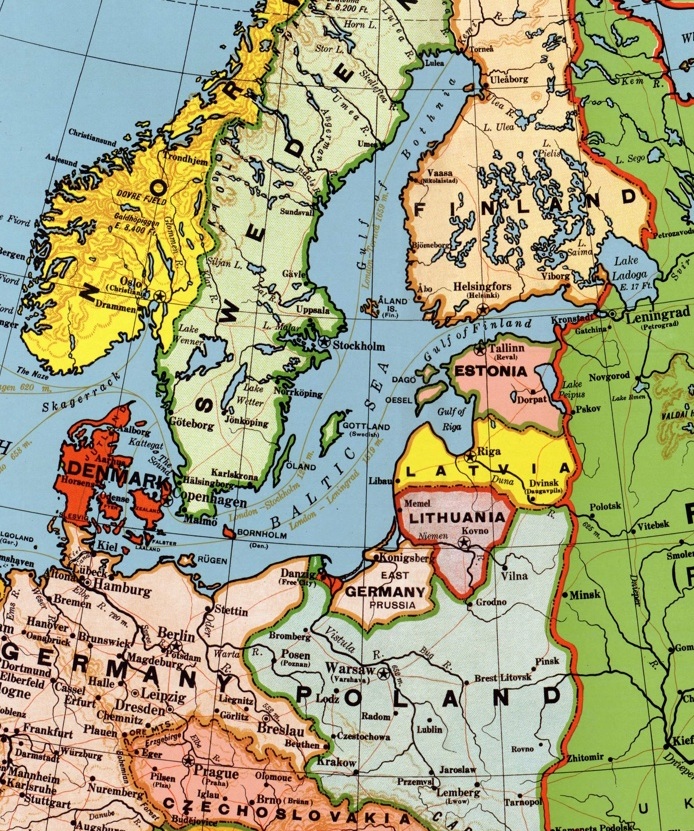
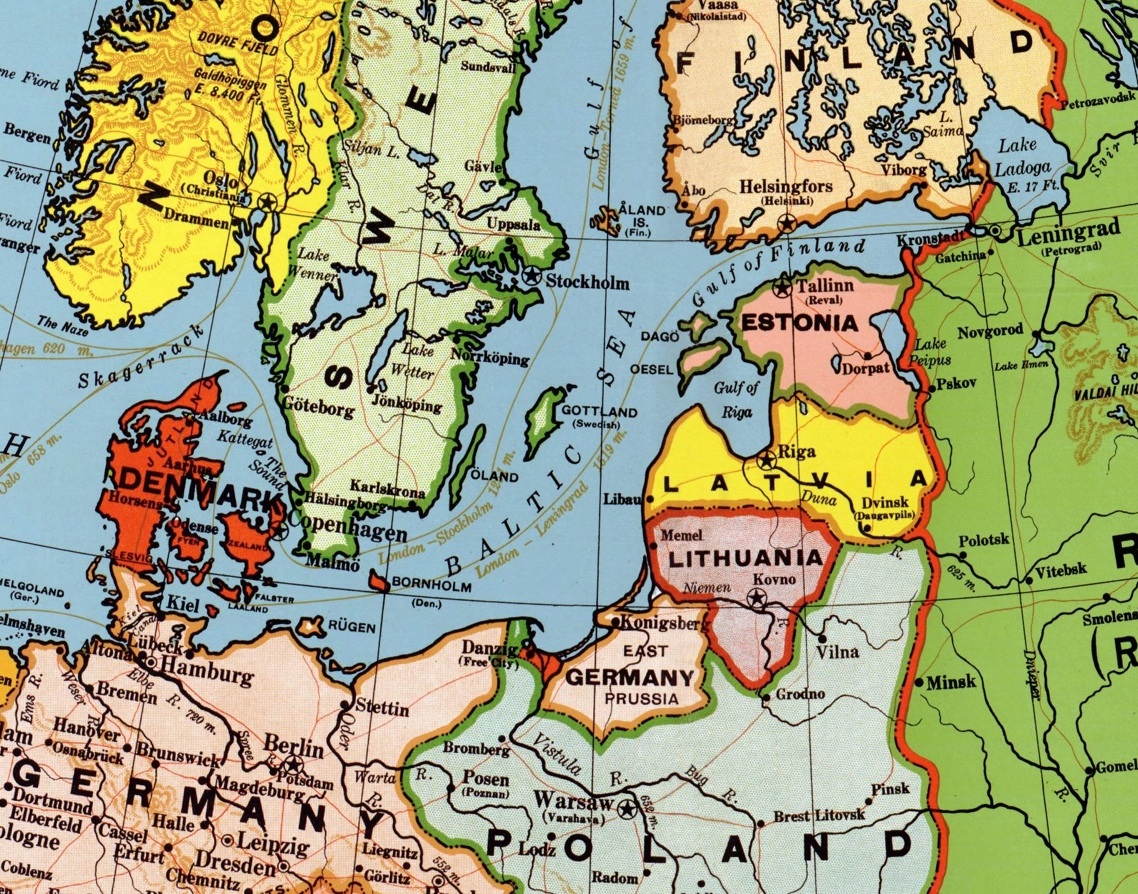
MAP

of Northern Europe 1920s (click to enlarge in new window)

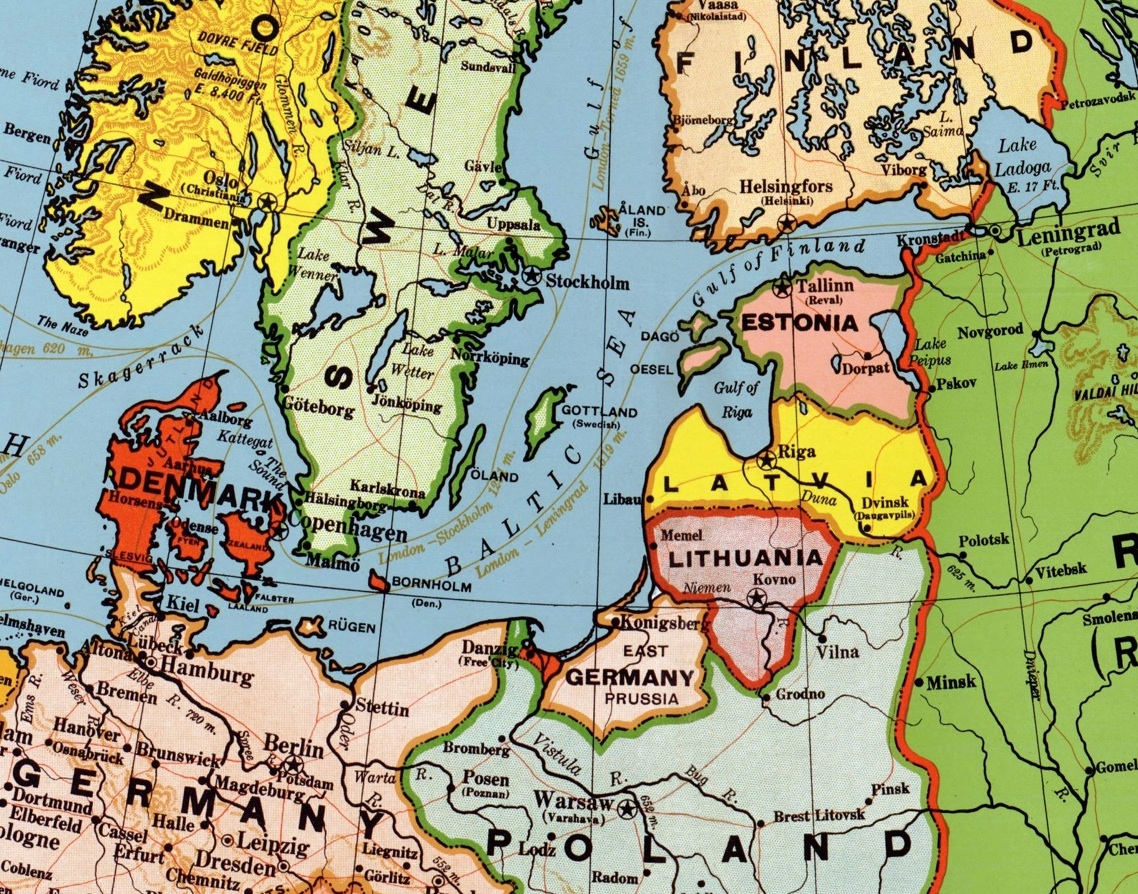
MAP

of Baltic States 1920s (click to enlarge in new window)


LIBERTY BELL PUBLICATIONS

June 1984

THE REST OF

DONALD DAY

by

Paul Knutson

Donald Day, who had been for many years the foreign correspondent of the Chicago Tribune in northern Europe, wrote a record of his observations, Onward, Christian Soldiers, in 1942. His English text was first published as a book in 1982. It was printed by William Morrison and appeared under the imprint of the Noontide Press of Torrance, California, As Professor Oliver pointed out in his review of that book in Liberty Bell for January, 1983, the text had been copied, with some omissions and minor changes, from an anonymously issued mimeographed transcription of a defective carbon copy of the author’s manuscript, which had been brought to the United States in someway, despite the vigilance of Franklin Roosevelt’s surreptitious thought-police.

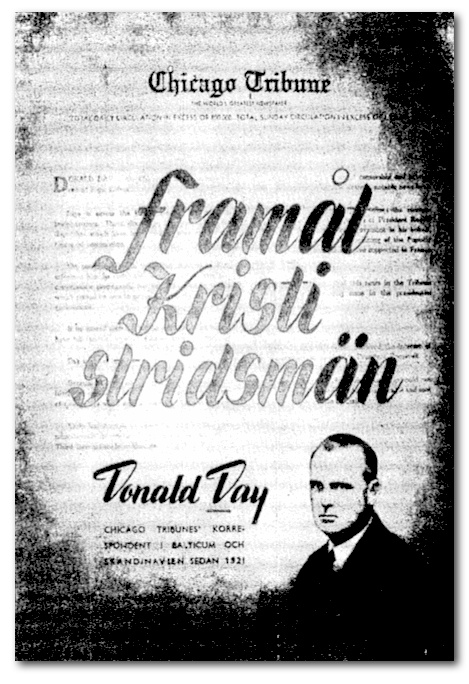
That was not the first publication of Day’s book. A Swedish translation, Framat Krististridsman, was published by Europa Edition in Stockholm in 1944. (That paper cover, printed in red, green, and black, is reproduced in black-and-white on the following page.)


Copies of this book still survive in Sweden and are even found in some public libraries. There may still be a copy in the Library of Congress, where, however, it was catalogued and buried among the very numerous books of a different Donald Day, a very prolific writer who midwifed the autobiography of Will Rogers and produced book after book on such various subjects as American humorists, the folk-lore of the Southwest, the tourist-attractions of Texas, and probably anything for which he saw a market, including a mendacious screed entitled Franklin D. Roosevelt’s Own Story. By a supreme irony, the Library concealed Framat Kristi stridsman in its catalogue by placing it between the other Day’s Evolution of Love and his propaganda piece for the unspeakably vile monster whose millions of victims included one of the last honest journalists.

The Swedish translation contains some long and important passages that do not appear in the book published in California and are not found in the mimeographed copy. By translating these back into English, I can restore Donald Day’s meaning, but, of course, I cannot hope to reproduce exactly the words and style of his original manuscript. I can also restore from the Swedish the deficiencies of the mimeographed transcript.

It seems impossible to determine now whether the parts of Day’s work that are preserved only in the Swedish were deleted by him to shorten his text when he sent a typewritten copy to the United States or were added by him before he turned his manuscript over to the Swedish translator at about the same time. At all events, the Swedish now alone provides us with some significant parts of bay‘s book and many Americans will want to have Day’s Work complete and entire.

For the convenience of the reader, I have, by arrangement with the publisher of Liberty Bell, included corrections of the printed English text where it departs, through negligence or misunderstanding, from the mimeographed text from which it was copied. I have passed over obvious typographical errors in the printed book, and omitted small and relatively unimportant corrections. For example, near the end of p. 44 of the printed book, the sentence should read, “All reported that the officials of the Cheka, later known as the GPU and NKVD, were Jews.

Day did not use footnotes, so the reader will understand what all the footnotes [indicated by the symbol *] on the following pages are my own explanations of the text.

The supplements below are arranged in the order of pages of the printed book, as shown by the note in the small type that precedes each section, The three sources are discriminated typographically thus; Italics show what is copied from the printed text to give continuity.

Ordinary Roman type is used for what is in the mimeographed copy but was omitted from the printed version. This, of course, is precisely what Day wrote in English.

What I have translated back from the Swedish appears in this style of type. These passages, as I have said, convey Day’s meaning without necessarily restoring exactly the words he used in his English original, from which the Swedish version was made.

*****


Editorial Note


Liberty Bell

With the foregoing supplements, we have at last as accurate a text of Donald Day’s Onward, Christian Soldiers as we are likely to have, barring the remote possibility that the manuscript Day gave to his Swedish translator may yet be discovered.

The Swedish translation is pedestrian, as indeed is Day’s English style, but a comparison of the Swedish with the extant parts of the English assures me of the translator’s general competence. In one passage, which we have only in the Swedish, in which Day reports his refusal to become a well-paid and dignified member of our Diplomatic Service with a “little Morgenthau” as an “adviser” to tell him what to do, the translator was evidently confused by the irony of some English phrase such as “executive for a Jew” and reversed Day’s obvious meaning;, this was corrected in the foregoing text.

The mimeographed version is evidently a transcription from Day’s carbon copy, with only such errors as only the most expert typists can entirely avoid. There is, however, one very odd error in the mimeographed version corresponding to our printed page 4 above; it reads “the Great Rocky mountains of the border of Tennessee and North Carolina.” That is geographically absurd, of course, and the Swedish (stora Rijkiga Bergen) shows that Day wrote “Great Smoky mountains,” as we have, printed above. It is probably only a coincidence that the Swedish word for “Smoky” could have suggested, to a person who knew no Swedish, the error made by the typist in California who copied Day’s carbon copy.

When Day relies on his recollection of what he was told years before, his memory is sometimes faulty, and we have naturally made no changes in what he wrote. He makes an obvious error on our page 4, where he says that the Cherokees were driven from their lands and moved to Indian Territory “toward the end of the last century.” Actually, the expulsion of the Cherokee Nation by an American army took place in 1838. The Cherokees, by the way, were the most nearly civilized of all the Indian tribes in the territory that is now the United States and Canada, and it is true that their expulsion from the lands that had been guaranteed to them by treaty inflicted great hardships on them: they lost most of their property, including their negro slaves, and large numbers of them perished as they were quite brutally herded from the Appalachians almost half way across the continent to what is now the southern border of Arkansas.

Ethnologists who have made intensive studies of the Indians of North America (e.g., Peter Farb) regard Sequoyah (Sequoia) as perhaps “the greatest intellect the Indians produced.” He was the son of a Cherokee woman by an unidentified white trader, and, growing up with the mother’s people, regarded himself as a Cherokee. He, however, was an exception to what Day says about half-breeds. Day may have been confused about the date of the expulsion because a few of the Cherokees succeeded in hiding from the perquisition in the wilds of the Great Smokies and were eventually given the small reservation they now occupy east of Bryson City in the toe of North Carolina. There was some agitation about them “near the end of the last century.

The circumstances in which Day’s carbon copy was smuggled into the United States remain obscure. When the mimeographed transcription was made and first issued, it contained a prefatory page on which an anonymous writer said,

It is my understanding that this book was published in; 1942, and then merely made an appearance at the book-sellers, when all copies were immediately withdrawn and destroyed without a single copy escaping the book-burners, I was also told that Mr. Day died shortly after this incident.

The page was presumably withdrawn when its author learned that Day was still alive at that time and an exile in Helsinki, since the Jews who rule the United States would not permit him to return to his native land.

It is curious that the man who made the transcription, which did effectively preserve Day’s work for the future, and who was evidently a resident of California, had heard a somewhat less plausible version of the rumor that was current in Washington in 1943. (See the review by Professor Oliver in Liberty Bell, January 1983, p. 27). It is quite possible that the source of both rumors was an effort by the apparatus of the great War Criminal in the White House to prevent the publication of the Swedish translation, which, as Day tells us in the last item in our supplements, was delayed in the press for two years by a “paper shortage” and it is noteworthy that the paper for it was finally obtained in Finland, not Sweden,* Until the book was finally published in 1944, the enemies of mankind could have imagined that their pressures on Sweden had effectively prevented Day’s exposure of one phase of their activity from ever appearing in print.

[* Day’s book was published by Europa Edition in Stockholm, which, however, had to have the printing done by Mercators Tryckeri in Helsinki. Although copies of the Swedish book have been preserved, Day’s work would not now be generally known — and would be supposed lost by Americans who heard of it — if the anonymous gentleman in California had not issued his mimeographed transcription.]

_______________________


KATANA — The Liberty Bell article continues with a list of text to be added or amended to the Noontide edition. All these changes (indicated by the dark blue text) have been entered in this expanded version of Onward Christian Soldiers.


Word Totals for the Additional Text

Introduction – –

Permit Me To Introduce Myself – 5,738 (all new)

Chapter 1 – 23

Chapter 2 – 307

Chapter 3 – –

Chapter 4 – 653

Chapter 5 – 1,225

Chapter 6 – –

Chapter 7 – –

Chapter 8 – 408

Chapter 9 – –

Chapter 10 – 907

Chapter 11 – 6

Chapter 12 – –

Chapter 13 – –

Chapter 14 – –

Chapter 15 – –

Chapter 16 – –

Chapter 17 – 2,167

Chapter 18 – 1,179

Chapter 19 – 89

Total words in original = 85,311

Total additional words = 12,702

_______________

Total words in expanded version = 98,013


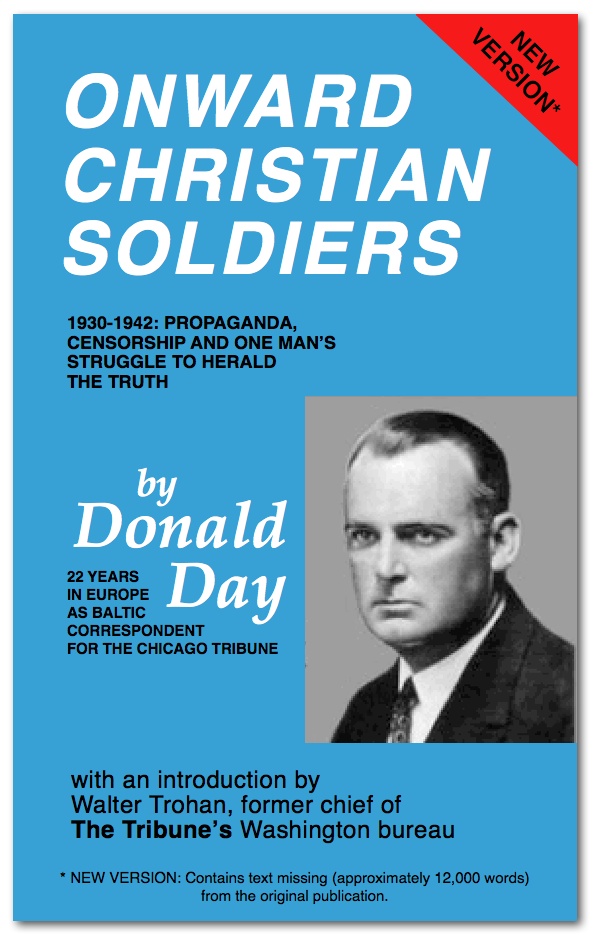
ONWARD


CHRISTIAN


SOLDIERS


1920-1942: Propaganda, Censorship

and One Man’s Struggle to Herald the Truth

Suppressed reports of a 20-year Chicago Tribune

correspondent in eastern Europe from 1921

Donald Day

With an introduction by Walter Trohan,

former chief of the Tribune’s Washington bureau

THE NOONTIDE PRESS


Chapter 11


Lithuania


In 1918 when Lithuania began her career as an independent nation she faced problems, many of which were similar to those confronting the Polish government. As in Poland the majority of Lithuania’s peasantry were illiterate. Like Poland this much smaller country had her minorities led by aggressive, unscrupulous Jews who fought hard to retain their monopolistic grasp upon trade, industry and to continue to function as the professional. Like Poland, Lithuania had to fight against the reactionary Roman Catholic Church. In this fight they had more success than the Poles. Lithuania’s educated class was even smaller than that of Poland. National consciousness was at a low ebb. Religion and nationality meant the same thing to the majority of the population.

Lithuania had not prospered under Czarist Russian rule. The living and cultural standards under the Russian administration, Polish nobility and Catholic church were miserably low. In the more northern Baltic provinces, Latvia and Estonia, the peasantry also felt suppressed. However these districts were Lutheran. It was not so difficult for an Estonian or Latvian to change his Lutheran religion to the Russian Orthodox Church in order to obtain a university education and the possibility of a career in Russia. Therefore, Estonian and Latvian migration was directed towards Russia. Many migrants obtained high posts in Russia. Those who followed a military career were permitted to study at the Russian military academy and occupy posts on the general staff. Poles were denied this latter honor. Out in western Siberia where many of these people settled, they introduced dairy farming. This industry which was developing rapidly up to the world war had been largely organized by Danish enterprise and capital. Other migrants from the Baltic provinces managed large estates or entered trade and industry.

[Page 132]

Catholics rarely change their religion so the Lithuanians emigrated to the United States and brought their priests with them. Their efforts to resist assimilation into American life have thus far been just as successful as those of the Poles. They maintain their own parochial schools, cultural societies and newspapers. And when the world war ended this Lithuanian racial group became active. So did the Poles, Czechs, Slovaks, Jews and other minority groups in America. The American delegation to the peace conference in Paris found themselves representing claims to national existence of a number of nations which would have disappeared more or less completely if the world had remained at peace another century. The Lithuanians did not halt at Paris. Many returned to their homeland where they played an important part in the foundation and organization of the Lithuanian republic.

In 1923, when I visited Lithuania, I discovered many officials had an American passport in one pocket and a Lithuanian passport in another. I wrote a sarcastic story how “Americans” were helping to organize a new nation in Europe. The result was painful for these people. They were called into the American consulate and told they must surrender their American passport and claim to citizenship or return home immediately.

Some returned, others remained.

When the Lithuanian state was carved from a corner of the cadaver of Imperial Russia, the town of Vilna was alloted to Lithuania. Once-upon-a-time, Vilna was the residence of the Lithuanian Grand Dukes. It is still regarded by the Lithuanians as their capital. Vilna was also coveted by the Poles.

The town was in the center of a poverty-stricken, illiterate, over-populated province whose sandy soil was barely able to provide a meager existence for a mongrelized population of Jews, Poles, Russians, Ruthenians and a few thousand Lithuanians. Poland’s appetite for other nations’ property equalled her ambitions. General Zellgowski seized the Vilna province by a putsch and presented it to Marshal Pilsudski. Warsaw also wanted a large chunk of Latvian territory around Daugavpils (Dvinsk). She failed to get it.

[Page 133]

The Lithuanians never forgot nor forgave this theft. Vilna became the theme song of their national propaganda. Vilna became Lithuania’s most profitable article of export. Every year the government sent agitators to the United States to collect money to strengthen the Lithuanian state for the approaching day when Lithuania would seize her ancient capital.

Remittances from Lithuanian-Americans averaged around four million dollars annually while contributions to various state projects brought in more money. In Polish hands Vilna helped to make Lithuania prosperous.

In Riga I had heard reports of the activities of the Lithuanian-Americans and in January 1923, when a group of so-called Lithuanian guerrillas appeared on the border of Memelland I telephoned John Dored, a Latvian friend who was a cinematographer representing Pathe News Weekly, that a story was developing and we boarded the train that night for Memel.

We awoke in the morning to find the door of our coupe guarded by a Lithuanian soldier. The car was empty. It had been detached from the train and placed on a siding at Krettingen. We ate our breakfast and I told John not to speak a word of anything but English and I would disarm the soldier and we would compel him to bring us to the commandant of the station.

When I took the soldier’s gun he was too astonished to resist, and when we presented ourselves before the commandant, I profanely protested against this treatment. The youthful Lithuanian captain listened to my outburst with delight. He apologized for not knowing we were Americans, explaining he was an American himself and pulled out a passport to prove it. I asked him why he was wearing a Lithuanian uniform. It appeared he had been a sergeant in the American expeditionary force to France and had decided to visit the country of his parents before he went home. In Kaunas he had been offered a commission in the Lithuanian army and had decided to remain awhile in service. I told him he must let us cross the frontier and join the forces of the Lithuanian insurgents who were marching on Memel. He agreed, and we found the commander and staff of the insurgents in the railroad station at Bajoren having breakfast.

Budrys, who led the putsch, was a former sergeant in the German river police. He said his attack upon Memel had come to a halt because the French garrisons were offering resistance. The Lithuanians did not want to fight the French, who had armed the German policemen in Memel and placed them in advanced positions ordering them to resist the Lithuanian attacks or they would be shot from behind.

[Page 134]

I told Budrys if he wanted to capture Memel he didn’t have much time left, as both England and France were sending warships there and it was up to him to seize the town before they arrived. I also said we should like to go forward with the advancing troops, promising that the Lithuanian government should receive a copy of the film showing “this heroic exploit” and the million Lithuanians in the United States should read of his successful campaign. Some hours later we rejoined Budrys and his staff outside Memel. He told us he had decided to order an immediate attack, asking if we wanted to go along. I heard some prisoners had been captured in the fighting on the previous day and asked him to delay the operation until we had taken pictures of the prisoners.

He obligingly ordered them brought out from the cellar of the farm where they had been confined and we placed them in the center of a platoon of his irregulars and staged a march-by while Dored filmed this historic scene from the top of a woodshed. There were four tall, husky built German policemen in their khaki uniforms and ten tough little French soldiers. This was the first time in generations that Germans and French have been captured fighting against a common foe.

Then we entered an old Ford car and accompanied the Lithuanians in the battle of Memel; total casualties 8 killed and 15 wounded. The French garrison, consisting of two companies of infantry, withdrew to the western suburb of the town and dug some trenches around their barracks.

The Lithuanians left them alone. That night, in order to dispatch my cable to Chicago, I journeyed in a car to Libau returning to Memel in the early hours of the morning.

The insurgents were a most miserably clad army. Dressed in the tattered garb of Lithuanian peasants, many wearing sandals made of birch-bark and legs bound with strips of linen, they were supposed to represent a spontaneous uprising of the Lithuanian inhabitants of the Memel territory. However, in reality they were Lithuanian peasants carrying army rifles and there were a number of heavy machine guns.

Commander Budrys reviewed his troops on the Memel market place in the morning. The masquerade of the march on Memel when the “insurgents” straggled along the road with only a pretense of military formation, was over. The soldiers marched by in good formation. I complimented Budrys, telling him he was the most remarkable military man I had ever met; that overnight he had been able to transform his horde of Lithuanian peasants,

who were only motivated by burning patriotism and who with their chosen leaders had decided to capture Memland for the Fatherland,”

into trained troops with complete discipline. Budrys smiled.

President Smetona came to Memel. His chief qualification for the post of President of Lithuania was his wife, but we’ll go into that later. There also arrived some mysterious Catholic priests dressed in civilian clothes who were very active.

[Page 135]

A few days later the town was thrilled and the Lithuanians were scared by the arrival of the British cruiser Caladon. Budrys called me in and asked for more suggestions. He had never been confronted with such a situation and I saw an opportunity to get Dored another good action picture. Dored and myself watched the arrival of the Caladon from the lighthouse which towered out of the custom yard. The big warship came slowly up the harbor and as she maneuvered over to the quay her guns swung slowly around, trained the whole time on the town. She was cleared for action.

I suggested to Budrys that as soon as the cruiser made fast he should stage a little parade of his troops along the quayside. Dored was able to get a film of the shabbily clad Lithuanian forces as they marched down the dock alongside and past the British ship and disappeared around the comer of some warehouses. In order to impress the newcomers properly with their numbers, the infantry marched past twice but their single troop of cavalry appeared only once as I was afraid the horses, which were strikingly bad, might even be recognized by the sailors as being the same nags.

The British decided to negotiate and Consul General Fry arrived in Memel from Danzig. He demanded Budrys should withdraw his troops from Memel. This was refused. Later I was asked to visit Fry at the British consulate. When the consul general said the situation in Memel was quite unbearable, and it was shocking that the Lithuanian insurgents should defy the League of Nations and the Guarantors of the Memel Convention, I told him, with the confidence of truth that the solution seemed simple. I said I could arrange with the Lithuanians that they would remove their troops back across the little river which flows through the town. This would enable the Caladon to land a detachment of marines who could patrol the western half from the river to the barracks where the French were entrenched. After the expected French destroyers arrived, the French troops could embark, then after a face-saving interval, the British marines could embark and the town could be left in the hands of the Lithuanians. Fry did not seem to welcome this idea and stalked from the room. Some ten days later this very scheme was carried through and I cabled the entire story to The Tribune which published it under the headline:

TRIBUNE MAN MEMEL PEACEMAKER.

With the departure of the French High Commissioner Petisnex, Consul General Fry and the British and French war vessels, the troubles of the Lithuanians began, for they had undertaken to give autonomous rule to the Memelanders whose culture and living standard were far higher than their own.

A very large percentage of the Memelanders were of Lithuanian origin.

[Page 136]

Before the war they had petitioned the Kaiser asking that church service be held in their language, which was a Lithuanian dialect. At the time of the putsch the Memellanders were so demoralized by the inflation of the German mark they did not realize what was happening. The only Memellanders involved in the putsch were a few Lithuanians whose motives may have been purely patriotic but who were certainly most anxious to obtain good jobs for themselves in the new government. The inflation was tragic. The mark was falling so rapidly that storekeepers kept their premises open only two hours each day. But even then they could not replace the goods they sold with the receipts from their sales. People carried about handbags full of money with which they tried to buy something. Life’s savings were wiped out. People who sold property could buy little or nothing with the money they received. With the value of money gone, other values seemed to disappear.

Many Memelanders welcomed the introduction of Lithuanian currency for it, at least, was stabilized and normal life could be resumed. I was never in Germany during the inflation period, but the few weeks I experienced the ruin of the mark in Memel was enough to give me a deep horror of inflation and the terrible demoralization which comes with it. At the time of the Memel putsch Germany was prostrate. Berlin could do nothing to protect this territory. The world war peace proved a curse to Germany.

I harbored the foolish idea that the Lithuanian government had some common sense. That with the acquisition of the Memelland they would cease their clamor for the return of Vilna from Poland and open relations with the Warsaw government, thus removing the chief obstacle to a close federation with their northern neighbors, Latvia and Estonia.

At the expressed invitation of the Lithuanian government I paid a short visit to Kaunas (Kovno) before I returned to Riga.

Before the world war Kaunas was a dirty little Russian garrison town.

There was no canalization, water supply or paved streets, and the only imposing buildings were the churches. The army had prohibited the erection of buildings more than three stories high.

The Lithuanians set to work to organize their government and modernize their capital with all the energy and vitality of a small nation which thought at last they had achieved their place in the sun. On the day of my arrival, the government-subsidized Vilna League held a mass meeting at the grave of Lithuania’s unknown soldier. Agitators spoke some hours in a bitter frost. I heard Vilna frequently mentioned and my interpreter said the speakers were proclaiming that now that Memel had been captured, the next step was the capture of Vilna and the nation must work with this end in view.

[Page 137]

It was evident the Lithuanians were not satisfied. It appeared they had enough to do to put their own house in order before they acquired any more real estate. Kaunas had only two miserable dirty hotels and one restaurant. This eating place was so filthy I told the manager unless he cleaned it immediately I was going to engage some scrub woman and superintend the cleaning myself. The next morning three women were at work. I ordered the removal of the lampshades from the table and the dirty hangings above the Zakuska table and saw they were placed in the garbage can before I went to the foreign office. They were black with fly specks denoting they had been cleaned only before the previous summer and not since then.

The Lithuanian government was then headed by E. Galvanauskas, leader of the nonpartisan party. He attempted to inform me the Memel putsch had been a spontaneous uprising of the inhabitants of the Memel district who revolted and overthrew the German directorate. I informed him this was a ridiculous statement since I had accompanied the disguised regular troops of the Lithuanian army in their attack upon Memel and had met the handful of Memelland Lithuanians who had helped the putschers. The Premier, who also held the post of minister of foreign affairs, said Lithuania was not appeased by the annexation of Memelland and would continue to maintain its claim to Vilna and would refuse to open normal diplomatic relations with Poland.

On the wall of Galvanauska’ s cabinet hung a map of the Baltic region. I noticed the towns of Memel, Vilna, Tilsit, Koenigsberg and Libau were marked with small Lithuanian flags and asked what claim could Lithuania possibly have to Libau. The Premier said Libau contained a Lithuanian colony. I told him he might as well put a Lithuanian flag to mark the cities of Riga and Leningrad since the iszoschiki (cabmen) in those two centers were also almost exclusively Lithuanians and also he might put up a large map and mark the cities of Pittsburg and Chicago with Lithuanian flags since many Lithuanians worked in the steel mills, slaughterhouses and other large industries in those American cities. The next time I visited the Premier I noticed the map had been removed from the wall.

After sending a number of cables reporting on Lithuanian affairs to my newspaper to Riga where I wrote a long letter to my editors, Colonel R.R. McCormick and Captain J .M. Patterson, I began by reporting that once upon a time the Lithuanians had been a great tribe of people, but they had not progressed much farther than the tribal stage. In describing my experiences in Memel and Lithuania, I reported the Lithuanians had as much right to govern the Memelland as the Apache Indians had to govern Arizona. They played a mean trick on me and published this private letter under my name on the first page of the paper and spoiled my relations with the Lithuanian government for several years. Unfortunately for me this article was mailed to a member of the staff of the American consulate in Kaunas who mimeographed it and circulated it among the diplomats and foreign businessmen as a piece of humor.

[Page 138]

But my expose had results. The foreign office immediately bought a hotel, rebuilt a portion of it. They also moved the restaurant to a better location and began to modernize and clean up the town. In my experience as a foreign correspondent I have noticed that governments are not grateful and neither do they pay attention when you write articles reflecting favorably on their activities. They seem to consider this their just due. But when an unfavorable story appears they neither forget nor forgive. I have informed many foreign ministers they should be grateful to foreign newspapermen for what they do not write, rather than complain if an unpleasant story appears.

On 17 February 1923 the Ambassador’s conference handed over the sovereignty of Memelland to Lithuania. The so-called Klaipeda (Memel) convention was signed in Paris on 8 May 1924. This made the road clear for Lithuania to begin a foolish and shortsighted policy of forcing the Memellanders to become 100% Lithuanians which in the end cost them the Memel district.

Lithuania’s greatest mistake was to ignore the advice and reject the assistance proffered by the Memelland Lithuanians. Those men were better educated and equipped to govern the Memel district than the Lithuanians. Here again the Roman Catholic Church played its politics for it was determined to absorb the Lutheran Memellanders into the Catholic Church by fair means or foul, mostly foul. To digress for a moment, perhaps others have also noticed how the Catholic Church seems to be able to give its followers that assurance and self-confidence which other people acquire by hard work.

Ignorant, incompetent, uncultured and half-educated Lithuanian Roman Catholic officials were appointed to important posts in Memelland.

Lithuania, (the church was here largely to blame) tried to direct the education of the children, to enforce the use of the Lithuanian language to supplant German and local Lithuanian dialect, and gradually oust the Memelland Directorate and supplant it with a Lithuanian administration.

During the years Lithuania pursued this policy I visited Memelland a number of times, talking with all classes of the population and interviewing Memelland officials and the Lithuanian governor. When I asked these various governors why they didn’t arrange a weekly meeting with the directorate officials and try and reach agreement or a friendly compromise on the many different questions they were perpetually quareling about, they admitted to me they were not permitted to do this. The Kaunas government, they said, was determined to force through its policy and individually they could do nothing about it.

[Page 139]

As Germany’s internal position continued to improve and real progress was achieved by the National Socialist administration, the Memellanders became more and more dissatisfied. All their pre-world-war and postwar ideas about guarding their own precious dialect were forgotten in their desire to become Germans again.

I was in Danzig when I heard of the intention of the German government to re-annex the Memel territory. I joined forces with Porter of The Associated Press and we engaged an automobile and drove all night.

Between Koenigsberg and Tilsit, we passed many detachments of the German army on the march and fully equipped. Germany never does anything half way. We managed to pass the army and cross into Memelland at Tilsit before the troops arrived. The police director of Tilsit issued me a remarkable pass entitled:

Unbedenklichkeitsbascheinigung No. 1,

which gave me freedom of movement in the occupied Memelland. We continued the journey to Memel.

En route I saw an inn where a crowd of brownshirted SA men had gathered. We halted and I bought them a round of beer and asked what they had been doing. From the talk of some it seemed they had been busy all night beating up Lithuanian officials, but I kept asking questions until I discovered that in this entire district they had beaten two Lithuanians.

From other meetings it seemed probable that quite a few Lithuanian officials had aroused the hatred of the local population by their actions but I found no evidence of anyone being killed. So far as we could discover, the occupation came off without a single fatality.

In Memel we discovered the Hotel Victoria had been taken over by the Gestapo. We could not even get a cup of coffee so I demanded we be billeted in a private home where we could eat, wash up and rest. They directed us to the home of a local shipbuilder, Herr Lindenauer, who mournfully showed me a cellar full of German wines he had imported a few weeks previously, paying the exorbitant Lithuanian customs duties.

Our host took good care of us.

It was announced that morning that Hitler would address a mass meeting. The crowd waited hours before he appeared. Memel not only contained many Lithuanians, but there were also many Jews and communists in the town, enemies of Nazism. Despite this, Hitler stood up in an open car which passed slowly through the narrow streets. I stood on the sidewalk and was only six feet from him when the car passed. He did not look well. His short address also revealed something was wrong.

[Page 140]

Two days later in the Park Hotel in Koenigsberg, the head waiter who had journeyed to Memel to serve the standup luncheon attended by Hitler and his entourage told me the Fuhrer had been stricken with influenza on his first sea journey and the doctors forbade his landing. But he was not dissuaded and although he had a high fever he spoke to the Memellanders and after attending the luncheon returned to the warship and went to bed.

All afternoon and evening the correspondents sat by the telephone waiting for their calls to come through from Berlin. Porter and I scooped them by motoring back to Tilsit and phoning our stories from there. The Memelland chapter was closed. Memel became again a small unimportant German provincial town, but its culture and economic future is secured.

If Lithuania had had a culture equal, or higher, than that of Memelland, and had displayed more common sense and consideration in ruling this territory, perhaps this historical development would have been different.

As it was, the Lithuanian government was the first of the new states in Europe to collapse into a dictatorship. In 1926 the quarrels between the political parties became so bitter that Professor Augustinas Waldemaras staged a bloodless putsch and seized power. But the professor did not want to become president. He stuttered. Anatonas Smetona, who after his term of president ended got a small job in a small bank, was called upon by Waldemaras to reoccupy this post. He moved into the Kaunas White House, located next door to the ghetto, and continued to. consume large quantities of cognac and took up horseback riding while his wife took over the job of president.

Madame Smetona was an extremely capable woman with an aptitude for political intrigue. She loved to play bridge all night until it was time for her to attend the six o’clock mass in the morning. Her regularity at mass won for her the sympathy of the uncultured Lithuanian element, which was rather large, and the support of the Catholic church, which was considerable.

However Madame Smetona had a sweetheart, a Jesuit priest of dubious reputation who went about in civilian clothes and who was otherwise a very worldly person of promiscuous morals and acquisitive ideals. This love affair continued unmolested until the Vatican sent a new Papal Nuncio, Msg. Bartoli. shortly after his arrival, the Nuncio discovered the clandestine relations between the President’s wife and the Jesuit priest.

[Page 141]

He acted with more energy than sense, sending the priest to a monastery distant from Kaunas, ordering him to get his head properly tonsured and measured for the garments of his calling. Deprived of her companion, Madame Smetona acted with equal energy. The Kaunas chief of police called upon the Papal Nuncio, assisted him in packing his belongings, brought him in a car to the east Prussian frontier, and unceremoniously deposited him outside the sovereign frontiers of Lithuania, ordering him to get back to the Vatican and forget about this country. The Vatican broke off diplomatic relations and the Jesuit priest came out of retirement. He never went back.

I reported this fascinating scandal to The Tribune and enough of the story was published to call forth more recriminations.

Professor Waldemaras, who was the brains of the government, was not very popular with the Catholic church. He foiled two plots to overthrow his dictatorship. He had used the pampered officers of the air force to stage his putsch by promising them some new airplanes. His enemies, a few years later, attempted to use the same tactics. I happened to be in Kaunas on one of these occasions. A delegation of officers called on Waldemaras informing him he must resign. He told them he was conducting important diplomatic negotiation with several governments and he must first inform them of the details before he could formally resign and submit to arrest.

His buffet was well stocked with drinks and a few hours later, when all the officers were drunk, he went into the next room, called up his friend the chief of police, and had them locked up. Waldemaras told me how he had outwitted his enemies with enjoyment. He was a resourceful man, small in stature, and I called him a “hard boiled bantam egg.” In American slang a hard-boiled egg is a rough, uncompromising person. We were friends and I had many interesting interviews with him.

At one time I thought I would try my hand at some diplomacy. I told Waldemaras I was going to Warsaw and would there visit the Polish Foreign Minister Zaleski. I asked him what were Lithuania’s minimum terms for a compromise peace and the opening of diplomatic relations with Poland. He thought awhile and suggested I tell Zaleski that Lithuania would be satisfied if Poland would cede the Suvalki region, a small district in the neighborhood where the frontiers of Poland, Lithuania and east Prussia touch, and Svencionys, a village northeast of Vilna solidly inhabited by Lithuanians. The professor admitted Lithuania didn’t want back Vilna and wouldn’t know what to do with it if the Poles did give it back.

A week later I was closeted with Zaleski in the Polish foreign office telling him of my conversation with Waldemaras. Zaleski sighed. He said he would like to agree but he knew the Polish government would not. He explained too many ministers thought if Poland should make a territorial concession to Lithuania they might be asked to make another to the Germans in the Danzig corridor. A short time later enough foreign political pressure had been applied to Lithuania to compel Waldemaras to meet meet with Zaleski in a conference held in Koenigsberg in an effort to settle Lithuanian-Polish differences. The conference failed.

[Page 142]

Zaleski told me how when he first met Waldemaras at the peace conference of Paris they arranged a private meeting and Zaleski invited him to make his claims. Waldemaras wanted Suvalki. Zaleski agreed. He wanted Vilna. Zaleski agreed. Waldemaras was about to mention Grodno when he suddenly stopped, recalling that if the Poles gave him all the Lithuanians asked for then they would be a minority in their own country.

That was Zaleski’s plan.

One reason why Waldemaras was unpopular with the Catholic church was Madame Waldemaras. She was a French woman of petit bourgeoise origin to whom Waldemaras had been united by a civil ceremony which, in the eyes of the prurient church, does not sanctify cohabitation. Madame Waldemaras had a biting tongue and became jealous of Madame Smetona who led Kaunas Society affairs with her usual ability and success. Gossip spread and Madame Smetona ordered her husband to remonstrate with the professor. Waldemaras said although he could speak twenty different languages he could not control the tongue of his wife. There was another putsch, this time successful, and Waldemaras was deposed. He had staged so many successful political comebacks that Madame Smetona took no chances and his brutal and rigorous imprisonment affected his health. Later he was permitted to go abroad. He remained an exile until the Soviets took Lithuania when he returned.

Smetona and his wife fled from the country. They are now living in Chicago which contains a large number of unassimilated Lithuanians.

After Waldemaras was removed, the chief power behind the Lithuanian government was the Catholic Church which provided Madame Smetona with her lover and used her as a tool to control the country. The church kept its firm grip on the ministry of foreign affairs, whose officials were all under its influence.

Scandals make interesting reading and it would be very wrong to permit them to obscure the fact that Lithuania made really tremendous progress during its short term of independence. Most of this progress however, was made despite the Catholic church rather than because of its efforts. The Lithuanian government carried through a real land reform. In Poland, they talked about it for years. Lithuania had a good system of cooperatives while Poland established her first small Polish farmers’ cooperative in 1933. The old cooperatives in Poland were either of German or Ukrainian origin.

[Page 143]

The average Lithuanian peasant, although he was far behind the farmers of Latvia and Estonia, still ate better food, clothed himself better and was better housed than the average Polish peasant. Lithuania, however, was handicapped by a ruthless, grafting church organization and by an equally ruthless and grasping horde of rapacious Jews. She also had the same landlord caste which cared nothing about their peasantry or holdings, and many of whom permitted their estates to be managed by plenipotentiaries. She also began her national life without a middle class and only a small group of people with higher education.

Yes, Lithuania started at scratch with Poland but in her short race for life as a nation she accomplished far more than the Poles, who looked down upon the Lithuanians with that contempt born of egoism and ignorance.

As a reporter covering northeastern Europe, I faithfully chronicled progress. But her political leaders intrigued with the Soviet government and quarreled with Poland and Germany. In the end the Bolsheviks, who Prime Minister Tubelis told me would come to help Lithuania if she became involved in serious difficulties with Poland or Germany, invaded his country and massacred and exiled those leaders and the better elements of the population.

As a nation I found the Lithuanians had more sound qualities than the Poles. They were better organizers, more reliable and have a big portion of that indomitable trait of stubborness which is. one of the chief characteristics of the East Prussians who have partly inherited it from the Borussians, a Lithuanian tribe assimilated by the Germans in their conquest of East Prussia. Students of ethnology may make many interesting discoveries in the Baltic.

The revolution now sweeping Europe might also be regarded as a new Nordic conquest of Europe. It certainly embodies a fight for survival of Nordic ideals. Important results are already evident. Jewish culture and ideals have been cauterized from Europe. Slav culture has been expelled eastwards. The decadent Latin ideals represented and defended by French culture have been so weakened that recovery will require generations if it comes at all. The political power once wielded incompetently and selfishly by the Roman Catholic Church has been destroyed in many countries and weakened in others.

Europe today is passing through a new reformation period. What will evolve from its gigantic and desperate struggle for survival in a world threatened by Jewish control is too early to say. For one, I always have been an optimist about Europe’s future. European culture is too great and heroic to die and it most certainly will not perish at the hands of the kosher butcher who enslaved Russia and who is now engaged in a struggle to enslave the United States and the rest of the world.

In America our struggle has yet to come. It will come.


_______________________


NOTES


* Images (maps, photos, etc.) have also been added that were not part of the original Noontide edition.


__________________

Knowledge is Power in Our Struggle for Racial Survival


(Information that should be shared with as many of our people as possible — do your part to counter Jewish control of the mainstream media — pass it on and spread the word) … Val Koinen at KOINEN’S CORNER


Click to go to >> OCS – Part 1: Reviews; Background Information

Click to go to >> OCS – Part 2: Introduction; Permit Me to Introduce Myself

Click to go to >> OCS – Part 3: Why I Did Not Go Home; The U.S.

Click to go to >> OCS – Part 4: Lativa

Click to go to >> OCS – Part 5: Meet the Bolsheviks

Click to go to >> OCS – Part 6: Alliance With the Bear

Click to go to >> OCS – Part 7: Poland

Click to go to >> OCS – Part 8: Trips; The Downfall of Democracy

Click to go to >> OCS – Part 9: Jews

Click to go to >> OCS – Part 10: Russia

Click to go to >> OCS – Part 11: Lithuania

Click to go to >> OCS – Part 12: Danzig; Lithuania

Click to go to >> OCS – Part 13: Sweden; Norway

Click to go to >> OCS – Part 14: Finland

Click to go to >> OCS – Part 15 (last) : England; Europe; Epilogue; Index of Names


PDF of this blog post. Click to view or download (2.1 MB).

>>Onward Christian Soldiers by Donald Day – Part 11


Version History

Version 2: Dec 8, 2019 — Re-uploaded images and PDF for katana17.com/wp/ version

Version 1: Published Mar 26, 2015

Posted in Baltic States, Bk - Onward Christian Soldiers, Communism, Donald Day, Europe, Finland, France, Germany, International Finance, Jews, Latvia, Lithuania, National Socialism, Norway, Poland, Propaganda - Anti-German, Race Differences, Revisionism, Russia, Sweden, The International Jew, White Nationalism, WW I | 3 Comments

Onward Christian Soldiers – Part 10: Russia


Onward Christian Soldiers 

[Part 10]


Note

This new version of Onward Christian Soldiers that I’ve compiled consists of the original contents published by Noontide Press in 1982 plus the “missing” text that, for reasons explained below, was in the Swedish version published in 1942.

I’ve also included some supplementary texts here giving the history of the missing parts of Day’s book. Also book reviews by Revilo Oliver and Amazon readers (see Part 1).

KATANA


Contents


Maps of Northern Europe & the Baltic States

THE REST OF DONALD DAY by Paul Knutson — 1984

EDITORIAL NOTE by Liberty Bell

The Resurrection of Donald Day — A review by Revilo P. Oliver. The Liberty Bell — January 1983

TWO KINDS OF COURAGE by Revilo P. Oliver. The Liberty Bell — October 1986

AMAZON REVIEWS

__________________

ONWARD CHRISTIAN SOLDIERS

Chapter

Introduction

Permit Me To Introduce Myself * (all new)

1 Why I did not go Home *………………………………. 1

2 The United States  *………………………………………. 7

3 Latvia  ………………………………………………………… 21

4 Meet the Bolsheviks  *………………………………….. 41

5 Alliance with the Bear  *……………………………….. 53

6 Poland  ……………………………………………………….. 63

7 Trips  ………………………………………………………….. 85

8 The Downfall of Democracy * ………………………. 93

9 Jews  …………………………………………………………… 101

10 Russia  *………………………………………………………. 115

11 Lithuania * ………………………………………………….. 131

12 Danzig  ……………………………………………………….. 145

13 Estonia  ……………………………………………………….. 151

14 Sweden  ………………………………………………………. 159

15 Norway  ………………………………………………………. 169

16 Finland  ………………………………………………………. 183

17 England  *……………………………………………………. 197

18 Europe  *…………………………………………………….. 201

19 Epilogue  *…………………………………………………… 204

Index of Names  ………………………………………………….. 205

* Contains new material (dark blue text) missing from original Noontide edition.

MAP

of Northern Europe 1920s (click to enlarge in new window)

MAP

of Baltic States 1920s (click to enlarge in new window)


LIBERTY BELL PUBLICATIONS

June 1984

THE REST OF

DONALD DAY

by

Paul Knutson

Donald Day, who had been for many years the foreign correspondent of the Chicago Tribune in northern Europe, wrote a record of his observations, Onward, Christian Soldiers, in 1942. His English text was first published as a book in 1982. It was printed by William Morrison and appeared under the imprint of the Noontide Press of Torrance, California, As Professor Oliver pointed out in his review of that book in Liberty Bell for January, 1983, the text had been copied, with some omissions and minor changes, from an anonymously issued mimeographed transcription of a defective carbon copy of the author’s manuscript, which had been brought to the United States in someway, despite the vigilance of Franklin Roosevelt’s surreptitious thought-police.

That was not the first publication of Day’s book. A Swedish translation, Framat Krististridsman, was published by Europa Edition in Stockholm in 1944. (That paper cover, printed in red, green, and black, is reproduced in black-and-white on the following page.)


Copies of this book still survive in Sweden and are even found in some public libraries. There may still be a copy in the Library of Congress, where, however, it was catalogued and buried among the very numerous books of a different Donald Day, a very prolific writer who midwifed the autobiography of Will Rogers and produced book after book on such various subjects as American humorists, the folk-lore of the Southwest, the tourist-attractions of Texas, and probably anything for which he saw a market, including a mendacious screed entitled Franklin D. Roosevelt’s Own Story. By a supreme irony, the Library concealed Framat Kristi stridsman in its catalogue by placing it between the other Day’s Evolution of Love and his propaganda piece for the unspeakably vile monster whose millions of victims included one of the last honest journalists.

The Swedish translation contains some long and important passages that do not appear in the book published in California and are not found in the mimeographed copy. By translating these back into English, I can restore Donald Day’s meaning, but, of course, I cannot hope to reproduce exactly the words and style of his original manuscript. I can also restore from the Swedish the deficiencies of the mimeographed transcript.

It seems impossible to determine now whether the parts of Day’s work that are preserved only in the Swedish were deleted by him to shorten his text when he sent a typewritten copy to the United States or were added by him before he turned his manuscript over to the Swedish translator at about the same time. At all events, the Swedish now alone provides us with some significant parts of bay‘s book and many Americans will want to have Day’s Work complete and entire.

For the convenience of the reader, I have, by arrangement with the publisher of Liberty Bell, included corrections of the printed English text where it departs, through negligence or misunderstanding, from the mimeographed text from which it was copied. I have passed over obvious typographical errors in the printed book, and omitted small and relatively unimportant corrections. For example, near the end of p. 44 of the printed book, the sentence should read, “All reported that the officials of the Cheka, later known as the GPU and NKVD, were Jews.

Day did not use footnotes, so the reader will understand what all the footnotes [indicated by the symbol *] on the following pages are my own explanations of the text.

The supplements below are arranged in the order of pages of the printed book, as shown by the note in the small type that precedes each section, The three sources are discriminated typographically thus; Italics show what is copied from the printed text to give continuity.

Ordinary Roman type is used for what is in the mimeographed copy but was omitted from the printed version. This, of course, is precisely what Day wrote in English.

What I have translated back from the Swedish appears in this style of type. These passages, as I have said, convey Day’s meaning without necessarily restoring exactly the words he used in his English original, from which the Swedish version was made.

*****


Editorial Note


Liberty Bell

With the foregoing supplements, we have at last as accurate a text of Donald Day’s Onward, Christian Soldiers as we are likely to have, barring the remote possibility that the manuscript Day gave to his Swedish translator may yet be discovered.

The Swedish translation is pedestrian, as indeed is Day’s English style, but a comparison of the Swedish with the extant parts of the English assures me of the translator’s general competence. In one passage, which we have only in the Swedish, in which Day reports his refusal to become a well-paid and dignified member of our Diplomatic Service with a “little Morgenthau” as an “adviser” to tell him what to do, the translator was evidently confused by the irony of some English phrase such as “executive for a Jew” and reversed Day’s obvious meaning;, this was corrected in the foregoing text.

The mimeographed version is evidently a transcription from Day’s carbon copy, with only such errors as only the most expert typists can entirely avoid. There is, however, one very odd error in the mimeographed version corresponding to our printed page 4 above; it reads “the Great Rocky mountains of the border of Tennessee and North Carolina.” That is geographically absurd, of course, and the Swedish (stora Rijkiga Bergen) shows that Day wrote “Great Smoky mountains,” as we have, printed above. It is probably only a coincidence that the Swedish word for “Smoky” could have suggested, to a person who knew no Swedish, the error made by the typist in California who copied Day’s carbon copy.

When Day relies on his recollection of what he was told years before, his memory is sometimes faulty, and we have naturally made no changes in what he wrote. He makes an obvious error on our page 4, where he says that the Cherokees were driven from their lands and moved to Indian Territory “toward the end of the last century.” Actually, the expulsion of the Cherokee Nation by an American army took place in 1838. The Cherokees, by the way, were the most nearly civilized of all the Indian tribes in the territory that is now the United States and Canada, and it is true that their expulsion from the lands that had been guaranteed to them by treaty inflicted great hardships on them: they lost most of their property, including their negro slaves, and large numbers of them perished as they were quite brutally herded from the Appalachians almost half way across the continent to what is now the southern border of Arkansas.

Ethnologists who have made intensive studies of the Indians of North America (e.g., Peter Farb) regard Sequoyah (Sequoia) as perhaps “the greatest intellect the Indians produced.” He was the son of a Cherokee woman by an unidentified white trader, and, growing up with the mother’s people, regarded himself as a Cherokee. He, however, was an exception to what Day says about half-breeds. Day may have been confused about the date of the expulsion because a few of the Cherokees succeeded in hiding from the perquisition in the wilds of the Great Smokies and were eventually given the small reservation they now occupy east of Bryson City in the toe of North Carolina. There was some agitation about them “near the end of the last century.

The circumstances in which Day’s carbon copy was smuggled into the United States remain obscure. When the mimeographed transcription was made and first issued, it contained a prefatory page on which an anonymous writer said,

It is my understanding that this book was published in; 1942, and then merely made an appearance at the book-sellers, when all copies were immediately withdrawn and destroyed without a single copy escaping the book-burners, I was also told that Mr. Day died shortly after this incident.

The page was presumably withdrawn when its author learned that Day was still alive at that time and an exile in Helsinki, since the Jews who rule the United States would not permit him to return to his native land.

It is curious that the man who made the transcription, which did effectively preserve Day’s work for the future, and who was evidently a resident of California, had heard a somewhat less plausible version of the rumor that was current in Washington in 1943. (See the review by Professor Oliver in Liberty Bell, January 1983, p. 27). It is quite possible that the source of both rumors was an effort by the apparatus of the great War Criminal in the White House to prevent the publication of the Swedish translation, which, as Day tells us in the last item in our supplements, was delayed in the press for two years by a “paper shortage” and it is noteworthy that the paper for it was finally obtained in Finland, not Sweden,* Until the book was finally published in 1944, the enemies of mankind could have imagined that their pressures on Sweden had effectively prevented Day’s exposure of one phase of their activity from ever appearing in print.

[* Day’s book was published by Europa Edition in Stockholm, which, however, had to have the printing done by Mercators Tryckeri in Helsinki. Although copies of the Swedish book have been preserved, Day’s work would not now be generally known — and would be supposed lost by Americans who heard of it — if the anonymous gentleman in California had not issued his mimeographed transcription.]

_______________________


KATANA — The Liberty Bell article continues with a list of text to be added or amended to the Noontide edition. All these changes (indicated by the dark blue text) have been entered in this expanded version of Onward Christian Soldiers.


Word Totals for the Additional Text

Introduction – –

Permit Me To Introduce Myself – 5,738 (all new)

Chapter 1 – 23

Chapter 2 – 307

Chapter 3 – –

Chapter 4 – 653

Chapter 5 – 1,225

Chapter 6 – –

Chapter 7 – –

Chapter 8 – 408

Chapter 9 – –

Chapter 10 – 907

Chapter 11 – 6

Chapter 12 – –

Chapter 13 – –

Chapter 14 – –

Chapter 15 – –

Chapter 16 – –

Chapter 17 – 2,167

Chapter 18 – 1,179

Chapter 19 – 89

Total words in original = 85,311

Total additional words = 12,702

_______________

Total words in expanded version = 98,013


ONWARD


CHRISTIAN


SOLDIERS


1920-1942: Propaganda, Censorship

and One Man’s Struggle to Herald the Truth

Suppressed reports of a 20-year Chicago Tribune

correspondent in eastern Europe from 1921

Donald Day

With an introduction by Walter Trohan,

former chief of the Tribune’s Washington bureau

THE NOONTIDE PRESS


Chapter 10


Russia


Dinner parties in Riga generally began at eight. Very often the guests were still seated at the table at two in the morning. But conversation did not end then. Talk continued until three, four or even five o’clock. Then after sandwiches, another round of vodka or some beer, the party would disperse.

Many years passed before Riga society degenerated to bridge. Conversations were captivating, interesting and sometimes charming. Everyone spoke from three to ten languages. Table-talk was in Latvian, German and Russian. People, telling a story, would begin in one language and continue until they found a better word to describe their thoughts in another tongue. They would switch over and continue. Sometimes, before the story would be ended, all three languages would be used.

At one of these parties, some time ago, a Russian woman attempted to monopolize the conversation. She was evidently homesick. We heard of the lavishness of Petrograd, the dazzling riches of Moscow, the bounteous Ukraine, the beautiful Crimea, the exotic Caucases, the uncouth Siberia, the wild North. Russia, she declared in ecstacy, had everything, really everything.

Here I felt constrained to interrupt.

There is one important thing which Russia lacks,” I contended.

And what is that may I ask?” she questioned.

The right kind of people to inhabit the country,” I replied.

There was no answer and we turned to other subjects.

[Page 116]

In my twenty years residence in Riga I sought to avoid close association with Russians, all shades of Russians. It was not actual dislike, for the average Russian is a very likable person. My articles were often quoted in Russian language newspapers published in Europe and I was invited to Russian gatherings and functions. These invitations I did not accept, not even to the annual Russian navy ball which was one of the season’s most enjoyable functions. I knew many of these White Russians and some of them I felt instinctively that I could not trust.

In my earlier contacts with the Russians I was impressed with the great similarity existing between them and the American Negro. Both races are artistic. They have natural gifts for music and dancing. They have a childish love for adornment. Just as the Russian peasant will hang up his new pair of boots beneath the ikon in the comer of the wall to admire them better, so the Negro will place his new shoes on a table to contemplate them with the rapture of a child.

It is remarkable fact that the best bass voices in the world are to be found among the Russians and Negroes. Both are collective minded, they like to live in groups. Both are lazy and not inclined to work except under compulsion. They are both irresponsible and unreliable. If you send either a Russian or a Negro out to do something for you, you are never certain that it will be done the way you want it to be. This sounds childish but they are childish in many ways. They have many of the good and bad characteristics of children.

The mentality of the Russians and the American Negroes has been affected by centuries of slavery. Both were freed from slavery about the same time. The Negro in 1863, the Russian 1858-63. These generations of servitude developed an aptitude for petty intrigue and duplicity, which, coupled with their instability, spells tragedy. This comparison could be continued and broadened, but in defense of the Negro I must report that he has a higher conception of honor than the Russian, probably because in his homeland he most generally saw high standards of honesty and honor.

For many centuries the Russians have lived in groups. That pioneer spirit which is a fundamental characteristic of the Nordic-Teuton is absent in the Russian. When the Slavs spread out through the vast expanse of Russia this colonization of tremendous areas was motivated chiefly be a desire to get as far away as possible from the government. For more than a thousand years that government, with only brief intervals, represented oppression and terror. Following the rivers, penetrating great forests and wide swamps the Russians attempted to hide themselves from their despots, but without success. The church and the chinovnik (official) followed them everywhere.

[Page 117]

Life in these primitive communities centered around the Starastvo, which means literally “the oldest.” He was elected by the village to rule as chieftain. He had two rivals competing for his authority. One, the local government official. The other the priest. All three used chicane, intrigue and petty espionage.

One of the features of life in a small community is that everyone seems to know what everyone else is doing. Gossiping is a fundamental human attribute everywhere. But in the Slav this is developed to a far greater degree than in the Nordic-Teuton. The starastvo, chinovik and priest competed for levies and taxes. Informers were well paid by all three. The priest and chinovnik were paid by the central government. The former received a percentage of the taxes he helped collect, the latter a percentage of the fines. Over the course of centuries this system of rule demoralized everyone. This demoralization penetrated so deeply that it has influenced the Russians in their national and individual development. Treachery and duplicity seemed to become an ingrained trait in the Russian character. To betray a friend or a neighbor does not mean much to a Russian.

Now this is a pretty broad statement to make. I reached this conclusion only after observing and studying Russia, Russians and Russian history for many years. In Nordic-Teutonic countries a man’s word of honor is everywhere considered to be something real, the tangible, something that can be depended upon. In Russia there is a widely quoted proverb which roughly translated runs:

That bridge is hanging on a word of honor.

Meaning the bridge is apt to collapse at anytime. The proverb reveals the depth of the gulf separating the two races. It is due to these traits that the Russian, compared to the Nordic-Teuton, is a sub-man. These sub-men have developed nothing in their form of government which can be adopted with profit by other nations. But what they have developed to a higher degree than any other nation is something which repels Europe with horror. It is treachery and terror.

Bolshevism succeeded in imposing its rule upon Russia by taking over espionage network of the Okhrana, the political police of the Czarist regimes. The leading officials of this organization were eliminated and the Okhrana was converted into the Cheka (extraordinary commissions) by Felix Djerjinski, a maniac Pole whose chief assistants were two Jews, Menshinski and Jagoda. Djerjinski died suddenly and mysteriously at a meeting of the presidium of the supreme executive committee in Moscow when he was attempting to help Leon Trotsky obtain control of the communist party after the death of Lenin. He is said to have been poisoned by Stalin. In any event his death arrived at a convenient moment for Stalin who then seized power.

[Page 118]

Since then the Cheka has changed its name twice. It became the GPU (State Political Administration) and later the Nar. Kom. Vnu. Del.

(People’s Commissariat for Internal Affairs). These changes in name were to delude people abroad into thinking this agency for terror had been abolished. The second change of name was ignored abroad which continued to call the terrorists the GPU. Since the death of Djerjinski, the GPU has had five leaders, Menshinski, Jagoda, Akulov, Yezhov and Berija. All are Jews. Under their administration millions of Russians perished. I have mentioned this once before and repeat here for emphasis.

It was this organization which systematically massacred all members men, women and children, of the upper and middle classes in Russia. The Jews applied terror to all classes of the population. It was used to enable them to obtain complete control over the people living within Russia. The system of terror and treachery which the Russians had themselves devised was used against them by the Jews who exploited this fatal weakness in the Russian character.

Mankind has evolved many different forms of government. In modern times civilized forms of government have only limited power against individuals whom they can fine, imprison and execute. In Russia the Jews expanded terror into a science. The Soviet form of government, under their direction, not only can fine, imprison and execute, but it can also discharge a man from his position, prevent him from obtaining further employment, confiscate his food and clothing cards, seize his living quarters, expel his children from schools, evict his wife and children into the street, and destroy an entire family by sending its different members to different places of exile.

The terror of the Czarist regimes of olden days has been made complete. Every man knows that should he commit an offense against the Jewish regime, not only himself, but also his entire family, including his parents and relatives, may suffer; that even his friends may be included in the purge.

In Soviet cities where the chief concern is obtaining more food or better living quarters, everybody was at the mercy of his neighbors. It was sufficient — to ruin a man and his family — to report to the nearest GPU office that he was the son of a wealthy farmer (a farmer with two horses is classified as wealthy by the communists) or that his father occupied a good position before the revolution.

[Page 119]

Life became hell on earth everywhere Jewish authority expanded. This system of espionage and terror was just as strongly organized in the village as in the city. The local GPU man has almost unlimited authority.

He can dispossess any peasant he wishes and compel him and his family to move at least fourteen miles away before he can settle again in some abandoned shack. Or worse, he can order them to be deported to the far North or Siberia.

Long before the world war the average American had only a dim idea about Russia. Very few knew anything about Russian history of literature.

Their knowledge of Russia was based on the contents of occasional newspaper articles and stories told by Russian emigrants. These were almost entirely Jews. And the stories making the most lasting impression upon the minds of the average American were those tales of pogroms in Ruthenian and Ukrainian villages, of exiles sent to Siberia and of the allegedly cruel and despotic regime of the Czars.

In his book Innocents Abroad, our Mark Twain devoted a few scathing paragraphs to the Czar and his regime. Twain exemplified the attitude of the average American who is little different from the average human being and is prone to form opinions upon hearing one-sided or insufficient evidence.

The extremely bad reputation which the Czarist regime had abroad for cruelty and despotism was largely manufactured by the Jews. The old ruling class in Russia was mostly of Nordic-Teutonic origin. This class learned to know the Jew through centuries of contact. And the better they can know them, the more adamant they were against allowing them more privileges.

The Jews were largely segregated in the provinces of Ruthenia, White Russia and Poland. Those few who were permitted to live in Petersburg, Moscow and other larger Russian cities were required before the war to have a higher education. Because of these restrictions against their rapacity the Jews hated the Czarist regime virulently.

This world-wide Jewish campaign against the Czarist government of Russia, which developed towards the close of the last century, so undermined the prestige of Russia abroad that the world welcomed the revolution in Russia and hailed the downfall of the Czarist regime as a sign of progress. From all over the world Jewish revolutionaries poured into Russia to take vengeance upon the Russian people and to help the erection of a new imperialist Jewish power, one of whose first decrees was to make anti-Semitism a crime punishable by death.

[Page 120]

The revolution in Russia attracted the support and attention of the so-called liberal element throughout the world. They hoped out of the massacres, civil war, plagues and famine which followed the turnover would come a new, wonderful and enlightened government which would embody all or most of those principles they pretended to be fighting for in their own countries. Instead they witnessed further depravity and class warfare.

The liberal movement has its followers among the educated class, which has sometimes been miscalled the intelligentsia. Its record reveals that its leaders and their followers really belong to the unintelligentsia.

In his creation of forms of government, man has generally tried to achieve security and progress. The Bolsheviks pretend to be on the side of progress. They set out to form a heaven on earth by completely exterminating all classes of the population who defended property, that is to say, security. They murdered millions of Russians and starved and exiled millions more. The liberals of the world applauded. Occasionally one of their number was shocked into protest. But he was howled down by the Jewish inspired-and-led liberal clique.

In their own lands and under their own governments, the liberals oppose bitterly all attempts to curb individual freedom, which includes:

freedom of press, speech and religion. In Russia, where Bolshevism abolished these varieties of freedom, the liberals found this justifiable and excusable. In their own countries they have enthusiastically defended the most horrible atrocities of Bolshevism while at the same time they have held protest meetings, collected funds, employed attorneys and used every possible form of agitation against their own governments when these have placed communists and revolutionaries under arrest, or sentenced them to prison for violations of the law. In thus doing they proved the liberal movement is no longer liberal. It has aged quickly and become senile. It has acquired, not the harmless childlike manner of an old man, but the violent ravings of a lunatic. Defenders of Bolsheviks are mentally degenerate. They are the enemies of the better elements of society.

This unintelligentsia often prides itself on having a very liberal code of morals. It throngs into Soviet representations abroad on revolutionary holidays to partake of caviar, vodka and other delicacies provided by the new Jewish rulers of Russia. It accepts subsidized journeys to Russia and permits various agencies of the Soviet regime to stuff its pockets with money. It thinks it perfectly proper for an orator, lecturer, author or journalist to earn his living by becoming an advocate of communism. But anyone condemning the Jew, the Communist, the Communist International, or the Soviet government is branded as a traitor to society who is somehow or other in the pay of the reactionary elements.

[Page 121]

The unintelligentsia was one of the first classes to be thoroughly and systematically liquidated in Russia by the Jewish terror. All Russian liberal leaders, and this included the Social Democratic party, were exterminated. The portent of this action was never grasped by the unintelligentsia abroad. That is, if with the assistance of their efforts a communist regime should be established in their own country they would be one of the first classes to be purged from the ranks of society. This seemingly has never entered their thoughts. This is because the unintelligentsia in their secret hearts are also revolutionaries. They are dissatisfied with the makeup of the society in which they live and wish to change it. So long as they support the Bolsheviks they are anti-social. And as long as they follow the banners raised by the Jews they are a dangerous element.

These members of the unintelligentsia who have visited Russia since the revolution had no first hand knowledge of the Russia of the Czars.

Towards the end of the last century and the beginning of this, Russia, under a Nordic-Teutonic ruling class, was making rapid and tremendous progress. New schools were being opened and great strides were being made towards abolishing illiteracy. Progress was being made in all branches of human endeavor. This is not in defense of the Czarist regime but a reminder that under the former government life was incomparably better for the inhabitants than it is today, or has been during the past twenty five years.

Let us remember when the Russian Premier Stolypin was shot and killed in the Kiev opera house in 1911, five people were hanged for this crime and a few score conspirators were sentenced to Siberia. When Commissars Uritzski and Kirov were shot by assassins in Leningrad, five thousand prisoners having nothing to do with the crime were shot after Uritzski’s death while an unknown number were shot in Leningrad and 137 were shot in Moscow following the assassination of Kirov.

Exile to Siberia was once regarded as awful punishment. But this form of exile under the Czarist regime was a summer vacation compared to the fate suffered by exiles of the GPU. In pre-world war Siberia the political exile could live in luxury and even have servants. And revolutionists invariably had money. Confinement in Siberia did not affect the health of the commissars.

Germany has often been blamed for sending Lenin to Russia. But the United States permitted Trotsky and many thousands of sadistically minded Jews to leave the ghettos of New York to go to Russia. But how did those revolutionary exiles reach Switzerland and New York from Siberia? That is a question which liberals never ask or attempt to answer.

[Page 122]

In Czarist Russia the nobility was a closed caste. In England it is a semi-open caste. In England when Max Aitken made a few million pounds he was told to kneel before the King and he arose as Lord Beaverbrook. In Russia this advancement in social rank was denied to the wealthy merchants and industrial leaders. Some of these men secretly helped the revolutionists. They provided the-money which enabled Lenin, Trotsky, Stalin and other revolutionary degenerates to live in comfort in Siberia and to bribe their way to freedom and to cross into China and journey around the world to New York or Switzerland.

The great majority of these wealthy Russians who helped the revolutionists conspire against the Czarist government were massacred by their communist proteges when they came into power. A few, like Lomonossov, Krassi, Aralov and others entered Soviet service and were used as Soviet agents abroad, naturally under the watchful eye of their GPU guardians.

The Czarist government of the past century was certainly not a model government. It was an imperialistically minded regime which sought to extend Slav influence far over the frontiers of Russia. It was expanding into the East and sought expansion into the South and West. But under its Nordic-Teutonic ruling class, however backward and reactionary it may have been, forces were developing which were giving the Russians a higher standard of living.

Living standards in Czarist Russia were very low compared to western European standards. The exploitation of the workers in Russian industries was cruel. But the great majority of those industries had been founded, organized and developed by western European capitalists and enterprisers. Those foreign factory owners in Russia whom I have met were never tired of telling me of their tremendous profits. It is a little known fact that American and English capital and American engineers founded and expanded the industries of Petersburg, now Leningrad and that the American church there became the English church when the Americans were supplanted by English specialists. Belgian and French capital entered Russia to build street car lines and other public utility projects. German capital was largely engaged in expanding Russian trade and commerce. Russia was a booming country up to the world war and world capitalism was finding dividends there just as luscious and rich as those which poured from the United States.

So when the Jewish led group of revolutionists murdered their way into control of Russia in the moral chaos which followed the world war, they seized a country which had been making good progress despite the fact a few thousand revolutionaries and criminals were living in Siberian villages and prison camps.

During my twenty year’s residence in Riga I frequently made comparisons between conditions of life under the regime of the last Czar and living standards under the communist government. And no matter what the unintelligentsia abroad might claim after their specially conducted tours of Russia there is no doubt but what life there has become worse for the inhabitants. At the outbreak of the present war the average Russian had less to eat, was more poorly clad and lived in more primitive quarters than the average Russian of 1914.

[Page 123]

Only in one respect had conditions changed for the better. The Russians had more books to read and people could read them. But this reading matter was controlled and expurgated by Commissar Chalatov.

Where dissenters appeared they were liquidated with haste. All who disagreed with the Lenin line, or the later Stalin line, were executed or exiled with their friends and supporters. Under Bolshevism massacres became a regular feature of Russian life.

When Stalin announced his first five year plan in 1928 it was discovered that in liquidating its opponents the Soviet government had liquidated the brains of Russia. The GPU was ordered to search through its prisons and concentration camps to salvage all engineers and persons with a technical education. But these communist slaves were insufficient in number.

Russia decided to employ foreign specialists. Many thousands of trained American engineers, unemployed victims of the capitalistic depression in America, went to Russia attracted by high salaries and special inducements.

These men had to renew their passports every two years and were obliged to visit Riga, the nearest point where existed an American consulate. Many of them visited my home. They all painted a picture of poverty, misery and terror. They were glad to leave Russia when their contracts expired. When they returned to the United States many attempted to warn the American people against communism. They contradicted the false propaganda being spread by Soviet agents and their paid dupes, the unintelligentsia. But they soon ceased their efforts, for the gangster communists of the U.S.A. beat some as a warning to the others and threatened them with death or worse unless they kept their mouths shut about Russia. Terror had become a main export article of the Soviet government.

From the experiences of these travelers, from official Soviet plans and speeches and from official Soviet publications and technical journals, it was impossible for observers to judge the extent and success of the industrialization program. I was interested in the production of agricultural machinery in Russia. By collecting every article I could find in the Soviet press over a number of years I hoped to be able to write a report about this industry. But there was never enough concrete information to make such a story. Communist writers carefully avoided giving any real information. All production figures were given in rubles and since the cost of the machine was never mentioned the figures quoted meant nothing.

[Page 124]

I spent many thousands of hours reading the Soviet press during these years. I found much information concerning communist interference into the affairs of other nations, including the United States. I found much information proving the predominant position the Jews held in Russia. I read many long treatises about the world revolution which would develop as a result of the new capitalistic war which the Soviet government was energetically helping to ferment by promoting mistrust and hatred between the nations and between the various classes of the population within these nations. I found much proof for the Jewish-communist persecution of Christianity and the seeming immunity of Jewish religious leaders and synagogues from persecution and oppression.

The Bolsheviks used their three agencies: the communist party, the communist international and the Soviet government to prevent any agreement or alliance between the three Baltic States, Lithuania, Latvia and Estonia. They prevented a similar alliance between the Scandinavian countries. They sowed mistrust between Poland and Germany, between France and Germany and between England and Germany. They encouraged quarrels in the Balkans. International rivalries, hatreds and mistrust were supported wherever they appeared. And everywhere the Bolsheviks were assisted by their friends, the untelligentsia, the so-called liberals. Their power was tremendous and it was used for evil.

One of their weapons, in their program of world revolution, has been the Soviet monopoly of foreign trade. The trade delegations the Soviet government established in many foreign countries did not confine their activities to trade. They indulged in political and economic propaganda.

Where they could they promoted economic disorder and hardship.

It was a common practice for the Soviet trade delegation to close a contract with a factory owner for a much larger amount of goods than his plant could produce within the stipulated time. The factory owner, being cordially assured this was only the first of a steady succession of similar orders, would borrow extensively to enlarge his plant, increase the number of workers and the output. When the time arrived to negotiate the second order he would be informed, on one excuse or another, that no further orders could be given.

Instead of making a profit he had incurred liabilities which sometimes forced him into bankruptcy. This class-conscious manner of doing business resulted in large losses in the Baltic States. Poland, Germany and other countries where attempts were made to promote trade relations with the Soviet government.

[Page 125]

When the plants were forced to reduce the number of their workers, communist agitators spread propaganda alleging the owners had been refused new Soviet orders because they failed to comply with the wishes of the Soviet government. In this manner the Soviet trade delegations promoted social unrest abroad. They were further active in promoting economic instability in the countries where they were stationed. It is sufficient to recall the revelations made by the Arcos raid in London to realize the communists have used their foreign trade monopoly to undermine socially and economically those countries who have concluded trade agreements with the Soviet regime.

In the present war the Soviet government is not interested in the fate of its soldiers taken prisoner by the enemy. It refused information about the prisoners its forces have captured. But it has always taken a paternal interest in revolutionaries imprisoned abroad. These are regarded by Moscow as casualties in the class war, which for Bolsheviks, is the most important form of war. In European jails these communists were provided with food, clothing, tobacco and money. Where possible they were exchanged for prisoners arrested in Russia. In some of these exchanges, notably between Lithuania and Poland and Russia, the Soviet exchanged Catholic priests for communists. Membership in the communist party is regarded by Moscow to entitle the revolutionist of foreign nationality to the protection and help of the Soviet government.

Naturally the question arises, why didn’t the world hear more about this state of affairs? In my reports to The Chicago Tribune during the past 23 years I frequently made detailed surveys, quoting official Soviet sources, of the above and other developments in Russia. These were published in The Tribune and some eighty other newspapers which subscribed to The Tribune’s foreign press service. The Tribune is owned by Christians and is one of the very few American newspapers which have been courageous enough to publish articles about the activities of the Jews in Russia and Europe. It is also the only American newspaper which has consistently employed American trained newspapermen as correspondents.

In 1921 I sent from Riga the first stories concerning the great famine in Russia. Floyd Gibbons was then chief of The Tribune’s foreign press service. He was for many years the star reporter of The Tribune and was one of the best American newspaperman ever to become a foreign correspondent. Floyd started to work on The Tribune in 1916, the same year as myself. He came to Riga to cover the famine story and made a trip to the famine centers on the Volga. Before he returned to Paris he tried to persuade me to leave Riga and become a member of either the Paris or London bureaus of The Tribune. I was, however, determined to remain in Riga until I could either obtain a Soviet visa or enter Russia without needing Soviet permission. In those days no one thought Bolshevism would survive as a form of government.

[Page 126]

I did succeed in making Riga an important center for Russian news and from this point covered events in Poland and Northeastern Europe. I have already mentioned some of Moscow’s attempts to discredit me. Riga soon became Moscow’s rival as a source of Russian news.

For 18 years Moscow’s star reporter was Walter Duranty, an Englishman employed by The New York Times, a newspaper owned by Jews.

Duranty became the apologist and advocate for the Soviet Government.

He was afforded many privileges by his communist friends. For many years Walter occasionally included in his messages to The Times denunciations of:

The White Guard Colonels who were spreading lies about the Soviets from Riga.

Once, when I met him in the Hotel Adlon in Berlin, I asked why he persisted in denouncing me as a White Guard Colonel. I pointed out that I have never exposed, or even mentioned in my messages, the correspondents stationed in Moscow, although there were many opportunities to do so. Duranty excused himself saying:

Donald, you have no idea how nice the Soviet authorities are to me after I sent our a message denouncing the White Guard Colonels in Riga.

This explanation did not satisfy me, but I made no attempt to retaliate. I knew and could prove the correspondents in Moscow were accepting favors and bribes, both direct and indirect, for advertising and defending the Soviet regime and reported these facts to my boss, Colonel McCormick. I made no attempt to use the columns of The Tribune to defend myself. The Tribune did that for me in the editorial columns.

I only knew of one correspondent representing American newspapers in Moscow whom I respect and whom I am proud to call a real colleague. He is Junius Wood, who represented the Chicago Daily News. He is now retired and living in Holland, Michigan. Junius was a real newspaperman. He came out to Riga occasionally for a breath of fresh air and to replenish his stock of coffee and I was always glad to have him as our guest.

After he had lived in Hotel Polshoye Moskovskaija for a number of years, the management decided they would install a wash basin with hot and cold running water in Junius’ room.

Several committees called examining the premises. Extensive plans were made. Repeated meetings and conferences were held.

At last the workers appeared to begin the undertaking and holes were broken in the floor. The unsheathed hot and cold water pipes were brought side by side up to the basin so that while the hot water was hot the cold water was luke warm through contact with the hot water pipe.

While this convulsive endeavor at progress was being completed, Junius one morning missed his razor, of the straight-bladed variety. He took up his telephone and called up Commissar Jagoda, then chief of the G.P.U. When he got the commissar on the phone, Junius explained his razor had disappeared.

But what has the G.P.U. to do with that?” asked Jagoda indignantly.

Well,” returned Junius, “Your agents have been searching my room and belongings for a number of years, and besides most of the employees of the hotel work for your G.P.U., so I want my razor back.

Jagoda began to get excited and attempted to order Junius to complain to the ordinary police.

Junius refused.

I’ve heard a lot about the G.P.U. and what a wonderful organization it is,” he said. “Now you have the chance to prove that you are not just a cheap second-class detective agency. If you can find my razor, then I will agree that the G.P.U. is a real secret service. I hold you personally responsible for the return of my razor and I want it back.

A short time later, some leather-clad G.P.U. men entered the room. They made a thorough search. They also arrested and searched the workers who had installed the wash basin. But they did not find the razor. The plumber’s union held an indignation meeting, where protest speeches were made that an American correspondent should accuse some of their membership of complicity in the disappearance of his razor.

The dignity and honor of the Soviet worker had been impugned. Junius refused to apologize and continued to demand the G.P.U. find his razor. But he gave them an impossible task. The incident ended with the plumber’s union sending a delegation to hand Junius a check to enable him to purchase a new razor and to apologize for the presence of some of their members in his room approximating the time his razor disappeared.

Junius finally left Moscow because the hotel persisted in increasing the price of his room until he was paying some twelve dollars a day. This irritated his editor who transferred him to Berlin.

Another type of newspaperman was Eugene Lyons, one-time correspondent of the United Press in Moscow. In 1935 The Tribune published the following editorial about Lyons under the headline:

NEWS FROM MOSCOW.

Occasionally readers inquire why The Tribune refuses to send a correspondent to Moscow. The reason is that an objective reporter cannot remain there. If any further evidence is required in support of this position, it is provided in this month’s issue of Harper’s Magazine, in an article entitled “To Tell or Not to Tell” by Eugene Lyons.

Mr. Lyons represented the United Press, an American news agency, in Moscow. He went there, he said, a firm sympathizer with the revolution. He deliberately set himself the task of presenting Russia to his American readers in as favorable light as he could. He played up the items which reflected credit upon the Bolsheviks. He glossed over the news which was unfavorable. His home office encouraged him in this practice, he says, in the expectation of being rewarded with the inside track on news. In this hope they were not disappointed. Because he had been the best of the good boys, Mr. Lyons was given a first exclusive interview with Stalin. Life was made extremely comfortable for him.

Mr. Lyons now concedes that Communism as practiced in Russia is brutal oppression supported by torture, murder, starvation. He laments that so-called liberals in America are not alive to the truth. The fact that their simple faith in Bolshevik goodness was supported by his deliberate distortion of the news seems to cause him no pangs of conscience.

This is not to say that Mr. Lyons has no conscience. It is merely a bit slow in its operation. He went to Russia in 1932. After five or six years there he made the momentous decision to tell the truth.

Now the gates of Russia are closed to him. He can’t go back any more, he says, because the commissars won’t permit that kind of reporting.

Until this attitude changes there will be no resident Tribune reporter in Russia.

Of course, Lyons is a Jew. And like many Jews, he tells the truth when it pays him well to do so. Other American correspondents in Moscow reported that when Lyons arrived he was a member of the American Communist Party in good standing and his employers knew of this political affiliation.

Being the most unscrupulous and unprincipled of the American news agencies, the United Press naturally became the unofficial news agency of the Roosevelt Trust.


Duranty, Lyons and Chamberlain (Christian Science Monitor) all made a special point of denouncing me and my reports of the great famine in the Ukraine in 1934 when some five million people died of starvation.

Lyons, after his reformation, estimated the victims at between seven and fifteen million.

The Soviet Government contended there was no famine at all. Duranty was permitted to make a trip to the Ukraine and send a number of dispatches, one from Odessa, giving an absolutely false picture of conditions. Later he told a gathering in my presence how in Odessa he had seen a woman drop a bottle of milk, which broke on the pavement, and how a man had flung himself on his knees and lapped up the milk from the street with his tongue like a famished animal. In books written after they had left Russia both Lyons and Chamberlain admitted it was they who had done the lying and confirmed The Tribune’s famine reports.

But to return to Lyons. At the Hotel Adlon bar in Berlin, a favorite rendezvous for newspapermen, he boasted one evening how, in the course of one year, he had swindled The United Press out of thousands of dollars on his expense account by charging them the normal rate of exchange for the dollars in Moscow, while he purchased roubles on the Black Exchange.

[Page 127]

On one of my trips to Finland, I met Mrs. Lyons who was employed as an actress by a Soviet film company. She had come to Helsinki on a shopping tour and asked Mrs. Day to help her. After purchasing large quantities of wearing apparel and cosmetics they went to the culinary department where Mrs. Lyons bought dozens of potato knives, kettles, pots, pans and other kitchen utensils. Amazed, Mrs. Day asked if such things could not be obtained in Moscow. Mrs. Lyons replied the factories in Russia were too busy making big things, like tractors, automobiles, etc., to be bothered with the manufacture of small things. She said a potato knife was a very acceptable present in Russia. The value of her purchases amounted to more than $2,000, and included a Ford car. She told me she had no difficulty with the Soviet customs as she was protected by the Soviet foreign office.

Another correspondent who carefully complied with Soviet wishes for many years was Henry Chamberlain of The Christian Science Monitor.

He has also written books since he left Russia; excellent books, the result of much observation and hard work. But no matter how excellent they may be, such books and articles written after many years of doping American newspaper readers with false news and propaganda disguised as “the truth about Russia” does not excuse the writers from betraying their calling as correspondents.

Easy money seems to be about the hardest thing in the world to resist.

Correspondents and diplomats found their stay in Moscow made both pleasant and profitable by their communist hosts and they were grateful.

However, it is hard to cherish as colleagues those who betray their newspapers and readers by knowingly sending false reports about events taking place before their eyes. If we newspapermen are to pretend to have a vestige of honor, we should attempt to live up to the chief principle of our calling: to report fairly, objectively and truly to our newspapers what we have been assigned to observe. If we find it impossible to do this, then it is time for us to quit our profession and find another more honorable means of making a living.

Moscow did not only find means to obtain favorable publicity by indirect and direct bribing of newspapermen and authors, it also used similar methods to influence professors, teachers, engineers, technicians, scientists and others. There was Colonel Cooper, the renowned American dam builder, who was called to Moscow to help the Soviets plan and build the great dam across the Dneiper, the Dneiprostroy. Colonel Cooper, according to a more reliable Moscow colleague, accepted as a retainer a check for a fantastic sum.

[Page 128]

In return he sent a staff of assistants to Moscow and made a speech-making tour of the United States advocating the recognition of the Soviet Government, praising the Bolshevik regime and telling his audiences:

Donald Day, The Chicago Tribune correspondent at Riga, Latvia, is lying far more than is necessary about Soviet Russia.

Cooper never told the Americans how the Dneiprostroy dam was built by slave labor. How the dam itself and the great factories nearby were surrounded by slums where tens of thousands of families lived in huts and holes dug in the ground. Of living conditions so appalling that their counterpart can only be found in the great kettles of human misery in China and India.

Perhaps one might feel complimented at being one of the objects of attack of a perverted propagandist who has received a million dollar bribe. But we have indeed developed a most peculiar idea of honor in the United States of America if we listen with respectful attention and publish columns of reports in our press about an engineer who has received an enormous sum of money to do, among other things, a lecture tour aimed to influence and change the foreign policy of the American government which, at the time of Cooper’s campaign, was against the recognition of the bloodstained government in Moscow.

This Communist propaganda abroad was not solely to benefit the Soviets in Russia and to gain for them supporters, admirers and friends.

It went much deeper than that. It was and is part of a process of demoralization which was and is going on throughout the world. The old standards of morality, the Christian standards developed under Western civilization, were being, and are still being, undermined by the Communists and their dupes. All classes of society are affected. Events and actions which a generation ago would have horrified society are now regarded with tolerance or indifference.

Famines in which millions perished. Purges in which thousands were shot and tens of thousands exiled. Pestilence. Dirty people with dirty morals. Hordes of homeless children, the product of the ferocious brutality of the Kremlin, being rounded up by policemen and sent to “special camps of designation,” there to be liquidated. Yes, the stories which came out of Russia did not make nice reading. Those correspondents in Moscow, those Soviet paid lecturers in the United States, the Communists, the Jews and their friends for many years called me a liar and claimed my accounts were either untrue or grossly exaggerated. But if there was error it was more on the side of understatement that overstatement. It is common for the mind to be unable to grasp the enormity of an event or a situation. When the human imagination cannot comprehend a thing, it frequently rejects it. That is why, after the Soviet rulers committed an especially terrible crime against their subjects and news about it was published abroad, their agents only needed to state blandly, “it is untrue” and the unintelligentsia believed them.

[Page 129]

In the United States this moral decline has been very apparent. Since the world war, the struggle for existence has become bitter and hard.

People’s respect for law and order was undermined by years of prohibition with its attendant corruption, bribery and disobedience of the law.

There has also been a campaign to shatter American ideals and to besmirch and vilify Americans who have made great names for themselves in our history. The American nationalists have been shouted down by the growing class of internationalism. There is no sign that opposition to the internationalizing of the United States has begun to crystallize. But there will be an opposition, an American opposition, for the United States today is not represented by Washington and New York.

The correspondents who forwarded twisted news and propaganda to the United States from Moscow must bear a sizable portion of the blame for poisoning American thought. They remained in Moscow year in and year out. They were seldom permitted to travel about in Russia and then they were provided with a Jewish guide to control their movements and interviews. Their chief source of news was the Soviet press, but they were not permitted to send abroad all the facts appearing in these publications.

They gave the United States a willfully distorted picture of Russia. Because the Jews there held a monopoly of the press, because the censors were Jews and because the members of the commissariat of foreign affairs who controlled the correspondents were Jews, it is clear the correspondents were compelled to give their newspapers a Jewish view of Russia.

Among the other correspondents-who after leaving Moscow admitted it was impossible to send anything approximating true news from Russia — is G.E.R. Godye, another correspondent of The New York Times, and Negley Farson, many years correspondent of The Chicago Daily News and later correspondent of The London Daily Mail. Godye continued his apologies for the Soviets after he left Russia while Farson wrote articles apologizing for the lies he had been compelled to feed the readers of The Mail during the winter of 1941-42 when he was again in Russia. Godye was so entranced by the misery he found in Moscow that he expressed the hope he would someday be permitted to return.

There was no censorship in Riga. This attractive city was an unusually favorable point to observe and report Russian developments. There we obtained Soviet newspapers and publications two days after issue. We knew what news the Moscow correspondents had been permitted to report and what had been tabooed. In Riga we further had the opportunity to interview travelers who arrived from Russia. They were largely diplomats, businessmen and engineers. The only tourists who visited Russia arrived in large groups and were under the close surveillance from the time they entered until their departure over the frontier.

[Page 130]

In all those years of watching Russia, I was struck by the remarkable fact that the only people who were allowed to travel about in Russia alone were Jews. They came from all over the world to visit their relatives.

Many came from America, but I also met Jews from Australia, South Africa, Canada, England and one from Scotland. Some were shocked by the conditions they encountered and frankly condemned Communism and all its works. Others were more favorably impressed, reporting progress and improvement. Upon closer questioning I discovered they all reacted according to the way they found their relatives. If they were suffering hardship in some backward village, the traveler was unfavorably impressed. If they were found occupying good government posts and living better than the average Russian the traveler was satisfied. The latter were in the majority.

Many of these Jewish travelers believed that some day the Jews in Russia would be called to an accounting for the sufferings inflicted upon the people by the Bolshevik regime. They reported that many Jews were anxious to migrate from Russia and tried to assist their relatives to leave.

They also anticipated a terrible pogrom should Bolshevism collapse. That the Jews recognized their responsibility for many of the horrors of Communism is further revealed by the tremendous efforts made by Jewish organizations abroad, primarily those in Great Britain and the United States, to pressurize these and other governments to grant Jews in Russia immigration visas. It was noticeable in later years how these efforts died away as the Jews realized there was little chance that their stranglehold upon Russia would be broken. For some years now the loyalty of the Jew of the world has been divided. They are definitely split into two camps, one of which regards Bolshevism as the sum of Judea’s ambition and the second, the more orthodox group, which clings to and works for the realization of the ancient Jewish dream to re-conquer Palestine, but which also helps Bolshevism where it can.


_______________________


NOTES


* Images (maps, photos, etc.) have also been added that were not part of the original Noontide edition.


__________________

Knowledge is Power in Our Struggle for Racial Survival


(Information that should be shared with as many of our people as possible — do your part to counter Jewish control of the mainstream media — pass it on and spread the word) … Val Koinen at KOINEN’S CORNER


Click to go to >> OCS – Part 1: Reviews; Background Information

Click to go to >> OCS – Part 2: Introduction; Permit Me to Introduce Myself

Click to go to >> OCS – Part 3: Why I Did Not Go Home; The U.S.

Click to go to >> OCS – Part 4: Lativa

Click to go to >> OCS – Part 5: Meet the Bolsheviks

Click to go to >> OCS – Part 6: Alliance With the Bear

Click to go to >> OCS – Part 7: Poland

Click to go to >> OCS – Part 8: Trips; The Downfall of Democracy

Click to go to >> OCS – Part 9: Jews

Click to go to >> OCS – Part 10: Russia

Click to go to >> OCS – Part 11: Lithuania

Click to go to >> OCS – Part 12: Danzig; Lithuania

Click to go to >> OCS – Part 13: Sweden; Norway

Click to go to >> OCS – Part 14: Finland

Click to go to >> OCS – Part 15 (last) : England; Europe; Epilogue; Index of Names


PDF of this blog post. Click to view or download (2.1 MB).

>> Onward Christian Soldiers by Donald Day – Part 10


Version History

Version 2: Dec 8, 2019 — Re-uploaded images and PDF for katana17.com/wp/ version


Version 1: Published Mar 24, 2015

Posted in Baltic States, Bk - Onward Christian Soldiers, Communism, Donald Day, Europe, Finland, France, Germany, International Finance, Jews, Latvia, National Socialism, Norway, Poland, Propaganda - Anti-German, Race Differences, Revisionism, Russia, Sweden, The International Jew, White Nationalism, WW I | 2 Comments

Onward Christian Soldiers – Part 9: Jews


Onward Christian Soldiers 

[Part 9]


Note

This new version of Onward Christian Soldiers that I’ve compiled consists of the original contents published by Noontide Press in 1982 plus the “missing” text that, for reasons explained below, was in the Swedish version published in 1942.

I’ve also included some supplementary texts here giving the history of the missing parts of Day’s book. Also book reviews by Revilo Oliver and Amazon readers (see Part 1).

KATANA


Contents


Maps of Northern Europe & the Baltic States

THE REST OF DONALD DAY by Paul Knutson — 1984

EDITORIAL NOTE by Liberty Bell

The Resurrection of Donald Day — A review by Revilo P. Oliver. The Liberty Bell — January 1983

TWO KINDS OF COURAGE by Revilo P. Oliver. The Liberty Bell — October 1986

AMAZON REVIEWS

__________________

ONWARD CHRISTIAN SOLDIERS

Chapter

Introduction

Permit Me To Introduce Myself * (all new)

1 Why I did not go Home *………………………………. 1

2 The United States  *………………………………………. 7

3 Latvia  ………………………………………………………… 21

4 Meet the Bolsheviks  *………………………………….. 41

5 Alliance with the Bear  *……………………………….. 53

6 Poland  ……………………………………………………….. 63

7 Trips  ………………………………………………………….. 85

8 The Downfall of Democracy * ………………………. 93

9 Jews  …………………………………………………………… 101

10 Russia  *………………………………………………………. 115

11 Lithuania * ………………………………………………….. 131

12 Danzig  ……………………………………………………….. 145

13 Estonia  ……………………………………………………….. 151

14 Sweden  ………………………………………………………. 159

15 Norway  ………………………………………………………. 169

16 Finland  ………………………………………………………. 183

17 England  *……………………………………………………. 197

18 Europe  *…………………………………………………….. 201

19 Epilogue  *…………………………………………………… 204

Index of Names  ………………………………………………….. 205

* Contains new material (dark blue text) missing from original Noontide edition.

MAP

of Northern Europe 1920s (click to enlarge in new window)

MAP

of Baltic States 1920s (click to enlarge in new window)


LIBERTY BELL PUBLICATIONS

June 1984

THE REST OF

DONALD DAY

by

Paul Knutson

Donald Day, who had been for many years the foreign correspondent of the Chicago Tribune in northern Europe, wrote a record of his observations, Onward, Christian Soldiers, in 1942. His English text was first published as a book in 1982. It was printed by William Morrison and appeared under the imprint of the Noontide Press of Torrance, California, As Professor Oliver pointed out in his review of that book in Liberty Bell for January, 1983, the text had been copied, with some omissions and minor changes, from an anonymously issued mimeographed transcription of a defective carbon copy of the author’s manuscript, which had been brought to the United States in someway, despite the vigilance of Franklin Roosevelt’s surreptitious thought-police.

That was not the first publication of Day’s book. A Swedish translation, Framat Krististridsman, was published by Europa Edition in Stockholm in 1944. (That paper cover, printed in red, green, and black, is reproduced in black-and-white on the following page.)


Copies of this book still survive in Sweden and are even found in some public libraries. There may still be a copy in the Library of Congress, where, however, it was catalogued and buried among the very numerous books of a different Donald Day, a very prolific writer who midwifed the autobiography of Will Rogers and produced book after book on such various subjects as American humorists, the folk-lore of the Southwest, the tourist-attractions of Texas, and probably anything for which he saw a market, including a mendacious screed entitled Franklin D. Roosevelt’s Own Story. By a supreme irony, the Library concealed Framat Kristi stridsman in its catalogue by placing it between the other Day’s Evolution of Love and his propaganda piece for the unspeakably vile monster whose millions of victims included one of the last honest journalists.

The Swedish translation contains some long and important passages that do not appear in the book published in California and are not found in the mimeographed copy. By translating these back into English, I can restore Donald Day’s meaning, but, of course, I cannot hope to reproduce exactly the words and style of his original manuscript. I can also restore from the Swedish the deficiencies of the mimeographed transcript.

It seems impossible to determine now whether the parts of Day’s work that are preserved only in the Swedish were deleted by him to shorten his text when he sent a typewritten copy to the United States or were added by him before he turned his manuscript over to the Swedish translator at about the same time. At all events, the Swedish now alone provides us with some significant parts of bay‘s book and many Americans will want to have Day’s Work complete and entire.

For the convenience of the reader, I have, by arrangement with the publisher of Liberty Bell, included corrections of the printed English text where it departs, through negligence or misunderstanding, from the mimeographed text from which it was copied. I have passed over obvious typographical errors in the printed book, and omitted small and relatively unimportant corrections. For example, near the end of p. 44 of the printed book, the sentence should read, “All reported that the officials of the Cheka, later known as the GPU and NKVD, were Jews.

Day did not use footnotes, so the reader will understand what all the footnotes [indicated by the symbol *] on the following pages are my own explanations of the text.

The supplements below are arranged in the order of pages of the printed book, as shown by the note in the small type that precedes each section, The three sources are discriminated typographically thus; Italics show what is copied from the printed text to give continuity.

Ordinary Roman type is used for what is in the mimeographed copy but was omitted from the printed version. This, of course, is precisely what Day wrote in English.

What I have translated back from the Swedish appears in this style of type. These passages, as I have said, convey Day’s meaning without necessarily restoring exactly the words he used in his English original, from which the Swedish version was made.

*****


Editorial Note


Liberty Bell

With the foregoing supplements, we have at last as accurate a text of Donald Day’s Onward, Christian Soldiers as we are likely to have, barring the remote possibility that the manuscript Day gave to his Swedish translator may yet be discovered.

The Swedish translation is pedestrian, as indeed is Day’s English style, but a comparison of the Swedish with the extant parts of the English assures me of the translator’s general competence. In one passage, which we have only in the Swedish, in which Day reports his refusal to become a well-paid and dignified member of our Diplomatic Service with a “little Morgenthau” as an “adviser” to tell him what to do, the translator was evidently confused by the irony of some English phrase such as “executive for a Jew” and reversed Day’s obvious meaning;, this was corrected in the foregoing text.

The mimeographed version is evidently a transcription from Day’s carbon copy, with only such errors as only the most expert typists can entirely avoid. There is, however, one very odd error in the mimeographed version corresponding to our printed page 4 above; it reads “the Great Rocky mountains of the border of Tennessee and North Carolina.” That is geographically absurd, of course, and the Swedish (stora Rijkiga Bergen) shows that Day wrote “Great Smoky mountains,” as we have, printed above. It is probably only a coincidence that the Swedish word for “Smoky” could have suggested, to a person who knew no Swedish, the error made by the typist in California who copied Day’s carbon copy.

When Day relies on his recollection of what he was told years before, his memory is sometimes faulty, and we have naturally made no changes in what he wrote. He makes an obvious error on our page 4, where he says that the Cherokees were driven from their lands and moved to Indian Territory “toward the end of the last century.” Actually, the expulsion of the Cherokee Nation by an American army took place in 1838. The Cherokees, by the way, were the most nearly civilized of all the Indian tribes in the territory that is now the United States and Canada, and it is true that their expulsion from the lands that had been guaranteed to them by treaty inflicted great hardships on them: they lost most of their property, including their negro slaves, and large numbers of them perished as they were quite brutally herded from the Appalachians almost half way across the continent to what is now the southern border of Arkansas.

Ethnologists who have made intensive studies of the Indians of North America (e.g., Peter Farb) regard Sequoyah (Sequoia) as perhaps “the greatest intellect the Indians produced.” He was the son of a Cherokee woman by an unidentified white trader, and, growing up with the mother’s people, regarded himself as a Cherokee. He, however, was an exception to what Day says about half-breeds. Day may have been confused about the date of the expulsion because a few of the Cherokees succeeded in hiding from the perquisition in the wilds of the Great Smokies and were eventually given the small reservation they now occupy east of Bryson City in the toe of North Carolina. There was some agitation about them “near the end of the last century.

The circumstances in which Day’s carbon copy was smuggled into the United States remain obscure. When the mimeographed transcription was made and first issued, it contained a prefatory page on which an anonymous writer said,

It is my understanding that this book was published in; 1942, and then merely made an appearance at the book-sellers, when all copies were immediately withdrawn and destroyed without a single copy escaping the book-burners, I was also told that Mr. Day died shortly after this incident.

The page was presumably withdrawn when its author learned that Day was still alive at that time and an exile in Helsinki, since the Jews who rule the United States would not permit him to return to his native land.

It is curious that the man who made the transcription, which did effectively preserve Day’s work for the future, and who was evidently a resident of California, had heard a somewhat less plausible version of the rumor that was current in Washington in 1943. (See the review by Professor Oliver in Liberty Bell, January 1983, p. 27). It is quite possible that the source of both rumors was an effort by the apparatus of the great War Criminal in the White House to prevent the publication of the Swedish translation, which, as Day tells us in the last item in our supplements, was delayed in the press for two years by a “paper shortage” and it is noteworthy that the paper for it was finally obtained in Finland, not Sweden,* Until the book was finally published in 1944, the enemies of mankind could have imagined that their pressures on Sweden had effectively prevented Day’s exposure of one phase of their activity from ever appearing in print.

[* Day’s book was published by Europa Edition in Stockholm, which, however, had to have the printing done by Mercators Tryckeri in Helsinki. Although copies of the Swedish book have been preserved, Day’s work would not now be generally known — and would be supposed lost by Americans who heard of it — if the anonymous gentleman in California had not issued his mimeographed transcription.]

_______________________


KATANA — The Liberty Bell article continues with a list of text to be added or amended to the Noontide edition. All these changes (indicated by the dark blue text) have been entered in this expanded version of Onward Christian Soldiers.


Word Totals for the Additional Text

Introduction – –

Permit Me To Introduce Myself – 5,738 (all new)

Chapter 1 – 23

Chapter 2 – 307

Chapter 3 – –

Chapter 4 – 653

Chapter 5 – 1,225

Chapter 6 – –

Chapter 7 – –

Chapter 8 – 408

Chapter 9 – –

Chapter 10 – 907

Chapter 11 – 6

Chapter 12 – –

Chapter 13 – –

Chapter 14 – –

Chapter 15 – –

Chapter 16 – –

Chapter 17 – 2,167

Chapter 18 – 1,179

Chapter 19 – 89

Total words in original = 85,311

Total additional words = 12,702

_______________

Total words in expanded version = 98,013


ONWARD


CHRISTIAN


SOLDIERS


1920-1942: Propaganda, Censorship

and One Man’s Struggle to Herald the Truth

Suppressed reports of a 20-year Chicago Tribune

correspondent in eastern Europe from 1921

Donald Day

With an introduction by Walter Trohan,

former chief of the Tribune’s Washington bureau

THE NOONTIDE PRESS


Chapter 9


Jews


On 18 November 1938, The London Times published an article dealing with the settlement of Jewish refugees under the headline: “Searching the Atlas.” I placed this in my archive. That headline is unwittingly anti-Jewish. It reveals just how unpopular the Jews are throughout the world.

No nation wanted them as immigrants. No nation was willing to give them homes as refugees. Even England, that great and enthusiastic fighter (sic) for the poor and oppressed did not want them. But England did want Jewish capital, and Jewish wealth fleeing from Europe before the storm found a ready refuge in London.

The Jew made tremendous efforts to expedite their exodus from Europe. Every available avenue was exploited. Every country was approached by Jews secretly and by Christians openly. In 1933 James G. MacDonald, American professor appointed by the League of Nations as High Commissioner for refugees coming from Germany, toured Europe seeking to persuade governments to grant visas to Jews.

I met MacDonald in Helsinki and Warsaw. But I was never able to meet him alone. There was always a Jew nearby to listen to the conversation.

He accepted this surveillance as a matter of course, as something which went with his salary. He talked much about;

the fundamental principles of equality before the law and racial tolerance so painfully won throughout the ages.

But he failed in his mission. No country wanted any more Jews and he was rebuffed everywhere he went. In 1933 he placed the number of exiles at 60,000. This, of course, was an understatement.

[Page 102]

In Warsaw I made several attempts to see MacDonald alone. I wanted to discuss the Jewish problem without being overheard by a Jew. I was unsuccessful. The Polish government emphatically refused to consider granting refuge to any more Jews. This decision was both revealing and ironical. It was Poland who had spewed forth most of these Jews into Europe. So if these Jews were such highly desirable citizens as MacDonald claimed, it would have been no more than natural for Poland to have welcomed them back. Instead the Poles greeted MacDonald and his mission with indignation rather than pleasure. I learned that ministers he interviewed told him if his search for a home for the unwanted Jewish refugees was successful then he should notify Poland as they were just as interested as Germany in ridding themselves of their Jews. Other countries adopted the same attitude.

In 1932 the world Jewish Zionist organization held a congress in Prague. Delegations arrived from all over the world headed by leaders of world Jewry. I happened to be in Prague at the time and asked permission to attend the meetings. It was granted willingly and I was given a seat on the speaker’s platform. I happened to be the only Christian attending the congress and my presence aroused some interest.

Rabbi Stephan Wise, American Zionist leader, had come with the New York delegates. Chief Rabbi Professor Dr. Schnorre of Warsaw was also present together with Rabbi Rubenstein of Vilna and a large delegation of Polish Jews. Rabbis Nurok and Dubin of Riga and many other leaders of eastern European Jewry were in attendance and Lord Melchett and his sister accompanied the British contingent from London. Melchett made a speech in English and apologized to the delegates that he could not address them in Yiddish or Hebrew but announced he was learning the ancient language and hoped to address them in their own tongue at their next meeting.

For a week I listened to speeches made in Yiddish, Hebrew and English. I discovered there were eight different Zionist parties. They range from the Revisionist Party, whose members wore brown shirts and Sam Brown belts and who proposed to treat the Arabs in Palestine in the same manner the Brown Shirts had treated the Jews in Germany, to the reddest-red Trotski communists who are even more left that the followers of Orthodox communism proselytized by Stalin. One evening the Jewish Brown Shirts staged a battle with the Communists and after a few minutes of rioting the Prague police cleared the hall. A few Jews were scratched but there were no serious casualties. The next day the congress convened as though nothing had occurred.

[Page 103]

Towards the end of the session a group of Jews approached me and asked if I had sent much news about the deliberations to The Tribune. I replied I had cabled very little, the reason why I attended was the hope I would obtain a good story. They asked, “What was this good story?” I said I had heard many great Jewish orators and leaders make speeches in which they explained why the Zionist movement should grow, that Palestine was the only hope for the Jews since no country wished to permit Jews to enter as immigrants or as refugees, that many countries, through introducing the numerus clausa in universities were handicapping the Jews in obtaining a higher education, that trade and other economic restrictions were making it difficult for the Jews in the fields of business and commerce, that anti-Semitism was growing throughout the world, that the Jews considered themselves disliked, persecuted and oppressed almost everywhere.

These speeches, I told my questioners, revealed that the Jews are unpopular, that their unpopularity is growing and there was something very radically wrong somewhere. I said if some really great Jewish leader would arise and ask the Jews to examine themselves to see if they could not find the reason for this dislike, then it would be an important story which I could report.

The Jews told me I had been wasting my time. They said no Jew would ever make such a speech or such a suggestion. I replied this was a matter for regret and said if the Jews were unable to face squarely the problem of their unpopularity then the time was coming when the Jews would be in a worse position in Europe than the Negroes were in the United States. At that time I had no idea my prediction would be so quickly realized.

Before continuing this chapter about the Jews, I want to insert here the text of a letter which I wrote to John Czech, sporting editor of The Polish Daily News of Chicago, in January 1938. This letter has an interesting history. I made some copies and mailed them to a number of friends, both in the United States and Europe, for I thought it might help throw a new light on the world wide campaign of the Jews to start a new world war and at the same time gain sympathy and popularity for their nation. I mailed one copy to a clergyman friend in America who gave it to Robert Edward Edmundson, formerly of the American consular service, who was conducting a campaign to awaken the United States to the peril of Judaism, which with the aid of the Roosevelt administration in Washington, has obtained a throttle hold on the American nation. Without asking my permission Edmundson published this letter under the auspices of his organization, the American Vigilante, and circulated many thousands of copies of it in the United States.

[Page 104]

Here is the letter:

(For publisher)

Dear John:

About the Jews, you write:

That they, are disliked and being openly persecuted, can be best attributed to-what?

The Jew’s ethical code is Oriental, and he demands that he be permitted to live, according to this Oriental code of ethics in a Christian civilization.

For a Jew to cohabit with a Christian girl is not adultery in his code of morals; neither is it against his religion. In fact, a large section of the Jews, if their behavior is considered, seem to consider this a privilege and a duty.

A Jewish wife cannot divorce her husband, or even complain to the Rabbi in case he lives with a Christian woman or girl. The Jew’s propensity for doing this is revealed by the nightclubs and other places of entertainment, and their attempt to solicit women on the street. This became so open a scandal in many countries in Europe that public feelings were outraged.

The Jews are a nation of lawyers, and very clever ones. In the welter of new laws and regulations governing business in all countries they have an advantage over their competitors, the Christian merchants.

This advantage is fundamental for the Christian is brought up to respect the law while the Cheder teaches the Jew how to evade Christian laws.

It is a tragedy that in most countries of Europe today, trade can only be conducted by paying bribes to government officials. And in the majority of cases, officials will not accept bribes from Christian merchants, but do accept them from Jews. This induced Christians to ask Jew to do bribing for them. It is demoralizing to all concerned.

Jews get more prosperous and acquire Christian mistresses and so anti-semitism increases. For many centuries the chief power of the Jew has been his ability to control and dispose of large sums of money. He is able to get loans and financial aid and credits where Christians are sadly handicapped.

The enormous power wielded by the international Jewish bankers stands behind and supports the little Jews, and until now has played a very great role in preserving them from “persecution.” I think persecution is the wrong word to use. In many cases it is retaliation from outraged Christians.

But now, with all nations balancing their economies, adopting managed currencies, restricting movements of currency and capital, the Jews have lost this important financial power in many countries, and they fear to lose it in others.

Remember how it was widely predicted that Germany would not survive because it had no gold? Well Germany surprised everyone and did survive. If the Jews had had complete world power, they would have smashed Germany long ago, but today their power is waning.

They are still powerful and influential in France, England and America. But even in these countries anti-Semitism has become more widespread., Jews The next reason for the unpopularity of the Jews, and I consider this one extremely important, is that the Jew is a parasite who has no objection to living on human weaknesses and failings whenever and wherever he can.

All American consuls have a small secret book (I have seen them) containing the names and photos and records of known white-slavers and dope traffickers. More than 98% of them are Jews, chiefly Polish, Lithuanian and Italian Jews.

No business is too depraved or dirty for them to engage in. As a police reporter in Chicago and New York I covered “red-light districts” and found that vice was a Jewish industry. It is the same in Paris and Vienna today, and formerly the Jews ran the rotten vice rackets in Berlin and other German cities just as they do in Poland.

The Jews formerly held an all powerful position in the press of Europe. I think they must be held chiefly responsible that freedom of the press has been destroyed or limited in practically all European countries.

Oriental lack of respect for the truth, the racial inclination to pornography, the fixed belief they constitute a class above the law, and their attempts to shield and protect other Jews engaged in criminal pursuits, have today resulted in a popular outburst of “anti-semitism” of which the “anti-Semitism” of Nazi Germany is only a small phase.

Today, much of Europe considers the Jew as an outlaw, and he has done much to deserve this classification.

Of course it is easy to write an indictment, and it sounds very foolish to attempt to indict a whole people. But really, why have we never heard the great leaders of world Jewry asking:

Why is it that today so many nations do not want us as citizens? Why is it we can no longer emigrate to any country we please? Why is it we are discriminated against in so many lands? Why are we hated and unpopular? Let us examine ourselves and our race thoroughly, and try and discover what are those characteristics we have which are the basis for the ‘anti-Semitism’ growing today.

Until some really great Jew thus indicts his people, and shows them the way to avoid “anti-Semitism” then the situation will become worse. I think the only way the Jews can successfully combat “anti-Semitism” is, they must publicly adopt Christian ethics and obey the laws of the Christian communities in which they reside. To hear the Jews blame Hitler and the Nazi government for the persecution of Jews in Germany is ridiculous. Besides, it is not persecution, it is the retaliation of an outraged Christian nation.

The Jews should blame Lloyd George and Clemenceau, the Versailles treaty and the fact the League of Nations has been largely a Jewish club since it was organized. Versailles, the League and Bolshevism are mostly responsible for the mushroom growth of “nationalism” in Europe.

Anti-Semitism” is spreading rapidly in Europe, and the alarm of the Jews is increasing. It is also swiftly developing in France, England and America. Because the Jew considers himself above the laws of these lands in which he lives, he has now been placed outside the laws of Germany, Rumania, Poland, Hungary, Jugoslavia, Lithuania and Latvia.

[Page 105]

[Page 106]

For the fact he is an international outlaw, he has chiefly himself, to blame. Jews will remain just that until they change their code of Oriental ethics and their manner of behavior. They have no right to appeal to any Christian community for sympathy until they themselves admit their faults. They have no right to appeal for justice so long as they do not respect the law themselves. They have no right to plead for help until they begin to help themselves.

The tragedy with most of us is, when we consider the Jewish problem, we forget to think and are swayed by our emotions. If the Jews claim they are being discriminated against, and persecuted, then there must be reasons for it.

Today practically every university and college in America has employed one or more Jewish professors and teachers exiled from Germany. They are mostly occupied in the faculties of law and economics.

Marx is their great economist. Freud is their moralist. And the Old Testament is their law. Get out your Bible and read the 34th chapter of Genesis and at the 25th verse stop and ask yourself if this wasn’t a typical dirty Jewish trick.

No, if all the Jews went to Palestine that country would not become the money changer of the world because the world is beginning to learn that money as a means of service is all right and as a means of usury is all wrong. The Jews are not nearly so clever as many seem to think.

They dig their own pit and fall into it without being pushed. And when they are in it they shriek for help from the same people for whom they dug the pit. And, when they are rescued, they begin immediately to dig another.

Jewish history reveals wherever the Jews went they multiplied, and the more they multiplied the more unpopular they got. Then they were kicked out; and today they lament because the world has become too small to maintain them all in comfort.

You will probably wonder why it is that the very great majority of Jews, no matter where they are, sympathize with and do what they can to help the Bolshevik regime in Russia. It is because this regime has been a Jewish racket from the first. The fact that a few Jewish commissars have been liquidated does not alter the fact that Jews control most of the commissariats of the Soviet government and have 100% control upon foreign affairs, education, the press, public health, justice, trade and industry and are powerful in others. When the Soviet regime falls, there will take place the most awful pogrom in world history. The Jews know this, and that is why they are assimilating themselves in Russia as quickly as they can. The Jews abroad know this and that is why they help Bolshevism whenever and however they can. They especially try to strengthen the prestige of the Soviet government, so that they, the Jews, will be more secure.

Poland has a terrific problem in having such a large Jewish minority, and because of this she deserves much more sympathy and help than she has received up to now.

I’ve studied the Jewish problem for a great many years with an open mind. I have read a great deal of Jewish history and other history. I have talked with several thousand Jews over here about their plight, very frankly, during the past 18 years, asking for their solution. They don’t seem to have one. I have asked why some great Jew does not arise and put the questions I did at the beginning of this letter. They tell me that no Jew will ever dare ask such questions because they contain an attack upon the Jewish religion itself.

My conclusions are: anti-Semitism is a perfectly natural historical development. It is going to become more and more general. The establishment of ghetto benches in the Polish universities is a step which has wide sympathy in Europe. This aggregation of Jews will continue to spread.

Even if they succeed in their aim of promoting a new world war, it will not help to solve the Jewish problem. The Jews will have to do that themselves. The blame cannot be placed on the Germans or anyone else.

The Jews are foreign to our civilization, and either they must get out, reform themselves, or destroy that civilization. It seems they are trying to accomplish the latter.

Sincere regards from your friend, Donald

[Page 107]

On 21 February 1938, Edmondson published this letter, fortunately for me, without my signature or the addressee’s name. Edmundson was prosecuted and denounced in New York as a Jew-baiter and to preserve himself from physical violence he moved to Scranton, Pennsylvania.

This letter classifies me as an anti-Semite and when the Jews have made this accusation I tell them they are wrong, that I have nothing against the Arabs or other Semite tribes.

As this letter mentions I arrived at these conclusions after studying the Jewish question for many years. This means more than it sounds. A newspaperman comes in contact with more people than the average man in any other professions and callings. His job is to collect news and this affords an unusual opportunity to study humanity in all walks of life.

As a reporter in Chicago I not only knew many gangsters and other criminals, but also knew policemen and police officials, lawyer, judges, municipal and federal officials, doctors, business men, etc., etc. When a police reporter in Chicago I was able to write from memory the names of some 1,000 policemen and tell the various precincts where they were stationed. This constituted half the entire police force. There was one reporter who was reputed to know the name of every man on the force.

[Page 108]

During my 25 years stay in Europe I have made many fresh friends and acquaintances in many countries. They also come from all walks in life, from the farmer with forty acres and five cows to the president. These cosmopolitan contacts were not confined to one country, for I traveled, worked and fished in many, and it was on these fishing trips that I came to know and understand the nations of northeastern Europe a little better, perhaps, than any other correspondent who has attempted to report on those regions.

I am mentioning this in order to emphasize that these opinions I have voiced about the Jews are not solely derived from what I may have read and heard, but from actual first hand experiences and contacts. If I have felt uplifted by contacts with fine Jews I have also felt defiled through contact with Jewish gangsters, revolutionists and other criminals. Because Municipal Judge Joseph Sabeth was just as kind and considerate as any man could be towards a youthful reporter, I cannot excuse the activities of his brother, Congressman Albert Sabath, who represents one of the Chicago districts in the United States House of Representatives and who has done everything in his power to open the doors of the United States to unrestricted Jewish immigration and who has worked to undermine the American immigration law.

So if we are to form an opinion of the Jewish question which would be fair to ourselves, we must first place our emotions aside, including those fostered or formed by friendships. I know that Judge Sabath would do everything in his power to aid and protect his brother, the Congressman, and for that reason, I must view him as one of the national minority who today are attempting to clinch their present dominating position in American national affairs.

If I have become pessimistic concerning the future of my own country, it is because I have watched for 22 years what the Jewish Bolsheviks were doing with Russia. If the Jews were unable to give Russia an improved standard of living, then how can they improve living conditions in the United States? If they were unable to manage Russia’s economic development for the benefit of the inhabitants, then how are they going to manage America’s economic development any better? If their rule has proved degenerate and depraved in Russia, then what will it prove in America? If they have converted the nations within Russia into spiritless robots, then what are they going to do with the unassimilated nationals within the United States and with the Americans themselves? If they have succeeded in bringing the United States, a Christian nation, into an alliance with an atheistic Asiatic despotism devoted to the promulgation of dialectical materialism, then what will happen to these American ideals?

For 25 years in Russia the Jews had a free hand to do as they wished.

[Page 109]

They erected a system of government founded on terror. They officially defended and sanctioned terror as a means of governing. They sought to excuse their reign, which they officially called “The Red Terror,” in their press and publications by saying their aim was to achieve a world revolution which would have enthroned the Jews in power all over the world.

They found many willing dupes.

One of the hidden sinister Semitic figures in Russia is Artemic Bagratovich Khalatov. During the early years of the revolution, Khalatov headed that branch of the Cheka which organized the food supply of the Soviets.

He organized the punitive expeditions of the Cheka which confiscated the grain and foodstuffs from the peasants. A policy whose direct result was the great famine of 1920-21. Khalatov occupied many posts of importance. Since 1927 he has been head of the Soviet publishing trust and the communist censorship. His name rarely appears in Bolshevik publications, although his picture and biography can be found in Soviet encyclopedias.

Khalatov is a stocky, burly, blackbearded Jew, who still conspicuously wears picee, those little curls which orthodox Jewry prescribes should be grown over the ears of the followers of Moses.

One of the most remarkable photographs I saw published in a Soviet magazine (Ogonjok) showed Khalatov and George Bernard Shaw addressing a meeting in Moscow. It was as great a contrast between human beings as could be imagined. Shaw, slender and immaculately garbed with his neatly tended, alter ego, intellectual, white beard, stood beside the swarthy heavy featured censor whose bright red lips were erotically framed by a tremendous bush of curly black hair. It was a picture which brought misgivings for the future of the Anglo-Saxon race, even in those days. For it portrayed and even seemed to symbolize the mental and moral corruption of the Western Anglo-Saxon intellectually degenerate world typified by Shaw.

Shaw did not visit Russia because he loved the Bolsheviks, but because like many humans, he likes money no matter where it comes from.

Khalatov interviews the authors visiting Russia for only one purpose.

He tells them his Soviet publishing trust has decided to publish some editions of their books, or to stage certain of their plays. As the Soviet government is sole publisher and producer in Russia, Khalatov passes across his desk a check made out on a large foreign bank for a sum large enough to stagger and whet the appetite of the expectant visitor. Khalatov explains the check may be regarded as a first payment on royalties to follow in the future.

[Page 110]

Naturally, nothing is mentioned about the future activities of the recipient. They are supposed to have enough sense to realize if they return home and grant interviews, make speeches and participate in the activities furthering the cause of the Judaized government of Russia, then other checks will be forthcoming.

This form of political corruption deserves to be called by its proper name, bribery. The fact that authors occupy such a prominent place in lists of Soviet friends abroad is not always due to their sincere political convictions. It is more often due to the fat checks which Commissar Khalatov places in their bank accounts as royalties for their works being published and produced in Russia.

There are possibly some authors whose sense of honor is strong enough to enable them to resist such bribes. I can report one such incident which also has its humorous side.

A few years ago a French author, Andre Gide, wrote a book which was favorably received in Moscow. He was invited to make a trip to the Soviet Union for the customary interview with Commisar Khalatov and to make the usual financial arrangements. Oddly enough Gide’s name made a greater impression upon Khalatov than his book. The French pronounce Gide as Zheed and Zheed is the Russian name for Jew. However, it has always been used throughout Russia as a derogatory epithet.

Since the Bolsheviks obtained power in Russia the Soviet government has considered anti-Semitism to be the same as counter-revolution. The Soviet government took every possible measure to protect the Jews from the Russians and to give them a special social standing, but it never published a decree protecting other nationalities from the Jews. An early decree prohibited people from addressing the Jews as Zheedi, fixing the penalty at three years imprisonment.

Khalatov saw an opportunity to show the Russian people that Zheed was a perfectly respectable word, the name of a renowned French author.

Accordingly Gide was given unusual publicity and privileges in Russia.

He made an extensive tour of the country and was introduced to many worker’s meetings. For some weeks the Khalatov controlled press and radio followed Gide’s movements and the name Zheed appeared daily in the Soviet press. What effect this campaign to give respectability to the word Zheed had upon the average Russian is unknown, but the impression it made upon the Frenchman was lamentable.

Having seen far more of Russia and the workings of communism than any other author who had visited the Soviets, Andre Gide returned to Paris and wrote another book which proved even more sensational than his previous effort. He related his experiences and made powerful denunciation of communism and its works. Khalatov and the other Bolsheviks became incensed. He ordered the communist press at home and abroad to conduct a violent campaign against Gide, who was branded as a turncoat and traitor to the proletarian cause. Within Russia this campaign of Khalatov again made the word Zheed synonymous with Sukin, Sin and other choice bits of Russian profanity.

[Page 111]

It is because the Jews today hold such tremendous power in Bolshevik Russia, England and the United States that they are feared in many other countries. People seem to forget they once held equally tremendous power in Germany, Austria, Czechoslovakia, Rumania, Poland not to mention other countries. It does seem odd that the word Jew is frequently used as a curse word in many languages. In the United States, where new words are born with remarkable rapidity, even the word Jew is considered too respectable to be applied to this human species. There the Red Sea pedestrians are called Kikes and Sheenies.

In Warsaw the tremendous number of applications for visas from Jews and Poles compelled the American government to enlarge the consulate staff to some sixty people. Almost all were engaged in handling visa cases. The reception room of the visa department had to be deloused every night. The daily recurring spectacle of hordes of Jews clamoring for visas proved too much for these Americans. Each Saturday afternoon, immediately after the closing of the consulate they would gather in a nearby restaurant and rave against this type of immigrant. They organized “The Kill a Kike a Day Club” and “The More and Better Pogram Society” and after a few drinks to overcome their depression, they would break forth into their battle song, which was “Onward Christian Soldiers.” We sang this with deep feeling in Warsaw against the Jews many years before Roosevelt and Churchill sang it for the Jews on board the ill-fated Prince of Wales.

Anti-Semitism is a contagious ailment and its sufferers generally contract this incurable malady by contact with the Jews themselves.

At a gathering of foreign correspondents in Berlin, Walter Duranty, for many years correspondent of The New York Times, said:

Day is the only American correspondent in Europe who has the courage to write about the Jews and the Jewish question.

But, as I have mentioned, I was able to make such reports because my editor had the courage to publish some of them and defended me when I was attacked by Jewish organizations in America.

On a table near my desk are piled many thousands of newspaper clippings. They are the stories I forwarded to The Tribune over these years. I generally wrote one or two messages every day. Unlike European newspapers, The Tribune appears every day of the year. There are also many longer articles forwarded by mail. They total a record of suffering and happiness, bestiality and nobility, decadence and progress, oppression and freedom, and many other things which can be lumped together under the phrase “human nature.” That is what a newspaperman contacts and studies.

[Page 112]

In the present war, propaganda has made freedom a fetish. During the past century it almost seems as though mankind has attained more freedom than they have known what to do with. For most of us freedom has come to mean: freedom to make as much money as possible with as little control as possible. This is because man has always been among the most acquisitive of animals.

Man has fought a long hard battle for freedom of the press and today the average man reads far more for entertainment than for knowledge.

He has fought longer and harder for freedom of religion and during the past generation church attendance in all denominations has fallen off tremendously. He has battled and warred for freedom of speech and he has permitted the most prized avenue of speech, the radio, to come either under government control or, in countries which today allege to have a monopoly of freedom, to come under the control of the Jews. And after generations of struggle, just where is mankind today? Involved in the greatest war of history, a war between nationalists and internationalists, between have-nots and haves, between Christian civilization and Jewish corruption, between progress and decay.

Man’s ideas of moral values are being revised. Many countries have reached the bitter conclusion it is not possible to maintain a satisfactory conception of freedom in a society which contains an unassimilated alien element actively engaged in opposing and destroying the ethical and moral bases of this society.

Broadly conceived, freedom might be interpreted to mean: man living and developing under a set of laws which he has adopted and which he respects. There can be no freedom if respect of the law is undermined.

And if leaders continue to fight for freedom and at the same time ignore the anti-social subversive elements taking advantage of this freedom to change or destroy the apparatus of government, then these leaders are fighting to promote chaos and for the destruction of the very thing they are fighting for.

The United States found it impossible to permit Asiatics to freely immigrate although our constitution proclaims:

that all men are created free and equal.

It discovered its white citizens could not maintain a decent standard of living if they had to compete economically against the immigrants from the East. Pogroms and riots against the Asiatics in California compelled the government to restrict this immigration.

[Page 113]

After the world war in Germany it was discovered that it was impossible to permit the eastern Jews to have the same extent of freedom enjoyed by the Germans without undermining the structure of German society. The eastern Jew is just as different from the German as the Asiatic is from the Californian.

In California the Asiatic immigrant worked together with his wife and children in the fields and sold his products at a price which forced the white farmers into bankruptcy. In Germany the Jewish immigrant also prospered greatly. He brought with him a different conception of freedom. For him it was an opportunity to enjoy the freedom and protection of German law while at the same time his behavior was bound only by his own Jewish law which grants him the right to disrespect and evade the Christian law code of the society in which he lived.

So in Germany the fate of the Jew was similar to the fate of the Asiatic in California. Both groups of immigrants produced a situation in which compromise proved impracticable.

Freedom also included the right of a community or a nation to live according to their own lights. That is why the thirteen colonies in America fought a revolutionary war and became the nucleus of the present United States. If an alien element intrudes and attempts to undermine or destroy the established conception of freedom, a conflict results which has no limits.

The example of what can happen to a nation in such an event is Russia. There an alien group of international revolutionaries utterly destroyed all the better elements of the nation in order to impose their own distorted ideas of life upon the masses of the inhabitants.

A similar ideological war of extermination threatened the nations of Europe. Many reacted instinctively at an early date. They declared war against the doctrines of communism by making the communist party an illegal organization and prosecuting its followers. Other nations followed until, twenty five years after the birth of this monstrosity, only two European nations, Sweden and Switzerland, recognize the communist party as a legal organization. It is significant that the countries nearest to the home of Bolshevism were the first to act against this menace.

This ideological war has spread and is spreading in Great Britain and the United States. In these two countries there is much prattle about freedom. It is here that freedom has been made a fetish. Moral turpitude has spread so widely among the rulers and inhabitants that many have welcomed the communists as an ally in the present war. Thus they have embraced a force which in the end is certain to destroy them just as surely as it destroyed the Russians. And so we come to Russia.


_______________________


NOTES


* Images (maps, photos, etc.) have also been added that were not part of the original Noontide edition.


__________________

Knowledge is Power in Our Struggle for Racial Survival


(Information that should be shared with as many of our people as possible — do your part to counter Jewish control of the mainstream media — pass it on and spread the word) … Val Koinen at KOINEN’S CORNER


Click to go to >> OCS – Part 1: Reviews; Background Information

Click to go to >> OCS – Part 2: Introduction; Permit Me to Introduce Myself

Click to go to >> OCS – Part 3: Why I Did Not Go Home; The U.S.

Click to go to >> OCS – Part 4: Lativa

Click to go to >> OCS – Part 5: Meet the Bolsheviks

Click to go to >> OCS – Part 6: Alliance With the Bear

Click to go to >> OCS – Part 7: Poland

Click to go to >> OCS – Part 8: Trips; The Downfall of Democracy

Click to go to >> OCS – Part 9: Jews

Click to go to >> OCS – Part 10: Russia

Click to go to >> OCS – Part 11: Lithuania

Click to go to >> OCS – Part 12: Danzig; Lithuania

Click to go to >> OCS – Part 13: Sweden; Norway

Click to go to >> OCS – Part 14: Finland

Click to go to >> OCS – Part 15 (last) : England; Europe; Epilogue; Index of Names


PDF of this blog post.  Click to view or download (2.1 MB).

>> Onward Christian Soldiers by Donald Day – Part 09


Version History

Version 2: Dec 8, 2019 — Re-uploaded images and PDF for katana17.com/wp/ version


Version 1: Published Mar 22, 2015

Posted in Baltic States, Bk - Onward Christian Soldiers, Communism, Donald Day, Europe, Finland, France, Germany, International Finance, Jews, Latvia, National Socialism, Norway, Poland, Propaganda - Anti-German, Race Differences, Revisionism, Sweden, The "City of London", The International Jew, Treaty of Versailles, White Nationalism, WW I | 8 Comments

Onward Christian Soldiers – Part 8: Trips; The Downfall of Democracy


Onward Christian Soldiers 

[Part 8]


Note

This new version of Onward Christian Soldiers that I’ve compiled consists of the original contents published by Noontide Press in 1982 plus the “missing” text that, for reasons explained below, was in the Swedish version published in 1942.

I’ve also included some supplementary texts here giving the history of the missing parts of Day’s book. Also book reviews by Revilo Oliver and Amazon readers (see Part 1).

KATANA


Contents


Maps of Northern Europe & the Baltic States

THE REST OF DONALD DAY by Paul Knutson — 1984

EDITORIAL NOTE by Liberty Bell

The Resurrection of Donald Day — A review by Revilo P. Oliver. The Liberty Bell — January 1983

TWO KINDS OF COURAGE by Revilo P. Oliver. The Liberty Bell — October 1986

AMAZON REVIEWS

__________________

ONWARD CHRISTIAN SOLDIERS

Chapter

Introduction

Permit Me To Introduce Myself * (all new)

1 Why I did not go Home *………………………………. 1

2 The United States  *………………………………………. 7

3 Latvia  ………………………………………………………… 21

4 Meet the Bolsheviks  *………………………………….. 41

5 Alliance with the Bear  *……………………………….. 53

6 Poland  ……………………………………………………….. 63

7 Trips  ………………………………………………………….. 85

8 The Downfall of Democracy * ………………………. 93

9 Jews  …………………………………………………………… 101

10 Russia  *………………………………………………………. 115

11 Lithuania * ………………………………………………….. 131

12 Danzig  ……………………………………………………….. 145

13 Estonia  ……………………………………………………….. 151

14 Sweden  ………………………………………………………. 159

15 Norway  ………………………………………………………. 169

16 Finland  ………………………………………………………. 183

17 England  *……………………………………………………. 197

18 Europe  *…………………………………………………….. 201

19 Epilogue  *…………………………………………………… 204

Index of Names  ………………………………………………….. 205

* Contains new material (dark blue text) missing from original Noontide edition.

MAP

of Northern Europe 1920s (click to enlarge in new window)

MAP

of Baltic States 1920s (click to enlarge in new window)


LIBERTY BELL PUBLICATIONS

June 1984

THE REST OF

DONALD DAY

by

Paul Knutson

Donald Day, who had been for many years the foreign correspondent of the Chicago Tribune in northern Europe, wrote a record of his observations, Onward, Christian Soldiers, in 1942. His English text was first published as a book in 1982. It was printed by William Morrison and appeared under the imprint of the Noontide Press of Torrance, California, As Professor Oliver pointed out in his review of that book in Liberty Bell for January, 1983, the text had been copied, with some omissions and minor changes, from an anonymously issued mimeographed transcription of a defective carbon copy of the author’s manuscript, which had been brought to the United States in someway, despite the vigilance of Franklin Roosevelt’s surreptitious thought-police.

That was not the first publication of Day’s book. A Swedish translation, Framat Krististridsman, was published by Europa Edition in Stockholm in 1944. (That paper cover, printed in red, green, and black, is reproduced in black-and-white on the following page.)


Copies of this book still survive in Sweden and are even found in some public libraries. There may still be a copy in the Library of Congress, where, however, it was catalogued and buried among the very numerous books of a different Donald Day, a very prolific writer who midwifed the autobiography of Will Rogers and produced book after book on such various subjects as American humorists, the folk-lore of the Southwest, the tourist-attractions of Texas, and probably anything for which he saw a market, including a mendacious screed entitled Franklin D. Roosevelt’s Own Story. By a supreme irony, the Library concealed Framat Kristi stridsman in its catalogue by placing it between the other Day’s Evolution of Love and his propaganda piece for the unspeakably vile monster whose millions of victims included one of the last honest journalists.

The Swedish translation contains some long and important passages that do not appear in the book published in California and are not found in the mimeographed copy. By translating these back into English, I can restore Donald Day’s meaning, but, of course, I cannot hope to reproduce exactly the words and style of his original manuscript. I can also restore from the Swedish the deficiencies of the mimeographed transcript.

It seems impossible to determine now whether the parts of Day’s work that are preserved only in the Swedish were deleted by him to shorten his text when he sent a typewritten copy to the United States or were added by him before he turned his manuscript over to the Swedish translator at about the same time. At all events, the Swedish now alone provides us with some significant parts of bay‘s book and many Americans will want to have Day’s Work complete and entire.

For the convenience of the reader, I have, by arrangement with the publisher of Liberty Bell, included corrections of the printed English text where it departs, through negligence or misunderstanding, from the mimeographed text from which it was copied. I have passed over obvious typographical errors in the printed book, and omitted small and relatively unimportant corrections. For example, near the end of p. 44 of the printed book, the sentence should read, “All reported that the officials of the Cheka, later known as the GPU and NKVD, were Jews.

Day did not use footnotes, so the reader will understand what all the footnotes [indicated by the symbol *] on the following pages are my own explanations of the text.

The supplements below are arranged in the order of pages of the printed book, as shown by the note in the small type that precedes each section, The three sources are discriminated typographically thus; Italics show what is copied from the printed text to give continuity.

Ordinary Roman type is used for what is in the mimeographed copy but was omitted from the printed version. This, of course, is precisely what Day wrote in English.

What I have translated back from the Swedish appears in this style of type. These passages, as I have said, convey Day’s meaning without necessarily restoring exactly the words he used in his English original, from which the Swedish version was made.

*****


Editorial Note


Liberty Bell

With the foregoing supplements, we have at last as accurate a text of Donald Day’s Onward, Christian Soldiers as we are likely to have, barring the remote possibility that the manuscript Day gave to his Swedish translator may yet be discovered.

The Swedish translation is pedestrian, as indeed is Day’s English style, but a comparison of the Swedish with the extant parts of the English assures me of the translator’s general competence. In one passage, which we have only in the Swedish, in which Day reports his refusal to become a well-paid and dignified member of our Diplomatic Service with a “little Morgenthau” as an “adviser” to tell him what to do, the translator was evidently confused by the irony of some English phrase such as “executive for a Jew” and reversed Day’s obvious meaning;, this was corrected in the foregoing text.

The mimeographed version is evidently a transcription from Day’s carbon copy, with only such errors as only the most expert typists can entirely avoid. There is, however, one very odd error in the mimeographed version corresponding to our printed page 4 above; it reads “the Great Rocky mountains of the border of Tennessee and North Carolina.” That is geographically absurd, of course, and the Swedish (stora Rijkiga Bergen) shows that Day wrote “Great Smoky mountains,” as we have, printed above. It is probably only a coincidence that the Swedish word for “Smoky” could have suggested, to a person who knew no Swedish, the error made by the typist in California who copied Day’s carbon copy.

When Day relies on his recollection of what he was told years before, his memory is sometimes faulty, and we have naturally made no changes in what he wrote. He makes an obvious error on our page 4, where he says that the Cherokees were driven from their lands and moved to Indian Territory “toward the end of the last century.” Actually, the expulsion of the Cherokee Nation by an American army took place in 1838. The Cherokees, by the way, were the most nearly civilized of all the Indian tribes in the territory that is now the United States and Canada, and it is true that their expulsion from the lands that had been guaranteed to them by treaty inflicted great hardships on them: they lost most of their property, including their negro slaves, and large numbers of them perished as they were quite brutally herded from the Appalachians almost half way across the continent to what is now the southern border of Arkansas.

Ethnologists who have made intensive studies of the Indians of North America (e.g., Peter Farb) regard Sequoyah (Sequoia) as perhaps “the greatest intellect the Indians produced.” He was the son of a Cherokee woman by an unidentified white trader, and, growing up with the mother’s people, regarded himself as a Cherokee. He, however, was an exception to what Day says about half-breeds. Day may have been confused about the date of the expulsion because a few of the Cherokees succeeded in hiding from the perquisition in the wilds of the Great Smokies and were eventually given the small reservation they now occupy east of Bryson City in the toe of North Carolina. There was some agitation about them “near the end of the last century.

The circumstances in which Day’s carbon copy was smuggled into the United States remain obscure. When the mimeographed transcription was made and first issued, it contained a prefatory page on which an anonymous writer said,

It is my understanding that this book was published in; 1942, and then merely made an appearance at the book-sellers, when all copies were immediately withdrawn and destroyed without a single copy escaping the book-burners, I was also told that Mr. Day died shortly after this incident.

The page was presumably withdrawn when its author learned that Day was still alive at that time and an exile in Helsinki, since the Jews who rule the United States would not permit him to return to his native land.

It is curious that the man who made the transcription, which did effectively preserve Day’s work for the future, and who was evidently a resident of California, had heard a somewhat less plausible version of the rumor that was current in Washington in 1943. (See the review by Professor Oliver in Liberty Bell, January 1983, p. 27). It is quite possible that the source of both rumors was an effort by the apparatus of the great War Criminal in the White House to prevent the publication of the Swedish translation, which, as Day tells us in the last item in our supplements, was delayed in the press for two years by a “paper shortage” and it is noteworthy that the paper for it was finally obtained in Finland, not Sweden,* Until the book was finally published in 1944, the enemies of mankind could have imagined that their pressures on Sweden had effectively prevented Day’s exposure of one phase of their activity from ever appearing in print.

[* Day’s book was published by Europa Edition in Stockholm, which, however, had to have the printing done by Mercators Tryckeri in Helsinki. Although copies of the Swedish book have been preserved, Day’s work would not now be generally known — and would be supposed lost by Americans who heard of it — if the anonymous gentleman in California had not issued his mimeographed transcription.]

_______________________


KATANA — The Liberty Bell article continues with a list of text to be added or amended to the Noontide edition. All these changes (indicated by the dark blue text) have been entered in this expanded version of Onward Christian Soldiers.


Word Totals for the Additional Text

Introduction – –

Permit Me To Introduce Myself – 5,738 (all new)

Chapter 1 – 23

Chapter 2 – 307

Chapter 3 – –

Chapter 4 – 653

Chapter 5 – 1,225

Chapter 6 – –

Chapter 7 – –

Chapter 8 – 408

Chapter 9 – –

Chapter 10 – 907

Chapter 11 – 6

Chapter 12 – –

Chapter 13 – –

Chapter 14 – –

Chapter 15 – –

Chapter 16 – –

Chapter 17 – 2,167

Chapter 18 – 1,179

Chapter 19 – 89

Total words in original = 85,311

Total additional words = 12,702

_______________

Total words in expanded version = 98,013


ONWARD


CHRISTIAN


SOLDIERS


1920-1942: Propaganda, Censorship

and One Man’s Struggle to Herald the Truth

Suppressed reports of a 20-year Chicago Tribune

correspondent in eastern Europe from 1921

Donald Day

With an introduction by Walter Trohan,

former chief of the Tribune’s Washington bureau

THE NOONTIDE PRESS


Chapter 7


Trips


Residence in a single city over a term of years does not make anyone intimately acquainted with the cultural and economic development of a country. In order to see what is taking place, it is necessary to make trips through the country itself.

Traveling by car year after year through the Baltic States, Poland, East Prussia and Finland, one always saw something new. It was easier to compare the rate of progress of each country. Each year the villages seemed to become cleaner. More new houses were in evidence. There was a still surer sign of increasing wealth in the larger and improved barns erected by the farmers. The roads improved. Everywhere I found proof of progress and increasing wealth and a better standard of living, except in Poland. There the countryside seemed stagnant.

I traveled many miles by car in Poland. Proceeding from Riga to Warsaw, we generally started early morning and at night we slept in some small East Prussian town near the Polish frontier and, next morning, continued the journey to Warsaw. I tried many different roads from the frontier into Warsaw. I tried coming up through the Polish corridor from Gydnia. I tried entering through Pommerania and proceeding via Posen to Warsaw. But I never succeeded in finding a good road or even one being kept in repair.

[Page 86]

In the territories Poland acquired and putsched from the Germans there had once been good roads. These were also full of holes and perilous to travel. Punctures were frequent because the roads contained many horseshoe nails. I found the Polish peasant helpful and courteous, despite their miserable life. But it was not advisable for a Christian traveler to ask directions from a Polish Jew. After being misdirected on two occasions I investigated and discovered there is a prevalent superstition among Jews that if they can give false directions to a Christian they will have good fortune in their next business enterprise.

I further learned that after nightfall one could not leave for a moment, an auto parked in any Polish village or town. Even if the car were locked, thieves would remove the radiator cap, valvecaps from the tires, tear off the windshield wipers and everything else removable. The American flag which waved in front of my car was no protection. It was also stolen on a number of occasions. In the villages it would create a sensation and groups of Jews would gather to stare at this emblem of a country which has not yet learned to distinguish between European and Oriental, between a Christian Nordic outlook on life and a Slav mode of behavior and living; a country in which they were free to conspire and intrigue and where they hoped they would someday occupy the dominating position that they occupied in Russia. Although I call these little settlements Polish villages, still a better name for them would be Jewish villages, for in many of them the Poles were in the minority.

Estonia, Latvia and Lithuania at the beginning of their national existence declared war on the village. It was difficult to find a village in the two northern Baltic States. Like the Finns and other Scandinavians, the Estonian and Latvian farmers liked to build their farmsteads far from their neighbors. It took the Lithuanian government many years to replace the villages with farmsteads but the result fulfilled the hope of the government.

The Slav type of village found in eastern Europe has contributed little to the inhabitants of them. The three most important people in the village are the Starastvo, nominally the oldest peasant who decided most questions arising in communal life, the priest and the policeman. The career and promotion of the latter two is dependent upon the amount of revenue and fines they collect from the villagers. It is largely for this reason that when a peasant obtained some money, either from the sale of produce, or a remittance from some relative abroad, they either spent it for vodka or buried it in the ground. The average villager was afraid to reveal he had money for this usually resulted in a visit from the priest or policeman.

[Page 87]

For many years the southeast comer of Latvia was the most poverty stricken and backward portion of the country. Illiterate, with a high birthrate and an almost equally high percentage of crimes and disease, Latgallia’s interests were chiefly represented in the Latvian parliament by priests. It was this section the Poles claimed from Latvia.

The Latvian government finally decided on radical measures. The land was surveyed, split into farms, the villages forcibly liquidated. The peasants, who for many generations had lived in squalor, exploited by the estate owners and blessed by the priests, were compelled to move out on these farms. Results became apparent almost immediately. The sale of kerosene, sugar, cotton goods, three essential staples, increased with every year. This forcible emancipation was only a small example of government interference into the private life of its citizens. Its success certainly justifies similar experiments and on a larger scale.

Some windy sage once remarked that the best government is the least government. This no longer holds true. Life has become too complex. It is just as necessary for nations to protect themselves from rapacious organizations as it is to preserve society from the onslaught of criminals. It does not matter whether these organizations are churches who seek to expend their temporal powers, properties and influence, or whether they are secret societies such as Masons, Knights of Columbus, Knights of Pythias, fraternal organizations of universities or political parties.

The time comes when the activities of such groups in exploiting or preying upon communities and nations reaches a limit and they do more harm than good. Then they either face liquidation by revolution or state control of their activities.

Such are the thoughts which come to mind when you travel by car along the bumpy tracks which pass under the name of roads in Poland. You also have time to contemplate the scenery as progress is slow. As one passes village after village with their thatched roofs, unfenced fields, ill kept garden patches, where fruit trees and berry bushes are noticeably absent and with swarms of undernourished, rickety, ragged and barefooted children, one becomes appalled at the general poverty. The egotistical comforting thought that perhaps those peasants are contented because they know nothing better and are used to a struggle for meager existence does not satisfy one’s conscience. One very seldom sees even a substantial school building which might be considered a sign of better things to come.

Miles ahead, at the crossroads, surrounded with dingy unpainted buildings and a few stores, looms the spires of a church. A church so large that it dwarfs the tall trees beside it. A church containing so many bricks that the building material it contains would construct several hundred substantial farmhouses and barns. It is the kind of landscape which one pictures existed back in the middle ages. One almost expects to see a knight in armor accompanied by his squire approaching instead of a motorcycle with a sidecar operated by Polish soldiers bouncing crazily from one side of the road to the other in a mad ride to some local staff headquarters.

[Page 88]

The imposing church and the tiny peasant huts; The plump priests and emaciated peasants; The sinister, sallow-faced Jews in their long black kaftans and greasy little picee (curls) dangling before their ears; The hollow-eyed children; And the horses! Straining at their rope harness; Pulling loads exacting their last ounce of strength; spring, summer, autumn, winter, you could always count their ribs. Didn’t they ever get enough to eat when the country was covered with grass? No matter whether their owners were peasant or priest, soldier or Jew, the horses were always starved. They fitted into the pervading picture of hopelessness, of poverty. For some reason the Poles prefer a mongrel horse with a strain of Arab blood, unfitted for heavy farm work. And the blind horses -but I have already told about them.

The journeys we made by car three or four times each year in all seasons and weather from Riga to Warsaw were adventures. We would start early in the morning. The road through Mitan and Meitene to the Lithuanian frontier was always kept in good condition by the Latvians.

Sometimes we would encounter on the frontier the car of the Belgian minister to Latvia, a notorious tightwad. Meat, poultry, butter, eggs and some other products were a trifle cheaper in Lithuania than Latvia. This diplomat would travel to Joniskis, just across the frontier, purchase enough provisions to last a fortnight and save perhaps five or ten dollars on each journey.

Constructed by Russian engineers during the reign of Catherine the Great the postroad running from Petersburg to Riga and through Lithuania to Tilsit sometimes goes for many miles in a straight line. Although there is little important traffic along this road, the Lithuanians kept it well repaired. The two largest towns passed in Lithuania are Schaulen and Tauroggen. In twenty years of Lithuanian rule, many thousands of farms appeared on the country-side and hundreds of new modem buildings were erected in the towns. Lithuania revealed much greater progress in all sections of the country that could be observed in any district in Poland.

Particularly noticeable were the many modem school buildings. Children were healthier, people were better dressed. Farmers were building modem dairy barns. Scrub cattle were being replaced by thoroughbred strains. Even the Lithuanian pig took on a more aristocratic shape to provide more enticing hams for export. Lithuania was choked with food.

There was a large illegal traffic in foodstuffs over the East Prussian frontier which continued from the inflation period down to the outbreak of the new world war.

[Page 89]

And roast goose was the cheapest delicacy in Lithuania. In these lean days in Finland, the stomach frequently unfolds pages of mouth-watering memories. The pessimists wonder if such stomach-filling days will ever come again. The optimist, in thrilling anticipation, can already picture a roast goose, stuffed with apples, accompanied by an equally fragrant dish of sauerkraut and other “trimmings” being placed on the table. The optimist gets far more out of life than the pessimist. Why, he can even picture, himself regretfully refusing to have a second helping, or rather a third helping, of one of the most toothsome delicacies produced by creation, even though at the moment he feels he could absorb an entire goose by himself. To come to think of it, that is another thing we are fighting for over here in Europe, roast goose for everybody, not just for the commissars.

East Prussia does not appear to be a large district on the map. From end to end it is solidly German. It is irrelevant that some of its churches still conduct their services in the Lithuanian language or that many of its inhabitants have names of Lithuanian or Polish origin. What does matter is, its manicured landscape presents views of continuous delight to a farmer. Its forests are as carefully cultivated as its fields. Its roads are as neat as the German housewife keeps her children. Its fields are fenced.

The pastures contain herds of thoroughbreds, both cattle and horses. Its farms, large and small, are efficiently and beautifully cultivated. In East Prussia the traveler feels himself in the modem world, an orderly society with a high living standard and an old culture. There are poor people, as there are everywhere, but there is no stark poverty. Life’s good things seem to be most evenly divided as, for instance, they are in Sweden.

Frontiers make patriots. But in the case of East Prussia they have also been a spur to progress, an incentive towards efficiency. East Prussia reveals the gulf separating the German from the Slav. Its frontiers mark the demarcation of Western Civilization and Eastern Despotism. But not all of its frontier, for the same German culture, or should one say Nordic culture, exists in the Baltic states which, if they had been blessed with a century of peace, would have evolved into other East Prussias, other strongholds against the East.

Tilsit is a friendly little town. One Christmas Eve a heavy snowstorm made further travel impossible and we remained in the Koeniglicher Hof.

The restaurant was closed, for the staff was gathered round the Christmas tree. We were not invited to this intimate little ceremony but they brought a little Christmas tree with a dish of pfefferkuchen to our room.

[Page 90]

We went to church up the main street to discover the pastor was preaching his sermon in Lithuanian. That evening we played with the toys we had bought for our child friends in Riga.

En route to Warsaw we generally traversed Tapiau, Friedland, Hartenstein, Ortelsbarg to Willenborg on the Polish frontier. We spent the night at one of the latter towns for I would never risk a night journey in Poland.

Allowing for one or two punctures the trip from the frontier to Warsaw, a distance of just 100 miles, took from five to seven hours, depending on the state of the roads.

After 1933, on these journeys through East Prussia I occasionally caught glimpses of the new German army. Wonderfully trained and splendidly equipped these troops were seldom encountered on the main roads. Test marches and maneuvers were conducted on side roads where there was less traffic. The sign of these German military preparations was welcome to anyone coming from the Baltic States who knew the plans of Bolshevik Russia. Military experts, including Latvians and Estonians who had served in the Imperial Czarist general staff, told me one German soldier was equal to eight Russians. This estimate was based on experience of the World War.

We traversed other routes from Tilsit to the Polish frontier. Sometimes stretches of little used roads which would be in excellent condition on one trip, within a period of some weeks, when we passed the same way, would be filled with holes. There had been exceptionally heavy traffic. Then some signposts would announce that special police permits were required to pay visits to people living in these districts. Photographing was strictly forbidden. So it was evident that more powerful fortifications had been erected facing eastwards. They were completely concealed by the hills and forests.

To understand the East Prussians one must comprehend their love of work. I have found this to be a characteristic of the German everywhere, both in the United States and Europe. But in East Prussia it is paramount.

I have been visiting on estates where the Baron would arise at five o’clock to begin his day, just as busy and filled with work as the day of his farmhands. This love of work is not solely due to a spirit of acquisitiveness. It seems to come more from a love for efficiency, from a desire to accomplish as much as possible in the space of a short life-time, from the knowledge gathered from past generations that any moment this work might be interrupted by war. Sometimes one gained the impression that an East Prussian would rather work than make love. There is not much gaiety in the East Prussian. A glance at the store windows in Koenigsberg, Pillkallen, Lyck and Gilgenburg reveals the women like to dress in sombre colors. The favorite color is black, then comes dark greens and purples. Wars and the ever present threat from the east have laid a heavy hand upon this country. Yes, the women of this frontier region have mourned their dead in many, many wars.

[Page 91]

The more I learned about East Prussia and its inhabitants, the more difficult it became not to laugh when I heard the Polish chauvinists voice their claims that this territory should be annexed to Poland. In the Polish corridor it was possible to see what would happen. There the estates and larger farms were fighting a losing battle against the Polish state which was confiscating their lands piecemeal and settling ignorant, lazy, incompetent peasants upon plots of soil not large enough to provide them with a decent standard of living even though they farmed it efficiently. The Polish government assisted the settlers to build a hut, but not a barn. So they kept their livestock in their one room hut and the entire family slept on top of the stove. Many were too indolent to dig a well and the slovenly women walked long distances to obtain water from an unclean pond or stream.

It was not hard to imagine East Prussia’s fate should it fall into the hands of the Poles. The corridor was a wedge of depravity in the body of Germany. It evoked a wound which rankled for many years and showed no signs of healing, but instead grew more foul. Bromberg, Thorn and other towns in the corridor, which I visited frequently, resembled the towns of East Prussia. But they were German built towns inhabited by other races. The Germans had been replaced with Poles and Jews.

Buildings deteriorated from lack of repair. Streets were filthy. Shop windows were dirty and displayed inferior goods. Everywhere was evidence the corridor now contained a different culture, a backward, lower culture.

When one heard the professional Polish patriots declaiming where Poland’s future frontiers should extend, one was amazed the Poles were not first thinking of putting their own house in order before aspiring to acquire more of other people’s property. As it was, their houses already contained enough of other people’s property obtained illegally through putsches.

There was only one conceivable solution to the corridor problem. That was to raise the living and cultural standards of Poland to equal those existing in Germany and then opening the frontier as much as possible to promote neighborly relations between the peoples living on both sides of it; like the American-Canadian frontier. But that was impossible.

[Page 92]

I sometimes brought foreign friends with me by car across the frontier to Warsaw just to show them the difference between Willenberg and Chorzale, two small towns just five miles apart separated by an imaginary line drawn by man across a landscape. There were two centuries’ difference contained in those five miles. I felt it was something that had to be seen to be believed.

The greatest contrast was between the children. In Willenberg they wore shoes and stockings and looked as though they had daily contact with soap and water. In Chorzale many children were barefoot, even in November. In Willenberg the children sucked lollypops. In Chorzale they gnawed raw potatoes.

Now there was no special difference in the character of the land. Both towns were surrounded by estates and farms. There was less forest in Poland because much of the woods had long disappeared into the stoves of the peasants and little planting or proper cultivation had been done.

There seemed to be only one conclusion to be drawn. That these contrasts were due to a difference existing between the nature and capabilities of the inhabitants. Geography may have much to do with the forming of the character of peoples and nations, but landscapes are frequently altered by man. Landscapes can tell us the nature of the men inhabiting them.

In the Nordic countries many had not only learned how to combat nature but also how to cooperate with her. Trees not only line the roads by the brooks but they break the monotony of the meadows and adorn the farmstead. Everywhere one sees a love of nature which is also a love of beauty. This love of beauty is, of course, not confined to the Nordic countries. I have also seen it in the lonely little potted geranium in the tiny window of a Polish peasant’s hut. But it more often is encountered in the North. You often find that in places where nature is fought the hardest she is loved the most.

Chapter 8


The Downfall of Democracy


Some Poles like to assume that the United States has a debt to Poland because a few Poles assisted the Americans in our revolutionary war. H this debt did exist then it was paid many times over by the support the American government gave to Polish aspirations for independence and by assisting to finance the last Polish republic.

The Polish government viewed the United States as an object for exploitation. Besides expediting to America her unassimilable Jewish and other minorities, Poland was intensely interested in preventing the Americanization of five million Poles already in the United States.

The Polish government maintained and subsidized a large organization for this purpose in Warsaw. Free trips to Poland, decorations for the deserving and a never ending flood of propaganda contributed towards this aim. These activities paid big dividends. The remittances from America averaged from twelve to fourteen million dollars per year. They were not affected by the Polish government’s default on its debt to America.

In 1933 some member of the Polish government conceived the idea of convening a “World Congress of Poles” in Warsaw. Elaborate preparations were made and the Congress met in the summer of 1934. The World Polish Alliance charter was supposed to be kept secret until brought up for vote. The government hoped that its paid foreign agents and subsidized Polish organizations abroad would be successful in hastening the adoption of the charter with a minimum of discussion.

[Page 94]

I succeeded in obtaining a copy of the charter and, translating it, discovered it was merely a plan to enable the Polish government to obtain complete control of Polish organizations in the United States. Two of these, the Polish National Alliance and the Polish Roman Catholic Union, were fraternal insurance organizations with resources amounting to many millions of dollars. Both sent delegations to Warsaw.

John Cudahy, the American ambassador to Poland, called in the leaders of the Polish-American societies, and explained to them the would be congress was a maneuver to obtain control of their organizations and funds and advised against any affiliation with the project.

The congress met in the hall of the Polish parliament. Foreign Minister Beck and most of the Polish cabinet attended. John Kwick, president of the PNA made a speech. He bluntly told the assembled delegates that the American contingent felt themselves to be Americans of Polish decent and not Poles, that they had come to Warsaw to attend the congress but not to pledge their allegiance to either the congress or to the Polish government. With this speech the entire congress collapsed. The festive ceremony which had been arranged to take place in the Wawel castle in Krakow when the charter was to be signed was cancelled. After the adjournment I interviewed Kwick in the dingy government hotel adjoining the parliament house and he repeated and amplified his statements in English. I cabled the story home.

This dispatch caused much discussion among Polish organizations in America, and Kwick, before he left Poland, denied his interview with me.

This made no impression on The Tribune, which published an editorial praising the position taken by the American delegates. The Polish government felt they had wasted a large sum of money and an entire year of calculated intrigue to obtain control of the resources of these rich societies. The intrigues were continued but were now directed against Mr. Cudahy and myself. After many unpleasant experiences we both left Warsaw. Mr. Cudahy became American minister to Ireland and I returned to Riga. We were both happy at the change.

Ambassador Cudahy ably represented the United States in Poland. He was an old friend of Colonel McCormick, publisher of The Tribune, who instructed me to meet him when he arrived on board a Polish liner in the harbor of Gydnia. The Poles wished to show him special honor. Instead of occupying a compartment in the comfortable new sleeping car running between Gydnia and Warsaw, Mr. Cudahy was placed in a private car. It was not much bigger than an American caboose. It was one of those very small and old cars inherited from the rolling stock of Czarist Russia. It had four wheels and contained one large and two small compartments and an observation platform. This light vehicle was attached to the end of a fast train and as we bounced along over the not-any-too-good Polish roadbed, I felt sorry for the ambassador who was bouncing even more emphatically in his car at the tail-end of the train. In the morning when we arrived in Warsaw I hastened to the end of the train and watched Mr. Cudahy slowly and painfully step to the platform. Did you get any sleep? I queried.

[Page 95]

No”, he replied, “don’t ask me about that awful trip. Don’t you see I have to smile for the photographers?

That evening in the hotel Mr. Cudahy phoned suggesting we go out for dinner in some nice quiet hotel not too far from Warsaw. I suppose you mean the country club, I said. “That would be fine,’’ he assented. I broke the news that Warsaw had no country club and there was not a single restaurant in the neighborhood of Warsaw fit to eat in and the best restaurant in the city was Simon and Stocki, just across the street. I invited Michael Obarski, managing editor of the Polish Telegraph Agency, to join us. Obarski was a good newspaperman and a friend of many years standing. Because of his government connections he was a good man for the ambassador to know.

The disappearance of the ambassador from the hotel frightened the personnel of the embassy and the staff went out to search for him. We were soon discovered by one of the secretaries who, uninvited, imposed himself on our company. I condoled the ambassador, informing him he must submit to this form of control as long as he held this post.

Mr. Cudahy had many experiences in Poland, some amusing, others unpleasant. He was an enthusiastic hunter and had hunted after big game in Africa, Alaska and many other distant places. The Poles invited him to attend one of the diplomatic hunts arranged for Reichmarshal Goring at Bialowiccza, one of the largest forests in Europe, where the Polish Kings once held their hunts. I met him after one of these hunts and he was a very disappointed man.

When Cudahy returned to Washington he arranged to have another post. In my cable about his transfer I mentioned he had been promoted to American Minister to Ireland. Later Cudahy was again appointed ambassador, this time to Belgium. His courageous defense of King Leopold against the defamation campaign of the British propagandists ended his political career under the Roosevelt administration. In his thoughts and actions, Cudahy represented the real United States, not the Roosevelt cabal. He and Kennedy, who for a short period represented America at the Court of St. James, stood out among the Roosevelt appointees abroad.

Perhaps it is of some significance that both men are Catholics and the Catholic church in the United States, which reflects a large section of public opinion, opposed the entry of America into the war.

[Page 96]

The Polish press in the United States occasionally furnishes evidence concerning the ambition of the Poles and other unassimilated minorities to change the character of American culture. The New American, the official monthly organ of the Polish Students and Alumni Association of America, in its issue of November 1938, discussed the appeal of a writer named Louis Adamic asking for material to help him describe a complete picture of the Polish American. Bronis Kalp (probable Kalpinski) writes:

And I felt that here we must respond, for we have waited long for this man who wants to speak for us and for the rest of those who live here and who want to help in the building of America, not by discarding the ancient culture of their ancestors but by contributing it to all the other cultures for the formation of the ultimate America. As Louis Adamic says, the true American will come when all the best parts of each culture will be taken to use in the making of an entirely new American culture based on all traditions and not only the Anglo-Saxon.

This is not a single challenge. It is being voiced by many who are allied to American spirit and culture, which despite its defects and shortcomings did develop the pre-Roosevelt United States which had admirers and friends all over the world. Roosevelt, together with the foreign groups in America, is today liquidating democracy in the United States.

And democracy itself fosters the very weaknesses which contribute and aid in its destruction.

The downfall of democracy is due, very largely, to corruption. Democracy is tolerant of corruption because it is so corrupt itself. Under a democratic form of government groups of men form political parties to promote group or class interests. In cities and nations where reside many different nationalities those groups are more in number than places where the population is homogeneous.

New York City has always contained the largest percentage of foreigners of all American major cities. It is largely because of this that the administration of New York City is the most dishonest and corrupt in the United States.

A very large book could be written about corruption in American municipal politics. Politicians devote much of their time to thinking of ways and means to divert the taxpayers’ money into their own pockets and into those of their followers and supporters. While I have written of the corrupt politics in other nations, I wish to emphasize here that we have the same varieties of corruption in America. The terrible extent of municipal corruption in the United States cities and towns is passively accepted by the electorate. Newspapers are forever fighting and exposing it. Occasionally the voters go to the polls and oust a dishonest administration but the “clean-up” is seldom permanent. The cities in the United States which have an honest and efficient administration are few and far between.

[Page 97]

This corruption spread, first into the governments of different states.

For many years the national administration was comparatively honest and efficient. Graft and corruption were limited to a few appropriation measures, such as the so called Rivers and Harbors Bill, which enabled the senators and congressmen to reward some of their faithful with government money for a pretense of service and work. This bill was allegedly to keep harbors and rivers open to navigation.

The first world war introduced corruption on a large scale into Washington. The attempt to prohibit the sale of alcohol throughout the United States introduced corruption and disrespect for the law into the American family itself. Out of prohibition developed gangsters and racketeers who corrupted police departments, the judiciary and local and government officials.

It must be said to the credit of the older Saxon and other Nordic elements in America that they furnished a very small percentage of this lawless anti-social element in American life. The great majority of the gangsters and their ilk come from unassimilated aliens among whom the Jews and Italians play the leading role, both as active lawbreakers and as lawyers who counseled and defended these criminals before the courts.

It is an interesting fact that the development of mismanagement, corruption and graft in American cities is almost in direct proportion to the increase of the foreign element. And today we can regard the Roosevelt administration as the first minority government in the United States history. And with Roosevelt the corruption in the national government has approached those depths of dishonesty exemplified by New York City.

During the past decade we have seen in Europe many instances where corruption became so widespread and general that it threatened the existence of the nation itself. There have been revolts in many countries which have turned to authoritarian forms of government, dictatorships.

There are many different kinds of dictatorships. Sometimes they represent a special class of the population. Sometimes they represent the desire of an entire nation which, disillusioned with the breakdown of democorrupt government, willingly supports a movement which promises to clean up.

If we study the history of Europe after the first world war, one of the most remarkable developments is the collapse of the democratic form of government. The new European states, sired by President Wilson’s proclamation “self determination of small nations” and damned by the Versailles treaty, all adopted the French parliamentary system of government.

[Page 98]

This proportional system of representation whereby any political group could obtain a place in the government if it could obtain sufficient votes looks lovely on paper and it functioned for a few years in several new states. Lithuania’s parliamentary system was the first among the new states to collapse. From her declaration of independence on 16 February 1918, until 1926 when Professor Augustinas Waldemaras pulled off his first successful putsch, Lithuania had fourteen cabinets. Each functioned on an average of eight months while a new parliament was elected on an average of every eighteen months.

Lithuania had seven parties of Lithuanians and four representing its minorities, some of which were also split into subdivisions. The parliamentary system broke down in Italy, Germany, Poland, Latvia, Estonia and in other countries. In all these states the nationally minded element inherited control of the government. Internationally minded elements, the communists, socialists, clerical parties and minorities were outlawed.

This was the first stage of the European revolution. It was, in most countries, a revolution of the youth. Youth is always in the majority.

Democorrupt governments are afraid of the youth. Some states fixed the voting age as high as 25 years for men. Youth is usually radically minded.

My boss, Colonel McCormick, coined an apt epigram when he said:

The man who has not been a socialist before he is 25 has no heart.

The man who is a socialist after he is 25 has no brain.

As the Colonel is an outstanding patriot he probably referred to international socialism, for at the time of this remark the conception of national socialism was unknown in America.

The revolutionary movements in Europe attracted not only youth, but parents who raised children only to see them confronted with the spectres of unemployment and hunger. The new governments found their primary and most important task was to provide work for their people. Many succeeded. Corruption most certainly has not yet been entirely eradicated, but throughout Europe there seems to be a general movement towards honesty. In the United States this movement has not yet begun to crystallize. Although combating corruption may appear almost as hopeless a task as frustrating fornication, unless corruption is curbed we may as well prepare for communist revolutions in the remaining democratic countries and the extinction of those classes who have tolerated this state of affairs.

[Page 99]

Not many nations have succeeded in retaining a parliamentary form of government. In those countries where the party system survives, party and class politics have been largely abandoned for the duration of the war. A realization seems to be growing that their future existence depends upon their governments’ ability to combat corruption and give their people an honest and efficient administration.

Baron Dr. Bortil von Alfthan, a Finn, an efficiency engineer and for many years my colleague and correspondent of The Chicago Tribune in Finland, has compiled an interesting chart,* He calls it an analysis of the social structure during different ages. I am including it here because it is thought-provoking and seems to give a concise and clear picture of an important phase of the evolution now taking place all over the world, [See next page.]


Dr. von Alfthan’s comment upon this chart is as follows:

When hand work became insufficient to feed the growing masses directly from the earth, machines were invented and the technical age began. Industry requires great capital, and the capitalists became the ruling class whilst warriors were reduced from a class dominating society to a class serving society.

When industry developed rationalized mass production, the balance between production and consumption was more and more upset, as evidenced by ever increasing unemployment whilst simultaneously grain was burnt and coffee thrown into the seas. New methods of balancing economic life had to be invented. The leaders of this process will rise to the nobility position whilst the money nobility will be reduced to a class serving society instead of dominating it.

In both cases the new leading class is formed out of the best elements of all three layers of society of the vanishing age, whilst the reactionary members of the former ruling class are pressed downwards.

The alleged automatic self-adjustment of conditions, by the commodity prices under the Jaw of supply and demand in a free market worked satisfactorily during the period of rising capitalism, but now has been outrun by technical development.

The invention of machines is now being supplemented by the invention of new methods of organization, so as to restore the balance.

[* The chart in the mimeographed copies has been corrected from the Swedish. The arrows in the columns opposite the social pyramid show the social mobility by which a class in one era is formed from members of classes in the preceding era. Dr. von Alfthan’s analysis invites comparison with James Burnham’s famous and phenomenally successful book, The Managerial Revolution. Burnham’s description of what was happening in contemporary society is independent of his opinion of its desirability and probable consequences, which subsequently changed drastically. Dr. von Alfthan’s era of “Reformism” is, of course, represented by both Fascism and Communism, but was most completely realized in German National Socialism.]

Many clear thinking economists foresaw the present world convulsion years ago and published warnings against it. Their warnings passed unheeded. There is no doubt that the epoch of capitalism is drawing to an end and that the day of the organizers, as Dr. von Alfthan points out, has dawned. Today the world is in a process of reorganization. This is even admitted in the ruling circles of England and the United States where there has been much discussion of the after-war world.

President Roosevelt and Premier Churchill have promised the world four freedoms. It does not matter much what they are, although I recall something about freedom from fear, freedom from poverty, freedom from work and free passes to all baseball and football games. Judged upon past performance the promises of either of these men are not. very attractive.

Besides, they are cherishing as their ally the Jewish-Bolshevik government of Russia which will have nothing to do with the four freedoms. And since these men are openly allied with the Jews, let us devote the next chapter to them.


_______________________


NOTES


* Images (maps, photos, etc.) have also been added that were not part of the original Noontide edition.


__________________

Knowledge is Power in Our Struggle for Racial Survival


(Information that should be shared with as many of our people as possible — do your part to counter Jewish control of the mainstream media — pass it on and spread the word) … Val Koinen at KOINEN’S CORNER


Click to go to >> OCS – Part 1: Reviews; Background Information

Click to go to >> OCS – Part 2: Introduction; Permit Me to Introduce Myself

Click to go to >> OCS – Part 3: Why I Did Not Go Home; The U.S.

Click to go to >> OCS – Part 4: Lativa

Click to go to >> OCS – Part 5: Meet the Bolsheviks

Click to go to >> OCS – Part 6: Alliance With the Bear

Click to go to >> OCS – Part 7: Poland

Click to go to >> OCS – Part 8: Trips; The Downfall of Democracy

Click to go to >> OCS – Part 9: Jews

Click to go to >> OCS – Part 10: Russia

Click to go to >> OCS – Part 11: Lithuania

Click to go to >> OCS – Part 12: Danzig; Lithuania

Click to go to >> OCS – Part 13: Sweden; Norway

Click to go to >> OCS – Part 14: Finland

Click to go to >> OCS – Part 15 (last) : England; Europe; Epilogue; Index of Names


PDF of this blog post. Click to view or download (2.0 MB).

>> Onward Christian Soldiers by Donald Day – Part 08


Version History

Version 2: Dec 8, 2019 — Re-uploaded images and PDF for katana17.com/wp/ version


Version 1: Published Mar 19, 2015

Posted in Baltic States, Bk - Onward Christian Soldiers, Communism, Donald Day, Europe, Finland, France, Germany, International Finance, Jews, Latvia, National Socialism, Norway, Poland, Propaganda - Anti-German, Race Differences, Revisionism, Sweden, The "City of London", The International Jew, Treaty of Versailles, White Nationalism, WW I | 2 Comments

Holocaust Eyewitnesses: Is the Testimony Reliable?


Holocaust Eyewitnesses:


Is the Testimony Reliable?


UNCENSORED HOLOCAUST HISTORY


THE BARNES REVIEW • JULY/AUGUST 2013


By John Wear


INEVITABLY, WHEN ANYONE QUESTIONS THE GENOCIDE of European Jewry, the eyewitness testimony is raised as proof that the genocide happened. However, most of the eyewitness accounts of the holocaust story have proved to be extremely unreliable and at times even laughable. See for yourself.


[Image] June 3, 1992, John Demjanjuk laughs in Israel’s Supreme Court in Jerusalem.


John Demjanjuk, a naturalized American citizen, was accused by eyewitnesses of being a murderous guard at Treblinka named Ivan the Terrible.


Demjanjuk was deported to Israel, and an Israeli court tried and convicted him primarily based on the eyewitness testimony of five Jewish survivors of Treblinka. Demjanjuk’s defense attorney eventually uncovered new evidence proving that the Soviet KGB had framed Demjanjuk, and that documents supposedly showing him to be a guard at Treblinka were Soviet forgeries. The Israeli Supreme Court ruled that the eyewitness accounts were not credible and that Demjanjuk was innocent. [1]


[Image] Frank Walus (right) next to Ernst Zundel.


Another example of false witness testimony of the holocaust story occurred in the case of Frank Walus, who was a retired Chicago factory worker charged with killing Jews in his native Poland during the war. An accusation by Simon Wiesenthal that Walus had worked for the Gestapo prompted the U.S. government’s legal action.


During Walus’ trial 11 Jews testified under oath that Walus had murdered Jews during the war. After a costly four-year legal battle, Walus was finally able to prove that he had spent the war years as a teenager working on German farms. An American Bar Association article published in 1981 concluded in regard to Walus’ trial that:


“… in an atmosphere of hatred and loathing verging on hysteria, the government persecuted an innocent man.” [2]


It would be impossible for me to discuss every eyewitness account of the Holocaust story. To illustrate the unreliability of eyewitness accounts of the Holocaust story, I will analyze the eyewitness accounts of probably its three most famous survivors: Elie Wiesel, Simon Wiesenthal, and Viktor Frankl.


Continue reading

Posted in Auschwitz, Bergen-Belsen, Bk - The Auschwitz Lie, Brainwashing, Buchenwald, Dachau, Dr. Wilhelm Staglich, Elie Wiesel, Ernst Zundel, Germany, Holocaust, Holohoax, Jewish Problem/Question, Jews, Jews - Lying, John Wear, National Socialism, Nuremberg, Paul Rassinier, Propaganda, Propaganda - Anti-German, Revisionism, Simon Wiesenthal, The International Jew, Theresienstadt, Thies Christophersen, Third Reich, Viktor Frankl, WW II, Yad Vashem, Zundel Trials | 20 Comments

Onward Christian Soldiers – Part 7: Poland


Onward Christian Soldiers 

[Part 7]


Note

This new version of Onward Christian Soldiers that I’ve compiled consists of the original contents published by Noontide Press in 1982 plus the “missing” text that, for reasons explained below, was in the Swedish version published in 1942.

I’ve also included some supplementary texts here giving the history of the missing parts of Day’s book. Also book reviews by Revilo Oliver and Amazon readers (see Part 1).

KATANA


Contents


Maps of Northern Europe & the Baltic States

THE REST OF DONALD DAY by Paul Knutson — 1984

EDITORIAL NOTE by Liberty Bell

The Resurrection of Donald Day — A review by Revilo P. Oliver. The Liberty Bell — January 1983

TWO KINDS OF COURAGE by Revilo P. Oliver. The Liberty Bell — October 1986

AMAZON REVIEWS

__________________

ONWARD CHRISTIAN SOLDIERS

Chapter

Introduction

Permit Me To Introduce Myself * (all new)

1 Why I did not go Home *………………………………. 1

2 The United States  *………………………………………. 7

3 Latvia  ………………………………………………………… 21

4 Meet the Bolsheviks  *………………………………….. 41

5 Alliance with the Bear  *……………………………….. 53

6 Poland  ……………………………………………………….. 63

7 Trips  ………………………………………………………….. 85

8 The Downfall of Democracy * ………………………. 93

9 Jews  …………………………………………………………… 101

10 Russia  *………………………………………………………. 115

11 Lithuania * ………………………………………………….. 131

12 Danzig  ……………………………………………………….. 145

13 Estonia  ……………………………………………………….. 151

14 Sweden  ………………………………………………………. 159

15 Norway  ………………………………………………………. 169

16 Finland  ………………………………………………………. 183

17 England  *……………………………………………………. 197

18 Europe  *…………………………………………………….. 201

19 Epilogue  *…………………………………………………… 204

Index of Names  ………………………………………………….. 205

* Contains new material (dark blue text) missing from original Noontide edition.

MAP

of Northern Europe 1920s (click to enlarge in new window)

MAP

of Baltic States 1920s (click to enlarge in new window)


LIBERTY BELL PUBLICATIONS

June 1984

THE REST OF

DONALD DAY

by

Paul Knutson

Donald Day, who had been for many years the foreign correspondent of the Chicago Tribune in northern Europe, wrote a record of his observations, Onward, Christian Soldiers, in 1942. His English text was first published as a book in 1982. It was printed by William Morrison and appeared under the imprint of the Noontide Press of Torrance, California, As Professor Oliver pointed out in his review of that book in Liberty Bell for January, 1983, the text had been copied, with some omissions and minor changes, from an anonymously issued mimeographed transcription of a defective carbon copy of the author’s manuscript, which had been brought to the United States in someway, despite the vigilance of Franklin Roosevelt’s surreptitious thought-police.

That was not the first publication of Day’s book. A Swedish translation, Framat Krististridsman, was published by Europa Edition in Stockholm in 1944. (That paper cover, printed in red, green, and black, is reproduced in black-and-white on the following page.)


Copies of this book still survive in Sweden and are even found in some public libraries. There may still be a copy in the Library of Congress, where, however, it was catalogued and buried among the very numerous books of a different Donald Day, a very prolific writer who midwifed the autobiography of Will Rogers and produced book after book on such various subjects as American humorists, the folk-lore of the Southwest, the tourist-attractions of Texas, and probably anything for which he saw a market, including a mendacious screed entitled Franklin D. Roosevelt’s Own Story. By a supreme irony, the Library concealed Framat Kristi stridsman in its catalogue by placing it between the other Day’s Evolution of Love and his propaganda piece for the unspeakably vile monster whose millions of victims included one of the last honest journalists.

The Swedish translation contains some long and important passages that do not appear in the book published in California and are not found in the mimeographed copy. By translating these back into English, I can restore Donald Day’s meaning, but, of course, I cannot hope to reproduce exactly the words and style of his original manuscript. I can also restore from the Swedish the deficiencies of the mimeographed transcript.

It seems impossible to determine now whether the parts of Day’s work that are preserved only in the Swedish were deleted by him to shorten his text when he sent a typewritten copy to the United States or were added by him before he turned his manuscript over to the Swedish translator at about the same time. At all events, the Swedish now alone provides us with some significant parts of bay‘s book and many Americans will want to have Day’s Work complete and entire.

For the convenience of the reader, I have, by arrangement with the publisher of Liberty Bell, included corrections of the printed English text where it departs, through negligence or misunderstanding, from the mimeographed text from which it was copied. I have passed over obvious typographical errors in the printed book, and omitted small and relatively unimportant corrections. For example, near the end of p. 44 of the printed book, the sentence should read, “All reported that the officials of the Cheka, later known as the GPU and NKVD, were Jews.

Day did not use footnotes, so the reader will understand what all the footnotes [indicated by the symbol *] on the following pages are my own explanations of the text.

The supplements below are arranged in the order of pages of the printed book, as shown by the note in the small type that precedes each section, The three sources are discriminated typographically thus; Italics show what is copied from the printed text to give continuity.

Ordinary Roman type is used for what is in the mimeographed copy but was omitted from the printed version. This, of course, is precisely what Day wrote in English.

What I have translated back from the Swedish appears in this style of type. These passages, as I have said, convey Day’s meaning without necessarily restoring exactly the words he used in his English original, from which the Swedish version was made.

*****


Editorial Note


Liberty Bell

With the foregoing supplements, we have at last as accurate a text of Donald Day’s Onward, Christian Soldiers as we are likely to have, barring the remote possibility that the manuscript Day gave to his Swedish translator may yet be discovered.

The Swedish translation is pedestrian, as indeed is Day’s English style, but a comparison of the Swedish with the extant parts of the English assures me of the translator’s general competence. In one passage, which we have only in the Swedish, in which Day reports his refusal to become a well-paid and dignified member of our Diplomatic Service with a “little Morgenthau” as an “adviser” to tell him what to do, the translator was evidently confused by the irony of some English phrase such as “executive for a Jew” and reversed Day’s obvious meaning;, this was corrected in the foregoing text.

The mimeographed version is evidently a transcription from Day’s carbon copy, with only such errors as only the most expert typists can entirely avoid. There is, however, one very odd error in the mimeographed version corresponding to our printed page 4 above; it reads “the Great Rocky mountains of the border of Tennessee and North Carolina.” That is geographically absurd, of course, and the Swedish (stora Rijkiga Bergen) shows that Day wrote “Great Smoky mountains,” as we have, printed above. It is probably only a coincidence that the Swedish word for “Smoky” could have suggested, to a person who knew no Swedish, the error made by the typist in California who copied Day’s carbon copy.

When Day relies on his recollection of what he was told years before, his memory is sometimes faulty, and we have naturally made no changes in what he wrote. He makes an obvious error on our page 4, where he says that the Cherokees were driven from their lands and moved to Indian Territory “toward the end of the last century.” Actually, the expulsion of the Cherokee Nation by an American army took place in 1838. The Cherokees, by the way, were the most nearly civilized of all the Indian tribes in the territory that is now the United States and Canada, and it is true that their expulsion from the lands that had been guaranteed to them by treaty inflicted great hardships on them: they lost most of their property, including their negro slaves, and large numbers of them perished as they were quite brutally herded from the Appalachians almost half way across the continent to what is now the southern border of Arkansas.

Ethnologists who have made intensive studies of the Indians of North America (e.g., Peter Farb) regard Sequoyah (Sequoia) as perhaps “the greatest intellect the Indians produced.” He was the son of a Cherokee woman by an unidentified white trader, and, growing up with the mother’s people, regarded himself as a Cherokee. He, however, was an exception to what Day says about half-breeds. Day may have been confused about the date of the expulsion because a few of the Cherokees succeeded in hiding from the perquisition in the wilds of the Great Smokies and were eventually given the small reservation they now occupy east of Bryson City in the toe of North Carolina. There was some agitation about them “near the end of the last century.

The circumstances in which Day’s carbon copy was smuggled into the United States remain obscure. When the mimeographed transcription was made and first issued, it contained a prefatory page on which an anonymous writer said,

It is my understanding that this book was published in; 1942, and then merely made an appearance at the book-sellers, when all copies were immediately withdrawn and destroyed without a single copy escaping the book-burners, I was also told that Mr. Day died shortly after this incident.

The page was presumably withdrawn when its author learned that Day was still alive at that time and an exile in Helsinki, since the Jews who rule the United States would not permit him to return to his native land.

It is curious that the man who made the transcription, which did effectively preserve Day’s work for the future, and who was evidently a resident of California, had heard a somewhat less plausible version of the rumor that was current in Washington in 1943. (See the review by Professor Oliver in Liberty Bell, January 1983, p. 27). It is quite possible that the source of both rumors was an effort by the apparatus of the great War Criminal in the White House to prevent the publication of the Swedish translation, which, as Day tells us in the last item in our supplements, was delayed in the press for two years by a “paper shortage” and it is noteworthy that the paper for it was finally obtained in Finland, not Sweden,* Until the book was finally published in 1944, the enemies of mankind could have imagined that their pressures on Sweden had effectively prevented Day’s exposure of one phase of their activity from ever appearing in print.

[* Day’s book was published by Europa Edition in Stockholm, which, however, had to have the printing done by Mercators Tryckeri in Helsinki. Although copies of the Swedish book have been preserved, Day’s work would not now be generally known — and would be supposed lost by Americans who heard of it — if the anonymous gentleman in California had not issued his mimeographed transcription.]

_______________________


KATANA — The Liberty Bell article continues with a list of text to be added or amended to the Noontide edition. All these changes (indicated by the dark blue text) have been entered in this expanded version of Onward Christian Soldiers.


Word Totals for the Additional Text

Introduction – –

Permit Me To Introduce Myself – 5,738 (all new)

Chapter 1 – 23

Chapter 2 – 307

Chapter 3 – –

Chapter 4 – 653

Chapter 5 – 1,225

Chapter 6 – –

Chapter 7 – –

Chapter 8 – 408

Chapter 9 – –

Chapter 10 – 907

Chapter 11 – 6

Chapter 12 – –

Chapter 13 – –

Chapter 14 – –

Chapter 15 – –

Chapter 16 – –

Chapter 17 – 2,167

Chapter 18 – 1,179

Chapter 19 – 89

Total words in original = 85,311

Total additional words = 12,702

_______________

Total words in expanded version = 98,013


ONWARD


CHRISTIAN


SOLDIERS


1920-1942: Propaganda, Censorship

and One Man’s Struggle to Herald the Truth

Suppressed reports of a 20-year Chicago Tribune

correspondent in eastern Europe from 1921

Donald Day

With an introduction by Walter Trohan,

former chief of the Tribune’s Washington bureau

THE NOONTIDE PRESS


Chapter 6


Poland


If anyone is to be blamed for the tragedy of Poland, it is the Poles themselves. Not one of Poland’s immediate neighbors had a good word to say for this miserable country. The Rumanians detested the Poles, the Czechs hated them, the Germans despised them, the Lithuanians feared them, the Latvians loathed them, the Russians abominated them and the Ukrainians and Ruthenians abhorred them. During their short existence as a modem nation the Poles were unable to make friends, but they did make plenty of enemies.

Poland was too ambitious. She was not satisfied with her frontiers which were fixed by the peace conference in Paris. She wanted additional territory. She took it through organizing putsches. She gathered behind her frontiers millions of Germans, Ukrainians, Ruthenians, Russians and Lithuanians. She tried to assimilate them forcibly and failed. She also failed to provide a higher living standard for her inhabitants. She failed to provide an efficient government apparatus to manage the affairs of the country. The intrigues and treachery which fill so many chapters of Polish history also dominate the latest chapter. In the end she double-crossed herself and once again vanished from the map.

From 1921 till 1923 a journey from Riga to Warsaw was an adventure.

The train which brought you from Riga to the Polish frontier had to be abandoned at the border. Poland had changed her railroads to the European gauge, the Baltic States retaining the Russian broad gauge. During much of the year, but more in the winter months, squads of Polish soldiers equipped with machine guns rode on the trains from the Latvian frontier to Bialostok. The Vilna corridor contained many bandits and it was not until 1924 that order was completely established.

[Page 64]

Warsaw seethed with political intrigues. Poland wanted Danzig. She also claimed districts from Czechoslovakia and Latvia. She had hopes of assimilating Lithuania and acquiring Memel and Libau. Some political groups even looked forward to the day Poland would be able to seize east Prussia and colonize it with her fast breeding nationals. These hopes died away in later years, but they died hard. Poland had one opportunity and she seized it. When Germany reincorporated the Sudeten districts into the Reich from Czechoslovakia, Poland utilized this moment to annex Morova, Ostrova and other districts she had claimed from the Czechs.

When Poland became independent there were many Czechs employed as specialists and engineers in Polish factories and works. Within a few years they had all been expelled from the country. Conditions were made so unbearable for the Germans inhabiting the Polish corridor that a great migration developed. Almost 2,000,000 Germans left Poland and either settled in Germany or migrated overseas. This policy of terror, so typically Slav, continued until the German armies marched into Poland. It was also used against the Ukrainians, White Russians and Lithuanians. I knew the leaders of the persecuted groups and interviewed them many times over many years. I traveled extensively in Poland and had the opportunity to make first hand investigations. So when I say terror was used by the Poles I mean just that.

One of the great troublemakers in Poland was the Roman Catholic Church. This institution proselytizes for converts just as energetically as the Communist International. But it has somewhat older traditions. For centuries it had waged a struggle for survival against the Greek Orthodox Church in the east, the Autocephalic Church in the southeast and the pressure of the Lutheran Church from the north and west. Aggressive and pugnacious, its ambitions both rivaled and coincided with those of the Polish government. It wanted to destroy the Orthodox Church, the Autocephalic Church and Lutheran Church organizations and seize their properties and assimilate their believers. It wanted to turn Poland into a solid Roman Catholic country. It proposed, through monopolizing the Christian religion, to convert the minority nationalities into Poles.

The cultural level of much of the population was so low that this program had chances for success. In 1923 I visited Vilna to investigate the contention of the Lithuanians who claimed since this city was once upon a time their capital it should therefore belong to Lithuania. I went out in the market place and talked with the peasants. First I asked a number of them what was their nationality. Some replied “Catholic” others “Orthodox.

[Page 65]

I questioned them again asking what was their religion. The same people replied, “Polish”, “Russian,”Ruthenian.” Then I asked their names and after a search found a peasant with a Lithuanian name whom I asked if he were not a Lithuanian. He replied, “Yes, but I go to the Polish church.” Among the illiterate inhabitants, and there were many in Poland, religion and nationality meant the same thing. As a matter of fact I found Vilna’ s inhabitants in 1923 to consist of some 70% Jews, the remainder being Poles, Russians, Ruthenians and some 2% of Lithuanians.

After the third division of Poland in 1795 the Catholic church was the chief force in keeping alive the Polish national spirit. For the church this was a good business policy. It augmented its income and increased the scope of its activities adding a patriotic glamor to the prosaic priesthood.

Between the pressure applied by the Orthodox and Lutheran Churches and by the Russian, German and Austrian empires, Roman Catholicism and Polish nationalism became synonymous. Today Roman Catholic priests of Polish origin are working just as hard in the United States to prevent the Poles from becoming Americanized as they worked to prevent the Poles from becoming assimilated into the former Russian, German and Austrian states.

Occasionally we see something which is indelibly impressed upon the memory and which, from time to time, flashes into our mind with the same clearness as though we had seen it only a few hours previously.

Walking across the Place of the Three Crosses at the entrance to Allejo Ujazdowski in Warsaw I happened to glance up at the doors of the imposing church there. A good looking, strongly built Polish peasant girl was coming out of the church. On her piquant face was an expression which told an entire story. She had done something very naughty, but very delightful. It was also sinful and had been more than embarrassing to confess. But now it had been done. She had been forgiven. She was leaving the church with relief and a free conscience. And now she was going to do it all over again.

Compared to that face and the story it told, Mona Lisa was just a cheap lithograph. And there was more to it than that. That face told the whole story of the tremendous temporal and spiritual power of the Roman Catholic church which claims divine right to pardon sinners and can sell for money visas to enter heaven.

[Page 66]

Poland was a religious country. From Good Friday until Easter Monday it was impossible to obtain food in either hotels or restaurants. If foreign visitors wished to eat they had to patronize a Jewish restaurant or cafe.

Easter was even more important as a holiday than Christmas. But religion alone, no matter how devoutly followed, does not make the moral or spiritual backbone of a nation.

Paul Super was an American who worked for many years to help Poland. He was director of the American Young Men’s Christian Association. This organization believes that if a boy is brought up properly and receives training to make him a good citizen, then his religious life will take care of itself. Super succeeded in forming a YMCA organization in Poland which remained independent of the Roman Catholic Church.

Super was an excellent organizer. He not only succeeded in collecting large funds in Poland but also obtained sizable donations from America.

After working 18 years among Polish boys, he told me the thing which horrified him most was “The Pole’s lack of respect for property.” To put it more plainly: that there were so many thieves in Poland.

In his campaigns in the United States to raise money to help Polish youth, Super mailed tens of thousands of appeals to American firms and individuals. One of these, which he presented to me, was a small mimeographed leaflet. It contained a fearful indictment of the Polish government. It runs as follows:

I know a city-which has a population of 600,000 — but — it has water-works and no sewer system. It’s Lodz, Poland. It is probably the largest cotton-mill center on the continent of Europe. 1064 smoke-stacks belching smoke. Most of these are cotton mill smoke stacks. Tens of thousands of Mill-hands. Each one a person. There is utterly inadequate provision for decent recreation, physical exercise, vocational education, wholesome boy life. Owing to general conditions this city is a splendid breeding place for: discontent, radical socialism, bolshevism, tuberculosis, social immorality, irreligion. Young men born there hardly have a fair chance at life’s real values: education, christian character, personal growth, health, a chosen vocation, citizenship, enjoyment of beauty, home life.

He continues to tell how the YMCA (that is himself) succeeded in organizing some of the unselfish citizens of Lodz in 1922, how they obtained promises and enrolled 1,200 members of whom 340 were attending classes, and how they founded a library with 3,376 books which were read by 1,096 persons each month. He urged Americans to help widen YMCA work in Poland. Through this and other appeals Super collected money to build a modem YMCA building with a swimming pool for Lodz.

He erected three such institutions in Poland, the other two being located in Warsaw and Krakow.

But the point I am driving at is this: this appeal was mailed to America in 1934. The conditions he portrays as existing in Lodz were also to be found in many other Polish cities and towns. After 14 years of national existence the Polish government had been unable to improve such conditions. Neither in Lodz, nor any other town.

[Page 67]

Pride has always been a dominating characteristic of the Poles. At the receptions and parties I attended I was invariably asked how I liked Poland and I very frankly stated that I did not like the country at all. This always shocked the questioner. When I explained the living standard of the inhabitants of Lithuania, Latvia and Estonia was far higher then in Poland, that the streets of Baltic cities were not overrun with beggars, that the Baltic peoples could afford to buy soap and liked to use it and kept themselves, their homes, their cities and streets spotlessly clean, the Poles were very much surprised.

They were proud of their culture. That culture was much more of the past than of the present. For instance: they made much of the Poles’ love for horses. I have traveled much but I have never seen so many blind and starved horses as I have seen on city streets and country roads in Poland.

In fact, there were so many that I questioned a number of veterinary surgeons. They told me the average Polish peasant is so lazy and cruel that he frequently blinds a nervous, high-strung horse rather than take the trouble of breaking it properly to harness.

At one of these receptions a titled Polish woman became impatient with me.

Please remember Mr. Day, that Poland is a backward country. A century ago Poland was culturally 200 years behind France. Today we are still two hundred years behind France and very possibly we shall be still two hundred years behind France a hundred years hence.

France was the ideal of the average Pole.

She continued:

Let me tell you a true little story which will show you how backward we really are. It was told to me by our minister of health. Last year he issued an order directing the policemen throughout the country to make a monthly inspection of the village latrines. You see, usually a Polish village has only one latrine for the entire community and if it is a larger village sometimes there will be two. One policeman, making his usual inspection of the latrines in his district, discovered one to be clean and in good order. He complimented the Starastvo (village elder).

A month later to his amazement he discovered the latrine was still in the best of order. He asked the Starastvo to tell him how he managed to keep it so clean, so he could inform the other village leaders, thus relieving him of the necessity of imposing fines each month. ‘That is easy,’ said the Starastvo, ‘I keep it locked up.’

The Polish lady did not display the slightest trace of shame when she told me this anecdote. A few minutes later when she asked me what I thought of Polish women, I decided it was my turn to shock her. I said I found them “Beautiful, but dirty.

[Page 68]

The Poles were so used to hearing compliments from strangers that they enjoyed asking questions. The government also discouraged travel abroad and it required political pull and, for many, a prohibitive sum to obtain a passport. Despite my outspoken criticism I did have many friends in Poland, but very few were in government circles.

In 1926 I visited Warsaw late in January and remained several weeks. I found delegations from the Guarantee Trust Company and Dillon, Reed & Company, both of New York, who were negotiating a forty million dollar loan.

I cabled to The Tribune a series of articles about Poland’s financial situation. I reported the country was bankrupt. The Polish banks could not meet their commitments abroad. The Polish budget was so far out of balance that it could hardly be called a budget. The thirteen parties represented in the Polish Parliament made efficient and honest government impossible. All the ministries stank with corruption and bribery.

Poland’s financial and political future looked black.

These stories were published. The loan negotiations collapsed. The Polish foreign office ordered the secretary of the Polish Legation in Washington, Mr. Ostrowski, to visit Chicago, call on Colonel McCormick, publisher of The Tribune, and inform him that I was a drunkard and a liar and not a word of the report was true.

Colonel McCormick heard the complaint and suggested that since the accuracy of a Tribune correspondent had been questioned he would be glad to send another Tribune correspondent to Warsaw to check up on my reports. Mr. Ostrowski agreed and John Clayton, our correspondent in Berlin, visited Warsaw in March. Mr. Clayton’s reports were even more pessimistic than my own for the situation had deteriorated even more during the ensuing weeks. Needless to say Poland did not get her forty million dollar loan. It was some five weeks later that Marshall Pilsudski came to the rescue, staged a putsch, ousted the corrupt government and debased parliament and formed a dictatorship.

I liked and admired Pilsudski. He was a great patriot and a great vulgarian. Some time later, when another parliament had been elected, he addressed it. One evening I was in the offices of the Gazeta Polska, the government newspaper, when a copy of one of Pilsudski’s famous address arrived. There were several typists waiting to transcribe it to stencils for the mimeograph. The editor divided the speech among them and, taking me by the arm, said: “Now we must leave the room.” He explained that the Marshal used such terrifying language in his addresses that no gentleman could remain in the same room with a woman while she was copying the speech. He mourned the fact the Pilsudski was so vulgar and used such primitive language and said even the Marshal’s closest collaborators could not understand why he did it.

[Page 69]

But the reason was quite plain. Pilsudski used the same language the peasant addressed to his cow when it kicked over a pail of milk. He thought it more important the peasant should understand his views about Parliament than to couch his thoughts in parlor Polish. The Marshal was hard-boiled. Study the shape of his head. It was as square as the head of President Reichsmarshal von Hindenburg. His character matched his head. The honest, uncompromising square-headed Pilsudski told the round-headed Poles what had to be done. They did it.

While Pilsudski lived and dictated Poland made some progress. Charles Dewey, A Chicago banker, came to Warsaw and put Poland’s finances in order. He was Poland’s financial dictator and for several years the Polish state had to control and limit its expenditures according to his orders. Poland did get a twenty-five million dollar loan but she could not do with this money as she liked. She was treated like a bankrupt for she had to dispose of it according to Dewey’s orders and most of it was converted into gold to give the Polish zloty some sort of support. Dewey pulled the state out of financial bankruptcy. The threatened political bankruptcy which had been staved off by Pilsudski’s putsch did not materialize until after the leader’s death.

Pilsudski did everything he could to give Poland an honest, efficient government. A number of corrupt party leaders and government leaders and government officials were jailed. They were imprisoned in a concentration camp at Bereza Kartushk. It was not a pleasant place. The regime was hard and horrible stories were told about it in Warsaw. But it did put fear into the heart of the Poles. Government corruption decreased slightly. Efficiency remained a stranger.

Poland’s greatest handicap in starting her national existence in modem Europe was that she had no middle class. Both the nobility and the church seemed to think Poland could be run on feudal lines. There was a small educated class, most of whom held government positions. There were but few Poles following the professions and even less were engaged in business. The Jews functioned as Poland’s middle class. With their typical tenacity and nepotism the Jews attempted to monopolize these occupations. The hatred between the Poles and Jews intensified. In 1937, Polish universities introduced the numerous clauses in many faculties to help Polish students. In all the universities small wars broke out between the Polish and Jewish students. The favorite weapons were stink bombs and razor blades embedded in canes. There were many casualties.

[Page 70]

Anti-Semitism was not a phenomenon limited to Germany alone. It was one of the historical developments following the world war which destroyed the national barriers set up against the Jews in past centuries. The world war enabled the Jews to flood into Europe to prey upon Christian communities.

The Jews also attempted to monopolize journalism in Poland. They almost succeeded. During the years from 1921 till 1933 I Visited Poland three times each year. In that period almost the entire German press was represented by Jews. I can recall only one German journalist stationed in Warsaw and he represented the Deutsche Allgemeine Zeitung. The Jewish journalists representing the German press and those employed in the Jewish and Polish press in Poland did much to promote dissension and mistrust between Poland and Germany. They had no love for either Germany or Poland, and their chief aim was to promote the interests of the Jewish minority in both countries. The association of foreign journalists in Warsaw was composed almost entirely of Jews. I refused to join this organization and when I was invited to become a member I said that Gilbert Redfern, correspondent of The London Times and The Daily Telegraph, and myself were organizing a Christian foreign correspondent’s association. But we never succeeded. There was a perpetual shortage of Christian correspondents.

The Danzig elections in 1933 were exciting. The decadent German political parties were fighting a losing battle against the growing strength of the National Socialist Party in Danzig. A number of Warsaw correspondents arrived in the Free City to cover the election. When I had finished dictating my dispatch to London one evening, our London Bureau told me The Daily Herald had carried a banner headline over a story about the Jews crowding the trains fleeing Danzig. The following morning I investigated the story. I first went to the Polizei president who informed me that according to his police reports no Jewish residents had left the Free City. I next called on the rabbis of the old and new synagogues who said the Jews were neither panic stricken nor excited. They suggested to their congregations that during the election period Jews had better avoid gathering in restaurants and cafes and should spend their evenings at home in order to avoid possible incidents. I then visited the chief of the railroad station, which was under Polish administration. This Polish official informed me the number of Jewish travelers in recent days had been normal and there was no evidence of a Jewish exodus from Danzig.

[Page 71]

Thus having discovered that The Daily Herald sensation was a lie from beginning to end, I visited Jerzy Szapiro (Jew) who for many years represented The New York Times and The London Daily Herald in Warsaw and had come to Danzig to cover the elections. I asked him why he had sent a completely false report to his newspaper. Szapiro was astonished.

Why don’t you know that when I get a story on the front page of The Herald they pay me ten guineas for it?” he asked. “And tomorrow when I send them a contradiction or a denial of it then they will pay me another guinea. That is the way to make money.

I told Szapiro that I did not consider that kind of reporting as journalism and that he was a dirty liar and a disgrace to the profession. He was not insulted. Today he is working in London. Many of the Jewish journalists in Warsaw succeeded in escaping from the country when the war began.

Over in Berlin in 1935, when feeling was running high against the Jews, the correspondent of The London Daily Express, Pemberton, one evening sent a story to his newspaper relating how each morning autotrucks were sent to the different Jewish cemeteries, to collect the bodies of the Jews who had been murdered and tossed over the fence during the night. This sensation story was also published on the front page. A week later Pemberton was ordered to appear at the press department of the foreign office. He was shown a copy of the newspaper containing the story and asked if he had really sent such a dispatch. He admitted he had.

We have waited a week to see if you take the trouble to either visit these cemeteries or telephone them to check up your information,” the official said. “You made no effort to do so. Your story is a lie from beginning to end. We can no longer consider you as a reliable journalist. You have 24 hours to leave Germany.

This story was given to Pemberton by a crippled Warsaw Jew named Gurdusz whom Pemberton employed as secretary. Gurdusz was also expelled from Germany and he returned to Warsaw. There he found The Daily Express was represented by another Jew named Mike Nowinski. It was only a few weeks later that Nowinski was discharged and Gurdusz was appointed Warsaw correspondent for The Daily Express. I asked Gurdusz how he managed to get Nowinski’s job.

That was easy,” he boasted.

I obtained proof that Nowinski was the owner of two whorehouses in Warsaw and forwarded this information to The Express asking them if they wanted to keep a pimp as their correspondent.

Gurdusz excelled all the Warsaw correspondents in being the most unscrupulous liar that ever represented a foreign newspaper in that city of yellow journalism and faked news. Paralyzed from the hips down, he was confined to a wheelchair. He had two other Jews who collected information for him.

[Page 72]

When Foreign Minister Eden visited Warsaw en route to Moscow in 1938 he stopped overnight in Hotel Europeski. John Steele, veteran chief of The Chicago Tribune London Bureau, accompanied him together with many British and American newspapermen. Eden had a meeting with Foreign Minister Beck and the newspapermen received a few scraps of information which we cabled. One of Gurdusz’s boys approached me in the lobby pleading for news. I told what we had obtained and he left. Two days later I met Gurdusz who proudly said he had scooped all the correspondents with his interview with Eden. I asked for details. It seems his assistant returned and told him he had succeeded in speaking with Eden while the foreign minister was in his room changing his pants for the formal dinner which Minister Beck was staging in his honor. Eden told him he was not at all satisfied with the conference he had with Beck and was more than displeased with the Polish policy towards Russia.

Gurdusz had telephoned this fabrication to London and had received the compliments of The Express.

Even in pre-war days it would have been difficult to find a newspaper either in Europe or in America as dirty and depraved as The Daily Express, whose chief editor, by the way, was for many years a Jew.

Although many newspapers are just as perfidious in their treatment of foreign and other news and prefer sensational lies to the approximate truth, still one would have to search long and thoroughly to discover a newspaper as detestable as The Express.

Gurdusz’s father was a wealthy Warsaw leather merchant. His home was the headquarters of a small group of Jewish journalists who specialized not only in swindling their newspapers with fake stories, but carried this even further by faking their expense accounts. This clique fabricated stories of events alleged to be taking place in Moscow. One of the most brilliant frauds conceived in the Gurdusz home was an eyewitness description of the execution of Zinovier, Kamenev and Stecklov, three commissars liquidated by Stalin in one of his early purges of the communist party. Gurdusz described how these Reds faced a firing squad and, as only one handkerchief was available to bind their eyes, they met death singly. The execution and their last moments were portrayed with sadistic detail.

The source of this and other wonderful reports was supposed to be certain foreign legations in Moscow. Gurdusz frequently telephoned the British, French and other foreign representations in the Soviet capital. When some minor clerk answered the call, he would inquire about the weather or the request of some imaginary person for a visa and request the assistance of the consulate. The telephone call, was merely the excuse to obtain a receipt from the Warsaw telephone office that the call had been made. For a small bribe the girls in the exchange would provide six more duplicate bills. These would be included by the Jewish correspondents in their expense accounts to their newspapers. Thus each telephone call to Moscow, or to any other foreign centers where a story developed, was paid by six or more newspapers. The spectacle of these six pseudo journalists making up their expense accounts at the end of each month would hardly have pleased the editors.

[Page 73]

At one time Mike Nowinski, the brothel proprietor, represented The Chicago Tribune in Warsaw. I did not delegate him as correspondent there. He obtained this appointment from our Berlin correspondent. After trying to collaborate with Mike for some time, I discharged him. If there was something he would not do for money I have yet to discover it. One of his sources of income was to make the acquaintance of girl entertainers employed in Warsaw night clubs and cafes and introduce them to foreigners. The girls gave part of their earnings to Mike.

Mike knew more scandal than any other person in Warsaw. He loved to intrigue, and the more trouble he caused the more enjoyment he got out of life. I discovered his news reports to be just as unreliable as those of his colleague Gurdusz. He also dabbled in espionage for several legations as a sideline. He was a born agent-provocateur.

Mike was also a sadist. He kept small crocodiles as pets and fed them live fish and frogs. He wasted hours watching for the crocodiles to get up an appetite and eat their prey. Mike also attended every execution in Warsaw over a period of many years and enjoyed them immensely. It was a source of regret to him that his stories describing the hangings were never published. Mike tried to make his stories gruesome, but he wrote in Yiddish-English which made them funny. A Polish execution was an unpleasant ceremony, especially for the victim. Instead of a decent sized rope they used a cord and the doomed man was placed on a chair beneath the gallows. When the chair was removed, the drop was not enough to break his neck so he would strangle with ghastly contortions. Mike’s attempts to describe these executions seriously were so funny, they deserved to be published as humor.

Ostracized by decent people, shunned and feared by the indecent, Nowinski eventually obtained an American visa. He married the daughter of a Boston rabbi, a real estate speculator, who paid handsomely to have his daughter taken off his hands.

Today Nowinski has arrived at the Mecca of the Jews, Washington. He has obtained a government post under the Roosevelt administration.

What could be more natural. He is working for the Federal Bureau of Investigation, the American state police force. The American consul who gave Nowinski a visa to enter the United States committed a crime against the American people. I protested about this to our Embassy in Warsaw.

[Page 74]

The only good thing I can report in Nowinski’s favor is that, according to my knowledge, this ultra-contemptible man never sold cocaine.

I do not like to insult Joel Zang by including him in the same chapter with Szapiro, Gurdusz and Nowinski, for Zang was one of the more capable and accurate of the Jewish correspondents. But his technique of handling news is worth mentioning. Zang represented The Central News Agency, The Jewish Chronicle, The Sunday Times, The Referee, The News Chronicle: all of London, and The Manchester Guardian. When Zang had an interesting story he would first send a short item to the news agency which forwarded it to all the newspapers. Zang’s many editors would read it, recall they had a correspondent in Warsaw, and either cable or telephone him for more details which he, of course, was ready to provide.

Journalists like Zang were such rare exceptions among the Jews that they stood out from the crowd. But even though there is an occasional dependable Jewish newspaperman, still from my wide experience in America and Europe I sincerely believe Jews should be barred from working for newspapers owned or read by Christians. Jewish publications of all kinds should contain a prominently placed statement that they are Jewish. This would automatically brand them as being completely unreliable and people would read them at their own risk, or would know what to expect.

What I have written about the clique in Warsaw could be greatly elaborated. It could also be written about the Jewish journalists in pre-Nazi Germany, in pre-war France, in pre-anschluss Austria, in preoccupied Czechoslovakia, Lithuania and Latvia, and in present day Switzerland, Sweden, England and the United States. Today the press of England is saturated with Jews and Jewish propaganda while that of the United States is rapidly becoming so. The great majority of the American newspapers not yet owned or controlled by Jews are so afraid of them they fear to publish news disapproved by them.

In the two decades I have been forwarding news from Europe to America I have always called a Jew a Jew. Other American correspondents call Jews, Americans, Englishmen, Frenchmen, Germans, Poles, Lithuanians, Russians, as the case may be. But I was able to make such reports only because my newspaper had the courage to publish them and defended me when I was attacked by the Jews and their organizations in America. If it had not been for the loyal support given me by Colonel McCormick, the publisher of The Tribune, my career as correspondent might have ended many years ago. Fortunately for myself I received my newspaper training as a reporter on The Chicago City News Bureau.

[Page 75]

There inaccuracy meant discharge. It was this training which has enabled me to survive for so many years as a correspondent in Europe. My reports have been frequently challenged but I was always able to support my news with additional factual evidence when needed.

In 1933, when President Roosevelt appointed William Bullitt as ambassador to Moscow, I received a letter from Colonel McCormick instructing me to use his efforts to procure for me a Soviet visa. I met Bullitt at the home of John Cudahy, our ambassador to Warsaw. He promised to take up the matter with the Soviet foreign office and to communicate with me either through Mr. Cudahy or our minister in Riga, Mr. Lane.

Some months passed and I received another letter from Colonel McCormick, asking if I had heard from Bullitt. When he heard Bullitt had ignored his request he instructed me to send a story about Bullitt’s activities as ambassador in Moscow. I complied. A few weeks later, when I was again visiting Warsaw, another laconic note arrived from the Colonel:

I hear Bullitt is making a fool of himself in Moscow. Make a report.

The Colonel occasionally seemed to delight in giving his correspondents assignments which were almost impossible to carry out. But I had luck on my side.

The next morning I was drawing some money from the Bank Americanski. Standing in front of me at the teller’s window was a messenger of the American embassy who presented a check to be cashed. I knew the bank clerk and reached in and took the check. It was for two thousand dollars drawn upon Bullitt’s personal account in the Philadelphia General Trust Company and made out to our ambassador John Cudahy and endorsed by him. I memorized the number of the check and questioned the messenger. He told how Bullitt quite often sent such checks out from Moscow, how he cashed them at the bank for dollars and with this money bought Soviet roubles and chervonetz from Jewish valuts mechlers in the ghetto.

Sometimes the American diplomatic pouch to Moscow contained several kilograms worth of Soviet roubles.

Here was evidence for the kind of a story that Colonel McCormick had asked for. I recalled that when Bullitt first went to Moscow he had strictly ordered all members of the embassy staff not to purchase roubles on the Warsaw black exchange, promising them that he would obtain a special rouble rate from the Soviet state bank in Moscow. He confirmed this in his conversation with me when Cudahy was present.

I knew that in Moscow Bullitt had gone immediately to the State bank and borrowed some hundreds of thousands of roubles which he had divided among the embassy staff to cover personal expenses. Later he again appeared at the bank and asked for another loan, at the same time requesting a special rate for the American embassy. The Bolshevik bankers were not obliging, saying they could not give him a special rate.

[Page 76]

Bullitt asked how he was going to pay for the roubles he had already borrowed. He was told the bank would be glad to have his check for dollars at the official rate of exchange which was then one rouble thirteen kopeds for one dollar. Bullitt was horrified and refused to pay. All right, the banker told him, you know where you can get roubles.

The Soviet government knew everything about the illegal trade in roubles on the Warsaw black exchange. As a matter of fact it exported these roubles and placed them on sale through the Soviet trade delegation in Warsaw. As it was strictly forbidden for private persons to bring Soviet currency into Russia, the Soviet government did not need to worry about depreciating the value of their currency. This tricky manipulation whereby the Soviet government sold its own currency abroad for the bargain price of 50 roubles for one dollar was partly to keep the diplomats in Moscow bovinely contented and partly to demoralize them and make them friends of the Bolsheviks.

This cheap money made life in Moscow more attractive. The diplomats, most of whom pride themselves on their knowledge of art and antiques, haunted the second hand shops operated by the GPU buying the belongings of the murdered and liquidated Russian aristocracy and bourgeois for prices which enabled them to obtain a handsome profit on their “investments” abroad.

Rather than pay his loan from the state bank in dollars Bullitt sent out to Warsaw and bought several kilograms of Soviet roubles. In settling his debt to the bank Bullitt was obliged to buy so many roubles that the price on the black exchange rose to thirty roubles for the dollar. This made the diplomatic colony in Moscow, the majority of whom received their pay from their government in dollars, very dissatisfied. But the kind hearted Soviet government soon made matters right by increasing their rouble exports and everyone was happy until I saw Mr. Bullitt’s check.

That morning I visited Mr. Cudahy at the embassy and told him of my discovery. I also mentioned Colonel McCormick’s instructions and said I was going to send a story about the American ambassador to Moscow becoming a rouble smuggler. Cudahy was horrified and urged me to desist. I told him I would protect him and would not mention that Bullitt’s check had been made out in his name, but I pointed out that in doing this Bullitt was taking an unfair advantage through involving the ambassador in Poland in his smuggling operations and suggested that he instruct Bullitt to make out his checks hereafter to bearer.

However the story did not have the news value I had supposed. Colonel McCormick was not in Chicago and the story, although it appeared in The Tribune and many of our syndicate papers including The Washington Post passed unnoticed by the public although it did kick up a considerable row in the state department.

[Page 77]

A fortnight later Mike Nowinski, whom I had discharged as our correspondent in Warsaw, obtained the story from The Tribune and one afternoon it appeared under big headlines on the first page of all the Warsaw newspapers. Nowinski had obligingly supplied the newspapers with the misinformation that the United States government intended to conduct an investigation in Warsaw and since I would be unable to prove the truth of my story I was going to be recalled to America. I sent a letter to these newspapers informing them there would be no investigation as I had complete proof that the American ambassador to Moscow, Mr. Bullitt, was a valuta smuggler, that the American government knew I was in possession of this evidence and would therefore do nothing in this matter.

The story which appeared in the Warsaw press was telegraphed to other countries and mentioned in radio news broadcasts. Count Potocki, head of the Anglo-American department of the Polish foreign office, visited Ambassador Cudahy expressing his regrets that I was to go unpunished. He said if a Polish newspaperman had ever written such an expose of a Polish ambassador he would receive at least five years imprisonment. He further told Mr. Cudahy that in the future I was to be considered persona non grata by the Polish foreign office.

When Mr. Cudahy told me of this interview I asked his permission to mention it when I next met Count Potocki. He granted it. I called upon Potocki at the foreign office and explained I had received instructions from Colonel McCormick to report about Ambassador Bullitt’s activities in Moscow. I said this had nothing whatever to do with the Polish government but if they wished to take up this matter they could do so with The Tribune. Mentioning there was considerable difference (at that time) between American and Polish correspondents and since I could prove my charges against Bullitt I said no action would be taken against me by either my government or the Polish government. As for his statement that I was persona non grata I had felt I had been that ever since 1926 when I frustrated Poland’s attempts to obtain a forty million dollar loan in the United States. In conclusion, I suggested to Count Potocki it might be advisable for him to mind his own business in the future and leave me out of his discussions. Our language became rather heated and I am afraid I punctuated some of my remarks with profanity for I considered Potocki’s action entirely uncalled for.

The Bullitt affair ended with the Ambassador being recalled from Moscow. A short time later Roosevelt appointed him ambassador to France. The Tribune, commenting upon the President’s action in promoting Bullitt to this post published an editorial entitled “Kicked Upstairs.

[Page 78]

During the summer of 1934 I had an even more interesting encounter with the Polish foreign office. Stefan Klecgkowski was a reporter on the Kurjer Warszawski. When Filipowicz was Polish minister in Washington, Klecgkowski went there for propaganda work. When he arrived, the legation informed him it had no funds to pay his salary. He was left stranded with neither money nor friends in a strange country. Steve became editor of a Polish newspaper in New York which opposed the Pilsudski regime and worked there a few years before returning to Warsaw. His connection with an anti-Pilsudski paper proved a curse. The press department of the foreign office intrigued against him. When I employed him as translator the foreign office requested me to discharge him. They were unable to provide me with any evidence against him so I refused.

Steve was a friend of General Ladislaw Sikorski and introduced me to him. The General proved a valuable source of news. Some officers in the government camp came to him with gossip and information as to what was proceeding in government circles. They hoped the general would remember them when he once again was in power.

Sikorski was a gentleman and a fine officer. He reminded me very much of another officer friend, General Johann Laidoner, commander-in-chief of the Estonian army. Because he was an opponent of Marshal Pilsudski, Sikorski was placed on the shelf. He was kept on the active list, but was not given any post or duties. He lived in a small villa with a garden surrounded by a high fence on the road leading down from the Belveders, the residence of Marshal Pilsudski, to the Villanov castle. I visited him occasionally and he came to visit me. The General wrote many interesting articles which appeared in the Kurjer Warszawski. I forwarded some of these articles and interviews I had with the General to The Tribune, as a matter of news, but I did not agree with his point of view. I contended that Poland’s only hope for a safe national future lay in cooperation with Germany. Like too many Poles, the General pinned his faith on France. The great majority of educated Poles worshipped France.

They knew French history as well as their own. They believed a strong France and a strong Poland could keep Germany in check: The General was also in close touch with Polish Roman Catholic circles. He told me how despite restrictions imposed on his movements by the government he had managed to slip across the Czechoslovak frontier for a conference with Ignace Paderewski, the pianist and self made exile who had abandoned Poland and never returned after Pilsudski forced his abdication as president. Another party at this meeting was Vincent Witos, the bearded leader of the peasant’s party whose great influence with the peasants made him feared by the Pilsudski group. Witos was also an exile.

[Page 79]

Little came of these attempts of Sikorski to regain a position in Polish political life, except an attack upon his life.

One morning the General telephoned and asked if I could come to his villa immediately. I jumped in my car and in fifteen minutes the General was showing me the body of a dead man in his garden. He said some men had attempted to break into his house that night to kill him but his guards had shot one on the street in front of his house and the other in the garden. The Police had already removed the body of the man in the street. Sikorski had not mentioned the body in the garden as he wished to show it to me first.

The General said he knew the names of the men who plotted this attempted assassination. He anticipated another attempt which might be more successful and he wished to give me this information in order that I might write a story if his fears came true.

I told the General we might be able to prevent another attack if he would help me. He agreed and I suggested he write me a note stating how he had telephoned me asking me to visit his villa where he showed me the body of one of two assassins killed by his guards that night, that he knew about this plot against his life and had given me the names of the plotters authorizing me to publish these names if any future attempt was made.

The General wrote this note and signed it. I told him I would immediately send it by courier to the Bureau of The Tribune with instructions to mail it to the Chicago office. I said I would send a cabled story that evening to The Tribune describing this attempt to murder him and ask my editor to publish the story on the first page. I knew all the Polish newspapers in America would immediately republish the story, that it would be branded as a falsehood by the Polish government who would attempt to expel me from the country. I explained I would use this note to intimidate the ministry of foreign affairs to prevent this expulsion. In 1934 I was living in Warsaw.

The situation developed as anticipated. The Tribune did publish this story on the first page and the next afternoon I was called to the press department of the foreign office. The press chief smiled maliciously for we were not on friendly terms. He asked if I knew why he had phoned. I said I expected him to inform me that I had to leave Poland. He said this was correct and I must do so immediately. I replied I had no intention of obeying this order and told him to inform Col. Beck the foreign minister, that General Sikorski had given me the before mentioned note which was already in Berlin and if the Polish authorities dared to arrest me and expel me across the frontier I would publish the entire story and the names of those involved in the assassination plot. The press chief turned pale and quickly left the room. Returning in a few minutes he asked me to please forget the entire matter, it had all been a regrettable mistake.

[Page 80]

General Sikorski was not further molested by his enemies. Shortly afterwards he received long-awaited permission to make a visit to France where he had many powerful and influential friends. I might mention here that Sikorski and Beck were bitter enemies and the General had told me if he ever obtained power in Poland he most certainly would not have a murderer in his cabinet. It was common knowledge in Poland that Colonel Beck had been involved in the mysterious disappearance of General Zagurski, military commander of the Vilna district, who had quarreled with Pilsudski. At that time Beck was Pilsudski’s chief aide-de-camp.

Shortly after this event Beck decided to become foreign minister. Pilsudski refused to appoint him offhand but told him to take a post in the foreign office. So Beck became the pupil of August Zaleski who was Poland’s permanent foreign minister from May 1926, until Beck took over in November 1932.

I always liked and admired Zaleski. I interviewed him frequently while he was foreign minister and visited him in the Bank Mandlowy when he temporarily retired from politics and became a banker. He did his best to further Poland’s policy of intimate collaboration with France, but France continually snubbed Poland. In 1934, when Pilsudski sent France an ultimatum to join Poland in making an immediate war upon Germany or he would come to an agreement with Berlin, France refused and Pilsudski ordered Beck to sign the ten year pact of non-aggression and friendship with Germany.

Pilsudski’s choice of Beck as foreign minister was not a fortunate one.

Beck proved an adroit diplomat but he did not have the faculty of making friends and had no personal following except his close satellites to whom he gave posts in his ministry. When Pilsudski died in 1935 his last instructions to President Moscicki, Finance Minister Kwiatkowski and Josef Beck, the three men who divided his authority after his death, was to maintain friendly relations at all costs with Germany. Of these three men Beck was the strongest character. Moscicki was Poland’s greatest scientist and engineer and he tried to give his country an efficient government. Kwiatkowski in former days the President’s chief collaborator in his scientific work, tried to give it an honest government. Beck was entrusted with the task of continuing the foreign policy, the chief aim of which was rapprochement with Germany. All three men failed at their tasks. The Poles didn’t want an efficient government.

[Page 81]

Let me relate an experience which might help to prove this point. In 1936 I motored from Riga to Danzig and after forwarding some stories of the Danzig-Gydnia rivalry I went to Musz Lake in the corridor to meet a friend, Donald LeLara of Warsaw, to go fishing. Donald fished de luxe.

He carried a four cylinder outboard motor in his Hispano Suiza car and had bought boats on a number of Poland’s lakes to fish for pike. We stopped at the home of a farmer and I discovered a small stream flowing out of the lake into Germany which contained trout. I took a farmhand and wandered down this stream fly fishing. We met three boys with a net who had caught some trout, but as they had muddied the stream further fly fishing was impossible. I asked the farmhand why someone didn’t care for this little river and rent it to the Warsaw fishing club or some private person. He said no one could prevent the boys from fishing with nets and nightlines. When I asked if there were no one to maintain order he said:

When the corridor belonged to Germany there was only one policeman for the entire district and there was order. Now the same area has five policemen and there is no order, but we like it much better now,

This attitude was typical for the Poles.

Colonel Beck proved no match for Sir Howard William Kennard, the British ambassador, and Leon Noel, the French ambassador. These diplomats found willing accomplices among the Poles to sabotage the policy of friendship with Germany. To destroy Beck’s influence, which the name of Pilsudski maintained, this clique managed to appoint General RydzSmigly as Marshal of Poland. This new Marshal swung the weight of army influence away from Beck, who was eventually jockeyed into the position where he had to pay a visit to London. When he returned the British and French agents had a well paid clique to welcome him. A demonstration was staged outside the foreign office. Beck had to appear on the balcony. He acknowledged the applause of the mob and stepped back into his office to fall in a faint. Pilsudski’s policy of peace with Germany had been stabbed in the back by the Poles, and the Ambassadors Kennard and Noel directed the knife.

There is an old Chinese proverb that you can flatter a man into jumping from a house. The ambassadors did their part in flattering Poland into thinking she was a great power and that she had the support of France and England, especially England, against Germany. So Poland jumped and we know what happened to her.

When the corridor crisis, which had smouldered for many years, broke into flame the ambassadors repeatedly assured Poland that she would receive immediate, effective and material assistance should Germany attack. These promises were confirmed by the London press. If anyone wishes to know the extent to which England was involved in supporting Poland resistance to German demands they only need to read the editorials published during the latter days of August 1939, by The London Times, Daily Mail, Telegraph, Herald, etc.

[Page 82]

It is possible these promises were given in all seriousness. England’s brilliant plan was to rush her fleet into the Baltic Sea and occupy Libau as a base. The Polish divisions stationed in the Vilna corridor were to sweep through Lithuania and aid in the capture of Libau. The Poles had approached the Lithuanian government, asking permission for their troops to pass through the country. Lithuania said she would fight first. Latvia was also asked to surrender Libau to Poland if Germany attacked. The Letts also refused.

Fulfillment of England’s plan depended upon the Soviet government joining with England and France in an alliance directed against Germany.

A British-French delegation had been in Moscow since spring, trying to reach agreement with the communists. But the Soviet government had already concluded an economic agreement and was negotiating a political agreement with Germany. I knew about the economic but only suspected the political agreement. Today we know what followed. The Poles, dizzy with promises and other illusions, decided to resist Germany. They were betrayed by England and France after these two powers had been double-crossed by Moscow. The deluded incompetent Polish government had disappeared. Marshal Rydz-Smigly, the tool of the ambassadors of treachery Kennard and Noel, escaped to Rumania and thence to Turkey where he also disappeared. Beck is in an asylum in Rumania. Moscicki is reported living in seclusion in Switzerland. Kwiatkowski has disappeared.

And today in London, Pilsildski’s old enemies, led by General Sikorski are heading a shadow Polish government.

Although I like both Sikorski and Zaleski and have appreciated the friendship of these men and other Poles, I must state frankly my opinion, formed while watching and studying developments in Poland over twenty two years, that the project to restore the Polish state anything like her former boundaries is a crime against humanity.

If at some future date another Polish state should appear, steps should be taken to exclude the Catholic Church from having any voice whatever in its affairs. Catholicism in Poland was also synonymous with corruption.

The Catholic Church was the author of many shameful deeds in Poland.

One of the crimes in which it was heavily involved was the dynamiting of a number of Uniate churches in Galicia to force their congregations to attend services in Roman Catholic churches. The activities of the Catholics, both priests and laymen, in Poland, are the strongest argument one could possibly find for the separation of the church and the state and the denial to a church of monopoly of religion and education. The Catholic church in Poland, like the government apparatus, contained so much corruption that it too must bear a sizable portion of the blame for Poland’s debacle.

[Page 83]

Before any new Poland can appear on the map of Europe a Polish middle class has to be educated. The Poles must also learn a different conception of patriotism and honor than that taught by their church and learn to recognize and respect the rights and property of their immediate and more distant neighbors. If all of Poland’s neighbors, the Germans, Russians, Ruthenians, Ukrainians, Rumanians, Slovaks, Czechs, Lithuanians and Latvians were emphatically unanimous in their hatred of the Poles then there must be plenty of good reasons for this attitude. It is not enough to have a glorified expurgated history as an excuse for national existence. A nation must have the ability to improve the living standard of its people. After 22 years of national existence Poland’s standard of living was the lowest in Europe. That is why she collapsed like a house of cards when an enemy crossed her frontier.


_______________________


NOTES


* Images (maps, photos, etc.) have also been added that were not part of the original Noontide edition.


__________________

Knowledge is Power in Our Struggle for Racial Survival


(Information that should be shared with as many of our people as possible — do your part to counter Jewish control of the mainstream media — pass it on and spread the word) … Val Koinen at KOINEN’S CORNER


Click to go to >> OCS – Part 1: Reviews; Background Information

Click to go to >> OCS – Part 2: Introduction; Permit Me to Introduce Myself

Click to go to >> OCS – Part 3: Why I Did Not Go Home; The U.S.

Click to go to >> OCS – Part 4: Lativa

Click to go to >> OCS – Part 5: Meet the Bolsheviks

Click to go to >> OCS – Part 6: Alliance With the Bear

Click to go to >> OCS – Part 7: Poland

Click to go to >> OCS – Part 8: Trips; The Downfall of Democracy

Click to go to >> OCS – Part 9: Jews

Click to go to >> OCS – Part 10: Russia

Click to go to >> OCS – Part 11: Lithuania

Click to go to >> OCS – Part 12: Danzig; Lithuania

Click to go to >> OCS – Part 13: Sweden; Norway

Click to go to >> OCS – Part 14: Finland

Click to go to >> OCS – Part 15 (last) : England; Europe; Epilogue; Index of Names


PDF of this blog post. Click to view or download (2.0 MB).

>> Onward Christian Soldiers by Donald Day – Part 07


Version History

Version 2: Dec 8, 2019 — Re-uploaded images and PDF for katana17.com/wp/ version

Version 1: Published Mar 17, 2015

Posted in Baltic States, Bk - Onward Christian Soldiers, Communism, Donald Day, Europe, Finland, France, Germany, International Finance, Jews, Latvia, National Socialism, Norway, Poland, Propaganda - Anti-German, Race Differences, Revisionism, Sweden, The "City of London", The International Jew, Treaty of Versailles, White Nationalism, WW I | 4 Comments

Onward Christian Soldiers – Part 6: Alliance with the Bear


Onward Christian Soldiers 

[Part 6]


Note

This new version of Onward Christian Soldiers that I’ve compiled consists of the original contents published by Noontide Press in 1982 plus the “missing” text that, for reasons explained below, was in the Swedish version published in 1942.

I’ve also included some supplementary texts here giving the history of the missing parts of Day’s book. Also book reviews by Revilo Oliver and Amazon readers (see Part 1).

KATANA


Contents


Maps of Northern Europe & the Baltic States

THE REST OF DONALD DAY by Paul Knutson — 1984

EDITORIAL NOTE by Liberty Bell

The Resurrection of Donald Day — A review by Revilo P. Oliver. The Liberty Bell — January 1983

TWO KINDS OF COURAGE by Revilo P. Oliver. The Liberty Bell — October 1986

AMAZON REVIEWS

__________________

ONWARD CHRISTIAN SOLDIERS

Chapter

Introduction

Permit Me To Introduce Myself * (all new)

1 Why I did not go Home *………………………………. 1

2 The United States  *………………………………………. 7

3 Latvia  ………………………………………………………… 21

4 Meet the Bolsheviks  *………………………………….. 41

5 Alliance with the Bear  *……………………………….. 53

6 Poland  ……………………………………………………….. 63

7 Trips  ………………………………………………………….. 85

8 The Downfall of Democracy * ………………………. 93

9 Jews  …………………………………………………………… 101

10 Russia  *………………………………………………………. 115

11 Lithuania * ………………………………………………….. 131

12 Danzig  ……………………………………………………….. 145

13 Estonia  ……………………………………………………….. 151

14 Sweden  ………………………………………………………. 159

15 Norway  ………………………………………………………. 169

16 Finland  ………………………………………………………. 183

17 England  *……………………………………………………. 197

18 Europe  *…………………………………………………….. 201

19 Epilogue  *…………………………………………………… 204

Index of Names  ………………………………………………….. 205

* Contains new material (dark blue text) missing from original Noontide edition.

MAP

of Northern Europe 1920s (click to enlarge in new window)

MAP

of Baltic States 1920s (click to enlarge in new window)


LIBERTY BELL PUBLICATIONS

June 1984

THE REST OF

DONALD DAY

by

Paul Knutson

Donald Day, who had been for many years the foreign correspondent of the Chicago Tribune in northern Europe, wrote a record of his observations, Onward, Christian Soldiers, in 1942. His English text was first published as a book in 1982. It was printed by William Morrison and appeared under the imprint of the Noontide Press of Torrance, California, As Professor Oliver pointed out in his review of that book in Liberty Bell for January, 1983, the text had been copied, with some omissions and minor changes, from an anonymously issued mimeographed transcription of a defective carbon copy of the author’s manuscript, which had been brought to the United States in someway, despite the vigilance of Franklin Roosevelt’s surreptitious thought-police.

That was not the first publication of Day’s book. A Swedish translation, Framat Krististridsman, was published by Europa Edition in Stockholm in 1944. (That paper cover, printed in red, green, and black, is reproduced in black-and-white on the following page.)


Copies of this book still survive in Sweden and are even found in some public libraries. There may still be a copy in the Library of Congress, where, however, it was catalogued and buried among the very numerous books of a different Donald Day, a very prolific writer who midwifed the autobiography of Will Rogers and produced book after book on such various subjects as American humorists, the folk-lore of the Southwest, the tourist-attractions of Texas, and probably anything for which he saw a market, including a mendacious screed entitled Franklin D. Roosevelt’s Own Story. By a supreme irony, the Library concealed Framat Kristi stridsman in its catalogue by placing it between the other Day’s Evolution of Love and his propaganda piece for the unspeakably vile monster whose millions of victims included one of the last honest journalists.

The Swedish translation contains some long and important passages that do not appear in the book published in California and are not found in the mimeographed copy. By translating these back into English, I can restore Donald Day’s meaning, but, of course, I cannot hope to reproduce exactly the words and style of his original manuscript. I can also restore from the Swedish the deficiencies of the mimeographed transcript.

It seems impossible to determine now whether the parts of Day’s work that are preserved only in the Swedish were deleted by him to shorten his text when he sent a typewritten copy to the United States or were added by him before he turned his manuscript over to the Swedish translator at about the same time. At all events, the Swedish now alone provides us with some significant parts of bay‘s book and many Americans will want to have Day’s Work complete and entire.

For the convenience of the reader, I have, by arrangement with the publisher of Liberty Bell, included corrections of the printed English text where it departs, through negligence or misunderstanding, from the mimeographed text from which it was copied. I have passed over obvious typographical errors in the printed book, and omitted small and relatively unimportant corrections. For example, near the end of p. 44 of the printed book, the sentence should read, “All reported that the officials of the Cheka, later known as the GPU and NKVD, were Jews.

Day did not use footnotes, so the reader will understand what all the footnotes [indicated by the symbol *] on the following pages are my own explanations of the text.

The supplements below are arranged in the order of pages of the printed book, as shown by the note in the small type that precedes each section, The three sources are discriminated typographically thus; Italics show what is copied from the printed text to give continuity.

Ordinary Roman type is used for what is in the mimeographed copy but was omitted from the printed version. This, of course, is precisely what Day wrote in English.

What I have translated back from the Swedish appears in this style of type. These passages, as I have said, convey Day’s meaning without necessarily restoring exactly the words he used in his English original, from which the Swedish version was made.

*****


Editorial Note


Liberty Bell

With the foregoing supplements, we have at last as accurate a text of Donald Day’s Onward, Christian Soldiers as we are likely to have, barring the remote possibility that the manuscript Day gave to his Swedish translator may yet be discovered.

The Swedish translation is pedestrian, as indeed is Day’s English style, but a comparison of the Swedish with the extant parts of the English assures me of the translator’s general competence. In one passage, which we have only in the Swedish, in which Day reports his refusal to become a well-paid and dignified member of our Diplomatic Service with a “little Morgenthau” as an “adviser” to tell him what to do, the translator was evidently confused by the irony of some English phrase such as “executive for a Jew” and reversed Day’s obvious meaning;, this was corrected in the foregoing text.

The mimeographed version is evidently a transcription from Day’s carbon copy, with only such errors as only the most expert typists can entirely avoid. There is, however, one very odd error in the mimeographed version corresponding to our printed page 4 above; it reads “the Great Rocky mountains of the border of Tennessee and North Carolina.” That is geographically absurd, of course, and the Swedish (stora Rijkiga Bergen) shows that Day wrote “Great Smoky mountains,” as we have, printed above. It is probably only a coincidence that the Swedish word for “Smoky” could have suggested, to a person who knew no Swedish, the error made by the typist in California who copied Day’s carbon copy.

When Day relies on his recollection of what he was told years before, his memory is sometimes faulty, and we have naturally made no changes in what he wrote. He makes an obvious error on our page 4, where he says that the Cherokees were driven from their lands and moved to Indian Territory “toward the end of the last century.” Actually, the expulsion of the Cherokee Nation by an American army took place in 1838. The Cherokees, by the way, were the most nearly civilized of all the Indian tribes in the territory that is now the United States and Canada, and it is true that their expulsion from the lands that had been guaranteed to them by treaty inflicted great hardships on them: they lost most of their property, including their negro slaves, and large numbers of them perished as they were quite brutally herded from the Appalachians almost half way across the continent to what is now the southern border of Arkansas.

Ethnologists who have made intensive studies of the Indians of North America (e.g., Peter Farb) regard Sequoyah (Sequoia) as perhaps “the greatest intellect the Indians produced.” He was the son of a Cherokee woman by an unidentified white trader, and, growing up with the mother’s people, regarded himself as a Cherokee. He, however, was an exception to what Day says about half-breeds. Day may have been confused about the date of the expulsion because a few of the Cherokees succeeded in hiding from the perquisition in the wilds of the Great Smokies and were eventually given the small reservation they now occupy east of Bryson City in the toe of North Carolina. There was some agitation about them “near the end of the last century.

The circumstances in which Day’s carbon copy was smuggled into the United States remain obscure. When the mimeographed transcription was made and first issued, it contained a prefatory page on which an anonymous writer said,

It is my understanding that this book was published in; 1942, and then merely made an appearance at the book-sellers, when all copies were immediately withdrawn and destroyed without a single copy escaping the book-burners, I was also told that Mr. Day died shortly after this incident.

The page was presumably withdrawn when its author learned that Day was still alive at that time and an exile in Helsinki, since the Jews who rule the United States would not permit him to return to his native land.

It is curious that the man who made the transcription, which did effectively preserve Day’s work for the future, and who was evidently a resident of California, had heard a somewhat less plausible version of the rumor that was current in Washington in 1943. (See the review by Professor Oliver in Liberty Bell, January 1983, p. 27). It is quite possible that the source of both rumors was an effort by the apparatus of the great War Criminal in the White House to prevent the publication of the Swedish translation, which, as Day tells us in the last item in our supplements, was delayed in the press for two years by a “paper shortage” and it is noteworthy that the paper for it was finally obtained in Finland, not Sweden,* Until the book was finally published in 1944, the enemies of mankind could have imagined that their pressures on Sweden had effectively prevented Day’s exposure of one phase of their activity from ever appearing in print.

[* Day’s book was published by Europa Edition in Stockholm, which, however, had to have the printing done by Mercators Tryckeri in Helsinki. Although copies of the Swedish book have been preserved, Day’s work would not now be generally known — and would be supposed lost by Americans who heard of it — if the anonymous gentleman in California had not issued his mimeographed transcription.]

_______________________


KATANA — The Liberty Bell article continues with a list of text to be added or amended to the Noontide edition. All these changes (indicated by the dark blue text) have been entered in this expanded version of Onward Christian Soldiers.


Word Totals for the Additional Text

Introduction – –

Permit Me To Introduce Myself – 5,738 (all new)

Chapter 1 – 23

Chapter 2 – 307

Chapter 3 – –

Chapter 4 – 653

Chapter 5 – 1,225

Chapter 6 – –

Chapter 7 – –

Chapter 8 – 408

Chapter 9 – –

Chapter 10 – 907

Chapter 11 – 6

Chapter 12 – –

Chapter 13 – –

Chapter 14 – –

Chapter 15 – –

Chapter 16 – –

Chapter 17 – 2,167

Chapter 18 – 1,179

Chapter 19 – 89

Total words in original = 85,311

Total additional words = 12,702

_______________

Total words in expanded version = 98,013


ONWARD


CHRISTIAN


SOLDIERS


1920-1942: Propaganda, Censorship

and One Man’s Struggle to Herald the Truth

Suppressed reports of a 20-year Chicago Tribune

correspondent in eastern Europe from 1921

Donald Day

With an introduction by Walter Trohan,

former chief of the Tribune’s Washington bureau

THE NOONTIDE PRESS


Chapter 5


Alliance with the Bear


Nobody but the members of the German community organization in the Baltic States knows how hard they worked to persuade the German Baits to abandon their homes and properties in the Baltic countries and to return to Germany and there accept recompense.* There was much intermarriage between the Baits, Latvians and Russians. In some families only one member repatriated. In others only one or two remained.

There were divorces and marriages and many, very many, broken hearts. Some of the older people who repatriated died of homesickness.

One charming feature about the people of Riga was the way they cared for their dead. The cemeteries were all beautifully situated and were tended with love. On that great Lutheran Holiday, the Totenfest, everyone seemed to visit the cemeteries to pay a call upon relatives and friends loved and lost.

_________________

[* Day begins this chapter abruptly with the events that followed the “Non-Aggression Pact” that Hitler concluded with Stalin in August 1939 in an effort to avert the Second World War. The three Baltic states (Latvia, Estonia, and Lithuania) had to be conceded to the Jews’ Soviet Empire as part of the price for that treaty, but Germany insisted that the Germans residing in those states be permitted to return to Germany, where they would be compensated for the property they had to abandon. Many German families had been established in those regions for generations, and a sentimental attachment to their ancestral homes and often ties they had formed with non-German families made them understandably reluctant to leave, and Day begins his chapter with the efforts made to persuade them to save their lives. The more fat-headed, their minds stuffed with Jewish swill about “social justice” and the idealism of the gentle-souled Communists, elected to remain. The Baltic countries were occupied in 1940, and the Jews led in their hordes of savage beasts, many of them Mongoloid, for one of the glorious butcheries that warm the hearts of all “Liberal intellectuals” with secret joy, as they see in the extermination of the more intelligent and honorable members of a nation the realization of what they really mean by “spreading democracy.” Historians will long debate the wisdom of the “Non-Aggression Pact,” which gained for Germany only a short respite from attack by the military serfs of international Jewry, which had declared war on Germany in 1933.]


[Image] Riga on the coast of Latvia.

Very many people refused to leave just because they could not bear the thought of leaving these graves untended. This attitude cannot be considered entirely morbid, for sorrow has been given to us to cleanse the soul. We all have or will experience it.

The repatriated came from all sections of the population.

Some were government officials. Others held posts in the army and navy. Many had inherited business enterprises which had been in their families for generations. The repatriates felt themselves bound to the Baltic States by ties stretching back into the centuries.


[Image] A recent photo of Riga. The capital of Latvia and a Baltic Sea port. Situated on the Baltic Sea coast on the mouth of the River Daugava, Riga is the largest city in the Baltic states.

Riga was a city very largely built by German Balts. To the visitors its architecture was just as German as Danzig and Koenigsberg. Among its citizens could be found rivalry, discontent and even hatred, but they all loved Riga. So did the foreigners who lived there, myself included. The city was not too large. I often declared I never wanted to work in Chicago or New York again. Those cities are so tremendous that one frequently lives two and three hours’ ride, in auto, streetcar or subway, from one’s place of business or one’s friends. You feel yourself fortunate if you can meet your friends two or three times each year. In Riga you could see them frequently. There was the friendly, cozy atmosphere of a small town and just enough privacy to allow it to resemble a city.

The opera was probably the finest in Northern Europe, not excepting Stockholm. Its ballet was actually the best in Europe and nothing outside Russia could be compared to it. There were excellent theatres. During some seasons the Latvian, German and Russian theatres would all stage the same play. It was interesting to attend all of them and compare the different performances, all of which were good. The Russian theatre would stage Soviet plays and as all the actors had an intimate knowledge of Bolshevism and Soviet Life, they would give the performance an added satire and spice which made them noteworthy. The Jewish, Polish and Estonian theatres were also there, although less widely attended.

This competition in art and music made Riga culturally one of the most entertaining and interesting cities in Europe. Take, for instance, the ballet. Now Stockholm has a very fine ballet, but there they are all Swedes and the dancers are tall, slender, beautifully formed girls who look as though they might all have been poured out of the same mold. In Riga the ballet contained Latvians, German-Baits, Russians, Jews, Poles, Estonians, Caucasians, and among the dancers were also some English girls, daughters of families who had resided for some generations in Riga. The difference in nationality intensified the rivalry, with the result that its incomparable performances made the ballet the most popular form of entertainment in the city. When it performed, the opera was sold out. Riga’s extraordinarily high artistic life and its cultivation must be credited to the Latvians.

It has been a source of constant amazement to the occupation troops.

[Image] Feodor Ivanovich Chaliapin (1873 – April 12, 1938) was a Russian opera singer. The possessor of a large, deep and expressive bass voice, he enjoyed an important international career at major opera houses and is often credited with establishing the tradition of naturalistic acting in his chosen art form.

Germany was already acquainted with Riga’s musical ability and genius. When Chaliapin was engaged to perform in three Russian operas in Berlin, the choir of the Latvian opera was invited to come there and sing. At first performance, the choir received more applause than Chaliapin did himself. The ego of the artist was mortified. He demanded the conductor should alter the remaining performances so as to minimize the part of the choir. The conductor refused and Chaliapin, enraged, cancelled his engagement. The choir returned to Riga in triumph. They had “sung down” one of the greatest of living singers, an unprecedented achievement. And they had done it unintentionally.

The opera was one of the most remarkable developments and results of Latvian independence. Its past, and its performances today,* constitute a plea for the preservation of Latvian culture which has already found an echo. I arrived as an impartial American correspondent and now I must come forth as their advocate. I can truthfully report they are an essentially Nordic nation with Nordic traditions and the Nordic way of life. The Latvian blood is sound and has been enhanced rather than spoiled by the mixture of German, Swedish, Russian, French and other bloods which have flavored it in varying quantities during past centuries. Although Jewish Bolshevism with its policy of mongrelizing entire populations by the extermination of the upper classes has caused a terrible scar on the Latvian nation by liquidating the greater part of the upper class, the remainder of the population is sound and the good blood strains, which exist in all nations, remain.

[* Day is writing in 1942, when the Baltic states had been reclaimed for civilization by the German Army. His observation of the Jewish technique of destroying nations through mongrelization is extremely important, Since it is not yet feasible to stage large-scale massacres in the United States, mongrelization is promoted by agitation for “equality” and “civil rights” and by “education” to encourage miscegenation.]

I have always been an optimist concerning the future of Europe and my optimism has never faltered, as my friends can testify, even in the darkest days of Finland’s awful war for survival against the pest which rolled up like a tidal wave from the East. That wave is crashing itself to pieces against European Western culture which has helped to make the Finns the people they are.

There is not much use in seeking the blame for the debacle which overtook the Baltic States. Plenty can be found both within and without the Baltic States. Blame and advice are two things which mankind handles with the utmost generosity. it’s too bad they can’t be converted into money.

Many persons, including English propagandists and people influenced by them, have alleged to me that Germany sold the Baltic States to Moscow in return for the nonaggression pact signed on the eve of the outbreak of war. I have some facts which seem to indicate the contrary and which, at least, throw additional light on this accusation.

There are not many people in England who realize the terrific vitality of the German nation which impressed me strongly each time I visited Germany. I have some friends in London and among them were editors of The Daily Mail. I kept them informed as to developments in the Baltic and Russia and continually urged that England should ignore the insidious propaganda of the Jewish immigrants and their friends, the Bolsheviks, and make friends with Germany. I not only pointed out that Bolshevism was England’s most dangerous enemy but I put in much work and from my archives and other sources I collected all the statements.

[Page 54]

Stalin had made against the British Empire. I included excerpts from the journal of the Communist International of which I had a complete file, and other Soviet publications proving that the cardinal policy of Bolshevism was the destruction of the British Empire as being the first step on the road towards a successful world revolution.

I forwarded this material to my friends in England. I cannot forget a letter which I received from one of the editors of The Daily Mail who wrote:

Your material and views are convincing and many of us think the same way you do. But the people in power have another opinion. They think our only chance of saving Europe and ourselves is an alliance with the bear.

He underlined the two words “and ourselves.

I replied that according to my information and belief the negotiations in Moscow between the British and the French missions and the Bolsheviks would collapse, for I happened to know that Germany and Russia had reached an economic agreement and I thought a political agreement might be achieved. I said Moscow wanted war and hoped that Europe would fight to exhaustion and then the Red armies with their tanks and hordes of Asiatic soldiers would descend upon Europe and the world revolution would be underway.

I told this friend, as well as other friends in England, that I could only feel sorry for England and bid them farewell as that was the last they should hear from me. These letters were written between April and August, 1939. I have not written to my friends in England since then. I was a member of the British club in Riga for many years, but I attended their weekly suppers infrequently for I disliked arguments and I was certainly heartily opposed to British policies.

The Daily Mail, I must report this to its credit, did make an attempt to prompt a better understanding between Germany and England and assigned one of their best correspondents to write articles in this direction.

But the leading Jewish advertisers in England, headed by the tremendous Lyon’s Tea Shop concern, called on The Mail and threatened the newspaper with the loss of all its Jewish advertising if it did not change its editorial policy. Confronted with the choice of threatened bankruptcy or continuing a policy which might awake England to her danger, but which most certainly would open the paper to reprisals from the government, the management of The Mail chose to obey the Jews. The last tiny chance of preventing the Jews from pursuing their policy of involving England in war was gone.

[Page 55]

In the British club, when I did appear, long discussions developed with friends. They were not heated arguments. We listened to each other’s opinions. These Englishmen had a mistaken idea of their country’s strength and of the power of their allies, France and Poland. They felt sure America would be there to help. I contended they were mistaken, that, aside from a small minority group in Washington and New York and some of the eastern states, the great bulk of America was opposed to again entering a European war, let alone sending troops to Europe. At that time I did not believe they could propagandize us into entering the war, and if they should succeed I contended it would be too late to save themselves and their empire. Now I wasn’t attempting to pose as a prophet. I only thought I knew the sentiments of the great majority of Americans and I know that England was weak, France was demoralized, Poland was a bluff, Germany was strong and that the Bolsheviks would do everything they possibly could to start a war in Europe because they confidently expected they would be the only winner to come out of the conflict.

I did make one prediction when I said I was certain that, war or no war, Europe was going to get a good dose of National Socialism, that it was going to taste like castor oil to many, but it was going to clear out a lot of poisons from Europe’s system and make things run. I have been making that prediction for the past four years and do not hesitate to repeat it today.

These talks never got anywhere. In the end the same fate over-took us all. We had to abandon our homes and lost our belongings in various quantities, but, far more important, we lost our friends. Very many are dead. Others have disappeared into Bolshevik concentration camps.

Some were evacuated to Germany, Australia and many other countries.

Here I am in Helsinki and although I have a heart-felt hope to see Riga again some day I do not expect to find many of my friends there alive.

During the spring and summer of 1939, I sent a number of cables to my newspaper reporting what I knew about the German Soviet negotiations which are supposed to have begun in November, 1938, in Stockholm. I also branded the Polish policy as insane and reported that if Poland should willfully involve herself in a war with Germany, she would last just about three weeks.

Because of my reports about Poland my picture appeared on the first page of Warsaw newspapers captioned:

Donald Day, Chicago Tribune correspondent who is Poland’s public enemy No. 1.

The Poles had annulled my year’s visa in March, 1939, so I was unable to visit Warsaw and report first hand about the Polish persecutions of the German minority in the Danzig corridor. I had been there many time previously and I had also covered the atrocious treatments the Poles had meted out to the Ukrainians in Galicia and the Ruthenians in the Vilna corridor.

[Page 56]

An American newspaperman always gets to the source of a story if it’s humanly possible. As the Polish reign of terror in the Danzig corridor was obviously going to be the cause of the outbreak of war, I selected the next best place to get the story first hand and went over to the Prussian-Polish frontier.

I arrived in Koenigsberg and one of the first persons I visited was an old friend, the Lithuanian Consul General Dimsa. We discussed the situation at length. He placed his car and chauffeur at my disposal and I traveled up to the Polish corridor where the German authorities permitted me to interview the German refugees from many Polish cities and towns.

The story was the same. Mass arrests and long marches along roads toward the interior of Poland. The railroads were crowded with troop movements. Those who fell by the wayside were shot. The Polish authorities seemed to have gone mad. I have been questioning people all my life and I think l know how to make deductions from the exaggerated stories told by people who have passed through harrowing personal experiences.

But even with a generous allowance, the situation was plenty bad. To me the war seemed only a question of hours.

I returned to Koenigsberg and after forwarding my stories I called up Sigrid Schultz, The Tribune correspondent in Berlin. I told her what I had seen on the frontier and that I had also seen German troops and war preparations. Not many kilometers from Koenigsburg was one of those great flat East Prussian pastures on which was mounted battalions of heavy anti-aircraft guns. I stopped the car and counted more than sixty big cannons already in position, their muzzles raised and pointing East.

The entire field was surrounded by heavy caliber machine guns at one hundred meter intervals.

I told Sigrid the British-French negotiations in Moscow had broken down, that Russia had signed an economic pact with Germany and I strongly suspected a political agreement was approaching and she should watch for this story as it might break any moment. Sigrid laughed at me.

She said, according to the existing belief among the correspondents in Berlin a pact was certain to result from the British-French-Soviet negotiations in Moscow, and she ridiculed the possibility of a Soviet-German economic agreement. Like the other correspondents in Berlin, Sigrid simply wasn’t in touch with the situation. The economic pact I told her about was announced the same night, some hours after my call to Berlin.

[Page 57]

I read about it in the Koenigsberg newspapers the next morning and immediately visited another friend, Gauleiter Erich Koch, president of East Prussia, one of those human dynamos in the Nazi movement with an extra large portion of that special genius so widely evident in Germany, the ability to create and organize.

Telling the Gauleiter of my visit to the Polish frontier and of the talks with refugees, I asked if he intended to colonize them on his land reform projects. He replied with an emphatic, No! That all those people were going to be able to return to their homes since the German government intended to reoccupy those territories which Germany had lost through the Versailles treaty and which were putsched by the Poles.

I told him of a British war plan which envisaged the British fleet entering the Baltic Sea, occupying Libau, and that the Poles were planning to strike across Lithuania from the Vilna corridor towards Libau. The Lithuanians had told me of their determination to fight. The Latvians had also turned down the Polish request for Libau as a base. I asked Koch if the forces in East Prussia would move to the assistance of Lithuania if this was necessary. He said they would.

Mentioning the economic treaty announced that morning between Moscow and Berlin, I asked if there were not a political treaty impending.

Koch thumped his fist on the desk and said there would never be a political agreement between National Socialism and Bolshevism. I asked if the status quo of the Baltic States was affected in any way by the economic agreement with Moscow and he said so far as he knew it would not be influenced and Germany would certainly not agree to the demand of the Soviet government to seize the three Baltic countries. We talked for more than an hour and when I suggested I should bring my interview to him for his approval he said:

Mr. Day, I have known you for some years and think you are a reliable newspaperman. You may send this message without my reading it.

Thanking him for his confidence in me, I took my leave as we intended to meet again that night at a banquet the Koenigsberg Fair Committee was tendering to the foreign exhibitors and press in the Park Hotel.

I stopped and spoke with his adjutant telling him I had obtained a very remarkable interview, that it contained lots of dynamite and before I sent it to The Tribune I should prefer to have someone go over it with me. I asked him if he would agree to read my dispatch which I intended to write immediately. He agreed. A short time later I telephoned him from the hotel saying my story was completed. He said mobilization had been declared and it was impossible for him to receive me, suggesting we meet at the banquet.

[Page 58]

Accordingly we met that evening and I asked him if he would not read and approve my cable. He said he didn’t like to take this responsibility as he did not know America well enough and suggested I should not hesitate to forward it, as the Gauleiter had confidence in me, and my previous messages had never been questioned as to their content or accuracy. But I had a very strong hunch that I should not send the message without either the Gauleiter or someone else connected with him reading it first, so, I announced my intention to hold up the message until the next day.

Responsible American newspapermen are very careful in reporting interviews. No matter what shade of political opinion an American newspaper represents, it considers it a matter of honor to publish the statements of the interviewed person as accurately as possible. It often happens in the course of a long conversation that a responsible public official will make statements which he would not like to see in print. So I have always followed the principle that if a statesman or official is considerate enough to grant me an interview, I must be considerate enough to offer to show him this interview before it is published. I make only one exception to this rule and that is when the subject quoted touches upon the interests of my own country. Gauleiter Koch was an important person in the councils of the National Socialist party. He had made statements concerning Germany’s foreign policies. Therefore I thought it best to get this interview authenticated.

We began a very enjoyable dinner. I sat at a table with Consul General Dimsa and some Koenigsberg officials. Gauleiter Koch paid me the honor of coming to my table and sitting with me for some time. We were together when one of his aides hurried into the room and told him that Foreign Minister von Ribbentrop and his staff were about to arrive in Koenigsberg on board a special flight of planes enroute to Moscow and he would spend the night in Koenigsberg.

I have never seen a more surprised group of men in my life. The Gauleiter and his staff hurried out to the airfield. I went up to my room to rewrite that dispatch which I had begun with the Gauleiter’s statement that there would never be a political agreement between National Socialist Germany and Bolshevik Russia.

My room was on the fourth floor and I noticed the doors of all the rooms had been opened. I called the maid. She knew me as I had been stopping at the hotel ever since it had been opened. I asked who were the expected guests. She said Reichminister von Ribbentrop was occupying the room next to my own and named the other guests. But I had noticed that more rooms had been prepared than there were guests and asked who was expected to fill those at the end of the corridor. She said they had been reserved for Reichsmarshall Goring. It was my turn to be surprised and I asked her how she knew that. It seems some secret servicemen attached, to the Reichsmarshall’s staff had been in the room that morning to control them and fix wires for a special telephone to Berlin.

[Page 59]

I rewrote my cable and then sent another message to London announcing the arrival of von Ribbentrop in Koenigsberg and the sensation it had caused. I then went downstairs and found the Berlin delegation had arrived. I asked one of the staff when Goring was expected and he asked me how I happened to know of this. Mentioning that “a little bird had told me”, I asked what was the purpose of his joining the party if he should arrive. This official asked me not to cable anything about the Reichsmarshall (I had not mentioned this development in my story telephoned to London) and said if he joined the party then something really tremendous was going to take place in Moscow; the Soviet five year plan was going to be coordinated with the German four year plan. I impolitely burst out laughing saying I could go to bed without worrying as the Reichsmarshall most certainly would not arrive. The official asked why I laughed and I explained I knew quite a bit about the five year plan and I thought it impossible to combine it with the German plan.

The Reichsmarshall did not arrive and very early the next morning the foreign minister and his staff continued their flight. After breakfast I wrote a note to the Gauleiter saying I was glad I had obeyed by premonition and had not forwarded the interview the previous evening. I requested him to approve the enclosed story. He returned it shortly with a warm note of thanks.

Knowing the Baltic States would be greatly interested in his statements I showed the interview to Consul General Dimsa and to the Latvian Consul Vignrebs. I then gave a copy of my story to a German colleague who was returning to Riga that evening, requesting him to give it to the official Latvian government newspaper Brive Zime with the authorization to publish it under my name.

Late in the afternoon the foreign minister and his staff returned from Moscow. After supper I looked into the wine restaurant and noticed that Mr. von Ribbentrop was dining alone and was reading my telegram.

From across the room I could see it was my message for I used a special yellow paper I bought in Finland. I walked over, presented myself saying:

Mr. Minister I notice you are reading a message of mine which I forwarded only a few hours ago. Because of the difference of time between Koenigsberg and Chicago I can make any changes you may wish to suggest.

The minister asked me to wait a moment and continued to read with a wry smile, for Gauleiter Koch had spoken about a number of questions concerning foreign relations and policies. When he finished he said he had no changes to suggest and the story could stand as it was written. I then asked one question: Did the agreement he had just signed in Moscow change or affect in any way the status quo of the Baltic States?

[Page 60]

He said it did not. I asked if I could forward this statement to my newspaper and he said I could.

That evening I spent in company with a number of German journalists and National Socialist agents of various kinds. One was a youthful professor who had just returned from a journey through the Far East. His descriptions of the various places he had visited there were frequently interspersed with the remark:

And how they hate us there.

I at last interrupted him saying I had also traveled a bit and knew many people in many different countries. I had found that the Germans and their culture were respected everywhere and true enough, in many countries, the Germans were not popular. I ventured the opinion that one of the chief reasons for this dislike was the German’s love of work. They worked so incessantly and so hard that other people had to keep on their toes to compete with them. I told the professor that people who go about boasting how much they were hated generally ended up, not being hated, but by being despised and suggested we change the subject of conversation.

So we turned to the war that seemed only hours away.

On my way to my room that evening a man in civilian dress approached saying “Gestapo, your passport please.” I handed it over and went to bed. In the morning I wrote a note to my friend the Gauleiter and shortly before noon he phoned, asking me to visit him. He handed me back my passport saying he could not tell me why it had been taken. I asked for the two letters he offered to give me; one introducing me to all East Prussian officials asking that I be granted consideration and assistance in gathering and forwarding my news and, second; a personal note to Gauleiter Forster of Danzig, whom I already knew, requesting him to grant me similar help in Danzig. The Gauleiter said he could not give me those letters and when I asked the reason he asked if I had not read the papers that morning. I recalled a brief announcement placing all Germany under martial law. Such credentials could now only be obtained from military authorities. I had noticed that morning the numerous brown-uniformed Nazi officials seemed to have disappeared. In their place were many thousands of men wearing army uniforms on their way to report to various mobilization points in Koenigsberg.

I bid the Gauleiter farewell, for I intended to proceed to Danzig to witness the opening of the war. While paying the taxi in front of the hotel, another Gestapo man asked for my passport. I told him I had just received it back from the Gaulieter. He said he had orders to take it, so we went over to Gestapo headquarters where I was received by an official. He told me they knew of my efforts to rent a car to travel to Danzig and said I was not going to be permitted to go there. I asked why. He said:

[Page 61]

Mr. Day, we know of your relations with the Polish government. If something should happen to you in Danzig it would not be the fault of the Poles there, but would be blamed upon the Germans. We cannot take any risks. Therefore we cannot permit you to go to Danzig and you had better leave Koenigsberg.

I thanked him for this unexpected protection from an unawaited danger, and asked if this was to be interpreted as a command or a suggestion.

He said it was merely a suggestion. I said since I could not go to Danzig I preferred to wait in Koenigsberg a few days and he could keep my passport and I would return for it when intending to leave.

The atmosphere between Poland and Germany continued to grow more tense. I was afraid that despite Moscow’s refusal to join the Allies plan to attack Germany from the north and through the Baltic that Poland would make a desperate effort to break through Lithuania to Libau and cut me off from Riga, so I decided to return home. Two afternoons later, when the train left Koenigsberg, we passed long hospital trains with the Red Cross markings and neat, efficient looking nurses on the sidings. The girls waved us a cheerful farewell.

In the Baltic States people clung to the hope that the war would not spread further north in Europe. The Jewish, Bolshevik and British propagandists (I list them according to their importance) had done their work well. There was no sympathy for Germany, but there was still less for Poland. The dislike for Poland was so general that, up to the time of the complete occupation of that country by German and Soviet forces, nowhere in Europe was started a collection to help Polish war sufferers.

More than a hundred Polish military planes landed on Latvian airfields from Polish military aerodromes in the Vilna corridor. I noted the machine gun belts were filled with bullets. The machines were ready for action.

They fled to Latvia, many of the pilots bringing their wives, without firing a shot. When questioned they said they had received no orders. The Polish army had adopted the French army’s system of commands which proved antiquated for mechanistic warfare.

Poland’s military leaders, who boasted that fortifications within Poland were unnecessary because Polish strategy was based on attack, proved just as incompetent as the Polish government. Poland, after all, revealed she was just a pushover. Her dream of becoming a European great power, of acquiring more territory from other nations, of participating in a glorious victory march through the streets of Berlin, shattered like the empty vodka bottle tossed from the cart of a Polish peasant on his way home from market. Poland got drunk on history .. And history, no matter how proud and glorious it may be, is not enough to equip a nation for warfare. Some practical ability is also required. This was one of the several qualities making for true greatness which Poland lacked.

[Page 62]

While Germany was facing England and France and preparing her next blow, Moscow was laying its plans to acquire the Baltic States. The repatriation of the German-Baits alarmed many and some thousands of Lithuanian, Latvian and Estonian families, most of whom had lost members in the Bolshevik occupation of 1919, applied also for permission to enter Germany. In the great majority of cases these applicants were accepted. Others believed that since the Baltic States were such a large producers of food stuffs and since it was vital to Germany to protect all available sources of provisions, Berlin would still be able to protect their little countries from Soviet ambitions.

If the German army had moved into the Baltic and garrisoned these countries like the Soviets I am sure they would have been received with hatred, whereas the Red Army was received only with horror. Hatred was born later. Then the Estonians, Latvians and Lithuanians realized too late that the amiable, easy-going, Czarist Russia was extinct. Then they discovered their happy prosperous little countries had fallen into the clutches of a monster, not conceived and controlled by a Frankenstein, but by a “Finklestein.


_______________________


NOTES


* Images (maps, photos, etc.) have also been added that were not part of the original Noontide edition.


__________________

Knowledge is Power in Our Struggle for Racial Survival


(Information that should be shared with as many of our people as possible — do your part to counter Jewish control of the mainstream media — pass it on and spread the word) … Val Koinen at KOINEN’S CORNER


Click to go to >> OCS – Part 1: Reviews; Background Information

Click to go to >> OCS – Part 2: Introduction; Permit Me to Introduce Myself

Click to go to >> OCS – Part 3: Why I Did Not Go Home; The U.S.

Click to go to >> OCS – Part 4: Lativa

Click to go to >> OCS – Part 5: Meet the Bolsheviks

Click to go to >> OCS – Part 6: Alliance With the Bear

Click to go to >> OCS – Part 7: Poland

Click to go to >> OCS – Part 8: Trips; The Downfall of Democracy

Click to go to >> OCS – Part 9: Jews

Click to go to >> OCS – Part 10: Russia

Click to go to >> OCS – Part 11: Lithuania

Click to go to >> OCS – Part 12: Danzig; Lithuania

Click to go to >> OCS – Part 13: Sweden; Norway

Click to go to >> OCS – Part 14: Finland

Click to go to >> OCS – Part 15 (last) : England; Europe; Epilogue; Index of Names


PDF of this blog post. Click to view or download (2.6 MB).

>> Onward Christian Soldiers by Donald Day – Part 06


Version History

Version 2: Dec 8, 2019 — Re-uploaded images and PDF for katana17.com/wp/ version

Version 1: Published Mar 15, 2015

Posted in Baltic States, Bk - Onward Christian Soldiers, Communism, Donald Day, Europe, Finland, France, Germany, International Finance, Jews, Latvia, National Socialism, Norway, Poland, Propaganda - Anti-German, Race Differences, Revisionism, Sweden, The "City of London", The International Jew, Treaty of Versailles, White Nationalism, WW I | 6 Comments

Onward Christian Soldiers – Part 5: Meet the Bolsheviks


Onward Christian Soldiers 

[Part 5]


Note

This new version of Onward Christian Soldiers that I’ve compiled consists of the original contents published by Noontide Press in 1982 plus the “missing” text that, for reasons explained below, was in the Swedish version published in 1942.

I’ve also included some supplementary texts here giving the history of the missing parts of Day’s book. Also book reviews by Revilo Oliver and Amazon readers (see Part 1).

KATANA


Contents


Maps of Northern Europe & the Baltic States

THE REST OF DONALD DAY by Paul Knutson — 1984

EDITORIAL NOTE by Liberty Bell

The Resurrection of Donald Day — A review by Revilo P. Oliver. The Liberty Bell — January 1983

TWO KINDS OF COURAGE by Revilo P. Oliver. The Liberty Bell — October 1986

AMAZON REVIEWS

__________________

ONWARD CHRISTIAN SOLDIERS

Chapter

Introduction

Permit Me To Introduce Myself * (all new)

1 Why I did not go Home *………………………………. 1

2 The United States  *………………………………………. 7

3 Latvia  ………………………………………………………… 21

4 Meet the Bolsheviks  *………………………………….. 41

5 Alliance with the Bear  *……………………………….. 53

6 Poland  ……………………………………………………….. 63

7 Trips  ………………………………………………………….. 85

8 The Downfall of Democracy * ………………………. 93

9 Jews  …………………………………………………………… 101

10 Russia  *………………………………………………………. 115

11 Lithuania * ………………………………………………….. 131

12 Danzig  ……………………………………………………….. 145

13 Estonia  ……………………………………………………….. 151

14 Sweden  ………………………………………………………. 159

15 Norway  ………………………………………………………. 169

16 Finland  ………………………………………………………. 183

17 England  *……………………………………………………. 197

18 Europe  *…………………………………………………….. 201

19 Epilogue  *…………………………………………………… 204

Index of Names  ………………………………………………….. 205

* Contains new material (dark blue text) missing from original Noontide edition.

MAP

of Northern Europe 1920s (click to enlarge in new window)

MAP

of Baltic States 1920s (click to enlarge in new window)


LIBERTY BELL PUBLICATIONS

June 1984

THE REST OF

DONALD DAY

by

Paul Knutson

Donald Day, who had been for many years the foreign correspondent of the Chicago Tribune in northern Europe, wrote a record of his observations, Onward, Christian Soldiers, in 1942. His English text was first published as a book in 1982. It was printed by William Morrison and appeared under the imprint of the Noontide Press of Torrance, California, As Professor Oliver pointed out in his review of that book in Liberty Bell for January, 1983, the text had been copied, with some omissions and minor changes, from an anonymously issued mimeographed transcription of a defective carbon copy of the author’s manuscript, which had been brought to the United States in someway, despite the vigilance of Franklin Roosevelt’s surreptitious thought-police.

That was not the first publication of Day’s book. A Swedish translation, Framat Krististridsman, was published by Europa Edition in Stockholm in 1944. (That paper cover, printed in red, green, and black, is reproduced in black-and-white on the following page.)


Copies of this book still survive in Sweden and are even found in some public libraries. There may still be a copy in the Library of Congress, where, however, it was catalogued and buried among the very numerous books of a different Donald Day, a very prolific writer who midwifed the autobiography of Will Rogers and produced book after book on such various subjects as American humorists, the folk-lore of the Southwest, the tourist-attractions of Texas, and probably anything for which he saw a market, including a mendacious screed entitled Franklin D. Roosevelt’s Own Story. By a supreme irony, the Library concealed Framat Kristi stridsman in its catalogue by placing it between the other Day’s Evolution of Love and his propaganda piece for the unspeakably vile monster whose millions of victims included one of the last honest journalists.

The Swedish translation contains some long and important passages that do not appear in the book published in California and are not found in the mimeographed copy. By translating these back into English, I can restore Donald Day’s meaning, but, of course, I cannot hope to reproduce exactly the words and style of his original manuscript. I can also restore from the Swedish the deficiencies of the mimeographed transcript.

It seems impossible to determine now whether the parts of Day’s work that are preserved only in the Swedish were deleted by him to shorten his text when he sent a typewritten copy to the United States or were added by him before he turned his manuscript over to the Swedish translator at about the same time. At all events, the Swedish now alone provides us with some significant parts of bay‘s book and many Americans will want to have Day’s Work complete and entire.

For the convenience of the reader, I have, by arrangement with the publisher of Liberty Bell, included corrections of the printed English text where it departs, through negligence or misunderstanding, from the mimeographed text from which it was copied. I have passed over obvious typographical errors in the printed book, and omitted small and relatively unimportant corrections. For example, near the end of p. 44 of the printed book, the sentence should read, “All reported that the officials of the Cheka, later known as the GPU and NKVD, were Jews.

Day did not use footnotes, so the reader will understand what all the footnotes [indicated by the symbol *] on the following pages are my own explanations of the text.

The supplements below are arranged in the order of pages of the printed book, as shown by the note in the small type that precedes each section, The three sources are discriminated typographically thus; Italics show what is copied from the printed text to give continuity.

Ordinary Roman type is used for what is in the mimeographed copy but was omitted from the printed version. This, of course, is precisely what Day wrote in English.

What I have translated back from the Swedish appears in this style of type. These passages, as I have said, convey Day’s meaning without necessarily restoring exactly the words he used in his English original, from which the Swedish version was made.

*****


Editorial Note


Liberty Bell

With the foregoing supplements, we have at last as accurate a text of Donald Day’s Onward, Christian Soldiers as we are likely to have, barring the remote possibility that the manuscript Day gave to his Swedish translator may yet be discovered.

The Swedish translation is pedestrian, as indeed is Day’s English style, but a comparison of the Swedish with the extant parts of the English assures me of the translator’s general competence. In one passage, which we have only in the Swedish, in which Day reports his refusal to become a well-paid and dignified member of our Diplomatic Service with a “little Morgenthau” as an “adviser” to tell him what to do, the translator was evidently confused by the irony of some English phrase such as “executive for a Jew” and reversed Day’s obvious meaning;, this was corrected in the foregoing text.

The mimeographed version is evidently a transcription from Day’s carbon copy, with only such errors as only the most expert typists can entirely avoid. There is, however, one very odd error in the mimeographed version corresponding to our printed page 4 above; it reads “the Great Rocky mountains of the border of Tennessee and North Carolina.” That is geographically absurd, of course, and the Swedish (stora Rijkiga Bergen) shows that Day wrote “Great Smoky mountains,” as we have, printed above. It is probably only a coincidence that the Swedish word for “Smoky” could have suggested, to a person who knew no Swedish, the error made by the typist in California who copied Day’s carbon copy.

When Day relies on his recollection of what he was told years before, his memory is sometimes faulty, and we have naturally made no changes in what he wrote. He makes an obvious error on our page 4, where he says that the Cherokees were driven from their lands and moved to Indian Territory “toward the end of the last century.” Actually, the expulsion of the Cherokee Nation by an American army took place in 1838. The Cherokees, by the way, were the most nearly civilized of all the Indian tribes in the territory that is now the United States and Canada, and it is true that their expulsion from the lands that had been guaranteed to them by treaty inflicted great hardships on them: they lost most of their property, including their negro slaves, and large numbers of them perished as they were quite brutally herded from the Appalachians almost half way across the continent to what is now the southern border of Arkansas.

Ethnologists who have made intensive studies of the Indians of North America (e.g., Peter Farb) regard Sequoyah (Sequoia) as perhaps “the greatest intellect the Indians produced.” He was the son of a Cherokee woman by an unidentified white trader, and, growing up with the mother’s people, regarded himself as a Cherokee. He, however, was an exception to what Day says about half-breeds. Day may have been confused about the date of the expulsion because a few of the Cherokees succeeded in hiding from the perquisition in the wilds of the Great Smokies and were eventually given the small reservation they now occupy east of Bryson City in the toe of North Carolina. There was some agitation about them “near the end of the last century.

The circumstances in which Day’s carbon copy was smuggled into the United States remain obscure. When the mimeographed transcription was made and first issued, it contained a prefatory page on which an anonymous writer said,

It is my understanding that this book was published in; 1942, and then merely made an appearance at the book-sellers, when all copies were immediately withdrawn and destroyed without a single copy escaping the book-burners, I was also told that Mr. Day died shortly after this incident.

The page was presumably withdrawn when its author learned that Day was still alive at that time and an exile in Helsinki, since the Jews who rule the United States would not permit him to return to his native land.

It is curious that the man who made the transcription, which did effectively preserve Day’s work for the future, and who was evidently a resident of California, had heard a somewhat less plausible version of the rumor that was current in Washington in 1943. (See the review by Professor Oliver in Liberty Bell, January 1983, p. 27). It is quite possible that the source of both rumors was an effort by the apparatus of the great War Criminal in the White House to prevent the publication of the Swedish translation, which, as Day tells us in the last item in our supplements, was delayed in the press for two years by a “paper shortage” and it is noteworthy that the paper for it was finally obtained in Finland, not Sweden,* Until the book was finally published in 1944, the enemies of mankind could have imagined that their pressures on Sweden had effectively prevented Day’s exposure of one phase of their activity from ever appearing in print.

[* Day’s book was published by Europa Edition in Stockholm, which, however, had to have the printing done by Mercators Tryckeri in Helsinki. Although copies of the Swedish book have been preserved, Day’s work would not now be generally known — and would be supposed lost by Americans who heard of it — if the anonymous gentleman in California had not issued his mimeographed transcription.]

_______________________


KATANA — The Liberty Bell article continues with a list of text to be added or amended to the Noontide edition. All these changes (indicated by the dark blue text) have been entered in this expanded version of Onward Christian Soldiers.


Word Totals for the Additional Text

Introduction – –

Permit Me To Introduce Myself – 5,738 (all new)

Chapter 1 – 23

Chapter 2 – 307

Chapter 3 – –

Chapter 4 – 653

Chapter 5 – 1,225

Chapter 6 – –

Chapter 7 – –

Chapter 8 – 408

Chapter 9 – –

Chapter 10 – 907

Chapter 11 – 6

Chapter 12 – –

Chapter 13 – –

Chapter 14 – –

Chapter 15 – –

Chapter 16 – –

Chapter 17 – 2,167

Chapter 18 – 1,179

Chapter 19 – 89

Total words in original = 85,311

Total additional words = 12,702

_______________

Total words in expanded version = 98,013


ONWARD


CHRISTIAN


SOLDIERS


1920-1942: Propaganda, Censorship

and One Man’s Struggle to Herald the Truth

Suppressed reports of a 20-year Chicago Tribune

correspondent in eastern Europe from 1921

Donald Day

With an introduction by Walter Trohan,

former chief of the Tribune’s Washington bureau

THE NOONTIDE PRESS


Chapter 4


I Meet the Bolsheviks


I arrived in Libau on a January morning in 1921. The ship was moored on the quay next to the gates of the customs yard where, on a barrier of barbed wire, some twenty small children were clinging and crying for bread. Our steamer was the only ship in the harbor. The sailors gave each of the children a big hunk of bread and from the way they devoured it one could see they were really hungry.

[Image] Libau on the coast of Latvia.

I had encountered hunger before in American mining villages where miners had been on strike for many weeks and the strikers allowances from the union had been reduced to almost nothing. In Latvia I encountered hunger which affected a nation. The American Red Cross and the American Relief Administration were feeding tens of thousands of children in the Baltic States and Poland every day.

In Libau the entire St. Petersburg hotel had been taken over by the Soviet consulate. There were more than 100 people on the staff. With the exception of the consul and a few assistants they were all New York Jews.

Naturally the consul and these assistants were also Jews, but of Russian nationality.

Ali Baba and his forty thieves were rank amateurs compared to the staff of the Labau Soviet consulate. They considered it their duty to relieve all persons repatriating to Russia of their money and other valuables. The possession of a gold watch was considered counter-revolutionary, most of these deluded people who were entering Russia to participate in the pleasures of the Soviet paradise were Russians and Ukrainians. There were also many groups of revolutionary inclined Latvians, Lithuanians, Poles and Finns.

[Page 42]

On the walls of the consulate hung large signs in many languages announcing it was strictly forbidden to bring foreign currency of any kind into Russia and that it must be turned over to the consulate at the rate of 11,000 roubles for $1. Before being permitted to proceed further on their journey each immigrant was interviewed by a member of the consulate who informed him that if they had concealed currency or other valuables they had better surrender them immediately to avoid serious trouble.

I watched many of these interviews. The largest sum I saw turned over to the consulate officials was eleven thousand dollars in bills. This man was a carpenter-contractor who had lived 24 years in the United States and who had sold his home in order to migrate to Russia. Many thousands of such people passed through Libau en-route to Russia and almost certain starvation. The consulate officials would not reveal to me the total amount of confiscated foreign currency, but it was a large sum. On one occasion I was shown a large envelope containing the former belongings of a group of 120 such immigrants and was told it contained more than one hundred thousand dollars in cash.

The consulate found it impossible to provide sufficient roubles for all the money they exchanged. So for all sums above fifty dollars they gave a check on a Moscow bank. This bank had been nationalized and closed. It no longer existed. The victims of this swindle frequently made violent protests when they arrived in Moscow. Many were arrested and disappeared into numerous concentration camps, the living cemeteries of the better class people in Russia.

[Image] Postcard of Libau in the 1920s

The streets of Libau swarmed with more Jews seeking contact with the well-dressed prosperous immigrants. They offered them 80,000 roubles for $1. These swindlers also obtained their roubles from their friends in the Soviet consulate. This wholesale swindling went on for another year and I think my articles had something to do with the closing down of the Bolshevik Kosher Consulate in Libau.

I was much surprised to find nothing but New York and Russian Jews in the consulate and wondered when I would meet a real Russian Soviet employee. There was no sleeping car on the train to Riga so I sat up all night. Riga was just a depressing a sight as Libau. Streets were lined with shops whose boarded windows told of a famine of all kinds of goods.

On Kald street, the main thoroughfare through the old town, I found a bakery, the only one in the city, selling sweet cakes and tea.

[Page 43]

Visiting the Soviet legation, I filled out the long questionnaire applying or a Soviet visa. The official was a Whitechapel Jew from London who told me his name there had been Marshall. When he went to Russia to help the revolution he changed it to Markov. Ganetzski, the minister was also a Jew. When I asked where the Russians were they told me they were back in Russia.

There was a hopeful atmosphere in Riga. The city was crowded with Swedes, Danes and Norwegians who had done business with Russia in pre-war years. They hoped the Soviet monopoly of foreign trade would soon be modified and they could do business again. Large companies had been formed. The Riga customs house and warehouses were filled with goods waiting sale and transshipment to Russia. Most of these goods had to be later sold in Latvia at deflated prices. In a few years all these firms were bankrupt. Not one had succeeded in making steady business with Russia. Most of them had not made any business at all.

Both the American Red Cross and the American Relief Administration (ARA) had large staffs in Riga. There was some rivalry between these organizations. They had divided the relief work. The ARA was busy feeding tens of thousands of children in Latvia, Estonia and Lithuania.

The Red Cross was distributing medicines, equipping hospitals and caring for the health of the inhabitants. The Red Cross men wore uniforms and had been given many decorations. Even the bookkeeper looked like an English general. A fortnight later a telegram came from Moscow announcing my application for a visa had been rejected. It was signed by the chief of the Anglo-American department of the commissariat for foreign affairs who was a Finnish Jew named Nuorteva. I had discovered in New York that Nuorteva had embezzled large sums of money by collecting funds from Jewish clothing merchants for the support of the Soviet representation there and failed to turn this money over to them. One of the members of the Riga staff of the Soviet legation was another New York Jew named Chaiton. I gave him this information about Nuorteva, who a few weeks later was removed from his post and disappeared. Then I made another application. After the usual delay another negative telegram arrived. This time it was signed by Gregory Weinstein who had been one of the office boys in the Soviet legation representation in New York. Incidentally, office boys and messengers in Soviet institutions are all GPU men. I decided to remain in Riga until I could obtain permission to enter Russia.

I waited for this Soviet visa for twenty years, until the Soviet government annexed Latvia and expelled me from the country.

[Page 44]

In February the starving sailors of the Kronstadt garrison revolted. A dramatic battle was fought on the ice of the Neva bay before Petrograd and the Red Army captured the Naval base. The same naval units who had committed so many atrocities during the early years of the revolution and who helped Lenin obtain power were exterminated. A few refugees succeeded in reaching Finland and Estonia over the ice and the first serious uprising against Bolshevism ended in a massacre, setting a precedent which the Soviet regime followed.

Unable to sell confiscated gold abroad, the Soviet government struggled against growing disorganization within Russia. A few weeks later the Red Army succeeded in suppressing another uprising of the Don and Kuban cossacks. At the end of April, the famine, which prevailed in central and northern Russia, extended to the Volga provinces which, next to the Ukraine, are the greatest grain growing regions in Russia. The Soviet government formed a committee of the surviving Russians with internationally known names and published a heartbroken appeal addressed to the world asking to help Russia in her extremity. The Americans responded. Congress appropriated more than sixty-million dollars which was expended for food and medical supplies and saved Bolshevism from collapse.

Maxim Litvinov signed the agreement about the methods and terms of administering American relief in Russia with W.B. Brown of the ARA in Riga. The committee of Russians, the signers of the originaf appeal, disappeared and were not heard of again. The agreement was broken by the Soviet government which forced the ARA to expend large quantities of supplies to feed the personnel of the Soviet railroads and Soviet officials.

One of the conditions of the agreement which was actually fulfilled was the release of five Americans from imprisonment in Russia. I was with the officials who met these men at Narve, an Estonian town on the Soviet frontier. Flick and Estes were motion picture men captured by the Red Army in Russia. Marx was a bearded American of German descent employed as a specialist in Russia. Kalimantiano was an American of Greek descent. The fifth, Pattinger, was a soldier with the Americans troops in Vladivostok who one night boarded a train going in the wrong direction and awoke to find himself a prisoner. All these men were accused of espionage. They had been living in communist prisons from one to three years and were skeletons when they crossed the frontier. All confirmed the stories of mass executions and boundless terror in Russia.

[Page 45]

All reported that the officials of the Cheka, later known as the GPU and NKVD, were Jews. Estes and Flick were dressed in rags. Estes wore a pair of ancient red cavalry pants, faded and discolored. Flick wore a tom jacket and his last pair of pajama pants. All five gained an average of two pounds daily during the first seven days they were at liberty. The stories they told of execution, congested prisons and camps, vermin infested, emaciated prisoners and insufficient quantities of filthy food have since been confirmed by many hundreds of other men of all nationalities who, in one way or another, escaped from degenerate alien controlled Russia. At that time, June 1921, their story was new to a world not yet inured to such horrors.

Although the stories and articles I forwarded to my newspaper the first six months I spent in the Baltic States seemed to preclude my ever obtaining a Soviet visa, I persisted in filing applications regularly every six months for a number of years. In one of the last questionnaires I filled I answered all the questions as foolishly as possible. To the question, who my father was and his occupation, I answered he was a capitalist. To the one asking my reasons for wishing a visa I replied that I desired to enter Russia to collect souvenirs and overthrow the Soviet regime. When this original document arrived in the hands of Gregory Weinstein, chief of the Jewish-Anglo-American affairs commissariat, he became angry and sent a letter to Antonov, the Soviet press chief in Riga, denouncing The Tribune and myself in violent and vulgar language. Antonov foolishly permitted me to copy this letter and I carefully noted the mystical numbers at the top of the letterhead which proved its authenticity beyond doubt. I cabled this document to my paper. It was published, causing a small scandal in Moscow which resulted in Weinstein being transferred to the office of the commissariat of foreign affairs in Leningrad.

This gave me an opportunity I had been awaiting some time. Letting some weeks pass, I wrote Gregory a letter on The Tribune’s letterhead informing him I had made the inquiries he suggested and was sorry to inform him there was no possibility of his obtaining a visa to enter the United States. I further expressed regret at his being to homesick for his many friends in the New York ghetto and suggested, if he was really determined to leave the revolution in the lurch and return to New York then he had better make arrangements to obtain a Canadian visa, reminding him how easy it was to cross the Canadian-American frontier. As I had expected, the letter was immediately sent to the Corohkovaija headquarters of the GPU who placed Weinstein under arrest. He spent several weeks in prison before he was finally released having convinced the authorities it was a hoax. He became a ridiculous figure in Leningrad and was transferred to Ankara. I am not ashamed and have no regrets in playing this trick upon bushy-haired Gregory Weinstein. It was a provocation against a provocateur and it’s too bad it was not still more successful.

[Page 46]

After my incident with Weinstein I seldom visited the Soviet legation in Riga. Therefore I had no opportunities to continue my search for a Soviet foreign official of Russian blood. When M. Chicherin, Soviet foreign commissar, arrived in Rigaenroute to Rapallo, I attended the interview he granted the press in the legation. M. Florinski, his secretary and chief of protocol in the Moscow foreign office, officiated at this ceremony. Both men were Russians. Florinski was. the most effeminate person in male attire I have ever met. with the possible exception of ambassador Bullitt’ s secretary.

Denied the possibility of entering Russia myself, I occasionally employed local journalists to make journeys for The Tribune. I would give these men $500 to cover their expenses, agreeing to pay an additional $23 for each acceptable article they wrote after their return. In this manner we obtained several valuable series of articles revealing the living conditions in Russia. At various times these men visited the Ukraine and Volga districts and one wrote a series of articles about the situation of the orthodox church in Russia.

The Tribune was the only American newspaper or news agency to maintain a staff correspondent north of Berlin. As approximately eighty papers published the news collected by The Tribune’s Foreign Press Service it was largely those uncensored stories about happenings in Russia that stiffened American public opinion against recognition of the Soviet regime. In 1923 when our secretary of state, Charles E. Hughes, sent his polite but caustic note to the Soviet government declining to open diplomatic relations, it was delivered to the Soviet legation in Tallin, Estonia, by the office boy of the American consulate, an unprecedented and calculated insult to the regime of the communist hooligans in Russia.

During the first few years of my reporting news from Riga it was difficult to obtain Soviet newspapers and publications regularly. At that time diplomatic couriers were rapidly acquiring fortunes by smuggling contraband articles to and from Moscow. Officials protected by diplomatic passports also liked to purchase cheap in Moscow and sell dear abroad.

These travelers were the source of much interesting news, and the Latvian censor, with whom I cultivated close relations, kept me supplied with Soviet journals and newspapers until it was possible to formally subscribe to these publications and depend upon their being delivered.

As time passed, Riga became such an important center for Soviet news that Moscow authorities took action. The Soviet foreign office warned travelers against granting interviews in Riga. Later the single sleeping car on the train from Moscow to Riga was disconnected at Dvinski and routed through Lithuania to the German frontier. Travel to Riga was made as inconvenient and uncomfortable as possible. The route over Warsaw was improved and many travelers were given permission to leave Russia only via Poland.

[Page 47]

This action did not destroy Riga’s value as a news center. During this period I was approached on a number of occasions by Soviet officials and offered bribes. As the following letters reveal I kept my editor-in-chief informed as to these developments.

********

The Chicago Tribune Baltic Bureau

Rosenstr. 13/6

Riga, Latvia.

February 24, 1926

Col. R.R. McCormick, Publisher, The Chicago Tribune

Chicago.

Dear Colonel McCormick:

Just recently the Bolsheviks have taken a sudden extraordinary interest in The Chicago Tribune. Mr. Voldemer Anine has arrived here from Moscow and he informs me it is his special mission to find out the sources of all “the incorrect news” which is sent out from Riga. Mr. Anine arranged a meeting with me through some local newspapermen and in the course of our talk I asked him why the Soviets had persistently refused me a visa to enter Russia for the past five years. He said Moscow had very definite information that I was an agent of the American State Department. I naturally denied this allegation and stated I had never accepted money or performed espionage work for any government, let alone our own.

Mr. Anine at a later meeting assured me he was investigating the reports the local Soviet legation had sent about me and would take up with Moscow the matter of granting me a visa. In the meantime, he hinted, I could write my dispatches a little more objectively, for while he admitted the contents of my messages were seldom wrong, still he objected to the way they are written. I informed him the only way they could change my news would be to give me a visa to enter Russia where the censor could control my stories. I said I would continue to write as before.

I reported my first meeting to Steele (our London correspondent) and asked him if I should deny this allegation that I am a spy on our letterhead or should I ask you to deny it. Steele thought this accusation nothing unusual and said he doubted if you would dignify it with a denial, but suggested I report to you. The reason I think it is important is that it might prevent me from entering Russia for some time to come and I am still eager to see the inside of that country.

[Page 48]

From what I have heard there is little doubt but what Anine made the trip to Riga especially to investigate The Tribune. The strength of our news syndicate and the stories I have been writing about, they admit, is delaying the recognition of Russia by the United States. They are now doing everything possible to promote better feelings between the two countries and have even lightened up on the censorship in Moscow as Duranty’s (the correspondent of The New York Times) dispatches show.

According to instructions received some time ago I have made no further applications for a Soviet visa for the past 18 months. When Anine suggested they would be glad to receive another application form I informed him they had some thirty odd applications of mine in Moscow and if they wanted a correspondent at The Tribune to visit Moscow they should invite me. I further said The Tribune was not having a man stationed in Moscow so long as the censorship was maintained over news dispatches, but said you were interested in sending me to Russia to make a trip around the country, investigate conditions and report when I came out.

This is all I have to report on tonight. The economic situation in Russia is again getting interesting and it looks as though the hidden inflation of the Chervonouz will soon begin to show in the interior Soviet bourse. I can also report definitely there will only be a very small export of grain this coming Spring. Saturday I will write a more detailed report on the situation in there.

Many regards to you from, Donald Day, Baltic and Russian Correspondent.


Here is another of the many letters I wrote to Colonel McCormick reporting the intrigues and provocations of the Bolsheviks.

Colonel R.R. McCormick, Publisher.

The Chicago Tribune

Chicago

Dear Colonel McCormick:

Resenstr. l3/8

Riga, Latvia.

9 Sept.1926

I have just had another offer of a Soviet visa, but like previous ones, it had a string attached to it. This time one of the Soviet secretaries phoned and asked me to call. He said Moscow had authorized him to grant me a visa, but on his own responsibility. He said he would not like to take this risk unless I could give guarantee that I would write “objectively” and would not engage in any espionage in Russia. Moscow, he continued, also despite proof of my “loyalnosty” which means loyalty. I informed him that aside from the assurance that I would investigate and write about conditions impartially and I would not do any spying, that I could not give guarantee as far as loyalty went since correspondents were supposed to be loyal to their newspaper above all else. He suggested I think it over and call again.

A few days later I did call to pump out his offer. It developed he wanted me to establish a few agents here, but only in Baltic legations and consulates. My payroll could run as high as SSOO per month and I was to turn over to him all the information I could get about the present negotiations between Russia and the Baltic States regarding separate neutrality pacts. Since these facts are of very little importance I think he figured I could rake down about $400 per month for myself and begin to shade news in their favor. He said after a few months they would give me a visa and even arrange to get me an apartment in Moscow; thus placing me in the same class as commissars. I told him spying was not in my line and left.

The impression I got from these two talks is they want to get me on their payroll so they can feel safe about me before they grant me a visa.

Some one of these days I hope to be invited to Russia to make an investigation of conditions there on our terms. I’ve stuck it out more than five years now and guess I can wait a while longer.

Many regards from, Donald Day, Baltic and Russian Correspondent.

[Page 49]

On another occasion, Umanski, then press chief in the Moscow foreign office and later Soviet ambassador in Washington, was passing through Riga. He invited me to visit him. I refused to call at the Soviet Legation and suggested we meet in a cafe where I naturally brought a friend as a witness. Umanski made me a remarkable offer. First I should send The Tribune only news which would be provided me by the Soviet press attache in Riga. He said this would be a test of “my loyalty towards the Soviet government.” If I consented to do this for three months he would promise me a visa and also an apartment and automobile in Moscow where I could be accepted as the correspondent of The Tribune. As apartments in Moscow are unobtainable except through special assistance of the foreign commissariat this was a considerable bribe. I again declined and reported this offer to my paper.

Later Soviet agents were sent to Riga to deal with me in another fashion. Thanks to the efficiency of the Latvian political police I was unmolested although at different times I was warned against remaining out after dark and was instructed to carry a gun for a short period. My greatest protection was in the fact I represented the largest and most powerful newspaper in the United States which loyally supports its foreign correspondents.

A few years later, when the press chief of the Latvian foreign office, Mr. Alfred Bihlmans, was appointed minister to Moscow, there was a curious development. Bihlmans sent me a pressing invitation to come to Moscow as his guest and he had made arrangements with Soviet foreign so commissariat that I be granted a visa. As Bihlmans wrote, I was not to come to Moscow as correspondent of The Tribune but as a private individual and was not entitled to send any messages while I was there. I was suspicious and delayed my answer by cabling Colonel McCormick the facts asking for his permission. A few days later I received a reply that if I went to Moscow under those conditions it would be at my own risk.

In the meantime, for the first time in my life, I had my fortune told by a gypsy. Mrs. Day and I were walking downtown and I dropped in for a moment to visit my friend Earl Jurgenberg. When I rejoined Mrs. Day on the street she was talking with a gypsy who was trying to persuade her to have her fortune told. I was urged by both and crossing the palm of the gypsy with silver, I turned up my palm. In my pocket I had a book of tickets for the Irish Sweepstakes. I always felt I was going to win a prize for my father had lost so much money at racetracks and in running stables of race horses that I was certain the pendulum would swing back some day and deposit some of this money in my pocket.

The gypsy began to tell me some fact of my early life which happened to be correct and to hasten matters I asked if she saw any money in my hand. This hand spits on money, she exclaimed, spitting herself to illustrate. Money pours through this hand and it will always have money (which was very comforting news to me). She said I was going to receive a letter with money, lots of money, and was going on a journey over the water. This almost convinced me that one of my tickets had already drawn a winning horse for I had planned a trip to America in case fortune rolled my way. I asked if the journey was going to be a long one or a short one and she replied it was very short. I suddenly remembered with sorrow that I had telegraphed The Tribune office in Paris to forward me $500 as I intended to visit Finland and this entailed the very short trip across the water. The gypsy suddenly looked up at me and said earnestly: “Don’t you go in there.” She then passed her fingers across her throat and repeated her warning, pointing with her thumb over her shoulder. This was a real surprise for I had not been thinking of that invitation to visit Moscow. I then urged Mrs. Day to have her fortune told. The old woman took her hand and said immediately:

This is your second husband and twice in your life you have really wept.

Other inconsequential things followed. My wife later told me she had wept bitterly on two occasions.

First, when her baby died of starvation in Petrograd during the Bolshevik famine in the winter of 1918-19, and, second, when her husband died during the Bolshevik occupation of Riga. I decided then and there that I would not visit Moscow and before I had rejected the telephone invitation from the Soviet legation to come and get my visa, I had received other warning from more substantial sources.

[Page 51]

Three weeks later Archbishop John Pommers, head of the Orthodox church in Latvia and member of the foreign affairs committee of the Latvian parliament, telephoned. He informed me foreign Minister Zarinsch had just appeared before the committee and read a note from the Soviet Government putting forth three conditions on which Moscow was willing to sign a new trade treaty with Latvia. In 1934 Archbishop John, who was my friend for many years, was murdered in his villa in Meza Parks, a Riga suburb, by Bolshevik agents.

The conditions were: first that 55 White Russians, whose names were mentioned, should be arrested and expelled from the country. Second, the Russian newspaper Sevodnja, published in Riga, should be closed.

Third, that I should be expelled from the country. Archbishop John told me not to be disturbed as the committee had unanimously voted against complying with the Soviet demands. The next morning I visited Minister Zarinsch who confirmed the Archbishop’s information. I asked and received his permission to report this incident to The Tribune.


I shall not claim that Dr. Bihimans was acting in the Soviet government’s interest when he invited me to Moscow as his guest, but in January 1934 I was asked to visit the Latvian Ministry of Foreign Affairs. Bihimans had been appointed ambassador to Washington. I was shown a report that Bihimans had written about one of my stories that had appeared in the Tribune on the 1st of January.

In that article I reported that the parliamentary form of government in Latvia had broken down in a jumbled muddle of party politics and corruption, and I predicted that Latvia would presumably be the next country of Europe to have a dictatorial form of government (a result that in fact happened on May 15th of that same year).

Bihimans said that my article was offensive. But since the Tribune supported its correspondents and was the largest and most influential newspaper in America, he suggested that it would be easier to arrange my expulsion from Latvia through harassment. In his report he proposed three methods. First, the Latvian authorities could claim that I had driven my car in the country illegally and could levy so heavy a fine on me that I would be forced to leave. Second, the police could arrest me and accuse me of driving while intoxicated. Third, they could 18 effect a search of my home to look for contraband.

The last suggestion was typical of Bihimans’ character. A few months earlier, shortly before his departure for America, I gave a dinner in his honor and also invited publishers and correspondents from the region. With the dinner I served wine that I had obtained from a foreign consul who had suddenly been transferred, and I told Bihimans that for the first time in my life I had acquired a small wine cellar.* 

When I asked the official of the Ministry of Foreign Affairs about the government’s Intentions, he laughed and said;

Bihimans’ memorandum merely shows that he is still working for the Bolsheviks, and you are welcome to stay in Latvia as long as you wish.

I would add that during these past twenty-two years I have written many articles that could be considered favorable or unfavorable about all the countries I visited for the Tribune. I never encountered the slightest difficulty with the new directors or other authorities in Latvia, Estonia, Finland, Sweden, Norway, East Prussia, or Danzig, But I had enormous problems with, and probably escaped by good luck the many traps laid by, the authorities in Soviet Russia, Poland, and Lithuania.

I shall explain this briefly. Those three countries were interested in exploiting the United States. They considered that every news bulletin that conflicted with their propaganda in the United States was detrimental to their interests. The Bolsheviks wanted to obtain recognition and credits. The Poles wanted to ship their Jews and other minorities to the United States as immigrants. They also  wanted loans and credits, and they further made every effort to increase the money remittances of the 5,000,000 Poles living in America back to Poland. Lithuanian ambitions were precisely the same.

I have written very many articles and forwarded many cables in the course of these years which reflected credit upon Poland and Lithuania. But I also pitilessly exposed those governments when they attempted to exploit my country in favor of their own. It is strange how quickly a favorable article is forgotten and how long an unfavorable one is remembered. The Polish and Lithuanian press chiefs whom I have known seemed to believe that favorable articles were the only kind that should be written by a correspondent.

[* The point here, of course, is that the Jew who had been made Latvian Ambassador to the United States suggested that the Latvian police could find the wine Day had obtained from the consul and, with Jewish ethics, pretend that he had obtained it from smugglers.]


_______________________


NOTES


* Images (maps, photos, etc.) have also been added that were not part of the original Noontide edition.


__________________

Knowledge is Power in Our Struggle for Racial Survival


(Information that should be shared with as many of our people as possible — do your part to counter Jewish control of the mainstream media — pass it on and spread the word) … Val Koinen at KOINEN’S CORNER


Click to go to >> OCS – Part 1: Reviews; Background Information

Click to go to >> OCS – Part 2: Introduction; Permit Me to Introduce Myself

Click to go to >> OCS – Part 3: Why I Did Not Go Home; The U.S.

Click to go to >> OCS – Part 4: Lativa

Click to go to >> OCS – Part 5: Meet the Bolsheviks

Click to go to >> OCS – Part 6: Alliance With the Bear

Click to go to >> OCS – Part 7: Poland

Click to go to >> OCS – Part 8: Trips; The Downfall of Democracy

Click to go to >> OCS – Part 9: Jews

Click to go to >> OCS – Part 10: Russia

Click to go to >> OCS – Part 11: Lithuania

Click to go to >> OCS – Part 12: Danzig; Lithuania

Click to go to >> OCS – Part 13: Sweden; Norway

Click to go to >> OCS – Part 14: Finland

Click to go to >> OCS – Part 15 (last) : England; Europe; Epilogue; Index of Names


PDF of this blog post. Click to view or download (2.0 MB).

>>Onward Christian Soldiers by Donald Day – Part 05


Version History

Version 3: Dec 8, 2019 — Re-uploaded images and PDF for katana17.com/wp/ version


Version 2: Mar 13, 2015 – added image of Libau.

Version 1: Published Mar 13, 2015

Posted in Baltic States, Bk - Onward Christian Soldiers, Communism, Donald Day, Europe, Finland, France, Germany, International Finance, Jews, Latvia, National Socialism, Norway, Poland, Propaganda - Anti-German, Race Differences, Revisionism, Sweden, The "City of London", The International Jew, Treaty of Versailles, White Nationalism, WW I | 1 Comment

Onward Christian Soldiers – Part 4: Latvia


Onward Christian Soldiers 

[Part 4]


Note

This new version of Onward Christian Soldiers that I’ve compiled consists of the original contents published by Noontide Press in 1982 plus the “missing” text that, for reasons explained below, was in the Swedish version published in 1942.

I’ve also included some supplementary texts here giving the history of the missing parts of Day’s book. Also book reviews by Revilo Oliver and Amazon readers (see Part 1).

KATANA


Contents


Maps of Northern Europe & the Baltic States

THE REST OF DONALD DAY by Paul Knutson — 1984

EDITORIAL NOTE by Liberty Bell

The Resurrection of Donald Day — A review by Revilo P. Oliver. The Liberty Bell — January 1983

TWO KINDS OF COURAGE by Revilo P. Oliver. The Liberty Bell — October 1986

AMAZON REVIEWS

__________________

ONWARD CHRISTIAN SOLDIERS

Chapter

Introduction

Permit Me To Introduce Myself * (all new)

1 Why I did not go Home *………………………………. 1

2 The United States  *………………………………………. 7

3 Latvia  ………………………………………………………… 21

4 Meet the Bolsheviks  *………………………………….. 41

5 Alliance with the Bear  *……………………………….. 53

6 Poland  ……………………………………………………….. 63

7 Trips  ………………………………………………………….. 85

8 The Downfall of Democracy * ………………………. 93

9 Jews  …………………………………………………………… 101

10 Russia  *………………………………………………………. 115

11 Lithuania * ………………………………………………….. 131

12 Danzig  ……………………………………………………….. 145

13 Estonia  ……………………………………………………….. 151

14 Sweden  ………………………………………………………. 159

15 Norway  ………………………………………………………. 169

16 Finland  ………………………………………………………. 183

17 England  *……………………………………………………. 197

18 Europe  *…………………………………………………….. 201

19 Epilogue  *…………………………………………………… 204

Index of Names  ………………………………………………….. 205

* Contains new material (dark blue text) missing from original Noontide edition.

MAP

of Northern Europe 1920s (click to enlarge in new window)

MAP

of Baltic States 1920s (click to enlarge in new window)


LIBERTY BELL PUBLICATIONS

June 1984

THE REST OF

DONALD DAY

by

Paul Knutson

Donald Day, who had been for many years the foreign correspondent of the Chicago Tribune in northern Europe, wrote a record of his observations, Onward, Christian Soldiers, in 1942. His English text was first published as a book in 1982. It was printed by William Morrison and appeared under the imprint of the Noontide Press of Torrance, California, As Professor Oliver pointed out in his review of that book in Liberty Bell for January, 1983, the text had been copied, with some omissions and minor changes, from an anonymously issued mimeographed transcription of a defective carbon copy of the author’s manuscript, which had been brought to the United States in someway, despite the vigilance of Franklin Roosevelt’s surreptitious thought-police.

That was not the first publication of Day’s book. A Swedish translation, Framat Krististridsman, was published by Europa Edition in Stockholm in 1944. (That paper cover, printed in red, green, and black, is reproduced in black-and-white on the following page.)


Copies of this book still survive in Sweden and are even found in some public libraries. There may still be a copy in the Library of Congress, where, however, it was catalogued and buried among the very numerous books of a different Donald Day, a very prolific writer who midwifed the autobiography of Will Rogers and produced book after book on such various subjects as American humorists, the folk-lore of the Southwest, the tourist-attractions of Texas, and probably anything for which he saw a market, including a mendacious screed entitled Franklin D. Roosevelt’s Own Story. By a supreme irony, the Library concealed Framat Kristi stridsman in its catalogue by placing it between the other Day’s Evolution of Love and his propaganda piece for the unspeakably vile monster whose millions of victims included one of the last honest journalists.

The Swedish translation contains some long and important passages that do not appear in the book published in California and are not found in the mimeographed copy. By translating these back into English, I can restore Donald Day’s meaning, but, of course, I cannot hope to reproduce exactly the words and style of his original manuscript. I can also restore from the Swedish the deficiencies of the mimeographed transcript.

It seems impossible to determine now whether the parts of Day’s work that are preserved only in the Swedish were deleted by him to shorten his text when he sent a typewritten copy to the United States or were added by him before he turned his manuscript over to the Swedish translator at about the same time. At all events, the Swedish now alone provides us with some significant parts of bay‘s book and many Americans will want to have Day’s Work complete and entire.

For the convenience of the reader, I have, by arrangement with the publisher of Liberty Bell, included corrections of the printed English text where it departs, through negligence or misunderstanding, from the mimeographed text from which it was copied. I have passed over obvious typographical errors in the printed book, and omitted small and relatively unimportant corrections. For example, near the end of p. 44 of the printed book, the sentence should read, “All reported that the officials of the Cheka, later known as the GPU and NKVD, were Jews.

Day did not use footnotes, so the reader will understand what all the footnotes [indicated by the symbol *] on the following pages are my own explanations of the text.

The supplements below are arranged in the order of pages of the printed book, as shown by the note in the small type that precedes each section, The three sources are discriminated typographically thus; Italics show what is copied from the printed text to give continuity.

Ordinary Roman type is used for what is in the mimeographed copy but was omitted from the printed version. This, of course, is precisely what Day wrote in English.

What I have translated back from the Swedish appears in this style of type. These passages, as I have said, convey Day’s meaning without necessarily restoring exactly the words he used in his English original, from which the Swedish version was made.

*****


Editorial Note


Liberty Bell

With the foregoing supplements, we have at last as accurate a text of Donald Day’s Onward, Christian Soldiers as we are likely to have, barring the remote possibility that the manuscript Day gave to his Swedish translator may yet be discovered.

The Swedish translation is pedestrian, as indeed is Day’s English style, but a comparison of the Swedish with the extant parts of the English assures me of the translator’s general competence. In one passage, which we have only in the Swedish, in which Day reports his refusal to become a well-paid and dignified member of our Diplomatic Service with a “little Morgenthau” as an “adviser” to tell him what to do, the translator was evidently confused by the irony of some English phrase such as “executive for a Jew” and reversed Day’s obvious meaning;, this was corrected in the foregoing text.

The mimeographed version is evidently a transcription from Day’s carbon copy, with only such errors as only the most expert typists can entirely avoid. There is, however, one very odd error in the mimeographed version corresponding to our printed page 4 above; it reads “the Great Rocky mountains of the border of Tennessee and North Carolina.” That is geographically absurd, of course, and the Swedish (stora Rijkiga Bergen) shows that Day wrote “Great Smoky mountains,” as we have, printed above. It is probably only a coincidence that the Swedish word for “Smoky” could have suggested, to a person who knew no Swedish, the error made by the typist in California who copied Day’s carbon copy.

When Day relies on his recollection of what he was told years before, his memory is sometimes faulty, and we have naturally made no changes in what he wrote. He makes an obvious error on our page 4, where he says that the Cherokees were driven from their lands and moved to Indian Territory “toward the end of the last century.” Actually, the expulsion of the Cherokee Nation by an American army took place in 1838. The Cherokees, by the way, were the most nearly civilized of all the Indian tribes in the territory that is now the United States and Canada, and it is true that their expulsion from the lands that had been guaranteed to them by treaty inflicted great hardships on them: they lost most of their property, including their negro slaves, and large numbers of them perished as they were quite brutally herded from the Appalachians almost half way across the continent to what is now the southern border of Arkansas.

Ethnologists who have made intensive studies of the Indians of North America (e.g., Peter Farb) regard Sequoyah (Sequoia) as perhaps “the greatest intellect the Indians produced.” He was the son of a Cherokee woman by an unidentified white trader, and, growing up with the mother’s people, regarded himself as a Cherokee. He, however, was an exception to what Day says about half-breeds. Day may have been confused about the date of the expulsion because a few of the Cherokees succeeded in hiding from the perquisition in the wilds of the Great Smokies and were eventually given the small reservation they now occupy east of Bryson City in the toe of North Carolina. There was some agitation about them “near the end of the last century.

The circumstances in which Day’s carbon copy was smuggled into the United States remain obscure. When the mimeographed transcription was made and first issued, it contained a prefatory page on which an anonymous writer said,

It is my understanding that this book was published in; 1942, and then merely made an appearance at the book-sellers, when all copies were immediately withdrawn and destroyed without a single copy escaping the book-burners, I was also told that Mr. Day died shortly after this incident.

The page was presumably withdrawn when its author learned that Day was still alive at that time and an exile in Helsinki, since the Jews who rule the United States would not permit him to return to his native land.

It is curious that the man who made the transcription, which did effectively preserve Day’s work for the future, and who was evidently a resident of California, had heard a somewhat less plausible version of the rumor that was current in Washington in 1943. (See the review by Professor Oliver in Liberty Bell, January 1983, p. 27). It is quite possible that the source of both rumors was an effort by the apparatus of the great War Criminal in the White House to prevent the publication of the Swedish translation, which, as Day tells us in the last item in our supplements, was delayed in the press for two years by a “paper shortage” and it is noteworthy that the paper for it was finally obtained in Finland, not Sweden,* Until the book was finally published in 1944, the enemies of mankind could have imagined that their pressures on Sweden had effectively prevented Day’s exposure of one phase of their activity from ever appearing in print.

[* Day’s book was published by Europa Edition in Stockholm, which, however, had to have the printing done by Mercators Tryckeri in Helsinki. Although copies of the Swedish book have been preserved, Day’s work would not now be generally known — and would be supposed lost by Americans who heard of it — if the anonymous gentleman in California had not issued his mimeographed transcription.]

_______________________


KATANA — The Liberty Bell article continues with a list of text to be added or amended to the Noontide edition. All these changes (indicated by the dark blue text) have been entered in this expanded version of Onward Christian Soldiers.


Word Totals for the Additional Text

Introduction – –

Permit Me To Introduce Myself – 5,738 (all new)

Chapter 1 – 23

Chapter 2 – 307

Chapter 3 – –

Chapter 4 – 653

Chapter 5 – 1,225

Chapter 6 – –

Chapter 7 – –

Chapter 8 – 408

Chapter 9 – –

Chapter 10 – 907

Chapter 11 – 6

Chapter 12 – –

Chapter 13 – –

Chapter 14 – –

Chapter 15 – –

Chapter 16 – –

Chapter 17 – 2,167

Chapter 18 – 1,179

Chapter 19 – 89

Total words in original = 85,311

Total additional words = 12,702

_______________

Total words in expanded version = 98,013


ONWARD


CHRISTIAN


SOLDIERS


1920-1942: Propaganda, Censorship

and One Man’s Struggle to Herald the Truth

Suppressed reports of a 20-year Chicago Tribune

correspondent in eastern Europe from 1921

Donald Day

With an introduction by Walter Trohan,

former chief of the Tribune’s Washington bureau

THE NOONTIDE PRESS


Chapter 4


Latvia


The human mind has a peculiar characteristic. When a normal person looks back on the past, the first things that come to mind are the pleasant memories. That is why “the good old times” are so often mentioned. We regard persons who recall the unpleasant things as misanthropic and neurasthenic. They are in the minority. But perhaps it would be better for many of us to widen that view into the past and make comparisons. So let us review the short life of the Baltic countries. They can teach us much.

One of the attractions of living in the Baltic States was their size. You could compare it with life in a city like Chicago with life in a small town. I became personally acquainted with the presidents and ministers. I knew the leaders of the different political parties, the leading churchmen who also meddled in politics, businessmen and industrial leaders. As a fisherman I made trips into many parts of these countries and talked and lived with the farmers. I had the honor of being invited to state functions and festivals. I made friends in all walks of life. In fact, if I had died there, I think I would have had a respectably sized funeral.

In many respects Latvia was the most remarkable of the three Baltic republics. For in Latvia you could find many of the problems which troubled Europe. Of these the minority problem was outstanding.

The ill-fated League of Nations, which degenerated into a Jewish club before it expired, made a special point of trying to protect the minority populations of Europe. In all nations where national minorities existed, the Jews tried to lead and utilize these groups to obtain special privileges.

[Page 22]

So instead of promoting international concord, the League fostered and sharpened national differences. During the early days of its existence its influence was great and its rare decisions commanded respect. But as Jewish and capitalistic influence grew, its power waned.

Latvia did her best to live up to the policies laid down by the League.

But Latvia had too many minority groups. The government was supporting Latvian, German, Russian, Ruthenian, Polish, Estonian, Lithuanian, Yiddish and Hebrew schools and handsomely subsidized a French lycee and an English institute. Most of those minority schools were concentrated in Riga, although there were a few in provincial centers.

In the autumn of 1934 when I returned to Riga from Warsaw and visited President Karl Ulmanis, who called himself Vadonis, or leader, we talked through the afternoon and, incidentally, I asked him how he expected to produce good citizens when the government treated the children just like the ranches in our Western states handle their cattle. He asked me to explain. I told him how each spring the ranches held their roundups and the cowboys drove in the cattle from the hills and each calf was given the same brand as its mother. In Riga the same method was used. When the children grew up they were placed in schools teaching their mother tongue. As each minority group had adopted a different colored school cap for the pupils the children were marked for life. I asked the Vadonis why Latvia didn’t adopt the American school system where they could receive some hours of instruction each day in their native language, but at the same time they would have some hours of study together in the Lettish language. Studying under one roof they would learn to play together, quarrel together, grow up together to be Latvian Citizens.


[Image] President Karl Ulmanis

Ulmanis said the country did not have sufficient money to build such a chain of modem schools and admitted the minority school problem was one of the most serious confronting the country. I suggested that for a start all the colored school caps be abolished since this would help to prevent the many street fights which occurred daily between schoolboys of different nationalities. A few weeks later this action was taken and I know of boys who went bare-headed for weeks rather than wear the plain black cap which had been prescribed for all children.

Of course this measure didn’t solve the problem, far from it. In Latvia, just as in all Europe, school teachers consider it of supreme importance not only to educate their children but to make them fervent patriots. In these multi-language schools the teachers were not so much concerned to make good citizens as they were in making good Letts, Germans, Russians, Poles, Jews, etc., of their pupils. The children grew up hating one another. What applied to Latvia also applied to every other country with minority groups. It even applies to the United States where the national minorities maintain their own schools.

[Page 23]

Here I again must recall something which happened in America.

During the first years of the world war Henry Ford announced his firm had established a minimum wage of SS per day for the many thousands employed in his factory. This unprecedented step created a sensation in capitalistic America. The Chicago Tribune, in an editorial, denounced Ford as an anarchist. Ford sued The Tribune for $300,000 libel and The Tribune faced trial before the federal court in Chicago. During the trial Ford took the witness stand and in the course of cross examination he admitted a meager schooling. Questioned about some points in American history, Ford exclaimed “History is the bunk.” (Bunk means claptrap.) The Tribune headlined this statement by Ford the next day, but Ford won the case and The Tribune was ordered to pay him five cents damages. It was a moral victory for Ford and The Tribune’s check for five cents is framed and hangs on the wall of Ford’s office in Detroit. How many of us laughed at this statement of Ford but it was only after I lived for some years in Europe that I realized that Ford knew what he was talking about.

Some years ago an English journalist, a Riga friend, paid a visit to Paris. One Sunday afternoon he and his wife boarded a train to visit a French provincial town about sixty miles from Paris. Walking through the streets they passed a local museum and he halted for a moment to read a placard placed over a cannon. There, he said, he got one of the greatest shocks of his life, for he read in French that this cannon had been captured from the British army in battle. They went into the museum where he was stunned to see a large collection of British flags and banners captured by the French in their wars. Back in Riga, he told me that then only he realized the deficiencies of English education, for in school he never had heard that the British had lost battles. His studies had been confined to those they had won.

His experience gave me the idea to read the history books of the multilingual Riga schools. The contents of those books explained the hatred with which the small boys in their different colored caps fought fresh battles on the streets. What happened in Riga was happening all over Europe. The danger embodied to international relations contained in the children’s history books was first recognized in the Scandinavian countries where, since 1919, a movement has been under way to revise history textbooks. Public educators from Finland, Sweden, Norway and Denmark met and agreed to collaborate in removing from their school books all material which might lead to the development of hatred or bad feeling between their countries. It was hoped this action would help to bind the four Nordic countries more closely together. The war interfered with this development. The platonic friendship between these countries was not strong enough to unite them when danger threatened.

[Page 24]

In making their pupils into enthusiastic patriots the teachers in many European countries also succeeded in developing enthusiastic and bitter hatred. The blame must be shared by schools, churches and synagogues.

And during my investigation of this problem an idea came which some day may prove of some use. Why not take one or two leading historians from all European countries and bring them together at some pleasant, but isolated health resort and provide them with facilities to fulfill their assignment:-to evolve a history book for primary schools which would deal with European history objectively and ignore those national claims and aspirations which are so largely responsible for hatreds and antagonisms.

This assembly of professors might be informed they would be confined to the grounds of this hotel until the book was completed. In order to prevent this from degenerating into a life-time job they might further be informed that for the first six months they would be privileged to eat three good meals each day. The second six months they would be limited to two meals per day and after the first year of deliberation they would be limited to one meal per day until the book was completed. The finished book would have to have the approval of two thirds of those compiling it and it would be adopted by all European schools. If the authors succeeded they would receive a life pension. Some might suggest that a weak point in this plan would be possible dissenters but there is an effective way to deal with them. During their confinement the historians should be left strictly to themselves and no publicity of any kind should be given to their debate and discussions. Deprived of the ability of self-advertisements the theatrical element would be lacking and the participants might further be influenced by a ruling that not one of them would be permitted to write anything about the proceedings after they were concluded. In this way a practical and fair-as-possible history of Europe might be evolved which could be used to educate the youth of Europe without causing or engendering national hatreds. A utopian plan, perhaps, but it might help to speed up the discussions which began in Scandinavia soon after the world war.

It seems a disgrace to religion that churches and synagogues have utilized history and national and racial hatred to bind their followers still more closely to their religious organizations. Two of the chief offenders in this respect are the Roman Catholic and Jewish religions.

[Page 25]

Future Europe will have occasion to bless the present revolution which in very many countries has divorced the church from politics. Clerical and rabbinical politicians are no better than politicians representing other parties and, as a whole, politicians are among the most egotistical of humans. First they must think of their own careers. Second comes the interests of their small selected personal following. Third comes the interests of their party organization. Fourth, the frequently selfish interests of their electorate. The interests of the nation come in a poor fifth.

In a way politicians are like actors. Both are in love with the sound of their own voices. But the actor is more honest, for he plays a role which is not himself.

There are many countries in Europe where the parliamentary system survives today. In Finland, Sweden, Denmark and Switzerland the form of government had not changed, chiefly because the dry rot of political corruption has not spread far enough to destroy the faith of the voters in their government and the parties are still willing to place national interests above those of the party. In Estonia, Latvia, Lithuania, Poland and other European governments where party interests became paramount the parliamentary system collapsed.

Latvia was a Europe in miniature. This little country contained many parties and many quarreling minority groups. For an American who had heard much propaganda in his own country about the desirability of intermarriage and amalgamation of various racial stocks to form a new United States nationality, the little “melting pot” of Latvia seemed to indicate the impossibility to merge and obliterate nationalities, at least in a country where one nationality did not have an overwhelming superiority to the others. On one occasion the hundred delegates to the Latvian parliament represented 24 political parties, a European if not a world record. Among the delegates were Roman Catholic and Greek Orthodox archbishops, a Lutheran bishop and a Jewish rabbi.

So long as the economic situation in Latvia continued to improve and it was possible to create new wealth, this transplanted improvisation of the French proportional system of representative government managed to function; even the cabinet succeeded cabinet in rapid succession and the resources and policies of the country came under the control of political groups of widely different interests and opinions.

For a short time Latvia realized that continuity was necessary in her foreign policy. Sigfried Meirovica remained as foreign minister despite cabinet changes. The dissension among the Latvians, the German Balts, the Jews, Poles, Lithuanians, Russians and other national groups handicapped progress. It seemed as though they were unable to agree on anything, not even upon matters of vital national interest. In 1923, with the enthusiasm of youth, I sought a solution.

[Page 26]

Approaching Meirovica I suggested that in order to advertise Riga and Latvia around the Baltic and to attract visitors, business and capital to the country, a committee might be formed and a fund created to purchase an unusually desirable prize to be given for a yachting race in the gulf of Riga. I suggested when the committee be formed the nationality question should be ignored. Aside from a small original subsidy from the government to get the project started the remainder of the needed funds should be collected from all classes and sections of the inhabitants of Riga. This was necessary to develop a keen civic interest in the event. The prize should be named after the city of Riga, and be competed for each year by all yacht clubs around the Baltic Sea. If the inhabitants of Riga could be persuaded to act together and cooperate in holding a great annual yachting regatta this might be the start for cooperation on other questions and problems, I argued, remarking that yacht owners are generally well-to-do businessmen and if several hundred could be attracted to spend a week in Latvia each year considerable business for the country might result.

Meirovica thought the idea a good one and asked what I expected to gain from it. I replied: nothing, that I would be glad to help in the organization and publicity without recompense. He thought this strange but suggested I draw up a complete prospectus and hand it to him for submission to the cabinet.

Knowing how such projects are organized in the United States where there is intense rivalry between cities I prepared the plan, going into details, especially how the money should be collected from as many different firms and individuals as possible to strengthen public interest in the event. Meirovica read it through, pronounced it excellent and told me he would do his best to persuade the cabinet to adopt it.

The next day he called me in and said the cabinet had rejected it. I asked what possible objection could be raised and he said some ministers were afraid some person living in Riga who was not a Lett might win the prize. At that time most yachts in Riga were owned by German-Baits and Scandinavians. So the project collapsed and during the following years no attempt was made to achieve any spirit of unity among the many different belligerent nationalities in Latvia, and Riga continued to be a town with a stunted civic spirit.

The Latvians have many admirable characteristics and they are also Nordic people. They are personally very clean. On hunting and fishing trips all over the country I have eaten and slept in many farmhouses and never once encountered vermin. Like the Estonians and Finns the Latvians also have their saunas and love their vapor baths.

[Page 27]

It was the ambition of every farmer to send at least one of his children through the university. Many of the farmers spoke Latvian, Russian and German, while all older people knew at least two languages well. There was almost no illiteracy.

They are also a hard working people. Those farmhouses I visited during the early years of national independence were plain and simply furnished.

But each visit I noted that some new expensive piece of farm machinery had been purchased, there were more pigs in the sty, more and better cows in the pasture.

I recall how one summer afternoon a farmer’s wife ceremoniously and proudly brought out six new silver teaspoons when she served us tea with her fresh baked bread, butter cheese and honey. From the way she handled those teaspoons I sensed that soon every housewife in the district would have to have six silver teaspoons. It was only after the farm itself was well equipped with machinery and thoroughbred livestock that the farmer’s family began to purchase more comfortable furniture for their homes and little luxuries for themselves.

The Latvian government knew the importance of having good roads and keeping them in repair. If farmers came more often to town they would see more desirable things to buy. They would return to their farms determined to work a little harder, to raise an extra pig, increase their milk output, place another hectare to the cultivation of flax, that back breaking crop which demands more hard work than any other plant grown in the North. So Latvia prospered. So did Finland, Estonia and Lithuania.

Their advancement between the years 1919 and 1939 was absolutely amazing. Those who followed fortunes believed those countries would have a wonderful future if peace could be preserved. But it so developed that only one of those countries, Finland, was willing to fight for its life.

Searching for an explanation one must return to the farming population. The governing class of all three Baltic nations was only one, at the most two or three, generations removed from the farm. They were too busy with their own internal problems to realize that the super-nationalism engendered by the world war, fostered by the League of Nations and utilized by themselves for their own selfish aims was swiftly carrying Europe towards catastrophe. These people had but little experience in administration and still less in statesmanship.

[Page 28]

A few Baltic leaders recognized the necessity of forming a close military and economic union between their countries. But neither Latvia nor Estonia were interested in Lithuania’s claims to Vilna and Memel. Lithuania was too intent upon pressuring her emigrants in the United States to send more money home by keeping alive her perpetual squabble with Poland and Germany to regard with favor a Baltic Union. Estonia managed to get along favorably with her small German-Bait minority. But it seemed the Latvians were mentally and spiritually unable to cooperate with their minorities. There were many reasons for this and one of the more important ones was the fact that Riga, the capital of the Letts, was a city built by Germans. There was nothing Lettish about it. This attitude made the Latvians vulnerable to intrigues coming from Moscow. Estonia and Lithuania both feared a customs union would lead to the concentration of trade and industry in Riga, the natural center of the Baltic States.

The Latvians and Estonians had sent few emigrants to America but they had sent many to Russia. The average Latvian and Estonian was a much better man than the average Russian. They were more efficient workers, more capable organizers, better educated and more intelligent.

They occupied many important positions in Russia and under the old Imperial regime had found life there both easy and pleasant. They liked the easy-going, hospitable, broad-natured Russians. For that matter, so did the Germans, English and Americans who came into contact with the Russians.

Talking with many of the older generation in the Baltic States during these years, I found they had never thought their nation would be so fortunate as to achieve independence after centuries of vassaldom and oppression. Up to the end of the world war they considered themselves as great Russians, a term which also embraced many Finnish and other tribes residing in North Russia. As a matter of fact the real Great Russian is a mixture of Finn and Slav. The blond hair and blue eyes came from Finnish blood for the Slav is dark haired and brown eyed.

However, the Estonians and Latvians harbored a different feeling towards the Baltic Germans. Most of the lands in the Baltic States are in the hands of baronial families. This developed an acute land hunger among the inhabitants. The descendants of German colonists, the German-Baits were determined to keep as many as possible of the administrative posts for themselves. They were defending their German culture and Lutheran religion from the infiltration of the Slavs and the Russian Orthodox Church. For them the peril of being completely assimilated into Russian life outweighed all other considerations. Oddly enough, they were also loyal Great Russians as the world war proved. The Russian aristocracy and ruling class contained much Nordic blood. Modern history proves it is the best blood strain in Russia.

[Page 29]

But these Baltic Germans made a great mistake. Instead of assimilating the Estonians and Latvians into their own ranks they put a special ban on mixed marriages. They did something more short-sighted. They learned the local Latvian and Estonian languages in order to be able to speak with the local inhabitants in their own tongue. German was the “ruler’s language” and reserved for intercourse among themselves. German Balts took actual pride in trying to have a better knowledge of these languages than the natives themselves. Many were remarkable linguists.

They made many great gifts, especially cultural and spiritual, to these nations but they refused to accept them as equals. Some of this spirit would be attributed to the danger the German-Baits faced in the ever threatening assimilation into Russia. Some was due to the instinctive feeling that the Germans had a higher culture and were afraid of being absorbed by the lower-cultured but more virile Estonian and Latvian nations. Some was also due to the very human spirit of selfishness which desired to keep everything they had acquired in the Baltic regions for themselves.

Time did not help the German-Bait element. Their blood got stale.

Many families, noticeably those of the nobility, became degenerate. A study of the history of East Prussia where the German conquerors absorbed completely the Borrussians (a Lithuanian tribe) and brought in colonists from Holland and many sections of Germany who were better able to till moors and swampland than local people, reveals that mixture of kindred bloods has greatly contributed to East Prussia’s greatness.

An observation made in Danzig is worth noting here. I was the guest of the President of the Senate, Dr. Sahn, a tall distinguished man who had a charming wife with whom I spent a memorable evening. President Sahn’s head was so square that I imagined it could be fitted into a square box without leaving much empty space. It was the same type of head one sees so frequently in East Prussia, Lithuania, Latvia, Estonia, and Finland. It is strikingly different from the round head of the Slavs. The incessant quarrel between the Poles and Germans in Danzig I once described to my paper as a war between the round-heads and square-heads. Ethnologically northeastern Europe contains many different racial strains but the square-heads will be found to constitute a large proportion of the ruling class everywhere. Lithuania is an especially happy hunting ground for a phrenologist. I once saw a company of newly mobilized recruits from a district near Mariampol whose freshly shaven heads revealed many of the men were descendants of the ancient Huns for they all had that peculiar bump on the rear top of their skull which is a feature of that nation.

[Page 30]

In their hearts the Estonians and Latvians felt they were superior to the Russians and for that reason they liked them. But in their hearts they also felt inferior to the Germans and therefore disliked them. So when they started their national existence they turned their faces towards England, hoping that somehow, someway Great Britain would help to safeguard their future national independence. They willingly complied with British requests and demands only to discover in the end that the British policy was quite as selfish as their own. Finland also had a similar experience.

When the Baltic States and Poland decided to discontinue the study of Russian in the lower schools and give English first place among the foreign languages, I interviewed the ministers of education of these four countries. They all said the Russian language today represented an outlook on life which was more Asiatic than European, that it represented a new type of pseudo-culture dangerous to the future of their countries, that it would be desirable and advisable that the present generation growing up in these countries should forget the Russian language entirely, that if someday Russia should again turn her face towards the West and adopt a civilized code of honor, ethics and morality permitting intercourse between this country. and her neighbors, then children could again be taught the Russian language, but not before.

When I asked these ministers why English was preferred to German, they voiced the hope England would become their friend and protector.

None of them liked Germany because they had all obtained German property and belongings when Germany was weak and unable to defend herself. They wanted to keep what they had obtained by confiscation, nation limitation and putsch and not pay for it. Estonia was the only one of these four countries who came to an agreement with Germany about payment for confiscated land of the Baltic barons. Of these four countries Estonia had the highest sense of honor.

Although I have many friends in Latvia, to be fair I must report that the Latvians have one extremely disagreeable national characteristic. They are an envious nation. I have always told this to their face. They did not envy their neighbor nations. They envied each other. Latvian men and women, who through exceptional ability and hard work made careers and gathered wealth for themselves were the object of envy. This is an unpleasant side of the Latvians which counter-balances many fine sides of their character. It is not so evident in the countryside as in the town.

One of the most miserable and disgusting developments which took place after the Red Army occupied the country was that most members of the Latvian Soviet Government, whose formation was directed and controlled by Moscow, were members of the staff of the Jaunakas Sinas. This newspaper had one of the most remarkable circulations in the entire world.

For many years its circulation averaged between 150,000 and 200,000 daily. Now the population of Latvia was less than two million and if the minorities were deducted and the average Latvian family was calculated to include five persons, then every other family in the country read this paper.

[Page 31]

Janis Benjamin and his wife were the founders and sole owners. They kept their paper clear of party politics, employed the best of writers and authors in the country, and the result was success for the newspaper and great wealth for themselves. I happen to know they paid high salaries.

Many Latvian diplomats, whose salaries were small and allowances modest, earned needed pocket money by acting as correspondents.

Mr. and Mrs. Benjamin bought a beautiful estate and made their villa on the Riga seaside, one of the show places of the beach. When King Gustav arrived in Riga for a visit they quarreled with the government because they desired to have the King as their guest in their villa. For a time success appeared to have gone to their heads. But when Mr. Benjamin died, his wife, who was the undisputed leader of Latvian society, became a changed person and instead of having a few friends she had many. When the Bolsheviks established themselves in Latvia she was one of the first to be dispossessed. Her newspaper properties were nationalized. She would also have fled abroad, but like all Latvians, she deeply loved her country. She was obliged to go and live with friends.

At three o’clock one morning the GPU autotruck halted in front of the house and Mrs. Benjamin, carrying a small parcel and dressed in her summer clothes, was one of those who were driven away to the Riga freightyard and placed in a barred freight car and sent into Russia. I had another friend living in the same building, Liebrecht, a businessman, and for many years president of our fishing club. At the last minute Liebrecht, who was arrested on the same night with his wife and son, received permission to return to his apartment where he collected all his fishing tackle to bring into exile.

Professor Kirckenstein, for many years a member of the staff of the Jaunakas Sinas, was appointed by the Bolsheviks president of Soviet Latvia. Willy Lacis, for many years managing editor, became minister of the interior and collaborated with the GPU. Other well paid employees of Mrs. Benjamin were ministers and high officials in the new Red government. Not one attempted to protect or help her. This can only be attributed to that spirit of jealous envy which I previously mentioned and which I encountered in all classes of society. It weakened Latvian morale. It handicapped and prevented a real spirit of national unity. And I believe, that more than any other single factor, it contributed to the downfall of the Latvian nation. If such a trait is excusable then the excuse must be found in those centuries when the Latvians went hungry under German rule. It will take more than one generation to breed out this weakness. It is a failing more easy to condemn than to remedy. But it would be wrong to ignore it in considering Latvia’s terrible fate.

[Page 32]

Ulmanis, Latvia’s first and last chief of state, was one of those square-headed men I have previously mentioned. Born of farmer parents his education carried him to Switzerland and later to the United States, where he became lecturer at the University of Nebraska. He was one of the founders of the republic and became leader of the farmer’s party.

Ulmanis enjoyed the frequent elections for he was an unusually successful campaigner, and had adopted methods employed by Nebraska congressmen who, when they went out to speak to the farmers did not forget to take along a few musicians and a humorist. His election meetings were widely attended because he provided entertainment and was a good speaker himself. I think I can safely report that his morals were somewhat higher than those of the average politician, for no matter what his enemies may relate, Ulmanis may have grafted for his great cooperative CONSUMS and for his party, but he did not graft for himself, and although he had the opportunity to acquire a personal fortune he did not do so. This naturally added to his popularity.

In 1934, when internal political quarrels and party corruption had brought Latvia to the verge of bankruptcy and chaos, Ulmanis took charge. He was not the originator of the bloodless putsch which placed him in power. One of the men who persuaded him to take over the leadership of the country was Janis Kissels whom I first met in 1921 when he was an ordinary policeman in the small country district, Ugale. This was where diplomatic hunts were staged and Kissels helped, so efficiently in their organization he was promoted to become chief of a precinct in Riga. He often called on me. He thought if the League of Nations was to have a real future then someday it must organize an international police force and his ambition was to obtain a post on such a body. To this end he teamed one language each year and was able to speak, read and write eleven European languages at the time he persuaded Ulmanis to seize control of the government. The putch was cleverly arranged. The French minister was giving a large reception which was attended by most members of the government and political leaders. Policemen were stationed outside the legation and as the visitors left they were placed under arrest and carted off to jail. Their wives were permitted to go home.

Ulmanis was both practical and clever. He sent his prisoners to an improvised concentration camp in Libau. There they were given much liberty and many privileges. They ate four meals daily and the best cooks procurable were provided by Ulmanis who also ordered the delicacies of the season be included in the menu.

[Page 33]

He told me about this later. When he had asked and I had told him about the cruel and heartless regime of the Bereze Kertushka concentration camps in Poland, where Pilsudski imprisoned his opponents. UImanis said this was not the way to treat political prisoners. He was proud that all his captives had gained considerably in weight during their confinement. He said: feed a man well and get him fat and he gets lazy and contented with life. That is what I tried to do with my enemies. When I thought they had got fat enough I sent them word if they would go home quietly and forget party politics and behave themselves I would guarantee they would be paid pensions equalling the salaries they had received at the time of their arrest. Practically every one of them agreed to this proposal.

Up to the putsch Ulmanis had been intriguing and fighting for the Latvian farmers. Now he found himself in a position where he was compelled to consider the needs and aspirations of all sections of the population. He did a good job and under his short rule Latvia made great progress. Agriculture was nationalized and Latvia became one of the most efficient and productive food exporting countries in Europe. Ulmanis secretly admired and studied closely developments in Germany. His policies benefitted the Latvians but penalized other nationals. There were more than 350 Scandinavians in business in Riga when Ulmanis putsched power in 1934. In 1939 only forty remained. Most of the branches of business in which they were engaged had been nationalized.

In the autumn of 1934 I asked Ulmanis to explain why, when all other European countries were importing war munitions, freight cars and steamers coming to Latvia were filled with agricultural machinery and fertilizers. The Vadonis said if war should develop between Russia and Germany there was nothing that Latvia might do now that would save the country. He said he believed the Latvian’s best hope for future national existence was to try and bring their living standard and culture to such a high level that it would never be forgotten by the people who, no matter what happened, would always keep those memories in their hearts.

But, I replied, if there is a war Latvia will be forced to choose sides and who will you choose, Germany or Russia? Ulmanis laughed and said: Of course we will choose the winner. At that time Ulmanis thought war could be avoided. He met the end of his regime bravely. I heard him address the Latvian nation over the radio for the last time, telling them to remain calm, maintain order and stay at their posts, as he intended to stay at his, until the last. His fate is unknown. He was the greatest man his nation ever produced.

[Page 34]

Even great men have their weaknesses and Ulmanis’ weakness was that he could not judge men. He permitted himself to be surrounded by sycophants, many of whom were incompetent careerists. With many powers interested in Latvia’s foreign policy, Ulmanis’ personal popularity never became great enough for him to announce and carry through a clear-cut foreign policy.

His closest friend was Wilhem Munters. I first met Munters in 1921.

He was then clerk in the foreign office and, unshaven and unkempt, he lead a demonstration of Latvians who gathered before the American mission to cheer the decision of the American government to recognize Latvia de jure. Munters spent much time with Ulmanis. At Vecaki, a small seaside resort where I owned a villa, the two men came to spend their vacation in a distinctly fourth class hotel, the only one available in this secluded place. They avoided outside company and took long walks together in the forest.

Munters was half Estonian and half German-Bait. His gift for languages and intrigues were qualities which enhanced his career as a diplomat. He became a Mason and Ulmanis made him foreign minister in his cabinet. Munters willingly joined the British efforts to encircle Germany and once, when he was received by Hitler in Berlin, he had an inaccurate report to the Latvian cabinet which caused the government to reject Germany’s offer for a pact which might have spared Latvia and the rest of Northeastern Europe untold misery and suffering.

Munter’s marriage was one of the greatest mysteries in Latvia. He suddenly became the husband of the wife of a notary public called Suna.

This woman had been married once before and her first husband had been a Bolshevik. Suna, her second husband, had suspicious connections.

Her marriage to Munters was a still greater surprise when the new Madame Munters spent her honeymoon in the company of her divorced husband. Munters did not take her with him on his journeys around Europe because he was informed she would not be acceptable as a guest in the capitals he visited. While he was away from Riga, his wife lived with her divorced husband. She made no secret of her complicated marital relations and frankly told acquaintances her former husband needed her to manage his household.

The minister and his wife were frequently seen in public with members of the local Soviet legation. Influential members of the government tried to warn Ulmanis that Munters was under Bolshevik influence. Ulmanis would not listen. His intimate friendship with Munters continued, although he refused flatly to have anything to do with Madame Munters.

[Page 35]

In July, 1940, shortly after the Red Army had completed the occupation of Latvia, the American minister John C. Wiley telephoned me to report he had been the guest of Munters at their villa in Sigulda, a Latvian resort. Upon his return to the legation he said Munters’ maid had telephoned saying immediately after the minister had left for Riga, two automobiles with GPU men had driven up and abducted Munters, his wife and their two children. A few weeks later Mrs. Munters returned to Riga and packed their belongings which were transported to Moscow.

Munters is now an official of the Soviet Commissariat of Foreign Affairs in Moscow.

I had little to do with Munters. I instinctively mistrusted him from the first time I met him. I had Latvian friends who occupied high positions and who had been friends of Ulmanis long before the Latvian Republic had ever been dreamed of, but not one of them could fathom the hold which Munters had upon Ulmanis or the power which Mrs. Munters exercised over her husband. I leave you to draw your own conclusions, although all indications point to Munters as an arch traitor who sold his country to Moscow.

Another man who seemed to have an unusual influence over Ulmanis was Rabbi Dubin who was chiefly responsible for the growth of the Jewish minority in Latvia. It was Dubin who succeeded in persuading Ulmanis to give permission for many thousands of Russian Jews to enter Latvia. He also aided the influx of additional thousands of other Jews when the uprising against the Jews began in Germany and spread to other countries. It was these proletarian revolutionary Jews who conducted a hilarious wake over the coffin of the Latvian Republic. It was the Jews who were delirious with joy when the Red Army tanks rolled into Riga. It was the Jews who participated in the introduction of the Red Terror against the very Latvians who had given them refuge and shelter from countries which had vomited them forth. I saw all this happen.

Even though some of them seemed too envious, the Latvians were real and sincere patriots who loved their country deeply. I know of only one who fled from Riga. I did not hear of others trying to escape. The fugitive was Alfred Bersunsch, minister of labor and propaganda, who most certainly would have been one of the first to be executed had he remained. Ulmanis and the remaining leaders of the Latvian people remained even after they had been deposed and were hourly expecting arrest.

I met Police Inspector Kissels on the street in civilian clothes shortly before I was given 24 hours to leave the country. One of the first actions of the Bolsheviks when they occupied eastern Poland was to exterminate all police officials. In Latvia and other Baltic countries the first action of the Soviet GPU was to recruit the hooligan element of the population who were armed and furnished with red armbands and detailed to “help” the local police. Kissels and the other higher police officials had already been forced to resign. I urged him to flee to Sweden. I happened to have enough dollars with me to finance his journey, and offered them to him.

[Page 36]

He refused, saying he could not run away. A few weeks later when the GPU called to arrest him, he shot himself. He was a brave man and a patriot.

There were plenty of motor driven fishing boats and Sweden was not far away. Some Latvians owned large and sturdy motorboats which could have made the journey. But aside from President Smetona, his family and clique, who fled from Lithuania, and Minister Bersinsch who fled from Latvia I do not know of any other escapes, or attempts to escape of government people from the Baltic countries. There were a few unimportant people who managed to cross the Finnish gulf to Finland and most of these immediately volunteered to serve with the Finnish forces.

The subconscious sometimes has the faculty of making things difficult for us. In writing about the Baltic States my heart seems to tell me they are dead. The Baltic nations are not dead. But their governments are.

They died most horribly.

Can you picture groups of men and women and children being forced to crawl on their hands and knees through the streets to the railroad station where they were herded like animals, the men into one row of freight cars, the women and children into another? They these trains with their human freight leaving during the night on journeys lasting for many days eastwards? From one distant station to another till the secret destination was reached? Families separated forever on this earth? Farewells which turned into moans of utter despair? This happened in Kaunas (Kovno) the capital of Lithuania.

Can you picture autotrucks night after night rumbling through the streets carrying their loads of arrested men and women to secret prisons?

Of tiny torture cells in which the prisoner was unable to lie down or even sit down? Of actual physical torture to obtain confessions of acts never committed, or of information concerning the whereabouts of fugitives from the communist class war.? Of men flayed alive, castrated, with their faces beaten until their noses and jaw-bones were smashed and broken?

All this before the communist executioner with a single shot in the back of their head put them out of their misery? Of Christian women and girls being violated by Jewish Chekists? All this happened in Riga, the capital of Latvia.

[Page 37]

Can you picture men, women and children being placed in freight cars and being kept there two and three days without food, without water, without facilities to perform natural functions? The men in one line of cars, the women and children in another? Of agonized screams for help from both lines of cars? Of indignant crowds of people gathering wishing to rescue them? Of platoons of GPU troops rounding up these people and marching them off to forced labor on fortification works? Of trains finally disappearing into the night, also eastwards to exile and death? AU this happened in Tallin (Reval) the capital of Estonia.

These unfortunates were families of army officers, government officials of all kinds, businessmen, factory owners, lawyers, doctors, dentists, writers and journalists. Only one section of the educated class seemed exempt from this extermination policy. It was the engineers and building contractors. They remained to operate the confiscated factories and to supervise the construction of fortifications.

There is plenty of gruesome evidence concerning the short bloody reign of Bolshevism in the Baltic States. All three countries have published books containing photographs and sworn testimony. For one who has lived in the Baltic States twenty years and who was personally acquainted with many of the victims this material is agonizing. There are many groups of photos of the same person. First you see a businessman or public official you know in peacetime. Next to it is his picture found in the archives of the GPU. He has become haggard, unshaven and his unkempt clothing reveal weeks of imprisonment. His hopeless face is lined with suffering. Beneath this is the picture of his horribly mutilated body. His distorted swollen features are almost unrecognizable. Yet it is undoubtedly the same man.

Destroyed towns and shattered buildings can be replaced. The best strains of a nation’s blood are irreplaceable. The destruction of literally tens of thousands of the best families, not men alone, but entire families, of Estonia, Latvia, Lithuania, not to speak of similar slaughter in Eastem Poland, Polish Ukraine, Bessarabia and Butovina have left scars on these nations and communities which will take generations to efface.

The Red Terror, as it is called by the Communists themselves, was introduced as a matter of course in those countries annexed by the Soviet Government. Red Terror is the liquidation by execution and exile of all classes except the proletariat. The GPU in the Baltic States employed the same methods used during the early years of the revolution in Russia.

The sadistic barbarity which the GPU used against the outlawed classes is a practical and effective method of terrorizing into inaction any element of the population which might resist.

[Page 38]

Compared with the mental and physical torture methods of the Jewish GPU of Russia, the guillotine of the French revolution was a very pleasant form of death. Chroniclers tell us how hoi polloi of Paris screamed with sadistic delight when a dripping head with blond hair was held up on the scaffold for their inspection. This suggests the victims of the French revolution included the Nordic element. This instinctive racial hatred manifested itself in the Russian revolution where the upper classes were also of the Nordic race. Racial hatred also played a role in the actions of the Jewish GPU in the Baltic States.

You notice I say Jewish GPU. This is correct. From the very beginning of the Russian revolution the terrorists branch of the government was in the hands of the Jews. Felix Djerjinski, a Pole who first headed the Cheka. had Menshinski and Jagoda as assistants. He was succeeded by Menshinski, who was followed in succession by Jagoda, Yeshov, Akulov and then Berija who now heads this terror organization. All of these men are Jews. All the testimony gathered from survivors of the Red Terror in the Baltic States confirms that the GPU leaders were, almost without exception, Jews. And so long as the GPU holds supreme control in Russia, the Soviet Government must be regarded as a Jewish controlled regime. I might mention here that I have reported this phase of the communist revolution many times during the past 22 years to The Chicago Tribune which, together with other American newspapers subscribing to our press service, has published these articles.

But not always. There have been some exceptions.

On Sunday night, 16 June 1940, the Latvian government capitulated to an ultimatum from Moscow demanding a change of government and the right for the Red Army to occupy Latvia’s chief centers. In a tragic address President Ulmanis informed his countrymen over the radio of his government’s decision. It was the last time they heard him speak.

Large Red Army garrisons had already been established in the vicinity of Riga. The inhabitants had become accustomed to seeing groups of Red Army officers in the streets. They would not look you in the face. They ignored the salutes of the Latvian officers and soldiers. The salute was introduced for the first time in the Red Army a fortnight later.

The first Soviet tanks rumbled over the bridge from the Mitau road late Monday afternoon. As they clattered along over the cobblestone streets to take positions before the railroad station, a crowd of some 3,000 poured out of the Moscow suburb and Marien street to welcome them. They cheered the tanks wildly. I followed the tanks and watched the crowd. It consisted of more than ninety percent Jews, representing all strata of Riga’s Jewish population.

[Page 39]

A small detail of police attempted to maintain order but as more tanks arrived, the enthusiasm of the Jews got out of control. Some tried to mount the tanks and embrace the Russians. A Latvian policeman was attacked and tossed over an embankment. Shots rang out and I saw another policeman fall dead. At this point one of the Soviet tank officers shouted a command. A machine gun was trained on another group of Jews who were attacking a policeman. There was a short burst of fire and several Jews were wounded. Rioting continued sporadically, despite a curfew clearing the streets at ten at night. The Latvian police, who had been disarmed upon the demand of the Soviet minister in Riga, were unable to restore order and both the Latvian army and the occupying forces of the Red army sent out squads to assist the police. Many Jews were arrested and later released.

I had discovered, that for some unknown reason, there was no censorship on my messages after midnight. Early Tuesday morning I dictated my report to our office in Amsterdam and it appeared in The Tribune the same morning. It was not until many weeks later, when I was in Finland covering the inter War, that I received the clippings of my stories which my office forwards to me each month. My report of the riot was published under the headline:

RIGA REDS BATTLE POLICE TEN SLAIN AS SOVIETS OCCUPY LATVIA.

I had emphasized in my report that it was the Jews and not the Latvians who had welcomed the Red Army tanks in Riga, that it was the Jews who attacked the Latvian police, that it was the Jews who had been arrested for rioting. But the word ‘’Jew’’ did not once appear in the story. This is regrettable for it was very misleading. The reader obtained the impression that it was a Latvian crowd who welcomed the Bolsheviks. I had also reported how I questioned the Jewish demonstrators and asked them why they were so happy and how they replied:

Now the Germans will never come here.

The fact that the first act of the Jewish rioters was to attack and murder unarmed Latvian policemen speaks for itself. The Jews greeted the Soviet usurpers as liberators. The other inhabitants greeted them with horror and fear.

I was not expelled from Riga until a month later. The Tribune gave me permission to leave immediately but I telegraphed my office that I had never heard of a newspaperman running away from a good story and I was not going to be the first one to do so.


_______________________


NOTES


* Images (maps, photos, etc.) have also been added that were not part of the original Noontide edition.


__________________

Knowledge is Power in Our Struggle for Racial Survival


(Information that should be shared with as many of our people as possible — do your part to counter Jewish control of the mainstream media — pass it on and spread the word) … Val Koinen at KOINEN’S CORNER


Click to go to >> OCS – Part 1: Reviews; Background Information

Click to go to >> OCS – Part 2: Introduction; Permit Me to Introduce Myself

Click to go to >> OCS – Part 3: Why I Did Not Go Home; The U.S.

Click to go to >> OCS – Part 4: Lativa

Click to go to >> OCS – Part 5: Meet the Bolsheviks

Click to go to >> OCS – Part 6: Alliance With the Bear

Click to go to >> OCS – Part 7: Poland

Click to go to >> OCS – Part 8: Trips; The Downfall of Democracy

Click to go to >> OCS – Part 9: Jews

Click to go to >> OCS – Part 10: Russia

Click to go to >> OCS – Part 11: Lithuania

Click to go to >> OCS – Part 12: Danzig; Lithuania

Click to go to >> OCS – Part 13: Sweden; Norway

Click to go to >> OCS – Part 14: Finland

Click to go to >> OCS – Part 15 (last) : England; Europe; Epilogue; Index of Names


PDF of this blog post. Click to view or download (2.2 MB).

>>Onward Christian Soldiers by Donald Day – Part 04


Version History

Version 2: Dec 8, 2019 — Re-uploaded images and PDF for katana17.com/wp/ version

Version 1: Published Mar 11, 2015

Posted in Baltic States, Bk - Onward Christian Soldiers, Communism, Donald Day, Europe, Finland, France, Germany, International Finance, Jews, Latvia, National Socialism, Norway, Poland, Propaganda - Anti-German, Race Differences, Revisionism, Sweden, The "City of London", The International Jew, Treaty of Versailles, White Nationalism, WW I | 2 Comments

Onward Christian Soldiers – Part 3: Why I did not go Home; The U.S.


Onward Christian Soldiers 

[Part 3]


Note

This new version of Onward Christian Soldiers that I’ve compiled consists of the original contents published by Noontide Press in 1982 plus the “missing” text that, for reasons explained below, was in the Swedish version published in 1942.

I’ve also included some supplementary texts here giving the history of the missing parts of Day’s book. Also book reviews by Revilo Oliver and Amazon readers (see Part 1).

KATANA


Contents


Maps of Northern Europe & the Baltic States

THE REST OF DONALD DAY by Paul Knutson — 1984

EDITORIAL NOTE by Liberty Bell

The Resurrection of Donald Day — A review by Revilo P. Oliver. The Liberty Bell — January 1983

TWO KINDS OF COURAGE by Revilo P. Oliver. The Liberty Bell — October 1986

AMAZON REVIEWS

__________________

ONWARD CHRISTIAN SOLDIERS

Chapter

Introduction

Permit Me To Introduce Myself * (all new)

1 Why I did not go Home *………………………………. 1

2 The United States  *………………………………………. 7

3 Latvia  ………………………………………………………… 21

4 Meet the Bolsheviks  *………………………………….. 41

5 Alliance with the Bear  *……………………………….. 53

6 Poland  ……………………………………………………….. 63

7 Trips  ………………………………………………………….. 85

8 The Downfall of Democracy * ………………………. 93

9 Jews  …………………………………………………………… 101

10 Russia  *………………………………………………………. 115

11 Lithuania * ………………………………………………….. 131

12 Danzig  ……………………………………………………….. 145

13 Estonia  ……………………………………………………….. 151

14 Sweden  ………………………………………………………. 159

15 Norway  ………………………………………………………. 169

16 Finland  ………………………………………………………. 183

17 England  *……………………………………………………. 197

18 Europe  *…………………………………………………….. 201

19 Epilogue  *…………………………………………………… 204

Index of Names  ………………………………………………….. 205

* Contains new material (dark blue text) missing from original Noontide edition.

MAP

of Northern Europe 1920s (click to enlarge in new window)

MAP

of Baltic States 1920s (click to enlarge in new window)


LIBERTY BELL PUBLICATIONS

June 1984

THE REST OF

DONALD DAY

by

Paul Knutson

Donald Day, who had been for many years the foreign correspondent of the Chicago Tribune in northern Europe, wrote a record of his observations, Onward, Christian Soldiers, in 1942. His English text was first published as a book in 1982. It was printed by William Morrison and appeared under the imprint of the Noontide Press of Torrance, California, As Professor Oliver pointed out in his review of that book in Liberty Bell for January, 1983, the text had been copied, with some omissions and minor changes, from an anonymously issued mimeographed transcription of a defective carbon copy of the author’s manuscript, which had been brought to the United States in someway, despite the vigilance of Franklin Roosevelt’s surreptitious thought-police.

That was not the first publication of Day’s book. A Swedish translation, Framat Krististridsman, was published by Europa Edition in Stockholm in 1944. (That paper cover, printed in red, green, and black, is reproduced in black-and-white on the following page.)


Copies of this book still survive in Sweden and are even found in some public libraries. There may still be a copy in the Library of Congress, where, however, it was catalogued and buried among the very numerous books of a different Donald Day, a very prolific writer who midwifed the autobiography of Will Rogers and produced book after book on such various subjects as American humorists, the folk-lore of the Southwest, the tourist-attractions of Texas, and probably anything for which he saw a market, including a mendacious screed entitled Franklin D. Roosevelt’s Own Story. By a supreme irony, the Library concealed Framat Kristi stridsman in its catalogue by placing it between the other Day’s Evolution of Love and his propaganda piece for the unspeakably vile monster whose millions of victims included one of the last honest journalists.

The Swedish translation contains some long and important passages that do not appear in the book published in California and are not found in the mimeographed copy. By translating these back into English, I can restore Donald Day’s meaning, but, of course, I cannot hope to reproduce exactly the words and style of his original manuscript. I can also restore from the Swedish the deficiencies of the mimeographed transcript.

It seems impossible to determine now whether the parts of Day’s work that are preserved only in the Swedish were deleted by him to shorten his text when he sent a typewritten copy to the United States or were added by him before he turned his manuscript over to the Swedish translator at about the same time. At all events, the Swedish now alone provides us with some significant parts of bay‘s book and many Americans will want to have Day’s Work complete and entire.

For the convenience of the reader, I have, by arrangement with the publisher of Liberty Bell, included corrections of the printed English text where it departs, through negligence or misunderstanding, from the mimeographed text from which it was copied. I have passed over obvious typographical errors in the printed book, and omitted small and relatively unimportant corrections. For example, near the end of p. 44 of the printed book, the sentence should read, “All reported that the officials of the Cheka, later known as the GPU and NKVD, were Jews.

Day did not use footnotes, so the reader will understand what all the footnotes [indicated by the symbol *] on the following pages are my own explanations of the text.

The supplements below are arranged in the order of pages of the printed book, as shown by the note in the small type that precedes each section, The three sources are discriminated typographically thus; Italics show what is copied from the printed text to give continuity.

Ordinary Roman type is used for what is in the mimeographed copy but was omitted from the printed version. This, of course, is precisely what Day wrote in English.

What I have translated back from the Swedish appears in this style of type. These passages, as I have said, convey Day’s meaning without necessarily restoring exactly the words he used in his English original, from which the Swedish version was made.

*****


Editorial Note


Liberty Bell

With the foregoing supplements, we have at last as accurate a text of Donald Day’s Onward, Christian Soldiers as we are likely to have, barring the remote possibility that the manuscript Day gave to his Swedish translator may yet be discovered.

The Swedish translation is pedestrian, as indeed is Day’s English style, but a comparison of the Swedish with the extant parts of the English assures me of the translator’s general competence. In one passage, which we have only in the Swedish, in which Day reports his refusal to become a well-paid and dignified member of our Diplomatic Service with a “little Morgenthau” as an “adviser” to tell him what to do, the translator was evidently confused by the irony of some English phrase such as “executive for a Jew” and reversed Day’s obvious meaning;, this was corrected in the foregoing text.

The mimeographed version is evidently a transcription from Day’s carbon copy, with only such errors as only the most expert typists can entirely avoid. There is, however, one very odd error in the mimeographed version corresponding to our printed page 4 above; it reads “the Great Rocky mountains of the border of Tennessee and North Carolina.” That is geographically absurd, of course, and the Swedish (stora Rijkiga Bergen) shows that Day wrote “Great Smoky mountains,” as we have, printed above. It is probably only a coincidence that the Swedish word for “Smoky” could have suggested, to a person who knew no Swedish, the error made by the typist in California who copied Day’s carbon copy.

When Day relies on his recollection of what he was told years before, his memory is sometimes faulty, and we have naturally made no changes in what he wrote. He makes an obvious error on our page 4, where he says that the Cherokees were driven from their lands and moved to Indian Territory “toward the end of the last century.” Actually, the expulsion of the Cherokee Nation by an American army took place in 1838. The Cherokees, by the way, were the most nearly civilized of all the Indian tribes in the territory that is now the United States and Canada, and it is true that their expulsion from the lands that had been guaranteed to them by treaty inflicted great hardships on them: they lost most of their property, including their negro slaves, and large numbers of them perished as they were quite brutally herded from the Appalachians almost half way across the continent to what is now the southern border of Arkansas.

Ethnologists who have made intensive studies of the Indians of North America (e.g., Peter Farb) regard Sequoyah (Sequoia) as perhaps “the greatest intellect the Indians produced.” He was the son of a Cherokee woman by an unidentified white trader, and, growing up with the mother’s people, regarded himself as a Cherokee. He, however, was an exception to what Day says about half-breeds. Day may have been confused about the date of the expulsion because a few of the Cherokees succeeded in hiding from the perquisition in the wilds of the Great Smokies and were eventually given the small reservation they now occupy east of Bryson City in the toe of North Carolina. There was some agitation about them “near the end of the last century.

The circumstances in which Day’s carbon copy was smuggled into the United States remain obscure. When the mimeographed transcription was made and first issued, it contained a prefatory page on which an anonymous writer said,

It is my understanding that this book was published in; 1942, and then merely made an appearance at the book-sellers, when all copies were immediately withdrawn and destroyed without a single copy escaping the book-burners, I was also told that Mr. Day died shortly after this incident.

The page was presumably withdrawn when its author learned that Day was still alive at that time and an exile in Helsinki, since the Jews who rule the United States would not permit him to return to his native land.

It is curious that the man who made the transcription, which did effectively preserve Day’s work for the future, and who was evidently a resident of California, had heard a somewhat less plausible version of the rumor that was current in Washington in 1943. (See the review by Professor Oliver in Liberty Bell, January 1983, p. 27). It is quite possible that the source of both rumors was an effort by the apparatus of the great War Criminal in the White House to prevent the publication of the Swedish translation, which, as Day tells us in the last item in our supplements, was delayed in the press for two years by a “paper shortage” and it is noteworthy that the paper for it was finally obtained in Finland, not Sweden,* Until the book was finally published in 1944, the enemies of mankind could have imagined that their pressures on Sweden had effectively prevented Day’s exposure of one phase of their activity from ever appearing in print.

[* Day’s book was published by Europa Edition in Stockholm, which, however, had to have the printing done by Mercators Tryckeri in Helsinki. Although copies of the Swedish book have been preserved, Day’s work would not now be generally known — and would be supposed lost by Americans who heard of it — if the anonymous gentleman in California had not issued his mimeographed transcription.]

_______________________


KATANA — The Liberty Bell article continues with a list of text to be added or amended to the Noontide edition. All these changes (indicated by the dark blue text) have been entered in this expanded version of Onward Christian Soldiers.


Word Totals for the Additional Text

Introduction – –

Permit Me To Introduce Myself – 5,738 (all new)

Chapter 1 – 23

Chapter 2 – 307

Chapter 3 – –

Chapter 4 – 653

Chapter 5 – 1,225

Chapter 6 – –

Chapter 7 – –

Chapter 8 – 408

Chapter 9 – –

Chapter 10 – 907

Chapter 11 – 6

Chapter 12 – –

Chapter 13 – –

Chapter 14 – –

Chapter 15 – –

Chapter 16 – –

Chapter 17 – 2,167

Chapter 18 – 1,179

Chapter 19 – 89

Total words in original = 85,311

Total additional words = 12,702

_______________

Total words in expanded version = 98,013


ONWARD


CHRISTIAN


SOLDIERS


1920-1942: Propaganda, Censorship

and One Man’s Struggle to Herald the Truth

Suppressed reports of a 20-year Chicago Tribune

correspondent in eastern Europe from 1921

Donald Day

With an introduction by Walter Trohan,

former chief of the Tribune’s Washington bureau

THE NOONTIDE PRESS


Chapter 1


Why I did not go Home


The American consul in Stockholm telephoned ordering me to appear at his office with my passport. It was a summons I had been awaiting ever since Litvinov arrived in Washington as Soviet ambassador. I obeyed but without my passport. It had been handed to the hotel porter several days previously to obtain new ration cards as I had just returned from a visit to my home in Helsinki. I asked the consul why he wanted my passport. He said the American State Department had ordered that it be taken from me. I was to be sent home immediately. There were no reasons given for this action. When I said I did not have my passport with me the consul said he had already sent messengers to the police and the ration card office looking for it. It appeared as though they wanted my passport very badly. He said this was correct and refused to give me permission to return to Helsinki to close the bureau of The Chicago Tribune and my apartment and settle my personal affairs. I said this matter required some consideration and left.

I decided to return to Helsinki and cabled this decision to Colonel McCormick, publisher of The Chicago Tribune, informing him how the state department was trying to force me to return to the United States. I told him I could remain in Europe if he wished and could continue to forward news to The Tribune through Switzerland. It was not until five days later that I received the reply which ordered me home.

[Page 2]

In the meantime things had occurred which compelled me to disobey the orders of my newspaper for the first time since I had entered its employ in 1916. Herschel Johnson, the American minister to Sweden, had asked the assistance of the Swedish authorities to prevent me from leaving for Finland. In explaining this unusual action of the American government he said that Washington charged me with being;

anti-Bolshevik, anti-British and anti-Roosevelt.

This confirmed my suspicions; that the Soviet government had requested the American government to have me recalled from Europe where I had been stationed since 1921.

If there had been a real charge against me it would have been a simple matter for the state department to complain to Colonel McCormick and request that I be recalled. But this high-handed action had been taken without the knowledge of my newspaper. Visiting the legation, I asked to see the minister. He was busy and sent word I should see Mr. Green, the counsellor. He refused to give me an explanation merely stating, “Day, if we don’t win this war we are finished.” I told him I was returning to Helsinki.

During the previous ten months I had not received a single letter from my home office. So far as I know, none of my letters to my editor had been delivered. As for the charges the American minister preferred against me, they also apply to The Chicago Tribune which stationed me in Riga for more than 20 years reporting developments in Russia and Northern Europe. I happened to be the only American staff correspondent stationed in this part of Europe. The Chicago Tribune editorially opposed the Bolshevik regime. It had always warned our government of the machinations of the British government against the United States; among other acts, London had successfully organized the debtor nations of Europe to default together with Great Britain in paying their war and post-war debts to America. It had also unsuccessfully warned the American people against the intrigues and propaganda of the British government to involve us in a European war, our involvement converting it into a new world war, more dangerous and horrible than the last. It had unsuccessfully campaigned against Franklin Roosevelt, and the international forces behind him, who for years maneuvered to bring America into the war and who finally succeeded.

I was even more involved than The Tribune. For more than 20 years my name had been signed to my dispatches. I had been under constant attack by Soviet, Jewish, Polish and Lithuanian newspapers in the United States. On a number of occasions, through denunciations and provocations these forces attempted to have me either recalled or discharged. Although I had made applications over a period of years for a Soviet visa, I had never been granted permission to visit Russia. 

[Page 3]

In 1939 the Polish government annulled my visa and refused to permit me to make further trips to Poland where I had visited three and sometimes four times a year since 1922. In 1939 the Lithuanian government, after refusing to censor my cables, ordered me expelled from the country. The Soviets, Jews, Poles and Lithuanians all maintain powerful agencies in Washington to pressurize the American government. So unfortunately I found myself in the position of having far more enemies than friends in Washington where the government is now making extraordinary efforts to comply with the demands and requests of the Soviet government.

But the chief reason for my unwillingness to obey the order of Washington and return home at the present time dates back to June, 1921 when Maxim Litvinov was Soviet minister in Tallin, Estonia. The Soviet legation was then occupying Hotel Petersburg (now Bristol). Litvinov’s office was in the same comer room which I was occupying two years later when the communists staged their unsuccessful putsch in the Estonian capital.

At that time no reputable firm or banking concern abroad would have anything to do with the Soviet government. The great famine of 1921-22 had begun in Russia. Litvinov had succeeded in breaking through the boycott of the great foreign banks who refused to purchase the confiscated Bolshevik gold. Olaf Aschberg, a Jewish banker in Stockholm, together with Scholl, an Estonian banker, handled the first Soviet gold shipments abroad. Litvinov and his aides had closed a contract with a firm of Holland Jews for two and a half million dollars worth of old German uniforms salvaged from the world war. I was on the quayside when the first shipment arrived. The cases were opened by Soviet officials. The uniforms and shoes were torn, bloodstained and filthy beyond description. The Soviet government had been duped and swindled in one of its first foreign business transactions. This story was widely published abroad and Litvinov was recalled to Moscow. I called on him twice the afternoon of his departure. He was walking up and down the room nervously twitching his hands. His wife sat by the window crotcheting.

The first meeting was short. When I asked him to arrange a Soviet visa for me to visit Leningrad and watch the arrival of the first American shipments carrying food for the starving Russians, he said he would consider it and asked me to call later. The second meeting was even shorter for he hysterically ordered me to leave the room. Litvinov acted like a badly frightened man.

[Page 4]

That night the Soviet minister left for Moscow to explain who was responsible for the purchase of three shiploads of unusable clothing. Two days later Litvinov’s secretary came to visit me. He was a Jewish youth named Guy, one of three brothers who left New York to enter Soviet service. He told me his fear that Litvinov might place the blame for this shady business transaction upon his shoulders. He was even more frightened than Litvinov had appeared to be and showed me a curtly worded telegram ordering him to come to Moscow immediately. Guy wanted to desert the Bolshevik diplomatic service and return to New York. As he had surrendered his rights to American citizenship when he migrated to Russia, there was no hope of obtaining an American visa on his Soviet diplomatic passport. He said he would write me from Moscow and also communicate with me through another employee of the Soviet legation if he arrived there safely and was not arrested.

Nothing more was ever heard of him and a fortnight later stories were current in Moscow that Litvinov had succeeded in convincing the Checka that he was not to blame for the corrupt clothing purchase.

I have occasion to know that Litvinov has long memory and, as I cabled to Colonel McCormick, so long as he is persona grata in Washington I will be non grata.

I had already purchased tickets for my wife and myself to leave Stockholm on the Saturday boat for Turku (Abo). When I learned on Friday of the American minister’s efforts to detain me in Sweden I boarded a train for Haparanda and entered Finland at Tornio. Arriving at the Helsinki station I was met on the platform by Lewis Gieck, legation secretary, who said Arthur Svhoenfeldt, the American minister, wanted to see me.

Two days later I called at the legation and was informed he also had orders to take my passport. I repeated my request for an explanation of this action. He said this would only make matters worse for me in Washington and advised me to obey the orders of the government, and, since the country was at war, I no longer had any individual or personal rights and had to do what I was told. I told the Minister of my suspicion of a Soviet intrigue against me in Washington and of my previous relations with Litvinov, explaining this was why I wanted to know the reason I was being treated like a criminal. I further said that I would much rather help Finland in her war against Bolshevik Russia than to return home under a cloud, and I had already applied to enlist in the Finnish army as a volunteer. I refused to surrender my passport until informed why I had to do so.

I informed The Tribune of this step and requested that I be granted indefinite leave without pay, or be placed on pension. The Tribune replied that my refusal to return home automatically severed my connections with the paper whereupon I sent my last cable. It read as follows:

Colonel McCormick

Chicago Tribune

via Presswireless Beme

I have been loyal to my newspaper and my country and have obeyed your instructions twenty two years, and would certainly follow them now if I had not been treated like a criminal in Stockholm and had our authorities not refused to give me an explanation of their actions. I deeply regret your decision but under present circumstances think it best that I remain here. As they have been holding up Tribune remittances to me for some months as a last request will you please see that money due me is paid into my account. Goodbye Colonel. You have been a boss I have always been proud to serve. Thank you.

Donald Day

[Page 5]

There are naturally other reasons why Washington wanted to remove me from my post in Northern Europe. Washington does not want to have any independent American correspondents in Europe. Formerly a correspondent’s first loyalty was to his newspaper. Today it must be to the Roosevelt Trust in Washington. Today instead of reporting news, correspondents are expected to report propaganda. They are expected to help the government delude newspaper readers. War is supposed to justify many things incompatible with peacetime standards of honor. Patriotism is very often a shroud concealing a cadaver wasted with pain and wracked with torture. Perhaps it is unfortunate for myself that I cannot adapt myself to the Roosevelt Trust’s perversion of patriotism. If, after thirty years of newspaper work I am suddenly treated as a criminal, then something has radically changed.

The war into which the Roosevelt Trust plunged without adequately preparing the nation either morally or spiritually or even taking proper military precautions, is not a popular war in the United States. In order to strengthen its position, the Roosevelt Trust is attempting to convert all news emanating from Europe into propaganda against Europe. An attempt is being made to build up a picture of a plague-ridden, starving, oppressed and poverty-stricken Europe enslaved by the Axis powers. At first Roosevelt made a pretense of desiring to save Europe. But no sooner than the Atlantic Charter had been signed it was cast overboard. There has never been a word said in the official propaganda about rescuing.

Europe from the danger and threat of Bolshevism. The Roosevelt Trust has been the supporter of Bolshevism and it was Roosevelt who brought about official recognition of the infamous regime of Moscow against the expressed wishes of the greater majority of the American people. The Roosevelt government, just like the Churchill government, is willing to turn Europe over to the tender mercies of the Jewish terrorists who have enforced the red terror in Russia for the past 25 years. That is why I preferred to join the Finnish army.

[Page 6]

And by the way, the reason I am not now wearing the Finnish uniform is because the American legation informed the Finnish foreign office that if Finland accepted my services it would be considered “an unfriendly act.” As I told the American minister, the fuss the American government was making about me might lead me to believe I was an important personage. In any case it was all the more reason why I should not comply with Washington’s instructions.

At present (January, 1943) it is a disgrace to the American press and the American people that there is not one native born American correspondent stationed in Stockholm. In January, 1942, the American minister asked me if it would not be in American interests to have a number of American correspondents in Stockholm to report available news. I replied there are a number of reliable newspapermen in America who had been previously stationed in Berlin and who would be glad to work on an assignment in Stockholm. I said the foreigners then sending news to the United States were no more trustworthy than the self-styled journalists I had known in Warsaw, Prague and Vienna. Later the minister told me he had recommended Washington to permit some correspondents to be sent to Stockholm. (Since writing the above, two Americans have arrived in Stockholm. However their assignment does not mean that the American government has changed its policy of boycotting and distorting news from Europe.)

There is really only one way to handle news. It is to present it accurately and fairly as possible, or not to publish it at all. Lying is dangerous and reacts against the liar. This was once a platitude in America, but that was before the Jews crossed the Potomac and ensconced Roosevelt in the White House.

A few generations ago a different type of man was living in the White House. He was Abraham Lincoln. He and George Washington are our greatest American patriots and they have become heroes of the real American nation. It was Abraham Lincoln who said:

I am not bound to win, but I am bound to be true. I am not bound to succeed, but I am bound to live up to what light I have. I must stand with anybody that stands right; stand with him while he is right, and part with him when he goes wrong.


Chapter 2


The United States


Before I begin to write more about my own country let me present a few letters from Americans published in The Chicago Tribune. Even though these letters appeared in 1940-41 they are still interesting and timely.

Tens of thousands of letters were published in the American press and mailed to the American president and members of Congress. Besides revealing that a very great majority of Americans did not want to become involved in a-world war, they further reveal America was not spiritually, morally or materially prepared for war.

The Tribune published the following letter under the caption:

IT IS NOT OUR WAR

Newport, Rhode Island

1 June 1941

It would be one of the world’s tragedies to have Britain fall — but this possibility must be faced and we must recognize it courageously and not indulge in wishful thinking.

The propaganda of intimidation, which has confused and in some instances convinced Americans that if Britain falls it means the annihilation of our republic, is based solely on the determination of some of our politicians to involve us in active hostilities. If our 130,000,000 citizens cannot maintain our American system without the protection of the British Empire, then the blood of our forefathers was shed in vain.

We established “our way of life” in spite of the British Empire and if we must depend upon it, or any other foreign power, for its continuance, it is a confession that either our citizens have degenerated or that our “way of life” is. not strong or practical enough to be sustained even by 130,000,000 people.

[Page 7]

Those of us who have not been so self-centered that we ignored the “handwriting on the wall” have long recognized the insidiousness of the propaganda upon which our country has been fed; cautiously at first; but increasing in its alarming prophesies of woe unless we should fling our nation into the European maelstrom.

Ever since the development of the German Empire there has been a struggle between it and the British Empire for supremacy. Although Europe has been a cockpit for nearly 2,000 years, its wars were comparatively minor affairs until Britain felt her supremacy endangered first by Napoleon and then by Germany. Today both Britain and Germany are determined to control Europe and world trade-and their rival ambitions can only result in the most destructive and cruel war the world has ever experienced.

It is not our war-or was not until the New Deal was wooed by a mirage of world domination and shamelessly violated every shadow of neutrality, becoming nothing but the pawn of Britain. Our experiences of the past should have proved to us that Europe only wishes our financing and our materials, war, and otherwise. No European nation would come to our aid, even diplomatically — unless it favored their own personal objectives. Americans, by and large, paid no attention to the fact that Britain “let the United States down” shamelessly in the Manchukuo affair only a few years ago. She ignores her debt, which the United States citizens are still in the process of paying.

Are we so gullible that we think the British king and queen came to Washington in July, 1939 merely as a friendly gesture? The heads of great nations, mature in diplomacy and international intrigue do not make such “gestures” unless they expect as a result something of material value to their own country. No one knows what promises and agreements were made over the hot dogs and beer enjoyed at Hyde Park, N.Y., and many thoughtful citizens are convinced today that the village on the Hudson witnessed one of the most world shattering agreements. The politician’s problem was how to create the United States national enthusiasm for war, which was so plainly not our affair.

Up to the present Germany has not made one hostile gesture toward the United States, although she has been verbally castigated, insulted, and incited unceasingly by the New Dealers, and even the President himself.

It is inconceivable that a nation can be so deluded as to believe that it is America’s part to reform the whole world; and in view of the disgraceful conditions in our country today, which is an Augean stable of crime, strikes, violence, class hatred, graft and corruption, it is somewhat audacious for us to adopt a “holier than thou” attitude. The government turns a deaf ear to those conditions, wagging tongues in Congress being the only effort to remedy a situation which is a disgrace in the eyes of the world.

The objective of the administration’s gleeful enthusiasm for the war is partly revealed by a speech of the United States Attorney General in Havana on 27 March 1941. If it is the ambition of the administration (Roosevelt) to be the dominating power in a world federation of nations, it will have a rude awakening. The elder nations would never consent to that. To them the United States of America is only a nation to be milked for financing and supplying them with their necessities in time of emergency, but when the necessity ceases, we immediately become Uncle Shylock — and our citizens meekly pay the bills.

Mature nations with experienced statesmen at their head do not sacrifice their countries for sentimental causes, and only indulge in the slaughter and devastation of war if it is to be ultimately — if victorious to their definite advantage. Real statesmen (differentiated from politicians inexperienced in world affairs and with limited horizons such as we are afflicted with here, where they gauge Europe’s problems, jealousies, and antagonisms by their own state) do not jeopardize their nations unless some very material benefit is to ensue. You may say we are guarding our own safety by being un-neutral and depleting our own defenses to help Britain — that is the propaganda of the administration (Roosevelt). Had we maintained neutrality, had we not egged on European nations with promises of aid, especially England and France before the war began, Europe would have found a way to settle her problems; neither of those nations was adequately prepared for war and from the first they have relied on us to supply everything they found themselves deficient in. There is no “sentimentality” — and should not be-in international relations, except in our own United States where we are too young as a world power and too emotional to use ordinary common sense.

Today we are facing national bankruptcy, confiscatory taxation, and slaughter of our citizens-for what? Because two great European nations, bitter rivals, are fighting for supremacy. We talk about this war being again one “to save democracy” — just as dictated by the so-called democracies, which through its vindictiveness and harshness brought about the most rigid forms of government since the days of ancient Rome. We ourselves have set up a dictator in violation of our Constitution and the ideal of government upon which our nation was founded.

It is useless to talk about our keeping out of this war, now we are already in it, except it has not reached the point of a “shooting war” as General Hugh Johnson calls it. Mr. Stimson and Colonel Knox openly told our citizens on 24 April that we had gone so far in aid to Britain we could not now retreat. This is the position our warmongers have been intriguing for-a position insidiously reached, where Congress and the citizens have no honorable alternative but to a declaration or definite act of war. War has not come to us from Germany, not through any of the “window dressing” reasons dinned in our ears by the administration, but solely through the ruthless ambition for world domination which has eaten away the souls of our officials. If Britain falls, we will have to fight with both Europe and Asia, due to our belligerent attitude toward both continents-and we will have the undying hatred of England, which will feel the defeat was due to our tardiness in fulfilling our promises.

[Page 8]

[Page 9]

My blood boils to know that any group of unscrupulous politicians can so delude and deceive millions of our people. Is this the way the 20th Century “democracy” works?

Through the apathy and gullibility of our citizens, our elected representatives have become our masters instead of our servants. Only a handful of courageous senators and congressmen oppose the sacrifice of our nation and its citizens, and they, as well as any citizen who dares voice a warning to the country of the true situation, are insulted and defamed from high places, proving a desire to intimidate and censor free speech.

As far back as 1936 we civilians knew that war in Europe was inevitable. The President had, of course, inside information regarding the situation. What did he do to increase our utterly inadequate defenses? Nothing, except talk, until the “conversations” with the British rulers-when at last steps were taken to remedy the situation. If you feel I am unduly prejudiced, look at the statistics.

Look back at history. Every great empire has fallen sooner or later.

We do not want Britain to fall-but she herself did not prepare for what many of her statesmen foresaw and warned against. Let us face the facts as they are and the possibilities which exist-let us save America first and not betray our heritage through unreasoning sentimentalism.

Now you can understand why I and millions of others in this land of ours look upon the future with foreboding and apprehension.

Ellen F. Fitzsimons

Here is another poignant letter published in The Chicago Tribune under the caption:

Youngstown, Ohio

26 February

THIS OUR WORLD

I should like to compliment your paper on being the last stand of the few remaining on earth. The Declaration of Independence and the Constitution are scraps of paper. The radio, the press, most of our ministers and educators proudly proclaim themselves “internationalists,” most, if not all of them, have not the slightest notion of the issues involved in this or any European war.

I think this will be recorded as the saddest period in American history. In these days we are deliberately turning our backs on every one of our country’s ideals and launching out on the unknown sea of internationalism, where we have made only one disastrous foray before. The saddest thing about the whole tragedy is the deliberate way we are betraying our boys. Since the other futile fiasco in Europe, we have taught in our colleges the futility, the waste, the propaganda, the high sounding lies that belong to war and the war spirit. Now we ask these boys, sufferers already from the war-made depression, to stick their necks out. This time we do not even give a reason.

At a recent meeting of deans of various schools, one dean said we had debunked war too much and that now our young men were not willing to come to the defense of their country. It is our generation God help us — which is not intelligent enough or Christian enough or patriotic enough to save our country from dictatorship and disaster.

When I contemplate what we are planning to do with these young lives for no reason under the sun, I cannot look them in the face for the very shame.

I try to follow Christ, and need the spiritual leadership of the church in this dark hour of my life. Most ministers are so busy stirring up bate for Hitler and sympathy for Churchill that they have no time for heartbroken mothers. Strange that Christ did not stir up a revolution against Caesar or establish the “four freedoms.” Strange that he taught the narrow doctrine of peace and appeasement. Most ministers are now internationalists and tell us we must make the world safe for Christ by killing off all who disagree with King George, except the Russians.

Sir, this is not a Christian nation, it is no longer an American nation, it is not civilized. We will soon be pouring out our wealth and our boys’ blood for no reason at all. The only realistic advice I can give to youth is not to bring defenseless children into this world to be slaughtered until we become civilized, which will not be in our generation. We are on the “wave of the future” and a very menacing wave it is and a very dark future. In the name of the finest and bravest youths in the world about to be slaughtered, we American parents thank you for your old fashioned stand of America First.

Mr. and Mrs. G.W. Glasgow

And here is another striking letter published under the caption:

DEMOCRACY DOOMED

Rockford, Illinois

11 February

Democracy, as we have known it, is definitely on the way out. Let us not kid ourselves on this score. It is on the way out because it cannot endure unless the majority of citizens are intelligent and have a sense of responsibility; unless they are willing to give as well as take; unless they consider the common welfare as well as their own. They must have patriotism. They must understand the fundamentals of economics. They must insist on office-holders who have intelligence, character and human sympathy.

We have such citizens but they are not in the majority. Most people, belonging to some pressure group, want all for themselves without regard for others. For instance, the only “sacrifice” that labor is willing to make is “more money for less work.” Some other groups are in the same class.

We are being eased into fascism fast. The pressure groups led by Franklin D. Roosevelt, are the ones leading us into it. Roosevelt will go down in history as the great destroyer of American democracy.

J.P. Grip

[Page 11]

[Page 12]

•  •  •

There is little need to either argue or elucidate the various points of those letters, although I think if Mr. Grip were better acquainted with the “-isms” of Europe he would remark that America is swinging more towards bolshevism than fascism. All three letters reveal a widespread demoralization in the United States and very many people recognize the fact that President Roosevelt has played a major role in both the outbreak and development of the present war. Roosevelt more or less acknowledged his parentage when, not long ago, he suggested that a name be found for the war. Perhaps he should like history to call it the Roosevelt World War although the KOSHER WORLD REVOLUTION would be a better title for the conflict.

American imperialism is something new, even for Americans. One of the chief aims of the Roosevelt Trust was to restore equality for the Jews in Europe. But equality is hardly the proper word to use. What is really intended is, the domination of Jews over Europe.

American imperialism is something new, even for Americans. The two chief aims of the Roosevelt Trust are; 1. To reimpose the gold standard on world economy.* 2. To restore equality for the Jews in Europe. But equality is hardly the proper word to use. What, is intended is the domination of Jews over Europe.

A few weeks before I became the first American political refugee in Sweden, one of my colleagues gave vie some unsolicited advice. He suggested I should return to America and begin to pull strings to obtain an appointment as American Commissar to the Baltic States when America had won the war. He said that the American government would be glad to be represented by a Nordic American experienced in East European affairs, as I am, and that I should not anticipate any difficulties in that desirable position, inasmuch as I would have with me a little Morgenthau as coadjutor. I replied that I had no wish to be an executive for a Jew and that I hoped that some day the Americans would gain control over their own government in Washington. Many people in Stockholm believed that the war would end in chaos throughout Europe and that Europe would be dominated by the Jews for many years. Since that time, that opinion has undergone some change. American Jews are now showing restraint, so that the Russian Jews may press their own demands.

[* On the significance of this statement at the time Day wrote, see the review in Liberty Bell, January 1983, pp. 30-31.]

Those Americans who recognized the imminent peril to their country, who warned their fellow citizens of the immigration of Jews and other alien elements, who lectured about American imperialism, were either frightened into silence or shut up in prison. Hypnotized by the Jew-controlled radio and press, the American people sat idly by while their sovereignty was being stolen from under their noses. The Americans have only now begun to suffer. And for that we have only ourselves to thank.

A singular characteristic of the internal life of the United States has been the disinclination of the older types of Americans to take an active part in the governing of their country. Between the American Civil War and the world war the United States passed through a period of tremendous economic expansion.

Older types of Americans were more attracted to participate in the development of industry and business or to follow one of the professions than to enter government service.

Low pay and slow advancement made government posts unpopular.

For the same reasons Americans were not interested in a military career.

After an education at West Point, the government military academy, an officer might serve his entire life in the American army without advancing beyond the rank of major. In government service higher posts depended more upon political protection and connections than upon ability.

At the outbreak of this war the American government had only 3,000 officers capable of giving military instruction to candidates for commissions. The United States has no military caste as is to be found in European nations. This does not mean there is a lack of patriotism among the older type Americans but only indicates how far the Americans have always considered themselves from the possibility of being engaged in any war except of their own choosing, i.e., a war in which American interests were threatened. The possibility that an American president should take upon himself to extend the American sphere of interests to include those of the British Empire, of the Communist International in Moscow, and to take China and the Far East under American protection was never dreamed of. It seemed too fantastic.

[Page 13]

Something strange has happened to America. This development began many years ago when emigrants from Eastern and Southern Europe began to pour into the United States. Until that time American immigration had come from nations related in race. They were chiefly Anglo-Saxon, Scandinavian and Germanic nations. All of these are Nordic with a common cultural heritage.

Many Germans cannot understand how it was possible for the extremely large German element among our immigrants to become assimilated into American life so thoroughly and so quickly. As a boy I recall how in Chicago the city was proud it had almost a half million Germans among its inhabitants. They were certainly by far the most cultured element among our foreign born population excepting of course, their blood brothers, the Scandinavians who also lived with them on the North side of the city. They had pleasant homes and lived in clean surroundings.

They had beer gardens and turnvereins. They had two well printed, largely circulated newspapers. But this German element, like the Scandinavian element, did not organize its own schools. As other American cities with similar settlements such as Milwaukee, St. Louis and Indianapolis, the Germans and Scandinavians sent their children to American schools. And within two generations the German newspapers, turnvereins [1] and other social organizations disappeared completely. It was a remarkable development. The Germans have intermarried with the Anglo-Saxon and Scandinavian elements of our population and are now part of Nordic America.

Among the elements which have resisted assimilation in America the Jews and Slavs have been most successful. Both these racial groups are much faster breeders than the Nordic element. They settled in the larger cities in compact masses. Now it is one of the peculiarities of the Slavs that their churches have always utilized patriotism to strengthen their hold upon their followers. The first thing a Slavic community did in America was to build a church. This was followed by a school. Then came newspapers, theaters and other social organizations.

It was the same with the Jews. The synagogues organized their cheders where rabbis teach children the Jewish spiritual, ethical and moral code laid down in the Talmud which prescribes the actions of the Jews in their intercourse with Christians. However these cheders supplemented the American public schools which are attended by Jewish children. The Jews, Poles, Czechs, Lithuanians, Italians, etc., succeeded in their purpose, which was to remain foreigners in the country which offered them hospitality. There is no fundamental difference between a Communist Jew, a Zionist Jew, an American, British, Polish, Lithuanian or any other variety of Jew. They may quarrel furiously among themselves, as they do, but when they turn to face the Christian there is the united front.

[1] turnverein: (from German turnen, “to practice gymnastics,” and Verein, “club, union”), association of gymnasts founded by the German teacher and patriot Friedrich Ludwig Jahn in Berlin in 1811. The term now also denotes a place for physical exercise. The early turnvereins were centres for the cultivation of health and vigour through gymnastic exercise, including the use of such modern gymnastic equipment as the horizontal bar, parallel bars, side horse, and vaulting horse. The organizations were also intended to prepare German youth to defend their country against Napoleonic France, and gymnasts were encouraged to develop a spirit of patriotism and Deutschheit.

[Page 14]

After the world war when a great mass migration movement began from eastern Europe to America, a bitter fight began in the United States to control immigration. The Nordic American realized the danger of being overwhelmed by inferior races. The Jews led the fight against the passage of the immigration law. They organized the other unassimilated minority groups, especially the Slavs, to bring all possible pressure to bear upon the American Congress to defeat the passage of the law.

When I arrived in Europe in January 1921, public opinion in America was just beginning to realize that if America was to remain Nordic, with a Nordic civilization and Nordic ideals, then immigration must be controlled. I began to forward articles and telegrams about the immigration problem immediately to my newspaper. Tens of thousands of applications for American visas were being made every month at the American consulates in eastern Europe. By far the largest percentage of the would-be migrants were Jews.

Unknown to the Americans the Jews in the United States had collected huge funds to assist the Jews of eastern Europe to reach America. In Riga for the first time I came into contact with Jewish journalists. They forwarded news to Jewish newspapers in Germany, France, England, the United States and many other countries. Most of their stories concerned pogroms. They obtained them from Jews who had succeeded in bribing their way out of Russia and who were attempting to bribe their way into other countries. I was approached on many occasions and asked to forward pogrom stories. I investigated and found them untrue. The Jewish refugees were seeking sympathy and assistance. With their oriental imagination and disrespect for the truth, they embellished rumors they had heard in the course of their pilgrimage until they became a real slaughter or a pitiless massacre. These stories were eagerly published by the Jewish press all over the world who were supporting the collection of funds to enable more and more Jews to reach the United States.

I discovered that the two largest American-Jewish so-called relief organizations were acting contrary to the law of the United States. They were not so much interested in relief which was a screen for their illegal activity of actively supporting and financing this mass immigration. They had power and influence enough in Moscow to insert advertisements in the soviet press which carried the message:

Have you a long lost relative in the United States? Would you not like to go to that country of unlimited opportunities? Then give us the last address you have of your relatives and we will find them for you and arrange for your passage and your visa.

[Page 15]

In the United States the Hebrew Immigrant’s Aid Society (HIAS) and the American Joint Distribution Committee (JOINT) collected many millions of dollars, not only from Jews but also from Christian societies and individuals, ostensibly to aid Jewish war sufferers in Europe. Part of this money was used in actual relief work but a large amount was placed in a revolving fund from which sums were loaned to emigrants to pay their visas and traveling expenses to America. These loans were repayable over a term of years with a low rate of interest. If the law restricting migration had not been introduced within a short period, the great majority of Jews living in eastern Europe and Russia would have succeeded in entering America. But this law, which was designed to preserve America as a Nordic country, failed in its purpose. The Jews found means of evading the law. They migrated to the United States in hundreds of thousands. And within the short space of 15 years, the United States, like the Jewish controlled Union of Soviet Socialistic Republics, has become an instrument of Jewish imperialistic ambitions.

JOINT expended tens of millions of dollars to finance Jews starting in business in eastern Europe after the world war. It assisted in the organization of Jewish banks, cooperatives, factories and workshops.

This flood of American dollars, controlled and directed by JOINT, resulted in the Jews obtaining a throttle hold on most branches of trade and industry in Poland, Rumania, Lithuania, Latvia and in other countries. With this financial help the Jews obtained an advantage over Christian war sufferers who did not receive such assistance from abroad.

They forged ahead in business, trade and industry and between the years 1920 and 1933, the Jews achieved a dominating economic position in Europe.

The activities of these two great international Jewish relief organizations in promoting emigration from Europe to America was illegal according to American law. I kept reporting about this development until the American government was forced to take action. However, Jewish influence at Washington was sufficiently powerful to delay the adoption of counter-measures. It was not until the country at last awoke to the terrible danger embodied in this immigration that an overwhelming wave of public sentiment forced Congress to pass the Johnson Immigration Law.

The fight against the passage of the immigration law marked the first appearance of the Jews acting as a national minority in American domestic politics. It was interesting to follow the political activities of the Jews which were revealed by Jewish newspaper correspondents in New York and Washington whose articles were published in many Jewish newspapers in Europe. They were also especially active in the campaign to promote mass Jewish migration to America. They reported how Jewish organizations had succeeded in uniting other national groups, including the Poles, Lithuanians, Czechs, Slovaks, Italians, Greeks, Armenians, Ukrainians and Russians in pressurizing Congress to vote against the law.

[Page 16]

Jewish newspapers in Eastern Europe proudly reported the growing number of Jews in the United States and their rapidly increasing influence and importance in American political, economic, cultural and social life. Only a few years after the passage of the immigration law the Baint of Warsaw boasted that the Jewish residents of Washington outnumbered the Negroes living there. I translated many of these articles and telegraphed them back to America.

Immediately following the world war the millions of Jews living in Soviet Russia began to flow across the frontiers. Some remained in the Baltic States and Poland. Others settled in Germany, Czechoslovakia, Austria, France, Rumania and other countries. The great majority attempted to reach America. Rabbis played an important role in this migration of the Jewish people. They provided false documents, such as birth certificates and other identification papers, to Jews born in White Russia and the Ukraine, testifying these people had been born in Latvian, Lithuanian, Polish and other cities. With these false papers the Jews, sometimes legally, but very frequently with the aid of bribes, obtained visas to enter these countries and obtained passports.

In 1923 the American consulate in Riga had accepted some 80,000 applications from Jews for American visas. Our consulate in Warsaw had more than 350,000 applications. In Europe more than a million Jews had applied for American visas. Every passenger steamer leaving Europe for the United States was crowded, largely with Jewish refugees.

Shortly before the Johnson Immigration Law to limit the number of immigrants came up for vote in Congress, I wrote a letter to Colonel McCormick, publisher of The Tribune, pointing out the grave danger to America embodied in this Jewish migration. I had already written many articles about the undesirability of these immigrants. I suggested that all correspondents of The Tribune concentrate on writing a series of articles about the immigration problem in an effort to arouse American public sentiment so this law would be passed. My suggestion was adopted and these articles, published by The Tribune and the 80 other American newspapers subscribing to our service, helped to counteract the pressure and propaganda the Jews had concentrated upon Washington to defeat the law.

[Page 17]

My series of articles covered the immigration situation in Russia and northeastern Europe. After reporting from Riga and Kovno (Kaunas) I visited Duneberg (Daugavpils), Wilna, Grodno, Bialostok and Warsaw. In an interview the Polish minister of interior told me he had granted permission to 350,000 Jews to leave Poland and had withheld exit visas from some 180,000 Poles who also wanted to migrate.

Explaining his action he said America was a great country and could assimilate the Polish Jews, and if America would only accept Poland’s Jews as immigrants it would solve one of Poland’s most pressing problems. When I asked why exit visas had been refused to so many Poles he said Poland had such large minority groups the government had decided to prevent Polish emigration to swell the Polish majority within the country. In my report I pointed out that if Poland had been unable to assimilate her Jewish population over a period of 500 years there was little possibility of the United States being able to perform this task.

This story, which was also published in a Washington newspaper, caused a sensation and the very next day the same Polish minister issued a statement denying that he had ever met Die or granted me such an interview. His action did not prevent a protest from being lodged with the Polish government from the American government against Poland’s efforts to unload her unwanted Jewish minority in the United States.

But the passage of the immigration law which sought to favor the admittance of the Anglo-Saxon-Germanic-Scandinavian nations did not solve America’s immigration problem. The Jews and other unassimilated minority groups in America continued their efforts to annul or amend the law to permit their nationals to enter the United States. My articles assisted in the defeat of the Perlman Amendment which aimed to grant visas to relatives of families already living in America. I pointed out how the Jews made a speciality of falsifying immigration documents and if this amendment were passed it would be discovered that every Jew in Europe had near relatives in America. American immigration restrictions exempt religious leaders. I discovered in the Lithuanian capital, Kaunas, three special rabbi schools. The average person doesn’t know there are two kinds of rabbis, one a religious leader and the other a butcher. These schools were graduating rabbi-butchers by the hundreds. Any young Jew could enter and graduate after he had grown his picic (little curls which dangle before the ears of Orthodox Hebrews) and garbed himself in the long black kaftan. Naturally all rabbi-butchers claimed to be religious leaders in their application for an American visa.

[Page 18]

A young American vice-consul assisted me in bringing this to the attention of the Lithuanian authorities who closed these schools. The vice-consul was transferred to South America as a result of Jewish pressure in Washington and more attacks were made against me by the Jews in the United States.

One of the things I noticed traveling about in Lithuania, Latvia, Poland and other eastern European countries was that the Jews seem to completely lack any sense of patriotism or civic spirit. Take an automobile and travel to any one of a half-dozen small towns in a radius of fifty miles of Warsaw. These towns, with between twenty and fifty thousand inhabitants, present a terrible picture of poverty, depravity and squalor. Most of the houses have thatched roofs. If you found one with a tin roof and made inquiries you would discover that a tin roof had been erected by a Pole who had either returned from America or who had relatives there. In any of these towns it would be difficult to discover a new building, one erected during the last twenty years. Parks, children’s playgrounds, an attractive movie house, a modem store or an up-to-date business establishment simply did not exist.

The point is that the majority of the inhabitants of these towns are Jews. They are all engaged in business. They bought the produce of the surrounding countryside inhabited by Poles, and sold to them the goods they consumed. They had been doing this for three or four hundred years.

They had made money. But where did this money go to? It did not remain in these towns to contribute to their development through erection of new buildings, paved streets, canalization, waterworks or any of the institutions which mark an improvement in the standard of living of the inhabitants. No, the people still drew their water from the town pump. The most modem thing visible in the market place is the gasoline pump which would be tended by a swarthy bearded Jew in his kaftan, dressed like his ancestors of centuries ago.

These sloven miserable towns portray a poverty as black as the Jew’s beard. They do not recommend the Jew as a desirable citizen for any country. Some of the money these Jews acquire, and have acquired in past generations, disappears in emigration. Young Jews have always attempted to avoid military service. Bribes and money were needed to enable them to flee abroad. Some of the money, of course, is hoarded.

Some of it goes to pay taxes. But where is the remainder?

A day spent in such a town, whether it be in eastern Latvia, Lithuania, Poland or Rumania, develops a better understanding of the Jew. Why he will engage in any dirty business, pander to any vice, commit crimes, in fact, will do almost anything to keep from returning to such a village and to such a life. A life of cheating and swindling the peasants, dodging payment of taxes, bribing and corrupting his contemptible paltry way through a depraved and dirty life, a life ordered in this way by his religion, a creed of hate and fear, a belief so hopeless that he is more afraid of death than a believer in any Christian sect however perverted and fantastic it may be.

[Page 19]

Perhaps I had better offer some proof for the statement the Jews are afraid of death.

During the world war one of my sisters became a nurse in the great King’s County Hospital in New York City. One of her assignments there was to care for a ward of one hundred beds which contained old people on the verge of death. The average number of deaths was six each day. My sister noticed that whereas Christians faced death calmly and confidently, the Jews struggle against it and passed from life choking and moaning with terror. She could not understand why the Jews are so afraid to die.

Later, when she became better acquainted with their religion she comprehended. I have also seen Jewish gangsters electrocuted for murder. They do not die like men. They have to be doped before they can be dragged, stumbling with fear, to the little room containing the electric chair.


_______________________


NOTES


* Images (maps, photos, etc.) have also been added that were not part of the original Noontide edition.


__________________

Knowledge is Power in Our Struggle for Racial Survival


(Information that should be shared with as many of our people as possible — do your part to counter Jewish control of the mainstream media — pass it on and spread the word) … Val Koinen at KOINEN’S CORNER


Click to go to >> OCS – Part 1: Reviews; Background Information

Click to go to >> OCS – Part 2: Introduction; Permit Me to Introduce Myself

Click to go to >> OCS – Part 3: Why I Did Not Go Home; The U.S.

Click to go to >> OCS – Part 4: Lativa

Click to go to >> OCS – Part 5: Meet the Bolsheviks

Click to go to >> OCS – Part 6: Alliance With the Bear

Click to go to >> OCS – Part 7: Poland

Click to go to >> OCS – Part 8: Trips; The Downfall of Democracy

Click to go to >> OCS – Part 9: Jews

Click to go to >> OCS – Part 10: Russia

Click to go to >> OCS – Part 11: Lithuania

Click to go to >> OCS – Part 12: Danzig; Lithuania

Click to go to >> OCS – Part 13: Sweden; Norway

Click to go to >> OCS – Part 14: Finland

Click to go to >> OCS – Part 15 (last) : England; Europe; Epilogue; Index of Names


PDF of this blog post. Click to view or download (2.2 MB).

>> Onward Christian Soldiers by Donald Day – Part 03


Version History

Version 2: Dec 8, 2019 — Re-uploaded images and PDF for katana17.com/wp/ version

Version 1: Published Mar 9, 2015

Posted in Baltic States, Bk - Onward Christian Soldiers, Communism, Donald Day, Europe, Finland, France, Germany, International Finance, Jews, National Socialism, Norway, Poland, Propaganda - Anti-German, Race Differences, Revisionism, Sweden, The "City of London", The International Jew, Treaty of Versailles, White Nationalism, WW I | 4 Comments