[Part 09]
[Benton Bradberry’s 2012 book, “The Myth of German Villainy” is a superb, must-read, revisionist look at how the German people have been systematically, relentlessly and most importantly, unjustly vilified as the arch criminal of the 20th century. Bradberry sets out, cooly and calmly as befits a former US-Navy officer and pilot, to show why and how the German people have been falsely accused of massive crimes and that their chief accuser and tormenter, organized jewry is in fact the real party guilty of monstrous crimes against Germans and the rest of the world.
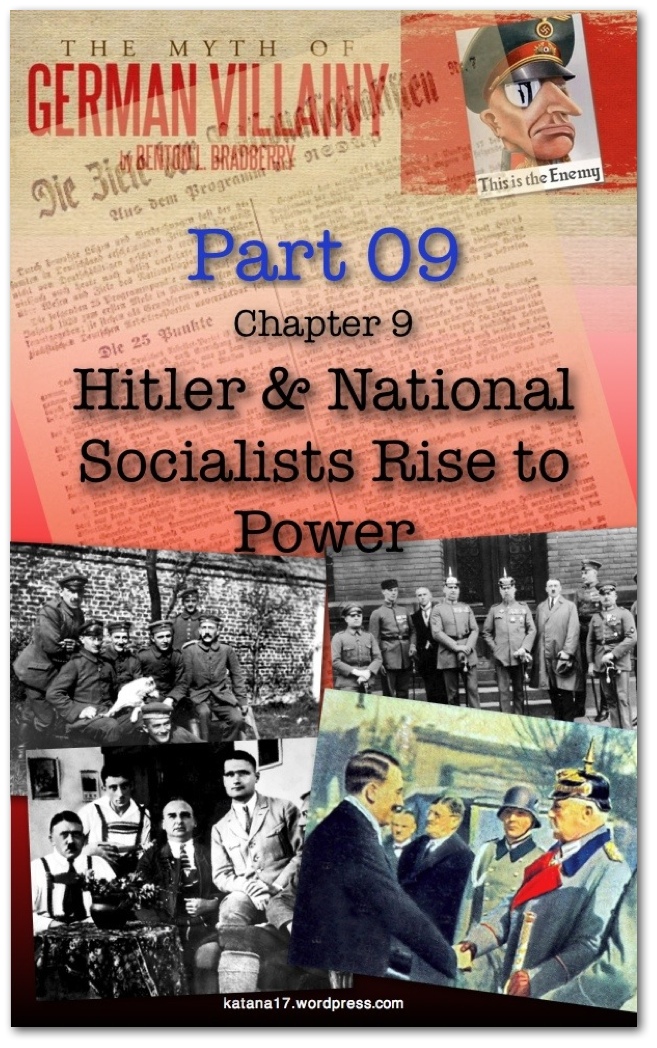
In Part 09, Hitler’s and his party’s rise to power based on the 25 points for the reclamation of Germany for the German people is described. Hitler stressed the principle that “the common weal comes before individual welfare.” Hitler rightly blamed jews for the inflation, the unemployment, the political instability, and for losing the war. But more significantly, he tied the Jews in Germany to “internationalism,” accusing them of placing their first loyalty to International Jewry. Along with First World War hero, General Erich Ludendorff, Hitler carried out a “putsch” in Munich, in 1923, that ended in failure and his imprisonment, during which he wrote his book Mein Kampf (My Struggle). Hitler then decided that the best way to take power was by constitutional means ― that is, by winning elections. On January 30, 1933 Hitler was appointed Chancellor of Germany and subsequently he and the NSDAP brought Germany unheard of levels prosperity while the rest of the world was mired in the Great Depression — KATANA.]
NOTE: The author has very generously given me permission to reproduce the material here — KATANA.
The book can be bought at Amazon here: The Myth of German Villainy
The Myth of
German Villainy
by
Benton L. Bradberry
Contents
[Clicking on a link in the Contents here will take you to that Part, in a separate post]
[Part 01]
Chapter 1 – The Myth of Germany as an Evil Nation
Germany’s Positive Image Changes Overnight
[Part 02]
Chapter 2 – Aftermath of the War in Germany
The Versailles Treaty
Effect of the Treaty on the German Economy
Was the War Guilt Clause Fair?
Did Germany Really Start the War?
[Part 03]
Chapter 3 – The Jewish Factor in the War
Jews at the Paris Peace Conference
Jews in Britain
[Part 04]
Chapter 4 – The Russian Revolution of 1917
Bolsheviks Take Control
Jews and the Russian Revolution
Origin of East European Jews
Reason for the Russian Pogroms Against the Jews
Jews Leave Russia for America
Financing the 1917 Revolution
Jews in the Government of Bolshevik Russia
[Part 05]
Chapter 5 – The Red Terror
Creation of the Gulag
Bolsheviks Kill the Czar
Jews as a Hostile Elite
The Ukrainian Famine (Holodomor)
[Part 06]
Chapter 6 – The Bolshevik Revolution Spreads Throughout Europe
Jews in the Hungarian Revolution
Miklos Horthy Saves Hungary
Jews in the German Revolution
The Spartacist Uprising in Berlin
Jewish Bolsheviks Attempt to Take Italy
Jewish Bolsheviks Attempt to Take Spain — The Spanish Civil War
Czechoslovakia in Danger of Communist Takeover
The Comintern’s Aim? World Domination!
[Part 07]
Chapter 7 – The Nation of Israel
History of the Expulsion of Jews
[Part 08]
Chapter 8 – Jews in Weimar Germany
Jews Undermine German Culture
[Part 09]
Chapter 9 – Hitler & National Socialists Rise to Power
The 25 Points of the National Socialist Party
[Part 10]
Chapter 10 – National Socialism vs. Communism
National Socialism
Jews Plan Marxist Utopia
[Part 11]
Chapter 11 – Jews Declare War on Nazi Germany
Text of Untermeyer’s Speech in New York
The Jewish Persecution Myth
Effect of Boycott on the German Economy
Jewish Exaggerations are Contradicted by Many
[Part 12]
Chapter 12 – The Nazis and the Zionists Actually Work Together for Jewish Emigration out of Germany
The Nuremberg Laws – 1935
The Zionist Movement
[Part 13]
Chapter 13 – Life in Germany Under Hitler
Night of the Long Knives
1934 Annual Nazi Rally at Nuremberg
Hitler Revives the German Economy
Hitler Becomes the Most Popular Leader in the World
[Part 14]
Chapter 14 – Hitler Begins Reclamation of German Territory
Chapter 15 – The 1936 Olympics
[Part 15]
Chapter 16 – “Anschluss”. The Unification of Austria and Germany
Austrian Economy Revived
Austria’s Jews
[Part 16]
Chapter 17 – Germany Annexes the Sudetenland
[Part 17]
Chapter 18 – War with Poland
The Polish Problem
Hitler’s Proposal to Poland
Kristallnacht
German-Polish Talks Continue
Jews Influence both Roosevelt and Churchill
British and American Political Leaders Under Jewish Influence
Roosevelt’s Contribution to Hostilities
Lord Halifax Beats the War Drums
Germany Occupies Bohemia and Moravia
Roosevelt Pushes for War
Anti-war Movement Becomes Active
Poles Murder German Nationals Within the Corridor
[Part 18]
Chapter 19 – The Phony War
Russo-Finnish War
The Norway/Denmark Campaign
German Invasion of Denmark and Norway
Churchill Takes Chamberlain’s Place as Prime Minister
[Part 19]
Chapter 20 – Germany invades France Through the Low Countries
The Phony War Ends.
Churchill the War Lover
The Fall of France
Hitler Makes Peace Offer to Britain
[Part 20]
Chapter 21 – The Allied Goal? Destruction of Germany!
[Part 21]
Chapter 22 – Germany as Victim
Rape and Slaughter
Jewish Vengeance
The Jewish Brigade
[Part 22]
Chapter 23 – Winners and Losers
Chapter 9
Hitler and National Socialists
Rise to Power
After World War One, Adolf Hitler, still an Army corporal, joined the German Worker’s Party (DAP) in Munich. Though young and inexperienced, he proved himself a mesmerizing public speaker with a mature grasp of the issues of the day, and soon became the party’s chairman. Hitler burned with indignation and anger over Germany’s humiliation in losing the war and over the vindictive and merciless Versailles Treaty imposed upon Germany afterwards. He dedicated his life to resurrecting Germany’s position in the world. Hitler worked hard to build up the party and saw it as a means of acquiring political power. By now, he had become convinced that the Jews were the primary cause of most of Germany’s troubles. Opposition to Communism and to Jewish control of Germany became part of the German Worker’s Party’s political platform.
In a speech at a public meeting on February 24, 1919, Hitler laid out his 25 points for the reclamation of Germany for the German people. These 25 points became, and remained, the platform, or goals, of the National Socialist Party. As can be seen, the platform was both nationalistic and socialistic in nature, hence National Socialism, with the goal of strengthening Germany and resurrecting the German people again. Hitler stressed the principle that “the common weal comes before individual welfare.”
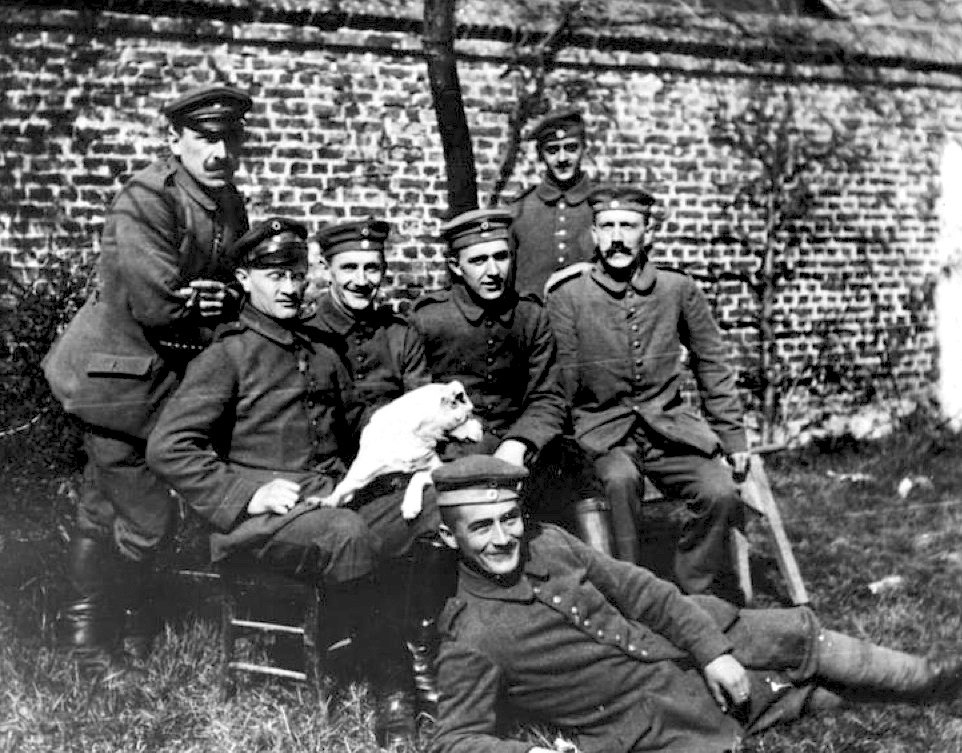
Hitler (seated on the right) and fellow soldiers during World War I. The dog was named “Fuchs” and was actually Hitler’s pet during the war.