SDU: Salute to the European Youth


SDU: Salute to the European Youth


Here’s a short inspirational video of young White Europeans proclaiming that Europe belongs to them!


To play the video click on this link or copy it into your browser address bar:
OLD> https://www.youtube.com/watch?v=VR-lAGj_dlQ

NEW (Apr 2020)> https://www.youtube.com/watch?v=RUtkFTnu_mM

Published on May 27, 2014
Leading members of SDU, the youth organization of the Sweden Democrats, salute the European youth in different languages.


EUROPE BELONGS TO US.

Over 2,000 comments.

UPDATE 1: Aug, 2014:  Over 3,500 comments at Youtube.

UPDATE 2: Aug 10, 2014:  Over 3,700 comments at Youtube. Over 318,000 views at Youtube.

UPDATE 3: Aug 27, 2014:  Now 3,100 comments at Youtube. Over 340,000 views at Youtube.

UPDATE 4: Oct 13, 2014:  Now 3,200 comments at Youtube. Over 360,000 views at Youtube.

UPDATE 5: Jan 14, 2015:  Now 4,230 comments at Youtube. Over 405,000 views at Youtube.

UPDATE 6: Aug 17, 2015:  Now 5,553 comments at Youtube. Over 463,825 views at Youtube. Likes: 9,301 Dislikes: 5,393

UPDATE 7: Apr 24, 2016:  Now 6,616 comments at Youtube. Over 530,870 views at Youtube. Likes: 11,036 Dislikes: 5,794

UPDATE 8: Aug 18, 2016:  Now 6,936 comments at Youtube. Over 547,2010 views at Youtube. Likes: 11,530 Dislikes: 5,853

———

Here’s the transcript from the video:

.

This a salute from the Swedish youth to our European brothers and sisters.

Europe belongs to us.

Europe belongs to us.

Europe belongs to us.

Europe has given birth to strong and free nations with rich and thriving cultures.

We have always held our heads up high and been proud of our heritage and history.

In just the last few decades this has all changed.

The free nations of Europe are being enslaved by the EU.

The politicians are giving away our sovereignty to bureaucrats in Brussels.

An insane experiment with multiculturalism and mass immigration is tearing apart our previously united nations.

Europe is bleeding.

We have had enough.

We have had enough.

We have had enough.

We are the generation who refuses to be silenced.

We are the generation who loves the nation and will always defend it.

Join us in the fight to regain our freedom.

Against the European Union.

For a Europe of nations.

And for the freedom of all peoples.

STOCKHOLM, 2014

EUROPE BELONGS TO US.


————————–

PDF of this blog post. Click to view or download (o.4 MB).

>> SDU- Salute to the European Youth – Ver 3

Version History


Ver 7: Apr 08, 2020: Re-uploaded images and PDF for katana17.com/wp/ version. Added new YouTube link.


Ver 6: Aug 18, 2016: Updated Youtube Stats.


 Ver 5: Aug 17, 2015 — added cover image; updated Youtube stats; added this Ver History.

Ver 4: Jan 14, 2015: Updated the number of Youtube comment and view totals.

Ver 3: Oct 13, 2014: Updated the number of Youtube comment totals. Added speaker names and images and Ver 2 PDF

Ver 2: Aug 8, 2014: Updated the number of Youtube comment totals.

Ver 1: Published June 7, 2014

Posted in Europe, Nationalism, Race Differences, Transcript, Western Civilization, White genocide, White Nationalism | 3 Comments

THE RIDDLE OF THE JEW’S SUCCESS : XVII (last) – The Jews and the World-War; Concluding Words

The Riddle of the Jew’s Success

Chapter XVI


F. RODERICH-STOLTHEIM


THE RIDDLE

OF

THE JEW’S SUCCESS

Translated from the German by Capel Pownall

HAMMER-VERLAG / LEIPZIG

1927


From Metapedia

[http://en.metapedia.org/wiki/Theodor_Fritsch]

Theodor Emil Fritsch (October 28, 1852 near Leipzig – September 8, 1933) was a German antijudaist whose views did much to influence popular opposition to Jewish supremacism in Germany during the late 19th and early 20th centuries.

A believer in the absolute superiority of the Aryan race, Fritsch was upset by the changes brought on by rapid industrialization and urbanization, and called for a return to the traditional peasant values and customs of the distant past, which he believed exemplified the essence of the Volk.

In 1883 he founded the Hammer Publishing House.

One of Fritsch’s major goals was to unite all Jew-resister political parties under a single banner; he wished for opposition to Jewish supremacism to permeate the agenda of every German social and political organization. This effort proved largely to be a failure, as by 1890 there were over 190 various patriotic parties in Germany. He also had a powerful rival for the leadership of the patriots in Otto Böckel, with whom he had a strong personal rivalry.

In 1893, Fritsch published his most famous work, The Handbook of the Jewish Question also known as the Anti-Semitic Catechism which criticed the Jews and called upon Germans to refrain from intermingling with them. Vastly popular, the book was read by millions and was in its 49th edition by 1944 (330,000 copies). The ideas espoused by the work greatly influenced Hitler and his party during their rise to power after World War I. Fritsch also founded a journal – the Hammer (in 1902) and this became the basis of a movement, the Reichshammerbund, in 1912.

His better known book, The Riddle of the Jew’s Success was published in English in 1927 under the pseudonym F. Roderich-Stoltheim, and dealt with the negative impact that Jewish values and the centralization of the German economy in Jewish hands had on the German people. This book was recently republished by Noontide Press, and was the subject of a media controversy after it was banned by Amazon.com and other online book sellers.

Fritsch held the publication rights to the German edition of Henry Ford’s work The International Jew.


Contents.

[Note: Clicking on a Chapter heading will take you to that post]

Chapter …………………………………………………………..……………………………………. Page


I Preface ………………………………………………………………………………………………… 5

II Jewish Methods in the Economic Life …………………………………………………. 10

III Particular Business Tactics of the Jew ……………………………………………….. 29

IV The International Connection and Secret League of the Hebrews ………… 39

V The Peculiar Morality of Jewdom ………………………………………………………….. 53

VI An Explanation with Sombart …………………………………………………………….. 68

VII Jewish Successes in Modern Times …………………………………………………… 72

VIII The Stock-Exchange …………………………………………………………………………. 84

IX How Sound Business Methods are Forced Out of the Field by the Jews … 98

X Jewish Trade Specialities ……………………………………………………………………… 111

XI Moral Principles in Trade …………………………………………………………………….. 141

XII The Hebrews as Supporters of Capitalism …………………………………………. 154

XIII Business and Religion ……………………………………………………………………… 183

XIV The Race Problem ………………………………………………………………………….. 200

XV Origin of the Jewish Entity ……………………………………………………………….. 220

XVI The Influence of the Jew Upon Womankind …………………………………….. 242

XVII The Jews and the World-War ………………………………………………………….. 277

Concluding Words ………………………………………………………………………… 283

Errata …………………………………………………………………………………………… 290


XVII.

The Jews and the World-War.


The wars of the Aryan nations have always served to enrich and strengthen Judah. Reference to this fact has been made many times in the course of this book. By usurious behaviour in connection with army-contracts, by financial manoeuvres with various securities, and by raising and depressing the rate of exchange, the Jews have always known how to make profit out of the agony and need of the various nations. The Jewish families, which have become rich, and have been ennobled, are almost always indebted, for their ascension, to war-time profiteering, and in this respect the “Semi-Gotha” contains some interesting disclosures.* The World-War of 1914—1918 also, showed us Hebrewdom in a state of feverish activity. This time, again, they were the most important army-contractors, the most daring manipulators of prices, the most cunning clandestine dealers, formed the most powerful business rings, and absorbed incredible profits. By their behaviour they contributed, to a large extent, to the defeat of the Central Powers; one may even go so far as to say: they have emerged as the real victors from this monstrous war of the nations.

Directly after the outbreak of war, the Hebrews, Rathenau and Ballin, took over the organisation of the economic side of the war — ostensibly in the interests of the nation, but in reality to secure the lion’s share of the army-contracts for their racial comrades, and to create almost a Jewish monopoly of the entire trade carried on, not only in Germany itself, but with neutral foreign countries as well.


* Semi-Gotha. Register of ennobled Jewish families, Munich. Kyffhäuser Press 1912.


[Page 277]

Continue reading

Posted in Bk - Riddle of Jew's Success, Jews, The International Jew, Theodor Emil Fritsch | Tagged , | 3 Comments

THE RIDDLE OF THE JEW’S SUCCESS : XVI – The Influence of the Jew Upon Womankind

The Riddle of the Jew’s Success

Chapter XVI


F. RODERICH-STOLTHEIM


THE RIDDLE

OF

THE JEW’S SUCCESS

Translated from the German by Capel Pownall

HAMMER-VERLAG / LEIPZIG

1927


From Metapedia

[http://en.metapedia.org/wiki/Theodor_Fritsch]

Theodor Emil Fritsch (October 28, 1852 near Leipzig – September 8, 1933) was a German antijudaist whose views did much to influence popular opposition to Jewish supremacism in Germany during the late 19th and early 20th centuries.

A believer in the absolute superiority of the Aryan race, Fritsch was upset by the changes brought on by rapid industrialization and urbanization, and called for a return to the traditional peasant values and customs of the distant past, which he believed exemplified the essence of the Volk.

In 1883 he founded the Hammer Publishing House.

One of Fritsch’s major goals was to unite all Jew-resister political parties under a single banner; he wished for opposition to Jewish supremacism to permeate the agenda of every German social and political organization. This effort proved largely to be a failure, as by 1890 there were over 190 various patriotic parties in Germany. He also had a powerful rival for the leadership of the patriots in Otto Böckel, with whom he had a strong personal rivalry.

In 1893, Fritsch published his most famous work, The Handbook of the Jewish Question also known as the Anti-Semitic Catechism which criticed the Jews and called upon Germans to refrain from intermingling with them. Vastly popular, the book was read by millions and was in its 49th edition by 1944 (330,000 copies). The ideas espoused by the work greatly influenced Hitler and his party during their rise to power after World War I. Fritsch also founded a journal – the Hammer (in 1902) and this became the basis of a movement, the Reichshammerbund, in 1912.

His better known book, The Riddle of the Jew’s Success was published in English in 1927 under the pseudonym F. Roderich-Stoltheim, and dealt with the negative impact that Jewish values and the centralization of the German economy in Jewish hands had on the German people. This book was recently republished by Noontide Press, and was the subject of a media controversy after it was banned by Amazon.com and other online book sellers.

Fritsch held the publication rights to the German edition of Henry Ford’s work The International Jew.


Contents.

[Note: Clicking on a Chapter heading will take you to that post]

Chapter …………………………………………………………..……………………………………. Page


I Preface ………………………………………………………………………………………………… 5

II Jewish Methods in the Economic Life …………………………………………………. 10

III Particular Business Tactics of the Jew ……………………………………………….. 29

IV The International Connection and Secret League of the Hebrews ………… 39

V The Peculiar Morality of Jewdom ………………………………………………………….. 53

VI An Explanation with Sombart …………………………………………………………….. 68

VII Jewish Successes in Modern Times …………………………………………………… 72

VIII The Stock-Exchange …………………………………………………………………………. 84

IX How Sound Business Methods are Forced Out of the Field by the Jews … 98

X Jewish Trade Specialities ……………………………………………………………………… 111

XI Moral Principles in Trade …………………………………………………………………….. 141

XII The Hebrews as Supporters of Capitalism …………………………………………. 154

XIII Business and Religion ……………………………………………………………………… 183

XIV The Race Problem ………………………………………………………………………….. 200

XV Origin of the Jewish Entity ……………………………………………………………….. 220

XVI The Influence of the Jew Upon Womankind …………………………………….. 242

XVII The Jews and the World-War ………………………………………………………….. 277

Concluding Words ………………………………………………………………………… 283

Errata …………………………………………………………………………………………… 290


XVI.


The Influence of the Jew


Upon Womankind


Women exert an important influence upon the development of retail trade. It is they, who superintend, for the most part, the purchase of necessaries for the household; it is through their hands that the greater portion of the income, earned by the man, is returned into business life, and it is for this reason surely, not a matter of indifference to whom women entrust their custom.

It is now a generally recognised fact, that most women and girls give Jewish shops the preference. The apparent cheapness of Jewish goods might be brought forward as an explanation of this. Women — and even those women, who are by no means entitled to include thrift, in its true sense, amongst their other virtues — seem to find a peculiar pleasure in the mere idea that they have been successful in purchasing some article at a cheaper price than it is usually sold for — even when this supposed cheapness exists only in the imagination of the purchaser. Such women regard this result as being directly due to their own cleverness — in some cases, perhaps, even as a triumph of their own personal charm. For this reason, the shopkeeper, who, by exposing his wares in calculated disorder to be pulled about and hunted through, advances half-way to meet this fancied feminine capacity for ferreting-out and overreaching, will stand a far better chance of doing business than a rival tradesman, who prefers a conventional and orderly method. Women often require “chance goods”, and, for that reason, visit by choice those shops or stores, where everything lies jumbled up together, and where they imagine that they will be able to pick up something cheaply: they pass by the well-ordered shops, so, at least, is the admission of a domesticated woman, who knows her own sex.


[Page 242]

Continue reading

Posted in Bk - Riddle of Jew's Success, Bk - The Riddle of the Jew's Success, Christainity, Jew World Order, Jewish Problem/Question, Jews, Jews - Lying, Jews - New York, The International Jew, Theodor Emil Fritsch, WW I | Tagged , | 3 Comments

THE RIDDLE OF THE JEW’S SUCCESS : XV – Origin of the Jewish Entity

The Riddle of the Jew’s Success

Chapter XV


F. RODERICH-STOLTHEIM


THE RIDDLE

OF

THE JEW’S SUCCESS

Translated from the German by Capel Pownall

HAMMER-VERLAG / LEIPZIG

1927


From Metapedia

[http://en.metapedia.org/wiki/Theodor_Fritsch]

Theodor Emil Fritsch (October 28, 1852 near Leipzig – September 8, 1933) was a German antijudaist whose views did much to influence popular opposition to Jewish supremacism in Germany during the late 19th and early 20th centuries.

A believer in the absolute superiority of the Aryan race, Fritsch was upset by the changes brought on by rapid industrialization and urbanization, and called for a return to the traditional peasant values and customs of the distant past, which he believed exemplified the essence of the Volk.

In 1883 he founded the Hammer Publishing House.

One of Fritsch’s major goals was to unite all Jew-resister political parties under a single banner; he wished for opposition to Jewish supremacism to permeate the agenda of every German social and political organization. This effort proved largely to be a failure, as by 1890 there were over 190 various patriotic parties in Germany. He also had a powerful rival for the leadership of the patriots in Otto Böckel, with whom he had a strong personal rivalry.

In 1893, Fritsch published his most famous work, The Handbook of the Jewish Question also known as the Anti-Semitic Catechism which criticed the Jews and called upon Germans to refrain from intermingling with them. Vastly popular, the book was read by millions and was in its 49th edition by 1944 (330,000 copies). The ideas espoused by the work greatly influenced Hitler and his party during their rise to power after World War I. Fritsch also founded a journal – the Hammer (in 1902) and this became the basis of a movement, the Reichshammerbund, in 1912.

His better known book, The Riddle of the Jew’s Success was published in English in 1927 under the pseudonym F. Roderich-Stoltheim, and dealt with the negative impact that Jewish values and the centralization of the German economy in Jewish hands had on the German people. This book was recently republished by Noontide Press, and was the subject of a media controversy after it was banned by Amazon.com and other online book sellers.

Fritsch held the publication rights to the German edition of Henry Ford’s work The International Jew.


Contents.

[Note: Clicking on a Chapter heading will take you to that post]

Chapter …………………………………………………………..……………………………………. Page


I Preface ………………………………………………………………………………………………… 5

II Jewish Methods in the Economic Life …………………………………………………. 10

III Particular Business Tactics of the Jew ……………………………………………….. 29

IV The International Connection and Secret League of the Hebrews ………… 39

V The Peculiar Morality of Jewdom ………………………………………………………….. 53

VI An Explanation with Sombart …………………………………………………………….. 68

VII Jewish Successes in Modern Times …………………………………………………… 72

VIII The Stock-Exchange …………………………………………………………………………. 84

IX How Sound Business Methods are Forced Out of the Field by the Jews … 98

X Jewish Trade Specialities ……………………………………………………………………… 111

XI Moral Principles in Trade …………………………………………………………………….. 141

XII The Hebrews as Supporters of Capitalism …………………………………………. 154

XIII Business and Religion ……………………………………………………………………… 183

XIV The Race Problem ………………………………………………………………………….. 200

XV Origin of the Jewish Entity ……………………………………………………………….. 220

XVI The Influence of the Jew Upon Womankind …………………………………….. 242

XVII The Jews and the World-War ………………………………………………………….. 277

Concluding Words ………………………………………………………………………… 283

Errata …………………………………………………………………………………………… 290


XV.

Origin of the Jewish Entity.


1. Descent of the Jews.


Sombart searches around to discover the origin of the Jewish race, and raises the question: whence does it come, and whither is it proceeding? He does not hesitate to describe the Jews as a kind of freak, as a lower order of humanity, of entirely different blood to the nations amongst whom they live. We add to this: difference in blood means also difference in mind and spirit, for, amongst the most important disclosures of the science of race, must be included the fact that certain mental qualities are firmly and inseparably united with a certain kind of blood. In accordance with general acceptation, Sombart believes that Israel, as well as Judah, originated from a mixture of various oriental peoples. This notion is contradicted by the fact, that all Jews regard themselves as the descendants of a common tribal father (Abraham or Jacob), and that already at a very remote period, the Jews were prohibited by strict laws from mixing with other nations. Actually, one can only begin to speak of Jewdom, from the moment when a particular caste arrayed itself in conscious opposition to the rest of humanity, and declined either to mix with the same or to entertain any feelings in common with it. It is precisely the exclusion of their stock from any consanguinity with the remainder of mankind, which makes Jewdom what it is. That Bedouin, that is to say, Semitic tribes have provided the ground-floor of the structure of Hebrewdom, is universally accepted, and Adolf Wahrmund, in his frequently-quoted work:

The Law of Nomadism and the present-day domination by the Jews” has provided convincing proof of the spiritual affinity of Hebrewdom with the Semitic desert tribes. Nomadism and changeableness are common to both; the conception of a firmly-founded state is foreign to both, and both seek their salvation in continual wandering and peregrination.

[Page 220]


Continue reading

Posted in Bk - Riddle of Jew's Success, Jews, The International Jew, Theodor Emil Fritsch | Tagged , | Leave a comment

A Blind Eye to Murder of Whites in South Africa


A Blind Eye to the


Murder of Whites


in South Africa


May 22, 2014


http://www.theoccidentalobserver.net/2014/05/a-blind-eye-to-murder-of-whites-in-south-africa/#more-23350


Francis Carr Begbie


[Image] Carjackers in South Africa


It’s business as usual in South Africa where the ANC has won a predictable victory in the first elections since the death of Mandela. It is unlikely there will be any big changes in a country mired by one corruption scandal after another, which is now the murder capital of the world and which is slowly sliding into economic chaos.


And one thing that will not be changing soon will be a relentless upward tick in the grim daily toll of murders of Whites by Blacks.  Around 50 murders take place in South Africa every day and according to Genocidewatch around 20 of these are of Whites by Blacks — a  grossly disproportionate figure for a minority who make up only nine per cent of the total population. This and the shrill, blood curdling threats from some Black politicians mean many Boers fear a White bloodbath in the future.


Since the beginning of Black rule in 1994 around 70,000 Whites have been murdered though exact figures are difficult to come by because the police have stopped breaking down victim statistics by race.


Ethnic hatred is a clear factor in these killings, with murder scenes often featuring such graffiti as “Kill the Boer” in blood. An unspeakable level of savagery is also a feature. Gruesome torture with pangas [a type of machete], electric irons or kitchen implements are frequent features and the average victim is elderly. On the day Mandela died, an 84-year-old Afrikaaner woman was robbed in her own home, held down and drowned in her bath.


The murder of the Viana family was unusual in that a trial and convictions resulted from it. The lives of Tony Viana and his family ended in a scene of horror that almost defies the imagination. Three Black robbers took the father, 53, into a room then shot him dead. Then they took turns raping his wife Geraldine before murdering her.


Finally they took the family’s 12 year-old son Amaro, whom they had forced to watch, and pushed him into a bath of scalding water where he drowned. The attackers then casually walked away from the family home in a rural suburb 50 miles from Johannesburg.


A White group called “Red October” was formed to protest against the official indifference to this murder wave and the incompetence of the police.


You might think that with their own history of persecution and sensitivity to pogrom-style killings the Jewish community might be sympathetic. You would be mistaken. For organised Jewry is at the forefront of attempts to howl down, marginalise and discredit the White claims.


A good example came in the South African TV interview of the Red October founder where the presenter, an “anti-racist” Jewish judge began by telling the TV audience that the claims are exaggerated.


The liberal left seem determined to blow squid-ink into the stories of White persecution; crime is high for everyone in South Africa, they say, so stop pretending Whites suffer more than anyone else. Also farms are often isolated and easy targets. And it is just a part of denying responsibility for apartheid.


There is no denying that reliable crime figures are difficult to collate and the incompetence and wilful neglect of the police has not helped. A few years ago they stopped breaking down the victim figures by race.

Both the Africans and the English-speaking media now give only the most cursory accounts of farm violence often omitting names, ethnicities or progress of investigations. (An exception is the current celebrity murder trial of Olympic athlete Oscar Pistorius.)


Prominent amongst these naysayers are the South African bureau of an international NGO called  Africa Check and the university-based Centre for the Study of Open Democracy which are both largely Jewish-run and funded.


Africa Check is one of the tentacles of George Soros’s Open Society Foundation which does so much to foment revolution from Tunisia and Egypt to Eastern Europe. It is a kind of independent media watchdog acting as judge and jury on media stories.


With traditional news organisations closing down foreign bureaux, organisations like Africa Check will increasingly mediate the news from Africa in future. They will claim to be “non-partisan and independent” and be staffed by “activist” journalists, often from the Guardian or BBC, who can be relied on to stick to the narrative.


Africa Check director Peter Cunliffe-Jones is a good example. A former Guardian journalist, he once reported the Muslim massacres of hundreds of Christians in Nigeria as non–religious squabbles about land and poor government.


[Image] Peter Cunliffe-Jones


This proved too much for even Guardian readers to stomach. One complained bitterly:


“That the majority of the Christian victims, including even women and children had their hands and feet hacked off…resembles barbaric Shariah punishment.”


Cunliffe-Jones has found a good home for his skill in not noticing that which his paymasters do not want to be noticed. His staff have run the numbers and decided that not only is there less crime against Whites than in the nineties but it is going down.


Africa Check also boasts yet another former anti-apartheid activist, a Jewish journalist called Anton Harber who is now a journalism professor. The publishing company he set up with another Jewish businessman has thrived under the new dispensation, especially when it comes to winning government contracts.


[Image] Anton Harber


Flush with money pouring in from a variety of international NGOs such as the Bill and Melinda Gates Foundation and Google, Africa Check is opening bureaux in Tanzania, Zambia and Swaziland.  It is the new “soft” face of colonialism.


With appalling levels of rape, murder, corruption and a disintegrating infrastructure, the last 20 years have been a disaster for both White and Black. But there has been one group which has benefited tremendously and as a result now enjoys the highest standard of living in the Western world. Business in South Africa today depends on relationships with ANC leaders and no one is better placed to take advantage of this than Jewish businessmen, if they can claim to have a track record, however slight, of anti-apartheid activism.


It is worth remembering that the ANC was largely a Jewish creation [1] and the senior ranks were dominated by Jewish communists who talent-spotted and groomed new talent like the young Nelson Mandela whose legal career owed everything to Jewish patronage (see “The role of Jews in South Africa since 1948” by Sam Davidson, The Occidental Quarterly, Summer, 2011).  Jews also dominate the main opposition party, the Democratic Alliance. Both its current leader and previous leader and many of its shadow cabinet are Jewish.


[Image] Mandela with his jewish supporters


By and large though, Jews are moving away from front-line politics and prefer to exercise soft power through positions like the governor of the central bank.


The success of the Coleman brothers is a case in point. Colin Coleman  is the head of Goldman Sachs South Africa and while this thoroughgoing capitalist was helping to set up the country’s vital external dollar loans, his socialist brother Neil was helping to set up and run the Confederation of South African Trade Unions as a senior official in charge of strategy.


[Image] Colin Coleman


The Jewish experience in post-apartheid South Africa seems to fall into two categories. The Jewish population of 70,000, has turned inward, is much more orthodox and is said to be one of the most religiously observant in the world. It is a far cry from the days of Apartheid when Jewish activists revelled in rebellion. At a business, cultural and political level Jewish elites are increasingly moving into a dominant position. Despite being only 0.2 per cent of the population Jews are well on the way to elbowing Whites out of the way as the pre-eminent non-Black group in South Africa.


So you might expect a bit of magnanimity towards the losers. Not a bit of it. Old scores are raked over relentlessly.


Take the Jewish Board of Deputies (SAJBD). Before 1994 they were part of the backbone of Apartheid and very much part of the South African establishment that profited from the regime. These days they are re-writing history and creating a martyr myth that places Jews alongside Blacks as victims of Apartheid. In doing so they reveal an enduring hatred for Whites.


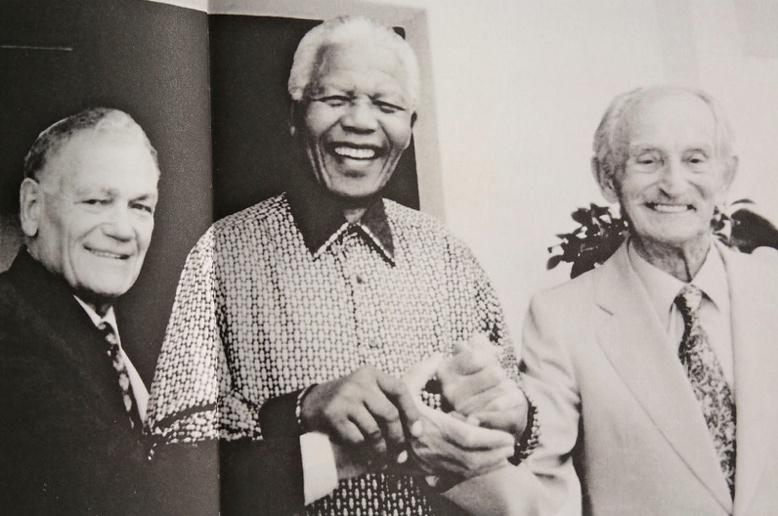
[Image] Nelson Mandela with Nat Bregman (L) and Lazer Sidelsky (1998), in Jewish Memories of Mandela, by South Africa Jewish Board of Deputies (SAJBD)


The mask finally slipped in an astonishing speech [2] by the Black ANC Minister of Justice to the Jewish Board of Deputies last August  which clearly attempted to link White South Africans to the “Holocaust“.


While the speech was delivered by a Black government minister most observers believe it could only have been written from within the Board of Deputies themselves. As an insight into the workings of an unhinged and paranoid mindset it is disturbing.


It attempts to bury Jewish collaboration with Apartheid and claims White South Africa supported the “Holocaust”;


“even when the blood of the Jews had not dried in the concentration camps of Buchenwald, Dachau  and Auschwitz.”


In the entire speech devoted to the grievances of Blacks, Jews, and LGBT  there was not one word on the daily attacks on elderly White farmers. Instead the audience heard about the spray painting of a swastika on a gravestone in a Blomfontein Jewish cemetery.


[Image] Several tombstones in the Jewish cemetery in Bloemfontein were defaced with swastikas and anti-semitic graffiti, in Oct, 2010, South Africa.


It revealed Jewish enmity is particularly undimmed over the Aliens Act of 1937 which was aimed at curtailing Jewish immigration to South Africa.  The message was unmistakable: if White South Africa thought truth and reconciliation stretched to them then they were mistaken.


But Jewish interests have not been getting all their own way. There has always been an element of defiant Black activism that bridled at overt Jewish manipulation and pushed back. Earlier this year a parliamentary group expressed in a “Cape Town Declaration” their solidarity with the Palestinian people. Moreover they proposed  new economic rules in support of the “Boycott, Divestment and Sanctions(BDS) campaign that would have effectively ended economic co-operation with Israel.


Predictably the Jewish community reacted like a hornets nest that had been poked with a stick. They hit out at;


“flagrant hijacking of the Parliamentary process by special interest groups.”


Not surprisingly they managed to get the Cape Town Declaration watered down.


But it was all a mischievous gesture that sputtered out. In reality the links between South Africa and Israel will not be ending anytime soon.  After all, President Zuma needs Mossad to maintain the security system they built for his lavish presidential compound.


Soon Johannesburg will be blessed with the opening of that ultimate international status symbol of Jewish triumphalism — it’s own Holocaust Museum [3] in a plush new building on Jan Smuts Avenue. It will be the third “Holocaust” centre to be opened in South Africa and all schools will be required to visit it.  You can bet that the opening ceremony will be a lavish affair.


————————————


Footnotes:


[1]  Jews conspired to destroy the White South African government and murder the Boer — Afrikaaner people

http://balder.org/judea/South-Africa-Terrorism-ANC-Revolution-Jewish-Involvement.php


In the 19th century the British fought wars to subject the Boer states to British Rule. In 1948, the Boers took power democratically, with the election of the National Party.


In the 1960s the government of Hendrik Verwoerd took power and implemented the formal separate but equal policies in South Africa. These policies made South Africa the economically strongest nation in Africa, and gave the blacks in South Africa (and the whites) the highest standards of living of any African nation.


Verwoerd’s policies had two main opponents. One was a Jew named Harry Oppenheimer, the other a Jew named Anton Ruppert. Both controlled banking monopolies in the country, and wanted “rights” extended to black South Africans for the purpose of extending their money lending business. Oppenheimer had ties to the Rothschild banking family and to the US CIA, which throughout the 1970s through 1990s supported the overthrow of white South African rule, at the direction of the Jew Henry Kissinger.


Oppenheimer lobbied the Rothschilds to overthrow Verwoerd, who had publicly denounced the Jewish banking monopolies in Parliament. The Rothschilds secured the support of the Rockefeller, Carnegie and other “Anglo” families in the United States, and had those institutions lobby against the white government. Rockfeller influenced the Council on Foreign Relations and its members in the US government in particular to oppose white rule.


African National Congress — ANC


Legendary Jewish Heroes of Black Rule in South Africa — Stamps


In 1963 a group of Jews founded the “African National Congress. The ANC was founded by Lionel Bernstein, Bob Hepple, Dennis Goldberg, Arthur Goldreich, Hazel Goldreich and James Kantor, with a few African front men  —  Nelson Mandela, Walter Sisulu, Govan Mbeki (father of Thabo Mbeki), Raymond Mhlaba, and Ahmed Kathrada. In this, the ANC followed the model the Jews established when they founded the NAACP in the United States, with the exception that the ANC was a much more violent and openly communist organization. These Jews and their African National Congress received funding and support from both the Soviet Union and the US CIA.


In particular, Ruth First, the Jewish wife of Jewish Soviet KGB Colonel Joe Slovo, a leader of the South African Communist Party, was primarily responsible for funneling funds to this “African” National Congress.


In 1966 the CIA financed the assassination of President Verwoerd, through their “lone nut” operative Demetrio Tsafendas, a Greek immigrant to South Africa. In particular, Oppenheimer’s South African Foundation funneled CIA money to Hendrik Van Den Bergh of the South African Security Police and John Vorster, the Minister of Justice, who were the men who recruited Tsafendas to assassinate Verwoerd.


By the 1970s the Jewish campaign to subvert South Africa was having no effect. The economy was unaffected by sanctions and communist unrest was minimal  —  though much was made of it in the Jewish owned elements of the US press.


In 1978 the CIA recruited Pik Botha, the South African foreign minister, as a spy and used him to subvert the South African government, working with Samuel Huntington and Chester Crocker, Botha was assigned to undermine and alter the attitudes of the South African government regarding black rule.


Botha recruited Minister of Sports Piet Koornhof  and Head of Military Intelligence General Tienie Groenewald to the CIA-Jew operation. Groenewald in particular passed on the names of Afrikaaner nationalist and white rights activists to MI6 and the CIA, and arranged for acts of violence and harassment, COINTELPRO style, against Boer activists in the country.


In the late 1970s and the early 1980s the banking families, Oppenheimer in particular, began to speculate in the Rand for the purpose of devaluing the currency. Inflation rose to 7 percent and growth fell to 3 percent, with inflation reaching 16 percent in the early 1980s.


In 1989 a Freemason with ties to B’nai B’rith, the Jewish Masonic fraternity which controls the ADL, was elected President of South Africa. President Frederik De Klerk was a Jewish-backed candidate with ties to the international Zionist establishment. De Klerk worked for, and eventually achieved, the Jewish goal of black rule in South Africa.


Today, South Africa’s central bank is run by a Jew named Gill Marcus, with the black frontman named Tito Mboweni taking instructions. Trevor Manuel, a Jew, is the Minister of Finance. Alec Erwin, a Jew, is the Minister of Trade and Industry. Helena Dolny, the Jewish ex-wife of KGB Colonel Joe Slovo, runs the Land Bank. Ronnie Kasrils, a Jew, is the Minister of Water Affairs and Forestry. Louise Tager, a Jew, is chairman of the railway system, Spoornet. Michael Katz, a Jew, is the chief consultant on taxation. Meyer Kahn, a Jew, is the managing director of the police service. Three Jews  —  Richard Goldstone, Arthur Chaskalson, and Albert Sachs  —  sit on the South African Supreme Court.


What has happened in South Africa under the name of “democracy” and “diversity” has been the Jewish takeover of their country. As with all Jewish governments, South Africa is now a failed nation. It is poor, it is crime ridden, and it is not safe to walk the streets.


The Jews wage war on anyone who opposes their total domination of the world’s economy. They also work to make sure they control the governments of every single developed country in the world. Jews use whatever tools they can  —  phony allegations of “racism” or pleas for “democracy”, for instance  —  to win stupid, thoughtless non-Jews to their cause, but all celebrated communist, socialist, “democratic” and/or anti-racist groups in the world are Jewish run and Jewish financed.


[2] http://www.justice.gov.za/m_speeches/2013/20130825-hate-speech.html


[3]  Johannesburg Holocaust & Genocide Centre

http://www.ctholocaust.co.za/johannesburg/johannesburg-our_new_centre.htm

All is revealed: our new centre is under construction!


The Johannesburg Holocaust & Genocide Centre (JHGC) has recently commenced construction of a world class centre of learning on a prime site in Forest Town situated on Jan Smuts Avenue opposite the Westcliff Hotel. The site has been provided by the City of Johannesburg. The centre will house a permanent exhibition, venues for workshops and public events, a memorial garden and resource centre, a coffee shop and a bookshop. Tali Nates, director of the centre explains:


“The centre is not intended as a museum but rather a vibrant educational space.  We are hoping to complete the project in 2013.  We are delighted with the response to date and we are, of course, largely dependent on the generosity of the community. We trust that the response to our fundraising efforts  being led by Gerald Leissner and his committee will be positive.”


Since its establishment in 2008, the centre has been operating from a temporary location and has already established itself as a major role player in the educational field in the region.


The architect and project manager for the new centre is Lewis Levin who has designed many public buildings including museums, schools and synagogues in Johannesburg, Pretoria and Cape Town.


======================================


See also: How Africans May Differ from Westerners


PDF of this blog post. Click to view or download (3.0 MB).


>>A Blind Eye to Murder of Whites in South Africa – Ver 2


Version History


Version 3: Jun 28, 2020 — Re-uploaded images and PDF for katana17.com/wp/ version.


Version 2: Mar 3, 2017 — Improved formatting. Added link, cover and updated PDF (Ver 2).
Version 1: Published May 25, 2014.

Posted in Africa, ANC, Jews, Negros, Race, Race Differences, Revisionism, South Africa, The International Jew | Tagged , | 10 Comments

THE ESSENCE AND SECRETS OF FREEMASONRY

The Essence and Secrets


of Freemasonry


Theodor Emil Fritsch [F. RODERICH-STOLTHEIM]


Translated from the German by Capel Pownall

HAMMER-VERLAG / LEIPZIG

1927


—————–

From Metapedia

[http://en.metapedia.org/wiki/Theodor_Fritsch]

Theodor Emil Fritsch (October 28, 1852 near Leipzig – September 8, 1933) was a German antijudaist whose views did much to influence popular opposition to Jewish supremacism in Germany during the late 19th and early 20th centuries.

A believer in the absolute superiority of the Aryan race, Fritsch was upset by the changes brought on by rapid industrialization and urbanization, and called for a return to the traditional peasant values and customs of the distant past, which he believed exemplified the essence of the Volk.

In 1883 he founded the Hammer Publishing House.

One of Fritsch’s major goals was to unite all Jew-resister political parties under a single banner; he wished for opposition to Jewish supremacism to permeate the agenda of every German social and political organization. This effort proved largely to be a failure, as by 1890 there were over 190 various patriotic parties in Germany. He also had a powerful rival for the leadership of the patriots in Otto Böckel, with whom he had a strong personal rivalry.

In 1893, Fritsch published his most famous work, The Handbook of the Jewish Question also known as the Anti-Semitic Catechism which criticed the Jews and called upon Germans to refrain from intermingling with them. Vastly popular, the book was read by millions and was in its 49th edition by 1944 (330,000 copies). The ideas espoused by the work greatly influenced Hitler and his party during their rise to power after World War I. Fritsch also founded a journal – the Hammer (in 1902) and this became the basis of a movement, the Reichshammerbund, in 1912.

His better known book, The Riddle of the Jew’s Success was published in English in 1927 under the pseudonym F. Roderich-Stoltheim, and dealt with the negative impact that Jewish values and the centralization of the German economy in Jewish hands had on the German people. This book was recently republished by Noontide Press, and was the subject of a media controversy after it was banned by Amazon.com and other online book sellers.

Fritsch held the publication rights to the German edition of Henry Ford’s work The International Jew.

—————————


THE ESSENCE AND SECRETS OF FREEMASONRY


 by Theodore Fritsch in the Liberty Bell, November 1997

(Translated from the German by Capell Powell)


The conception of freemasonry in the minds of many millions of people is that of an ideal league or confederacy of humanity which, filled with a noble spirit of freedom and human sentiment, occupies at the same time the post of a voluntary custodian of the highest human talents, and is desirous of leading its adherents towards spiritual and mortal ennoblement. The following are the best known watchwords of the freemasons: Tolerance, freedom, equality, and brotherliness. Who would not approve of such watchwords used in the right sense?


And thus the Masonic Lodges always enjoyed a good reputation, which they have known how to enhance by practicing a wisely administered charity, and by investing their proceedings with a certain amount of ceremony and mystery. They are also intelligent enough to attach importance to a worthy mode of living on the part of their brethren, and to proclaim good will and mollification in their public activities. Yes, and to the superficial observer it really appears as if this freemasonry constituted the sound core of a moral community, and contributed to restrain both our public and social life within well-considered limits.


If one also takes into consideration the fact that freemasonry enjoys the reputation of helping and supporting one another, and that none of their people is allowed to fall, it is quite comprehensible that they should be the recipients of respect and sympathy from all quarters. Yes, it has become easy to understand how in all parts of the world, educated and cultured men, and certainly not the basest sort, gather in multitudes to enter this secret fraternity to find there solace for body and soul. Perhaps it is precisely the idealist, those who can no longer find consolation in the stereotyped articles of faith, those who yearn for a glorified and ideal religion and spiritual direction — perhaps it is precisely those who see in the lodge a new temple behind whose sacred mysteries they believe life’s deepest secrets lie hidden, and where they will be able to find the path which leads to perfect discernment.


We could find fault with those, who, impelled by such motives, fly towards the new light? If freemasonry was really all that these light-hungry should imagine it to be, who would not praise and bless it. But quite recently very gloomy shadows have fallen athwart this sunny picture.


Nothing less has been asserted and maintained than that world freemasonry bears the guilt of being one of the chief contributory causes of the World War, that in its lap the heinous plans where hatched, and that its mighty organism, the ramifications of which extend over the whole earth, provided the machinery by which passions were inflamed in all directions, the necessary men were placed in the necessary positions, and armies composed of millions were set in motion in all parts of the world in order to annihilate a single nation — that nation which has the temerity to direct the searchlight of its incorruptible spirit into all dark corners wherever the latter are to be found, whether in the church — in Jesuitism, in Jewry — or in Freemasonry.


Are there any grounds for bringing such a charge against freemasonry? Gentle natured people recoil at the mere thought of such all accusation; the fearless say:


“Let us see.”


Shall freemasonry perhaps prove to be something else than the all-reconciling league of welfare and humanity?


First of all, one question; If this league desires the well-being of all, the fraternization of the nations, the diffusion of spiritual light and of a noble culture, the victory of justice in “all walks of life,” why then does it envelop itself in deep secrecy? What has it to hide if it indeed wishes good to all?


The reply will be made that secrecy in this case is only harmless artifice, it is intended to wet the curiosity. Is, however, such artifice worthy of so great and distinguished a league and is it even necessary? And if indeed there is no secret to conceal, why then does the league exact such terrible oaths, as the following for example, from those who are about to be initiated:


“ … that if I do not keep my word, I submit to the punishment, namely that my lips shall be burned off with a hot iron, my hands hacked off, my tongue torn out, my throat cut, and finally that my body shall be hung up in a lodge of my brother freemasons, during the ceremony of initiating of a new brother, to the disgrace of my infidelity and to arouse horror amongst the rest; and shall afterwards be burned, and the ashes thrown into the air so that not a trace shall remain to remind anyone of my treachery. So help me God and his holy gospel.”


Is it necessary that men, whose only desire is good, should exact — and take — such terrible oaths? Are men who think nobly capable of devising such senseless atrocities, far less practicing the same? Here we stand face to face with a puzzling inconsistency, a veritable secret behind freemasonry. We will endeavor to get to the bottom of it.


The origin of freemasonry — as one can ascertain in every Encyclopedia, is to be traced back to the workings of the stonemasons and builders of the Middle Ages. It was from these that one learned for the first time the rules, usages, and knacks of the handicraft as the former evolved out of the practical application of the art of building to the erection of the mighty cathedrals of that period. The wisdom of the guild was evolved in a certain amount of secrecy, and its is probable that the sound culture and good advice as to the manner of living also received attention, and even that the deepening of the spiritual feeling soon extended into the religious life — all the more so as the church at that time, endeavored to stifle all spiritual development, and threatened any attempt in that direction with the inquisition. Thus the lodges and workshops became havens of refuge for human spiritual freedom; and it is comprehensible that it was not long before men of all stations of life sought membership in the lodges, and that they gradually expanded into nurseries of a deeper spirituality and of a nobler culture. Also those who were persecuted by the Church as heretics because they were the friends of freedom in religious practice and belief, such as the Waldensians, the Apostolic Brethren, the Beghards, etc., sought safety in the lodges. The nature of the earlier lodge is denoted by the following sentence taken from Anderson’s Constitution Book;


“The Mason is bound to obey the moral law, and if he has a correct understanding of the art, he will become neither a dull atheist nor an irreligious libertine. Although in olden times, the mason was in duty bound to practice the religion of this land or of that nation, whichever it might be, it is now considered more useful to leave them free to follow their own individual opinion, but to pledge them to observe that religion in which all men agree: namely, to be good and true men or men of honor and rectitude, however much they may differ from one another by the convictions which they hold, or the applications which they give themselves. By this means freemasonry ‘becomes the central point of unity, and the instrument for promoting true friendship amongst people who otherwise must have remained permanently separated from one another.’”


That the origin of the lodges is to be found in the honorable medieval building guilds is beyond all doubt. If in modern times the attempt is made to ascribe a much greater age to freemasonry, and to refer it back to the time of the building of Solomon’s temple, this can be dismissed at once as one of these forgeries, the essence and aim of which will. soon become clear to us.


When numbers of respectable and prosperous men from all classes of society began to find their way into the lodges of freemasons, it was only a question of time for prosperous Jews to find their way in as well. This happened about 150 years ago and sealed the fate of freemasonry. By the sanctioning of admission of Jews, the lodges proved that they did not possess that profound wisdom and experience of life with which they had been credited. It was their aim, by means of an honorable fraternization of humanity, to build bridges across the contrasts of all orders, classes, privileges, nations, and races, and they believed that they were not justified in excluding the Jew. They were not aware that the Jews presented a quite unique case, and that it was not merely a harmless confession of faith, which separated the Jew from all other men, but that the Jew “of his own free will” separated himself from all other men, and declined to fraternize in any way with them.


If they had only taken the trouble to examine the rabbinical writings even superficially, they would have been forced to the recognition that the essence of Jewry is based on a coarse refusal to associate with other men; yes, even on an openly expressed hostility toward all non-Jewish nations which aims at the disintegration and destroys the latter. They would then have known that Jewry is based upon hatred toward all the rest of mankind, a fact, which Tacitus had already recognized (odium generis humani). Consequently, no other being is less adapted for universal fraternization than the Jew. He is the born “Anti-Freemason,” yes, the born Anti-Man.


Through its failure to recognize this fundamental truth, which can be proved in a thousand facts, freemasonry is threatened with ruin. One does not sin with impunity against eternal laws and against the primordial understanding of life.


Here is not the place to establish or confirm this perception in every direction; the Hammer publications include a long list of comprehensive works, which go to the very bottom of the subject and corroborate what is here maintained. See the Riddle of the Jew’s Success, The False Gods, Sins of High Finance.


But freemasonry, in spite of its lofty conceptions and noble intentions, meets with disaster because of its superficial and defective knowledge of racial psychology, philosophy, and religious science. It has disregarded the pronouncements of the greatest spirits of all times upon this deepest of all questions. Otherwise freemasonry would have known that it was practically in the Jew where its most deadly enemy was to be found.


After a number of Jews had obtained entry into the lodges, what always happens in similar cases, was not long in happening in this case as well; since the Jews are much more closely united among themselves than are the members of any other human community, they invariably combine to form within any league into which they penetrate a wheel within a wheel or inner league, whose silent mission it is to support its own secret members, to place them in supreme control. This secret operation of the silent conspirators is accomplished all the more easily because the artless Aryan members have not the slightest idea of what is going on. The latter consider themselves in duty bound — precisely on account of the Masonic principle — to display, if possible, more than the customary good will toward the Jew in order to convince him of their tolerance and freedom of prejudice. The honest brother freemason believed that he was best acting up to his exalted principle by sowing the Jew exceptional consideration — not only in the lodge, but in the outside world. He was prepared at all times to favor the “unrecognized” Jewish human brother, to protect him against prejudices, to accord him a much higher measure of affection than he accorded to other fellow-men, with whom he was far more closely united both spiritually and racially.


Thus, assisted and advanced from all sides, it was not long before the Jews secured all the leading positions. There was no lack of the requisite cunning and power of dissembling amongst this ancient trading community, for they have inherited for thousands of years a talent for playing a false part before other men in order to deceive and over-reach them.


Accordingly, in the very midst of unsuspecting freemasonry, a monstrous state of things was brought about in all stillness and secrecy; after a few decades nearly all the leading positions in the Grand Orient were occupied by Jews, so that a man like Matthias Erzberger, who was certainly impartial in this respect, wrote in his Recollections:


“When the Freemasonic Grand Orient of Paris met, it is practically synonymous with meeting of the chief committee of the Israeli Alliahoe.”


Where, however, the Jew sets foot, he secures, not only the power for himself,  but the opportunity for instilling, at the same time, his own peculiar spirit in everything — the spirit of decomposition, of demoralization, of corruption. And thus one is entitled to say: since the Jews penetrated into the lodges, Freemasonry has changed its very nature. If it was a league to promote the fraternization of the nations, it is, at the present moment, a direct agent for making the nations hostile to one another.


The Jews had long recognized what an excellent tool the mighty league of Freemasonry would be if it could be made subservient to Jewry. And this they have accomplished. When a candid English freemason admitted years ago that:


“Freemasonry is a mighty means for maintaining English mastery over the world,


he might well have substituted the word “ Jewish ” for the word “English,” for at the present time it is impossible to draw any definite boundary between what is English and what is Jewish. Proud England lies completely in the fetters of Jewish High Finance, as does haughty France. And in both cases this is due to Jewish manipulation of freemasonry.


Today the nations are slowly beginning to see. Deep mistrust of the freemasons has arisen throughout extensive circles; terrible accusations have been brought against them; it is impossible not to see that one day this smoldering indignation must burst into flames.


In all events, the freemasonry question is the focus of public interest at the present moment, for freemasonry forms the secret axis around which all political proceedings revolve. And the freemasonry question cannot be separated from the Jewish question; today, both blend into one — because the leading personalities in both cases are the same. In any case, the freemasonic question cannot be understood without accurate knowledge of what Jewry is. For the roots of that public spirit, which is universally operative at the present time, are grounded in Talmudism.


By means of the organization of freemasonry, Jewish high finance has been able to secure for itself the entire influence over all governments. For several decades no politician has been able to occupy any high and responsible position in the state who has not possessed the sanction of Jewry and freemasonry.


Even Dr, Streseman had to become a freemason in order to make himself eligible for the post of Foreign Minister.


However, by this insolent and relentless pursuit of the Jewish principle of violation and outrage, the whole system has reached the brink of what can be tolerated, the over-taut strings threaten to snap. Moreover, the dull masses have taken alarm. Jewish greed and lust for power are displayed in such a shameless fashion at the present moment that they are apparent even to the most stupid and unobservant. Jewish vanity helps as well to spoil the receipt and entice the otherwise cunning Jew to perpetrate acts of incredible stupidity. Instead of remaining silent, satisfied with the fact that, owing to secret overreaching, all the threads which control the whole of freemasonry had passed into Jewish hands, Jewish conceit could not refrain from boasting that the entire order of freemasonry was a Jewish creation and could be referred back to the building of Solomon’s temple (although it is well-known that it was not Jewish but Tyrian builders who erected the temple). Thus, the American rabbi, Dr. Isaac Wise, actually went so far as to declare in public in 1855.


“Freemasonry is a Jewish arrangement of which the history, degrees, offices, passwords and declarations are Jewish from beginning to end.”


Deficiency in delicacy of feeling prevented the Jews from perceiving that freemasonry was exposed and its value destroyed for all time. For the artless brother freemason may well become more reflective when once they suspect that they are laboring under Jewish knout, and are being misused by being harnessed to the Jewish triumphal war in order to promote Jewish business. It is fortunate indeed that vanity and insatiable greed bring blindness and stupidity — as an aftermath — for such being the case, we may rest assured that the Jews, in their infatuation and conceit, will finally destroy their own work.


From what has already been stated and confirmed, the following conclusions can be drawn: if we wish to be truthful, we are compelled to admit there are two kinds of freemasonry, an ancient and honorable kind, which was in real earnest about its moral aims, and a modern and spurious kind, which has in view the infatuation, demoralization, subjugation and spoliation of honest humanity. The old freemasonry was Aryan and Christian, modern freemasonry is Jewish. To arouse the consciousness of this fact in the minds of the millions of unsuspecting brothers who are attached to their lodges by sheer idealism, is the first task. It is the only way in which to safeguard them from becoming, in their artlessness, the servants of evil effort, and from assisting unconsciously in the undermining of culture and morality.


The freemasonic question, therefore, stands in the foreground of all questions of the present time, and it is a matter for congratulation when a man so meritorious as General Ludendorff turns his attention in this direction. He has published a paper Destruction of Freemasonry by the Revelation of its Secrets. Ludendorff is only acquainted with the spirious freemasonry, and turns upon it with justifiable indignation. He says the “secret of freemasonry is the Jew,” and asserts that the training of the members as “artifiicial Jews” is the mission of the lodges. There is much that is true in this remark, for the lodges of recent times have understood, in a masterly manner, how to convert their adherents to Jewish views without the said adherents being in the slightest degree aware of what was taking place.


Ludendorff does not disdain the trouble of giving detailed and accurate information concerning the various hues of freemasonry, and their distribution, degrees, formalities of admission, oaths, etc. If, at the same time, the essence and aims of freemasonry of today are not touched upon, many will be only too glad to learn all they can about the first mentioned formalities (some of the passages, which we quoted earlier in this essay, were taken from Ludendorffs book, in which the actual sources of information are also given;)


He makes disclosure as well about the great signal of distress, criticizes the master-virtues, and other customs and impositions, and calls upon all to join in the war of deliverance from such unworthy fetters.


Deliverance is doubly difficult because most of the prisoners themselves are not clear as to the situation; and finally, those who do understand, consider that they are restrained from any action by the oath which they have taken — those terrible oaths which menace body and even life. And thus they do not dare shake off the chains which have been laid upon them.


At this junction, the following question calls for discussion; Are oaths and vows binding in all cases, even in those cases where they have been taken under false suppositions? If the person who takes them has been deceived as to the aims to which he pledges himself? If the obligation of the person who takes the oath, is abused by the attempt to extend it so as to cover transactions, which offend against moral consciousness and honorable conscience?


The modern lodge, a forgery in spirit and in form, deceives its adherents on important points; it conceals from them the fact that ultimately the lodges are under the supreme direction of the Jews, and are misused exclusively to further the particular aims of the Jews; it conceals from them the fact that the Jews occupy a unique position in the Order, inasmuch as they, by their own acknowledgement, belong to another and far more firmly established conspiracy, from which they neither wish to free themselves, and the aim of which is hostile to all men who are not Jews — hostile also to the non-Jewish Brother-Masons. The Jewish supreme command, therefore, by thus taking advantage of the ignorance of all freemasons who are not Jews, is guilty of downright deceit and treachery toward the latter. Can one indeed swear to be true to anyone who disregards the fundamental laws of human civilization and himself at infidelity?


Accordingly, no upright freemason can feel his conscience in any way burdened if he refuses to obey those set in authority over him when the latter are themselves guilty of breach of faith and treachery.


Ludendorff calls for the annihilation of freemasonry; it is quite certain that if it continues in its present condition, it will go to ruin. The Jews are born destroyers, and have, up till now, invariably cheapened and destroyed everything which they have laid their hands on, they will also in due course destroy freemasonry.


It will be a cause of regret to many that an organization of such marvelous construction, which came near to being a blessing and a benefit to mankind, should fall so miserably into decay. Accordingly the question arises: can freemasonry reform itself? Can it be led back again to the old and honorable path?


It is for the freemasons to discuss this question amongst themselves. It is for them to look around and see if they cannot find a man in their ranks who possesses sufficient insight, strength and courage to carry this work to a successful conclusion.


The task is an indescribably difficult one, for the innocent freemasons in their blindness have placed all the power in the hands of the Jews, the traitors. It would require more than normal human strength and farsightedness to break this demonical ban. And yet, that spirit, which idealism and the noblest men have hitherto attempted to instill into freemasonry, deserves ultimately to become reality. Make the attempt.


For more information on Freemasonry read Freemasony, The Growing Menace of Freemasonry and Freemasonry at a Glance, available from Liberty Bell Publications.


======================================


PDF of this blog post. Click to view or download.

THE ESSENCE AND SECRETS OF FREEMASONRY


Version History


Version 2: Nov 27, 2020 — Re-uploaded an image and PDF for katana17.com/wp/ version. Improved formatting.


Version 1: Published May 22, 2014

Posted in Bk - Riddle of Jew's Success, Freemasons, Germany, Jews, The International Jew, Theodor Emil Fritsch | Tagged , | Leave a comment

THE RIDDLE OF THE JEW’S SUCCESS : XIV – The Race Problem

The Riddle of the Jew’s Success

Chapter XIV


F. RODERICH-STOLTHEIM


THE RIDDLE

OF

THE JEW’S SUCCESS

Translated from the German by Capel Pownall

HAMMER-VERLAG / LEIPZIG

1927


From Metapedia

[http://en.metapedia.org/wiki/Theodor_Fritsch]

Theodor Emil Fritsch (October 28, 1852 near Leipzig – September 8, 1933) was a German antijudaist whose views did much to influence popular opposition to Jewish supremacism in Germany during the late 19th and early 20th centuries.

A believer in the absolute superiority of the Aryan race, Fritsch was upset by the changes brought on by rapid industrialization and urbanization, and called for a return to the traditional peasant values and customs of the distant past, which he believed exemplified the essence of the Volk.

In 1883 he founded the Hammer Publishing House.

One of Fritsch’s major goals was to unite all Jew-resister political parties under a single banner; he wished for opposition to Jewish supremacism to permeate the agenda of every German social and political organization. This effort proved largely to be a failure, as by 1890 there were over 190 various patriotic parties in Germany. He also had a powerful rival for the leadership of the patriots in Otto Böckel, with whom he had a strong personal rivalry.

In 1893, Fritsch published his most famous work, The Handbook of the Jewish Question also known as the Anti-Semitic Catechism which criticed the Jews and called upon Germans to refrain from intermingling with them. Vastly popular, the book was read by millions and was in its 49th edition by 1944 (330,000 copies). The ideas espoused by the work greatly influenced Hitler and his party during their rise to power after World War I. Fritsch also founded a journal – the Hammer (in 1902) and this became the basis of a movement, the Reichshammerbund, in 1912.

His better known book, The Riddle of the Jew’s Success was published in English in 1927 under the pseudonym F. Roderich-Stoltheim, and dealt with the negative impact that Jewish values and the centralization of the German economy in Jewish hands had on the German people. This book was recently republished by Noontide Press, and was the subject of a media controversy after it was banned by Amazon.com and other online book sellers.

Fritsch held the publication rights to the German edition of Henry Ford’s work The International Jew.


Contents.

[Note: Clicking on a Chapter heading will take you to that post]

Chapter …………………………………………………………..……………………………………. Page


I Preface ………………………………………………………………………………………………… 5

II Jewish Methods in the Economic Life …………………………………………………. 10

III Particular Business Tactics of the Jew ……………………………………………….. 29

IV The International Connection and Secret League of the Hebrews ………… 39

V The Peculiar Morality of Jewdom ………………………………………………………….. 53

VI An Explanation with Sombart …………………………………………………………….. 68

VII Jewish Successes in Modern Times …………………………………………………… 72

VIII The Stock-Exchange …………………………………………………………………………. 84

IX How Sound Business Methods are Forced Out of the Field by the Jews … 98

X Jewish Trade Specialities ……………………………………………………………………… 111

XI Moral Principles in Trade …………………………………………………………………….. 141

XII The Hebrews as Supporters of Capitalism …………………………………………. 154

XIII Business and Religion ……………………………………………………………………… 183

XIV The Race Problem ………………………………………………………………………….. 200

XV Origin of the Jewish Entity ……………………………………………………………….. 220

XVI The Influence of the Jew Upon Womankind …………………………………….. 242

XVII The Jews and the World-War ………………………………………………………….. 277

Concluding Words ………………………………………………………………………… 283

Errata …………………………………………………………………………………………… 290


XIV.

The Race Problem.


1. In general.

Sombart gives himself great airs in his XIIth chapter, where he treats of Jewish peculiarity when regarded from a racial point of view. He is of opinion — obviously with a side thrust at the wicked AntiSemites — that the racial problem and national psychology have become the plaything of caprice and dilettantism, and that in particular the portrayal of the Jewish entity is:

undertaken as a kind of political sport by coarse individuals with gross instincts”.

It certainly cannot be denied that, in the course of the Anti-Semitic movement, many people and tendencies have started up, whose origins and pretensions will not bear investigation; but, at the present day, even these people, who can never inflict enough pain by the derision, which they cast upon the opinions of others, refuse, in a superior manner, to listen to anything Anti-Semitic. And yet, a very considerable number of leading spirits and estimable characters have belonged, and still belong to the spokesmen of this movement. We do not wish here to dwell upon the fact that great men in all times, that philosophers from Giodarno Bruno and Voltaire to Fichte, Herder, Schopenhauer and Feuerbach, that statesmen like Frederick the Great, Napoleon I and Bismarck, that artists like Richard Wagner and Franz Liszt must be included amongst the opponents of the Jews.*


* A collection of extracts from the writings of these men is to be found in the “Handbuch der Judenfrage” (Handbook of the Jewish Question) 27 edition, pages 12—117. — The racial question is dealt with exhaustively by the well-known geographer Rich. Andree in “Zur Volkskunde der Juden” (Popular information respecting the Jews) Bielefeld 1881.


[Page 200]

The more modern Anti-Semitic movement also includes in its ranks as spokesmen, individuals like Paul de Lagarde, Eugen Dühring and Adolf Wahrmund, whose profound erudition cannot even be approached by any of their opponents however much it may be belittled or ignored by the public press, itself completely under Jewish domination. However, before everything, it must not be forgotten that it was the wicked Anti-Semites, who first tackled the Race-problem and aroused racial consciousness again among the nations. If, at the commencement, it was only the difference between Aryan and Semite, which engaged their attention, it is nevertheless due to their initiative that the whole of the modern racial movement has come into being, and has built itself up upon the fundamental views of the AntiSemites.

Continue reading

Posted in Bk - Riddle of Jew's Success, Jews, The International Jew, Theodor Emil Fritsch | Tagged , | 4 Comments

THE RIDDLE OF THE JEW’S SUCCESS : XIII – Business and Religion

The Riddle of the Jew’s Success

Chapter XIII


F. RODERICH-STOLTHEIM


THE RIDDLE

OF

THE JEW’S SUCCESS

Translated from the German by Capel Pownall

HAMMER-VERLAG / LEIPZIG

1927


From Metapedia

[http://en.metapedia.org/wiki/Theodor_Fritsch]

Theodor Emil Fritsch (October 28, 1852 near Leipzig – September 8, 1933) was a German antijudaist whose views did much to influence popular opposition to Jewish supremacism in Germany during the late 19th and early 20th centuries.

A believer in the absolute superiority of the Aryan race, Fritsch was upset by the changes brought on by rapid industrialization and urbanization, and called for a return to the traditional peasant values and customs of the distant past, which he believed exemplified the essence of the Volk.

In 1883 he founded the Hammer Publishing House.

One of Fritsch’s major goals was to unite all Jew-resister political parties under a single banner; he wished for opposition to Jewish supremacism to permeate the agenda of every German social and political organization. This effort proved largely to be a failure, as by 1890 there were over 190 various patriotic parties in Germany. He also had a powerful rival for the leadership of the patriots in Otto Böckel, with whom he had a strong personal rivalry.

In 1893, Fritsch published his most famous work, The Handbook of the Jewish Question also known as the Anti-Semitic Catechism which criticed the Jews and called upon Germans to refrain from intermingling with them. Vastly popular, the book was read by millions and was in its 49th edition by 1944 (330,000 copies). The ideas espoused by the work greatly influenced Hitler and his party during their rise to power after World War I. Fritsch also founded a journal – the Hammer (in 1902) and this became the basis of a movement, the Reichshammerbund, in 1912.

His better known book, The Riddle of the Jew’s Success was published in English in 1927 under the pseudonym F. Roderich-Stoltheim, and dealt with the negative impact that Jewish values and the centralization of the German economy in Jewish hands had on the German people. This book was recently republished by Noontide Press, and was the subject of a media controversy after it was banned by Amazon.com and other online book sellers.

Fritsch held the publication rights to the German edition of Henry Ford’s work The International Jew.


Contents.

[Note: Clicking on a Chapter heading will take you to that post]

Chapter …………………………………………………………..……………………………………. Page


I Preface ………………………………………………………………………………………………… 5

II Jewish Methods in the Economic Life …………………………………………………. 10

III Particular Business Tactics of the Jew ……………………………………………….. 29

IV The International Connection and Secret League of the Hebrews ………… 39

V The Peculiar Morality of Jewdom ………………………………………………………….. 53

VI An Explanation with Sombart …………………………………………………………….. 68

VII Jewish Successes in Modern Times …………………………………………………… 72

VIII The Stock-Exchange …………………………………………………………………………. 84

IX How Sound Business Methods are Forced Out of the Field by the Jews … 98

X Jewish Trade Specialities ……………………………………………………………………… 111

XI Moral Principles in Trade …………………………………………………………………….. 141

XII The Hebrews as Supporters of Capitalism …………………………………………. 154

XIII Business and Religion ……………………………………………………………………… 183

XIV The Race Problem ………………………………………………………………………….. 200

XV Origin of the Jewish Entity ……………………………………………………………….. 220

XVI The Influence of the Jew Upon Womankind …………………………………….. 242

XVII The Jews and the World-War ………………………………………………………….. 277

Concluding Words ………………………………………………………………………… 283

Errata …………………………………………………………………………………………… 290


XIII.

Business and Religion.


Sombart speaks mockingly of the “fearful maxims” which Pfefferkorn, Eisenmenger, Rohling, Dr. Justus and others have culled from the religious books of the Jews. It would have been a good thing if he had submitted a sample of these “horrors” to his readers, for, often as these “maxims” have been examined by other conscientious scholars, they — the maxims — have invariably retained the same aspects. And, when the explanatory artifices of the Jews are brought into play, according to the receipt given in chapter V, one is in a position to understand that the Hebrew can interpret entirely different, and far worse meanings out of those doctrines, than the conscientious Christian translator is capable of. The same Sombart, who reported to us some time back, how, owing to the Talmud, the entire Jewish spiritual world had declined into impotence, and how every minute point, every letter, every word had its own important meaning, goes so far as to say light-heartedly a few pages further on:

naturally in the course of so many centuries these particular doctrines have altered entirely in meaning.

This is untrue. All that is correct is, that in the Talmud with its commentaries, the most divergent opinions of the Rabbis find utterance, and that the doctrines and expositions contained therein, frequently contradict one another; that, however, is only equivalent to saying that it is open to every faithful Jew to accept as authentic whatever doctrine and exposition may best suit his purpose for the time being. Thus, when one passage reads: “you must not lie to, deceive, or rob the Goi”, and another Rabbi says: “under circumstances you may do so”, more latitude is allowed to the conscience of the Jew who believes in his Talmud. He can act either in this way, or in that, and will still find himself in agreement with the law, will still remain a pious and orthodox Jew.

[Page 183]

Out of the mass of inconsistencies and contradictions contained in the Rabbinical writings, arises that cheap form of diversion which the Rabbis have always carried on at the expense of those who do not happen to be Jews. If anyone calls attention to a passage in the Talmud, which states: You may do the Goi an injury, the Rabbi can at once turn up another place where it says: You must not do this. The morality of the Talmud is like a conjurer’s box with a false bottom, from which the moral and the immoral can be produced according to wish. It is therefore, trifling on the part of Sombart when, referring to the serious scientific study which Christian Scholars have made of the Talmud, to speak of the:

downright silly game, which the Anti-Semites and their Christian or Jewish opponents have been playing ever since the recollection of man”.

The only question is, which side is playing a silly game. Sombart himself is engaged in a game of harassing and mystifying when he says with reference to these matters:

So far as the religious writings are read by the laity themselves, it seems to me essential that, generally speaking, a settled opinion should be expressed with regard to any particular question. It is a matter of indifference if, at the same time, the contrary opinion is also represented; for the devout man, who has been edified by these writings, is content to accept the view which coincides with his own interests, so that he is thereby in a better position to defend the same.

According to this logic one might well believe that Sombart had also attended the Talmudic School, for this is a genuine specimen of the Rabbinical expression of opinion: one particular view or manner of understanding suffices if it exactly suits the reader! — capital. But if there happen to be two entirely opposite opinions, the devout man has the opportunity of selecting whichever one pleases him best. And one is bound to admit this is a very empty kind of morality.

Sombart adds:

since everything, in this case, is divine revelation, one passage is just as valuable as another.

Quite correct! here we have the morality with the double bottom — openly defended by a scholar who does not desire to be a Jew!

[Page 184]

The Rabbinical writings, which most certainly have been written by the most intellectual amongst the Jewish people, actually prove that, amongst the Jews, the feeling for true morality, for the ethical consciousness, is entirely wanting.

There is no good and evil for them; everything is gauged by momentary advantage. A naive ponderer, like Friedrich Nietzsche, saw with admiration in all this, a “higher form of morality,” and felt tempted to write his “Jenseits von Gut und B-se” (“The other side of Good and Evil”). He had no conception how his action smoothed and prepared the way for unmoral Jewdom. There is no “other side” to good and evil for constructive and productive people, for nations of real culture; these require stern standards and accurate balances to determine what is constructive and what is destructive, and to show what preserves and what demolishes. It is only the Hebrew, who does not construct anything, who can allow himself the luxury of an “other side to Good and Evil.

Sombart is more honest when he confesses:

I find in the Jewish Religion the same leading ideas as those which characterize capitalism: I see that the former is filled with the same spirit as the latter.

In reality, the conscienceless predatory spirit, which distinguishes modern Capitalism in its worst form — Mammonism — fulfils also the Talmudic Rabbinical doctrine. One must be grateful to Sombart for this admission. He proceeds to say — and this statement must also be approved on account of its honesty — that this religion:

has not arisen from an irresistible impulse, nor from the deep fervour of the heart of those, whose souls have been mutilated, nor from the religious ecstasy of adoring spirits, but from a premeditated plan like a carefully-considered proposition, resembling a diplomatic problem.

He designates it as a work of the understanding, calculated to break up and enslave the whole natural world. How strangely does this opinion correspond with the perception of the derided Anti-Semites, who have been saying the same for decades!

[Page 185]

Undoubtedly the Jewish doctrine arises from the understanding, warped with vanity, which has lost all touch with the fundamental laws of natural growth or development, and would like to convert life, devoid now of soul and reason, into a sum of arithmetic. The word, Rationalism, which one would like to apply to this particular frame of mind and this mode of regarding life, is not appropriate here. Ratio always means reason, i.e., thought that is in harmony with natural laws; reason is not merely understanding, but is, at all events, understanding united to instinct or feeling, being endowed with a keen sensibility as to the essential nature of things.

Mere understanding is simply arithmetic, without instinct, without feeling. And the Jewish mode of thinking must be placed in this category. If, according to the popular belief, the devil is to be regarded as stupid, then this points out very pertinently the purely intellectual nature of the calculation and scheming which arise out of Evil. For this calculation, devoid of instinct, invariably ends by deceiving itself for the simple reason that no allowance having been made for Nature, the calculation rests on a false basis. When Sombart says:

Rationalism is the principal trait of Judaism just as it is of Capitalism,

he means the mere mechanism of the understanding — soulless calculation. And when he goes on to say:

the Jewish religion does not recognise anything of a mystic nature,

he might have said still more correctly that it did not recognise idealism, nor true morality, nor anything ethical. When he further maintains that the ancient religions were always ready to attribute any deed, which aroused a sense of shame or remorse, to the Divinity, it is the Jewish doctrine alone that entirely justifies the accusation.

Already, in the time referred to by the Old Testament, all kinds of disgraceful deeds, perpetrated by the people of Judah against other nations, were undertaken, always ostensibly at the bidding of their God Jahwe or Jehovah; and the same diversion is continued in the Talmud. Jahwe not only approves of all manner of evil things, but he himself, as personification of the Jewish entity, tells lies and deceives.

[Page 186]

The philosopher, Ludwig Feuerbach, has already designated the so-called Jewish religion as nothing more than a business contract between Judah and its God. Nothing is to be found in these laws and doctrines, which does not hint at some material benefit for the children of Israel. Jahwe demands obedience from his people, and promises them in return: riches and long life.

Utilitarianism profit — is the predominant principle of Jewdom” says Feuerbach. “The Jews have retained their peculiarity up to the present day: their deity is the most practical principle in the world: egoism, and egoism in the form of religion.” Ernest Renan says the same thing (Hist. des lang. sém.).

Sombart is no different with reference to Jewish doctrine:

There is no kind of compact or partnership between God and man, which is not consummated in the form that man performs something that is agreeable to God, and is rewarded by God correspondingly.

But even Jahwe does not do anything for his chosen people except for cash down. He is no God of the self-sacrificing love, but is an out-and-out business man like the Jew himself; and thus, throughout the whole Jewish religion, there is no higher moral guiding star. There is nothing to raise man above himself, no unselfish sacrifice, no inspiration for ideals. Always only:

A constant weighing-up and comparison of the advantage or disadvantage, which any action or omission to act may entail, a most complicated kind of book-keeping in order to keep the debit side of each individual’s account in order.

Such is Jewish piety according to Sombart. And, just as according to the Jewish mode of thinking, everything resolves itself into action and reaction, into payment and acquisition, so, in the so-called Jewish religion, is the acquisition of money regarded as the supreme and sole object of life. The Jew introduces the huckster’s spirit even into his divine services, and Sombart reports that these ceremonies have, in many cases, developed into nothing less than formal auctions. Thus, for example, the official posts of the Thora in the Synagogue are sold by auction to the highest bidders (Sombart page 249).

[Page 187]

He also confirms that the Rabbis were, for the most part, prominent business people, (compare also page 73) and therefore we are bound to acquiesce when he hints that the Jewish religious system has greatly assisted the capitalistic career of Jewdom. In other words, the so-called Jewish religion is nothing else than the wrapping-up of sharp business practices in a religious garment.

A nation certainly has nothing to be proud of in having invented and retained in favour, even up to the present day, a code of morals which in truth is devoid of all morality. But why should not the Hebrew cling tenaciously to this traditional doctrine; for, thanks to its help, success is on his side! Why should he not cherish his Jahwe, who has been such an excellent adviser to him in all business matters? It is a fatal weakness of the other nations that, up till now, they have not been able to perceive what their real relations to the Jews are, and have not been able to discover the ways and means by which the Jews enrich themselves. So the Jew still retains the fantasy that not only is his intelligence of a higher quality than that of other men, but that his religion is also superior to theirs. He will only become sober-minded when the other nations at last settle accounts with him, and when he discovers that the accountant, Jahwe, unmasked and hurled from his throne, is no longer in a position to help him.

***


Indeed, there cannot be any more striking contrast than that presented by the intense, unearthly idealism of Christ, which disregards the material world, and the rabbinical spirit which is directed entirely towards material advantage and earthly enjoyment. Sombart says:

In this respect the Jews stand in the most striking contrast to the Christians, whose religion has endeavoured to its utmost to embitter all joy in this world. Just as often as riches are praised in the Old Testament, are they cursed, and poverty extolled, in the New Testament.

It is therefore illuminating, why the devout Christian and the pious Jew play such very unequal parts in the acquisitive life.

[Page 188]

The Christian seeks to acquire in order to gain his living; the Jew is desirous of heaping up riches in order to control and to enjoy. And, at this juncture, the question arises: Has not the unworldly religion of the Christians perhaps been the unconscious agent to fasten the golden fetters of Jewdom on the Aryan nations? — But while the views taken of life, and the moral obligations of the Aryan nations have, in the course of time, altered and become freer and more humane, the same cannot be said of Jewdom. Its law remains rigid and unchangeable up to the present day: in the course of 3,000 years Jewdom cannot record any moral advance. What stands written, stands written, and is just as valid today as on the first day, when, according to the legend, it was dictated directly by Jahwe to Moses on the summit of Mount Sinai. Jewish law is built up on a faith of sheer and literal acceptation, with exclusion of all common sense and of all unfettered judgement. It reduces its adherents to dumb slaves. Jewdom is, in reality, the religion of servility.

Whenever the fable is repeated that the Jews were our instructors in moral and religious matters, and presented us, as it were, with a religion, the repetition discloses either complete ignorance of the subject, or a deliberate perversion of facts.

The people of Judah were never moral and pious in our sense of these words; they do not possess any faculty of perception in this respect. And whoever regards the blind subservience of the Hebrew to literalness as the highest degree of piety, is incapable of recognising the spiritual and moral nature of the genuine man. The really religious man is he, who untiringly searches for the deepest and most intimate associations between natural and moral occurrences, who is constantly extending his knowledge, who surveys and judges of his own actions according to their effect, and who does not cling blindly and incapable of judgement to mere literal forms. Lagarde says appositely:

A religion only lives as long as it is cultivated.

[Page 189]

In reality it is only the constant striving for moral perfection and the constant seeking for and deepening of moral insight, which form the essence of true religiousness. Where these are wanting, there is no religion; and they are wanting in Jewdom. The slave to literalness, who conforms to the timeworn doctrine without passing any criticism, and who, at the best, endeavours to thread a way by means of cowardly subtlety between the various precepts of the same, is wanting in nothing so much as in religious consciousness. And thus, from this standpoint, the Jewish doctrine cannot lay any claim to the name of religion.

Sombart says with respect to the “Thora” of Israel:

The commands and prohibitions of God contained therein must be observed most strictly by the pious man; whether great or small; whether they appear sensible or senseless to him; they are to be fulfilled in the strictest sense of the word, just as they stand, for the simple reason that they are the command of God.

Thus, common sense and individual reflection, individual moral feeling and conscience are excluded — of necessity — in order to equip Jewdom for the particular task, which has been assigned to it as its world mission: viz. to ruin the other nations morally and physically, and to seize their possessions.

The Jewish nation is the soulless tool of an abstract idea, which has been exalted even to Divinity, and whose ultimate aim is the plundering and annihilation of honest mankind. The driving force in this struggle is the hatred of mankind, a disposition hostile to life, the evil spirit.

From a superficial point of view, that is to say the point of view of all those to whom the essence of true religion is unknown, the Jewish doctrine may certainly appear as a model religion because it concerns itself with the lowest functions of life (for instance, with one’s behaviour in the w.c.), and represents all such precepts as direct commands from God.

Moreover, the Jewish language possesses a peculiar pathos, a fact to which Goethe has already called attention, and readily avails itself of extravagant expressions. But we must not be led astray by the high-sounding words. It is frequently the case in ordinary life that the person, who has the richest vocabulary and the most touching phrases at his disposal, has a cold heart, whilst another, whose soul is almost choked with overpowering emotion, is unable to utter a word.

[Page 190]

Both the written and the spoken language of the Jews use occasionally extravagant expressions for what is actually base, worldly, and even immoral, and by this means the semblance of religiousness is aroused, where, in reality, nothing of that nature exists. On the other side, blind obedience raises itself, which slavishly follows the letter of the law, which constitutes the might of the business managers of this “religion,” namely the Rabbis. And thus it is intelligible if the apparent piety of the Jews appears exemplary to priests, who are greedy of power.

In reality, the Hebrews have borrowed many devout words from the religions of older and more deeply-feeling nations, in order to act as a cloak to their selfish and worldly aspirations. When a comparatively honest Hebrew, like Dr. Jacob Fromer, maintains that in Jewdom everything is ethical,* all that he means to say is: everything therein is regarded from a practical point of view: for the conception of morality is foreign to this man also. I should feel inclined to believe that the Hebrew meant Art when he said Ethics, so as to give to all bargains and transactions, even of the lowest description, a decent appearance, and to invest the same with a mantle of piety, although the pretence could not be extended beyond representing that the transaction in question lay within the province of God. For instance, a Hebrew, who was about to rob a man, actually went so far as to clothe his intention in the following words:

My Lord God, thou hast given thy servant power over the goods of the stranger, and see, I hasten to execute thy divine Will.” —

In this manner the Hebrew has introduced an element of untruthfulness and hypocrisy into the life of mankind, that is devoid of all naturalness and morality, and which is intended to detach the rest of humanity from any dependence on Nature and common sense. And this hostile principle works with amazing results, and is, at this moment, steadily and irresistibly dragging mankind down that stairway of degeneration prepared for it by the Jew.


* See Dr. Jacob Fromer: “Das Wesen des Judentums” (The Essence of Jewdom). The author has been fiercely attacked by many of his co-religionists on account of his frank and frequent criticisms.


[Page 191]

One may say: Jewdom is an attempt to tear the existence of mankind apart from Nature, and to mould it into a kind of calculating and exact comprehension. This is what is understood by the much-praised “Intellectuality” of Hebrewdom. To say no more about it, a life without dependence upon Nature cannot continue for any length of time; and just as the Hebrew with his disintegrating intellect has never succeeded in maintaining a state of his own, has never succeeded in creating an independent, self-contained, and self-supporting society and culture, so does he convey the spirit of disintegration into the midst of those nations, who believe in culture. From whatever point he is regarded, the Hebrew displays the features of the parasite. He does not derive his means of existence directly from Nature — from the soil — but only by means of an intermediary system of living, the essential members of which he sucks dry. But it is the custom of the parasite, if not checked, to entirely consume the juices and energy of its host, and then, if it is unable to migrate to a fresh source of sustenance, it perishes together with the host.

Accordingly there is little that can be regarded as rational in the nature of the parasite, but there is, on the contrary, a blind and greedy stupidity, which finally destroys the foundation of the parasite’s own existence. The Jews, therefore, are not, as Sombart is of opinion, “rationalists,” but short-sighted beings, wanting in sensibility, and nothing better than spongers.

His aversion to everything natural does not allow the Hebrew to feel any unfeigned pleasure in the simple expressions of Nature. A lovely flower, the song of a bird, are meaningless to him; he is scarcely aware of them.* Human emotions, such as affection, and sympathy with other beings, which would impede his cold and calculated pursuit of what is advantageous, appear to him mere folly. The Talmudic doctrine has no room for such. Rabbinism is a stern schooling for the Jewish soul, which finds its counterpart, perhaps, only in the arts, principles and practices of the Jesuits.


* Heinrich Heine’s classification of plants, as those which one eats, and those which one cannot eat, is an excellent instance of the Jewish perception of nature.


[Page 192]

Everything is calculated and adapted with the object of making the pupil the hard tool of another’s will. A good heart and a gentle disposition must not be tolerated, because these would prejudice the object and purpose of trade. Sombart calls the Jewish doctrine a:

Mechanism of means to carry out a purpose.

Certainly a great deal of what is contained in the Rabbinical Writings sounds very fine and virtuous; especially the unceasing zeal manifested towards unchastity, which even goes so far as to spurn womankind and all natural pleasure derived from the senses:

Let not thine eyes lust after women, turn a deaf ear to their voice, avert thy gaze from their form. Thou shalt not even look upon the garment of a woman with approval!

And so it continues in the same strain; but how does all this agree with what is actually practised? From time immemorial up to the present day the Hebrews are known to us as the most shameless pursuers of women. And anyone who undertook to write a history of Jewish unchastity, would have to extend it into countless volumes.

If the Rabbis of the Talmud are so zealous in warning their people against unchastity, the principal cause for this would appear to be fear regarding their own peculiar weakness. Even Sombart admits that, in the case of the Jews, we have to deal with a people strongly disposed towards sexual excesses, whom Tacitus has already described as a “projectissima ad libidinem gens.” Just as the Hebrew is unnatural in everything else, so is he unnatural in this respect; his sexual inclinations and desires exceed all usual bounds and are quite without restraint.


The separation or shutting-off of the Jews.

We will now return to the affinity between the Jewish religion and Capitalism. Sombart also allows that the object of the Jewish doctrine is: to conduct a life, contrary to Nature or alongside nature, in order to develop an economic system, which likewise builds itself up alongside nature and in defiance of it. And, he is of the opinion that the religion of the Jews must be the means of accomplishing this.

[Page 193]

In order that Capitalism could develop, it was first of all necessary that all the bones in the body of the industrious and forceful, but neutral man should be broken, that a specific psychology or mechanism of the soul, equipped solely from the intellect, should be substituted in the place of the original and natural life, and that a subversion, as it were, of all the values of life should be introduced. The ‘homo capitalisticus’ is the artificial and artful creation, which finally emerges from this subversion.

One is now entitled to ask: what was then the motive for such an extraordinary object? What natural man could entertain the desire to renounce and subvert all his natural inclinations?

Here it is not the case as Sombart thinks, and is generally believed, of the Hebrew being the product of a cunningly thought-out doctrine of life, but rather as follows: the strange doctrine arises from, or is the product of the Hebrew himself, and his attitude towards honourable society. The conjecture holds good that Jewdom originated amongst the expelled elements of the ancient, civilised, oriental nations,* and one must bear in mind the Tschandala of the Indians, composed of the degenerates and criminals excluded from the honourable castes, in order to find an enlightening explanation of the peculiarity of Hebrew mentality. Those who had been expelled, despised by all the other castes, revenged themselves by deriding and reversing all moral conceptions. What was sacred to others, they made a mockery of; they praised, on the contrary, those attributes and dispositions which other people despised.

Amongst these people everything is profane, which is sacred in our eyes; and, on the other hand, what appears abominable to us is permissible to them”,

thus characterises Tacitus the Jews. In reality the very essence of Jewishness is a subversion of all the views of moral humanity.

Whether it happens unconsciously or is undertaken deliberately, it still remains a fact that the Hebrews, in their nomenclature, reverse the names of many things; thus, for example, those who have been expelled, they call “the chosen”.


* See Fritsch: “Handbuch der Judenfrage” (Handbook of the Jewish Question.) 27th Edition page 236, and “Origin and Essence of Jewdom”, “Jahwe or Jehovah Book”, second edition pages 176—193.


[Page 194]

Out of this compulsory segregation — the Tschandala were not allowed to dwell amongst the honourable castes — they established, in the course of time, a voluntary separation; and finally raised their segregation to the status of law, and in their turn — like the gipsies and the wandering people of the Middle Ages — looked down with contempt upon all who stood outside their circle, that is to say, upon all honest people.

The seclusion of the Jews from the rest of humanity, to which it is customary to refer as if it were the result of some cruel despotism, has always been voluntary; they were not driven into the Ghetto, but united of their own free will to form it, in order to practise their own peculiar customs without interruption, and also because their law forbids contact with the rest of mankind. It was therefore an advance on the part of the public authorities, when they allowed the Hebrews to erect separate quarters for the Jews. Many Jewish historians admit this frankly, and also the proved fact that it is precisely the Ghetto life, which is mainly responsible for preserving the Jewish national existence. Sombart says:

The Jews themselves created the Ghetto, which originally, from the non-Jewish point of view, was to be regarded as a concession or privilege, and not the consequence of a hostile attitude. They wished to live apart because they regarded themselves as superior to the common people surrounding them; because they felt themselves the chosen — the priestly people Their disposition, which is hostile to every foreign element, their tendency towards seclusion, extend far back into the ages.

Already, at a very remote period, they were forbidden to contract mixed marriages with other nations; and the Old Testament is full of outbursts of contempt for the surrounding nations — Edom and the Canaanites. The reproach, so often raised by people prone to sentimentality, that the Jews have become what they are, in consequence of the scorn and exclusion which they have experienced from the other nations, is thus quite beside the mark. It was far more a case of the Jews excluding themselves from other nations; they regarded, themselves as a peculiarity, high above all other peoples upon whom they looked down disdainfully.

The Jews desired and were obliged to live thus in accordance with their destiny, which was their religion,” is the opinion of Sombart.

[Page 195]

The economic nations have often approached the Jews with goodwill and trust: they — the Jews — enjoyed, during the Middle Ages, not only all rights, but often actual privileges, particularly under the government of the crosier (compare page 20 and following). A bishop, named Hausmann, built a well-fortified town, especially for the Jews, at Speyer in the 11th century, from which they used to undertake veritable pillaging excursions into the surrounding country, without anyone being able to intercept them. They were not obliged to restore any stolen property, which might be found amongst them, or could, at any rate, charge any price which they liked to set upon the same.

The important consequence of this segregation and concentration of the Jewish population, which were effected by religion, as far as the economic life was concerned, was just that foreignness of which we have already recognised the importance: namely that all traffic of the Jews, as soon as they emerged from the Ghetto, was a traffic with foreigners.

In such a strain writes Sombart. Foreigners or strangers, are, as we have learned from our examination of the Talmudic writings (Section V), outlaws, beasts, fit material for exploitation. In the case of such strangers, usury was not only allowed, but ordered to take precedence of every thing else, and if there are perhaps passages in the Talmudic writings, which seem to teach the contrary, these are only variegations customary in Rabbinical Jewdom, which are intended to obscure the real sense. Even Sombart concedes this much:

I am inclined to think that a great part of these discussions serve the exclusive purpose of obscuring, by all kinds of sophistry, the extraordinarily clearly defined situation, which has been created by the Thora.

[Page 196]

Thus, according to the Jewish doctrine, you may practise usury at the expense of the foreigner (5 Moses 23, 20); and plainly stated, the larger the amount of undeserved wealth, which the Hebrew amasses during his life, the greater the complacency with which he looks back on that past life; for, by so doing, he has rendered his God supreme service — that God, Jahwe, who so ardently desires the spoliation and extirpation of all the other nations of the world.

Whilst the pious Christian”, continues Sombart, “who has practised usury, is seized with agonies of remorse on his death-bed, and is ready, before the end comes, to divest himself of all his property because he, at this moment, regards it as unjustly acquired, and it weighs upon his soul; the pious Jew, on the contrary, in the evening of his life, surveys with gratification the well-filled trunks and chests, crammed with Zechins, which he has succeeded, throughout his long life, in squeezing out of the wretched Christians. This is a spectacle upon which his pious heart can regale itself with the utmost satisfaction, for every groschen which lies there is, as it were, an offering laid before his God.” (Sombart page 287).

Sombart is of the opinion that only ignorance or malice could deny that the position of the foreigner, as far as Jewish justice is concerned, is an exceptional position, and that the obligations and responsibilities of the Jew refer always and only to the “neighbour” i.e., to the Jewish racial companion.

And he adds:

But the fundamental idea, that you should have less consideration for the stranger than for the racial companion, has not altered from the time of the Thora until the present day.

This is a most important admission, and can always be brought forward as a challenge to those people, who are of the opinion that the Jewish doctrine is, at the present day, no longer efficacious, and that the Talmud contains views, which have been overcome. By these very words, Sombart at the same time, contradicts his opinion expressed above, that the Talmud doctrine has altered in the course of the centuries.

This completely vague perception: that you are not committing any sin, and that it is permissible in the course of business with a stranger to tell him that odd is even, became firmly established wherever that formal Rabbinism developed out of a study of the Talmud, which was the case in many districts of Eastern Europe. (Sombart page 289).

Even the Jewish historian, Graetz, who otherwise certainly cannot be regarded as impartial, confesses that:

Distortion and perversion, the trickiness of the lawyer, affectation of wit and precipitate rejection of whatever might not be included in his range of vision, are the essential features of the Polish Jew. Honesty, and a sound mode of thinking have deserted him, as well as simplicity, and a desire for and an appreciation of truth.

[Page 197]

We certainly are of opinion that, so far as moral negligence in the case of the Jew is concerned, it is not a question of the loss and disappearance of moral qualities, but is, on the contrary, to be attributed to a primitive and hereditary defect; for we discover this trait, not merely since the origin of the Talmud, but already even in The Old Testament. One need only call attention to the treacherous behaviour of the sons of Jacob, who persuaded the honest Hevites to undergo circumcision, and then attacked and slew them while suffering from the effects of the operation. (1. Moses 34).

It is worthy of note how the Rabbis in their Talmudic writings concern themselves in a most intimate manner with all kinds of business practices; and again, it is only in accordance with the principles of the Talmud, that warnings should be issued ostensibly against immoral business practices, whilst later on, the prohibitions are withdrawn and the selfsame practices are declared permissible. Rabbi Jehuda speaks thus in one and the same breath:

The grocer shall not present the children with cakes and nuts, for, by so doing he attracts them to his shop — the Sages, however, allow it. Further, one must not cut the price — the Sages, however, are of the opinion: the precept is worthy of remembrance (i.e., it would be a praiseworthy habit). Abba Saul has decided that the split beans are not to be picked out — the Sages, on the contrary, allow it.

Here we find the contradictory and discordant morality of the Talmud expressed in the sleekest manner — apparently without consciousness that it is a doctrine of nonsense and immorality. That is to say: everything is forbidden and everything is allowed; see which suits you best. However, the compilers of the Shulchan aruch, without any attempt at concealment, have made this question perfectly clear; they say in Chochen hammischpat 228,18:

The shopkeeper is permitted to make presents of nuts and suchlike to the children who buy from him, in order to attract them to him; he is also in the position to sell more cheaply than the market-price, and the people on the market are unable to raise any objection.

[Page 198]

Unrestricted license in underbidding and competition form the very life-breath of the Jewish existence, everything is permitted, which makes business easy; everything is allowed, which puts the Jew in a position to over-reach and fleece others. For this reason, Sombart says at the conclusion of this chapter:

God (i.e., Jahwe — English Jehovah) desires free-trade, God desires freedom of industry! What a motive to make the same effective in the economic life.

The references of Sombart to the accordance of English Puritanism with Judaism are interesting, and Heine, in his time, made fun of this association by calling the Puritans “pork eating Jews”. A fact, which Sombart lays stress upon, is that the Jews in England, especially among the Puritans, enjoyed during the 17th century a respect and reverence, which are only to be described as fanatical, and many writers of the period vied with one another to prove that the English were direct descendants of the Jews. At all events, certain pietistic circles in England were at great pains to copy the Jews in their mode of living, nomenclature and other externals. This symbolism was carried so far, that the Christian clergy and even the Christian laity studied the Rabbinical literature for preference.

Sombart refers to a “droll little book”, which appeared in 1608, under the title of the “Calvinistic Mirror of the Jews”, and which, amongst other things, treated of the relations subsisting between Puritanism (Calvinism) and Judaism. The following quotation out of this book is worthy of note:

the Jews penetrate into every country to cheat the inhabitants.

In the Netherland and German pietistic circles also, (Wupperthal, Swabia etc.) one encounters reminders of the English Puritanism in the form of nomenclature, intense veneration of the Sabbath, and so forth. These form, without doubt, the strongest props of that fateful validity which the Old Testament possesses in the German Protestant Church. There are even Protestant clergy, who are ready to represent the Jews as the pattern of religiousness, and — perhaps unconsciously — to work more for the cause of Jewdom than for that of Christianity.

[Page 199]

======================================


Click to go to >> The Riddle of the Jew’s Success: I – Preface

Click to go to >> The Riddle of the Jew’s Success: II – Jewish Methods in the Economic Life

Click to go to >> The Riddle of the Jew’s Success: III – Particular Business Tactics of the Jew

Click to go to >> The Riddle of the Jew’s Success: IV – The International Connection and Secret League of the Hebrews

Click to go to >> The Riddle of the Jew’s Success: V – The Peculiar Morality of Jewdom

Click to go to >> The Riddle of the Jew’s Success: VI – An Explanation with Sombart

Click to go to >> The Riddle of the Jew’s Success: VII – Jewish Successes in Modern Times

Click to go to >> The Riddle of the Jew’s Success: VIII – The Stock-Exchange

Click to go to >> The Riddle of the Jew’s Success: IX – How Sound Business Methods are Forced Out of the Field by the Jews

Click to go to >> The Riddle of the Jew’s Success: X – Jewish Trade Specialities

Click to go to >> The Riddle of the Jew’s Success: XI – Moral Principles in Trade

Click to go to >> The Riddle of the Jew’s Success: XII – The Hebrews as Supporters of Capitalism

Click to go to >> The Riddle of the Jew’s Success: XIII – Business and Religion

Click to go to >> The Riddle of the Jew’s Success: XIV – The Race Problem

Click to go to >> The Riddle of the Jew’s Success: XV – Origin of the Jewish Entity

Click to go to >> The Riddle of the Jew’s Success: XVI – The Influence of the Jew Upon Womankind

Click to go to >> The Riddle of the Jew’s Success: XVII – The Jews and the World-War; Concluding Words


PDF of this blog post. Click to view or download.

>> THE RIDDLE OF THE JEW’S SUCCESS – Part 13


Version History

Version 3: Jan 4, 2020 — Re-uploaded images and PDF for katana17.com/wp/ version.


Version 2: Added chapter links and new cover image – Sep 27, 2014


Version 1: Published May 20, 2014

Posted in Bk - Riddle of Jew's Success, Jews, The International Jew, Theodor Emil Fritsch | Tagged , | 3 Comments

THE RIDDLE OF THE JEW’S SUCCESS : XII – The Hebrews as Supporters of Capitalism

The Riddle of the Jew’s Success

Chapter XII


F. RODERICH-STOLTHEIM


THE RIDDLE

OF

THE JEW’S SUCCESS

Translated from the German by Capel Pownall

HAMMER-VERLAG / LEIPZIG

1927


From Metapedia

[http://en.metapedia.org/wiki/Theodor_Fritsch]

Theodor Emil Fritsch (October 28, 1852 near Leipzig – September 8, 1933) was a German antijudaist whose views did much to influence popular opposition to Jewish supremacism in Germany during the late 19th and early 20th centuries.

A believer in the absolute superiority of the Aryan race, Fritsch was upset by the changes brought on by rapid industrialization and urbanization, and called for a return to the traditional peasant values and customs of the distant past, which he believed exemplified the essence of the Volk.

In 1883 he founded the Hammer Publishing House.

One of Fritsch’s major goals was to unite all Jew-resister political parties under a single banner; he wished for opposition to Jewish supremacism to permeate the agenda of every German social and political organization. This effort proved largely to be a failure, as by 1890 there were over 190 various patriotic parties in Germany. He also had a powerful rival for the leadership of the patriots in Otto Böckel, with whom he had a strong personal rivalry.

In 1893, Fritsch published his most famous work, The Handbook of the Jewish Question also known as the Anti-Semitic Catechism which criticed the Jews and called upon Germans to refrain from intermingling with them. Vastly popular, the book was read by millions and was in its 49th edition by 1944 (330,000 copies). The ideas espoused by the work greatly influenced Hitler and his party during their rise to power after World War I. Fritsch also founded a journal – the Hammer (in 1902) and this became the basis of a movement, the Reichshammerbund, in 1912.

His better known book, The Riddle of the Jew’s Success was published in English in 1927 under the pseudonym F. Roderich-Stoltheim, and dealt with the negative impact that Jewish values and the centralization of the German economy in Jewish hands had on the German people. This book was recently republished by Noontide Press, and was the subject of a media controversy after it was banned by Amazon.com and other online book sellers.

Fritsch held the publication rights to the German edition of Henry Ford’s work The International Jew.


Contents.

[Note: Clicking on a Chapter heading will take you to that post]

Chapter …………………………………………………………..……………………………………. Page


I Preface ………………………………………………………………………………………………… 5

II Jewish Methods in the Economic Life …………………………………………………. 10

III Particular Business Tactics of the Jew ……………………………………………….. 29

IV The International Connection and Secret League of the Hebrews ………… 39

V The Peculiar Morality of Jewdom ………………………………………………………….. 53

VI An Explanation with Sombart …………………………………………………………….. 68

VII Jewish Successes in Modern Times …………………………………………………… 72

VIII The Stock-Exchange …………………………………………………………………………. 84

IX How Sound Business Methods are Forced Out of the Field by the Jews … 98

X Jewish Trade Specialities ……………………………………………………………………… 111

XI Moral Principles in Trade …………………………………………………………………….. 141

XII The Hebrews as Supporters of Capitalism …………………………………………. 154

XIII Business and Religion ……………………………………………………………………… 183

XIV The Race Problem ………………………………………………………………………….. 200

XV Origin of the Jewish Entity ……………………………………………………………….. 220

XVI The Influence of the Jew Upon Womankind …………………………………….. 242

XVII The Jews and the World-War ………………………………………………………….. 277

Concluding Words ………………………………………………………………………… 283

Errata …………………………………………………………………………………………… 290


XII.

The Hebrews as supporters of Capitalism.


Sombart advances the question as to whether the Jew possesses a special capacity for capitalism. It appears most extraordinary to us that such a question should ever have been propounded. Capitalism is not an activity, which calls for a special kind of capacity, but a condition, the cultivation or administration of which, calls for certain qualifications. Even, in the case of the Hebrew, capitalism, for its own sake, is not regarded as the main object, but rather as a means for increasing his own power, and for enslaving those, who are not Jews.

Thus, the question will take the following shape: does the Hebrew possess a special talent for amassing capital, and for giving a capitalistic formation to the economic life? Nobody has ever been in doubt concerning this fact.

Sombart claims for the Hebrews the merit of being the founders and upholders of modern world-wide commerce, of modern finance, of the Stock Exchange, in fact, of the commercialisation of the entire economic life; of being the parents of free trade, and of free competition, of being the exponents of the modern spirit in the realm of business. We will cheerfully concede all this, but, at the same time it is perfectly clear to us, that this modern spirit is by no means a good spirit, for it is the spirit of the disintegration of political economy, of the destruction of the productive nations. The explanation of the idea of capitalism, which, according to Sombart, is as follows, seems strange indeed to us:

Capitalism is the name we give to that organisation of economic intercourse, by which two different groups of the population — the owners of the means of production, who, at the same time, carry on the work of directing, and the ordinary work-people who own nothing — cooperate, so indeed that the representatives of Capital (i.e., of the requisite store of the necessary goods) are the real economic subjects, that is to say, hold the power of deciding the nature and direction of the economic management, and bear the responsibility for the issue, whatever it may be” (page 186).

[Page 154]

According to this, Capitalism characterizes itself as the economic method of the proletarian state, which is ruled and guided unresistingly by a few financial magnates, as a new edition of slavery in its most acute form. In actuality, this is the ideal of the Hebrew, to whom it has been promised in the Talmud, that a time will come when every Jew will possess 2800 slaves.

The only question is whether the other nations regard such a state of things as desirable, and are willing to help to bring it about.

This might be expressed in a somewhat more general fashion as follows: the capitalistic economic system regards the formation of capital as the principal aim of economic activity.

According to this system, capital, and not man, is of most importance. This system places man and his spiritual needs on a lower plane than the accumulation of capital. Moneymaking is regarded as the first principle of life. And the object of this creation of capital? — the domination and exploitation of mankind by means of loan-servitude.

Formerly the earning of money was a side-issue in the economic life; the other, and more important object was: on the one hand, the satisfaction of human needs by the production of the requisite goods, and the guaranteeing, on the other hand, of the possibility of an existence for the producer, as well as for the business or middleman. The man, and the possibility of his existence, were always the chief consideration. According to the capitalistic system of the Hebrew, the matter was regarded in a very different light. Sombart is of opinion that:

Out of a systematic direction of economic affairs, for the purpose of making profit, which thereby provides the incentive for the effort to expand continuously all kinds of business activity, arises, as a natural consequence, a conscious guiding or directing of all trading activity towards the supreme reasonable method of establishing and maintaining economic relations.

[Page 155]

It is certainly true that the economic life receives a very marked warp or distortion in one particular direction, if one enquires every moment what profit can be made, but we certainly cannot recognise the method just described as the “supreme rational”; it is rather supremely irrational, because it is so busily engaged in the mad accumulation of capital that it entirely disregards the aim of all culture: namely the preservation and elevation of mankind.

In olden times the economic method was grounded firmly on the principle of organic growth and building-up, but the modern Jewish economic method aims at a ruthless extermination — at the so-called predatory culture. It drags riches together, from all directions, at the cost of human welfare; it produces wares, which, to a considerable extent, serve but one purpose, and that is simply to entice and trick money out of the pockets of the people; it creates a few rich by the indebtedness and impoverishment of the masses. But, above all, it uses up human energy to such an extent, that it must soon end in the exhaustion and decline of the nation.

It is characteristic of this capitalistic system that it is unable to realise the effects of its own action — that it is actually killing the goose, which lays the golden eggs. Impelled by the short-sighted greed for amassing money, it wrecks the organic foundations of national life. Is there perhaps design behind all this? Is this Jewish-capitalistic economic method perhaps the means to the end of fulfilling the ancient commandment:

Thou shalt eat up all nations?

Sombart asks the question:

What is the meaning in the capitalistic sense of a successful stroke of business? Naturally that this activity, with its terms and conditions, should be followed by a good result. In what way however, is this successful result to be gauged? Certainly not by the quality of the performance. Just as little by the quantity. All the more, simply and solely, if. . .

The reader expects now to hear: whether, under the operation of this beneficial, capitalistic system, Culture and Humanity are to be conducted to a still higher plane, or: whether Morality and Social Arrangement are to show a gratifying advance?

[Page 156]

— Oh, dear no; completely erroneous! According to Sombart, the beneficial result of this economic method is to be gauged solely as follows:

If, at the end of an economic period the advanced money is again in hand, and has brought with it something additional, which we call profit” (page 188).

The sublime blessings, to be derived from this economic system, could not be stated in a more pertinent manner, and one must infer that Sombart is a man, with a very keen sense of sarcastic humour, who, under the pretext of recognition, is desirous of exposing, in these words, the utter barrenness of capitalism. Even the question is not asked, whether an improvement in the production of goods is the result of this economic method — no:

the sole consideration is, that at the conclusion of the transaction, the gain in money or property remains in the hands of the capitalist, who took it in hand.

— Mankind, you have no need to be alarmed; capitalistic Jewdom is conducting you towards a splendid goal:

. . . so that the debit and credit of the ledger shall be closed with a balance in favour of the enterprising capitalist. In this effect are included all the successes and all the transactions, undertaken by the capitalistic organisation.” (Sombart p. 188)

What is then an undertaker or contractor in the capitalistic sense?

He is a man,” says Sombart, “who has a task to fulfill, and sacrifices his life in fulfilling it.”*

Certainly there are undertakers or contractors of this kind but, for the most part, they are not of Jewish origin. Certainly there are men, who, with the sacrifice of their entire physical and mental energy, devote themselves to some great work and who can be described as actually sacrificing their lives for these objects.

Great industrialists, such as Krupp, Borsig, Schichau, Hartmann and many others were men of this stamp, but we certainly do not find Hebrews amongst them.


*A strange formulary! Just as if the official, the officer, the doctor, the workman etc had not also tasks to fulfill, and might not with equal right be said to sacrifice their lives in fulfilling the same!


[Page 157]

The Rothschilds, Bleichröders, Guttmanns, Hirschs have accumulated hundreds of millions, in a few decades, but we search in vain for any great and astounding work, which they have accomplished; we see, at the most, that they have known how to exploit, in the most cunning fashion, other men, who have been the real producers, in order to amass enormous riches for themselves; we are unable to perceive that they have in any way hazarded their lives, while engaged in this kind of business. They were the money-lenders and speculators, who finally pocketed the entire benefit accruing from the work of others, without themselves accomplishing anything worth mentioning. If Sombart means, that the real promoter of undertakings must be a combination of producer and dealer, it does not say much for the Hebrew capitalists as far as the promotion or origination of undertakings is concerned, for, as a rule, we find nothing of the productive element in them, only the dealer. And the latter Sombart defines in the following manner:

The dealer is a man, desirous of lucrative business, all of whose ideas and feelings are concentrated upon the value in money of conditions and negotiations, and who therefore consistently regards all phenomena in terms of money; for whom the world is a great market of supply and demand, of crises and occasions, of possibilities of gains and losses, who is always asking: How much does it cost and what does it yield? And whose incessant questions in this respect resolve themselves into the final momentous one: What does the world cost?

Truly, the character and behaviour of the Hebrew, as dealer, could not be better portrayed, and we have a strong suspicion that Herr Sombart is, in reality, a cleverly disguised opponent of the Jews. With still more exquisite irony, he characterises the Hebrew actually as “discoverer” — namely as the discoverer of fresh possibilities of “doing business”, who knows full well, how and where to discharge his goods, when there is not the slightest requirement nor demand for the same, and who, in order to excite new needs, provides Esquimos with bathingdrawers and niggers with hot-water bottles.

[Page 158]

And Sombart also knows full well how to portray the tenacious importunity of the Hebrew, when he characterises the specifically Jewish talent for dealing, as the art of:

Acquiring a pair of old trousers by cunningly wearing out the patience of a needy cavalier, to whose apartments he may already have been five times without accomplishing his purpose, in order, later on, to talk some peasant into buying the garment, by exercising all his powers of persuasion.

According to Sombart, amongst the other requirements of the Dealer, must be included a power “to see with a thousand eyes, and to hear with a thousand ears”, and this accomplishment has been brought to perfection by Jewdom, by means of the organisation and consistent cooperation of all Jews. The German business-man can only see with his own two eyes, and only in exceptional cases has other eyes at his disposal, to help him to extend his vision. Jewdom, however, has been organised into a Hydra with a thousand heads, which are all attached to the same body, and which all follow the same instinct. This Jewish “dealing” organisation, with its thousand senses, spies upon the artless nations, never lets an opportunity slip of “doing business”, and knows how to arrange matters so that the profit always falls to its share.

According to the sound, old, time-honoured ideas, trading or dealing was an honourable exchange, in which one gave either goods for goods, or goods for money; and the sense of fairness regulated the proceeding to mutual satisfaction. In the case of an honestly conducted transaction both sides might well derive advantage and profit therefrom, because the object purchased might be worth more to the purchaser than the price paid, and, at the same time, the seller might secure a profit. It is quite different according to the Jewish perception.

Sombart’s opinion is, that trading or bargaining means “a struggle with mental weapons”, and, in reality, all Jewish trading and bargaining is made up of persuasion, overreaching, false representation and imposition. He is not desirous merely of satisfying a want but, in addition to endeavouring to secure an excessive profit for himself, he attempts to do the other side as much harm as possible. The Hebrews, as a nation, which, for thousands of years, has practised nothing but haggling, usury and overreaching, have developed the art of persuasion to the highest possible point.

[Page 159]

How often does one not hear simple-natured people, who have been talked into buying the goods of some Jewish pedlar, excuse themselves by saying:

I had to buy something from the man because I could not otherwise get rid of him”.

Yes, it is impossible to ignore the fact that many Jews — at any rate when they come into contact with artless and ingenuous people — possess an almost demoniacal power of suggestion, and of infatuating simple natures, so that the latter follow unresistingly the intentions of those, who are fooling them. We shall return to this particular theme in chapter XVI:

The influence of the Jew upon Womankind.” — “One of the most effective inward means of coercion, which the Hebrew is in the habit of applying, consists in arousing the idea, that the immediate conclusion of the business in hand will prove advantageous.

Thus speaks Sombart, and the Hebrew knows full well how to utilise this means to the very utmost. It is actually a fact that some Jewish pedlars are in the habit of intimating to possible customers, that the goods they offer, are stolen property, or are taken from a bankrupt’s stock, and must, on that account, be disposed of as quickly as possible, and at almost any price.

Sombart rightly refers to the peculiar position of isolation, which the Hebrew takes up in the midst of the other national communities, as a circumstance, which confers exceptional advantages upon him in the midst of the other nations. He emphasizes that the advantages, enjoyed by the Hebrew, are rooted in the following circumstances:


1. in their extensive dispersion,

2. in their alienage,

3. in their half-citizenship, and

4. in their wealth.

Unfortunately Sombart has omitted the most important items, namely,

5. the open and the secret connection amongst themselves, and

6. the Jewish morality, which is especially adapted for trading and for deceit.


1. The extensive dispersion.

The Hebrews, thanks to their extensive dispersion over all lands, are enabled, by means, of their international and domestic connections, which they attend to with the utmost assiduity, to maintain an accurate survey of all economic occurrences in distant, as well as in adjacent territories.

[Page 160]

By this means they are enabled to secure, at all times, the earliest reliable information concerning the prospect of the crops, concerning the production and sale of goods, concerning stocks of goods in hand, concerning the forwarding of goods, both by land and water, and concerning the circulation of money and any local deficiency of money. It is also known for certain that they mutually exchange most valuable information and hints with respect to these matters — not only by means of the reports in the Press of the various markets and exchanges, which reports are, almost without exception, under their control — but also by means of private letters and dispatches in cipher.

Important facts like these, are far too little known and appreciated at their full value in our time. Anyone, who has an inkling of these matters, cannot be in the least surprised at the success of the Jews; he, at any rate, will not gaze upwards with amazement and admiration at the supposed eminent and unusual faculties for trade, possessed by the Jews, because these faculties rest on very ordinary foundations. There have always been men with keen insight, who have seen through these inner workings; but, unfortunately the wisdom of olden times seems lost to the present generation, and it often appears to us as if our teachers and spiritual pastors, as well as our political leaders of today, put on smoked spectacles, so as not to see what is happening before their eyes.

Even in the year 1698, a report from the French Ambassador at the Hague, is devoted to a description of the activities of the Dutch Jews, and of the machinations of these people on the Amsterdam Exchange.* Amongst other things, mention is made therein of the secret brotherhoods (Congregations), which the Jews maintain, and which stand in the most intimate connection with one another. For instance, the:

Fraternity of Saloniki, which rules over their nation in both those other parts of the world, and is surety for it,” and that of “Venice which, together with that of Amsterdam, holds sway over all the northern parts.


* Revue historique. Vol. 44 (1890)


[Page 161]

Mention is also made that these “brotherhoods” are only tolerated in England, and have to be kept secret in France. The result of the intercourse between these “brotherhoods” is, that the Jews are the first and the best informed concerning anything connected with trade, or of a novel nature, and out of this liaison they build up their system (The Speculation), and meet weekly on Sundays for consultation, while the Christians are occupied with their religious duties.

The ambassador continues:

These speculative schemes, which are of a most subtle nature, and have been prepared in accordance with the intelligence, which has come in during the preceding week, are sifted and refined by their Rabbis and learned men, and are then, on the following Sunday, handed over to their Jewish brokers and agents, who are selected for their exceptional craftiness. After the latter have consulted with one another, each of them circulates, on the same day, the news, which is specially adapted to serve their purposes. The next day, they at once set to work buying, selling, exchanging and dealing in shares. As they always have large sums of money and stocks of goods at their disposal, they are always in a position to judge correctly when the right moment has arrived to carry out their ‘coups’, whether at the top or at the bottom of the market, or simultaneously in both directions.” (Sombart, page 202.)

This has been, in very truth, the secret of the Jewish brokers for centuries, and it is nothing less than astounding how neither our merchants, nor our learned political economists, nor our politicians, nor our statesmen can see through these secret machinations, and still cling to their naive belief that supply and demand determine the price. In reality, the Hebrews, combined internationally, form a clique for exploring all opportunities, and for systematically influencing all market conditions.

Even at the present day, similar conspirators and instigators of the same unsavoury plotting and scheming are to be found amongst the Rabbis, and one can soothe one’s self with the reflection that, on occasions, matters are dealt with in the Synagogues, which have nothing to do with the service of God, but which, on the contrary, exhale the very essence of trade and the money-market (compare page 74).

This Jewish system of espionage, and the secret machinations in the synagogues and on the Stock Exchange, place the Hebrew in a position to obtain quicker and more reliable information, concerning all matters, than anybody else in the country, not excepting the Governments.

[Page 162]

And thus it comes to pass, that the latter, in their naiveté and artlessness, frequently imagine that they must make use of the Hebrew, not only for the purpose of obtaining important news from abroad, but also in order to exert diplomatic influence in all directions. They forget that by doing this, they are putting the cart in front of the horse, and that it is Jewdom and the money-market, which derive thereby all the benefit from any new political move.

Anyone, who is desirous of obtaining a correct idea of the methods and extent of Jewish interference with and intrusion into the higher political circles, should read what Emil Witte, formerly commercial counsellor under v. Holleben at the German Embassy in the United States, has to say in his book “Aus einer deutschen Botschaft. Zehn Jahre deutsch-amerikanischer Diplomatie” (From a German Embassy. Ten years of German American diplomacy). This work is rich in disclosures concerning the nature of, and the position occupied by the two telegraphic agencies of Reuter (London) and Wolff (Berlin), to whom has been assigned the chief rôle of making known important political news to the public by means of the Press.

Whilst dealing with this subject, the following remarks will be of interest, as they afford glimpses into the career of a Jewish adventurer. The founder of the “Reuter Bureau” was born in Cassel of poverty-stricken Jewish parents, and his real name is Josaphat. After an obscure and apparently turbulent youth, Reuter became partner in a bookseller’s business in Berlin; he left this position on account of certain “irregularities”, and soon afterwards founded the Reuter Bureau in London, in company with a fellow tribesman, Dr. Engländer, one of those numerous men of honour, who, by their assumed German names, bring everything connected with that country into disrepute abroad, and who was, at the same time, a pronounced Anarchist.

[Page 163]

With the help of Oscar Meding (Gregor Samarow) the well-known Guelphic author and political agent, he was successful in inducing the blind King George V of Hannover to grant the concession of a telegraph-cable from Lowestoft to Norderney, which he disposed of, in 1869, for a profit of more than £200,000 (over four million marks) to the British Government. Raised to the grade of Baron by Duke Ernst of Coburg-Gotha, he earned large sums of money by acting as impresario to the Shah Nasr-el-Din of Persia, and paid the latter’s travelling expenses all over Europe. By so doing, he secured from the Shah, every possible concession, which Persia had to impart.

In order to put a stop to the mutual competition, engendered by the founding in Berlin in 1865 of the telegraphic bureau of Dr. Wolff — also a Jew — Reuter purchased a part share in the same, so that since then the same genius has held sway over the two bureaux. What the nature of this spirit or genius is, can be ascertained later on in this book, at the appropriate place. Here it will suffice to say, that the owner of the R. Bureau — Baron de Reuter — is portrayed as a man, possessed by a demoniacal ambition, who is enabled, by his position and his enormous wealth, to play a pernicious part on the political stage, even though it takes place behind the scenes. A man, moreover, utterly unscrupulous as to the means he employs to enrich, and to advance himself — one can read a great deal more about him in Witte’s book — and who was turned out by Bismarck on account of the hostile tone, which his news service always displayed towards Germany.

The German Baron had his revenge for this, by securing a dominating influence in the direction of Wolff’s Bureau, which is supported by Prussia and Germany, and since then has taken his part in shaping politics in both of these countries by the method peculiar to him. How and when this takes place, the public has never been allowed to learn, although it is a fact of common knowledge in all our newspaper offices, that Reuter’s Bureau is the heart and soul of all the foreign animosity towards the German Empire.*


* Anyone, who is desirous of tracking down the instigators of the World’s War, must certainly not pass Reuter by unnoticed.

——————

[Page 164]

Thus, this institution, which exists to feed half the world with news — in other words to influence vast masses of people — is connected by the “most intimate ties” with the telegraphic bureau of Wolff, which is domiciled in Berlin. What that means, is expressed by Witte, on page 118, in a quotation from an article in “Black and White” by a former Times correspondent—Charles Lowe — concerning the bills of exchange transactions between Reuter and Wolff, as well as the inner organisation of the telegraphic bureau of Wolff:

‘Wolff’ is a joint-stock company, composed of some of the first Jewish bankers in Berlin, and, naturally enough, the members of this association claim the privilege for themselves of having the first look at all important telegrams, a privilege, the prodigious significance of which, for the twin worlds of international politics and international finance, is immediately apparent.

The W. T. B. is a semi-official arrangement, the recognised organ of the German and Prussian Government. ‘Doutdes’ (I give in order that you may give) or, “quid pro quo” (nothing for nothing) is the principle, which regulates its relations to both governments, of which it is, at one and the same time, henchman and mouthpiece. Many contemptuous expressions have been used concerning the ‘Reptile’ Bureau in Berlin, but, as a matter of fact, such a Bureau does not exist, or, at any rate, only in the shape of the above-mentioned telegraphic bureau.

This is not to say that Wolff receives a subsidy in money out of the ‘Reptile’ fund of the Government. In the case of a newspaper, or a similar undertaking, however, payment, in the form of important news, is just as valuable, if not more valuable, than payment in hard cash.

What does the payment to Wolff consist of? First of all, in the precedence, which the Government accords to all messages received by or emanating from Wolff’s Bureau, in order to assure to that office, whenever possible, priority in the publication of its announcements, a consideration, which is naturally of the utmost importance to a telegraphic bureau.

Moreover, the Government makes use of Wolff’s Bureau as its channel of information and mouth-piece, when it wishes to publish a “dementi” to influence public opinion, or to communicate certain information in a certain form to the world — especially to that part, which lies outside Germany; this last can be very comfortably accomplished thanks to Wolff’s international “connections.

The W. T. B. is an institution, founded by Bleichroder, and for which Louis Schneider, formerly non-commissioned officer and later courtier, the well-known reader to King William I, was successful in obtaining the favourable notice of his august master.

[Page 165]

In his letter to Dr. Wolff, in which he praises the Doctor’s intention, the King, in 1865, announced his expectation that “patriotic financiers like Messrs Oppenfeld, Magnus and Bleichröder” would support Wolff’s undertaking. What the shareholders in Wolff’s Telegraphic Bureau understand by “patriotism”, is disclosed by the activity of this institution, which Bismarck distinctly referred to in his famous aphorism “to lie like a telegram.” The principal shareholders according to Witte, are the chief of Bleichröder’s Bank, Dr. Paul von Schwabach, English Consul-General, and Herbert v. Reuter, chief of the English telegraphic bureau, whose enmity towards Germany is an established fact. Amongst other shareholders are the banking houses of Mendelsohn and of Warschauer.

Similar agreements to that between the Bureaux of Wolff and Reuter exist also between these two institutions and official or semi-official telegraphic agencies in other European countries, of which the best known are the French “Agence Havas” and the Italian “Agencia Stefania”. All these are in the hands of Jews. One must pause to reflect what it really means, when one learns that by means of contracts, in which high penalties have been mutually agreed upon, each of the above-mentioned “Bureaux” engages to communicate to the Press in unaltered form (that is to say without any regard for the truth) any message, received from any other agency belonging to the Union or Ring of telegraphic news-agencies! Of the two competing American telegraphic news-agencies “Associated Press” and “Laffan Bureau”, the former enjoys, thanks to the “smartness” of its representative, without any reciprocation on its side, official priority for the quickest dispatch of its news from Berlin — because one believes here in Germany that by this complaisance a “Good Press” is manufactured in America.

One must read Witte’s book, in order to learn from the actual facts of the World War, what astounding success has resulted from this policy.

[Page 166]

Witte continues:

the men, who are interested in the telegraphic bureaux, know no fatherland, think and feel internationally. — War, and danger of war provide, as far as they are concerned, the most favourable opportunities for fishing in troubled waters. It has already repeatedly come to light in the Law Courts, and there is documentary evidence to confirm the statement, that Wolff’s Bureau has suppressed important news in the interests of its shareholders, so that the ‘patriotic financiers’ (to whom King William I addressed himself) might be enabled, thanks to the exclusive information, to transact profitable business on the Stock Exchange. It was established, moreover, that the Foreign Office communicates the Speech from the Throne of the Kaiser, at the opening and closing of the Reichstag, to Wolff’s Bureau, several hours before it is made known to the Reichstag and to the Press.” (Page 121 — 122).

This “national” Telegraphic Bureau was not ashamed to receive subscriptions from private individuals for the quickest possible telegraphic information of the death of the Emperor William II during the life of this monarch. Already for years (Witte wrote his book in 1907) the number of such subscribers had reached 5000.

One asks one’s sell: are the representatives of the German Empire unable to discover any means of protecting themselves against this “patriotic” Telegraphic Bureau and its dark machinations by instituting themselves a self-supporting independent news-service, which would ward off from us the insidious peril, which threatens the whole German Empire by the prejudicing of its outlook and opinions for the sake of Jewish money interests?* Sombart can also tell us something about similar secret methods of the Jews. He says:

Their method in High Finance has frequently been the following: they first of all made themselves useful to the prince or ruler, as interpreters, by means of their knowledge of languages; they were then sent as negotiators and agents to foreign courts: then the prince or ruler entrusted them with the management of his property (which opportunity, it may be remarked by the way, was skillfully taken advantage of to lead the prince or ruler into debt, and to become his creditor), and by these means they became masters of the finances, and, in more recent years, of the Exchanges (page 203).


* Even during the World War the W. T. B. was allowed to have a monopoly of the news-service! Who can wonder now at the way in which the war ended.


[Page 167]

The Jews work always according to the same old receipt. It is already sketched out in fullest detail in the history of Joseph of Egypt’s behaviour towards Potiphar and Pharaoh; and thus the Hebrew does not find it necessary to develop any particular intelligence in order to repeat the same old artifice daily — especially as the Christian nations are brought up in complete ignorance of such tricks, and repeat, in good faith, the Jewish lie that the Egyptian Joseph was a pious, virtuous man and a national benefactor. Even in the earliest times the Jews played a leading part at the courts of the German princes; thus, for example, Isaac at the court of Charlemagne, and Kalonymos at the court of Otto II. Frederick Barbarossa was surrounded by an entire staff of Jews, just like Rudolph I. — Maximilian I, being an unbusiness-like man, was heavily in debt to the Jews. During the extensive German wars in the 17th and 18th centuries, espionage was carried on by the Jews, in all directions, to an enormous extent; even during the Prussian-German wars of liberation in 1813 and later (compare the Kreuzzeitung 1913 No. 209) more than half the traitors, who served the French as spies, were Jews.*

The Jews were to be found in swarms at the various Courts until the monarchs fell. The latter were blind enough to take the most dangerous enemies of the monarchy to their bosom, and to place implicit trust in them. The collapse of the monarchs is not undeserved; stupidity is a crime in rulers; there was no lack of warning.


* This much is certain: the Jewish boast, on the contrary, concerning the participation of Jews in the battles of liberation, was proved already in the year 1819 to be a lie. That the same lie flourishes today, and even to a greater extent than formerly, so that one Jewish Journalist even goes so far as to claim Eleonore Prochaska — the Potsdam heroine — as a Jewess, is only in accordance with the usual Jewish falsification of history.


[Page 168]

In modern times, the notorious Bernhard Maimon provides a typical example of the Jewish intriguer behind the scenes on the political stage. On account of frequent thefts of documents from the Foreign Office in Paris, in 1911, various arrests were made, and Maimon, who was eventually unmasked as the leader of an extensive system of espionage, was included amongst the thieves. Concerning this talented political adventurer one could read as follows in a Jewish paper:

Bernard Maimon, who is perhaps sixty years of age, is, without doubt, one of the most interesting adventurers of the present time, truly a modern Casanova, who, just like his famous (Jewish) predecessor, is constantly and universally engaged in politics, works simultaneously for and against all parties, brings the greatest financial operations to successful issue, negotiates the most difficult state loans, and still has time and inclination to engage in most daring love-adventures.

Bernhard — or properly Baruch — Maimon is a Gallician Jew, which has not prevented him from playing, sometimes the Christian, sometimes the Moslem. He was well versed, not only in the Talmud, but also in the Koran and in the Bible, and understood, to a remarkable degree, how to make the most of this knowledge. The Hebrew paper full of admiration, relates further:

His extensive public, and still more extensive secret relations with the British Embassy were in constant rivalry with his mysterious connections with other Embassies, and especially with the palace of Abdul Hamid. Tachsin, the first secretary at Yildiz Kiosk, was literally a mere tool in the hands of Maimon. And whenever Maimon stayed away from the palace in his own hotel, there was an uninterrupted exchange of letters and messages between Yildiz and Maimon, by night as well as day.

Apparently Maimon gave the first consideration to the interests of England, but it is quite certain that he had other irons in the fire. He was a spy for the whole world, and it flattered his vanity to play with the first diplomatists of the day like a cat plays with a mouse, and to converse with monarchs, in their private apartments, concerning matters, which their ministers only learnt about for the first time much later on in the day. The Winter Palace on the Neva was open to him, and Abdul Hamid had the greatest personal regard for, and placed the blindest confidence in him, in spite of, or just because Maimon was on very friendly terms with the Young Turks. Whenever Maimon was staying in Constantinople, Abdul Hamid took counsel with him daily concerning all international questions, and when he was at a distance from the Bosphorus, his advice was often sought and given by telegraph.

[Page 169]

And, at one and the same time, Bernard Maimon was the counsellor — even the friend of King George of Greece, and his adviser during the Turco-Grecian War. He put in an appearance at Crete, accompanied by an entire staff of the leading French and English war-correspondents, and even the renowned American photographer, Underwood, was not wanting, for pictures of the most memorable episodes had to be provided for the great illustrated papers of both hemispheres — and Bernard Maimon naturally as the central figure in each case! The political adventurer, Bernard Maimon, travelled only by special train from one residence to the other, and lived only In the best hotels. — So much for the wisdom of the old governments, and so much for the wisdom of their diplomacy! Who can wonder that they suffered ship-wreck!

***


The distribution of the Hebrews over all lands is particularly advantageous for their system of reconnoitering, and one can take it for granted that the distribution represents a carefully spread net, so that every important centre has its appointed spy or scout. When Governments so frequently gave the preference to Jews in the case of army-contracts and similar business transactions, it was always justified by the argument that the Jews, thanks to their far-flung net of agents, were in a far better position than other merchants to “assemble” rapidly provisions and other materials in large quantities — thanks again to the connections, which they maintained from town to town. In a book with the title “Über Judentum und Juden” (Concerning Jewdom and the Jews) [1795] the author, von Kortum says:

The Jewish contractor has no need to be scared by difficulties. He has only to electrify the Jewish community at the right place, and in a moment he has as many helpers and helpers’ helpers as he requires.

Then again, how he emphasises the fact:

formerly the Jew never traded alone as an isolated individual, but always as a member of the most extensive trading company in the world”,

and there is also a noteworthy petition of the merchants of Paris, in the latter half of the 18th century, which states:

they (the Jews) resemble drops of quicksilver, which disperse themselves and run about in all directions, but which, on the slightest shock, reunite themselves into one mass.

[Page 170]

The fact that the Government gives the Jews still further support for their business espionage, by entrusting them with the consular representations, belongs to those incomprehensibilities, of which our administrative wisdom furnishes so many instances.


2. The “foreignness” of the Hebrews.

The fact that the Hebrew is a foreigner in all countries is of great use to him. The Jew never identifies himself with the interests of the country in which he lives. He has his own peculiar nationality, and constitutes, with those of his kind, an international nation as it were; and the interests of this nation are supreme with him; they form, literally, the base of his religious faith. Why should he break away from a community, which is not only united by the double tie of consanguinity and religion, but represents as well a gigantic business association, which, simply owing to this adherence to one another, is able not only to maintain its own existence but can guarantee an existence to each individual Jew as well!

And an alien business association of this kind, with an alien religion, will see to it that its interests are sharply separated from those of other nations, and must accordingly confront the latter both as foreigner and enemy. The leaders of the Hebrew nation recognised this fact thousands of years ago; and, for this reason, they drew up the rule:

remain a stranger in the land, for you go there to take possession of it.

And, as Professor Adolf Wahrmund very appositely remarks, the Jews, even at the present day, regard their journey across the world as a warlike expedition, undertaken for the purpose of conquest — certainly not by displaying courage, sword in hand, but by the weapons of financial and mental enslavement, with which they overreach and infatuate the different nations, and impose usurious spoliation and moral disturbance on them.

Just as Jacob, the ancestor of Jewry, defrauded the honest peasant Esau of his rights as first-born, and, by a trick, sneaked into possession of what should have been another’s inheritance, so, even up to the present day, Jewdom remains the professional “sneaker” of inheritance among the other nations.

[Page 171]

The Talmudic doctrine announces:

The possessions of those, who are not Jews, are to be regarded as property without an owner, and whoever is the first to seize the same is entitled to it.

One must certainly concede that the Hebrews have acquired to an uncommon degree agility of mind, business circumspection, and a penetrating judgement as regards relations and persons. These capabilities are the inheritance of a race, which, for thousands of years, has not practised anything but trading, usury, espionage and overreaching of honest people.

It was, by no means, the external pressure of his environment, which converted the Hebrew into a usurer and a deceiver; he has never been anything else. This can be seen from his primordial laws and doctrines, which — apart from meaningless stories and forms of ritual, scarcely touch upon anything except how to exploit and befool that part of humanity, which is not Jewish. It must also be taken into consideration that Jewdom, which is for ever on the move, impelled by the lust for roving, and which represents the nomadism of modern times, is enabled, by constant change of relations and surroundings, to develop a keener insight into affairs, than those who never move from the spot where they were born. The Hebrews are intruders everywhere, who were obliged to capture a place for themselves by means of cunning, and who, for that reason, have always practised, in a masterly fashion, the requisite artifices. “New-settlers” as Sombart, not very appropriately, calls them:

must keep their eyes open, in order to make themselves quickly at home in their new quarters, must be careful how they proceed, in order that they may, at any rate, make a livelihood under the new conditions.

While the long established inhabitants are resting comfortably in their warm beds, they (the Jews) are standing outside in the chilly morning air, and must first of all endeavour to build themselves a nest! There they stand — regarded by all settled inhabitants as intruders.

[Page 172]

And the alienage of the people of Juda, as even Sombart allows, is not only of an external but of an internal nature as well. He says:

Israel, however, was alien amongst the other peoples since time immemorial in quite another — one might almost say psychological social sense, in the sense, of an internal contrariety to the population surrounding them, in the sense of an almost partitioned-off seclusion from the economist nations. They, the Jews, were conscious that they were something out of the ordinary, and were, in turn, regarded as such by the economist nations.

That, in the last analysis, is the secret which stigmatises Hebrewdom: this alienage and contrariety, which they, as guests in foreign countries, feel and display towards their hosts; and it is the chief defect of our education, that not only are these peculiar relations not made clear to us, but we are actually deceived concerning them! While the Jew never allows himself to forget for one moment that he must regard us as strangers and enemies, whom it is business to exploit and overreach, we are brought up under the false impression that the Hebrew is a harmless member of the human community, just like the members of any other nation. And even more; we actually befriend and favour the most dangerous enemy of our economic and national existence, in consequence of the unlucky associations which Church doctrine has most erroneously derived from the traditions of Jewdom.

The Church ascribes a moral and religious importance to the Jew, which he simply does not possess. Out of this fundamental error on our part, Hebrewdom draws its main strength; our blindness and foolish trust provide him with the most favourable opportunities. Whilst he—certainly with the demeanour of the innocent friend of humanity — lies in wait for each opportunity to overreach us, we advance towards him with open arms, open heart and open pocket, and make his task of exploiting and harming us a very easy one. Viewing the situation, as described above, one may well ask if the Hebrew really is in need of a special intelligence department, and of superior business ability, in order to gain an economic advantage over us, when the secret alliance of his racial companions and our unlimited trustfulness have already made the game so ridiculously easy for him.

[Page 173]

We have already seen, in section V, how the Hebrew, in his compartment-like seclusion, recognises no moral obligations of any kind toward us; and how he considers himself entitled to abuse our trustfulness in any and every way.

One must realise that the whole culture of civilised humanity rests on a foundation of mutual trust. The co-operation of a great, civilised community is only rendered possible by each honestly fulfilling his duty, and thereby justifying the reliance and confidence of others in him. The Hebrew knows nothing of fidelity and trust — at least as far as “strangers” are concerned. He knows only of a compact with his own clique, which is more of the nature of a conspiracy, and which is indispensable for the successful issue of his plans for overreaching others.

As regards strangers, however, he considers himself freed from any moral responsibility whatever. Sombart says:

The mere fact that one had to do with a ‘stranger’ has sufficed in all times, which had not yet been tainted by humanitarian considerations, to relieve the conscience and to loosen the bonds of moral obligation.

And this is the position taken up by the Hebrew even at the present day; all of us are strangers in his eyes, fit material for exploitation, whom it is his duty to injure, for the greater honour of Israel and of his idol Jahwe. These relations of the Hebrew with the stranger are the antithesis to the attitude and behaviour of the German under like conditions. Overstrained conceptions of humanity prompt us to display especial consideration and obligingness towards those, who are not Germans. We have had to pay dearly for this unpatriotic indulgence in the past; and to nobody more than to the Jews.


3. Semi-Citizenship of the Jews.

The Semi-Citizenship of the Jews, which has already been mentioned, proceeds from their alien nature. They are semi-citizens amongst us, because their allegiance to our national community is only feigned and superficial, for secretly they retain their separate Jewish civil community, and their separate nationality.

[Page 174]

This causes them, however, in another sense to become double-citizens, for, according to the law, they belong simultaneously to two nationalities and states; amongst us they are, at one and the same time, German and Hebrew; they are amenable to two systems of law, and can claim protection from both; for they have the option of invoking, at one time, the German, and at another, the Jewish code, selecting whichever system appears to be most advantageous. They acquire thereby privileges over all other citizens of the state, and it is only a trait of their ancient mendacity and presumption, when they behave as if they were not treated with full justice in our country. As a matter of fact as double citizens they enjoy double rights — are actually privileged. Fichte has already called attention to this:

Through almost every country in Europe a mighty, hostile state is extending itself, and is engaged in constant warfare with all the other states: its oppressive tyranny causes grievous suffering to the citizens of all the other countries, and it is called Jewdom. I do not believe that this fearful state of affairs has come about because Jewdom forms a separate and exceedingly compact community, but because it is founded upon hatred of the whole human race.”*

It has gone so far, in his (Fichte’s) opinion, that:

In a country where even the King may not, of his own free will, deprive me of the cottage, which I inherited from my father, and where I have my legal rights against the all-powerful minister, the first Jew, nevertheless, who takes it into his head, can plunder me with impunity,” and he then continues:

You are all aware of this and cannot deny it, and utter words sweet as sugar about tolerance, the rights of man and civic rights, and the whole time you are inflicting injury on our chief rights as men Cannot you recall in this case the instance of the state within the state?

Does not the intelligible thought ever occur to you that the Jews, who, apart from you, are citizens of a state, which is more firmly founded and more powerful than all of yours, will, if you once give them citizenship in your own countries, tread you, the original citizens, under their feet?


* J. G. Fichte: “Urteile über die französische Revolution” (Opinions concerning the French Revolution) [1793] Extracts are to be found in the “Handbuch der Judenfrage” (Handbook of the Jewish Question). 26th Edition, Pages 63—65.


[Page 175]

The assertion that, in olden times, the Jews were denied entry into the honourable industries, and consequently were forced to resort to usury, is contradicted in the most emphatic manner by Sombart. He cites, amongst other proofs, an order of the Cabinet, dated 1790, which permitted the protected Jews of Breslau to carry on all kinds of mechanical crafts, and mentions also that, amongst these Jews, besides those who were tolerated, there were privileged and universally privileged ones, who were allowed full exercise of all Christian rights in the ordinary course of life. It is quite certain that some Jews enjoyed special privileges, which were hereditary in their families.* Sombart also lays stress on the fact, that if the Jews neither obtained nor sought for admittance into the corporations and guilds, this was to be attributed mainly to the Christian character of these organisations; the crucifix repelled them. The Jews, moreover, already in the 12th and 13th centuries, were not only on a completely equal footing with the great merchants, the shopkeepers and the leading people as regards freedom of the markets (Freitag: “Bilder a.d. Vergangenheit” II — Pictures out of the past II) but they actually had the privilege over their competitors of being protected, together with clergymen, women and pilgrims, against all action under feudal law (Schröder’s Rechtsgeschichte. IHistory of Law. I). In olden times the religiousness of the Christian, and the alienage of the Jew himself, operated to the latter’s advantage, just as German cowardliness and “culture” do, at the present day. Owing to their alienage the Jews possessed one peculiar advantage, namely, that there was no need for them to take part in the quarrels of other nations, and could, on that account, all the more easily derive benefit from political complications — at the expense of the two conflicting powers.


* “Amongst themselves the Jews lived (during the 10th-12th centuries and later) according to the Mosaic-Talmudic Law, from which, later on, many legal ideas have crept into the common law of the community. In each town the Jews formed a special community by themselves” — that is to say the Ghetto — “under a Jewish bishop, who was appointed by the King at their suggestion, and who exercised judicial powers amongst them in all cases of dispute.


[Page 176]

Sombart says:

national conflicts became actually the principal source of Jewish acquisition.

Espionage might also be included (compare page 156). Besides this, one must not forget the farming-out of the privilege to mint money, which the German Emperors, since the 13th century, had made over to the towns and to the large landowners, who, in their turn, had handed it on to single tenants — amongst them many Jews. Up to the middle of the 18th century these people secured enormous profits for themselves from debasement of the coinage alone.

Outwardly good and inwardly bad, outwardly Frederick but inwardly Ephraim”*

was the derisive comment of the people of Brandenburg concerning the badly silvered-over groschen, issued during the Seven Years War.


4. Jewish Wealth.

The ancient complaint about the oppression of the Jews in olden times, contradicts itself alone by the fact of their indulgent mode of living, and their display of luxury. We have already mentioned how they inhabited the most magnificent mansions, not only in Holland and London, but also in Paris and Hamburg, and Glckel of Hameln discourses in the same strain concerning the princely splendour displayed at a rich Jewish wedding in Amsterdam.

Sombart furnishes long lists of the names of rich Jews in England, Hamburg and Frankfurt, during the 17th and 18th centuries, and the amounts — stated in figures — of the fortunes of these people are a sufficient refutation of the ancient fable about the “poor, oppressed Jew.” He says:

The peculiar and interesting fact, that the Jews were always the richest people, has continued unaltered for centuries, and remains as true today as it was two or three hundred years ago. It anything, it is still more pronounced and universal at the present time than formerly.”**


* The Jew Ephraim (Itzig & O) was the head of the mintage-farmers, of whose services Frederic the Great was compelled to avail himself when surrounded with difficulties.

** Sombart’s book is especially recommended to the notice of Social Democrats, in order that they may learn who are the originators of the capitalistic system, which they pretend to hate so much, and who are the real oppressors of the people. Perhaps then they will begin to reflect whether they are justified in selecting their leaders and advisers out of this particular circle.


[Page 177]

We possess sufficient explanation of this mystery, when we have once become acquainted with the means, by which Jewdom acquires its riches. Only we must once more oppose the erroneous idea, that the riches of the Jews, who live in our midst, are part and parcel of the national wealth. The Hebrews, of their own accord, place themselves outside the pale of the nation; their riches, therefore, are not to be included in our national wealth. On the contrary, the Jewish riches are the sum of what is lost to us in prosperity. These riches, at the present moment, are in the possession of a foreign and hostile nation, which is using them in order to oppress us. All the mighty banking foundations and gigantic Stock Exchange speculations of the Hebrews are, in reality, consummated mainly with our money. In the case of all Jewish activity there is no suggestion of the creation of sound economic values, but only of a crafty shifting of ownership. An honest Hebrew, one Conrad Alberti (Sittenfeld), acknowledged as much when he wrote as follows in the “Gesellschaft” of 1889 No. 12:

No one can dispute that Jewdom takes a leading part in polluting and corrupting all relations. A characteristic of the Jew is the stubborn endeavour to produce values without work, and this being a matter of impossibility, it simply means that these values are artificially produced by swindling and corruption, by manoeuvres on the Stock Exchange in conjunction with the Press in order to spread false rumours, and by other and similar methods. These artificial and fictitious values are then acquired, unloaded and exchanged for genuine values, produced by real work, only to melt away and vanish in the hands of their new owners like Helen in the arms of Faust. The representatives of corruption on the Exchange, in the Press and in the Theatre in my novel ‘The Old and Young’, representatives of that class who strive to enrich themselves without working, are therefore Jews.

When Sombart says: “Capitalism is born from the money loan”, I should like to add to this: Capitalism actually exists only in the money-loan; for, under the expression “Capital” in the narrower sense, I understand only Loan-Capital, that is to say the kind of capital which is utilised, not to generate productive activity, but solely to win interest. It cannot be disputed that the dangerous capitalism of the present day arises solely from the loaning of money, for the productive fortunes of our great industrialists must not be compared in this respect with the usury-capital of the Rothschilds and their associates.

[Page 178]

The productive capital of industry consists, like that of the large land-owners, preponderatingly of landed property, buildings and industrial investments, and only gives a return when inventive intelligence, organising power and hard work are also brought into active operation. The distinguishing feature, however, of loan-capital — “speculative capital” — is to bring in a return without doing any work for it. Productive capital gives opportunity for work and wages simultaneously to hundreds and thousands, but loan-capital is only a steady drain on the return earned by others, taking often the lion’s share; for it makes sure of its percentage whatever happens, even when adverse circumstances or the failure of the harvest wipe out all profit.

When certain people make the simple masses believe that the farmer and the large land-owner — the hated “Agrarian” — are the real oppressors and plunderers of the people, they omit to mention that very frequently this “Agrarian” himself is grievously oppressed, and is on the rack from year’s end to year’s end, to raise the money to pay the interest on the mortgages. The workman in industrial service, or in possession of a handicraft, always remains a free man, who receives an honest wage for honest work, and who can, if he chooses, give notice and change his employer. But whoever finds himself in the bondage of Loan-capital and doomed to pay interest, is seldom, if ever, able to shake off the fetters. The landowner, burdened with mortgages, is far less free and far less of a master than the youngest proletarian from the factory.

All his life long he, and often his children and grandchildren as well, are chained to the same piece of soil, which claims all their labour in order to raise interest for Loan-capital. How crazy it is then, to direct the envy and hatred of the town bred proletariat against these supposed tyrants! In reality, many of these so-called owners — even the large landed proprietors — are themselves “owned” by the Loan-capitalists.

[Page 179]

A new kind of secret serfdom has come into being, which is invisible to the ordinary public, and which consists in allowing the slave to retain the outward appearance of lord and master, whilst it condemns the much-envied owner to a kind of bondage.

This bondage is rooted finally in our wrong arrangement of our interest system. It is opposed to common sense, in the case of a sum of money lent on interest once only, to make, not only the recipient of the loan, but his children and children’s children liable to pay interest for all time. This “eternal interest” is, on the one side, the curse of the productive classes, and on the other, the fertile soil in which are rooted the power and dominancy of that oppressor of the nations — Judah. The interest system invests the moneylender with a relative might which, in reality, is more oppressive than the dominance and despotism of the olden times.

The despot of earlier times invariably took the part of his bondmen, and protected them against dangers from without, because their preservation and his own economic interest were inseparable. The lender of money does not recognise this personal concern for the welfare of those who pay him interest; he chases them ruthlessly from hearth and home when they are no longer able to pay him tribute. He also enjoys the advantage that the unpledged portion of his debtor’s property falls, in this manner, into his clutches as well.

Sometimes he acquires, under a forced sale, the entire possessions of his debtor in satisfaction of his claim, and thereby gains that part of the property, which had not yet been pledged. He then introduces a fresh “interest-slave” into the property, and proceeds to treat the same, who perhaps has increased the value of the property by his personal energy, in precisely the same manner should he fall into arrears.

Between the “interest-master” and the “interest-slave” all human relations have ceased; the connection between the two has become purely mechanical; it has become unhuman and soulless. On the other hand, the activity of the receiver of interest does not call for the slightest intellectual or physical exertion.

[Page 180]

The knight of olden times protected his bondmen with spear and shield against their foes; the lord of capital has divested himself of all such responsibilities. The accumulation of capital also has become a purely mechanical process. Interest and capital accumulate in accordance with the purely mechanical law of mass-attraction — an absolutely imbecile proceeding devoid of any organic sense. Sombart says:

With regard to the lending of money, economic activity as such has lost all meaning; the occupation of lending money has ceased to be a sensible activity of either mind or body.

There is one, and only one object: the material result i.e., the acquisition of fresh capital, and therewith the extension of the power of the lender of the money.

In this manner loan-capital gains power over other men, and has forced itself into a dominating position, which is founded neither on physical, nor on intellectual, nor on moral superiority. This position depends entirely upon a fictitious power, and one which is devoid of any human element, namely the conception or notion of capital. It is enabled by means of eternal interest, extending into immeasurable time, to make foreign labour subject to itself, and to overpower and crush all spiritual and moral effort. The formation of capital out of interest is something automatic and spiritless, for it can be consummated just as well in the hands of an idiot as in the hands of a being destitute of all morality — simply by a fiction, by a false economic view.

The possibility of earning money without any personal exertion by an economic transaction, makes its first distinct appearance in the lending of money. The possibility also, of getting strangers to work for one without physical compulsion, is immediately apparent.

Thus writes Sombart on page 223; it seems to us, however, that the “scooping-in” of interest is scarcely worthy of the name of “economic transaction.

After such illuminating reflections, it seems very extraordinary to us, that it is precisely in the capitalistic Jewish press where a bitter hatred is unceasingly fomented against the domination of olden times, and against anything which refers to, or recalls the same. Feudal-domination, Knighthood, Nobility are mediaeval ideas, and as such are exposed to incessant attacks from the so-called “liberal” press.

[Page 181]

With what right and for what purpose? Simply with the object of not allowing the infatuated population, who are ignorant of history, to wake up to the fact that they are languishing and wasting away under new tyrants, the interest-despots, who set to work in a far more selfish and brutal manner than was ever the case even with the most ruthless Feudal-Lord of the Middle Ages.

[Page 182]


======================================


Click to go to >> The Riddle of the Jew’s Success: I – Preface

Click to go to >> The Riddle of the Jew’s Success: II – Jewish Methods in the Economic Life

Click to go to >> The Riddle of the Jew’s Success: III – Particular Business Tactics of the Jew

Click to go to >> The Riddle of the Jew’s Success: IV – The International Connection and Secret League of the Hebrews

Click to go to >> The Riddle of the Jew’s Success: V – The Peculiar Morality of Jewdom

Click to go to >> The Riddle of the Jew’s Success: VI – An Explanation with Sombart

Click to go to >> The Riddle of the Jew’s Success: VII – Jewish Successes in Modern Times

Click to go to >> The Riddle of the Jew’s Success: VIII – The Stock-Exchange

Click to go to >> The Riddle of the Jew’s Success: IX – How Sound Business Methods are Forced Out of the Field by the Jews

Click to go to >> The Riddle of the Jew’s Success: X – Jewish Trade Specialities

Click to go to >> The Riddle of the Jew’s Success: XI – Moral Principles in Trade

Click to go to >> The Riddle of the Jew’s Success: XII – The Hebrews as Supporters of Capitalism

Click to go to >> The Riddle of the Jew’s Success: XIII – Business and Religion

Click to go to >> The Riddle of the Jew’s Success: XIV – The Race Problem

Click to go to >> The Riddle of the Jew’s Success: XV – Origin of the Jewish Entity

Click to go to >> The Riddle of the Jew’s Success: XVI – The Influence of the Jew Upon Womankind

Click to go to >> The Riddle of the Jew’s Success: XVII – The Jews and the World-War; Concluding Words


PDF of this blog post. Click to view or download.

>> THE RIDDLE OF THE JEW’S SUCCESS – Part 12


Version History


Version 3: Jan 4, 2020 — Re-uploaded images and PDF for katana17.com/wp/ version.

Version 2: Added chapter links and new cover image – Sep 27, 2014

Version 1: Published May 19, 2014

Posted in Bk - Riddle of Jew's Success, Jews, The International Jew, Theodor Emil Fritsch | Tagged , | 4 Comments

THE RIDDLE OF THE JEW’S SUCCESS : XI – Moral Principles in Trade

The Riddle of the Jew’s Success

Chapter XI


F. RODERICH-STOLTHEIM


THE RIDDLE

OF

THE JEW’S SUCCESS

Translated from the German by Capel Pownall

HAMMER-VERLAG / LEIPZIG

1927


From Metapedia

[http://en.metapedia.org/wiki/Theodor_Fritsch]


Theodor Emil Fritsch (October 28, 1852 near Leipzig – September 8, 1933) was a German antijudaist whose views did much to influence popular opposition to Jewish supremacism in Germany during the late 19th and early 20th centuries.


A believer in the absolute superiority of the Aryan race, Fritsch was upset by the changes brought on by rapid industrialization and urbanization, and called for a return to the traditional peasant values and customs of the distant past, which he believed exemplified the essence of the Volk.


In 1883 he founded the Hammer Publishing House.


One of Fritsch’s major goals was to unite all Jew-resister political parties under a single banner; he wished for opposition to Jewish supremacism to permeate the agenda of every German social and political organization. This effort proved largely to be a failure, as by 1890 there were over 190 various patriotic parties in Germany. He also had a powerful rival for the leadership of the patriots in Otto Böckel, with whom he had a strong personal rivalry.


In 1893, Fritsch published his most famous work, The Handbook of the Jewish Question also known as the Anti-Semitic Catechism which criticed the Jews and called upon Germans to refrain from intermingling with them. Vastly popular, the book was read by millions and was in its 49th edition by 1944 (330,000 copies). The ideas espoused by the work greatly influenced Hitler and his party during their rise to power after World War I. Fritsch also founded a journal – the Hammer (in 1902) and this became the basis of a movement, the Reichshammerbund, in 1912.


His better known book, The Riddle of the Jew’s Success was published in English in 1927 under the pseudonym F. Roderich-Stoltheim, and dealt with the negative impact that Jewish values and the centralization of the German economy in Jewish hands had on the German people. This book was recently republished by Noontide Press, and was the subject of a media controversy after it was banned by Amazon.com and other online book sellers.


Fritsch held the publication rights to the German edition of Henry Ford’s work The International Jew.


Contents.

[Note: Clicking on a Chapter heading will take you to that post]

Chapter …………………………………………………………..……………………………………. Page


I Preface ………………………………………………………………………………………………… 5

II Jewish Methods in the Economic Life …………………………………………………. 10

III Particular Business Tactics of the Jew ……………………………………………….. 29

IV The International Connection and Secret League of the Hebrews ………… 39

V The Peculiar Morality of Jewdom ………………………………………………………….. 53

VI An Explanation with Sombart …………………………………………………………….. 68

VII Jewish Successes in Modern Times …………………………………………………… 72

VIII The Stock-Exchange …………………………………………………………………………. 84

IX How Sound Business Methods are Forced Out of the Field by the Jews … 98

X Jewish Trade Specialities ……………………………………………………………………… 111

XI Moral Principles in Trade …………………………………………………………………….. 141

XII The Hebrews as Supporters of Capitalism …………………………………………. 154

XIII Business and Religion ……………………………………………………………………… 183

XIV The Race Problem ………………………………………………………………………….. 200

XV Origin of the Jewish Entity ……………………………………………………………….. 220

XVI The Influence of the Jew Upon Womankind …………………………………….. 242

XVII The Jews and the World-War ………………………………………………………….. 277

Concluding Words ………………………………………………………………………… 283

Errata …………………………………………………………………………………………… 290


XI.

Moral Principles In Trade.


Many people consider themselves very clever when they impart the advice to the merchant, who complains that he is unable to hold his own against the Jews: do the same as the Jew! In reality, this amounts to the following: do not recognise any religious motives whatever in your mode of doing business, and descend to the level of a low money-grubber and voluptuary. The economic principle of the Jew threatens to trample under foot, in our time, all other higher principles of life. That, however, is no evidence of its superiority, but of the contrary — its moral inferiority; for, the supposition that, if all forces have free play, the better and the nobler must win, is erroneous.

On the contrary, what Goethe said, remains true for all time: Nobody should complain about what is base, For it remains all-powerful, whatever people may say.

So far as ordinary, everyday life is concerned, what is low and devoid of scruple wins invariably, if it is allowed free play — just as surely as the manners of the quadruped prevail over those of the civilised man if both are compelled to live in the same room, and to feed out of the same trough.

The task assigned to anyone, who has a desire to promote real culture, consists in subduing or eradicating what is vile, in order that it may not smother what is noble, before the latter can arrive at full development. Whoever is desirous of rearing choice plants in his garden, must wage incessant warfare against weeds and insect pests. Unfortunately in our time, the morality, belonging to the higher culture, has been neglected and forgotten, namely, the will to control, and the right to control, which is the prerogative of all that is noble. When one no longer dared to think, and to act like an aristocrat, everything became vulgar and plebeian; and the Hebrew is the leading dancer in the Cancan of vulgarity. He calls this descent into vulgarity “Progress”, and designates, on the other hand, everything of an aristocratic or noble nature, as out-of-date or reactionary.

[Page 141]

Society, in former days, possessed an organic structure; it separated itself, practically automatically, into classes, whose rights and duties were conscientiously defined and graduated.

Thus, a genuine social and moral order came into being, which secured to each man such prosperity as he was entitled to, and assigned to him his due share of rights, as well as duties. The Hebrew has shattered this ancient moral order to pieces. He has absolutely no perception for a moral structure of this kind; to his eyes it appears merely a jumble of disconnected fragments; he is incapable of understanding the purpose of all this regulated coherence. He regards every restraint as a fetter, and as an interference with his liberty.

In addition to his greed for gain, the Hebrew is, for this reason, driven by an irresistible impulse, before all other things, to dissolve all old-established associations, and to break up all arrangements, which are the outcome of social organisation.

He calls for “Freedom” and “Equality”, but whether he does so out of pure calculation, or reacts in response to some dark instinct, it is difficult to say; at any rate, he knows for certain that, on the dissolution of all social bonds, he and his fellow-conspirators will gain the upper hand in the ensuing chaos. Thus, it is that he demands — loudly and incessantly — “Free play for the exercise of every kind of power”, which, in reality, amounts to:

Privilege for unscrupulousness, and domination by those, who conspire in secret.

There is no doubt whatever that the phrase “Freedom and Progress” has provided the Hebrew with a slogan, which he has known how to make his own particular property, certainly not to procure freedom for others but to procure license for himself, and to unsettle and seduce others to desert the firm union of time-honoured organisation, so that, disorganised and isolated, they may, all the more easily, fall into his power.

In spite of this, it is his constant boast that, by breaking down the old restrictions, he has introduced a desirable and beneficial freedom into the economic life; and, to a superficial observer, this may well appear to be true.

[Page 142]

But, in reality, a ruthless campaign of all against all has been instituted, which has certainly produced, as its first and immediate result, a release of all kinds of forces, and a stimulating and goading of the economic life to an alarming extent, but which must eventually exhaust the most valuable activities in a nation, and end in a complete victory for those, who are most ruthless and dishonest.

In former times, there was also no lack of stimulating competition; it was, however, of quite a different kind. The competition then, was in the good quality of what was produced; whoever sold the best goods, secured the most custom. The Hebrew, by “cutting” prices, has reversed the nature of the competition; for today, the low value of the goods produced is the principal object of the commercial rivalry of the world. Whoever can manage to offer goods at an exceedingly low price — without any consideration for the quality, or, at any rate, only with the appearance of quality — is assured of success. And, whoever makes use of deception, in addition, can rely upon brilliant results. Unclean competition has usurped the position, once occupied by sound and straightforward commercial rivalry.

There is no doubt whatever — as has been stated already on page 99 — that the ancient guilds, which the Hebrew invariably abuses as a reactionary system, possessed their good features. They not only required proof of the capability of each craftsman, but they tested also the quality of what was produced. Each master had to answer for the genuineness of the goods, which he produced, and the guild or hallmark furnished the article produced with evidence of its soundness.

At the time spoken of, there still existed a morality in business, which, at the present day, has dwindled away to such an extent, that only some pitiful traces are still to be found, here and there. That mutual “hunting-down” of customers, which was formerly regarded as dishonourable, is, today, the special boast of the Hebrew.

[Page 143]

In those days there was a maxim:

No one must force his way into the business of another, or push his own business to such an extent that another citizen is ruined thereby.

This amount of morality, this amount of regard for one’s neighbour, this amount of social sense are unknown in the business-life of today. The announcement that one would accept lower prices than one’s competitors, was regarded, in olden times, as the lowest degree of commercial impropriety. The Hebrew, with mental machinery of an entirely different kind, has no sympathy with such dignity and propriety. These appear to him merely as irksome restrictions, which make it more difficult to earn money; for this reason he rejects them. An inevitable sequel to these modern business maxims and views is the relaxation of all morality, and of all social ties throughout the community. One looks around and asks one’s self, if humanity indeed has made any moral or social advance since those olden days.

Whilst the merchant of former times knew how to preserve the dignity of the independent man, and in the course of trading, never sacrificed his self-respect in order to obtain business, the Hebrew, on the contrary, has degraded the entire domain of commerce, and has cast honour and shame to the winds, simply to create business. He has introduced into the economic life that degrading hurry and scurry, which wears the soles off the boots in order to steal a march on a competitor, and sacrifices self-respect and decency sooner than allow any business to go elsewhere.

Only the grossest form of self-deception could enable anyone to imagine that this kind of mutual “hunting-down” is of the slightest value from an economic point of view. In reality this excessive activity is accompanied by a crazy waste of energy. Formerly, as now, the merchant found his customers, but the whole process was carried on, and completed itself, in a peaceful and dignified fashion. The merchant could wait until the customer came; and the customer came, surely enough, for there was nobody interested in alienating him.

Thus all business traffic pursued the even tenor of its way, without haste and without excitement, and a man could obtain a decent subsistence without infringement of his self respect.

[Page 144]

At the present day, business people harry one another to death, for each has the feeling that a potential robber is lurking in ambush, in his preserve, ready to waylay his customers and to take their money if he does not come up quickly to prevent it.

This hurry and nervousness, peculiar to present-day business, first made their appearance when the Jewish traders assumed the ascendancy. Sombart says:

The world, well-arranged as it used to be, with all its ancient soundness and solidity was simply taken by storm by the Jews, and we behold this people, stride by stride, thrusting back the former economic order and economic mode of thinking.

Actually, this assault by the Hebrews on our Aryan world is not only an attack on our economic arrangements, but is simultaneously an attempt to undermine the very foundations of our moral system. Sombart certainly gives it as his opinion, that transgressions against the precepts of rectitude and morality are part and parcel of human nature. We protest against such a conception. Certainly there have always been individuals, who have not known how to remain within the limits, appointed by rectitude and morality, but they were invariably denounced as bunglers and disturbers, and regarded accordingly. Respect for the restraints of law and sound morality must be set down as a fundamental and marked feature of the Aryan or Nordic mode of living and thought; and if, at the present day, we are scarcely aware of the possession of this quality, we at any rate know, that it was bad example and dire necessity, which compelled us to cast it from us. He, who wishes to compete on equal terms with the Hebrew, must descend to the moral level of the latter.

This dire necessity has forced itself upon the German merchant, at an earlier date, than upon his brother traders in other countries, as Germany, on account of its political disruption, has fallen an easier prey to the Jew than any other of the ancient lands of culture. Two hundred years ago, the German name already laboured under the misfortune of being used as a cloak by the Jews.

[Page 145]

When the Jewish business people began to come into prominence, an English writer (1745) expressed his indignation, that there were certain people, who publicly announced their readiness to sell their goods at lower prices than their fellow-traders. He stigmatized this unseemly “cutting” of prices, as shameless. In England, “Dutchmen”, that is to say, taken literally, “Germans”, were regarded as being the instigators of this practice. It was really the inhabitants of Holland, however, who were meant, and who, up till the year 1648, belonged politically to the German Empire, and were then, as now, called “Dutchmen.” It is these people i.e., the Dutch Jews, whom we Germans have to thank for the unpleasant fact that, even now, the English and Americans refer contemptuously to the Germans as “Dutchmen.

The Dutch Hebrews, who arrived in England at that time, were the real originators of under-bidding, and of the traffic in shoddy merchandise. The Jews also, who were hunted out of Spain, and fled, for the most part, to Holland, made their sinister influence felt upon the destinies of us Germans. Soon after 1700, they had already begun a system of predatory culture in a recovering Germany; the book-trade serves as an instance, upon which particular business they conferred the questionable benefit of sales, on a gigantic scale, at book-auctions, a practice, which they had introduced in Holland, because the profit by the old-fashioned method of selling volume by volume was acquired too slowly to suit their taste.

In modern times also, it is much to be regretted that the German merchant has accustomed himself to, and definitely accepted, all kinds of unseemly practices, which were formerly the monopoly of the Hebrews. Sombart allows that Jewish ethics differ from those of mankind in general, and that those offences on the part of Jews against public morality cannot be laid to the account of any individual in particular, but arise rather from those general ideas regarding life and business morality, which are implanted in the Jewish nature. He asks (page 153):

What really then was specifically Jewish? And is one entitled to assume, in general a peculiar idiosyncrasy in the attitude of the Jew towards all enduring arrangements? 

[Page 146]

I believe so; yes, and I believe that this specific Jewish characteristic of infringing the law, expresses, before everything else, the idea that the Jews regard their offences against right and morality, as not being the particular concern of any individual amongst them, but rather as being the discharge of a code of commercial morality, accepted by and current amongst the Jews, and that their business habits are only those, which are sanctioned by the majority of the Jewish business people. We are bound to conclude, from the general and continued practice of fixed customs, that the Jews do not at all regard their irregular mode of trading as immoral, and consequently as unpermissible, but are convinced, on the contrary, that they are acting in a perfectly moral manner — the ‘correct’ right as opposed to a ridiculous conception of right and morality.

As a matter of fact, our moral perception of things is “senseless” so far as the Hebrew is concerned; it is too lofty for him. If there is any pronounced feature about Hebrewdom, whereby it can at once be distinguished from the rest of humanity, it is precisely this absence of moral sensitiveness.

In reality the Hebrew is a lower type of being, in whom all those qualities are wanting, which confer a real dignity upon mankind—honour, a sense of shame, a conscience and moral consciousness. As our entire existence is confined within these barriers, we are naturally not so free to carry on the competitive struggle, whether it be of a spiritual or economic nature, so effectively as the person, who declines to recognise any such restraints. Just as a cleanly being steps aside to avoid a foul mire, into which a swine plunges with satisfaction, so does a man, with clean instincts, revolt against following the Hebrew into the swamp of moral degradation. If he tries to do so, either he or his better nature is ruined.

And this is the peculiar difficulty of the present time, that we have allowed ourselves to be overcome by the swinish predilection of the Hebrew, that we have descended from our moral altitude, in order to scuffle with him in the mud and mire for our daily fodder. It is vain to hope that one will ever be able to elevate the Hebrew to the plane of nobler manhood; for at least three thousand years, he has shown himself to be incapable of improvement, and he will always remain so. It is a fallacy to maintain that this moral deficiency made itself so glaringly conspicuous in the Jew, owing to his compulsory detention in the Ghetto, and would leave him as soon as he was permitted to move freely in a moral community.

[Page 147]

This fond expectation has been bitterly disappointed by the actual facts: the Hebrew, with his insensibility for higher moral values, will invariably drag down the rest of the community to his own low level, whenever he is permitted full scope for his baneful activity. The same presumption has shown itself to be false also, in countries, where the Jews have enjoyed unrestricted freedom for centuries, such countries for instance, as England, the Netherlands and the United States. In these lands, as well as in France, where they have had complete civic rights since the end of the eighteenth century, and now are the undisputed masters*, their nature has not altered by one hair-breadth.

Sombart speaks in the highest terms of a certain Jewess, the so-called “Glückel von Hameln,” who lived from 1645 to 1724, and wrote her own biography. But, in spite of his praise, he added the significant remark:

All the aspirations and endeavours, all the thoughts and feelings of this woman centred themselves on Money. For the whole 313 pages of her memoirs, she speaks of nothing else but money, and of acquiring riches.” (Page 156).

And it is this trait especially, which proclaims the lower nature, and which predominates in the Hebrew; for we are entitled to maintain with confidence, that the man is by so much the more spiritual and moral, the less his thoughts are influenced by material considerations.

The noblest spirits, taken from any period, have seldom been good managers. The interest concerning money did not occupy their minds to any considerable extent, and was regarded as a secondary consideration. It was the noble Nazarene, who announced:

You cannot serve both God and Mammon.

The more idealism, the more spiritual purity and dignity, and the less regard for money.


* After Martin, Levy is the name, which occurs most frequently in the French business world, a fact which the well-known Dr. Bertillon has established by reference to the various address-books. (T-gl. Rundschau, Nr. 291 of 1913).


[Page 148]

The Hebrew endeavours to substitute cunning in the place of the idealism, in which he is so conspicuously lacking, and to compensate for his deficiency in moral feeling and in deep instincts, by a more subtle understanding. The intellect — the cool power of calculation — belongs, by no manner of means, to the higher spiritual functions; invariably it forms but a poor substitute for the deeper spiritual forces, which are wanting, for the feeling and perceiving discernment of things and connections between things. Just as the Hebrew endeavours in the economic life to substitute the mere possession of money for the ability to work and create, in which he is so deficient, so does he endeavour to conceal his lack of the deeper, spiritual capacity by a veneer of sham culture. It is, for this reason, very questionable praise, when Sombart refers again and again to the “pre-eminent intellectuality” of the Jews; In reality, all that he means is the mental cunning, the subtle process of calculation, which is peculiar to a low order of intellect.


Deviation in the trend of Jewish life.

Now we will occupy ourselves for a short time with the economic side of the matter: the Hebrew desires to possess riches in order to obtain mastery over others, and to oppress them; and it is in this particular, where there is a great difference between the acquisition of money by Jews, and the acquisition of money by other races. Certainly there are plenty of business people amongst Aryans and Christians, whose inclination is predominantly towards making money, and people, enough and to spare, who do not pay much attention to the moral side of the question, and regard all means and methods as equally good, provided that money can be acquired thereby. But, in one respect, they impose a restriction on themselves; they content themselves with guarding and enjoying their wealth; they do not begrudge others, besides themselves, the opportunity to acquire wealth and to enjoy it. It is quite different where the Hebrew is concerned.

[Page 149]

It is, as if he is consumed by an inappeasable hatred towards all, who happen to possess something; as if he felt himself alone entitled to claim all material possessions in this world for himself and for his people; as if he could not rest so long as goods and money still remained in the hands of those, who are not Jews. This frame of mind finds unconcealed expression in the Talmudic-Rabbinical writings. One finds there, for instance:

God created the world solely for the Jews, and accordingly all property in the world belongs to the Jews.

The Talmud therefore declares:

The possessions of those, who are not Jews, are equivalent to possessions without an owner and the first, who seizes the same, is entitled to them.

This is no theoretical interpretation; the Jews take it, and act on it in deadly earnest. They regard it as their special mission in life to travel all over the earth in order to acquire all the possessions of the Goyim. They do not consider that they have fulfilled their duty to their God, Jahweh, until all the riches in the world are in their hands, so that they can lay the same at the feet of their idol. It is for this reason that the real Jew is animated by a feverish restlessness to dispossess the Goy of his property. It is, as if he suffered mental distress, so long as there remained any property in his vicinity, which he had not yet acquired. It is precisely this behaviour, which draws such a sharp dividing line between the Jewish and “Christian” business and usury practices. The Hebrew does not only desire to gain, but to ruin and enslave others as well. The young deputy Bismarck, speaking in the Landtag of 1847, furnished a classical proof of this contention:

I will give an example, which contains the whole history of the relations existing between Jew and Christian. — I know a rural district where the Jewish population is numerous, where there are peasants, who cannot call a single object on their farms their own property, where the entire furniture, from the bed to the stove, belongs to the Jew, and where the peasant pays a rent for each separate piece of furniture; the growing corn and the corn in the barn belong to the Jew, and the Jew sells the corn for bread, seed and feeding purposes back to the peasant again, by the peck. I, at any rate, in the course of my professional duties, have never come across nor even heard of a Christian practising usury comparable with this.

[Page 150]

Anyone, who is acquainted with the activity of the Jews in Bavarian Franconia, in Hesse, in the north of Würtemberg and other places, can provide more than enough instances of a similar kind.

The Jew, when doing business, is always impelled by a double motive: not only does he desire advantage for himself, but he wishes, at the same time, to cause damage to the other side. It is for this reason, that he will not reject a piece of business, that brings him in nothing, so long as it serves his purpose of weakening others. His aim is to sweep all competitors away.

He does not ask”, says Sombart, “if a profit can be made or not, or if it will be necessary to work for a time without making a profit, simply in order that, later on, he may make all the more profit”.

This is the “great”, startling innovation, which the Jew has introduced into business life, and which celebrates its economic triumph in the form of the great “Stores”. At the back of the Jewish fighting tactic, is always lurking the idea of monopoly — of sole domination — the desire to annihilate all competitors.

A dark instinct for disturbance and destruction, for confusion and dissolution, all of which facilitate the plundering of others, is the most marked feature in the Hebrew; for, in the universal ruin, the richest booty falls to his share. In this respect he resembles the vulture, which, scenting its prey, hovers over the battle-field. The ruin of others brings him his surest spoil.

Whilst the merchant of former days willingly restricted his activities to dealing in one speciality, in one particular district, the Hebrew, by preference, deals everywhere with everybody. The former division of trade, according to specialities, had the great advantage of enabling the merchant to acquire a far more thorough knowledge of his goods, and, at the same time, to provide, in his particular line, the greatest variety of choice.

[Page 151]

The Hebrew, on the contrary, whose original business-occupation was always in the old-clothes shop, in which secondhand articles of all kinds were to be found, has not been able, even at the present day, to free himself of his preference for a medley of second-hand rubbish: he preserves the character and atmosphere of the old-clothes shop, even in his emporiums of trash and his great “stores”; yes, and even into his great industrial undertakings. Even Sombart perceives in all this, what he describes as a characteristically Jewish touch, and acknowledges that the great “stores” are almost exclusively in Jewish hands.

Sombart mentions with pride, that the Hebrews are the fathers of the “hire-purchase” business; and this may well be the case. (Compare page 117). One must not run away with the idea, which is for ever being trumpeted forth in the advertisements of these business, namely that sympathy with the small man was the motive, which originated them. A far different tendency is at the root of the movement. Just as the Hebrew buys up the harvest, for a mere song, from a peasant, who is short of money, or is in other difficulties, while the grain is still on the stalk and even before it is ripe, so does he secure for himself, by means of the “hire-purchase” system, all the wages of the poor man for weeks and months in advance. In Faust the Jew is spoken of as follows:


Er schafft Antizipationen—

Die Schweine kommen nicht zu Fette,

Verpfändet ist der Pfühl im Bette,

Und auf den Tisch kommt vorgegessen Brot.

(Goethe)

[“He creates anticipations . . .

The swine are never left to fatten

Pawned is the pillow in the bed

And the very bread, which is placed on the table,

has been eaten in advance.”]

The Jew knows how to prevent the unfortunate people from taking their money elsewhere, by binding them over in a legal agreement, to assign the proceeds of their labour to him for a long time in advance. The “hire-purchase” system is therefore a particular and valuable link in the chain of business operations, by which the Jews suck up the money in circulation.

[Page 152]

It prevents the saving of money by those, who are not Jews, and quickens the return flow, even of the smallest stream of money, into the reservoir of Judah. Certainly all these Jewish practices have introduced a novel and peculiar atmosphere into modern business life, but it is certainly not a healthy and beneficial one. The final injurious effects of this kind of commercial activity upon the economic life are not immediately apparent, for the excessive stimulation of the economic life produces, with its colour, variety and movement, a positively dazzling effect. But it is no less certain that this Jewish tendency, in the economic life, is continually bringing public morality to a lower and lower level, and is destroying all regard for the general welfare of the community.

The principle of ruthless selfishness has obtained the mastery, and the right of the individual to enrich himself, by any and every means, has established itself, even if the rest of the community suffer grievously thereby, and both state and morality are sacrificed. Social harmony has been replaced by mutual enmity, everybody fights everybody, and this can only end in universal destruction. It is no longer a cause for wonder when active business people break down prematurely from nervous exhaustion in their best years, and when all manner of insidious diseases and social disorders arise out of this mad state of affairs. We are being continually and insistently informed that all this must be so — that all this is inseparable from progress. We perceive, at any rate, that the physical and mental powers of mankind are giving way, under these malign influences, to the verge of complete extinction.

This method of destruction must be opposed by a wise and sensible discipline, whereby all the material requirements of life can be satisfied without impairing the constitutive powers of mankind. This disciplinary system must adopt, as its standard, the principle that the preservation and elevation of mankind are of more importance than the mere increase of business, and the accumulation of world riches.

[Page 153]


======================================


Click to go to >> The Riddle of the Jew’s Success: I – Preface

Click to go to >> The Riddle of the Jew’s Success: II – Jewish Methods in the Economic Life

Click to go to >> The Riddle of the Jew’s Success: III – Particular Business Tactics of the Jew

Click to go to >> The Riddle of the Jew’s Success: IV – The International Connection and Secret League of the Hebrews

Click to go to >> The Riddle of the Jew’s Success: V – The Peculiar Morality of Jewdom

Click to go to >> The Riddle of the Jew’s Success: VI – An Explanation with Sombart

Click to go to >> The Riddle of the Jew’s Success: VII – Jewish Successes in Modern Times

Click to go to >> The Riddle of the Jew’s Success: VIII – The Stock-Exchange

Click to go to >> The Riddle of the Jew’s Success: IX – How Sound Business Methods are Forced Out of the Field by the Jews

Click to go to >> The Riddle of the Jew’s Success: X – Jewish Trade Specialities

Click to go to >> The Riddle of the Jew’s Success: XI – Moral Principles in Trade

Click to go to >> The Riddle of the Jew’s Success: XII – The Hebrews as Supporters of Capitalism

Click to go to >> The Riddle of the Jew’s Success: XIII – Business and Religion

Click to go to >> The Riddle of the Jew’s Success: XIV – The Race Problem

Click to go to >> The Riddle of the Jew’s Success: XV – Origin of the Jewish Entity

Click to go to >> The Riddle of the Jew’s Success: XVI – The Influence of the Jew Upon Womankind

Click to go to >> The Riddle of the Jew’s Success: XVII – The Jews and the World-War; Concluding Words


PDF of this blog post. Click to view or download.

>>  THE RIDDLE OF THE JEW’S SUCCESS – Part 11


Version History

Version 4: Jan 4, 2020 — Re-uploaded images and PDF for katana17.com/wp/ version.

Version 3: Added chapter links and new cover image – Sep 27, 2014

Version 2: Added PDF of post – May 19, 2014


Version 1: Published May 18, 2014

Posted in Bk - Riddle of Jew's Success, Jews, The International Jew, Theodor Emil Fritsch | Tagged , | 2 Comments