Henry Ford — Part 3: What I Learned About Business

[This autobiography of Henry Ford describes the creation and building of the Ford Motor Company as well as his business philosophy. Ford was one of the world’s greatest industrialists, businessmen, entrepreneurs and visionaries. He introduced the assembly line, reduced working hours, introduced a high minimum wage, the five-day work week, etc., at the beginning of the 20th century. Ford was greatly admired by Adolf Hitler, the driving force behind National Socialism. In turn, Ford became an admirer of Hitler and equally shared his understanding of the menace the world faced with International jewry. — KATANA]


Henry Ford - My Life and Work - Cover Ver 2

[Click to enlarge]


My Life and Work


Henry Ford


Part 3 


IN  COLLABORATION  WITH

SAMUEL  CROWTHER


GARDEN CITY                       NEW YORK

DOUBLEDAY,  PAGE  &  COMPANY


1923


CONTENTS


Introduction — What is the Idea? ……………….……………… 1

Chapter I. The Beginning of Business ……………..….………. 21

Chapter II. What I Learned About Business ……………….. 33

Chapter IIi. Starting the Real Business …………..………….. 47

Chapter IV. The Secret of Manufacturing and Serving .. 64

Chapter V. Getting into Production ……………….…….……… 77

Chapter VI. Machines and Men …………………………..………. 91

Chapter VII. The Terror of the Machine ………….………….. 103

Chapter VIII. Wages …………………………………………..………. 116

Chapter IX. Why Not Always Have Good Business? ……..131

Chapter X. How Cheaply Can Things Be Made? …….……. 141

Chapter XI. Money and Goods …………………………..……….. 156

Chapter XII. Money — Master or Servant? ………….……… 169

Chapter XIII. Why Be Poor? ……………………………..……….. 184

Chapter XIV. The Tractor and Power Farming ..…….…… 195

Chapter XV. Why Charity? …………………………………………. 206

Chapter XVI. The Railroads ………………………………………… 222

Chapter XVII. Things in General ………………………..……….. 234

Chapter XVIII. Democracy and Industry ………..………….. 253

Chapter XIX. What We May Expect …………………..……….. 267

Index ……………………………………………………………..…..……… 285


Chapter II


What I Learned About Business


My “gasoline buggy” was the first and for a long time the only automobile in Detroit. It was considered to be something of a nuisance, for it made a racket and it scared horses. Also it blocked traffic. For if I stopped my machine anywhere in town a crowd was around it before I could start up again. If I left it alone even for a minute some inquisitive person always tried to run it. Finally, I had to carry a chain and chain it to a lamp post whenever I left it anywhere. And then there was trouble with the police. I do not know quite why, for my impression is that there were no speed-limit laws in those days. Anyway, I had to get a special permit from the mayor and thus for a time enjoyed the distinction of being the only licensed chauffeur in America. I ran that machine about one thousand miles through 1895 and 1896 and then sold it to Charles Ainsley of Detroit for two hundred dollars. That was my first sale. I had built the car not to sell but only to experiment with. I wanted to start another car. Ainsley wanted to buy. I could use the money and we had no trouble in agreeing upon a price.

It was not at all my idea to make cars in any such petty fashion. I was looking ahead to production, but before that could come I had to have something to produce. It does not pay to hurry. I started a second car in 1896; it was much like the first but a little lighter. It also had the belt drive which I did not give up until some time later; the belts were all right excepting in hot weather. That is why I later adopted gears.

[Page 34]

I learned a great deal from that car. Others in this country and abroad were building cars by that time, and in 1895 I heard that a Benz car from Germany was on exhibition in Macy’s store in New York. I traveled down to look at it but it had no features that seemed worth while. It also had the belt drive, but it was much heavier than my car. I was working for lightness; the foreign makers have never seemed to appreciate what light weight means. I built three cars in all in my home shop and all of them ran for years in Detroit. I still have the first car; I bought it back a few years later from a man to whom Mr. Ainsley had sold it. I paid one hundred dollars for it.

During all this time I kept my position with the electric company and gradually advanced to chief engineer at a salary of one hundred and twenty-five dollars a month. But my gas-engine experiments were no more popular with the president of the company than my first mechanical leanings were with my father. It was not that my employer objected to experiments — only to experiments with a gas engine. I can still hear him say:

Electricity, yes, that’s the coming thing. But gas — no.

He had ample grounds for his skepticism — to use the mildest terms. Practically no one had the remotest notion of the future of the internal combustion engine, while we were just on the edge of the great electrical development. As with every comparatively new idea, electricity was expected to do much more than we even now have any indication that it can do. I did not see the use of experimenting with electricity for my purposes. A road car could not run on a trolley even if trolley wires had been less expensive; no storage battery was in sight of a weight that was practical. An electrical car had of necessity to be limited in radius and to contain a large amount of motive machinery in proportion to the power exerted.

[Page 35]

That is not to say that I held or now hold electricity cheaply; we have not yet begun to use electricity. But it has its place, and the internal combustion engine has its place. Neither can substitute for the other — which is exceedingly fortunate.

I have the dynamo that I first had charge of at the Detroit Edison Company. When I started our Canadian plant I bought it from an office building to which it had been sold by the electric company, had it revamped a little, and for several years it gave excellent service in the Canadian plant. When we had to build a new power plant, owing to the increase in business, I had the old motor taken out to my museum — a room out at Dearborn that holds a great number of my mechanical treasures.

There was no “demand” for automobiles — there never is for a new article.

Continue reading

Posted in America, Europe, Henry Ford, WW I | Leave a comment

Henry Ford — Teil 2: Geschäftsanfänge

[Die Autobiographie von Henry Ford die Gründung und Bau der Ford Motor Company sowie seine Unternehmensphilosophie beschreiben. Ford war einer der weltweit größten Industriellen, Geschäftsleute, Unternehmer und Visionäre. Er führte das Fließband, Kurzarbeit, führte eine hohe Mindestlöhne, die Fünf-Tage-Woche, usw., zu Beginn des 20. Jahrhunderts. Ford war stark von Adolf Hitler, die treibende Kraft hinter dem Nationalsozialismus zu bewundern. Im Gegenzug wurde Ford ein Bewunderer von Hitler und sein Verständnis für die Bedrohung der Welt mit dem internationalen Judentum konfrontiert zu gleichen Teilen getragen. — KATANA]

Henry Ford - Mein Leben Und Werk - Cover

[Klicken zum Vergrößern]


Mein Leben und Werk


Henry Ford


Teil 2 


Henry Ford - Mein Leben Und Werk - Portrait


 HENRY FORD

MEIN LEBEN UND WERK

EINZIG AUTORISIERTE DEUTSCHE AUSGABE

VON

CURT UND MARGUERITE THESING

ACHTZEHNTE AUFLAGE

PAUL LIST VERLAG LEIPZIG

DRUCK VON HESSE & BECKER, LEIPZIG

1923


INHALT

Seite


Vorwort des Herausgebers  . . . . . . . . . . . . . . . . .  . . . . . . . . . . . . . . . VI

Einleitung Mein Leitgedanke  . . . . . . . . . . . . . . . . .  . . . . . . . . . . . . .  1

I. Kapitel. Geschäftsanfänge  . . . . . . . . . . . . . . . . .  . . . . . . . . . . . 25

II. Kapitel. Was ich vom Geschäft erlernte  . . . . . . . . . . . . . . . . . 38

III. Kapitel. Das eigentliche Geschäft beginnt . . . . . . . . . . . . . . . 54

IV. Kapitel. Das Geheimnis der Produktion und des Dienens . . . 74

V. Kapitel. Die eigentliche Produktion beginnt  . . . . . . . . . . . . . . 89

VI. Kapitel. Maschinen und Menschen  . . . . . . . . . . . . . . . . . . .  . 106

VII. Kapitel. Der Terror der Maschine  . . . . . . . . . . . . . . . . . . . . .  120

VIII. Kapitel. Löhne  . . . . . . . . . . . . . . . . . . . . . . . . . . . . . . . . . . . . 135

IX. Kapitel. Warum nicht immer  gute Geschäfte machen?. . . . .153

X. Kapitel. Wie billig lassen sich Waren herstellen? . . . . . . . . . . 165

XI. Kapitel. Geld und Ware  . . . . . . . . . . . . . . . . . . . . . . . . . . . . . . 183

XII. Kapitel. Geld — Herr oder Knecht?  . . . . . . . . . . . . . . . . . . . . 198

XIII. Kapitel. Warum arm sein?  . . . . . . . . . . . . . . . . . . . . . . . . . . .215

XIV. Kapitel. Der Schlepper und elektrisch

betriebene Landwirtschaft  . . . . . . . . . . . . . . . . . .228

XV. Kapitel. Warum Wohltätigkeit?  . . . . . . . . . . . . . . . . . . . . . . . 242

XVI. Kapitel. Die Eisenbahnen  . . . . . . . . . . . . . . . . . . . . . . . . . . . 260

XVII. Kapitel. Von allem Möglichen  . . . . . . . . . . . . . . . . . . . . . . .  274

XVIII. Kapitel. Demokratie und Industrie  . . . . . . . . . . . . . . . . . .  296

XIX. Kapitel. Von künftigen Dingen  . . . . . . . . . . . . . . . . . . . . . . . 312

VI


I. KAPITEL


GESCHÄFTSANFÄNGE


Am 31 Mai 1921 brachte die Ford-Automobil-Gesellschaft Wagen Nr. 5000000 heraus. Er steht jetzt in meinem Museum neben dem kleinen Benzinwägelchen, an dem ich meine Versuche begann, und das zum erstenmal im Frühjahr 1898 zu meiner Zufriedenheit lief. Ich fuhr den Wagen gerade, als die Reisstaare in Dearborn einzogen, und die kehren immer am 2. April zurück. Die beiden Wagen sind in ihrer äußeren Gestalt grundverschieden und in Bau und Material fast ebenso ungleich. Nur der Grundriß ist seltsamerweise fast unverändert bis auf einige Schnörkel, die wir an unsern modernen Wagen nicht wiederaufgenommen haben. Denn jenes kleine, alte Wägelchen lief, obwohl es jiur zwei Zylinder besaß, 82 Kilometer in der Stunde und hielt bei seinem Benzinbehälter von nur 12 Litern volle 100 Kilometer aus. Und auch heute noch ist es so gut wie am ersten Tage! Die Bauart hat sich eben weniger rasch entwickelt als die Herstellungstechnik und die Materialverwendung. Vervollkommnet hat sich natürlich auch diese; der heutige Ford-Wagen — ,,Modell T“ — hat vier Zylinder, einen Selbstanlasser und ist überhaupt in jeder Hinsicht ein bequemerer und praktischerer Wagen. Er ist einfacher als sein Vorgänger, aber fast jeder Teil ist bereits in dem Urbild enthalten. Die Änderungen verdanken wir unseren Erfahrungen in der Herstellung und keineswegs einem neuen Grundprinzip — , woraus ich die wichtige Lehre ziehe, daß es besser ist, alle Kraft einzusetzen, eine gute Idee zu vervollkommnen, statt anderen, neuen Ideen nachzujagen. Eine gute Idee bietet gerade so viel, als man auf einmal bewältigen kann.

26

Das Farmerleben trieb mich dazu, neue und bessere Transportmittel zu erfinden. Ich wurde am 30. Juli 1860 auf einer Farm bei Diarborn in Michigan geboren, und die ersten Eindrücke, deren ich mich entsinnen kann, waren, daß es dort, an den Resultaten gemessen, viel zu viel Arbeit gab. Auch heute habe ich in bezug auf das Farmerleben noch das gleiche Gefühl.

Es geht die Sage, daß meine Eltern sehr arm waren und es schwer hatten. Sie waren zwar nicht reich, aber von wirklicher Armut konnte nicht die Rede sein. Für Michigan Farmer waren sie sogar wohlhabend. Mein Geburtshaus steht noch und gehört mitsamt der Farm zu meinen Liegenschaften.

Auf unserer wie auf anderen Farmen gab es damals zuviel schwere Handarbeit. Schon in meiner frühesten Jugend glaubte ich, daß sich vieles irgendwie auf eine bessere Art verrichten ließe. Darum wandte ich mich der Technik zu — wie auch meine Mutter von jeher behauptete, ich sei der geborene Techniker. Ich besaß eine Werkstatt mit allen möglichen Metallteilen an Stelle von Werkzeugen, bevor ich noch etwas anderes mein eigen nennen konnte. Zu jener Zeit gab es noch kein neumodisches Spielzeug: was wir hatten, war selbst gefertigt. Meine Spielsachen waren Werkzeuge — wie auch heute noch. Jedes Stück einer Maschine war für mich ein Schatz.

Das wichtigste Ereignis jener Knaben jähre war mein Zusammentreffen mit einer Lokomobile etwa zwölf Kilometer von Detroit, als wir eines Tages zur Stadt fuhren. Ich waidamals zwölf Jahre alt. Das zweitwichtigste Ereignis, das noch in das gleiche Jahr fiel, war das Geschenk einer Uhr.

Ich kann mich an die Maschine erinnern, als wäre es gestern; war sie doch das erste nicht von Pferden gezogene Fahrzeug, das ich in meinem Leben zu Gesicht bekam, Sie war in der Hauptsache dazu bestimmt, Dreschmaschinen und Sägewerke zu treiben und bestand aus einer primitiven fahrbaren Maschine mit Kessel und einem hinten an gekoppelten Wasserbehälter und Kohlenkarren.

27

Zwar hatte ich schon viele von Pferden gezogene Lokomobilen gesehen: diese jedoch hatte eine Verbindungskette zu den Hinterrädern des w^agenähnlichen Gestells, das den Kessel trug.

Continue reading

Posted in America, Europe, Henry Ford, WW I | Leave a comment

Henry Ford — Part 2: The Beginning of Business

[This autobiography of Henry Ford describes the creation and building of the Ford Motor Company as well as his business philosophy. Ford was one of the world’s greatest industrialists, businessmen, entrepreneurs and visionaries. He introduced the assembly line, reduced working hours, introduced a high minimum wage, the five-day work week, etc., at the beginning of the 20th century. Ford was greatly admired by Adolf Hitler, the driving force behind National Socialism. In turn, Ford became an admirer of Hitler and equally shared his understanding of the menace the world faced with International jewry. — KATANA]


Henry Ford - My Life and Work - Cover Ver 2

[Click to enlarge]


My Life and Work


Henry Ford


Part 2 


IN  COLLABORATION  WITH

SAMUEL  CROWTHER


GARDEN CITY                       NEW YORK

DOUBLEDAY,  PAGE  &  COMPANY


1923


CONTENTS


Introduction — What is the Idea? ……………….……………… 1

Chapter I. The Beginning of Business ……………..….………. 21

Chapter II. What I Learned About Business ……………….. 33

Chapter IIi. Starting the Real Business …………..………….. 47

Chapter IV. The Secret of Manufacturing and Serving .. 64

Chapter V. Getting into Production ……………….…….……… 77

Chapter VI. Machines and Men …………………………..………. 91

Chapter VII. The Terror of the Machine ………….………….. 103

Chapter VIII. Wages …………………………………………..………. 116

Chapter IX. Why Not Always Have Good Business? ……..131

Chapter X. How Cheaply Can Things Be Made? …….……. 141

Chapter XI. Money and Goods …………………………..……….. 156

Chapter XII. Money — Master or Servant? ………….……… 169

Chapter XIII. Why Be Poor? ……………………………..……….. 184

Chapter XIV. The Tractor and Power Farming ..…….…… 195

Chapter XV. Why Charity? …………………………………………. 206

Chapter XVI. The Railroads ………………………………………… 222

Chapter XVII. Things in General ………………………..……….. 234

Chapter XVIII. Democracy and Industry ………..………….. 253

Chapter XIX. What We May Expect …………………..……….. 267

Index ……………………………………………………………..…..……… 285


Chapter 1


The Beginning of Business


On May 31, 1921, the Ford Motor Company turned out Car No. 5,000,000. It is out in my museum along with the gasoline buggy that I began work on thirty years before and which first ran satisfactorily along in the spring of 1893. I was running it when the bobolinks came to Dearborn and they always come on April 2nd.

There is all the difference in the world in the appearance of the two vehicles and almost as much difference in construction and materials, but in fundamentals the two are curiously alike — except that the old buggy has on it a few wrinkles that we have not yet quite adopted in our modern car. For that first car or buggy, even though it had but two cylinders, would make twenty miles an hour and run sixty miles on the three gallons of gas the little tank held and is as good to-day as the day it was built. The development in methods of manufacture and in materials has been greater than the development in basic design. The whole design has been refined; the present Ford car, which is the “Model T,” has four cylinders and a self starter — it is in every way a more convenient and an easier riding car. It is simpler than the first car. But almost every point in it may be found also in the first car. The changes have been brought about through experience in the making and not through any change in the basic principle — which I take to be an important fact demonstrating that, given a good idea to start with, it is better to concentrate on perfecting it than to hunt around for a new idea. One idea at a time is about as much as any one can handle.

[Page 22]

It was life on the farm that drove me into devising ways and means to better transportation. I was born on July 30, 1863, on a farm at Dearborn, Michigan, and my earliest recollection is that, considering the results, there was too much work on the place. That is the way I still feel about farming. There is a legend that my parents were very poor and that the early days were hard ones. Certainly they were not rich, but neither were they poor. As Michigan farmers went, we were prosperous. The house in which I was born is still standing, and it and the farm are part of my present holding.


My toys were all tools — they still are! And every fragment of machinery was a treasure.”

Continue reading

Posted in America, Europe, Henry Ford, WW I | Leave a comment

Henry Ford — Teil 1: Vorwort des Herausgebers; Einleitung Mein Leitgedanke

[Die Autobiographie von Henry Ford die Gründung und Bau der Ford Motor Company sowie seine Unternehmensphilosophie beschreiben. Ford war einer der weltweit größten Industriellen, Geschäftsleute, Unternehmer und Visionäre. Er führte das Fließband, Kurzarbeit, führte eine hohe Mindestlöhne, die Fünf-Tage-Woche, usw., zu Beginn des 20. Jahrhunderts. Ford war stark von Adolf Hitler, die treibende Kraft hinter dem Nationalsozialismus zu bewundern. Im Gegenzug wurde Ford ein Bewunderer von Hitler und sein Verständnis für die Bedrohung der Welt mit dem internationalen Judentum konfrontiert zu gleichen Teilen getragen. — KATANA]


Henry Ford - Mein Leben Und Werk - Cover

[Klicken zum Vergrößern]


Mein Leben und Werk


Henry Ford


Teil 1 


Henry Ford - Mein Leben Und Werk - Portrait


 HENRY FORD

MEIN LEBEN UND WERK

EINZIG AUTORISIERTE DEUTSCHE AUSGABE

VON

CURT UND MARGUERITE THESING

ACHTZEHNTE AUFLAGE

PAUL LIST VERLAG LEIPZIG

DRUCK VON HESSE & BECKER, LEIPZIG

1923


INHALT

Seite


Vorwort des Herausgebers  . . . . . . . . . . . . . . . . .  . . . . . . . . . . . . . . . VI

Einleitung Mein Leitgedanke  . . . . . . . . . . . . . . . . .  . . . . . . . . . . . . .  1

I. Kapitel. Geschäftsanfänge  . . . . . . . . . . . . . . . . .  . . . . . . . . . . . 25

II. Kapitel. Was ich vom Geschäft erlernte  . . . . . . . . . . . . . . . . . 38

III. Kapitel. Das eigentliche Geschäft beginnt . . . . . . . . . . . . . . . 54

IV. Kapitel. Das Geheimnis der Produktion und des Dienens . . . 74

V. Kapitel. Die eigentliche Produktion beginnt  . . . . . . . . . . . . . . 89

VI. Kapitel. Maschinen und Menschen  . . . . . . . . . . . . . . . . . . .  . 106

VII. Kapitel. Der Terror der Maschine  . . . . . . . . . . . . . . . . . . . . .  120

VIII. Kapitel. Löhne  . . . . . . . . . . . . . . . . . . . . . . . . . . . . . . . . . . . . 135

IX. Kapitel. Warum nicht immer  gute Geschäfte machen?. . . . .153

X. Kapitel. Wie billig lassen sich Waren herstellen? . . . . . . . . . . 165

XI. Kapitel. Geld und Ware  . . . . . . . . . . . . . . . . . . . . . . . . . . . . . . 183

XII. Kapitel. Geld — Herr oder Knecht?  . . . . . . . . . . . . . . . . . . . . 198

XIII. Kapitel. Warum arm sein?  . . . . . . . . . . . . . . . . . . . . . . . . . . .215

XIV. Kapitel. Der Schlepper und elektrisch

betriebene Landwirtschaft  . . . . . . . . . . . . . . . . . .228

XV. Kapitel. Warum Wohltätigkeit?  . . . . . . . . . . . . . . . . . . . . . . . 242

XVI. Kapitel. Die Eisenbahnen  . . . . . . . . . . . . . . . . . . . . . . . . . . . 260

XVII. Kapitel. Von allem Möglichen  . . . . . . . . . . . . . . . . . . . . . . .  274

XVIII. Kapitel. Demokratie und Industrie  . . . . . . . . . . . . . . . . . .  296

XIX. Kapitel. Von künftigen Dingen  . . . . . . . . . . . . . . . . . . . . . . . 312

VI


VORWORT DES HERAUSGEBERS


[* See end for Google English translation of this Letter from the Editor]

Das Buch, das wir hiermit der deutschen Öffentlichkeit übergeben, enthält die Lebensauffassung und das Lebenswerk des größten Industriellen, den die Welt je gesehen hat. Henry Ford gehört nicht nur in Amerika, sondern fast ebenso in Europa zu den meistumstrittenen Persönlichkeiten. Er hat sich in wenigen Jahren vom kleinen Erfinder und Automobilfabrikanten zu einem der mächtigsten Männer der Vereinigten Staaten aufgeschwungen.

So oft Ford mit einer neuen Geschäftsankündigung, die auch in Zeiten allgemeiner Preissteigerung regelmäßig in einer Preisherabsetzung seiner Waren bestand, an die Öffentlichkeit trat, hieß es in Wall Street und in der von dort abhängigen Presse: ,,Nun muß der Zusammenbruch der Ford-Gesellschaft erfolgen!“

Durch sein Prinzip der Dienstleistung, das heißt der Lieferung bestmöglicher Produkte zu niedrigsten Preisen bei gleichzeitiger Zahlung von Rekordlöhnen, durch seinen Grundsatz, sich mit kleinstem Gewinn zu begnügen, die Fabrik nicht in erster Linie als Geldheckmaschine, sondern als ein Institut, das eigentlich der Allgemeinheit gehört, aufzufassen und sich selbst nur als Verwalter anvertrauten Gutes, ist es ihm in zehn Jahren gelungen, die jährliche Produktion von Fordautomobilen von 18664 Wagen im Jahre 1909/10 auf 1250000 Wagen im Jahre 1920/21 zu steigern und gleichzeitig den Verkaufspreis von 950 Dollar auf 355 Dollar zu senken. Die bis dahin im Geschäftsleben nie gekannte Verbilligung seiner Waren, die ständige Erhöhung der Löhne seiner Arbeiter und Angestellten, sein Kampf gegen das Bankwesen und die Ablehnung jedes Bankkredits haben Ford in den Kreisen der Bankiers und bei den Führern der großen Truste wohl zum bestgehaßten Manne gemacht.

VII

Ein andrer gegen ihn erhobener Vorwurf besteht in seinem angeblichen Antisemitismus. Sein Buch, ,,Der internationale Jude“, verleiht dieser Auffassung, liest man das Werk nur oberflächlich, eine gewisse Berechtigung.

Trotzdem wäre es irrig, Ford als Antisemiten im landläufigen, Übeln Sinne zu bezeichnen. Sein Kampf gilt nicht dem einzelnen Juden, noch der jüdischen Rasse, sondern nur gewissen sozialen und politischen Erscheinungen, Er hält es für eine Gefahr, daß die Banken und die Presse Amerikas zum größten Teil in jüdischen Händen sind, und würde es sicher für gleich verderblich halten, wenn derart lebenswichtige Institutionen ausschließlich von irgendeiner politischen Clique kontrolliert würden.

Fords Memoiren sind nicht das Werk eines wissenschaftlichen Denkers; sie sind auch kein Lehrbuch des kaufmännischen und industriellen Erfolges. Ford ist auch alles andre eher als ein Literat. In der ganzen etwas saloppen Art, in der er seine Erinnerungen niederschreibt, verrät sich der seif – made – man, der Autodidakt. Aber aus jeder Zeile spricht der originelle, urwüchsige Denker, der unbeirrt um alle Tradition doch mit erstaunlicher Zielsicherheit seine eignen Wege schreitet. Vor allem jedoch ist sein Werk von einem idealistischen Geist getragen, der, im Sonderfall vielleicht rücksichtslos, immer das große Ziel der Menschheit im Auge behält. Die Ideen, die Ford in seinen Betrieben bereits zum großen Teil zur lebendigen Tat gestaltet hat, berühren sich übrigens eng mit Grundsätzen, die der große deutsche Industrielle Walther Rathenau in Wort und Schrift vertreten hat.

Gerade die deutsche Industrie kann in diesen Tagen harten Ringens um ihre Weltgeltung aus der Art lernen, wie Ford kaufmännisch rechnet und organisiert, wie in seinen Fabriken jeder Handgriff genau ausgedacht, ja jeder Schritt des Arbeiters berechnet wird, um auch die geringste Energie- und damit Geldverschwendung zu vermeiden.

Continue reading

Posted in America, Europe, Henry Ford, WW I | Leave a comment

Henry Ford — Part 1: Introduction — What is the Idea?

[This autobiography of Henry Ford describes the creation and building of the Ford Motor Company as well as his business philosophy. Ford was one of the world’s greatest industrialists, businessmen, entrepreneurs and visionaries. He introduced the assembly line, reduced working hours, introduced a high minimum wage, the five-day work week, etc., at the beginning of the 20th century. Ford was greatly admired by Adolf Hitler, the driving force behind National Socialism. In turn, Ford became an admirer of Hitler and equally shared his understanding of the menace the world faced with International jewry. — KATANA]


Henry Ford - My Life and Work - Cover Ver 2

[Click to enlarge]


My Life and Work


Henry Ford


Part 1 


IN  COLLABORATION  WITH

SAMUEL  CROWTHER


GARDEN CITY                       NEW YORK

DOUBLEDAY,  PAGE  &  COMPANY


1923


CONTENTS


Introduction — What is the Idea? ……………….………………. 1

Chapter I. The Beginning of Business ……………..….………. 21

Chapter II. What I Learned About Business ………………… 33

Chapter IIi. Starting the Real Business …………..………….. 47

Chapter IV. The Secret of Manufacturing and Serving …… 64

Chapter V. Getting into Production ……………….…….…….. 77

Chapter VI. Machines and Men …………………………..……… 91

Chapter VII. The Terror of the Machine ………….…………. 103

Chapter VIII. Wages …………………………………………..…….. 116

Chapter IX. Why Not Always Have Good Business? …….131

Chapter X. How Cheaply Can Things Be Made? …….….. 141

Chapter XI. Money and Goods …………………………..……… 156

Chapter XII. Money — Master or Servant? ………….……. 169

Chapter XIII. Why Be Poor? ……………………………..……… 184

Chapter XIV. The Tractor and Power Farming ..…….….. 195

Chapter XV. Why Charity? ……………………………………….. 206

Chapter XVI. The Railroads ……………………………………… 222

Chapter XVII. Things in General ………………………..…….. 234

Chapter XVIII. Democracy and Industry ………..…………. 253

Chapter XIX. What We May Expect …………………..……… 267

Index ……………………………………………………………..……… 285


INTRODUCTION


WHAT IS THE IDEA?


We have only started on our development of our country — we have not as yet, with all our talk of wonderful progress, done more than scratch the surface. The progress has been wonderful enough — but when we compare what we have done with what there is to do, then our past accomplishments are as nothing. When we consider that more power is used merely in ploughing the soil than is used in all the industrial establishments of the country put together, an inkling comes of how much opportunity there is ahead. And now, with so many countries of the world in ferment and with so much unrest every where, is an excellent time to suggest something of the things that may be done in the light of what has been done.

When one speaks of increasing power, machinery, and industry there comes up a picture of a cold, metallic sort of world in which great factories will drive away the trees, the flowers, the birds, and the green fields.

And that then we shall have a world composed of metal machines and human machines. With all of that I do not agree. I think that unless we know more about machines and their use, unless we better understand the mechanical portion of life, we cannot have the time to enjoy the trees, and the birds, and the flowers, and the green fields.

[Page 2]

I think that we have already done too much toward banishing the pleasant things from life by thinking that there is some opposition between living and providing the means of living. We waste so much time and energy that we have little left over in which to enjoy ourselves.

Power and machinery, money and goods, are useful only as they set us free to live. They are but means to an end. For instance, I do not consider the machines which bear my name simply as machines. If that was all there was to it I would do something else. I take them as concrete evidence of the working out of a theory of business, which I hope is something more than a theory of business — a theory that looks toward making this world a better place in which to live. The fact that the commercial success of the Ford Motor Company has been most unusual is important only because it serves to demonstrate, in a way which no one can fail to understand, that the theory to date is right. Considered solely in this light I can criticize the prevailing system of industry and the organization of money and society from the standpoint of one who has not been beaten by them.

Power and machinery, money and goods, are useful only as they set us free to live. They are but means to an end.

As things are now organized, I could, were I thinking only selfishly, ask for no change. If I merely want money the present system is all right; it gives money in plenty to me. But I am thinking of service. The present system does not permit of the best service because it encourages every kind of waste — it keeps many men from getting the full return from service. And it is going nowhere. It is all a matter of better planning and adjustment.

I have no quarrel with the general attitude of scoffing at new ideas. It is better to be skeptical of all new ideas and to insist upon being shown rather than to rush around in a continuous brainstorm after every new idea. Skepticism, if by that we mean cautiousness, is the balance wheel of civilization.

[Page 3]

Most of the present acute troubles of the world arise out of taking on new ideas without first carefully investigating to discover if they are good ideas. An idea is not necessarily good because it is old, or necessarily bad because it is new, but if an old idea works, then the weight of the evidence is all in its favor. Ideas are of themselves extraordinarily valuable, but an idea is just an idea. Almost any one can think up an idea. The thing that counts is developing it into a practical product.

I am now most interested in fully demonstrating that the ideas we have put into practice are capable of the largest application — that they have nothing peculiarly to do with motor cars or tractors but form something in the nature of a universal code. I am quite certain that it is the natural code and I want to demonstrate it so thoroughly that it will be accepted, not as a new idea, but as a natural code.

The natural thing to do is to work — to recognize that prosperity and happiness can be obtained only through honest effort. Human ills flow largely from attempting to escape from this natural course. I have no suggestion which goes beyond accepting in its fullest this principle of nature. I take it for granted that we must work. All that we have done comes as the result of a certain insistence that since we must work it is better to work intelligently and forehandedly; that the better we do our work the better off we shall be. All of which I conceive to be merely elemental common sense.

I am not a reformer. I think there is entirely too much attempt at reforming in the world and that we pay too much attention to reformers. We have two kinds of reformers. Both are nuisances. The man who calls himself a reformer wants to smash things. He is the sort of man who would tear up a whole shirt because the collar button did not fit the buttonhole. It would never occur to him to enlarge the buttonhole.

[Page 4]

This sort of reformer never under any circumstances knows what he is doing. Experience and reform do not go together. A reformer cannot keep his zeal at white heat in the presence of a fact. He must discard all facts.


Nature has vetoed the whole Soviet Republic. For it sought to deny nature.


Continue reading

Posted in America, Europe, Henry Ford, WW I | Leave a comment

Das Blackguard — Winston Churchill

[[Dies ist eine Übersetzung von The Blackguard – Winston Churchill. Wenn Leser erkennen keine wesentlichen Fehler in der Übersetzung informieren Sie mich in den Kommentaren wissen.]

This is a German translation of The Blackguard — Winston Churchill. If readers spot any significant errors in the translation please let me know in the comment section.]


[Click to enlarge]


Das Blackguard


Winston Churchill


The Barnes Review — 2012 Januar – Februar


ILLUSTRATION: RICHARD COLE I DRAWN & QUARTERED/NEWSCOM

& KATANA


Der Artikel wird von BROSCHÜRE exzerpiert kühn berechtigt, That Bastard Churchill, von patriotischen Schriftsteller Maj. ME Thurgood. Es wird eine Blasenbildung ausgesetzt werden von Winston Churchill Mangel an Menschlichkeit und Ritterlichkeit im Krieg, seine schlechte Laune und bizarren Gewohnheiten und seine unersättliche Gier nach Alkohol – unten gewaschen mit einer guten Dosis von Christian Blut. Die jahrzehntelange Propaganda haben Millionen von Menschen glauben, Churchill war eine Art eines englischen Retter, wenn in der Tat, der Architekt der Zerstörung des britischen Empire war er.

Von Major MERVYN F. THURGOOD


Continue reading

Posted in America, Arabs, Balfour Declaration, Churchill, Communism, Czechoslovakia, Danzig, England, Europe, France, Franklin D., Hitler, Jew World Order, Jews, Jews - Naming, National Socialism, New World Order, Poland, Propaganda - Anti-German, Roosevelt, Russia, Secret Elite, Sudeten German, Third Reich, Treaty of Versailles, WW I, WW II | 5 Comments

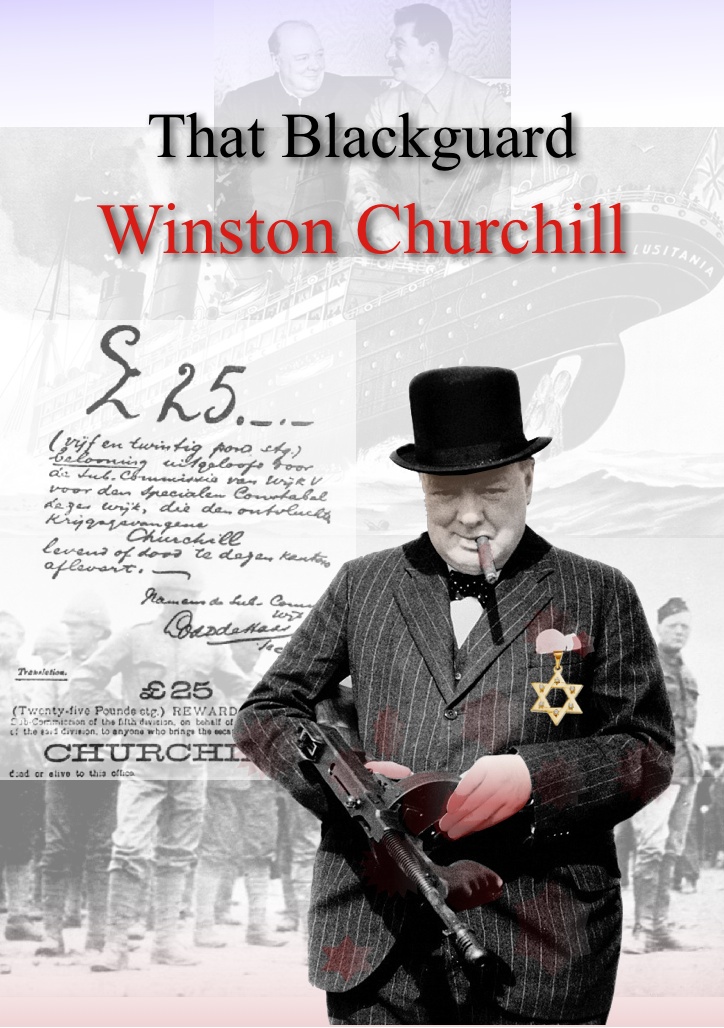
That Blackguard — Winston Churchill

[Click to enlarge]


That Blackguard


Winston Churchill


The Barnes Review — 2012 January – February


ILLUSTRATION: RICHARD COLE I DRAWN & QUARTERED/NEWSCOM

& KATANA


THE ARTICLE IS EXCERPTED FROM A BOOKLET boldly entitled That Bastard Churchill, by patriotic writer Maj. M.E Thurgood. It is a blistering expose of Winston Churchill’s lack of humanity and chivalry in war, his bad temper and bizarre habits, and his insatiable lust for alcohol — washed down with a good dose of Christian blood. Decades of propaganda have millions of people believing Churchill was some kind of an English savior when, in fact, he was the architect of the destruction of the British empire.

By MAJOR MERVYN F. THURGOOD

Continue reading

Posted in America, Arabs, Balfour Declaration, Churchill, Communism, Czechoslovakia, Danzig, England, Europe, France, Franklin D., Hitler, Jew World Order, Jews, Jews - Naming, National Socialism, New World Order, Poland, Propaganda - Anti-German, Roosevelt, Russia, Secret Elite, Sudeten German, Third Reich, Treaty of Versailles, WW I, WW II | 13 Comments

Zion’s Trojan Horse: Part 7 (last) — Anti-Gentilism; Chance or Design; About the Author

[How Organized Jewry has taken control of the US government and subverted it as part of its goal of achieving world domination — KATANA]


[Click to enlarge]


Zion’s Trojan Horse


By Senator Jack B. Tenney


Part 7


ZION’S TROJAN HORSE

A TENNEY REPORT

On World Zionism

By Senator Jack B. Tenney

Introduction by Col. John Beaty

Published by:

Sons of Liberty P.O. Box 449

Arabi, LA 70032

Printed In the United States of America


TABLE OF CONTENTS


INTRODUCTION By Col. JOHN BEATY ………………………………. 175

Part I

THE WANDERING JEW …………………………………………………. 177

In Dispersion From the Beginning …………………………………… 177

The Chosen People ………………………………………………………… 180

Part II

THE TERRIBLE POWER OF THE PURSE ………………………. 188

Jacob Henry Schiff ………………………………………………………… 189

The Rothschilds …………………………………………………………….. 190

The Warburgs ………………………………………………………………… 192

Part III

PRELUDE TO CONQUEST ………………………………………………. 193

The World Zionist Organization ……………………………………….. 193

Toward World Government ……………………………………………..  195

Part IV

THE REVOLUTIONARY PROLETARIAT ……………………………….197

The Jewish Socialist Federation of America ……………………….. 197

The Socialist International …………………………………………………. 202

The National Workmen’s Committee …………………………………. 204

Part V

JEWISH REVOLUTION ………………………………………………….. 205

Part VI

WE ARE ONE PEOPLE” ………………………………………………….. 211

Unity of Mind and Purpose” ……………………………………………. 211

The Copenhagen Manifesto ………………………………………………. 214

Part VII

THE JEWISH NATION ………………………………………………………. 215

The International Jew at Versailles …………………………………….. 215

The Versailles Treaty ………………………………………………………….. 217

Second Meeting of the American Jewish Congress ………………. 218

Part VIII

CONQUEST OF THE JEWISH COMMUNITIES ……………………… 219

Groundwork for World Government ……………………………………. 219

First World Jewish Conference ……………………………………………. 221

The Constituent Session of the World Jewish Congress …….. 224

Mobilization of World Jewry ……………………………………………….. 226

Part IX

THE LEAGUE OF NATIONS ……………………………………………… 228

Part X

AGITATION FOR WORLD WAR II …………………………………….. 236

Part XI

ANTI-GENTILISM …………………………………………………………….. 239

Part XII

CHANCE OR DESIGN? …………………………………………………….,. 246

ABOUT THE AUTHOR

INDEX  [see PDF]


[Page 175]


INTRODUCTION


By CoL. JOHN BEATY, author of

The Iron Curtain Over America


To be of major significance, a book on the current world scene must meet three requirements:

(1) It must be the work of a person who has been in an exceptional position for breaking through censorship and learning the truth;

(2) it must be full and complete and written fearlessly, with no effort to hide or gloss over the evil deeds of any faction or minority; and

(3) it must be written by one who is skilled in the writer’s art.

ZION’S TROJAN HORSE, by Jack Tenney, possesses the triple qualification.


(1) Ten years of arduous work in the California Senate as Chairman of the Committee on Un-American Activities has given Senator Tenney a great body of information on vital facts to which newspaper columnists and other political writers, and even academic historians, have no means of access. The reason is obvious. In his strategic position, Senator Tenney not only had opportunities denied to others for uncovering secret data; he even had the power to force the disclosure of much information which would under no circumstances have become known to a writer who was not in a similar position of government authority.


(2) An author’s incumbency in high office or in a strategic position does not, however, guarantee that his book is of major importance. Too many such personages have written books to throw a smoke screen over their own surrenders to political expediency or to alien pressure. Other authors have written books which purport to cover the history of the past half century or to deal with the foreign policy of the United States of America and yet, from fear of an alien minority, make no reference whatever to Middle East, Israel, Jews, Judaism, Khazars, or Zionism! These books name names, but never the names of such history-making Jews as, for example, the Rothschilds, Chaim Weizman, Samuel Untermeyer, Stephen A. Wise, and Louis D. Brandeis — much less the names of those Jews prominent in more recent times in atomic espionage; in the U. S. executive departments, especially Treasury and State; and above all, in the personal staffs of the last three Presidents of the United States.


Books that leave out such topics and such names are worse than useless. They are dangerous. They teach the reader to place the blame for the world’s perilous condition upon people of his own creed and kind, and not where it belongs — upon scheming alien manipulators. Such books present a picture as much distorted from the truth as would be presented by a history of the U. S. Revolutionary War which made no reference to taxation without representation, the Declaration of Independence, and the Continental Congress; and made no mention of Thomas Jefferson, Benjamin Franklin, John Hancock, or other men prominent at the time in influencing public opinion.


[Page 176]


But how, the reader may ask, can one tell without reading it whether a book by a seemingly authoritative author gives a full coverage of its subject? Fortunately, there is an easy test. Consult the index of each book which has attracted your attention. Make your own comparison, and back the book of your choice. The merest glance at the index of ZION’S TROJAN HORSE will show its full and fearless coverage of all phases of its vital subject.


(3) Whatever a man’s former position of authority and however full his coverage of his subject, he cannot have maximum effectiveness unless he writes well. Senator Tenney writes with a confidence and a zeal which the reader immediately senses and shares. Imbued by the emotion of the author, the reader is swept forward through the mass of details which fill the years between Karl Marx and the present. He is both fascinated and terrified by the climactic story of the growth of two tremendous forces, Communism and Zionism, so closely related in their objectives. The reader sees with the horror which can be induced only by superb literary writing how the aims of these two forces, Communism and Zionism, are alike hostile to America as a nation and to the Christian civilization of which our nation is the finest flower. The reader shares the author’s indignation at the subtle way in which Communism and Zionism have played Christian nations against each other in bloody conflict, and is appalled at the combination of subtle infiltration, brazen bullying, and everlasting propaganda with which these two alien forces have ridden rough-shod over the world and have demanded and secured in this country rights and privileges which involve the destruction of America and the degradation of the Christian West.


In Paradise Lost John Milton wrote the epic of the fall of man, a fall which was engineered by an alien intruder into the Garden. In ZION’S TROJAN HORSE, Jack Tenney has written of the fall of American man, and of American women, too, under the blandishments, the bribes, and the intimidation of alien intruders into our garden-spot, America. To read this great book is to arm yourself with knowledge. With your increased knowledge you will feel increased confidence and have a new power to go forth and defend your country, your ideals, and your faith.


DALLAS, TEXAS

DECEMBER 4, 1953

[Page 177]


XI


Anti-Gentilism


Karl Marx’s attack upon religion as “the opium of the people” was not so much an attack upon all religions as it was a war against Christianity. Like most intellectual revolutionary Jews, Marx was no more an adherent of Judaism than he was of Christianity. Ethnically, however, he was a Jew. In substance Marx reminded the Jews that they must not demand equality with Christians; they must seek the total destruction of Christianity. Marx believed that the Jew has within himself the privilege of being a Jew. It was his contention that the Jew, as a Jew, has rights that the Christian does not have.


Why does the Jew demand rights that he does not have and that Christians enjoy?” he asked.


He reasoned that the Jew, in demanding emancipation from the Christian State, demands that the Christian State abandon its religious prejudice.


And he, the Jew, does he abandon his own religious prejudices?


Has he then the right to demand of another that he relinquish his religion? Marx concludes that as long as the State remains Christian; as long as Jew remains Jew, both are equally incapable, the one to give emancipation, and the other to receive it.


Thundering in the columns of “Deutsch·Franzosishe Jahr bucher”, Marx demanded:


“Upon what title do you Jews ground your claim for emancipation? On your religion? It is the mortal foe of the State (Christian) religion.”


The Marxian philosophy does not tolerate compromise.


What then is the Marxian solution?


Concluding that as long as States are Christian and the religion of the Jews is the mortal foe of the state religion, Marx proceeds to lay down the formula for the destruction of Christianity; — the establishment of atheism.


“The most rigid form of opposition between the Jew and the Christian,” he avers, “is the religious opposition. How does one get rid of an opposition? By making it impossible. And how make impossible a religious opposition? By suppressing religion.”


[Page 240]


Marx was willing to concede that the Jew had been emancipated In his day, but in a Jewish manner. He believed that the Jew had been emancipated in precise measure as the Christians had become Jews. He knew that the Jew, “who was merely tolerated in Vienna,” determined by his sole financial power the future of all Europe; that the Jew, who might be without rights in the smallest of the German states, decided the future of Europe. He believed that the Jew had made himself the master of the financial market through the medium of gold which had become a world power, and through the “practical Jewish spirit” which had become the spirit in practice of the Christian people. But, to Marx, this type of emancipation was not enough. Real emancipation, in the Marxist sense, could only be achieved by the total destruction of Christianity.


A tidal wave of atheism rolled across Europe in the wake of Marxism, inundating the low places in Christendom; — surged across the seas to America; rising higher and higher to wash against the walls of colleges and universities, — even to the pulpits of churches that had withstood fire and sword. As the muddy waters churned and seethed the flags of proud States went down to be lost in the flotsam and filth of the flood. Where the waters receded there appeared great scars of erosion on the face of the earth; — scars that reflected the dwindling dignity of man and his vanishing freedoms.


The apostles of Marx had succeeded better than they knew.

Continue reading

Posted in Christainity, Europe, Germany, Hitler, Jew World Order, Jews, Jews - Naming, League of Nations, Mind Control, National Socialism, Religion, Rothschild, Russia, Talmud, Treaty of Versailles, WW I | 4 Comments

Zion’s Trojan Horse: Part 6 — The League of Nations; Agitation for World War II

[How Organized Jewry has taken control of the US government and subverted it as part of its goal of achieving world domination — KATANA]


[Click to enlarge]


Zion’s Trojan Horse


By Senator Jack B. Tenney


Part 6


ZION’S TROJAN HORSE

A TENNEY REPORT

On World Zionism

By Senator Jack B. Tenney

Introduction by Col. John Beaty

Published by:

Sons of Liberty P.O. Box 449

Arabi, LA 70032

Printed In the United States of America


TABLE OF CONTENTS


INTRODUCTION By Col. JOHN BEATY ………………………………. 175

Part I

THE WANDERING JEW …………………………………………………. 177

In Dispersion From the Beginning …………………………………… 177

The Chosen People ………………………………………………………… 180

Part II

THE TERRIBLE POWER OF THE PURSE ………………………. 188

Jacob Henry Schiff ………………………………………………………… 189

The Rothschilds …………………………………………………………….. 190

The Warburgs ………………………………………………………………… 192

Part III

PRELUDE TO CONQUEST ………………………………………………. 193

The World Zionist Organization ……………………………………….. 193

Toward World Government ……………………………………………..  195

Part IV

THE REVOLUTIONARY PROLETARIAT ……………………………….197

The Jewish Socialist Federation of America ……………………….. 197

The Socialist International …………………………………………………. 202

The National Workmen’s Committee …………………………………. 204

Part V

JEWISH REVOLUTION ………………………………………………….. 205

Part VI

WE ARE ONE PEOPLE” ………………………………………………….. 211

Unity of Mind and Purpose” ……………………………………………. 211

The Copenhagen Manifesto ………………………………………………. 214

Part VII

THE JEWISH NATION ………………………………………………………. 215

The International Jew at Versailles …………………………………….. 215

The Versailles Treaty ………………………………………………………….. 217

Second Meeting of the American Jewish Congress ………………. 218

Part VIII

CONQUEST OF THE JEWISH COMMUNITIES ……………………… 219

Groundwork for World Government ……………………………………. 219

First World Jewish Conference ……………………………………………. 221

The Constituent Session of the World Jewish Congress …….. 224

Mobilization of World Jewry ……………………………………………….. 226

Part IX

THE LEAGUE OF NATIONS ……………………………………………… 228

Part X

AGITATION FOR WORLD WAR II …………………………………….. 236

Part XI

ANTI-GENTILISM …………………………………………………………….. 239

Part XII

CHANCE OR DESIGN? …………………………………………………….,. 246

[Page 175]


INTRODUCTION


By CoL. JOHN BEATY, author of

The Iron Curtain Over America


To be of major significance, a book on the current world scene must meet three requirements:

(1) It must be the work of a person who has been in an exceptional position for breaking through censorship and learning the truth;

(2) it must be full and complete and written fearlessly, with no effort to hide or gloss over the evil deeds of any faction or minority; and

(3) it must be written by one who is skilled in the writer’s art.

ZION’S TROJAN HORSE, by Jack Tenney, possesses the triple qualification.


(1) Ten years of arduous work in the California Senate as Chairman of the Committee on Un-American Activities has given Senator Tenney a great body of information on vital facts to which newspaper columnists and other political writers, and even academic historians, have no means of access. The reason is obvious. In his strategic position, Senator Tenney not only had opportunities denied to others for uncovering secret data; he even had the power to force the disclosure of much information which would under no circumstances have become known to a writer who was not in a similar position of government authority.


(2) An author’s incumbency in high office or in a strategic position does not, however, guarantee that his book is of major importance. Too many such personages have written books to throw a smoke screen over their own surrenders to political expediency or to alien pressure. Other authors have written books which purport to cover the history of the past half century or to deal with the foreign policy of the United States of America and yet, from fear of an alien minority, make no reference whatever to Middle East, Israel, Jews, Judaism, Khazars, or Zionism! These books name names, but never the names of such history-making Jews as, for example, the Rothschilds, Chaim Weizman, Samuel Untermeyer, Stephen A. Wise, and Louis D. Brandeis — much less the names of those Jews prominent in more recent times in atomic espionage; in the U. S. executive departments, especially Treasury and State; and above all, in the personal staffs of the last three Presidents of the United States.


Books that leave out such topics and such names are worse than useless. They are dangerous. They teach the reader to place the blame for the world’s perilous condition upon people of his own creed and kind, and not where it belongs — upon scheming alien manipulators. Such books present a picture as much distorted from the truth as would be presented by a history of the U. S. Revolutionary War which made no reference to taxation without representation, the Declaration of Independence, and the Continental Congress; and made no mention of Thomas Jefferson, Benjamin Franklin, John Hancock, or other men prominent at the time in influencing public opinion.


[Page 176]


But how, the reader may ask, can one tell without reading it whether a book by a seemingly authoritative author gives a full coverage of its subject? Fortunately, there is an easy test. Consult the index of each book which has attracted your attention. Make your own comparison, and back the book of your choice. The merest glance at the index of ZION’S TROJAN HORSE will show its full and fearless coverage of all phases of its vital subject.


(3) Whatever a man’s former position of authority and however full his coverage of his subject, he cannot have maximum effectiveness unless he writes well. Senator Tenney writes with a confidence and a zeal which the reader immediately senses and shares. Imbued by the emotion of the author, the reader is swept forward through the mass of details which fill the years between Karl Marx and the present. He is both fascinated and terrified by the climactic story of the growth of two tremendous forces, Communism and Zionism, so closely related in their objectives. The reader sees with the horror which can be induced only by superb literary writing how the aims of these two forces, Communism and Zionism, are alike hostile to America as a nation and to the Christian civilization of which our nation is the finest flower. The reader shares the author’s indignation at the subtle way in which Communism and Zionism have played Christian nations against each other in bloody conflict, and is appalled at the combination of subtle infiltration, brazen bullying, and everlasting propaganda with which these two alien forces have ridden rough-shod over the world and have demanded and secured in this country rights and privileges which involve the destruction of America and the degradation of the Christian West.


In Paradise Lost John Milton wrote the epic of the fall of man, a fall which was engineered by an alien intruder into the Garden. In ZION’S TROJAN HORSE, Jack Tenney has written of the fall of American man, and of American women, too, under the blandishments, the bribes, and the intimidation of alien intruders into our garden-spot, America. To read this great book is to arm yourself with knowledge. With your increased knowledge you will feel increased confidence and have a new power to go forth and defend your country, your ideals, and your faith.


DALLAS, TEXAS

DECEMBER 4, 1953

[Page 177]


IX


The League of Nations


The League of Nations may be said to have been founded by President Woodrow Wilson, although the idea was not original with him. Senator Henry Cabot Lodge, speaking at Washington, D. C., In May of 1916 before the League to Enforce Peace was more emphatic in his endorsement of the plan than was Wilson. Said Lodge:


“I do not believe that when Washington warned us against entangling alliances he meant for one moment that we should not join with other civilized nations of the world if a method could be found to diminish war and encourage peace.”


Said President Wilson:


“We are participants, whether we would or not, in the life of the world … every people has a right to choose the sovereignty under which they shall live … the small states of the world have a right to enjoy the same respect for their sovereignty and for their territorial integrity that the great and powerful nations expect and insist upon … the world has a right to be free from every disturbance of its peace that has its origin In aggression and disregard of the rights of peoples and nations … I say that the United States is willing to become a partner in any feasible association of nations formed in order to realize these objects and make them secure against violation.”


The League to Enforce Peace was supported and ultimately supplanted by other organizations whose sponsorship more definitely reflected the current left-wing, socialist and collective viewpoint. As has already been shown, the leading organizations of Jewry throughout the world were already on record for, and actually promoting, an international federation. The League of Free Nations Associations, although further to the left than the League to Enforce Peace, worked with the latter group, and was one of the first to endorse the League of Nations Covenant. The League of Free Nations Associations became the New York Foreign Policy Association after the war and oriented its activities toward the ultimate consummation of its original purposes.


[Page 229]


That ultimate world government is one of the objectives of socialism was clearly revealed in the activities of the Fabian Society of England for the League of Nations Covenant. The Fabians worked closely with the League of Nations Society In propagandizing for an international organization. A League of Nations Society was also created in France.


The League of Nations Society was organized in London in May of 1915. It was the outgrowth of a series of meetings instigated by the Fabians. W. H. Dickinson, M. P., became the organization’s first chairman. He had been prominently identified with the World Alliance for International Friendship Through the Churches. In March of 1916 Theodore Marburg, who founded the League to Enforce Peace in the United States June 17, 1915, addressed the League of Nations Society and declared:


“that the objects of the League to Enforce Peace and the League of Nations Society were almost the same.”


By November 1916 the League of Nations Society boasted of 300 members.


In July of 1917 Lord Parmoor was a Vice-President of the Society. Noll Buxton, M. P., G. Lowes Dickinson, and L. S. Woolf were members of the Executive Committee.


In July of 1918 a letter of invitation to join a League of Free Nations Association was circulated. Among those who signed the invitation were Professor Gilbert Murray and H. G. Wells.


By November of that year the League of Free Nations Association and the League of Nations Society merged into a new organization -the League of Nations Union. On the first General Council of the Union were:


Lord Robert Cecil;

Professor Gilbert Murray;

J. H. Thomas;

J. R. Clynes;

H. N. Brailsford;

J. M. Kenworthy;

J. C. Wedgwood;

Miss Maud Royden;

and R. H. Tawney.


(Brailsford, in 1921, wrote a Preface to Trotsky’s “The Defense of Terrorism!’) ‘The Outline of History”, by H. G. Wells — “written with the advice and editorial help of Mr. Ernest Barker… and Professor Gilbert Murraymade its first appearance in semi-monthly parts.


Its purpose is clearly evident now. In addition to its mental orientation toward atheism, socialism and internationalism, it attempts to lay the ground-work for a super-world government.


Douglas Reed describes Wells as;


“a disbeliever and sedentary pamphleteer in whose mind inconsequent ideas scurried about from first reaction to second thought and later afterthought like riotous mob that surges forwards to destroy, reels backward at the word ‘police’, and then scatters and scuttles through the byways, throwing a random stone from aimless rage.”


Although he was ultimately to declare that he saw “the world as a jaded world devoid of recuperative power”, Wells envisioned the “world state” in his Outline of History as an inevitable historical development. “It will be based,” he declared;


“upon a common world religion, very much simplified and universalized and better understood. This will not be-Christianity nor Islam nor Buddhism nor any such specialized form of religion…”


[Page 230]


Whatever else may be said of Well’s contribution to the “world-super-state” idea, his “Outline of History” became an important adjunct to the propaganda machine designed for the destruction of patriotism in Great Britain and the United States.


The League of Nations Union was supported in 1920 by donations. Major David Davies, M. P., made the largest contribution 14,737 pounds. Barons E. B. d’Erlanger ana F. A. d’Erlanger, and N. M. Rothschild and sons donated 3,000 pounds each. Other contributors were the Government of the Peruvian Republic, 1,000 pounds; F. Eckstein, 500 pounds; Sir M. Samuel, 210 pounds; Sir Carl Meyer, 210 pounds; and the Zionist Organization, 210 pounds.


Thus, socialists, pro-communists and Zionists, together with their stooges and innocents, promoted the League of Nations and laid the foundation for world government. One world war could not quite accomplish the ultimate objective. It is extremely doubtful that World War II achieved it.


World War III?


“The events of August, 1914,” wrote H. G. Wells, “seem to have taken President Wilson, like the rest of his fellow-countrymen, by surprise. We find him cabling an offer of his services as a mediator on August 3rd. Then, for a time, he and America watched the conflict. At first neither the American people nor their President seem to have had a very clear or profound understanding of that long-gathered catastrophe. Their tradition for a century had been to disregard the problems of the Old World, and it was not to be lightly changed… President Wilson and the American people were dragged into the war by this supreme folly (unrestricted submarine warfare of the Germans). And also they were dragged into a reluctant attempt to define their relations to Old World politics in some other terms than those of mere aloofness. Their thoughts and temper changed very rapidly…”


President Wilson declared that a durable peace must be “peace without victory.” Within a few days (April 6, 1917) Congress, at his direction, declared war on Germany. The President announced that it was a “war to end war” and that its purpose was to “make the world safe for democracy.” History is only now underscoring the tragic asininity of this double-talk. Peace and victory came November 11, 1918 and Wilson rushed to Paris and proceeded to lose both.


[Page 231]


Marxism not only advocates the necessity for the destruction of religion in its quest for power but Marxists everywhere similarly work for the abolition of nationalism.Religion” and “patriotism” are the outer ramparts of Christian civilization, and they must first be destroyed if the forces of Marxism are to conquer and dominate the world. Because patriotism and nationalism are the natural and logical result of the integrated family unit Marxism strikes also at the family. It too must be destroyed and its component parts reduced to the common collectivity. It does not stop, even here.


The dignity of man, his initiative, his individuality-all must be leveled to the common denominator.


Propagandists of the Socialist and Communist persuasion subtly attack “mother”, “home”, “heaven”, “the flag”, “fatherland”, and “patriotism.” These cherished and respected terms, together with the sacred things they represent, are made to appear ridiculous and “reactionary”; — obsolete remnants of tribalism perpetuated by sinister men who wish to plunge the world into frequent bloodbaths for the purpose of making money. To these propagandists the “elaborate inculcation” of these concepts into the minds of people constitute the process of “manufacturing” patriots. Such patriots, from the Marxian viewpoint, are “provincial”, mentally “immature” and “reactionary”. To organized Jewry patriotism is equivalent to nationalism; nationalism equivalent to fascism, — and fascism means “anti-Semitism.” This Jewish concept, of course, applies only to Gentile patriotism and has no references to Jewish nationalism.


Some “scientific” critics of patriotism advance the theory that nationalism is a form of overdeveloped “ethnocentrism” (regarding one’s own race as the chief interest and the center of culture) a Greek combining form that tends to give the entire subject a bad odor. By diagnosing the natural phenomenon as “ethnocentrism” the propagandist is enabled to elaborate upon the “malady” without fear of contradiction because he has thereby removed the subject from the realm of the simple and the knowable into the sphere of the pseudo-scientific and the conjecturaL He may therefore say that ethnocentrism is characterized by unreasonable antipathy and hostility toward all those who are not members of a given nation, and that such words as “alien” and “stranger” are synonymous to “enemy” in the mind of the ethnocentrist.


Most of the critics of patriotism are in agreement that nationalism is chiefly a menace to the Socialists, Communists, the Jews and other aliens who represent a disruptive element within a given country. Although they do not so frankly state it, the meaning is clear. The principle that all beleaguered individuals and groups tend to protect themselves when under harassment or attack — preservation is the first law of nature — is forgotten and brushed aside.


[Page 232]


Both the Socialists and the Communists boldly proclaim their intention to destroy the freedom of the individual, to confiscate his property and regiment his life. Organized Jewry, either as an ally of the Marxists or as an independent nation within a nation, insists on maintaining an independent status with or without dual citizenship. The resultant resentment on the part of those who resist Communist and Jewish objectives is labeled “fascism” — which, of course, it is not. Nations have been acting very much the same in these respects ever since the beginning of recorded history.


These apostles of collectivity go much further In their incessant attacks upon the resistive powers of those they have marked for destruction. They preach that advocates of military preparedness and strong foreign policy are the “extreme nationalists” and the potential “Nazis” and “Fascists.” If the mental reflexes of a nation may be thoroughly conditioned in accord with this “line” — it will fail to resist when attacked and perish without lifting a finger in its own defense. If a nation’s leaders can be made to believe that fear of Communism is “collective paranoia”, and preparedness against the Soviet Union is “military megalomania” then the destruction of Western Christian Civilization may be achieved without too much physical exertion on the part of its enemies.


These defamers of patriotism apparently find nothing wrong with the individuals and groups — the Socialists and Communists who have publicly proclaimed their intention to destroy all nations — except the Soviet Union. To threaten the lives, property and freedoms of men everywhere appears to be a high virtue when practiced by Communists; to insist on remaining a nation within the nations of the world; to invade and steal a country; — these things appear to be idealistic when advocated and accomplished by organized Jewry and Zionists.


President Wilson’s “self-determination” and “political independence” for all nations are planks in the Wilsonian platform for world government that have been somewhat embarrassing to the propagandists of internationalism. To attack these fundamental principles of the Wilson formula is to endanger the prestige that Wilson represents in the drive for world power. If nations may reserve the right of self-determination and political independence — and these rights are protected by the concerted power of nations — it is quite obvious that world domination by any single group is impossible. So, with or without Wilson, “self determination” and “political independence” must be treated as sinister symptoms of “ethnocentrism” and thrown in the ash-can with “mother”, “home”, “heaven”, “flag” and “country.” When Wilson spoke of the “rights of small nations” he believed in the principle.


[Page 233]


That he either had his tongue in his cheek, indulging in psychological warfare, or was exhibiting latent “fascist” tendencies is untenable. But, as all of these principles constitute formidable obstacles along the Marxist advance to world power the proponents of internationalism are determined to obliterate them from the minds of men.


Irrendentism may be said to be another road-block to the ideological conquest of the world. It is a word that is little used.


It refers to the principles, policy, or practice of a party, or of persons, who seek to reincorporate within their national boundary territory of which their nation has been deprived. It is, according to the “brain-washers”, another form of extreme nationalism unless applied to Zionism (although the definition does not cover the facts as they apply to Palestine). Like all other forms of nationalism, Irrendentism is conveniently considered a world peace disturbing nuisance (except in certain obvious cases, — the Soviet Union and Zionism) and it therefore is listed by the internationalists with the other “obnoxious” characteristics of nationalism.


Homogeneity — same character, like nature or kind — is another symptom of paranoia of the nationalistic mind according to the Marxist proponent of “one worldism”. The demand for homogeneity on the part of the people of a given country is always depicted as a persecution of minorities because of race, language or religion. The internationalist never recognizes the factors of allegiance, political assimilation or national solidarity, — except as they are manifestations of his own philosophy. The antagonistic, hostile activities of foreign-born anarchists, Socialists, Communists and Zionists, all working against the interest of the country of their adoption or refuge are not considered unusual, ungrateful or worthy of comment by Marxian propagandists. In countries such as the United States and Great Britain, where the discordant and unassimilable elements of the world have found freedom and hospitality, the cry against homogeneity has been greatest. It is not enough, of course, that these refugees find haven and freedom. They must of necessity continue to create the frictions that caused their expulsion from their native lands. It is not enough for them to become Englishmen and Americans with the freedom to exercise their particular religious beliefs; it is not enough to enjoy the rights of citizenship; they must destroy the homogeneous instincts of the majority so that their own minority homogeneity may pass unnoticed.


The United States has, in truth, been the melting pot of the world. It has successfully assimilated most of the nations of Europe.


[Page 234]


The homogeneity that emerged was not so much of language, race, religion and culture as it was of a new and unique concept of freedom. The United States generously opened its arms to the oppressed of the world and most of those who came gratefully merged into the American pattern. Only the hordes of Khazar Jews, with their twin philosophies of Marxism and Zionism, have refused to assimilate. On the one hand they have insisted on being a separate people; a fragmentized nation in dispersion, and on the other hand they have sought to refashion the religion, the traditions and the customs of the land of their exile. Their members predominate among the revolutionary and subversive forces at work within the country and their names are always listed where treason and traitors are exposed. They seek, through every medium of propaganda, the universal acceptance of heterogeneity so that their failure to assimilate may pass unnoticed in the resultant dissonance.


The Comite des Delegations Juives aupres de la Conference de Paix sought to insure heterogeneity within nations through “minority” treaties between the new States carved out of Europe at the “Peace table” and the Allied Powers, and enforced by the international machinery of the League of Nations. The. first of these “minority treaties” was imposed upon Poland. Czechoslovakia was next (September 10, 1919), with Jugoslavia (September 10, 1919), Rumania (December 9, 1919), and Greece (August 10, 1920) following. The Treaty of St. German with Austria (September 10, 1919), the Treaty of Neuilly with Bulgaria (November 27, 1919), and Treaty of Lausanne with Turkey (July 24, 1923) contain clauses modeled upon the Polish treaty for the establishment of the principles of heterogeneity. Albania and the Baltic States were ultimately forced into line. Fifteen States in all were compelled to protect the indigestible elements within their frontiers, thus crippling their national development and insuring violent eruptions beyond the power of any international organization to control.


Under the provisions of these treaties the “minorities” were placed under the protection of the League of Nations as subjects of “international concern.” The Permanent Court of International Justice was given jurisdiction of disputes arising out of alleged infractions of the minority provisions.


When President Wilson arrived in Paris in January of 1919 he declared that the League is “the central object of our meeting” and, in spite of the attitudes of Lloyd George and Clemenceau he insisted that the Peace Conference take up the League of Nations proposal before considering political and territorial matters. Wilson headed a commission of nineteen which was able to present a tentative draft of the Covenant to the Conference on February 14.


President Wilson called it “a guarantee of peace.” On April 28, 1919 the document, with some revisions, was adopted unanimously by the Conference. The League of Nations was given official status on January 10, 1920.


[Page 235]


One of the functions of the League of Nations (later to become an integral part of United Nations’ philosophy for the emergence of a super-world government) was the promotion of “international cooperation” in the fields of world health, labor, transportation, communications, finances, etc. Although the Covenant did not provide for or authorize their creation, the Council established commissions to deal with these objectives. The Economic and Financial Organization, Organization for Communications and Transit, International Office of Public Health (established at Paris) and the International Committee on Intellectual Cooperation were among the important permanent bodies created. The International Committee on Intellectual Cooperation coordinated the work of such sub-groups as the International Research Council, the Institute of International Law, the International Academic Union, etc. An International Institute of Intellectual Cooperation was established in Paris in 1924. The International Cinematographic Institute, together with innumerable committees of one kind or another, ultimately became known as the Intellectual Cooperation Organization.


Among others, the Advisory Commission on the Traffic in Opium and other Dangerous Drugs and the International Convention for the Suppression of the Traffic in Women and Children may be mentioned as salutary efforts on the part of the League to deal with international evils.


The International Labor Organization was the result of Article 23 of the Covenant of the League. Its primary purpose was the promotion of uniform labor legislation throughout the world. Its efforts, as might have been expected, were futile. The United States became a member by Presidential proclamation August 20, 1934. Isador Lubin was the first United States Government representative. The International Labor Organization was destined to survive the League fiasco and become an affiliate of the United Nations.


Although the Bank for International Settlements was not strictly a League of Nations organization its role in the over-all development of internationalism is important. It was created in 1930 to act as trustee and agent for the creditor governments in the collection and allocation of indemnity payments. Its stock of one hundred million dollars was underwritten by banks in Great Britain, France, Italy, Germany, Japan, Belgium and the United States. The United States Federal Reserve Banks were not permitted to participate.


By the end of 1938 the failure of the League of Nations was almost complete. Of the sixty-two nations that had once constituted its membership only forty-nine remained. With the close of 1940 it had ceased to exist. It had gone the way of its predecessors, the Holy Alliance, the Concert of Europe and the Permanent Court of Arbitration. It failed because humanity had not been reduced to its common denominator and because its machinery had not been designed for physical persuasion. “Mother”, “home”, “the flag”, “heaven” and “country” were yet too deeply rooted in the minds and hearts of the people. Another and, perhaps yet another, world catastrophe would be necessary before such “reactionary” concepts would be blasted from the breasts of human beings.


[Page 236]


X


AGITATION FOR WORLD WAR II


Meanwhile organized Jewry’s campaign within the nations of the world and its continuous use of the rostrum in the Palace of the League of Nations at Geneva brought the world closer to new disaster. The internal affairs of German Upper Silesia were under attack in 1936 and 1937 and the conflict was sharpened considerably by Poland’s declaration that she would no longer be bound by the “minority treaty.


The question of ten thousand Jews in the Free City of Danzig was the basis for considerable agitation before the League of Nations. The special status for the small Jewish population was a continuous sore spot. The imposition of special privileges led to natural resentment on the part of the people of Danzig, which was immediately attended by vigorous condemnation on the part of world Jewry. Resentment gave way to frustration and excesses.


The Government attempted to throw off the chains of the treaty.


Although the activities of the representatives of world Jewry before the League of Nations accomplished little or nothing for the Jews of Danzig the resultant publicity was grist in the mill for organized Jewry’s campaign against Germany throughout the nations of the world.


Meanwhile most of the Jews in the free city of Danzig had departed.


The annexation of Austria on March 11, 1938 was the signal for an appeal by the World Jewish Congress to the League of Nations for protection of that country’s one hundred and ninety two thousand Jews. Similar appeals were made from time to time both in behalf of the Jews of Austria and of Czechoslovakia. Hitler’s concern for his blood-brothers in the Sudetenland — similarly duplicated by organized Jewry’s concern for its own blood-brethern was a coincidence that appeared to pass unnoticed.


[Page 237]


Poland — which contained the greatest Jewish population finally became the principal issue. The World Jewish Congress initiated a series of public demonstrations designed to arouse indignation throughout the world. A conference on the Polish Jewish question was organized by the American Jewish Congress in New York City January 31, 1937. Two thousand three hundred and ninety-six delegates representing eight hundred and thirty-five Jewish organizations attended. A similar conference was held in London on April 6, 1937 under the auspices of the British Section of the World Jewish Congress. Its one hundred delegates purported to speak for the religious, fraternal, Zionist and labor organization of British Jewry. The Canadian Jewish Congress staged a series of protest demonstrations during the same month. On June 1, 1937 the Federation des Societes Juives de France convoked a protest meeting in Paris. An “emergency conference” was called in New York City on June 10, 1937 attended by two thousand four hundred and sixty-two delegates from eight hundred and seventy organizations. A delegation of two hundred headed by Dr. Stephen S. Wise was dispatched to Washington with a memorandum addressed to the State Department. Why two hundred delegates were necessary is better guessed than explained. The memorandum recited the oppression of the Jews in Poland. Its presentation by Dr. Wise to Secretary of State Cordell Hull on July 12, 1937 was dramatized by a public declaration protesting the treatment of the Jews in Poland signed by one hundred and fourteen non-Jews in the fields of “religion, science, literature, and education.


The World Jewish Congress stepped up its clamor during succeeding months. The Socialists, the Communists and left-wing groups added their voices. At the initiative of the Congress, meetings and demonstrations swept across the world. Declarations, manifestos, and petitions cluttered the streets and the desks of public officials. In Belgium seventy university professors, writers and social leaders, addressed statements of solidarity and protest to the Conseil des Associations Juives.


A protest, signed by twenty five French authors and college professors, supplemented a similar protested by the League of the Rights of Man. Resolutions, statements, protests and declarations multiplied through the wizardry of the World Jewish Congress: — a resolution from the Polish League of Peace and Freedom in Warsaw; a statement from the International League for Academic Freedom; a protest from the Institute of International Education; a declaration from the American Student Union; a resolution from the American Federation of Teachers, and others too numerous to mention.


In answer, Poland, in 1938, adopted a law providing that persons who had been abroad for a period of five continuous years would be deprived of their Polish citizenship and forbidden to return to Poland. Jews, among others, who had been absent from Poland more than five years were interned in a camp at Zbaszyn when they attempted to re-enter the country. The World Jewish Congress immediately intervened with the Polish Ambassadors in Paris and Washington. Dr. M. L, Perlzweig was dispatched to Warsaw to take the matter up with the Polish government. World War II intervened and German troops invaded Poland before Dr. Perlzweig was able to get down to cases with the officials of the government.


[Page 238]


The World Jewish Congress used the efforts of the Rumanian government to throw off the shackles of Versailles to the best advantage along with its other activities. The Congress actually boasts of its successful efforts in “the early overthrow” of one of the Rumanian governments by stating that “it is no mere conjecture” that the “efforts of the World Jewish Congress were responsible.” As Rumania struggled with the handcuffs of the “minority” clauses of the treaty, organized Jewry capitalized on the “persecution of the Jews” within the country.


In January of 1938 the Prime Minister of Rumania declared that four waves of immigration had brought between 250,000 to 500,000 Jews into the country and the Minister of Foreign Affairs stated that Rumanian Jews were not entitled to a special status over other citizens. A Royal Decree of January 22, 1938 ordered the revision of the citizenship status of all Jews in Rumania.


The World Jewish Congress invoked the provisions of the “minority” treaty clauses before the League of Nations and dispatched strong protests to the French and British Foreign Ministers. Dr. Perlzweig in London, Marc Jarblum in Paris, and Dr. Kubowitzki in Brussels descended on the Foreign Offices of the respective governments. Dr. Wise was in constant communication with the White House in Washington. The Rumanian government was compelled to resign on February 10, 1938.


In May of 1938 the Hungarian government proposed to limit the number of Jewish employees in all branches of economy to twenty percent of the population. The WJC intervened. In Iraq, Uruguay and in all parts of the world where Jews resided the World Jewish Congress proceeded to tell their respective governments that their Jewish citizens were a peculiar people with very special and exceptional rights. There was no cessation in the outcry; no relaxation of the drums of war.


In the beginning organized Jewry had declared war on the central governments of Europe and had sought to impose its will on their people through treaty provisions and the machinery of the League of Nations. In the end they made their war a world war and involved most of the civilized nations in the conflagration.


In the end few would remember what it was. all about, how it started and why. No one would be certain who led the demonstrations, signed the declarations, made the protests and passed the resolutions. Men would march and men would die; battles would be fought that would take the names of nations and oceans; there would be sacrifice, tears, blood and sweat. But, when it was over the people of the world would not really remember very much about it. Some might recall that it had been frightful in the sacrifice of Christian blood and staggering in the waste of Gentile wealth.


Some might slowly learn that there had been no real victory and that the promised peace was to be as chimerical as had been the “war to end war” and the struggle to “make the world safe for democracy.


[Page 239]


_______________________________________


Version History & Notes

Version 1: Published Jul 14, 2015

__________________

Notes

* The original text was part of a larger work, hence the page numbering starting from p. 175.

* Images not in the original document.

* Footnotes are not in the original document.

* Cover page is a modified version of the original.


__________________

Knowledge is Power in Our Struggle for Racial Survival

(Information that should be shared with as many of our people as possible — do your part to counter Jewish control of the mainstream media — pass it on and spread the word) … Val Koinen at 

KOINEN’S CORNER


======================================


Go to >> Zion’s Trojan Horse: Part 1 — Introduction; The Wandering Jew


Go to >> Zion’s Trojan Horse: Part 2 — Terrible Power of the Purse; Prelude to Conquest


Go to >> Zion’s Trojan Horse: Part 3 — The Revolutionary Proletariat ; Jewish Revolution


Go to >> Zion’s Trojan Horse: Part 4 — We Are One People ; The Jewish Nation


Go to >> Zion’s Trojan Horse: Part 5 — Conquest of the Jewish Communities


Go to >> Zion’s Trojan Horse: Part 6 — The League of Nations; Agitation for World War II


Go to >> Zion’s Trojan Horse: Part 7 (last) — Anti-Gentilism; Chance or Design; About the Author


PDF of this post. Click to view or download (0.6 MB). >>ZION’S TROJAN HORSE – Part 6


Version History


Version 2: Jul 26, 2020 — Re-uploaded images and PDF for katana17.com/wp/ version. Improved formatting.


Version 1: Published Jul 14, 2015

Posted in Christainity, Europe, Germany, Hitler, Jew World Order, Jews, Jews - Naming, League of Nations, Mind Control, National Socialism, Religion, Rothschild, Russia, Talmud, Treaty of Versailles, WW I | 1 Comment

Zion’s Trojan Horse: Part 5 — Conquest of the Other Jewish Communities

[How Organized Jewry has taken control of the US government and subverted it as part of its goal of achieving world domination — KATANA]


[Click to enlarge]


Zion’s Trojan Horse


By Senator Jack B. Tenney


Part 5


ZION’S TROJAN HORSE

A TENNEY REPORT

On World Zionism

By Senator Jack B. Tenney

Introduction by Col. John Beaty

Published by:

Sons of Liberty P.O. Box 449

Arabi, LA 70032

Printed In the United States of America


TABLE OF CONTENTS


INTRODUCTION By Col. JOHN BEATY ………………………………. 175

Part I

THE WANDERING JEW …………………………………………………. 177

In Dispersion From the Beginning …………………………………… 177

The Chosen People ………………………………………………………… 180

Part II

THE TERRIBLE POWER OF THE PURSE ………………………. 188

Jacob Henry Schiff ………………………………………………………… 189

The Rothschilds …………………………………………………………….. 190

The Warburgs ………………………………………………………………… 192

Part III

PRELUDE TO CONQUEST ………………………………………………. 193

The World Zionist Organization ……………………………………….. 193

Toward World Government ……………………………………………..  195

Part IV

THE REVOLUTIONARY PROLETARIAT ……………………………….197

The Jewish Socialist Federation of America ……………………….. 197

The Socialist International …………………………………………………. 202

The National Workmen’s Committee …………………………………. 204

Part V

JEWISH REVOLUTION ………………………………………………….. 205

Part VI

WE ARE ONE PEOPLE” ………………………………………………….. 211

Unity of Mind and Purpose” ……………………………………………. 211

The Copenhagen Manifesto ………………………………………………. 214

Part VII

THE JEWISH NATION ………………………………………………………. 215

The International Jew at Versailles …………………………………….. 215

The Versailles Treaty ………………………………………………………….. 217

Second Meeting of the American Jewish Congress ………………. 218

Part VIII

CONQUEST OF THE JEWISH COMMUNITIES ……………………… 219

Groundwork for World Government ……………………………………. 219

First World Jewish Conference ……………………………………………. 221

The Constituent Session of the World Jewish Congress …….. 224

Mobilization of World Jewry ……………………………………………….. 226

Part IX

THE LEAGUE OF NATIONS ……………………………………………… 228

Part X

AGITATION FOR WORLD WAR II …………………………………….. 236

Part XI

ANTI-GENTILISM …………………………………………………………….. 239

Part XII

CHANCE OR DESIGN? …………………………………………………….,. 246

[Page 175]


INTRODUCTION


By CoL. JOHN BEATY, author of

The Iron Curtain Over America


To be of major significance, a book on the current world scene must meet three requirements:

(1) It must be the work of a person who has been in an exceptional position for breaking through censorship and learning the truth;

(2) it must be full and complete and written fearlessly, with no effort to hide or gloss over the evil deeds of any faction or minority; and

(3) it must be written by one who is skilled in the writer’s art.


ZION’S TROJAN HORSE, by Jack Tenney, possesses the triple qualification.


(1) Ten years of arduous work in the California Senate as Chairman of the Committee on Un-American Activities has given Senator Tenney a great body of information on vital facts to which newspaper columnists and other political writers, and even academic historians, have no means of access. The reason is obvious. In his strategic position, Senator Tenney not only had opportunities denied to others for uncovering secret data; he even had the power to force the disclosure of much information which would under no circumstances have become known to a writer who was not in a similar position of government authority.


(2) An author’s incumbency in high office or in a strategic position does not, however, guarantee that his book is of major importance. Too many such personages have written books to throw a smoke screen over their own surrenders to political expediency or to alien pressure. Other authors have written books which purport to cover the history of the past half century or to deal with the foreign policy of the United States of America and yet, from fear of an alien minority, make no reference whatever to Middle East, Israel, Jews, Judaism, Khazars, or Zionism! These books name names, but never the names of such history-making Jews as, for example, the Rothschilds, Chaim Weizman, Samuel Untermeyer, Stephen A. Wise, and Louis D. Brandeis — much less the names of those Jews prominent in more recent times in atomic espionage; in the U. S. executive departments, especially Treasury and State; and above all, in the personal staffs of the last three Presidents of the United States.


Books that leave out such topics and such names are worse than useless. They are dangerous. They teach the reader to place the blame for the world’s perilous condition upon people of his own creed and kind, and not where it belongs — upon scheming alien manipulators. Such books present a picture as much distorted from the truth as would be presented by a history of the U. S. Revolutionary War which made no reference to taxation without representation, the Declaration of Independence, and the Continental Congress; and made no mention of Thomas Jefferson, Benjamin Franklin, John Hancock, or other men prominent at the time in influencing public opinion.


[Page 176]


But how, the reader may ask, can one tell without reading it whether a book by a seemingly authoritative author gives a full coverage of its subject? Fortunately, there is an easy test. Consult the index of each book which has attracted your attention. Make your own comparison, and back the book of your choice. The merest glance at the index of ZION’S TROJAN HORSE will show its full and fearless coverage of all phases of its vital subject.


(3) Whatever a man’s former position of authority and however full his coverage of his subject, he cannot have maximum effectiveness unless he writes well. Senator Tenney writes with a confidence and a zeal which the reader immediately senses and shares. Imbued by the emotion of the author, the reader is swept forward through the mass of details which fill the years between Karl Marx and the present. He is both fascinated and terrified by the climactic story of the growth of two tremendous forces, Communism and Zionism, so closely related in their objectives. The reader sees with the horror which can be induced only by superb literary writing how the aims of these two forces, Communism and Zionism, are alike hostile to America as a nation and to the Christian civilization of which our nation is the finest flower. The reader shares the author’s indignation at the subtle way in which Communism and Zionism have played Christian nations against each other in bloody conflict, and is appalled at the combination of subtle infiltration, brazen bullying, and everlasting propaganda with which these two alien forces have ridden rough-shod over the world and have demanded and secured in this country rights and privileges which involve the destruction of America and the degradation of the Christian West.


In Paradise Lost John Milton wrote the epic of the fall of man, a fall which was engineered by an alien intruder into the Garden. In ZION’S TROJAN HORSE, Jack Tenney has written of the fall of American man, and of American women, too, under the blandishments, the bribes, and the intimidation of alien intruders into our garden-spot, America. To read this great book is to arm yourself with knowledge. With your increased knowledge you will feel increased confidence and have a new power to go forth and defend your country, your ideals, and your faith.


DALLAS, TEXAS

DECEMBER 4, 1953

[Page 177]


VIII


Conquest of the Jewish Communities


Groundwork for World Government


The success of Comite des Delegations Juives in putting over a major portion of organized Jewry’s program on the legitimate representatives of the Peace Conference encouraged the perpetuation of the Committee. An ad hoc organization in the beginning it now became permanent, dropping “aupres de la Conference de la Paixfrom its title. Leo Motzkin became the leading figure in the post Conference activities of the Committee.


[Image] Leo Motzkin

Its real purpose appears to have been political. It exerted itself in the League of Nations as other Jewish organizations were to do at a later day in the United Nations. It purported to speak for Jews everywhere. Many of its leaders were active in the Interparliamentary Union, the International Congresses of Minorities and the International Union of League of Nations Associations. Among these individuals were:


Leo Motzkin;

Max Laserson;

Dr. Emil Margulies;

Dr. Jacob Robinson;

Rabbi Z. P. Chajes;

Meir Dizengoff;

Nathan Feinberg;

Dr. Oscar Karbach;

and Dr. Benzion Mossinson.


[Page 220]


In 1920 the Comite des Delegations Juives proposed that the Conference for a Permanent American Jewish Congress create a Council of Jewish Delegations (Vaad Haaratzoth) to be composed of delegates of national congresses or similar bodies. Dr. Leo Motzkin came to the United States in 1923 and on May 13 he addressed the Executive Committee of the American Jewish Congress, advocating the creation of a World Conference of Jews.

Continue reading

Posted in Christainity, Europe, Germany, Hitler, Jew World Order, Jews, Jews - Naming, League of Nations, Mind Control, National Socialism, Religion, Rothschild, Russia, Talmud, Treaty of Versailles, WW I | 3 Comments