Uncovering The Forces For War – Part 2 – Twenty Years Armistice

Cover - Uncovering the Forces for War


Uncovering


The Forces For War


by

Conrad K. Grieb


[Part 2]


EXAMINER BOOKS

P. O. Box 144-Station Y

NEW YORK 21, N. Y.

Copyright. 1947

ANONYMITY


So you see, my dear Coningsby, the world is governed by very different personages from what is imagined by those who are not behind the scenes.” — Coningsby (page 233, Century Edition, 1903) by Benjamin Disraeli, Earl of Beaconsfield.


(First published in 1844)


VI


Contents


Foreword


1. British-American Rapprochement  1

2. British-German Cleavage 7

3. “Roping in America” — 1917  15

4. Twenty Years Armistice  27

5. “Roping in America” — 1941  49

6. Other Influences  73

7. Conclusions  89


Appendices:

No. I President Lincoln and the International Bankers of His Day  91

No. II British Concentration Camps In the Boer War  93

No. III The War in South Africa, by J. A. Hobson  95

No. IV Democracy and Social Instability, by J. Middleton Murry  99

No. V Winston Churchill in India 101

No. VI Winston Churchill on War  101

No VII  Walter Rathenau Predicted Germany Today  103

No. VIII  Austria Before Hitler, by Dr. Joseph Eberle  104

No. IX  Danzig and The Corridor, by W. H. Dawson  106

No. X Anti-Defamation League of B’nai B’rith  107

No. XI  Theodore Herzl Confutes Nathan Ohrbach  108

Bibliography  110

Index  112

Books For Collateral Reading  117


VII


One does not need to be endowed with an abnormally vivid imagination in order to foresee that for us to guarantee Germany’s Eastern frontier would be an act of sheer criminal lunacy.” — R. W. Walmsley, London Economist, 14th Nov. 1931 (p. 914).


Sir Walter Layton, M.A., C.B.E., Editor of The Economist, commented on the letter above as follows:


We are apt to judge, when we look into the East Europe settlement, that its terms are inequitable and they ought not to be perpetuated even if they could be.” (Page 899.)


VIII


CHAPTER FOUR


Twenty Years Armistice


Behind the facade of Government two occult powers are now determining the destinies of the world.

One of these is the disseminated Wealth of the Democracy, canalized both by the plutocratic oligarchy of the Bankers (la Haute Finance), whose clients, the Modern States, great and small, are constrained to apply to them for immense loans, and by the great manufacturers and mining proprietors, who tend to be actuated solely by economic interest and who often combine in international trusts, the operations of which are merely hampered by patriotic questions of national policy and national honour.

The other power is the mysterious pervasive force known as Public Opinion, which is becoming more and more conscious of its efficacy, and, as its curiosity concerning the public weal and concerning international facts and correlations grows more alert is manifesting a proportionately livelier jealousy of its prerogatives.” — (William Morton Fullerton, Problems of Power (page 1.)


The twenty years armistice between the two World Wars has been well called by one writer, John Howland Snow, the “tragic interludes of ‘Peace.” Of this period William Orton wrote in the preface to his book. TWENTY YEARS ARMISTICE — 1918-1938:


Twenty years ago the great guns of the west ceased firing. Millions of exhausted men sought home and work, leaving their dead behind them. But up in the Arctic Circle, across the Polish marshes and the Russian plains, along the Danube and the Mediterranean, in Asia Minor and Serbia, the war went on. Suicide, assassination, and revolution swept through the western world. Bounteous harvests brought ruin and not rejoicing, debt piled on debt, hatred across frontiers reflected the deepening privation within.

* America. . . . WHICH WAY? page 23


[Page 27]


The first decade brought general economic disaster. In the second the political structure began to crack, as a settlement backed by force felt the strain of an answering counter thrust. No more than a collapsing house can suddenly be rebuilt could Europe swiftly be reconstructed; instead came an inconceivable rearmament. Such effort as had never been mobilized for living was again mobilized for destruction. While babies were masked against poison from the sky, old men dug holes in the ground for refuge, and millions of youths trod their fathers’ tracks the road to death.

Will it never end? May our children live? Is there anywhere, in this shame of civilization, the germ of a new conscience, the hope of a true peace? It is time to take stock. Versailles, Geneva, Locarno — where and how did we fail? Or is there a curse on us all: on all our pacts, treaties, and covenants? It is of no more use to group ourselves into rival gangs to defame and denounce each other, with the good men all on one side — one’s own — and the bad men all, on the other. That way lies everlasting war. It is of no more use to hope that men will become brothers overnight, with a sudden dawn of reason triumphant over centuries of passion. But hope itself we cannot abandon: because we dare not.

It is time to take stock; to survey these two ghastly decades from the depth of our economic and political distress, and face our errors. War is now, as it never was before, the major industry — in dollars and cents — of nearly all ‘civilized’ peoples. Even America renounces war on paper and arms to the teeth in practice; every frontier of the old world, every capital, prepares for the coming death. Something is wrong — not merely with day to day policy, but the fundamental attitudes and assumptions which that policy reflects. Perhaps a review of the record will help to reveal what is wrong. The construction of a social order based on peace instead of war cannot be accomplished by a priori schemes of, any sort whatever; it must proceed from realistic study of what has actually happened, why and how.”*


* Such is this attempt.


[Page 28]


We have reviewed a number of responsible opinions on the Versailles Treaty. Admittedly the Entent attempt at peace was a failure. We have also reviewed some influences making that “peace.” Germany, precariously shaky within, accepted an armistice on the basis of Wilson’s Fourteen Points, while her still well-equipped armies were in the field. Forced to bear the onus of the “Guilty Nation” as a sop to public opinion in the countries of the conquerors, Germany was made to suffer to an appalling extent from the British blockade for months after the armistice was signed. (For a complete description read Arthur Bryant’s UNFINISHED VICTORY, the chapter Famine Over Europe.)


Professor Harry Elmer Barnes, author of THE GENESIS OF THE WORLD WAR; IN QUEST OF TRUTH AND JUSTICE, etc., wrote in part in The New York World Telegram on March 29, 1940:


Some maintain that one people is more cruel and brutal than another. They point to the long-since-exploded German atrocities during the World War and to Hitler’s treatment of the Jews. But they overlook that fact far and away the greatest atrocity in all human history was the British blockade of Germany for months after November, 1918, as a result of which over 800,000 German women, children and old people were starved to death and millions were emaciated and stunted.

Had Hitler tortured and killed everyone of a half million Jews living in Germany in 1933 such a foul and detestable act would still have left him a piker compared with Britain’s blockade of 1918-19.” (Italics ours — Ed.)


* See Appendix IV.


[Page 29]


Collin Brooks, English author of books on economics and finance, writes in CAN CHAMBERLAIN SAVE GREAT BRITAIN?:


Germany herself never accepted, and does not now accept, the view that she was blood guilty, nor the view that she was thoroughly defeated in the field. Nine days before the Armistice one of the German High Command told his Government that ‘the German army is still strong enough to stand against its opponents for months to come, to achieve local success and exact new sacrifices from the enemy.’

We are not here concerned to argue the rightness of either viewpoint. We are concerned only to note the indisputable fact that, whatever the guilt of Germany in 1914 and whatever the state of her armies in 1918, she accepted an armistice on terms that were afterwards deliberately broken.

The ‘Treaty’ was handed to her, metaphorically, on the point of a bayonet. It was, therefore, not a treaty at all, since the very word means an agreement reached by negotiation. The German Empire was stripped of its overseas possessions. These were the two most glaring breaches of faith which rankled in the bosoms of the German people long after the War had ended. That Germany should be disarmed while her small and vindictive neighbors were strongly arming rankled ‘only less’ bitterly.

What followed?

The events in post-war Germany have been often described. To avoid any suspicion of over-statement arising from personal prejudice I extract a striking account from a book written from the standpoint of observers who would place their faith in the old democracy rather than in new dictatorship, which was published in 1935. It is THE WAY OF THE DICTATORS, by Lewis Broad and Leonard Russell.


[Page 30]


With admirable restraint they write: 

The economic distress in Germany in the decade following the War was more severe than anything known in England in modern times. It fell short, certainly, of the famine in Russia, but the German people endured privations unparalleled among civilized races in our day. As a result of the Allied blockade — which continued for some months after the War ended — there was a scarcity of all kinds of food. The nation lost much of its power of resistance to illness and infection; ill-nourishment produced a mental inertia in adults; children were to be seen suffering from hunger madness.

These were the conditions that saw the birth of Hitlerism.

The blockade was lifted; the standard of living gradually improved, but it remained, and remains below the level in England and France The working classes had a grim struggle for existence. There was the nightmare for the nation of the catastrophic plunges of the Mark, when as paper money was churned out by the printing presses the people’s wealth and savings vanished. There was a respite, and then Germany felt the onset of the world economic blizzard. The chaos of national bankruptcy again appeared imminent. Trade and industry collapsed, men went out of work thousand after thousand, until at one time it was estimated that the unemployed touched a figure of ten millions.

This is the background, these are the conditions which explain the rise of Hitlerism. The older democratic parties appeared to be failing in the maintenance of the old order. The people turned to Hitler as the strong man who could save the country from bolshevism. The older parties were conscious of the limitations of their ability and power. Hitler was conscious of the national aspirations, and proclaimed his ability to bring about their fulfilment.” (Page 120.)


[Page 31]


Lloyd George, in THE TRUTH ABOUT THE PEACE TREATIES, writes:


It is not difficult to patch up a peace that may last until the generation which experienced the horrors of war has passed away. .. What is difficult is to draw up a peace which will not provoke a fresh struggle when those who have had practical experience of what war means have passed away . . . you may strip Germany of her colonies, reduce her armaments to a mere police force and her navy to that of a fifth-rate power; all the same, in the end if she feels that she has been unjustly treated in the peace of 1919 she will find means of exacting retribution from her conquerors. . . . Injustice, arrogance, displayed in the hour of triumph will never be forgotten or forgiven.

For these reasons I am, therefore, strongly averse to transferring more Germans from German rule to the rule of some other nation than can possibly be helped. I cannot conceive any greater cause of future war than that the German people who have certainly proved themselves one of the most vigorous and powerful races in the world, should be surrounded by a number of small states, many of them consisting of people who have never previously set up a stable government for themselves, but each of them containing large masses of Germans clamoring for reunion with their native land. The proposal of the Polish Commission that we should place 2,100,000 Germans under the control of a people which is of a different religion and which has never proved its capacity for stable self-government throughout its history must in my judgment lead sooner or later to a new war in the East of Europe.

If we, are wise, we shall offer to Germany a peace, which while just, will be preferable for all sensible men to the alternative of Boshevism. We cannot both cripple her and expect her to pay. .. It must be a settlement which will contain in itself no provocations for future wars. . . .


[Page 32]


Clemenceau, supported by a telegram sent to Lloyd George by 370 of his supporters in Parliament urging him to redeem his election pledges to “hang the Kaiser” and to make Germany pay till the “pips squeaked,” was able to bring to naught this belated sanity on the part of a man elected to make a peace.


Kirby Page quotes other English opinion as follows: *


The memoirs of Lord Carnock which have recently been published contain much significant data. As Sir Arthur Nicolson, he was Permanent Under-Secretary of Foreign Affairs during the critical days prior to and after the outbreak of hostilities. In the present volume which has been edited by his son we are informed that Lord Carnock ‘was incensed by the theory, which was even then (1917) being propagated, that Germany had provoked the war. .. He followed the peace negotiations with interest and apprehension. He was appalled by the Treaty of Versailles. Particularly did he resent the paragraph which obliged Germany by force to admit that she was solely responsible for the war.’” (PORTRAIT OF A DIPLOMATIST. Page 314.)

After endeavoring to interpret the reasons why his father’s generation of diplomats felt obliged to follow policies which eventually proved to be fatal, Mr. Harold Nicolson, himself a qualified student of international affairs, wrote in PORTRAIT OF A DIPLOMATIST,”(XV, XVI.):


This does not mean that I consider Germany responsible for the war, or that I feel anything but dislike for that ignorant and disgraceful paragraph in the Treaty of Versailles which endeavors to fix such responsibility upon her. I consider on the contrary that Germany is placed at an unfair disadvantage in all discussions of the origins, as distinct from the causes of the war. As regards the origins (1900-14) I consider Germany at fault; though even less at fault than Austria or Russia.

* National Defense, page 111.


[Page 33]


As regards the causes (1500-1900) I consider the main onus falls on England. This distinction requires further explanation. By 1900, having absorbed the Dutch Republics in South Africa, the British Empire was satiated. She desired only to preserve the vast possessions which she had acquired. This placed her in a defensive position — a position which it is easy to represent as being honorable and pacific. Our own predatory period — and it was disgraceful enough — dated from 1600 to 1900. During that period we were far more violent and untruthful than were the Germans during those fourteen years which preceded the war. Unfortunately, however, the historians of the war are bound from lack of space to throw the maximum emphasis upon the period when England was sitting digestive in her armchair and when Germany, young and hungry, was manifesting the unwisdom of adolescence. Before we blame Germany, we must first blame our own Elizabethans. The spirit was exactly the same. The Germans, however, owing to a higher state of culture and rectitude, behaved less blatantly; and were less successful.


Evidently the Germans have never been quite tough enough in their war policies to entitle them to a seat among the mighty who put their official seal on all righteousness. In London on January 9, 1946, Air Marshal Sir Arthur Tedder told high British officers that Germany had lost the war because she had not followed the principles of total warfare.* — (N. Y. Times, Jan. 10, 1946.)


Freda Utley, an Englishwoman, married to a Russian Jew, disillusioned after living for some years in the Soviet Union, writes:


It is usual to say that the Nazis will never be satisfied, and to picture the Germans as a peculiar people, more aggressive and power-loving and chauvinist than the British and French and other ‘peace-loving powers.’ This argument takes no account of past history of the fundamental causes of German aggression.


* See Appendices V and VI.
[Page 34]


In the past Britain and France were just as aggressive, else they could never have acquired their great colonial empires. The scramble for colonies went on merrily all through the nineteenth century and came to an end only when most of Asia and Africa had been divided up. By the opening years of the twentieth century England and France had not only bitten off about as much as they could chew, but realized that further colonial conquest must lead to war between the imperialist powers. Hence the Open Door policy proclaimed for China by the United States at Britain’s instigation. Moreover, the ease and security which colonial exploitation had produced in England and France conduced to a pacific temper and a desire to sit down and enjoy life. Why should we assume that the Germans would react any differently to the possession of a great empire? The argument that they are peculiarly aggressive by nature simply does not hold water. Until the Napoleonic wars the Germans had little national consciousness and were regarded as hopelessly peaceful people by the more ‘virile’ French. French aggression from Louis XIV to Napoleon finally galvanized the Germans into abandoning their old pleasant unnationalist and pacific ways. They formed themselves into a nation under Prussian leadership, but by that time most of the ‘uncivilized’ races and peoples had already been conquered by Britain, France, Holland, Belgium and the United States. Since there were no more colored people to conquer, the Germans were driven, first in 1914-18, to attempt a redivision of Asia and Africa through the defeat of France and England, and then from 1933 onward to try to form a European empire.” (THE DREAM WE LOST, page 339.)


[Page 35]


Arthur Bryant writes of the Treaty (in UNFINISHED VICTORY):


The evil went far beyond the confines of Germany Before the war she had been the best customer of Austria-Hungary, Italy, Russia, Holland, Norway, Switzerland and all Scandinavia, and the second best of Great Britain, France and Belgium. German capital and organization had helped to turn the wheels of industry in every country in central and eastern Europe. The economic dislocation of Germany meant, therefore, the economic dislocation of a whole continent. . . . So blinded were men by hatred after the suffering and destruction of four year’s warfare that many otherwise sane leaders of industry and finance lent themselves to this suicidal policy. They thought that by doing so they would cripple an energetic and dangerous rival forever.” (Page 69.)

. . . the misery of Austria provided one of the most terrible spectacles of post-war Europe.” (Page 96.)


We could quote many more authorities on what the Peace of 1919 meant to Europe in starvation, misery and horror.


Two English writers tell us who used to advantage this misery and prostration of Teutonic peoples in Central Europe.


Ellis Ashmead Bartlett writes:


Among this conglomeration of nationalities and creeds (in Vienna — Ed.) the Jew stood out prominently and dominated every situation. Jews of every race were to be found amongst this cosmopolitan throng and as the Jew knows no frontiers except the faith of his co-religionists. He was generally first in possession of news, true or false, and was thus able to control the great speculative market. .. One only sees the Jew in his real element during these world cataclysms. It is only then that his peculiar qualities have full scope for their employment.

Thus, dying Austria became the happy hunting ground for the Jewish vulture, although foreign ‘Has Vogels’ were also plentiful. . . . The little Jews swarmed over Vienna and devoured its decaying remains like flies round a raw steak on a hot summer’s day. One could scarcely walk in the street without treading on them. The city, its institutions, finance and material wealth crumbled in their hands and they crowded out the hotels, restaurants, cafes and shops.” (THE TRAGEDY OF CENTRAL EUROPE, page 37.)


[Page 36]


Arthur Byrant writes of Germany (in UNFINISHED VICTORY):


The change in the distribution of German wealth that followed this great disaster (the inflation-Ed.) amounted to nothing less than a revolution. the chief gainers were those who had been able to command foreign currency. . . . It was the Jews with their international affiliations and their hereditary flair for finance who were best able to seize such opportunities. . . . They did so with such effect that even in November, 1938, after five years of anti-semitic legislation and persecution, they still owned according to the The Times (London) correspondent in Berlin, something like a third of the real property in the Reich. Most of it came into their hands during the inflation. The Jews obtained a wonderful ascendancy in politics, business and the learned professions. In the artistic and learned professions the Jewish supremacy was as marked. Authoriship in Germany almost seemed to have become a kind of Hebrew monoply.” (Pages 135-137.)


Vladimir de Korostovetz, one of a prominent pre-War Russian-Ukranian family, writes of postwar Germany:


Organizers of the White Slave traffic swooped down on pre-Hitler Germany like birds of prey. They formed bogus companies. making adventure films. . . in South America. . . signed contracts with armies of film-struck girls who were promptly packed off to South America. The whole of this unsavory trade was in the hands of International Jewry in general and the scum of Russian Jewry in particular. German theatres and cinemas were in the hands of speculators and controlled by International Jews, whose motto was Money, Money, Money. They made fortunes fostering extremism.” (EUROPE IN THE MELTING POT, pages 96-97.)


[Page 37]


Sisley Huddleston, well-known English journalist, in his book WAR UNLESS, tells us how Germany reacted to this alien exploitation:


There have been three stages of Germany’s revolt: first, despair, which provoked passive resistance and bankruptcy; second, finesse, of which Stresemann was the principle exponent by which Germany gradually moved from one position to another; third, force.” (Page 79.)


After years of travail, President von Hindenburg appointed Adolf Hitler, leader of the National Socialist party, to the Chancellorship. The new Government’s policies were designed to bring order out of chaos. An end was put to wrangling of the numerous political parties. Restrictions, applicable only within the Reich, were imposed upon those who had taken advantage of the internal political and economic disorganization. A period of stability began Conditions improved.


The National Socialist Party had been in power scarcely six months when Samuel Untermeyer, * prominent Jewish attorney of New York, delivered a significant address. On August 7, 1933, the day of his arrival from Europe, where he had gone to attend a meeting of the International Jewish Congress at The Hague, Mr. Untermeyer said, in part, over Radio Station WABC:


I deeply appreciate your enthusiastic greeting on my arrival today, which I quite understand is addressed not to me, personally, but to the holy war in the cause of humanity in which we are embarked. It is a war that must be waged unremittingly until the black clouds of bigotry, race hatred and fanaticism, that have descended upon what was once Germany, but is now medieval Hitler land, have been dispersed. If we once admit, as is brazenly insisted by the German Government, that such fiendish persecution of the people of one race or creed is an internal domestic affair, and not a world concern, how are we to know whose turn will be next? Now or never must all nations of the earth make common cause against the monstrous claim that the slaughter, starvation and annihiliation without rhyme or reason . . . is an internal affair against which the rest of the world must stand idly by and not lift a hand in defense . . . for the jews are the aristocrats of the world.


*Attorney for Charles M. Schwab during First World War years, Untermeyer made millions in Bethlehem Steel Corporation stock.


[Page 38]


Thus, in 1933, Organized World Jewry publicly and openly declared war on Germany.


Here is a super-national group of people capable of frustrating efforts toward international amity whenever it sees fit to regard its racial members as being unfairly dealt with. That its members may be guilty of offenses against the customs, traditions, and national cultures of the nations in whose midst they live is, apparently, of no consequence.


Walter Rathenau, [1] ever torn between his German environment and his racial inheritance, perceived this cleavage between Jews and the people among whom they lived. In Maximilian Harden’s paper, Zukunft, March 6th, 1897, he struggles to give a clear picture of the Jewish problem:


Whoever wishes to see it, should wander through the Tiergartenstrasse at twelve o’clock on a Berlin Sunday morning, or else look into the foyer of a theatre in the evening. Strange sight! There in the midst of German life is an isolated race of men. Loud and self conscious in their dress, hot-blooded and restless in their manner. . . An asiatic horde on the sandy plains of Prussia. . . . Forming among themselves a close corporation, rigorously shut off from the rest of the world. Thus, they live half-willingly in their invisible ghetto, not a living limb of the people, but an alien organism in its body. . . .” (Walter Rathenau, Kessler, page 37.)


1. See Appendix VII.


[Page 39]


Now, with this background, let us proceed to the world situation, which, rather than becoming more serene and secure with the advent of a stable regime in Germany, becomes increasingly agitated.


Douglas Reed, for 11 years, foreign correspondent for The London Times, in his book, DISGRACE ABOUNDING, gives a survey of conditions in Central Europe somewhat different from that of Europe being devoured by an insatiable beast, we Americans have been asked to believe. Referring to the surrender of Czecho-Slovakia to Germany by the democracies, Reed writes:


The Austrians were of German stock; many of them wanted Hitler; many evils needed remedying in Austria, [2] which a lethargic vested interest regime, monarchists, clericals and Jews, would never have altered. But here . . . in Prague? business was thriving in Prague. One reason was Prague had become a clearing house for Jewish emigration.” (Page 458.)

But on this occasion chance has enabled me, in an additional chapter, to give you the best possible example of the way organized world Jewry works and of the immense power it wielded in goading word opinion against Germany” (Page 477.)


Then about his American publisher declining to publish DISGRACE ABOUNDING he writes:


The real meaning of that decision is that, you may slander and libel Germany as much as you like, and be paid for it, but you must not discuss the Jewish problem, you must not assert that there is a Jewish problem. One publisher, not a Jew, said that an American publisher would court misfortune by publishing it, because 90 per cent of the American newspapers are Jewish and the Jewish influence extends in similar proportion throughout the whole ring of trades connected with publishing. The importance of this, for you, is that you should realize that what is presented to you as ‘American Approval’ or ‘American Disapproval’ of this or that British policy is not American but Jewish opinion. . . . If you are to fight Germany again, you must do it for England’s sake. You must not allow yourselves to be egged on by Jews masquerading today as ‘German public opinion, ‘tomorrow as Czechoslovak public opinion,’ the day after as ‘English public opinion’ and the next day as ‘American public opinion.’


2. See Appendix VIII


[Page 40]


Mr. Reed brings to us information about economic and social conditions in Europe not widely publicized in America:


One day in the House of Commons, Mr. R. S. Hudson, of your Department of Overseas Trade, said: 

Germany was not discriminating against British goods in Germany Our complaint was that Germany was by her methods destroying trade throughout the world. . . . It is difficult to get exact information of the way things are done, but in Central and Southeastern Europe the basis of Germany’s hold is that she pays to the producer much more than the world price. They obviously do that at the expense of their own people, but it does effect us.

Then Reed says:


Germans, in their country are not less well cared for than English people in theirs, but better.” (Page 188.)


Reed, then quotes Mr. Hudson again:


No one wants to introduce similar methods. We do not want to see the cost of bread increased in England because we buy in competition with Germany, wheat in Rumania at over the world price. But clearly we have to meet this competition in the case of Poland, and the Government has made a survey of all possible methods. The only way the Government sees is by organizing our industries in such a way that they will be able to speak as units with their opposite number in Germany and say ‘Unless’ you are prepared to put an end to this form of competition and come to an agreement ‘on the market prices which represent a reasonable return, then we will fight you and beat you at your own game.


[Page 41]


To this lesson in economics by Parliamentary Secretary Hudson of His Majesty’s Overseas Trade Department, Mr. Reed is quick to reply:


This is not an answer unless you improve the condition of your work people. It is not enough to say that you will at all cost defend the profits of your manufacturers — unless you are simultaneously prepared to raise the standard of living of your work people.


Reed, quoting Hudson again:


Clearly this country is infinitely stronger than, I was going to say any country, but certainly Germany Therefore, we have a great advantage, which would result in our winning the fight.


Reed, continuing his comment:


. . . at last, at long last, and after so many years of warnings, the danger seems to have been realized. But you will have to gird your loins as you never did before, if your are really going to win this fight. You are faced with a country immensely strong in arms and immensely strong in real wealth — not gold bars in a vault of the national bank, but industry, agriculture, the thrift and energy of the work people, and the conditions of life they enjoy.


In Germany now they have a mighty organization, equipped with full powers, for improving the lot of the work people in factories and work shops. Their engineers and social workers and artists go into the factories and see what needs to be done. They say that a shower room, a recreation room, a restaurant, a medical clinic, a dental clinic is needed and these are provided They have a civic sense, a social conscience, a feeling of the community of German mankind — in spite of their bestial concentration camps — which you lack.” (Page 190.)


[Page 42]


Reed, placing English supremacy above any question of right or wrong, as Mr. Balfour had before him, says:


England is rearming to meet some imminent, and deadly danger. What danger? Germany. We are not strong enough to withstand her alone; we can only withstand her if we have allies. Our War Minister has stated that in a European war in which we take part we shall send nineteen divisions to the Continental mainland.

Presumably to ensure the victory of the Policy of Appeasement by Non-Intervention in the Sacred Right of Self-Extermination.

The Czecho-Slovak army had forty-two divisions. If we had let Czecho-Slovakia fight for us, we should presumably not have needed to send the flower of a new British generation abroad to die in the most unfavorable circumstances, for what we can send is less than half what Czecho-Slovakia had.

Here we have British diplomacy revealed: The constant quest for allies to do battle for British interests whenever and wherever their supremacy is endangered.*


We are indebted to Mr. Reed for giving us a glimpse of the forces gathering for an assault upon the continent — the dark thunderheads of war forming in England with alien, non-British aid.


*Latest press and radio reports have General Anders homeless Polish Army being made a part of the British army, the Dutch home guard being taken under the protective guidance of the British command, and the formation of a German army under. General Rundstedt to fight for British interests acquired in Germany by conquest. Perhaps this accounts for the sudden effort to establish an official government in the country against which Britain and her allies so lately fought a victorious war of destruction.


[Page 43]


Freda Utley has a word to say about Mr. Hudson’s complaint against Germany:


When the world economic crisis began in 1920, the fall in value of their agriculture exports drove weaker nations ‘of Europe, which had no closed colonial markets, near to bankruptcy. Unable to pay their debts, they dropped out of the international monetary system and started to trade by barter. Germany took the lead in organizing and profiting from this new system of trade-trade among debtors who could no longer get credits from the United States, Britain and France because the gold standard has broken down almost everywhere. Managed currencies, quotas, blocked credits, and barter trade led to the establishment of virtual state monopolies of foreign trade in one country after another. This new method of trading enabled fascist Powers to defy the financial power of England, France and the United States, which the Germans termed international Jewish finance.” (The Dream We Lost, pages 345-346.)


Both Mr. Hudson and Mr. Reed have allowed no question of right or wrong to influence their thinking about the new method of trading which enabled the Fascist powers to escape from the burdensome tolls of international finance. Even war was no deterrent. We quote Kirby Page:


One of the terrible results of war is found in the fact that it releases such an immeasurable volume of hatred that the victors demand their utmost pound of flesh from the vanquished and thereby sow the seeds of another conflict. The Treaty of Versailles and other World War treaties placed as crushing a burden upon the Central Powers as the Allies thought they could possibly endure. This Carthaginian peace was justified on the ground that Germany and her colleagues were solely responsible for causing the war. Competent historians have now abandoned the theory of the sole guilt of the Central Powers. But the Allied Governments still insist upon claiming the rights and privileges which were extorted from the vanquished and refuse to recognize the justice and necessity of making drastic changes in the peace treaties.


[Page 44]


Peace cannot permanetly be maintained if the winners insist upon preserving the status quo as fixed by the iniquitous peace treaties. The Germans are utterly unreconciled to the award of the Danzig Corridor to Poland and eventually will fight for its recovery if a pacific adjustment of this controversy is not secured. They cannot and will not continue to make annual indemnity payments of half a billion dollars for the next forty or fifty years. The harboring of the illusion that peace can be preserved without making radical changes in the peace treaties will lead to tragic consequences.” (National Defense, page 323.)


Imagine New England cut off from the rest of the United States by a corridor running down from Canada to Boston. Boston is as American as Danzig is German. Would American opinion long remain quiet in the face of cries of misgovernment and a desire to be united with the Homeland?


A review of American history will indicate somewhat more precipitate action than that followed by Germany in the case of Danzig and the Corridor. For this, an article by Fletcher Pratt in the American Mercury of December, 1938, entitled U. S. A.: THE AGGRESSOR NATION, will serve as a good illustration.


To cite the numerous statements of competent, authorities condemning the Polish Corridor is beyond our scope. *


Winston Churchill, whose fickle judgement, from political season to political season, leaves one wondering for whose best interests he speaks, said this is the debate on the King’s Speech, November 23, 1932, House of Commons (Hansard, 5th Series, Vol. 272):


*See Appendix IX.


[Page 45]


. . . I would follow any real path, not a sham or a blind alley which led to lasting reconciliation between Germany and her neighbors. Removal of the just grievances of the vanquished ought to precede the disarmament of the victors. It would be safer to open questions like those of the Danzig Corridor and Transsylvania with all their delicacy and difficulty in cold blood and in a calm atmosphere and while the victor nations still have ample superiority, than to wait and drift on inch by inch, and step by step, until once again vast combinations equally matched confront each other face to face. . . . We might find ourselves pledged ill honour and in law to enter a war against our will and against our better judgment in order to preserve those very injustices and grievances which sunder Europe today, which are the cause ‘of present armaments and which, if not arrested, will cause another war. . . .


Oh, fickle British Statesman for whom move you the tiller that has guided your country’s Ship of State and the world into that very war of which you spoke?


In his book, DOWN THE YEARS, Sir Austin Chamberlain gives us an example of the British policy ‘of aggression against the Continent. The Low Countries (Holland and Belgium) are encompassed by the extension of the British island shore frontiers across la Manche.


For in truth,” writes Sir Austin, “their frontier is our frontier and the destruction of their independence would be a fatal blow to our own.” (Page 166.)


Joining forces twenty-five years later with this knight of British imperialism was a liberal democratic imperialist.


Our frontier is on the Rhine,” Franklin D. Roosevelt is reported to have said to a group of Senators at a White House Conference.


Liberal democratic imperialists liberal with the territory of any country they conquer by an aggression masked in the idealism of a crusade set up themselves as the arbiters of the frontiers of the world, not with justice, but by force of arms.


[Page 46]


Sir Austin did concede, however, “ . . . that we (England) have no direct interest in the Polish Corridor or Upper Silesia and certainly we are not called upon to 46 assume any particular responsibility in regard to them.” Even on these frontiers, far removed from the Low Countries, Sir Austin was not too sure. “But who can predict with confidence,” he wrote in the very next sentence, “that if they (the Polish Corridor and Upper Silesia Ed.) gave rise to conflict, we should remain entirely unaffected and that the experience of 1914 might not be repeated?” (Page 165.)


With its Balance of Power policy, that heart of the British World Empire, removed from the mainland by the narrow width of la Manche (commonly miscalled the English Channel), has brought the disaster of war, death, and destruction to the Continent and the world and powerfully aided, in cooperation with an alien influence shielded in “The City”, * the ascendancy of Bolshevism to its present dominant position in the affairs of the world.


Europe was not to be allowed to progress into social amity, and political and economic stability, under the leadership of the National Socialist Government of the Third Reich. This Government had brought notable improvement to the economic condition of Germany. The measures employed were domestic and internal. They effected no other countries, except as other countries“chose to see a danger to their system of economic and financial exploitation of “Balkanized Europe” as the improved conditions in Germany began to spread throughout Europe.


It is difficult to find non-inflammatory books describing the improving conditions in Central Europe at this time. Samuel Untermeyer’s declaration of a holy war on behalf of Organized World Jewry did immeasurable harm, as it was intended to do, to any fair reporting of the conditions in Europe. Honest scholarship disappeared under pressure from this strongly organized minority.


* See The Empire of “The City,” by E. C. KIIluth.


[Page 47]


An American observer in Germany writes:


Lurid as were the details of bodily mistreatment, it must be emphatically stated that this form of National Socialist attack on Jewry was exaggerated by the foreign press far out of proportion to its importance in the German anti-Jewish movement and was as far removed from the general tone of German life as Negro lynchings in our South is from normal American life.” (UNDER THE SWASTIKA, page 193, John B. Holt.)


Freda Utley gives us some idea why the details were lurid:


The Soviet Government’s suspicion that many of its citizens would escape from the socialist paradise if they could is probably justified. Perhaps Stalin has been wiser than Hitler in this respect. Whereas thousands of Jews and a goodly number of liberals have been allowed to leave Germany, and even former victims of the Gestapo have succeeded in getting out of the country to tell the tale of their sufferings to a horrified world, Stalin has shot or interned in concentration camps all whom he suspected of disliking the regime and has prevented even the ‘free’ citizen from leaving the country for a short visit abroad. Consequently, whereas the horrors of Nazi Germany are known to the whole world, very few people know anything about the suffering and oppression of the Russians under Stalin” (DREAM WE LOST, page 306.)


(The reader will understand why Freda Utley’s book “THE DREAM WE LOST” is out of print and scarce.)


[Page 48]
 

======================================


PDF of Part 2. Click to view or download (0.5 MB). >> UNCOVERING THE FORCES FOR WAR – Part 2


Version History
Version 1: Published Jul 3, 2014
Posted in Balfour Declaration, Bk - Uncovering The Forces For War, Jews, Revisionism, The International Jew, Third Reich, WW I, WW II | Leave a comment

Uncovering The Forces For War – Part 1 – British-American Rapprochement; British-German Cleavage; Roping in America” — 1917

Cover - Uncovering the Forces for War


Uncovering


The Forces For War


by

Conrad K. Grieb


[Part 1]


EXAMINER BOOKS

P. O. Box 144-Station Y

NEW YORK 21, N. Y.

Copyright. 1947

by

Conrad K. Grieb

New York. N. Y.

All Rights Reserved


Price

One Dollar


DEDICATION


To those many Americans who are seeking a firmer factual footing in the mire of misinformation that covers the world today, this study is respectfully dedicated.


III


Truth


The supreme freedom is the freedom of the people to know the truth. For the peace and prosperity of the world it is more important for the public to know the liberal truth than the reactionary truth. Perhaps some day all of us will be strong enough to stand the real truth.” — Henry A. Wallace, former vice-president of the United States (New York Times, January 7, 1947).


Mr. Wallace, perhaps unintentionally, has said something of great importance in these words. If he really meant it when he said the supreme freedom is the freedom of the people to know the truth, then he must agree that it is vitally important for all possible sides of the truth to be presented to the people. To suppress one truth and let the people know only the other truth — Mr. Wallace admits in the words quoted above there are two truths, the liberal and the reactionary — then, it must seem to every fair-minded person, the people will get only a one-sided truth, and they will never acquire the strength, which Mr. Wallace evidently considers most desirable, to know the real truth.


In the following pages, therefore, the reader will find some uncontestable truths which may prove to be vitally necessary to his understanding of the real truth.


IV


Foreword


Despite all the propaganda efforts made by the protagonists of the shibboleth of Democracy two world wars in a generation have left the world not better off, but worse. And the propagandists for Democracy cannot change that fact, no matter what they do.


They can place the blame where they will, almost without opposition, because of their monopoly of the public opinion manufacturing agencies. And by constant repetition they can have most of the people believing them.


But here, the author challenges the monopolists of public opinion by examining unpublicized material — unpublicized because this material reveals the UNDER COVER FORCES FOR WAR.


February 1, 1947


V


ANONYMITY


So you see, my dear Coningsby, the world is governed by very different personages from what is imagined by those who are not behind the scenes.” — Coningsby (page 233, Century Edition, 1903) by Benjamin Disraeli, Earl of Beaconsfield.


(First published in 1844)


VI


Contents


Foreword


1. British-American Rapprochement  1

2. British-German Cleavage 7

3. “Roping in America” — 1917  15

4. Twenty Years Armistice  27

5. “Roping in America” — 1941  49

6. Other Influences  73

7. Conclusions  89


Appendices:

No. I President Lincoln and the International Bankers of His Day  91

No. II British Concentration Camps In the Boer War  93

No. III The War in South Africa, by J. A. Hobson  95

No. IV Democracy and Social Instability, by J. Middleton Murry  99

No. V Winston Churchill in India 101

No. VI Winston Churchill on War  101

No VII  Walter Rathenau Predicted Germany Today  103

No. VIII  Austria Before Hitler, by Dr. Joseph Eberle  104

No. IX  Danzig and The Corridor, by W. H. Dawson  106

No. X Anti-Defamation League of B’nai B’rith  107

No. XI  Theodore Herzl Confutes Nathan Ohrbach  108

Bibliography  110

Index  112

Books For Collateral Reading  117


VII


One does not need to be endowed with an abnormally vivid imagination in order to foresee that for us to guarantee Germany’s Eastern frontier would be an act of sheer criminal lunacy.” — R. W. Walmsley, London Economist, 14th Nov. 1931 (p. 914).


Sir Walter Layton, M.A., C.B.E., Editor of The Economist, commented on the letter above as follows:


We are apt to judge, when we look into the East Europe settlement, that its terms are inequitable and they ought not to be perpetuated even if they could be.” (Page 899.)


VIII


CHAPTER ONE


British-American Rapprochement


Time may dispel many pleasing illusions and destroy many noble dreams but it will never shake my belief that the wound caused by the wholly unlooked for and undesired separation of the Mother from her child is not to bleed forever. Let men say what they will, therefore I say, that surely as the sun in the heavens once shown upon Britain and America united, so surely is it one morning to rise, shine upon, and greet again the united states, the British American Union.” — Andrew Carnegie.


With this thought Andrew Carnegie closed the 1893 edition of his book “Triumphant Democracy.” Significantly, you will look in vain for these concluding words in later editions which omit entirely the last chapter, “The Re-union of Britain and America.


Force had not succeeded in bringing about the reunion of the mother with her child, so ardently looked forward to by Carnegie. Two military adventures on the Western shore of the Atlantic by Britain had ended in failure.


During the Civil War:

England and America were brought to the verge of war by the affair ‘Trent’ and later by the building of Confederate vessels in English yards.” [1]


And then, with the assassination of President Lincoln, [2] the British policy towards America changed to one of friendliness. It would not be difficult to find authoritative evidence that the reconciliation was actually between American banking institutions and the banking interests in England, rather than between the peoples of the two countries.


[1] American Political History, Viola Conklin, page 402.@

[2] See Appendix 1.


[Page 1]


Hilaire Belloc in MONARCHY, A STUDY OF LOUIS XIV, writing of the influence of the money power, states in the preface:


Those who omit it — omit the one thing salient, the one thing omission of which renders their judgment worthless.

At the turn of the century the policy of reconciliation had so far advanced that Professor Dicey recommended the establishment of a common citizenship. [3] The Anglo-American League, a society formed in London in the summer of 1898 consisting of representative individuals chosen from all grades of social, political, civil, and commercial life, adopted the following resolutions:


Considering that the people of the British Empire and of the United States of America are closely allied in blood, inherit the same principles of self-government, recognize the same ideals of freedom and humanity in the guidance of their national policy, and are drawn together by strong common interests in many parts of the world, this meeting is of the opinion that every effort should be made, in the interests of civilization and peace to secure the most cordial and constant co-operation between the two nations.


That program of “cordial and constant co-operation between the two nations” brought not peace but the most destructive wars of the modern era.


The astute British diplomatists had appraised the growing strength of English-speaking America and sought by every means to involve their former colony, now grown strong, in an imperialist policy so that in times of crisis British and American interests would be so intertwined as to be one.


[3] The Contemporary Review Advertiser, April, 1897, page 212.


[Page 2]


Of Theodore Roosevelt, who had become President when McKinley died by an assassin’s bullet, William Morton Fullerton, correspondent of The Times (London), writes:


His coming was the arrival of the magician who made America to loom over the top of the sea, and finally to become visible from Madrid, Paris, Berlin and London, and even from China and from the islands of the Pacific.” [1]


Theodore Roosevelt’s arbitration of the Morocco dispute between the great powers of Europe was a step on the way to participation in European affairs which Fullerton describes as:


. . . often the blind but consecutive effort to shatter German hegemony, and to establish equilibrium, among the Great Powers.” [2]


The scholarly John R. Dos Passos, a New York attorney for commercial interests of his day, writes glowingly of the unification of the English-speaking people:


When the sun disappeared on the last day of the Nineteenth Century it left in the horizon vivid pictures of two unexpected and incomplete events whose influence will penetrate far into the realm of future history and, throw light upon the great records which will be made in this new century. In one picture, the United States of America was seen fighting in the Philippines for the possession of a land which she claimed by double title of conquest and purchase. In the other, the British Empire was battling with the Boers: sending her armies over the seas into Africa, to answer the defiant and goading challenge of that people.

Neither the acquisition by the United States of new territories, conquered or purchased, from a weaker power, nor the subjugation of the Boers by England and the enforcement of absolute sovereignty upon their republics are, per se, events of supreme importance to the outside world.


[1] Problems of Power, page 24

[2] page 25.


[Page 3]


The continental powers view with comparative complacency the relinquishment of the sovereignty of Spain over the Philippines, Cuba, and Puerto Rico; and while the subjugation of the Boers, and the metamorphosis of their republics into the colonies of the British Empire, awakens keener interest and criticism, these acts will, nevertheless, pass unchallenged, and eventually be acquiesced in.” [l]

But the deep significance of these two historic incidents is, that they have brought the English American peoples into such striking prominence that their present and future relations to each other and the aim and scope of their ambition, separately or combined, must become an absorbing topic of international thought and discussion.” (Pages 1-2.)  (The Anglo-Saxon Century.)


Dos Passos continues on Page 49:

The existing feeling among the people calling for a near and closer relationship of the English speaking race is the recognition of this evolution.

The belief that steps should be taken to put this feeling into some practical and tangible shape does not emanate from one country, but it comes from both. It springs not from official or diplomatic sources; it is the spontaneous utterance of the people of both countries.

The peculiar, isolated fact which brought this question to light, and to the attention of the two nations, was the Spanish -America War. The moral support which England gave to America in that struggle caused it to develop, and brought about its further propagation. England’s position in that war was not manifested in any official or recognized diplomatic manner, but, by some language, intimation, or action known and understood in the courts of Europe, the continental powers were made to understand that she would permit no interference with the United States in the conduct of the war.

[1] Jean Carrere, correspondent of Le Temps: writes, “Captain G., an English officer told him at Bloemfontem: ‘It is, however, in order to give gold to some financiers, at present one knows not where sheltered, that the soldiers of Great Britain have come here.’” See Appendices II, III.


[Page 4]


This worthy scholar relied on surface indications to reveal the shape of passing events. He did not observe that the surface, aside from revealing the shape of things, also conceals the contents. More alert observers have gone beneath surface observations to give us this more complete understanding of realities:


A word here as, to the British role in our acquisition of the Philippines is necessary to get a rounded picture of what Bemis (author of Diplomatic History of the U. S.) calls ‘The Greatest Mistake In the History of American Diplomacy.’

The British were very much worried that Germany would take over the Philippine Islands. As Germany was becoming a stronger rival of Britain in all parts of the world, this was the last thing the British wanted to happen.

Furthermore, the British wanted the United States to take a physical place in the Far East where it might support British policy to keep China open to Western trade, which was predominantly British trade. If the British could manoeuver us into not only an increasing trade stake but actual territory in the Far East, it would be much easier for Britain to obtain American co-operation in helping Britain preserve her Far Eastern stake, which was becoming more and more menaced by Germany and others.” (WHY MEDDLE IN THE ORIENT, Boake Carter and Thomas Healy, p. 61.)


What has been the result?


. . . while American men fought the Japanese, Imperialism marched on behind. Imperialism raised the British flag on Guadalcanal, after our men took it; Imperialism raised the British flag at Taraw a after our men took it; Imperialism raised the Dutch flag at New Hollandia — after our men took it. Imperialism waits, from Hong Kong to Singapore, to raise its empire-flags — and we at home are told to scrap synthetic rubber plants.” — (AMERICA .. WHICH WAY? p. 35, John Howland Snow.)


[Page 5]


In addition to the “vivid pictures of two unexpected and incompleted events” of which Mr. Dos Passos writes “when the sun disappeared on the last day of the Nineteenth Century,” the figures of two famous empire builders, Cecil Rhodes and Andrew Carnegie, silhouetted boldly on the sky-line, cast their shadows across the years to the present time.


Cecil Rhodes, in the first of his several wills, had already visualized a society, which he was later to finance, known as the Rhodes Scholarship Fund. Its purpose was to imbue talented young Americans, fitted for leadership, with ambition to devote their efforts in the fulfillment of Rhodes’ dream of a British-American Union.


The first draft of Rhodes’ will directed that a secret society should be endowed with the following objects:


The extension of British rule throughout the world .. the colonization by British subjects of all land where the means of livelihood are attainable by energy, labor and enterprise, and especially the occupation by British settlers of the entire continent of Africa, the Holy Land, the Valley of the Euphrates, the islands of Cyprus and Candia, the whole of South America, the islands of the Pacific not heretofore possessed by Great Britain, the whole of the Malay Archipelago, the seaboard of China and Japan, the ultimate recovery of the United States of America as an integral part of the British Empire.” (Italics ours.- Ed.) [1]


[1] Cecil Rhodes, page 50, Basil Williams.


[Page 6]


Fantastic dream? Fantastic as the design appears it already has been largely fulfilled. The Holy Land, the Valley of the Euphrates, all of the islands of the Pacific south of the equator, Candia and Cyprus and most of the continent of Africa are now under British control. It is no fantastic dream. Startling progress has been made towards Anglicizing American colleges, school textbooks, the lecture platform, the pulpit, the press and other channels of public education.” — (The Poisoned Loving Cup, pp. 112-113, Charles Grant Miller.)


The campaign to “rope in America” was in full swing at the turn of the century. Backed by the gigantic private fortunes of two men — the one, a patriotic Englishman who sought the recovery of the United States of America as an integral part of the British Empire; the other, an American of Scottish birth who remained a British patriot at heart, and longed for the day to greet again the united states, the British -American Union — funds are never lacking to beguile the American people into willingly serving the needs of the Empire with their blood and their fortunes. A recent traveler to England, whose identity must remain unknown, found that America is still regarded in London as the best colony.


[Page 7]


CHAPTER TWO


British-German Cleavage


Il est dans mon systeme d’affaibler la Prusse; je veux qu’elle ne soit puissance dans le balance polique de l’Europe.” * — Napoleon at Tilsit in conversation with Tsar Alexander and the King of Prussia.


During the years before the outbreak of the First World War in 1914, Britain allowed it to appear that it was her support France and Russia sought for war against Germany Actually, her diplomatists, with characteristic shrewdness, were using France and Russia in Britain’s traditional Continental Balance of Power Policy.


Colonel E. M. House, President Wilson’s roving diplomat, sent a dispatch to the President dated May 29, 1914:


Whenever England consents, France and Russia will close in on Germany and Austria.” — (Intimate Papers of Colonel House, Vol. I, p. 249.)


Russia was evidently fearful that consent might not be given. Benckendorff, Russian ambassador in London, in a communication to Sazanov, Russian Foreign Minjster, wrote:


. . . It is impossible for the Anglo-Russian entente to be maintained if the estrangement between Britain and Germany ceases . . .


He was alarmed at the increasing proofs of Germany’s efforts to dissipate that estrangement:


. . . If the entent were confined to certain questions, England will see herself forced to consider German wishes relating to concessions and the partition of spheres of influence — this will, step by step, annul our entente and the Anglo-German understanding will then assume a general character, for such a combination possesses a very fascinating feature for England: the possibility of limiting her armaments.” [l]


* It is part of my system to weaken Prussia; “I mean she shall no longer be a power in the political balance of Europe.” (Quarante-Cinq Annees de Ma Vie:1770-1815, by Princess Radziwill.)


[Page 8]


In a confidential report on Feb. 27, 1914, the Russian Ambassador at Berlin wrote to the Russian Foreign Minister as follows:


According to wholly confidential reports reaching me the growing military strength of Russia is causing even more serious anxiety at Berlin .. No wonder that in view of such considerations, the Germans are straining every nerve to be ready for war with us .. It is my conviction that between the lines printed about Russso-German relations in German newspapers of late one may always read fear of Russia. In conclusion, let me express hope that they are not in error about this at Berlin.”*


In his book, NATIONAL DEFENSE, Kirby Page writes on Page 77:


The Germans were afraid of ‘encirclement,’ fearful of French revenge and jealousy, alarmed over Pan-Slavism, apprehensive that the British fleet might block the way to the world’s resources and a place in the sun.

. . . ‘We must make greater exertions than other Powers,’ exclaimed Bismarck, ‘on account of our geographical position. We lie in the middle of Europe; we can be attacked on all sides. God has put us in a situation in which our neighbors do not allow us to fall into indolence or apathy. The pike in the European fish pond prevent us from becoming carp.’” — (BISMARCK, J. W. Headlem, p. 444.)


[1] The Secret History of a Great Betrayal, E, D. Morel. Page 23.

*Entente Diplomacy and The World, B. de Siebert, page 711.


[Page 9]


‘The Germany army,’ said Lloyd George in a famous address delivered only a few months before war broke out, ‘is vital not merely to the existence of the German Empire but to the very life and independence of the nation itself, surrounded as Germany is by other nations each of which possesses arms about as powerful as her own . . . She has therefore become alarmed by recent events, and is spending huge sums of money on the expansion of her military resources.’” — (Daily Chronicle, Jan. 1, 1914.)

On an earlier occasion, in Queen’s Hall, July 28, 1908, Lloyd George said: ‘Look at the position of Germany Her army is to her what our navy is to us — her sole defense against invasion. . . . Here is Germany in the middle of Europe with France and Russia on either side and with a combination of armies greater than hers. Don’t forget that when you wonder why Germany is frightened at alliances and understandings.’


Kirby Page writes further on page 79:


‘This Teuton block in the middle of Europe,’ said the British Major-General Malcolm, ‘thrust in between Latin and Slav, presents a horrible problem the position of the Teuton has been that he must always be ready to fight for his life. He must either make himself secure or be obliterated. The result has been to produce a vigorous, aggressive and sometimes unscrupulous race.’” — (INFORMATION ON THE REDUCTION OF ARMAMENTS, p. 11; J. W. Wheeler-Bennett.)

The use of uncivilized troops by France was a source of terror to many Germans. In 1913 Von Wrochem wrote: ‘France’s colored troops should especially not be underestimated; these black beasts fight like wild things and if once they overflowed our land there would be terrible days.’” — (THE NEUROSIS OF THE NATIONS, p. 138, C. E. Playne.)


[Page 10]


The Germans experienced the terrors of black occupation troops after the last war. Now rendered defenseless, they are again experiencing a far worse ordeal at the hands of their democratic liberators. Senator James O. Eastland said in the Senate, June 29, 1945 (Congressional Record, Vol. 91, No. 130, p. 7104.):


I was informed by generals and high ranking Government officials that in the city of Stuttgart, when the French army moved in, several thousand Christian German girls from good families were rounded up and placed in the subway, and for four or five days they were kept there and criminally assaulted by Senegalese soldiers from Africa. It was one of the most horrible occurences of modern times.


Early in 1914 Britain’s secret relations with the Entente were still a matter of uncertainty to the other two members, Russia and France The Russian Ambassador in Berlin, reporting to Sazonov, February 13, 1914, remarks that Cambon ( French Ambassador in Berlin) is very much worried by the constant rumor of an improvement in Anglo-German relations, since he agrees that there is a possibility of rapprochement between these two countries in the future. On the occasion of Tirpitz (head of German Admiralty) making a speech in the Reichstag virtually recognizing British naval superiority, Sazonov wired to Beckendorff (Russian Ambassador in London) about this alarming symptom and his uneasiness at the effort of German diplomacy to bring about a rapprochement with England. He wanted to know in what degree machinations of that sort might find a favorable soil in London. — de Siebert Collection No. 770, as outlined by E. D. Morel in SECRET HISTORY OF A GREAT BETRAYAL, page 34.)


There were groups in England strongly opposed to a rapprochement with Germany As early as 1897 the Saturday Review on September 11 wrote an explosive article which included these sentences:


If Germany were extinguished tomorrow, the day after tomorrow there is not an Englishman in the world who would not be the richer. Germania delenda est.


[Page 11]


Edwin D. Schoonmaker in DEMOCRACY AND WORLD DOMINION, writes on page 69 in regard to this pre-ward period:


Interesting as all this is in its bearing upon the dire calamity which was soon to engulf the world, the following bit of conversation between a distinguished diplomat, Mr. Henry White, and Mr. Balfour, affords a peculiar insight into the recesses of British foreign policy during this critical period. No one whose reading has covered this interesting period will fall to note that the expressions of this British statesman are typical of similar remarks which crop out. of British political literature during this whole period. To get the full force of this remarkable conversation, It should be remembered that it took place upon the eve of the second Hague Conference for the limitation of armament and that Mr. White, then in Brussels, had been asked by President Theodore Roosevelt to go to London to see Mr. Balfour and secure his cooperation in making the coming conference. a success. If the reader is amazed by the glimpse into the governing mind of Great Britain, he will note that Mr. White was no less amazed.

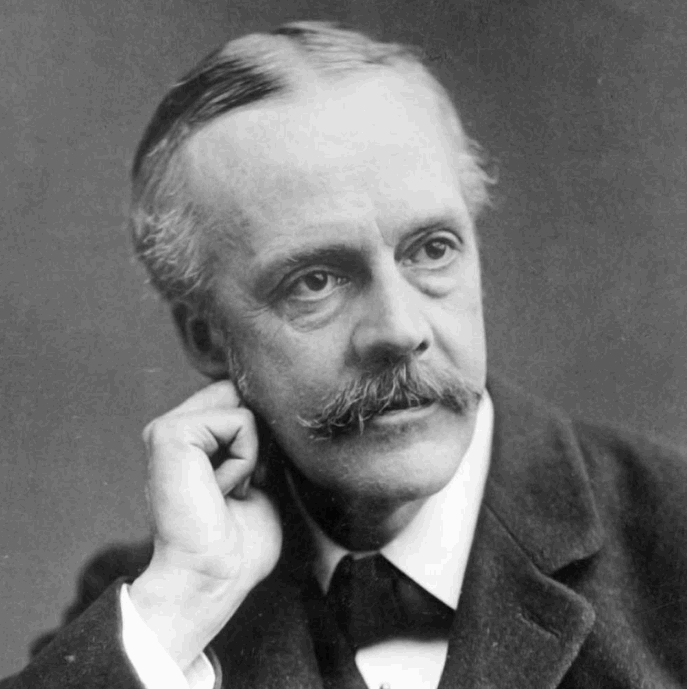
Balfour (somewhat lightly): ‘We are probably fools not to find a reason for declaring war on Germany before she builds too many ships and takes away our trade!’

White: ‘You are a very high minded man in private life. How can you possibly contemplate anything so politically immoral as provoking a war against a harmless nation which has as good a right to a navy as you have? If you wish to compete with German trade, work harder.’

Balfour: ‘That would mean lowering our standard of living. Perhaps it would be simpler for us to have a war.’

White: ‘I am shocked that you of all men should ennunciate such principles.’

Balfour (again lightly); ‘Is it a question of right or wrong? Maybe it is just a question ‘Of keeping our supremacy.’” — From HENRY WHITE, THIRTY YEARS OF AMERICAN DIPLOMACY, by Allan Nevins, pp. 257-8.)


[Page 12]


Of the years of diplomatic intrigue which led up to 1914, E. D. Morel, former Member of Parliament wrote:


‘British policy’ was the policy not of Britain, but of the handful of liberal cabinet ministers who, with their accomplices in the world of foreign office and embassy officialdom, journalism and finance, were running the country onto the rocks.” — (Secret History of a Great Betrayal.)


T. St. John Gaffney, American Consul General at Munich at the outbreak of war in 1914, writes:


For twenty years previous to the war I had been an annual visitor to England, where I had also a large acquaintance with all classes of the people. I was both astonished and amused at the growth of hostility to Germany, and my English friends did not hesitate to declare to me with perfect frankness and customary English bumptuousness that it was necessary to destroy Germany or England would lose her commercial predominance in the world’s market. The question with them was purely one of trade supremacy and with English arrogance they spoke as if they required no allies to accomplish their purpose. I used to laugh at their fears and their boasts and assured them that no spirit of hostility outside trade rivalry prevailed in Germany, but my views were not taken seriously and they one and all declared that in the interest of British trade Germany must be destroyed. Little did I dream at that time of the conspiracy that England had woven to mobilize the world against the Germanic people and how she would succeed in using the blood and treasure of other nations to accomplish her criminal ambition.” — BREAKING THE SILENCE (p. 11).


[Page 13]


Russian Foreign Minister Sazanov need have had no fears of a rapprochement between England and Germany early in 1914.


It was not to be.


[Page 14]


CHAPTER THREE


Roping In America — 1917


After the war broke out, the American press, under the tutelage of the English, and its financial and political employers attained the nadir of degradation and in succumbing utterly to the wild excesses of the war-mania, became openly criminal.” — (T. St. John Gaffney, in BREAKING THE SILENCE, p. 5.)


British propaganda, never absent among influential, public-opinion forming Americans in times of peace, goes to war for the Empire in 1914. Kirby Page writes of this in NATIONAL DEFENSE (page 126):


A year after success had crowned the Allied efforts to induce the United States to enter the war, Sir Gilbert Parker in a notable article in Harper’s Magazine, March 1918, shed light on the British technique: ‘Practically since the day war broke out between England and the Central Powers I became responsible for American publicity. I need hardly say that the scope of my department was very extensive and its activity widely ranged. .. I also frequently arranged for important public men in England to act for us by interviews in American newspapers; and among these distinguished people were Mr. Lloyd George, Viscount Grey, Mr. Balfour, Mr. Bonar Law, the Archbishop of Canterbury, Sir Edward Carson, Lord Robert Cecil Mr. Walter Runciman, the Lord Chancellor, Mr. Austen Chamberlain, Lord Cromer, Will Cooks, Lord Curzon, Lord Gladstone, Lord Haldane, Mr. Henry James, Mr. John Redmond, Mr. Selfridge, Mr. Zangwill, Mrs. Humphrey Ward and fully a hundred others.


[Page 15]


Among other things, we supplied three hundred and sixty newspapers in the smaller States of the United States with an English newspaper, which gave a weekly review and comment of the affairs of the war. We established connection with the man in the street through cinema pictures of the Army and Navy, as well as through interviews, articles, pamphlets, etc. . . . We advised and stimulated many people to write articles; we utilized the services and the assistance of confidential friends. Besides an immense private correspondence with individuals, we had our documents and literature sent to great numbers of private libraries, Y. M. C. A. societies, universities, colleges, historical societies and newspapers.


The Central Powers had not been so easy to vanquish as the Entente had supposed. The barrage of English propaganda had, as yet, not brought the United States into the war. Again quoting Kirby Page in NATIONAL DEFENSE (p. 135):


If the Allies had been sure that they could not count upon the eventual support of America, they would in all probability have been compelled to enter into peace negotiations by the end of 1916 or early 1917.


This supports Churchill’s statement in August, 1936, to William Griffin, editor and publisher of the New York Enquirer, that:


America should have minded her own business and stayed out of the World War. If you hadn’t entered the war the Allies would have made peace with Germany in the Spring of 1917. Had we made peace then there would have been no collapse in Russia followed by Communism, no breakdown in Italy followed by Fascism, and Germany would not have signed the Versailles Treaty, which has enthroned Nazism in Germany If America had stayed out of the war, all of these ‘isms’ wouldn’t today be sweeping the continent of Europe and breaking down parliamentary government, and if England had made peace early in 1917, it would have saved over one million British, French, American and other lives.


[Page 16]


Returning again to Kirby Page in National Defense:


John Maynard Keynes says that the inner group at the British Treasury anxiously realized ‘how entirely helpless the task would soon have become without the assistance of the United States Treasury.’

Bonar Law, Chancellor of the British Exchequer, said on July 24, 1917, ‘It is an open secret that we had spent so freely of our resources that those available in America had become nearly exhausted when our great Ally entered the struggle.’


Garet Garret, more recently author of an excellent but not very widely known commentary on the twentieth century American revolution, THE REVOLUTION WAS, wrote in THE BUBBLE THAT BROKE THE WORLD (p. 126):


In the Spring of 1917 the star of Germanity was overcoming. ‘It cannot be said,’ wrote General Pershing in his final report, ‘that German hopes of a final victory were extravagant, either as viewed at that time or as viewed in the light of history. Financial problems of the Allies were difficult, supplies were becoming exhausted and their armies had suffered tremendous losses. Discouragement existed not only among the civil population but throughout the armies as well.’


However “hitherto unsuspectedly powerful forces” already had been secretly set in operation.


It is timely to state here, that when any group organizes to make its influence felt in either domestic affairs, international affairs, or both, the results of its policies, and of its actions, are subject to historical analysis and criticism. The growth of the Jewish influence in America is beyond the scope of this inquiry. We are concerned, however, with the influence of ORGANIZED WORLD JEWRY on the participation of the United States in the great wars of this century.


[Page 17]


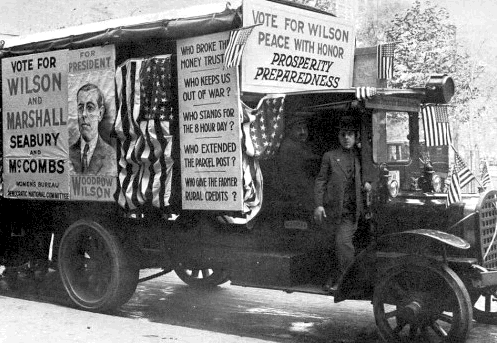
Woodrow Wilson was President during the participation of the United States in the First War Between The Nations. Influences bringing about his election are worthy of examination.


Jennings C. Wise in his book, WOODROW WILSON, DISCIPLE OF REVOLUTION, writes:


Marburg noted the headway ‘Wilson was making and felt that he was well on his way to capture him for the Internationalists. Apparently he agreed with his friend, Rabbbi Stephen S. Wise, that if there was to be a Democratic President, Wilson would be preferable to Bryan. Nor was the wise Rabbi the only member of his race who believed this. The upshot was that, thoroughly alive to the value of the Jewish vote, Wilson agreed to speak in Carnegie Hall on the subject of the Russian treaty and the passport question. This speech was one of the most idealistic he ever made. The Jews were greatly pleased. Within a few days Henry Morgenthau and Abram L. Elkus, both prominent representatives of their race, tendered to McCombs their support of Wilson, with whom it was arranged that Morgenthau should serve as Chairman of Wilson’s campaign committee. [l] It was directly understood among the three that McCombs would urge Morgenthau’s appointment as Secretary of the Treasury and the appointment of Elkus to an important ambassadorial post. (Later, after he had availed himself of Morgenthau’s services, Wilson repudiated this agreement; Morgenthau and Elkus were compelled to divide a four-year ambassadorship to Turkey.)

Bernard Baruch also now came out strongly for Wilson. With no experience in ‘big business,’ thus insidiously, gradually, surely, Wilson was being obligated to Jewish financiers, while being committed unknown to McCombs, to the program of the Internationalists.” (Pages 93-94.)


[1] This might be termed the First Morgenthau Plan.


[Page 18]


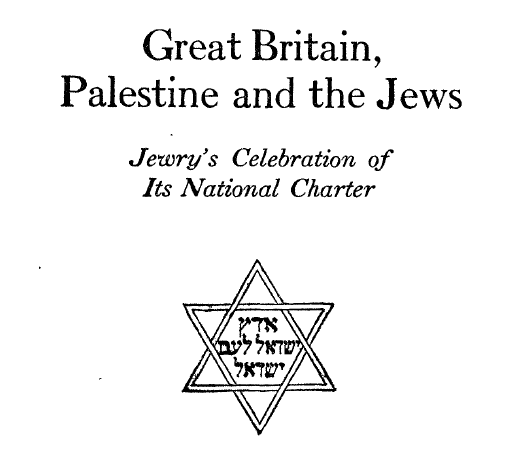
Such were the “hitherto unsuspectedly powerful forces” which were set in operation in 1916. Let us quote directly from the source, a pamphlet published by Samuel Landman, Secretary to the Joint Zionist Council of the United Kingdom in 1912, Joint Editor of the Zionist in 1913-14 and author of pamphlets on History of Zionism and Sionism, Its Organization and Institutions.
In Mr. Landman’s pamphlet, GREAT BRITAIN, THE JEWS AND PALESTINE, published in 1936 by the New Zionist Publications, the following appears on pages 4 and 5: *


During the critical days of 1916 and of the impending defection of Russia, Jewry, as a whole. was against the Czarist regime and had hopes that Germany, if victorious, would in certain circumstances give them Palestine. Several attempts to bring America into the war on the side of the Allies by influencing Jewish opinion had failed. Mr. James A. Malcolm, who was already aware of German prewar efforts to secure a foothold in Palestine through the Zionist Jews and of the abortive Anglo-French demarches at Washington and New York; and knew that Woodrow Wilson, for good and sufficient reasons, always attached the greatest importance to the advice of a very prominent Zionist (Mr. Justice Brandies of the U. S. Supreme Court); and was in close. touch with Mr. Greenberg, Editor of the Jewish Chronicle (London); and knew that several important Zionist leaders had already gravitated to London from the Continent on the qui vive awaiting events; and appreciated and realized the depth and strength of Jewish National aspirations; spontaneously took the initiative, to convince first of all Sir Mark Sykes, Under Secretary of the War Cabinet, and afterwards Monsier Picot, of the French Embassy in London, and Monsieur Gour of the Quai d’Orsay (Eastern Section), that the best and perhaps the only way (which proved so to be) to induce the American President to come into the War was to secure the co-operation of Zionist Jews by promising them Palentine, and thus enlist and mobilize the hitherto unsuspectedly powerful forces (italics ours Ed.) of the Zionist Jews in America and elsewhere in favor of the Allies on a quid pro quo contract basis.


* Also see Jewish Chronicle, December 20, 1935, February 7, and May 8, 1936; and World Jewry, February 22 and March I, 1935.


[Page 19]


Thus, as will be seen, the Zionists, having carried out their part, and greatly helped to bring America in, the Balfour Declaration of 1917 was but the public confirmation of the necessarily secret gentlemen’s agreement of 1916 made with the previous knowledge, acquiesence and/or approval of the Arabs and of the British, American, French and other Allied Governments, and not merely a voluntary altruistic and romantic gesture on the part of Great Britain as certain people either through pardonable ignorance or unpardonable ill-will would represent or rather misrepresent. . . .


An interesting account of the negotiations carried on in London and Paris and subsequent developments, has already appeared in the Jewish press and need not be repeated here in detail, except to recall that immediately after the ‘gentlemen’s’ agreement between Sir Mark Sykes authorized by the War Cabinet and the Zionist leaders, cable facilities through the War Office, the Foreign Office and the British Embassies, Legations, etc., were given to the latter to communicate the glad tidings to their friends and organizations in America and elsewhere, and the change in official and public opinion as reflected in the American press in favour of joining the Allies in the War, was gratifying as it was surprisingly rapid.


[Page 20]


Apparently this agreement was timed to swing influential support over to Wilson in the election of 1916. Jennings C. Wise writes in his book:


Another new source of support in 1916 was the sudden and tremendous enthusiasm displayed by Zion — is Jewry for Woodrow Wilson. About this there is perhaps a little mystery. Referring to a pamphlet published in 1936 by Samuel Landman, Solicitor and Secretary of the Zionist organization during the War, which purports to make quite clear the switch in Jewish support from the German to the Allied cause: the initial bias was not simply anti-Russian but pro-German. The reason was that the Zionists had expected to ‘close a deal’ with Germany, for the later possession of Palestine, which they subsequently effected with the Allies.

“Jewish influence had much to do with Wilson’s initial anti-Entente bias. Later, it influenced him in the opposite direction. The Jewish backing he enjoyed in 1916 constitutes strong circumstantial evidence that Wilson had subscribed, at least tentatively, to the British deal with the Zionists. . . .” (page 458.)


To return to the Landman pamphlet, this writer says further:


. . . the fact that it was Jewish help that brought the U. S. A. into the War on the side of the Allies, has rankled ever since in German — especially Nazi — minds and has contributed in no small measure to the prominence which anti-semitism occupies in the Nazi program.


Jennings Wise adds in a footnote on page 524:


. . . the Zionist-Ally deal which may have influenced Wilson against the Germans initially, the actual, much later entrance into the war of the United States was directly provoked by specific German acts having no relation to the Zionist incident.


It is a matter of historical record that the State Department held Germany to strict accountability on agreed rules of the sea while at the same time overlooking the British violations which the Germans were combatting. Apparently everything was done to force a breach that would publicly justify a declaration of war.


[Page 21]


A more extensive study could draw a parallel with the diplomatic chicanery, for it was nothing less than that, during the 1939-41 period. One cannot escape observing the outline of a plan to involve the United States in the policy of world imperialism in which it is still enmeshed.*


The entrance of the United States into the First War Between the Nations was decisive.


We will now examine a number of observations and comments on the making of the peace.


My views,” writes Robert Lansing, Secretary of State throughout the War, and one of the five American representatives at the Peace Conference, in his book, THE PEACE NEGOTIATIONS, “concerning the Treaty at the time of the conversations with Mr. Bullitt are expressed in a memorandum of May 8, 1919, which is as follows:

The terms of peace were yesterday delivered to the German plentipotentaries, and for the first time in these days of feverish rush of preparation there is time to consider the treaty as a complete document.

The impression made by it is one of disappointment, of regret, and of depression. The terms of peace appear immeasurably harsh and humiliating, while many of them seem to me impossible of performance.

The League of Nations created by the Treaty is relied upon to preserve the artificial structure which has been erected by compromise of conflicting are sown in so many articles and which under normal conditions would soon bear fruit. The League might as well attempt to prevent the growth of plant life in a tropical jungle. War will come sooner or later.


  • Charles A. Beard, American Foreign Policy In the Making, 1932-1940.
  • Also see “America Goes to War,” by Charles C. Tanslll.


[Page 22]


It must be admitted in honesty that the League is an instrument of the mighty to check the normal growth of national power and national aspirations among those who have been rendered impotent by defeat. Examine the treaty and you will find peoples delivered against their will into the hands of those whom they hate, while their economic resources are torn from them and given to others. Resentment and bitterness, if not desperation are bound to be the consequences of such provisions. It may be years before these oppressed peoples are able to throw off the yoke, but as the day follows night the time will come when they will make the effort.

This war was fought by the United States to destroy forever the conditions which produced it. These conditions have not been destroyed. They have been supplanted by other conditions equally productive of hatred, jealousy and suspicion. In place of the Triple Alliance and the Entente has arisen the Quintuple Alliance which is to rule the world. The victors in this War intend to impose their combined will upon the vanquished and to subordinate all interests to their own.

It is true that to please the aroused opinion of mankind and to respond to the idealism of the moralist they have surrounded the new alliance with a halo and called it ‘The League of Nations’ but whatever it may be called or however it may be disguised it is an alliance of the Five Great Military Powers.

It is useless to close our eyes to the fact that the power to compel obedience by the exercise of the united strength of ‘The Five’ is a fundamental principle of the League. Justice is secondary. Might is primary.

The League as now constituted will be the prey of greed and intrigue; and the law of unanimity in the council, which may offer restraint will be broken or render the organization powerless. It is called upon to stamp as just what is unjust.

We have a treaty of peace, but it will not bring permanent peace because it is founded on the shifting sands of self interest.


[Page 23]


In the view thus expressed I was not alone. A few days after they were written I was in London, where I discussed the treaty with several leading British statesmen. I noted their Opinions thus: ‘the consensus was that the treaty was unwise and unworkable, that it was conceived in intrigue and fashioned in cupidity, and that it would produce rather than prevent wars.’ One of these leaders of political thought in Great Britain said that ‘the only apparent purpose of the League of Nations seems to be to perpetuate the series of unjust provisions which are being imposed.’” (Page 272.)


J. Middleton Murry, an English author of note, writes in a similar vein in THE BETRAYAL OF CHRIST BY THE CHURCHES (page 143):


Theoretically, the proper form of a democratic peace was adumbrated in the formation of the League of Nations; but this was completely perverted by founding the League on the sacrosanctity of the punitive and vindicitive Peace Treaty. This corruption of the new idea by using the League, of which the most active elements were successor-states created at the expense of the two German Empires, to act as a jailer to a prostrate Germany, was the major political crime of the modern age. For the League of Nations was a necessary idea, if the world was to be made safe for democracy. Either it or some similar form of closer international organization was the rightful consequence of the victory of the democracies. By perverting it into an instrument of domination, they prevented Europe from finding any way forward, and condemned Europe to a final frenzy of nationalist and totalitarian war, in the course of which it is probable that democracy will Perish.


[Page 24]


Dr. Edward J. Dillon concluded the Foreword of his book, THE INSIDE STORY OF THE PEACE CONFERENCE, with these words:


In the meanwhile the Conference . . . . has transformed Europe into a seething mass of mutually hostile states powerless to face the economic competition of their overseas rivals and has set the very elements of society in flux.


That was in the year 1919.


Dr. Dillon makes other observations of interest:


Of all the collectivities whose interests were furthered at the Conference, the Jews had perhaps the most resourceful and certainly the most influential exponents. There were Jews from Palestine, from Poland, Russia, the Ukraine, Rumania, Greece, Britain, Holland and Belgium; but the largest and most brilliant contingent was sent by the United States . . . Western Jews, who championed their Eastern brothers, proceeded to demand a further concession (aside from removing existing disabilities) which many of their co-religionists hastened to disclaim as dangerous — a kind of autonomy which Rumanian, Polish and Russian statesman, as well as many of their Jewish fellow subjects, regarded as tantamount to the creation of a state within a state. Whether this estimate is true or erroneous, the concessions asked for were given, but supplementary treaties insuring the protection of minorities are believed to have little chance of being executed, and may, it is feared, provoke manifestations of elemental passions in the countries in which they are to be applied.” (Page 12.)


Dr. Dillon says the delegates:


. . . feared that a religious — some would call it racial — bias lay at the root of Mr. Wilson’s policy. It may seem amazing to some readers, but it is none the less a fact that a considerable number of delegates believed the real influences behind the Anglo-Saxon people were Semitic.


[Page 25]


They confronted the President’s proposal on the subject of religious inequality, and in particular, the odd motive alleged for it, with the measures for the protection of minorities which he subsequently imposed on the lesser states, and which had for their keynote to satisfy the Jewish elements in Eastern Europe. And they concluded that the consequence of expedients framed and enforced in this direction were inspired by Jews, assembled in Paris for the purpose of realizing their carefully thought-out program, which they succeeded in having substantially executed. However right or wrong these delegates may have been it would be a dangerous mistake to ignore their views, seeing that they have since become one of the permanent elements of the situation. The formula into which this policy was thrown by the members of the conference, whose countries it affected, and who regard it as fatal to the peace of Eastern Europe was this: ‘Henceforth the world will be governed by the Anglo-Saxon peoples, who, in turn are swayed by their Jewish elements.’” (Page 497.)


This review of the influences that brought the United States into the First World War began with the United States and the British Empire reaching for world power by a coalescing of interests. It ends with the policies of the two English-speaking countries being influenced by an intensely self-interested race.


On such a scene as this, born of the spirit of liberalism, the Jew, freed from old restrictions imposed by nations who held their national heritage above commercial enterprise, expanded his energies and talents to influence every phase of activity of what can be called the commercially intense nations. Werner Sombart, the German social philosopher and historian, has written:


The Jewish spirit, after all, largely controls our entire age, for what has been characterized as the spirit of this economic age, is, in fact largely a Jewish spirit. And Karl Marx was certainly right to the extent in which he said that ‘the practical Jewish spirit became the practical spirit of the Christian peoples,’ that ‘the Jews have emancipated themselves to the extent in which Christians have become Jews’ and that ‘the real nature of the Jew has realized itself in the bourgeois society.’” (A NEW SOCIAL PHILOSOPHY, p. 178.)


*See Marxism and Judaism, by Salluste La Revue de Paris, Juillet-Aout, 1928.


[Page 26]

======================================


PDF of Part 1. Click to view or download (0.5 MB). >> UNCOVERING THE FORCES FOR WAR – Part 1


Version History
Version 1: Published Jul 1, 2014
Posted in Balfour Declaration, Bk - Uncovering The Forces For War, Jews, Revisionism, The International Jew, Third Reich, WW I, WW II | Leave a comment

Background to Treason: The Balfour Declaration

Background to Treason:


The Balfour Declaration

William Pierce

[Image] Arthur Balfour

 http://www.counter-currents.com/2014/06/background-to-treason-the-balfour-declaration/


Editor’s Note:


The following text by William Pierce is an excerpt from a longer text, “Background to Treason: A Brief History of U.S. Policy in the Middle East, Part 1: From the Exodus to the Balfour Declaration.” I simply removed everything before the discussion of the Balfour Declaration. Pay no mind to Pierce’s passing reference to the now thoroughly discredited Khazar account of the originals of Ashkenazi Jewry.


The middle of the 19th century saw a growing restlessness in the Jews of eastern and central Europe. The Industrial Revolution and all the changes in trade, transportation, and life-styles that came with it had broken up old patterns and created new opportunities, and the Jews began reorganizing themselves to take advantage of these.


They created two new movements: one, preaching internationalism and class warfare was directed primarily toward the Gentiles. It was Communism, and its principal founder was the Jew Karl Marx.


The other, directed toward the Jews only, preached Jewish nationalism and solidarity It was Zionism, and one of its first proponents was Moses Hess, a close associate and friend of Marx. Hess’s book Rome and Jerusalem, published in 1862, was one of the seminal documents of the Zionist movement.


[Image] Moses Hess


The Zionists wanted to establish an exclusively Jewish national state, from which they could direct the activities of the Jews spread throughout the Gentile world — and eventually direct the Gentile world itself Toward this end groups of Jews from Europe began buying up land in Palestine and establishing Jewish colonies there in the 1870s and 1880s.


This colonization activity inevitably provoked the fear and resentment of the Palestinians, and in response the Turkish administrators took measures to limit the activities of the Zionists in Palestine. The Jews countered by seeking political allies among the Gentiles in England and Europe and looking for ways to bring pressure against the Turks.


To coordinate their moves they organized a Zionist Congress, which held its first meeting in August 1897, in Basle, Switzerland The leading figure at the first Zionist Congress was Theodor Herzl (1860-1904), whose book Der Judenstaat (The Jewish State), published in Vienna the year before, contained a cogent summary of the Zionist position.


 [Image] Theodor Herzl


According to Herzl:


Every nation in whose midst Jews live is, either covertly or openly, anti-Semitic…. Anti-Semitism increases day by day and hour by hour among the nations; indeed, it is bound to increase, because the causes of its growth continue to exist and cannot be removed.


He saw this anti-Semitism, which arose naturally wherever the Jewish presence made itself felt, as a blessing, because it kept the Jews conscious of their unique status, prevented their assimilation, and united them in their efforts to overcome their Gentile hosts:


… [T]hus united, we suddenly discover our strength…. When we sink, we become a revolutionary proletariat, the subordinate officers of the revolutionary party; when we rise, there rises also our terrible power of the purse.


Even before the Zionist Congress met, Herzl had been attempting to persuade the Turks to give the Jews free rein in Palestine. First he tried blackmail, hinting that he and his fellow Jews, by using their influence, could either silence or intensify the agitation against Turkey then being carried on in various European capitals by Armenian expatriates, who had their own grievances.


When the blackmail didn’t work, Herzl’s thoughts turned to war. He told his fellow Zionists at Basle that they might be able to achieve control of Palestine through a European war, if they played their cards right:


It may be that Turkey will refuse or will be unable to understand us. This will not discourage us. We will seek other means to accomplish our end. The Orient question is now a question of the day. Sooner or later it will bring about a conflict among the nations. The great European war must come. With my watch in hand do I await this terrible moment. After the great European war is ended the peace conference will assemble. We must be ready for that time.[1]


The other Zionist leaders fell in with Herzl’s war plans — which, it is well to note, were proclaimed to world Jewry 17 years before the actual outbreak of the war. As it turned out, the Jews were able to use the war just as they had hoped: from it they finagled a promise by the government of Great Britain to secure Palestine for them.


This promise, the so-called “Balfour Declaration,” has an especially interesting history, for it not only throws light on the crucial period during which the Jews first secured the control over the foreign policy of the United States which they still wield — that is, the period during which the American people lost their sovereignty, unknowingly yielding to an alien minority in their midst the power to choose which nations would be America’s friends and which her foes; to decide when there would be peace and when war, and how each war would be waged, whether to win or lose or draw — but it also brilliantly illuminates the general modus operandi which the Jews, spread out as they are among many nations, have long used in playing off one nation against another in order to attain their own ends.


It would hardly be possible to relate here every Zionist move in the 20 years between Herzl’s speech to the first Zionist Congress and the British government’s offer of Palestine to the Jews, even if all the moves were known. It must suffice, in laying the background, to mention a few key developments which made the Balfour Declaration possible.


First, the years immediately following the first Zionist Congress saw an enormous influx of Jews into the United States. Although U.S. immigration statistics prior to 1899 do not reveal the race or religion of immigrants, we know that in 1897 the total Jewish population of the United States was approximately 800,000 — and nearly half of those had arrived in the preceding decade. By 1914 the number had more than tripled, to some 2 1/2 million. The majority of the new immigrants came from Russia, where the Zionist movement was especially strong.


[Image] The Jewish Immigrant publication


This tidal wave of Jewish immigrants made itself felt very soon in the economic and political life of the United States. Jewish ambition and energy, not to mention a predilection for those endeavors yielding quick gain, resulted in a phenomenally rapid growth in the financial power wielded by Jews in the country, and this power was put to immediate use in acquiring a political influence disproportionate to their numbers. Already in 1896, the year before Herzl’s speech, the New York Times fell into Jewish hands, with its purchase by Adolph Ochs. Thirteen years before that Joseph Pulitzer, the Jewish father of yellow journalism, had purchased the New York World. And in the years between 1897 and 1917 the Jews continued their acquisitions, building a very strong bridgehead in the news media for furthering their long-range goals.


[Image] Adolph Ochs


Just as the Palestinians had reacted to the Jewish colonization of Palestine, so did White Americans react to the Jewish colonization of America. The politicians responded with their typical timidity and ambiguity to White demands for a halt to the flood of Jews. In 1897 the U.S. Congress enacted a law requiring proof of literacy before immigrants could be admitted to the United States. The law would have kept out most of the Jews from Russia and other parts of eastern Europe then pouring into the country, but it never had a chance to accomplish its aim, because President Cleveland vetoed it.


As the growing Jewish presence became more obnoxious to Americans, the pressure on the reluctant politicians to do something grew. Jewish political influence had also grown apace, however, and the Jews were able to counter every effort at legislation intended to keep them out of the country. President Taft vetoed another immigrant-literacy law early in 1913, just before leaving office, and President Wilson did the same thing in 1914.


 [Image] Jewish immigrants leaving Ellis Island, 1915


The second major development leading to the Zionists’ triumph in 1917 was the election of Woodrow Wilson to the Presidency in 1912, and then his reelection in 1916. Wilson was entirely their man. From the time he took office in 1913 until he left it in 1921, he made hardly a decision without consulting his counselor and confidante, Louis Dembitz Brandeis.


 [Image] Louis Dembitz Brandeis


Wilson was an ineffectual man, who, after failing to make a career for himself as a lawyer, retreated to the academy, teaching political science first at Bryn Mawr, then at Wesleyan, and finally at Princeton. He was also less than brilliant as an academician, but he possessed a rhetorical flair which he used to promote a hodgepodge of confused, liberal notions, thereby gaining for himself the backing of the liberal element among the Princeton faculty, who eventually boosted him into Princeton presidency. He was never very strong, and he suffered several major breakdowns, even in the relatively sheltered life of a professor.


Louis Brandeis (1856-1941), an enormously wealthy and successful Boston lawyer, was the son of Jewish immigrants from Bohemia. He was also the leader of the Zionist movement in the United States. In 1912 he headed the group which invited Nahum Sokolow, the Zionist leader from Russia, to speak in the United States. In 1914 he organized and became the chairman of the Provisional Executive Committee for General Zionist Affairs. But his Zionist leadership was something kept between himself and his fellow Jewish nationalists.


To the American public and the Democratic Party’s politicians he was a very clever advocate of “democracy,” who was involved in a number of celebrated legal cases on behalf of labor unions. His left-wing admirers in the press nicknamed him “the people’s lawyer.


[Image] Woodrow Wilson


Wilson had also achieved something of a reputation as a champion of equality and democracy when, as president of Princeton University, he became embroiled in a fight to abolish Princeton’s exclusive student eating clubs, which he regarded as elitist and undemocratic. The ruckus caused by Wilson’s opposition to the eating clubs brought him to the attention of New Jersey’s Democratic Party political bosses, and they chose him as their gubernatorial candidate in 1910. They also introduced him to Brandeis, who took the weak, vain, professorial Wilson firmly in hand and guided him in all political matters (and many private matters as well) thereafter.


When Wilson became President he immediately offered Brandeis a position in his Cabinet, but the clever Jew chose instead to remain in the background, where his influence over Wilson would not become compromised by public scrutiny. Indeed, Brandeis was very wise in this decision, because when he did accept an appointment to the Supreme Court from Wilson in 1916, there was a great deal of public opposition.


Nevertheless, Brandeis became the first Jew to serve on the U.S. Supreme Court, and he did so without giving up his informal post as counsel to the President and general political “fixer,” as recent research has revealed. [2]


The third development which was essential to Zionist aims was the war itself and the impasse it had reached in the autumn of 1916. We dare not become involved in a history of the First World War here, but the main points relevant to our following of the Zionist trail are these: The principal antagonists were Britain and Germany One of the many countries fighting on the British side was Imperial Russia. One of the several countries on the German side was Turkey. In the west the antagonists were stalemated, facing each other in opposing trenches which stretched across the continent from north to south and unable to gain very much ground on either side without enormous losses.


The German Verdun campaign of 1916, the longest and bloodiest “battle” in the history of warfare, had failed to achieve any significant advantage for the Germans, and it was to cost them and their French opponents half a million casualties each before it finally petered out. The Franco-British Somme offensive, which followed the ebb of the German offensive at Verdun — and which cost the British 19,000 dead on the first day — proved equally inconclusive.


[Image] The battle of the Somme took place between 1 July and 18 November, 1916, The British Expeditionary Force and the French Army conducted a joint offensive against the Germans, who had held much of the territory since 1914. When the battle had ended, the allies had advanced almost 10 km but were still 5 km from their major objective. More than one million casualties were suffered.


On the eastern front the Russian Brusilov offensive cost the Czar a million men and left him so weakened that the Germans thereafter held the advantage.


At sea German submarines were claiming an increasing toll on British shipping, and Britain was feeling the strain. The only hope British leaders could see for ending the stalemate was to bring America into the war. Otherwise, to continue the war would bankrupt them; they would be obliged to accept a compromise peace, without achieving their aim of crushing Germany as an industrial-commercial rival. The public sentiment in America was strongly against intervention in the war, and Wilson won reelection in November by campaigning as a pacifist. His campaign slogan was, “He kept us out of war.


Thus was the stage set. Now enter the Zionists.


The Jews had three principal aims: First, to break the Turkish hold on Palestine. Second, to obtain from whichever power replaced Turkey in Palestine the concessions they had been unable to obtain from the Turks. Third, to destroy Russia, an object of special hatred to them.


Until the fall of 1916 it was the third of these aims which manifested itself most noticeably in the Jews’ policy. It is well to remember that it had been Rus warriors, under Sviatoslav the Great, who in 965 had utterly smashed the Khazar Empire, and the Ashkenazic Jews, who made up virtually all of the Zionist leadership, had long memories. Even today Jews celebrate annually their triumphs over enemies thousands of years ago.


Furthermore, a parallel Jewish movement, Bolshevism, had made great strides in Russia, and Jews throughout the world, of whatever persuasion, wanted to see the Russians weakened to the point that the Bolsheviks could seize the nation. It was with this purpose in mind that Jacob Schiff, America’s richest Jew, financed Trotsky and his fellow Jewish Bolsheviks to the tune of $25 million. Later, after the downfall of Russia, Schiff opened his coffers to the Zionists.


[Image] Jacob Henry Schiff (born Jakob Heinrich Schiff; January 10, 1847 – September 25, 1920)


[Image] Leon Trotsky born Lev Davidovich Bronshtein (7 November 1879 – 21 August 1940) was a Russian Marxist revolutionary and theorist, Soviet politician, and the founder and first leader of the Red Army.


Toward the end of 1916, however, it was clear that Russia was in terminal condition. Although she still had vast armies in the field and even vaster reserves of manpower at home, from a strategic viewpoint Russia was whipped, and the Germans were already beginning to withdraw troops from the eastern front in order to bolster their strength in the west.


A good share of the credit for the Russian collapse belonged to the Bolsheviks, who were working furiously to undermine morale in the trenches and in the factories. They spread pacifist and defeatist leaflets among the troops and carried on in Russia’s cities much as they did more than 50 years later in America’s cities during the Vietnam war.


Until this point then, it had behooved the Jews to back Germany, and they did. Ultimately, however, their plan called for Germany — or, at least, Germany’s ally Turkey — to lose. So it was that in October 1916 the Jews made their offer to the British government: We will bring America into the war, if you will take Palestine away from the Turks and give it to us.


The story of this offer, its acceptance by the British government, and its aftermath has been told in several places and hinted at in many. Not in any of the “approved” history texts dealing with the First World War which are used today in American colleges and universities, of course, or in any “popular” treatments of the war to be found in newsstand paperbacks, but the interested reader can nevertheless find a number of unimpeachable, firsthand accounts, if he is willing to dig a bit in a large library. For example, Malcolm Thomson, the biographer of David Lloyd George, Britain’s wartime prime minister, writes on pages 273-74 of David Lloyd George, the Official Biography (London, 1949):


[Image] David Lloyd George, 1st Earl Lloyd-George of Dwyfor, OM PC (17 January 1863 – 26 March 1945) was a British Liberal politician and statesman.


. . . In the autumn of 1916, when the question of strengthening sympathy with the Allied cause was growing acute, an Armenian Jew, James A. Malcolm, who was giving expert help and advice to the Government about Middle Eastern matters, approached [Foreign Office Undersecretary Sir Mark] Sykes and urged that the Allies should capture the sympathies of American Jewry — at that time tending to favour Germany — by a declaration of support for the Zionist cause. Sykes saw the possibilities of the suggestion, and laid it before Lord Milner, who took it up with the Cabinet.


. . . Secret assurances were given to the Zionist leaders through Sykes that the British government would support their cause if the consent of their Allies could be obtained. A message to this effect was sent to Justice Brandeis, the American Zionist, who was a close friend of President Wilson, and the help of leading Zionists in all the Allied countries was mobilized.


Samuel Landman, secretary to Zionist leaders Chaim Weizmann and Nahum Sokolow in 1916, and later general secretary of the World Zionist Organization, narrates the events from firsthand knowledge in his booklet Great Britain, the Jews, and Palestine (London, 1936). [3] On pages 4-5 he writes:


During the critical days of 1916 and of the impending defection of Russia, Jewry, as a whole, was against the Czarist regime and had hopes that Germany, if victorious, would in certain circumstances give them Palestine. Several attempts to bring America into the War on the side of the Allies by influencing influential Jewish opinion were made and had failed. Mr. James A. Malcolm, who was already aware of German pre-war efforts to secure a foothold in Palestine through the Zionist Jews and of the abortive Anglo-French demarches at Washington and New York; and knew that Mr. Woodrow Wilson, for good and sufficient reasons, always attached the greatest possible importance to the advice of a very prominent Zionist (Mr. Justice Brandeis, of the U.S. Supreme Court); and was in close touch with Mr. Greenberg, Editor of the  Jewish Chronicle (London); and knew that several important Zionist Jewish leaders had already gravitated to London from the Continent on the qui vive awaiting events; and appreciated and realised the depth and strength of Jewish national aspirations; spontaneously took the initiative, to convince first of all Sir Mark Sykes, Under Secretary to the War Cabinet, and afterwards Monsieur Georges Picot, of the French Embassy in London, and Monsieur Gout of the Quai d’Orsay (Eastern Section), that the best and perhaps the only way (which proved so to be) to induce the American President to come into the War was to secure the co-operation of Zionist Jews, by promising them Palestine, and thus enlist and mobilise the hitherto unsuspectedly powerful forces of Zionist Jews in America and elsewhere in favour of the Allies on a quid pro quo contract basis. Thus, as will be seen, the Zionists, having carried out their part, and greatly helped to bring America in, the Balfour Declaration of 1917 was but the public confirmation of the necessarily secret “gentleman’s” agreement of 1916 made with the previous knowledge, acquiescence and/or approval of the Arabs and of the British, American, French and other Allied Governments, and not merely a voluntary altruistic and romantic gesture on the part of Great Britain as certain people either through pardonable ignorance assume or unpardonable ill-will [sic] would represent or rather misrepresent.


An interesting account of the negotiations carried on in London and Paris, and subsequent developments, has already appeared in the Jewish press and need not be repeated here in detail, except to recall that immediately after the “gentleman’s” agreement between Sir Mark Sykes, authorised by the War Cabinet, and the Zionist leaders, cable facilities through the War Office, the Foreign Office and British Embassies, Legations, etc., were given to the latter to communicate the glad tidings to their friends and organisations in America and elsewhere, and the change in official and public opinion as reflected in the American press in favour of joining the Allies in the War, was as gratifying as it was surprisingly rapid.


[Image] Samuel Landman’s booklet (98 pages) Great Britain, the Jews, and Palestine (London, 1936).


Landman tells the same story in other places: for example, in a lengthy letter titled “The Origin of the Balfour Declaration” published in the  Jewish Chronicle (London, February 7, 1936; page 33).


A much more detailed account of the negotiations between the Jews and the British government in October 1916 is in Two Studies in Virtue (London, 1953), a biography of Sir Mark Sykes by his son, Christopher Sykes, who drew extensively on his father’s diaries and letters of the period. A few paragraphs excerpted here from pages 180-188 of that book suggest the essentials:


 [Image] Colonel Sir Mark Sykes, 6th Baronet (born Tatton Benvenuto Mark Sykes; 16 March 1879 – 16 February 1919) was an English traveller, Conservative Party politician and diplomatic adviser, particularly about matters respecting the Middle East at the time of the First World War.


. . . One day in October of 1916 a certain Mr. James Malcolm came to visit Mark Sykes.. . . Sykes . . . [said] that he could see no end to the war. In France there was a military deadlock. At sea the power of the [German] submarine was growing; on land that of the Russian armies failing. . . . A decisive victory, or indeed a victory of any kind, seemed impossible without American participation on an enormous scale, and of that he saw little likelihood. . . . At this Mr. Malcolm took occasion to harangue his friend on the principles which should govern British foreign policy regarding the Jewish world. . . . He proceeded to tell him about Zionism. . . .

Mr. Malcolm . . . then told Sykes of a very curious and powerful influence which Zionists could exert. One of President Wilson’s closest advisers and friends was Justice Louis D. Brandeis, a Jew. . . . It was believed . . . that Wilson was attached to Brandeis by ties of peculiar hardness. . . . It followed that . . . a Zionist policy was in truth the way to capture American sympathy [for the Allies]. . . .

. . . [Malcolm then said:]

The question is, do you want the help of the Jews of the United States? The only way you can get that help is by offering Palestine to the Zionists.


. . . [After the British had agreed to the Zionist terms, the leader of the Zionist delegation, Nahum] Sokolow made a simple request, namely that the Zionist Committee should have facilities for communications abroad. He pointed out that since they were an international body this was especially needful to them, and he suggested that they should be granted governmental privileges, since they could thus attain their object while subjecting themselves to the needs of secrecy and censorship.

The next morning . . . [Sokolow] got what he asked for: it was agreed that the War Office and the Foreign Office would send Zionist letters and telegrams by way of [British] Embassies. . . . The news was given out to Jewish communities all over the world that in return for certain services the British Government . . . would satisfy the Jewish longing for Palestine . . .

A more general account is given by Professor H. W. V. Temperley in his six-volume work,  A History of the Peace Conference of Paris (London, 1924). Of the Balfour Declaration he writes (vol. vi, pp. 173-174):


That it is in purpose a definite contract between the British Government and Jewry represented by the Zionists is beyond question. In spirit it is a pledge that in return for services to be rendered by Jewry the British Government would ‘use their best endeavours’ to assure the execution of a certain definite policy in Palestine.


As Samuel Landman notes above, once the deal had been struck and the word sent out to American Jews;


the change in official and public opinion as reflected in the American press in favor of joining the Allies in the war was surprisingly rapid.


President Wilson, without blushing or skipping a beat, changed his tune from;


I kept us out of war” to “We must destroy German militarism in order to make the world safe for democracy.


[Image] Thomas Woodrow Wilson (December 28, 1856 – February 3, 1924) was the 28th President of the United States from 1913 to 1921.


A detailed examination of the chicanery used by the “American” press and President to coax a reluctant nation into sending its sons off to die in Flanders’ fields and a thousand other foreign places, in order that, unknown to them, the Jews could satisfy their side of their deal with the British government, would take us far beyond the scope of this article. The various pretexts used for abandoning neutrality — such as Germany’s submarine blockade of Britain and the so-called “Zimmermann telegram” — are treated exhaustively in the “approved” textbooks on the war (although they are treated with utmost seriousness rather than as pretexts).


In brief, it was a matter of Wilson’s talking peace, even sending his personal factotum, “Colonel” Edward Mandell House, on supposed peace missions to the various belligerents, while actually seizing every opportunity to fan the flames of war. The scheme was to present an appearance to the public of his being forced, much against his will, to go to war in order to defend America’s honor. Because the war provided plenty of real opportunities for international “incidents” to occur, especially when Wilson took pains to see that Americans would be in harm’s way as often as possible, it was not overly difficult to generate the desired impression in the public mind.


For example, when a German submarine sank the British ship Laconia [4] on February 25, 1917, with the loss of three Americans who were aboard, Wilson and the press put on a great show of moral outrage at this act of German “barbarism,” treating it as an intolerable affront to American sovereignty.


[Image] RMS Laconia was a Cunard ocean liner built by Swan Hunter & Wigham Richardson, launched on 27 July 1911.


It was a matter of exaggerating incidents which could have been ignored — or avoided altogether — if Wilson really had wanted to preserve American neutrality. The German submarine blockade of Britain was milked for all it was worth to generate anti-German sentiment among the American people, while the far more ruthless British blockade of Germany was quietly ignored. Wilson connived to assure that the former would yield pretexts for intervention, while he took measures to prevent American ships and citizens from running afoul of the latter. [5]


In any event, it is clear that Mr. Ochs’s investment in the New York Times yielded a handsome dividend to world Jewry, as did Mr. Brandeis’ years of patient counsel to the fawningly grateful and ever more dependent Woodrow Wilson.


The British formalized their intention to satisfy their side of the deal with the Jews by issuing the Balfour Declaration, which was in the form of a letter, dated November 2, 1917, from British Foreign Secretary Arthur Balfour to “Lord” Lionel Rothschild, who was recognized as the leader of the Jewish community in Britain. The brief document merely stated a resolution which had been approved by the British Cabinet:


His Majesty’s Government view with favour the establishment in Palestine of a national home for the Jewish people, and will use their best endeavours to facilitate the achievement of this object, it being clearly understood that nothing shall be done which may prejudice the civil and religious rights of existing non-Jewish communities in Palestine, or the rights and political status enjoyed by Jews in any other country.


[Image] Lionel Nathan de Rothschild, OBE (25 January 1882 – 28 January 1942) was an English banker and Conservative politician.


The last provision, added at Jewish insistence, reveals the Zionists’ intention that Jews everywhere should be uniquely favored by being permitted to enjoy the citizenship, with full rights and privileges, of both the Gentile country in which they happen to reside at the moment and of their “national home” in Israel.


The reservation about not prejudicing the “civil and religious rights of existing non-Jewish communities in Palestine” was, under subsequent Jewish pressure, eventually ignored.


The Balfour Declaration provides an especially interesting example of the hypocritical cant which has characterized the statesmanship of both of the great English-speaking powers during the 20th century. Pious concern for the rights of the non-Jews in Palestine is expressed in a document which, in effect, is a promise by the British government to secure for the Jews land which belonged neither to it nor to the Jews. How did Mr. Balfour imagine that his government could accomplish that dubious feat without prejudicing the rights of the current owners of the land, who were in no mood to give it up willingly?


One is reminded of the British government’s claim in September 1939 that it was declaring war on Germany in order to protect the freedom of its ally Poland, which had been invaded by Germany — a claim which conveniently overlooked the fact that the Soviet Union had also invaded Poland. In 1945 the same British government, its earlier expression of concern for Polish freedom buried under a bushel of new cant about democracy and peace, obligingly agreed to its ally becoming an unwilling vassal of the Soviet Union.


Nothing, however, can quite match the unabashed brazenness of the hypocrisy Woodrow Wilson displayed in engineering the entry of the United States into the First World War — unless it was that displayed a generation later by Franklin Roosevelt, when he too talked peace and plotted war, at the behest of the same people Wilson had served.


Wilson’s campaign propaganda for the 1916 election emphasized his stance of non-intervention in the war then raging in Europe. Most of the press and the public were also against intervention. Then, after Wilson’s reelection — and the British-Zionist deal, concluded just a few days before the election — the press began a “surprisingly rapid” shift toward an interventionist stance. Wilson followed, calling for a declaration of war against Germany just five months after his reelection.


[Image] A New York Journal headline marks the entrance of the United States into World War I, April 6, 1917.


Even before that, however, he and Brandeis had been planning war, and it was their secret assurances that the United States would be brought into the war that led British leaders to reject Germany’s peace offer of December 12, 1916. If that offer had been accepted, the lives of some three million White soldiers — including 115,000 Americans — Which were consumed in 1917 and 1918 would have been spared. Furthermore, the Second World War, which grew out of the unjust conditions imposed on Germany after the Allied victory, would have been avoided. And if Russia could have had peace in December 1916, she probably would have had time to stamp out the Bolshevik virus being spread among her soldiers and workers by the Jews, and Communism would have suffered a setback from which it might never have recovered. All of the grim and bloody consequences of Wilson’s switch in foreign policy stem from the Zionist influence in the U.S. news media and politics, which had been built up over the preceding two decades.


[Image] WILSON’S campaign propaganda for the 1916 election emphasized his stance of non-intervention in the war then raging in Europe. Most of the press and the public were also against intervention. Then, after Wilson’s reelection — and the British-Zionist deal, concluded just a few days before the election — the press began a “surprisingly rapid” shift toward an interventionist stance. Wilson followed, calling for a declaration of war against Germany just five months after his reelection.

Even before that, however, he and Brandeis had been planning war, and it was their secret assurances that the United States would be brought into the war that led British leaders to reject Germany’s peace offer of December 12, 1916. If that offer had been accepted, the lives of some three million White soldiers — including 115,000 Americans — which were consumed in 1917 and 1918 would have been spared.

Furthermore, the Second World War, which grew out of the unjust conditions imposed on Germany after the Allied victory, would have been avoided. And if Russia could have had peace in December 1916, she probably would have had time to stamp out the Bolshevik virus being spread among her soldiers and workers by the Jews, and Communism would have suffered a setback from which it might never have recovered.

All of the grim and bloody consequences of Wilson’s switch in foreign policy stem from the Zionist influence in the U.S. news media and politics, which had been built up over the preceding two decades.


Upon reflection, may we not conclude that lying cant is what should be expected of any government which has degenerated to the point that it consists mainly of lawyers? And is not that the kind of government which must inevitably devolve under a system which gives the franchise to the credulous and the gullible?


It is the historians and the teachers, however, who most deserve our scorn. Everyone expects lawyers to lie; word trickery is their stock-in-trade. No lawyer committed to the truth could hope to earn a living. But historical scholars are supposed to be different. They are supposed to be indifferent to popular myths, always seeking the reality which lies beneath the facile explanations of governments and politicians.


The explanation for the reluctance of modern historians to write about the Zionist role in the First World War is this: In the immediate postwar years, the Zionist responsibility for America’s entry into the war was a valid topic for historical investigation and discussion, with even the Zionists freely admitting their actions. After all, America and Britain had won the war, and Germany was down and out. How could the truth hurt anyone?


Then in 1933 Germany, under Adolf Hitler, began getting back on its feet. Suddenly any discussion of the truth about the Zionist role in the last war became “anti-Semitic.


One man who was privy to every detail of that role was David Lloyd George. In 1938 the former British war secretary and prime minister wrote a two-volume book,  The Truth about the Peace Treaties. In that book he described the way in which Jews all over the world — in Germany and Russia as well as in America — immediately switched from a pro-German to an anti-German stance after the deal between his government and the Zionists was made. He pointed out the fatal consequences this switch had for the German war effort. And on page 1140 he noted:


The Germans themselves know that to be the case, and the Jews in Germany are suffering today for the fidelity with which their brethren in Russia and in America discharged their obligations under the Zionist pledge to the Allies.


Since the Second World War, any criticism of the Jews has been taboo, and even the historical scholars have feared to tread on ground where their discoveries might reveal the Jews in a a bad light. The consequences of this cowardice have been very costly indeed.


From National Vanguard magazine (December, 1982),  transcribed by Michael Olanich


http://www.counter-currents.com/2014/06/background-to-treason-the-balfour-declaration/


Notes


[1] American Jewish News (New York), March 7, 1919. A photographic reproduction of the pertinent sections from that publication and other Zionist documents may be found in Issue No. 48 of National Vanguard.


The reader should note that Herzl uses the expression “the nations,” both in this speech and in the excerpt quoted above from his book, as a code phrase: He gives it the same meaning it has in the Old Testament, as in, “I have this day set thee over the nations… to root out and to pull down and to destroy ” (Jeremiah 1:10) That is, “the nations” means “the goyim.


Harper’s Bible Dictionary (Madeleine S. Miller and J. Lane Miller, New York, 1959), has the entry: “nations, a term used by Hebrew writers for non-Israelites, outsiders, Gentiles, heathen.


[2] The Brandeis-Frankfurter Connection: The Secret Political Activities of Two Supreme Court Justices, by Bruce Murphy (Oxford University Press, 1982). Murphy, a political science professor at Pennsylvania State University, discovered an extensive file of correspondence between Brandeis and a Jewish law professor at Harvard University, Felix Frankfurter (1882-1965). From the time of his appointment to the Supreme Court in 1916 until his retirement in 1939, Brandeis paid Frankfurter to serve as his messenger and errand boy, so that Brandeis could secretly maintain all of his political contacts behind the cloak of judicial impartiality.


[3] http://libcudl.colorado.edu/wwi/pdf/i73443578.pdf


[4] RMS Laconia was a Cunard ocean liner built by Swan Hunter & Wigham Richardson, launched on 27 July 1911, delivered to the Cunard Line on 12 December 1911, and began service on 20 January 1912. She was the first Cunard ship of that name.


On the outbreak of World War I Laconia was converted into an armed merchant cruiser in 1914 and based at Simon’s Town, South Africa in the South Atlantic, from which she patrolled the South Atlantic and Indian Ocean until April 1915. She was then used as a headquarters ship for the operations to capture Tanga and the colony of German East Africa. She continued to serve on the East Africa station, before returning to Britain with a convoy in June 1916. She was handed back to Cunard in July 1916 and on 9 September resumed service.


On 25 February 1917 she was torpedoed by SM U-50 6 nautical miles (11 km) northwest by west of Fastnet while returning from the USA to England with 75 passengers (34 first class and 41 second class) and a crew of 217 commanded by Captain Irvine. The first torpedo struck the liner on the starboard side just abaft the engine room, but did not sink her. 20 minutes later a second torpedo exploded in the engine room, again on the starboard side, and the vessel sank at 10:20 pm. 12 people were killed, six crew and six passengers, including two American citizens, Mrs. Mary Hoy and her daughter, Miss Elizabeth Hoy, who were originally from Chicago.


Chicago Tribune reporter Floyd Gibbons was aboard Laconia when she was torpedoed and gained fame from his dispatches about the attack.


[5] The chicanery involved in the way Wilson and the press dealt with the blockades the belligerents imposed on one another is revealed especially well in Colin Simpson’s excellent and thoroughly documented book The Lusitania (Boston, 1972). That book in turn refers the interested reader to a number of other valuable sources.


Source: http://nationalvanguard.org/2014/06/background-to-treason-part-1/


======================================


PDF of this blog post. Click to view or download (1.7 MB). >> Background to Treason – The Balfour Declaration Ver 2


Version History


Version 3: Aug 25, 2020 — Re-uploaded images and PDF for katana17.com/wp/ version.


Version 2: Dec 16, 2017 — Improved formatting.


Version 1: Published Jun 27, 2014

Posted in Balfour Declaration, Banksters, Britain, Chaim Weizmann, Communism, Democrat Party, Germany, Israel, Jewish Bolsheviks, Jewish Problem/Question, Jewish Supremacism, Jews, Jews - Lying, Leon Trotsky, Lloyd George, Marxism, Media - jewish domination, New World Order, Palestine, Propaganda - Anti-German, Revisionism, Rothschild, Russia, Russian Revolution 1917, The International Jew, Traitors - Politicians, White Nationalism, William Pierce, Woodrow Wilson, WW I, Zionism, Zionists | 10 Comments

RACE, EVOLUTION, AND BEHAVIOR – Part 8: Questions and Answers


RACE, EVOLUTION, AND BEHAVIOR:


A Life History Perspective


 [Part 8]


2nd Special Abridged Edition

By Professor J. Philippe Rushton


University of Western Ontario

London, Ontario, Canada N6A 5C2


Author

J. Philippe Rushton is a professor of psychology at the University of Western Ontario, London, Ontario, Canada. Rushton holds two doctorates from the University of London (Ph.D. and D.Sc) and is a Fellow of the John Simon Guggenheim Foundation, the American Association for the Advancement of Science, and the American, British, and Canadian Psychological Associations. He is also a member of the Behavior Genetics Association, the Human Behavior and Evolution Society, and the Society for Neuroscience. Rushton has published six books and nearly 200 articles. In 1992 the Institute for Scientific Information ranked him the 22nd most published psychologist and the 11th most cited. Professor Rushton is listed in Who’s Who in Science and TechnologyWho’s Who in International Authors, and Who’s Who in Canada.


[Page 5]

Contents


Preface 6

1. Race is More Than Skin Deep 7

Race in History
Race in Today’s World
Why Are There Race Differences?
Conclusion
Additional Readings

2. Maturation, Crime, and Parenting 13

Maturation
Crime
Personality, Aggression, and Self-Esteem
Parenting and Out-of-Wedlock Births
Longevity and Population Growth
Conclusion
Additional Readings

3. Sex, Hormones, and AIDS 18

Sexual Behavior and Attitudes
Sexual Physiology and Anatomy
AIDS and HIV
Conclusion
Additional Readings

4. Intelligence and Brain Size 22

Culture Fair Tests
Intelligence and Brain Size
Race Differences in Brain Size
Magnetic Resonance Imaging
Brain Weight at Autopsy
Measuring Skull Size
Measuring Living Heads
Summarizing Brain Size Differences
Conclusion
Additional Readings

5. Genes, Environment, or Both? 28

Heritability Studies
Adoption Studies
Race and Heritability
Trans-racial Adoption Studies
Heritabilities Predict Racial Differences
Regression to the Average
Conclusion
Additional Readings

6. Life History Theory 34

r-K Life History Theory
Race Differences and r-K Strategies
Testosterone — The Master Switch?
Conclusion
Additional Readings

7. Out of Africa 39

The Evidence
Geography and Race
Conclusion
Additional Readings

8. Questions and Answers 42

Is Race a Useful Concept? (Chapter 1)
Are the Race Differences Real? (Chapters 2 through 5)
Is the Relationship Between Race and Crime Valid? (Chapter 2)
Is the Relationship Between Race and Reproduction Valid? (Chapter 3)
Is the Genetic Evidence Flawed? (Chapter 5)
Is r-K Theory Correct? (Chapter 6)
Aren’t Environmental Explanations Sufficient? (Chapter 5)
Is Race Science Immoral? (Chapter 1)
Closing Thoughts
Additional Readings

[Page 6]


[Page 42]

8: Questions and Answers


This final chapter lists the most important questions I have been asked about my r-K theory and my answers to them. It also gives pointers to the earlier chapter(s) that discuss each topic in greater detail, my closing thoughts on Race, Evolution, and Behavior, and on the story of the abridged edition.

You may be asking, “Why is the information about race in this book so different from what I have seen in magazines, college texts, and on TV?” The answer is that about 70 years ago the social sciences took a wrong turn. They left Darwinism and refused to look at the biological basis of human behavior — evolution and genetics. They also divided into separate academic fields and lost the forest for the trees.

In this book I try to re-unite the social and biological sciences on the issue of race. The evidence I have used comes from the best scientific journals, not from obscure sources. I began to study and publish scientific articles on race in the early 1980s. Since then I have received many questions about my work. Probably you’ve thought of some of these questions yourself.

This final chapter lists the questions I have been asked most often and my answers to them. I’ve grouped the questions by major topic. Each topic has a pointer to the chapter(s) in this abridged edition that discuss the topic in detail.


Is Race a Useful Concept? (Chapter 1)


Q: You write as if race is a valid biological concept. Aren’t you only repeating the stereotypes of 18th and 19th century Europeans?

A: True, there is a 200-year history of “European” research on race. But similar descriptions were made by Arab and Turkish writers nearly 1,000 years earlier and some can even be traced back to the ancient Greeks. Today, new methods of genetic DNA analysis agree with the original classifications made by early European scientists based on their observations.


Q: But isn’t race “just skin deep”? Don’t most scientists now agree that race is a social construct, not a biological reality?

A: Biological evidence shows that race is not a social construct. Coroners in crime labs can identify race from a skeleton or even just the skull. They can identify race from blood, hair, or semen as well. To deny the existence of race is unscientific and unrealistic. Race is much more than “just skin deep.


Q: Your three major racial categories overlap and it isn’t possible to assign each person to a race. So isn’t your three-way racial classification scheme somewhat made-up?

A: Yes, to a certain extent all the races blend into each other. That is true in any biological classification system. However, most people can be clearly identified with one race or another. In both everyday life and evolutionary biology, a “Black is anyone most of whose ancestors were born in sub-Saharan Africa. A “White is anyone most of whose ancestors were born in Europe. And an “Oriental is anyone most of whose ancestors were born in East Asia. Modern DNA studies give pretty much the same results.

[Page 43]

Q: Doesn’t the Out of Africa theory imply that we are “all Africans under the skin”?

A: Yes and no. The theory is that Homo sapiens first appeared in Africa about 200,000 years ago. Then some groups migrated north about 110,000 years ago into Europe and Asia. A further split took place between the “ancestral Whites and the “ancestral Orientals about 40,000 years ago. True, all humans are brothers (and sisters). But we all know that brothers and sisters can still be very different from one another.


Q: All Whites aren’t the same. All Blacks aren’t alike. Neither are all Orientals. Isn’t there more variation within races than between them?

A: There is a lot of variation within each of the three races. The full range of variation will be found within any of the major racial groups. Still, group averages are important. Each racial group has a bell curve distribution with some people at the high end and some at the low end, and most people in the middle.

Groups with a high average will have many more people at the high end and not so many people at the low end. The 6-point IQ difference between Orientals and Whites and the 15-point IQ difference between Whites and Blacks means that a higher percentage of Orientals and a lower percentage of Blacks end up in the highest IQ categories. Those percentages have real implications in school and at work.

The same is true for crime. Most people of any race are hard-working and law abiding. There is no “criminal race. However, the difference in average crime rate means that a much higher percentage of Blacks can fall into a life of crime. The 85 average IQ of criminals is almost identical with the 85 average IQ of Blacks, so IQ is related to crime. Although Blacks make up only about 12% of the U.S. population, each year they commit about half of all crimes.


Q: Why do you base so much of your argument on the differences between the three major races? Are you not ignoring divisions and sub-groups within the three races?

A: Of course there are subdivisions within the three major races. The Oriental group can be subdivided into Northeast Asians (such as the Chinese, Japanese, and Koreans) and the Southeast Asians (such as the Filipinos and Malays). Black and White groups can also be subdivided in the same way. Nevertheless, my simplified three-way division serves a purpose. In science, a concept is useful if it groups facts so that general laws and conclusions can be drawn from them. The three-way classification is scientifically justified because it shows a consistent pattern for many different traits, with Orientals at one end, Blacks at the other, and Whites in between.


Are the Race Differences Real? (Chapters 2 through 5)


Q: Haven’t you just chosen the studies that fit with your three-way race pattern and ignored all the ones that do not?

A: If that were true, where are the studies I have ignored? I have not ignored any important studies. Whenever averages are used from several studies, the same three-way pattern of race differences appears.


Q: Aren’t some of the studies you use, especially those on race and brain size, very old? Haven’t they been shown to be examples of racist bias rather than honest reports of scientific facts?

A: No. Even the most recent studies, using the latest technology (such as Magnetic Resonance Imaging to measure brain size), give the same results as the older studies. These state-of-the-art studies of brain size are reviewed in Chapter 4. They are much more precise studies than the older ones, but produce almost exactly the same results. Only “political correctness caused the early findings to “vanish from the scientific radar screen. If there is any bias, it is on the part of those who choose to misrepresent both the older studies and the recent research on race and brain size to justify a social agenda they want to promote.

[Page 44]

Q: Aren’t you really producing the race differences by averaging the results of many studies? Wouldn’t it be better just to look at the very best studies?

A: Using an average of all the data is better than using any single measurement or study. When you take an average, the errors fade and real differences appear. Hundreds of studies published in the best journals show the three-way pattern of race differences.


Q: Isn’t it possible to get a pattern of race differences in brain size (or IQ or any trait) simply by using the studies that support the point you are trying to make?

A: That’s exactly why it is better to average all the data. Averages are used for many sports competitions including some Olympic events, public opinion polls about upcoming elections, or the stock market performance with the Dow Jones Average. The same is true when studying race, brain size, IQ, and crime.


Is the Relationship Between Race and Crime Valid? (Chapter 2)


Q: Your three-way pattern in race differences in crime is based on official reports of arrests and convictions. But don’t self-report studies show that there are no race differences in crime?

A: Self-reports show a smaller race difference than the official arrest and conviction records. However, self-reports are only valid as a measure of less violent crime. They often include minor items like “Have you ever been in a fight? or “Would you worry about being in debt? Unlike official crime reports, they often give no facts about the frequency of criminal behavior. Self-reports do not distinguish between career criminals and first offenders.


Q: But don’t the arrest and conviction statistics from U.S. police departments and the FBI reflect America’s history of racism?

A: INTERPOL Yearbooks show the same three-way pattern of race differences in crime. African and Caribbean countries have twice as many violent crimes per person as do European countries and three times as many as do the Asian Pacific Rim countries like Japan and China.


Q: Aren’t Black Americans really the victims of crime, not the cause?

A: Many Blacks are indeed victims of crime. And there are many White and Oriental criminals. Nevertheless, the criminals are disproportionately Black. U. S. Department of Justice statistics report that Blacks are 60 times more likely to attack Whites than Whites are to attack Blacks. For the 20% of violent crimes that are interracial, 15% involve Black offenders and White victims; 2% involve White offenders and Black victims.

[Page 45]


Is the Relationship Between Race and Reproduction Valid? (Chapter 3)


Q: Doesn’t the evidence on race and penis size come from 19th Century stories by racist Europeans in colonial Africa?

A: The earliest findings come from the Arabic explorers in Africa and one study by a French army surgeon originally published in 1898. More up-to-date information comes from the World Health Organization. Their studies show the same three-way race pattern as do all the other studies.


Q: Isn’t the material on race and sex a kind of pornography? Isn’t race controversial enough without bringing sex and AIDS into the picture?

A: One World Health Organization study I mentioned in the previous answer examined penis size in order to provide the right size condoms to slow the spread of AIDS. Finding out which groups are most at risk for sexually transmitted diseases can help slow their spread and save lives.


Is the Genetic Evidence Flawed? (Chapter 5)


Q: How can you talk about a genetic basis for intelligence, criminality, or sexuality? No one has ever found a gene responsible for any of these. Brain size and structure may be genetic, but we still do not know exactly which genes are important for IQ or how they work.

A: New research is providing the answer. Every day the newspaper or TV reports that someone has just found a gene for alcoholism, intelligence, impulsivity, aggression, longevity, or other human behavior. When the Human Genome Project has finished mapping all our genes, we will know even more about the genetic basis of behavior.


Q: Isn’t this Genetic Determinism?

A: I never claimed that race differences are 100% genetic. Obviously, environmental factors are important. The scientific argument is really between “hereditarians and “egalitarians.” Hereditarians, like myself, think the best explanation of why the races differ involves both genes and environment. Egalitarians claim the races differ for 100% cultural reasons and some of them feel so strongly about it that they try to stop even discussion or research on the genetics of race.


Q: You use twin studies to show how much is caused by genes and how much is caused by environment. Isn’t it really the interaction of the two that matters?

A: Of course, every trait is the result of the interaction of heredity and environment. But if interaction is so important, why do identical twins who are brought up in different homes grow to be so much alike? It is because heredity plays a big role in development. The older we get, the more our genes, rather than our childhood environments, take control.


Q: Even if heredity is important for individuals, does that really tell us anything about race differences?

A: The evidence in Chapter 5 shows that genes do contribute a lot to race differences. Evidence comes from trans-racial adoption studies. Oriental, Mixed-Race (Black-White), and Black children adopted into middle-class White homes grow to resemble their true biological parents, not the White families who raised them. Mixed-Race (Black-White) infants grow up to have IQs between the IQs of pure Black and pure White children. Oriental children raised in White homes obtain IQs higher than White children, even if they were malnourished in infancy.

[Page 46]

Q: But don’t most experts believe that the cause of race differences in IQ is environmental, not genetic?

A: A survey done by Mark Snyderman and Stanley Rothman in the 1987 American Psychologist found that a majority (52%) of scientists said the Black-White IQ difference was partly genetic. Only 17% said it was entirely cultural. More recently, a special task force of the American Psychological Association agreed that there was a three-way pattern of race differences in brain size and IQ. Perhaps because of political correctness, the Task Force threw up its hands about the causes and decided to play it safe by saying “no one knows why” (see the 1996 and 1997 issues of the American Psychologist.).


Is r-K Theory Correct? (Chapter 6)


Q: You use r-K Life History Theory to explain race differences. You claim that Blacks are less K than Whites who are less K than Orientals. Haven’t you twisted r-K theory to fit your own ideas about race differences?

A: Not at all. The key for understanding K-selection is the predictability of the environment. Tropical areas like Africa are less predictable because of parasites and sudden droughts. Therefore they select for an r-strategy rather than a K-strategy.


Q: Doesn’t the r-K theory apply only to differences between different species, not to races within the same species?

A: It applies to both. Humans are very K compared to other species. Still, some people are more K than others. Highly K-selected men, for example, invest time and energy in their children rather than the pursuit of sexual thrills. They are “dads” rather than “cads.” The r-K theory was first used to explain differences within species. I have applied it to race differences within humans.


Aren’t Environmental Explanations Sufficient? (Chapter 5)


Q: Couldn’t the life-history differences you talk about just be the best response to cultural conditions? Since Blacks live in poor environments doesn’t the r-strategy make sense? How can you invest if you have nothing to invest?

A: That could be, but the facts say no. Well-to-do college-educated Black women have more sexual intercourse at an earlier age and suffer greater infant mortality than do poorer White women who haven’t gone to college. That fits with the r-K theory of race differences, but not with an environmental r-K theory. Orientals who have a poorer environment than Whites, have less sexual intercourse, start at a later age, and have lower infant mortality. Again, that fits with the r-K theory of race differences, but not with an environmental r-K theory.


Is Race Science Immoral? (Chapter 1)


Q: Why haven’t I read this information on race differences in newspapers or seen it on TV? Isn’t studying race differences immoral?

A: In the 1950s the liberation movements in the Third World and the Civil Rights Movement in the U.S. convinced many people, including journalists and politicians, that it was wrong to look at race differences. The goal of equal rights seemed to require not just political, but biological sameness. Many people wanted to believe that race differences were not at all genetic, and some were willing to distort the social sciences by separating them from the biological sciences. This book tries to put all the behavioral sciences back together again.

[Page 47]

Q: Can any good come from your theory of race differences, even if it is true? Weren’t theories about race differences the reason for racism, genocide and the Holocaust?

A: The Nazis and others used their supposed racial superiority to justify war and genocide. But just about every idea — nationalism, religion, egalitarianism, even self-defence — has been used as an excuse for war, oppression or genocide. Science, however, is objective. It can’t give us our goals, but it can tell us how easy or difficult it will be to reach our goals. Knowing more about race differences may help us to give every child the best possible education and help us to understand some of our chronic social problems better.


Q: Wouldn’t we be better off to ignore race and just treat each person as an individual?

A: Treating others as we would like to be treated is one of our highest ethical rules. So is telling the truth. The fact is that each of us is influenced by our genes and our environment. Treating people as individuals does not mean we should ignore or lie about race differences. Scientists have a special duty to examine the facts and report the truth.


Q: Why did the Charles Darwin Research Institute publish this Y2K [2000] version of the abridged edition? What happened to the original publisher?

A: Transaction Publishers printed 100,000 copies under their copyright. They sent 35,000 to scholars around the world — members of the American Anthropological Association, the American Psychological Association, the American Sociological Association, and the American Society for Criminology. Then the Progressive Sociologists, a self-proclaimed radical group within the American Sociological Association, along with some other “anti-racist groups, threatened Transaction with loss of a booth at its annual meetings, advertising space in journals, and access to mailing lists if they continued to send out the abridged edition. Transaction caved in to this pressure, withdrew from publishing the abridged edition, and even apologized. They claimed that the Transaction copyright should never have appeared on the book and that it had “all been a mistake.


These events sadly confirm what I wrote in the first abridged edition — that some vocal groups in academia and the media forbid an open discussion of race. They fear any open discussion of race research, all of which has appeared in peer-reviewed scientific journals. Truth, however, always wins out in the long run.


Closing Thoughts


The information in this book shows that the races differ in important ways. They differ, on average, in brain size, intelligence, sexual behavior, fertility, personality, maturation, life span, crime and in family stability. Orientals fall at one end of the three-way pattern of differences, Blacks fall at the other end, and Whites usually fall in between. Only a theory that looks at both genes and environment in terms of Darwin’s theory of evolution can explain why the races differ so consistently throughout the world and over the course of time.

Both science and justice call for us to seek and tell the truth, not to tell lies and spread error. While the research in this book first appeared in peer-reviewed academic journals, many in the media, the government, and unfortunately even in the universities and colleges, skillfully avoid all such evidence. Hopefully this abridged edition will help set the record straight and make the latest scientific findings on race, evolution, and behavior open to all.

[Page 48]

If we want to understand human behavior, the social sciences must get back together with the biological sciences. This book is a step in that direction. When we look at both genes and environment we may be able to understand human problems. With that knowledge, society can then go about trying to solve them. The first step is for all of us to be as honest as we can be about race, evolution, and behavior.

Additional Readings


Levin, M. (1997). Why Race Matters. New York: Praeger.

Rushton, J. P. (2000). Race, Evolution, and Behavior (3rd ed.). New Brunswick, NJ: Transaction.

[Page 49]

Bulk Rate Ordering for 

2nd Special Abridged Edition of 

Race, Evolution, and Behavior 

If you enjoyed reading this 110-page special abridged pocketbook, which summarizes important social and behavioral science research on race and race differences, you can order additional copies. Bulk rates are available for seminars, workshops, or for distribution to media figures (especially columnists who write about race issues), professors, teachers, and anyone interested in this vital subject.

Single copy $5.95

Bulk Rates 

10 copies $25.00
25 copies $50.00
50 copies $75.00
100 copies $100.00
500 copies $300.00
1000 copies $400.00

All prices include postage & handling.

— — — — — — — — — — — — — — —

CHARLES DARWIN RESEARCH INSTITUTE

P.O. Box 611305, Port Huron, MI 48061-1305 

Please send me copies of the abridged pocketbook edition of Race, Evolution, and Behavior. Enclosed is my check or money order for $ . Name Address City/State/Zip

Country (if not USA).

[Page 50]

Third Unabridged Edition of Race, Evolution, and Behavior

This 400-page new (Y2000) edition contains over 1,000 references to the scholarly literature, a glossary, complete name and subject indexes, and 65 charts, maps, tables, and figures. It is an essential reference book for professionals and students of anthropology, psychology, sociology, and race relations. The hardcover unabridged Race, Evolution, and Behavior ($24) is especially appropriate for donation to public libraries, colleges and universities. The softcover unabridged edition ($14) provides a more economical way to order as a college or graduate school text.

— — — — — — — — — — — — — — — — 

CHARLES DARWIN RESEARCH INSTITUTE

P.O. Box 611305, Port Huron, MI 48061-1305

Please send me copies of the hardcover ($24) unabridged edition of Race, Evolution, and Behavior. Or,copies of the softcover ($14) unabridged edition. Enclosed is my check or money order for $ Add $4.50 postage and handling for 1st copy; $1.00 more for each additional book.

Name

Address

City/State/Zip

Country.

======================================


Click here for Race, Evolution and Behavior >>>

Part 1: Preface; Race is More Than Skin Deep

Part 2: Maturation, Crime, and Parenting

Part 3: Sex, Hormones, and AIDS

Part 4: Intelligence and Brain Size

Part 5: Genes, Environment, or Both?

Part 6: Life History Theory

Part 7: Out of Africa

Part 8: Questions and Answers


PDF of this blog post.

Click to view or download (1.0 MB). >>  Race, Evolution, and Behavior – Part 8 Ver 2


PDF of all 8 parts, i.e., complete booklet (clean text PDF).
Click to view or download. (3.0 MB) >>


Version History


Version 5: Jan 14, 2020 — Re-uploaded images and PDFs for katana17.com/wp/ version.


Version 4: Aug 13, 2015 — Added Cover page; improved  formatting; expanded Contents page; added updated PDFs (ver 2).


Version 3: Added full booklet download here. Apr 8, 2015


Version 2: Added note that full booklet available Jun 27, 2014


Version 1: Published Jun 25, 2014

Posted in Africa, Evolution and Behavior, IQ, Negros, Race, Race Differences | 2 Comments

RACE, EVOLUTION, AND BEHAVIOR – Part 7: Out of Africa


RACE, EVOLUTION, AND BEHAVIOR:


A Life History Perspective


 [Part 7]


2nd Special Abridged Edition

By Professor J. Philippe Rushton


University of Western Ontario

London, Ontario, Canada N6A 5C2


Author

J. Philippe Rushton is a professor of psychology at the University of Western Ontario, London, Ontario, Canada. Rushton holds two doctorates from the University of London (Ph.D. and D.Sc) and is a Fellow of the John Simon Guggenheim Foundation, the American Association for the Advancement of Science, and the American, British, and Canadian Psychological Associations. He is also a member of the Behavior Genetics Association, the Human Behavior and Evolution Society, and the Society for Neuroscience. Rushton has published six books and nearly 200 articles. In 1992 the Institute for Scientific Information ranked him the 22nd most published psychologist and the 11th most cited. Professor Rushton is listed in Who’s Who in Science and TechnologyWho’s Who in International Authors, and Who’s Who in Canada.


[Page 5]

Contents


Preface 6

1. Race is More Than Skin Deep 7

Race in History
Race in Today’s World
Why Are There Race Differences?
Conclusion
Additional Readings

2. Maturation, Crime, and Parenting 13

Maturation
Crime
Personality, Aggression, and Self-Esteem
Parenting and Out-of-Wedlock Births
Longevity and Population Growth
Conclusion
Additional Readings

3. Sex, Hormones, and AIDS 18

Sexual Behavior and Attitudes
Sexual Physiology and Anatomy
AIDS and HIV
Conclusion
Additional Readings

4. Intelligence and Brain Size 22

Culture Fair Tests
Intelligence and Brain Size
Race Differences in Brain Size
Magnetic Resonance Imaging
Brain Weight at Autopsy
Measuring Skull Size
Measuring Living Heads
Summarizing Brain Size Differences
Conclusion
Additional Readings

5. Genes, Environment, or Both? 28

Heritability Studies
Adoption Studies
Race and Heritability
Trans-racial Adoption Studies
Heritabilities Predict Racial Differences
Regression to the Average
Conclusion
Additional Readings

6. Life History Theory 34

r-K Life History Theory
Race Differences and r-K Strategies
Testosterone — The Master Switch?
Conclusion
Additional Readings

7. Out of Africa 39

The Evidence
Geography and Race
Conclusion
Additional Readings

8. Questions and Answers 42

Is Race a Useful Concept? (Chapter 1)
Are the Race Differences Real? (Chapters 2 through 5)
Is the Relationship Between Race and Crime Valid? (Chapter 2)
Is the Relationship Between Race and Reproduction Valid? (Chapter 3)
Is the Genetic Evidence Flawed? (Chapter 5)
Is r-K Theory Correct? (Chapter 6)
Aren’t Environmental Explanations Sufficient? (Chapter 5)
Is Race Science Immoral? (Chapter 1)
Closing Thoughts
Additional Readings

[Page 6]


[Page 39]
 

7: Out of Africa


The latest theory of human origins — Out-of-Africa — provides the final piece to the puzzle. It explains why r-K theory accounts for race differences in body, brain, and behavior. As races moved out of Africa they evolved away from r-type behaviors and toward K-type. Moving out of Africa meant increasing brain size and IQ, but lowering reproduction, aggression and sexual activity.


Based on his theory of evolution, Charles Darwin thought Africa was “the cradle of mankind. He did not have any fossils from Africa to support his theory but he concluded that humans came from Africa based on watching the chimpanzee and the gorilla. If the African apes were our closest living relatives, it made sense that humans first evolved on the only continent where all three species lived.


Evidence from genetics, the fossil record, and archaeology have since all proved Darwin correct. The human line began with the African fossil species called Australopithecus. Later human ancestors Homo erectus and then Homo sapiens also appeared first in Africa.


Homo sapiens were fully human. They were in Africa less than 200,000 years ago. Moving to the Middle East about 100,000 years ago, they then spread out across the world. They replaced the Neanderthal and Homo erectus groups they met either by fighting or competing for food.


When modern humans left Africa they began to develop the racial traits we see today by adapting to the new regions and climates. The first split in the human line took place about 100,000 years ago between groups that remained in Africa (ancestors to modern Blacks) and those who left Africa. Then about 40,000 years ago the group that left Africa divided once again, into the ancestors of today’s Whites and Orientals.


This history of moving first out of Africa into Europe and then later into East Asia explains why Whites fall in between Orientals and Blacks on the life history variables. The split between Africans and non-Africans happened first, almost twice as early as the split between Orientals and Whites.


The Out of Africa theory explains the good fit between the r-K life history traits and race differences. It is hard to survive in Africa. Africa has unpredictable droughts and deadly diseases that spread quickly. More Africans than Asians or Europeans die young — often from tropical disease. In these African conditions, parental care is a less certain way of making sure a child will survive. A better strategy is simply to have more children. This tilts their life history toward the r-end of the r-K scale. A more r-strategy means not only more offspring and less parental care. It also means less culture is passed from parent to child, and this tends to reduce the intellectual demands needed to function in the culture. And the process continues from one generation to the next.


In contrast, the humans migrating to Eurasia faced entirely new problems — gathering and storing food, providing shelter, making clothes, and raising children during the long winters. These tasks were more mentally demanding. They called for larger brains and slower growth rates. They permitted lower levels of sex hormones, resulting in less sexual potency and aggression and more family stability and longevity. Leaving the tropics for the northern continents meant leaving the r-strategy for the K-strategy — and all that went with it.


[Page 40]


The Evidence


How can we know if the Out of Africa theory is true? To answer that question, we have to look at the evidence from genetics, paleontology, and archaeology.


The History and Geography of Human Genes (1994) by Luigi Cavalli-Sforza and his colleagues looks at thousands of genetic DNA comparisons of the races. Geneticists count the number of gene mutations in each group to measure which groups are most closely related and when the groups split from one another. These DNA studies support the Out of Africa theory that the split between Africans and all other groups was the first to take place.


Fossils of prehistoric humans tell us that early steps in our evolution took place in Africa. Homo sapiens lived in Africa between 200,000 and 100,000 years ago, but they only reached the Middle East about 100,000 years ago. Earlier hominids such as the Neanderthals were very different from modern humans. They had faces that jut further forward and they had larger front teeth than any living Europeans, Africans, or East Asians. Neanderthals had denser bones, thicker skulls, and more pronounced brow ridges than any modern humans. By comparison, all living humans are alike, despite our race differences.


Archaeology tells us the same story. The crude, Early Stone Age culture (termed Lower Paleolithic) of Homo erectus, existed more than one million years before Homo sapiens appeared. The Early Stone Age tool kit had hand-axes, choppers, and cleavers, all very similar in shape. However, the Middle Stone Age tool kit of the Neanderthals (termed Middle Paleolithic) included more advanced stone tools and the use of bone.


When modern humans first appeared on the scene 100,000 years ago, things started to change in major ways. The Late Stone Age tool kit (termed Upper Paleolithic) was highly specialized. It consisted of thinner blades struck off of stone cores to make knives, spear barbs, scrapers and cutters. Standardized bone and antler tools appeared in the tool kit for the first time, including needles for sewing fur clothes. The Late Stone Age tool kit contained tools made of several parts tied or glued together. Spear points were set in shafts and ax heads in handles. Rope was used to make nets to trap foxes, rabbits, and other small animals. Advanced weapons like barbed harpoons, darts, spear-throwers, and bows and arrows gave Late Stone Age people the ability to kill animals from a safe distance.


Survival in Northeast Asia about 40,000 years ago also required warm clothing. Archeologists have found needles, cave paintings of parkas, and grave ornaments marking the outlines of shirts and trousers. We know that warm furs were worn. Fox and wolf skeletons missing their paws tell us that these animals were skinned to make fur clothes. Houses were dug into the ground to provide insulation. These large dwellings were marked by post holes and had walls made from mammoth bones. Fireplaces and stone lamps were used to light the long Arctic winter night.


Geography and Race


Africa is warmer than the northern continents, but it is a less stable habitat. Droughts, storms, and diseases from viruses, bacteria, and parasites cause high death rates, even today. Without modern medical care, insuring survival in Africa means having many young (r-strategy). In the more stable environments of Europe and Asia, survival is insured from having fewer young, but caring for them very well (K-strategy).


The environment of Eurasia produced physical differences between the races. Northern Europe’s cloudiness meant less sunshine. This decreased the intake of vitamin D, so lighter skin and hair were needed to let more sunlight get in. As a result, Europeans born with lighter skin and hair were healthier. They had more chance of having children who would survive and reproduce.


East Asia was even colder than North Europe, but with less cloud cover and more sunlight. There a thicker layer of fat helped to insulate against the cold. This gives many Orientals a so-called “yellow” complexion because it reduces the visibility of red blood vessels close to the skin. Meanwhile in Africa melanin gives the skin a black color to protect it from the scorching rays of the sun.


[Page 41]


Climate differences also influenced mental abilities. In Africa, food and warmth were available all year round. To survive the cold winters, the populations migrating northwards had to become more inventive. They had to find new sources of food and methods for storing it. They needed to make clothing and shelters to protect against the elements. Without them the people would have died. Both parents had to provide more care to help their young survive in the harsher climates.


Whites and Orientals in Eurasia had to find food and keep warm in the colder climates. In the tropics, plant foods were plentiful all year round. In Europe and Asia they were seasonal and could not be found during many winter and spring months.


To survive the long winters, the ancestors of today’s Whites and Orientals made complex tools and weapons to fish and hunt animals. They made spearheads that could kill big game from a greater distance and knives for cutting and skinning. Fires, clothes and shelters were made for warmth. Bone needles were used to sew animal skins together and shelters were made from large bones and skins.


Making special tools, fires, clothing and shelters called for higher intelligence. Moving “Out of Africa meant moving into a K-type life-history strategy. That meant higher IQ, larger brains, slower growth, and lower hormone levels. It also meant lower levels of sexuality, aggression, and impulsive behavior. More family stability, advanced planning, self-control, rule-following, and longevity were needed.


Conclusion


Fossil records, archaeology, and genetic DNA studies of the living races support Charles Darwin’s insight that we evolved in Africa. Humans then spread to the Middle East, Europe, Asia, Australia, and then to the Americas. As humans left Africa, their bodies, brains and behavior changed. To deal with the colder winters and scarcer food supply of Europe and Northeast Asia, the Oriental and White races moved away from an r-strategy toward the K-strategy. This meant more parenting and social organization, which required a larger brain size and a higher IQ.


Additional Readings


Cavalli-Sforza, L. L., Menozzi, P., & Piazza, A. (1994). The History and Geography of Human Genes. Princeton, NJ: Princeton University Press.


Stringer, C. & McKie, R. (1996). African Exodus. London: Cape.

======================================

Version 3: Jan 14, 2020 — Re-uploaded images and PDF for katana17.com/wp/ version.


Version 2: Aug 13, 2015 — Added Cover page; improved  formatting; expanded Contents page; added updated PDF (ver 2).


Version 1Published Jun 23, 2014

Posted in Africa, Evolution and Behavior, IQ, Negros, Race, Race Differences | 3 Comments

RACE, EVOLUTION, AND BEHAVIOR – Part 6: Life History Theory


RACE, EVOLUTION, AND BEHAVIOR:


A Life History Perspective


 [Part 6]


2nd Special Abridged Edition

By Professor J. Philippe Rushton


University of Western Ontario

London, Ontario, Canada N6A 5C2


Author

J. Philippe Rushton is a professor of psychology at the University of Western Ontario, London, Ontario, Canada. Rushton holds two doctorates from the University of London (Ph.D. and D.Sc) and is a Fellow of the John Simon Guggenheim Foundation, the American Association for the Advancement of Science, and the American, British, and Canadian Psychological Associations. He is also a member of the Behavior Genetics Association, the Human Behavior and Evolution Society, and the Society for Neuroscience. Rushton has published six books and nearly 200 articles. In 1992 the Institute for Scientific Information ranked him the 22nd most published psychologist and the 11th most cited. Professor Rushton is listed in Who’s Who in Science and TechnologyWho’s Who in International Authors, and Who’s Who in Canada.


[Page 5]

Contents


Preface 6

1. Race is More Than Skin Deep 7

Race in History
Race in Today’s World
Why Are There Race Differences?
Conclusion
Additional Readings

2. Maturation, Crime, and Parenting 13

Maturation
Crime
Personality, Aggression, and Self-Esteem
Parenting and Out-of-Wedlock Births
Longevity and Population Growth
Conclusion
Additional Readings

3. Sex, Hormones, and AIDS 18

Sexual Behavior and Attitudes
Sexual Physiology and Anatomy
AIDS and HIV
Conclusion
Additional Readings

4. Intelligence and Brain Size 22

Culture Fair Tests
Intelligence and Brain Size
Race Differences in Brain Size
Magnetic Resonance Imaging
Brain Weight at Autopsy
Measuring Skull Size
Measuring Living Heads
Summarizing Brain Size Differences
Conclusion
Additional Readings

5. Genes, Environment, or Both? 28

Heritability Studies
Adoption Studies
Race and Heritability
Trans-racial Adoption Studies
Heritabilities Predict Racial Differences
Regression to the Average
Conclusion
Additional Readings

6. Life History Theory 34

r-K Life History Theory
Race Differences and r-K Strategies
Testosterone — The Master Switch?
Conclusion
Additional Readings

7. Out of Africa 39

The Evidence
Geography and Race
Conclusion
Additional Readings

8. Questions and Answers 42

Is Race a Useful Concept? (Chapter 1)
Are the Race Differences Real? (Chapters 2 through 5)
Is the Relationship Between Race and Crime Valid? (Chapter 2)
Is the Relationship Between Race and Reproduction Valid? (Chapter 3)
Is the Genetic Evidence Flawed? (Chapter 5)
Is r-K Theory Correct? (Chapter 6)
Aren’t Environmental Explanations Sufficient? (Chapter 5)
Is Race Science Immoral? (Chapter 1)
Closing Thoughts
Additional Readings

[Page 6]


[Page 34]

6: Life History Theory


The theory of r-K life histories explains the worldwide three-way pattern in race differences. The r-strategy means being very sexually active and having many offspring. The K-strategy means having fewer offspring, but with both mother and father giving them more care. Humans are the most K strategists of all species. Among humans, Orientals follow the most K-strategy, Blacks the most r-strategy, and Whites fall in between.

The previous chapters showed that there are important race differences in brain size, hormone levels, even bone and tooth development, as well as sexual behavior, aggression, and crime. The three-way pattern in which the races differ — Orientals at one end, Blacks at the other, and Whites in between — is true all around the world. A look at history shows that the race differences we see today were also seen in the past.

Why do the races differ? Of course, poverty, nutrition, and cultural factors are important. But so too are the genes. Culture theory alone cannot explain all the findings.


r-K Life History Theory


Harvard University biologist E.O. Wilson was the first to use the term r-K Life-History Theory. He used it to explain population change in plants and animals. I have applied it to the human races.

A life-history is a genetically-organized group of traits that have evolved together to meet the trials of life — survival, growth, and reproduction. For our purposes, r is a term in Wilson’s equation that stands for the natural rate of reproduction (the number of offspring). The symbol K stands for the amount of care parents give to insure that their offspring survive. Plants and animals have different life history strategies. Some are more r and others are relatively more K.

The r and K strategists differ in the number of eggs they produce. The r-strategists are like machine-gunners. They fire so many shots that at least one of them will hit the target. The r-strategists produce many eggs and sperm, and mate and give birth often. The K-strategists, on the other hand, are like snipers. They put time and effort into a few carefully placed shots. K-strategists give their offspring a lot of care. They work together in getting food and shelter, help their kin, and have complex social systems. That is why the K-strategists need a more complex nervous system and bigger brain, but produce fewer eggs and sperm.

This basic law of evolution links reproductive strategy to intelligence and brain development. The less complex an animal’s brain, the greater its reproductive output. The bigger an animal’s brain, the longer it takes to reach sexual maturity and the fewer offspring it produces (see Chart 10). Oysters, for example, have a nervous system so simple that they lack a true brain. To offset this they produce 500 million eggs a year. In contrast, chimpanzees have large brains but give birth to one baby about every four years.

In different species of plants and animals we find a consistent pattern between these two variables — intelligence and reproductive rate. The number of offspring, the time between births, the amount of care parents give, infant mortality, speed of maturity, life span, even social organization, altruism, and brain size all fit together like pieces of a puzzle. The complete puzzle forms a picture biologists call the r-K Life History Strategy.


[Page 35]


The r-type life history involves higher levels of reproduction, while the K-type strategy requires greater parental care and use of mental attributes. Since larger brains need more time to be built, all the stages of development are also slowed down. The gestation period for some smaller-brained primates (like lemurs and monkeys) is 18 weeks. But for bigger-brained primates (like chimpanzees and gorillas) it is 33 weeks. Some monkeys have their first pregnancy at the age of nine months. Gorillas, which have bigger brains and greater intelligence, have their first pregnancy at ten years.

Monkeys are born with a brain very nearly 100% its adult size, while chimpanzees and gorillas are born with about 60% of adult brain size. Human babies are born with a brain that is less than 30% of its adult size. For the first few months of life, monkeys are better than apes in most tests of sensory-motor behavior. And infant apes are superior to infant humans on these tasks. The r-K relationship is true for different species and also applies to humans.

Chart 10 shows where various animals fall on the r-K scale. Different species are, of course, only relatively r or K. Rabbits are K-strategists compared to fish. But they are r-strategists compared to primates (monkeys, apes, and humans, who are the best K-strategists among mammals). Humans may be the most K species of all. And some humans are better K-strategists than others.


Chart 11 lists traits typical of r and K reproductive strategies. Every species and every race has a certain life history that we can describe in terms of r-K. The position of each species (or race) on the r-K scale shows the strategy that gave its ancestors the best chance to survive in their habitat.


Chart 12 shows the life phases and gestation times (conception to birth) for six different primates. They show a scale of increasing K, from lemur to macaque, to gibbon, to chimp, to early humans, to modern humans. Each step in the scale means that the species puts more time and energy into caring for its young and insuring their survival. Each step also means not having as many offspring. Note the different sizes of each of the phases for the different species in Chart 12. Only humans have the post reproductive (i.e., after menopause) phase.


[Page 36]


The differences in r-K strategies that exist even in primates are important. A female lemur is an r- strategist for a primate. She produces her first offspring at nine months and has a life expectancy of only 15 years. A female gorilla is a K-strategist. She has her first pregnancy at about age 10 years and can expect to live to the age of 40. The lemur may mature, have a number of young, and die before the gorilla has her first baby.


[Page 37]


Race Differences and r-K Strategies


How do the three races fall along the r-K scale? Look back at the pattern of racial differences in Chart 1 (page 19). Compare them to the r-K traits in Chart 11 (page 77). Orientals are the most K, Blacks are the most r, and Whites fall in between.


Being more r means:

* shorter gestation periods

* earlier physical maturation (muscular control, bone and dental development)

* smaller brains

* earlier puberty (age at first menstruation, first intercourse, first pregnancy)

* more developed primary sexual characteristics (size of penis, vagina, testes, ovaries)

* more developed secondary sexual characteristics (voice, muscularity, buttocks, breasts)

* more biological than social control of behavior (length of menstrual cycle, periodicity of sexual response, predictability of life history from start of puberty)

* higher levels of sex hormones (testosterone, gonadotropins, follicle stimulating hormone)

* higher levels of individuality (lower law abidingness)

* more permissive sexual attitudes

* higher intercourse frequencies (premarital, marital, extramarital)

* weaker pair bonds

* more siblings

* higher rates of child neglect and abandonment

* greater frequency of disease

* shorter life expectancy


[Page 38]


Testosterone — The Master Switch?


Testosterone may be a master switch that sets the position of the races on the r-K scale. We know that this male sex hormone affects self-concept, temperament, sexuality, aggression and altruism. It controls the development of muscles and the deepening of the voice. It can also contribute to aggression and problem behavior. A study of over 4,000 military veterans found high testosterone levels predicted greater criminality, alcohol and drug abuse, military misconduct, and having many sex partners.

We can now see how different testosterone levels among the three races might explain the r-K behavioral differences. With higher testosterone levels, Blacks are more likely to put time and energy into having offspring. On the other hand, Asians and Whites with lower testosterone levels put more time and energy into caring for a few offspring and making long term plans. But, how did this happen? And why? For the answers we must turn to human origins and the Out-of-Africa theory of racial evolution.


Conclusion


r-K Life History Theory, a basic principle of modern evolutionary biology, explains the three- way pattern of differences in brain size, IQ, and behavior, described earlier. Every species of plant or animal can be placed on the r-K scale. The r end of the scale means having more offspring, maturing earlier, having smaller brains and providing less parental care. The K end of the scale means having fewer offspring, maturing later, having larger brains, and providing more parental care. Humans are the most K species of all. Among humans, Orientals are the most K, Blacks the most r, and Whites fall in between.


Additional Readings


Johanson, D. C. & Edey, M. A. (1981). Lucy: The Beginnings of Humankind. New York: Simon & Schuster.


Lovejoy, C.O. (1981). The origin of man. Science, 211, 341-350.


======================================


Click here for Race, Evolution and Behavior >>>

Part 1: Preface; Race is More Than Skin Deep

Part 2: Maturation, Crime, and Parenting

Part 3: Sex, Hormones, and AIDS

Part 4: Intelligence and Brain Size

Part 5: Genes, Environment, or Both?

Part 6: Life History Theory

Part 7: Out of Africa

Part 8: Questions and Answers


PDF of this blog post.

Click to view or download (2.0 MB). >>   Race, Evolution, and Behavior – Part 6 Ver 2


Version History


Version 3: Jan 14, 2020 — Re-uploaded images and PDF for katana17.com/wp/ version.


Version 2: Aug 13, 2015 — Added Cover page; improved  formatting; expanded Contents page; added updated PDF (ver 2).


Version 1: Published Jun 20, 2014

Posted in Africa, Evolution and Behavior, IQ, Negros, Race, Race Differences | 6 Comments

Misha: Surviving with Wolves or …


Misha: Surviving with Wolves

Or Lying with Wolves?

Jett Rucker

Smith’s  Report – No.  206  Challenging the Holocaust Taboo Since 1990  June  2014 

Online at www.codoh.com


[Image] Two covers of Misha Defonseca’s book


Misha (deWael) Defonseca was unquestionably a victim, if a “collateral” victim, of the Germans who were occupying her country of Belgium when she was four years old. They executed both of her parents after duly trying them as resistance fighters and finding them guilty. That all this, including their execution, was perfectly legal under the Geneva Convention that governed occupiers and occupied alike was of course lost on the four-year-old as it is lost today on the many adults under the sway of the slogan “German, bad; Resistance, good” at least as it pertains to World War II. Such is the verdict of “to the victor go the spoils.


[Image] Misha (deWael) Defonseca holding a baby wolf (not).


Misha soon realized that her parents were gone forever, and not long after that, she realized that the Germans/Nazis had taken them away from her. The rest was well lost along with the idea that, during the Holocaust, there was a war going on. Eventually, and quite understandably, Misha, a Catholic girl raised in occupied Belgium by her grandparents, conceived herself a victim of the Germans/Nazis in a more “mainstream” way, up to and including becoming a “Jew” by the time she lived with her husband, Mr. Defonseca, in New Jersey. It was sometime during this period that she conceived her tale of persecution and lupine salvation in the story that she presented to her synagogue’s congregation as “surviving with wolves,” a saga in which she walked across Europe from Auschwitz back to her home in the protective and nurturing company of a pack of wolves.


Publisher Jane Daniels got wind of this tale somehow in the mid 1990s and smelled the mother of all potboilers. Having approached Defonseca and finding her a bit wanting in tale-spinning ability in written English, she resourcefully paired her up with Vera Lee, a French-speaking former professor at Boston College, to ghostwrite the story. Here, as elsewhere, Daniels added impetus to the undertaking.


[Image] Jane Daniels (left) and Vera Lee


Ultimately, after a good deal of the mid-wifing that publishers used to be counted upon to provide, a book was published: title, Misha: A Mémoire of the Holocaust Years; author, Misha Defonseca. This was in 1997. Daniels’s hopes for major sales in the US were disappointed by sales that never topped 5,000 copies, but this calculus was upset entirely by two developments: (a) that sales in Europe of translations into French and other languages skyrocketed; and (b) that Disney Studios optioned the story for production as a film.


[Image] French cover of Misha Defonseca’s book


From that point, a feeding frenzy ensued that involved not only the New Jersey wolf Jane Daniels but those of another pack in Los Angeles known as the Palmer & Dodge Literary Agency, in fact the subsidiary of a law firm in that city. The smell of money was in the air, and the pack was in full cry. In particular, the European rights, by way of some subterfuge on the part of the lawyers in La La Land, were in play, and Daniels managed thereby to horn in on the millions of euros flowing from them. A detailed account (http://tinyurl.com/pkmzufx) of the interlocking bands of chicanery afoot was presented at findlaw.com, pursuant to one of the innumerable lawsuits filed and adjudicated over a period of twelve years in the overburdened courts of the Commonwealth of New Jersey. This 2005 action was not the final action of this legal saga, and it’s possible that the final action has not yet even been initiated, much less concluded. But it’s an excellent rundown for those interested in the tawdry details.


But another smell was in the air, that of fraud, and that fragrance attracts predators of an altogether different kind. But it took the verdict of Misha’s 2002 suit against her publisher for absconding with revenues from Europe that should have been Misha’s to attract the bloodhounds. That verdict, a jury trial in, yes, New Jersey, yielded a verdict of $7 million to Misha and $3 million to Lee, the ghostwriter.


But the judge tripled these verdicts on the grounds that Daniels had deliberately committed fraud against her author and her ghostwriter, to $22 million and $9 million respectively. Daniels, who no doubt had suspected the story was bogus from the get-go, hired forensic genealogist Sharon Sergeant to run down proof of Misha’s fabrications. Whatever might be said of Daniels’s ethics or even her astuteness as chief executive officer and sole employee of Mt. Ivy Press [1] (http://tinyurl.com/og9o4vm), she does seem to know how to go out and find talent.


 [Image] Sharon Sergeant


Sergeant quickly fetched up Misha’s background: she was, as mentioned above, a Catholic girl who grew up in Belgium during World War II and had never gotten near a concentration camp, nor wolves, for that matter.


[Image] Dancing with wolves


Daniels also resorted to the Internet (http://tinyurl.com/q6mv6of) to plead her case, in a deceptive manner quite the equal of her author’s own incredible tale. Atrocity piled atop mendacity piled atop injustice piled atop deception. It’s all quite a story. As in all things Holocaust, be careful what you believe, and how firmly you believe it.


The news today is of an “award” in the busy courts of New Jersey of $22.5 million to . . . Jane Daniels from Misha Defonseca a.k.a. Monique deWael. So much time had elapsed since the original award of that same amount in the other direction in 2002 that Daniels, the wronged plaintiff, had to file a new action to reverse the award to the original fraudster, rather than simply appealing that original award and having it vacated. The wheels of justice, like those of fraud, deception, and opportunities for mulcting a gullible public, turn but slowly. But the money awarded Misha in 2002 was taken back, or was in all likelihood never paid over in the first place.


So, at the end of the day, has justice been done? The entire notion of justice seems to fade away among packs of wolves such as play the main parts in this saga, which has so far taken more than twice the length of time that the entire Holocaust (remember the Holocaust?) itself took. The amount taken from one wolf and given to another has been rescinded. Both wolves have made plenty of money from the deal, and it would appear that they will be able to keep it.


Except for wolf Jane Daniels, she who holds the tainted claim to having put this entire caper together. The 2002 award of $9 million from her to ghostwriter Vera Lee appears to stand. No doubt there will be numerous future actions with which the courts of New Jersey may busy themselves before that matter is settled, if indeed it ever is. But Vera Lee would appear, indeed, to be either an innocent or at least a neutral in this evil enterprise, and very much a victim of fraud perpetrated by Jane Daniels and her co-conspirators in Los Angeles. In any case, she seems to continue her own career of writing and publishing rather “above ground,” unlike the CEO of Mt. Ivy Press, who might be thought to have found it best to fade into obscurity with whatever millions she managed to hang onto from the Misha Wolves Caper.


Today’s report in the New Republic (http://tinyurl.com/k2ptlo9) of the latest, and one of the biggest, developments in this case ends with an arresting passage that includes one of the central claims of the account of the Holocaust that is protected by law in growing numbers of countries: “If ordinary German soldiers could take pleasure in bayoneting babies, if millions of people could be gassed and burned to ash, then why couldn’t a girl be raised by wolves?


Indeed. This question is so very well asked. Maybe central aspects of the Holocaust story today swallowed by millions of people denied by law of any opportunity to hear any contrary view are fabrications fully as blatant and imaginative as Misha’s trek across Europe in the company of a nurturing pack of wolves.


It’s all so incredible.


Isn’t it?


———————————-


Footnote:

[1] Mt. Ivy Press webpage.


===============================================


See Also:


The World’s First Anti-Holocaust Convention — Instauration Dec, 1979

An Open Letter to New Jersey’s Governor

Historians or Hoaxers?

House of Orwell

Misha: Surviving with Wolves or …

Bradley Smith’s Smith Report # 1

The Liberation of the Camps: Facts vs. Lies

The Plum Cake


Auschwitz: Myths and Facts

Powers and Principalities XI – Ewen Cameron, MK-Ultra, Holocaust Revisionism — TRANSCRIPT

Tales of the Holohoax – A Historian’s Assessment – Part 1

The Holocaust Lie — Made in America

Probing the Holocaust: The Horror Explained — TRANSCRIPT

Jim Rizoli Interviews Prof Robert Faurisson, Oct 2015 — TRANSCRIPT

Holocaust Eyewitnesses: Is the Testimony Reliable?

Alain Soral – My Homage to Robert Faurisson, Oct 2018 — TRANSCRIPT

Inside Auschwitz – You’ve never seen THIS before! — TRANSCRIPT


Amazion Bans 100s of Holocaust Revisionist Books!

AUSCHWITZ – A Personal Account by Thies Christophersen

Jim Rizoli Interviews Bradley Smith — TRANSCRIPT

London Forum – Alfred Schaefer – Psychological Warfare – TRANSCRIPT

The Realist Report Interviews Eric Hunt — TRANSCRIPT

Red Ice Radio – Germar Rudolf – Persecution of Revisionists & Demographic Disaster – Part 1— TRANSCRIPT

Red Ice Radio: Nicholas Kollerstrom — TRANSCRIPT

Red Ice TV – Ingrid Carlqvist – Scandal in Sweden When Ingrid Questions the Unquestionable — TRANSCRIPT

The Realist Report with Carolyn Yeager on Johnson vs Anglin debate — TRANSCRIPT


============================================


PDF of this blog post. Click to view or download.

>> Misha – Surviving with Wolves Or Lying with Wolves Ver 2


Version History

Version 3: Jan 27, 2020 — Re-uploaded images and PDF for katana17.com/wp/ version. Also added See Also links.


Version 2: Aug 17, 2015 — Updated Cover image and PDF.


Version 1: Published Jun 18, 2014

Posted in Holocaust, Holohoax, Jews, Revisionism, WW II | Tagged , , , , | 7 Comments

RACE, EVOLUTION, AND BEHAVIOR – Part 5: Genes, Environment, or Both?


RACE, EVOLUTION, AND BEHAVIOR:


A Life History Perspective


 [Part 5]


2nd Special Abridged Edition

By Professor J. Philippe Rushton


University of Western Ontario

London, Ontario, Canada N6A 5C2


Author

J. Philippe Rushton is a professor of psychology at the University of Western Ontario, London, Ontario, Canada. Rushton holds two doctorates from the University of London (Ph.D. and D.Sc) and is a Fellow of the John Simon Guggenheim Foundation, the American Association for the Advancement of Science, and the American, British, and Canadian Psychological Associations. He is also a member of the Behavior Genetics Association, the Human Behavior and Evolution Society, and the Society for Neuroscience. Rushton has published six books and nearly 200 articles. In 1992 the Institute for Scientific Information ranked him the 22nd most published psychologist and the 11th most cited. Professor Rushton is listed in Who’s Who in Science and TechnologyWho’s Who in International Authors, and Who’s Who in Canada.


[Page 5]

Contents


Preface 6

1. Race is More Than Skin Deep 7

Race in History
Race in Today’s World
Why Are There Race Differences?
Conclusion
Additional Readings

2. Maturation, Crime, and Parenting 13

Maturation
Crime
Personality, Aggression, and Self-Esteem
Parenting and Out-of-Wedlock Births
Longevity and Population Growth
Conclusion
Additional Readings

3. Sex, Hormones, and AIDS 18

Sexual Behavior and Attitudes
Sexual Physiology and Anatomy
AIDS and HIV
Conclusion
Additional Readings

4. Intelligence and Brain Size 22

Culture Fair Tests
Intelligence and Brain Size
Race Differences in Brain Size
Magnetic Resonance Imaging
Brain Weight at Autopsy
Measuring Skull Size
Measuring Living Heads
Summarizing Brain Size Differences
Conclusion
Additional Readings

5. Genes, Environment, or Both? 28

Heritability Studies
Adoption Studies
Race and Heritability
Trans-racial Adoption Studies
Heritabilities Predict Racial Differences
Regression to the Average
Conclusion
Additional Readings

6. Life History Theory 34

r-K Life History Theory
Race Differences and r-K Strategies
Testosterone — The Master Switch?
Conclusion
Additional Readings

7. Out of Africa 39

The Evidence
Geography and Race
Conclusion
Additional Readings

8. Questions and Answers 42

Is Race a Useful Concept? (Chapter 1)
Are the Race Differences Real? (Chapters 2 through 5)
Is the Relationship Between Race and Crime Valid? (Chapter 2)
Is the Relationship Between Race and Reproduction Valid? (Chapter 3)
Is the Genetic Evidence Flawed? (Chapter 5)
Is r-K Theory Correct? (Chapter 6)
Aren’t Environmental Explanations Sufficient? (Chapter 5)
Is Race Science Immoral? (Chapter 1)
Closing Thoughts
Additional Readings

[Page 6]


[Page 28]
 

5: Genes, Environment and Brain Size


A number of studies show that race differences are caused by both genes and environment. Heritabilities, cross-race adoptions, genetic weights, and regression-to- the-average all tell the same story. Cross-race adoptions give some of the best proof that the genes cause race differences in IQ. Growing up in a middle-class White home does not lower the average IQ for Orientals nor raise it for Blacks.

Can any environmental factor explain all the data on speed of dental development, age of sexual maturity, brain size, IQ, testosterone level, and the number of multiple births? Genes seem to be involved. But how can we know for sure?

Some traits are clearly inherited. For example, we know that the race differences in twinning rate are due to heredity and not to the environment. Studies of Oriental, White, and Mixed-Race children in Hawaii and of White, Black, and Mixed-Race children in Brazil show that it is the mother’s race, and not the father’s, that is the determining factor. But the role of racial heredity is found for other traits as well.

Heritability Studies


Heritability is the amount of variation in a trait due to the genes. A heritability of 1.00 means that the differences are inborn and the environment has no effect. A heritability of zero (0.00) means the trait is controlled by the environment and not at all by the genes. A heritability of 0.50 means that the differences come from both the genes and the environment.

Heritability is useful for animal breeders. They like to know how much genes influence things like milk yields and beefiness in cattle or determine which dogs can hunt, and which are good with children. The higher the heritability, the more the offspring will resemble their parents. On the other hand, low heritabilities mean that environmental factors like diet and health are more important.

For people, we measure heritability by comparing family members, especially identical with fraternal twins, and adopted children with ordinary brothers and sisters. Identical twins share 100% of their genes, while fraternal twins share only 50%. Ordinary brothers and sisters also share 50% of their genes, while adopted children share no genes. If genes are important, identical twins should be twice as similar to each other as are fraternal twins or ordinary siblings — and so they are.

Some identical twins are separated early in life and grow up apart. The famous Minnesota Twin Study by Thomas J. Bouchard and others compared many of these. (See Chart 8).

Even though they grew up in different homes, identical twins grow to be very similar to each other. They are similar both in physical traits (like height and fingerprints) and in behavioral traits (like IQ and personality). Identical twins who grow up in different homes share all their genes but do not share the effects of upbringing. As you can see in Chart 8, heredity accounted for 97% of the difference for fingerprints, and the environment only 3%. Social attitudes were 40% heredity, 60% environment. IQ was 70% heredity, 30% environment.

Identical twins are often so alike that even close friends cannot tell them apart. Although the twins in the Minnesota Project lived separate lives, they shared many likes and dislikes. They often had the same hobbies and enjoyed the same music, food, and clothes. Their manners and gestures were often the same. The twins were very alike in when they got married (and sometimes divorced) and in the jobs they held. They even gave similar names to their children and pets.

[Page 29]


One of these pairs, the “Jim twins,” were adopted as infants by two different working-class families. But they marked their lives with a trail of similar names. Both named their childhood pet “Toy. Both married and divorced women named Linda and then married women named Betty. One twin named his son James Allen, the other named his son James Alan.

Another pair of separated twins were helpless gigglers. Each twin said her adoptive parents were reserved and serious. Each one said she never met anyone who laughed as easily as she did — until she met her twin!

Heredity also affects the sex drive. The age of our first sexual experience, how often we have sex, and our total number of sexual partners all have heritabilities of about 50%. So do the odds that we will get divorced. Several studies find that homosexuality, lesbianism, and other sexual orientations are about 50% genetic.

Twin studies show that even social attitudes are partly genetic in origin. One Australian study of 4,000 twin pairs found there was a genetic influence on specific political beliefs like capital punishment, abortion, and immigration. It turns out that criminal tendency is also heritable. About 50% of identical twins with criminal records have twins with criminal records, while only about 25% of fraternal twins do.

Genes influence helping behavior and aggression. A large study of British twins found that the desire to help or hurt others has a heritability of around 50%. For men, fighting, carrying a weapon, and struggling with a police officer are all about 50% heritable.

[Page 30]

My article in the 1989 Behavioral and Brain Sciences shows that who we marry and who we choose as friends is also partly genetic. When the blood groups and heritabilities of friends and spouses are compared, we find that people chose partners who are genetically similar to themselves. The tendency for like to attract like is rooted in the genes.

Adoption Studies


A good check on the results of twin studies comes from adoption studies. A Danish study (in the 1984 issue of Science) examined 14,427 children separated from their birth parents as infants. Boys were more likely to have a criminal record if their birth parents had a criminal record than if their adoptive parents did. Even though they were brought up in different homes, 20% of the full brothers and 13% of the half-brothers had similar criminal records. Only 9% of the unrelated boys brought up in the same home both had criminal records.

The Colorado Adoption Project found that genes increase in influence as we age. Between age 3 and 16, adopted children grew to be more like their birth parents in height, weight, and IQ. By age 16 the adopted children did not resemble the people who had reared them. The heritability of height, weight, and IQ in infancy are all about 30%. By the teenage years, they are about 50%, and by adulthood, they are about 80%. Thus, as children grow older, their home environments have less impact and their genes have more impact, just the opposite of what culture theory predicts.

Race and Heritability


Can heritability tell us anything about the differences between races? Yes, a lot! Studies show that when the heritability is high in Whites, it is also high in Orientals and Blacks. When it is low in Whites, it is also low in Orientals and Blacks. For example, the heritability of IQ is about 50% for Blacks, Orientals, and other groups, just as it is for Whites. So there is a genetic basis for intelligence in all three races.

One study used the Armed Services Vocational Aptitude Battery (ASVAB), given to many men and women going into the military. It found that in all three races the similarity among siblings was the same. The genetic influence on IQ in Orientals, Whites, and Blacks is about equal. There is no special factor, like the history of slavery or White racism, that has made cultural influences stronger for one race than for another.

Trans-racial Adoption Studies


The best evidence for the genetic basis of race-IQ differences comes from trans-racial adoption studies of Oriental children, Black children, and Mixed-Race children. All these children have been adopted by White parents at an early age and have grown up in middle-class White homes.

One well known trans-racial adoption study is Sandra Scarr’s Minnesota project. The adopted children were either White, Black, or Mixed-Race (Black-White) babies. The children took IQ tests when they were seven years old and again when they were 17.

In their initial report, the authors thought that their study proved that a good home could raise the IQs of Black children. At age 7, their IQ was 97, well above the Black average of 85 and almost equal to the White average of 100. However, when the children were retested at age 17, the results told another story (reported in the 1992 issue of Intelligence).

At age seven, Black, Mixed-Race, and White adopted children all had higher IQ scores than average for their group. Growing up in a good home helped all the children. Even so, the racial pattern was exactly as predicted by genetic theory, not by culture theory. Black children reared in these good homes had an average IQ of 97, but the Mixed-Race children averaged an IQ of 109, and the White children an IQ of 112.

[Page 31]

The evidence for genetic theory got stronger as the children grew older. By age 17, the IQs of the adopted children moved closer to the expected average for their race. At age 17 adopted White children had an IQ of about 106, Mixed-Race adoptees an IQ of about 99, and adopted Blacks had an IQ of about 89. IQ scores are not the only evidence in this study. School grades, class ranks, and aptitude tests show the same pattern.

When Sandra Scarr got the results of her follow-up study at age 17, she changed her mind about the cause of why the Blacks and Whites differed. She wrote, “those adoptees with two African American birth parents had IQs that were not notably higher than the IQ scores of Black youngsters reared in Black families.” Growing up in a White middle-class home produced little or no lasting increase in the IQs of Black children.

Some psychologists disagreed with her. They claimed “expectancy effects,” not genes, explained the pattern. They argued that the Black and White children were not treated the same. Even if parents took good care of their children, the schools, classmates, and society as a whole discriminated against Black children and this hurt their IQs. Because we expected Black children to do poorly in school, they lived up to our low expectations.

Is there any way to decide between the genetic theory and the expectancy theory? There is. A special analysis of the Scarr study compared parents who believed that they had adopted a Black baby but, really, had adopted a Mixed-Race (Black-White) child. The average IQ for these Mixed-Race children was just about the same as for other Mixed-Race children and above that for adopted Black children. This was true even though the parents who adopted these Mixed-Race children thought their babies really had two Black parents.

Chart 9 summarizes the results for Oriental children adopted into White middle-class homes. Korean and Vietnamese babies from poor backgrounds, many of whom were malnourished, were adopted by White American and Belgian families. When they grew up, they excelled in school. The IQs of the adopted Oriental children were 10 or more points higher than the national average for the country they grew up in. Transracial adoption does not increase or decrease IQ. The three-way pattern of race differences in IQ remains.

The Minnesota Transracial Adoption Study also showed that there are race differences in personality. Black 17-year-olds were more active and more disruptive than White 17-year-olds. Korean children raised in White American families were quieter and less active than White children.

Heritabilities Predict Racial Differences


There are other ways to test the influence of genes and environment on race differences in IQ. Some test items have higher heritability, i.e. they are more the result of heredity than others. If genes cause the Black-White IQ differences, then Blacks and Whites should differ on these high heritability items. Arthur Jensen’s 1998 book, The g Factor, shows that indeed race difference are higher on tests with higher heritability, even for toddlers.

Inbreeding depression gives us still another way to test if genes explain Black-White differences. It occurs when harmful recessive genes combine and lowers height, health, and IQ. Inbreeding depression is more likely when children are born to closely related people (such as cousins). Most IQ tests are made up of several sub-tests such as vocabulary, memory, and logical reasoning.

The children of cousin marriages have a lower IQ than do other children and their scores are more depressed on some IQ sub-tests than on others. The more inbreeding depression affects a sub-test, the more we know that genes affect sub-test performance. Therefore, genetic theory predicts that the tests showing the most inbreeding depression will also show the most Black-White difference.

In a study published in Intelligence in 1989 I looked at the amount of inbreeding depression on scores among cousin marriages in Japan for 11 sub-tests of a well known IQ test. Then I compared which sub-tests showed the most inbreeding depression and which ones had the most Black-White difference in the U.S. The sub-tests that showed the most inbreeding depression also showed the most Black-White differences. Since the inbreeding depression numbers came from a study of Japanese cousin marriages, the cultural differences between Blacks and Whites in the U.S. cannot explain why Blacks find some IQ sub-tests harder than others.

[Page 32]


Regression to the Average


Regression to the Average provides still another way to test if race differences are genetic. The children of very tall parents are taller than average. But they are shorter than their parents and nearer the average of their race. Similarly, children of very short parents are shorter than average, but taller than their parents. This is called the Law of Regression to the Average. It is not true just for height, but for IQ as well. Most physical and psychological traits show some regression effect.

Regression to the Average happens when very tall (or very high IQ) people mate because they pass on some, but not all, of their exceptional genes to their offspring. The same thing happens with very short (or very low IQ) people. It’s like rolling a pair of dice and having them come up two sixes or two ones. The odds are that on the next roll, you’ll get some value that is not as high (or as low).

Here’s why regression is important to our studies. Because Whites and Blacks come from different races, they have many different genes. The Law of Regression predicts that for any trait, scores will return to the average of their race. The Regression Law predicts that in the U.S., Black children with parents of IQ 115 will regress toward the Black average of 85, while White children with parents of IQ 115 will regress only toward the White average of 100.

The law also works at the other end of the scale. Black children with parents of IQ 70 will move up toward the Black average IQ of 85, but White children with parents of IQ 70 will move further up toward the White average of 100. When we test these predictions about Regression to the Average from parent to child they prove true.

[Page 33]

The Regression Law also works for brothers and sisters. Black and White children matched for IQs of 120 have siblings who show different amounts of regression. Black siblings regress toward an IQ of 85, while White siblings regress only to 100. The opposite happens at the lower end of the scale. Black and White children matched for IQs of 70 have siblings who regress differently. Black siblings regress toward an average of 85, whereas White siblings move to 100.

Regression to the Average explains another interesting finding. Black children born to rich parents have IQs that are two to four points lower than do White children born to poor parents. The high IQ Black parents were not able to pass on their IQ advantage to their children even though they did give them good nutrition, good medical care, and good schools. Only genes plus environment tell the whole story.

Conclusion


Genes play a big part in IQ, personality, attitudes, and other behaviors. This is true for Orientals, Whites, and Blacks. Trans-racial adoption studies (where infants of one race are adopted and reared by parents of a different race), studies of regression to the mean (which compare parents and siblings in the different racial groups), and of inbreeding depression (which study the children of closely-related parents) all provide evidence for why genes cause the races to differ in IQ and personality. No purely cultural theory can explain these results, which are not only explained but predicted by genetic theory.

Additional Readings


Jensen, A. R. (1998). The g Factor. Westport, CT: Praeger.

Weinberg, R. A., Scarr, S., & Waldman, I. D. (1992). The Minnesota Transracial Adoption Study: A follow-up of IQ test performance at adolescence. Intelligence, 16, 117-135.


======================================

Version 3: Jan 14, 2020 — Re-uploaded images and PDF for katana17.com/wp/ version.


Version 2: Aug 13, 2015 — Added Cover page; improved  formatting; expanded Contents page; added updated PDF (ver 2).


Version 1Published Jun 18, 2014

Posted in Africa, Evolution and Behavior, IQ, Negros, Race, Race Differences | 1 Comment

RACE, EVOLUTION, AND BEHAVIOR – Part 4: Intelligence and Brain Size


RACE, EVOLUTION, AND BEHAVIOR:


A Life History Perspective


 [Part 4]


2nd Special Abridged Edition

By Professor J. Philippe Rushton


University of Western Ontario

London, Ontario, Canada N6A 5C2


Author

J. Philippe Rushton is a professor of psychology at the University of Western Ontario, London, Ontario, Canada. Rushton holds two doctorates from the University of London (Ph.D. and D.Sc) and is a Fellow of the John Simon Guggenheim Foundation, the American Association for the Advancement of Science, and the American, British, and Canadian Psychological Associations. He is also a member of the Behavior Genetics Association, the Human Behavior and Evolution Society, and the Society for Neuroscience. Rushton has published six books and nearly 200 articles. In 1992 the Institute for Scientific Information ranked him the 22nd most published psychologist and the 11th most cited. Professor Rushton is listed in Who’s Who in Science and TechnologyWho’s Who in International Authors, and Who’s Who in Canada.


[Page 5]

Contents


Preface 6

1. Race is More Than Skin Deep 7

Race in History
Race in Today’s World
Why Are There Race Differences?
Conclusion
Additional Readings

2. Maturation, Crime, and Parenting 13

Maturation
Crime
Personality, Aggression, and Self-Esteem
Parenting and Out-of-Wedlock Births
Longevity and Population Growth
Conclusion
Additional Readings

3. Sex, Hormones, and AIDS 18

Sexual Behavior and Attitudes
Sexual Physiology and Anatomy
AIDS and HIV
Conclusion
Additional Readings

4. Intelligence and Brain Size 22

Culture Fair Tests
Intelligence and Brain Size
Race Differences in Brain Size
Magnetic Resonance Imaging
Brain Weight at Autopsy
Measuring Skull Size
Measuring Living Heads
Summarizing Brain Size Differences
Conclusion
Additional Readings

5. Genes, Environment, or Both? 28

Heritability Studies
Adoption Studies
Race and Heritability
Trans-racial Adoption Studies
Heritabilities Predict Racial Differences
Regression to the Average
Conclusion
Additional Readings

6. Life History Theory 34

r-K Life History Theory
Race Differences and r-K Strategies
Testosterone — The Master Switch?
Conclusion
Additional Readings

7. Out of Africa 39

The Evidence
Geography and Race
Conclusion
Additional Readings

8. Questions and Answers 42

Is Race a Useful Concept? (Chapter 1)
Are the Race Differences Real? (Chapters 2 through 5)
Is the Relationship Between Race and Crime Valid? (Chapter 2)
Is the Relationship Between Race and Reproduction Valid? (Chapter 3)
Is the Genetic Evidence Flawed? (Chapter 5)
Is r-K Theory Correct? (Chapter 6)
Aren’t Environmental Explanations Sufficient? (Chapter 5)
Is Race Science Immoral? (Chapter 1)
Closing Thoughts
Additional Readings

[Page 6]


4: Intelligence and Brain Size


[Page 22]


IQ tests measure intelligence and predict real life success. The races differ in brain size and on IQ tests. On average Orientals have the largest brains and highest IQs. Blacks average the lowest, and Whites fall in between. The brain size differences explain the IQ differences both within groups and between groups.


Psychologists use IQ tests to measure what we call “intelligence” or “mental ability.” Brighter people score higher on IQ tests than most people. Less bright people score lower. IQ tests are not perfect, but they are useful and tell us a lot.

IQ tests are made to have an average of 100. The “normal” range goes from “dull” (IQ around 85) to “bright” (IQ around 115). IQs of 70 suggest handicap, while IQs of 130 and above predict giftedness. The average Oriental IQ is about 106, the White IQ about 100, and the Black IQ about 85. This pattern is found around the world, with Blacks in Africa having a lower IQ than Blacks in America.

The 1994 best seller The Bell Curve shows how IQ predicts success in education, jobs, and training. Low IQ predicts child abuse, crime and delinquency, health, accident proneness, having a child out of wedlock, getting a divorce before five years of marriage, and even smoking during pregnancy. Groups with higher IQs have more gifted people. While Orientals developed complex societies in Asia, and Whites produced complex civilizations in Europe, Black Africans did not.

The Black-White difference in IQ appears as early as three years of age. If the races are matched for education and income, the gap only goes down by 4 IQ points. So, Black-White differences are not due only to social class. It is less well known that Orientals have a higher IQ than Whites.

The Bell Curve highlighted British psychologist Richard Lynn’s 20 year survey of the global pattern of IQ scores. He found Orientals in the Pacific Rim to have IQs in the 101 to 111 range, Whites in Europe to have IQs of 100 to 103, and Blacks in Africa to have IQs of around 70 (see Chart 6).

The average IQ of 70 for Blacks living in Africa is the lowest ever recorded. The Raven’s Progressive Matrices measures reasoning, not culturally specific information. Using this test, Kenneth Owen found a Black African IQ of 70 for 13-year-olds in the South African school system. So did Fred Zindi, a Black Zimbabwean, in a study of 12-to 14-year-olds in his country. Interestingly, the Mixed-Race students in South Africa had an IQ of 85 — the same as Blacks in the United States, Britain, and the Caribbean. Genetic methods (like those used in paternity tests) show that Mixed-Race Blacks have about 25% White ancestry. Their IQs fall half way between pure Blacks (70) and pure Whites (100).

[Page 23]


Culture Fair Tests


Is it fair to compare race and IQ? Yes. First, IQ tests predict achievement in school and on the job just as well for Blacks as for Whites and Orientals. Second, the very same race differences show up on tests made to be “culture-free” as well as on standard IQ tests. In fact, Blacks score slightly higher on standard IQ tests than they do on these “culture-free” tests. This is the opposite of what culture theory predicts.

Blacks score higher on verbal tests than they do on nonverbal tests, and they do better on tests of school knowledge than they do on tests of reasoning ability. From grades 1 to 12, Blacks fall just as far below Whites in school work as they do on IQ tests. Blacks score below even more disadvantaged groups, such as American Indians. Again, this is not what culture theory predicts.

Black-White differences are greatest on tests of reasoning and logic. Blacks do best on tests of simple memory. For example, Blacks do almost as well as Whites on tests of Forward Digit Span, in which people repeat a series of digits in the same order as they have heard them. Blacks do much poorer than Whites, however, on tests of Backward Digit Span, in which people repeat the digits back in reverse order. Hundreds of studies reviewed in Arthur Jensen’s book The g Factor show how hard it is to explain race differences in IQ just in terms of cultural bias.

[Page 24]

Probably reaction time is the simplest culture free mental test. In the “odd-man-out” test, 9- to 12-year-old children look at a set of lights. They have to decide which one goes on, and then press the button closest to that light.

The test is so easy that all children can do it in less than one second. Even here, children with higher IQ scores are faster than lower IQ children. Around the world, Oriental children are faster than White children who are faster than Black children.

Intelligence and Brain Size


My article with C. D. Ankney “Brain Size and Cognitive Abilityin the 1996 issue of the journal Psychonomic Bulletin and Review surveyed all the published research on this topic. It included studies that used the state-of-the-art technique known as Magnetic Resonance Imaging (MRI) which gives a very good image of the human brain. There were eight of these studies with a total sample size of 381 adults. The overall correlation between IQ and brain size measured by MRI is 0.44. This is much higher than the 0.20 correlation found in earlier research using simple head size measures (though 0.20 is still significant). The MRI brain size/IQ correlation of 0.44 is as high as the correlation between social class at birth and adult IQ.

Race Differences in Brain Size


Chart 7 shows that there are race differences in brain size. Orientals average 1 cubic inch more brain matter than Whites, and Whites average a very large 5 cubic inches more than Blacks. Since one cubic inch of brain matter contains millions of brain cells and hundreds of millions of connections, brain size differences help to explain why the races differ in IQ.

[Page 25]

The rest of this chapter documents that four different methods used to measure brain size all produce the same results. The methods are MRI, weighing the brain at autopsy, measuring the volume of an empty skull, and measuring the outside of the head. Note that race differences in brain size remain even after you adjust for body size.

Magnetic Resonance Imaging


One MRI study of race differences in brain size looked at over 100 people in Britain. (It was published in the 1994 issue of Psychological Medicine). The Black Africans and West Indians in the study averaged smaller brains than did the Whites. Unfortunately, the study did not give much information on the age, sex, and body size of the people tested.

Brain Weight at Autopsy


In the 19th century, the famous neurologist Paul Broca found that Orientals had larger and heavier brains than did Whites, while Whites had larger and heavier brains than did Blacks. Broca also found that White brains had more surface folding than Black brains. (The more folded the surface of the brain, the more brain cells it can contain.) White brains also had larger frontal lobes which are used in self control and planning.

By the early 20th century, anatomists had reported brain weights at autopsy in journals such as Science and the American Journal of Physical Anthropology. These early studies found the brain weights of Japanese and Koreans were about the same as those of Europeans, even though the Orientals were shorter in height and lighter in weight.

In 1906, Robert Bean reported on 150 brains of autopsied Blacks and Whites in the American Journal of Anatomy. Brain weight varied with the amount of White ancestry from no White ancestry = 1,157 grams to half-White ancestry = 1,347 grams. He found the brains of Blacks were less folded than those of Whites and had fewer fibers leading to the frontal lobes.

Many other studies followed. In 1934, Vint noted the results of an autopsy study of brain weights from Black Africans in the Journal of Anatomy. He found that the brains of Africans were 10% lighter than those of Whites. In the 1934 issue of Science, Raymond Pearl reviewed autopsy results from Black and White soldiers who had died in the American Civil War (1861-1865). He found the brains of Whites weighed about 100 grams more than the brains of Blacks. And among Blacks, Pearl also found that brain weight increased with the amount of White ancestry.

In a 1970 article in the American Journal of Physical Anthropology, Philip V. Tobias claimed that all these early studies were wrong. He said they ignored factors like “sex, body size, age of death, childhood nutrition, origin of sample, occupation, and cause of death.” However, when I myself averaged all the data in Tobias’s review, I found it still showed that Orientals and Whites have heavier brains than Blacks. Even Tobias finally had to agree that Orientals have “millions” more extra neurons than Whites who have “millions” more than Blacks.

In 1980, Kenneth Ho’s team confirmed the Black-White differences. Their autopsy study was published in the Archives of Pathology and Laboratory Medicine. It avoided the possible errors claimed by Tobias. Original brain weight data for 1,261 American adults showed that Whites averaged 100 grams more brain weight than did Blacks. Because the Blacks in the study were similar in body size to the Whites, differences in body size do not explain away these race differences in brain size.

[Page 26]

Measuring Skull Size


Another way to measure brain size is by filling skulls with packing material. In the 19th century, over 1,000 skulls were studied by American anthropologist Samuel George Morton. He found that Blacks had skulls about 5 cubic inches smaller than Whites.

In 1942, anatomist Katherine Simmons reported on over 2,000 skulls in the journal Human Biology. She confirmed Morton’s earlier work finding that Whites have larger skulls than Blacks. Because the Blacks in her sample were taller than the Whites, the skull size differences could not be due to body size.

Kenneth Beals and his team further confirmed these findings in the 1984 issue of Current Anthropology. They reported the measurements of up to 20,000 skulls from around the world. Skull sizes varied with place of origin. Skulls from East Asia were 3 cubic inches larger than those from Europe which were 5 cubic inches larger than skulls from Africa.

Measuring Living Heads


Brain size can be measured by taking outside head measurements. These results confirm the findings based on the method of weighing brains and filling skulls.

I reported (in the journal Intelligence, 1992) on a sample of thousands of U.S. Army personnel. Even after correcting for body size, Orientals had a larger head size than Whites, who had a larger head size than Blacks (see Chart 2, page 23). In 1994, I reported (also in Intelligence) a study of tens of thousands of men and women collected by the International Labour Office in Geneva, Switzerland. Head sizes (corrected for body size) were larger for East Asians than for Europeans. Europeans had larger heads than Blacks.

In another study (in the 1997 issue of Intelligence), I reported the measurements for 35,000 children followed from birth to age 7 by the famous Collaborative Perinatal Study. At birth, four months, one year, and seven years, Oriental children had larger cranial sizes than White children, who had larger cranial sizes than Black children (see Chart 2, p. 23). These differences were not due to body size because the Black children were taller and heavier than the White and Oriental children.

Summarizing Brain Size Differences


Chart 7 shows average brain size for the three races using all four measurement techniques and also (where possible) correcting for body size. Orientals averaged 1,364 cm 3 , Whites averaged 1,347 cm 3, and Blacks averaged 1,267 cm 3. Naturally the averages vary between samples and the races do overlap. But the results from different methods on different samples show the same average pattern — Orientals > Whites > Blacks.

Conclusion


Studies of race differences in brain size use a number of methods, including MRI. All methods produce the same results. Orientals have the largest brains (on average), Blacks the smallest, and Whites in between. These differences in brain size are not due to body size. Adjusting for body size still results in the same pattern. The three-way pattern is also true for IQ. These race differences in brain size mean that Orientals average about 102 million more brain cells than Whites, and that Whites have about 480 million more than Blacks. These differences in brain size probably explain the racial differences in IQ and cultural achievement.

Additional Readings


Jensen, A. R. (1998). The g Factor. Westport, CT: Praeger.

[Page 27]

Rushton, J. P. & Ankney, C. D. (1996). Brain size and cognitive ability: Correlations with age, sex, social class, and race. Psychonomic Bulletin and Review, 3, 21-36. 

======================================


Click here for Race, Evolution and Behavior >>>

Part 1: Preface; Race is More Than Skin Deep

Part 2: Maturation, Crime, and Parenting

Part 3: Sex, Hormones, and AIDS

Part 4: Intelligence and Brain Size

Part 5: Genes, Environment, or Both?

Part 6: Life History Theory

Part 7: Out of Africa

Part 8: Questions and Answers


PDF of this blog post.

Click to view or download. >>   Race, Evolution, and Behavior – Part 4 Ver 2


Version History


Version 3 Jan 14, 2020 — Re-uploaded images and PDF for katana17.com/wp/ version.


Version 2: Aug 13, 2015 — Added Cover page; improved  formatting; expanded Contents page; added updated PDF (ver 2).


Version 1: Published Jun 16, 2014

Posted in Africa, Evolution and Behavior, IQ, Negros, Race, Race Differences | 1 Comment

RACE, EVOLUTION, AND BEHAVIOR – Part 3: Sex, Hormones, and AIDS


RACE, EVOLUTION, AND BEHAVIOR:


A Life History Perspective


 [Part 3]


2nd Special Abridged Edition

By Professor J. Philippe Rushton


University of Western Ontario

London, Ontario, Canada N6A 5C2


Author

J. Philippe Rushton is a professor of psychology at the University of Western Ontario, London, Ontario, Canada. Rushton holds two doctorates from the University of London (Ph.D. and D.Sc) and is a Fellow of the John Simon Guggenheim Foundation, the American Association for the Advancement of Science, and the American, British, and Canadian Psychological Associations. He is also a member of the Behavior Genetics Association, the Human Behavior and Evolution Society, and the Society for Neuroscience. Rushton has published six books and nearly 200 articles. In 1992 the Institute for Scientific Information ranked him the 22nd most published psychologist and the 11th most cited. Professor Rushton is listed in Who’s Who in Science and TechnologyWho’s Who in International Authors, and Who’s Who in Canada.


[Page 5]

Contents


Preface 6

1. Race is More Than Skin Deep 7

Race in History
Race in Today’s World
Why Are There Race Differences?
Conclusion
Additional Readings

2. Maturation, Crime, and Parenting 13

Maturation
Crime
Personality, Aggression, and Self-Esteem
Parenting and Out-of-Wedlock Births
Longevity and Population Growth
Conclusion
Additional Readings

3. Sex, Hormones, and AIDS 18

Sexual Behavior and Attitudes
Sexual Physiology and Anatomy
AIDS and HIV
Conclusion
Additional Readings

4. Intelligence and Brain Size 22

Culture Fair Tests
Intelligence and Brain Size
Race Differences in Brain Size
Magnetic Resonance Imaging
Brain Weight at Autopsy
Measuring Skull Size
Measuring Living Heads
Summarizing Brain Size Differences
Conclusion
Additional Readings

5. Genes, Environment, or Both? 28

Heritability Studies
Adoption Studies
Race and Heritability
Trans-racial Adoption Studies
Heritabilities Predict Racial Differences
Regression to the Average
Conclusion
Additional Readings

6. Life History Theory 34

r-K Life History Theory
Race Differences and r-K Strategies
Testosterone — The Master Switch?
Conclusion
Additional Readings

7. Out of Africa 39

The Evidence
Geography and Race
Conclusion
Additional Readings

8. Questions and Answers 42

Is Race a Useful Concept? (Chapter 1)
Are the Race Differences Real? (Chapters 2 through 5)
Is the Relationship Between Race and Crime Valid? (Chapter 2)
Is the Relationship Between Race and Reproduction Valid? (Chapter 3)
Is the Genetic Evidence Flawed? (Chapter 5)
Is r-K Theory Correct? (Chapter 6)
Aren’t Environmental Explanations Sufficient? (Chapter 5)
Is Race Science Immoral? (Chapter 1)
Closing Thoughts
Additional Readings

[Page 6]


3: Sex, Hormones, and AIDS

[Page 18]


Race differences exist in sexual behavior. The races differ in how often they like to have sexual intercourse. This affects rates of sexually transmitted diseases. On all the counts, Orientals are the least sexually active, Blacks the most, and Whites are in between. The races also differ in the number of twins and multiple births, in hormone levels, in sexual attitudes, and even in their sexual anatomy.

The races differ in their level of sex hormones. Hormone levels are highest in Blacks and the lowest in Orientals. This may tell us why Black women have premenstrual syndrome (PMS) the most and Orientals the least.

The races also differ in testosterone level which helps to explain men’s behavior. In one study of college students, testosterone levels were 10 to 20% higher in Blacks than in Whites. For an older sample of U.S. military veterans, Blacks had levels 3% higher than Whites (see the 1992 issue of Steroids). In a study of university students, Black. Americans had 10 to 15% higher levels than White Americans. The Japanese (in Japan) had even lower levels.

Testosterone acts as a “master switch.” It affects things like self-concept, aggression, altruism, crime, and sexuality, not just in men, but in women too. Testosterone also controls things like muscle mass and the deepening of the voice in the teenage years.

Sexual Behavior and Attitudes


Blacks are sexually active at an earlier age than Whites. Whites, in turn, are sexually active earlier than Orientals. Surveys from the World Health Organization show this three-way racial pattern to be true around the world. National surveys from Britain and the United States produce the same findings.

A Los Angeles study found that the age of first sexual activity in high school students was 16.4 years for Orientals, 14.4 years for Blacks, with Whites in the middle. The percentage of students who were sexually active was 32% for Orientals but 81% for Blacks. Whites again fell between the two other races. A Canadian study found Orientals to be more restrained, even in fantasy and masturbation. Orientals born in Canada were just as restrained as recent Asian immigrants.

Around the world, sexual activity for married couples follows the three-way pattern. A 1951 survey asked people how often they had sex. Pacific Islanders and Native Americans said from 1 to 4 times per week, U.S. Whites answered 2 to 4 times per week, while Africans said they had sex 3 to 10 times per week. Later surveys have confirmed these findings. The average frequency of intercourse per week for married couples in their twenties is 2.5 for the Japanese and Chinese in Asia. It is 4 for American Whites. For American Blacks it is 5.

Racial differences are found in sexual permissiveness, thinking about sex, and even in levels of sex guilt. In one study, three generations of Japanese Americans and Japanese students in Japan had less interest in sex than European students. Yet each generation of Japanese Americans had more sex guilt than White Americans their age. In another study, British men and women said they had three times as many sexual fantasies as Japanese men and women. Orientals were the most likely to say that sex has a weakening effect. Blacks said they had casual intercourse more and felt less concern about it than whites did.

[Page 19]

Sexual Physiology and Anatomy


Ovulation rates differ by race, as does the frequency of twins. Black women tend to have shorter cycles than do White women. They often produce two eggs in a single cycle. This makes them more fertile.

The rate of two-egg twins is less than 4 in every 1,000 births for Orientals. It is 8 for Whites, but for Blacks it is 16 or greater. Triplets and quadruplets are very rare in all groups, but they show the same three-way order — Blacks have the most, then Whites, and Orientals the least.

From the 8th to the 16th centuries, Arab Islamic literature showed Black Africans, both men and women, as having high sexual potency and large organs. Nineteenth century European anthropologists reported on the position of female genitals (Orientals highest, Blacks lowest, Whites intermediate) and the angle of the male erection (Orientals parallel to the body, Blacks at right angles). They claimed Orientals also had the least secondary sex characteristics (visible muscles, buttocks, and breasts), Blacks the most. Other early anthropologists also reported that people of mixed race tended to fall in between.

Should we take these early reports by outsiders on so sensitive a subject seriously? Modern data seem to confirm these early observations. Around the world, public health agencies now give out free condoms to help slow the spread of AIDS and help save lives. Condom size can affect whether one is used, so these agencies take note of penis size when they give out condoms. The World Health Organization Guidelines specify a 49-mm-width condom for Asia, a 52-mm-width for North America and Europe, and a 53-mm-width for Africa. China is now making its own condoms — 49 mm.

Race differences in testicle size have also been measured (Asians = 9 grams, Europeans = 21 g). This is not just because Europeans have a slightly larger body size. The difference is too large. A 1989 article in Nature, the leading British science magazine, said that the difference in testicle size could mean that Whites make two times as many sperm per day as do Orientals. So far, we have no information on the relative size of Blacks.

AIDS and HIV


Race differences in sexual behavior have results in real life. They affect sexually transmitted disease rates. The World Health Organization takes note of sexual diseases like syphilis, gonorrhea, herpes and chlamydia. They report low levels in China and Japan and high levels in Africa. European countries are in the middle.

The racial pattern of these diseases is also true in the U.S. The 1997 syphilis rate among Blacks was 24 times the White rate. The nationwide syphilis rate for Blacks was 22 cases per 100,000 people. It was 0.5 cases per 100,000 for Whites, and even lower for Orientals. A recent report found up to 25% of inner city girls (mainly Black) have chlamydia.

Racial differences also show in the current AIDS crisis. Over 30 million people around the world are living with HIV or AIDS. Many Blacks in the U.S. do get AIDS through drug use, but more get it through sex. At the other extreme, more AIDS sufferers in China and Japan are hemophiliacs. European countries have intermediate HIV infection rates, mostly among homosexual men.

Chart 5 shows the yearly estimates of the HIV infection rate in various parts of the world from the United Nations. The epidemic started in Black Africa in the late 1970s. Today 23 million adults there are living with HIV/AIDS. Over fifty percent of these are female. This shows that transmission is mainly heterosexual. Currently, 8 out of every 100 Africans are infected with the AIDS virus and the epidemic is considered out of control. In some areas the AIDS rate reaches 70%. In South Africa one in 10 adults is living with HIV.

The HIV infection rate is also high in the Black Caribbean. About 2%! Thirty-three percent of the AIDS cases there are women. This high figure among women shows that the spread tends to be from heterosexual intercourse. The high rate of HIV in the 2,000 mile band of Caribbean countries extends from Bermuda to Guyana, and it seems to be the highest in Haiti, with a rate close to 6%. It is the most infected area outside of Black Africa.


[Page 20]

Data published by the U.S. Centers for Disease Control and Prevention show that African Americans have HIV rates similar to the Black Caribbean and parts of Black Africa. Three percent of Black men and 1% of Black women in the U.S. are living with HIV (Chart 5). The rate for White Americans is less than 0.1%, while the rate for Asian Americans is less than 0.05%. Rates for Europe and the Pacific Rim are also low. Of course AIDS is a serious public health problem for all racial groups, but it is especially so for Africans and people of African descent.

Conclusion


The three-way pattern of race differences is found in rates of multiple births (two-egg twinning), hormone levels, sexual attitudes, sexual anatomy, frequency of intercourse, and sexually transmitted diseases (STDs). Both male and female sex hormone levels are the highest in Blacks, the lowest in Orientals, with Whites in between. Sex hormones affect not only our bodies, but also the way we act and think. Blacks are the most sexually active, have the most multiple births, and have the most permissive attitudes. Orientals are the least sexually active and show the least sexual fantasy and the most sexual guilt. Whites are in the middle. Sex diseases are most common in Blacks, least so in Orientals, with Whites in between the two. The very high rate of AIDS in Africa, the Black Caribbean and in Black Americans is alarming.

[Page 21]

Additional Readings


Ellis, L., & Nyborg, H. (1992). Racial/ethnic variations in male testosterone levels: A probable contributor to group differences in health. Steroids, 57, 72-75.


UNAIDS (1999). AIDS epidemic update: December 1999. United Nations Program on HIV/AIDS. New York.


======================================


PDF of this blog post.

Click to view or download. >>  Race, Evolution, and Behavior – Part 3 Ver 2


Version History


Version 3: Jan 14, 2020 — Re-uploaded images and PDF for katana17.com/wp/ version.


Version 2: Aug 13, 2015 — Added Cover page; improved  formatting; expanded Contents page; added updated PDF (ver 2).

Version 1: Published Jun 13, 2014
Posted in Africa, Evolution and Behavior, IQ, Negros, Race, Race Differences | 1 Comment