[Part 19]
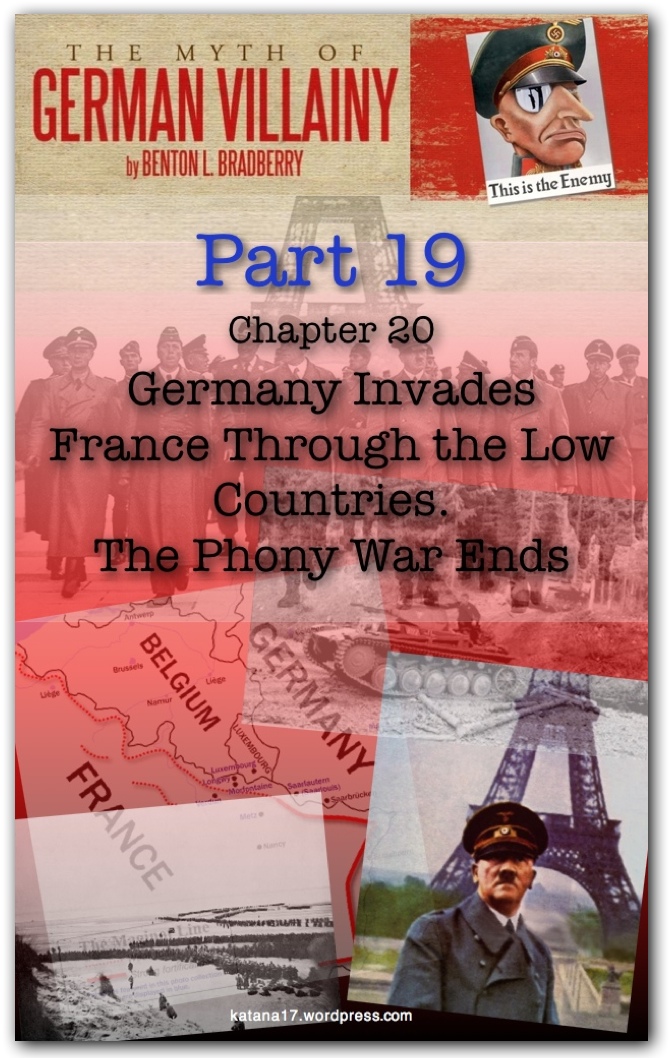
[Benton Bradberry’s 2012 book, “The Myth of German Villainy” is a superb, must-read, revisionist look at how the German people have been systematically, relentlessly and most importantly, unjustly vilified as the arch criminal of the 20th century. Bradberry sets out, coolly and calmly as befits a former US-Navy officer and pilot, to show why and how the German people have been falsely accused of massive crimes and that their chief accuser and tormenter, organized jewry is in fact the real party guilty of monstrous crimes against Germans and the rest of the world.
Part 19 starts with the German invasion of France via Belgium, Holland, and Luxembourg on May 1940, thus ending the so-called “Phony War“. This was an essential survival reaction to the planned invasion of Germany by a British/French army. The “miracle at Dunkirk” was in fact an extraordinary peace overture, made by Hitler, to England. Despite this and repeated peace offers made by Germany, Churchill, the front-man for the jewish supported “War Party“, rejected them all.
Churchill’s personality is described, with his life-long love of war and indifference to the massive deaths of innocent people.
Hess’ flight to Scotland to negotiate with a group of pro-German elitists in Britain, known as the “Cliveden Set”, is described and how Hitler had hoped that if successful it would;
“bring about, if not a military alliance of Germany with England against Russia, then to bring about a neutralization of England.”
Both Churchill and Roosevelt worked together to bring America into the war, using among other methods, the jewish control over Hollywood to pump out pro-British, anti-German propaganda to bring America into the war on Britain’s side.
Unable to lure Germany into open war with America directly, Roosevelt achieved it by provoking the Japanese to attack at Pearl Harbor. The Tripartite Agreement then brought Germany into a war with the United States, accomplishing both Churchill and Roosevelt’s aim.
The Germans were then, as defenders of Western Christian Civilization, arrayed against not only a rapacious foe, the Soviet Union which threatened to sweep over and obliterate Europe, but also the “arsenal of democracy” the United States and its massive industrial capacity, able to supply all its allies without limit. Behind these forces against Germany stood Organized Jewry, directing the ever-growing carnage — KATANA.]
NOTE: The author has very generously given me permission to reproduce the material here — KATANA.
The book can be bought at Amazon here: The Myth of German Villainy
The Myth of
German Villainy
by
Benton L. Bradberry
Contents
[Clicking on a link in the Contents here will take you to that Part, in a separate post]
[Part 01]
Chapter 1 – The Myth of Germany as an Evil Nation
Germany’s Positive Image Changes Overnight
[Part 02]
Chapter 2 – Aftermath of the War in Germany
The Versailles Treaty
Effect of the Treaty on the German Economy
Was the War Guilt Clause Fair?
Did Germany Really Start the War?
[Part 03]
Chapter 3 – The Jewish Factor in the War
Jews at the Paris Peace Conference
Jews in Britain
[Part 04]
Chapter 4 – The Russian Revolution of 1917
Bolsheviks Take Control
Jews and the Russian Revolution
Origin of East European Jews
Reason for the Russian Pogroms Against the Jews
Jews Leave Russia for America
Financing the 1917 Revolution
Jews in the Government of Bolshevik Russia
[Part 05]
Chapter 5 – The Red Terror
Creation of the Gulag
Bolsheviks Kill the Czar
Jews as a Hostile Elite
The Ukrainian Famine (Holodomor)
[Part 06]
Chapter 6 – The Bolshevik Revolution Spreads Throughout Europe
Jews in the Hungarian Revolution
Miklos Horthy Saves Hungary
Jews in the German Revolution
The Spartacist Uprising in Berlin
Jewish Bolsheviks Attempt to Take Italy
Jewish Bolsheviks Attempt to Take Spain — The Spanish Civil War
Czechoslovakia in Danger of Communist Takeover
The Comintern’s Aim? World Domination!
[Part 07]
Chapter 7 – The Nation of Israel
History of the Expulsion of Jews
[Part 08]
Chapter 8 – Jews in Weimar Germany
Jews Undermine German Culture
[Part 09]
Chapter 9 – Hitler & National Socialists Rise to Power
The 25 Points of the National Socialist Party
[Part 10]
Chapter 10 – National Socialism vs. Communism
National Socialism
Jews Plan Marxist Utopia
[Part 11]
Chapter 11 – Jews Declare War on Nazi Germany
Text of Untermeyer’s Speech in New York
The Jewish Persecution Myth
Effect of Boycott on the German Economy
Jewish Exaggerations are Contradicted by Many
[Part 12]
Chapter 12 – The Nazis and the Zionists Actually Work Together for Jewish Emigration out of Germany
The Nuremberg Laws – 1935
The Zionist Movement
[Part 13]
Chapter 13 – Life in Germany Under Hitler
Night of the Long Knives
1934 Annual Nazi Rally at Nuremberg
Hitler Revives the German Economy
Hitler Becomes the Most Popular Leader in the World
[Part 14]
Chapter 14 – Hitler Begins Reclamation of German Territory
Chapter 15 – The 1936 Olympics
[Part 15]
Chapter 16 – “Anschluss”. The Unification of Austria and Germany
Austrian Economy Revived
Austria’s Jews
[Part 16]
Chapter 17 – Germany Annexes the Sudetenland
[Part 17]
Chapter 18 – War with Poland
The Polish Problem
Hitler’s Proposal to Poland
Kristallnacht
German-Polish Talks Continue
Jews Influence both Roosevelt and Churchill
British and American Political Leaders Under Jewish Influence
Roosevelt’s Contribution to Hostilities
Lord Halifax Beats the War Drums
Germany Occupies Bohemia and Moravia
Roosevelt Pushes for War
Anti-war Movement Becomes Active
Poles Murder German Nationals Within the Corridor
[Part 18]
Chapter 19 – The Phony War
Russo-Finnish War
The Norway/Denmark Campaign
German Invasion of Denmark and Norway
Churchill Takes Chamberlain’s Place as Prime Minister
[Part 19]
Chapter 20 – Germany invades France Through the Low Countries
The Phony War Ends.
Churchill the War Lover
The Fall of France
Hitler Makes Peace Offer to Britain
[Part 20]
Chapter 21 – The Allied Goal? Destruction of Germany!
[Part 21]
Chapter 22 – Germany as Victim
Rape and Slaughter
Jewish Vengeance
The Jewish Brigade
[Part 22]
Chapter 23 – Winners and Losers
Chapter 20
Germany Invades France
Through the Low Countries
The Phony War Ends
On May 10, the same day Churchill became Prime Minister, Germany invaded Belgium, Holland, and Luxembourg, as the only viable pathway into France, which was Germany’s primary goal. This must also be seen as a pre-emptive strike, as Britain had already sent large numbers of troops into France, and a combined British/French army of 500,000 men was at that moment being organized for an invasion of Germany. Since their declaration of war on Germany, both Britain and France had been frantically building up their military forces in preparation for an all out offensive against Germany. Germany, as previously discussed, had tried to avoid a war with Britain and France, and even made a formal peace offer to both countries after the Polish war ended, but it was rejected out of hand. Not only did Britain and France reject Germany’s offer of peace, but went even further and began a relentless naval campaign against Germany, known as the Battle of the Atlantic, which included a naval blockade of German ports. It was clear that a land attack on Germany would follow as soon as the Allied military build-up was ready.
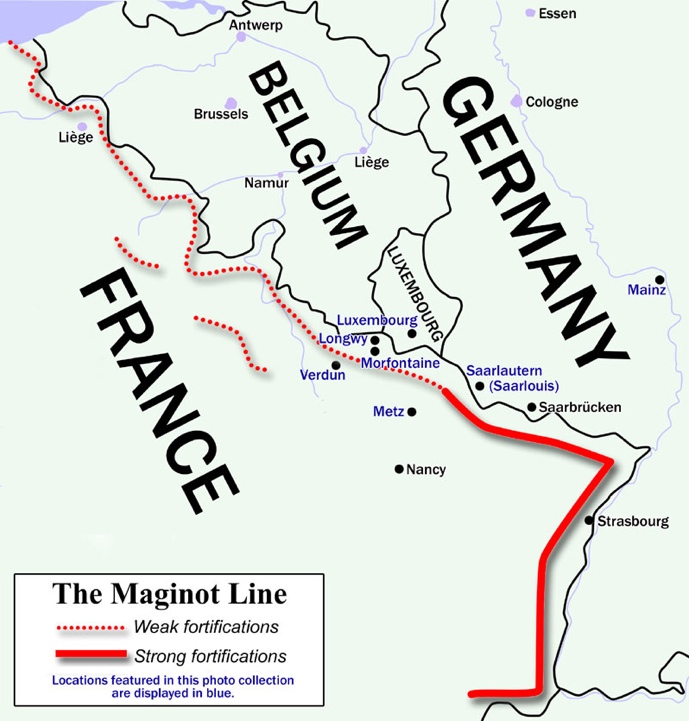
What was Germany to do, wait helplessly for the inevitable invasion? Again, Hitler seized the initiative and beat them to the punch with his invasion of the Low Countries on May 10 and his rapid push into France. France’s impregnable Maginot Line blocked a German invasion across the German/French border, but the Maginot Line extended only to the Luxembourg border. The border between France and Belgium, and France and Luxembourg was unfortified all the way to the English Channel. An invasion of France would have to go around the Maginot Line, through the only route available, and that would be through the Netherlands, Belgium or Luxembourg. Again, Hitler’s initiative was “reactive” in nature, and essentially “defensive” as opposed to “offensive.” All of Hitler’s military initiatives were of this nature; all the result of Allied provocations or of Allied threats. Britain, led by Churchill, was the provocateur throughout.
Three days after becoming Prime Minister, and three days after the German invasion of the Low Countries, Churchill addressed the House of Commons and made his melodramatic “blood, sweat and tears” speech. In the speech, he declared British war aims as:
“Victory. Victory at all costs. Victory in spite of all terror. Victory, however long and hard the road may be, for without victory there is no survival.”
Churchill deliberately ignored the fact that Adolf Hitler had made numerous peace overtures to Britain, had repeatedly expressed his admiration for the British Empire, had even offered German military assistance if needed by the British Empire, and had made repeated attempts to establish friendly relations with Britain, all of which were spurned. Germany had no designs on Britain and wanted above all else to avoid a war. It should also be remembered that Britain and France declared war on Germany, not the other way around. Germany’s occupation of Norway, as well as the invasion of the Low Countries, were actually defensive in nature, though Churchill and his “war party” held them up as the ultimate proof of Germany’s plan to conquer the world. Perhaps they even believed it.
Churchill’s life dream had at last come true. He was now Prime Minister of England, fulfilling his imagined destiny of heroically leading the British Empire to victory in war. Making peace with Germany was the farthest thing from his mind.
On May 10, 1940, German bombers hit air bases in France, Luxembourg, Belgium, and the Netherlands, destroying large numbers of Allied planes on the ground and crippling Allied air defenses. Elite squads of German paratroopers were dropped onto fortified Allied points along the front, neutralizing a key element of France’s defense strategy.
On the ground, German forces advanced in two directions: one through the Netherlands and northern Belgium (as Britain and France had expected) and the other, larger force to the south, through Luxembourg and into the Ardennes Forest on a path that led directly into the French heartland (which was completely unexpected). Unaware of the German advance to the south through the Ardennes Forest, Britain and France sent the bulk of their troops to Belgium.
During the first days of the attack, German progress toward Brussels and The Hague was slowed unexpectedly by the formidable resistance of the Dutch forces. On May 14, when the Dutch forces refused to surrender, the German Luftwaffe was unleashed for a massive bombing attack on central Rotterdam. Efforts were made to call the bombers back when the Dutch suddenly agreed to negotiate, but only a few of the German pilots received the message and turned back. The remaining bombers continued on and dropped their bombs on the city, killing more than 800 civilians. The Netherlands surrendered that same day.
The British and French plan to defend Belgium was to make a stand at a line of forts between the cities of Antwerp and Liege. Unaware that these forts had already been captured by German paratrooper units on the first night of the invasion, the British and French armies found themselves under attack on May 13. At the same time, the second German offensive to the south emerged from the Ardennes Forest, to the complete surprise of the Allies. Over the next few days, the main Allied armies were trapped between the two German forces, able neither to protect Paris nor to stop the Germans from advancing to the English Channel. Then, when the German troops to the south moved between the French and British forces, the Allies were divided and thus weakened still further. The Allied defense of Belgium turned out to be an unequivocal disaster.
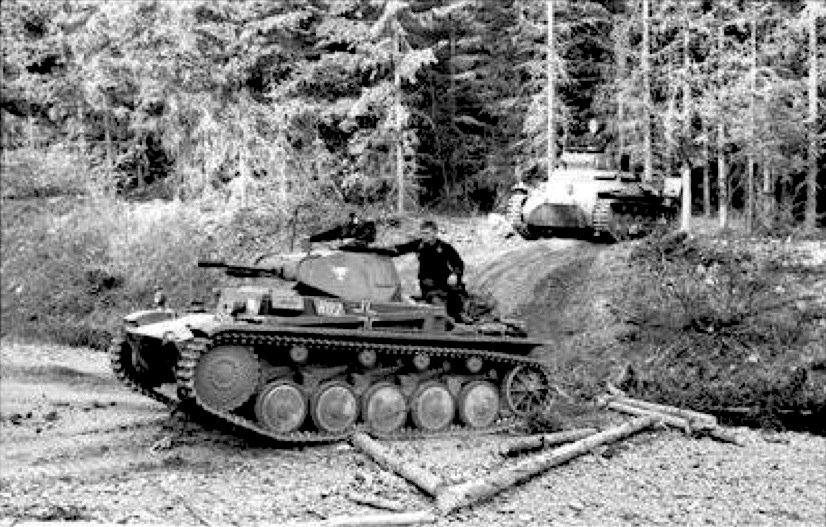
German tanks emerge from the Ardennes Forest
While the main French army was trapped between the two German armies, the British Expeditionary Force (BEF) was pushed to the coast near the French port of Dunkirk. Over 200,000 British and 140,000 French, 340,000 in all, were trapped on the beaches of Dunkirk; sitting ducks for the German forces pressing in on them.