Jews Must Live – Part 8: THE JEW IN BUSINESS


Jews Must Live


Part 8


by Samuel Roth


Jews Must Live — Originally published in 1934 (New York: The Golden Hind Press, Inc.), 319 pp. First reprinted in 1964, but with 5 chapters mysteriously taken out and with further abridgment of text in chapter IV. I’m not aware of a full reprint ever being done. As far as I know, the version presented below, proofread from an original 1st edition, is the only complete and accurate version of Jews Must Live available on the Web. -JR 7/9/2005

http://www.jrbooksonline.com/roth.htm

JEWS MUST LIVE

AN ACCOUNT OF THE PERSECUTION OF THE WORLD BY ISRAEL ON ALL THE FRONTIERS OF CIVILIZATION
ILLUSTRATED BY JOHN CONRAD


ABOUT THE AUTHOR


About the author: Polish-born Jew Samuel Roth (1893 – 1974) emigrated to America with his family at the age of four. By the 1920s he was an established poet, with his work published in some major literary outlets.


At the same time, he began publishing erotica, most famously a pirated version of D. H. Lawrence’s Lady Chatterly’s Lover, which, although tame by present-day standards, landed Roth in jail on pornography charges.


Later, he began publishing real pornography and was repeatedly arrested and jailed, eventually serving around nine years behind bars all told.


His last great court case, which took place in 1957 (Roth . United States, 354 U.S. 476), redefined the Constitutional test for determining what constitutes obscene material unprotected by the First Amendment and became a template for liberalizing First Amendment decisions of the 1960s.


Written by one America’s most famous Jewish pornographer, this work provides a shocking and insightful account of Jewish attitudes towards Gentiles.


Samuel Roth first embraced Judaism and Zionism, but later blamed other Jews for his financial and legal troubles — which landed him in jail. He became so embittered with his treatment at the hands of his co-religionists that he wrote this book which he said exposed their underhanded dealings with the Gentile world.


The engrossing narrative starts with the origin of Jewish behavior, which Roth identifies as coming from the Old Testament/Talmud. Using specific examples (such as the Jewish patriarch Abraham’s pimping of his wife Sarah to blackmail neighboring Gentile tribes into handing over their possessions). Roth claims that such behavioral patterns are repeated to the present day.


This behavior, Roth says, is founded in a Jewish belief that all the world’s possessions belong to them by divine right. He then discusses the effect of Jews in law, media, medicine, prostitution, literature, arts, and much more. Also included is a fascinating section on the vow-breaking Kol Nidre prayer.


Roth also includes detailed sections on his own experience at being swindled, and concludes that ant-semitism is always the a reaction to Jewish behavior, and not the product of some irrational disposition on the part of the Gentile, as is so often claimed.


He explains his position in this way:


“I don’t think I ever shared the Jewish contempt for the goyim, which is part and parcel of all Jewish psychology.”


http://www.jrbooksonline.com/roth.htm


Chapters II, III, XIII, XVI and XVII are completely missing from the 1964 “re-published” edition.


We can only speculate as to why these chapters were taken out. The first two may have been “offensive” to “traditional” Christian types (to include the text missing from ch. IV), but the rest remains a mystery. “The Life and Death of William Faro” gets to the whole purpose of the book: that fellow Jews had cheated Roth, who wrote the book (exposing Jewish practices) in retaliation. “Farewell to Judas” is an interesting account of his adventures aboard a cruise ship, during which Roth found his true self, while the Appendix includes two rare literary works: “The Jew”, originally an article in Voltaire’s Dictionnaire Philosophique but expurgated from most editions, and a full English translation of Heinrich Heine’s “Disputation”. Incidentally, “Disputation” is referred to in “Bolshevism from Moses to Lenin”, f/n 67 (f/n 70, 1999 ed.).


Note: The expurgation of Roth’s book is mentioned by Dr. Revilo P. Oliver in his essay “The Enemy of Our Enemies”, Part II, f/n 29 and 70.


A Roth “mug shot


Testifying before a Senate subcommittee. [Text: Samuel Roth, a publisher of erotic and nudist books, in United Sates Court House, Foley Square, where he appeared yesterday before the Senate subcommittee investigating juvenile delinquency.]


“The next time you read about a particularly bloody pogrom and pause to wonder how Christians, dedicated to a religion of mercy, can exercise so much brutality against the Jews, remember that the Jew wheedles all the mercy out of his neighbors in the ordinary course of business.

He lies and cheats until he is caught. When caught, instead of accepting punishment, he moans and tears his hair, invokes the sores of ancestors in their graves and living relations at the point of death in hospitals, until the wronged gentile, nauseated, lets him go.

Then, thumbing his nose at the gentile behind his back, the Jew goes about his business the same way, lying and cheating now doubly to make up for lost time.

A pogrom is usually the climax of years of such relentless goading. Do you wonder that when the final reckoning comes the gentile is absolutely merciless?”


— Samuel Roth, Jews Must Live, Ch. XIII, p. 206, f/n 31 [expurgated chapter]


Copyright, 1934

by

THE GOLDEN HIND PRESS, INC

Dedication:

“TO THE FIRST GENERATION OF JEWS THAT WILL LEARN HOW TO PRONOUNCE MY NAME SOFTLY”


CONTENTS


I        PROLOGUE: THE GENESIS OF JEW-HATRED 11

II      THE JEW-HATRED OF GENESIS* 25

III    IS MONOTHEISM A PURELY JEWISH CONCEPTION?* 41

IV    JEW-HATRED AS A NATURAL INSTINCT 55

V.     LEOLOM TICKACH: ALWAYS TAKE 69

VI    THE BRINGING-UP OF THE LITTLE JEW 85

VII   WHAT HAVE THE JEWS CONTRIBUTED TO AMERICAN CULTURE? 99

VIII  THE JEW IN BUSINESS 111

IX    JUDAISM IS NOT A MISFORTUNE TO THE JEWS ALONE 127

X      THE JEW AS A LAWYER 143

XI    THE JEW AS A PHYSICIAN 161

XII   THE JEW AND THE LAND 175

XIII THE LIFE AND DEATH OF WILLIAM FARO* 189

XIV  THE JEWS, THE THEATRE AND THE WOMAN MARKET 223

XV    THE RAPE OF LAKEWOOD, LONG BRANCH AND ATLANTIC CITY 239

XVI   FAREWELL TO JUDAS* 255

XVII  APPENDIX: DO JEWS EMIT A PECULIAR ODOR?* 289


* Chapters missing from the 1964 “re-published” edition.


Chapter VIII


THE JEW IN BUSINESS


Since, therefore, he neither creates nor labors, how then, you will ask, does the Jew subsist in America?

I find in the March 11, 1865 issue of Notes and Queries, an English weekly of very high character, the following letter signed by W. J. Charlton:

Are there any Jews who, answering to what we call ‘artisans,’ work as such in any of our large manufacturing towns, or in any of our cotton mills? I know there are Jews who keep shops but are there any who work as do our carpenters and laborers? Are there, in fact, any class of Jews answering to our class of artisans? I should feel much obliged by this information.

If you will take the trouble to look through Notes and Queries for that year, and for five years after that, you will find plenty of scholarly, impartial correspondence by Jewish rabbis and Jewish journalists on a vast variety of Jewish matters, but no answer whatever to W. J. Charlton’s momentous question, a question that has been asked in every civilized country that has offered the Jews freedom of movement, and has always been received with the same frozen silence.

It is my honest belief that nothing the Jew does in America is essential to its welfare. On the contrary, a great deal of what the American Jew does is subversive of America’s best interests. Like his creature Jehovah, a teacher he never tires of imitating, the Jew in America is forever engaged in the fascinating pursuit of creating everything he needs out of nothing — his modest opinion of the gentile world about him.

Alas, we have become a nation of luft-menschen [25] moaned the great J. L. Peretz, in the midst of the teeming life of Russian Jewry about him, who were doing in his day in Odessa what the Jews are doing in our day in New York. “We must begin to build,” he cried out warningly. “We must make — out of fools, wise people; out of fanatics, men of sense; out of idlers, workers; useful decent workmen who labor for their own livelihood and thereby increase the wealth of society.


[25] People who live without visible means of support


These words were written more than thirty years ago. When Peretz died in 1917 he had not lived to see any substantial improvement in the status of his people, either from within or from without. Without, nations were still enacting civil and political restrictions against Jews. Within, the Jews themselves were not at all chastened: they were still a nation of sinisterly busy idlers.

What is this Jewish business of creating everything out of nothing? It is very fascinating, I assure you. The whole thing may perhaps be expressed in one magical word. But since it is a word to which you have in the course of your life attributed other meanings, I better warn you not to jump at conclusions too quickly. The word is merchandising. You will not understand what I mean till I show you how it works out.

John Hanly & Son are running a successful furniture business in Battle Creek, Michigan. John Hanly, who is the senior member today, was the Son of a generation ago. But the business is not only very old. It is very good. They have seven solid busy outlets in the seven biggest cities east of the Mississippi. It would seem that there is not very much left for them to wish for by way of business. John Hanly, Sr., thinks so. John Hanly, Jr., thinks so. And even you might think so. But Mr. Isadore Cohen does not think so.

Mr. Isadore Cohen has just made a big clean-up in the fur business in New York. It will probably be at least three years before anyone else can earn a nickel in the fur business, so effectively has Mr. Cohen cleaned it up and out. Mr. Cohen realizes this and has turned to other fields for new conquests. He has noticed the advertisements of John Hanly & Son. He has even passed through two or three of their bright stores. In the back of his mind Mr. Cohen has made the following note concerning John Hanly & Son: Good furniture makers, but like all goyim, too damned conservative. The whole thing recurs to his mind now. He calls up Mr. Hanly, Sr., establishes an appointment with him, and something like the following conversation takes place:

Mr. Cohen: I believe you sell about half a million dollars worth of furniture a year, Mr. Hanly?

Mr. Hanly: You are correctly informed Mr. Cohen.

Mr. Cohen: Well, how would you like to treble your business in six months’ time?

Mr. Hanly: Very much. What’s your plan?

(He knows in advance that the Jew has a plan. Every Jew he has ever met has had some kind of plan by which he made money, without hazarding anything like a real investment. And if you can make money just out of a plan, what couldn’t you make out of a whole furniture factory?)

Mr. Cohen: I will explain my plan to you by example. There is is the eastern window of your factory building a magnificent dining-room suite, probably the most elegant manufactured for general consumption in America. Approximately how many sets of it do you dispose of in a month?

Mr. Hanly: I would say about sixty. Around Christmas the figure might be doubled.

Mr. Cohen: Would you say that within the class of people for whom this suite was built only sixty people a month are tempted to buy it?

Mr. Hanly: But you forget that it sells for twelve hundred and fifty dollars a suite. Many more are probably tempted. But only those who can afford to spend twelve hundred and fifty dollars, actually get it.

Mr. Cohen: You mean only those who can spare so much out of their savings can get it — for your terms are cash with delivery.

Mr. Hanly: I guess that’s about right.

Mr. Cohen: Would you say that a man who earns five thousand dollars a year can afford such a suite?

Mr. Hanly: Certainly. He makes such a purchase only once in a lifetime.

Mr. Cohen: But most people who earn five thousand dollars a year do not put much into savings accounts. Did that ever occur to you? They like to spend their money lavishly, and they do — on everything except your furniture. In entertainment, for instance. The average man pays a dollar a seat in the theatre, but your five thousand a year man pays at least four, and often as much as ten. In clothing. The average man pays thirty dollars for a suit of clothes, but the five thousand a year man pays a hundred. In furniture. There are companies which soak him twice as much as the prices you ask for things worth not half of the things you manufacture — why? You know the answer. He is not compelled to go to his slender savings. Your five thousand a year man has good taste, and he would infinitely prefer buying your suite to the things he is compelled to get from the installment houses. But you don’t let him.

Mr. Hanly: Suppose the five thousand a year man loses his job?

Mr. Cohen: If he hasn’t paid for his merchandise, and cannot go on paying it, we take it back from him.

Mr. Hanly: That would never do. To dispose of it, I’d have to go into the second-hand furniture business.

Mr. Cohen: Certainly not, sir. You would have nothing to do with that. I have in mind a man who will buy from you every installment contract you make. You will have none of the trouble of collecting or retrenching on your contract. You will be paid by this man the full amount of the purchase the day after the contract is signed and delivered.

Mr. Hanly: But to produce so much more furniture will require a much larger factory than the one we have. More machinery and more money with which to buy materials and build.

Mr. Cohen: You have nothing to worry about. I know the very man who will supply you with the capital you need at moderate interest.

Mr. Hanly: But such a new system of doing business will require a radically different organization: new methods, new people –

Mr. Cohen: Didn’t I tell you that you have nothing to worry about? I’ll supply you with the men, the money and the new organization. And you will retain a controlling interest in the business.

What is the result?

Hanly succumbs to the plan. Cohen gets the run of the plant. Israel Isaacs, a friend of Cohen’s, agrees to buy all of the new Hanly installment contracts at a discount of fifteen percent for cash, which Hanly adds on to the bills of his customers. Another of Cohen’s associates (the same fellows who helped him make that killing in the fur business in New York) Rueben Samuels, lends Hanly the half a million dollars he needs for the expansion of the business along the new lines. Before the Hanlys can realize what has happened, everything about them, in stores and factories, has been so completely changed that it is practically not the same organization. All of their old employees have been discharged. The new faces about them are long and dark, and burn about the eyes with a strange lustful fire.

It’s beginning to look as if we’re running a Yiddish colony,” complains John Hanly, Jr., dryly.

What’s the use of crying?” says John Hanly, Sr. “They get the business — and isn’t that the real important thing?

I wonder,” says John Hanly, Jr.

The Jews get the business, alright. There is no disputing that. At the end of the first year, Cohen’s brightest conjectures have been surpassed. The reorganized firm of John Hanly & Son has sold nearly two million dollars worth of furniture. But for the first time in many years it is in financial difficulties. For there is a grave difference between the book profits of a business and its net profits. The one thing Hanley had not taken into reckoning was the interest on that half a million dollars advanced to him by Rueben Samuels for the expansion of the business. With the bonus, that alone comes to forty-five thousand dollars. A lot of money.

There is more trouble with Israel Isaacs. Mr. Hanly, Sr., discovers that he had made no arrangement with Mr. Isaacs as to what was to be done with reclaimed furniture. When a purchaser of a Hanly suite of furniture defaults in his payments, Mr. Isaacs has a novel way of collecting. He seizes the furniture, sells it to himself (through a dummy) for a trifling sum, and then sues the purchaser and collects from him the full balance through the courts. How does he collect? Mr. Isaacs has established such an influence in the courts that you would think, watching how his accounts are called in and threatened, that the district attorney’s office is really only a collecting agency functioning solely for the benefit of Mr. Isaacs. Having bought back the furniture at a price much less than it costs the Hanly company to manufacture, Mr. Isaacs can afford to sell it to the public at about half of what the Hanly stores ask for the same set. The Isaacs Furniture Company opens its doors to the general public, and it isn’t long before a rumor spreads that the furniture at the Isaacs Company is not really second-hand. It is just a way the Hanly Company has devised of selling its surplus of expensive furniture.

Isaacs sales rise. Hanly sales rise, too — but the prices fall. At the end of the second year of the business of the new organization there are not even book profits. There certainly is no money for the interest on Rueben Samuel’s loan. And here a real crisis arises. Mr. Samuels will not accept the interest alone, even if the company can raise it. He wants the whole principle because he has another enterprise in mind. He must have all the money or else. – Or else what? You’ve guessed it. Within six weeks another important change takes place in the personnel of John Hanly & Son.

The business remains the same. The name remains the same. But when the legal clouds have rolled away, it is discovered that the new president of John Hanly & Son is Mr. Isadore Cohen. The new treasurer is Mr. Rueben Samuels. The new secretary is Mr. Israel Isaacs.

What has become of John Hanly, Sr., and John Hanly, Jr.? They are lucky if they have been permitted to retain clerkships in their own business.

America is full of businesses bearing old Christian names, but which are really owned by Jews. Most of them have been acquired in the manner I have just described, the way the Jew creates something out of nothing.

The charge is frequently brought against the Jew that he is in financial control of everything on the American continent. It is a compliment he hardly deserves, and it is very easy to prove that there is absolutely no truth in the charge. One has only to make a cursory survey of the big banks of the country to arrive at the realization that far from being in control of the nation’s finances the Jews are themselves underlings on Wall Street.

What people do not realize is that the underlings of Wall Street are the lions of Main Street.

High finance — in America or elsewhere — the Jews most certainly do not control. The management of the moneys, the life blood of a nation comes under the heading of statesmanship, which the Jews — as in Disraeli and Garibaldi — have occasionally produced for the goyim, but never for themselves.

But what need has the Jew for high finance? Does he not exercise a control he could not possible wield from a seat as lofty as Wall Street? Financial mastery he has. But it is a subterranean one. It is a mastery he enjoys much more, precisely because it comes to him more naturally. The Jew better than anyone else in the world knows how to dispossess the poor and the members of the middle class. To fit this case, the old P. T. Barnum adage needs only a little changing. A gentile enters business every minute, with two Jews waiting to take him out of it.

What difference does it make that the sun shines, if there is still a Czar in Russia?” sang Lermontov.

So might an American merchant ask:

Of what use is it that J. P. Morgan is king of Wall Street, if when I need money, I have to come to Levy?

Levy, Levy, Levy. A familiar name. Let’s get a little closer to him.

Mr. Levy’s office is not on Wall Street, it is on any one of several hundred Main Streets in the United States. Very close to the railway station. Whether this is designed so that he may be in a conspicuous place or to to keep him where he can make his escape at a moment’s notice, I do not know. Whatever the reason is, one thing I am quite sure of, Mr. Levy is playing safe.

Mr. Levy’s methods are very much like the methods of Mr. Rueben Samuels. But there is just enough difference between them to make a sketch of it interesting.

The case in point is that of Mr. Levy’s dealings with Mr. Frederic Linton.

Mr. Linton works a farm twelve miles from a railway station on Main Street. Nr. Linton is a pretty shrewd business man even if his business does happen to be farming. For a long time he has managed to extract from his sixty acres just a little more than a good livelihood. Witness the fact that he has a son at Yale and a daughter at Vassar. It takes a little money to manage that.

But no one is proof against an occasional attack of bad times. Suddenly, almost without a warning sign, Linton discovers himself alarmingly short of cash. It’s purely a problem in economic policy. If he does not immediately make certain important repairs in his house, barn and machinery, he will eventually run into much graver trouble with them. His balance at the bank has been, of late, so meager that he is almost ashamed of making his slender deposits. As for asking for a loan. Nevertheless he hardens himself to the task and seeks out the manager of the bank.

The banker listens to Linton’s recital of his needs attentively and sympathetically, although it is a story he has had to listen to many times. But in the end he has to shake his head. He would like to make the loan, he tell Linton. He has no doubt that it is a very safe loan to make. But he cannot. There are orders from high up which he does not dare to disregard. The new bank safety, he has been sternly warned, lies in greater restriction in the making of loans.

Since he is already in town, Linton decides to try his luck with some of his friends. Old friends like Eddie Howe and George Brent. he begins by telling them about his visit to the bank. They are sympathetic. But they have been caught quite as badly as he. . . .

Tell you what,” says Eddie Howe. “There’s always one man in town who has ready cash to spare. Why don’t you try to see Jake Levy?

But doesn’t he drive a rather shrewd bargain?” objected Linton.

Sure,” agrees Howe. “But when you get down to doing business with Levy it means that you practically have no other choice.

Linton had almost decided to let the repairs go hang when a whim changed his mind. Wonder what sort of man this Levy might be. What sort of security could he ask for that the bank knew nothing about?

The first thing Mr. Linton notices is a sign in Levy’s window:


MONEY LOANED AT LEGAL INTEREST


Funny, thinks Linton. Like a man hanging out a sign to inform people that he is not a criminal; something queer about it; too damned much legality. Besides, there is a rate of legal interest, and it is six percent. Yet one heard of people paying this Levy the most exorbitant interest for comparatively small loans. . . .

The second surprise is Mr. Levy himself. Mr. Levy is nothing like Linton has pictured to himself. Mr. Levy is tall, clean-shaven and bears himself supplely, almost graciously. The sort of man one might find in the best clubs, Mr. Linton was thinking when Mr. Levy reached out his hand and greeted him by name. Then Mr. Linton got the uncomfortable feeling that he had been under the surveillance of those shrewd gray eyes for a long time.

Twelve hundred dollars,” muses Mr. Levy. “And how much time do you want in which to pay it back?

Mr. Linton thinks. “Four months would be plenty of time,” he says.

You’re counting on a good market,” observes Mr. Levy.

Have you any reason to believe that it wont be?

No Mr. Linton. But it’s good business, in such matters, to count on a poor market. Besides, I will charge you for eight months the same rate it would cost you for four. It’s a minimum I’ve set myself, and you may as well get the benefit of the additional time.

So far everything sounds lovely. A little too lovely. Mr. Linton knows that there must be something else. Something hidden.

And the rate of interest?” he asks.

The legal rate — six percent.

Very well, then, will you take my note?

Certainly.” And here Mr. Levy makes a slight, significant pause. The surprise is coming, Linton says to himself. “There is another condition I have not mentioned, Mr. Linton.  We charge a service fee of ten percent on the face of the note.”

Mr. Linton is taken by surprise, in spite of himself. “Service fee? What for?

Technically, Mr. Linton, it is for bookkeeping, billing, etc. Actually it’s for making a loan which the bank considers unsound. You have been to your bank, have you not, Mr. Linton?

Yes. But damn it all, you wouldn’t make this loan to me if you were not certain of your ability to collect it?

The service charge is essential and unavoidable,” says Mr. Levy with cold finality.

Mr. Linton takes the twelve crisp, brand new one hundred dollar bills and signs for Mr. Levy a note for thirteen hundred and ninety two dollars.

A week before the note falls due at Linton’s bank, Linton receives the following note from Levy. Its surface considerateness puzzles him.

I am taking the liberty of calling your attention to your note to the amount of $1200.00, which falls due in another week, because it is just possible that you may not be in a position to meet it in full. You are at liberty, should you find it necessary, to arrange for renewal. Please come to see me at your earliest convenience.

Linton wonders how Levy could have guessed that he was unprepared to meet the note. Again he gets that creepy feeling that he is being secretly watched. But there is no alternative. He must see Levy and arrange a renewal.

This time,” says Mr. Levy, “I shall ask you to give me two notes: one payable in ninety days to the amount of twelve hundred dollars, the other for the balance of four hundred twenty-eight dollars and sixty-four cents, due ninety days after that.

Linton feels that he is slowly getting into some kind of trap. But it is too late to retreat. He cannot help himself. To pay the note in full now would leave him without the cash needed for his children’s tuition at school for the following year. He signs the notes.

Before the due date of the first note, the one for twelve hundred dollars, there is this time no advance letter from Levy suggesting a renewal. So Linton goes, uninvited, to Levy’s house. But as usual, when Levy has determined on a course of action, he is not to be swerved.

That note for twelve hundred dollars must be met, Mr. Linton. I make it an unbreakable rule never to let my cash stay out more than eleven months.”

But in another three months you will have got more than four hundred dollars for your loan. That’s nearly forty percent interest. Surely you can afford to be a little more lenient.”

Mr. Levy now rises gravely in his chair. All his elegance has been strained to a fine vanishing point.

I am sorry, Mr. Linton,” he says with suppressed excitement, “but I will have to judge for myself how lenient I can afford to be. If your money is not in the bank to meet my note I will have to protest.

The twelve hundred dollar note is duly met, without protest. To accomplish this, Linton has to sell some of the machinery he has had mended, and some cattle he can spare just a little, and ninety days later when the second note, the one for four hundred and twenty-eight dollars and sixty-four cents comes due, there is absolutely no way he can raise the money. He even tries the bank.

Once more the manager of the bank listens to him. This time with more care than sympathy.

I wish I could help you, Mr. Linton,” he says, in conclusion. “Unfortunately you have made yourself quite helpless. There is no way in which a decent banking institution could remedy your difficulties.

And once more we find Linton pleading with Levy.

Renew,” says Levy. “But how can you expect it of me? You’ve sold pretty nearly everything salable on your land. In a forced sale, what you have left will hardly bring back the amount of this note.

But you don’t understand, Mr. Levy, that I want to pay you back? Why talk of a forced sale?

Mr. Levy looks across the littered table with tremendous earnestness.

Because there will be a marshall’s sale if you do not meet this note, Mr. Linton.

The note is not met. Judgment is entered. A marshall appears on the property and levies on it full. The sale takes place. And Mr. Linton’s poor sixty acres from which he had derived such a proud livelihood go — do you know to whom? You’ve already guessed it. To Mr. Levy.

A disillusioned man, Mr. Linton hunts up Mr. Levy in his house several hours after the sale.

This is going to be terrible news to my children at school,” he explains in the flat even tones of a man whom you cannot possibly punish anymore. “Can you try to arrange to give me some time in which to adjust my affairs so that I will be able to break it to them gently?

Here the inborn messianic qualities of the man Levy rise to stupendous heights. He places both hands on the shoulders of Linton.

But you don’t have to leave at all if you don’t want to,” he says soothingly. “Why can’t you and your wife remain on the farm and continue to run it as if it were your own? You can move into the smaller house, and when your children come back from college they can help you run things. You don’t mind occupying the smaller house, will you? I have some relations in mind for the bigger one. And they will work along with you gladly, happily to make things hum on the farm. What do you say?

If Mr. Linton had thought before that he had been reduced to the final stage of humiliation he now knew that he had been mistaken. All the ruthless scheming of the Jew, all his apparent unaccountable hardness, had been directed towards this one terrible point. There were some people of his, Jews, who needed a place in the sun — and Levy had supplied it to them out of his, Linton’s, life. Levy might have made more money on him by continuing the loan, but that was not really what Levy had been after. Someone had to be dispossessed that his relations might have a home. Linton realized with a sinking heart that he really had no chance. His whole life had been lost the moment he crossed Levy’s threshold. He had been dealing not with a man but with a whole people.

There is nothing for Mr. Linton to do, however, but to accept.

Mr. Levy shakes both his hands vigorously. The man is almost warm again.

I knew you’d be a sport,” he cries. “And I’m sure you’ll be very comfortable.

Maybe. But the likelihood is that poor Linton will never again be comfortable till they stretch him out in a good strong pine box, out of reach of the swarm of Levys that have been loosed on the farm, to direct him, his wife and his children. What Linton will never understand, even if he lives to be eighty, is how a loan of twelve hundred dollars at legal interest can have made such a difference in his fortunes.


*    *    *


Linton and Hanly belong to the more substantial part of society. The damage done there is deadly, to be sure. But the Lintons and the Hanlys have some hope.

Under the title Bootlegging Blood Money, Isaac Don Levine gives an account of the workings of the Loan Shark among the poor masses of America. He cites the case of a man in Dallas, Texas, who paid $640 over a period of four years on a loan of $20, and still owes the principal. Another of a young clerk who paid ten dollars a month over a period of two years on a fifty dollar loan, and has not yet got rid of the loan shark. A woman who paid $194 in interest on an original loan of $5 and did not complain to the police until the usurer threatened to seize her furniture. Also the case of a youth of nineteen who “enmeshed by a loan shark before he had reached the age for making a legal contract, paid $148 on a $5 debt to an automobile finance company, which was able to extort 1000% interest from the victim with the aid of a justice of the peace and two constables.”

Most dramatic and noteworthy, however, is the case of David Law, a Tampa negro who borrowed $5 from a loan shark company, and was so hounded by the usurers that he killed one and dangerously wounded another and — in Florida where negro lynchings are still plentiful — was freed on the plea of the prosecuting attorney who held that, under the circumstances, the negro was fully justified in the shooting.

What measures cannot be justified against people who, for the advance of a small sum of money, tie up salaries, practice black-mail, sell-out and ruin estates, and even prey on the slender incomes of helpless war veterans!


*    *    *


We see the Jew, then, in business, as promoter, money-lender, salesman par excellence, the author and chief instigator of a system of credit by which a nation-wide usury rises like a Golem with a million hands on a million throats, to choke the honor and the freedom-of-movement of a hard-working people. These Levys who make money simply by lending it shrewdly at tremendous heart-eating interest, it is not in their miserable souls to bring anything into existence, nor is it in their hearts to sustain the life of those bright beautiful things which have been brought into the world of life by others. They know only the great bargain by means of which they make themselves the masters of the things manlier men than themselves have dreamed out.


—————————————————————-


Click a link to go to >

Jews Must Live Part 1 – PROLOGUE: THE GENESIS OF JEW-HATRED

Jews Must Live Part 2 – THE JEW-HATRED OF GENESIS

Jews Must Live Part 3 – IS MONOTHEISM A PURELY JEWISH CONCEPTION?

Jews Must Live Part 4 – JEW-HATRED AS A NATURAL INSTINCT

Jews Must Live Part 5 – LEOLOM TICKACH: ALWAYS TAKE

Jews Must Live Part 6 – THE BRINGING-UP OF THE LITTLE JEW

Jews Must Live Part 7 – WHAT HAVE THE JEWS CONTRIBUTED TO AMERICAN CULTURE?

Jews Must Live Part 8 – THE JEW IN BUSINESS

Jews Must Live Part 9 – JUDAISM IS NOT A MISFORTUNE TO THE JEWS ALONE

Jews Must Live Part 10 – THE JEW AS A LAWYER

Jews Must Live Part 11 – THE JEW AS A PHYSICIAN

Jews Must Live Part 12 – THE JEW AND THE LAND

Jews Must Live Part 13 – THE LIFE AND DEATH OF WILLIAM FARO

Jews Must Live Part 14 – THE JEWS, THE THEATRE AND THE WOMAN MARKET

Jews Must Live Part 15 – THE RAPE OF LAKEWOOD, LONG BRANCH AND ATLANTIC CITY

Jews Must Live Part 16 – FAREWELL TO JUDAS

Jews Must Live Part 17 (last) – APPENDIX: DO JEWS EMIT A PECULIAR ODOR?


PDF of this post. Click to view or download (0.9 MB) >> Jews Must Live -Part 08


Version History


Version 2: Mar 16, 2021 – Updated Cover image. Re-uploaded images and PDF for katana17.com/wp/ version. Improved formatting.


Version 1: Published Jan 20, 2015

Posted in America, Christainity, Europe, Germany, Jews, Jews - Naming, National Socialism, Propaganda - Anti-German, Race, Third Reich, WW II | 4 Comments

Tales of the Holohoax – A Historian’s Assessment – Part 2 (last)


Tales of the Holohoax


A Historian’s Assessment 


Part 2 of 2


 [KATANA: This is Mark Weber’s somewhat cautious assessment of the satirical cartoon booklet, Tales of the Holohoax (Ver 1). This is not presented as a full endorsement of Weber’s views, but rather to present worthwhile commentary on this booklet that resulted in the injustice of Simon Shepard being sentenced to over 4 years in jail in Britain, merely for publishing it.


For further information on Simon Shepard please go this site by by Michael Hoffman (one of the contributors to the booklet).


http://revisionistreview.blogspot.jp/2010/02/tales-of-holohoax-and-denmarks-anti.html

See also: http://www.dailystormer.com/cartoon-holohoax-blasphemy-condemned-by-same-hypocrites-who-now-claim-we-are-all-charlie/


NOTES

Clicking on images will give you a higher resolution image.

All images (cartoons and photos) and text in blue are NOT part of Mark Weber’s original text.]


Contents


Part 1

[Note: Goes to a separate post]


Declaration of Mark Weber

Here is My Assessment

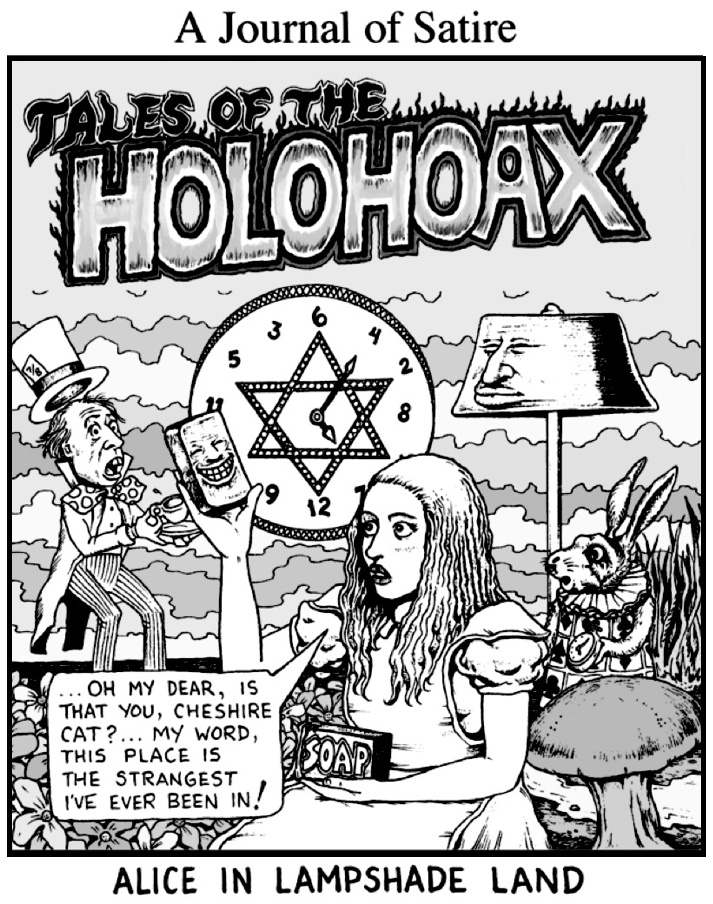
Front Cover : Alice in Lampshade Land

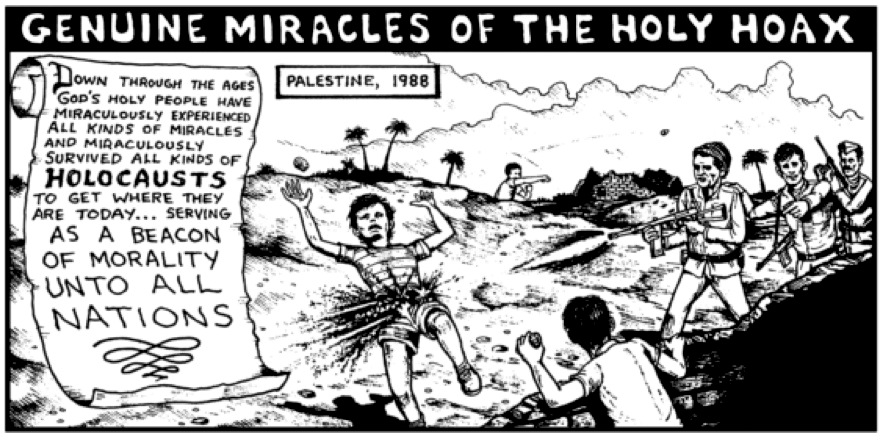
Page 2: Genuine Miracles of the Holy Hoax — Palestine 1988

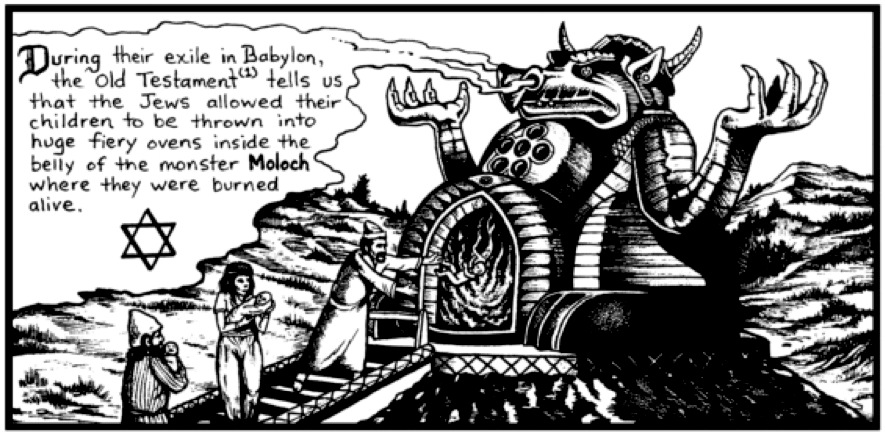
Page 3: Jewish Children Sacrificed to Moloch

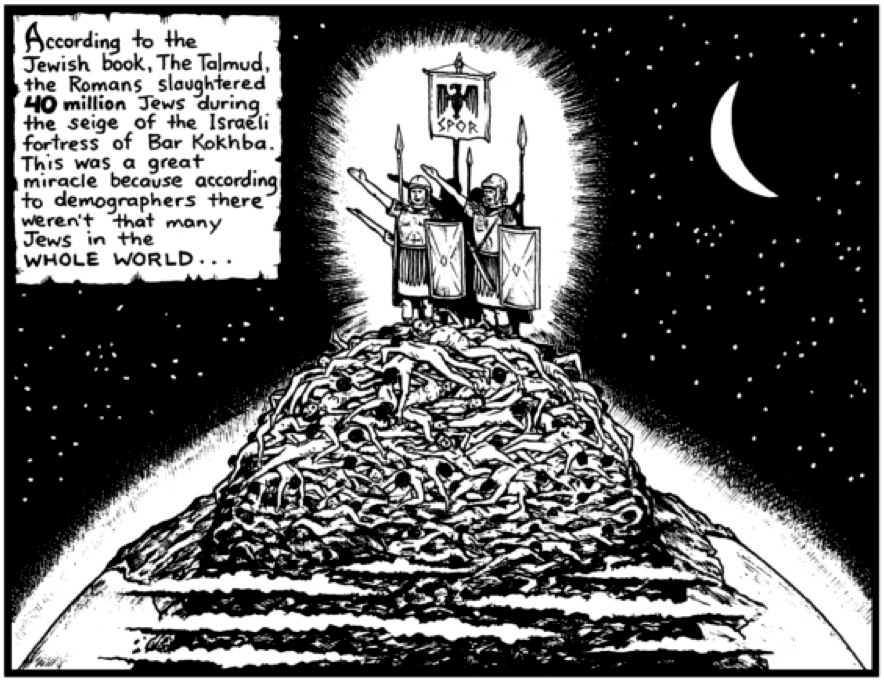
Romans slaughter 40 million Jews

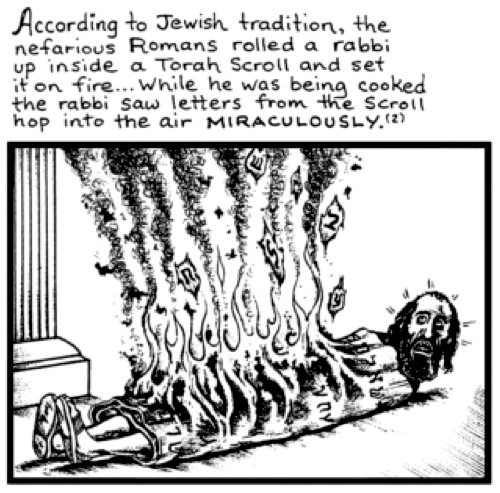
Page 4: Rabbi Rolled up in Torah Scroll and Set on Fire

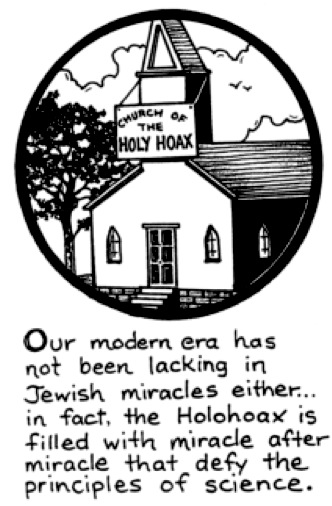
Church of the Holy Hoax

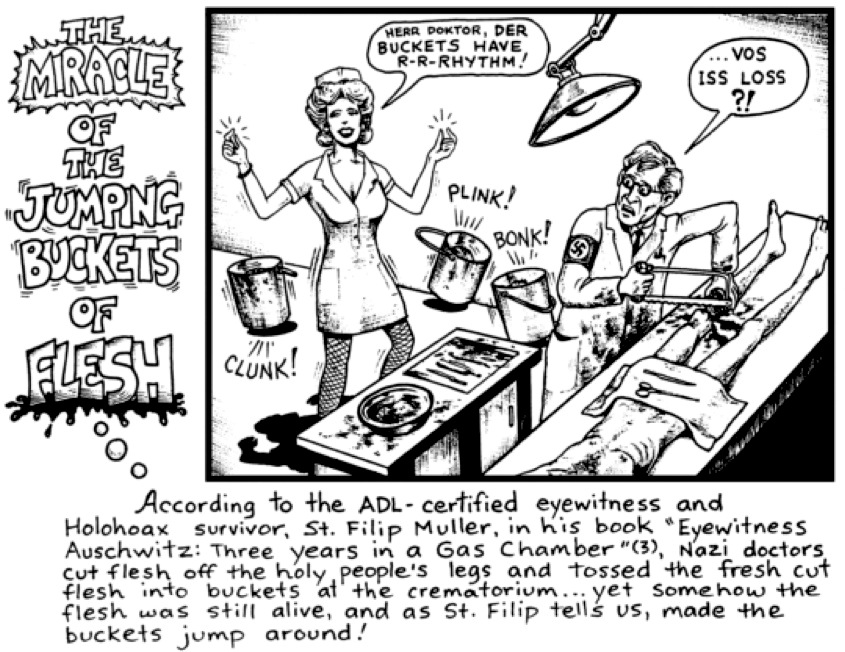
The Miracle of the Jumping Buckets of Flesh

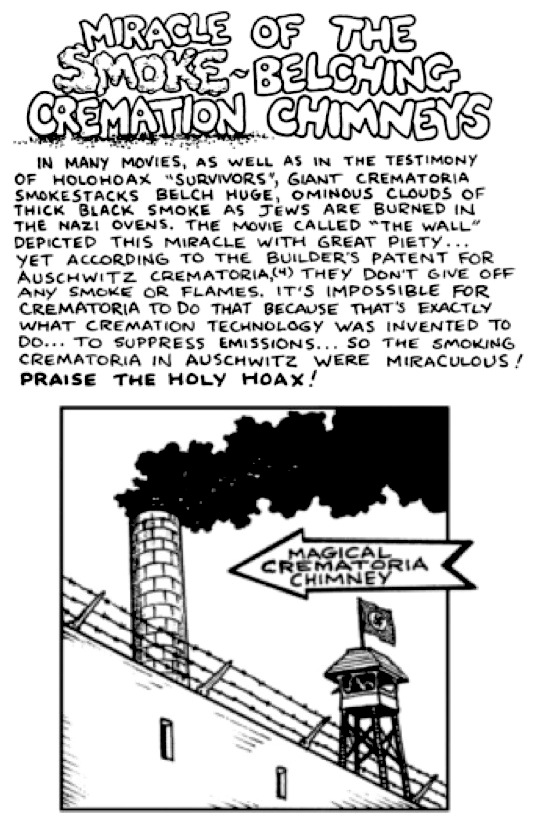
Page 5: Miracle of the Smoke-Belching Cremation Chimneys

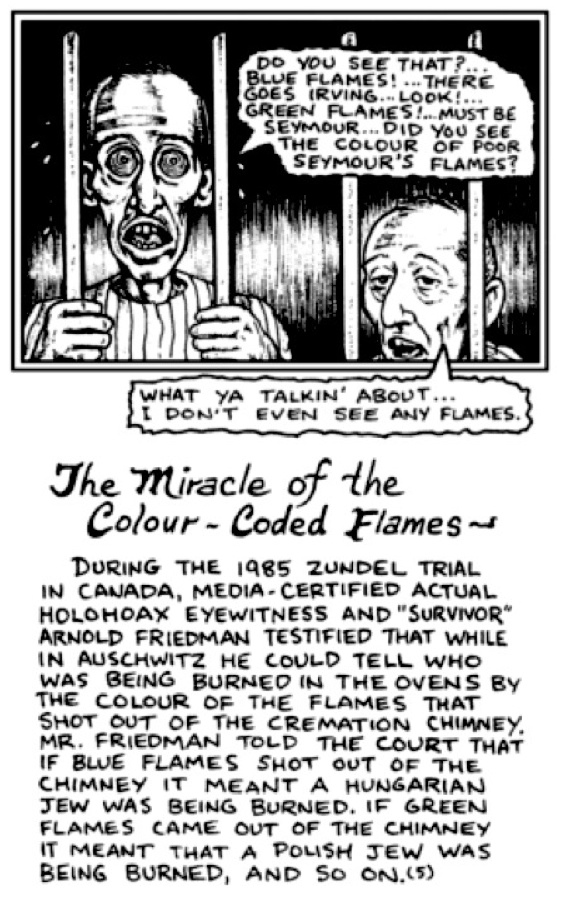
The Miracle of the Colour-Coded Flames

Pope Elie’s Miraculous Escape

Page 6: The Miracle of Anne Frank’s Diary

The miracle of the GAS CHAMBER BARBER SHOP

Page 7: The Miracle of the 23 Million Jews

The Miracle of the Magic Gas Chambers!


CONTENTS


Part 2


Declaration of Mark Weber

Here is My Assessment

Page 8: The Miracle of the Burning Pits

Those Who Miraculously SURVIVED

Having to work like this is a real holocaust …

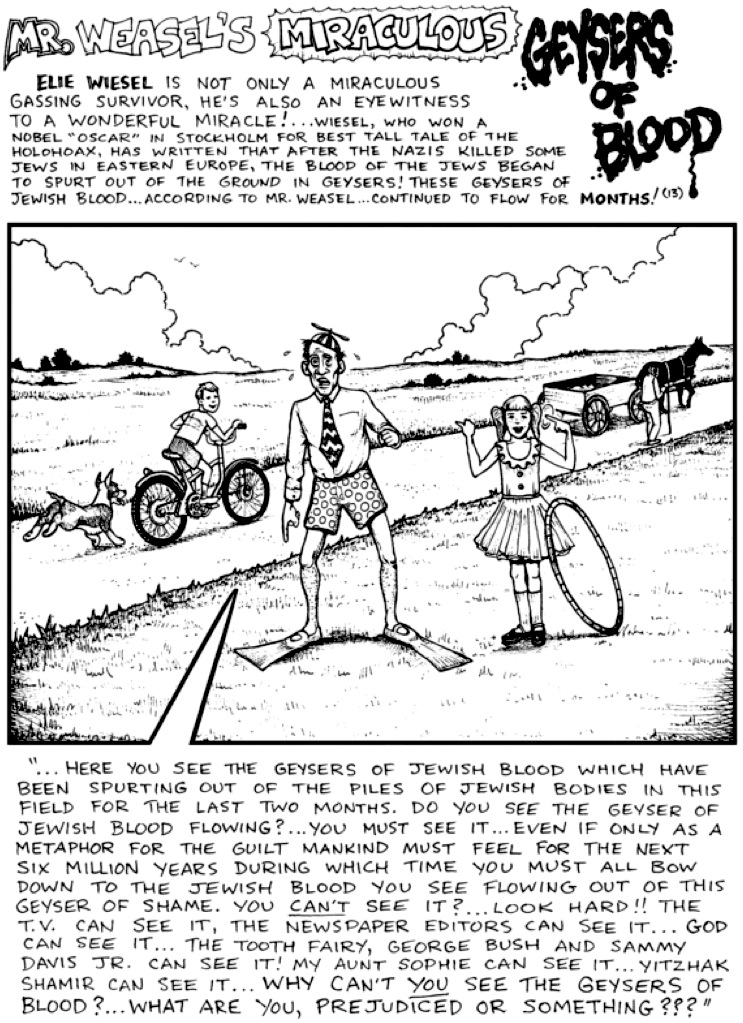
Page 9: Mr. Weasel’s Miraculous Geysers of Blood

Page 10: Alice in Lampshade Land

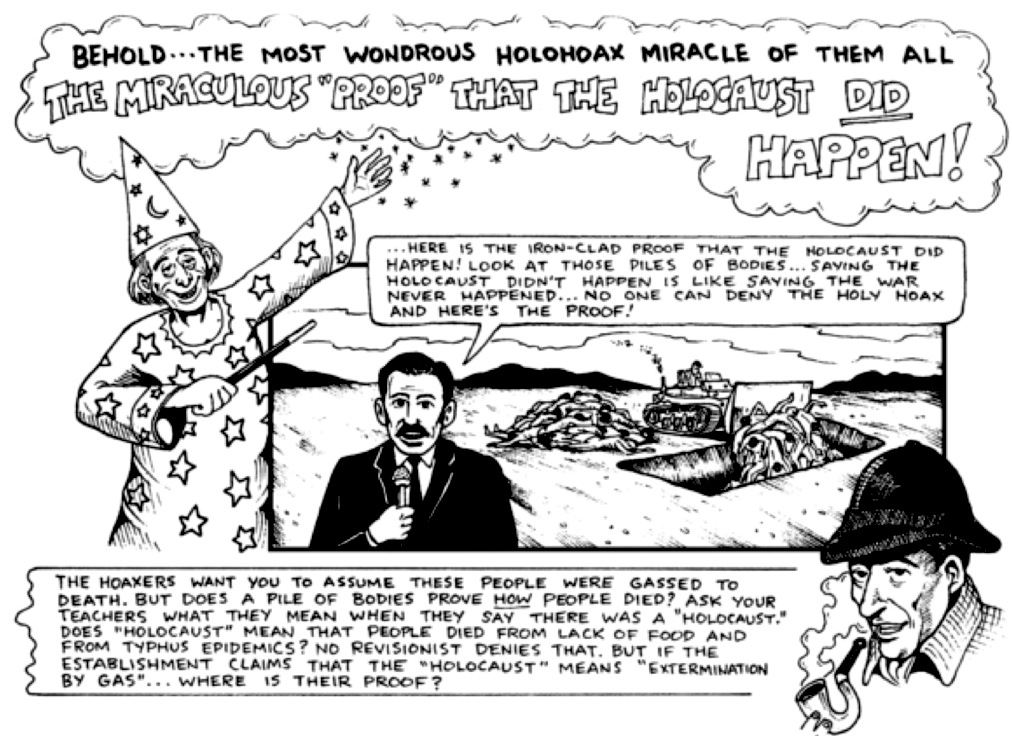
Page 11: The Miraculous “Proof” that the Holocaust DID happen!

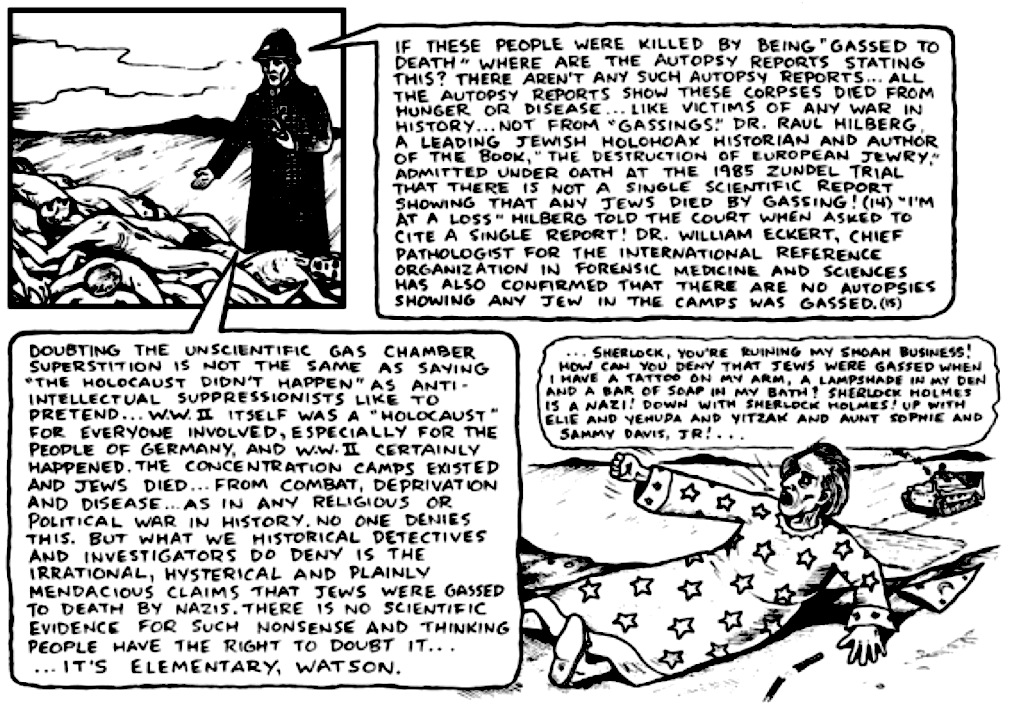
Sherlock: If these people were killed by being “gassed to death” where are the autopsy reports stating this?

Page 12: Crimes by the Jews Not Reported by the News …

The Reality: Even the best gentiles should be killed!

Page 13: Jews beaten and whipped by Nazi commandant Hoess

Oh … I feel so guilty for being White!

Page 14: Israeli soldier: Isn’t Holocaust propaganda great?

Communist leadership consisted of hundreds of Jews

Dresden, Germany, Feb 14-15, 1945

Page 15: [NOTE: Unable to locate this page – katana]

“many of the ‘Jews’ today are Khazars posing as Jews …”

Beating of French Professor Robert Faurisson

Holocaust Memorial Museum in Washington, DC

NOTES

Bibliography

Tales of the Holohoax — A Journal of Satire. Vol. 1, No. 1

Back Cover/ Page 16: Ye Olde Gas Bag

Summary


PDF

Version History


Part 2

top


Declaration of Mark Weber

top


Expert Report by Mark Weber on the Heretical Press publication Tales of the Holohoax.


In 2008 Simon Sheppard was prosecuted for its publication, even though the comic had been sold in Britain for around two decades.


[Image] Simon Sheppard


The following report was not allowed to be submitted into evidence because “the truth is no defence.” Later, prosecution barrister Jonathan Sandiford told the jury, “You need not concern yourselves with the truth. You only need consider whether these matters are abusive or insulting.


My name is Mark Weber. I was born on October 9, 1951, in Portland, Oregon, USA. I studied history at Portland State University, the University of Illinois (Chicago), the University of Munich (in Germany), and Indiana University (in Bloomington).


[Image] Mark Weber


In 1976 I graduated from Portland State University with a Bachelor’s degree (high honors). In 1978 I received a Master’s degree in modern European history from Indiana University, where I also served as an instructor.


On March 22, 1988, I was accepted by a court in Toronto, Canada as qualified to give opinion evidence testimony on the Holocaust and Germany’s wartime Jewish policy. After being qualified by Judge Ron Thomas of the District Court of Ontario, I testified for five days in the high-profile case.


During the past 20 years I have carried out extensive independent study on history, particularly 19th and 20th century European and US history. This included considerable research in the National Archives and the Library of Congress (both in Washington, DC ) during the late 1970s and early 1980s into the ordeal of Europe’s Jews during the Second World War.


That research included study of the aerial photographs of Auschwitz taken by the Allies in 1944, the complete, original records of the German wartime Einsatzgruppen units, the German Foreign Office files on the “final solution of the Jewish question in Europe,” the SS concentration camp administration records, the Wannsee Conference protocol and memoranda, and many US Army records, as well as virtually all protocol and memoranda, and many US Army records, as well as virtually all documents and testimony relating to Germany’s wartime Jewish policy in the 42 volumes of the Nuremberg Tribunal and in the other volumes of testimony and documents of postwar Allied trials. In addition, I have carefully studied the works of prominent historians of the Holocaust, including Raul Hilberg, Gerald Reitlinger, Leon Poliakov and Lucy Dawidowicz.


I am the author of many scholarly published articles and reviews on a range of historical issues, including many on Germany’s wartime Jewish policy and the Holocaust, and on the implications and consequences of this chapter of history. These include “Buchenwald: Legend and Reality” (with the first-ever publication of a secret post-war US Army report on conditions in that notorious camp), “Treblinka,” “Stutthof,” “Bergen-Belsen: The Suppressed Story,” “High Frequency Delousing Facilities at Auschwitz,” “Pages from the Auschwitz Death Registry Volumes,” “Wilhelm Höttl and the Elusive ‘Six Million’,” “New ‘Official’ Changes in the Auschwitz Story,” and “Tell-Tale Documents and Photos from Auschwitz.


My detailed study, “The Nuremberg Trials and the Holocaust,” was published as a book in 1998 in French translation under the title La face cachée de Nuremberg.


Since January 1991 I have been living in southern California, where I have been employed full time as a writer, editor and/ or director of the Institute for Historical Review (IHR), an independent “think tank” and research and publishing center. For nine years I served as editor of the IHR’s Journal of Historical Review. The IHR is recognized by the US Internal Revenue Service as a public interest educational enterprise, which means that donors may deduct the amount of their donations to the IHR from their incomes for tax purposes.


I have been asked to provide an analysis of the 16-page booklet “Tales of the Holohoax,” based on my specialized study and training as a historian.


Here is My Assessment

top


The obvious main purpose of this booklet is to discredit the generally-accepted Holocaust story of the systematic killing of some six million European Jews during World War II, or at least on some aspects of it. A notice at the top of the booklet’s front cover, “A Journal of Satire,” serves as a disclaimer, warning the reader that this is not to be regarded as a scholarly publication. Adding to its obviously polemical and satirical character is the booklet’s “comic book” format and irreverent title.


All the same, the reader is encouraged to believe that the booklet’s assertions are true and based on fact. To lend credibility to assertions made in the booklet’s text, sources or references are sometimes provided. A few of these are given in the text itself, but most are in the form of numbered sources or references through the booklet text, and which are all listed in the “Endnotes” section on page 15. Although I have not been able to check all of the sources or references in the “Endnotes” listing, most of those I was able to check are accurate, or at least essentially so.


[Note: For previous pages please see Part 1]


Page 8: The Miracle of the Burning Pits

top


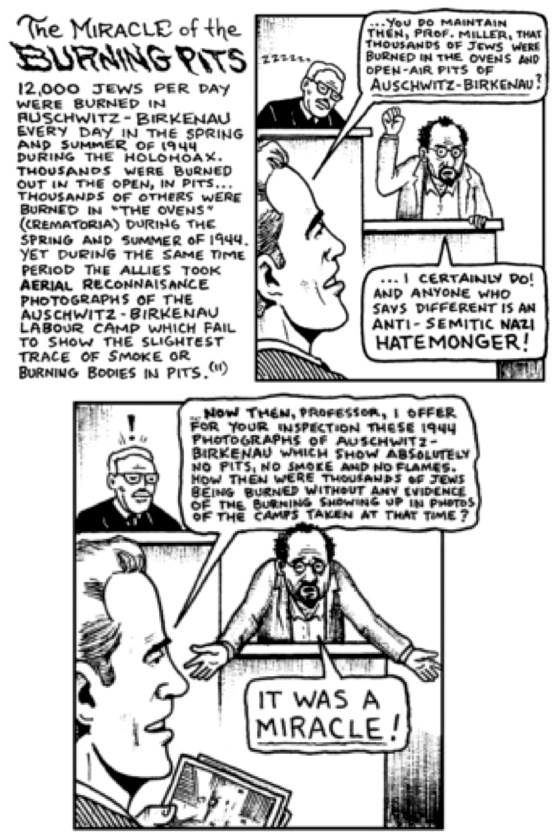
The two drawings at the upper portion of this page, and the accompanying text, headed “The Miracle of the Burning Pits,” are meant to discredit the often-repeated claim that in the Auschwitz-Birkenau camp during the spring and summer of 1944 many thousands of corpses of gassed Jews were cremated every day in open pits.


The cited source – Endnote 11 – are wartime Allied aerial reconnaissance photos taken on a range of dates in 1944.


In 1979 at the National Archives in Washington, DC, I examined all of the large, original film rolls of these aerial reconnaissance photos. I also carefully examined enlargements of the most relevant individual frames of this collection, that is, the photos of Auschwitz and Auschwitz-Birkenau. I also studied relevant available literature, and I discussed these photos with a photo interpreter who had played a role in making public these photographs through the CIA.


As the booklet text suggests here, the claims of mass burnings of bodies in open-air pits are indeed incompatible with the evidence of these 1944 aerial reconnaissance photos.


[Image Text: The Miracle of the Burning Pits

12,000 Jews per day were burned in Auschwitz-Birkenau every day in the spring and summer of 1944 during the Holohoax. Thousands were burned out in the open, in pits … Thousands of others were burned in “the ovens” (crematoria) during the spring and summer of 1944.

Yet during this period the Allies took aerial reconnaissance photographs of the Auschwitz-Birkenau labour camp which fail to show the slightest trace of smoke or burning bodies in pits. (11)

Attorney: … You do maintain then, Prof. Miller, that thousand of Jews were burned in the ovens and open-air pits of Auschwitz-Birkenau?

Prof. Miller: … I certainly do! And anyone who says different is an anti-semitic Nazi hatemonger!

Attorney: … Now then, Professor, I offer for your inspection these 1944 photographs of Auschwitz-Birkenau which show absolutely no pits, no smoke and no flames. How then were thousands of Jews being burned without showing up in photos of the camps taken at that time?

Prof. Miller: … It was a MIRACLE!]


Claims of mass cremation in pits at Birkenau are also not credible because it is extraordinarily difficult to burn corpses in the open air, and even more so in pits. This point was made by Ivan Legacé, a crematory manager and operator, in court testimony given in April 1988. (See: B. Kulaszka, ed., “Did Six Million Really Die?” [1992], p. 270.)


Those Who Miraculously SURVIVED

top


When he was asked about the often-made allegation that some 4,400 bodies were cremated each day at Auschwitz-Birkenau in the spring or summer of 1944, Legacé responded by saying that such claims are “preposterous,” “beyond the realm of reality” and “ludicrous.”


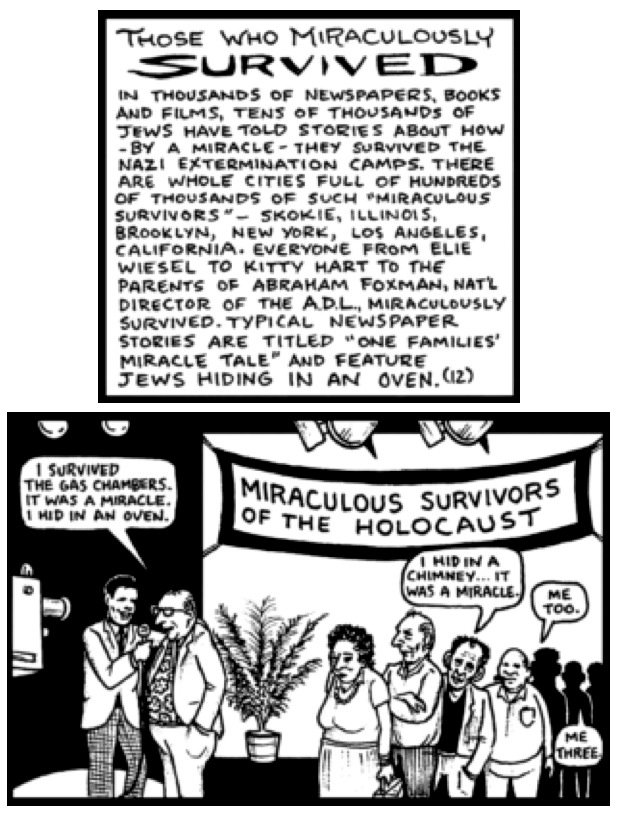
[Image Text: Those Who Miraculously SURVIVED

In thousands of newspapers, tens of thousands of jews have told stories about how — by a miracle — they survived the Nazi extermination camps. There are whole cities full of hundreds of thousands of such “miraculous survivors” — Skokie, Illinois … Brooklyn, New York … Los Angeles, California. Everyone from Elie Wiesel to Kitty Hart to the parents of Abraham Foxman, Nat’l Director of the A.D.L. miraculously survived. Typical newspaper stories are titled, “One Families’ Miracle Tale” which features a motif of Jews hiding in an oven. (12)

TV studio set Banner: MIRACULOUS SURVIVORS OF THE HOLOCAUST

Survivor 1: I survived the gas chambers. It was a miracle. I hid in an oven.

Survivor 2: I hid in a chimney … It was a miracle.

Survivor 3: Me too

Survivor 4: Me three]


The drawings in the middle and bottom of this page, and the accompanying texts, under the heading “Those Who Miraculously Survived,” are about false or exaggerated claims of “miraculous” Holocaust survivors.


Although I was not able to check this particular reference – Endnote 11 – (The Washington Times, April 12, 1983, p. B-1), I can confirm that many Holocaust survivor claims are indeed exaggerated or not true.


For example, Jewish “Holocaust survivor,” Moshe Peer recounted in a memoir and to a Canadian journalist his wartime ordeal as an eleven-year-old in the Bergen-Belsen concentration camp. He claimed that he;


“was sent to the [Bergen-Belsen camp] gas chamber at least six times.”


The journalist’s newspaper account went on to relate:


“Each time he survived, watching with horror as many of the women and children gassed with him collapsed and died. To this day, Peer doesn’t know how he was able to survive.”


(Source: K. Seidman, “Surviving the Horror,” The Gazette [Montreal, Canada ], August 5, 1993. A facsimile of this item was published in The Journal of Historical Review, Nov.-Dec. 1993, p. 24.)


Peer’s story is not true. In fact, and as every reputable historian of the subject now acknowledges, not a single person was ever “gassed” at the Bergen-Belsen camp.


Having to work like this is a real holocaust …

top


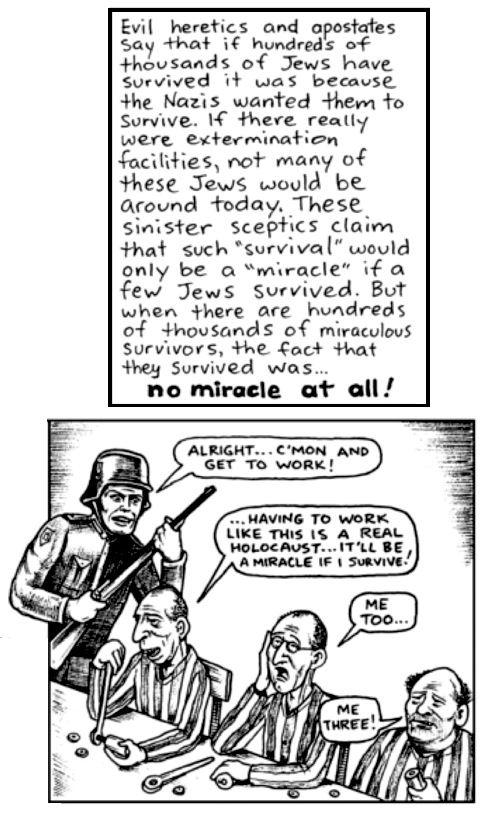
[Image Text: … Evil heretics and apostates say that if hundreds of thousands of Jews have survived it was because the Nazis wanted them to survive. If there really were extermination facilities, not many of these Jews would be around today. These sinister skeptics claim that such “survival” would only be a “miracle” if a few Jews survived … But when there hundreds of thousands of miraculous survivors, the fact that they survived was no miracle at all!

Nazi guard: Alright … C’mon and get to work!

Inmate 1: … Having to work like this is a real holocaust … It’ll be a miracle if I survive!

Inmate 2: Me too …

Inmate 3: Me three!]


Page 9: Mr. Weasel’s Miraculous Geysers of Blood

top


[Image Text: Mr. Weasel’s Miraculous Geysers of Blood.

Elie Wiesel is not only a miraculous gassing survivor, he’s also an eyewitness to a wonderful Miracle! … Wiesel, who recently won a Nobel “Oscar” in Stockholm for best tall tale of the Holohoax, has written that after the Nazis killed some Jews in Eastern Europe, the blood of the Jews began to spurt out of the ground in geysers! These geysers of Jewish blood … according to Mr. Weasel … continued to flow for months! (13)

Weasel: “ … Here you see the geysers of Jewish blood which have been spurting out of the piles of Jewish bodies in this field for the last two months. Do you see the geyser of Jewish blood flowing? … You must see it … even only as a metaphor for the guilt mankind must feel for the next six million years during which time you must all bow down to the Jewish blood you see flowing out of this geyser of shame.

You can’t see it? … Look hard!! The T.V. can see it, the newspaper editors can see it … God can see it … the tooth fairy , George Bush and Sammy Davis Jr. can see it! My aunt Sophie can see it … Yitzhak Shamir can see it … Why can’t you see the geysers of blood? … What are you, prejudiced or something!!!”]


Under a heading, “Mr. Weasel’s Miraculous Geysers of Blood,” there is a drawing of a man, presumably Elie Wiesel, who claims to see;


“geysers of Jewish blood which have been spurting out of the piles of Jewish bodies in this field for the last two months.”


The text at the top of this page tells the reader:


“Elie Wiesel is not only a miraculous gassing survivor, he’s also an eyewitness to a wonderful miracle! … Wiesel, who won a Nobel ‘Oscar’ in Stockholm for best tall tale of the Holohoax, has written that after the Nazis killed some Jews in eastern Europe, the blood of the Jews began to spurt out of the ground in geysers! These geysers of Jewish blood … according to Mr. Weasel … continued to flow for months! (13)”


The source cited here for this – Endnote 13 – is a book by Wiesel, The Jews of Silence, p. 48. Although I was not able to check this source directly, I did confirm that what is written here about Wiesel is not quite accurate.


Prof. Robert Faurisson, in his essay, “A Prominent False Witness: Elie Wiesel,” relates that Wiesel did not himself claim to have seen such “geysers,” but only that he heard this story from someone else. Citing the French edition of Wiesel’s book, Paroles d’étranger, Faurisson quotes Wiesel as writing that:


“Later, I learn from a witness that, for month after month, the ground never stopped trembling; and that, from time to time, geysers of blood spurted from it.”


Page 10: Alice in Lampshade Land

top


[The drawing on this page also appears on the front cover of this booklet.]


[Image Text: Alice in Lampshade Land ~

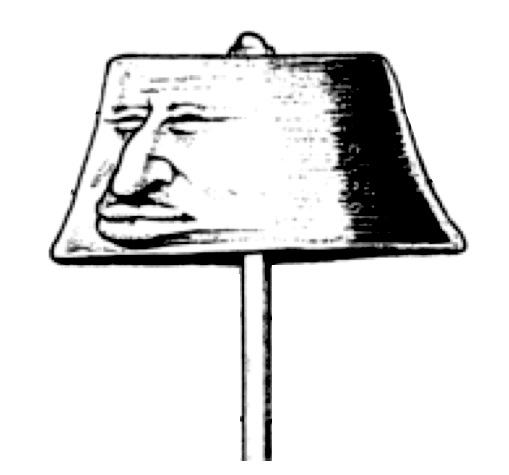
Sub-human, demon possessed, evil, wicked, vile neo-Nazi devil-monsters made bars of soap out of Jewish people’s fat and lampshades out of their skin, according to the official stories and rumors of media and classrooms, Yuck! What scum those Nazis were. The only scum lower than them would be someone who would make up such a story to falsely accuse the German people of horrible crimes they never committed.

But of course, even though no such supposed soap or lampshade was ever submitted to a science lab, to prove that it really did come from human fat, and that it was made by Germans; your teachers, reporters, and Judeo-Christian ministers will tell you, “The Germans really did make these monstrous things’ …Amen.

Alice: … Oh my dear, is that you, Cheshire cat? … My word this Jewish wonderland is the strangest I’ve ever been in!

… Even Holohoaxers sometimes get fed up with the more egregious aspects of the hoax and thus as a kind of damage-control for preserving belief in the core of the tale (the gassings), two Jewish historians … Dr Raul Hilberg of the Univ. of Vermont and Prof. Deborah Lipstadt of U.C.L.A. have finally admitted in public that the stories about the Nazi lampshades and bars of soap stories are nothing but lies! (14)

But people still repeat the lampshade and soap stories anyway because after all … it’s only Germans that are being defamed. Moreover, what religious believer ever stopped believing in a holy wonderland just because science or evidence contradicted it?]


The drawing and text on this page, under the heading “Alice in Lampshade Land,” deals with two lurid Holocaust stories. The first is the widely-repeated story that bars of soap were manufactured from the corpses of murdered Jews. (The “Alice in Wonderland” character in the drawing is holding one of the legendary soap bars.) The second story is that lampshades were made from the skin of murdered Jews. In that regard, the face shown on the “lampshade” in the drawing here is a stereotypical Jewish face, with fleshy lips and a large, “Jewish” nose.


As the text at the lower part of this page indicates, historians now generally acknowledge that these two legendary stories are not true.


I am familiar with the sources or references cited here – Endnote 14. For example, I am familiar with press reports confirming that Deborah Lipstadt and Yehuda Bauer – two prominent Holocaust historians – now acknowledge that the “soap story” is not true.


According to Endnote 14, on page 15;


“similar anti-German atrocity propaganda about soap was invented during World War I (see Arthur Ponsonby, Falsehood in Wartime).”


This is not quite accurate. A chapter of the book Falsehood in Wartime deals with similar World War I stories about German manufacturing of lubricating oil, fertilizer and fats – but not soap – from the bodies of dead soldiers in “corpse factories.” (For more on this, see my “Jewish Soap” article, published in the Summer 1991 issue of The Journal of Historical Review. Posted at http://www.ihr.org/jhr/v11/v11p217_Weber.html )


With regard to the “lampshade story,” I can confirm that the source cited in Endnote 14 (page 15) is valid, although the citation is not very precise.


As far as I know, I am the first person to cite or quote from the remarks mentioned here by Lucius D. Clay about the lampshade story. That was in my article on the Buchenwald camp, published in the Winter 1986-87 issue of The Journal of Historical Review (posted at http://www.ihr.org/jhr/v07/v07p405_Weber.html )


I wrote that General Lucius D. Clay, Commander in Chief of U.S. Forces in Europe and Military Governor of the U.S. Occupation Zone of Germany, 1947-49, carefully reviewed the Ilse Koch case in 1948 and found that, whatever her other misdeeds, the lampshade charge was baseless. He commuted her sentence from life imprisonment to four years, and informed the Army Department in Washington:


“There is no convincing evidence that she [Ilse Koch] selected inmates for extermination in order to secure tattooed skins or that she possessed any articles made of human skin.”


I also quoted from a 1976 interview with Clay, in which he recalled:


“We tried Ilse Koch… She was sentenced to life imprisonment, and I commuted it to three [four] years. And our press really didn’t like that. She had been destroyed by the fact that an enterprising reporter who first went into her house had given her the beautiful name, the “Bitch of Buchenwald,” and he had found some white lampshades in there which he wrote up as being made out of human flesh … Well, it turned out actually that it was goat flesh. But at the trial it was still human flesh. It was almost impossible for her to have gotten a fair trial.”


Page 11: The Miraculous “Proof” that the Holocaust DID happen!

top


This page, headed “The Miraculous ‘Proof’ That the Holocaust Did Happen,” deals with the significance of the well-known photos of masses of dead bodies found in German concentration camps at the end of the war.


[Image Text:

Jewish Magician: Behold … the Most Wondrous Holohoax Miracle of them All

The Miraculous “Proof” that the Holocaust DID happen!

Reporter: … Here is the iron-clad proof that the Holocaust did happen! Look at those piles of bodies … Saying the Holocaust didn’t happen is like saying the war never happened … No one can deny the Holy Hoax and here’s the proof!

Sherlock: The hoaxers want you to assume these people were gassed to death. But does a pile of bodies prove how people died? Ask your teachers what they mean when they say there was a “Holocaust.”

Does “Holocaust” mean that people died from lack of food and typhus epidemics? No revisionists denies that. But if the establishment claims that the “Holocaust” means “Extermination by gas” … where is the proof?]


Everyone is familiar with the horrific photographs of dead and dying inmates found in concentration camps such as Bergen-Belsen and Nordhausen when they were liberated by British and American forces in the final weeks of the war in Europe. As suggested in the booklet text, many people accept these photos as proof of “the Holocaust.”


The booklet goes on to tell the reader that these dead inmates had died of “hunger or disease… like victims of any war in history… not from ‘gassings!’.” This is a valid point. The much-photographed dead and dying inmates found in camps liberated by American and British forces in 1945 were, in fact, victims of disease and malnutrition brought on by the complete collapse of Germany in the final months of the war. (For more on this, see my essay, “Bergen-Belsen : The Suppressed Story,” published in the May-June 1995 issue of The Journal of Historical Review. Posted at http://www.ihr.org/jhr/v15/v15n3p23_Weber.html )


Sherlock: If these people were killed by being “gassed to death” where are the autopsy reports stating this?

top


[Image Text:

Sherlock: If these people were killed by being “gassed to death” where are the autopsy reports stating this? There aren’t any such autopsy reports … All the autopsy repots show these corpses died from hunger or disease … like victims of any war in history … not from “gassings.”

Dr. Raul Hilberg a leading Jewish Holohoax historian and author of the book, “The Destruction of European Jewry,” admitted under oath at the 1985 Zundel Trial that there is not a single scientific report showing that any Jews died by gassing! (14)

“I’m at a loss” Hilberg told the court when asked to cite a single report! Dr William Eckert, chief pathologist for the International Reference Organization in Forensic Medicine and Sciences has also confirmed that there are no autopsies showing any Jew in the camps was gassed. (15)

Sherlock: Doubting the unscientific gas chamber superstition is not the same as saying, “The Holocaust didn’t happen” as anti-intellectual suppressionists like to pretend … W.W. II itself was a “Holocaust” for everyone involved, especially for the people of Germany, and W.W. II certainly happened. The concentration camps existed and Jews died … from combat, deprivation and disease … as in any religious or political war in history. No one denies this. But what we historical detectives and investigators do deny is the irrational, hysterical and plainly mendacious claims that Jews were gassed to death by Nazis. There is no scientific evidence for such nonsense and thinking people have the right to doubt it … It’s elementary, Watson.

Jewish Magician: … Sherlock, you’re ruining my Shoah business!

How can you deny that Jews were gassed when I have tattoos on my arm, a lampshade in my den and a bar of soap in my bath!

Sherlock Holmes is a Nazi! Down with Sherlock Holmes! Up with Elie and Yehuda and Yitzak and aunt Sophie and Sammy Davis, Jr! …]


As the booklet text relates here:


“If these people were killed by being ‘gassed to death’ where are the autopsy reports stating this? There aren’t any such autopsy reports … All the autopsy reports show these corpses died from hunger or disease … like victims of any war in history … not from ‘gassings.’ Dr. Raul Hilberg, a leading Jewish Holohoax historian and author of the book, ‘The Destruction of European Jewry’ admitted under oath at the 1985 Zundel trial that there is not a single scientific report showing that any Jew died by gassing! (14) ‘I’m at a loss’ Hilberg told the court when asked to cite a single report! Dr. William Eckert, chief pathologist for the International Reference organization in forensic medicine and sciences has also confirmed that there are not autopsies showing any Jew in the camps was gassed. (15).”


There are some mistakes or inaccuracies here. For one thing, Hilberg’s book is actually entitled The Destruction of the European Jews. It is true, as the booklet text relates, that in his testimony in the 1985 Zundel trial, Hilberg said that there are no autopsy reports showing that even a single person died from exposure to poisonous gas in chambers. However, Hilberg’s testimony is not inconsistent with the “standard” Holocaust story, because he and other Holocaust historians contend that the bodies of all Jews who were killed in gas chambers were cremated.


The footnote 14 given in the text here on this page is not valid. This note 14 should instead refer to Endnote 15 on page 15, which cites a Canadian Press (CP) report published in The Sault Star, a Canadian newspaper, about Hilberg’s testimony in 1985. This item is reproduced in full, apparently in facsimile, in The Great Holocaust Trial, a book by Michael A. Hoffman II (Third edition, 1995, p. 88). The date given on the facsimile is January 18, not January 16, 1985.


The footnote 15 given in the text here on this page is an apparent mistake. As already mentioned, endnote 15 on page 15 refers to a newspaper report about Hilberg’s testimony, and makes no mention of a William Eckert. I am not familiar with the claim made here attributed to “Dr. William Eckert,” nor was I able to find any independent confirmation of this finding by him.


Near the bottom of this page, the booklet’s author writes:


“Doubting the unscientific gas chamber superstition is not the same as saying “The Holocaust didn’t happen”, as anti-intellectual suppressionists like to pretend … W.W. II itself was a “Holocaust” for everyone involved, especially for the people of Germany, and W.W. II certainly happened.

The concentration camps existed and jews died … as in any religious or political war in history. No one denies this.

But what we historical detectives and investigators do deny is the irrational, hysterical and plainly mendacious claims that Jews were gassed to death by Nazis. There is no scientific evidence for such nonsense and thinking people have the right to doubt it.”


Evidence for wartime killings of Jews in gas chambers is less substantial or abundant than many assume. This point was made by Arno J. Mayer, a professor of history at Princeton University. In his book, Why Did the Heavens Not Darken? (Pantheon, 1989; pp. 362-363), this Jewish scholar wrote:


“Sources for the study of the gas chambers are at once rare and unreliable … there is no denying the many contradictions, ambiguities and errors in the existing sources.”


In this regard, it is also worth recalling that for years it was authoritatively claimed, and even “proven” in courts, that prisoners were killed in gas chambers at Dachau, Buchenwald and other concentration camps in Germany proper. Claims of homicidal gassings in those camps ultimately proved to be groundless, and are now rejected by all reputable historians.


All the same, to dismiss evidence for wartime killings of Jews in gas chambers as mere “nonsense” and “plainly mendacious” is unjustified.


It is true that some skeptics of the standard Holocaust story – who are routinely castigated as “deniers,” but referred to here in the booklet as “we historical detectives and investigators” – contend that there were no homicidal gassings of Jews during World War II. However, other skeptics, such as David Irving, accept that homicidal gassings of Jews did take place, or may have taken place.


Page 12: Crimes by the Jews Not Reported by the News …

top


On this page, under the heading “Crimes by Jews Not Reported in the News,” is text and three drawings that depict Jews with unattractive, exaggerated features. Jewish pretensions of love for all humanity are contrasted with vicious remarks by some Jews about non-Jews (gentiles).


[Image Text:

Crimes by the Jews

Not Reported by the News …

Our “uncensored” news media forgot to tell you a thing or two about those war criminals they love to worship … Israeli war criminal and zionist war crimes. The Media Image:

Three Jewish Angels: We love everyone … We believe in peace, equality, tolerance and love for all mankind. Let all men come together as brothers and sisters … Let us love one another as our prophets and sages have told us … The world need more brotherhood and love and peace … We must all combat BIGOTRY, HATE and RACISM!


The Reality: Even the best gentiles should be killed!

top


In the middle of this page, in a portion headed “The Reality,” Rabbi Simon ben Yohai (Shimon bar Yohai) is quoted from the Talmud as telling his fellow Jews that “… Even the best of the Gentiles should all be killed.


[Image Text:

The Reality:

Rabbi: Even the best gentiles should be killed?*

* LITERALLY, “Tob shebe goyyim harog.” The word “goyim” calls Gentiles (non-jews) cattle. This slogan comes from the Talmud, the Jewish holy book! It was uttered by the Zionist’s most revered “prophet and sage” Rabbi Simon ben Yohai, whose grave in Israel is a national shrine. The accuracy of this quotation is verified in the article titled “Gentiles” in the Jewish Encyclopedia, edited by Isodre Singer.

The genocidal and racist mentality of the modern Zionist is evident as well … for example, in 1986, Israeli Army Chief Chaplain Shmuel Derlich issued an order to the Israeli army to exterminate all Germans to the last man, woman and child. (“The Nation” magazine, Aug. 16, 1986, p. 103. For further testimony of hatred and racism toward non-jews see Jewess Evelyn Kaye’s book “The Hole in the Sheet,” (16))

Israeli Army Sermon Israel, Summer 1986

Army Chief Derlich: You Israeli soldiers must exterminate the Amalek-Germans to the last man, woman and child … this a mitzvah … KILL THEM ALL!]


The authenticity of this Talmudic quote has been confirmed by reputable specialists, including British scholar and explorer Sir Richard F. Burton, in his book The Jew, The Gypsy and El Islam (1898 edition, p. 119); Rabbi Mordechai Friedfertig, in his essay “Divrei Moredchai – Our Sacred Texts”; Jewish American scholar David Klinghoffer, in a 1994 item, “Among Strangers”; and, Jewish scholar Israel Shahak, a Holocaust survivor and, for years, a professor in Israel, in his book, Jewish History, Jewish Religion: The Weight of Three Thousand Years (London: Pluto, 1994), pp. 78-80.


A more complete and accurate rendering of this quote is:


“The best of the non-Jews should be killed. The best of the snakes, their skulls should be crushed.”


Some Jewish commentators express embarrassment over the ferocity of this statement, and try to play down its importance. All the same, the basic Jewish attitude toward non-Jews, as expressed in the Talmud, is hardly a loving one. In his book Jewish History, Jewish Religion (page 80), Israel Shahak writes:


“As for gentiles, the basic Talmudic principle is that their lives must not be saved, although it is forbidden to murder them outright.”


At the bottom of this booklet page is a hateful injunction attributed to Israeli Army Chief Chaplain Shmuel Derlich. Although I was not able to confirm the accuracy of this specific injunction, or to check the reference given here for it (The Nation, August 16, 1986), I can confirm that comparable remarks have been made by similarly prominent Israelis.


In Jewish History, Jewish Religion, (pp. 76, 113, n. 7), Israel Shahak cites an exhortation to Israeli soldiers by the Chief Chaplain of the Israeli Army’s Central Region Command, Colonel Rabbi A. Avidan (Zemel). In a booklet published in 1973 for Israeli troops, the rabbi declared:


“When our forces come across civilians during a war or in hot pursuit or in a raid, so long as there is no certainty that those civilians are incapable of harming our forces, then according to the Halakha [Jewish religious law] they may and even should be killed … Under no circumstances should an Arab be trusted, even if he makes an impression of being civilized … In war, when our forces storm an enemy, they are allowed and even enjoined by the Halakha to kill even good civilians, that is, civilians who are ostensibly good.”


Shahak also relates (page 91):


“In fact, it is not uncommon for reserve soldiers called up for to do a tour of duty in the Gaza Strip to be given an ‘educational lecture’ in which they are told that the Palestinians of Gaza are ‘like the Amalekites.’ … There are many similar examples of bloodthirsty rabbinical pronouncements against the Palestinians, based on these laws.”


Shahak goes on to explain to readers of his book (pages 96-97) that:


“Anyone who lives in Israel knows how deep and widespread these attitudes of hatred and cruelty to towards all Gentiles are among the majority of Israeli Jews … Judaism is imbued with a very deep hatred towards Christianity, combined with ignorance about it.”


Endnote 16 (on page 15) cites the book Jewish History, Jewish Religion, by Israel Shahak, and another book co-authored by Shahak. I am familiar with the first of these two works. I was not able to check The Nation item mentioned here in the text.


Page 13: Jews beaten and whipped by Nazi commandant Hoess

top


On this page, and on page 14, television reports (exaggerated or untrue) of German Holocaust crimes against Jews are sharply contrasted with atrocities and crimes reportedly committed by Jews, especially Israelis, against non-Jews. The reality of Israel’s often brutal and criminal treatment of non-Jews in the occupied territories is, of course, well known and abundantly documented. The author of this booklet is by no means the first or only person to write indignantly about “western taxpayers” support for Israel, in spite of the Zionist state’s harsh and illegal policies.


I was not able to check The Nation item mentioned here in the text.


[Image Text:

TV: Here you see the Jews beaten and whipped by Nazi commandant Hoess …

Three TV viewers: Those terrible Nazis! 

TV Caption: Beirut, Lebanon, August 1982

After the Israeli invasion of Lebanon the Israeli air force indiscriminately bombed clearly marked schools and hospitals. Researcher Alexander Cockburn states that Israeli forces have been responsible for 200,000 deaths since 1948 (“The Nation” magazine, June 23, 1984, p. 754). Yet there is virtually no move to cut-off Western taxpayer support of this carnage. The West has armed and bankrolled this Zionist murder-spree for more than forty years. (For graphic documentation of the Israeli Air Force holocaust against Lebanon see the tightly suppressed book “God Cried” by Tony Clifton, Quartet Books, 1983.)]


Oh … I feel so guilty for being White!

top


[Image Text:

Debbie: Oh … I feel so guilty for being White! We enslaved the Blacks and crucified the Jews … I never want to have a baby …

What if it was another Hitler?

Boyfriend: … You’re right, Debbie.

Man with pipe (? Jew): … Jews have been terribly persecuted … The Jews suffered Holocaust after Holocaust throughout history. It would be a sin against them … We non-Jews are all guilty and owe Jews a lot.


Page 14: Israeli soldier: Isn’t Holocaust propaganda great?

top


[Image Text:

Concern for the Jewish ghosts of the 1930’s and 40’s is infinitely greater than concern for the welfare of flesh and blood humanity suffering and dying in Palestine …

TV: … And the Nazis forced weak, elderly Jews to flush themselves down the toilet … One million were drowned in this way …

Israeli soldier: … Ha-ha … Isn7t Holocaust propaganda great? … It keeps people’s minds centred on the past while the Palestinians people of today are massacred.

The media-induced fixation with only one war, one war crime and one nation of supposed war criminals has served as a handy focus for attention away from Israeli murders not only of the present but also of the past …]


The reader is told here:


“The media-induced fixation with only one war, one war crime and one nation of supposed war criminals has served as a handy focus for attention away from Israeli murders not only of the present but also of the past.”


This same point has been made by many others, including a number of Jewish writers.


Amira Hass, an award-winning Israeli journalist and author, for example, says that Israel has turned “the Holocaust” into a “political asset.” In an April 2007 column in the influential Israeli daily Haaretz, she wrote:


“Turning the Holocaust into a political asset serves Israel primarily in its fight against the Palestinians. When the Holocaust is on one side of the scale, along with the guilty (and rightly so) conscience of the West, the dispossession of the Palestinian people from their homeland in 1948 is minimized and blurred.”

“The phrase ‘security for the Jews’ has been consecrated as an exclusive synonym for ‘the lessons of the Holocaust.’ It is what allows Israel to systematically discriminate against its Arab citizens … Turning the Holocaust into an asset allows Israel to present all the methods of the Palestinian struggle (even the unarmed ones) as another link in the anti-Semitic chain whose culmination is Auschwitz …”

“Separating the genocide of the Jewish people from the historical context of Nazism and from its aims of murder and subjugation, and its separation from the series of genocides perpetrated by the white man outside of Europe, has created a hierarchy of victims, at whose head we stand … Whoever criticizes Israel’s policies toward the Palestinians is denounced as an anti-Semite, if not a Holocaust denier… The transformation of the Holocaust into a political asset for use in the struggle against the Palestinians feed on those same stores of official cynicism, but it is part of the consensus.”


Norman Finkelstein, a Jewish scholar who teaches at DePaul University in Chicago, wrote in his bestselling book, The Holocaust Industry, that “invoking The Holocaust” is “a ploy to delegitimize all criticism of Jews.” He added:


“By conferring total blamelessness on Jews, the Holocaust dogma immunizes Israel and American Jewry from legitimate censure… Organized American Jewry has exploited the Nazi holocaust to deflect criticism of Israel ‘s and its own morally indefensible policies.”


This view is echoed by another Jewish scholar, Tony Judt, who is director of the Remarque Institute at New York University. In a piece published in early 2005 in The Nation, he wrote:


“The Shoah [Hebrew term for Holocaust] is frequently exploited in America and Israel to deflect and forbid any criticism of Israel. Indeed, the Holocaust of Europe’s Jews is nowadays exploited thrice over: It gives American Jews in particular a unique, retrospective ‘victim identity’; it allows Israel to trump any other nation’s sufferings (and justify its own excesses) with the claim that the Jewish catastrophe was unique and incomparable; and (in contradiction to the first two) it is adduced as an all-purpose metaphor for evil – anywhere, everywhere and always – and taught to schoolchildren all over America and Europe without any reference to context or cause. This modern instrumentalization of the Holocaust for political advantage is ethically disreputable and politically imprudent.”


(For more on all this, see my essay, “Holocaust Remembrance: What’s Behind the Campaign?” Posted at http://www.ihr.org/leaflets/holocaust_remembrance.shtml )


Communist leadership consisted of hundreds of Jews

top


In the middle of this booklet page (p. 14) is a drawing and some text about the Jewish role in the early Soviet regime, and crimes committed by Jews who served the Soviet state.


[Image Text:

TV: … The Nazis fed Jewish babies to a pack of rabid German Sheperds … One million Jewish infants killed in this manner …

Man with pipe: Those stinking Nazis …Look at that … How gross!

Soviet (Jewish) soldier: … Die, you Christian goyim! We will all be avenged now that we rule Russia.

The early communist leadership in Russia consisted of hundreds of Jews like Leon Trotsky, Moses Uritsky, Apfelbaum (Zinoviev) and the half-Jew Lenin. They made up the highest ranks of the Secret Police and Red Army. These alien communists hated the Christian people of Russia and ordered the murder of tens of thousands of them.

The very first law ever promulgated in the official communist newspaper “Izvestia” (July 27, 1918) made opposition to Jews a crime punishable by death.

Apfelbaum wrote in “Krasnava Gazeta” (Aug. 31, 1918), demanding that an ocean of blood wash over the Christian people of Russia. “Let there be floods of blood … more blood! As much as possibly.

The Gulag death camps were devised by a Turkish Jew, Naftaly Frenkel (Solzhenitsyn, “Gulag Archipelago” Vol. 2).

There has never been a single movie on T.V. showing the atrocities committed against the Christian people of Eastern Europe but there have been over 500 movies made about “What Nazis Did,” No Jewish-Communist war criminal has ever been prosecuted or sought for the mass murder of Christians.]


It is indeed true, as the booklet relates here, that such misdeeds are not well known. This point was made recently by Sever Plocker, chief economics editor of Israel’s largest circulation daily newspaper, Yedioth Ahronoth. In an essay, “Stalin’s Jews,” posted on the Ynet News website (Dec. 21. 2006), he wrote:


“An Israeli student finishes high school without ever hearing the name Genrikh Yagoda, the greatest Jewish murderer of the 20th Century, the GPU’s deputy commander and the founder and commander of the NKVD. Yagoda diligently implemented Stalin’s collectivization orders and is responsible for the deaths of at least ten million people. His Jewish deputies established and managed the Gulag system…”

“Many Jews sold their soul to the devil of the Communist revolution and have blood on their hands for eternity. We’ll mention just one more: Leonid Reichman, head of the NKVD’s special department and the organization’s chief interrogator, who was a particularly cruel sadist.”

“In 1934, according to published statistics, 38.5 percent of those holding the most senior posts in the Soviet security apparatuses were of Jewish origin … Turns out that Jews too, when they become captivated by messianic ideology, can become great murderers, among the greatest known by modern history … I find it unacceptable that a person will be considered a member of the Jewish people when he does great things, but not considered part of our people when he does amazingly despicable things.”


(For more on the Jewish role in the Bolshevik seizure of power and in Russia’s early Soviet regime, see my essay on this, posted at http://www.ihr.org/jhr/v14/v14n1p- 4_Weber.html )


As significant as the Jewish role was in the Bolshevik takeover of Russia and the early Soviet regime, this role is sometimes exaggerated. For example, it is not true, as claimed here in this booklet, that Lenin was “half-Jewish.” His ancestry was one-quarter Jewish. The booklet reader is also told that:


“The very first law ever promulgated in the official Communist newspaper ‘Izvestia’ (July 27, 1918) made opposition to Jews a crime punishable by death.”


In fact, numerous laws and decrees were promulgated by the young Soviet regime and publicly issued in the seven or so months following the Bolshevik seizure of power on November 6-7, 1917.


Dresden, Germany, Feb 14-15, 1945

top


A valid point is made in the text at the bottom of this page, in noting the “authentic Holocaust” of Allied bombing during World War II. This campaign took the lives of some 500,000 or 600,000 Germans, overwhelmingly civilians, including tens of thousands in the infamous fire-bombing of Dresden on February 13-14, 1945.


[Image Text:

TV: … Here you see the Jews being pushed into giant food mixer devised by the fiendish Gestapo … One million Jewish Rabbis died in this blender.

Boyfriend: Wow! … I never knew that … Those Nazi pigs!

Debbie: T.V. is so informative!

Caption: Dresden, Germany, Feb 14-15, 1945

If there was an authentic Holocaust in World War II it was the burning alive of approximately half a million German woman, children and other civilians in deliberate allied air force fire-bombings of the civilian quarters of every major city. In Dresden, Germany, a medieval city of no military significance, British and U.S. bombers intentionally burned alive tens of thousands of German woman and children, on orders of Winston Churchill and with the approval of roosevelt.

The agony, horror and screams of these innocent German woman and children are not heard on our T.V. sets. The war criminals who perpetrated this mass murder are not sought … nor prosecuted.]


Page 15: [NOTE: Unable to locate this page – katana]

top


“Many of the ‘Jews’ today are Khazars posing as Jews …”

top


In the text at the top of this page, the reader is told that;


“most of those who call themselves ‘Jews’ today have no blood relation or ancestral link to the Israelites but are in fact imposters,” and that “many of the ‘Jews’ today are Khazars posing as Jews …”


Over the years some plausible evidence has been presented to support the view that most Ashkenazi Jews are not of Hebraic ancestry, but instead are descendants of the Khazars, a central Asiatic people. However, the balance of modern scholarship on this question does not support this view.


Beating of French Professor Robert Faurisson

top


In the text at the bottom of the page, mention is made of the savage beating of French professor Robert Faurisson on September 16, 1989, and of some of the arrests, prison ordeals and acts of terror against Ernst Zundel. These points are valid, and have been abundantly verified. For more about the persecution of and terror against Faurisson and other Holocaust skeptics, see, for example, my 1993 publication, “The Zionist Terror Network,” the text of which is posted at http://www.ihr.org/books/ztn.html).


Holocaust Memorial Museum in Washington, DC

top


As a kind of conclusion, the reader of this booklet is told:


“The wild fables about homicidal gas chambers have become the parables of an informal state religion of the West. Government, schools and media inflict this morbid, funereal mindset on young people, to instill guilt and as a form of group-libel/hate propaganda against White people, especially Germans. There is a synagogue masquerading as a museum in Washington, D.C. supported by public funds (the U.S. Holocaust Museum), which is the first cathedral to the first state-established religion in American history, and a similar shrine has been installed in London ‘s Imperial War Museum. People who question the central assumptions of the gas chamber cult are denounced as heretics; belief is supposed to be automatic. Everyone has the right to ask questions and to read books which given an alternative view – there are always two sides to a story. The gas chamber dogma can only maintain credibility through censorship, lies and suppression of debate. You have the right to doubt, to scepticism and to scientific proof. However, there is no scientific proof of homicidal gassings, as was admitted by Jewish historian Dr.Raul Hilberg (transcript of the trial of Ernst Zundel, Ontario, Canada, Jan. 17, 1985, pp. 968-969.)”


The language here is polemical and overstated. For example, the US Holocaust Memorial Museum in Washington, DC, is not a “synagogue masquerading as a museum.” All the same, the writer makes some valid points here. I have made similar points myself in my essay “Holocaust Remembrance: What’s Behind the Campaign?” (posted at http://www.ihr.org/leaflets/holocaust_remembrance.shtml).


It is not an exaggeration to assert, for example, that “the Holocaust” now has a semi-religious status in western society. Rabbi Michael Goldberg, a Jewish author and religious leader, says that for many Jews the “veneration” of the Holocaust has become a new religion. In his 1995 book, Why Should Jews Survive?, he goes on to write:


“And as with any organized church, this Holocaust cult has its own tenets of faith, rites, and shrines.”


NOTES

top


  1. Jeremiah 7:31.
  2. Statement of Rabbi Hillel David, Orthodox Congregation Rabbinical Institute Sharai Torah, NY Times, Sept. 19, 1988, p. B-3.
  3. Filip Muller, Eyewitness Auschwitz: Three Years in the Gas Chambers, Stein and Day, New York, 1979, pp. 46-47. Muller’s work is partly plagiarized from a 1961 book, Doctor at Auschwitz (Crest Publishing) by the pseudonymous “Dr” Miklos Nyiszli.
  4. Manufacturer’s patent, Topf and Son.
  5. The Globe and Mail (Toronto) Jan. 12, 1985, pp. 1 and 2.
  6. Time magazine, March 18, 1985, p. 79.
  7. NY Post, Octover 9, 1980.
  8. Shoah: An Oral History of the Holocaust. The Complete Text of the Film by Claude Lanzmann. NY: Pantheon Books, 1985.
  9. Martin Gilbert, Auschwitz and the Allies, London: Michael Joseph, 1981, p. 26.
  10. Fred A. Leuchter, Jr. The Leuchter Report, April 20, 1988. Mr. Leuchter is an engineering consultant to the U.S. Prison System on execution gas chamber design and construction. Also cf. Ditlieb Felderer’s videotape, Tour of Auschwitz Fakes.
  11. Aerial reconnaissance photographs of Auschwitz-Birkenau taken by the Mediterranean Air Force April 4, May 31, June 26, July 8, Aug. 9, Aug. 20, Aug. 25, Sept. 13, Nov. 29 and Dec. 21, 1944. Records of the U.S. Defense Intelligence Agency. Cf. especially exposures #5022 of June 26, 1944.
  12. The Washington Times, April 12, 1983, p. B-1.
  13. Elie Wiesel, The Jews of Silence, New American Library, 1966, p. 48.
  14. On the soap hoax, cf. for example the article by Deborah Lipstadt, L.A. Times, May 16, 1981. On the lampshade myth, cf. statement of Gen. Lucius Clay, former Military Governor of the U.S. Occupation Zone in Germany, who testified they were fabricated from goat skin; Official Proceeding of the Geo. C. Marshall Research Foundation.
  15. Sault Star, Jan. 16, 1985 p. A-11. Reproduced in The Great Holocaust Trial, by M.A. Hoffman, p. 92.
  16. Statement in a letter to L.A. Rollins from Wm. G. Eckert, MD, director of the International Reference Organization in Forensic Medicine and Sciences based at Wichita State University, Jan. 15, 1989.


Bibliography

top


Butz, Arthur, The Hoax of the 20th Century (book). $9.50 from Wiswell Ruffin, Box 236, Dresden, NY 1441.

Felderer, Ditlieb, Tour of Auschwitz Fakes (videotape). $36.50 from address above.

Hoffman, Michael A., The Great Holocaust Trial (book). $8.50 from address above.

Hoffman, Michael A., The Great Holocaust Trial (videotape). $36.50 from address above.

Hoffman, Michael A., A Candidate for the Order (novel). $9.50 from address above.

Kaye, Evelyn, The Hole in the Sheet (book). $19.45 from address above.

Note: for bulk-rate prices on multiple copies of this comic book send a self-addressed, stamped envelope.

Prices subject to change without notice. NY residents add 7% sales tax.


—————————————————————–


Tales of the Holohoax — A Journal of Satire. Vol. 1, No. 1

top


A Journal of Satire. Vol. 1, No. 1

Art: A.W. Mann.

Script: Michael A. Hoffman II.

THANKS TO: L.A. Rollins, Bradley Reed Smith, Fritz Berg, Ditlieb Felderer, Adam Parfrey, Nicholas Schrek, Konk, Tab, Skinhead Nation, Juvenal, Swift, Twain, Mencken and C.F. Celine.

Entire Contents Copyright 1989 by Wiswell Ruffin House.

PO Box 1449, Temecula, CA 92390; PO Box 236, Dresden, NY 14441, USA.

All Rights Reserved.

Printed in the United States of America by Sovereign Right of the First Amendment to the Constitution with apologies to no one.

DEDICATION: To publisher Ernst Zundel who has been prosecuted in two Canadian trials (1985 & 1988), assaulted, jailed and bombed for the sole “crime” of printing the book, Did Six Million Really Die?

No portion of this comic book may be reproduced in any form by any means without prior written permission from Wiswell Ruffin House.


—————————————————————–


Back Cover/ Page 16: Ye Olde Gas Bag

top


On the back cover, under the heading “Ye Olde Gas Bag,” are drawings of a “Jewish Holocaust survivor” with an unattractive, stereotypical “Jewish face,” and accompanying text in which the “survivor” character makes obviously absurd and mendacious statements.


[Image Text:

Gas Bag: … Let’s see … I was gassed six times … No, ten times! … Twice at Auschwitz, five at Buchenwald, three times at Treblinka, nine times at Dachau, four times in Belzec and once in San Quentin … And there are five million, nine hundred ninety nine thousand, nine hundred and ninety nine like me in Brooklyn.

Gas Bag: Everyone must remember from now till doomsday, that I only escaped the ovens by a miracle. But 25 of my aunts, 16 of my uncles, 42 of my cousins, three of my parents and all my children were gassed.

One Nazi S.S. Officer … He must have been at least seven feet tall … smashed my infant’s brains out on the floor with a sledgehammer … His boss, Mengele, kept human eyeballs pinned to his office wall. Oh, it was terrible!

Nobody suffered like I suffered. Those Germans were devils, and if I live a thousand years I will never forgive and never forget that they tried to turn me into a lampshade …

Gas Bag: Hollywood hasn’t made enough Holocaust movies. Americans should be forced to see those movies 24 hours a day and step up your payments to Israel, you Americans …We could use the money for my son’s new casino he’s building in Atlantic City.

Soon I’m going to start my own Holocaust museum. For ten bucks I’ll show you my tattoo. The lampshades, the soap, the gas cannisters, the hair, false teeth, eyeballs, my Auschwitz uniform and if you pay a few shekels more I’ll even show you the uniform I wore when I was a poor persecuted commissar in the Soviet NKVD … 

Is the camera off yet? No? … O.K. … Oh, it was terrible … You’re all guilty, you didn’t do enough to stop it. Nobody suffered like we suffered. They tried to turn me into a bar of soap … But I escaped. It was a miracle. But they did turn aunt Sophie into a pair of alligator boots that I saw Himmler wearing once … then they gassed me … 50 times … no, it was one hundred times, I remember now …

Cameraman and muscian: zzzzzzzzzzzzzzzzzzzzzzzzzzz]


Even though (and as already mentioned) many claims by Holocaust survivors have proven to be false or overwrought, I am not aware of any Jewish survivor making claims as outlandish as those presented here.


Because this page’s text is so hyperbolical and unspecific, I am unfortunately not able to evaluate it as a historian.


Summary

top


While it is true that many claims by Jewish Holocaust survivors are indeed groundless or extravagant, the main focus of this frankly satirical and polemical booklet on such claims may be misleading or unfair, given the undeniable reality that large numbers of Jews were mercilessly put to death during World War II. For example, and as I have testified, many tens of thousands of Jews were killed by German units in mass shootings in the occupied Soviet territories, notably in 1941 by the notorious “Einsatzgruppen.”


At the outbreak of World War II in 1939, there were hundreds of Jewish communities scattered across eastern and central Europe, especially in eastern Poland, Lithuania and Ukraine. But these communities, with their many hundreds of thousands of Jewish inhabitants, were eradicated during the war years. Given this grim reality, the survival of at least some of the Jews who were alive at the end of the war in Europe was indeed fortuitous, if not “miraculous.”


This booklet is on more solid ground in its treatment of what Jewish scholar Norman Finkelstein calls “the Holocaust industry,” and in highlighting the double standard of western society that sanctions a kind of “hate propaganda” against Germans and other Europeans in the context of “Holocaust remembrance,” while prohibiting a comparable emphasis on Jewish or Zionist misdeeds.


—————————————————————-


Go2 > Tales of the Holohoax – A Historian’s Assessment Part 1


—————————————————————-


PDF

top


PDF of this post. Click to view or download (3.5 MB) >> Tales of the Holohoax – A Historian’s Assessment Part 2


PDF of Parts 1 and 2. Click to view or download (5.7 MB) >>Tales of the Holohoax – A Historian’s Assessment


Version History

top


Version 8: Nov 16, 2020 — Improved formatting. Added Table of Contents with links.


Version 7: Jun 25, 2020 — Improved formatting. Fixed some typos.


Version 6: Dec 28, 2019 — Re-uploaded images and PDFs for katana17.com/wp/ version.


Version 5: Feb 11, 2019 — Added color cover.


Version 4: Nov 23, 2018 — Improved formatting.


Version 3: Jun 21, 2016 — Improved formatting.


Version 2: Jun 18, 2015 — Improved formatting.


Version 1: Published Jan 17, 2015.

Posted in Auschwitz, Europe, Germany, Holocaust, Holohoax, Israel, Jews, Jews - Naming, National Socialism, Propaganda - Anti-German, Race, Third Reich, WW II | 1 Comment

Jews Must Live – Part 7: WHAT HAVE THE JEWS CONTRIBUTED TO AMERICAN CULTURE?


Jews Must Live


Part 7


by Samuel Roth


Jews Must Live — Originally published in 1934 (New York: The Golden Hind Press, Inc.), 319 pp. First reprinted in 1964, but with 5 chapters mysteriously taken out and with further abridgment of text in chapter IV. I’m not aware of a full reprint ever being done. As far as I know, the version presented below, proofread from an original 1st edition, is the only complete and accurate version of Jews Must Live available on the Web. -JR 7/9/2005

http://www.jrbooksonline.com/roth.htm

JEWS MUST LIVE

AN ACCOUNT OF THE PERSECUTION OF THE WORLD BY ISRAEL ON ALL THE FRONTIERS OF CIVILIZATION
ILLUSTRATED BY JOHN CONRAD


ABOUT THE AUTHOR


About the author: Polish-born Jew Samuel Roth (1893 – 1974) emigrated to America with his family at the age of four. By the 1920s he was an established poet, with his work published in some major literary outlets.


At the same time, he began publishing erotica, most famously a pirated version of D. H. Lawrence’s Lady Chatterly’s Lover, which, although tame by present-day standards, landed Roth in jail on pornography charges.


Later, he began publishing real pornography and was repeatedly arrested and jailed, eventually serving around nine years behind bars all told.


His last great court case, which took place in 1957 (Roth . United States, 354 U.S. 476), redefined the Constitutional test for determining what constitutes obscene material unprotected by the First Amendment and became a template for liberalizing First Amendment decisions of the 1960s.


Written by one America’s most famous Jewish pornographer, this work provides a shocking and insightful account of Jewish attitudes towards Gentiles.


Samuel Roth first embraced Judaism and Zionism, but later blamed other Jews for his financial and legal troubles — which landed him in jail. He became so embittered with his treatment at the hands of his co-religionists that he wrote this book which he said exposed their underhanded dealings with the Gentile world.


The engrossing narrative starts with the origin of Jewish behavior, which Roth identifies as coming from the Old Testament/Talmud. Using specific examples (such as the Jewish patriarch Abraham’s pimping of his wife Sarah to blackmail neighboring Gentile tribes into handing over their possessions). Roth claims that such behavioral patterns are repeated to the present day.


This behavior, Roth says, is founded in a Jewish belief that all the world’s possessions belong to them by divine right. He then discusses the effect of Jews in law, media, medicine, prostitution, literature, arts, and much more. Also included is a fascinating section on the vow-breaking Kol Nidre prayer.


Roth also includes detailed sections on his own experience at being swindled, and concludes that ant-semitism is always the a reaction to Jewish behavior, and not the product of some irrational disposition on the part of the Gentile, as is so often claimed.


He explains his position in this way:


“I don’t think I ever shared the Jewish contempt for the goyim, which is part and parcel of all Jewish psychology.”


http://www.jrbooksonline.com/roth.htm


Chapters II, III, XIII, XVI and XVII are completely missing from the 1964 “re-published” edition.


We can only speculate as to why these chapters were taken out. The first two may have been “offensive” to “traditional” Christian types (to include the text missing from ch. IV), but the rest remains a mystery. “The Life and Death of William Faro” gets to the whole purpose of the book: that fellow Jews had cheated Roth, who wrote the book (exposing Jewish practices) in retaliation. “Farewell to Judas” is an interesting account of his adventures aboard a cruise ship, during which Roth found his true self, while the Appendix includes two rare literary works: “The Jew”, originally an article in Voltaire’s Dictionnaire Philosophique but expurgated from most editions, and a full English translation of Heinrich Heine’s “Disputation”. Incidentally, “Disputation” is referred to in “Bolshevism from Moses to Lenin”, f/n 67 (f/n 70, 1999 ed.).


Note: The expurgation of Roth’s book is mentioned by Dr. Revilo P. Oliver in his essay “The Enemy of Our Enemies”, Part II, f/n 29 and 70.


A Roth “mug shot


Testifying before a Senate subcommittee. [Text: Samuel Roth, a publisher of erotic and nudist books, in United Sates Court House, Foley Square, where he appeared yesterday before the Senate subcommittee investigating juvenile delinquency.]


“The next time you read about a particularly bloody pogrom and pause to wonder how Christians, dedicated to a religion of mercy, can exercise so much brutality against the Jews, remember that the Jew wheedles all the mercy out of his neighbors in the ordinary course of business.

He lies and cheats until he is caught. When caught, instead of accepting punishment, he moans and tears his hair, invokes the sores of ancestors in their graves and living relations at the point of death in hospitals, until the wronged gentile, nauseated, lets him go.

Then, thumbing his nose at the gentile behind his back, the Jew goes about his business the same way, lying and cheating now doubly to make up for lost time.

A pogrom is usually the climax of years of such relentless goading. Do you wonder that when the final reckoning comes the gentile is absolutely merciless?”


— Samuel Roth, Jews Must Live, Ch. XIII, p. 206, f/n 31 [expurgated chapter]


Copyright, 1934

by

THE GOLDEN HIND PRESS, INC

Dedication:

“TO THE FIRST GENERATION OF JEWS THAT WILL LEARN HOW TO PRONOUNCE MY NAME SOFTLY”


CONTENTS


I        PROLOGUE: THE GENESIS OF JEW-HATRED 11

II      THE JEW-HATRED OF GENESIS* 25

III    IS MONOTHEISM A PURELY JEWISH CONCEPTION?* 41

IV    JEW-HATRED AS A NATURAL INSTINCT 55

V.     LEOLOM TICKACH: ALWAYS TAKE 69

VI    THE BRINGING-UP OF THE LITTLE JEW 85

VII   WHAT HAVE THE JEWS CONTRIBUTED TO AMERICAN CULTURE? 99

VIII  THE JEW IN BUSINESS 111

IX    JUDAISM IS NOT A MISFORTUNE TO THE JEWS ALONE 127

X      THE JEW AS A LAWYER 143

XI    THE JEW AS A PHYSICIAN 161

XII   THE JEW AND THE LAND 175

XIII THE LIFE AND DEATH OF WILLIAM FARO* 189

XIV  THE JEWS, THE THEATRE AND THE WOMAN MARKET 223

XV    THE RAPE OF LAKEWOOD, LONG BRANCH AND ATLANTIC CITY 239

XVI   FAREWELL TO JUDAS* 255

XVII  APPENDIX: DO JEWS EMIT A PECULIAR ODOR?* 289


* Chapters missing from the 1964 “re-published” edition.


Chapter VII


WHAT HAVE THE JEWS CONTRIBUTED TO AMERICAN CULTURE?


The Jews have made a habit of saying, when someone goes to the Bible for criticism of Jewish things, that the Devil is fond of quoting from the Scriptures. I am afraid that, before they are through reading this book, it is not at all unlikely that they will accuse the Devil of having written them.

I call your attention to verses ten and eleven of the sixth chapter of Deuteronomy:

And it shall be when the Lord thy God shall bring thee into the land which He swore unto thy fathers, to Abraham, to Isaac and to Jacob, to give thee — (there will be) great and goodly cities which thou didst not build, and houses full of good things which thou didst not fill, and cisterns hewn out, which thou didst not hew, vineyards and olive trees, which thou didst not plant, and thou shalt eat and be satisfied.

The Lord might have added, in the same spirit:

And there shall be paintings and statues for you to appraise, breathe profoundly significant words over, and sell at a goodly price, which thou hast not conceived in thine own heart; poems to recite and put into eloquent anthologies which thou hast not written or encouraged; operas (containing prima donnas ready for seduction) which thou wilt parade pompously through the world’s great cities, but which thou hast not taken the trouble to measure out; and the great businesses to inflate which were first conceived in the brains of the goyim, wrought into shape by the sinews of the goyim, but the profits of which shall legitimately be yours. All these and much more shall be thine for the adopting and adapting, that they may shine as a cultural light over thy dark heads, to remain a glory to Israel forever.

The author of Deuteronomy had a real understanding of the profound indolence of the Jewish national attitude towards the real work of the world. He brings it into light in more places than the passage I have singled out for quoting. He says nothing about the Jewish attitude towards the arts, for the very excellent reason that the Jewish arts then, as now, were quite non-existent. I have never paid much attention to the national Jewish reluctance to join in the manual labor of the world, although it has always seemed to me a very grave flaw in our character. But I have been annoyed by our attitude towards the arts, and once, in my book Now and Forever I tried to explain it away in the following manner:

“Zangwill: You don’t seriously mean that you look upon the making of statues and paintings as harmful?

Roth: Only the other day I was explaining this to one of your Georgian poets who was sharing tea with me in a dark corner of the Savoy dining-room. ‘How is it,’ he asked me, nodding a pig’s head, ‘that you Jews have contributed nothing to the plastic arts?’ I took up the delicate saucer from under my cup and rapped it gently against his bald pate. He looked grieved but I hastened to explain myself. ‘If you knew,’ I said to him, ‘that every time you made such a saucer it would split over your head, would you be anxious to continue producing them?’

But the making of statues and paintings is harmful to us in yet another way. To survive, we Jews must love nothing better than ourselves. This is how the rabbis considered the matter. Once Jews take to the making of images, they would create in shadow and in stone, figures so much more beautiful, and so much more appealing than the figures in their own flesh and blood, that, being a people with a sense of justice, they would learn to prize them more. The rabbis feared that the presence within our sight of overwhelmingly beautiful figures sprung out of our foreheads, would degrade for us the people passing before us in the common robes of humanity.[22] 


[22] Since writing these lines I have realized the unsoundness of the thought which underlies them. At no time have the goyim held against us the few honest contributions which Jews have made to the arts in Europe. Russia has never thrown at the heads of Jews any of the statues of Antokolsky. Nor has any Englishman tried to stop a Jew’s mouth with one of the drawings of Jacob Epstein.


But no. Jews are not satisfied with understanding their barrenness. On the contrary, they must make it appear that the barrenness is an illusion. The desert is not a desert if it is a Jewish desert, but an orchard chocked with fruit trees. It is not necessary to even respond to the spirit of creation to prove yourself of a creative nature — if you happen to be a Jew. A pose is all the equipment you need. And so it has become an old Jewish habit to assume that the Jew has culturally enriched every country he has favored with his presence and his patronage. This lofty assumption, especially in the field of culture, comes instinctively to a people whose interest goes out to all things the pursuit of which involves the expenditure of a minimum of energy.

Many articles and books have already been written on the subject of how much the Jews have enriched America culturally. Needless to add, Jews authored them. And while it is undoubtedly true that Jews have given themselves over infinitely to the vain-show and inglorious barter which everywhere accompany the development of the arts and the sciences, I cannot find anything of value that they have themselves created in their two hundred and fifty years residence on the American continent.

This is true in science as well as in arts. In science, it is usual for the American Jew to invoke the names of Jacques Loeb in biology and Charles Steinmetz in electricity. But American Jewry’s claim to these laurels is very vague. Both Loeb and Steinmetz were born in Germany. They grew up in Germany and developed their insights in German universities and laboratories. Having attained noticeable stature in their own countries, they were invited, as was Albert Einstein later, to make their homes in America. The invitations, even, came not from Jews but from non-Jewish organizations interested in scientific research and in whatever values these men could bring to the promotion of certain vast commercial enterprises. It had nothing to do with culture in the first place. And, in the second place, if it were a matter of culture, the Jews would certainly have had nothing to do with it. A cultural contact between these two scientists and American Jewry would have been unthinkable and abhorrent to the scientists. At no time while Loeb and Steinmetz lived in America did their lives even faintly touch the life of the Jewish community. If being in America meant anything to Jacques Loeb, it certainly did not crop up in his work which was a magnificent attempt to prove that animal (including human) life is as mechanical as any machine which we ourselves put together out of the raw and crumby materials of a disordered nature. As for Steinmetz, no man of his time worked harder than he to split up the poor electron which has neither race nor sex. It is difficult to imagine even his corpse at a Zionist rally.

In painting, sculpture and music the Jews conjure up a swarm of names. In painting as in sculpture there is not a name I would trouble to remember or repeat. In music it has become good form to praise the work of George Gershwin. But you have only to sound it next to the name of Edward McDowell to realize its hollowness.

In poetry, what Jewish names can we offer to place next to the names of Edgar Allen Poe, Walt Whitman, Robert Frost or Edwin Arlington Robinson?

The closest Jewish approach to poetry in America was in the work of a woman, Ada Isaacs Menken, a descendant of French Huguenauts in New Orleans, who for two years before the appearance of Leaves of Grass, published her Infelcia, in the same style, poetry both trenchant and lovely. She married a Jew in Baltimore, and her marriage was short-lived; owing to the untimely death of her husband. But she had become so strangely enamored of Jewish ideas that she continued to regard herself, for the rest of her life, as a guardian of the Jewish People. She began, after her husband’s death, to publish a weekly periodical devoted to Jewish news and the discussion of Jewish problems, but found Baltimore too tedious, and moved her operations to Europe and England. In England she became the center of attraction for English writers and European writers who came to England to visit. [23] When all Jewry was excoriating Charles Dickens for the character of Fagin in Oliver Twist, it was she who extracted from him the promise that he would remunerate the Jews for the damage done them by creating, in another novel, the character of a good Jew. [24] But it should also be noticed that, after her husband, she never again made friends with Jews. She married again three times. Once she descended to the level of taking a prize fighter for a husband. But never another Jew.


[23] Swinburne wrote his lustful Dolores to her and posed with her in a photograph which the British Museum will let you look at if you can show the librarian a doctor’s certificate.

[24] Dickens kept his word. The “character” he eventually produced was good alright, but outside of his name he had no Jewish qualities by which he might be recognized as a Jew.


Emma Lazarus repeated in English some of the plaintive melodies of Heine. But in her own right she was not a poet worthy of remembrance. The names of James Oppenheim, Alter Brody, Donald Evans and Joseph Auslander are repeatedly suggested. But they only testify to the Jew’s eternal reaching out for honors which are beyond his reach. James Oppenheim’s verses reveal the futility of an American Jew trying to climb to the prophetic heights of Issaiah on the ladder of Walt Whitman. Brody’s free verse sketches of the Jewish east side have a thin, shrill lyricism; they no more make poetry than the sketches of Martha Wolffenstein which were written in unpretentious (and therefore more serviceable) prose. Donald Evans did achieve a measure of poetry. But his work, alas, broke down, prematurely, with his brief life. He even achieved an imitator in the untidy verses of Maxwell Bodenheim. But no one will be grateful to him for that. So much for what the Jews have contributed to American poetry.

In the production of prose American Jewry is, if possible, even poorer. I understand that Robert Nathan who composed the novel Jonah is a Jew. I know that the author of Dark Mother, Waldo Frank, is a Jew. Pearl Buck, after spending twenty years as a Christian missionary to the heathen Chinese, confessed blushingly to being a Galician Jewess. But Nathan’s is very insubstantial irony. Frank has begun splendidly some of the worse novels published within the last twenty years. And Pearl Buck is just readable enough to make an amazing exhibition of a cumbersome sentimental machinery. There is, of course, some merit in every one of these writers, I grant you. But can you make a national feast of such crumbs?

I am here reminded forcibly of a very portentous omission. If I did not mention him at all, as I feel I should not, people might conclude that I had either forgotten him or that it would not save my theme to measure his value. I mean, of course, Ludwig Lewisohn, the author of Upstream, The Case of Mr. Crump, and a dozen other books with which he has harassed the press within the last two decades. He has attained no mean measure of popularity as a writer of fiction, and even some stature in the critical esteem of the nations as an artist. Years ago, I recollect, I picked up a book of pleasing translations by Mr. Lewisohn from modern French poets. I have never been pleased by anything from his pen since. As a writer, he seems to me gross, vulgar and insincere. When Upstream appeared, American Jewry made such an issue of it, that nearly fifty thousand copies of it were sold before it was generally realized that it was almost impossible to read the book. The immense vogue which Upstream enjoyed, described two tragic spectacles: a popular book that nobody could read, and a newly discovered writer who had gone lost before you could take a good look at him. Israel which followed it was a hodge-podge of Jewish ideas by a Jew only recently converted to Judaism. The Island Within revealed hitherto unsuspected narrative powers. If Mr. Lewisohn practiced long enough, you feel he might qualify as a contributor the Saturday Evening Post. The Case of Mr. Crump was still easy reading. But it saddened hope for Mr. Lewisohn’s future as a popular writer. It was now apparent that Mr. Lewisohn too his practice too seriously. There is scant comfort for American Jewry in the prose of Ludwig Lewisohn.

We have, however, made one contribution to the scene of letters in the United States which it would be vain for us to try to pass over. It has made so deep an impression on the life of the continent that it would be difficult to equal in the literary annals of any other country. It is a contribution no one will dispute with the Jews, because it is such an unpleasant one. I mean the gossip-column as invented by Walter Winchell and developed by Louis Sobol, George Skolsky and a dozen other Jewish journalists throughout the United States.

The Winchell idea was a very simple one. People want news, and the majority of the people have a stomach only for news with a certain amount of spice in it. But there is a limit to the amount of spice to be found in regular news. Even a newspaper like The Graphic (in which Mr. Winchell was permitted to develop his new Journalistic formula) could not stretch interest in the shabbier tragedies of a day beyond a certain point. But Mr. Winchell had made a very interesting discovery. There was a borderline between vital people and the things they would do or might do that provided a much richer field of contemplation for the reader who wanted more spice than even the spiciest news could offer. To exploit this rich, virgin soil was Mr. Winchell’s happy inspiration.

I do not know whether Mr. Winchell approached any other newspaper publishers with this idea. The records have it that he came to Bernard Macfadden, just as Macfadden had announced his intention of starting an afternoon daily tabloid for New York City. There is certainly no doubt that Mr. Winchell found a natural home in the Graphic which was reputed to enjoy a total of nine million dollars worth of libel suits against it when it discontinued publication. At any rate, Mr. Macfadden was the only other Jewish newspaper publisher in New York, and it was inconceivable that Mr. Ochs who professes interest only in “news fit to print” would have given him a hearing. The Winchell-Macfadden combination was, in the language of Broadway, “a perfect natural.

I am offering you,” explained Winchell, “a new departure in Journalism, maybe in Literature. Something to give a life to your newspaper that will not be enjoyed by any of the papers competing with you. I will explain to you, by example. Here is a morning paper. Do you see this paragraph announcing a birth in the Gould family? Pretty flat, don’t you think? But suppose you had printed a week ago that one of the Goulds anticipated a blessed event? Wouldn’t that have been much more exciting? Here is an item about a divorce in one of New York’s most famous theatrical families. They’ll never let the details ooze out, probably too slimy. So of what interest is the divorce? But what excitement there would have been if a month ago I had printed in my column a hint that the home-fires in a certain theatrical household were beginning to burn low! Get me?

Where will I get my information? Simple enough. Such stuff drifts in by the carload through the mail and the telephone into every newspaper office. As newspapers are constituted today they cannot use nine tenths of this information. In the first place, it is never authentic enough. In the second place, there is always danger of a libel suit. What is needed to bring this mass of really exciting news into the newspapers? A new language. English, yes. But an English with more than one meaning. An English with words of possible three or four different kinds of meanings. An insinuating, clear-hinting, spicy language. And it wont matter whether your information is correct or not. You can practically manufacture your own sensations.

This is what Mr. Winchell proposed to make of a column, the medium which once served Eugene Field and still serves Heywood Broun. What he has done, and how successfully he has done it, are matters of record. His manner and methods were very swiftly aped — by other Jews. Yes, there are a few gentiles who do gossip-columns, but they are conspicuously unsuccessful. The success of the gossip-columnist depends on his ability to shamelessly stick his nose into the most private affairs of people of importance, and on the reckless courage to give publicity to what he learns, regardless of how devastating its effects may be in the lives of the people reflected on. The work of some of the columnists is occasionally covered with a fine film of blackmail. But that is, after all, within the national tradition.

What then? We have certainly partaken of the lustre of the intellectual life of America. But have we added any rays or radiance to its glitter and charm? It would seem not. But that has not prevented us in fulfillment of all the prophecies, from making a good business of the light we found. In the matter of poetry, for instance. Not in all their combined lives have Poe, Whitman and Frost earned what a well known Jewish salesman of Jewelry earns every year by gathering together their best work, as well as the best works of dozens of other American poets, into anthologies, where they may shine next to “poems” of his own. The same thing happens in painting, in sculpture, and in music. The Jew comes into the concert hall as if the very life of music depended on him. As a matter of fact he is only there to make a collection.

Do you remember, Herbert, one of those innumerable discussions held one night in my West Eighth Street bookshop on what was wrong with the American novel? Let me recall it to you. John Gould Fletcher, in New York on one of his visits from England, had walked in on us accidentally. Karl Wisehart was there too: at that time he was toying with at least three potential novels of Negro life in the south. Minna Loy (of the white brow, long gold earrings, and rambling free verse poems in The Little Review) was smoking comfortably and studying the sounds of our voices. I believe we had also with us that Jewish writer of gypsy stories whose name it is always good taste not to remember.

I don’t know how it happened, but the talk had fallen on poor Washington Irving, and someone said what a pity it was that he took such pains with a landscape to which he seemed to have not the faintest human attachment. Fletcher observed, further, that Herman Melville’s persistent preoccupation with foreign scenes made it appear that he was, during his whole life in full flight from American things. Someone else — and that might have been you — spoke briefly of the cheerless inventions of James Branch Cabell. I, it must have been who added that Theodore Dreiser’s ox-like nibblings at American life suggested the enthusiasm of a man feeding on a diet of sand. And I think it was Karl who pronounced the inevitable conclusion which we all accepted without further argument. American literature suffered because of the absence in America of a real love for the American scene.

What else is there to writing?” cried Karl. “What is the whole magic of a Tolstoy, a Flaubert, a Dickens, or a Hawthorne? Every page of Tolstoy reflects as in a mirror Tolstoy’s love of the Russian land and everything that flowers and crawls on it. The prose of Flaubert is a reproduction, in the most exquisite miniature, of the flora and fauna of France. So anxious was Flaubert to give his writing the natural scenes of the soil of France, that he winnowed out of it even the shadow of an intellectual life. Dickens, like Fielding before him, had only the most perfunctory interest in natural landscape, but there was not a department of human life on the British Isles that was safe from his prying and tender eyes. And had not New England been morally as well as physically frozen, Hawthorne might have been easier to take to one’s heart. Since Hawthorne, for all American writers have cared about, we might as well have given our country back to the Indians.

Karl exaggerated, of course, as people usually do in such discussions. But in the main I think he was correct that night. The arts spring forth only out of the love of man for the life in which he is rooted, from his attachment to that part of the earth which he has made his home. It is a man’s performance of the double function of taking root and making a real marriage with his country which constitutes culture and civilization. The offspring of such a marriage are good books, paintings and statues — jewels which the earth yields up only to the most persistent and energetic of her wooers.

What a sorry spectacle the Jew makes on this continent which he pretends to have enriched! Not only does he fail to contribute any glamour to the scene. He does not even contribute man-power. He does not dig wells, plough fields, forge skyscrapers, lay bricks, cut out trenches, spin wheels, bake dough, fell trees, pack tin cans, sweep streets, heave coal, fire furnaces, weave cloth, dig subways, raise ramparts, wall floods, rivet bridges, hinge gates, or fight fires. Even at a time like this, when more man-power is offered this country than it can; alas, utilize, it cannot be disputed that quite as important as the vision of an artist who swings a nation from goal to goal, is the man-power with which the vision is reached and passed on the way to the next. Towards the man-power of America Jewry contributes only that which it catches in its own sweatshops, as in so many rat-traps — set by itself. It seems to be part of the Jew’s unwritten code that he should never work. Unless something happens to change his vision, I venture to add that he never will, either.


—————————————————————-


Click a link to go to >

Jews Must Live Part 1 – PROLOGUE: THE GENESIS OF JEW-HATRED

Jews Must Live Part 2 – THE JEW-HATRED OF GENESIS

Jews Must Live Part 3 – IS MONOTHEISM A PURELY JEWISH CONCEPTION?

Jews Must Live Part 4 – JEW-HATRED AS A NATURAL INSTINCT

Jews Must Live Part 5 – LEOLOM TICKACH: ALWAYS TAKE

Jews Must Live Part 6 – THE BRINGING-UP OF THE LITTLE JEW

Jews Must Live Part 7 – WHAT HAVE THE JEWS CONTRIBUTED TO AMERICAN CULTURE?

Jews Must Live Part 8 – THE JEW IN BUSINESS

Jews Must Live Part 9 – JUDAISM IS NOT A MISFORTUNE TO THE JEWS ALONE

Jews Must Live Part 10 – THE JEW AS A LAWYER

Jews Must Live Part 11 – THE JEW AS A PHYSICIAN

Jews Must Live Part 12 – THE JEW AND THE LAND

Jews Must Live Part 13 – THE LIFE AND DEATH OF WILLIAM FARO

Jews Must Live Part 14 – THE JEWS, THE THEATRE AND THE WOMAN MARKET

Jews Must Live Part 15 – THE RAPE OF LAKEWOOD, LONG BRANCH AND ATLANTIC CITY

Jews Must Live Part 16 – FAREWELL TO JUDAS

Jews Must Live Part 17 (last) – APPENDIX: DO JEWS EMIT A PECULIAR ODOR?


PDF of this post. Click to view or download (1.0 MB) >> Jews Must Live -Part 07


Version History


Version 2: Mar 15, 2021 – Updated Cover image. Re-uploaded images and PDF for katana17.com/wp/ version. Improved formatting.


Version 1: Published Jan 18, 2015

Posted in America, Christainity, Europe, Germany, Jews, Jews - Naming, National Socialism, Propaganda - Anti-German, Race, Third Reich, WW II | 5 Comments

Jews Must Live – Part 6: THE BRINGING-UP OF THE LITTLE JEW


Jews Must Live


Part 6


by Samuel Roth


Jews Must Live — Originally published in 1934 (New York: The Golden Hind Press, Inc.), 319 pp. First reprinted in 1964, but with 5 chapters mysteriously taken out and with further abridgment of text in chapter IV. I’m not aware of a full reprint ever being done. As far as I know, the version presented below, proofread from an original 1st edition, is the only complete and accurate version of Jews Must Live available on the Web. -JR 7/9/2005

http://www.jrbooksonline.com/roth.htm

JEWS MUST LIVE

AN ACCOUNT OF THE PERSECUTION OF THE WORLD BY ISRAEL ON ALL THE FRONTIERS OF CIVILIZATION
ILLUSTRATED BY JOHN CONRAD


ABOUT THE AUTHOR


About the author: Polish-born Jew Samuel Roth (1893 – 1974) emigrated to America with his family at the age of four. By the 1920s he was an established poet, with his work published in some major literary outlets.


At the same time, he began publishing erotica, most famously a pirated version of D. H. Lawrence’s Lady Chatterly’s Lover, which, although tame by present-day standards, landed Roth in jail on pornography charges.


Later, he began publishing real pornography and was repeatedly arrested and jailed, eventually serving around nine years behind bars all told.


His last great court case, which took place in 1957 (Roth . United States, 354 U.S. 476), redefined the Constitutional test for determining what constitutes obscene material unprotected by the First Amendment and became a template for liberalizing First Amendment decisions of the 1960s.


Written by one America’s most famous Jewish pornographer, this work provides a shocking and insightful account of Jewish attitudes towards Gentiles.


Samuel Roth first embraced Judaism and Zionism, but later blamed other Jews for his financial and legal troubles — which landed him in jail. He became so embittered with his treatment at the hands of his co-religionists that he wrote this book which he said exposed their underhanded dealings with the Gentile world.


The engrossing narrative starts with the origin of Jewish behavior, which Roth identifies as coming from the Old Testament/Talmud. Using specific examples (such as the Jewish patriarch Abraham’s pimping of his wife Sarah to blackmail neighboring Gentile tribes into handing over their possessions). Roth claims that such behavioral patterns are repeated to the present day.


This behavior, Roth says, is founded in a Jewish belief that all the world’s possessions belong to them by divine right. He then discusses the effect of Jews in law, media, medicine, prostitution, literature, arts, and much more. Also included is a fascinating section on the vow-breaking Kol Nidre prayer.


Roth also includes detailed sections on his own experience at being swindled, and concludes that ant-semitism is always the a reaction to Jewish behavior, and not the product of some irrational disposition on the part of the Gentile, as is so often claimed.


He explains his position in this way:


“I don’t think I ever shared the Jewish contempt for the goyim, which is part and parcel of all Jewish psychology.”


http://www.jrbooksonline.com/roth.htm


Chapters II, III, XIII, XVI and XVII are completely missing from the 1964 “re-published” edition.


We can only speculate as to why these chapters were taken out. The first two may have been “offensive” to “traditional” Christian types (to include the text missing from ch. IV), but the rest remains a mystery. “The Life and Death of William Faro” gets to the whole purpose of the book: that fellow Jews had cheated Roth, who wrote the book (exposing Jewish practices) in retaliation. “Farewell to Judas” is an interesting account of his adventures aboard a cruise ship, during which Roth found his true self, while the Appendix includes two rare literary works: “The Jew”, originally an article in Voltaire’s Dictionnaire Philosophique but expurgated from most editions, and a full English translation of Heinrich Heine’s “Disputation”. Incidentally, “Disputation” is referred to in “Bolshevism from Moses to Lenin”, f/n 67 (f/n 70, 1999 ed.).


Note: The expurgation of Roth’s book is mentioned by Dr. Revilo P. Oliver in his essay “The Enemy of Our Enemies”, Part II, f/n 29 and 70.


A Roth “mug shot


Testifying before a Senate subcommittee. [Text: Samuel Roth, a publisher of erotic and nudist books, in United Sates Court House, Foley Square, where he appeared yesterday before the Senate subcommittee investigating juvenile delinquency.]


“The next time you read about a particularly bloody pogrom and pause to wonder how Christians, dedicated to a religion of mercy, can exercise so much brutality against the Jews, remember that the Jew wheedles all the mercy out of his neighbors in the ordinary course of business.

He lies and cheats until he is caught. When caught, instead of accepting punishment, he moans and tears his hair, invokes the sores of ancestors in their graves and living relations at the point of death in hospitals, until the wronged gentile, nauseated, lets him go.

Then, thumbing his nose at the gentile behind his back, the Jew goes about his business the same way, lying and cheating now doubly to make up for lost time.

A pogrom is usually the climax of years of such relentless goading. Do you wonder that when the final reckoning comes the gentile is absolutely merciless?”


— Samuel Roth, Jews Must Live, Ch. XIII, p. 206, f/n 31 [expurgated chapter]


Copyright, 1934

by

THE GOLDEN HIND PRESS, INC

Dedication:

“TO THE FIRST GENERATION OF JEWS THAT WILL LEARN HOW TO PRONOUNCE MY NAME SOFTLY”


CONTENTS


I        PROLOGUE: THE GENESIS OF JEW-HATRED 11

II      THE JEW-HATRED OF GENESIS* 25

III    IS MONOTHEISM A PURELY JEWISH CONCEPTION?* 41

IV    JEW-HATRED AS A NATURAL INSTINCT 55

V.     LEOLOM TICKACH: ALWAYS TAKE 69

VI    THE BRINGING-UP OF THE LITTLE JEW 85

VII   WHAT HAVE THE JEWS CONTRIBUTED TO AMERICAN CULTURE? 99

VIII  THE JEW IN BUSINESS 111

IX    JUDAISM IS NOT A MISFORTUNE TO THE JEWS ALONE 127

X      THE JEW AS A LAWYER 143

XI    THE JEW AS A PHYSICIAN 161

XII   THE JEW AND THE LAND 175

XIII THE LIFE AND DEATH OF WILLIAM FARO* 189

XIV  THE JEWS, THE THEATRE AND THE WOMAN MARKET 223

XV    THE RAPE OF LAKEWOOD, LONG BRANCH AND ATLANTIC CITY 239

XVI   FAREWELL TO JUDAS* 255

XVII  APPENDIX: DO JEWS EMIT A PECULIAR ODOR?* 289


* Chapters missing from the 1964 “re-published” edition.


Chapter VI


THE BRINGING-UP OF THE LITTLE JEW


Jews are constantly telling me what a grievous disadvantage they find themselves under in conducting their business because they happen to be Jews. The word “happen” is theirs, not mine. They forget to make a very important distinction, which can only be made if you have been honest enough to observe it. Being a Jew is a disadvantage only if you are a Jew doing business within the Jewish tradition. But you can be a Jew who conducts his business honestly and decently. I have met one or two such Jews in my life. I have never known them to suffer of racial prejudice.

But most Jews (unless they deal exclusively with their own kind, in which case, Heaven help them!) find themselves up against the rock of gentile prejudices even before they have had any dealings at all with the gentile. It certainly cannot be fair, it will be argued, to condemn a man even if he is guilty, before he has had a chance to show his hand.  The answer is that there is no law compelling the gentile to wait till he has been cheated before he steps out of the way of the Jewish trap. The average Jew displays his disposition on his face, the result of his peculiar up bringing on the principle: Leolom Tickach, always take. It has brought the old wolf so much into his face the gentile has to be a born ass to let himself be bitten.

About two years ago, Harry Montor of the Seven Arts Syndicate came to ask me for an interview.

There is really only one question I want you to answer,” he said. “You’ve developed quite a publishing business. Have you found being a Jew an obstacle to your career?

My answer, syndicated as The Strange Career of Samuel Roth, was easy to give. I had not found being a Jew an obstacle to me either in the publishing business or in any branch of the life I had lived. In spite of my naturally indolent attitude towards studies, I was graduated from a gentile grammar school with honors. I obtained entry for my poetry and prose into the best newspapers and magazines, just by submitting my work through the mails. I got a scholarship in Colombia University, not by passing examinations, or exerting influence, but by submitting to the scholarship committee a few immature but ambitious sonnets. I lived in Hartley Hall on the Columbia campus the quietest and most beautiful months of my life. But for America’s entering the war, I would still be there.

Yes, the goyim were always generous to me. But, on the other hand, I never tried to fool them or even court their favors. In grammar school, I made no effort to become friendly with my gentile teachers or with the students in my classes who were not Jews. John Erskine and Carl Van Doren, whose gracious interest made possible my Colombia scholarship, knew that they were helping a Jew because it was almost the very first things I told them. My very first contribution to Columbia Spectator was the review of a Jewish book. It was a very strict principle with me. If I found it at all necessary to deal with a goy, I made certain to warn him in advance that I was a Jew and liable to change shape and eat him at a moment’s notice.

Discrimination against Jews at the University was plentiful, of course. But I do not remember that anyone discriminated against Irwin Edman, Frank Tannenbaum or myself. The very contrary to the usual was true, I know, in my case. I was liked rather than avoided for my aggressive Jewishness. After I publicly announced that I would join no fraternity to which Jews were not admitted, I believe I received more pressing invitations to join than many a popular gentile in my class. I advance the suggestion that it is altogether possible for a Jew to live at peace with the Christian world about him, if he begins by presenting his proper credentials, and does not try to establish with it a basis of equality which does not exist. Being born a Jew is a misfortune, like being born a Pigmy. I have never known a Pigmy to advance his fortunes in the world by affecting stilts. But a Jew can make a beautiful position in the world for himself merely by being honest.

Israel Zangwill made it a point of honor to impress his nationality on all the people he dealt with, although the overwhelming Jewishness of his physiognomy should have made that unnecessary. He liked to tell how on board the ship, that took him to America the first time, he had the good fortune to become acquainted with an eminent economist who was to occupy the chair in economics at one of the great eastern universities. The economist labored under the disadvantage of a bad case of spinal curvature, but Zangwill found him one of the pleasantest of companions and the days and nights passed swiftly for both of them because of their numerous animated conversations. When finally the Statue of Liberty was sighted in New York harbor, the economist suggested to Zangwill that they might, if he wished it, continue their lively discussions on shore. “But you understand that I’m a Jew,” interposed Zangwill gravely. “Yes,” replied the economist, “and you understand, of course, that I’m a hunchback.” I do not imply that there is necessarily dishonest in the attitude of a Jew who undertakes a business relationship with a gentile without warning him in advance that he is a Jew. In most cases when he fails to do this, the Jew is merely exercising his constitutional right as a citizen of a free republic. No one can blame the Jews for being reluctant to give up without a struggle the civil privileges which during the last hundred years they have wrested, by main force of wheedling and wit, from unwilling constitutional governments. I am, however, advancing the opinion that if we exercise our newly acquired rights more cautiously, our chances will be better not only to keep them but possibly to gain even new ones. The presence in the American constitution of articles granting the Jews equality in the face of the law does not alter the fact that to the average American, a Jew is still a Jew, and subject to great suspicion.

Suppose the American constitution does give us equal rights with Gentile American citizens? Does that alter the fact that every once in a while another great American industry joins in the boycott of Jewish labor? Does our theoretical equality makes it easier for Jewish students to enter American colleges? Constitutional rights that have been granted can also be taken away. The increasing hostility of America to its Jewish citizenry would seem to indicate it as the height of folly for American Jews to rest nonchalantly on their constitutional rights.

During my days as a bookseller on West Eighth Street, I became friendly with a man who employed more than four thousand people. It was known of him also that he did not permit Jews to work in any branch of his business.

Will you tell me why?” I once asked him.

Just business,” he said, “Jews are not dependable, and they are untrustworthy.

Would that explain their success in business?” I asked.

I don’t know what explains a Jew’s success in business,” he replied. “But have you ever heard of a Jew who made a success of another man’s business?

I was silent.

He smiled. “When you find such a Jew,” he said “send me a wire collect, and I’ll begin hiring Jews immediately.

Have you never employed a Jew, then?

Sure, many of them. By accident. They come around to our employment department, give Christian names, and get away with it — until I spot them. At the works they say that I’ve got an unfailing eye for Jews. They never escape me.

I protested that this seemed both remarkable and unbelievable. I, a Jew, very frequently mistook a Jew for a gentile!

Being a Jew isn’t it enough, Roth. You’ve got to have a nose for Jews. You’ve got to be able to smell them out. If I can’t spot it in their features, I can find their Jewishness in their conversation.

What about Jews with Harvard accents?

You’ve got me wrong. I didn’t mean their accents at all. Most American Jews talk like Americans, and less with their hands than regular Americans do. I have a more infallible way of recognizing a Jew in my employ. When a Jew talks to his employer he usually looks over his head.

I think I know exactly what this man meant. Isaac looks over the head of his employer to the invisible Lord God of Israel. Since all the wealth before him was really meant for the enrichment of Israel, there must be at hand some nice easy way to get out of the crude hands of the goy in actual possession. He cannot help this dishonest feeling. It is almost as instinctive with him as it is instinctive for the gentile who sees him to pass by him. That’s how poor Isaac has been brought up. And what a little Jewish boy has learnt, to quote a contemporary patriotic Jewish drama, he never forgets.

What is this Jewish upbringing! To know it you have to enter and live in, a Jewish home. I only knew one Jewish home intimately, the one in which I was, so to say reared, and so I shall give you some inkling of it. It was typical of all Jewish homes, rich or poor alike.

The Hebrew of the rabbis was all I had been permitted to learn in Poland. My father’s respect for what might be learned outside of the Pentateuch being very scant, it was lucky for me that public school attendance in New York City was compulsory. I was enrolled in the public school of my district. But that did not mean the end of my Hebrew studies. To continue those I was compelled to go to cheder (Hebrew school) for two hours after school every afternoon.

My father had to pay so much every week for my Hebrew schooling. What he paid came out of the slender means by which we were fed and clothed. And what poverty we lived in, those days! My father drudged heavily and bitterly for the little money he earned. For some fifteen or eighteen dollars he found once a week in his pay envelope he had to rise four o’clock mornings to go to work, and he stuck to his machine till nearly ten o’clock at night. The agony his livelihood cost him made a miser out of my father. He could not bear to part with the greenbacks which came to him with so much anguish of body and spirit. But not once did I hear him complain of the cost of my Hebrew education.

It was really heartrending. He grudged my poor mother every penny he allowed her for the bare necessities of life and the rental of the insect-ridden apartment we occupied on Broome Street. If he found in the ice-box, when he came home, apart from what had been left for his supper, a little butter, an egg, or some barley, he quarreled about it interminably with my mother, and was certain to cut down her allowance the following day. Yet when it came to parting with cheder money, no questions were asked. Why?

The explanation for this is simple enough. Without the aid of a local police to enforce it, Hebrew education is compulsory among Jews. To fail to force me to go to cheder would have meant complete social ostracism for my father and mother. The Jewish boy must learn enough Hebrew whereby to read his prayer book on Saturday mornings in synagogue, and for the ceremony of Bar Mitzvah, his thirteenth birthday, when he is installed as a full-grown member of the Jewish community, with full responsibilities of a citizen. To have failed in this important preparation is, in Jewish life, an act of high treason to the Jewish nation. That is how it happened that, against my own wishes I spent the precious hours after school, learning Hebrew [20].


[20] When I became a Zionist in 1912, I had forgotten the little Hebrew I had learnt; but, having resumed Hebrew studies of my own free will, I found them delightful and instructive.


If you stop an American Jew and ask him why he plagues his children with Hebrew studies (after the already exhausting sessions of the public schools) he will give you one of two reasons. He will either plead that he is giving his son the religious education he needs to complete his equipment for a successful career, or that he thinks it is important to supplement the cultural training his son is acquiring in the public school with the cultural Jewish training that is traditionally just as important to his son.

The first answer is given by the simple ignorant Jew, the sort of Jew my own father was. The answer is sincere and honest enough, for it was transmitted to him by a hundred thoughtless generations. But fundamentally it is untrue. The amount of Hebrew a child needs to know for purely religious purposes, he learns in two years, before he is six years old, before he is required to begin his secular education. And religion is not taught in the Hebrew schools.

Hebrew instructors are not religious and do not bother to teach religion. I was a cheder student when a child, and I was never taught religion. When I grew older I held a position with the Bureau of Jewish Education maintained by funds publicly collected from the Jewish community of New York. I do not think I violate any confidences when I assert that neither its chief executive nor any one of his dozen department heads were believers in the Jewish religion.

The cultural reason sounds more plausible but has even less foundation in fact. If the Hebrew schools foster Jewish culture, where is this culture? Now culture is either creative or absorptive. Creative Jewish culture we have not in America even in its lowest form. As for absorptive culture — which consists of the contemplation of culture created by others, and so transmitted through time and space — there is almost none of that in America either. What have we of Jewish culture in America, really? The national anthem, a few field songs from Palestine, and some anemic modern adaptations of themed from the Old Testament. The few serious Hebrew works imported into the United States from Europe and Asia Minor are for the absorption of the few European Jews who have made of America a sort of haven of despair in their old age.

The cultural argument is the rankest sort of pretence. Do the thousands of French families in the United States compel their children to study French after school so as to preserve with them the inheritance of French culture? Or is there any reason to believe that the French think any less of their culture than the Jews think of theirs? How many German schools do the fifteen million Germans in the United States maintain to help their children keep the inheritance of German culture? The preservation of Jewish religion and culture are merely excuses for something else, a smoke-screen. What the Jew really wants and expects to achieve through the instrumentality of the Hebrew school is to cultivate in his son the sharp awareness that he is a Jew and that as a racial Jew — apart from all the other races — he is waging an old war against his neighbors. The young Jew must learn to remember that before anything else he is a Jew, that, before any other allegiance, comes his allegiance to the Jewish People. He may be a good American if it is good business to be a good American. He may even pose as a good Chinaman. But no obligation he contracts with a non-Jew is to be considered valid if it violates the interests of this most important obligation of his.

The first thing the young Jew learns is that he is a Jew. The second thing he learns is that being a Jew makes him different from the members of all the other peoples on the face of the earth. Sanctity, because of the ever presence of the synagogue as a background is inevitably part of his impression of his function as a Jew. If the family in the midst of which he is reared has shed all of its religious feathers, then a sense of superiority takes the place of the feeling of sanctity. The third thing he learns is that, as a member of a nation of priests, it is his business to make for himself a high place in the world, some position from which he will be able to compel the world to pay him tribute.

Most desirable for the young Jew, he is told impressively, is it, for him to become a member of one of the professions — to become a doctor, a lawyer, an engineer, even a salesman or an agent. To be compelled to go to work, to do manual labor for one’s livelihood, is the very worse state the young Jew can fall to, something to make him really ashamed and humiliated.

This attitude of the Jews towards manual labor is historic. The Jewish apologists have a neat explanation for it. In most of the countries of the Diaspora the Jews were not permitted to own land or to work on it. Nor were they permitted to work for Christians. And since Jewish merchants could give employment only to a fraction of the great numbers of young Jews, the rest had to turn for careers to salesmanship, money-lending and the other promoting aspects of trade. This does not explain why Jews have never, like other peoples, gone into a wilderness and built up a land of their own. Nor why in England, in the thirteenth century, under Edward I, they did not take advantage of the offer by which Edward promised to give them the very opportunities Jews had been crying for for centuries.

After imprisoning the whole Jewish population in his domain for criminal usury and debasing the coin of the realm, Edward, before releasing them, put into effect two new sets of laws: the first made it illegal for a Jew in England to lend money at interest. The second repealed all the standing laws which kept Jews from the normal pursuits of the kingdom. Under these new statutes Jews could even lease land for a period of fifteen years and work it. Edward advanced this as a test of the Jew’s sincerity when he claimed that all he wanted was an opportunity to work like other people. If they proved their fitness to live like other people, the inference was that Edward would let them buy land outright and admit them to the higher privileges of citizenship. Did the Jews take advantage of Edward’s decree? This way. To get around the laws against usury they invented such new methods of skinning the peasants and the nobles that the outcry against them became greater than ever, and Edward had to expel them to avert a civil war. It was not recorded that one Jew took advantage of the new right to till the soil.

During the Napoleonic era there was a rabbi in Metz, Aaron Worms by name, who felt deeply the shame of the traditional Jewish attitude towards manual labor. He took the trouble to publicly rebuke the people for it, and, as an example, apprenticed his son Eijah to an artisan. But it was a vain gesture, as has been the effort of every Jew of integrity to civilize his people. For his pains, there were Jews in Europe who called him an apostate — and worse. The Jew’s feeling of superiority to manual labor has become second nature with him. It has been inborn and inbred in him as carefully and painstakingly as the virtues of a life of useful labor are inbred in the lives of the children of the rest of the nations.

The Jewish boy’s progress through school is observed with the most hawk-like watchfulness. Does he show himself argumentative? Deep of voice?  Cunning of device? It is immediately taken for granted that the Law is his natural, God-given profession. Plans are made to finance his way through the best possible law-school. There may not be money for other things in the house or with which to pay legitimate debts. But there will be money, and plenty of it, forthcoming for Willie’s tuition and upkeep in law school. Aptness in science, on the other hand, marks Izzie for the medical profession. It is not, of course, as simple to make a doctor as it is to make a lawyer, for at least three times as much time and money is required. To make a doctor out of Izzie, practically the whole family is set to work; it is sometimes even necessary to marry him off in advance so as to get him the help-in-advance of a goodly dowry. A facility with figures, in the same manner, points to a career in engineering and accountancy. Every promise is noted and capitalized.

Now there would not be so much harm in the Jews taking in such immense droves to the practice of the cardinal professions if they approached them in the proper spirit. But the Jew does not, cannot, turn to the law with anything like reverence for the profession or for its splendid traditions. Willie sets his jaw grimly to the task of competing with several thousands of other Willies for the few scraps of pickings in law lying about loose, and Izzie’s attitude towards medicine is not much more cheerful or respectful. The attitude of a young Jew towards his profession is really like that of a gangster towards a new racket. The real end is the amount of money it is likely to yield him in exchange for the smallest investment of labor and enthusiasm. But more of this when we take up the Jews as doctors and as lawyers.

Does poor Simon bring home bad marks from school? He is continually warned, by parents and neighbors, that unless he shows decided improvement he will without doubt forfeit the support of his family in the direction of a career. It is pointed out, with the most painful emphasis, that unless he picks up in his studies, he will sink into the horrible ignominy of having to work for his livelihood. So deeply is it impressed on the growing Jew that to have to work with his hands is the most awful humiliation of life, that, no matter what becomes of him, he inwardly determines that he will not submit to work.

The easiest business for the young Jew not apt enough to enter one of the major professions, is selling newspapers. Almost all the news stands in America are owned by Jews. The news stand, however, is only a stepping stone. Once he has saved up a few hundred or a few thousand dollars, the Jew sells his news stand (to some other Jew beginning a similar career) and buys into a business where the chances of monetary profits are greater. He takes to selling haberdashery, hosiery, and real estate. Businesses in which the margin of profit is limited by established prices do not interest him.

But you must have some money with which to buy even a news stand. The young Jews who have no money at all to start with, and certainly no legitimate positions to fill [21], take to selling. They sell kitchen utensils from door to door, things which have no standard price, “blind articles,” they are called, on which the return in profit is from five hundred to a thousand percent. These young Jews have created an amazing variety of things to sell.


[21] There was a time when young Jews in great number took to jobs as street-car conductors. That was before the car companies installed efficient check-up systems for fares collected. Today the only Jews found as conductors in street-cars are Jews who were reared in orphan asylums where the prejudice against real work is not so assiduously cultivated.


There was always a strong streak of perverseness in my nature. After being graduated from Public school, in which I showed no aptness for arguments or science, but did write a history of the world in rhymed couplets, I was expected to at least find a position in an office. I went to work instead, in a smoking-pipe factory where the air was full of an evil-smelling dust, most obnoxious in my division where the stems were csut. The factory was on Avenue B and Seventeenth Street, the very heart of the East Side, but there was only one other Jew working in that factory, a Galician Jew who was foreman. When he learned that I was not only a Jew but a graduate from public school, he decided that I must be out of my mind.

What becomes of the young Jews who cannot attain to one of the professions, have not the money with which to buy a news stand or the mental resourcefulness to create a selling line? Most of them remain on the street-corners of their neighborhoods and become the petty thieves, hold-up-men, strike-breakers, back-store crap-shooters, street-corner mashers, dope peddlers and dope smugglers, white slave traffickers, kidnappers and petty racketeers of every peaceful community in America.

Certainly Jews are not the only people who become gangsters, to make civilized life on this continent creepy with a thousand species of repellent crime. The Irish, Greek and Italian immigrants contribute their substantial share. There is, however, this difference between their respective contributions. The Irishman, the Italian and the Greek become criminals out of sheer necessity, and remain so only as long as the necessity lasts. As in every other thing the Jew touches, he immediately conceives of it as a career. The Irish, Italian and Greek gangsters are skin sores on the social body. Eventually, with a little application of remedy, they can be cleared away. The Jewish gangster imbeds himself deeply in the flesh of society. He becomes a permanent if not a fatal tumor.


—————————————————————-


Click a link to go to >

Jews Must Live Part 1 – PROLOGUE: THE GENESIS OF JEW-HATRED

Jews Must Live Part 2 – THE JEW-HATRED OF GENESIS

Jews Must Live Part 3 – IS MONOTHEISM A PURELY JEWISH CONCEPTION?

Jews Must Live Part 4 – JEW-HATRED AS A NATURAL INSTINCT

Jews Must Live Part 5 – LEOLOM TICKACH: ALWAYS TAKE

Jews Must Live Part 6 – THE BRINGING-UP OF THE LITTLE JEW

Jews Must Live Part 7 – WHAT HAVE THE JEWS CONTRIBUTED TO AMERICAN CULTURE?

Jews Must Live Part 8 – THE JEW IN BUSINESS

Jews Must Live Part 9 – JUDAISM IS NOT A MISFORTUNE TO THE JEWS ALONE

Jews Must Live Part 10 – THE JEW AS A LAWYER

Jews Must Live Part 11 – THE JEW AS A PHYSICIAN

Jews Must Live Part 12 – THE JEW AND THE LAND

Jews Must Live Part 13 – THE LIFE AND DEATH OF WILLIAM FARO

Jews Must Live Part 14 – THE JEWS, THE THEATRE AND THE WOMAN MARKET

Jews Must Live Part 15 – THE RAPE OF LAKEWOOD, LONG BRANCH AND ATLANTIC CITY

Jews Must Live Part 16 – FAREWELL TO JUDAS

Jews Must Live Part 17 (last) – APPENDIX: DO JEWS EMIT A PECULIAR ODOR?


PDF of this post. Click to view or download (1.0 MB) >> Jews Must Live -Part 06


Version History


Version 2: Mar 15, 2021 – Updated Cover image. Re-uploaded images and PDF for katana17.com/wp/ version. Improved formatting.


Version 1: Published Jan 16, 2015

Posted in America, Christainity, Europe, Germany, Jews, Jews - Naming, National Socialism, Propaganda - Anti-German, Race, Third Reich, WW II | 6 Comments

Tales of the Holohoax – A Historian’s Assessment – Part 1


Tales of the Holohoax


A Historian’s Assessment 


Part 1 of 2


 [KATANA: This is Mark Weber’s somewhat cautious assessment of the satirical cartoon booklet, Tales of the Holohoax (Ver 1). This is not presented as a full endorsement of Weber’s views, but rather to present worthwhile commentary on this booklet that resulted in the injustice of Simon Shepard being sentenced to over 4 years in jail in Britain, merely for publishing it.


For further information on Simon Shepard please go this site by by Michael Hoffman (one of the contributors to the booklet).


http://revisionistreview.blogspot.jp/2010/02/tales-of-holohoax-and-denmarks-anti.html


See also: http://www.dailystormer.com/cartoon-holohoax-blasphemy-condemned-by-same-hypocrites-who-now-claim-we-are-all-charlie/


NOTES

Clicking on images will give you a higher resolution image.

All images (cartoons and photos) and text in blue are NOT part of Mark Weber’s original text.]


CONTENTS


Part 1

Declaration of Mark Weber

Here is My Assessment

Front Cover : Alice in Lampshade Land

Page 2: Genuine Miracles of the Holy Hoax — Palestine 1988

Page 3: Jewish Children Sacrificed to Moloch

Romans slaughter 40 million Jews

Page 4: Rabbi Rolled up in Torah Scroll and Set on Fire

Church of the Holy Hoax

The Miracle of the Jumping Buckets of Flesh

Page 5: Miracle of the Smoke-Belching Cremation Chimneys

The Miracle of the Colour-Coded Flames

Pope Elie’s Miraculous Escape

Page 6: The Miracle of Anne Frank’s Diary

The miracle of the GAS CHAMBER BARBER SHOP

Page 7: The Miracle of the 23 Million Jews

The Miracle of the Magic Gas Chambers!

NOTES

PDF

Version History


Part 2

(Note: this is a separate post)

Page 8: The Miracle of the Burning Pits

Those Who Miraculously SURVIVED

Having to work like this is a real holocaust …

Page 9: Mr. Weasel’s Miraculous Geysers of Blood

Page 10: Alice in Lampshade Land

Page 11: The Miraculous “Proof” that the Holocaust DID happen!

Sherlock: If these people were killed by being “gassed to

death” where are the autopsy reports stating this?

Page 12: Crimes by the Jews Not Reported by the News …

The Reality: Even the best gentiles should be killed!

Page 13: Jews beaten and whipped by Nazi commandant Hoess

Oh … I feel so guilty for being White!

Page 14: Israeli soldier: Isn’t Holocaust propaganda great?

Communist leadership consisted of hundreds of Jews

Dresden, Germany, Feb 14-15, 1945

Page 15: [NOTE: Unable to locate this page – katana]

“many of the ‘Jews’ today are Khazars posing as Jews …”

Beating of French Professor Robert Faurisson

Holocaust Memorial Museum in Washington, DC

NOTES

Bibliography

Tales of the Holohoax — A Journal of Satire. Vol. 1, No. 1

Back Cover/ Page 16Ye Olde Gas Bag

Summary


PDF

Version History


Part 1

top


Declaration of Mark Weber

top


Expert Report by Mark Weber on the Heretical Press publication Tales of the Holohoax.


In 2008 Simon Sheppard was prosecuted for its publication, even though the comic had been sold in Britain for around two decades.


[Image] Simon Sheppard


The following report was not allowed to be submitted into evidence because “the truth is no defence.” Later, prosecution barrister Jonathan Sandiford told the jury:


“You need not concern yourselves with the truth. You only need consider whether these matters are abusive or insulting.”


My name is Mark Weber. I was born on October 9, 1951, in Portland, Oregon, USA. I studied history at Portland State University, the University of Illinois (Chicago), the University of Munich (in Germany), and Indiana University (in Bloomington).


[Image] Mark Weber


In 1976 I graduated from Portland State University with a Bachelor’s degree (high honors). In 1978 I received a Master’s degree in modern European history from Indiana University, where I also served as an instructor.


On March 22, 1988, I was accepted by a court in Toronto, Canada as qualified to give opinion evidence testimony on the Holocaust and Germany’s wartime Jewish policy. After being qualified by Judge Ron Thomas of the District Court of Ontario, I testified for five days in the high-profile case.


During the past 20 years I have carried out extensive independent study on history, particularly 19th and 20th century European and US history. This included considerable research in the National Archives and the Library of Congress (both in Washington, DC ) during the late 1970s and early 1980s into the ordeal of Europe’s Jews during the Second World War.


That research included study of the aerial photographs of Auschwitz taken by the Allies in 1944, the complete, original records of the German wartime Einsatzgruppen units, the German Foreign Office files on the “final solution of the Jewish question in Europe,” the SS concentration camp administration records, the Wannsee Conference protocol and memoranda, and many US Army records, as well as virtually all protocol and memoranda, and many US Army records, as well as virtually all documents and testimony relating to Germany’s wartime Jewish policy in the 42 volumes of the Nuremberg Tribunal and in the other volumes of testimony and documents of postwar Allied trials. In addition, I have carefully studied the works of prominent historians of the Holocaust, including Raul Hilberg, Gerald Reitlinger, Leon Poliakov and Lucy Dawidowicz.


I am the author of many scholarly published articles and reviews on a range of historical issues, including many on Germany’s wartime Jewish policy and the Holocaust, and on the implications and consequences of this chapter of history. These include “Buchenwald: Legend and Reality” (with the first-ever publication of a secret post-war US Army report on conditions in that notorious camp), “Treblinka,” “Stutthof,” “Bergen-Belsen: The Suppressed Story,” “High Frequency Delousing Facilities at Auschwitz,” “Pages from the Auschwitz Death Registry Volumes,” “Wilhelm Höttl and the Elusive ‘Six Million’,” “New ‘Official’ Changes in the Auschwitz Story,” and “Tell-Tale Documents and Photos from Auschwitz.


My detailed study, “The Nuremberg Trials and the Holocaust,” was published as a book in 1998 in French translation under the title La face cachée de Nuremberg.


Since January 1991 I have been living in southern California, where I have been employed full time as a writer, editor and/ or director of the Institute for Historical Review (IHR), an independent “think tank” and research and publishing center. For nine years I served as editor of the IHR’s Journal of Historical Review. The IHR is recognized by the US Internal Revenue Service as a public interest educational enterprise, which means that donors may deduct the amount of their donations to the IHR from their incomes for tax purposes.


I have been asked to provide an analysis of the 16-page booklet “Tales of the Holohoax,” based on my specialized study and training as a historian.


Here is My Assessment

top


The obvious main purpose of this booklet is to discredit the generally-accepted Holocaust story of the systematic killing of some six million European Jews during World War II, or at least on some aspects of it. A notice at the top of the booklet’s front cover, “A Journal of Satire,” serves as a disclaimer, warning the reader that this is not to be regarded as a scholarly publication. Adding to its obviously polemical and satirical character is the booklet’s “comic book” format and irreverent title.


All the same, the reader is encouraged to believe that the booklet’s assertions are true and based on fact. To lend credibility to assertions made in the booklet’s text, sources or references are sometimes provided. A few of these are given in the text itself, but most are in the form of numbered sources or references through the booklet text, and which are all listed in the “Endnotes” section on page 15. Although I have not been able to check all of the sources or references in the “Endnotes” listing, most of those I was able to check are accurate, or at least essentially so.


Front Cover : Alice in Lampshade Land

top


On the front cover is a cartoonish drawing captioned “Alice in Lampshade Land.” Because this same drawing appears inside, along with some text, my comments on this are given further below, at the place where the content of page 10 is treated.


[Image Text: Tales of the HOLOHOAX

… Oh my dear, is that you Cheshire cat? … My word this place is the strangest I’ve ever been in!

ALICE IN LAMPSHADE LAND]


Page 2: Genuine Miracles of the Holy Hoax — Palestine 1988

top 

On this page, under the headline “Genuine Miracles of the Holy Hoax,” are two drawings, along with some text.


[Image Text: Palestine, 1988

Down through the ages God’s holy people have miraculously experienced all kinds of miracles and miraculously survived all kinds of HOLOCAUSTS to get where they are today … serving as a beacon of morality unto all nations]


The drawing at the top, identified “Palestine 1988” shows Israeli soldiers wantonly killing a stone-throwing Palestinian boy. This image is contrasted with references, noted in the accompanying text, to Jews as “God’s Holy people” who are “serving as a beacon of morality unto all nations.


The drawing at the lower part of this page recalls and reinforces ancient perceptions of Jews as avaricious and materialistic. Jews are depicted here with unattractive, stereotypical features. Jewish men are shown carrying bags of money or other valuables, and a Jewish woman is shown hauling a load of expensive fur coats.


On this page the booklet bluntly contrasts Jewish/Israeli pretensions of moral rectitude with the reality of the Jewish state’s sometimes brutal and oppressive policies, notably in its treatment of non-Jews in the occupied territories. Although presented here in a heavy-handed way, this is a valid point, and one that many others, including quite a few Jewish and Israeli writers, have made over the years.


[Image Text: They miraculously survived drowning, when the Red Sea parted for them as they fled Pharoah’s oppression …]


The image of Jews as an exalted and morally superior people is rooted in the ancient Hebrew scriptures. In the book of Deuteronomy (Deut. 7:6 and 14:2), for example, God (Yahweh) supposedly tells the Jews:


“For you are a people holy to the Lord your God; The Lord your God has chosen you to be a people for his own possession, out of all the peoples that are on the face of the earth.”


Elsewhere in the Hebrew scriptures, God promises the Jews that, on the basis of a special “covenant,” they will have great wealth and power over non-Jews. (See, for example: Deut 6: 10-11; Deut 11: 22-25; Psalms 2:8-9; Isaiah 60:10-14; Isaiah 61: 5- 6.)


Page 3: Jewish Children Sacrificed to Moloch

top


The drawing at the top of this page depicts ancient Hebrews sacrificing babies to the flames of a man-made deity, the “Moloch.”


[Image Text: During their exile in Babylon the Old Testament (1) tells us that the Jews allowed their children to be thrown into huge fiery ovens inside the belly of the monster Moloch where they were burned alive.]


The source provided for this claim – Endnote or footnote Number 1, given on page 15 in the “Endnotes” section – is to the Biblical verse, Jeremiah 7:31:


“For the sons of Judah have done evil in my sight, says the Lord; they have set their abominations in the house which is called by my name, to defile it. And they have built the high place of Topheth, which is the valley of the son of Hinnom, to burn their sons and their daughters in the fire; which I did not command, nor did it come into my mind.”


Reputable historians agree that, as suggested here, the ancient Hebrews apparently did sometimes sacrifice children to the flames of a man-made deity. This is confirmed, for example, in the “Moloch” entry in the 1957 edition of the Encyclopaedia Britannica (Vol. 15, pages 678-679). However, this practice was apparently not as widespread among the Hebrews as it was among other Semitic peoples in the region.


Romans slaughter 40 million Jews

top
The drawing on the lower portion of this page refers to gross exaggerations of Jewish deaths at the hands of their ancient enemies, in this case, claims in the Jewish Talmud that in suppressing the Bar Kokhba revolt in Judea in 135 A.D. Roman forces slaughtered 40 million Jews.


[Image Text: According to the Jewish book, The Talmud, the Romans slaughtered 40 million Jews during the siege of the Israeli fortress of Bar Kokhbar. This was a miracle because according to demographers there weren’t that many Jews in the WHOLE WORLD …]


I was not able to check the relevant Talmud sections. However, this specific Talmudic claim is noted by Dr. Arthur Butz in his book, The Hoax of the Twentieth Century (2003 edition, p. 296).


Of course, no modern scholar accepts such outlandish claims as historically valid or accurate. Even Jewish scholars readily acknowledge that such Talmudic figures are extravagantly inflated. Similar exaggerations, it should be noted, appear in ancient non-Jewish writings.


Page 4: Rabbi Rolled up in Torah Scroll and Set on Fire

top


[Image Text: According to Jewish tradition, the nefarious Romans rolled a rabbi up inside a Torah scroll and set it on fire … While he was being cooked the rabbi saw letters from the scroll hop into the air MIRACULOUSLY. (2)]


The drawing on the upper left of this page shows a rabbi being burned inside a scroll. The accompanying text refers to an ancient Jewish claim whereby;


“ … the nefarious Romans rolled a rabbi up inside a Torah scroll and set it on fire … While he was being cooked the rabbi saw letters from the scroll hop into the air MIRACULOUSLY.”


The source provided for this assertion – Endnote 2 – is a statement by a rabbi that supposedly appeared in an item in The New York Times of Sept. 19, 1988. I was not able to check this source or reference. The reader is then told that:


“Our modern era has not been lacking in Jewish miracles either … in fact, the Holohoax is filled with miracle after miracle that defy the principles of science.”


Church of the Holy Hoax

top


[Image Text: CHURCH OF THE HOLY HOAX

Our modern era has not been lacking in Jewish miracles either … in fact, the Holohoax is filled with miracle after miracle that defy the principles of science.]


In the pages that follow, the reader is presented with a number of such “miracles,” based on statements by Jewish “Holocaust survivors.”


The Miracle of the Jumping Buckets of Flesh

top


The first of these is given at the lower part of this page, in a section titled “The Miracle of the Jumping Buckets of Flesh.” The macabre drawing and text here is based on a claim by former Auschwitz prisoner Filip Müller (Mueller) as related in his memoir. I checked a US edition, entitled Eyewitness Auschwitz: Three Years in the Gas Chambers (Stein & Day, 1984), pages 46-47.


[Image Text: The Miracle of the Jumping Buckets of Flesh …

Nurse: Herr Doktor, der buckets have r-r-rhythm!

Doctor: …vos iss loss?!

According to the ADL-certified eyewitness and Holohoax survivor, St. Filip Muller, in his book “Eyewitness Auschwitz: Three Years in the Gas Chambers” (3), Nazi doctors cut flesh off the holy people’s legs and tossed the fresh cut flesh into buckets at the crematorium … yet somehow the flesh was still alive, and as St. Filip tells us, made the buckets jump around!]


Here is the relevant passage:


“After their execution the chosen bodies were laid on a table. The doctors proceeded to cut pieces of still warm flesh from thighs and calves and threw them into waiting receptacles. The muscles of those who had been shot were still working and contracting, making the bucket jump about. At first we thought the Nazis planned to use human flesh for plastic operations on wounded soldiers. Only later we learned that those buckets of living flesh were taken to the Institute of Hygiene at Rajsko where it was used in the laboratories for the growing of bacterial cultures.”


This unbelievable claim, and other similarly incredible Holocaust claims presented elsewhere in this booklet, are based on statements by Jewish Holocaust survivors. Responsible historians understand, of course, that “eyewitness” accounts are often not reliable, and that such testimony should be evaluated critically and accepted only when it can be verified by other evidence.


Among the scholars who have warned about the dubious worth of such testimony is Jewish historian Samuel Gringauz, himself a Holocaust “survivor.” In an article published in the January 1950 issue of Jewish Social Studies (the original of which I have consulted), Gringauz wrote:


“The hyperhistorical complex [of survivors] may be described as judeocentric, lococentric and egocentric … This is the reason why most of the memoirs and reports are full of preposterous verbosity, graphomanic exaggeration, dramatic effects, overestimated self-inflation, dilettante philosophizing, would-be lyricism, unchecked overestimated self-inflation, dilettante philosophizing, would-be lyricism, unchecked rumors, bias, partisan attacks and apologies.”


Over the years I have evaluated many testimonies by Jewish Holocaust survivors, including first-person verbal testimony. In my experience, testimony of Holocaust survivors is usually credible when the witness is describing what he or she has personally observed, but not when relating what he or she has heard from others, second or third-hand.


Page 5: Miracle of the Smoke-Belching Cremation Chimneys

top


At the top of this page is a drawing and text, under the heading “Miracle of the Smoke-Belching Cremation Chimneys.”


[Image Text: Miracle of the Smoke-Belching Cremation Chimneys

In many movies, as well as in the testimony of Holohoax “survivors”, giant crematoria smokestacks belch huge, ominous clouds of thick black smoke as Jews are burned in Nazi ovens. The movie called the “The Wall” depicted this miracle with great piety … yet according to the builder’s patent for Auschwitz crematoria, (4) they don’t give off any smoke or flames. It’s impossible for crematoria to do that because that’s exactly what cremation technology was invented to do … to suppress emissions … so the smoking crematoria in Auschwitz were miraculous!

Praise the Holy Hoax!

MAGICAL CREMATORIA CHIMNEY ]


According to the text, “survivor” testimony about smoke-belching chimneys is not credible because;


“it’s impossible for crematoria to do that because that’s exactly what cremation technology was invented to do… to suppress emissions…”


In support of this assertion, “the builder’s patent for Auschwitz crematoria” is mentioned, with a footnote reference – Endnote 4 – to “Manufacturer’s patent, Topf & Son.” Of course, the source cited here is hardly one that any reader of this booklet is in a position to check for himself. I was not able to do so. All the same, this point is essentially a valid one.


Over the years, a number of Holocaust “eyewitnesses” have indeed testified that in 1944 crematories in the Auschwitz-Birkenau camp spewed smoke or even flame. On the basis of information provided to me by American crematory staff members, as well as a study of relevant technical literature and other research, I can confirm that claims about crematories at Auschwitz-Birkenau spewing smoke or flame are not true.


Ivan Legacé, a manager and experienced operator of a crematorium in Calgary, Canada, spoke about this in sworn testimony given in April 1988 during the second “Holocaust trial” in Toronto. He testified that crematories, including the wartime crematories in the Auschwitz-Birkenau camp, do not, and cannot, emit smoke or flame.


Legacé’s courtroom testimony is described in Robert Lenski’s book, The Holocaust on Trial (published in 1990). A more detailed report on Legacé’s testimony is provided in ‘Did Six Million Really Die?’: Report of the Evidence in the Canadian ‘False News’ Trial of Ernst Zündel (pages 267-271). This 560-page work, compiled and edited by attorney Barbara Kulaszka, and published in 1992, is faithfully based on the court transcript of the 1988 “Holocaust trial” in Toronto.


The Miracle of the Colour-Coded Flames

top


The drawing and text in the middle of this page, headed “The Miracle of the Colour- Coded Flames,” is based on courtroom testimony of Arnold Friedman, a Jew who had been a prisoner during the war in the Auschwitz-Birkenau camp.


[Image Text: Left inmate: Do you see that? …Blue flames! … There goes Irving … Look! … Green flames! … Must be Seymour … Do you see the colour of poor Seymour’s flames?

Right inmate: What ya talkin’ about … I don’t even see any flames.

The Miracle of the Colour-Coded Flames …

During the 1985 Zundel Trial in Canada, media-certified actual Holohoax eyewitness and “survivor” Arnold Friedman testified that while in Auschwitz he could tell who was being burned in the ovens by the colour of the flames that shot out of the cremation chimney. Mr. Friedman told the court that if blue flames shot out of the chimney it meant a Hungarian Jew was being burned. if green flames came out of the chimney it meant that a Polish Jew was being burned, and so on. (5)]


The source or reference provided for this – Endnote 5 – is testimony of Friedman in January 1985, as given in the transcript of the 1985 trial of Ernst Zundel, and a report in the Toronto Globe and Mail newspaper of January 12, 1985, pages 1, 2. [a]


I was not able to check the transcript of that 1985 trial, but I did check and confirm the Globe and Mail item, as reproduced in facsimile in the book The Great Holocaust Trial, by Michael A. Hoffman II (Third edition, 1995, p. 49). On this particular point, the Globe and Mail item reports:


“Mr. Friedman said the young internees even thought they could tell whether fat or skinny people, Ukrainians or Poles, were being cremated by looking at the color of the smoke.”


Pope Elie’s Miraculous Escape

top


The drawing and text at the bottom of this page is headed “Pope Elie’s Miraculous Escape.” According to the text, Elie Wiesel – the well-known Nobel prize laureate who was a prisoner in several wartime German camps;


“… survived the Nazi killing machine at Auschwitz, only to be imprisoned in Buchenwald where according to Elie, ‘They sent ten thousand to their deaths every day!’ But despite the methodical nature of the Nazi killing machine, Pope Elie miraculously escaped being killed. ‘I was always in the last hundred (to be killed) near the gate.’ (6) … Yet the Nazis never got him …”


[Image Text: Pope Elie’s Miraculous Escape

The Pope of the Holy Hoax is his Pontificance, Elie Wiesel. By a miracle, Pope Elie survived the Nazi killing machine at Auschwitz only to be imprisoned in Buchenwald where according to Elie, “They sent ten thousand to their death every day!” But despite the methodical nature of the Nazi killing machine, Pope Elie miraculously escaped being killed. “I was always in the last hundred (to be killed) near the gate.” (6) … Yet the Nazis never got him … IT WAS A MIRACLE!

Loudspeaker: … We repeat! … Number 100 … Pope Elie … Report to the gas chamber at once!

Pope Elie: … I keep tellin’ ya … I’m busy … Re-schedule me, already! ]


The source cited here – Endnote 6 – is Time magazine, March 18, 1985, p. 79. I checked the original of this item, and can confirm that the source is valid, and that Wiesel is more or less accurately quoted here. In the Time article, headlined “Author, Teacher, Witness,” the relevant quote is:


“In Buchenwald they sent 10,000 to their deaths each day. I was always in the last hundred near the gate. They stopped. Why?”


As quoted here, Wiesel greatly exaggerated the character and scope of deaths in the Buchenwald camp. According to the Encyclopaedia Judaica (1971), the total number deaths, of all causes, in the Buchenwald camp was 56,549. A U.S. Army intelligence report of April 24, 1945, noted that the total number of certified deaths in the camp was 32,705.


A detailed June 1945 U.S. government report about Buchenwald put the total number of deaths in the camp at 33,462, of whom more than 20,000 died in the chaotic final months of the war. (For more on all this, see my article, “Buchenwald: Legend and Reality,” published in the Winter 1986-87 issue of The Journal of Historical Review. Posted at http://www.ihr.org/jhr/v07/v07p405_Weber.html )


Page 6: The Miracle of Anne Frank’s Diary

top


Along with a drawing of Anne Frank at the top of this page, there is text, headed The Miracle of Anne Frank’s Diary,” which reads:


“St. Anne is the girl that wrote a ‘diary’ which has been a bestseller around the world. She had a magic pen that changed dates and rewrote the ‘diary’ two years later. When Anne died of typhus the pen was inherited by her daddy, who rewrote the ‘diary’ over and over again. (7) And the magic pen never ran out of ink!


[Image Text: The Miracle of Anne Frank’s Diary

St. Anne is the girl that wrote a “diary”which has been a bestseller around the world. She had a magic pen that changed dates and rewrote the “diary” two years later. When Anne died of typhus the pen was inherited by her daddy, who rewrote the “diary” over and over again. (7) And the magic pen never ran out of ink!

Calendar: 1942, April 1

Angel: Here’s your pen, dear … It’s the latest model from the the future …

Anne: Gosh!]


I was not able to check the reference or source given here – Endnote 7 – “Simon Sheppard, Anna Frank’s Novel: The Diary is a Fraud, Heretical Press, 2001.”


Given that no one, to my knowledge, has ever made any claim about a “magic pen” that changed dates in the Anne Frank diary, or which never ran out of ink, the text here is extravagant and rather silly.


Although many people are under the impression that Anne Frank was put to death in a gas chamber, or was otherwise killed, historians universally accept that she died of typhus in the Bergen-Belsen camp, apparently in March 1945, just weeks before the end of the war in Europe.


The book that for decades has been issued and widely accepted as “the diary” of Anne Frank is, in fact, a work assembled by Anne Frank’s father and others from the teenage girl’s diverse writings, and then extensively edited. The “assembled” and heavily edited character of the well-known “diary” was confirmed by the Netherlands State Institute for War Documentation in its “critical edition,” published in English and 1989, with a revised edition in 2003.


The miracle of the GAS CHAMBER BARBER SHOP

top


The drawing at the bottom of this page, with accompanying text, headed “The Miracle of the Gas Chamber Barber Shop,” is based on testimony of Abraham Bomba, as given in the Claude Lanzmann film, Shoah. Here is the booklet text:


“In the holy movie ‘Shoah’ we meet St. Abraham Bomba who ran a barber shop in the gas chamber at Treblinka, which according to him, featured 16 barbers plus 140 inmates, plus some benches in a space that was only 16 square meters big! This may well have been the most crowded barber shop in the world. It was a miracle the barbers could get the inmates hair cut in time for the next scheduled gassing, which according to St. Bomba was every five minutes… But it would have taken hours to vent the poison Zyklon gas…

… So if this weren’t a magic barber shop everybody would have been killed… including the barbers. (8).”


[Image Text: The miracle of the GAS CHAMBER BARBER SHOP — in the holy movie “Shoah” we meet St. Abraham Bomba who ran a barber shop in the gas chamber at Treblinka, which according to him, featured 16 barbers plus 140 inmates plus some benches in a space that was only 16 square meters big! This may have been the most crowed barber shop in the world. It was a miracle the barbers could get the inmates hair cut in time for the next scheduled gassing, which according to St. Bomba was every five minutes … But it would have taken hours to vent the poison Zyklon gas …

Sign on wall: Treblinka Shave and Shower

Customer: Go easy on the sideburns, Abe.

… So if this weren’t a magic barber shop everybody would have been killed … including the barbers. (8)]


The source cited for this – Endnote 8 – is the transcript of the Shoah film that was published as a book in 1985. I have checked the book. The testimony of Bomba is given there on pages 111-117.


Contrary to what the booklet text suggests, neither Bomba nor any reputable historian ever claimed that Zyklon was used at Treblinka to kill prisoners. Instead, it is generally claimed that Jews were killed there in chambers with exhaust from one or more engines.


The booklet more or less accurately quotes what Bomba said, as related in the Shoah film and book.


Bomba did indeed say that he and the other workers – “about sixteen or seventeen barbers” – carried out their hair cutting “inside the gas chamber,” which he said was “not a big room, around twelve feet by twelve feet” – that is, about 16 meters square. Bomba also claimed that there were benches in the room, as well as “about 140, 150 women,” with children, or “between sixty and seventy women in the same room at one time.


Contrary to what the booklet text asserts, Bomba did not say that the gassings took place every five minutes. Instead, he indicated that each gassing was about five minutes in duration. Bomba also claimed that the dead bodies were removed from the room (chamber) in one or two minutes. He is quoted as saying that;


“in two minutes – in one minute – everything was clear. It was clean to take in the other party of women and do the same thing they did to the first one.”


On its face, the story that Bomba tells is not credible. It is difficult to avoid the conclusion that at least some of his testimony is exaggerated.


Page 7: The Miracle of the 23 Million Jews

top


The text and accompanying drawing, under the heading “The Miracle of the 23 Million Jews…,” is based on a sentence from Auschwitz and the Allies, a book by British Jewish historian Martin Gilbert.


[Image Text: The Miracle of the 23 Million Jews …

Martin Gilbert is one of the most respected high priests of the Holohoax religion. In his catechism, St. Gilbert states that: “In the spring and summer of 1942 … hundreds of thousands of Jews were being gassed every day.” (9)

If 200,000 Jews were indeed gassed daily by the Nazis for the 17 weeks of spring and early summer, that would be 23,800,000 Jews gassed just in those 4 months alone! What a miracle this must have been since there weren’t 23 million Jews in the whole world at that time …]


Gilbert is quoted here as saying that:


“In the spring and summer of 1942 … hundreds of thousands of Jews were being gassed every day.”


The booklet text goes on to conclude that:


“If 200,000 Jews were indeed gassed daily by the Nazis for the 17 weeks of spring and early summer, that would be 23,800,000 Jews gassed in just those 4 months alone!”


I have checked the source cited here – Endnote 9. The relevant sentence in this book is indeed on page 26. It reads as follows:


“The deliberate attempt to destroy systematically all of Europe’s Jews was unsuspected in the spring and early summer of 1942: the very period during which it was at its most intense, and during which hundreds of thousands of Jews were being gassed every day at Belzec, Chelmno, Sobibor and Treblinka.”


If instead of “hundreds of thousands,” Gilbert had written “tens of thousands” or “many thousands,” or if he had left out the words “every day,” this sentence would have been consistent with the “standard” or generally accepted Holocaust claims about the scope of killings at the four camps mentioned here.


Of course, neither Gilbert nor any other historian has ever asserted that anything like 23 million Jews were put to death in the camps of Belzec, Chelmno, Sobibor and Treblinka. However valid the point that the booklet’s author is making here, it’s stretching things to base it on a single sentence from a single book by a single historian, even one as prominent as Martin Gilbert.


The Miracle of the Magic Gas Chambers!

top


At the lower part of this page there is a drawing of a ramshackle building, identified with a sign reading “Auschwitz Gas Chamber.” In the accompanying text, which is headed “The Miracle of the Magic Gas Chambers,” the booklet reader is told:


[Image Text: The Miracle of the Magic Gas Chambers …

This is one of the most powerful and sacred of all Holohoax miracles. According to scientists and engineers who have inspected the “GAS CHAMBERS” on display in Auschwitz, Poland (10) it was impossible for any of these to have ever operated as gas chambers due to a total lack of properly sealed doors, fans or vents.

The Jews must have been “gassed” by magic!

Sign: Auschwitz Gas Chamber

Guide: … And here are the high-tech, hermetically sealed gas chambers where the methodical Nazis gassed millions of Jews with Zyklon B …]


“According to scientists and engineers who have inspected the ‘gas chambers’ on display in Auschwitz, Poland (10) it was impossible for any of these to have ever operated as gas chambers due to a total lack of properly sealed doors, fans or vents.

The Jews must have been ‘gassed’ by magic!”


The source cited here – Endnote 10 (on page 15) is “The Leutcher Report.


This is a reference to the detailed 1988 report by American gas chamber specialist Fred A. Leuchter, Jr. (correct spelling) about the Majdanek, Auschwitz and Auschwitz-Birkenau camps. He had been commissioned by the defense case in the Toronto “Holocaust Trial” to carry out a forensic investigation of the alleged wartime gassing facilities at those camp sites. In sworn testimony in April 1988 in the second Zundel trial, and in his report about his on-site investigation, Fred Leuchter explained in detail that the supposed gas chambers at Auschwitz, Birkenau and Majdanek could not possibly have been used to gas people as alleged.


In spite of fervent efforts over the years to discredit Leuchter and his findings, the key conclusions of his 1988 report have been independently confirmed by other specialists, including German chemist Germar Rudolf and Austrian engineer Walter Lüftl.


NOTES

top


[a]

The First Zundel Trial 1985 Transcript

JANUARY 11, 1985 — CROSS-EXAMINATION OF ARNOLD FRIEDMAN BY MR. CHRISTIE:

Q. [Christie] It’s my understanding that you say that in addition to the fourteen-foot high flames going out of the chimneys, you also indicated that you could tell the difference between skinny people or fat people from the colour of the flames. Did you say that?

A. [Friedman] Yes.

Q. And you mean to have us believe that {406|407} the difference of colour would be determined by the people who were being burned? Right?

A. Well, as we said earlier —

Q. Please, please.

A. We were discussing various things and this was part of the discussion of the guesswork we kids had in guessing that these were Hungarian transports because they have these type of flame, and these are Polish transports, they’re very skinny, and therefore it’s low fat people who were being burned, and therefore – but this was not medical evidence.

Q. It was guessing. It was you kids having guessing games.

A. Of our discussion at the time.

Q. And naturally, that would terrify you?

A. No. We were living with that for nine months and it doesn’t terrify you. You just accept it as price of surviving another day.

Q. You formed the opinion that – you gave that as evidence, actually, under oath, I think in this Court about the skinny people having a different coloured flame than the fatter people? You actually swore that. {407|408}

A. That was an opinion, yes, an opinion we formed. I am not a medical person nor am I capable of giving medical evidence or scientific evidence.

Q. I understand. But this is the kind of atmosphere in which you lived in which these opinions were being expressed.

A. Yes.

—————

The complete transcript can be downloaded as a free PDF here:

https://shop.codoh.com/book/the-first-z%C3%BCndel-trial-en/829/


Part 2

top


Go2 > Tales of the Holohoax – A Historian’s Assessment Part 2


PDF

top


Click to view or download (2.9 MB) >> Tales of the Holohoax – A Historian’s Assessment Part 1 (ver 2)


Version History

top


Version 11: Jan 16, 2021 — Added NOTES section with Arnold Friedman cross-examination transcript by Doug Christie at the 1985 Zundel Trial in Toronto. Also link to free PDF of complete trial transcript.


Version 11: Nov 16, 2020 — Improved formatting. Added Table of Content links.


Version 10: Jun 25, 2020 — Improved formatting. Fixed some typos.


Version 9: Dec 28, 2019 — Re-uploaded images and PDF for katana17.com/wp/ version.


Version 8: Feb 11, 2019 — Added color cover.


Version 7: Nov 23, 2018 — improved formatting.


Version 6: Jun 21, 2016 — Improved formatting.


Version 5: Mar 27, 2016 — improved formatting.


Version 4: Jun 18, 2015 — improved formatting.


Version 3: This post was mis-labelled at Part 2 by mistake; fixed.


Version 2: Added Table of Contents, edited text format, made minor corrections — Jan 17, 2015

Version 1: Published Jan 12, 2015

Posted in Auschwitz, Europe, Germany, Holocaust, Holohoax, Israel, Jews, Jews - Naming, National Socialism, Propaganda - Anti-German, Race, Third Reich, WW II | 9 Comments

Jews Must Live – Part 5: LEOLOM TICKACH: ALWAYS TAKE


Jews Must Live


Part 5


by Samuel Roth


Jews Must Live — Originally published in 1934 (New York: The Golden Hind Press, Inc.), 319 pp. First reprinted in 1964, but with 5 chapters mysteriously taken out and with further abridgment of text in chapter IV. I’m not aware of a full reprint ever being done. As far as I know, the version presented below, proofread from an original 1st edition, is the only complete and accurate version of Jews Must Live available on the Web. -JR 7/9/2005

http://www.jrbooksonline.com/roth.htm

JEWS MUST LIVE

AN ACCOUNT OF THE PERSECUTION OF THE WORLD BY ISRAEL ON ALL THE FRONTIERS OF CIVILIZATION
ILLUSTRATED BY JOHN CONRAD


ABOUT THE AUTHOR


About the author: Polish-born Jew Samuel Roth (1893 – 1974) emigrated to America with his family at the age of four. By the 1920s he was an established poet, with his work published in some major literary outlets.


At the same time, he began publishing erotica, most famously a pirated version of D. H. Lawrence’s Lady Chatterly’s Lover, which, although tame by present-day standards, landed Roth in jail on pornography charges.


Later, he began publishing real pornography and was repeatedly arrested and jailed, eventually serving around nine years behind bars all told.


His last great court case, which took place in 1957 (Roth . United States, 354 U.S. 476), redefined the Constitutional test for determining what constitutes obscene material unprotected by the First Amendment and became a template for liberalizing First Amendment decisions of the 1960s.


Written by one America’s most famous Jewish pornographer, this work provides a shocking and insightful account of Jewish attitudes towards Gentiles.


Samuel Roth first embraced Judaism and Zionism, but later blamed other Jews for his financial and legal troubles — which landed him in jail. He became so embittered with his treatment at the hands of his co-religionists that he wrote this book which he said exposed their underhanded dealings with the Gentile world.


The engrossing narrative starts with the origin of Jewish behavior, which Roth identifies as coming from the Old Testament/Talmud. Using specific examples (such as the Jewish patriarch Abraham’s pimping of his wife Sarah to blackmail neighboring Gentile tribes into handing over their possessions). Roth claims that such behavioral patterns are repeated to the present day.


This behavior, Roth says, is founded in a Jewish belief that all the world’s possessions belong to them by divine right. He then discusses the effect of Jews in law, media, medicine, prostitution, literature, arts, and much more. Also included is a fascinating section on the vow-breaking Kol Nidre prayer.


Roth also includes detailed sections on his own experience at being swindled, and concludes that ant-semitism is always the a reaction to Jewish behavior, and not the product of some irrational disposition on the part of the Gentile, as is so often claimed.


He explains his position in this way:


“I don’t think I ever shared the Jewish contempt for the goyim, which is part and parcel of all Jewish psychology.”


http://www.jrbooksonline.com/roth.htm


Chapters II, III, XIII, XVI and XVII are completely missing from the 1964 “re-published” edition.


We can only speculate as to why these chapters were taken out. The first two may have been “offensive” to “traditional” Christian types (to include the text missing from ch. IV), but the rest remains a mystery. “The Life and Death of William Faro” gets to the whole purpose of the book: that fellow Jews had cheated Roth, who wrote the book (exposing Jewish practices) in retaliation. “Farewell to Judas” is an interesting account of his adventures aboard a cruise ship, during which Roth found his true self, while the Appendix includes two rare literary works: “The Jew”, originally an article in Voltaire’s Dictionnaire Philosophique but expurgated from most editions, and a full English translation of Heinrich Heine’s “Disputation”. Incidentally, “Disputation” is referred to in “Bolshevism from Moses to Lenin”, f/n 67 (f/n 70, 1999 ed.).


Note: The expurgation of Roth’s book is mentioned by Dr. Revilo P. Oliver in his essay “The Enemy of Our Enemies”, Part II, f/n 29 and 70.


A Roth “mug shot


Testifying before a Senate subcommittee. [Text: Samuel Roth, a publisher of erotic and nudist books, in United Sates Court House, Foley Square, where he appeared yesterday before the Senate subcommittee investigating juvenile delinquency.]


“The next time you read about a particularly bloody pogrom and pause to wonder how Christians, dedicated to a religion of mercy, can exercise so much brutality against the Jews, remember that the Jew wheedles all the mercy out of his neighbors in the ordinary course of business.

He lies and cheats until he is caught. When caught, instead of accepting punishment, he moans and tears his hair, invokes the sores of ancestors in their graves and living relations at the point of death in hospitals, until the wronged gentile, nauseated, lets him go.

Then, thumbing his nose at the gentile behind his back, the Jew goes about his business the same way, lying and cheating now doubly to make up for lost time.

A pogrom is usually the climax of years of such relentless goading. Do you wonder that when the final reckoning comes the gentile is absolutely merciless?”


— Samuel Roth, Jews Must Live, Ch. XIII, p. 206, f/n 31 [expurgated chapter]


Copyright, 1934

by

THE GOLDEN HIND PRESS, INC

Dedication:

“TO THE FIRST GENERATION OF JEWS THAT WILL LEARN HOW TO PRONOUNCE MY NAME SOFTLY”


CONTENTS


I        PROLOGUE: THE GENESIS OF JEW-HATRED 11

II      THE JEW-HATRED OF GENESIS* 25

III    IS MONOTHEISM A PURELY JEWISH CONCEPTION?* 41

IV    JEW-HATRED AS A NATURAL INSTINCT 55

V.     LEOLOM TICKACH: ALWAYS TAKE 69

VI    THE BRINGING-UP OF THE LITTLE JEW 85

VII   WHAT HAVE THE JEWS CONTRIBUTED TO AMERICAN CULTURE? 99

VIII  THE JEW IN BUSINESS 111

IX    JUDAISM IS NOT A MISFORTUNE TO THE JEWS ALONE 127

X      THE JEW AS A LAWYER 143

XI    THE JEW AS A PHYSICIAN 161

XII   THE JEW AND THE LAND 175

XIII THE LIFE AND DEATH OF WILLIAM FARO* 189

XIV  THE JEWS, THE THEATRE AND THE WOMAN MARKET 223

XV    THE RAPE OF LAKEWOOD, LONG BRANCH AND ATLANTIC CITY 239

XVI   FAREWELL TO JUDAS* 255

XVII  APPENDIX: DO JEWS EMIT A PECULIAR ODOR?* 289


* Chapters missing from the 1964 “re-published” edition.


Chapter V


LEOLOM TICKACH: ALWAYS TAKE


I was born in (N)ustcha, [16] a village on the river Strippa, where Austrian Poland relinquished her nationals to the lesser tender mercies of the Russian Empire. As well as I can remember, we were one of the less than a dozen Jewish families in the environs. Only four of them are completely within my recollection. Lippe Goy was a breeder of pigs. Reb Sholom the lumber merchant had a mortgage on the village church at whose iron door he collected a toll every Sunday morning from the worshippers — to reduce his mortgage. The Tavias ran the big inn (which had once belonged to my grandfather) at the crossroads leading from (N)ustcha to Pidlipitz; and we operated a new, smaller inn on the hillside leading to the church. I learned to read the Bible when I was barely two years old. I had just passed my third year when my father deposited me in the home of an aunt of mine in Zborow, further down the river, because, he said, there was nothing left that he could teach me.

I knew even in (N)ustcha that the gentiles regarded us with a terrible loathing. But how was it possible for them to love us? Lippe Goy sold them sick pigs at prices which would have been too much to pay for healthy ones. The Tavias made them drunk at the inn every Saturday night, and robbed them of their week’s wages (just as they had robbed my grandfather of the Inn); and Reb Sholom every Sunday morning, including Christmas, sent his wife with the church-key to collect the toll or refuse to open the iron door to the worshippers. I once heard my father wonder that Reb Sholom’s wife who was cross-eyed and had never been taught how to count beyond ten, should invariably come home from these jaunts with the correct sum.

My family’s position in the village was a trifle better than that of the rest of the Jews. My grandfather and his four sons had made of themselves a sort of local legend. Without ever having been known to lay violent hands on a human being, [17] the old man had established a reputation for great physical strength and courage. He also had a cunning in dealing with people in matters of business, though he had never been known to employ it dishonestly. [18] All in all, we had never been known to deal evilly by any gentiles; and since the Jews had robbed us as well as themselves, the goyim had a sort of softness for us. But that applied only to the older men and women. To the children we were just zhidas, like the children of Lippe Goy, Tavia and Reb Sholom; and when I accompanied my sister to the village spring for water they invariably threw stones at us.

My earliest knowledge of the Jewish attitude towards their gentile neighbors came from listening at our Inn to the stories of Jewish travelers (who stopped with us for a drink or a night’s lodging) about their business with the goyim. To my innocent brain it appeared that the whole purpose of the Jew in business was to get the best of the goy. When the goy had been cheated business was good. When the Jew had come out even, business was very bad, indeed. For the greater the harm he had done in a business transaction with a goy, the deeper appeared the narrative delight of the Jew to whom I was listening. I could not help feeling towards the goyim some of the pity I had felt for Esau when he let out that bitter cry on discovering the duplicity of Jacob. [19]


[16] I had always heard the word pronounced as Nustcha, and so I have spelt it in several books of mine in which I had occasion to refer to the village of my birth. But I have learned, since, that the real spelling of the word is Ustcha.

[17] An instance of this. A goy once tried to kiss my young aunt Sarah, behind the bar. She cried out, and my grandfather strode in. “If someone doesn’t take out this swine, something terrible will happen,” he drawled, and the rest of the goyim almost tore the offender apart in getting him out of the Inn.

[18] Instance. While my grandfather was in charge of the building of an important road, a woman in the village was robbed. Certain that it was one of the workingmen, my grandfather called them together during the lunch period, told them of the robbery, and suddenly displayed to them a handful of evenly cut straws. “I am going to give every one of you a straw,” he announced, “and the straw of the man who robbed that poor woman will have grown an inch, when I come to take it back.” He distributed the straws, gathered them back a minute later, and he recognized the thief because when he came to him he found that he had bitten off a whole inch of the straw.

[19] I knew the goyim of (N)ustcha only by sight, for I never learned to talk a word of Polish.


The reader, and especially the incensed Jew, may here get the impression that I am currying favor with the gentile or his religion or both. Nothing can possibly be further from what is the real state of my mind and my heart. I don’t think I ever shared the Jewish contempt for the goyim, which is part and parcel of all Jewish psychology. But for thirty-nine years I have watched the violence of the goyim against a people I loved. The hands they laid on the Jews were lain on me. The bruises which Christendom inflicted on the body of Israel are living bruises on my body. It does not matter that my heart has turned against the Jews. I am, because of that, no more friendly to their tormentors; and I am not the kind of Jew who is ever likely to kiss the rod with which he was once smitten. Luckily for me, it is not necessary, in my country and my age, to make a choice of religion. If, as would have been true in the Middle Ages, I had to make a choice between Judaism and Christianity, I would simply have to cut my throat.

I am trying to tell an honest, unbiased story. That was the state of affairs between the Jews and gentiles in (N)ustcha, the village in which I was born. I have no reason to believe that things were any different in any other village in the world at that time.

In Zborow, where my father brought me to continue my Hebrew education, the Jewish religion prevailed, among the Jews, in its most orthodox form. The town was one of the oldest in Poland, its marketplace one of the busiest. To a stranger, come upon this scene of petty and virulent barter, the impression must have been that he was in a Jewish town. Behind the stalls, fiercely vying to outdo one another, brown-bearded, peak-capped men and bewigged, red-shawled women, raged to and fro. Yet Zborow was not a Jewish town. More than seventy percent of its inhabitants were Slavonic Poles. The Jews formed much less than a third of the population.

Why then, you might ask, this decided predominance in the general appearance of things, since even in the matter of property ownership the Jews were in a humble minority? The simplest answer is that the appearance of things in this world is usually illusory, and we Jews have always been past-masters in the arts of illusion. We have learned to dominate the landscape of any country by the very singular process of electing ourselves to do all the grouping.

More than a century before I was imposed on the scene, the old wooden synagogue that stood in the midst of the marketplace in Zborow had been reared. It was a very old building; it had already survived four fires and three massacres. Yet there it towered in its agedness as firm and as imposing as any structure in the town. Morning, noon and night, Jews held festive, strangely joyous prayer meetings before the screened Ark of the Covenant in the heart of the synagogue. A Jew prays a little more frequent than a Christian and a little less frequent than a Mussulman. But the Jewish form of prayer differs both in heart and outline from any other species of prayer in the world. The difference is the difference between one approach to God and another. Mohammedans and Christians humble themselves before their deities. The Christian in church. The Mohammedan wherever he may happen to be when the muezzin announces the hour of prayer. The Jew has everything very carefully arranged. God belongs in the synagogue. He, the Jew, belongs in the marketplace. God has only one business. It is to look after the prosperity of Israel. The Jew walks briskly into his synagogue three times a day, at set hours, to remind God of this important business.

The Jews formed only a fraction of the population of Zborow. But by virtue of their sensitiveness to their inherent worth, they regarded themselves as its natural masters. Concerning their superiority over the rest of the population of the town, there could be no question in their minds. It was all very simple. They were Jews. And the goyim were only goyim. Superiority, come to think of it, is not exactly the word with which to explain the precedence which the Jews of Zborow felt over their neighbors. The numerical superiority of the goyim was an accident unworthy of being given a second thought. Their superiority in legal possessions — ah, that was the real rub! What the goyim had was only a temporary possession which the stupid law of the gentiles was attempting to make permanent. Were not they, the Jews, God’s chosen? Did not God mean in the very beginning that all the good things of the world should belong to his favorites? It was a Jew’s business to remember this at all times, especially in his dealings with goyim. It was practically a moral obligation on the part of every conscientious Jew to fool and cheat the goy wherever and whenever possible. The impression this arrangement made on me at the time was that the world had been created by God for the habitation and prosperity of Israel. The rest of Creation — cows, horse, nettles, oak-trees, dung and goyim — were placed there for our, the Jews’, convenience or inconvenience, depending on God’s good humor for the time being. Just then, I understood, God’s attitude towards his chosen ones was, and for many centuries had been, one of stern disapproval. That was the reason why the goyim had everything and we had practically nothing. If we went to synagogue regularly (especially on the Sabbaths and Yom Kippur, the Sabbath of Sabbaths) God would eventually relent and let us fool back from the uncouth laps of the goyim all the divine favors which really were intended for us.

The Jews pride themselves on their reluctance to proselytize. They explain that this is a sign not only of religious exclusiveness, but of their good will towards the rest of the religions. It is nothing of the sort. The Jews do not proselytize because they are firmly convinced that they will eventually inherit the earth, and they want as few claimants as possible to this windfall.

I have referred to the “festive, strangely joyous prayer-meetings before the screened Ark of the Covenant.”  The Jews of Zborow belonged to a sect of mystics, then the most popular in Eastern Europe, known as the Chassidim. The whole philosophy of the chussid (as a Chassidic Jew is referred to) was to be happy in adversity because the kingdom of God was terribly near at hand. The morning, noon and evening rounds at the synagogue were cycles of breathless singing and crazy dancing before the screened Ark of the Covenant. We had a sort of secret understanding with the Torah, our bride, and God’s representative on earth. On holy days we lingered over kissing the Torah, as though we hoped to overhear her reveal the exact day of the confusion of the benighted goyim.

We despised the goy, and we hated his religion. The goy, according to the stories crooned into the ears of the children, wantonly worshipped an unsightly creature called the yoisel — and a dozen names too foul for repetition. The yoisel had once been a human being and a Jew. But one day he had gone out of his mind, and in that pitiably bewildered state announced that he was the Lord God himself. To prove it, he offered to fly over the populace like an angel. With the help of a page blasphemously torn out of Holy Writ, and placed under his sweating arm the yoisel did fly over the multitudes of Jews in the crowded streets of Jerusalem. So impressive a spectacle did he create that even the most pious among the Jews were moved in his direction. But Rabbi Shammai, angered at the foul impudence of this demented creature, and fearful of a possible religious crisis on earth, tore out two leaves from the pages of Holy Writ, and placing them one under each arm flew even higher than the yoisel with only one page of Holy Writ for motor power. He flew over the yoisel himself and urinated over him. Instantly the power of the yoisel’s bit of Holy Writ was nullified and the yoisel fell to the ground amidst the jeers and taunts of the true believers in the streets of Jerusalem. This extraordinary caricature of the founder of the opposing religion made possible one of the queerest adventures of my life.

Six years later I was looking through the eyes of a nine year old boy over the early spring harbor of the city of Hamburg. The family was migrating to America, to join my father who had left four years before. Several hundred of us, men, women and children, in ragged clothing were being borne submissively in a small boat towards the ocean liner Pretoria which was to carry us across a bleak stretch of water to America — a land of promise that promised different things to so many different people. The splendid well-dressed people traveling first and second class had gone out before us. We had caught occasional glimpses of them in the office of the agent and in the lobby of the hotel, during the two days in which we had to wait for the Pretoria to steam into the harbor. One by one, as we stepped from the gangplank that had led us into the larger ship, everyone of us were handed, gratis, a small booklet with black paper covers.

Whenever my eye falls accidentally on the daily ship-list of the New York Times, I look to see if the Pretoria is still afloat. Invariably I find that she is either going to or coming from America. Is it another ship that has inherited the name of that damnable old tub? I cannot believe that a ship plying today a course of trade between Europe and America can contain a den as dark, dismal and lurid with wormy horror, as the hold of the Pretoria which enveloped our poor weary bones in 1904. The beds were raised one on top of another, six beds to a row. There was just room enough between a bed and the bed over it for a human being to crawl and stretch out. Two beds were our whole reservation, the fourth and the fifth in a row. On the fourth my mother slept with my sister; on the fifth I slept with my younger brother.

The beds were dark, dirty and verminous. Since there was no deck on which third-class passengers could promenade, we were expected to remain where we were placed, and only creep out from our terrible holes for the little food that was served to us in wooden bowls three times a day. It could not have been much worse if we had been prisoners instead of paying passengers. Some kerosene lamps suspended from the ceiling gave forth a white unsteady light.  And to add to the unpleasantness, the ragged mattresses gave out a queer green odour. I have been in prisons whose fare and general atmosphere were superior to the hold of the Pretoria.

Then in that loathsome darkness something really wonderful came to pass.

On the second day of the voyage I opened one of those black booklets and began to read in it. I became interested immediately because it was written in the only language to which I had become accustomed, the language of prophecy. The whole thing concerned a new Jewish prophet. His name was Yehoshea. Long after all the old prophets of Israel had died out, this Yehoshea, a direct descendant of King David, had arisen to bring back to all Jews the promise of eternal life which Jacob had been on the point of communicating on his death bed to his sons when sudden death, alas, paralyzed his tongue. How, when the rabbi recited the tale of that interrupted prophecy, I had grieved that the angel of death had so cruelly cut him off! For, if Jacob had only been able to utter for us those few precious words how much of our pains and difficulties might have been spared us in the thousands of years of our terrible exile! And now I had lived to see the day when the whole people had outlived the catastrophe!

“Listen to this,” I cried out to my mother and sister in the lower berth. And I read to them the words of the new prophet in Israel. My mother and sister listened, as did the rest of the miserable residents of that dungeon. How tender those words must have sounded to them in their foul dark beds!

In that hour came his disciples on Yehoshea, saying: Who, then, is the greatest in the kingdom of heaven? And he called to him a little child, and set him in the midst of them, and said: ‘Verily I say unto you, unless ye turn and become as little children, ye shall in nowise enter into the kingdom of heaven. Whosoever therefore shall humble himself as this little child, the same is the greatest in the kingdom of heaven. And who so shall receive one such little child in my name receiveth me; but who so shall cause one of these little ones which believe in me to stumble, it were profitable for him that a great millstone should be hanged about his neck, and that he should be sunk into the depths of the sea.” 

You can imagine for yourself from what I have already told you of the appearance of the occupants of the hold of the Pretoria that there was very little real learning amongst us. How was I, how were they, to recognize in the names of Yehoshea the founder of Christianity whom we knew only by the foulest of names? Was it possible for anyone to recognize in the sweet words in that book (which I was to learn years afterwards was the New Testament) the religion we had been taught to abominate!

Every day I read allowed a new portion of the little book with the black covers. The green sea continued to pound sonorously on the walls of the old ship. We pressed ill fed bellies against the soft dank mattresses that were like so many elevated graves. But every ear was strained intently for the strange music of the new speech. On the eighth day I had finished reciting the whole book. But I urged by everyone to begin it all over again from page one.

The strangest conversations took place during that time between myself and some of the other passengers. I felt important for had I not discovered this new prophet for my people?

What did you say was his name?” an old Jew asked from the other end of the line of beds.

Yehoshea.

Strange. It sounds like Yeshia. But it is most certainly not Yeshia. I know every word of the prophet Yeshia, and these are not his words.

Certainly he is not the prophet Yeshia. It says here that Yehoshea is a prophet,” I reminded him.

Maybe so. But we have not been led to expect a new prophet. The only one we expect is the Messiah.

That was true. I remembered it. “Then who can this Yehoshea be?

The old man slowly shook his head.

The answer came to us suddenly and dramatically. One afternoon, as I was in the midst of one of my recitations from the little book with the black covers, I heard a strange outcry as of someone in great danger. I looked down from the elevation of my bed and saw a man in a silk mantle and a red beard pointing a finger at me and shouting with such fury that his words were incoherent to me. He was obviously not one of us. He was richly garbed, his locks were black and well combed, and he had a paunch.

Word concerning what had been happening amongst us had apparently reached the upper deck of the ship, and there stood the man with the red beard like some avenging angel.

Don’t you realize that he is talking to you!” cried out the old Jew from the other end of the hold.

I can see. But what does he want!

By this time the Jew with the red beard had regained clarity of speech.

Give me that heathen scroll!” he thundered, pointing to the little book with the black covers.

I hesitated. After all I didn’t know who the man was. And the book was my property. It had been put into my hands by someone who had said to me with his eyes: This is for you. It is yours to hold and to keep.

It’s the Rav from Pinsk,” I heard the voice of the Jew crying to me.

Tremulously I surrender my precious possession to the avenging angel with outstretched hand below me. The moment his fingers touched it he began to tear it into pieces. He tore the book first into several parts. Then he tore ten pages at a time. Then he seized the large pieces of the pages and tore them into smaller bits, all the time holding on to all the fragments for fear that some pieces of it might remain large enough to make it possible for someone to read it. When he had satisfied himself that not a decipherable line was left he flung the whole thing in one white shower over the floor of the hold.

He decided, before leaving to take one last parting shot at me.

You should be placed in Cherem!” he thundered.

Then, turning to the older people in the cots about me he continued to pour out the vials of his wrath:

Fools! Oxen! Asses! To be misled by a child! You will all burn for this!

And so cursing he strode out, climbing the stairs which led out of our hell to the civilized quarters he occupied on one of the upper decks.

So you see, I have been what in my estimation is even worse than a priest or a rabbi. I have been a missionary. But it was not really my fault. It was the fault of the rabbis who so grossly misrepresented Christianity to me.

The Jewish answer to this is that the Jews of Poland are carrying out a policy of retaliation. It is true that the Polish children in the neighboring cloisters were led to believe much more grotesque things about Jews. Without first giving them any idea of historic background Poles teach their children to believe that the Jews killed their Savior. The children go out into the world with the belief that the very Jews they are about to meet in the streets, in offices, in restaurants, are the killers of Christ. The result is that when the little shkutzim becomes big goyim they look upon the Jews they meet with vague hatred and an eerie suspiciousness. But there is a noteworthy difference in the working out of these two programs of misrepresentation. All that the priests promote in the Poles is a little occasional violence which the goy permits himself to carry only occasionally to an extreme which hurts. But what of the little Jews who are told that they are the salt of the earth, that what they see before them really belongs to them, and is only to be won away with the superior brain with which God had endowed his chosen ones! Each of them, when he grows up, becomes an agency of cunning to defeat the civil law. The Polish Jew does not remain in Poland. He migrates. Eventually he finds himself a rich nest in England, in France, in Germany, in America, or in one of the South American countries. To each of the countries of his invasion, the Jew brings the whole bag of commercial tricks and statutory maneuvers with which he poisons the arteries of the civilized world.

I was a little more than nine years old when I left Poland. I never returned to it. My only other experience with a European Jewry was some six months I spent in London during the winter of 1919-1920. In London I knew only two Jews — as wide apart as the poles of the earth. The first Jew, Israel Zangwill, with whom I had had considerable correspondence while in America, was one of the noblest people it has been my privilege to met. He stands in my esteem as a human being next to Theodore Herzl who died the year I came to America. Like Herzl, Zangwill gave his whole life to the Jewish people. Like Herzl he died of it. The Jews ate up Zangwill alive just as they had eaten up Herzl before him, and every decent Jew who gave them a leadership of pity. I saw them killing Zangwill here in America with my own eyes. He had come over at the invitation of the Jewish Congress to open up the first session of 1924. In accepting the invitation Zangwill had made one reservation: he must be permitted to speak without interference. He would not brook having anyone read and approve his speech in advance of delivery.

The famous meeting took place in Carnegie Hall. Evidently Stephen Wise and “the boys” had no idea what Zangwill meant by the liberty to say what was in his mind. Zangwill rose that night and brought that meeting to the front of every newspaper in the world. He told the Jewish Congress, in effect, that it was a movement of people who preyed on the lamentable condition of International Jewry for only two reasons: the big ones for the publicity, the little ones for the miserable salaries which they dragged down in their various positions. It was the truth and it hurt. “If you are prepared to meet the Jewish problem with the courage and self denying labors it demands, I am here to join you, to work with you, to die with you. But I can not permit myself to join in a movement whose whole business is the satisfaction of some smaller and larger vanities.” The answer to that was the most ferocious attack I have ever seen directed on one man. Zangwill returned to England a broken man. The last few months of his life he spent in a half insane effort to prove to London audiences that if he was a poor Jew he was at least a very good playwright. He spent almost every cent he had in the world producing his plays to empty houses in His Majesty’s Theatre. He left practically no estate when he died.

The second Jew I met in London was the editor of The Jewish Chronicle, a weekly journal, one of the richest in England, which for years had reprinted without permission from me and of course without offering anyone remuneration, my weekly contributions to the Hebrew Standard. I went to him when my money had given out, I had no job and had no money left for food and shelter. I did not come to ask him to pay me for work of mine he had already used. I offered to sell him some parts of my new book which I had just finished. But he would not as much as look at it.

But you may want to run some of this,” I urged.

In that case,” he said, “we will reprint what we want after the book has appeared in America.

You don’t understand,” I insisted. “I haven’t eaten for nearly two days. I must have some money immediately. I wouldn’t come to you, I assure you if I did not find myself stranded.

He smiled sourly on me. “I do understand that you need money,” he said. “But why should we pay for something we know we will eventually get for nothing?

I looked at him with dejected stupefaction, and rose to go. He rose, too, and held out to me a dark, wrinkled hand. I wanted to spit into it, but remembered that he was a very old man.

You’re a hell of a Jew,” I said, wresting my eyes away from that mean hand.

He broke out into an ugly cackle, Jewish grace in London.

I am a good Jew. It is you who are not much of a Jew. Have you never heard the saying of our Fathers: Leolom Tickach — always take?

Yes, I had heard of it. But the awfulness of its application in real life, real Jewish life, had never come to me before.


—————————————————————-


Click a link to go to >

Jews Must Live Part 1 – PROLOGUE: THE GENESIS OF JEW-HATRED

Jews Must Live Part 2 – THE JEW-HATRED OF GENESIS

Jews Must Live Part 3 – IS MONOTHEISM A PURELY JEWISH CONCEPTION?

Jews Must Live Part 4 – JEW-HATRED AS A NATURAL INSTINCT

Jews Must Live Part 5 – LEOLOM TICKACH: ALWAYS TAKE

Jews Must Live Part 6 – THE BRINGING-UP OF THE LITTLE JEW

Jews Must Live Part 7 – WHAT HAVE THE JEWS CONTRIBUTED TO AMERICAN CULTURE?

Jews Must Live Part 8 – THE JEW IN BUSINESS

Jews Must Live Part 9 – JUDAISM IS NOT A MISFORTUNE TO THE JEWS ALONE

Jews Must Live Part 10 – THE JEW AS A LAWYER

Jews Must Live Part 11 – THE JEW AS A PHYSICIAN

Jews Must Live Part 12 – THE JEW AND THE LAND

Jews Must Live Part 13 – THE LIFE AND DEATH OF WILLIAM FARO

Jews Must Live Part 14 – THE JEWS, THE THEATRE AND THE WOMAN MARKET

Jews Must Live Part 15 – THE RAPE OF LAKEWOOD, LONG BRANCH AND ATLANTIC CITY

Jews Must Live Part 16 – FAREWELL TO JUDAS

Jews Must Live Part 17 (last) – APPENDIX: DO JEWS EMIT A PECULIAR ODOR?


PDF of this post. Click to view or download (1.0 MB) >> Jews Must Live -Part 05


Version History


Version 2: Mar 15, 2021 – Updated Cover image. Re-uploaded images and PDF for katana17.com/wp/ version. Improved formatting.


Version 1: Published Jan 12, 2015

Posted in America, Christainity, Europe, Germany, Jews, Jews - Naming, National Socialism, Propaganda - Anti-German, Race, Third Reich, WW II | 4 Comments

Jews Must Live – Part 4: JEW-HATRED AS A NATURAL INSTINCT


Jews Must Live


Part 4


by Samuel Roth


Jews Must Live — Originally published in 1934 (New York: The Golden Hind Press, Inc.), 319 pp. First reprinted in 1964, but with 5 chapters mysteriously taken out and with further abridgment of text in chapter IV. I’m not aware of a full reprint ever being done. As far as I know, the version presented below, proofread from an original 1st edition, is the only complete and accurate version of Jews Must Live available on the Web. -JR 7/9/2005

http://www.jrbooksonline.com/roth.htm

JEWS MUST LIVE

AN ACCOUNT OF THE PERSECUTION OF THE WORLD BY ISRAEL ON ALL THE FRONTIERS OF CIVILIZATION
ILLUSTRATED BY JOHN CONRAD


ABOUT THE AUTHOR


About the author: Polish-born Jew Samuel Roth (1893 – 1974) emigrated to America with his family at the age of four. By the 1920s he was an established poet, with his work published in some major literary outlets.


At the same time, he began publishing erotica, most famously a pirated version of D. H. Lawrence’s Lady Chatterly’s Lover, which, although tame by present-day standards, landed Roth in jail on pornography charges.


Later, he began publishing real pornography and was repeatedly arrested and jailed, eventually serving around nine years behind bars all told.


His last great court case, which took place in 1957 (Roth . United States, 354 U.S. 476), redefined the Constitutional test for determining what constitutes obscene material unprotected by the First Amendment and became a template for liberalizing First Amendment decisions of the 1960s.


Written by one America’s most famous Jewish pornographer, this work provides a shocking and insightful account of Jewish attitudes towards Gentiles.


Samuel Roth first embraced Judaism and Zionism, but later blamed other Jews for his financial and legal troubles — which landed him in jail. He became so embittered with his treatment at the hands of his co-religionists that he wrote this book which he said exposed their underhanded dealings with the Gentile world.


The engrossing narrative starts with the origin of Jewish behavior, which Roth identifies as coming from the Old Testament/Talmud. Using specific examples (such as the Jewish patriarch Abraham’s pimping of his wife Sarah to blackmail neighboring Gentile tribes into handing over their possessions). Roth claims that such behavioral patterns are repeated to the present day.


This behavior, Roth says, is founded in a Jewish belief that all the world’s possessions belong to them by divine right. He then discusses the effect of Jews in law, media, medicine, prostitution, literature, arts, and much more. Also included is a fascinating section on the vow-breaking Kol Nidre prayer.


Roth also includes detailed sections on his own experience at being swindled, and concludes that ant-semitism is always the a reaction to Jewish behavior, and not the product of some irrational disposition on the part of the Gentile, as is so often claimed.


He explains his position in this way:


“I don’t think I ever shared the Jewish contempt for the goyim, which is part and parcel of all Jewish psychology.”


http://www.jrbooksonline.com/roth.htm


Chapters II, III, XIII, XVI and XVII are completely missing from the 1964 “re-published” edition.


We can only speculate as to why these chapters were taken out. The first two may have been “offensive” to “traditional” Christian types (to include the text missing from ch. IV), but the rest remains a mystery. “The Life and Death of William Faro” gets to the whole purpose of the book: that fellow Jews had cheated Roth, who wrote the book (exposing Jewish practices) in retaliation. “Farewell to Judas” is an interesting account of his adventures aboard a cruise ship, during which Roth found his true self, while the Appendix includes two rare literary works: “The Jew”, originally an article in Voltaire’s Dictionnaire Philosophique but expurgated from most editions, and a full English translation of Heinrich Heine’s “Disputation”. Incidentally, “Disputation” is referred to in “Bolshevism from Moses to Lenin”, f/n 67 (f/n 70, 1999 ed.).


Note: The expurgation of Roth’s book is mentioned by Dr. Revilo P. Oliver in his essay “The Enemy of Our Enemies”, Part II, f/n 29 and 70.


A Roth “mug shot


Testifying before a Senate subcommittee. [Text: Samuel Roth, a publisher of erotic and nudist books, in United Sates Court House, Foley Square, where he appeared yesterday before the Senate subcommittee investigating juvenile delinquency.]


“The next time you read about a particularly bloody pogrom and pause to wonder how Christians, dedicated to a religion of mercy, can exercise so much brutality against the Jews, remember that the Jew wheedles all the mercy out of his neighbors in the ordinary course of business.

He lies and cheats until he is caught. When caught, instead of accepting punishment, he moans and tears his hair, invokes the sores of ancestors in their graves and living relations at the point of death in hospitals, until the wronged gentile, nauseated, lets him go.

Then, thumbing his nose at the gentile behind his back, the Jew goes about his business the same way, lying and cheating now doubly to make up for lost time.

A pogrom is usually the climax of years of such relentless goading. Do you wonder that when the final reckoning comes the gentile is absolutely merciless?”


— Samuel Roth, Jews Must Live, Ch. XIII, p. 206, f/n 31 [expurgated chapter]


Copyright, 1934

by

THE GOLDEN HIND PRESS, INC

Dedication:

“TO THE FIRST GENERATION OF JEWS THAT WILL LEARN HOW TO PRONOUNCE MY NAME SOFTLY”


CONTENTS


I        PROLOGUE: THE GENESIS OF JEW-HATRED 11

II      THE JEW-HATRED OF GENESIS* 25

III    IS MONOTHEISM A PURELY JEWISH CONCEPTION?* 41

IV    JEW-HATRED AS A NATURAL INSTINCT 55

V.     LEOLOM TICKACH: ALWAYS TAKE 69

VI    THE BRINGING-UP OF THE LITTLE JEW 85

VII   WHAT HAVE THE JEWS CONTRIBUTED TO AMERICAN CULTURE? 99

VIII  THE JEW IN BUSINESS 111

IX    JUDAISM IS NOT A MISFORTUNE TO THE JEWS ALONE 127

X      THE JEW AS A LAWYER 143

XI    THE JEW AS A PHYSICIAN 161

XII   THE JEW AND THE LAND 175

XIII THE LIFE AND DEATH OF WILLIAM FARO* 189

XIV  THE JEWS, THE THEATRE AND THE WOMAN MARKET 223

XV    THE RAPE OF LAKEWOOD, LONG BRANCH AND ATLANTIC CITY 239

XVI   FAREWELL TO JUDAS* 255

XVII  APPENDIX: DO JEWS EMIT A PECULIAR ODOR?* 289


* Chapters missing from the 1964 “re-published” edition.


Chapter IV


JEW-HATRED AS A NATURAL INSTINCT


But what sort of speech is this for a Jew, you are probably asking yourself, by this time? I can see the question half-glimmering in your eyes. My answer must be steel set in granite. The dew of compassion has entirely dried up in my bowels. I am myself a Jew, I know it. But I am a Jew who has been brought to the point where he so loathes his people that he thinks in terms of their destruction. No, it has not escaped me that the destruction of Israel would mean my own end, too. I would not want to survive in a world without Jews. Yet, by God, I don’t know how I shall ever again contentedly live with them: I pray for my own effacement as fervently as I pray for theirs. This is a work of terror, and I am trying to make a terribly good job of it. I have taken out the old Jewish carcass to expose it in the sun. I shall rub it till every sore on it shines like a planet of light.

I know how well the Jews have earned the hatred which is in my heart towards them. I do not doubt that they have earned in equally good measure the hatred which the nations entertained towards them since records of such international courtesies have been made. Anti-Semitism is a natural effect of a social cause. I cannot understand why such a deep mystery is made of this simple cause.

The causes of anti-semitism lie in the very deepest recesses of human nature. They are like pebbles at the bottom of a very deep stream. But the waters of the stream are clear and I have no difficulty making them out.

The first cause of Jew-hatred goes back to the nature of Jewish leadership, a black veil on the conscience of the race. The second goes back to the nature of the people itself, and it is an evil no less foul. The first appears to be an evil without remedy. But the second does not seem to me impossible to deal with.

Beginning with the Lord God of Israel himself, it was the successive leaders of Israel who one by one foregathered and guided the tragic career of the Jews — tragic to the Jews and no less tragic to the neighbouring nations who have suffered them. But we must have been a pretty horrible people to start with. Our major vice of old, as of today, is parasitism. We are a people of vultures living on the labor and the good nature of the rest of the world.

But, despite our faults, we would never done so much damage to the world if it had not been for our genius for evil leadership. Granted our parasitism. But Parasitism is a virtue as well as an evil. Certain germ-parasites are essential to the steady flow of blood through the arteries of an organic body. Certain social parasites, by the same dispensation, are important to the functioning of the blood of the body politic. The shame of Israel comes not of our being the bankers and the old clothes-men of the world. It comes, rather, of the stupendous hypocrisy and cruelty imposed on us by our fatal leadership, and by us on the rest of the world.

The whole career of Jewry divides itself for me into three distinctive and significant parts. The first was the period of the patriarchs when the Jews were numerically so inferior to the nations about them that they practically never went went out to war against them, but depended, for looting them, on the success of such little games as palming off wives as sisters and buying birthrights. The second period was the long national rest in Goshen, and the subsequent flight from Egypt, during which the Jews discovered, to their own amazement, that they had grown into a population of more than two million people. They were now so superior numerically to the little tribes and kingdoms of Arabia, who stood in the way of their march on Canaan, that it was practically no effort to slaughter them. And so they did. This second period lasted about two centuries, to the anguish of a bleeding peninsula. The inevitable followed, and that brings us into the third major division of Jewish history. The wrath of the larger nations to the north and the west of Judea was aroused against the usurpers. One by one they swooped down on the Jews. The tide of conquest turned; it was now the Jews who were slaughtered and taken into captivity almost at will. At one time nearly three quarters of the whole Jewish nation was seized and carried into a captivity from which it was never returned. It took a little time for this “stiff-necked people,” as the prophets called them, to realize that once more it was they who were numerically inferior to their enemies. The realization sank in slowly but surely. Wisdom pointed out a reversal of national policy. The time when they could destroy their neighbor-nations by violence being definitely at an end, did they give up the national ghost? Ah, no. For the first of all Jewish creeds is that Jews must live. It does not matter how, by what, or to what end? Jews must live. And so a return was made to the ancient policy of conquest by the more peaceful and delicate methods of cheating, lying and pimping.

See the Jews swinging forth triumphantly out of the haphazard crossing through the Red Sea. Behind them their old neighbors the Egyptians are drowning in the waves loosed by the all-just Lord God of Israel. There is a theory that the parting of the waters of the Sea, and the closing up of the waters, the first to let the Jews go through, and the second to drown their Egyptian pursuers, were part of a great engineering feat worked out by Moses and his advisors. I don’t think it makes any difference by what agency this business was accomplished; the nature of it alone is important to bear in mind. And the triumph of the escaped servants, laden with the loot stolen from their masters. Moses and his sister Miriam are singing to Israel. They are singing a new song. It is a song of triumph such as the Hebrews have never sung or listened to before. The people join lustily in the renascence of an old passion—the passion to destroy by violence, hitherto unknown to their cringing natures. Every Jewish crisis seems to have had its particular bitch-Jewess. Miriam was the bitch-Jewess of that crisis.

We can safely set our faces away from the beauty and good voice of Miriam. But the figure of Moses, singing to them in a high voice, and at the same time speaking soothingly to them in a deadly under-tone, is not one to overlook:

I will sing to the Lord, for He is highly exalted;
The horse and His rider hath He thrown into the Sea.
The Lord is my strength and song,
And He is become my salvation;
This is my God, and I will glorify Him;
My father’s God and I will exalt Him.
The Lord is a man of war.
The Lord is His name
.”

The Lord is highly exalted. But not because he is the Lord of the Universe. Not because he is the creator of heaven and earth. The Lord has been promoted. He has become a doer of much grander deeds. “The horse and his rider hath He thrown into the Sea.” The Lord is the hero of Israel’s great hour of triumph.

You have heard the voice of Moses singing aloud. Much more terrible is the roll of his voice as he whispers in a soothing undertone: “You are a holy people. A people superior to and set apart from the rest of the peoples of the earth. For the rest of the people worship idols and images. What are idols and images? Things made out of wood, stone and brass. If the idol is of wood, stone will break him. If he is of stone, brass will crumble him into shapelessness. And if the idol be made of brass a metal stronger than brass will be found to shatter him. But what can be found between Heaven and earth to destroy your God? There he is, your Lord God, high in the sky, where no human being can reach him even with the aid of the eye. There is deep wisdom in having a God whom your neighbor cannot possibly reach either to jostle him or to implore his favors. That is your wisdom, my people, that is your strength. It elevates you to a place so much higher than your ignorant neighbors that you really need give them no consideration whatsoever.”

With that music in their ears the Jews proceed to annihilate their neighbors. They go about it like a nation of trained butchers. Nowhere in the history of the world, not even in the story of Timur who “built his ghastly tower of eighty thousand human skulls,” is found such sweet relish in sheer butchery. But wait. Something happens to relieve the awful tension of this ghastly song. Moses has gone up unto the mountain of the Lord to arrange a set of laws, for even thieves need a code to go by.

No ordinary Jew is this man Moses. But a mighty big man. A man big enough to go up the whole height of Sinai and get together with the big mogul of the mountain. For forty days they wrestle with the task and during those forty days Moses neither eats, drinks nor sleeps, by way of emulating the big boss who doesn’t have to. On the fortieth day the Lord looks up from the tablets of fire, and down the mountains, and turns his dreadful face to Moses in a savage humour:

Look down,”

Yes, Lord.”

What do you see?

The tops of rocks and trees, singed by your last passage down the slope.”

Don’t you see your precious people, Moses?

No, Lord. You forget that my eyes are only human.

Well, if you could see with my eyes, you’d behold those insects of yours dancing around a calf — a golden calf.

Ah, the boys are playing again!

They made a personal covenant with me, Moses.

Sure they did. I’m your witness. But what’s one or more covenants among good fellows!

Moses.

Yes, my Lord.

Of what use is it, I ask you, to write laws for such people?

Are you asking me? I told you the answer to that one the first time you tried to scare me from behind a burning gooseberry bush.”

I remember. You were right, too, and I knew it. But I was trying to keep a covenant of my own. This time I am going to destroy them, the whole damn lot of them.

You should have done that in the first place. It would have saved plenty of humiliation all around.”

Well it’s not too late to do it now.

It may not be too late. But this isn’t really the right time for it, Lord.

You’re trying to dissuade me Moses. You’ve become fond of the wretched beggars, and you’re trying to dissuade me from destroying them. I tell you I’m going to destroy them, and no one is going to stop me.”

I didn’t say you couldn’t destroy them, my Lord. I said you shouldn’t. And I said that for your sake, not for theirs. Remember when you proposed to me the first time to take them out of Egypt? And how set I was against it? I told you the whole story then, Lord. They’re a lousy, thieving quarrelsome people, every bit as like their ancestors Abraham, Isaac and Jacob as vermin grown to the stature of men can be. I don’t know how you happened to get on such intimate terms with the like of Abraham, Isaac and Jacob. But I didn’t ask you then. I’m not asking you now. We all make our mistakes. But why bother with their foul offspring, I asked? Well, there was that damned covenant. And you would fulfill it, and you’ve done everything you could to do so. As usual, I let you have your own way about it. You rooted them out of their precious dungheaps in Goshen, even though you had to do it at the expense of all those swell Egyptians, making the green waters of the Nile run red like the nose of Pharaoh after the queen has violently tweaked it for him. Has there been one moment since that terrible day you put me at the head of them in which you weren’t sorry for having started the whole affair? Believe me, I loathe them the more every day I see them. Nothing would please me better than to see them utterly destroyed, completely wiped out. Old as I am, I’d lovingly go back to swine-herding whenever you can arrange to let me off. But I must think of you, Lord, your reputation. So thinking, I advise you not to do it. Destroy them by all means. But not now. Let them get into Canaan first. You will in that way fulfill your covenant with their vermin-ridden forefathers and save your reputation amongst the nations. Yes, it comes to that.

The Egyptians, for instance, think ill enough of you for associating with Jews. If you crush out their loathesome blood here against the desert rocks and sands, what do you think they’ll say? They’ll say that you fooled the Jews out of Egypt just for the pleasure of squeezing the life out of them in the loneliness of the desert.”—The Lord listens, and he softens. Moses is right. It would hurt his reputation abroad if he took it out of the Jews in this out of the way hole. For the time being, he will let them alone. And so he places the golden tablets with his own hands in the arms of Moses and watches ironically the big man’s meditative descent down the slope. Moses, lovingly embracing the results of those labors of forty days and forty nights, reaches the foot of the mountain. And now it is his turn to see with naked eyes what the Mogul beheld looking down from his mountain. And seeing the jubilant Jews making gay circles around the golden calf, and singing obscene songs as they danced, the hunger in his belly gnawed savagely into his heart, and anger like a hot brand flamed up in the starved bowels of the man Moses. Up went the great arms clutching the tablets and with such force did he fling them against the rocks at the bottom of Sinai that no one has been able to find a whole fragment of them since that time. Forgotten was the sweet wisdom with which he had dissuaded the Lord from destroying the Jews. In the anger engendered in him by the sight of what had so angered the Lord, he gave the most horrible order for slaughter ever given. Let every man now proceed to kill the man next to him, he cried out, and a hundred and eighty-six thousand Jews had been slain when the anger of Moses had sufficiently subsided for him to countermand the terrible command. [15]


[15] You will take notice here that I quote the Bible only when I find that I cannot improve on it.

Moses was a big and terrible man. A man whose soul had great spaces in it. Spaces wide enough to contain the leering face of Elohim, forty years of patience in Midbur, and the contemplation of a horde of savages who had no stomach for the uncertainties of the pace he set them. Moses was a man good to look upon, and he must have been beautiful to behold even when, standing at the foot of Sinai, he perceived the Israelites make a thigh-dance around the abomination of gold. But, in his way, Aaron was a man of a deeper and sweeter understanding than that great brother of his who could not find in his vast heart a little patience for the Jewish weakness for idols— even for one little golden calf. Aaron understood. And because he felt that the worship of idols was a good thing for the soul of Israel, even the worship of a golden calf, he countenanced the business of creating it in the absence of Moses.

See,” said the Jews to Aaron, “all the people about us worship idols. There is no way of becoming friendly with the people about us except to get together with them in idol worship. Are we always to do nothing but murder and move on?

It must have been from words such as these that Aaron understood why the Jews wanted to go back to idol worship. Half of the Old Testament—Genesis, Exodus, Leviticus, Numbers, Deuteronomy (the world’s most beautiful farewell oration), Joshua, Judges and Samuel—is a ballad of Israel resting from the labors of following some evil leader to immerse itself in the delights of idolatry.

Read the story for yourself. Moses dies, so the Jews return to idolatry. Joshua, strengthened by the co-operation of Judah, gains dominance over the people, once more the song of the Lord resounds, and more little tribes and nations are hammered into the dust. Joshua dies, and instantly the Jews return to idolatry. Gideon brings them back to God and slaughter, and so the race continues to run with the judges and prophets of Israel leading them to slaughter, and the people making every possible effort to return to idolatry and a peaceful way of living.

The rabbis have, of course, their explanation of this phenomenon. The idea of an immaterial God was too fine to be grasped by an unlettered desert people all by itself. With the help of a leader intoning into their ears they might grasp the idea and hold it. They could be trusted to hold on to the idea only as long as the leader kept his watchful eye on them. Their song master gone, it was only natural that the Jews should slide back into the low state from which they had been uplifted.

But the explanation I am inclined to believe, is the one that must have been in the mind of Aaron when he consented to the making of the golden calf. The Jews, however much they may have enjoyed the violence prophecy required of them, had the gregarious instincts of all other human peoples. They wanted a little companionship, a little conviviality. By imposing on them the idea that they were, by their affinity with the Lord God, too good to associate with the rest of the tribes in Arabia, the Judges and Prophets threw Israel into a fearful loneliness. It might be a very fine thing, thought the Jews, to be a holy people, if you don’t happen to be the only holy people. What fun can there possibly be in being God’s chosen people, if there is no one you can talk to about it?

All things considered, it is remarkable how the leaders of the Jews continually managed to force them out of the idolatry they so ardently longed for, and which, during the brief spells in which they were permitted to enjoy it unmolested, must have made them feel human again. A savage, ruthless and invulnerable people were those prophets and judges in Israel. Up to our own time the making of an idol is an abomination in Israel. Intermarrying with the gentiles is successfully forbidden by the rabbis, who in our time take the places of the judges and prophets of old, when marrying Jews and Jewesses must be so painful.

With that invisible wall (more formidable than the great Wall of China which can be seen by the naked eye) erected about them, the Jews marched north, east and west. At one time or another they have been in trouble in almost every branch of what is now the civilized world. England, among the first European countries to be adopted by Jews as their homeland, expelled them bodily and precipitously in the year 1290. Edward I made a great sacrifice when he did that, because the Jews loaned him money at much easier interest than was demanded by the Italian bankers from Lombardy. But that was the way of the Jews. They asked almost nothing for their money from the king of England — so that when the rest of the people complained to him of their heartlessness he would have reason to keep his ears closed to their crying. But there is just so much of the protesting of even the most slavish populace that a king can ignore with safety. Edward I knew that, and when he realized that the patience of England was at an end, he signed the famous edict. So grateful to him for that edict was the population of Britain that even the peasants (whom the Jews had never trusted with money) contributed to a popular subscription of money presented to their king which made it unnecessary for him to ever borrow money again. Edward I booting some fourteen thousand Jews across the English channel, set a fashion that was quickly followed by Italy, Spain, Portugal, France and Germany.

The tide of immigration now turned eastward — into Poland, Russia and the other Slavonic nations.  But as sure as it had followed them everywhere else, Jew-hatred developed in Poland and in Russia. We have witnessed during the later part of the nineteenth century and during the early years of the twentieth a revival in the east of the virulent anti-Semitism of the west. The hellish tortures of the Inquisition were rivaled by the pogrom and the boycott. France, which dismissed the Jews in the thirteenth century and re-admitted them in the fifteenth, burst into the epic of the Dreyfus case just when Russia was multiplying pogroms. Germany, which had never taken decisive action against the Jews, has broken into such anti-Semitic activity that she may destroy herself in the agony of it.

In the ensuing chapters of this book I shall take up one by one both the alleged and the real causes of anti-Semitism. Here I merely wish to reaffirm the fact that anti-Semitism is so instinctive that it may quite simply be called one of the primal instincts of mankind, one of the important instincts by which the race helps to preserve itself against total destruction. I cannot emphasize the matter too strongly. Anti-Semitism is not, as Jews have tried to make the world believe, an active prejudice. It is a deeply hidden instinct with which every man is born. He remains unconscious of it, as of all other instincts of self preservation, until something happens to awaken it. Just as when something flies in the direction of your eyes, the eyelids close instantly and of their own accord. So swiftly and surely is the instinct of anti-Semitism awakened in man.

If it were true, as the Jews claim, that the gentiles lay violent hands on them purely out of prejudice against their religion, out of envy of their superior commercial genius, how would the Jews ever get into a civilized country to begin with? Have not Jews been admitted from time immemorial, freely, kindly, almost happily by every nation at whose gate they have knocked for admittance? The story of the Jews, as they have themselves written it out , has always gone out ahead of them, to spread through the foreign people and evoke in their minds curiosity and pity. Have the Jews ever had to petition a country for admission — the first time?

Read for yourself the story of the progress of Jewry through Europe and America. Wherever they come they are welcomed, permitted to settle down, and join in the general business of the community. But one by one the industries of the country close to them because of unfair practices — until, it being impossible to longer hold n check the wrath of a betrayed people, there is violence and, invariably, an ignominious ejection of the whole race from the land. There is not a single instance when the Jews have not fully deserved the bitter fruit of the fury of their persecutors. Except possibly what is happening in Germany today. But I shall take up this matter in its proper place.

In those European countries where the Jews have not been reduced to the status of a second rate citizenry (like the Negroes in the south) the feeling against the Jews is increasing swiftly and heading matters decisively in that direction. In Romania and in Austria there is constant street-violence against Jews. In England and in France the influence of the Jews in politics, business and the professions has created an atmosphere so stifling to the natives that a whole press has sprung up in those countries whose sole business is advocating another, but this time permanent expulsion of the Jews. Speaking of the press, I do not think there is a single newspaper in Europe which is friendly to the Jews.

Even in America, the most patient of the western nations, things are coming to a head. It is no secret that the immigration restriction laws passed a generation ago were leveled chiefly against the Jews. Industry after industry has taken steps to exclude Jews as employees. The civil population is chafing under the abuses of Jewish doctors and Jewish lawyers. There is blood in the eye of Uncle Sam as he looks across the ringside at the pudgy, smiling Uncle Moses.

Just a fencing bout,” says Uncle Moses reassuringly.

Fencing bout hell,” growls Uncle Sam. “This is a fight to a finish.

In just such a position a Pharaoh in Egypt once reasoned:

Behold the people of the children of Israel are too many and too mighty for us; come let us deal wisely with them lest they multiply, and it come to pass, that when there befalleth us any war, they also join themselves unto our enemies, and fight against us, and get them up out of the land.

It has become the reasoning of every king and congress of every country invaded by the Jewish People. It has never changed because the nature of the Jews has undergone no reasonable change. We are still the seed of Abraham, Isaac and Jacob. We come to the nations pretending to escape prosecution, we the most deadly prosecutors in all the wretched annals of man.

Apion, in his vicious and lying arguments against the Jews, tried to spread the infamy that the Jews were leprous and instead of running away from Egypt, were really kicked out of it. Apion was probably as great a liar as any Alexandrian rabbi of his day. There is no reason to believe that the Jews were any less healthy than the other wanderers in the wildernesses of Asia and Africa who had the hygienic sagacity to fine-comb their hair at least once every other week. But I remember, in this connection, Franz Oppenheimer’s brilliant theory concerning the formation of states. In the beginning, he argues, there are two types of communities from which the state is evolved: the peaceful, un-chartered tillers of the soil who may be compared collectively to the passive female organ: and the bands of wandering marauders whose only means of living is to fall on one or more of these peaceful settlements, enslave them and commercialize their talents and labors. This second type of community he compared to the male. When those two meet, and one penetrates the other, the theory goes on, conception takes place, and there is a blessed event — the birth of a new state. The Jewish nation certainly constitutes a community such as Franz Oppenheimer designates as the male organ. The organ is constantly at work and may be depended on for services in and out of time. But there is a grave difficulty. The organ is diseased. The disease is a sort of moral gonorrhea known as Judaism, and seems to be, alas, incurable. The results of such mating, as any good doctor will tell you, are invariably treacherous and unhealthy. If you are in doubt take a look at any Jew-ridden country in Europe. If you need to be further convinced, take a look at what’s happening in America.


—————————————————————-


Click a link to go to >

Jews Must Live Part 1 – PROLOGUE: THE GENESIS OF JEW-HATRED

Jews Must Live Part 2 – THE JEW-HATRED OF GENESIS

Jews Must Live Part 3 – IS MONOTHEISM A PURELY JEWISH CONCEPTION?

Jews Must Live Part 4 – JEW-HATRED AS A NATURAL INSTINCT

Jews Must Live Part 5 – LEOLOM TICKACH: ALWAYS TAKE

Jews Must Live Part 6 – THE BRINGING-UP OF THE LITTLE JEW

Jews Must Live Part 7 – WHAT HAVE THE JEWS CONTRIBUTED TO AMERICAN CULTURE?

Jews Must Live Part 8 – THE JEW IN BUSINESS

Jews Must Live Part 9 – JUDAISM IS NOT A MISFORTUNE TO THE JEWS ALONE

Jews Must Live Part 10 – THE JEW AS A LAWYER

Jews Must Live Part 11 – THE JEW AS A PHYSICIAN

Jews Must Live Part 12 – THE JEW AND THE LAND

Jews Must Live Part 13 – THE LIFE AND DEATH OF WILLIAM FARO

Jews Must Live Part 14 – THE JEWS, THE THEATRE AND THE WOMAN MARKET

Jews Must Live Part 15 – THE RAPE OF LAKEWOOD, LONG BRANCH AND ATLANTIC CITY

Jews Must Live Part 16 – FAREWELL TO JUDAS

Jews Must Live Part 17 (last) – APPENDIX: DO JEWS EMIT A PECULIAR ODOR?


PDF of this post. Click to view or download (1.1 MB) >> Jews Must Live -Part 04


Version History


Version 2: Mar 15, 2021 – Updated Cover image. Re-uploaded images and PDF for katana17.com/wp/ version. Improved formatting.


Version 1: Published Jan 10, 2015
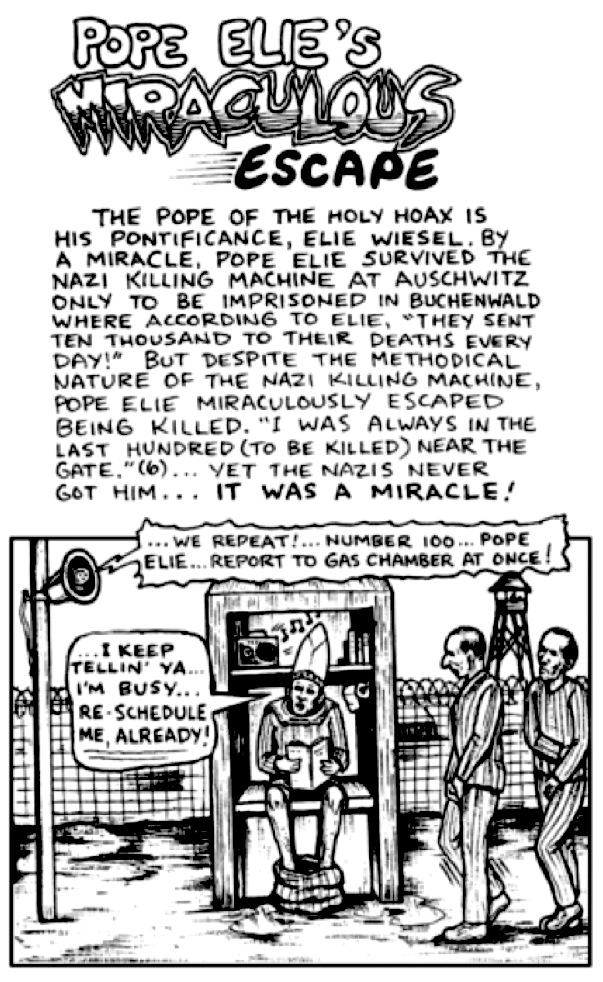
Posted in America, Christainity, Europe, Germany, Jews, Jews - Naming, National Socialism, Propaganda - Anti-German, Race, Third Reich, WW II | 3 Comments

Jews Must Live – Part 3: IS MONOTHEISM A PURELY JEWISH CONCEPTION?


Jews Must Live


Part 3


by Samuel Roth


Jews Must Live — Originally published in 1934 (New York: The Golden Hind Press, Inc.), 319 pp. First reprinted in 1964, but with 5 chapters mysteriously taken out and with further abridgment of text in chapter IV. I’m not aware of a full reprint ever being done. As far as I know, the version presented below, proofread from an original 1st edition, is the only complete and accurate version of Jews Must Live available on the Web. -JR 7/9/2005

http://www.jrbooksonline.com/roth.htm

JEWS MUST LIVE

AN ACCOUNT OF THE PERSECUTION OF THE WORLD BY ISRAEL ON ALL THE FRONTIERS OF CIVILIZATION
ILLUSTRATED BY JOHN CONRAD


ABOUT THE AUTHOR


About the author: Polish-born Jew Samuel Roth (1893 – 1974) emigrated to America with his family at the age of four. By the 1920s he was an established poet, with his work published in some major literary outlets.


At the same time, he began publishing erotica, most famously a pirated version of D. H. Lawrence’s Lady Chatterly’s Lover, which, although tame by present-day standards, landed Roth in jail on pornography charges.


Later, he began publishing real pornography and was repeatedly arrested and jailed, eventually serving around nine years behind bars all told.


His last great court case, which took place in 1957 (Roth . United States, 354 U.S. 476), redefined the Constitutional test for determining what constitutes obscene material unprotected by the First Amendment and became a template for liberalizing First Amendment decisions of the 1960s.


Written by one America’s most famous Jewish pornographer, this work provides a shocking and insightful account of Jewish attitudes towards Gentiles.


Samuel Roth first embraced Judaism and Zionism, but later blamed other Jews for his financial and legal troubles — which landed him in jail. He became so embittered with his treatment at the hands of his co-religionists that he wrote this book which he said exposed their underhanded dealings with the Gentile world.


The engrossing narrative starts with the origin of Jewish behavior, which Roth identifies as coming from the Old Testament/Talmud. Using specific examples (such as the Jewish patriarch Abraham’s pimping of his wife Sarah to blackmail neighboring Gentile tribes into handing over their possessions). Roth claims that such behavioral patterns are repeated to the present day.


This behavior, Roth says, is founded in a Jewish belief that all the world’s possessions belong to them by divine right. He then discusses the effect of Jews in law, media, medicine, prostitution, literature, arts, and much more. Also included is a fascinating section on the vow-breaking Kol Nidre prayer.


Roth also includes detailed sections on his own experience at being swindled, and concludes that ant-semitism is always the a reaction to Jewish behavior, and not the product of some irrational disposition on the part of the Gentile, as is so often claimed.


He explains his position in this way:


“I don’t think I ever shared the Jewish contempt for the goyim, which is part and parcel of all Jewish psychology.”


http://www.jrbooksonline.com/roth.htm


Chapters II, III, XIII, XVI and XVII are completely missing from the 1964 “re-published” edition.


We can only speculate as to why these chapters were taken out. The first two may have been “offensive” to “traditional” Christian types (to include the text missing from ch. IV), but the rest remains a mystery. “The Life and Death of William Faro” gets to the whole purpose of the book: that fellow Jews had cheated Roth, who wrote the book (exposing Jewish practices) in retaliation. “Farewell to Judas” is an interesting account of his adventures aboard a cruise ship, during which Roth found his true self, while the Appendix includes two rare literary works: “The Jew”, originally an article in Voltaire’s Dictionnaire Philosophique but expurgated from most editions, and a full English translation of Heinrich Heine’s “Disputation”. Incidentally, “Disputation” is referred to in “Bolshevism from Moses to Lenin”, f/n 67 (f/n 70, 1999 ed.).


Note: The expurgation of Roth’s book is mentioned by Dr. Revilo P. Oliver in his essay “The Enemy of Our Enemies”, Part II, f/n 29 and 70.


A Roth “mug shot


Testifying before a Senate subcommittee. [Text: Samuel Roth, a publisher of erotic and nudist books, in United Sates Court House, Foley Square, where he appeared yesterday before the Senate subcommittee investigating juvenile delinquency.]


“The next time you read about a particularly bloody pogrom and pause to wonder how Christians, dedicated to a religion of mercy, can exercise so much brutality against the Jews, remember that the Jew wheedles all the mercy out of his neighbors in the ordinary course of business.

He lies and cheats until he is caught. When caught, instead of accepting punishment, he moans and tears his hair, invokes the sores of ancestors in their graves and living relations at the point of death in hospitals, until the wronged gentile, nauseated, lets him go.

Then, thumbing his nose at the gentile behind his back, the Jew goes about his business the same way, lying and cheating now doubly to make up for lost time.

A pogrom is usually the climax of years of such relentless goading. Do you wonder that when the final reckoning comes the gentile is absolutely merciless?”


— Samuel Roth, Jews Must Live, Ch. XIII, p. 206, f/n 31 [expurgated chapter]


Copyright, 1934

by

THE GOLDEN HIND PRESS, INC

Dedication:

“TO THE FIRST GENERATION OF JEWS THAT WILL LEARN HOW TO PRONOUNCE MY NAME SOFTLY”


CONTENTS


I        PROLOGUE: THE GENESIS OF JEW-HATRED 11

II      THE JEW-HATRED OF GENESIS* 25

III    IS MONOTHEISM A PURELY JEWISH CONCEPTION?* 41

IV    JEW-HATRED AS A NATURAL INSTINCT 55

V.     LEOLOM TICKACH: ALWAYS TAKE 69

VI    THE BRINGING-UP OF THE LITTLE JEW 85

VII   WHAT HAVE THE JEWS CONTRIBUTED TO AMERICAN CULTURE? 99

VIII  THE JEW IN BUSINESS 111

IX    JUDAISM IS NOT A MISFORTUNE TO THE JEWS ALONE 127

X      THE JEW AS A LAWYER 143

XI    THE JEW AS A PHYSICIAN 161

XII   THE JEW AND THE LAND 175

XIII THE LIFE AND DEATH OF WILLIAM FARO* 189

XIV  THE JEWS, THE THEATRE AND THE WOMAN MARKET 223

XV    THE RAPE OF LAKEWOOD, LONG BRANCH AND ATLANTIC CITY 239

XVI   FAREWELL TO JUDAS* 255

XVII  APPENDIX: DO JEWS EMIT A PECULIAR ODOR?* 289


* Chapters missing from the 1964 “re-published” edition.


Chapter III

IS MONOTHEISM A PURELY JEWISH CONCEPTION?


What have we thus far?

The portraits of three subtle barbarians. Our forefathers, yes, but barbarians. Shrewd, careful, sinister, adventurous, bargain-driving, wily men — but barbarians just the same. It is not mentioned by the author of Genesis whether they could read or write. And so steeped are their portraits in the very blackest colors of barbarism that to suppose them to have been literate is the very wildest flight of fancy.

There they are: three old barbarians. As I look upon them I wonder how their names could have inspired the world with such awe; I wonder which of the three I dislike the least. A conclusion not difficult to reach. Much can be forgiven Abraham for his power as a warrior. Much more will be conceded to Jacob for his tenderness for the woman Rachel. But what shall redeem for us the centuries of fantastic devotion which we heaped upon the lazy, stupid swaggering figure of Isaac?

But you are forgetting, I can almost hear the rabbis object. You have not only Abraham, Isaac and Jacob. You have also Monotheism.

Ah, Monotheism! I had almost forgotten it!

I do not think the average scholar will attach much value to my opinion on the importance to civilization of the monotheistic conception of the universe. Philosophers, ethical philosophers in particular, usually rate it — the conception, of course, very highly. But these same kindly people invariably conceive of human history in terms of a cycle of progress, which is only one of the many ways in which they give expression to their delightful naiveté. As for me, the word progress itself has always appeared as a sort of inverted mirage. Nevertheless I know that the world in which we live is devoted to the idea of progress, so much so that it has made of the theory of evolution — that scientific development of the idea of progress which the late Jacques Loeb riddled so devastatingly — a sort of modern religion. This same world holds in a towering esteem the monotheistic conception of the universe. So that at the basis of every reputable historian’s work is the undisputed hypothesis that it is one of the three essential pillars of European civilization. Rome, he would solemnly have you believe, gave the world its laws. Athens, its arts. Jerusalem, monotheism.

It is clear that these historians build not out of what they know but of what they have been told. It is an exercise in mortification to observe them at their work. They go to the library for the bare facts, and no one can find fault with the ardor with which they pursue their studies. But when it comes to reaching the very simplest conclusion — which alone could justify their labors — they go for it to their church.

First observation: God has never offered himself in the same form to two races. To one race he has appeared in the form of the stump of a tree. To another as the sun; to still another as the moon. De­pending on the nature of the recipient of the vision, God has ap­peared as a bull, a cow, a tiger, a donkey, a creature with two heads, one a lion, the other a dog; to another race, with an instinctive reluc­tance to bother with expensive images, he appeared totally invisible.

Second observation: The meaning of God has never been the same to two races of mankind. To one race he would appear as the creator of a universe the gradual dissolution of which was to him a matter of amused indifference. To another he was a vengeful demon who was continually stayed from destroying it, only by the most lavish sacrifices offered up to him by men. Man, like God, creates in his own image. And Zeus is as peculiar to the Romans as Jupiter is to the Greeks.

Now nothing has a more obvious stamp of truth than the assertion that everything in an organic universe goes back to one primal seed out of which all the known forms of life sprouted and developed. Once you have conceded this singular genesis, it is almost gratifying to personify it and endow this personality with the charm, power and humor of an omnipotent creator. And yet, except to be used by one class of people as a symbol by which to dominate another, of what use to mankind is this fictitious centralized deity?

Someone should make a creditable beginning of the denial of monotheism before the imagination of the race is completely destroyed by it. As a matter of fact, life does manifest itself to our senses in many different forms. The best we can see for the beginning of any form of life is some accident in space to which it might be traced by a wisdom as yet unknown to us. Why, therefore, should we con­fine all of the phenomena of life to one major accident! Why could there not have been many accidents, quite unrelated to one another?

But, to return to the original question, why cannot the historians go for their conclusions to the facts which they investigate so zealously?

If the footnotes with which these historians strew the margins of their texts tell an honest story, they do a great deal of varied reading and research. Yet you do not have to go very far into historic origins to recognize that every ancient literature embodies, in one form or another, the monotheistic idea. Indeed, many works based on it antedate the writings of Deutor-Issaiah (in whom the Jewish conception reaches a measure of clearness and sincerity) by a thou­sand years and more. Zarathustra who lived some time in 800 B.C., and might almost be said to have been a contemporary of Issaiah’s, certainly expressed the same idea in much loftier if less passionate imagistic speech. Why, then, is Jerusalem credited with monotheism? Partly because, while the disciples of Zarathustra tended to their home-fires in India and Arabia, the Jews, through Mohammed and Jesus, shot the idea of one God to the north and the south of the Mediterranean. But chiefly because the Jews themselves, Torah in hand, and the cry, Hear O Israel, the Lord our God, the Lord is One on their lips, insinuated Monotheism into every nook and cranny of the earth. True or not, the belief that monotheism sprang forth from the racial genius of the Jews has become so common that even the official enemies of the Jews and some of them, such as G. K. Chesterton and Hillaire Belloc, should know better, — do not trouble to deny it. Their attitude seems to be that it would be much simpler to deny altogether the value of monotheism and create a better repute for the virtues of paganism, than to try to wrest this brass laurel from the crown of Israel.

There have been, as a matter of fact, two dissenting voices, voices ventured forward so meekly, that they have scarcely been heard; the voice of Ernest Renan, who spent a lifetime on Semitic studies only to discover when he was too old to turn to anything else, that the whole matter (learning and people) were exceedingly distasteful to him; and the voice of William Robertson Smith, a Scottish theologian whose only radical departure from custom was to occasionally drop the William from his name.

Renan cautiously propounded the theory that monotheism was really an instinct, and that a Semitic one; therefore the universal belief that it was inimical to the Hebrew race should be modified. Smith, who probably never gained access to the writings of his delicate French contemporary, brings his even more dilatory argument to a head with the suggestion that “what is often described as a natural tendency of Semitic religion toward ethical monotheism is in main nothing more than a consequence of the alliance of religion and monarchy.”

Of the Jews themselves, however, the attitude of Rabbi David Phillipson is typically cocksure:

The Hebrews alone of all Semitic peoples reached the stage of pure monotheism through the teachings of their prophets; however, it required centuries of development before every trace of idolatry disappeared even from among them, and before they stood forth as ‘a unique people on earth,’ worshippers of the God, and Him alone.

We must, however, get ourselves a more impartial definition of monotheism than the pronouncement of this pompous rabbi. We find one in the essays of Dr. George Galloway who describes monotheism as “the ripest expression of the religious consciousness. It rests on the conviction that the ethical and religious values must have a sufficient ground and, this is the one God on whom all existence and value depend.”

A good definition this. Probably as good a one as will ever be offered. I had this definition in mind while going through the Old Testament again. During a rather careful rereading in which it became increasingly clear to me that I was the book’s first intelligent reader in two thousand years. [12] I find that, with the exception of the first eleven chapters of Genesis, which might or might not have been writ­ten by a Jew, there is not much more than an occasional hint of the monotheistic idea to be found in this whole structure of Judges, Kings and Prophets. The conception of God in the first eleven chapters of Genesis is singularly lofty.[13] After that, it becomes the portrait of an ordinary tribal god; except that in none of the chronicles of tribal gods that have come within my reading range, have I encountered a tribal god as cruel, jealous, lustful, mean, lying, cheating and treacherous, as that great little guinea pig the God of Israel.

___________________

[12] It would here be to the point to remind the reader that for nearly three hundred years millions of intelligent people read and recited the most famous of Shakespeare’s sonnets in the belief that they were addressed to a woman. The discovery that they were written to a man — and could not possibly have been inspired by a woman — was not made till the very end of the nineteenth century.

[13] This is the only drawback to the theory that Genesis is really two narratives blended into one. How can two men of such imaginativeness have written at the same time and in the same country?


The very opening words of the twelfth chapter of Genesis begin to set the character of the God of Israel:

Now the Lord said unto Abram: ‘Get thee out of thy country, and from thy kindred, and from thy father’s house, unto the land, that I will show thee. And I will make thee a great nation, and I will bless thee and make thy game great; and be thou a blessing. And I will bless them that bless thee, and him that curseth thee will I curse; and in thee shall all the families of the earth be blessed.”

To be a true and just God, in accordance with the monotheistic ideal, God would have to be aloof from all men. So it is a bit surprising that his first human announcement should be that he has made to alliance with a man. More regrettably, no reason is assigned for his selection of Abraham for such an important business: it seems an affair like love at first sight, where the object has as yet to prove worthiness. But there is here one touch of true monotheism; for, be God’s reasons for choosing Abraham sufficient or not, He does promise that;

in thee shall all the families of the earth be blessed.”

The promise continues in the fourteenth verse of the next chapter:

And the Lord said unto Abram, after that Lot was separated from him: ‘Lift up now thine eyes, and look from the place where thou art, northward and southward and eastward and westward; for all the land which thou seest, to thee will I give it and to thy seed forever. And I will make thy seed as the dust of the earth; so that if a man can number the dust of the earth, then shall thy seed also be numbered. Arise, walk thou through the land in the length of it and in the breadth of it; for unto thee will I give it.”

It is only natural, if God has chosen to work his wonders for the rest of the world through Israel, that the latter should be endowed with some fertile territory to develop in. But in the opening of the fifteenth chapter the operations of the Lord become definitely suspicious:

After these things the word of the Lord came unto Abram in a vision, saying: ‘Fear not, Abram, I am thy shield, thy reward shall be exceeding great.’”

If Israel is to become a blessing for the nations, what evils would there be to shield Israel from? And why this offer of an excessive reward, as if it were not a reward but a bribe? What are Israel’s labors to consist of? In return for what particular favors to the Lord are such lavish favors being offered?

The Lord’s frankness to his dearly beloved chosen ones increases. In the opening words of the fifteenth chapter we get a rather definite intimation of what the Lord expects of his people Israel.

And he said unto Abram: ‘Know of a surety that thy seed shall be a stranger in a land that is not theirs and shall serve them; and they shall afflict them four hundred years; and also that nation whom they shall serve, will I judge; and afterward shall they come out with great substance.’

Can the last words of this momentous passage mean what they appear to tell on the surface? Is God really promising Abraham that some day the nation to develop out of his seed will be permitted by the Lord to loot a nation that is not their own? If there is any doubt that the meaning is precisely what appears on the surface of God’s words, it is dispelled by verse nineteen of the third chapter of Exodus:

And I know that the King of Egypt will not give you leave to go,” God says to Moses, “except by a mighty hand. And I will put forth My hand, and smite Egypt with all My wonders which I will do in the midst thereof. And after that he will let you go. And I will give this people favor in the eyes of the Egyptians. And it shall come to pass that, when ye go, ye shall not go empty; but every woman will ask of her neighbor, and of her that sojourneth in her house, jewels of silver, and jewels of gold; and raiment; and ye shall put them upon your sons, and upon your daughters; and ye shall spoil the Egyptians!

When an English novelist, Charles Dickens, portrayed in a great novel, Oliver Twist, a Jew named Fagin, instructing little English boys in the art of pocket-kerchief snatching, a howl of protest went up from universal Jewry that resounded through every corner of the civilized world. Dickens was excoriated as a liar and a Jew-hater. The book, one of the most beautiful in all literature, was declared to be a nasty, deliberatively venomous slander of a noble, long suffering race. But when it is our own sacred book of record, instructing our children in the very lowest possible way to rob their neighbors it is to be regarded as sacred scripture and unimpeachable evidence of the nobility of our racial character.

But you do not have to wait till Exodus to discover the true character of the God of Israel, to realize what a palpable sham and hollow pretense is this promise of his, through the goodness of Israel to bless the families of the earth. In his first and only interview with Isaac, the second of that great thievish triumvirate, [14] he betrays what is his real attitude towards the rest of the nations:

And Isaac went unto Abimelech king of the Philistines unto Gerar. And the Lord appeared unto him and said: ‘Go not down into Egypt; dwell in the land which I shall tell thee of. Sojourn in this land, and I will be with thee, and will bless thee; for unto thee, and unto thy seed, I will give all these lands, and I will establish the oath which I swore unto Abraham, thy father.”

___________________

[14] God, it would seem, had no better opinion of Isaac than did his father Abraham. For, having once addressed him, he never troubled himself with Isaac again.


This land in which the blessers of the world were to develop their peculiar talents was to be taken away, stolen outright, not in the name of any political or commercial treaty, but in the name of a mysterious arrangement with the divinity, from the people who had cultivated it and who were still in peaceful possession of it.

But,” I can hear a pompous rabbinical voice intervening, “these Canaanites were just so many pagans, and unworthy of a land as fruitful as Palestine.”

The Old Testament here is a deadly witness against the integrity of the God of Israel, and especially against the cynical Jewish claim that the best proof of Israel’s superiority over the rest of the nations of the earth is in Israel’s survival. Yes, Israel did eventually conquer all of Canaan and put most of its inhabitants to the sword. But compare the Hebrews described thus far, with the people ruled by Abimelech, King of the Philistines. How pure and beautiful they appear to be, compared with the Jews, especially in that marvelous line spoken by Abimelech, after he had caught Isaac disporting himself in public with the woman he had pretended was his sister. Instead of just kicking Isaac out of his domain as he might very well have done without any difficulty, he turned to him and said:

What is this that thou hast done unto us? One of my people might easily have lain with thy wife, and thou wouldst have brought guiltiness upon us.

If there is a nobler, more moral speech in the literature of the world I have not come across it. It certainly shows that these Canaanites were more sensitive to fine moral values than even the most loquacious of the Hebrew prophets. If the Jews survived, as they did, a people so much nobler than themselves, what is there left to say for the virtues of mere survival?

The only Jewish effort to explain away this horrible enigma was made in his vast history of the Jews by Professor Heinrich Graetz. Graetz tried, in a half-hearted round-about way, to develop a rationale for the Jewish claim to the lands of the Canaanite nations. “These claims,” he wrote, “derived further strength from the tradition left by the patriarchs to their descendants as a sacred bequest, that the Deity, whom they had been the first to recognize, had repeatedly and indubitably, though only in visions, promised them this land as their possession, not merely for the sake of showing them favor, but as the means for attaining a higher degree of culture. This culture would frequently consist in Abraham’s doctrine of a purer belief in the One God, whose nature differed essentially from that of the gods whom the various nations represented in the shape of idols and by means of other senseless conceptions. The higher recognition of the Deity was designed to lead Abraham’s posterity to the practice of justice towards all men, in contradiction to the injustice universally prevailing in those days.”

This is a very remarkable paragraph. If I had it in my power, I would post it on the door of every synagogue in the world. For it embodies in a few innocently meant words almost every form and species of our peculiar Jewish hypocrisy.

To begin with:


1. There is the remarkable assertion (put forth so brazenly that, offhand, no one would think of disputing it) that the Jews were the first people in the world to conceive of the idea of a One God Universe. When you remember that this was an illiterate and unlettered people born into a world already vastly enriched by every species of literature, that their first exercise in writing was in Chaldean (the Yiddish of their time), with centuries to elapse before they would develop their own language, the conceit is too pitiable even to laugh at.

2. That the conception of the One God as a God of justice and mercy was an innovation that was not only Jewish but would have been impossible of conception except by Jews. This of a people born in bastardies, weaned on pillage, and brought to the estate of a nation in a state of such constant butchery that the average life of their kings on a throne was something like two and a half years.

3. That religious belief is the very highest form of culture, that there cannot be any culture outside of faith and prayer.

4. That for the expression of a profoundly divine idea, gossip is more effective than the art of sculpture. The Old Testament itself is replete with expressions of contempt for images, those painted as well as those molded out of wet clay. It would have been a relief to find in a people, deprived of the privilege of sharing so much loveliness, at least a sincere expression of regret. But no, Jews must take pride in their aesthetic castration as far forward as the end of the nineteenth century.

5. That the covenant between Abraham and God was an unselfish one, aimed at the enrichment not of Israel but of the world of nations about him.

And lastly:

6. That before the appearance of the Jews, the world was a den of vice and iniquity. Abraham, Graetz would have you believe, caught the first human glimpse of God, and with the opening of his eyes let the first ray of good dawn on an unborn moral world.


What Graetz and the rest of the Jewish apologists today call the Jews’ very own peculiar monotheism (without a murmur of protest from a stupefied world), began life two thousand years ago as a simple but totally incredible explanation of the unwarranted stealing of a peaceful country by a horde of savages. The explanation of seizure by divine inspiration was not a new one to the world. It had already grown old with mankind when it was put forth. But once offered, the credulity with which it has been met is truly amazing. Never before had national thieving been brought to such a high estate and rendered so precious in the annals of man.

I believe I have shown how little there was in the history of the Jews before Moses to justify the world’s even entertaining the idea of their divine choice as the chosen people of God. What do we find after the advent of Moses?

In one Midianite camp alone, the Lord God supervised the capture of six hundred and seventy-five thousand sheep, seventy-two thousand oxen, sixty-one thousand asses, and thirty-two thousand virgins. All the men, and all the wives, and all the male children were massacred; the girls and the booty were divided between the Jews and their Lord God.

In Jericho, at the instigation of Joshua, who was impatient with details, the Lord of Israel placed an anathema over the whole population. He massacred them all, virgins and asses alike, and spared only the harlot Rahab for sheltering the Jewish spies who had reached there in advance of this sacred expedition.

A whole tribe, or almost all of it, was slaughtered in civil war at one time, without anyone raising a finger to stop it.

Twenty six nations in all were conquered by this great and just Lord God. For one of them, Amalak, whose sin was that they had the insolence to dispute the Jews’ invasion of Canaan by way of their own territory, God conceived such a deadly hatred of that he ordered the wholesale destruction of the nation, men, women, children and cattle, that even their remembrance might fade out under the heavens.

All this towards what end! That the Jews might be able to beset the plains of Canaan with a national life that had not a single artistic grace to relieve its monotonous and fearful ugliness.

You have here a portrait not only of the God of Israel but of his chosen people as well. Man, like God, creates in his own image.


—————————————————————-


Click a link to go to >

Jews Must Live Part 1 – PROLOGUE: THE GENESIS OF JEW-HATRED

Jews Must Live Part 2 – THE JEW-HATRED OF GENESIS

Jews Must Live Part 3 – IS MONOTHEISM A PURELY JEWISH CONCEPTION?

Jews Must Live Part 4 – JEW-HATRED AS A NATURAL INSTINCT

Jews Must Live Part 5 – LEOLOM TICKACH: ALWAYS TAKE

Jews Must Live Part 6 – THE BRINGING-UP OF THE LITTLE JEW

Jews Must Live Part 7 – WHAT HAVE THE JEWS CONTRIBUTED TO AMERICAN CULTURE?

Jews Must Live Part 8 – THE JEW IN BUSINESS

Jews Must Live Part 9 – JUDAISM IS NOT A MISFORTUNE TO THE JEWS ALONE

Jews Must Live Part 10 – THE JEW AS A LAWYER

Jews Must Live Part 11 – THE JEW AS A PHYSICIAN

Jews Must Live Part 12 – THE JEW AND THE LAND

Jews Must Live Part 13 – THE LIFE AND DEATH OF WILLIAM FARO

Jews Must Live Part 14 – THE JEWS, THE THEATRE AND THE WOMAN MARKET

Jews Must Live Part 15 – THE RAPE OF LAKEWOOD, LONG BRANCH AND ATLANTIC CITY

Jews Must Live Part 16 – FAREWELL TO JUDAS

Jews Must Live Part 17 (last) – APPENDIX: DO JEWS EMIT A PECULIAR ODOR?


PDF of this post. Click to view or download (1.6 MB) >> Jews Must Live -Part 03


Version History


Version 2: Mar 15, 2021 – Updated Cover image. Re-uploaded images and PDF for katana17.com/wp/ version. Improved formatting.


Version 1: Published Jan 8, 2015
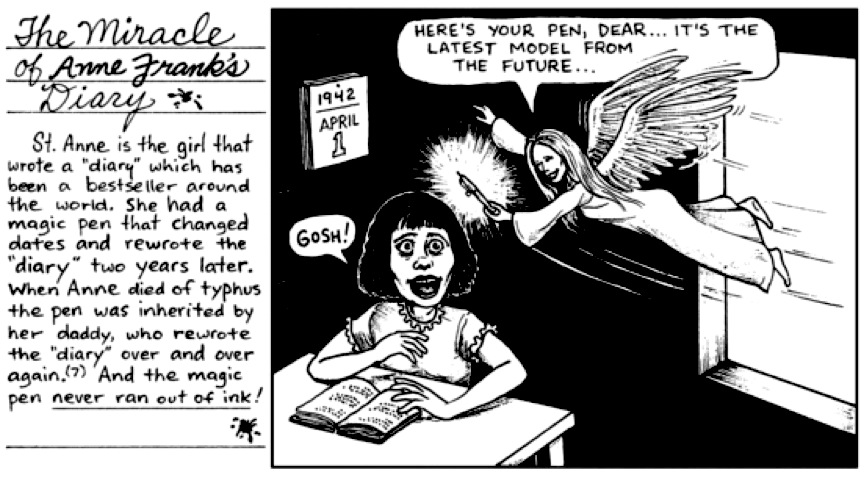
Posted in America, Christainity, Europe, Germany, Jews, Jews - Naming, National Socialism, Propaganda - Anti-German, Race, Third Reich, WW II | 4 Comments

Jews Must Live – Part 2: THE JEW-HATRED OF GENESIS


Jews Must Live


Part 2


by Samuel Roth


Jews Must Live — Originally published in 1934 (New York: The Golden Hind Press, Inc.), 319 pp. First reprinted in 1964, but with 5 chapters mysteriously taken out and with further abridgment of text in chapter IV. I’m not aware of a full reprint ever being done. As far as I know, the version presented below, proofread from an original 1st edition, is the only complete and accurate version of Jews Must Live available on the Web. -JR 7/9/2005

http://www.jrbooksonline.com/roth.htm

JEWS MUST LIVE

AN ACCOUNT OF THE PERSECUTION OF THE WORLD BY ISRAEL ON ALL THE FRONTIERS OF CIVILIZATION
ILLUSTRATED BY JOHN CONRAD


ABOUT THE AUTHOR


About the author: Polish-born Jew Samuel Roth (1893 – 1974) emigrated to America with his family at the age of four. By the 1920s he was an established poet, with his work published in some major literary outlets.


At the same time, he began publishing erotica, most famously a pirated version of D. H. Lawrence’s Lady Chatterly’s Lover, which, although tame by present-day standards, landed Roth in jail on pornography charges.


Later, he began publishing real pornography and was repeatedly arrested and jailed, eventually serving around nine years behind bars all told.


His last great court case, which took place in 1957 (Roth . United States, 354 U.S. 476), redefined the Constitutional test for determining what constitutes obscene material unprotected by the First Amendment and became a template for liberalizing First Amendment decisions of the 1960s.


Written by one America’s most famous Jewish pornographer, this work provides a shocking and insightful account of Jewish attitudes towards Gentiles.


Samuel Roth first embraced Judaism and Zionism, but later blamed other Jews for his financial and legal troubles — which landed him in jail. He became so embittered with his treatment at the hands of his co-religionists that he wrote this book which he said exposed their underhanded dealings with the Gentile world.


The engrossing narrative starts with the origin of Jewish behavior, which Roth identifies as coming from the Old Testament/Talmud. Using specific examples (such as the Jewish patriarch Abraham’s pimping of his wife Sarah to blackmail neighboring Gentile tribes into handing over their possessions). Roth claims that such behavioral patterns are repeated to the present day.


This behavior, Roth says, is founded in a Jewish belief that all the world’s possessions belong to them by divine right. He then discusses the effect of Jews in law, media, medicine, prostitution, literature, arts, and much more. Also included is a fascinating section on the vow-breaking Kol Nidre prayer.


Roth also includes detailed sections on his own experience at being swindled, and concludes that ant-semitism is always the a reaction to Jewish behavior, and not the product of some irrational disposition on the part of the Gentile, as is so often claimed.


He explains his position in this way:


“I don’t think I ever shared the Jewish contempt for the goyim, which is part and parcel of all Jewish psychology.”


http://www.jrbooksonline.com/roth.htm


Chapters II, III, XIII, XVI and XVII are completely missing from the 1964 “re-published” edition.


We can only speculate as to why these chapters were taken out. The first two may have been “offensive” to “traditional” Christian types (to include the text missing from ch. IV), but the rest remains a mystery. “The Life and Death of William Faro” gets to the whole purpose of the book: that fellow Jews had cheated Roth, who wrote the book (exposing Jewish practices) in retaliation. “Farewell to Judas” is an interesting account of his adventures aboard a cruise ship, during which Roth found his true self, while the Appendix includes two rare literary works: “The Jew”, originally an article in Voltaire’s Dictionnaire Philosophique but expurgated from most editions, and a full English translation of Heinrich Heine’s “Disputation”. Incidentally, “Disputation” is referred to in “Bolshevism from Moses to Lenin”, f/n 67 (f/n 70, 1999 ed.).


Note: The expurgation of Roth’s book is mentioned by Dr. Revilo P. Oliver in his essay “The Enemy of Our Enemies”, Part II, f/n 29 and 70.


A Roth “mug shot


Testifying before a Senate subcommittee. [Text: Samuel Roth, a publisher of erotic and nudist books, in United Sates Court House, Foley Square, where he appeared yesterday before the Senate subcommittee investigating juvenile delinquency.]


“The next time you read about a particularly bloody pogrom and pause to wonder how Christians, dedicated to a religion of mercy, can exercise so much brutality against the Jews, remember that the Jew wheedles all the mercy out of his neighbors in the ordinary course of business.

He lies and cheats until he is caught. When caught, instead of accepting punishment, he moans and tears his hair, invokes the sores of ancestors in their graves and living relations at the point of death in hospitals, until the wronged gentile, nauseated, lets him go.

Then, thumbing his nose at the gentile behind his back, the Jew goes about his business the same way, lying and cheating now doubly to make up for lost time.

A pogrom is usually the climax of years of such relentless goading. Do you wonder that when the final reckoning comes the gentile is absolutely merciless?”


— Samuel Roth, Jews Must Live, Ch. XIII, p. 206, f/n 31 [expurgated chapter]


Copyright, 1934

by

THE GOLDEN HIND PRESS, INC

Dedication:

“TO THE FIRST GENERATION OF JEWS THAT WILL LEARN HOW TO PRONOUNCE MY NAME SOFTLY”


CONTENTS


I        PROLOGUE: THE GENESIS OF JEW-HATRED 11

II      THE JEW-HATRED OF GENESIS* 25

III    IS MONOTHEISM A PURELY JEWISH CONCEPTION?* 41

IV    JEW-HATRED AS A NATURAL INSTINCT 55

V.     LEOLOM TICKACH: ALWAYS TAKE 69

VI    THE BRINGING-UP OF THE LITTLE JEW 85

VII   WHAT HAVE THE JEWS CONTRIBUTED TO AMERICAN CULTURE? 99

VIII  THE JEW IN BUSINESS 111

IX    JUDAISM IS NOT A MISFORTUNE TO THE JEWS ALONE 127

X      THE JEW AS A LAWYER 143

XI    THE JEW AS A PHYSICIAN 161

XII   THE JEW AND THE LAND 175

XIII THE LIFE AND DEATH OF WILLIAM FARO* 189

XIV  THE JEWS, THE THEATRE AND THE WOMAN MARKET 223

XV    THE RAPE OF LAKEWOOD, LONG BRANCH AND ATLANTIC CITY 239

XVI   FAREWELL TO JUDAS* 255

XVII  APPENDIX: DO JEWS EMIT A PECULIAR ODOR?* 289


* Chapters missing from the 1964 “re-published” edition.


Chapter II


THE JEW-HATRED OF GENESIS


The scrolls unroll before me.

In the beginning God created the heavens and the earth. And the earth was unformed and void, and darkness was on the face of the deep.

The very first words I ever read. They are still the most beautiful words I know. Baaraishes buroo Elohim as kashamayimm vehu-uretz. Vehu-urtez hoysu sehoi uvohoi, vechoischach aal penai tekoim.” That is how the words actually sounded. I read on through the unfolding scrolls, from the first word to the last, and the ancient wonder stirs into music for me again. Good, deep, true lovely old book. It tells a straightforward honest story. None of the illusions, following which I almost broke my neck, are here. Only the rabbis lied to me.

The first time I heard the words, of the poet-author of Genesis it was from the mouth of my father, and I revered him as if he were himself their author. My father’s father was a great man in the country in which I was born: I heard him recite Hebrew words one Yom Kippur night, and he wavered like a great god with wings between the two tall taper lights on each side of the Ark of the Cove­nant. My father had three brothers, each as tall and as stalwart as himself: occasionally Hebrew words would emanate from them, and they appeared to grow into godhood in front of my eyes. They are all dead now except one. I realized long before they died that they were not gods. My father’s father, his father before him, and all the Jewish fathers yielding all the way back to Abraham the father of them all — they were all Jews, far, far from gods.

[Page 25]

No one knew this better than that wise poet-author of Genesis — now that I have learned how to read him correctly.

And there was a famine in the land,” he relates, “and Abram went down into Egypt to sojourn there: for the famine was sore in the land. And it came to pass when he was come near to enter into Egypt that he said unto Sarai, his wife: Behold now, I know that thou art a fair woman to look upon. And it will come to pass when the Egyptians will see thee, that they will say: ‘This is his wife,’ and they will kill me, but thee they will keep alive. Say, I pray thee, thou art my sister; that it may be well with me for thy sake, and that my soul may live because of thee. And it came to pass, that, when Abram was come into Egypt, the Egyptians beheld the woman that she was very fair. And the princes of Pharaoh saw her, and praised her to Pharaoh; and the woman was taken into Pharaoh’s house. 

And he dealt well with Abram for her sake; and he had sheep, and oxen, and he-asses, and men-servants and maid-servants, and she-asses and camels. And the Lord plagued Pharaoh and his house with great plagues because of Sarai Abram’s wife. And Pharaoh called Abram and said: ‘What is this that thou hast done unto me? Why didst thou not tell me that she was thy wife? Why saidst thou; She is my sister? so that I took her to be my wife; now therefor behold thy wife, take her, and go thy way! And Pharaoh gave men charge concerning him; and they brought him on the way, and his wife, and all that they had. And Abram went up out of Egypt, he, and his wife and all that he had, and Lot with him, into the South. And Abram was very rich in cattle, in silver, and in gold.” [3]

Apparently these words describe one of the very early stages in the career of this nomad chieftain to whom the blood of our race rolls back. By the evidence of the little (practically nothing outside of his wife’s beauty) he brought along with him to Egypt, Abraham was rich only in his dreams of the future. Else — supposing, as we have no right to, that he had a strength such as is not represented by worldly goods — why should he have been afraid of Pharaoh? But there can be no misunderstanding the nature of this little jaunt of Abraham’s. It was only one of several such raids told with cynical politeness as to detail by the author of Genesis. There probably were more raids which it was pointless to record. One thing is certain: those visits were not motivated by friendliness.


[3] All Biblical quotations in this book are from the Jewish Publication Society translation, accepted by the Jews as the most faithful to the original Hebrew, obtainable in English.

[4] Even the bare pretense that this is done for fear of his life is abandoned in the telling of the second adventure.


According to the most reliable historians of that period the nomads wandered through many countries, sometimes by pre-arrangement with those countries, but more frequently in the spirit of sheer invasion. The historian of the Encyclopaedia Brittanica says:

In times of draught and food-shortage such nomads as these . . . were compelled to raid their agricultural, settled neighbors.

But in that first recorded trip to Egypt, Abraham, of whom the ancient historian Nicolaus of Damascus wrote that he “came with an army out of the land above Babylon” and “reigned at Damascus,” was not yet strong enough to enrich himself by violence. There are, however, more ways than one of making conquest. The one chosen by Abraham, and resulting in his being laden by Pharaoh with presents for the favors of his beautiful wife, has become a very popular occupation. Apparently, also, few of the tricks in the game as it is played today were unknown to Abraham. How else are we to understand these words in Genesis

The Lord plagued Pharaoh and his house with great plagues because of Sarai Abram’s wife.

I cannot accept the popular anti-Semitic interpretation that Abraham and his wife suffered of a venereal disease. On the contrary I do not think anything physical is implied here at all. Whenever he means to convey the idea of a physical ailment the poet of Genesis is always at great pains to name it. Here he merely says that the Lord plagued Pharaoh and his house. Is it too rash to assume that this plague sounds a little more like blackmail than syphilis? Or why, if this is not true, is the poet at pains to explain that when Abraham returned with his family out of Egypt he;

was very rich in cattle, in silver and in gold.”

That Abraham, having discovered this new racket, decided to practice it further, becomes apparent when he repeats the adventure in a similar manner before the king of another people.

And Abraham journeyed from thence toward the land of the South and dwelt between Kadesh and Gerar. And Abraham said of Sarah and his wife: ‘She is my sister. [4]

And Abimelech King of Gerar sent, and took Sarah. But God came to Abimelech in a dream of the night, and said to him: ‘Behold, thou shalt die, because of the woman that thou hast taken; for she is a man’s wife! Now Abimelech had not come near her; and he said: ‘Lord, wilt thou slay even a righteous nation? Said he not himself unto me: she is my sister? and she, even herself said: He is my brother. In the simplicity of my heart and the innocency of my hands have I done this!

And God said unto him in the dream: ‘Yea, I know that in the simplicity of thy heart hast thou done this, and also witheld thee from sinning against Me. Therefore suffered I thee not to touch her. Now therefore restore the man’s wife; for he is a prophet, and he shall pray for thee, and thou shalt live; and if thou restore her not, know that thou shalt surely die, thou, and all that are thine.’ And Abimelech rose early in the morning, and called all his servants, and told them all these things in their ears; and the men were sore afraid. 

Then Abimelech called Abraham, and said unto him: ‘What hast thou done unto us? and wherein have I sinned against thee, that thou hast brought on me and on my kingdom a great sin? thou hast done deeds unto me that ought not to be done! And Abimelech said unto Abraham: ‘What sawest thou that thou hast done this thing?’ And Abraham said: ‘Because I thought: Surely the fear of God is not in this place: and they will slay me for my wife’s sake. 

And moreover, she is indeed my sister, the daughter of my father, but not the daughter of my mother; and so she became my wife. And it came to pass when God caused me to wander from my father’s house, that I said unto her: ‘This is thy kindness which thou shalt show unto me; at every place whither we shall come, say of me: he is my brother.’ And Abimelech took sheep, and oxen, and men-servants and women-servants, and gave them unto Abraham, and restored him Sarah his wife. And Abimelech said: ‘Behold, my land is before thee: dwell where it pleaseth thee! And unto Sarah he said: ‘Behold I have given thy brother a thousand pieces of silver; behold, it is for thee a covering of the eyes [5] to all who are with thee; and before all men thou art righted.’”  


[4] Even the bare pretense that this is done for fear of his life is abandoned in the telling of the second adventure.

[5] ‘Covering of the eyes’ the oriental expression for ‘hush-money.’


Abraham became a really rich man. There was too much for him to lose now if having tried this little game, it should happen to fail. Besides, having had the greater means, there were other grander schemes to work. The story of Abraham becomes eloquent with intrigues and alliances between himself and other desert bandits and — God. He solemnly announces his allegiance to a new Deity, and, probably to economize on the expensive materials which went into the making of idols, and to save himself the trouble of having to cart them about with him in the desert, he invented God’s in-corporeality. This carried him far into the esteem of his gaping contemporaries. Only one thing seemed to trouble him: the lack of a son to inherit the spoils and found a new nation in his name, as he had promised himself in his dreams. Genesis reports that Abraham was not really very particular. Finding himself too old to beget children of his own, Abraham was quite content to let Ishmael, a son by his wife’s servant Hagar, to be his heir. If the passion of the narrative here is to be trusted, Abraham was more than ordinarily fond of Ishmael. But Sarah had never forgiven Hagar for laughing at her, and as she hated Hagar she loathed Hagar’s offspring. No, under no circumstances was that obnoxious handmaiden of hers to fall heir to the name and riches of Abraham. Rather, since Abraham was too old for the hope of a child by him, would it be a son of her own by the seed of another man which might fructify within her [6]. Nothing is clearer in the book of Genesis than that Sarah was a shrew, and that Abraham was a henpecked husband.

The stream of the narrative in Genesis is often turbulent and unclear because it is really two narratives blended into one, with spots where the process of blending was not so successfully accomplished. But the unfolding of the strange circumstances leading to the birth of Isaac is not the result of this difficulty. It must have been told quite honestly by the author (or authors) of Genesis; but it was ob­viously tampered with by those Hebrew scholars in Alexandria who committed most of the mischief in Biblical exegesis. Here is the passage as it is given to us today:

And the Lord appeared unto him (Abraham) by the terebinths of Mamre, as he sat in the text door in the heat of the day; and he lifted his eyes and looked, and lo, three men stood over against him; and when he saw them, he ran to meet them from the tent door, and bowed down to the earth, and said: ‘My LORD, if now I have found favor in thy sight, pass not away, I pray thee, from thy servant. Let now a little water be fetched, and wash your feet and recline yourself under the tree. And I will fetch a morsel of bread, and stay ye your heart; after that ye shall pass on; forasmuch as ye are come to your servant.’ And they said: ‘So do as thou hast said.’ And Abraham hastened into the tent unto Sarah, and said: ‘Make ready quickly three measures of fine meal, knead it and make cakes! And Abraham ran unto the herd, and fetched a calf tender and good, and gave it unto the servant; and he hastened to dress it. And he took curd, and milk, and the calf which he had dressed, and set it before them and he stood by them under the tree, and they did eat. 

And they said unto him: ‘Where is Sarah thy wife?’ And he said: ‘Behold, in the tent,’ And he said: ‘I will certainly return to thee when the season cometh round; and lo, Sarah thy wife, shall have a son! And Sarah heard in the tent door, which was behind him. Now Abraham and Sarah were old, and well stricken in age; it had ceased to be with Sarah after the manner of women. And Sarah laughed within herself, saying: ‘After I have waxed old shall I have pleasure [7] my lord being old also?’ And the Lord said unto Abraham: ‘Wherefore did Sarah laugh, saying: Shall I of a surety bear a child, who am old? Is anything too hard for the Lord? At the set time I will return unto thee ‘ when the, season cometh round, and Sarah shall have a son! Then Sarah denied, saying: ‘I laughed not,’ for she was afraid. And He said: ‘Nay but thou didst laugh!


[6] A barren woman is a firm believer in her husband’s barrenness.

[7] The issue is whether Abraham shall have an heir. But notice what the old bitch is thinking about.


Until the very last bantering words it is wildly possible that a story as gravely beautiful, as poetically sincere as Genesis might have confused humanity and divinity so badly. But would even the most rabid apologist for Abraham and our national pride insist that the Lord carried on such petty and utterly useless banter with the woman Sarah?

Notice that three people appear before Abraham. Three people are fed by him, and fed “to stay the heart,” an expression that would never have occurred to the original author if he tried to convey the impression that Abraham knew he was entertaining the Lord himself. But Abraham, you will notice, carries on his conversation with only one. The expurgators of the Bible who here did their best to veil the clear sense of the narrative, would have you believe that the trio consisted of God and two of his angels. Nothing concerning their nature is said or hinted in the first part of the narrative here quoted. But in the next part, when, their leader having remained behind to converse with Abraham, the two are described entering the city of Sodom, the Alexandria meddlers seem to have made up their minds, and those who are described as men in Chapter 18 are definitely referred to as angels in Chapter 19. This inconsistency is made plausible by the fact that the Hebrew word maluchim means both angels and messengers.

Now to any intelligent unprejudiced reader it should become obvious from the fact that Abraham greets three visitors and holds conversation with only one, that the one was some important local chieftain, on his way to prosecute an important business and that the two who accompanied him were his bodyguards. To prove that these two were servants and not angels, it is only necessary to prove that their master was a man, and not God. The Hebrew text, so inexpertly tampered with, proves this conclusively. The word Lord is written in two ways in Hebrew. When intended to denote the Deity it is spelled Yahwah, and pronounced Adenoi. But when the word is intended to denote a human master the word Adenoi is spelled as it is pronounced. In that part of the narrative where I reproduced the word LORD in capitals, the expurgators of Genesis — who faltered so frequently in their mystifications — spelled the word Adenoi, as appertaining to a man.

Instead of being, what it has been made to appear, a meeting between Abraham and God, the incident is merely that of a meeting between Abraham and one of his more powerful neighbor chieftains. His message to Abraham is in effect:

Obviously, Abraham, you are not a man to trifle with. One capable of inventing your particular monstrosity of a god, should be consulted on all important desert matters. Well, I don’t like the behavior of the people in Sodom. I understand the lovemaking of man and woman because it is sweet and fruitful. But what comes of the love of man and man and woman and woman? Certainly nothing that can be seen by the naked eye. And what a terrible example for our children. And what of the future of the race? Their destruction which is certain should be hastened. Towards that end I have sent my messengers ahead for a view of their fortifications. Then we’ll knock hell out of them. 

So much for our moral chieftain’s message. He began by accepting Abraham’s hospitality, and, with the insolence of the just, ended by proposing to provide him with an heir. [8] It is to be presumed from the context that the beauty of Sarah was as well known as Abraham’s unfortu­nate lack of an heir; so that when this chieftain saw the aged desert beauty winking at him from behind the doorway it was only natural for him to become licentiously interested.

But are you not going a bit too far from the accepted reading of the story, I can hear the reader ask. In proof of my belief that the incident as I quote it from the Old Testament has been tampered with [9], and that the story is really as I am setting it forth, I offer the corroboration of Philo Judaeaus, the greatest Hebrew scholar of all time. Philo, who lived about 10 B.C., must have had available the unaltered text of Genesis

 [10]. Here is his version of the matter:

And when those persons, having been entertained in his house, address their entertainer in an affectionate manner, it is again one of them who promises that he will himself be present, and will bestow on him a seed of a child of his own, speaking in the following words: ‘I will return again and visit thee again, according to the time of life, and Sarah thy wife shall have a son.’


[8] The reader might object that Abraham could hardly believe that a son would be his, if he were born of another man’s seed. A modern Abraham might not. But the ancient Hebrews had a peculiar attitude in such matters. I refer you to verse 6, chapter 38 of Genesis: “And Judah took a wife for Er his firstborn, and her name was Tamar. And Er Judah’s firstborn, was wicked in the sight of the Lord: and the Lord slew him. And Judah said unto Onan: ‘Go in unto thy brother’s wife, and perform the duty of a husband’s brother unto her, and raise up seed unto thy brother.”But how, it may be asked, could the chieftain so glibly promise that the issue would be a boy, and not a girl? The Arabians had a conceit about such matters, and thought they knew by position in love how to predetermine the sex of a child. Besides, an enamored man tries to be not accurate but persuasive.

[9] The prevailing edition of Genesis has the Lord saying to Abraham that his seed would be a stranger in a land not theirs and be afflicted for 400 years. In the version of Genesis available to Philo, the text read 40 years. Here, too, you see the hand of the expurgator attempting to connect this prophesy with the Jews’ eventual sojourn in Egypt.

[10] A similar accusation is made in the Koran. Several instances of vital falsification are cited. But the Koran is a very poor critic of almost everything else; and so I hesitate to cite it even where it is correct.

Apparently the Old Testament’s tamperers cut down his lordship’s proposed two visits to one, for it is only too obvious from the original, as quoted by Philo, that the first visit, “according to the time of life” was for the sowing of the seed, and the second, that he might see the seed in flower.

But Abraham lived to bitterly regret this bargain. The account Genesis gives us of Isaac, his indolence, his lack of pride and venturesomeness, makes him, a pale ragged figure beside that of the flaming Ishmael. The more Abraham looked at Isaac, the son of a stranger by his wife, the more he loved Ishmael, sprung from his own loins. He grew to hate Isaac with a terrible hatred, and it seems altogether likely to me that Abraham would have thought of the sacrifice of Isaac even without divine intervention.

If Isaac died, Abraham decided, he would never again let Sarah inveigle him into such an arrangement. And, whether Sarah liked it or not, Ishmael would inherit everything. If my suggestion that Abraham really took Isaac into the wilderness, when Sarah happened not to be aware, with the object of murdering him, is not true, why was Abraham so secretive about his operations! It could not be that he was performing a religious rite. All other religious rites Abraham performed within sight of all his family and servants.

The carelessness of our Hebrew fathers with regard to the chastity of their wives passes on in the same deliberate tradition, to Isaac. When, like his father, Isaac fell upon evil days, he wandered out with his family into the land of the Philistines, the people ruled by Abimelech whose affair with Isaac’s mother had been so costly to the tribal treasury. “And,” records Genesis,

“Isaac dwelt in Gerar. And the men of the place asked him of his wife; and he said: ‘She is my sister;’ for he feared to say: ‘My wife, lest the men of the place should kill me for Rebekah, because she is fair to look upon.’ And it came to pass when he had been there a long time, that Abim­elech king of the Philistines looked out at a window, and saw, and, behold, Isaac was sporting with Rebekah his wife. And Abimelech called Isaac and said: “Behold of a surety she is thy wife, and how saidst thou: she is my sister?” And Isaac said unto him: ‘Because I said: Lest I die because of her.’ And Abimelech said: ‘What is this thou hast done unto us? One of the people might easily have lain with thy wife, [11] and thou wouldst have brought guiltiness upon us.’ And Abimelech charged all the people saying: ‘He that toucheth this man or his wife shall surely be put to death.’ And Isaac sowed in that land, and found in the same year a hundredfold; and the Lord blessed him. And the man waxed great, and grew more and more until he grew very great. And he had possessions of flocks, and possessions of herds, and a great household; and the Philistines envied him.”


[11] What a compliment this is to Rebekah’s virtue!

It must have been this propensity to trade the favors of their women for gold that caused the Jews to be held in such abhorrence by the ancient world. How deep-stung was this hatred of Jews in olden times is testified to eloquently by the author of Genesis in his description of the feast set by Joseph for his brethren:

And Joseph made haste; for his heart yearned towards his brother; and he sought where to weep; and he entered into his chamber and he wept there. And he washed his face, and came out; and he refrained himself, and said: ‘Set on bread.’ And they set on for him by himself, and for them by themselves; because the Egyptians might not eat bread with the Hebrews; for that is an abomination for the Egyptians.”

That is all. The subject matter is never again broached either in Genesis or in the rest of the Old Testament. Why did not the author of Genesis, who had such a deep respect for Egypt, make some effort to explain Egypt’s contempt for the Jews? He might at least have tried to explain why the Egyptians at that table, all inferior to Joseph in rank, would have felt it an abomination to eat with him? His complete indifference to the matter is a more terrible accusation against the Jews than any to be found in the works of Livy and Apion. But might there not have been some explanation which was torn out of its context by the great expurgators?

The portrait of the third of the great founders of our blood is done in even more lurid colors. Jacob — did not stop after stealing his brother Esau’s birthright:

And it came to pass,” runs the story, “that when Isaac was old, and his eyes were dim, so that he could not see, he called Esau his elder son, and said unto him: ‘My son;’ and he said unto him: ‘Here am I’ And he said: ‘Behold, now, I am old, I know not the day of my death. Now therefore take, I pray thee, thy weapons, thy quiver and thy bow, and go out to the field, and take me venison; and make me savory food, such as I love, and bring it to me, that I may eat; that my soul may bless me before I die.’ And Rebekah heard when Isaac spoke to Esau his son. And Esau went to the field to hunt for venison, and to bring it. And Rebekah spoke unto Jacob her son, saying: ‘behold, I heard thy father speak unto Esau thy brother, saying: Bring me venison, and make me savory food, that I may eat, and bless thee before the Lord before my death. Now therefore, my son, hearken to my voice according to that which I command thee. Go now to the flock, and fetch me from thence two good kids of the goats; and I will make them savory food for thy father, that he may eat, so that he may bless thee before his death.’ And Jacob said to Rebekah his mother: ‘Behold, Esau my brother is a hairy man, and I am a smooth man. My father peradventure will feel me, and I shall seem to him, as a mocker; and I shall bring a curse upon me and not a blessing.’

And his mother said unto him: ‘Upon me be thy curse, my son only hearken to my voice, and go fetch me them.’ And he went, and fetched, and brought them to his mother; and his mother made savory food, such as his father loved. And Rebekah took the choicest garments of Esau her eldest son, which were with her in the house, and put them upon Jacob the young­er son. And she put the skins of the kids of the goats upon his hands, and upon the smooth of his neck. And she gave the savory food and the bread, which she had prepared, into the hand of her son Jacob. And he came unto his father and said ‘My father;’ and he said: ‘Here am I; who art thou, my son?’ And Jacob said unto his father: ‘I am Esau thy firstborn; I have done according as thou hast badest me. Arise, I pray thee, sit and eat of my venison, that thy soul may bless me.

‘And Isaac said unto his son: ‘How is it that thou hast found it so quickly, my son?’ And he said: ‘Because the Lord thy God sent me good speed! And Isaac said unto Jacob: ‘Come near I pray thee, that I may feel thee, my son, whether thou be my very son Esau or not.’ And Jacob went near unto Isaac his father; and he felt him, and said: ‘The voice is the voice of Jacob but the hands are the hands of Esau.’ And he discerned him not because his hands were hairy, as his brother Esau’s hands, so he blessed him. . . And it came to pass, as soon as Isaac had made an end of blessing Jacob, and Jacob was yet scarce gone out from the presence of Isaac his father, that Esau his brother came in from the hunting. And he also made savory food, and brought it unto his father; and he said unto his father: ‘Let my father arise and eat of his son’s venison, that thy soul may bless me.’ And Isaac his father said unto him: ‘Who art thou? And he said: ‘I am thy son, thy firstborn Esau! And Isaac trembled very exceedingly, and said: ‘Who, then, is he that hath taken venison, and brought it me, and I have eaten of all before thou camest, and have blessed him? Yea, and he shall be blessed! When Esau heard the words of his father he cried with an exceeding great and bitter cry. . .’

When the children, in the old little synagogue where I learnt my Hebrew letters, came to this portion of the Law, the rabbi would add: “And the cry which Esau uttered was so terrible that the fiery Gehannah itself opened before him.” The rabbi must have added this to frighten us, to give us an inkling of what a monster out of Hell the man Esau was, so as to make us loathe the hairy man. Instead, a thrill of sympathy shot through me for the cheated Esau. In my heart, I must have loved him more than I loved Jacob.

Only one thing relieves the portrait of Jacob, this man of monstrous cunning and endless guile: his love for Rachel. The appearance of Rachel introduces a new element into the story of the Hebrew race. Unlike the wives of Abraham and Isaac, shrews of the shrillest order, Rachel was beautiful and gentle. One can almost see her softening influence on the character of her husband who combined business subtlety with a fierce determination to rise even above the birthright he had purchased. The delicate fingers of Rachel soften some of the hard lines in the portrait of Jacob.


—————————————————————-


Click a link to go to >

Jews Must Live Part 1 – PROLOGUE: THE GENESIS OF JEW-HATRED

Jews Must Live Part 2 – THE JEW-HATRED OF GENESIS

Jews Must Live Part 3 – IS MONOTHEISM A PURELY JEWISH CONCEPTION?

Jews Must Live Part 4 – JEW-HATRED AS A NATURAL INSTINCT

Jews Must Live Part 5 – LEOLOM TICKACH: ALWAYS TAKE

Jews Must Live Part 6 – THE BRINGING-UP OF THE LITTLE JEW

Jews Must Live Part 7 – WHAT HAVE THE JEWS CONTRIBUTED TO AMERICAN CULTURE?

Jews Must Live Part 8 – THE JEW IN BUSINESS

Jews Must Live Part 9 – JUDAISM IS NOT A MISFORTUNE TO THE JEWS ALONE

Jews Must Live Part 10 – THE JEW AS A LAWYER

Jews Must Live Part 11 – THE JEW AS A PHYSICIAN

Jews Must Live Part 12 – THE JEW AND THE LAND

Jews Must Live Part 13 – THE LIFE AND DEATH OF WILLIAM FARO

Jews Must Live Part 14 – THE JEWS, THE THEATRE AND THE WOMAN MARKET

Jews Must Live Part 15 – THE RAPE OF LAKEWOOD, LONG BRANCH AND ATLANTIC CITY

Jews Must Live Part 16 – FAREWELL TO JUDAS

Jews Must Live Part 17 (last) – APPENDIX: DO JEWS EMIT A PECULIAR ODOR?


PDF of this post. Click to view or download (1.5 MB) >> Jews Must Live -Part 02


Version History


Version 2: Mar 15, 2021 – Updated Cover image. Improved formatting.


Version 1: Published Jan 5, 2015
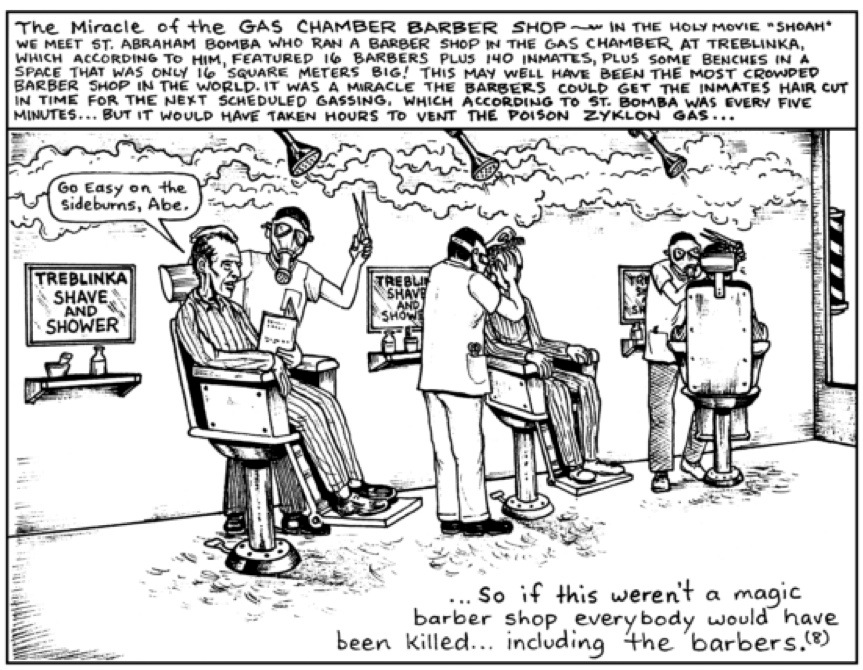
Posted in America, Christainity, Europe, Germany, Jews, Jews - Naming, National Socialism, Propaganda - Anti-German, Race, Third Reich, WW II | 6 Comments

Jews Must Live – Part 1: PROLOGUE: THE GENESIS OF JEW-HATRED


Jews Must Live


Part 1


by Samuel Roth


Jews Must Live — Originally published in 1934 (New York: The Golden Hind Press, Inc.), 319 pp. First reprinted in 1964, but with 5 chapters mysteriously taken out and with further abridgment of text in chapter IV. I’m not aware of a full reprint ever being done. As far as I know, the version presented below, proofread from an original 1st edition, is the only complete and accurate version of Jews Must Live available on the Web. -JR 7/9/2005

http://www.jrbooksonline.com/roth.htm

JEWS MUST LIVE

AN ACCOUNT OF THE PERSECUTION OF THE WORLD BY ISRAEL ON ALL THE FRONTIERS OF CIVILIZATION
ILLUSTRATED BY JOHN CONRAD


ABOUT THE AUTHOR


About the author: Polish-born Jew Samuel Roth (1893 – 1974) emigrated to America with his family at the age of four. By the 1920s he was an established poet, with his work published in some major literary outlets.


At the same time, he began publishing erotica, most famously a pirated version of D. H. Lawrence’s Lady Chatterly’s Lover, which, although tame by present-day standards, landed Roth in jail on pornography charges.


Later, he began publishing real pornography and was repeatedly arrested and jailed, eventually serving around nine years behind bars all told.


His last great court case, which took place in 1957 (Roth . United States, 354 U.S. 476), redefined the Constitutional test for determining what constitutes obscene material unprotected by the First Amendment and became a template for liberalizing First Amendment decisions of the 1960s.


Written by one America’s most famous Jewish pornographer, this work provides a shocking and insightful account of Jewish attitudes towards Gentiles.


Samuel Roth first embraced Judaism and Zionism, but later blamed other Jews for his financial and legal troubles — which landed him in jail. He became so embittered with his treatment at the hands of his co-religionists that he wrote this book which he said exposed their underhanded dealings with the Gentile world.


The engrossing narrative starts with the origin of Jewish behavior, which Roth identifies as coming from the Old Testament/Talmud. Using specific examples (such as the Jewish patriarch Abraham’s pimping of his wife Sarah to blackmail neighboring Gentile tribes into handing over their possessions). Roth claims that such behavioral patterns are repeated to the present day.


This behavior, Roth says, is founded in a Jewish belief that all the world’s possessions belong to them by divine right. He then discusses the effect of Jews in law, media, medicine, prostitution, literature, arts, and much more. Also included is a fascinating section on the vow-breaking Kol Nidre prayer.


Roth also includes detailed sections on his own experience at being swindled, and concludes that ant-semitism is always the a reaction to Jewish behavior, and not the product of some irrational disposition on the part of the Gentile, as is so often claimed.


He explains his position in this way:


“I don’t think I ever shared the Jewish contempt for the goyim, which is part and parcel of all Jewish psychology.”


http://www.jrbooksonline.com/roth.htm


Chapters II, III, XIII, XVI and XVII are completely missing from the 1964 “re-published” edition.


We can only speculate as to why these chapters were taken out. The first two may have been “offensive” to “traditional” Christian types (to include the text missing from ch. IV), but the rest remains a mystery. “The Life and Death of William Faro” gets to the whole purpose of the book: that fellow Jews had cheated Roth, who wrote the book (exposing Jewish practices) in retaliation. “Farewell to Judas” is an interesting account of his adventures aboard a cruise ship, during which Roth found his true self, while the Appendix includes two rare literary works: “The Jew”, originally an article in Voltaire’s Dictionnaire Philosophique but expurgated from most editions, and a full English translation of Heinrich Heine’s “Disputation”. Incidentally, “Disputation” is referred to in “Bolshevism from Moses to Lenin”, f/n 67 (f/n 70, 1999 ed.).


Note: The expurgation of Roth’s book is mentioned by Dr. Revilo P. Oliver in his essay “The Enemy of Our Enemies”, Part II, f/n 29 and 70.


A Roth “mug shot


Testifying before a Senate subcommittee. [Text: Samuel Roth, a publisher of erotic and nudist books, in United Sates Court House, Foley Square, where he appeared yesterday before the Senate subcommittee investigating juvenile delinquency.]


“The next time you read about a particularly bloody pogrom and pause to wonder how Christians, dedicated to a religion of mercy, can exercise so much brutality against the Jews, remember that the Jew wheedles all the mercy out of his neighbors in the ordinary course of business.

He lies and cheats until he is caught. When caught, instead of accepting punishment, he moans and tears his hair, invokes the sores of ancestors in their graves and living relations at the point of death in hospitals, until the wronged gentile, nauseated, lets him go.

Then, thumbing his nose at the gentile behind his back, the Jew goes about his business the same way, lying and cheating now doubly to make up for lost time.

A pogrom is usually the climax of years of such relentless goading. Do you wonder that when the final reckoning comes the gentile is absolutely merciless?”


— Samuel Roth, Jews Must Live, Ch. XIII, p. 206, f/n 31 [expurgated chapter]


Copyright, 1934

by

THE GOLDEN HIND PRESS, INC

Dedication:

“TO THE FIRST GENERATION OF JEWS THAT WILL LEARN HOW TO PRONOUNCE MY NAME SOFTLY”


CONTENTS


I        PROLOGUE: THE GENESIS OF JEW-HATRED 11

II      THE JEW-HATRED OF GENESIS* 25

III    IS MONOTHEISM A PURELY JEWISH CONCEPTION?* 41

IV    JEW-HATRED AS A NATURAL INSTINCT 55

V.     LEOLOM TICKACH: ALWAYS TAKE 69

VI    THE BRINGING-UP OF THE LITTLE JEW 85

VII   WHAT HAVE THE JEWS CONTRIBUTED TO AMERICAN CULTURE? 99

VIII  THE JEW IN BUSINESS 111

IX    JUDAISM IS NOT A MISFORTUNE TO THE JEWS ALONE 127

X      THE JEW AS A LAWYER 143

XI    THE JEW AS A PHYSICIAN 161

XII   THE JEW AND THE LAND 175

XIII THE LIFE AND DEATH OF WILLIAM FARO* 189

XIV  THE JEWS, THE THEATRE AND THE WOMAN MARKET 223

XV    THE RAPE OF LAKEWOOD, LONG BRANCH AND ATLANTIC CITY 239

XVI   FAREWELL TO JUDAS* 255

XVII  APPENDIX: DO JEWS EMIT A PECULIAR ODOR?* 289


* Chapters missing from the 1964 “re-published” edition.


Chapter I

PROLOGUE

THE GENESIS OF JEW-HATRED


Dear Herbert: —


I want you to learn of these things out of the overflowing of my pen, and know my feelings as if you had heard my own voice uttering them. I would not want the tongues of others, strangers or pretenders to my friendship, to touch this story with the sour whimsy of gossip. In any other voice but my own it must sound incredible and ugly that I should have taken this attitude towards our people. But it is not incredible because, as you see by my vouching for it, it is true. And nothing can be entirely without beauty that has lived so close to the fire which consumes.


How shall I get you to understand what an agony of spirit is involved in the launching of this work? It was easy enough to write, I assure you. What I have set down here I had to or go out of my mind. It struck me like a tidal wave; and before I could make any effort to direct it, it had made an avenue of progress out of every vein and artery of my body, it was riding every one of my living senses: everything I had ever seen, felt, heard and learned was being welded into artillery and commandeered into action in this new battle of my blood. Writing the book was really something of an organic necessity. But to give it to the printer, read proofs, arrange pages, and ultimately sign to it my tortured name, that is a metamorphosis I am still agonizing through.


People will say to you: It is obvious that Roth is deplorably blinded by what happened to him. He apparently got mixed up with a set of ruthless Jews. They fleeced him. And he is ungallantly throwing the onus on the whole Jewish people. Which is unjust and unfair.


[Page 11]


If it were not for what the Jews did to me, it is possible that I might never have come to this pass, for they lifted me bodily out of the set life of a Jew of forty and carried me here on their own shoulders. Does this impair my case against them? I do not think so. How, I ask you, have messages like this been brought to the world before? How have people been awakened before, to those strange and terrible visions which have catapulted mankind into what it describes itself today? Would my plea seem more authentic if I presented it in the guise of a series of statistical studies proving what a hideous swamp the Jews have made of Western Civilization? Would it better establish my sincerity if, like one of the minor prophets in Israel, I began my vision with the words And the Lord appeared to me and said? 


Is there any need to tell you what a lovely, fearful and proud thing my Jewishness has been to me all my life? I remember that when you first wandered into my bookshop on Eight West Street you sported a silver cross ornament, so far had you strayed from the fenced consciousness of being a Jew. I made no effort, then, to learn how it had come about. I judge now that you must have been born into a particularly ugly corner of Jewish life, and that the cross you wore was merely a symbol of the flash of fancy with which you raised yourself, by your bootstraps one might say, out of a contemptible environment. My enthusiasm served as a hook-chain to drag you back. Yes, I could almost see you change, as day by day you listened to me speak Yiddish and heard me discuss Jewish things. One day the cross disappeared entirely, and you began to speak Yiddish yourself, not badly. You were present on numerous occasions when I made myself the defender of our national integrity, as when I ordered a celebrated English poet out of my shop because he admitted that he was a contributor to G. K. Chesterton’s anti-Semitic weekly.


We lived those days in what the Jews call mockingly the Olem Hatoi, the world of illusion, as distinguished from the Olem Hazai, the real world, of which they speak with awe and reverence. We looked upon ourselves as free Jews, princes of the world’s most precious blood, descendents of the warrior-man Bar Cochba, and of the warrior-princes the Maccabees. For enchantment we had only to sound the names Abraham, Issac and Moses. For assurance: were we not an active and mighty factor in the upbuilding of America? And for reassurance: were not the deserts of Arabia blossoming under our patient labors of rehabilitation of forty years? As Jews we were the living embodiment of the vision incarnate. Everything said against us was so much evil slander inspired by envy. disappointment, and an unreasoning hatred — Jew-hatred. Jew-hatred differed from every other hatred in the world because it was altogether inspired by lies. About that there could possibly be no question.


In that spirit I wrote and published two books:  Europe (Liveright, 1919) and Now and Forever (McBride, 1925). Europe was a sort of uncouth epic in free verse in which I attacked Europe for the outrages she had wantonly practiced on the Jews during the great war. “The face of Israel will shine with power when Europe will be a name difficult to remember,” was one of the taunts in it that particularly pleased Israel Zangwill, for he frequently quoted it. Now and Forever continued in prose my reprisals against the gentiles, by means of an imaginary conversation on an imaginable variety of Jewish problems between myself and Zangwill who contributed a characteristic preface. If I remember correctly you did not like either of these books because, you argued, it should be possible for a man to remain a Jew without developing a serious case of high blood pressure.


But even in the blindness of my racial self-love I was observing things. In Now and Forever I pried a surgical knife into the anatomy of the God of Israel. I noticed the earthiness and unloveliness of Jewish women. I pricked the bubble of the theory that Jesus was a man of peace. I regretted that the Zionists had not had the fundamental decency to remain faithful — in spite of alluring British promises — to their pre-war pledges to Turkey. And I suggested that I would probably live to see Jews roasted alive on Fifth Avenue. My book was none the less a passionate defense of the Jews against their enemies. Yet, under the heading “A Playboy Prophet in Israel,” a man named Franklin Gordon, reviewing my book in The American Hebrew of July 10, 1925, wrote:


“What is the significance of this book, its salient characteristic? Perhaps its absolute freedom from cant, its plain speaking. So out-spoken is Mr. Roth in voicing his sentiments that one may question the advisability of having a book like his too promiscuously circulated. So much of it is open to misconstruction; so many pages in it could be lifted to serve as material for anti-Jewish propaganda.”


I remember that this paragraph perplexed me a little and amused me a great deal more. How could I take seriously the possibility that I might be instrumental in adding to the already overcrowded armory of the enemies of my people? Apparently I had pointed out serious blemishes in our poor defenses. But did even the most fanatic of Jews claim that we were a nation without faults? In their times, did not the Prophets report the blemishes of Israel from the housetops? So, secure in my illusions, I rested till the early months of 1933, the year of calamity. . . .


It is one of the felicities of my life that accident, or it may possibly be fate, always dramatizes my misfortunes by setting them up, as they occur, on a promontory. When news of the Nazi warfare against the Jews of Germany blazed out on the front pages of the American press, my own business affairs had just been swallowed in the waves of catastrophe. An employee of mine, a Jew, whom I had discharged for dishonesty, had devised a scheme for stealing my publishing business from me. With the help of several of my creditors, all Jews, a happy conspiracy was hatched. The available stock of my publishing firm, over fifty thousand books, well worth thirty thousand dollars, were sold by means of a fraudulent marshal’s levy to satisfy a dishonest judgment of some four hundred dollars. I shall go into the details of this sale later — as an illustration of the working of the Jewish lawyer in America — but for the present let it be sufficient for you to know that by that one stroke in the dark, for no inkling was given to me either of the judgment or the sale, my estate, worth easily a hundred thousand dollars, built up out of the hard work and consuming enthusiasm of fifteen years, became valueless.


Almost the same day, as it usually happens in my life, the dreadful news from Germany broke. Adolf Hitler, having become Chancellor of the Third Reich in spite of what had appeared to be insurmountable obstacles, was invoking all the powers of his new office against his political rivals, but especially against all the Jews of the realm. A general boycott had been proclaimed against Jewish business men and Jewish professionals. Jewish lawyers were being ousted from German courts, Jewish doctors from German hospitals, and Nazi troops were stationed in front of Jewish stores to warn Germans against patronizing Jew-owned shops.


Did you ever read Ovrohom Raisin’s story of the little ghetto boy who set down in his notebook the Jewish Almanac’s figure of the world population of the Jews, and, as they were reported in the press, subtracted from it the number of Jews killed in the Russian pogroms? As a Jew you know how true a picture of a Jewish child this is. Jewish children are brought up to take to heart all the difficulties of their people, as if what is happening to Kol Ysroel [1] is the business of Ben Ysroel [2]. They get to feel that way whether they are brought up to it or not.


I was only ten years old when the Kishenev pogrom broke out in 1904. But on account of it I could not eat or sleep well for a month. I knew no one in Kishenev. Like millions of others I had never heard of the place before reports of the massacre emblazoned its name on my revolving mind. It was as if people very close and dear to me had been assaulted. Fifteen years later I was on a Eighth Street cross-town car when a newspaper, opened in a seat opposite me, headlined the news that General Denikin was marching, through South Russia at the head of a vast army bearing on a multitude of banners the slogan: “Kill the Jews and Save Russia.” Tears gathered in my eyes. I got out at the next corner and wandered about the docks of Manhattan in a daze till past midnight.

––––––––––––––


[1] The whole people.

[2] A son of the people.


And so, in the midst of the news of the misfortune that had befallen the Jews of Germany, I wandered down Broadway, my own plight almost completely forgotten, when I remembered that the Harlans, friends of ours, were coming to the house for dinner. I must get home a little earlier, I thought. But time had already passed me and left me far behind. When I reached home the Harlans were in my library. Cocktails were being served; mine was already set aside for me.


“Still worrying about your business?” asked Mrs. Harlan.


It was not my business but rather the loss of it that was worrying me, I was about to reply when, suddenly, the peculiarity of my position flashed on me unpleasingly. The Harlans were gentiles. Moreover they had never tried to hide their dislike of Jews as a people. In this tragic moment of my people’s disillusionment was I not giving comfort to the enemy? I considered it cowardly and dishonest to entertain such thoughts in secret, so I proceeded to explain myself the the Harlans. A few days ago, I said to them, German Jews and German Gentiles were meeting in a cordial fellowship, such as we are meeting here tonight. Today, thousands of German Jews are knocking in vain on the doors of erstwhile friends, German Gentiles, for sympathy. Suppose, as appears to me entirely possible, what is happening in Germany today should break out in America tomorrow? I wonder if I might not find myself coming to you to ask you to harbor my children from the violence of the mob, even as Jews are doing in Germany today, only to hear you say, as many an honest German burgher is saying today to a suppliant Jewish neighbor:


“I cannot do what you ask of me. It is against law and order.”


Mrs. Harlan, whose first novel I had just published, undertook to answer my question.


“We do not like Jews, as you know,” she said. “But we do like you, and we are particularly fond of your children. If in the fury of mob psychology we should so far forget ourselves as to forget in our anger against your race our affection for you and your children, I suggest that our loss will be even greater than yours.”


I felt both mollified and rebuked, and for a while the subject was dropped. After dinner, we played, as usual, two hours of Pope Joan. Game over, Mrs. Harlan leaned back and said:


“I should think, after what you’ve gone through in the last few days, that you’d become something of an anti-Semite yourself.”


I looked up with surprise. “Why?


“If you could forget,” she mused, “a lot of what you must have learned in Hebrew school just long enough to get a glimpse of what the Jews are doing to you you wouldn’t have to ask why.”

“I see your point,” I said.

“But how can I let the thought of a few dishonest Jews blur for me the vision of a whole people?”

“But have you really in your mind a vision of the Whole people?” she pursued.

“You have a vision, of course. But it is not a vision which came to you out of the experience of your life. It was imposed on you, like any other form of patriotism, when you were too young to examine anything critically. It was grafted into your blood by the rabbis, in the spirit of My country, right or wrong. You have probably, all your life, suffered experiences such as these at the hands of the Jews you dealt with. But have you allowed your vision of the whole people to be modified ever so slightly? It just simply hasn’t occurred to you that the living people has to back up the living vision. Your vision, believe me, is one thing. What the Jews are in reality is something directly different.””


Such an argument in my own house! I would never have thought it possible. For the moment I was even too stupefied to protest.


“I have heard you talk of your princely Jewish blood,” continued Mrs. Harlan.

“You may have something of a mystic strain in you yourself. But look at the Jews you associate with. We have been meeting them in your house during the past year. We ate and drank with them at your table. Didn’t they continue to come here days after they had secretly sold you out? Are we to accept them as specimens of your princes of Jewish blood? In the course of our own lives, my husband and I have met many Jews, for how is one to avoid them in New York? But even knowing Jews as genuine as you and your wife has not helped to modify our feeling that Jews are a nation of leeches crowding the sensitive arteries of mankind. Take what is happening in Germany.”

“Blind race hatred,” I interrupted.

“Conducted by eighty-five million people? Do you believe a whole civilized nation would stand aside, witness what Hitler is doing to the Jews without a protest, unless there are real abuses on the part of the Jews which justified what is happening?”


I could not permit such an argument to remain unanswered. I told the Harlans vehemently and sincerely that it is wrong to blame a whole people for the malpractices of a few of its members.


“You are wrong,” I averred, “and so is Hitler’s Germany. Germany’s Jews have enriched Germany far beyond her capacity for gratitude. Are not Germany’s foremost living scientists, doctors and lawyers Jews? We are not mad enough to expect gratitude. But we do ask for a little reasonableness. As for my own difficulties, I added, I don’t think I can conscientiously blame the people who cheated me, as Jews. It is so easy to cheat me, the temptation would be too overwhelming even for a society of saints.”


The Harlans smiled and tactfully changed the subject of the conversation. I don’t think they had the faintest notion of what they had accomplished. For they had opened in me the locked gate of an emotion that must have been pounding away at my heart for a long time. It dawned on me suddenly, blindingly that all the evils of my life had been perpetrated by Jews. How powerfully woven about me had been my racial illusion that even a suspicion of this had never occurred to me before? The scroll of my life spread itself out before me, and reading it in the glare of a new, savage light, it became a terrible testimony against my people. The hostility of my parents towards me, reaching back deep into my childhood. My father’s fraudulent piety and his impatience with my mother which virtually killed her. The ease with which Frank had sold me out to my detractors. The Jews whose machinations had three times sent me to prison. The conscienceless lying of that clique of Jewish journalists which built up about my name the libel that I was unfair to the authors of the books I published. And a thousand minor incidents too petty to mention. I had never stretched out a hand to help a Jew or a Jewess without having had it bitten. I had never entrusted a Jew with a secret which he did not instantly sell cheap to my enemies. It wasn’t as as if I didn’t understand such things. I had myself needed help so many times in my life, and I had always been so grateful for the crumbs tossed in my direction. What was wrong with the people who accepted help from me? Was it only an accident that they were Jews?


Please believe me. I tried desperately to put aside this new, this terrible vision of mine. But the Jews themselves would not let me. Day by day, with cruel merciless claws, they dug into my flesh and tore aside the last shreds of the veins of illusion. With the subtle scheming and heartless seizing which is the whole of the Jew’s fearful leverage in trade, they drove me from law office to law office and from court to court, until I found myself, before I properly realized it, in the court of bankruptcy. It became so that I could not see a Jew approaching me without my heart rising up within me to mutter:


“There goes another Jew-robber, stalking his prey.”


And, in the meantime, the ages-old Jewish clamor grew noisier and noisier:  Help or we will be exterminated. The Jewish population of Germany was crying out, just as the Jews of Russia, Poland, France and Roumania had called out before, within my own lifetime. The appeal to me was just as personal as it had been in the days of my illusion: that is a habit one never outlives. But I could no longer make the same response. I found myself in the towering seat of judgment. I felt, in that dizzy position, as helpless as the crew of a ship described in Barbellion’s celebrated Journal. This crew had become so beloused that they were unable to steer the ship, and so helplessly floated out on it into a stretch of ocean where they died of starvation. On every side I was being eaten alive by Jews. And yet I had to make some answer to that cry. The realization of what that answer must be at first horrified me. . . .


For weeks I went about in a daze. Better, I vowed to myself a thousand times, be quiet, say nothing. But how could I keep quiet? In the name of what should I say nothing? After a lifetime of honest thinking was I to hold back because I could not reconcile myself with an old and apparently unsound tradition? I must give utterance to my feelings or forever after remain in a foul and oppressive darkness. One night, after spending the whole day wandering down the long span of Manhattan, I felt that I could not return home, and since my feet would not sustain my wandering any longer, I betook myself to one of those cheap lodging houses on the Bowery where for a quarter they let you have a bed in a dormitory containing about thirty beds.


Old, unshaven, wind-bitten faces, without a trace of hope or cunning, floated by me as I undressed. And I realized with a warming of my heart why I had come here. It was not the sort of place where one was likely to find a Jew. . . None of those shrewd robber faces would appear to molest me. . . . At last I would be able to sleep. My eyes closed with almost no effort. I slid into a light comforting slumber. . . And then a face, an old familiar tortured face, floated into the subconscious area of my mind. Maybe I could keep the Jews out of a temporary shelter. But how was I to keep them out of my dreams? The face spoke to me wearily, soothingly:


“Why have you permitted yourself to get into such a fever? Do you think you are by any chance the first Jew to have been robbed by Jews? See what they did to me. Jews have always been like that. Jews always will be like that. It is not worth bothering about.”

“I know,” I replied. “But what do you want with me?”

“You seem angry. That is strange. You’ve spoken and written about me a score of times. But I cannot remember that you were ever angry with me.”

“You’re a Jew,” I said. “And I came here to get away from Jews. What do you want with me?”

“I want to beg a consideration of you. Get out of the habit of talking and writing about my love of Jews. I know you mean well. But do you realize how you mock me when you do that? I remember gladly a warm corner in the synagogue where I first learnt my Hebrew alphabet. But what did I know then about Jews that my love should be remembered, set apart, and singled out for praise? Look at me. I live eternally in a sea of crooked noses, foul teeth, and cruel jibes which you describe as Calvary. Is it just to me that you should go on talking of my love of Jews?”


I didn’t know, I said.


“There is much more you are yet to learn. But don’t be afraid. What you are now learning is to be hated, not feared.”


And the face and the voice vanished.

I lay back on that shallow cot, my eyes fixed on the ashen shadows moving along the old wall before me.

I may not have been the first Jew wronged by Jews,” I vowed to myself.

But I will be the first Jew to arise and tell the truth about them.

From that point on I slept peacefully.


Somewhere in the Bible I must have read the line I will utterly destroy this people, saith the Lord God. Was it Jehovah speaking to Moses about the people he had just led out of Egypt? Whoever wrote that line had it in his heart about the Jews as I have it in my heart today. Disraeli set the Jewish fashion of saying that every country has the sort of Jews it deserves. It may also be true that the Jews have only the sorts of enemies they deserve, too.


And suppose I wanted to keep this terrible secret of mine? Where, supposing I had the strength to bear such a burden, would I hide it? On my back? The Jews themselves would pursue me through the streets, as the children pursued Elijah, and call hunchback after me. In my heart? They would be sure to spy the swelling, mistake the bulk for hidden treasure, and I would find myself engaged in constantly tearing their filthy fingers out of my bosom. At home? I have growing children there. I would as soon think of keeping sticks of dynamite loose about my house. . . .


“But you’re a Jew, our brother!” I hear a million little oilemhazainikis cry.


Very well. I have always accepted this responsibility solemnly. I shall not fail you this time, I promise. I will make myself worthy of the honor.


—————————————————————-


Click a link to go to >

Jews Must Live Part 1 – PROLOGUE: THE GENESIS OF JEW-HATRED

Jews Must Live Part 2 – THE JEW-HATRED OF GENESIS

Jews Must Live Part 3 – IS MONOTHEISM A PURELY JEWISH CONCEPTION?

Jews Must Live Part 4 – JEW-HATRED AS A NATURAL INSTINCT

Jews Must Live Part 5 – LEOLOM TICKACH: ALWAYS TAKE

Jews Must Live Part 6 – THE BRINGING-UP OF THE LITTLE JEW

Jews Must Live Part 7 – WHAT HAVE THE JEWS CONTRIBUTED TO AMERICAN CULTURE?

Jews Must Live Part 8 – THE JEW IN BUSINESS

Jews Must Live Part 9 – JUDAISM IS NOT A MISFORTUNE TO THE JEWS ALONE

Jews Must Live Part 10 – THE JEW AS A LAWYER

Jews Must Live Part 11 – THE JEW AS A PHYSICIAN

Jews Must Live Part 12 – THE JEW AND THE LAND

Jews Must Live Part 13 – THE LIFE AND DEATH OF WILLIAM FARO

Jews Must Live Part 14 – THE JEWS, THE THEATRE AND THE WOMAN MARKET

Jews Must Live Part 15 – THE RAPE OF LAKEWOOD, LONG BRANCH AND ATLANTIC CITY

Jews Must Live Part 16 – FAREWELL TO JUDAS

Jews Must Live Part 17 (last) – APPENDIX: DO JEWS EMIT A PECULIAR ODOR?


PDF of this post. Click to view or download (1.2 MB) >> Jews Must Live -Part 01


Version History


Version 3: Mar 15, 2021 – Updated Cover image. Improved formatting.


Version 2: Mar 5, 2021 – Re-uploaded images and PDF for katana17.com/wp/ version. Improved formatting.


Version 1: Published Jan 3, 2015.

Posted in America, Bk - Jews Must Live, Christainity, Europe, Germany, Jews, Jews - Naming, National Socialism, Propaganda - Anti-German, Race, Third Reich, WW II | 6 Comments