The Case for Germany – Part 1 – Goering’s Address; Der Fuhrer; The Beleaguered City


[Part 1]


I am deeply stirred by the word which Ulrich Hutten wrote the last time he seized his pen: — Germany.

ADOLF HITLER

January 30th, 1937


The Case for Germany 


A Study of Modern Germany 


by

A. P. Laurie

M. A. Cantab., D. Sc., LL. D. Edin., F. C. S., F. R. S. E.

With a Preface by Admiral Sir Barry Domvile

K. B. E., C. B., C. M. G.

Berlin W 15

Internationaler Verlag

1939

FIRST EDITION ………… JUNE 1939

SECOND EDITION ……. JULY 1939

ALL RIGHTS RESERVED

PRINTED IN GERMANY

DEDICATION

It is with admiration and gratitude for the great work he has done for the German people that I dedicate this book to the Fuhrer.

A. P. L.

TO THE READER

There are two sides to every question. You have read one side in our Press for six years.

This book gives the other side.

A. P. L.


PREFACE


It is a great pleasure to me to introduce the public to Dr. Laurie’s valuable book on modern Germany. He is best known to the world as a brilliant scientist, but he has found time in the intervals of his work to pursue with ardour the task upon which every sensible member of the British and German races should be engaged — namely the establishment of good relations and a better understanding between these two great nations.


Dr Laurie knows full well that this friendship is the keystone to peace in Europe — nay, in the whole world.


He is one of the small group who founded the Association known as “The Link”, whose sole aim is to get Britons and Germans to know and understand one another better. He is one of the most zealous workers in this good cause in the country.


He writes of the National Socialist movement with knowledge and great sympathy.


The particular value of this book lies in the fact that it is written by a foreigner, who cannot be accused of patriotic excess in his interpretation of the great work done by Herr Hitler and his associates. I recommend this volume with confidence to all people who are genuinely impressed with the desire to understand one of the greatest — and most bloodless — revolutions in history.


BARRY DOMVILE

Robin’s Tree

8th May 1939.


“As we advance in our social knowledge, we shall endeavour to make our governments paternal as well as judicial; that is, to establish such laws and authorities as may at once direct us in our occupations, protect us against our follies, and visit us in our distresses; a government which shall repress dishonesty, as now it punishes theft; which shall show how the discipline of the masses may be brought to aid the toils of peace, as the discipline of the masses has hitherto knit the sinews of battle; a government which shall have its soldiers of the ploughshare as well as its soldiers of the sword, and which shall distribute more proudly its golden crosses of industry — golden as the glow of the harvest — than it now grants its bronze crosses of honour — bronzed with the crimson of blood.”


RUSKIN. Political Economy of Art.


“All front fighters fought side by side and went through an inferno. They are all comparable to the heroes of the ancient world. It was the manhood of the nations in their prime who fought and experienced the horrors of modern war.


In another war the flower of the nations’ men and women will have to fight. Europe will be destroyed if the best in all of the nations are wiped out. A new conflict will exceed even the ghastly tragedies of the Great War.


I believe that those who rattle the sabres have not participated in war. I know that war veterans speak and think differently.


They energetically desire to prevent another conflict. I hope that the men who are standing before me can contribute to preserve the peace of the world — a peace of honour and equality for all.


Let us not talk of prestige as between the victors and the defeated. This is my one request: Forget what has divided the nations before and remember that history has advanced.”


Field Marshal GOERING addressing the British

and German war veterans.


CONTENTS


CHAPTER ……………………………………………………………. PAGE


Dedication

To the Reader

Preface

Field Marshall Goering’s Address

I.   DER FUHRER ……………………………………………………….. 11

II.   THE BELEAGUERED CITY ……………………………………. 21

III.   NATIONAL SOCIALISM ……………………………………… 25

IV.   THE NAZI RALLYS AT NUREMBERG ……………………. 34

V.   THE FOREIGN POLICY OF GERMANY ……………………. 41

VI.   ENGLAND AND GERMANY ………………………………….. 49

VII.   MARCH 7th, A MOST IMPORTANT DATE …………… 54

VIII.   THE REAL ENEMY OF EUROPE ……………………….. 58

IX.   COMMUNISM VERSUS NATIONAL SOCIALISM …… 62

X.   THE UNION OF THE GERMAN PEOPLE …………………. 68

XI.   ACTS OF “AGGRESSION” BY GERMANY ……………… 79

XII.   THE DANCE OF DEATH ……………………………………… 85

XIII.   OUR FUTURE POLICY TOWARDS GERMANY ……. 93

XIV.   THE HITLER YOUTH MOVEMENT ……………………… 100

XV.   THE WINTER HELP ORGANIZATION ………………….. 104

XVI.   NATIONAL SOCIALISM AND THE PROTESTANT

CHURCH ……………………………………………………………………… 109

XVII. ECONOMICS …………………………………………………….. 118

XVIII. THE FOUR YEARS PLAN …………………………………… 138

XIX.   THE GERMAN COLONIES …………………………………. 141

XX.   THE LABOUR FRONT ………………………………………….. 146

XXI.   AGRICULTURE …………………………………………………. 155

XXII. MUNICH AND AFTER ………………………………………… 167


Chapter One


DER FUHRER


De l’audace et encore de l’audace et toujours de l’audace.


It has often been said here of the Fuhrer that he was “only a house painter” or that he had “no education”, and the general tendency of opinion in England is that he was not a public school man and therefore is not much good. This attitude shows not only a regrettable snobbishness, but a total ignorance of the origin of so many great men. It is an error which we in Scotland are not likely to fall into, as so many of our famous Scotsmen have come from a similar stock, and have had a similar upbringing and education to that of the Fuhrer.


The Highland crofter with his fierce independence, and the poor Scottish student who worked on the farm all summer to pay his university fees, are our equivalent to the finest type of European peasant, who produces a Mussolini, and a Hitler, and the small farmers of America who produced an Abraham Lincoln.


It is among the peasants of Europe that the old customs and traditions are maintained; the towns people tend to become all of one pattern, and it is to the country that we must go to find the old costumes handed down for centuries, and the old legends and fairy tales. The people in the mountain and forest districts of Germany still live in the houses, and wear on gala days the costumes with which the Grimms fairy tales are illustrated; through these tales we live in an imaginary world in our childhood, with which the familiar Grimms fairy tales are illustrated; through these tales we live in an imaginary world in our childhood which is the familiar every day world to them. However strong may be our link with Germany in later life, through the Protestant religion which we owe to her, and through her philosophy and music, the ties formed at our most impressionable age are with the peasant.


[Page 12]


In the district of Waldviertel, lives a race of peasants who, in spite of having been part of the Austrian Empire, still speak the Bavarian dialect, and have clung fiercely to their traditions and racial independence. In 1672 a son was born to two of these peasants who bore the name of Stephan Hitler. His descendants lived on in the same district, until Alois Hitler, the Fuhrer’s father, determined to see the world, and set off on foot for Vienna. He became a Customs official, but love of the soil was strong in him, and he soon bought a farm in the beautiful district where the Inn joins the Danube, where he established his family, and to which he went on his retirement to take up again the life of a farmer which had been led by his ancestors.


It was here that Hitler passed his early childhood, and attended the monastery school where he first saw the Swastika carved on the arch of a stone wall.


As a boy his desire was to be an artist. On the death of his parents he went to Vienna with a few coins in his pocket taking his portfolio of drawings with which he hoped to gain entrance to the Vienna art school. “You will never be a painter”, said the Professor who glanced through his drawings, “but you show some talent for architecture”. An interesting prophesy for the future of the boy who was to superintend the rebuilding of Berlin.


Rejected as a pupil both at the school of art and architecture, he found himself alone in Vienna with only a few coins between him and starvation. Building was going on everywhere and he found employment as a builder’s labourer: the boy of 18 entering on a life of desperate poverty learnt to know all that was most sordid and cruel in the life of a great city. For long his only home was the corner of a cellar which he shared with other workmen. His fellow workmen were all followers of Karl Marx, and endless discussions went on in which young Hitler joined.  He became convinced that the Socialists and Communists were on the wrong lines, refused to join the trade union and for this refusal suffered an early martyrdom, — he had no sooner got a job than his fellow workmen had him dismissed.


[Page 13]


During this period he learnt the close connection between the Socialist movement in Vienna and the Jews. He has told us of his astonishment when he met in the street a Rabbi with long locks dressed in his caftan. He realised for the first time the existence in the heart of his civilisation of a people of an Eastern race and Eastern religion, foreign to all his racial and religious traditions and exercising an enormous influence through their control of finance. A people bound together by devotion to their race, which had survived being scattered broadcast through the world and persecuted through the centuries.


Finding it impossible to earn his living as a labourer unless he accepted the teaching of Karl Marx, he managed to pick up a scanty living by painting and selling cards. Many of his sketches made at this time survive, and show considerable artistic talent. After a time he migrated from Vienna to Munich and found a lodging with a small working tailor’s family. He continued to earn a small pittance by his painted cards, and began to devour all the books he could get out of the public library on history and politics. The tailor and his family have always remained his good friends, and have the pleasantest recollection of the courteous young Austrian who was adored by the children and made his good landlady anxious for his health by his omniverous reading on history and politics, which often continued through the night. He denied himself bread in order to have the means to visit the theatre, especially the great works of Wagner whom he revered and still reveres today.


When war broke out he got permission from Austria to join a German regiment, and went joyfully to fight for his beloved Fatherland; at last, he felt, he could do something for Germany. He was chosen for the dangerous task of dispatch carrier from the trenches, was twice decorated for valour, was wounded, and won the affection and admiration of his fellow soldiers. His final decoration, the Iron Cross of the First Class, was won for capturing single handed a small French force and leading them back to his own trenches by sheer bluff and personality. At the close of the war he was blinded by a gas attack and lost his sight for some time, and ultimately returned to Munich still in the army.


[Page 14]


Munich like the rest of Germany was in a state of anarchy and after a desperate struggle had suppressed a Communist rising which committed the most brutal atrocities. Hitler was employed to lecture to the troops to correct the disaffection among them and show them the follies of Communism.


A few months after his return the disastrous terms of the Treaty of Versailles were made known to the Germans. They were received with a feeling of utter dismay which was soon succeeded by one of hopeless despair. Hitler in the meantime had discovered during his lectures to the soldiers where his real future lay, and determined to return to civilian life and devote himself to politics. He investigated all the various groups which had formed themselves, each sure that they had the means of saving Germany, but none of them had grasped what seemed to Hitler the only road to salvation. He alone conceived the bold idea of refusing to accept the exactions of the Treaty of Versailles; but how was he, an unknown soldier, to get his ideas to the people of Germany?


One night he read a pamphlet, which had been given him at a meeting, by a workman called Anton Drexler, and realised that here at last was someone who was thinking along the right lines. Next evening he went to a meeting of this “Deutsche Arbeiterpartei”, a group of seven men with only 7.50 marks for funds, which was later to emerge as the National Socialist Party and sweep the whole of Germany.


Hitler inevitably became their leader and convinced them that the only chance of success was to hold public meetings. One of their first modest ventures was a meeting in the Munich Hofbraukeller, which held about 130 people. Hitler rose to address them and laid before them his whole plan for regenerating Germany. As he spoke the audience became wildly enthusiastic. He realised that he had the gift of oratory, and that by the use of this gift he could rouse Germany to action. The audience went out to spread everywhere the name of Hitler. Their future meetings grew larger and funds began to flow into the empty cash box. The Socialists became alarmed and decided to break up Hitler’s meetings by physical violence; but he had foreseen this development and had called to him a handful of his old comrades of the battlefield and organised them as a militant body whom he called his Storm Troopers.


[Page 15]


In November 1921 he decided to hold a great mass demonstration to test the real strength of the new movement, and if it succeeded to spread his organisation over the whole Reich. The Socialists determined that it should fail, and arranged to make an attack at the meeting which would smash the movement once and for all. The audience sat at little tables and refreshed themselves with beer while listening to the speaker. In Munich these beer mugs are heavy earthenware vessels. While Hitler was speaking the Socialists had been storing the empty mugs under their tables for ammunition, and at a given signal began hurling them at the heads of the audience and at Hitler who was standing on a table. During the rain of mugs Hitler never moved, and by some miracle was not hit. His Storm Troopers went promptly into action and though they were unarmed and their opponents had knives and other ugly weapons and greatly outnumbered them, the Storm Troopers after a desperate fight drove them out of the meeting. The scene was one of the wildest description and the hall was littered with broken mugs and smashed tables and chairs. Hitler calmly continued his speech where he had left off as if nothing had happened. Henceforth the Storm Troopers were known as “Storm Detachment” (Sturm Abteilung or SA.).


While the Nazi movement was spreading through Bavaria, the Bavarians were getting more and more dissatisfied with the central government in Berlin, and a movement was spreading to separate Bavaria from the Republic. The Bavarian Minister von Knilling appointed, Herr von Kahr as Commissar with almost absolute power. Herr von Kahr broke off relations with Berlin and was joined in his revolt by the heads of the army and the police in Bavaria. There was talk of a march on Berlin, while Ebert was considering the possibility of ordering the army of the Republic to march on Bavaria. Von Kahr and Hitler were in agreement, but von Kahr hesitated and failed to push the rebellion. On November 9th 1923, Hitler and Ludendorff were marching through Munich at the head of their comrades and fellow members through cheering crowds, when they were stopped by a cordon of police who fired upon them. The scene was one of the wildest panic, the street was strewn with dead and wounded, eighteen of Hitler’s comrades were killed, and Hitler was thrown down injuring his shoulder.


[Page 16]


This attack by the police was followed up by the arrest of Hitler and many of his party.


At his trial he made a speech in which he unfolded his whole policy; a speech which made a great impression in Germany. “It is not you, Gentlemen”, — he told the Court — “who pass judgment on us. We shall be judged before the eternal bar of history.” He was condemned to five years imprisonment in the fortress of Landsberg, a sentence which was afterwards commuted to nine months, and was soon joined in prison by many of his followers who were allowed by the prison rules to mix together in the daytime. While there letters and presents poured in from all over Germany, but his organisation was rapidly falling to pieces without the presence of its leader. It was during his imprisonment that he dictated “Mein Kampf to Hess.


When he left prison in December 1924 he had come to the conclusion that a revolution based on a coup d’etat did not provide a permanent foundation on which to build a new state, and determined to undertake the colossal task of converting the whole German people and obtaining power by their votes. In spite of being forbidden to speak in several of the German federal states, his movement made rapid progress, and returned larger and larger numbers of members to the Reichstag at each election.


The work of building up this great organisation was stupendous, and during elections he flew in a plane all over Germany speaking everywhere and organising his followers. Finally he had a large majority over any other party in the Reichstag, and Hindenburg conferred on him the post of Chancellor, on January 30, 1933. Hitler asked the Reichstag for absolute power for four years; this was granted, and afterwards confirmed by a plebiscite of the whole German people.


Placed in power, he did not follow the usual practice of Dictators and shoot his opponents. The more dangerous enemies of the new government were put in concentration camps, where they suffered no more hardships than the common soldier. Civil servants opposed to him and Jewish professors and heads of institutions, were pensioned off at the full value they would have received in old age. Then began the vast task of re-organising Germany; the most bloodless revolution the world has ever seen had been accomplished.


[Page 17]


One cannot read the story of Hitler’s early life without realising that everything went to form his mind for his future task. Consciously his ambition was to become a painter, but his early absorption in history and geography pointed in another direction. As a young boy, he came to realise what it meant to be separated from Germany, and to live in an Empire which is largely dominated by alien Slavonic influences. He read a history of the war of 1870 when he was a boy, and asked himself, why did we not go to the help of the Germans? The answer was plain. Because although we are Germans, we are divided from our blood brothers; the peoples would have joined, but the outside influence of rival dynasties kept them apart. Can we not see in this deep impression the reason behind his resolve to unite Austria and Germany, and his determination to bring the Sudeten Germans back to their fatherland?


He has denounced the folly of conquering and subduing foreign peoples. He had a perfect example before him in his youth, in the endless struggles to subdue the turbulent slav populations of the Austrian Empire, which finally caused its destruction. He was horrified when he visited as a young man the Austrian parliament, and found it full of Slavs who were making long speeches in languages which only a few could understand, and whose racial hatreds finally boiled up into a free fight.


The great social reforms which he has carried out can in the same way be attributed to his early experience. His sufferings of poverty, uncertainty of employment, and starvation in Vienna, when he was left an orphan at eighteen and had to become a labourer, made a deep impression on his mind, and unconsciously again, fate was shaping his destiny, giving him by this harsh treatment an understanding and insight into the difficulties and struggles of the working classes, which he could never have had otherwise. He has fought and conquered for Germany the terrible disease of unemployment, remembering his own misery when he was workless, and the pressing anxiety of where the next meal was to come from.


[Page 18]


Brought into contact with Communism, the accepted faith of his fellow workmen, he was faced at an early age with fundamental political problems. Communism aims at a class war which would split Europe horizontally and result in an international communist state. Hitler saw in nationalism an emotional force which could unite all the peoples of a nation in a common purpose of justice for all classes. Communism appeals to hate, and denies the national bond, while nationalism appeals to the natural good feeling between the members of the same community. Communism is therefore necessarily anti-Christian, and nationalism is Christian, so long as it is used as a motive for internal reform, and does not result, as it has done so often in the past, in the proof of patriotism being the extent of our hatred of other nations. Brought into intimate contact with Communism as an active political force, and not as a subject for discussion in the study, he learnt to hate it, and to hate the men who were exploiting the workmen for their own purposes. His contact with Communism was therefore a part of his training for his future task; still a boy in years, he had to choose between the risk of starvation or the acceptance of Communism, and he chose to suffer hunger rather than bow the knee to the god of hate and class war.


As a soldier in the battlefield, he was to learn the horror and the mad futility of war, and the wickedness of hatred between nation and nation. Patriotism, according to Hitler, means, thou shalt love the people of thine own nation as thyself. Patriotism according to the Peace treaties, means, thou shalt hate the people of other nations.


The solution of these fundamental problems was hammered out by the young Hitler in suffering, and the lessons learnt burnt into his soul. Most men who had endured what he had, would have joined the ranks of those preaching the gospel of hate; hatred of the rich and powerful, and hatred of the peoples of other nations. It is true that in “Mein Kampf, he shows something of the old Adam, but the fires of suffering have burnt all dross out of his soul, so that he comes today before men with a message of Peace and goodwill.


[Page 19]


We have many impressions of Hitler from those who have known him personally, but perhaps the most interesting is the one given by his jailer. The relation of jailer and prisoner is naturally a difficult one, and yet he speaks of Hitler’s unfailing courtesy, and prompt recognition of the necessity for prison discipline. The jailer occasionally had difficulties with the young Nazis, who were indignant at their imprisonment, and chafed at prison rules. When trouble arose he had only to go to Hitler, who would say, “leave it to me”, and everything was put right. He speaks of his unfailing cheerfulness, how he encouraged his followers, and kept them interested to break the monotony of prison life, and of his invincible courage in spite of the apparent wreckage of his party.


His kindly personality, simplicity, modesty and absence of all pretence are spoken of by everyone. When his old Munich landlady summoned up courage to call upon him, she had only to explain to the two S. S. men on guard that she had known Hitler in the old days, to have every door opened to her and to be greeted by Hitler as a dear old friend.


While Hitler has this charming personality, he is of the stern stuff of which leaders of revolutions are made. He stands apart and like all men of genius who have led great movements he is simple and direct, and puzzles and alarms the complex confused personalities of the ordinary diplomatist; yet anyone who will with an open mind study his speeches and watch his actions can learn to understand him. Dwelling among his beloved mountains he makes his decisions and carries them out swiftly and with absolute certainty.


He burns with one consuming passion, his love of Germany and the German people, rich and poor, old and young, and above all the children. “How wonderful”, he has said, “are the children of Germany.


He feels bitterly her wrongs, the Treaty of Versailles and all that followed. The writer of “Mein Kampf is there today, with its cynical exposure of European statesmanship, and its call for revenge, but he has found a better way. He has realised that the war and the infamous Treaty were symptoms of a deep rooted disease and that Europe must begin anew.


[Page 20]


He bases his political creed on an idealised conception of nationality, and of race of which nationality is the flower. God, he tells us, has made different nations. Each nationality has something to contribute to civilisation but the value of the contribution lies in its being essentially national. Those who say that Hitler is out for the conquest of other peoples show a complete misconception of his beliefs. To introduce an alien element by conquest of another country is to injure your own. A race can only reach its highest perfection if it is kept pure, and a nation must work out its own salvation and must care above all else for its own people. Patriotism in its highest form means the complete subjugation of individual gain for the whole community. He believes that no alien element can be expected to work in with this ideal, and herein lies one of his main arguments against the Jewish community in Germany.


Instead of suppressing nationalities, the policy of the treaties which the League supported, he takes that deep emotion love of country — and bends it to a new purpose, service to one’s own people and peace with one’s neighbours.


There are times when God in compassion for the self inflicted sufferings of men sends a man simple and direct in thought and inspired by one passion, to carry out an ideal which controls him. Hitler has been entrusted with the task not only of saving the German people, but of securing peace in a distracted Europe. Future generations will recognise him as the man who led Europe into the paths of peace.


Chapter Two


THE BELEAGUERED CITY


In order to understand Hitler’s denunciation of the Treaty of Versailles, it is necessary to realise the strategic position of Germany at the time he came into power, and to compare the map of Europe at that time with the map before the war. Germany is bounded by other countries, except along the Baltic, and if we proceed to trace this post-war frontier we shall find that the title given to this chapter was fully justified at that time.


We shall begin with the frontier facing France. Alsace and Lorraine, which had belonged to Germany since the war of 1870, were restored to France. These territories which contain a mixed French and German population, have changed hands more than once. Louis XIV seized them in time of peace, and they continued to be part of France after the close of the Napoleonic wars, to be regained by Germany in 1870. France never ceased to look forward to their recovery; the statues in Paris representing the two provinces being always draped in black. It is probable that if they had not been taken by Germany in 1870, the war of 1914 would have been confined to Eastern Europe. While the Treaty of Versailles was being drafted, Foch wished to have the whole of the Rhine Provinces added to France, and during their occupation after the Treaty was signed, attempts were made to agitate for their separation from Germany. The plebiscite taken in the Saar at the end of its occupation under the League, showed clearly that these provinces had no desire for separation, but they were included in the neutral zone, and German troops were forbidden to enter them. France built the Maginot line of forts within five miles of the frontier, armed with powerful siege guns able to throw shells twenty miles inside the German frontier. These forts extended from the Rhine to the borders of Luxembourg.


[Page 22]


The Treaty of Versailles re-created the country of Poland out of Russian, German and Austrian territory, and in order to give Poland an outlet to the sea, presented her with a broad strip of land on the Vistula, ending in the town of Danzig, which was made a free city under the suzerainty of Poland and the League.


This strip of territory cuts off East Prussia from the rest of Germany. Difficulties have arisen over Danzig, the population of which is more than 90% German, difficulties which have been increased by Poland building the new port of Gdynia in the neighbourhood, on Polish territory, to which her sea-going trade is being diverted. The Polish corridor contains a mixed population of Poles and Germans, and was given to Poland without a plebiscite. According to the German census of 1910, it contained a majority of Germans. A considerable section of Silesia, including three quarters of the valuable Silesian coal fields, was given to Poland in spite of a plebiscite in favour of retention by Germany. As this extensive minefield had been developed by German capital, and contained a considerable German population, this region has also been the source of endless difficulties. One of the causes of trouble is the low standard of living and wages of the Polish miner, wages which the German miner who was handed over has had to accept.


The Treaty of Versailles carved up the whole Austrian Empire, creating the new country of Czecho-Slovakia, which contained six different races over whom the Czechs, having a small majority, have ruled. Bohemia which, as can be seen from the map, cuts into the heart of Germany, was formerly part of the friendly Austrian Empire, but now belongs to Czecho-Slovakia. It has been a bone of contention between the Czechs and the Germans for centuries, contains a population one third German and two thirds Czech, and includes the important historical city of Prague. The German population suffered severely under Czech rule; the Czechs never having carried out the clauses in the Peace treaties designed for the protection of minorities. CzechoSlovakia is a democracy, but a democratic government is no protection to an alien race in a permanent minority, and the Czechs kept their prisons full of German political prisoners.


[Page 23]


It is generally admitted today that the commissioners who drew up the new frontiers showed very little wisdom or knowledge of the various peoples whose fate they were deciding in an arbitrary manner. They refused a plebiscite which had been promised by Wilson whenever it suited their purpose.


If we now look at the geographical position of Germany as a whole when Hitler came into power, it is obvious that she had extensive frontiers on the other side of which were peoples who were far from friendly, not through any faults of the German people of today, but because of long enmity extending into the past. France and Germany had been foes since the days of Louis XIV both for racial and historical reasons, and France hastened, as soon as the war was concluded, to build up an army far more formidable than the one she had possessed in 1914, to make alliances with Poland and Czecho-Slovakia directed against Germany, and to lend these countries large sums to enable them to buy arms. In Bohemia, in place of the friendly Austrian Empire, Germany had the Czechs who were her hereditary foes, and resuscitated Poland was not too friendly to the Germans who assisted in carving up her territory in the 18th century. Behind Poland and Czecho-Slovakia lies the Soviet Republic which has two reasons for hating Germany : the racial reason that as Slavs they hate Germans; and the political reason that the Soviet is a Communist Government bitterly opposed to National Socialism, the Nazi revolution being just in time to prevent a Communist revolution in Germany. Finally, France, after the signing of the Treaty of Locarno, which seemed to give Germany some security, entered into an alliance with Russia which CzechoSlovakia also joined. Czecho-Slovakia offered Bohemia to Russia as a base for her bombing planes, within 150 to 250 miles of every important city in Germany except Hamburg, and promised a free passage to the Soviet troops through her territory to attack Germany.


No one therefore who looks at the map can doubt the correctness of the title I have given to this chapter. The huge guns of the Maginot line can destroy the German towns to 20 miles behind the frontier, and it forms a military base for the invasion of the Rhine provinces; while a Russian fleet of bombing planes planted in Bohemia can destroy the cities of Germany.


[Page 24]


The invasion of the Ruhr by France in time of peace had shown Germany what to expect from her neighbours if she remained in this vulnerable position to the enemy without the gates.


In addition, at the time when Hitler came into power, the Communist vote had risen to 7 million, and the German people had already experienced the horrors of a Communist rising in Munich, Central Germany, the Ruhr Valley and in Hamburg. Horrors that would have been repeated all over Germany if Hitler had not acted promptly.


Germany’s very existence depended on a highly centralised government; a stern internal discipline; the training to arms of the young men; the possession of munitions not inferior to her neighbours; and the organisation of the whole nation for one purpose, the preservation of the German people from attack. Germany is not in the position to attack, nor desirous of attacking any nation in Europe; but no nation could be expected to tolerate for long this policy of encirclement without taking measures for defence.


======================================


PDF of this post. Click to view or download (0.3 MB). >> The Case for Germany – Part 1


Version History


Version 3: Jun 16, 2022 – Re-uploaded images and PDF. Improved formatting.


Version 2: Added links to other parts –  Sep 22, 2014.


Version 1: Published Sep 12, 2014.

Posted in Bk - The Case for Germany, Britain, Germany, Jews, New World Order, Revisionism, The International Jew, Third Reich, White Nationalism, WW II | 1 Comment

LIFE IN THE THIRD REICH


LIFE IN THE THIRD REICH


And the


World Political Situation


Then and Now


Aug 2002


A speech by


Friedrich Kurreck


English translation by Eric Thomson


CONTENTS


Introduction

The German Folk-Community Spirit Survived the War

In National Socialism the Workers and Employers Formed a United Front Against the Combined Enemies of Capitalism and Communism

In World War II, Almost the Entire World was Called Upon to Beat Down the Diligent, Brave Germans in a Long, Forced War

This is Capitalism and Globalism in Their Purest Forms. We Must Defend Ourselves Against Them with All Our Strength

It was Then Already Decided Upon to Kill Off the German People

The German People Froze and Starved

How Did I Survive This Ordeal?

The Communist Party Attacks the Farmers

It was a Great Gathering of Donations for the Poorest of the Poor in Germany’s Needy Mountain Regions and Cities

German Workers, That is, the German Folk, Were to Drive on the Autobahns

For the Restoration of the Economy, the German Steel Industry Urgently Needed Iron Ore

Hitler’s Germany Never Experienced a Financial Crisis

Foreign Trade

Some Contemporary Foreign Opinions About Hitler and National Socialism in “Those Times”

Under Hitler, the First Vacation Cruise Ships Were Built for the German Workers

Germany Had Become Off Limits to Looters

Footnotes

Version History & Notes


Introduction

top


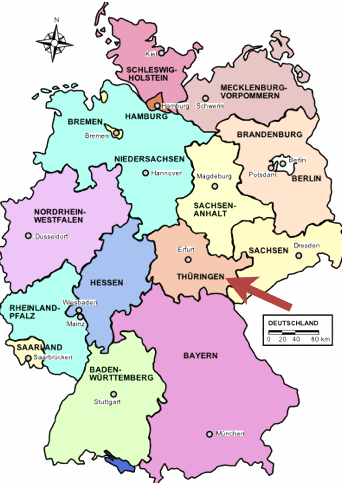
I am happy to inform you about our life in Hitler’s time, for today’s politicians and mass media are purposefully untruthful about that time. I am a Thüringer who grew up in a farming family with seven children, and I have vividly experienced Hitler’s time. My profession is that of certified engineer, for which I began my studies in Thüringen. I had a scholarship, since my mother could not provide money for tuition after my father was killed by lightning. Under National Socialism, it was no problem for a member of a numerous family to obtain a scholarship plus living expenses.


One had merely to fill out an application.


[Image] Location of Thuringen in Germany


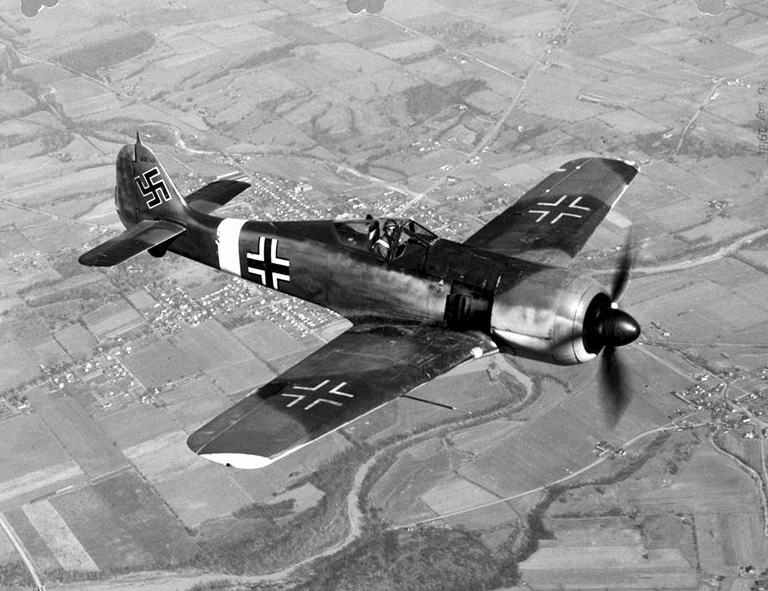
As the English, with genocide intent, began bombing German cities’ populations of civilian men, women, children and elderly, I volunteered for the Air Force to become a pilot in order to shoot down the English terror bombers. In the course of the war, I served as a pilot in a fighter squadron.


After my imprisonment, I returned to my home in Thüringen, but I had to flee to West Germany, because my friends and others were being grabbed by the Communist criminals, never to return.


[Image] German WW II fighter plane


I completed my studies in West Germany, while earning my own living expenses. After six years of professional activities, I secured a position as chief engineer in a large West German industrial enterprise. I later founded my own development firm whose many inventions and developments enabled me to create many jobs for Germans.


Today’s decline in nearly every area of German society stems from the continual failures of the postwar political system and its politicians.


Postwar West Germany was rebuilt by us, the young, former soldiers who returned from imprisonment, along with the men and women of our homeland. There were also many old and fit business managers who had, during the war, managed to increase war production under the hail of English and American bombs. All of us wanted to rebuild our Germany in the spirit of German unity. The BRD (Federal Republic of Germany) was presented to us as provisional, until the re-establishment of Germany.


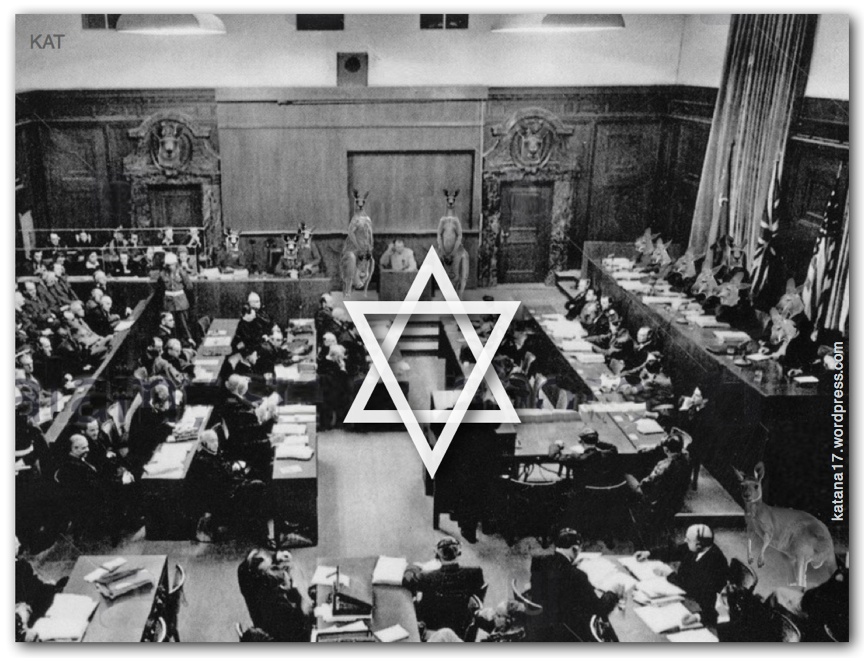
Today, the established politicians of all stripes tacitly take this provisional, unconstitutional BRD as permanent. No established politician of today has ever acknowledged this unacceptable situation for the future. The German Reich still has its legitimate existence. It is just not functioning! The fate of our politicians whom we elected in 1933 is generally known; the Nuremberg Judgements were blatant injustice!


[Image] The Nuremberg Kangaroo Court


The German Folk-Community Spirit Survived the War

top


Here is an example: The postwar Ruhr district was a huge heap of rubble as the English took away its remaining undamaged machinery to England as reparations. As you know, the Soviets did the same.


A general strike was called by the newly-established union to prevent the removal of a large 10,000 ton forging press. This was the biggest press in the world and it could have brought us economic advantages. I would also like to add that the union leader still thought as a German. This matter concerned the preservation of remaining jobs and the preservation of our people. This rally also found representatives of the Ruhr business in attendance. After the many fighting speeches had been made by the union side, a businessman asked to speak. He declared;


let them take the old thing. We used it to make our entire war production. We shall build new ones that are bigger and better!


At one stroke came the determined decision:


Yes, yes, yes!” was the answer.


He had said the magic words.


The old spirit of the folk-community was still alive and discoverable!


[Image] A 10,000 ton forging press in operation


In National Socialism the Workers and Employers Formed a United Front Against the Combined Enemies of Capitalism and Communism

top


The English took the old press to England, where it surely sits today. We young engineers of that time took these words to heart and subsequently constructed and built the most modern presses which gave us many production advantages over England and the other victor states, and brought about West Germany’s great rise to prosperity. England still had production facilities which were decades obsolete, as the norm for its industries. Over there, factories still had long drive-shafts from which transmission belts drove the individual machines. In Germany, we had already been using modern electric-powered machines, which is proven to be a great technical advantage; The English auto firms overtaken by the Germans, also bear witness today to the inefficiency of English businesses, which is also a source of the capitalist English hatred of the efficient Germans.


In World War II, Almost the Entire World was Called Upon to Beat Down the Diligent, Brave Germans in a Long, Forced War

top


Under Hitler, National Socialism emphasized the principle, as stated already, that workers and employers belong together as a united entity and they were not to be agitated nor played off against one another, contrary to the capitalist system of today.


During the course of my career, I have had to consider always this decisively correct and important concept. What can an employer do with ever so good inventions and developments, if he has no workers in his shop to produce them? Nothing! And vice versa: what can a very good worker do, if he has no employer whose business decisions can provide him with modern technology? Nothing!


The principle is that those who work with their heads and their hands, united with nationally-conscious employers, belong together as a team.


This political principle, combined with our retreat from the capitalist gold standard, delivered us from the hopelessness and harm inflicted by the Versailles Dictate. Germany under Hitler was no longer the World War I victors’ object of plunder.


That was Hitler’s concept of folk community which is reviled and unheeded today. There is no remaining national consciousness in today’s politicians, or better said, today’s capitalist vassals. “Economic development through more mergers” are today’s magic words. Foreign capitalists now decide upon the elimination of German jobs. The playing off of workers against employers and vice versa within the folk community is the foremost principle of today’s pseudo-democratic capitalist system.


Today we see many negative examples in the economy where this has occurred. The German worker has finally become the football of foreign economic interests.


This is Capitalism and Globalism in Their Purest Forms. We Must Defend Ourselves Against Them with All Our Strength

top


I would like to add, that under Hitler, the 6 to 7 million unemployed under the “Weimar Republic” were, for the most part, re-employed within two and one half years. Within five years, full employment was reached.


Hitler’s enemies claim today that full employment was only achieved by rearmament. That is absolutely untrue. Armaments began to play a big economic role for the first time in 1939, as England and France forced war upon us. Here are the figures:


German Defence Industry Income from 1933 to 1939:

1933/34 RM 1.9 billion = 4% of the National Income

1934/35 RM 1.9 billion = 4% of the National Income

1935/36 RM 4 billion = 7% of the National Income

1936/37 RM 5.8 billion = 9% of the National Income

1937/38 RM 8.2 billion = 11% of the National Income

1938/39 RM 18.4 billion = 22% of the National Income


The above figures belie the Allied accusations that Germany armed her way out of the Great Depression. The economic situation of the so-called “Weimar Republic” began with the loss of World War I, which was waged by England against Germany in the form of encirclement and the unprecedented hunger blockade.


In his book, “Propaganda for War”, Prof. H.C. Peterson wrote:


By 1918, approximately 763,000 Germans had died of malnutrition and sickness resulting from the blockade.


These Germans were children, women, old men — the weakest members of society.


Charles C. Tansill wrote in his book, “Back Door to War”:


The signing of the armistice on November 11th, 1918 did not lift the blockade against Germany. Months after the end of the First World War, the Allied governments allowed no food to reach millions of starving people in Germany.


It was Then Already Decided Upon to Kill Off the German People

top


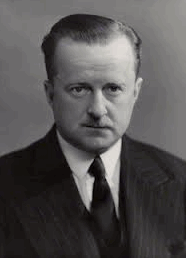
Duff Cooper, [1] First Lord of the Admiralty, wrote:


We did everything in our power to starve the women and children of Germany.


[Image] Alfred Duff Cooper


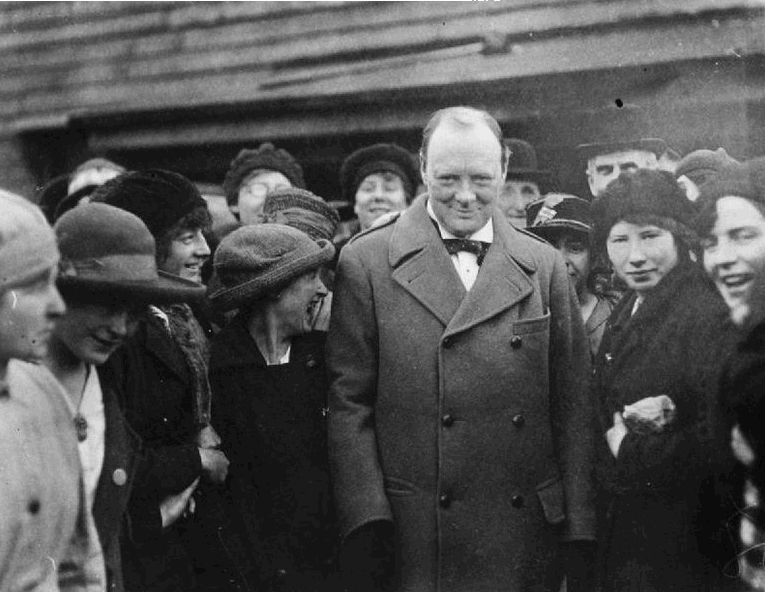
Churchill, who was even then an influential English politician, declared in an interview in the London Times:


If Germany re-establishes her trade in the next 50 years, we shall have fought the war (First World War) in vain.


[Image] Churchill meets female workers at Georgetown’s filling works near Glasgow, October 1918


All the anti-German hatred was put on paper at the conclusion of the Versailles Conference in 1919. Germany had to give its gold reserves to the rich victors, amounting to the unprecedented sum of 100 billion marks, in gold. This amount would also be revised upward! By comparison, France was required by the Frankfurt Peace Treaty of 1871 to withdraw from Elsass-Lothringen and to pay war reparations of 5 billion francs.


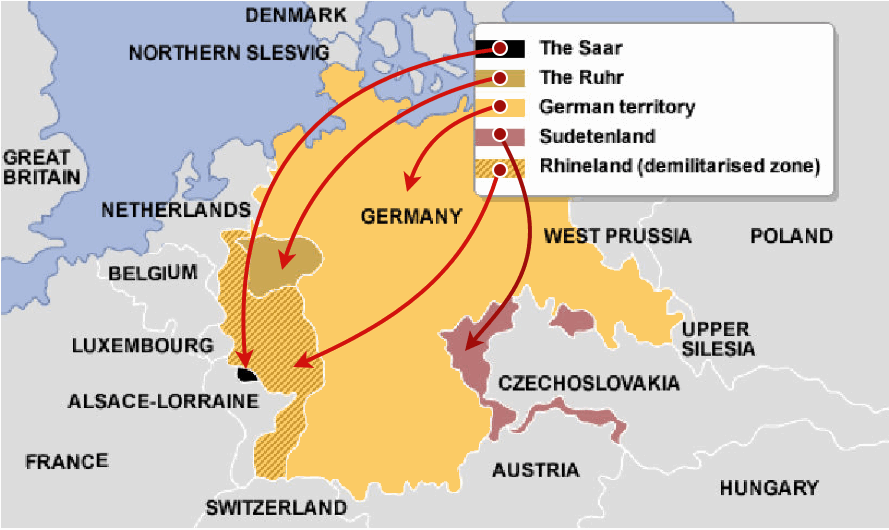
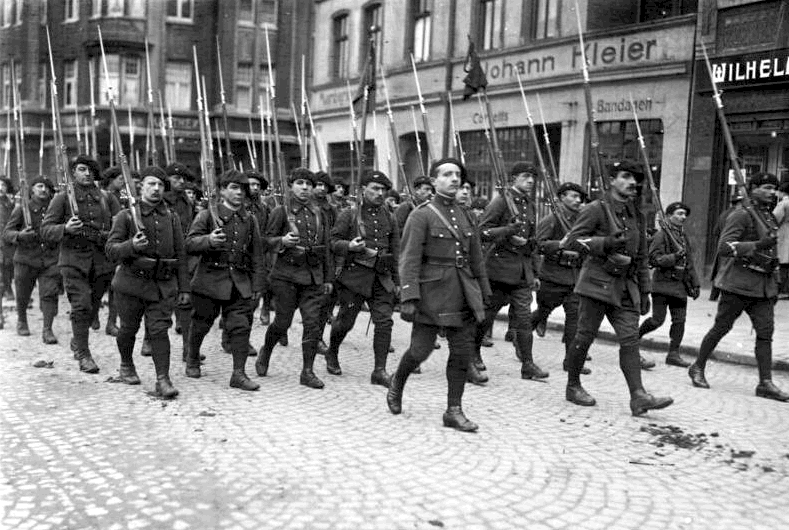
Since Germany could not pay such a huge amount of ‘reparations’, France took its share by occupying the Ruhr and Rheinland areas and diverted their coal production to France.


[Image] Germany after Versailles Treaty


[Image] Occupation of the Rhineland (1918–1919) French Chasseurs Alpins in Buer on 11 January 1923.


The German People Froze and Starved

top


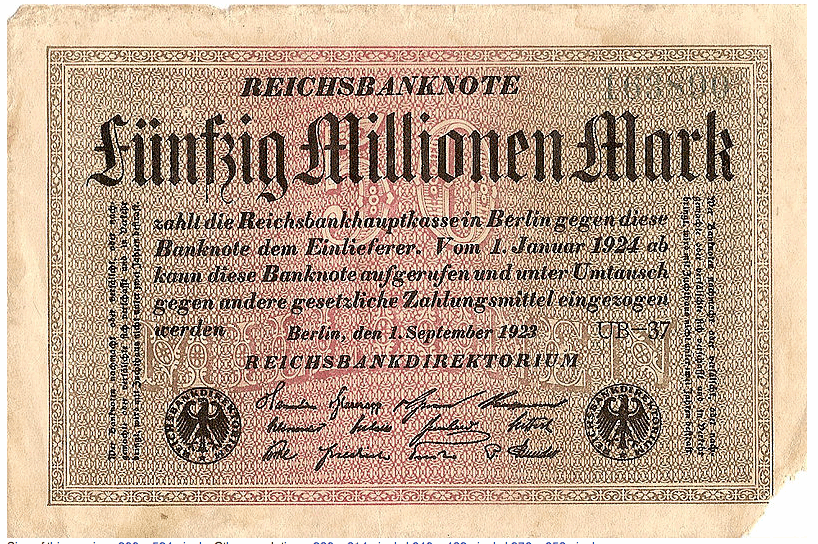
Because of this enormous reparations figure, to be paid in gold, there was no longer any backing for the mark. This led to inflation. This wiped out the Germans’ savings. In those days, a loaf of bread cost 2 billion marks; at the end of the inflation, a pound of butter cost 2 trillion marks.


[Image] A 50,000,000 (50 million) mark banknote from 1923.


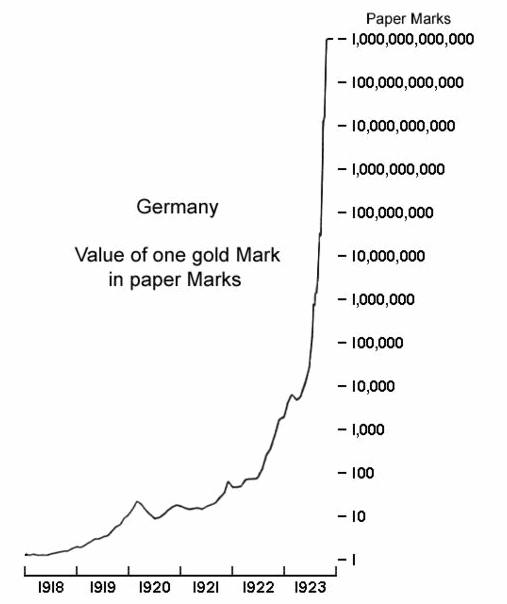
The hyperinflation in the Weimar Republic was a three-year period of hyperinflation in Germany (the Weimar Republic) between June 1921 and January 1924.


[Image] Weimar Republic hyperinflation from one to one trillion paper Marks per gold Mark; on a logarithmic scale.


As a means of payment, the mark was only paper, without any backing!


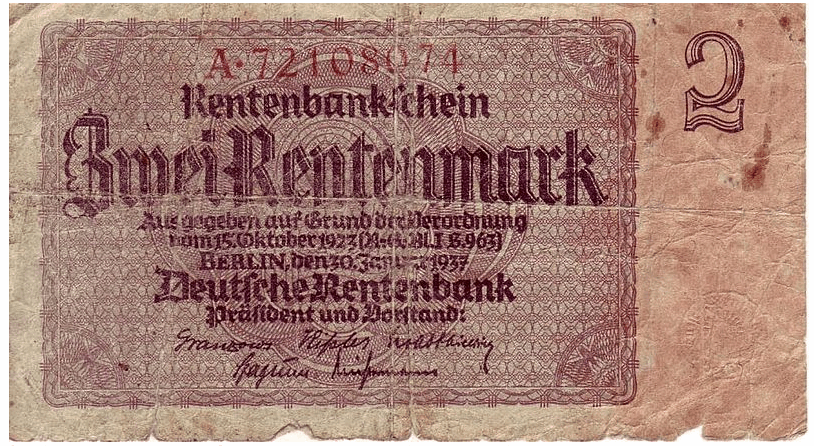
The introduction of the “revenue mark” [Rentenmark] [2] in 1924 ended the inflation and revalued the mark. The revaluation did not solve the basic problem of unemployment, because of which the common folk and former workers lacked the simplest and most basic necessities of life, especially food.

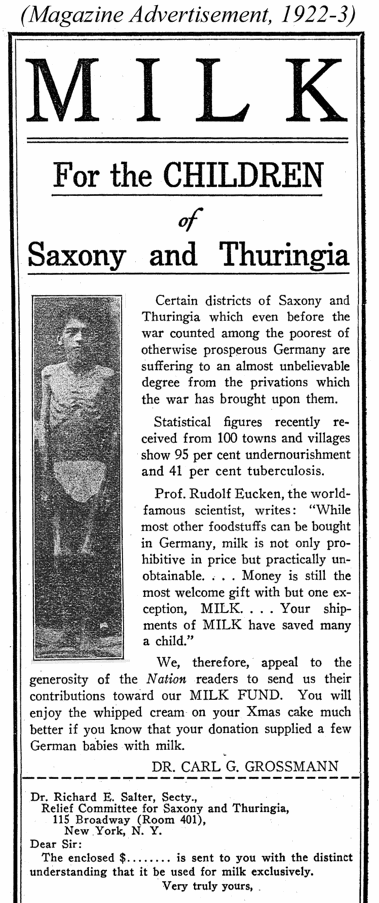
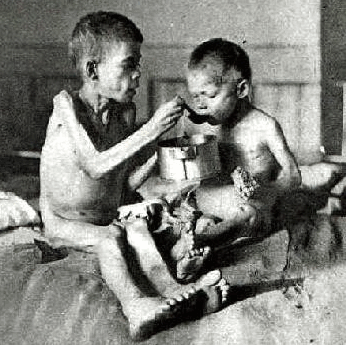
[Image] This sad advertisement (attached herein) ran on the pages of THE NATION for a number of years following the end of the W.W. I. Posted by a German charity, the ad pictures  — what we can assume to be — a starving German child from one of the more impoverished regions of Saxony or Thuringia. All told, the photo and the accompanying text clearly illustrate the economic hardships of post-World War I Germany.


The “Weimar Republic” years were for the German people distinguished by unemployment and hunger, a lack of warm housing in winter and a hopeless future. The urban suicide rate was very high. Children were the foremost victims of the pervasive poverty of those times. Because the government lacked viable alternatives and suffered from certain democratic defects, it could only rely upon emergency decrees. Hitler showed the proper direction to be taken by these bungling politicians of the 32 parties of those times. Of that, more later.


[Image] Starving German children


How Did I Survive This Ordeal?

top


Entire armies of unemployed streamed out from the cities, into the countryside, to beg food for their families. In the villages the unemployed offered to work as farmhands, just for something to eat. In autumn they gleaned the freshly-harvested potato fields for any potatoes which remained in the ground. The poor workers lacked money to buy coal for heating. As winter approached, one could buy a so-called “wood licence” by paying a forester one mark. The owners of such licences had the right to gather broken branches as firewood from the state forests. In this way, the forests were cleared, and were not in the condition in which one finds them today. Every day, one saw columns with their hand carts, marching in the direction of the forests.


Lying and cynical journalists prattle today about “The Golden Twenties”! Golden for whom? For the despoilers of the German people? Anything else is an additional, shameless sneer and lie against the multitudes of starving and freezing people of those times.


The Communist Party Attacks the Farmers

top


The farmers of Thüringen had mostly small holdings, no money and were often deeply in debt. Nevertheless, the Communists deemed them to be property owners, and as such, their political enemies. Our small farm was ‘haunted’ by groups of these people, and was robbed again and again.


These visits were characterized by rude and arrogant behavior, with orders to put food on the table for them, for free, of course! My father would say to my mother, “Give them all we have, or else they will burn down our house.” The night sky was often lit up by the flames of farmhouses which had been torched. People said it was done by the Communists. In that time, anxiety was our constant companion. It was a revolutionary situation!


Later, as Hitler established the Storm Troops (S.A.), this specter was quickly banished and relative order returned. Throughout the mountain regions all over Germany, the common people were especially hard hit by the all-pervasive hunger.


By means of a democratic election, Hitler took over the leadership of Germany on January 30th, 1933. What he took over was a totally bankrupt state, the “Weimar Republic”, with 6 to 7 million jobless workers. As I already mentioned, all German gold reserves had been taken by the rich victors of World War I as reparations. The treasury was empty!


All the German people were filled with hope for this new beginning under Hitler. He had promised us “Work and Bread”, and he kept his word, unlike the politicians of today’s “Second Republic on German Soil.” That we shall not forget!


For Hitler it was out of the question for Germany to become indebted to the jewish bankers of international finance in order to develop the economy. He did not want to fall back into their interest-slavery! The National Socialist folk economy under Hitler thus stands in contrast to today’s politicians of the “German Federal Republic” (BRD) with its capitalist system of irresponsible debt-machinations.


Hitler had found a new way, and therein lie his great and unique accomplishments. It is important for you to hear how ingeniously he did it, to the displeasure of the foreign capitalists. Hitler’s Way is called “Folk’s Economy”. Many of succeeding generations know very little about it, so I shall clarify: To alleviate the greatest need of the German people, “Winter Assistance Work” was immediately called into being. Its motto was:


No one shall starve and freeze!


It was a Great Gathering of Donations for the Poorest of the Poor in Germany’s Needy Mountain Regions and Cities

top


This was a first-rate social action, and it had great success. The poor people of these regions made small items, such as wood carvings, glassware and the like, as tokens for donations received, quickly earning them work and bread. People displayed these tokens to show that they had done their bit to help the poor folk, which spurred the entire German folk to do likewise.


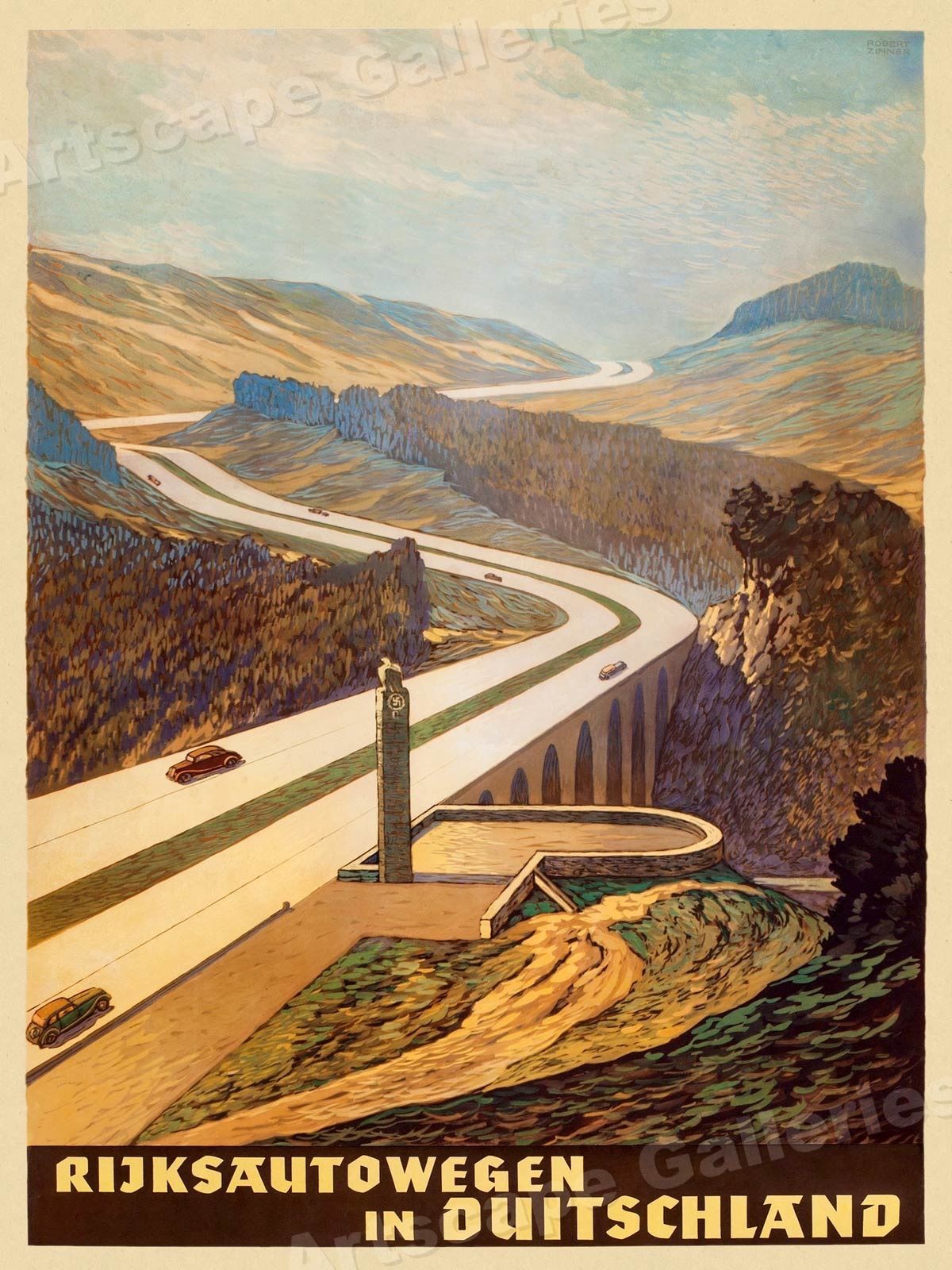
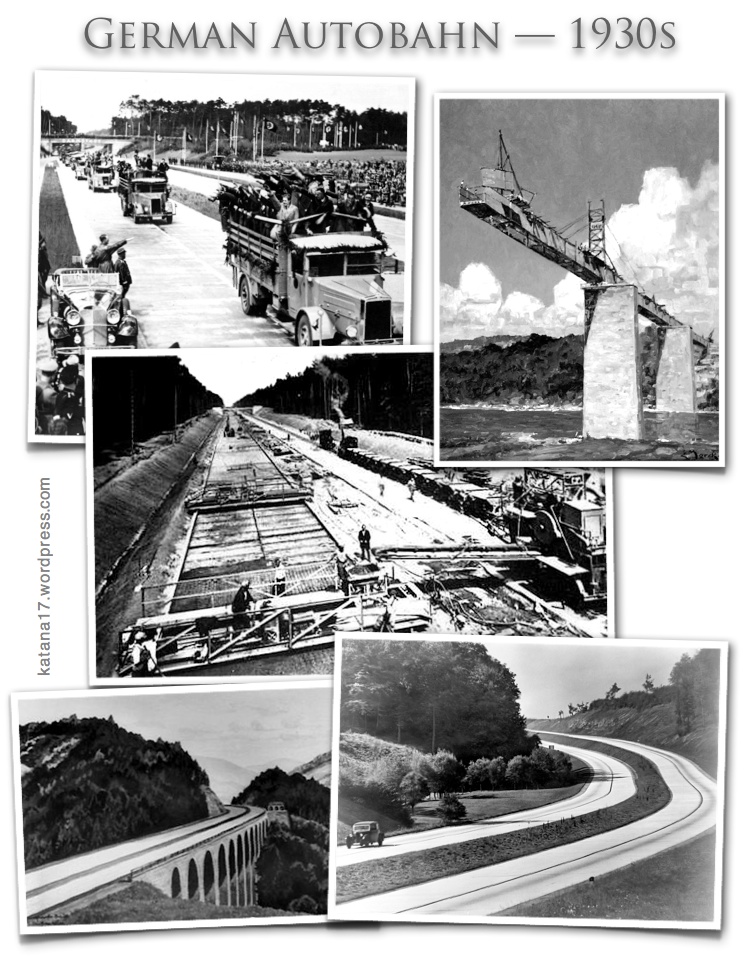
In order to provide work and bread to the millions of unemployed, the plan to “motorize” Germany was developed. The construction of autobahns was begun, using only German materials.


As you know, today’s roads are paved with bitumen or asphalt. This petroleum product had to be imported and paid for in dollars, but we had no dollars. Thus was concrete slab construction invented. The roadway was made of concrete slabs laid together upon compacted earth. All necessary materials were available in Germany. The inventors and builders were the engineers, Dr. Todt and Dr. Dorpmüller.


German Workers, That is, the German Folk, Were to Drive on the Autobahns

top


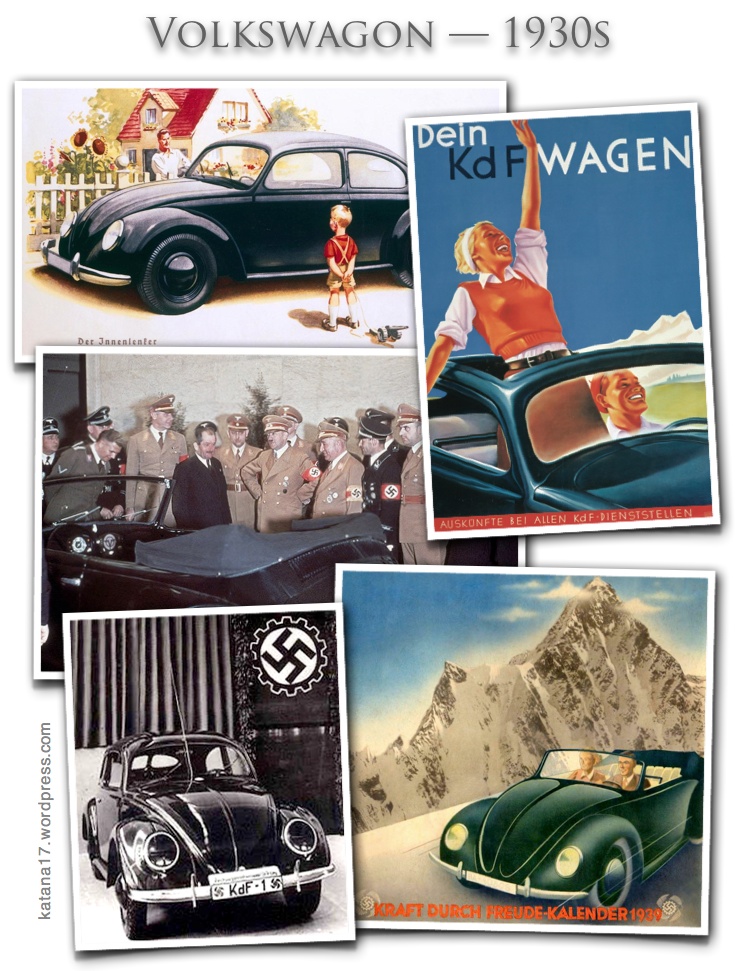
The German auto industry made its proposal: the price per automobile would be between 1,350 and 1,600 Reichsmarks, but these prices were too high for Hitler. Hitler proposed the building of a new and modern auto for the folk. Dr. Porsche built this new auto, the Volkswagen.


This auto was new in every respect and was the most-built and most economical car in the world. At that time it cost 995 Reichsmarks, which could be paid off in small installments. We will not forget that “Volkswagen” was the word Hitler personally chose, a term which the postwar spirit has been unable to eradicate. Think about that when you see a VW.


In order to keep Germany independent of (largely jewish) international finance, German chemists made tires from domestically available German materials, chiefly coal, by means of polymerization. The Buna Works in Merseburg was built for that purpose. The tires made of German artificial rubber were also stronger than those made of natural rubber.


Cars also need gasoline, and this is a distilled petroleum product. Oil could only be purchased from overseas with dollars, which we did not have.


German inventiveness and enterprise produced gasoline from coal-liquification. Thus came about the Leuna Works at Merseburg. Even today, South Africa produces gasoline according to this technique. The German inventors were the chemists, Fiscner and Tropsch.


The Germans needed clothes, but cotton could only be purchased with dollars from overseas. It was thus under Hitler that the first practical rayon fiber was invented. The rayon factory remains today in Schwarza, Thüringen. Combined with German sheeps’ wool, this material made comfortable clothing. After Germany lost the war which was forced upon us, the Americans stole the patent for this fiber as war booty, and sold clothing made of it back to us, for dollars!


For the Restoration of the Economy, the German Steel Industry Urgently Needed Iron Ore

top


There were no dollars available to purchase the rich iron are of Sweden, with its iron content of 81% to 85%. Therefore, a new process, the “KruppRenn Process”, was developed. This enabled us to use domestic German ore, with only 23% to 26% iron content. The German miners, steelworkers and metal-working firms went back to work without being in debt to jewish financiers of the victor states of England and America, thus avoiding their interest-slavery. Their displeasure was not only evident, but so was their desire to change this situation, by means of war, if necessary!


The construction of houses and apartments for workers was notable everywhere. The financing arrangements were quite reasonable. Newly married couples with children received generous loans repayable in ten years, so they could buy a spacious house or apartment. The birth of the first child would cancel a quarter of the loan; four children would cancel the entire debt! Hitler’s viewpoint was as follows:


Over a ten year period, a family with four children will not only earn more than just the amount of the loan, but will pay taxes on hundreds of useful items.


The houses and apartments were naturally constructed according to the highest standards of public health, a factor for which previous worker housing projects were very negligent. In a few years, tax revenues trebled.


Before the end of 1933, Hitler succeeded in building 202,119 dwellings in accordance with his building program. Within four years, nearly l.5 million (1,458,128) were built for the German people.


The monthly rent for a worker, as prescribed by law, was not to exceed 26 Reichsmarks. That was about one eighth of his monthly earnings! Employees with higher incomes paid 45 Reichsmarks maximum. Compare this with today’s rents!


Hitler’s Germany Never Experienced a Financial Crisis

top


These outstanding achievements of the German folk were accomplished with German inventiveness and industry under Hitler’s leadership, and with these achievements Germans’ self-confidence returned. We were independent and free, without having to be in debt. That is also something we will not forget! The same evaluation can be made in many other areas.


As I have already stated, I come from a peasant family, so I therefore wish to tell how Hitler solved the German agricultural problems. The farmers also lost their savings in the great inflation. For the jews and other foreign speculators, this dire state of affairs was an enormous profit-making opportunity. It was said:


Go to Germany, and you can buy a farm or a factory for a few dollars!


And they came. The provision of credit at high interest led the way to dependence, forced sales and property losses.


At the Bückeburg Farmers’ Day celebrations in 1935, Hitler announced the passage of The Farm Inheritance Law for the protection of agriculture, whereby farms bigger than 15 acres could only be transferred by inheritance. Such farms already in alien hands had to be returned to their previous owners. The National Socialist state made available the necessary funds for repurchases. The purchase of farms for a few dollars was nullified by The Farm Inheritance Law, much to the joy of the farmers. It was a brilliant chess move for the protection of German agriculture! The great rake-off by foreign speculators was retroactively curtailed, and they could do nothing with their ill-gotten Reichsmarks, because they were not convertible. This naturally stirred such people’s hatred for National Socialist Germany.


Other effective measures were taken on behalf of the farmers, whose incomes were the lowest in Germany. In 1933 alone, 17, 611 houses were built for farmers. Within 3 years, 91,000 such houses were built. By these and other measures, Hitler benefited the farmers and improved their economic situation.


Foreign Trade

top


Because Germany was no longer on the gold standard, her foreign trade became a well-functioning barter system. All countries which were independent of the U.S.A. and England gladly adopted this system. In exchange for machinery, we received ores, coffee, tropical fruit and important raw materials from Spain, Portugal, Brazil and other lands. All European and overseas countries approved of this method of doing business, because Germany was a very fair trading partner. A U.S. dollar evaluation of this trade was not possible, for these countries had no dollars to buy German machinery. To this day, people of these lands still say that they were fairly treated by Hitler-Germany. They remain our friends today.


Their export products were not subject to speculation in the New York Stock Exchange, much to the advantage of our former trading partners.


This trading method was naturally a thorn in the eye of the Anglo-American-Jewish banksters, while they could no longer profit from it. Extreme agitation against Germany was the result.


The first declaration of war by The Jewish World Congress came just 3 weeks after Hitler’s democratic election. This sensational declaration was published by London’s Daily Express on March 24, 1933, as major front-page news. Here are a few excerpts from this declaration of war:


…14 million jews, throughout the world, are united as one man in declaring war on German persecution of their brothers in faith… World jewry has decided not to remain silent in the face of a resurgent jew-baiting of the Middle Ages… The jewish prince of trade leaves his house of business, the banker his bank, the storekeeper his shop and the door-to-door, peddler his tray. (Editor’s note: Were there no jewish laborers?) They unite in holy war against the jews’ Hitlerian enemy.


As we know today, world jewry was not concerned for their “brothers in faith” in Germany, but only about Hitler’s withdrawal from the gold standard by means of German productivity, and world jewry’s consequent loss of their rackets in Germany. Two days after world jewry’s declaration of war and agitation against Germany, The Zionist Union for Germany sent a telegram to the top jews in America dated March 26, 1933:


In regard to foreign misinformation about the German jews for the purpose of making anti-German propaganda, The Zionist Union for Germany declares: With great resolve we have informed the entire jewish world press via the Jewish Telegraph Agency, already on March 17th, of our declaration against all anti-German propaganda. We have publicly repeated our protest against all untruthful atrocity announcements and baseless sensationalism.

We protest against every attempt to place jewish interests at the service of other countries or groups. The defence of jews’ civil rights and their economic position cannot and must not be coupled with anti-German political actions.


Despite these warnings from German jews, the leadership of world jewry continued their campaign of atrocity propaganda against Germany. Thus was the world political climate poisoned. The president of the ‘neutral’ U.S.A. zealously joined the fray. In Chicago, on October 50, 1937, he spoke for the first time about “peaceful nations” versus “aggressor nations” (Japan, Italy and Germany) which should be “quarantined”, that is, embargoed, by the U.S.A. This was later known as “the quarantine speech”. At the conclusion of this speech, Roosevelt said hypocritically:


I an resolved to pursue the politics of peace, by means of all practical measures, in order to avoid entanglement in war… Positive efforts must be made to keep the peace. America hates war. America hopes for peace. America will take an active role in striving for peace.


On November 21, 1938, Jerszy Potocki, the Polish Ambassador in Washington, DC, mentioned that he had visited U.S. Ambassador William Bullit, in Paris, who told him that Roosevelt had decided to lead the U.S.A. into the next war, which could last for six years. Bullit spoke about Germany and Hitler with extraordinary vehemence.


On December 27th, 1945, James Forrestal, U.S. Navy Undersecretary during the war, confided in his diary:


Played golf with Joe Kennedy. I asked him about his conversations with Roosevelt and Neville Chamberlain in 1938. Among other things, he said that Hitler would have fought against Soviet Russia, without seeking a later conflict with England, if it were not for Bullit’s and Roosevelt’s insistence in the summer of 1939 to humiliate Germany by means of Poland. Neither France nor Britain would have made Poland a cause for war, had it not been for Washington’s constant prodding… Chamberlain was convinced that the U.S.A. and world jewry had forced England into war…


In 1938, the jewish declaration of war against Germany was repeated.

German goods were boycotted in the U.S.A. The U.S. people were urged by the jew-owned press to “boycott all German goods” and German businesses. Jews planted explosives on German freighters. The Swiss National Socialist leader, Wilhelm Gustloff, and later, von Rath of the German Embassy in Paris, were murdered by jews. World jewry’s declaration of war against Germany and their attacks on Germans and German interests overseas also endangered jews in Germany. The result was that jewish businesses were boycotted in Germany, again.


Boycott jewish goods” heralded a one-day boycott of jewish businesses in Germany, on April 1, 1933. International jewry was responsible for the war, and because they were the declared enemies of Germany, they would be treated as prisoners of war, and confined as such.


You should also know that on March 24th, 1933, The National Union of Jewish Front Soldiers sent a note to the U.S. Embassy in Berlin, which stated:


…It is also our decision to reject the irresponsible anti-German agitation of so-called jewish intellectuals overseas. These men, who were for the most part never known as German jews, gave up their right to be our self-styled defenders when they abandoned us at the critical moment and fled the country. They have no right to meddle in German-jewish affairs. From their safe cover they dishonorably shoot their arrows of exaggeration to injure German jews as well as Germany…


Apparently, these jewish war agitators on the other side of the Atlantic cared nothing for the lives and safety of the German jews. They continued their agitation in the most evil manner as war came, with their constant defamation of Germany and Hitler. With the unconditional surrender of the German defence forces on May 8th, 1945, the anti-Germans attained their goal: once again, the German folk could be carved up like a dead goose, as is happening today.


Our successors know absolutely nothing about these foregoing events. The German folk are purposely kept ignorant by the politicians and media.


Why?


Some Contemporary Foreign Opinions About Hitler and National Socialism in “Those Times”

top


Next, I would like to cite a foreign politician who was our enemy in World War I, the former Prime Minister of England, Lloyd George, on his 1936 visit to Germany, as reported by The Daily Express of London:


I have just returned from a visit to Germany. I have seen the famous German Leader, and also some of the great changes he has brought about. Whatever one nay think of his methods, which are certainly not parliamentary, there is no doubt that he has brought about a wonderful change in the thinking of the German people. For the first tine since the (First World) War, there reigns a general feeling of confidence. The people are happier. Throughout the entire land there is a general outpouring of joy. It is a happier Germany.


One man has achieved this miracle. The fact is that Hitler has freed his land of its fear of constant, despair and humiliation, which has given him in today’s Germany, unfettered authority.


It is not merely for his popular leadership that he is admired. (Hitler) is honored as a national hero who has rescued his land from total hopelessness and degradation. He is Germany’s George Washington, the man who won independence from his country’s oppressors.


On May 7th, 1945, the Norwegian Nobel Prize winner, Knut Hamsun, was quoted in Aftenposten:


Hitler was a reformer of the highest rank, and his historical fate was to be in a time of unexampled brutality, of which he was finally a victim.


There were others, such as Churchill and Roosevelt. During the 1936 Olympics, Churchill said:


We will force Hitler into war, whether he wants it or not.


In 1937, Churchill said to German Foreign Minister Ribbentrop:


If Germany gets too strong, we shall smash her again!


Roosevelt declared before the U.S. Congress, in 1934;


There will be war with Germany… all has been planned for some time…


Lord Halifax, Foreign Minister and Viceroy of India, also a warmonger, as quoted in Prof. David L. Hoggan’s 1962 book, “The Forced War”, said:


We have decided to place the entire blame for the war upon Hitler.


Hitler did not want war! On July 190, 1940, he declared in his speech before the Reichstag:


I am, today, still saddened by the failure of my efforts to establish a friendship with England, which, I believe, would be a blessing for both peoples.


Hitler often travelled in his special train from Berlin to Munich and back. As soon as the people on either side of the tracks would see his train, they would stop their work and wave, or give the German salute. Hitler was one of us, and we were proud of him!


My father was a small farmer, who had to pay his property taxes every six months. The tax collector was a forestry worker in the same district, who was appointed by the finance department. Although his house was just 150 meters away from ours, my father would wear his best suit, to bring his contribution to our country, which was called Germany. The paying of taxes was for my father an honorable and sacred duty. Compare this attitude with the corrupt behavior of today’s politicians of The German Federal Republic, in regard to tax matters!


Since Hitler’s takeover of government was democratic, rather than by violent overthrow, he took away the rubber truncheons of the police. After so many Germans had been degraded by these weapons in Weimar times, it was no longer permitted to beat Germans. This, clearly showed that the leadership of the Third Reich had trust, rather than fear for the folk, and that the folk had trust, rather than fear for their leadership! The crime rate was extremely low under Hitler. Please consider what it means today, that it is illegal to have a weapon. Weapons permits are virtually nonexistent today. This can only mean that the politicians of the Federal German Republic (BRD) distrust and fear their own people. A drug problem was unheard of in Hitler-times!


Under Hitler, the First Vacation Cruise Ships Were Built for the German Workers

top


The big cruise ships, “Wilhelm Gustloff”, “Robert Ley”, “Cap Arkona” and others enabled German workers to take sea cruises for little money. The ships were brand new, and most modern in design. These ships were barred from British harbors, basically to prevent the British workers from seeing what was available to German workers under Hitler’s National Socialism.


The favorite destinations were the Portuguese island of Madeira, as well as the Spanish islands and port cities.


In Hitler-times we perceived in our lives a breakthrough into a new dimension. A few years previously, the folk were in the greatest adversity, and now, a new and better future lay before us, after decisive changes of direction. Many foreigners sent their children to study in Germany where they wished to learn about Hitler’s Folk’s Economy and German technology which was the apex of technological achievement.


Hitler had thereby shown the whole world that an economy could be built by the will of a people, without gold. This way was entirely new, and recommended itself to many poor peoples of the Earth.


Hitler’s foreign capitalist opponents therefore viewed his new economic system as a declaration of war and a danger to the entire capitalist gold standard system, with its boundless credit that created debt-slavery, dependence and dissolution of the poor countries under Judeo-Anglo-American high finance.


Germany Had Become Off Limits to Looters

top


World jewish leaders brag:


We have the greatest power on Earth: gold!


(By which they create poverty! Ed.)


Hitler and his able comrades developed and directed an efficient economic system out of adversity, which endangered the entire capitalist system. The gold price threatened to fall, which would mean universal disaster for these capitalists! This new economic system was not only historically unprecedented, with no basis upon gold, it was, from the beginning, serious competition against capitalism, of East and West.


This new economic system could only be destroyed by war, and our opponents began their preparations quite early. In his speech at Fulton in 1946, Churchill declared:

The war was not only waged to defeat fascism (sic) in Germany, but to conquer the German export market. We could have, if we had wanted, prevented war in 1935, without firing a shot, but we did not wish to do so.


The Jewish World Congress and capitalist England and France declared war on Germany, because their looter-system was in danger, and threatened with losses in the future. Nor will we forget that the U.S. leadership stood in the background from the beginning, as one of the warmongers. The value of their gold was in danger!


It was taken into account that the war which the Allies wished to force upon Germany would cause the deaths of millions of innocent people. The Second World War caused the deaths of some 55 million people, including 11 million Germans, of whom millions were women and children.


World War II was conducted as a war of genocide against Germany, to kill the maximum number of Germans, while destroying the German economy for all time. The bombardment of German cities resulting in the deaths of more than a million women and children make that policy clearly evident.


This war was a many million-fold bloodbath, caused by a small group of Judeo-Anglo-American capitalists, their lackeys and stooges, on behalf of their gold and their money. Today, the archives are open. The truth is known! One needs only to make the effort to track down this secret story, according to Honore de Balzac, for this is where the real causes of war appear.


The “Cold War” temporarily spared the German people from total annihilation, but our elected “representatives” in the Bundestag work openly to dissolve the German folk, and to replace us with a multi-cultural society, a multi-national state on German soil. Thus will the victors, who conducted genocide against Germany in war, achieve their final goal.


In order to conceal and cover up the real background and causes of the war against Germany, every means is used against Hitler and the Third Reich:


Defamation, criminalization, the falsification of history and outright lies. It is alleged that the ‘democracies’ had to defend themselves against Hitler’s plans to ‘conquer the world’.


This is absolute nonsense, shameless calumny and lying atrocity propaganda, which is also spread by postwar German politicians and the jewish-owned mass media. The entire political establishment of today is determined to conceal the truth about Hitler-times. Patriotic Germans who reveal the truth are thrown in jail, despite the ‘guarantee’ under Article 5 of the German constitution which states that everyone is free to express his opinions.


Today, the capitalist German Federal Republic has a debt of 2,355 billion marks. That is monstrous and inconceivable! Some 5.7 million unemployed have been jobless for a decade, and the so-called ABM manpower are concealed unemployed, who make up 1.5 million of the actual jobless figure. The huge national debt no longer allows the financing of job-creation programs. Economically, the Federal Republic of Germany is finished. Under Hitler, such a collapse would not be possible!


Today’s economic and cultural decline in Germany and the retreat from German values result from the victors’ imposition of their capitalist, pseudo-democratic system. The unmistakable goal is to bring about the distortion and destruction of Germany’s great culture-bearing folk, through alienation and the falsification of German history. If German justice prescribes hanging for those committing high treason, why are those unpunished, who seek the destruction and replacement of the German folk with a multicultural society? So far, we have been denied our democratic right of a referendum on such important national questions.


The German Federal Republic uses the word, “evident” (well-known) to suppress freedom of expression in regard to important topics! The courts and the news media are the whores of the money-powers behind the curtain of anonymity, just as John Swinton, former publisher of The New York Times, revealed in 1914.


National Socialism could only be impeded by imposing war upon Germany, who had to fight against overwhelming material and military might. Compared with parasitic capitalism, with its great profits for the few, who must always rely upon war to attain their goals, National Socialism was and still is the far better alternative.


This speech appeared in the weekly newspaper, Der Schlesier, July 26 to August 16th, 2002.


———————————


Footnotes

top


[1]  Alfred Duff Cooper;(1890-1954), British political leader and author. He was created First Viscount Norwich of Aldwick in 1952. Born in London on Feb. 22, 1890, he was educated at Eton and at Oxford University. He served in World War I with the Grenadier Guards, winning the Distinguished Service Order. In 1919 he married Lady Diana Manners, a celebrated beauty and actress of some distinction who played the Madonna in the stage production of The Miracle (1923) in the United States.


A Conservative, Cooper served in the House of Commons, first representing Oldham (1924— 1929), and then St. George’s Division at Westminster (1931-1945). He became financial secretary to the War Office (1928-1929 and 1931-1934) and to the Treasury (1934-1935). From 1935 to 1937 he was secretary of state for war and in 1937 he was made first lord of the admiralty. He resigned that post in 1938 in protest over the Munich settlement; his staunch opposition to “appeasement” caused Adolf Hitler to bracket him with Winston Churchill and Anthony Eden as “one of the principal warmongers.


In 1940-1941 he was minister of information in the Churchill government. When the British and French armies met disaster in France in May 1940, Cooper calmly heartened the British people over the radio, quoting Shakespeare’s lines about St. Crispin’s day from Henry V, counseling against not only panic itself but the very thought of panic. He was ambassador to France from 1944 to 1947.


Cooper’s nine books include Talleyrand (1932) and Haig (2 vols, 1935, 1936). He died aboard ship off Vigo, Spain, on Jan. 1, 1954.


[2] When a new currency, the Rentenmark, replaced the worthless Reichsbank marks on November 16, 1923 and 12 zeros were cut from prices, prices in the new currency remained stable. The German people regarded this stable currency as a miracle because they had heard such claims of stability before with the Notgeld (emergency money) that rapidly devalued as an additional source of inflation. The usual explanation was that the Rentenmarks were issued in a fixed amount and were backed by hard assets such as agricultural land and industrial assets, but what happened was more complex than that, as summarized in the following description.


In August 1923, Karl Helfferich proposed a plan to issue a new currency (Roggenmark) backed by mortgage bonds indexed to market prices (in paper Marks) of rye grain. His plan was rejected because of the greatly fluctuating price of rye in paper Marks. The Agriculture Minister Hans Luther proposed a different plan which substituted gold for rye and a new currency, the Rentenmark, backed by bonds indexed to market prices (in paper Marks) of gold.


The gold bonds were defined at the rate of 2790 gold Marks per kilogram of gold, which was the same definition as the pre-war goldmarks. The rentenmarks were not redeemable in gold, but were only indexed to the gold bonds. This rentenmark plan was adopted in monetary reform decrees on October 13–15, 1923 that set up a new bank, the Rentenbank controlled by Hans Luther who had become the new Finance Minister.


After November 12, 1923, when Hjalmar Schacht became currency commissioner, the Reichsbank, the old central bank, was not allowed to discount any further government Treasury bills, which meant the corresponding issue of paper marks also ceased. Discounting of commercial trade bills was allowed and the amount of Rentenmarks expanded, but the issue was strictly controlled to conform to current commercial and government transactions. The new Rentenbank refused credit to the government and to speculators who were not able to borrow Rentenmarks, because Rentenmarks were not legal tender.


When Reichsbank president Rudolf Havenstein died on November 20, 1923, Schacht was appointed president of the Reichsbank. By November 30, 1923, there were 500 million Rentenmarks in circulation, which increased to 1 billion by January 1,1924, and again to 1.8 billion Rentenmarks by July 1924. Meanwhile, the old paper Marks continued in circulation. The total paper Marks increased to 1.2 sextillion (or 1,200,000,000,000,000,000,000) in July 1924 and continued to fall in value to one third of their conversion value in Rentenmarks.


The monetary law of August 30, 1924 permitted exchange of each old paper 1 trillion Mark note for one new Reichsmark, equivalent in value to one Rentenmark.

http://en.wikipedia.org/wiki/Hyperinflation_in_the_Weimar_Republic


[Image] Two Rentenmark (Issued according Decree of 15th of October 1923, RGBL I S.963).


======================================


PDF Notes

* Total words = 7,640
* Total images = 17
* Total A4 pages = 44


PDF of this post. Click to download (10 MB).


LIFE IN THE THIRD REICH Ver 3


Version History

top


Version 5: Oct 17, 2018 — Improved formatting. Updated cover. Added 6 more images. Added Table of Contents with links. Added Ver 3 of PDF of post for download.


Version 4: Oct 16, 2018 — Improved formatting.


Version 3: Added images and footnotes – Oct 5, 2014.


Version 2: Some formatting changes to the PDF – Oct 1, 2014.


Version 1: Published Sep 9, 2014.

Posted in Britain, Germany, Jews, National Socialism, New World Order, Propaganda - Anti-German, Revisionism, The International Jew, Third Reich, Treaty of Versailles, White Nationalism, WW II | 5 Comments

The Wisdom & Musings of John, an Old Retired Chicago Cop – Part 1


The Wisdom & Musings of


John, an Old Retired Chicago Cop

Part 1

[https://katana17.com/wp/]

September 12, 2014

[Image] This was the reflective decal that was used on CPD cars in the sixties and seventies.


The following comments were all made on the excellent Irish Savant blog* starting from Nov 2010 to Feb 2013. As a retired cop from Chicago, John’s comments reflect his street-wise wisdom, race realism and cutting humor that will have savvy readers nodding (and occasionally laughing) in agreement, or not.

http://irishsavant.blogspot.com/

WARNING!


John’s worldview is an acquired one, so bear with the birth pangs.

– John appears to have an on and off love affair with his CAPS KEY. It’s usually either ON or off. I suspect the cause of this stems simply from a sense of efficiency — why spend time and energy in engaging or disengaging that damn CAPS KEY lock? AND BTW, WTF IS A CAPS KEY LOCK?

– In a similar vein John is not man to be held down by tyrannical rules concerning punctuation, grammar or spelling. Real men make and follow their own rules.

– John calls a spade a fucking spade. He doesn’t call a nigger an African American, he calls him a nigger. Likewise he doesn’t call a jew a Chosen One, he calls him a jew.

– Dim Witted Liberals (DWL) and the Politically Correct (PC) crowds will find the following material deeply shocking and offensive. As John would say, “WELL FUCK OFF!” For those that persist, you can learn a lot from someone who has spent his life dealing with the damage to society that you fuckers have created.
With the above warning in mind please learn and enjoy!

PS: John, if you are reading this, many thanks!
Note: The bold text refers to the blog post title being commented on in the Irish Savant.

__________


Madness? Maybe, but maybe not

Anonymous said…

BRAVO SAVANT ON YOUR BLOG. AS A RTIRED CHICAGO COP I CAN SEE WHERE YOU ARE COMING FROM,THE AREAS OF THE CITY THAT WENT FRON WHITE TO BLACK IN 2 YRS LOOK LIKE BERLIN AFTER THE WAR, I MEAN HOW CAN YOU DESTROY REINFORCED CONCRETE. THE PC PEOPLE CRY AND CARRY ON ABOUT EQUALITY AND THEN LEAVE WHEN THE DESTRUCTION SETS IN. BEWARE OF THESE PC PEOPLE IN YOUR GOVT, AS THEY WILL GIVE THE STORE AWAY, THE SOMOLIANS AND NIGERIANS IN YOUR COUNTRY WILL BOOST THE CRIME RATE 100 PERCENT, GOOD LUCK TO YOU IN YOUR QUEST TO KEEP IRELAND FROM BECOMING A RACE POOR WASTE LAND.

25 June 2009 18:08

__________

More educational advances

Anonymous said…

just a thought how about a tv show called this old whore or why stop there how bout the beverly tranvestites, the list and possibilities are endless, the wild animal kingdom filmed in Cork city, the new history channel showing how Ireland has fallen apart in the lst ten years due to its new divesity,give it a shot savant you tell the truth, A RTD CHICAGO COPPER,

1 September 2009 18:28

__________

I’ve been rumbled!

Anonymous said…

SAVANT AS A FORMER CHICAGO COP RETIRED, I HAVE HAD TO LISTEN TO THAT TYPE OF TALK FOR 8 HOURS ON AND THEIR MISFORTUNE WAS ALAWAYS SOMEONE ELSES FAULT, IF A NEIGHBOR WAS A CONTIENOUS WORKER WHO SUCEEDED IN BUSINESS OR WAS A GOOD FAMOLY MAN HE WAS ACCUSSED OF ACY=TING WHITE, SO FEAR NOT MY MAN, WILLIE FEEELS THE WALLS OF HIS HER STUPITY BEING BUILT HIGHER AND CAN ONLY REACT IN THIS ILLITERATE MANNER, GREAT BLOG MY BROTHER YOU SPEAK THE TRUTH.

22 September 2009 13:52

__________

Tell me lies, tell me sweet little lies….

Anonymous said…

OFF TOPIC SAVANT. I KNOW YOU HAVE A HUGE FOLLOWING AND WAS WONDERING IF YOU COULD GET ME NUDE PHOTOS OF THE SINGING GROUP THE COORS. I WOULD LIKE TO SPANK EACH OF THEM, COME TO THINK OF IT THEY CAN SPANK ME. THE PHOTOS SHOULD BE PROVOCITIVE AND SENSUAL WITH EACH GIRL WEARING ONLY STILLETO HEELS.I WOULS LIKE TO SPANK YOU SAVANT IF I COULD GET A BIG ENOUGH LOW BOY AND A CHICAGO HYDRAULIC OVERHEAD CRANE.THANK YOU VERY MUCH. P.S,TELL THE GIRLS TO STAY AWAY FROM O.J. SIMPSON AND A RTD SUBUBAN CHICAGO POLICE SGT. NAMED DREW PETERSON ALSO A 3RD RATE AUTHOR NAME ANN MARIE ORTEGA, I CAN BE REACHED AT JOHN OLD RTD COPPER % chicago alcholic tratment center, chicago ilinois.

23 January 2010 20:02

__________

Tell me lies, tell me sweet little lies….

Anonymous said…

DEar savant, are you telling me thatAndrea is into the guiding hand of a older man ala oh daddy ill be good for you hmmm.glad to hear of your weight loss, bet you can get into a size 54 waist in sans a belt.i remain John old ritred copper.@Chicago alcoholic treatment center/Swedish american home for the mentally impaired, 2600so,California ave, chicago Illinois, attn; cook county jail,

24 January 2010 21:51

__________

Haiti relief: A true international effort

Anonymous said…

I WOULD STLL LIKE TO GET SPANKED BY ANDREA CORR, OR VISA VERSA.JOHN OLDE RETIRED CHICAGO COPPER.

4 February 2010 20:43

__________

Regenerating Limerick

Anonymous said…

THEY TRIED THIS IN CHICAGO WITH THE SECTION 8 PROGRAM, WHEREAS THEY TOOK THE PROJECT TRASH AND SENT THEM INTO ALL WHITE SUBURBS AND PUT THEM INTO PRISTINE DWEELINGS AND THE GOVT, PAID THE RENT. IN THE END WE HAD PORCH MONKEYS SITTING ON THE STOOPS DRINKING AT 10 IN THE MORNING. NUMEROUS BREAKINS,MOLESTATION OF YOUNG TEEN GORLS, ETC ETC. THE ONLY REDEEMING FACTOR WAS THAT THESE AREAS WERE THE LIBERAL ONES WHERE SILK STOCKING LIBERALS RALLEYED AROUND THE CAUSE OF DIVERSITY TO BEGAN WITH BUT NOW ITS COME HOME TO ROOST, IF ONE FAMILY WAS PUT IN A APT. OR HOUSE IT WOUND UP WITH 3 EXTENDED FAMILIES IN THE ONE DWELLING.

17 February 2010 19:09

__________

Regenerating Limerick

Anonymous said…

WAS IN DUBLIN YEARS BACK AND RELATIVE TOOK ME TO A AREA CALLED SHERIFF STREET OR ROAD, I FELT SELF CONSIOUS AS I WAS WEARING NEAT CLOTHES AND SHINED NEW SHOES AND DIDNT HAVE SCAR TISSUE ON MY HEAD OR BLACK OR SWOLLEN EYES AND MISSING TEETH AND THESE WERE JUST THE WOMEN, DO YOU KNOW OF THIS AREA SAVANT.

18 February 2010 22:39

__________

Make the burka mandatory

Anonymous said…

at my age i think i would hit on granny the tatoo queen,John old rtd chicago copper

25 February 2010 03:47

__________

Epic Beard Man: The main lesson

Anonymous said…

either way im glad the nigger got hos ass kicked. john old rtd chicago copper/

26 February 2010 03:34

__________

Epic Beard Man: The main lesson

Anonymous said…

was in ireland back in 60s where the educated irish castigated me as a yank about the civil rights struggle in america, my answer alaways was how many do you want we can send you some. guess what itcame true and now where are the political correct people from that time. probably throwing rocks at the kaffirs. john old rtd. chicago copper.

26 February 2010 18:13

__________

Make the burka mandatory

Anonymous said…

my statement about hitting on tatto grannie is to be restated, i think grannie is hot but i also relish rancid hamburger and milk 3 months past its exporation date. john old rtd chicago copper.

28 February 2010 21:09

__________

The shocking tale of Pastor Kiweweesi

Anonymous said…

giant whooper, laughing my ass off,john old rtd chicago copper.

28 February 2010 21:04

__________

True….

Anonymous said…

hmmmm, i would consider doing a threesome with this couple as they both look in need of discipline and the guiding hand of a older more experinced gentlman, John old rtd. chicago copper.

3 March 2010 18:28

__________


Contradictions of Affirmative Action

Anonymous said…

hung around with a kid while growing up in chicago and his dad was a orthodox kosher jew who was feld reb in german army in WW1, this consisted of his ministing to jews who served the Kaiser as a chaplain, he swore up and down that germans would not do the acts that WW11 exposed. tough old guy some drunk made a crack outside a tavern about the old guys side locks and Rebbe decked and walked on his way.found that german jews had great loyalty to germany up to time of Hitler and would have fought on his side if craziness had not started, their loyalty matched that of american jews.

6 March 2010 17:41

__________

Contradictions of Affirmative Action

Anonymous said…

lucinda your oppression started with trying to fool god. every generation of your people deserved to get it. your nation is the most kicked outof any nation. put the in your bong and smoke it, yeah i said bong. and yes they only have double standards, they will maintain that they dont, liars, they wont give a hand job but they will def like one

6 March 2010 20:39

__________

Country in shock as postal service demonstrates urgency

Anonymous said…

SAVANT, THIS WAS FLOATING AROUND THE STATES FOR AGES ONLY THE WORD IRISH WAS AMERICAN, LOVE IT THO.

15 March 2010 06:03

__________

Country in shock as postal service demonstrates urgency

Anonymous said…

SAVANT, JUST WONDERING IF LIKE THE STATES THE NEW IMPORTED POOR PEOPLE IN YOUR COUNTRY BRING CRYING INFANTS TO THE MOVIES IN THE CINEMA AND DO THEY TALK WHILE THE MOVIES ON AND DO THEY HAVE THE TINY TV SETS THAT THEY LIKE TO PLAY WHILE THE FILM IS IN PROGRESS AND ALSO DO THEY LIKE TO TALK TO THE SCREEN AS IN WATCH OUTS, HES BEHINS DA DOOR, OR SLAP DAT BITCH SUCKER ETC ETC. JUST WONDERING. A OLD CHICAGO COPPER RTD.

16 March 2010 04:57

__________

Hi, I’s the Cheef Ejukator

Anonymous said…

years back myself and another copper had a detail at my old high school Calumet in chicago, the reason for our presence was to make sure the lil nubians wouldnt murder each other after school. on a bet we asked each passing kid who was president of the US during the Eisenhower administration. the answers we got were astounding.Reagan, Elvis, Mayor Daley.and even one for Hitler, funny yes but pathetic. I wondered down the hall to where we used to keep the throphies foe city wide football wins, instead of the throphies that were all gone the display case contained RIP cards and jackets of kids who were murdered by other kids. scary isnt it. unfortunatley this is what you will be seeing in your country as the govt, lets more of these wild people come in.so you see Detroit dosent surprise me.John old rtd chicago copper.

18 March 2010 16:58

__________

Nasty, racist Google

Anonymous said…

this sounds like a job for mr, Wisenfeld and the kid who asked all colored people to leave Wal mart, John old ret, chicago copper.

24 March 2010 04:56

__________

Nasty, racist Google

Anonymous said…

WHAT A BEAUTY, IS THIS THE NEW LORD MAYOR OF DUBLIN, GOTTA SEE HER IN HER OFFICIAL ROBES AND OTHER OFFICIAL PARAPHENIALIA AND JUST HANG AROUND TO HEAR HER MELODIC VOICE ANNOUNCE WORDS OF WISDOM TO HER GATHERED FLOCK.

24 March 2010 16:11

__________

For f*ck sakes!!!!

Anonymous said…

in chicago it seems that security guard field marshall uniforms are the norm some months, saw one kaffair in dunkin dounuts one morning and he had a ww11 german officers cap on with the eagle and swastika and a chicago police uniform blouse buttoned to the neck and did i mention it was 90 degress and humid,this fool said he was working for some amos and andt security company and i was afraid if he was armed as he probably was, we went out to the public phone and put a 9 11 call in for a possible man with a gun and went across the street to watch, when cops came he was packing a 3 57 magnum in a shoulder holster,and was taken out fighting yelling hes bes late fo da job, hilarious our darkies,

14 April 2010 17:24

__________

Just a thought…

Anonymous said…

you tell the real deal savant.as a cop in chicago for thirty years i saw nice bungalows built for our culural enrichers with govt. funds and two years later they were abandoned and trashed and eventually torn down, when the goody liberals were asked why the reply alaways was the showo economic conspiracey against the black community ad naseum, if you want to see the new america go to the blog that shows how detroit looked then and now. truly scary

24 April 2010 17:12

__________

Reasons to be cheerful!

Anonymous said…

and while he fucked me in the ass i thought how wonderfull it was that i was receiving his load of manly semen in my rectum, torn as it was.and when he forced me to place his 12 inch cock in my mouth i was hoping deep inside that i could meet him again to discuss the futher of the oppresed blacks of the world, old rtd chicago copper.

26 April 2010 17:12

__________

The British bulldog re-emerges

Anonymous said…

bravo for the brits from chicago. they are a race of giants and now have had enough from the cultural enrichers. btw that flag on the boat looks like the patty tri color. hmmmmmm interesting.

8 May 2010 18:38

__________

The pros and cons of a Muslim baby sitter

Anonymous said…

savant, i beleive the book of kells kept in dublin has similar texts in its reading, one i recall is if paddy punches kevin, kevins tribe has the right to emasulate the said paddy and to seize his livestock and primitive still and ravage all women in said tribe named fiona, bridget, mary nora,also to rape all of paddys sheep. i may be wrong but if its in the book,,,,,,,,, john old retired chicago copper.

18 May 2010 19:08

__________

My solution to racial disparities

Anonymous said…

off topic savant, years back while a copper in chicago, my partner and i acting silly asked a kaffair if he knew two guys named hitler and stalin who were known to be in the neighborhood creating havoc, said kaffair said that yes they hung out by the tots playlot after dark down by the swings and they drank out of brown bags and sold a little weed, hmmmmm. true story.

22 May 2010 19:52

__________

My solution to racial disparities

Anonymous said…

off topic savant, is it just me or did the woman who played the vetranarian on ballykissangle look at times like a man and sometimes a woman. enquiring chicago minds await your response with mixed emotions,

24 May 2010 18:58

__________

My solution to racial disparities

Anonymous said…

to 18;52. i to was a chicgo cop years back and worked the now gone robert taylor projects on state st,one fine summer evening i was on 12th floor looking east towards lake michigan and a little 13 yr old girl 8 months pregnant came up to say hello, kidding her i asked if she knew the big body of water we were looking at, she stated she didnt, so acting cute i said it was the pacific ocean and if she crossed it she would be in china, sho nuff, i eats da shit outa chop suey she exclaimed.sad but true,

27 May 2010 18:55

__________

The joy of Summer!

Anonymous said…

HATE TO SAY IT SAVANT BUT GOT TO ADMIT IT LOOKS LIKE A TYPICAL AMERICAN LADY SITTING THINKING OF HER NEXT HEART ATTACK MEAL.JOHN OLD RETIRED CHICAGO COPPER.

1 June 2010 21:34

__________

Ireland: All you need to know is here

Anonymous said…

off topic savant but yrs ago atemmpting to get out of a dublin downpour we ducked into a entry way of a closed business and when i paid attn. to where i was it said swastika laundries and tile work on entry was decorated with swastikas, does this place still exist, whats its history, did the pc people come down on it etc.

5 June 2010 19:05

__________

Paris hotties (a la Huffington Post)

Anonymous said…

i recall daddy williams running around calling everybody mother fuckin racists when one of the he she daughters got a bad call. wat else new.

7 June 2010 19:39

__________

Paris hotties (a la Huffington Post)

Anonymous said…

just wondering savant if your new cultural enrichers get on public tranportation in ireland and find it neccesary to spy a young girl and sidel up to her and pull out his dick and masturbate in front of her, this is common here in the states as it beleives that said young lady will all at once fall in love with the monkey.

8 June 2010 18:59

__________

God be with the days……..

Anonymous said…

got to admit savant the one with the chick getting spanked was a erotic turn on for john old rtd. chicgo copper. her in anguish with lace petticoat in disaray. a look of distress on her preety face. oh my what was to follow that we didnt see, damn right ill buy chase and sanborn.

10 June 2010 18:05

__________

Schadenfreude and the World Cup

Anonymous said…

AS A YANK WHO HAS VISITED IRELAND NUMEROUS TIMES I HAVE FOUND THE ENGLISH WELCOMED AND LAUDED IN OLD EIRE. THE SINS OF THE PAST KING BILLY THE BOYNE ETC ETC ARE ONLY MENTIONED I FOUND AMONGST THE DOLE LAYABOUTS IN THE NORTH THAT FOOLS IN AMERICA WERE SENDING MONEY TI VIA NORTHERN IRISH AID THAT WENT INTO PCKETS OF SHARPIES WHO BOUGHT PUBS AND REAL ESTATE.IN FACT IN SOME CASES I HAVE FOUND BRITS ARE MORE WELCOME THEN YANKS.

14 June 2010 22:56

__________

Ever regret a slogan?

Anonymous said…

you gotta do a story on the parcel of dutch models who were arrested in south african for the world cup for advertising illegally.

they all wore matching orange mini skirts. its your story

17 June 2010 05:06

__________

Ever regret a slogan?

Anonymous said…

off topic savant but why are the kerry men known in america as the irish sicilians, is it because they will knife you in the back or what.

17 June 2010 16:57

__________

A Pyrrhic Victory?

Anonymous said…

yrs back a jewish group in chicago was on a tirade to try and stop local jews from going to mexico for vacations, as it turned out thejews would go into the resturants and stores and insult and yell at the help never tip made comments like; this is all your good for etc etc, the mexicans being proud totally ignored them when they came into places of business and the mgment agreed with them, jews claimed it was blatant anti,semitism. i have found israelis better guests in hotels etc then american jews, israelis on the whole do not want to be identified with them.

18 June 2010 18:23

__________

A Pyrrhic Victory?

Anonymous said…

ive noticed things are getting meaner since the recession- the phone company shuts you off if you are two days later , before you could go two months and they would call first- Chase bank will no longer float debit cards on the weekends -its 34 in overdraft per swipe- now landlords are making renters pay for water and garbage when it used to be included. just seems meaner – gotta squeeze more blood out of the turnip.

19 June 2010 23:07

__________

A Pyrrhic Victory?

Anonymous said…

but on the other hand i have met irish in america who came from humble homes in mayo and galway and then got a little education and money and turned overnite into blatant social climbers and name droppers and then claim they went to ;uni; in dublin and were raised in limerick city or some other town. frank mccourt knew his people and reconized this and was lambasted for telling the truth about his background and what he went through as a kid. btw irish alzheimers, you forget everything but the ego, grudges, socila climbing and nasty gossip, frank told that one nite at a book signing.

22 June 2010 21:02

__________

A Pyrrhic Victory?

Anonymous said…

RONAN TYNAN DOESENT HAVE A LEG TO STAND ON IT SEEMS.

26 June 2010 20:26

__________

Taliban educational programme

Anonymous said…

YES IF THRUTH BE KNOWN, I FOR ONE HAVE HAD MORNINGS LIKE THIS.

29 June 2010 00:46

__________

Taliban educational programme

Anonymous said…

BUT ON THE OTHER HAND, IT SEEMS THE LITTLE TYKE IS HAVING A HANDS ON APRENTICESHIP OF A TRADE THAT WILL BENEFIT HIM AND THE OTHER BELEIVERS IN HIS FAITH IMMENSLEY FOR YEARS DOWN THE LINE,NO REASON TO LOSE YOUR HEADS OVER THIS SAVANT. NO PUN INTENDED.

29 June 2010 21:17

__________

Nigerian WC team arrives home to Dublin

Anonymous said…

DARKIES ARE HIGHLY HUMEROUS, NICE WHITE TEETH, AWESOME GRINS,SATURDAY NITE CARRY ONS WITH FIGHTS , KNIVES AND GUNS AND NEVER CALL THE BOSS THEY WILL NOTBECOMING INTO DAY.AND NOW THE PC BASTARDS HAVE TAKEN AWAY OUR NIGGERMANIA, OH THE INHUMANITY OF IT ALL.

29 June 2010 00:45

__________

Taliban educational programme

Anonymous said…

YRS AGO WE HUNG OUT A CONVIENCE STORE ON MIDNITES IN THE GHETTO WHEN I WAS A COP, ONE NITE A OLDER KAFFAIR CAME IN AND SAID TO THE PALISTINAN GUY WHO OWNED HEY MUSTAFA MAN, IT BE TRUE THAT IN TOUR COUNTRY THEY CUT A DUDES HAND OFF FOR STEALING AND SHIT, MUSTAFA REPLIED NO NOT MY COUNTRY BUT IN IN SAUDI ARABIA AND SUCH THEY DO THIS TO CRIMINAL THEIEFS, KAFFAIR THOUGHT ABOUT IT A MINUTE AND SAID, MAN THEY DO THAT HERE THEY BE LOTS OF LEGLESS ARMLESS MOTHER FFFFFFFFS RUNNING AROUND, WE FELL ON GROUND LAUGHING, JOHN OLD RTIRED CHICAGO COPPER.

30 June 2010 05:42

__________

Nigerian WC team arrives home to Dublin

Anonymous said…

I found that you in england have half a million somalians and that female castration is widely used in England. I think that sums it up

they brought england down to their level not the other way and they are in your country because they destroyed their own

3 July 2010 02:34

__________

What I’ve learned from the Srebrenica massacre

Anonymous said…

we went to yugoslavia croatia 15 years back to visit medjgorie and found that the croations were not that friendly to americans at all or for that matter to anyone, the serbs we met were friendly and had a sense of humour, lest we forget that serbs were our allies in ww11 and hid downed us and brit airmen whereas the croats would turn them over to their german handlers for a reward.remember the utasche and the butcher ante pavolac the croat butcher who collected human eyes in a wicker basket.the list goes on what the croats did along with their muslim brethren who they then turned on and murdered when time was ripe.

10 July 2010 19:50

__________

Suddenly…..

Anonymous said…

YRS BACK WHILE IN IRELAND I TOLD MY IN LAWS THAT THE EU CAME WITH A LOT OF STRINGS ATTACHED BUT THEY THOUGHT IT WAS THE GREATEST THING SINCE SLICED BREAD, NOW I UNDERSTAND THE GERMANS MAY GO BACK TO THE DEUTSH MARK AS THEIR CURRENCY AS THE EURO IS NOT LIVING UP TO EXPECTATIONS, WATCH THE GREEKS DO THE SAME, THE EU SHOVED THESE NIGGERS DOWN YOUR THOART IN BRUSSELS AND NOW YOUR GETTING SMART.

11 July 2010 06:02

__________

What I’ve learned from the Srebrenica massacre

Anonymous said…

had a neighbors kid who was on a carrier in the Adriactic sea while blow job clinton was us pres,they had orders to fly off and bomb serb targets of opportunity and one sat morning they saw a local commuter trai crosing a bridge and l et go with air to ground missilesand after the hit they came back exillarated with much talk of how it must of been troops, supplies etc etc,it came out the following monday that the train was taking kids home from a outing in the next town and 90 percent were doa.someone got hold of the photos of rescuers and victims and posted them in ships ready room. captain was outraged but the damage was done, two pilots atemmpted suicide and 3 requested to resign commisions and a near mutiny ensued when pilots refused to fly anymore sorties against serbs without 100 percent factual knowledge,if the serbs once loved us they sure hated us after that,bosnia was a ethnic cultural religious war we shouldnt have got involved in in the ist place.

12 July 2010 06:46

__________

The Equality Industry comes up trumps!

Anonymous said…

ANY SYSTEM THAT BLACKS GET HOLD OF WILL BE ROBBED AND DESTROYED BY BLACKS, HERE IN CHICAGO THE PUBLIC HOUSING, THE TRANSPORTATION SYSTEM. THE EDUCATIONAL SYSTEM.THE CITY JAIL SYSTEM.IF IT HAS A MONETARY VALUE IT WILL BE RANSACKED BY THESE PEOPLE AND FALL INTO A BLACK HOLE WHERE THERE IS NO ACCOUNTABILITY, IF IT IS QUESTIONED THEY WILL PULL THE RACE CARD DAT YA ALL BES RACIS AND SHEET. JOHN OLD RTD CHICAGO COPPER. PS WE JUST HEARD TODAY THAT THE 3RD POLICEMAN IN 8 WEEKS HAS BEEN MURDERED HERE BY THE DIVERSITY PEOPLE.

18 July 2010 19:08

__________

Check this out

Anonymous said…

contrary to popular beleif there will be a MOO AND OINK establised at 111th and kedzie in mount greenwood in chicago along with a public aid office in this all white community thanks to our alderperson theif GINGER RUGAI. FOR THOSE WHO DONT KNOW moo and oink IS A 3RD WORLD grocery store that sell nothing but cheap cuts of meat and fish to the diversity people on the south side, the public aid office goes without saying. john old rtd chicago copper.

24 July 2010 19:35

__________

It gets crazier and crazier

Anonymous said…

My Dad came from Sweden after the 1st world war and settled in Chicago.as kids he told stories to us of fierce winters and hard work and the power and misrule of the Lutheran church and of the land they owned and the monopolies they held on production of various liquors and beer.he also told us of the fights on fair days and the dances and festvals held each year, never never once did we ever hear him speak of these untermensh from other planets in his Parish in the south of SWEDEN, BUT NOW THE STUPID pc cunts want them to have it all, im all for the young neo Nazis in Sweden. also hurt by the bpn loss in saxon Britain, John old rtd. Chicago copper.

31 July 2010 00:21

__________

It gets crazier and crazier

Anonymous said…

feminism is just one of a coherent set of pathologies, all designed as part of the long march through the institutions to destroy the west. although gramsci may have been the originator of the concept, we all know the group that put it into practical effect!

31 July 2010 03:06

__________

Paying both sides in the war

Anonymous said…

savant not to forget all the narrow back irish here in the states giving to the ira frornt noraid which the ira took and bought pubs and farms with and laughed at the stupid yanks.

6 August 2010 05:54

__________

Paying both sides in the war

Anonymous said…

12;24 YES YOUR RIGHT ABOUT THE IRA AND LETTING THE NIGGERS IN IRELAND. ALSO OLD TIMERS TOLD ME THAT MICHAEL COLLINS SHOULD HAVE BEEN THE PRIME MINISTER OF IRELAND ONLY FOR THE FACT THAT DEVELERA ON ADVICE OF THE CHURCH HAD HIM ASSAINATED AS COLLINS BELEIVED IN SEPERATION OF CHURCH AND STATE AND TOTAL LAND REFORM, THE PRIESTS WOULD OF HAD TO FIND A REAL JOB. OLD DEV WAS THE CHURCHES DARLING BOYO.

7 August 2010 19:54

__________

A tale of two stories

Anonymous said…

OLD MAN O HARE WAS INVOLVED WITH THE GREEN SHEET THAT WAS AND IS TO THIS DAY A STABLE TO ALL RACE TRAP AFECINADOS THAT GIVES THE LINE UP OF ALL HORSE RACES, THE REASON HE WENT TO THE FEDS WAS THAT HE WANTED HIS SON BUTCH TO GO TO THE NAVAL ACADEMY AS THE SON WANTED TO BE A AIRMAN, THE DEAL WAS THAT IF HE GAVE UP THE MOB THE KID HAD THE APPOINTMENT IN THE BAG SO EDDIE GAVE EVIDENCE AGAINST BIG AL. THE NEXT YEAR EDDIE WAS DRIVING DOWN ARCHER AVE ON THE SOUTH SIDE AND WHEN HE GOT TO THE STOP SIGN AT HOYNE AVE A LINCOLN PULLED UP NEXT TO HIM AND HE WAS TAKEN OUT WITH TWO SHOT GUN BLASTS, AND THATS THE STORY, DIDNT KNOW HE WAS A LAWYER THO JOHN OLD RTD, CHICAGO COPPER.

10 August 2010 05:13

__________

A tale of two stories

Anonymous said…

EASY EMManuel also chased a young italian high school girl around city hall trying to get into her pants in chicago, young kid went home and told daddy and brothers who came to city hall looking for mr. emmauel who then hid in a janitors broom closet for next 24 hours, true story.

11 August 2010 15:54

__________

The New Democracy: 1 person, 6 votes

Anonymous said…

keep ireland white.or the outcome will be mass violence not the irish but the cunts who are destroying our country.

13 August 2010 20:31

__________

Sweden continues to celebrate diversity

Anonymous said…

sweden has gone insane, no doubt of it. this liberalism has come full cicle to bite them on the ass, the only ones i admire over there are the skin heads who tell it like it is, if sweden falls into the facist net she has no one to blame but herself.

14 August 2010 14:47

__________

It gets crazier and crazier

Anonymous said…

one of the problems is young women dont know what they are getting into. they fall for the romance of the unknown and you can blame romance novels and end up raped.

also foerign men who are dark etc

really work hard to get them into bed. another problem is most middlelcass white women have been taught it is bitchy to doubt a mans intentions and so they end up in a vulnerable situation and are raped.

15 August 2010 06:48

__________

It gets crazier and crazier

Anonymous said…

i knew from the time she was a baby – red haired blue eyed girl, whose mother wanted her to be really smart and a lady, although her mother was neither, and she put her daughter in public schools with the black boys, who saw her fair skin and hair and her timid nature and ruined her, she became a drunk.,she moved to las vegas and took up with all black men, she became a stripper and a hooker and brought her black man back home.how her mother could go on living. no one put their foot down.

her friend was taught to wrestle and do martial arts from the age of five. she was allowed to beat up any boy who harassed her and black boys and mexicans tried to rape her at school and she beat the shit out of them . she did not take up with blacks and married a white man. what does this tell you? the little lady had no survival skills- the not so nice girl survived, both had to deal with the same males. the boys at school told the new boys dont mess with J– she will kill you

finally the constant problem of boys trying to sexually harm females in the schools was too much and she went to alternative school

15 August 2010 06:55

__________

Sweden continues to celebrate diversity

Anonymous said…

her parents should have told her no.

i hope the other girls learn from her death

15 August 2010 06:43

__________

A new play: Dining In Oakland

Anonymous said…

oakland . home of JACK LONDON is no more, feral niggers all over the place, this is a case of NIGGERS GONE WILD,

21 August 2010 19:46

__________

A new play: Dining In Oakland

Anonymous said…

OFF TOPIC SAVANT.does ireland still sell SWEET AFTON SMOKES, LOVED THEM WHEN I WAS THERE YEARS BACK, STILL TRYING TO GET THEM IN CHICAGO AREA.I ALSO RECALL WOODBINES, MADE AMERICAN CAMEL UNFILTERED TASTE LIKE VIRGINIA SLIMS.

22 August 2010 03:49

__________

Dennis Prager : High School Principal Speech

Anonymous said…

can tell the pricipal is a true german. no nonsense there thank god. but the p. c. people will try to get rid of this top notch educator as he speaks with to much sense. john, old rtd. chicago copper.

23 August 2010 00:05

__________

Clever cops

Anonymous said…

I fear,Savant,it will not be long before Ireland experiences this sort of incident-your increasing nigerian population will no doubt engage in this sort of behavior against the native Irish population.How the hell did nigerians end up in Ireland anyway??

27 August 2010 05:50

__________

Clever cops

Anonymous said…

hello savant, we have a yearly abortion called TASTE OF CHICAGO here in the windy city, where all area restuarants who are poliically connected have a two week spread of highly rich and pricey foods,now in the last few yrs kids from the suburbs and white areas have been soundly punched, stabbed . groupped and have been shot at, all this was never in the msm, the mayor idiot theif that he is now wants to turn this over to a pvt polittalcy mgt. company to over see the graft and mayhem. john old rtd. chicago copper.

27 August 2010 05:52

__________

I’m with the pessimists

Anonymous said…

america went through a revolution, civil war. civil rights fight, 2 world wars, and vietnam and we came out stronger then we went in, and after the 2nd world war we helped defeated nations regain strenght to come back.the marshall plan, and american pvt. industry rebuilt japan and germany,if any other country canada included had our problems they would have shifted to ethnic enclaves in their own countries ala bosnia and the french speaking ppl of canada who dont speak english unless they are trying to sell you something, all in all the usa isnt so bad when it comes down to the thruth and when was the last time you heard of americans climbing the fence to flee into mexico.

30 August 2010 04:29

__________

We KNOW that…..

Anonymous said…

our shine loving mayor in chicago said today he wont run again, which probably means he is facing federal indicment, now the jew who runs with obama rahn emmanuell wants to be mayor\. god help us all.

7 September 2010 19:51

__________

Another mystery solved

Anonymous said…

DO THEY WEAR THESE FUCKED UP LOOKING CLOTHES IN IRELAND AS WELL, I DRIVE IN BLACK HOODS AND SOME WHITE ALSO AND SEE THESE CREATURES WALKING AROUND AND IT MAKES ONE WONDER.

10 September 2010 15:28

__________

Another mystery solved

Anonymous said…

OFF TOPIC SIR SAVANT, BUT NOW WITH MAYOR DALEY OF CHICAGO RETIRING RATHER SUDDENLY DUE TO SOON TO BE RELEASED FEDERAL INDICMENTS, IS THERE ANYONE IN IRELAND EVEN IAN PAISLEY WHO COULD FILL HIS SPOT AS BIG DADDY OF THE WINDY CITY, GIVE US A FEW NAMES AND NOT SOME GUY FROM THE KERRY BOGS, WE HAVE HAD ENOUGH OF THEM HERE OVER THE YEARS AND THEY SMELL FUNNY TALK YOU CANT UNDERSTAND AND WHEN THEY STEAL THEY GET CAUGHT AND GIVE EVERYONE INVOLVE UP TO THE COPS, THANX JOHN OLD RTD COPPER FROM CHICAGO

13 September 2010 03:55

__________

Delicious dilemma

Anonymous said…

the worst i have seen was on you tube where brit soldiers were coming home to their native base and were shouted and disrespected while marching through town after coming home from iraq, america may be in some ways be screwed up but we would never let the Muslims here do this thing.

14 September 2010 03:26

__________

Just a thought…..

Anonymous said…

often wondered Savant if ROMA DOWNEY IS AS HOT AS SHE LOOKS FOR A 40ISH CHICK, THOUGHT PERHAPS YOU HAVE SAMPLED THIS HONEY POT. ENQUIREING MINDS IN OHIO WISH TO KNOW,

19 September 2010 03:38

__________

Third World Britain

Anonymous said…

off topic savant, proud day for swewden. after 80 years they voted in the social dems who are no friend of the culural enrichers, saw the letters to ed today from the libtards, everyyhing was racist, facist well you know the drill. bravo sweden kick the swine out.take your country back.

21 September 2010 05:59

__________

Can anyone explain?

Anonymous said…

what, that nice guy in obamas cabinet is a isreali citizen via dual citizenship and now he want to run for mayor of chicago, could this mean he is going to fly planes into the remaining public housing projects here, hmmmm mixed emotions to say the least /

23 September 2010 20:19

__________

Spam alert

Anonymous said…

obongos cheif of staff now wants to be mayor of chicago, jew boy rahn emmanuell, the most arrogant insulting shesksa chasing son of a bitch you ever seen, look in dictionary under dirty jew and his picture is there,

27 September 2010 00:50

__________

Bubba’s pleased!

Anonymous said…

STRANGE AS IT SEEMS SAVANT, THESE FOLK ARE THE SAME AS THE NORTHERN IRISH PROTS WHO WERE RUN OUT YEARS AGO, THE ORIGINAL SCOTS IRISH, TOUGH ORNERY, AT TIMES VIOLENT AND ALSO AT TIMES VERY GENTLE AND HAVE A STRONG DISTRUST OF THE CATHOLICS JEWS AND ANY FORM OF GOVT,GREAT SOLDIERS AND ALSO VERY LOYAL AMERICAN PATRIOTS, THE TERM HILL BILLY COMES FROM KING WILLIAMS MOUNTAIN PEOPLE.

30 September 2010 04:06

__________

In mourning

Anonymous said…

hello from chicago savant. sorry to hear about your dog,we had a big old doppy golden Lab, could give us nothing but love and laughs, when he died in the house it was like a death in the family and yes i do beleive there are dogs in heaven to greet us, that love just gos on to another sphere,

4 October 2010 22:04


======================================

Go to Part 1

Go to Part 2

Go to Part 3


Click to download


Part 1 (0.8MB). >>The Wisdom & Musings of John, an Old Retired Chicago Cop – Part 1, Ver 3

Part 2 (0.8MB). >>The Wisdom & Musings of John, an Old Retired Chicago Cop – Part 2 – Ver 2

Part 3 (0.8MB). >>The Wisdom & Musings of John, an Old Retired Chicago Cop – Part 3 – Ver 2


Knowledge is Power in Our Struggle for Racial Survival


(Information that should be shared with as many of our people as possible — do your part to counter Jewish control of the mainstream media — pass it on and spread the word) … Val Koinen


Version History


Version 5: Feb 23, 2020 — Re-uploaded images and PDFs for katana17.com/wp/ version.


Version 4Aug 23, 2015 — Added updated cover image; added PDF Ver 3.


Version 3: Added links to other parts, Sep 21, 2014


Version 2: Updated Introduction,. Added image of police logo, Sep 14, 2014


Version 1: Published Sep 7, 2014

Posted in Africa, Black Crime, Britain, Chicago, Germany, Ireland, Jews, Negros, Race, WW II | 4 Comments

Hidden History: Amazon Customer Reviews – 3


HIDDEN HISTORY


The Secret Origins of the First World War


Amazon Customer Reviews – 3

Most Helpful First

Note: Comments on Amazon.uk and Amazon.com

as of Sep 2, 2014


Gerry Docherty and Jim Macgregor


EDINBURGH AND LONDON


Dedicated to the victims of an unspeakable evil.


————————————


5 of 9 people found the following review helpful

5.0 out of 5 stars

A must for those interested in the causes of the Great War, 1 Feb 2014

By – Mr. M. Sleight

I bought this on a recommendation from a friend as his brother is the joint author. It’s not an easy read but if you are interested 20th century in history it’s a good read


8 of 15 people found the following review helpful

5.0 out of 5 stars

A warning from history…….., 30 Sep 2013

By – Marcus Laver (United Kingdom)

This book isn’t for people who find comfort in conventional explanations of 20th century history. These people will prefer to believe the ‘official’ history as told by Max Hastings and other historians who back the establishment view – good for them! For those with more open minds, this book will provide plenty of ammunition to blow away the myths propagated by the official histories.

The main thesis of this book is that World War One was not an accident and neither was it orchestrated by devious Germans and the Kaiser, but that it was part of a global programme, devised by an elite of individuals on both sides of the Atlantic, aimed at establishing total dominance over the planet. These people, starting with Cecil Rhodes and Alfred Milner, taking in the Rothschilds and various other prominent people of the period, including Churchill and Lloyd-George, were committed to destroying the growing power of Germany by forming alliances in order to encircle the German Reich and eventually, annhilating it as a political and economic entity. Germany was viewed as a Carthage to Britain’s ‘Roman’ empire – an upstart challenging the dominance of the Anglo-Saxon, English speaking world. Such an upstart could not be allowed to exist. This thesis has already been explored in some depth in a number of other revisionist books, such as Pat Buchanan’s “Churchill, Hitler and the Unnecessary War”, and also Guido Preparata’s “Conjuring Hitler”, though these were more focused on World War 2 rather than the earlier conflict.

Nevertheless, the campaign to destroy Germany started as early as the 1890s and continued until 1945 – the first world war was only the first round in the process.

In many ways the Germanophobia buried deep in the British establishment is still with us today; you only have to look at the fanatically anti-EU (and therefore anti-German) stance of the Tory right wing and of the nauseatingly jingoistic UKIP. One look at the tabloid press in the UK tells you all you need to know about the persistent fear and loathing of Germany, carefully disguised as anti-EU polemic. Modern Germany is an effective puppet of the elite, but old hatreds die hard. Anything remotely ‘social’ from the EU is stamped on mercilessly by the elite owned press (virtually every newspaper), still fearful of Germany taking an independent line.

It doesn’t take much analysis to realise that British foreign policy since the 1890s has been guided by ‘hidden hands’ of elites formed by some of the richest individuals on the planet, and this continues to the present day. It’s also obvious that these elites are as influential in the USA as they are in the UK, and have been chiefly responsible for cementing the ‘special relationship’ between the two nations – a relationship never designed to benefit the peoples of these nations but only the very richest sections of society. The string pullers from the Rothschild led elite are still active today, and no aspect of domestic or foreign policy in the UK, USA and all the other countries of the so-called ‘democratic’ West can ever be implemented without their approval. After the collapse of the communist block the only obstacle left barring the elite’s total world domination lies in the Islamic middle east – it’s abundantly clear that this region is the next target of the elite and of its leading puppets in the USA and Israel.

This book gives a warning from history – we need to heed this warning and mistrust everything that our governments tell us.

————————- Comments (7)

JMB says:—————————————-

100%

except, in my view, for your UKIP reference….

I believe that the intention is for the USA, Israel AND the EU to be puppets of the elite. Don’t forget that British army regiments have already been identified to serve with the upcoming EU army. In disassociating us from the EU, UKIP are working fully against the hidden hands that you describe so well.

1 of 4 people think this post adds to the discussion.

In reply to an earlier poston 5 Nov 2013 22:11:55 GMT

Marcus Laver says:—————————————-

UKIP are also part of the establishment, otherwise the press would have laid into them like no tomorrow. For an anti-establishment party you would need to look at the BNP or the National Front.

0 of 4 people think this post adds to the discussion.

In reply to an earlier poston 6 Nov 2013 10:54:52 GMT

JMB says:—————————————-

The press do a good job of completely ignoring UKIP.

I thought this was a good sign….

But if you are right, I would genuinely like to know what individuals can do to de-rail the elite’s agenda and war juggernaut?

0 of 3 people think this post adds to the discussion.

Posted on 27 Feb 2014 16:19:53 GMT

Boetheus Prettypenny says:—————————————-

Ah, the joys of cable TV, latest refuge of the lunatic fringe.

2 of 2 people think this post adds to the discussion.

Posted on 27 May 2014 13:36:36 BDT

[Deleted by the author on 27 May 2014 13:37:15 BDT]

Posted on 19 Jun 2014 23:30:25 BDT

dwnotanumber says:—————————————-

A credulous review.

In fact “conventional explanations” by the “establishment” are challenged. Most famously Fritz Fischer’s thesis in Germany’s Aims in the First World War and War of Illusions: German Policies, 1911-14 challenged and destroyed the previous explanation.

“It doesn’t take much analysis” to start or believe in a conspiracy, in an elite or group of people who control everything. But how come if their ‘hands’ are hidden’ they are so “obvious” to conspiracy theorists?

We certainly should not take everything on trust from the government, but that does not mean we should instead put our trust in conspiracy theories.

1 of 2 people think this post adds to the discussion.

In reply to an earlier poston 20 Jun 2014 09:44:16 BDT

Marcus Laver says:—————————————-

Have you read the book? This isn’t about a mysterious conspiracy theory – the facts are fully documented. You might not like them, but that doesn’t make them any less relevant. As for German foreign policy in that period, yes it was clumsy and provocative, but this alone does not cause a world war to break out. Too much emphasis has been placed on Fischer’s thesis, which was written at a time when the Holocaust was receiving attention and Germany needed to be apologetic to the world. Unfortunately Fischer’s analysis interprets German defensive measures as if they were preparations for world war, which is far from accurate. German policy has to be viewed in the context of encirclement by France and Russia and a lack of reliable allies.


7 of 13 people found the following review helpful

5.0 out of 5 stars

Describes how unelected potentates within the British establishment engineered Boer War and World War 1, 28 Sep 2013

By – Mr. G. Knight (Kent – UK)

Potentially electrifying account of how a group of wealthy men engineered Boer War and World War 1 for imperial aggrandisement.

Perhaps time to re-appraise our history and some of the leading lights of the British establishment and the ultimately failed attempt to maintain and enlarge the empire.

Worthwhile following the leads in this book for purposes of corroboration; interestingly many of those leading lights insisted that their personal archives be destroyed after their deaths!?


1 of 3 people found the following review helpful

5.0 out of 5 stars

beautifully written, meticulously researched and eloquently articulated, 14 July 2014

By – Fi De-Mendonca

What an outstanding contribution to the understanding of the history of the first world war, beautifully written, meticulously researched and eloquently articulated. Exposing the Secret elite scoundrels and there evil deeds. Congratulation Jim Macgregor, and Gerry Docherty on a sensational book and for writing history. I hope we can learn from this new insight and wisdom.


11 of 24 people found the following review helpful

2.0 out of 5 stars

World War One: Whose fault?, 2 Aug 2013

By – Colin Carnall

Ok for the conspiracy theory buffs but not a serious account. Wholly one sided treatment of those parts of the available evidence supporting their position and essentially ignoring contrary evidence.

————————- Comments (6)

Initial post: 13 Aug 2013 11:42:21 BDT

Dr John ODowd says:—————————————-

I doubt this reviewer has read this book. I am currently three quaters way through it – and it is a mighty hefty read. To comment as he does, he would have had – not only to read the book – but also to have checked a thousand citations and almost three hundred references (fully cited and page-referenced). These include citations and detailed rebuttals of the elite propaganda that passes as ‘academic’ history witten by court historians and ruling-class apologists. I note the author of the review shares a name with a prominent professor in a well-known business school. Such institutions exist solely to maintain the acsendency of the 1% whose work the WWWI was (and all current conflicts are). If he is not the same fellow, his sparse and unargued comment is entirely consistent with what passes for academic activity in business schools.

8 of 13 people think this post adds to the discussion.

In reply to an earlier poston 14 Sep 2013 17:30:45 BDT

Marcus Laver says:—————————————-

This review is rubbish – merely an opinion without analysis. Worthless.

6 of 11 people think this post adds to the discussion.

In reply to an earlier poston 16 Oct 2013 10:26:29 BDT

Last edited by the author on 16 Oct 2013 10:27:22 BDT

Tim62 says:—————————————-

It’s hardly that, it is a very pithy review pointing out the main weakness of this book – namely that its analysis is weak, partial and one-sided. For all the mountain of documents the authors have sifted through, they have not assembled them in a coherent form. Their analysis – such as it is – is not supported by the historical evidence. They are of course entitled to their views, but I doubt you will find serious historians who agree with them (and no, that’s not because everybody else for the past 100 years has been somehow ‘nobbled’ by a hidden elite). This is not to same as saying Britain, France and Russia bear responsibility for WW1, of course they do. All states in the early 20th C were ultimately prepared to use the threat of continental war to make policy. But the idea that was itself was in any way a desireable policy is a non-starter. Look at the economic impact of war on all the European powers in both 1914-18 and 1939-45.

Sorry, but this review makes perfect sense.

3 of 8 people think this post adds to the discussion.

In reply to an earlier poston 15 Nov 2013 18:35:54 GMT

JMB says:—————————————-

Perhaps when you talk of ‘serious historians’ you mean salaried historians?!

2 of 5 people think this post adds to the discussion.

In reply to an earlier poston 19 Nov 2013 09:55:53 GMT

Tim62 says:—————————————-

Hi, no, just to correct your misunderstanding, when I mean serious historians, I mean just that. Best, Tim

2 of 6 people think this post adds to the discussion.

In reply to an earlier poston 5 Aug 2014 10:19:35 BDT

Colin Carnall says:—————————————-

You do not need to read citations to recognise that the list is partial. I read the book not the cited articles…..that is what reviewers do! I note this commentator recognises he cannot make a case because he resorts to a personal attack.


6 of 16 people found the following review helpful

1.0 out of 5 stars

Warning: Conspiracy Theory Claptrap, 8 Jun 2014

By – dwnotanumber

This is not a ‘revisionist’ history book, it is a conspiracy theory novel. Regurgitating Carroll Quigley and supported by some equally dodgy sources such as a nazi official and a holocaust denier (“excellent sources” proclaim the authors), alongside Trotsky and a handful of long-forgotten pre-world war 2 polemics, it makes up a story about a group the authors call the “Secret Elite” which seems to include just about everyone except for the Kaiser and some pacifists. Repetitive use of the meaningless term “Secret Elite” makes the book turgid and boring to read, and its continual use is clearly to hide the obvious flaws in the authors’ belief system. The authors are also rather too free with the use of the word “lie” without substantiating their claims, they are perhaps oblivious or uncaring that such usage can be applied in return. With no sense of irony the authors even admit at one point “You will find no evidence of this in history books. It isn’t there” !

If you think the Queen is a 12 foot lizard then this will confirm everything you have read on the internet.

This book is so bad that I will not resell it as in all conscience I could not pass it on.

————————- Comments (12)

Marcus Laver says:—————————————-

Idiotic review. The book is fully referenced, well researched and is very far from being conspiracy theory drivel. The facts are undeniable, irrespective of whether you like them or not. The secret elite does exist – why not use the term, as it’s pretty accurate and descriptive.

3 of 5 people think this post adds to the discussion.

Posted on 19 Jun 2014 12:36:36 BDT

Last edited by the author on 19 Jun 2014 12:38:08 BDT

Political Dissident says:—————————————-

@dwnotanumber,

1. Carroll Quigley was a respected historian whose research was based on archival material and other reliable sources.

2. Quigley gives an exact description of the “Secret Elite” a.k.a. “Anglo-American Establishment” (the Milner Group on the British side and the Eastern Establishment on the US side) and shows who belonged to it and why.

3. The statement “With no sense of irony the authors even admit at one point “You will find no evidence of this in history books. It isn’t there” !” is as uncalled for as it is irrelevant. It’s a well-known fact that a lot of data missing in history books can be found in national archives, biographies, private correspondence, newspaper articles, etc. This is precisely why new history books are being written all the time. Inconvenient to those who wish to preserve the official early-twentieth-century establishment line to the letter, but inevitable.

3 of 4 people think this post adds to the discussion.

In reply to an earlier poston 19 Jun 2014 22:59:07 BDT

dwnotanumber says:—————————————-

1. Respected by whom? Reliable sources does not mean a reliable interpretation of those sources.

2. Quigley does not give ‘an exact description of the “Secret Elite” ‘ not least because there was no such actual thing to be exact about. Quigley does not use the term “Secret Elite”, nor does Docherty & MacGregor’s invention “Secret Elite” entirely coincide with Quigley’s abstraction “Rhodes-Milner Group” (shortened to “Milner Group” for Anglo-American Establishment) – but that is beside the point. Quigley was not describing, he was making the fallacy of reification, whether deliberately or in error is the question.

3. The statement should be displayed on the front cover as a warning to readers. Docherty & MacGregor do not actually provide any missing data. It is a fallacy to argue on the basis of absence of evidence.

1 of 5 people think this post adds to the discussion.

In reply to an earlier poston 20 Jun 2014 11:02:08 BDT

Last edited by the author on 20 Jun 2014 13:26:17 BDT

Political Dissident says:—————————————-

1. For starters, Quigley was respected by institutions like Georgetown, Princeton and Harvard Universities where he was teaching. There is very little “theory” to the works of authors like Quigley and Docherty & MacGregor, and a lot of presentation of facts based on the sources. You haven’t shown that your interpretation of the sources is any more reliable.

2. The terms chosen to designate the Secret Elite are immaterial. It was generally accepted already at the time that powerful groups (“Cliveden Set”, “Eastern Establishment”, etc.) existed on both sides of the Atlantic who exerted a lot of influence on government (particularly foreign) policy. Quigley describes the Anglo-American Establishment by providing a list of key persons belonging to it and showing how they co-operated in the formation and running of organisations responsible for influencing or making government policy.

3. To argue on the basis of absence of evidence is not necessarily a fallacy. It depends on the argument. It is certainly arguable that systematic withholding of information is indicative of intent to cover up or deceive. The argument is not based on “absence of evidence” but on suppression of information. Docherty & MacGregor provide the data missing from official text books. That’s why the Establishment and its stooges find the book so annoying.

3 of 4 people think this post adds to the discussion.

In reply to an earlier poston 20 Jun 2014 22:13:25 BDT

dwnotanumber says:—————————————-

1. He may well have been respected as a teacher, but that does not prove he was a respected historian.

A fact is something that is not open to interpretation, the works of Quigley and his imitators are interpretations. Quigley certainly did examine sources, but he clearly left things out and made certain interpretations to fit his theory. I haven’t given my interpretation of those sources, I am just noting that I am aware of the deficiencies in Quigley’s interpretation of them.

While Quigley examined and interpreted source material Docherty & MacGregor rely uncritically on Quigley or tend to rely on the views of biased others as their sources. Whereas a historian, in contrast, would examine the views of biased people but would not regard their views as facts over other people’s views, and would take those views in context. By no stretch of the imagination then is this book “fully referenced, well researched”, it seems that the authors have simply supplied sources to fit their pet theory.

2. There were a number of grouping and individuals at this time (as in any time) seeking to influence government policy – and let’s not forget to state the obvious that Milner failed in his aim to achieve imperial federation. But by obsessively focusing on one grouping to the exclusion of what others were doing gives a false impression. Quigley does provide lists of names, the problem is that by placing them under an inclusive term “Group” he implies that all of them held the same view and unchanging aim all the time which is a falsification. Docherty & MacGregor go way, way, way beyond that with their super cover-all term “Secret Elite”. To believe that a ‘group’ has a single intelligence, and that only that ‘group’ determine all events is conspiracy theory pure and simple.

3 To argue on the basis of absence of evidence is always a fallacy – otherwise you can claim anything is true. Undoubtedly systematic withholding of information can be taken as indicative of intent to cover up or deceive, but even if shown to be the case it does not tell us what the information is.

Docherty & MacGregor do not actually provide any missing data. Indeed like Quigely’s work it is missing great chunks of data. The question again must be, is that deliberate?

2 of 4 people think this post adds to the discussion.

In reply to an earlier poston 21 Jun 2014 01:34:14 BDT

Political Dissident says:—————————————-

1. Being respected as a professor of history equals being respected as a historian. You are placing unwarranted emphasis on “theory” and “interpretation” and conveniently ignoring the facts presented by Quigley et al.

2. The fact that other groups existed does not detract from the fact that the Anglo-American Establishment was the most powerful and influential among them. After all, it was Rothschild and their agents J P Morgan who arranged the financing and supply of the Allied war effort. There is no intrinsic necessity for members of a group to hold identical views for the group to qualify as such. A family is a social group and a party a political group even if their members do not all hold identical views.

3. Your statement “To argue on the basis of absence of evidence is always a fallacy – otherwise you can claim anything is true” is itself a fallacy. One may perfectly well plead a defendant’s innocence on the basis of absence of evidence to the contrary. Indeed, “innocent until proven guilty” is a well-known legal principle. It doesn’t follow that “you can claim anything is true”.

Docherty and MacGregor are providing key data missing from Establishment-approved textbooks. The latter, for example, fail to disclose the fact that the war was financed and supplied by the Anglo-American Establishment and it is reasonable to assume that such omissions are deliberate.

3 of 4 people think this post adds to the discussion.

In reply to an earlier poston 21 Jun 2014 21:47:52 BDT

Last edited by the author on 21 Jun 2014 21:50:16 BDT

dwnotanumber says:—————————————-

1. If he was a respected historian he would be cited and referenced by other historians, which clearly isn’t the case. And please don’t tell me that’s because of a conspiracy by the establishment! That the establishment can acknowledge the existence of David Irving whilst simultaneously seeking to exclude him would seem to indicate that in Quigley’s case it’s more a case that no one takes him seriously.

2. Are you claiming that the aims of Rothschild and J.P. Morgan was British imperial unity? For surely that would be the definition of association with Milner. As soon as you move away from that definition then there is no “Milner group”, there is either no group at all or some other group. If lack of definition was Quigley’s error, it is Docherty & MacGregor’s speciality.

Clearly Milner, Kerr and Curtis were not the most powerful and influential people because they each failed in their different aims.

This lack of clarity about the group also seems to fall under the fallacy of composition (see Fischer Historian’s Fallacies: Toward a Logic of Historical Thought)

3. This is the fallacy of arguing from ignorance (see Fischer again). Show me the facts, not the absence of facts. And remember the burden of proof lies with the author.

What missing key data do they provide? By “Establishment approved textbooks” do you mean the books used in school?

If by “Anglo-American Establishment” (?) you actually mean say JP Morgan and Rothschild, then their role is already common knowledge, not a secret. For example: Britain, France, and the Financing of the First World War, which I would take to be an establishment book.

Conspiracy Theories: A Critical Introduction by Dr Jovan Byford –

“The conspiratorial body is usually represented not just as a list of names, but also graphically, in the form of complex diagrams and schemas illustrating the ties between different individuals and organisations” (p73): Docherty & MacGregor, appendix 1 and 2 – check!

“conspiracy theorists regularly invoke ‘evidence’ of foreknowledge about a dramatic event to suggest that its causes may have been different to those found in official explanations … the main tenet of the conspiracy theory is that a particular event was planned in advance” (p86-87): Docherty & MacGregor, whole book – check!

“in crafting their argument, conspiracy theorists often draw on the writing of their predecessors” (p87): Docherty & MacGregor, based on Quigley and Barnes – check!

It makes you wonder if there is a template that Docherty & MacGregor just downloaded and filled in.

1 of 4 people think this post adds to the discussion.

In reply to an earlier poston 22 Jun 2014 01:15:23 BDT

Last edited by the author on 22 Jun 2014 23:31:41 BDT

Political Dissident says:—————————————-

It is symptomatic of the Establishment and its stooges (or useful idiots) that their arguments sooner or later progress from the false and illogical to the absurd and irrational: according to them, if an author writes that a particular event was planned in advance, then he must be a “conspiracy theorist” (as if planning were not an everyday occurrence); likewise, if he draws on the writings of his predecessors (as if drawing on the writings of predecessors were something historians never do), etc., etc.

1. Quigley is in fact cited by historians, see Parmar’s “Think Tanks”. The bulk of Quigley’s “The Anglo-American Establishment” consists of historical facts, e.g., Rhodes’ advocacy of a secret society, the Anglo-American Establishment’s engineering of imperial conferences, the Commonwealth, the League of Nations, the RIIA and its sister organisation, the CFR, etc., etc. It seems to me that you are placing unwarranted emphasis on “theory” and “interpretation” while ignoring the facts in order to slant the debate in favour of the Establishment.

2. The aim of the Anglo-American Establishment was to control resources and finance in order to control economic and political systems. All the organisations it has set up (the Federal Reserve System, Commonwealth, League of Nations, United Nations, etc.) have been mere means to that end.

3. I haven’t the foggiest as to who you are referring to when talking about “fallacy of arguing from ignorance”. The central argument of authors like Quigley, Docherty and MacGregor is that the Establishment line is contradicted by historical facts. Rothschild and J P Morgan’s financing and supplying the Allied war effort and the profits they made from the war are certainly not “common knowledge”. Most members of the general public I have asked had no idea!

3 of 3 people think this post adds to the discussion.

In reply to an earlier poston 22 Jun 2014 22:53:00 BDT

Political Dissident says:—————————————-

Incidentally, the book you are citing (“Britain, France, and the Financing of the First World War”) shows that the imposition of financial dominance was central to the Establishment’s support for the war – which rather confirms the findings of authors like Quigley, Docherty and MacGregor.

3 of 3 people think this post adds to the discussion.

In reply to an earlier poston 23 Jun 2014 10:19:48 BDT

Political Dissident says:—————————————-

Essentially, what you seem to be saying is that the Establishment as a social, economic and political group doesn’t exist; that the Establishment (or elements thereof) had no desire to preserve and augment British (or its own) imperial power, colonial interests and, in particular, financial dominance; that it had nothing to do with anti-German propaganda, war preparations, secret military agreements or the funding, supplying and profiting from the war; that it had nothing to do with the creation of organisations intended to represent its interests and increase its power and influence such as the Federal Reserve System, the Commonwealth, the League of Nations, the United Nations, RIIA, CFR, etc.; that none of the above was planned; that Churchill never said “we are building with Germany in mind”; and, generally, that it all happened quite spontaneously and of its own accord and that nobody was ever responsible for anything with the singular exception of “those uppity and uncivilised Germans”.

In reply to an earlier poston 24 Jun 2014 12:20:20 BDT

Political Dissident says:—————————————-

What emerges from alternative histories like Quigley’s “The Anglo-American Establishment” is that Rhodes (a Rothschild associate) instigated the formation of a secret society and that Milner (another Rothschild associate) was a chief trustee of the Rhodes Trust (which was set up to administer Rhodes’ bequest and to educate future world leaders in line with Rhodes’ ideas) as well as a leading figure in the imperialist clique that exerted a great deal of influence on government, military, finance and other aspects of domestic and international life.

There is no evidence to suggest that this account is historically inaccurate, untrue or in any way “dodgy”. Even supposing, for the sake of the argument, that Quigley and other authors were “dodgy”, their dodginess must surely pale into insignificance when compared with the Establishment’s own dodginess.

Indeed, if we consider the state of the country and of most of the world for which the Establishment must bear some if not most of the responsibility, then the Establishment must be admitted to be about the dodgiest thing on the planet. At any rate, given that in the real world the importance of the Establishment and its policies far outweighs that of authors like Quigley, it is only proper to pay more attention to the former than to the latter.

Concerning the First World War, the Establishment line is that it was started by Germany’s invasion of Belgium. The difficulty with this line becomes apparent immediately we look at the evidence.

In his House of Commons speech of 3 August 1914, Foreign Secretary E. Grey failed to explain what the 1839 Treaty of London – which allegedly put Britain under obligation to defend Belgium – was all about. Instead, quoting former Prime Minister Gladstone, he said: “There is, I admit, the obligation of the Treaty. It is not necessary, nor would time permit me, to enter into the complicated question of the nature of the obligations of that treaty.”

The question that arises in the first instance is: if the “obligations” allegedly established under that treaty were so clear-cut as to warrant going to war, why was it so complicated and time-consuming to spell them out – even in outline?

The truth of the matter was that spelling out the alleged “obligations” would have debunked the myth of their existence.

Article 7 of the Treaty states: “Belgium shall form an independent and perpetually neutral State. It shall be bound to observe this neutrality towards all other States.”

It doesn’t say anywhere that Britain or any other major signatory power (France, Germany, Russia) was obliged to intervene by military means in case of Belgian neutrality being violated by the others.

The fact is that the Milner Group (the imperialist faction within the Establishment revolving round Milner and associates) had already made up its mind to attack Germany long before the Germans invaded Belgium. Indeed, the understanding was that Britain would attack Germany in case of war breaking out between Germany and France or Germany and Russia – irrespective of what happened to Belgium.

The pro-war faction’s position was made very clear by the press. For instance, the key reasons for military action given by the Establishment organ The Times were:

1. Britain must stand by her friends France and Russia.

2. Britain has a vital interest in seeing that France is not overwhelmed by Germany. The Power which dominates France will dominate Belgium and the Netherlands and threaten the very basis of the Empire’s existence – British sea-power

(The Times, 1 August 1914).

Note that this was not the position of the Government (the Cabinet was overwhelmingly against British involvement up to that point) but of the pro-war clique represented by Robert Cecil, Grey, Churchill and collaborators.

Moreover, the British and the French had been building up Russia against Germany, for example, by forming military alliances, by investing in Russian railways (to facilitate military transport), etc., thus making Russo-German conflict inevitable. Conflict with Russia meant conflict with France who was obliged to assist Russia (as per the Franco-Russian Alliance) and conflict with France meant conflict with Britain who was obliged to assist France (as per the secret agreements mentioned in Grey’s speech).

The clique behind these machinations knew it full well and was waiting for it. For example, as conceded by Martin Gilbert, Churchill knew that war between Germany and Russia would lead to British involvement against Germany (vol. 3, p. 25).

Had the Establishment been as hell-bent on world peace as it retrospectively makes out, it would have avoided straining relations with Germany by not encouraging Russia and by refraining from secret agreements against Germany. As, by their very nature, secret agreements cannot be construed as deterrent, they are suggestive of hostile intent.

Indeed, as early as 1906, the Belgian minister at Paris, A. F. G. Leghait wrote of “England’s desire to envenom matters to such an extent that war should be rendered inevitable”; in the following year, the Belgian minister in London, Count Lalaing, wrote that “It is evident that official circles in England are pursuing in silence a hostile policy which aims at the isolation of Germany”; and, in 1909, the Belgian minister at Berlin, Baron Greindl, wrote: “Colonel Barnardiston [the British military attaché in Brussels] asked us, in substance, to associate ourselves with an English and French aggression against Germany.”

The secret agreements of 1906 and 1912 between the British and Belgian military authorities, referred to in the Belgian Archives as “Anglo-Belgian Convention”, show (a) hostile intent on the part of elements of the British Establishment and (b) a blatant violation of the Belgian neutrality that Britain was allegedly “obliged” to defend.

In sum, whichever way we look at it, the Establishment line is untenable. If we take into account the involvement of vested interests associated with the Establishment in financing the war and other international projects promoting their agendas, the Establishment’s position becomes even shakier. In other words, the problem is caused by the contradiction between the Establishment line and historical facts, not by the historians who point it out.

3 of 4 people think this post adds to the discussion.

Posted on 22 Jul 2014 06:13:24 BDT

Last edited by the author on 22 Jul 2014 12:38:23 BDT

Peter Hof says:—————————————-

A response to dwnotanumber:

The “conspiracy theory” pejorative is a favorite refuge for the misinformed. It is impossible to make sense of British foreign policy (after 1900) without the assumption that Great Britain sought a confrontation with Germany. Ask yourself:

-Why would England conclude an Entente with France when France (Delcasse) had declared that any rapprochement with Germany was unthinkable unless Alsace and Lorraine were completely restored?

-Why did Edward VII while still Prince of Wales have secret meetings with Leon Gambetta, the prince of revanchards?

-Why did England support France against Germany during the two Moroccan crises when Germany was on solid legal and moral ground?

-Why did England support France in 1911 when France was in clear and indisputable violation of the Act of Algeciras, even going so far as to threaten war in Lloyd George’s Mansion House speech?

-Why did Grey conspire with France in a secret plan of campaign against Germany which he kept secret, not only from Germany, but from Parliament and even the Cabinet?

-Why did Grey in 1912 give Poincare and Sasonov a verbal promise of a 120,000-man British expeditionary force?

-Why did Grey ignore urgent German warnings about Russian mobilization measures and made no attempt to moderate Russia even as Russia had made the decision to order general mobilization and Germany was leaning heavily upon Austria?

These questions and many others have no credible answer unless we assume that England aimed at war with Germany. With this assumption, the puzzle pieces fall neatly into place.

Finally, you write: “With no sense of irony the authors even admit at one point ‘You will find no evidence of this in history books. It isn’t there'” ! But the irony is yours. You may have heard that when a nation decides upon war, the decision is not shouted from the rooftops nor is it proclaimed in banner headlines. What happens is that the nation embarks on a, well, conspiracy, to keep the decision a secret until public opinion is properly prepared. History is littered with examples. Look at William Randolph Hearst (the American Northcliffe) and the Spanish-American war. Or check Wilson’s Creel Commission whose purpose was described by George Creel himself: “What we had to have was no mere surface unity, but a passionate belief in the justice of America’s cause that should weld the people of the United States into one white-hot mass instinct with fraternity, devotion, courage, and deathless determination.”

There are other examples but you get the point. As for “conspiracy claptrap,” here is one for you: Germany started a world war in 1914 for no apparent reason and with every chance of defeat. Unless you buy Fischer’s claptrap, Germany had no motive except self-defense. Unless of course you think German leaders were “12 foot lizards” in which case the motive becomes irrelevant.


11 of 33 people found the following review helpful

1.0 out of 5 stars

Very partial pseudo-history, 15 Oct 2013

By – Tim62 “history buff” (London, UK)

It is interesting that communists and fascists do seem to like this book, for entirely different reasons I suspect. For communists because it is yet again proof of the corrupt and base nature of global capitalism, which must be swept away before we attain a workers’ paradise.

For fascists, I rather think because it ties into a nihilist agenda that has been trending in the anglo-blogosphere (sorry about that term) over the past few years, about how we cannot trust ‘them’ (you can define them largely how you want, but it is generally taken to be a shadowy ruling cabal) and it is the precursor to their idea of dismantling current democracies, and replacing them with an altogether different – and more illiberal – version of society.

In fact the ideas underpinning this book largely remind me of the late-60s/early-1970 Red Brigade/Baader Meinhof view that liberal democracy was merely a sham facade.

Read the book by all means, but then read a real history book. This one is very partial. Both authors have done an awful lot of work, crawling through the archives, but it seems they are very partial about how they then assemble the material they have collected.

If you want to argue that German was not alone guilty of starting WW1, there is absolutely plenty of evidence for that. France, Russia and Britain were all certainly prepared to risk conflict to pursue what they saw as vital state interests – but to go from that to some shadowy cabal is moonshine.

Sorry. It might work as fiction. It does not work as history. Try these books instead:

The Sleepwalkers: How Europe Went to War in 1914 by Christopher Clark, who argues against solely blaming Germany; Catastrophe: Europe Goes to War 1914 by Max Hastings, who argues that Germany and Austria-Hungary should bear the bulk of the blame.

Elsewhere we have The Origins of the First World War (Origins Of Modern Wars) by James Joll and Gordon Martel; The Origins of the First World War: Controversies and Consensus (Making History) by Annika Mombauer.

And of course there is the first volume, To Arms, in Hew Strachan’s magisterial three-volume work on the Great War, The First World War, Volume One: To Arms which covers its origins.

They all have different takes on 1914 – and all of them make more sense than this book.

————————- Comments (9)

Stephen Spielberg says:—————————————-

Thank you – you’ve confirmed my suspicions and I won’t need to read “it”!

5 of 13 people think this post adds to the discussion.

In reply to an earlier poston 11 Nov 2013 14:10:48 GMT

Anne says:—————————————-

In my view, the book is an indictment of the undemocratic machinations of a tiny clique.

To say that “communists and fascists like it” seems to suggest that liberal democrats are indifferent to such matters when in fact, in my experience at least, they are the first to criticise the abuse of democratic processes by vested interests.

Far from being intent on “dismantling current democracies,” mainstream criticism of democratic malpractice aims to put democracy back in the hands of the electorate.

To tar all critics of the system with the brush of “communists and fascists” seems unwarranted and undemocratic.

Also, to the extent that the book is based on undisputed historical facts, it can hardly be “pseudo-history.”

As for “partial” it is so by definition in the sense that it deals mainly with those bits of the WW1 puzzle that are often ignored by historians. In fact, there is no such thing as a “complete” history of the war, though Hidden History may contribute to one being written at some point in the future.

10 of 16 people think this post adds to the discussion.

In reply to an earlier poston 19 Nov 2013 10:01:36 GMT

Tim62 says:—————————————-

Hi Stephen, my pleasure, best Tim

2 of 9 people think this post adds to the discussion.

Posted on 25 Nov 2013 11:06:29 GMT

Marcus Laver says:—————————————-

You are absolutely correct that liberal democracy is a sham. It’s a sham because it’s not a real democracy at all. We vote in MPs (who are all vetted as ‘suitable’ prior to becoming candidates) to represent us and then they implement policies which are diametrically the opposite of what we want! Do you call that a proper democracy? And what do you mean by the book being partial? Are your ‘approved’ histories not partial? Sorry mate, I wasn’t born yesterday.

8 of 13 people think this post adds to the discussion.

In reply to an earlier poston 9 Dec 2013 12:12:19 GMT

Last edited by the author on 9 Dec 2013 12:16:44 GMT

Tim62 says:—————————————-

Well, all histories are ‘partial’, in the sense that every historian has took take a particular view of the facts and documents they research. The question is whether that ‘take’ is or is not valid. In terms of this book, I don’t think the writers’ take is valid, because I feel they make serious errors in their handling of their evidence – which undermines their argument.

As for the books I list, it’s by no means an approved list, the historiography of WW1 is huge and growing all the time – there are many other good accounts you could find – I just listed the ones I was reading now.

As for democracry now – in the 21st Century – and whether that is ‘real’ or not – that’s not the subject of the book, though it is a trope of many on the blogosphere – but I don’t agree it is a ‘sham’ in the sense that you mean.

2 of 8 people think this post adds to the discussion.

Posted on 17 Mar 2014 21:02:10 GMT

Angeln says:—————————————-

You might also note the authors’ surnames, which perhaps give them a special interest in continuing to demonize England as responsible for all the ills of the world, a pastime all ready popular among the legion of self-styled victims and martyrs on the internet, and which you can’t really blame for when they have such a receptive audience, not least among cretinous English swill now compliantly relocating themselves to ‘Yoo-kay’ because they, like you, don’t know which country they live in or even where to find London.

2 of 5 people think this post adds to the discussion.

In reply to an earlier poston 18 Mar 2014 10:38:19 GMT

Last edited by the author on 18 Mar 2014 10:39:21 GMT

Tim62 says:—————————————-

Hi Angeln,well the authors surnames aren’t relevant to me. There’s no law that says you have to be of a particular nation or ethnicity to write history. The only question is – is what you write any good?

As for knowing which country live in – or where London is – I am happy to put your mind at rest – I am English and I live in England, which is part of the United Kingdom of Great Britain and Northern Ireland, in a certain city called London. Glad we’ve cleared that one up. Best wishes

2 of 3 people think this post adds to the discussion.

Posted on 14 Jul 2014 15:15:40 BDT

TLR says:—————————————-

You realize that the Red Brigades/Baader Meinhof-type groups were thoroughly penetrated by security forces, organized crime and various neo-fascist elements in the 70s? Aldo Moro was kidnapped and killed by elements within his own government (and NATO) who wanted to stop his attempts to bring the Communist Party into the Italian government. Have you heard the term “Gladio”? There are actually many shadowy cabals (not just one), and they sometimes work together, sometimes fight with each other. Our modern “democracies” are basically shams run by powerful criminal organizations.

2 of 3 people think this post adds to the discussion.

In reply to an earlier poston 14 Jul 2014 16:05:37 BDT

Tim62 says:—————————————-

Hi TLR, thanks for the post, yes I had heard about the infilatration of the RB/BM – and Italy’s dirty politics are depressing, that’s true – but it is too much of a stretch to go from that to writing off modern ‘democracies’ – at least for me. Best


8 of 25 people found the following review helpful

1.0 out of 5 stars

the ‘analysis’ of evidence is laughable, 21 Aug 2013

By – A. Lister

There’s no display of curiosity what so ever in examining alternative explanations for seemingly odd or random historical events mentioned in the book, they’re just quoted to fit the authors per-decided hypothesis.

The authors seem to have reached a conclusion first, then looked for events that ‘might’ support their hypothesis and stated that it ‘did’ support the hypothesis.

————————- Comments (2)

Marcus Laver says:—————————————-

This ‘review’ is laughable.

8 of 15 people think this post adds to the discussion.

Posted on 15 Oct 2013 10:55:03 BDT

Tim62 says:—————————————-

A Lister, you are absolutely right. It is interesting that this book is proving popular with some, it does seem to be those who belive that a mysterious ‘they’ are out to dupe us all. Sadly the book does not live up to its blurb. The analystis largely non-existent. There is a real debate to be had about why Europe went to war in 1914. Lots of books are out there right now, many rightly pointing out that all sides were prepared to risk major conflict in pursuit of what they regarded as their national interests. This does not add to the debate. Best wishes Tim


4 of 19 people found the following review helpful

1.0 out of 5 stars

Laughable history book!, 18 Mar 2014

By – Sarah (Midlands, UK)

To call this a history book is laughable, it is a long and personal rant against England by two Scots (?) with excellent timing, just before the Scottish independence vote. It is true that the rich and powerful will always be in control. Those of us who are poor do suffer at their hands. But to say there was a cabal of just a few men in Britain who wanted to takeover the world is just ludicrous. Absolutely tosh.

If you really think we had any control over America at any stage, then you are obviously unaware that they bled us dry in the next war, and had to be dragged into both wars kicking and screaming. Notice these writers were assisted by Americans, American-Irish and Irish. All people with reasons to hate England and/or their own country enough to say anything. How on earth can any idiot believe Germany smashed their way through Belgium because they were forced too. Hello, Germany made the first moves before we even entered the war. I cannot believe that anyone who is not a conspiracy theorist or a hater of the English would ever give this book credence.

————————- Comments (9)

MRB says:—————————————-

Hi Sarah

Short, sharp, and to the point

1 of 4 people think this post adds to the discussion.

Posted on 18 Mar 2014 13:09:34 GMT

Political Dissident says:—————————————-

Sarah, if we admit that “the rich and powerful will always be in control” then we can’t argue that they are not in control.

Of course “we” didn’t have any control over America. The Milner Group and its Wall Street collaborators (what Quigley calls “the Anglo-American Establishment”) did.

As shown by Quigley, the key aims of the Milner Group – the clique behind British imperial and foreign policy – were:

1. The extension of British rule throughout the world

2. The colonisation by British subjects of all lands

3. The recovery of the United States of America as an integral part of the British Empire

4. The foundation of so great a power as to render wars (read anti-British resistance) impossible

(“The Anglo-American Establishment,” p. 33)

As for the book being “anti-English” we mustn’t forget that many of the key figures in the Milner Group and associates weren’t particularly “English.” See Lord Rothschild, Lord Milner, General Smuts, Lord Balfour, Alfred Beit, the Barings, etc. Even Churchill was half-American.

It’s the Establishment itself that’s anti-English, not those who criticise it. If you want to discuss English-hating Scots, you might want to start with Tony Blair and Gordon Brown.

9 of 10 people think this post adds to the discussion.

Posted on 18 Mar 2014 13:24:18 GMT

Political Dissident says:—————————————-

“… they bled us dry in the next war and had to be dragged in both wars kicking and screaming”

Those who “bled us dry” were not the same as those who “had to be dragged in both wars kicking and screaming.” The former were the Eastern (Wall Street) Establishment like J P Morgan (who pocketed most of America’s military expenditure), the latter were the American people.

As in Britain, we must make a clear distinction between the ruling elites and the ruled masses.

6 of 7 people think this post adds to the discussion.

Posted on 18 Mar 2014 13:43:43 GMT

Political Dissident says:—————————————-

“Germany made the first moves before we even entered the war”

Not true. The first moves were made by Russia who mobilised against Austria-Hungary and Germany. Being at war with Russia, Germany was automatically at war with Russia’s ally France who was bound by the Franco-Russian Alliance to attack Germany in case of any Russo-German conflict.

Germany had to try and knock France out of the war before concentrating on Russia. Britain had secret agreements to intervene against Germany on behalf of France (see E Grey’s Commons speech of 3 August) and would have entered the war with or without a German invasion of Belgium.

7 of 8 people think this post adds to the discussion.

Posted on 18 Mar 2014 19:11:15 GMT

Political Dissident says:—————————————-

The Establishment position – which was the position of the cabal (Churchill, etc.) – was made very clear in the press. For instance, the key reasons for military action given by The Times included:

1. Britain must stand by her friends France and Russia.

2. Britain has a vital interest in seeing that France is not overwhelmed by Germany, however friendly we may and do feel to the German people. The Power which dominates France will dominate Belgium and the Netherlands and threaten the very basis of the Empire’s existence – British sea-power

(The Times, 1 August 1914).

At the same time, the French and the British were building up Russia against Germany, for example, by forming military alliances, investing in Russian railways (to facilitate military transport), etc. As a result, Russo-German conflict was becoming inevitable and the cabal behind it knew it full well and was waiting for it – hence the secret agreements with France that not even the government knew about.

And if you’ve got a small clique or faction operating behind the scenes without even the knowledge of parliament and government, then the cabal and its conspiracy are not “theory” but fact.

6 of 7 people think this post adds to the discussion.

Posted on 18 Mar 2014 19:31:45 GMT

Last edited by the author on 18 Mar 2014 19:43:51 GMT

Political Dissident says:—————————————-

Had the cabal intended to deter Germany, it would have made its agreements with France and other interested parties public. The fact that it kept them secret suggests an intention to deceive the Germans into believing that Britain wouldn’t get involved.

The deliberate nature of Britain’s actions and those of her allies like Russia is confirmed by various pieces of evidence, e.g., a statement by an official of the anti-German Russian foreign ministry to the British military attaché to the effect that “we have arranged such a nice war for you” (see Max Hastings, “Catastrophe”).

5 of 6 people think this post adds to the discussion.

Posted on 19 Mar 2014 20:15:33 GMT

Political Dissident says:—————————————-

Having seen that the cabal was already prepared to go to war with Germany over France – before Germany even invaded Belgium – it is quite in order to have a closer look at the British position.

The statement “the power which dominates France will dominate Belgium and the Netherlands and threaten British sea-power” logically applies to any power. The fact that it was applied specifically to Germany and not to France shows that Germany was seen as an enemy from inception and it is pertinent to ask why.

The answer is found in Hastings’ “Catastrophe”: “between 1815 and 1870 Russia, Prussia, Austria and France carried equal weight on the world stage, behind Britain. Thereafter the new Germany powered ahead, becoming recognised as by far the most successful continental nation, world leader in almost every industrial sphere from pharmaceuticals to automobile technology, and a social pioneer in promoting health insurance and old-age pensions … Germany displaced France and Russia as the British Empire’s most plausible enemy. Britain, which had been the world’s first industrialised nation, saw its share of global manufacturing fall from one-third in 1870 to one-seventh in 1913 … “

Germany was Britain’s greatest economic competitor and that’s why she was regarded as an enemy by British industrialists and bankers and their political collaborators. As again admitted by Hastings, American industrialists, too, aimed to suppress Germany as an economic competitor: “US industrialists identified, at least in private, a strong interest in an outcome that weakened global competition from Germany. Their country from the outset leaned towards the Entente, and some important Americans offered endorsements … ” (p. 435).

The above industrialists belonged to the Anglo-American Establishment – the clique that campaigned for war against Germany, that financed and supplied the war and that pocketed most of the US-Allied war expenditure, “bleeding us dry.”

As the Anglo-American Establishment were “the rich and powerful in control,” any history that ignores them is by definition skewed. That’s why any book that throws some light on the bits official history chooses to sweep under the carpet must be welcomed as a step forward in historical research.

5 of 6 people think this post adds to the discussion.

Posted on 23 Apr 2014 10:46:39 BDT

Marcus Laver says:—————————————-

This is a really stupid review, with obvious anti-Irish and anti-Scottish prejudice, even racism. The reader is obviously someone who is totally ignorant and hasn’t even bothered to read the book.

4 of 6 people think this post adds to the discussion.

In reply to an earlier poston 23 Apr 2014 10:47:10 BDT

Marcus Laver says:—————————————-

Short, sharp and ridiculously moronic.


6 of 27 people found the following review helpful

1.0 out of 5 stars

A “must” for communists and fascists., 3 Oct 2013

By – WK

Read the reviews which applaud this book, and then read the other reviews written by those reviewers – and you will find that this book is heartily applauded by both communists and fascists. No surprise really, since the “evidence” it presents tends to confirm their view that liberal democracies are very very bad.

I can see why the book is so popular with fascists. It seems pretty close to the Nazi propaganda line on the origins of the war. In fact I am amazed that Goebbels didn’t write this book 70 years ago.

It is not quite so clear why the book is popular with communists. Perhaps their hatred of the western democracies makes them more sympathetic to the fascists than they usually pretend.

————————- Comments (10)

Initial post: 15 Oct 2013 11:17:09 BDT

Tim62 says:—————————————-

Very true

1 of 5 people think this post adds to the discussion.

Posted on 10 Nov 2013 14:45:21 GMT

Anne says:—————————————-

@WK

It would be interesting to know what your conception of “liberal democracy” is because there was nothing “democratic” about unelected characters like Churchill/Milner/Northcliffe and their activities. Besides, Churchill was an admirer of Mussolini, etc.

5 of 7 people think this post adds to the discussion.

In reply to an earlier poston 11 Nov 2013 09:40:25 GMT

Tim62 says:—————————————-

Of course Churchill was an elected cabinet minister in the period this book is talkng about – WW1. But you are absolutely right to question the activities of unelected press barons like Northcliffe. Milner too is an interesting figure – both for his influence in South Africa, and also in Lloyd George’s wartime cabinet. Mussolini was at this time not yet Il Duce, but a journalist and then soldier until he was wounded in 1917, when he went back to journalism.

0 of 2 people think this post adds to the discussion.

In reply to an earlier poston 11 Nov 2013 12:53:56 GMT

Anne says:—————————————-

1. Churchill was not “elected” but appointed First Lord of the Admiralty. He was described as “dictatorial” in his outlook by those who knew him. And he was an admirer of the fascists Mussolini and Mosley in the 20s and 30s (the time is immaterial in the context of WK’s remarks).

2. If a “liberal democracy” is run by the likes of Churchill, Milner and Northcliffe, then it is far from being an ideal form of democracy and people are entitled to criticise it without being labelled “fascists” and “communists.”

3. I haven’t seen any evidence to support the suggestion that Hidden History or its authors advocate communism and fascism as a substitute for liberal democracy.

7 of 9 people think this post adds to the discussion.

In reply to an earlier poston 11 Nov 2013 13:07:25 GMT

Last edited by the author on 19 Nov 2013 09:57:32 GMT

Tim62 says:—————————————-

Hi Anne

I have no problem with criticising democracy, nor with pointing out that pre-1914 UK had a very limited electoral franchise compared to the country after the 1918 and 1928 Representation of the People Acts. As for Churchill, he certainly was an elected politician. He was MP for Dundee in the 1910 election, and then was appointed as 1st Lord of Admiralty – which seems democratic to me, unless you argue that each cabinet post should then be subject to a separate election. As for whether it’s ideal or not, that from my point of view – as a reviewer of this book – is irrelevant. It’s not the point I was making in my review elsewhere, but a comment on the book. And yes, you are right it would be monstrous to label anybody who criticises how pre-1914 Uk was run as communist or fascist. As for the 1930s – it is not inside the time period I was concerned with, so I will leave that to you and WK

2 of 4 people think this post adds to the discussion.

In reply to an earlier poston 11 Nov 2013 13:07:26 GMT

Last edited by the author on 11 Nov 2013 13:20:20 GMT

Anne says:—————————————-

Also, note that WK’s “review” says very little about the book itself and its contents and a lot about what the reviewer thinks about “communists” and “fascists” – by which he or she presumably means people he/she disagrees with.

4 of 7 people think this post adds to the discussion.

In reply to an earlier poston 11 Nov 2013 13:12:37 GMT

Last edited by the author on 11 Nov 2013 13:23:04 GMT

Anne says:—————————————-

My comment was addressed to WK who was referring to “liberal democracy” in general, not at any particular point in time.

Your initial comment to WK’s review was “very true,” presumably, an expression of agreement.

3 of 6 people think this post adds to the discussion.

In reply to an earlier poston 11 Nov 2013 13:17:26 GMT

Last edited by the author on 12 Nov 2013 11:58:44 GMT

Anne says:—————————————-

Churchill was described as “dictatorial” from the time he became First Lord of the Admiralty which is within the time period under discussion.

Moreover, as your review refers to “communists and fascists” liking the book in the present, your concern isn’t exclusively with the WW1 period. See also your reference to the 60s and 70s.

3 of 6 people think this post adds to the discussion.

Posted on 25 Nov 2013 11:10:10 GMT

Marcus Laver says:—————————————-

Absolute rubbish. This book has been very well researched – which you would see if you read it properly. It does not put forward either a far-left or far-right viewpoint. It merely presents evidence that a small but immensely powerful elite prepared and planned the war for decades previously. If this doesn’t suit your world view, fair enough, but please don’t preach!

8 of 12 people think this post adds to the discussion.

Posted on 26 May 2014 16:17:50 BDT

Aspieman says:—————————————-

The UK was not a “liberal democracy” in 1914,most working class people were not enfranchised.That why we in Ireland had to fight for freedom and democracy against you.I believe you got one person-one vote about 13 years before WW2.

========================================


Very Important Book for our Time – MUST READ

By Edward Tsaion June 26, 2014

This is a very readable and well-told history of the “Secret Elite” who guided Britain to a path of war during the early 20th century, first the Boer War to steal gold from the Boers, and then to surround and provoke Germany to a ruinous war in order to destroy ?Britain’s upstart and primary rival. Aside from being great history, this book holds a mirror up to our current modern day farce of lies of hypocrisy in government, where the intention of peace is proclaimed loudly to much applause but deliberate imperialistic war is planned and executed. Moreover, the practice of “propaganda as news”, “controlled opposition” and “false flag” attacks are long standing, now centuries-old practices of allegedly “democratic” governments, where evil is made to appear good, and good is defamed as evil.

This book is like a very well-documented case study of this phenomenon. It precisely names the principle actors. It does not chase rabbits down rabbit holes, so speculation is very restrained. It shows exactly how a conspiracy at this level of power and influence actually works, how it places its favored and loyal members in key government posts on both sides of the political divide, manipulates public opinion through the press, makes secret arrangements with foreign agents with no accountability to the legitimate and elected public officials.

When I say JFK and RFK were assassinated by domestic conspiracy, that 9/11 was committed by domestic conspiracy and all the wars and revolutions in the Middle East and now Ukraine are planned by domestic conspiracy, the vast majority of my fellow Americans will scoff, but then again, the average American does not know history, and even highly educated ones refuse to exhibit any curiosity that might cause them to touch upon any uncomfortable truths. If you are that kind of person, I do not recommend this book, but it would be all too shocking. For those very few who wish to actually comprehend what is going on about them and understand why what is said in the halls of government never matches reality, this book is essential.

————————- Comments (1)

Initial post: Jul 31, 2014 9:05:02 PM PDT

Edward Tsai says::—————————————-

Update: finished reading this book. Absolutely fantastic and essential. I must say it again, MUST READ! How the British Parliament was railroaded into war, bypassing all democratic safeguards, is an echo of how America has entered into every war since WW2. It makes one think there is a playbook for instigating war by means of deception that goes back to at least the beginning of WW1, and that the infernal power elite … traitors to the United States, in fact … continually use, refine and update that playbook. Recent events in Syria and the Ukraine (and all the lies and deceptions emanating from Washington DC) are identical. Americans need to wake up to the highjacking of their country.

Reply to this post

2 of 2 people think this post adds to the discussion

————————————— END ———————————–


======================================


Click here for Hidden History Chpt 1 & 2


Click here for Hidden History – Amazon Reviews Part 1

Click here for Hidden History – Amazon Reviews Part 2

Click here for Hidden History – Amazon Reviews Part 3


PDF of this post and the two other posts with Amazon Customer Reviews.

Click to view or download (1.0MB). >>Hidden History – Amazon Reviews- 1, 2 and 3


Knowledge is Power in Our Struggle for Racial Survival


(Information that should be shared with as many of our people as possible — do your part to counter Jewish control of the mainstream media — pass it on and spread the word) … Val Koinen


Version History


Version 2: Re-uploaded images and PDF for katana17.com/wp/ version.


Version 1: Published Sep 3, 2014

Posted in Africa, Britain, Germany, Hidden History, Jews, New World Order, Race, Rothschild, Secret Elite, South Africa, The International Jew, WW I | Leave a comment

Hidden History: Amazon Customer Reviews – 2


HIDDEN HISTORY


The Secret Origins of the First World War


Amazon Customer Reviews – 2

Most Helpful First

Note: Comments on Amazon.uk and Amazon.com

as of Sep 2, 2014


Gerry Docherty and Jim Macgregor


EDINBURGH AND LONDON


Dedicated to the victims of an unspeakable evil.


————————————


7 of 11 people found the following review helpful

5.0 out of 5 stars

Secrets exposed., 14 Aug 2013

By – deejay

This book is far removed from conventional teachings of the history of the first world war , reading it ,one has no choice but to question the legitimacy of all previous teachings.

Written by two highly educated authors this book is an extremely detailed account of just who really was responsible for not only starting but prolonging the war. The research that has gone into this book is incredible, the result is a disturbing conclusion that defies all our previous understanding.

Hidden History is thought provoking, if it happened then *****?

—————————


5 of 8 people found the following review helpful

5.0 out of 5 stars

Brilliantly insighful and more like the truth, 19 Feb 2014

By – thomas jenkins (hereford, United Kingdom)

This is more like the truth. Thank you Docherty and Macgregor. Brilliantly researched, extremely well written and closer to the truth than we’ll ever hear from the likes of Paxman, Hastings, Strachan, Ferguson et al or their political masters. Surely the BBC will commission it? Surely? Indeed, as a license holder, I demand they commission it.

————————— (1)

Tim62 says:—————————————-

Why would the BBC commission this, it’s not serious


1 of 2 people found the following review helpful

2.0 out of 5 stars

Albert were delighted.., 9 Aug 2014

By – Leonard “Leonard” (England)

This isn’t a full review; in fact, I’m still reading the book. Something baffles me on page 58, para 2.: the statement that, after the Franco-Prussian War, which took place in 1870, “many in Britain, including the half-German Queen Victoria and her very German husband, Albert were delighted …” Are the authors not aware that Prince Albert died late in 1861? ”


2 of 4 people found the following review helpful

5.0 out of 5 stars

Read it and weep, 1 May 2014

By – Grumpy

History is written by the victor and this excellent & well-researched book, presents a compelling case that the victors didn’t just write the story of WW1 after the event, but conspired in advance to set the whole thing up. Such an apparently fantastical version of events that it would be horrific were it true, yet to dismiss as a fantasy consiprancy theory does no service to rigour of the authors. Ignore the initial tone which can seem alarmist. Make your own mind on the facts presented.


3 of 6 people found the following review helpful

1.0 out of 5 stars

History with a capital C, 7 Aug 2014

By – Michael A Carragher (Dublin, Ireland)

Hidden History: The Secret Origins of the First World War by Gerry Docherty & Jim Macgregor (Edinburgh: Mainstream Publishing Co, 2013), £20.00 (h/b)

On first blush this is an impressive work. Unlike many in its genre, its authors cite sources and add fifteen pages of bibliography—all camouflage.

Like heritage, its non-malignant half-sibling, conspiracy theory draws on history but is not constrained by scholarly discipline. Thus one looks in vain for either “Docherty” or “Macgregor” in their own bibliography, which one assuredly would find if “The history of the First World War [truly] is a deliberately concocted lie”, as they claim (p 11); War in History, Past and Present and other journals would have been eager to publish a paper exposing this lie, and the book would have the endorsement of historians. Its authors’ “explanation” for the absence of such endorsement is that the conspiracy to suppress the truth extends to academia. More on this later.

Docherty & Macgregor’s thesis is that Great Britain engineered the Great War in order to destroy Germany. This dead horse has been flogged intermittently for a century now, ever since Roger Casement’s The Crime Against Europe. While no historian would claim that Germany was solely responsible, the notion that Britain was remains risible.

Along with speculation and outright nonsense presented as fact, there’s a good deal of truth in Hidden History, for all conspiracy theory needs this to lend it plausibility. Cecil Rhodes indeed dreamt of a British-dominated world that would “render wars impossible and promote the best interests of humanity”. The immense power of the Milner-Rothschild group was typical of the time—across the Atlantic JP Morgan sorted out the Panic of 1907, if not quite literally out of his own pocket, by his wealth and the power that always goes with that. This was a paternalistic age, that of the great oligarchs but also the great philanthropists, an age that fostered a deep sense of duty in which men like Milner had to “choose between public usefulness and private happiness” (Carroll Quigley, The Anglo-American Establishment, p 11). It was also an age of secret diplomacy.

Eric Hobsbawm observes: “The most usual ideological abuse of history is based on anachronism rather than lies.” Docherty & Macgregor bring both ideology and anachronism to their treatment of the past and if they don’t tell lies, they don’t tell the whole truth. They omit to mention that Rhodes was an admirer of Germany and that the Rhodes Scholarship was open to Germans as well as Americans. Rhodes’ belief was that “a good understanding between England, Germany and [the USA would] secure the peace of the world” (Heather Ellis and Ulrike Kirchberger [eds], Anglo-German Scholarly Networks in the Long Nineteenth Century, p 214). The Milner Group’s opposition to the Second Reich was “concerned with upholding against the despotic state” and after the war it worked toward reconciliation and German recovery (Quigley, A-AE, pp 83, 60, 146, 242-45, passim).

Along with selectivity of truth goes shameless bias. The British are presented as the most heinous imperial oppressors; in fact the Germans make them look like altar boys—see David Olusoga and Casper W Erichsen, The Kaiser’s Holocaust: Germany’s Forgotten Genocide.

Paranoia was rampant across Europe by 1914, something historians ascribe to the secret diplomacy instigated by Bismarck and, far more so, the disastrous policies of Kaiser Wilhelm. Docherty & Macgregor blame the fiendish machinations of a “Secret Elite” of Perfidious Albion. Both they and historians date the change to about 1891 when “the formation of the secret society was agreed” (D&M p. 19).

Historians see the change rather in terms of the Reinsurance Treaty being allowed to lapse, and the displacement of Bismarck’s kleindeutschland policy by the Kaiser’s weltpolitik. Through 1891 the Russians appealed for the treaty’s renewal in vain; after issuing the blunt warning that they would not be friendless in Europe, the following year they opened negotiations with France, scuppering Bismarck’s policy of securing the Reich as “one à trois” among the Great Powers, and exposing it to a war on two fronts, the old chancellor’s nightmare.

From the Franco-Russian Alliance of 1894 stems the division of Europe into two increasingly paranoid camps, which eventually went to war. Was this a consequence of malice or of blundering, bombast and diplomatic failure? Deliberate malice, Docherty & Macgregor claim, drawing on the work of Carroll Quigley in support. They give ostentatiously respectful credit to Quigley, “one of the twentieth century’s most highly respected historians” (ibid, p. 13). Their analysis “goes far deeper than his initial revelations” (ibid, p 16) and they convey the impression that Professor Carroll is nodding benevolently down on their endeavour from whatever heaven good historians go to. This takes some chutzpah, given that the late professor took great umbrage to his work being hijacked to support far-fetched notions with which he definitely would not agree.

According to Quigley, the Milner Group (Docherty & Macgregor’s “Secret Elite”) “had great influence but not control of political life”; while it “directed policy in ways that were sometimes disastrous” its aims were “largely commendable”. Quigley gives credit to Bismarck’s “diplomatic genius” and “masterful grip” and describes his successors as “puppet chancellors” and “incompetents” (A-AE, p 115; Tragedy and Hope, p. 211). It was incompetence and arrogance that destroyed the balance of power that had been sedulously fostered by Bismarck toward European peace and common prosperity, and led to the disaster of the Great War, not the machinations of any “Secret Elite”.

Though he doesn’t seem to have ever used the word, Professor Quigley effectively endorses the sonderweg hypothesis: Germany achieved unification by “repudiating the typical nineteenth century values … the rationalism, cosmopolitanism and humanitarianism of the Enlightenment”, a repudiation that left Germans “ill at ease with equality, democracy, individualism, freedom and other features of modern life”. Yet their very envy of all this in other countries left them susceptible to totalitarian manipulation toward anything that could be presented as their due (T&H, pp 413-15). In an almost elegiac passage Quigley describes how diplomacy degenerated from Metternich’s dictum that “a diplomat … never permitted himself the pleasure of a triumph” to “polishing one’s guns in the presence of the enemy” (ibid, p 223). Bismarck maintained that even a declaration of war should be couched in courteous language, and while his “blood and iron” speech undoubtedly marked a watershed between these two positions, it was under Wilhelm II that bombast and bluster displaced negotiation, fear squeezed out wary trust, and the word of a gentleman could no longer be relied upon.

The outcome was “a precarious and dangerous balance of forces which only a genius could manipulate. Bismarck was followed by no genius. The Kaiser, Wilhelm II, was an incapable neurotic…. As a result, the precarious structure left by Bismarck was not managed but was hidden from view by a facade of nationalistic, anti-foreign, anti-Semitic, imperialistic and chauvinistic propaganda of which the emperor was the centre” (ibid, pp 416-17).

With friends like Quigley, what conspiracy theorist needs enemies? These statements are so congruent with historical orthodoxy that Docherty & Macgregor’s invocation of their author to support heretical views seems less like chutzpah than bare-faced robbery.

Given their misrepresentation of the views of a bona fide historian, imagine the damage these fellows can do with the works of, for example, Harry Elmer Barnes, long exposed as having been in the pay of Zentralstelle für Erforschung der Kriegshuldfrage, established by Weimar to exonerate Germany of any responsibility for the Great War?

To support their notion that the “Secret Elite” engineered the Great War Docherty & Macgregor purport that Belgium had made a secret alliance with Britain. This is an extraordinary claim so one looks for extraordinary support for it. What evidence that Belgium abandoned its internationally-guaranteed constitutional neutrality without anyone in the Brussels parliament or indeed across Europe managing to notice? Why, the unassailable testimony of Alexander Fuehr in his majestic tome, The Neutrality of Belgium (D&M, p. 108, f/n 41, e.g.), which he presented to a New York publisher in 1915.

Though the other works of this august historian and political analyst seem to have become as lost as the poetry of Sappho—doubtless through the dastardly depredations of the “Secret Elite”—his magnum opus survives and may be admired for its objectivity and a few other things by anyone with access to the internet. How the “Secret Elite” could have let this disastrous giveaway slip by them must baffle anyone so intelligent as to overlook the possibility that, coming up to an American election year, Herr Fuehr might, just might, have been a German stooge.

As historians know, the Conventions Anglo-Belges, on which the Germans, after invading a neutral country, based their claim that Belgium had abandoned its neutrality, were consultative and focused on defence of the 1839 treaty. A letter by General Ducarme to the Belgian Minister of War, cited perhaps to back up the integrity of Herr Fuehr should any suspicious soul doubt this (ibid, p 107, f/n 38), gives the game away when one takes the trouble to check it out: “The entry of the English into Belgium would take place only after the violation of our neutrality by Germany”.

Curses!—another toe shot off. But never mind, we’ve got eighteen left and the reassuring knowledge that most people don’t check footnotes, but take them as evidence of scholarship and good faith. They rather can serve to give “semblance of worth, not substance” (to borrow from Milton). As a professional witness in Irving -v- Lipstadt, Dr Richard Evans exposed how another conspiracy theorist, David Irving, “created” evidence with footnotes, some of his “sources” being entirely fictive. Denis Winter’s creative use of footnotes in Haig’s Command helped expose that book as cheap character assassination and permanently discredited its author. Guess who cites it? Our intrepid duo.

Their neutrality the Belgians rightly had perceived as under threat from the Schlieffen Plan—though until August 1914 it was assumed that invasion would be limited to buttressing of the German armies’ right wing and restricted to east of the Meuse; occupation and rape of almost the entire country had not been foreseen. Since at least 1905 it was known that Belgium lay in the German warpath, hence the Conventions, and hence the “enormous expansion of armed forces in a supposedly neutral nation” (ibid, p. 237). Perhaps Docherty & Macgregor don’t understand that meaningful neutrality must be defended, as the Swiss and Swedes understood. The Belgian field force of 150,000 was pitifully small, not the sinister menace to Germany and its millionenheer armies that Docherty & Macgregor pretend.

The many crises that punctuated the years leading up to 1914 were cunningly engineered by the “Secret Elite”, who made them all appear Germany’s fault and managed to hoodwink historians, Professor Quigley included. “The first Moroccan crisis arose from German opposition to French designs on Morocco…. The Germans insisted on an international conference in the hope that their belligerence would disrupt the Triple Entente and isolate France”. “The danger of … war [after the 1908 Balkan crisis] was intensified by the eagerness of the military group in Austria … to settle the Serb irritation once and for all” (Quigley, T&H, pp 219-25).

Many of the claims made in this book are bizarre—at best—and the authors repeatedly go far beyond what evidence supports. Indeed, they come close to endorsing Ché’s dismissal of evidence as “unimportant bourgeois detail”: “Those who consider that the only true history is that which can be evidenced to the last letter necessarily constrain their parameters” (D&M, p 360).

This line chimes with those from one of the most dangerous books of the twentieth century, The Courage to Heal, by Ellen Bass & Laura Davis (still, like Mein Kamf, readily available): “If you think you were abused, and your life shows the symptoms, then you were” (p 22); “demands for proof are unreasonable” (p 137). In the “witch hunt” of the 1990s this book gained sanctity, even in courts of law. Evidence? An unimportant detail. Corroborative testimony? Are you accusing this poor woman of lying? One man was convicted of an historic murder solely on the testimony of his volatile daughter, whose mental instability was presented to the court as evidence of the trauma she had witnessed as a child. This is what happens when we refuse to be constrained by parameters. If you think the Brits started the war, and your mind shows the symptoms, then they did. In a postmodern dystopia of “competing narratives” it’s as good a yarn as any.

Docherty & Macgregor give an example of what “not constraining parameters” presumably means when they point out that the Parliament Act of 1911 did not reduce “the powers of the aristocracy … at all” (D&M, pp 169-70), a claim that goes against both evidence and commonsense (seldom a conspiracy theorist’s strong suit). There’s grim hilarity in the notion that the Boers’ “moral code … was far better than that of Rhodes and the British” (ibid, p 34), given that Die Groot Trek was prompted by Britain’s abolition of slavery and the “outrageous” Ordinance 50 of 1828, which gave equal rights to all subjects of the British Empire, regardless of race. In the Boer Republics “kaffirs” faced legal discrimination and the Boer “moral code” eventually gave post-colonial South Africa apartheid.

Queen Victoria, we are told, was “a favourite cousin” of the odious Leopold II (ibid, p 107). In fact, while Leopold I had been Victoria’s favourite uncle, she thought her cousin “‘very odd’ and in the habit of ‘saying disagreeable things’” (Adam Hochschild, King Leopold’s Ghost, p 35). Honest error? Perhaps—but as the Royal Family was among the “Secret Elite”, a little guilt-by-association can do Docherty & Macgregor’s thesis no harm.

The Schlieffen Plan just possibly could be regarded as defensive, as Docherty & Macgregor claim, in that attack is an effective defence; but when we look at the September Programme, and its proposal to dismember Belgium and annex whole provinces of France, and impose a zollverein on most of Western Europe, we perceive a whimsical interpretation of “defensive”. When we look at how a million square miles was annexed at Brest-Litovsk we know that Germany wanted hegemony, not security. When we look at “the Kaiser’s jihad”—the plan to foment Moslem rebellion across the British Empire toward German control from the English Channel to the Bay of Bengal—we know that any presentation of the Reich as hapless victim of British machinations is nonsense.

Given that it more than anything else contradicts their own hypothesis, Docherty & Macgregor pass over the Fischer Hypothesis with suspicious haste, in a bare half page. It was, we are assured, “demolished” by Professor Marc Tractenberg (D&M, p 355).

To dissect what Fischer wrote and take lawyerly issue with semantics is hardly demolition. “Evidence that the Germans were pressing for a war in the Balkans … cannot be taken as evidence that [they] were really trying to engineer a European war”, says Tractenberg (The Craft of International History: A Guide to Method, p 72). This may be true in a legal sense, but in July 1914 legal considerations had gone by the board. In the face of world opinion after the Sarajevo outrage, Russia could have done little had Austria launched a punitive expedition and “the Serbian problem could be brought to a head without provoking a general war” indeed (ibid, p 71).

But the Austrians were not interested in punishing Serbia but in destroying it, dismembering it among its Balkan enemies, thereby getting rid of the troublesome Serbs while buying the allegiance or at least the benevolence of the territorial beneficiaries. This Russia absolutely would not allow and everyone knew that, so in this indisputable light “Evidence that the Germans were pressing for a war in the Balkans” actually can be taken as evidence that they were determined to engineer any Third Balkan War into European war. The Fischer Hypothesis isn’t even dented by this pedantic nit-picking, far less “demolished”.

But hey, let’s not be constrained by parameters!

The collective of anecdote and accusation is not evidence. Scientists, historians and commonsensical people know never to impute to malice or conspiracy what can be accounted for by incompetence, foolishness, stupidity or chance. Conspiracy theorists have a different world view. Rather than use Occam’s Razor to shave assumptions to a minimum, they see this as a weapon deployed against them, concealed by historians under the cloak of reasonableness in order to cut their throats. Will any of them be swayed by this review? Of course not! The reviewer is one of the “Secret Elite”, isn’t he?

Something that looks like a duck, walks like a duck and quacks like a duck is unlikely to be an ostrich in disguise. Something so loaded with overstatement (it’s got feathers: it’s an ostrich), so contradicted by its own sources and so demonstrably wrong cannot be history. Even when on relatively firm ground Docherty & Macgregor undermine their case by overstatement. That Edward Carson “continued to keep Ulster in close check” is doubtful (D&M, p 317); by July 1914 he had lost full control of the UVF he had helped create. Given Cabinet reluctance to accept even invasion of Belgium as a casus belli, the idea that a Liberal government would go to war with Germany over a few smuggled rifles and some provincial outrage is pathetic (ibid, p 318); the Milner Group was supportive of Irish Home Rule, not hostile (Quigley, A-AE, pp 83, 177-78). Yet Henry Wilson was an arch-intriguer, there were others like him and certainly more went on in Ireland, and indeed elsewhere, than has yet come out in the historical wash so here’s a suggestion:

“The Secret Elite controlled the writing and teaching of history [notably through] Oxford University” (D&M, p 353); but Oxford no longer holds the sway that it did, there are far more universities than in Rhodes’ time and history departments are more likely to be dominated by Anglophobic Marxists or PoMo ideologues than by Imperialist conservatives, so why don’t either or both of these gentlemen enrol and get academic imprimatur on their work? Just down the road from them is the University of Dundee, where they will find Dr John Regan, not renowned for his Anglophilia, and he will be happy, I’m rather sure, to get any genuine dirt on Henry Wilson and Perfidious Albion. “History”, he says, “is about challenging the past and historians” (http://www.dundee.ac.uk/history/staff/profile/john-regan), and Docherty and Macgregor certainly do that. They say they look forward to when their work is “perhaps” taught in schools and universities; this is not going to happen unless it gets academic endorsement.

Until it does it’s just conspiracy theory; merely more plausible than the paranoid postings of twitching lunatics holed up in cabins and caves, with enough assault-rifles to defend a small republic and more bullets and beans than brains.

————————- Comments (19)

Initial post: 11 Aug 2014 17:18:27 BDT

Peter Hof says:—————————————-

Michael Carragher strikes again. In refuting this latest diatribe, let’s begin with this recent headline in the Guardian:

“FOREIGN OFFICE HOARDING 1M. HISTORIC FILES IN SECRET ARCHIVE.

Justice secretary signed authorisation to place retention of files – some created in 19th century – on legal footing for 12 months.

The [British] Foreign Office has unlawfully hoarded more than a million files of historic documents that should have been declassified and handed over to the National Archives, the Guardian has discovered.

The files are being kept at a secret archive at a high-security government communications centre in Buckinghamshire, north of London, where they occupy mile after mile of shelving.

Most of the papers are many decades old – some were created in the 19th century – and document in fine detail British foreign relations throughout two world wars, the cold war, withdrawal from empire and entry into the common market.

They have been kept from public view in breach of the Public Records Acts, which requires that all government documents become public once they are 30 years old – a term about to be reduced to 20 years – unless the department has received permission from the lord chancellor to hold them for longer. The secret archive is also beyond the reach of the Freedom of Information Act.”

No wonder Mr. Carragher is confused.

For further details on this burgeoning scandal, please use the following link:

http://www.theguardian.com/politics/2013/oct/18/foreign-office-historic-files-secret-archive

This fits hand-in-glove with the thesis put forth by Messrs. Docherty and Macgregor as well as Professor Quigley’s own thesis as he himself described it on the back cover of his book:

“No country that values its safety should allow what the Milner group accomplished – that is, that a small number of men would be able to wield such power in administration and politics, should be given almost complete control over the publication of documents relating to their actions, should be able to exercise such influence over the avenues of information that create public opinion, and should be able to monopolize so completely the writing and the teaching of the history of their own period.”

Carroll Quigley

The Anglo-American Establishment.

With this settled, let’s get down to brass tacks. Mr. Carragher repeats yet again the error of blaming the Kaiser’s lapse of the Re-insurance treaty with Russia for the collapse of Bismarck’s handiwork and the resulting formation of the Franco-Russian Alliance, which in turn led to the division of Europe into opposing camps.

First, Bismarck constructed his alliance system with the sole object of denying the Powers of Europe as potential alliance partners to an implacably hostile France. Second, Kaiser Wilhelm had good reason for allowing the Re-insurance Treaty to lapse, as it was in conflict with the provisions of the Dual Alliance with Austria as the Kaiser explains in his memoirs. Third, the Franco-Russian Alliance was not an alliance at all, but an agreement between France and Russia to attack the Central Powers at the first opportune moment for the purpose of conquering Alsass-Lothringen for France, and satisfying the historic Russian drang nach Constantinople. as French ambassador Georges Louis would note in 1910:

“In the Alliance, Constantinople and the Straits form the counterpart of Alsace-Lorraine. It is not specifically written down in any definite agreement, but it is the supreme goal of the Alliance which one takes for granted. If the Russians open the question of the Straits with us, we must respond: `All right, when you aid us with respect to Alsace-Lorraine.'”

The planned Franco-Russian aggression was put on hold by the untimely 1894 death of Czar Alexander III and the truly woeful incompetence of his son and successor, Nicholas II.

It was the Secret Elite who arranged for Great Britain to join this unholy “alliance” in 1904 and 1907 thus transforming the moribund Franco-Russian Alliance into the very potent Triple Entente and raising the nightmare spectre of a European war. Preparing the diplomatic ground for changes as dramatic as these could only have been accomplished by the gravitas of a British King: Edward VII. His (alleged) godson, Sir Edward Grey and his minions followed in his royal wake to dot the i’s and cross the t’s. All of this was done in secret (as noted by Lord Loreburn in his book, How the War Came), and no one had any undue worries about any mere Minister or MP stepping boldly forward to warn the King against overstepping his constitutional limits.

Detailed and top-secret preparations with the French and Belgian General Staffs – as noted by S.B. Fay and Dr. Fuehr – readied the Secret Elite for the day when Gavrilo Princip fired the fatal shots heard `round the world and inaugurated the July crisis.

Barely three weeks later, July 20th, the French Government arrived at St. Petersburg on board France’s largest battleship and announced that in the present crisis, Russia should act with “firmness” and “dignity.” Three days later the French depart to the martial drumbeat of military parades and emotional expressions of mutual solidarity. The very next morning – July 24 – the Russians decide to proclaim the “Period Preparatory to War . . .”

The shopworn canard that Russia was acting to protect its “little Slavic brothers” is raised yet again. This despite the fact that Russia had traded away Bosnia Herzegovina in 1908, and in 1911 offered Turkey protection against the Balkan League (organized at Russia’s suggestion) which implied the use of Russian soldiers against Serbia.

Mr. Carragher abhors “conspiracy theories” like nature abhors a vacuum. Thus, the Spanish-American War was, presumably, an understandable American retaliation for the unprovoked Spanish assault upon the U.S.S. Maine. But was this war actually a conspiracy between American political leaders and Press lords like William Randolph Hearst to deprive Spain of its colonial possessions in the western hemisphere? Perish the thought! By Mr. Carragher’s standards, this was long on rank speculation but short on evidence. On the other hand, in the case of the Franco-Prussian War of 1870, the Ems telegram suffices in Mr. Caragher’s mind to shift blame for the war all the way from French onto Prussian shoulders. This is maintained by Mr. Carragher despite the frank admissions of culpability from French statesmen including Napoleon III himself.

The mother of all WW1 conspiracy theories is Fritz Fischer’s fantastic notion that in 1914, Germany attacked a vastly superior coalition in order to grab hegemony, first in Europe, then the world. In a murky morass of ludicrous suppositions, preposterous presumptions, nonsensical opinions, absurd speculations, daft conjectures, and farcical hypotheses, Mr. Fischer rolls out his comical piece de resistance. It is – wait for it – Bethmann’s September Programme. A thesis as ridiculous as this could only find traction in (mostly) German minds still haunted by Nazism and Mr. Carragher who apparently indulges conspiracy theorists when it suits him.

Mr Carragher describes “Hidden History” as “merely more plausible than the paranoid postings of twitching lunatics holed up in cabins and caves, with enough assault-rifles to defend a small republic and more bullets and beans than brains.” This unfortunate attempt at levity, while more appropriate to a comedy skit on Monty Python’s Flying Circus, might be extended to describe Mr. Carragher as holed up in his cabin with pen in hand and, between mouthfuls of nutritious beans, demolishing conspiracy theorists by the bushel.

To be fair, Mr. Carragher does suggest that “either or both of these gentlemen [Docherty and Macgregor] enrol (original spelling) and get academic imprimatur on their work.” While any such imprimatur is unlikely to come from the British Academy which provides funding for the likes of Mombauer, Strachan, Rohl, and similar court historians, it may yet come when the mass of secret Foreign Office documents mentioned above are released and the British people – and Michael Carragher – are finally allowed to know the truth about their government’s secret geo-political machinations which resulted in the precipitous, blood soaked decline of the once-glorious British empire and reduced it to the impotent nanny-state, cloying to Uncle Sam’s trousers, which it has now become.

In reply to an earlier poston Aug 11, 2014 3:12:56 AM PDT

Michael A Carragher says:—————————————-

When the Hanslope Park archive is transferred to the PRO it will be examined by historians who will amend their understanding of the past in light of what they find, as they did after Fritz Fischer discovered new material in the German archives. Anything from Hanslope Park that may support their theory Mr Hof and his ilk will trumpet; anything that doesn’t will be ignored; anything that contradicts it will be denounced, as they denounce the Fischer Hypothesis. Mr Hof’s intemperate treatment of this reflects the hatred felt toward a traitor, for Fischer was German and Mr Hof and his fellow-travellers base their case on a number of books written by Germans and their American stooges in the war- and inter-war years.

For historians and scientists, truth is always provisional, to be amended with the emergence of new evidence that changes our understanding, such as the Hanslope Park archive may well do. For religious zealots, ideologues and conspiracy theorists, truth is eternal and immutable, supportive evidence “unimportant detail”.

Eternal truths are based on sacred texts: the Bible, the Koran, the Protocols of the Elders of Zion, and, for Mr Hof, a miscellany of books written not quite so long ago. Jordan Michael Smith summarises:

“…between 1922 and 1927, forty volumes of official prewar records were published by [German] government-picked ‘independent’ historians that, in the words of one scholar, ‘established an early dependence of all students of prewar diplomacy on German materials.’ However, all the files came from the former Foreign Office. All documents from the crucial planning departments-the General Staff, the War Ministry, the Navy Office, and the economics section-were exempt from publication. They, of course, were the most damning and influential regarding German intentions. What was published was misleadingly edited.

“Nonetheless, the staggering amount of materials produced by these regime-approved scholars suggested by their very bulk that they were comprehensive. The German government spread the lie that these materials were exhaustive and that no contrary view was to be seen. During the Weimar Republic, tragically, these volumes played a vital role in spreading the pernicious ‘stab in the back’ claim-that pacifists, communists, socialists, and Jews had intentionally sapped the German army’s will and ability to fight, in doing so seizing defeat from the jaws of victory. Adolph Hitler appropriated this claim to explain why only National Socialism had the internal strength to rebuild Germany and why the Jews needed to be confronted for their alleged perfidy. Continuing well into the 1960s, most Germans believed that their country had fought a defensive war from 1914 to 1918.”

“Judging History: The Great War, Reconsidered” in World Affairs, May/June 2013.

Fischer let the cat out of the bag when he exposed those documents that Weimar and the Nazis had concealed, but for the likes of Mr Hof, this revelation of a conspiracy itself becomes “the mother of all WW1 conspiracy theories”!

To what extent Harry Elmer Barnes, Sidney Fay and others were dupes of the Germans or complicit in their deception is beside the point. The point is that their discredited work is still used by conspiracy theorists long after historians have dismissed it as partial, misleading and wrong.

Why would anyone do this? How can we account for why some people believe that generations of professional historians have turned history upside down; that the Jews-or whoever-run the world; that the Pope and the Queen of England are giant lizards working ecumenically to take over the planet for aliens?

Caitlin Shure explores the phenomenon in “Insight into the Personalities of Conspiracy Theorists” (Scientific American, August 8, 2013):

“Conspiracy theories and scientific theories attempt to explain the world around us. Both apply a filter of logic to the complexity of the universe, thereby transforming randomness into reason. Yet these two theoretical breeds differ in important ways. Scientific theories, by definition, must be falsifiable. That is, they must make reliable predictions about the world; and if those predictions turn out to be incorrect, the theory can be declared false. Conspiracy theories, on the other hand, are tough to disprove. Their proponents can make the theories increasingly elaborate to accommodate new observations; and, ultimately, any information contradicting a conspiracy theory can be answered with, ‘Well sure, that’s what they want you to think’.”

Ms Shure points out: “Psychologists find that distrust of authority and low agreeableness are among factors underlying the willingness to believe”. In accounting for this gullibility she adds low self-esteem, an ability to hold contradictory beliefs, and “a `monological belief system’, in which any and all events can be explained by a web of interconnected conspiracies”.

Psychologists and social theorists identify other factors, which may overlap:

Ignorance: people who know no better may take on faith what they are told by fools. Education and life-experience is the antidote here.

Low intelligence: similar to Ignorance in that these people know no better but different in that not a lot can be done to cure stupidity. Studies consistently find an inverse relationship between IQ score and holding odd, superstitious and incongruous beliefs. Possibly reinforcing such beliefs is that people with lower cognitive abilities can more easily be persuaded that their poor quality of life, a consequence of their lower intelligence and thereby-impaired skills, is rather “evidence” that the Illuminati, the Jews, the lizards are keeping them down.

Contrarianism: a sophomoric proclamation of something that may be only half-believed in order to attract attention. (I suspect that acquiring a girlfriend cures most sufferers.)

Calculation: the opposite to Stupidity. There’s money to be made in selling “Beware the Illuminati” tee-shirts alongside M16 conversion kits at gun-shows, and in filling lecture halls with fools who’ll pay to hear how the lizards are coming along. (Calculating conspiracy theorists may invoke the Gospel of WC Fields to justify their behaviour: “It is morally wrong to allow a sucker to keep his money”.)

Neurosis/psychosis: possibly less a cause than the effect of holding paranoid delusions, but obviously also a factor predisposing some people to adopt delusional beliefs.

Vanity: that the conspiracy theorist and a select few others are aware of the reality that the rest of the world is too stupid to see appeals to the vanity of the sufferer and reinforces the deluded belief. The inflated sense of importance may compensate for low self-esteem.

Thanatos syndrome: the persecution complex that leads to neurosis in some may persuade others that they are self-sacrificing heroes who must give their lives to defend humanity against the lizards, Jews or whatever-while taking as many unbelievers as possible with them to eternity. At this point the jihadists strap on the suicide belts and Timothy McVeigh sets out for Oklahoma. We see here Ms Shure’s “low agreeableness” factor taken to its limit.

While not always dangerous, it is futile to argue with people whose world-view is almost pre-Enlightenment, founded on assumptions and faith, not logical argumentation and objective evidence.

The futility is illustrated by the fact that on August 7 at 12:07:59 PM PDT I posted notification on another thread of my review of Hidden History:

http://www.amazon.com/review/R2O6G55GWI11NA/ref=cm_cd_pg_pg5?ie=UTF8&asin=B0058F9HOC&cdForum=Fx1XCPNVFYBENUO&cdPage=5&cdThread=Tx3CC8BJE9OZVJK&store=digital-text#wasThisHelpful

At 12:26:10 PM PDT Mr Hof responded to say that he had read my “silly review”. In nineteen minutes he had read a 3,000-word essay, evaluated its arguments, weighed its evidence, checked its many cited sources, and come to a considered conclusion on its merit. Of course he hadn’t. He didn’t need to. He needed only to scan the first few lines to know that my review did not support the Holy Writ of Barnes, Fay, Fuehr et al, and therefore was heresy, to be roundly denounced.

Anyone truly interested in the causes of the Great War needs to toss specious trash like Hidden History and Our Century and read Chris Clark’s The Sleepwalkers. This is one of those rare books that lives up to its hype. The depth and scope of Professor Clark’s research and the wisdom of his analysis could hardly be bettered. He’s as insightful as he’s fair: “It is a curious feature of the July Crisis of 1914 that so many of the key actors in it had known each other for so long. Beneath the surface of many key transactions lurked personal antipathies and long-remembered injuries” (p 90). This observation alone short-circuits much conspiracy theory.

Clark’s analysis of the Entente is all the more scrupulous given his Germanophilia:

“… neither the Entente Cordiale with France nor the Convention with Russia was conceived by British policy-makers primarily as an anti-German device. Inasmuch as Germany featured in British designs, it was mostly as a subordinate function of tensions with France and Russia…. Germany was a diplomatic irritant rather than an existential threat. ‘Anglo-German antagonism’ was not, in other words, the primary determinant of British policy.” (pp 140-41)

In his introduction Professor Clark explains that he is “concerned less with why the war happened than with how it came about” (p xxvii), and in his conclusion he argues:

“There is no smoking gun in this story; or rather, there is one in the hands of every major character. Viewed in this light, the outbreak of war was a tragedy, not a crime. Acknowledging this does not mean that we should minimise the belligerence and imperialist paranoia of the Austrian and German policy-makers that rightly absorbed the attention of Fritz Fischer and his historiographical allies. But the Germans were not the only imperialists and not the only ones to succumb to paranoia. The crisis that brought war in 1914 was the fruit of a shared political culture. But it was also multipolar and genuinely interactive-that is what makes it the most complex event of modern times and why the debate over the origins of the First World War continues….” (p 561).

On the same page he dismisses “conspiratorial narratives in which a coterie of powerful individuals, like velvet-jacketed Bond villains, controls events from behind the scene in accordance with a malevolent plan”; while acknowledging that “it is not, of course, logically impossible that war came about in this manner … such arguments are not supported by the evidence”.

Much earlier, but apropos this remark, Professor Clark acknowledges that “There are … still significant gaps in our knowledge” (p xxiii). If the Hanslope Park archive provides new evidence to fill those gaps he, like historians everywhere, will amend his views and write new books in light of our revised understanding. Mr Hof’s views will remain unchanged, whatever emerges.

Posted on 11 Aug 2014 20:23:16 BDT

Peter Hof says:—————————————-

The dark mind rises . . . still dark. Clearly, Mr. Caragher has failed to fully appreciate the implications of the article in the Guardian. So here it is in full:

“The [British] Foreign Office has unlawfully hoarded more than a million files of historic documents that should have been declassified and handed over to the National Archives, the Guardian has discovered.

The files are being kept at a secret archive at a high-security government communications centre in Buckinghamshire, north of London, where they occupy mile after mile of shelving.

Most of the papers are many decades old – some were created in the 19th century – and document in fine detail British foreign relations throughout two world wars, the cold war, withdrawal from empire and entry into the common market.

They have been kept from public view in breach of the Public Records Acts, which requires that all government documents become public once they are 30 years old – a term about to be reduced to 20 years – unless the department has received permission from the lord chancellor to hold them for longer. The secret archive is also beyond the reach of the Freedom of Information Act.

The Foreign Office is not the only government department that has been unlawfully hoarding files. This month the Guardian disclosed that the Ministry of Defence was unlawfully holding more than 66,000 historic files at a warehouse in Derbyshire, including thousands of files from the army’s Northern Ireland headquarters.

However, the Foreign Office’s secret archive, which is estimated to hold around 1.2m files and occupies around 15 miles of floor-to-ceiling shelving, is believed to be far larger than the combined undisclosed archives of every other government department. One of Britain’s leading historians describes its size as “staggering”.

A basic inventory of the hidden archive gives a clue to its enormousness: batches of files are catalogued according to the length of shelf space they occupy, with six metres and two centimetres dedicated to files about Rhodesia, for example, and four metres and 57 centimetres holding files about Guy Burgess and Donald Maclean, the KGB spies who operated inside the Foreign Office and MI6. There are 50 metres of files on Hong Kong, 100.81 metres about the United States and 97.84 metres of “private office papers”.

No length is given in the inventory for other categories such as Colonial Office files or records from the permanent under-secretary’s department, the point of liaison between the Foreign Office and MI6.

The inventory says there is one bag of records from the Foreign Office’s now notorious cold war propaganda unit, the Information Research Department. And buried away within the archive, wedged between files from the British military government in post-war Germany and lists of consular officials, are papers about the treaty of Paris, which concluded the Crimean war in 1856.

The Foreign Office’s realisation that it would eventually need to admit to the existence of such a vast repository appears to have come at a time when its lawyers were waging a court battle with a group of elderly Kenyans. It was a battle that it eventually lost, with the result that it was obliged to issue an unprecedented apology and pay millions of pounds in compensation to thousands of men and women who suffered severe mistreatment during the 1950s Mau Mau insurgency.

During those proceedings the Foreign Office repeatedly denied the existence of a much smaller secret archive of 8,800 colonial-era documents, known as the migrated archive. It was eventually obliged to admit that this did exist, and that its contents corroborated the Kenyans’ allegations about widespread acts of murder and torture by the colonial authorities.

As a first step, the Foreign Office gave its colossal secret a name, the Special Collections. Then last November the justice secretary, Chris Grayling, was asked to sign a blanket authorisation that is said to have placed the retention of the files on a legal footing for 12 months. No announcement was made.

Finally, a written statement about “public records” by the Foreign Office minister David Lidington was quietly issued in the Commons on a Friday afternoon. The statement included two sentences that referred to a “large accumulation” of documents.

As a result of the manner in which the matter was handled, the existence of the archive has remained all but unknown, even among historians. Anthony Badger, the Cambridge history professor who has been overseeing the declassification of the migrated archive, has written that he believes “it is difficult to overestimate the legacy of suspicion among historians, lawyers and journalists” that resulted from the concealment of those 8,800 files.

The discovery that the colonial-era documents are just a very small part of a hidden archive of more than a million files is certain to cause enormous damage to the Foreign Office’s reputation among historians and others. A Foreign Office spokesperson said the archive had accumulated over time and that “resources have not been available to review and prepare” them for release.

The handful of historians who have become aware of the archive are deeply sceptical about this claim, however. Richard Drayton, Rhodes professor of imperial history at King’s College London, said the size of the hidden archive was staggering, and it was “scandalous” that papers of such significance could be concealed for such a long time. “It’s a working archive, for a department which believes it has a long-term, historic interest in many parts of the world,” he said.

It was unclear whether there is any “truly explosive” material within the files, Drayton said, or whether officials were attempting to manage the country’s historic reputation. “It may be that from the perspective of the state, 50 years is a short time. But the idea that the British state today has an obligation to protect the reputation of the British state of 50 years ago seems to me wholly inappropriate. It would be a manipulation of history, which we associate with iron curtain regimes during the cold war, regimes that managed and controlled the past.”

Mandy Banton, senior research fellow at the Institute of Commonwealth Studies, said it was “extremely likely” that the archive had been culled to remove material that would most damage the reputation of the UK and the Foreign Office. Banton, a Colonial Office records expert who worked at National Archives at Kew, south-west London, for 25 years, said she had been “very angry” when she discovered that the migrated archives had been withheld. “I would have been incandescent had I learned while still working there. In lying to me, the Foreign Office forced me to mislead my readers.”

Freedom of information campaigners believe that the hoarding of such a huge amount of papers is symptomatic of a culture of secrecy and retention at the Foreign Office and across many other UK government departments. Maurice Frankel, director of the Campaign for Freedom of Information, an NGO that works to ensure the Freedom of Information Act is properly implemented, said: “The FoI system depends on people knowing what they hold and being transparent about what they hold.”

The archive is kept at Hanslope Park, a sprawling Foreign Office and MI6 outstation in the heart of the Buckinghamshire countryside. Sometimes referred to by Foreign Office staff as “Up North” – although it is only 60 miles north of London – Hanslope Park is also home to Her Majesty’s Government Communications Centre, a facility where hundreds of government scientists and technicians develop sophisticated counter-espionage measures.

They include measures intended to protect the UK government and its allies from the sort of surveillance that Edward Snowden’s leaks have shown to have been perfected by the National Security Agency and Britain’s GCHQ.

Two wire fences, one 10ft high and topped with razor wire, encircle the cluster of buildings at Hanslope Park. Between them is a no man’s land with intruder alarms. CCTV cameras are positioned every few yards and the entire perimeter is covered by floodlights. Inside, posters on the walls carry the half-joking warning: “Careless talk costs jobs.”

Curiously, many of the offices are said to house row after row of typewriters rather than computers, with incinerators at the end of each room for the disposal of typewriter ribbons – a measure to reduce electromagnetic emissions, which can travel for hundreds of yards and be deciphered by foreign governments.

Hanslope Park is not only a highly secure facility, it is also a place that appears to be accustomed to handling – and destroying – large amounts of paperwork. This, possibly, explains why the special collections have been held there.

The blanket authorisation signed by Grayling put the secret archive on a legal footing for 12 months, during which time the Foreign Office is expected to devise a plan for its declassification and transfer to Kew. A spokesperson said a plan would be presented next month to a committee that advises the National Archives and the Ministry of Justice.

It will be quite a task. Declassification of the migrated archive has taken two and a half years, with the final tranche of documents due to arrive at Kew next month. At that rate, clearing up the special collections would take around 340 years.”

Hopefully, this will shock Mr. Carragher’s shuttered mind into a fuller recognition of the truly stunning implications of the Guardian article – then again, maybe not.

In reply to an earlier poston Aug 11, 2014 3:04:32 PM PDT

Peter Hof says:—————————————-

First, Mr. Carragher describes my opinion of the “Fischer Hypothesis” as “intemperate.” The Fischer Hypothesis, recall, is that Germany started a European war in order to gain hegemony, first in Europe, then the world. There is today a veritable tall mountain of statistics which prove beyond a shadow of a doubt that in the summer of 1914, Germany was first among equals in virtually every economic and/or military category. This overwhelming hegemony – earned by the industry and talent of her people – was increasing monthly by leaps and bounds and Germany was even on schedule to surpass Great Britain in the export of finished goods for the first time ever. For what conceivable reason would Germany attack a vastly superior coalition to achieve something she already possessed IN SPADES? This in itself blows the Fischer “Hypothesis” completely out of the water. It is in fact Carragher’s support of this so-called hypothesis that is “intemperate” and not my refutation. If there is even ONE document discovered by Fischer (or, for that matter, Geiss) which substantially alters our understanding of the cause of WW1, I challenge Mr. Carragher to cite it. He will not do so because there are none.

Furthermore, I do not know why it is necessary to again point out to Mr. Carragher that the Weimar Government, including Karl Kautsky, was hostile to the Wilhelmine Government in the extreme. Paroxysms of happiness would have been aroused by any and all documents that would shine an unfavorable light upon the Kaiser and his remaining minions.

Mr. Carragher then writes:

“Contrarianism: a sophomoric proclamation of something that may be only half-believed in order to attract attention. (I suspect that acquiring a girlfriend cures most sufferers.)

Calculation: the opposite to Stupidity. There’s money to be made in selling “Beware the Illuminati” tee-shirts alongside M16 conversion kits at gun-shows, and in filling lecture halls with fools who’ll pay to hear how the lizards are coming along. (Calculating conspiracy theorists may invoke the Gospel of WC Fields to justify their behaviour: “It is morally wrong to allow a sucker to keep his money”.)

Neurosis/psychosis: possibly less a cause than the effect of holding paranoid delusions, but obviously also a factor predisposing some people to adopt delusional beliefs.”

Wow! If you are still awake after such stupefying pseudo-intellectual ja-de-ja-da, you are treated to this:

“Eternal truths are based on sacred texts: the Bible, the Koran, the Protocols of the Elders of Zion, and, for Mr Hof, a miscellany of books written not quite so long ago.”

Nice! Mentioning the Protocols of the Elders of Zion and the name of your protagonist in the same sentence is Lesson 1 in “Smear and Libel Tactics 101.”

After further indecipherable psycho-babble about the “Illuminati,” the “Jews,” the “lizards,” and “a `monological belief system’, in which any and all events can be explained by a web of interconnected conspiracies,” etc., etc., Mr. Carragher actually offers a ray of hope. He has apparently read a book (no, really) by Christopher Clark entitled: “The Sleepwalkers, How Europe went to War in 1914.” Hope springs eternal.

Despite having denounced Mr. Clark’s alleged “Germanophilia,” Mr Carragher seems to like this book. This means that he may yet emerge from the fever swamps where, in the manner of Don Quixote, he defends the likes of Fritz Fischer from assault by unsavory denizens of the historical underworld such as “Lizards, Illuminati,” and “conspiracy theorists.” Carragher has offered some quotes from Clark’s book, but here is one which he apparently overlooked:

“German economic power underscored the political anxieties of the great-power executives, just as Chinese economic power does today. Yet there was nothing inevitable about the ascendancy of Germanophobe attitudes in British foreign policy. They were not universal, even within the upper reaches of the Foreign Office itself, and they were even less prevalent across the rest of the political elite. Hard work behind the scenes was needed to lever Bertie, Nicolson and Hardinge into the senior posts from which they were able to shape the tone and course of British policy. Bertie owed his rapid ascent after years of frustration in low-level positions to his energetic politicking with the private secretary to King Edward VII. Hardinge, too, was a seasoned courtier and intriguer, who pushed Bertie’s candidacy for the Paris ambassadorship in 1905. Hardinge employed his connections at court to `override’ a `certain amount of obstruction at the top of the F.O.’ Bertie and Hardinge in turn cooperated in levering Arthur Nicolson into senior ambassadorial posts, despite the fact that his wife was said to shun society and to `dress like a housemaid’. British policy could have taken a different course: had Grey and his associates failed to secure so many influential posts, less intransigent voices, such as those of Goschen and Lascelles or of the parliamentary under-secretary Edmond Fitzmaurice, who deplored the `anti-German virus’ afflicting his colleagues, might have found a wider hearing. Instead, the Grey group gradually tightened their grip on British policy, setting the terms under which relations with Germany were viewed and understood.

The `invention’, as Keith Wilson has put it, of Germany as the key threat to Britain reflected and consolidated a broader structural shift. The polycentric world of the `great games’ in Africa, China, Persia, Tibet and Afghanistan, a world in which policy-makers often felt they were lurching from crisis to crisis and reacting to remote challenges rather than setting the agenda, was making way for a simpler cosmos in which one enemy dominated the scene. This was not the cause of Britain’s alignment with Russia and France, but rather its consequence. For the restructuring of the alliance system facilitated – indeed it necessitated – the refocusing of British anxieties and paranoia, which were riding high in the years around the Boer War. British foreign policy – like American foreign policy in the twentieth century – had always depended on scenarios of threat and invasion as focusing devices. In the mid-nineteenth century, French invasion scares had periodically galvanized the political elites; by the 1890s, France had been displaced in the British political and public imagination by Russia, whose Cossack hordes would soon be invading India and Essex. Now it was Germany’s turn. The target was new, but the mechanisms were familiar . . .”

Clark, Christopher (2013-03-19). The Sleepwalkers: How Europe Went to War in 1914 (Kindle Locations 3256-3392). HarperCollins. Kindle Edition.

Posted on 18 Aug 2014 15:24:22 BDT

Dr Mac says:—————————————-

Amazon provides an excellent forum for readers to review books, have a healthy discussion on a book and post comments for the benefit of other readers. There is, sadly, a misuse of this facility by a small number of individuals who do not understand the difference between respectfully taking issue with an author, and intentionally insulting them simply because they disagree with what they write. Known as”trolls”, they apparently get pleasure from posting blatantly disruptive, snide or insulting comments , and are considered sociopaths. The general advice to authors is ‘do not feed the trolls’, do not react to their immaturity, laugh them off.

The educated, eloquent troll such as Carragher has a penchant for veiled calumny, insulting innuendo and mocking comment. They invariably apply the label “conspiracy theory” in order to denigrate a book and put readers off. Carragher manages to squeeze that tired pejorative into his review six or seven times. Can that be a troll record on Amazon? He clearly has a broad knowledge of war history, but unfortunately it has been garnered from books that simply churn out the falsehoods created by English court historians. Having read all of those books Carragher knows for sure that Germany was responsible for the war, knows for sure that Britain could not possibly be responsible. Everything he has read tells him we are mistaken. Cognitive dissonance prevents him from opening his mind to any other possibility. How dare we write something that challenges his knowledge and everything he assumes to be true. Is it self-righteous indignation against those who challenge his assumptions that causes him to devote time to writing troll attacks on Amazon, or is there another reason behind it?

People who have actually read the book and commended it on Amazon are, according to Carragher’s fellow trolls, either ‘fascists’ or ‘communists’. Their message is clear, a book which appeals to ‘fascists’ or ‘communists’ must surely have been written by fascists or communists. The book is certainly touching the raw nerves of staunch British war guilt deniers. The ‘conspiracy theory’ pejorative is a refuge for the uninformed or, as Professor James F Tracy states, a disciplinary device used to place certain events off limits to debate and to prevent legitimate questions being asked about dubious official narratives. ‘I am unconvinced’, Tracy writes ‘that interest in or acceptance of “conspiracy theories” has any correlation with a lack of intelligence or education. In fact, some recent research suggests that entertaining conspiratorial explanations of reality-meaning that one does not take what their political leaders offer as explanations of policies or events-is likely indicative of a higher intelligence and simply good citizenship.’ Thankfully, more and more people across the world are displaying that good citizenship, questioning their political masters and academics, and no longer prepared to be treated like sheep. Will Carragher be swayed by this? Of course not! Professor Tracy himself is a ‘conspiracy theorist’ isn’t he?

2 of 2 people think this post adds to the discussion.

Posted on Aug 21, 2014 8:46:11 AM PDT

Dr Mac says:—————————————-

Let us take Troll carragher’s points one by one:

‘(1) One looks in vain for either “Docherty” or “Macgregor” in their own bibliography, which one assuredly would find if “The history of the First World War is a deliberately concocted lie”, as they claim.’

Docherty and Macgregor are too ‘bean brained’, as Carragher terms it, to understand his point. Authors do not include the title of the book currently being written in the bibliography of that book.

(2) ‘…journals would have been eager to publish a paper exposing this lie, and the book would have the endorsement of historians. Its authors’ “explanation” for the absence of such endorsement is that the conspiracy to suppress the truth extends to academia…’

In the real world the exact opposite is the case. Step outside parameters acceptable to the establishment and the oxygen of publicity is withdrawn. Our book sells extremely well despite the fact that it has been totally blanked by the mainstream press and journals in Britain. Our literary agent says he has never known anything like it in over 40 years in the publishing business. That is the reality for writers who challenge the received history. Carragher’s efforts as a troll to damage books which question the official narrative are but a mere irritation. The more ferocious the attack the more reassured writers can be that they are on the correct lines.

Regarding ‘the endorsement of historians.’ We are in communication with a number of historians who support our thesis. Academics are well aware, however, that their careers can be ruined for seriously challenging the received history. Guido Preparata, for example, a brave historian who wrote ‘Conjuring Hitler’ about banks and big business in America financing the rise of Hitler, (an essential read for all truth seekers) was forced out of his university and his career.

(3) ‘Docherty & Macgregor’s thesis is that Great Britain engineered the Great War in order to destroy Germany. This dead horse has been flogged intermittently for a century now, ever since Roger Casement’s The Crime Against Europe. While no historian would claim that Germany was solely responsible, the notion that Britain was remains risible.’

A dead horse has indeed been flogged for a century, but not the one that Carragher implies. In stating that no historian would claim Germany responsible, he truly displays his ignorance of the historiography. What about Sir Max Hastings, Professor John Rohl, Dr Annika Mombauer, Professor Garry Sheffield, Dr Catriona Pennel or Professor David Stevenson?

http://www.bbc.co.uk/news/magazine-26048324

What about Professor Hew Strachan or Professor Norman Stone among others?

He should name the books which blame Britain. Point them out so that others with an open mind can read them.

(4) The immense power of the Milner-Rothschild group was typical of the time-across the Atlantic JP Morgan sorted out the Panic of 1907, if not quite literally out of his own pocket, by his wealth and the power that always goes with that. This was a paternalistic age, that of the great oligarchs but also the great philanthropists…’

And if Carragher agrees with that he will agree with anything. Can we point him in the direction of the works of Mathew Josephson, Ida Tarbell, Walter W Ligget, Giovanni Arrighi, Burton Folsom and Jack London to name but a few?

(5) ‘Eric Hobsbawm observes: “The most usual ideological abuse of history is based on anachronism rather than lies.” Docherty & Macgregor bring both ideology and anachronism to their treatment of the past and if they don’t tell lies, they don’t tell the whole truth. They omit to mention that Rhodes was an admirer of Germany and that the Rhodes Scholarship was open to Germans as well as Americans. Rhodes’ belief was that “a good understanding between England, Germany and [the USA would] secure the peace of the world” ‘

Hobsbawm is an apt individual for Carragher to present as his paragon of intellectual and academic integrity. According to Pryce-Jones, he ‘steadily corrupted knowledge into propaganda, and scorned the concept of objective truth, he was neither a historian nor professional.’

On page 210 we write, ‘Rhodes Scholarships favoured American students, with one hundred allocated there, two for each of the fifty states and territories, whereas a total of sixty were made available for the entire British Empire.’ The fact that we didn’t mention one place available to a German student is being construed by Carragher as an ‘abuse of history’. In any case, according to Professor Quigley, the Rhodes scholarships had nothing to do with improving relations with Germany, but were ‘merely a façade to conceal the secret society, or, more accurately, they were to be one of the instruments by which the members of the secret society could carry out its purpose.’ [Quigley The Anglo-American Establishment, p 33] Its purpose was to take control of the world, and in order to realise that purpose they had first to destroy Germany, not promote a good understanding with it.

We have found no evidence whatsoever in all of Rhodes’s nefarious activities over the years that he was ‘an admirer of Germany.’ ‘Jealous of Germany’ would be a more apt term. His desire was to federate the English-speaking people and to bring all habitable portions of the world under their control. For that purpose he left part of his great fortune to found the scholarships ‘in order to spread the English ruling class traditions throughout the English speaking world as Ruskin had wanted.’ [Quigley, Tragedy & Hope, p131] In the final analysis it is immaterial whether or not Rhodes admired Germany. His role as leader of the Secret Elite effectively ended in 1895 following his part in the botched Jameson Raid into the Transvaal. Rhodes was dead and buried before the the new leader, Lord Alfred Milner, and the cabal set out their plan to destroy Germany.

There is likewise no evidence that Rhodes desired ‘the peace of the world.’ Quite the contrary. The word ‘peace’ may have been written into his will, but the will was a sham in terms of altruistic intent. This ‘peace loving man’ sent his British South Africa Company’s private army rampaging across Southern Africa to secure riches and tribal lands through the slaughter of thousands of tribal African’s with machine guns. The ‘peace-loving’ Rhodes encouraged war on the Boer farmers , the the destruction of tens of thousands of their farms and the slaughter of their livestock. Indeed, two years before his death in 1902, he reprimanded WT Stead for his opposition to the war. Rhodes raised no voice of objection against the horrors of the British concentration camps wherein some 20,000 children died. ‘Secure the peace of the world? Give us a break.

(6) ‘Along with selectivity of truth goes shameless bias. (that’s rich coming from him) The British are presented as the most heinous imperial oppressors; in fact the Germans make them look like altar boys-see David Olusoga and Casper W Erichsen, The Kaiser’s Holocaust: Germany’s Forgotten Genocide.’

‘Selectivity of truth’? ‘Shameless bias’ ? Carragher is not opposed to conspiracy theory, he breaths it. Olusoga and Erichsen’s book sits on our ‘atrocities’ book-shelve with Conan Doyle’s The Crime of the Congo, Hochschild’s King Leopold’s Ghost, E D Morel’s King Leopold’s Rule in Africa and John Doyle Klier’s Pogroms: Anti-Jewish Violence in Modern Russia. They describe the harrowing atrocities, despicable racism and religious bigotry against which we have campaigned our entire lives. Kaiser Wilhelm, King Leopold, Queen Victoria and her son, King Edward V11, can all roast in hell for their crimes against the people of Africa. Our book describes British atrocities in South Africa not because we are shamelessly biased in favour of Germany, but because it was entirely pertinent to our chronicling of Secret Elite activities from 1890 to 1914. In any case, Germany’s undoubted colonial atrocities in South West Africa do not alter the fact that Britain, not Germany, was responsible for the First World War. Carragher should stop clutching at straws and address the big issues we discuss in the book.

(7) ‘Historians see the change rather in terms of the Reinsurance Treaty being allowed to lapse, and the displacement of Bismarck’s kleindeutschland policy by the Kaiser’s weltpolitik.’

We’ll pass on that guff since Mr Hof has comprehensively dealt with it.

(8) ‘Docherty & Macgregor …give ostentatiously respectful credit to Quigley, “one of the twentieth century’s most highly respected historians.”‘

Ostentatiously respectful credit? Carragher truly is clutching at straws in his efforts to denigrate our work. He may not know it, but Carroll Quigley is one of the twentieth century’s most famous and highly respected historians. Full stop. His revelations that a powerful, secret cabal was controlling Britain make Carragher uneasy because they do square with his bizarre and distorted historical perspective.

(8) ‘They convey the impression that Professor Quigley is nodding benevolently down on their endeavour from whatever heaven good historians go to. This takes some chutzpah, given that the late professor took great umbrage to his work being hijacked to support far-fetched notions with which he definitely would not agree.’

Professor Quigley was indeed vexed that his work was being hijacked to support far-fetched notions. Notions such as Carragher’s that Britain was controlled by a peace-loving, democratic body that only went to war in order to defend little Belgium. The professor encouraged others to follow the markers he set down and that is exactly what we have done. We discuss the enigma that is Carroll Quigley in revealing the secret society and its nefarious aims, yet saying he agreed with those aims. The only thing we convey about Quigley is our clearly stated view that he was frightened of the consequences of his revelations. He suggested as much in a radio interview, and would not allow The Anglo-American Establishment to be published during his lifetime. Presumably through fear of repercussions.

(9)’According to Quigley, the Milner Group (Docherty & Macgregor’s “Secret Elite”) “had great influence but not control of political life.”‘

Quigley wrote that the methods of the all-powerful secret cabal could be summed up as ‘a triple-front penetration in politics, education and journalism; the recruitment of men of ability, chiefly from All Souls and by linking them through matrimonial alliances and by gratitude for titles and positions of power; and by the influencing of public policy by placing members in positions of power, shielded as much as possible from public attention.’ [A-AE, p 15] ‘No country that values its safety should allow what the Milner Group accomplished in Britain – that is, that a small number of men should be able to wield such power in administration and politics…’ [A-AE p197] But don’t take Carragher’s word or our word for it, read Quigley for yourself and witness the overwhelming control the Secret Elite exerted over politics, the press, the banks, industry, education, Oxford University and the writing of history. His entire book, The Anglo-American Establishment, is dedicated to revealing just that.

(10) ‘Given their misrepresentation of the views of a bona fide historian, imagine the damage these fellows can do with the works of, for example, Harry Elmer Barnes, long exposed as having been in the pay of Zentralstelle für Erforschung der Kriegshuldfrage, established by Weimar to exonerate Germany of any responsibility for the Great War?’

As ever, reactionaries trot out this old canard to blacken Professor Barnes and make him appear devious and dishonest. In the 1920s Germany commissioned a historical analysis of the war’s origins. Why on earth shouldn’t she? She was innocent. Harry Elmer Barnes, a man of recognised honesty and integrity from an erstwhile enemy country, no less, was invited to do it. He accepted, examined the evidence in all countries, discovered that Germany was indeed innocent, and wrote books on his findings. His ‘The Genesis of The World War’ and ‘In Quest of Truth and Justice’ are two of the most important books ever written on the First World War, and the very reason Carragher and his mob so determinedly attempt to blacken them. Like Guido Preparata, a generation or two later, for publishing his honest findings and speaking truth to power, Professor Barnes was targeted by that power and his reputation trashed. Another demonstration of the truism that the closer genuine historical researchers get to the truth, the more vociferous are the attacks they face. If the British Establishment and its attack dogs like Carragher are not attacking, you know you are following a cold trail. Carragher should put down his blinkered spectacles and attempt to overcome his cognitive dissonance. He would find it very liberating. His pathetic attempt to make it appear that Barnes abused his role as an academic historian and lied to exonerate his paymasters tells us more about his activities than it does anything about that courageous and honest historian. Truth seekers should have no qualms about reading Barnes’s work, indeed they must.

1 of 1 people think this post adds to the discussion.

Posted on Aug 21, 2014 8:53:49 AM PDT

Dr Mac says:—————————————-

(11) ‘To support their notion that the “Secret Elite” engineered the Great War Docherty & Macgregor purport that Belgium had made a secret alliance with Britain. This is an extraordinary claim so one looks for extraordinary support for it. What evidence that Belgium abandoned its internationally-guaranteed constitutional neutrality without anyone in the Brussels parliament or indeed across Europe managing to notice?’

The reason people in the Brussels parliament and across Europe didn’t know about the alliance clearly has to be spelled out for Carragher. The clue is in the name SECRET alliance. A secret is information kept from, or not known about, by others. Carragher feigns incredulity that secrets could be kept from the Belgian parliament. Were the MPs there somehow less gullible than British MPs who accepted the repeated lies over the years from the Prime Minister and Foreign Secretary that Britain had no secret alliances. Indeed more than half the membres of the British cabinet had no idea about the shared activities between Britain and France, and between Britain and Belgium.

That’s why they are known as the SECRET alliances, Mr Carragher.

(12) ‘… Why, the unassailable testimony of Alexander Fuehr in his majestic tome, The Neutrality of Belgium…’ etc.

Carragher throws in sarcasm for good measure, and attempts to denigrate the work of Alexander Fuehr. Why? What important message does Fuehr have that requires silencing?

‘…England’s real reasons for going to war with Germany had nothing to do with Belgium’s neutrality. …The fact is that England did not draw the sword for Belgium, but that Belgium is fighting for England. …The frequent notes of moral indignation, the constant references to the national honor and the reiterated assurances that Belgium had always lived up to her international obligations, displayed in those official documents, fall flat now, after the world has learned something about the Belgian Government’s illicit ante-bellum relations. It is obvious that its course of action could not have been determined by any considerations of Belgium’s national honor, but merely by the obligations which, contrary to international law, it had assumed toward England and France. Nevertheless, the question arises: what did the Belgian Government, in carrying out those obligations, expect? Could it reasonably hope and did it really expect successfully to stop the advance of the German army, with the aid of its secret allies…’

[Alexander Fuehr, The neutrality of Belgium ch V. http://www.gwpda.org/memoir/belgneut/BelgC05.htm#5.79 ]

Britain and Belgium were secret allies, according to Fuehr so Carragher attempts to denigrate him with this nasty little sting in his tail:

‘ Herr Fuehr might, just might, have been a German stooge.’

So, Fuehr and Barnes, and presumably ourselves and all others who present evidence of Germany’s innocence might just be ‘German stooges’. On the other hand, Oxford historians beholden to the very men responsible for the war, and who proclaimed Britain’s innocence at every turn, are paragons of honesty and integrity. This from the man who has the temerity to accuse us of being selective with the truth and shamelessly biased.

Let’s see if there are any other ‘German stooges’ suggesting a secret Anglo-Belgian alliance. Canadian Professor J S Ewart revealed that just as Britain had a secret military alliance with France, so she had with Belgium. In 1906 senior British and Belgian army officers began preparing together for the war. Britain would send 100,000 men across the Channel. Planning and preparation were carried out in secrecy, no agreement committed to paper. Agreements reached between General Ducarne, the Chief of the Belgian General Staff, the British General Staff and the British Minister responsible, were to be known only to them. During the Secret Elite’s remorseless countdown to war, the details were worked out in ever greater precision. Belgium was assured that within twelve or thirteen days, two British army corps, four cavalry brigades, and two brigades of mounted infantry would be landed. British Military Attaché, Lieutenant-Colonel Barnardiston, assured the Belgians that half the British army could actually be landed within eight days. Everything was prepared down to fine detail, including intermediary officers, interpreters, maps, uniforms, hospital accommodation for the wounded, etc. By 1912 the new Military Attaché, Lieutenant Colonel Bridges was able to assure Brussels that Britain now had available for dispatch to Belgium an army composed of six divisions of infantry and and eight brigades of cavalry. [JS Ewart, The Roots and Causes of the Wars, pp 542-43.]

What about the famous American war historian, Professor Sidney B Fay? Carragher likewise dismisses him and appears to consider him yet another ‘German stooge’. Fay tells us that in 1906 the Secretary of State for War, Lord Haldane, began secret preparations for war together with General Grierson of the British General Staff and French Military Attaché, Colonel Huguet. In the course of those Anglo-French joint military preparations, British and French Staff Officers carefully studied the ground upon which the armies were to fight, not only in France but in Belgium. Senior British officer Sir Henry Wilson, who was deeply in the secrets of the French General Staff, and Director of Military Operations no less, spent summer holidays on his bicycle reconnoitring the Belgian countryside. A gigantic map of Belgium covered the whole wall of his London Office highlighting roads the British army might follow. When asked by Count Metternich from the German embassy in London what was going on, Minister for War, Haldane, replied that a military convention between France and England did not exist, had never existed, and that no plans were in place for the conclusion of one. He claimed not to know of any conversations that had taken place between English and French officers to prepare military arrangements. [Fay, The Origins of the World War, pp. 212-13]

Henry Wilson was reconnoitring southern Belgium around Namur in August 1908. And again in August 1909 when he cycled the area around Mons. In January 1911 he was back in Brussels and met with members of the Belgian General Staff before driving around Namur. The following month he was back again in southern Belgium, and in October was back yet again cycling the zone south of the Meuse. What does Carragher think senior British officers were doing so often in Belgium and meeting with their General Staff, planning to rob a sweet shop on Rue des Bouchers?

(13) “The entry of the English into Belgium would take place only after the violation of our neutrality by Germany….The Belgian field force of 150,000 was pitifully small, not the sinister menace to Germany and its millionenheer armies that Docherty & Macgregor pretend.

Yet again Carragher conjures false accusations to discredit our work. The vast, vast majority of Belgians were brave, innocent and perfectly entitled to defend their homeland against invasion. They were never a ‘sinister menace to Germany’, and we have never ‘pretended’ that they were. ‘The German invasion of Belgium furnished Sir Edward Grey with his popular-appealing reason for entering the war. He was anxious that he should not be deprived of it by Belgian submission and urged them to resist.’ [Ewart 137]

Germany offered to respect Belgian neutrality if Britain agreed to remain neutral, but Grey declined without even mentioning it to the cabinet or parliament. The ‘sinister menace’ to Germany was not the Belgian army, but Sir Edward Grey and his puppet masters behind the scenes in London. ‘The German invasion of Belgium was not the cause of the war; the invasion of Belgium was not unexpected, the invasion of Belgium did not shock the moral susceptibilities of either the British or French governments. To colour the picture with the pigment of falsehood so as to excite popular indignation was imperative, and it was done with complete success.’ [A Ponsonby, Falsehood in Wartime, p. 56] In any case, as Professor Niall Ferguson states, If Germany had not invaded Belgium, Britain would have.

(14) ‘Many of the claims made in this book are bizarre-at best-and the authors repeatedly go far beyond what evidence supports. Indeed, they come close to endorsing Ché’s dismissal of evidence as “unimportant bourgeois detail”: “Those who consider that the only true history is that which can be evidenced to the last letter necessarily constrain their parameters” (D&M, p 360)This line chimes with those from one of the most dangerous books of the twentieth century…’

Carragher tears one sentence from its context to make it appear that we have a complete disregard for evidence to support our work. He then uses further underhand tactics to link us to ‘one of the most dangerous books of the twentieth century.’ Read the entire page in which the sentence properly sits, and the entire chapter titled ‘Lies, Myths and Stolen History’ and you will see that in lifting the sentence out of context, Troll Carragher is the real danger to truth. The chapter reveals how hundreds of thousand of documents in all countries across Europe which specifically related to the war’s true origins, were removed by an agent of the very men in London who were responsible for the war.

Throughout 1919, and at enormous cost, Herbert Hoover enlisted one thousand men (recently demobbed US officers, including 15 history professors) to scour Europe and remove the secret war documents of all belligerents. They included the complete minutes of the German Supreme War Council which would undoubtedly prove to the world that Germany was not responsible for the war. They were shipped to the west coast of America and hidden away under lock and key from prying eyes. It is explained away with the incredible assertion that Herbert Hoover simply wanted to preserve them for posterity. As the chapter explains, it was the grand theft of European history pertaining to the causes of the First World War, but we have yet to come across a mainstream British, French or American historian who refers to it. Carragher, of course, also totally blanks this astonishing fact in order to concentrate on his devious and despicable troll activities.

The chapter also explains how huge gaps exist in the official archives of the British Cabinet, Foreign Office, War Office and Committee of Imperial Defence for crucial weeks and months before and after the war began. This is no coincidence. The Guardian, considered Britain’s leading quality newspaper, recently reported that millions of these important documents are being kept locked away from historians in a large, high security establishment, Hanslope Park, north of London. One hundred years since the war began and the British Establishment still needs to keep the truth hidden.

http://www.theguardian.com/politics/2013/oct/18/foreign-office-historic-files-secret-archive

Insofar as we are aware, never at any time over the past 100 years has any British historian mentioned, let alone questioned, what happened to the massive quantities of documents missing from the British archives. Documents which are undoubtedly crucial to a true understanding of the war’s origins. Carragher apparently knew nothing of this, so when Mr Hof revealed it to him (see above postings) what was his response? Shock? Indignation that the Brits could be so devious? Clamouring for immediate release of the documents in the name of honesty and truth? No! None of these. He swats the astonishing revelation aside with, ‘When the Hanslope Park archive is transferred to the PRO it will be examined by historians who will amend their understanding of the past in light of what they find…’

Astonishing, truly astonishing. Carragher is dismissive of the notion that the conspiracy to suppress the truth about the origins of the First World extends into academic circles in Britain, so who are we to argue? The response of an enlightened Irish academic, Anthony Coughlan, is more to the point:

‘So much for British historians doing due diligence on their sources. If one cannot spot the filching of 1.2 million documents, and draw attention to the implications of such a gap in the official record, British historians surely need to re-assess their methodology. In effect, most conventional British historians have lost their credibility regarding the origins of World War 1.’

This then is the context in which sat our little sentence to which Carragher has attributed such evil intent. The point he cannot accept, wants to hide, is that the truth cannot possibly be evidenced to the last letter because those responsible for the war removed so much of the evidence. While mainstream British academics have purposefully ignored the above astonishing facts, genuine independent historical investigators are now building a true picture of the war using circumstantial evidence. It is a fact that Carragher and his ilk had best get used to. Circumstantial evidence will doubtless be unacceptable to our troll, but for hundreds of years lawyers have successfully applied in the criminal courts and many murderers have faced capital punishment on the strength of it. Lawyers talk about a cable analogy in circumstantial evidence. A cable made up of many strands which individually are not particularly strong, but the more strands which are applied to the cabal the stronger it becomes.

1 of 1 people think this post adds to the discussion.

Posted on Aug 21, 2014 9:15:29 AM PDT

Dr Mac says:—————————————-

(15) ‘Denis Winter’s creative use of footnotes in Haig’s Command helped expose that book as cheap character assassination and permanently discredited its author. Guess who cites it? Our intrepid duo.’

Guess who reviewed it? Our intrepid troll Carragher. He gave this ‘cheap character assassination’ book (he certainly knows a thing or two about character assassination) and ‘discredited author’ the top five stars on his review of the book on Amazon.

Carragher wrote:

‘A meticulously researched book … Winters backs his claim up with over twenty pages of end notes. Most disturbingly he was forced to do much of his research in the war records offices of Canberra and Ottawa because British archives, he claims, were “mysteriously” closed to him. Indeed, as part of his thesis he claims that the entire Official History was written to justify how the British High Command had conducted the war, and that an historian who was to have written an accompanying “popular history” was undermined and sacked when his version proved politically unacceptable. …a sombre and disturbing book that cannot be cast aside in the name of patriotism, loyalty or anything else.’

Denis Winter is far from being the first to find British archives closed to him, and will not be the last. The historian D’Ombrain noted that records were removed from the files by unknown persons as he was actually carrying out his research. Thanks to the Guardian article we now know that 100 years after the event, the British Government is still hiding such documents away under high security. If the Carragher thesis that Britain was a sweet, innocent country that went to war simply to support poor little Belgium is correct, why the need to conceal anything? Winter’s assertion that “the entire Official History was written to justify how the British High Command had conducted the war” was on the button and the very reason his superb book has been vigorously attacked by British Establishment trolls. What does Carragher’s astonishing 180 degree turn in his opinion of the book tell us? Purchase it and decide for yourself. Haig’s Command is yet another essential read.

(16) ‘…a little guilt-by-association can do Docherty & Macgregor’s thesis no harm.’

Well he certainly knows a thing or two about that bearded trick, since apportioning ‘guilt by association’ is clearly a Carragher forte. Witness how he subtly drops Mein Kamf and David Irving into his odious review of our book. Docherty and Macgregor, you see, are indeed nasty fascist conspiracy theorists and holocaust deniers to boot. Do not listen to a word they say. Carragher would not dare express this outright because he knows we would kick his ass straight into the civil courts. Like all trolls he is a coward. He resorts to cheap innuendo and implies guilt by association to fascism, while hiding behind the anonymity of the Amazon pages.

(17) ‘Given that it more than anything else contradicts their own hypothesis, Docherty & Macgregor pass over the Fischer Hypothesis with suspicious haste, in a bare half page. It was, we are assured, “demolished” by Professor Marc Tractenberg (D&M, p 355).The Fischer Hypothesis isn’t even dented by this pedantic nit-picking, far less “demolished”.’

What a surprise. Carragher is a Fischer fan and accepts his now now mangled thesis of German war guilt. Fischer was German historian who claimed that in early July 1914 the Germans had decided to start a continental war. British war guilt deniers were ecstatic when the book was published in 1961. If the Fischer thesis ‘more than anything else’ is Carragher’s ace card to trump our hypothesis then he truly is floundering. And, if Trachtenberg was merely pedantically ‘nit-picking in his dismissal of Fischer, he must surely be an awesome sight in full frontal attack.

For a summary see: http://mises.org/misesreview_detail.aspx?control=303

If Carragher won’t accept Trachtenberg’s word, how about Gerhard Ritter or Egmont Zechlin or Hans Mommesen or Sir Herbert Butterfield or Niall Ferguson, to name but a few? They will, of course, all be ‘German stooges’.

Niall Ferguson writes: ‘According to Fritz Fischer and his pupils they (Germans) were every bit as radical as the British Germanophobes feared. The war was an attempt ” to realise Germany’s political ambitions, which may be summed up as German hegemony over Europe” through annexations of French, Belgian and possibly Russian territory. …Yet there is a fundamental flaw in Fischer’s reasoning which too many historians have let pass. It is the assumption that Germany’s aims as stated after the war had begun, were the same as German aims beforehand. …But the inescapable fact is that no evidence has ever been found by Fischer and his pupils that these objectives existed before (his italics) Britain’s entry into the war. … All that Fischer can produce are a few Pan-Germans and businessmen, none of which had any official status…’ [Niall Ferguson, The Pity of War, pp 169-70.]

Carragher quotes the Hobsbawm view that ‘The most usual ideological abuse of history is based on anachronism.’ Indeed, and that is exactly what Fischer based his abuse of history on. What Carragher and his ilk cannot stomach is the proof that Germany had no ‘war aims’ prior to August 1914 for the very straightforward reason that she had no interest in a war. After being forced into a defensive war by the Russian and French mobilisations, she quite naturally and properly developed war aims. All countries did. Fischer has lost all credibility apart from a few British historians and apologists like Carragher who grimly cling to one of the few remaining props that shore up the crumbling walls of their myth. Why did Fischer concoct such lies and damning indictment of his own country? Historian, Professor Hans Fenske relates in a personal communication that in 1933 Fischer joined the so-called Sturmabteilung, the armed branch of the NSDAP. This helped promote his career to extraordinary professor of history at the university of Hamburg in 1942. His ‘Griff nach der Weltmacht’ (Germany’s Aims in the First World War)was an effort to dissociate himself from his Nazi past.

So, fascists are after all making an appearance here, and guess who supports them?

(18) “The Secret Elite controlled the writing and teaching of history [notably through] Oxford University” (D&M, p 353); but Oxford no longer holds the sway that it did…’

Few if any historians in England to this day are brave enough to speak out against the English orthodoxy or the word of the ’eminent’ Oxford professors past or present – the court historians who fabricated the history of the war to suit the agenda of their paymasters. That fabricated history – that conspiracy theory – is still taught to this day in English universities and schools. Are their any English Fritz Fischer’s out there prepared to challenge the English orthodoxy? None!. As the historian Murray Rothbard succinctly put it, ‘historical revisionism was an antidote to the dominant influences exerted by corrupt ‘court intellectuals’ over mainstream historical narrative. Mainstream historians distorted the historical record in exchange for power, prestige and loot. The task of revisionists is to penetrate the fog of lies and deception of these court historians and to present true history to the people.’

It comes as no surprise that Carragher fails to mention that the outrageous abuse of the historical record took place not in Germany, but in Britain. Professor Carroll Quigley devotes an entire chapter to the Secret Elite’s control of Oxford University, All Souls College in particular, and through that their control over the writing and teaching of history. He wrote: ‘No country that values its safety should allow what the Milner group accomplished – that is, that a small number of men…should be able to monopolize so completely the writing and the teaching of the history of their own period.’ [A-AE, p 197]

In our blog during the month of August we roll out Quigley’s research on Secret Elite control of Oxford, and name the court historians who falsified history in order to exonerate Britain. The Elites funded the professorships, appointed the professors, and ensured that what came out of Oxford followed their narrative. [firstworldwarhiddenhistory.wordpress.com ]

(19) ‘…why don’t either or both of these gentlemen enrol [at university] and get academic imprimatur on their work?

No thank you. We already have university degrees, and it has become very evident to us that a degree in history from an English university does not necessarily make for an honest or open historian.

And finally,

(20) Just down the road from them is the University of Dundee, where they will find Dr John Regan, not renowned for his Anglophilia, and he will be happy, I’m rather sure, to get any genuine dirt on Henry Wilson and Perfidious Albion. “History”, he says, “is about challenging the past and historians”, and Docherty and Macgregor certainly do that.’

Academic historians in Britain happily talk the talk, but seldom walk the walk. Carragher seems to know rather a lot about Dr Regan so let him arrange a meeting and we will be more than happy and willing to debate our work with him – or indeed with any other historian on any other platform. If Carragher has any confidence in his own knowledge base, he should forward his email address and stop hiding behind the curtain of anonymity at Amazon. We won’t hold our breath.

Peter Hof says:—————————————-

Wow! Dr. Mac takes Michael Carragher to the woodshed. The literary spanking administered by Dr. Mac to Mr. Carragher is unsurpassed and never more deserved. The best option for Mr. Carragher at this point is a tactical retreat to contemplate his increasingly uncertain future as a reviewer of books.

In reply to an earlier poston 19 Aug 2014 11:15:39 BDT

Michael A Carragher says:—————————————-

Any issue I take as a reviewer is with a book, not its author or authors, and any book that purports to support its case by drawing on long-discredited sources like Harry Elmer Barnes is immediately suspect. If the same book misrepresents the views of a more creditable author like Carroll Quigley it becomes gravely more suspect. If it fails to place its thesis in the context of current scholarship (addressing some of the salient books, journal articles and doctrinal theses of say the last decade), it forfeits any putative claim to be taken as history. If it tries to dismiss the main impediment to its thesis (the Fischer Hypothesis, in this case) in a half page and a short, grossly overstated single reference, it becomes safe to dismiss it as pretentious at best, and likely much worse.

I make no judgement on its authors; merely on their book. What I read I call for what it is, and what I read is what the authors wrote. There’s a difference between not pulling your punches and “intentionally insulting”.

I don’t propose to reprise my review; sufficient to reiterate that Hidden History is a bad book. It puts forward an account of the past at odds with that which is currently understood, and it “defends” this alternative, not as historians do, with evidence that can be sourced (and whose sources, when checked, back up the claims), but with flagrant misrepresentation, sophistry and bluff.

All these ploys make Hidden History a bad book indeed, and I have a right as a reviewer, if not a responsibility as an historian, to make this robustly and unambiguously clear in order to dissuade potential readers, who may be beguiled by its misuse of sources, and other flimflam, from swallowing its nonsense. If telling the truth makes me a troll, I thank Dr Mac for his compliment.

Dr Mac’s use of words like “calumny” and terms like “cognitive dissonance” makes one suspect that his PhD was not in English Literature or the language in which this is written, any more than it was in history, so maybe he misunderstands “troll”. (Or maybe he imagines that I can be intimidated by anyone who throws cheap buzz-words from behind a user-name.)

His powers of comprehension, if not his very reading skills, are far below what one would seem entitled to expect of any post-graduate, even in these days of grade-inflation: “Carragher knows for sure that Germany was responsible for the war” is abjectly at odds with what I wrote: “While no historian would claim that Germany was solely responsible…” Nor did I ever call anyone either fascist or communist.

But why let facts get in the way of a good ad hominem attack, any more than in the way of a good conspiracy theory?

The idea that Chris Clark is an “English court historian” shows the binary thinking of the conspiracy theorist. Professor Clark is Australian and ever since Charles Bean Australian historians tend to have been critical of, if not hostile toward, Britain’s management of the Great War. Furthermore, Clark is known as something of a Germanophile. Presumably any historian who doesn’t support the beliefs of Dr Mac is an “English court historian”, Germanophiles and even Germans (like Fritz Fischer) included.

As for “prevent[ing] legitimate questions being asked about dubious official narratives”: I have already made clear that like any historian I look forward to the opening of the Hanslope Park Archive and exploration of what it may contain in order to improve our understanding of the past; “questioning … political masters and academics” is a very good thing indeed, and swallowing unsubstantiated nonsense is always bad, as we saw in Germany between the wars and as we see in conspiracy theorists today. Questioning is what historians do; it’s said that if you aren’t occasionally surprised by what your research reveals, you aren’t doing your job. Mining the records for what supports your prejudice, and selectively quoting from what you find, is what conspiracy theorists do.

Should the good doctor wish to address any of the actual points made in my review, rather than distorting and misrepresenting them, I will be happy to engage with him. But I have far better things to do than give oxygen to conspiracy theorists so will ignore any further ad hominem attacks, non sequiturs and other fallacies, rhetorical evasions, misrepresentation and cant.

0 of 2 people think this post adds to the discussion.

In reply to an earlier poston 21 Aug 2014 09:23:27 BDT

Last edited by the author on 21 Aug 2014 09:29:58 BDT

Peter Hof says:—————————————-

From his disparaging and derogatory “review” of my own book, Our Century, I have learned that in responding to Mr. Carragher, it is always necessary to begin with a correction of his numerous errors of fact. Mr. Carragher writes:

“The idea that Chris Clark is an `English court historian’ shows the binary thinking of the conspiracy theorist.”

No one has charged Christopher Clark with being an “English court historian.” In fact, I gave Mr. Clark a five-star review and called his book (The Sleepwalkers) the best book on WW1 I have thus far read.

Then Mr. Carragher writes:

“I make no judgement on its authors; merely on their book. What I read I call for what it is, and what I read is what the authors wrote. There’s a difference between not pulling your punches and `intentionally insulting'”.

Perhaps Mr. Carrager would like to explain his description of Hidden History as:

“. . . merely more plausible than the paranoid postings of twitching lunatics holed up in cabins and caves, with enough assault-rifles to defend a small republic and more bullets and beans than brains.”

Or consider his insulting and derogatory judgment of Professor Harry Elmer Barnes who has the singular distinction of having authored a trail-blazing book which radically and permanently altered the historical consensus on the cause of World War 1.

In case you’re wondering, here is the theory on WW1, carefully cleansed and shorn of all smelly, underhanded conspiracy as Mr. Carragher would presumably have it:

Having cobbled together the largest Empire in the history of the world with bullets, boots, and battleships, British fortunes sank to a low ebb after the successful gold and diamond heist against the Boer Republics. It was decided that “splendid isolation” was no longer splendid and Great Britain resolved to live at peace with her neighbors. With this in mind, King Edward VII and Foreign Secretary Edward Grey concluded Ententes with both members of the explicitly anti-German Franco-Russian Alliance. With Edward VII clearing the diplomatic ground with his royal gravitas and Sir Edward following behind to cross the t’s and dot the I’s, massive concessions with regard to Morocco, Siam, and Persia (for which Britain would earlier have gone to war), re-aligned the British ship of state with Paris and St. Petersburg. German worries about encirclement were airily dismissed while Grey actively opposed any rapprochement with Germany and conducted intensive and detailed military “conversations” with France and Belgium – all kept meticulously secret from the Cabinet and Parliament and, of course, the people. Thus did the two Edwards – King and Lord – transform the moribund Franco-Russian Alliance into the very potent Triple Entente.

Of course, when the Austrian Archduke and his wife were murdered in Sarajevo, British leaders recognized that while this was serious, they had faith in the strenuous efforts of the indefatigable Sir Edward to preserve the peace.

But wait a minute! In early August there were reports that German troops had crossed the Belgian frontier. OMIGOSH! What was poor England to do? After all, the treaty of 1839 obliged the signatories to observe Belgian neutrality. True, the treaty did not require military intervention, and true, Belgium had merely requested diplomatic intervention. And true, British observance of past treaties had not exactly been sterling – the Act of Algeciras being the most recent example.

But British leaders were determined to do the right thing this time. Yessir! They would consider the treaty in its most extreme interpretation of “armed” intervention. Thus overcome with feelings of nobility and gallantry with not a wicked thought in their hearts, they sent Tommy Atkins cross-Channel to uphold the honor of Belgium even if – HORRORS! – this entailed a war with Germany.

It is astonishing but true that many if not most Britons (and at least one Irishman) cling to this ridiculous view a hundred years later and reject any other as a “conspiracy theory” even while accepting provably false theories like the Fischer thesis. If nothing else, this is eloquent testimony to the towering success of the Secret Elite. I cannot do better than the description of Michael Carragher as offered by Dr. Mac (above). It is eloquent in its brevity and accuracy. To wit:

“The educated, eloquent troll such as Carragher has a penchant for veiled calumny, insulting innuendo and mocking comment. They invariably apply the label “conspiracy theory” in order to denigrate a book and put readers off. Carragher manages to squeeze that tired pejorative into his review six or seven times. Can that be a troll record on Amazon? He clearly has a broad knowledge of war history, but unfortunately it has been garnered from books that simply churn out the falsehoods created by English court historians. Having read all of those books Carragher knows for sure that Germany was responsible for the war, knows for sure that Britain could not possibly be responsible. Everything he has read tells him we are mistaken. Cognitive dissonance prevents him from opening his mind to any other possibility. How dare we write something that challenges his knowledge and everything he assumes to be true. Is it self-righteous indignation against those who challenge his assumptions that causes him to devote time to writing troll attacks on Amazon, or is there another reason behind it?”

Indeed. But Mr. Carragher is not deterred. He writes that “I don’t propose to reprise my review” and “I have a right as a reviewer, if not a responsibility as an historian, to make this robustly and unambiguously clear in order to dissuade potential readers, who may be beguiled by its misuse of sources, and other flimflam, from swallowing its nonsense.”

Mr. Carragher should know that my “right” and “responsibility” are the same as his and I will return the favor in full measure and then some. Even at this late date, Mr. Carragher has yet to state a single reasoned critique. Cogent argument will be replied to in kind, but if he continues in this trollish vein, his bad reviews will inevitably be seen as recommendations, whilst his good reviews will cause the book to be ignored. Call it poetic justice.

Meanwhile, to those who still consider Germany wholly or mostly responsible, “Hidden History” will come like the monsoon rains to a parched desert. They should not allow themselves to be dissuaded by the likes of Michael Carragher.

1 of 1 people think this post adds to the discussion.

In reply to an earlier poston 25 Aug 2014 15:46:05 BDT

Dr Mac says:—————————————-

[READER NOTE: Dr Mac’s comments at Amazon.com are included here.]

Please see Amazon.com where I did indeed address every point Carragher made in his review. Apart from one, however, he failed to engage with some twenty points I raised, for the simple reason that he was completely wrong on all counts and could not answer them. Yet again, despite pleading that he does not throw persoanl insults, we have further obnoxious personal comments about my lack of reading skills and having sub-standard qualifications etc. Like his piece above, he spouted so much obnoxious personal bile on his Amazon.com post about me being ‘stupid’ etc. that they removed his post and warned him off. So much for responsibility and professionalism as an English historian. If he is indeed a historian who is confident in his own powers of comprehension, I challenge him yet again to advise us of his real name and his place of work. I will happily debate our thesis in any place at any time with him and his ilk. I might even throw in a tutorial for him in good manners.

1 of 1 people think this post adds to the discussion.

In reply to an earlier poston 25 Aug 2014 16:43:59 BDT

[Deleted by Amazon on 26 Aug 2014 05:55:11 BDT]

In reply to an earlier poston 26 Aug 2014 02:21:46 BDT

Last edited by the author on 26 Aug 2014 07:18:24 BDT

Peter Hof says:—————————————-

He’s baaack! Hardly able to sit on his posterior which is still red and stinging from the recent paddling administered by Dr. Mac, Mr. Carragher is back for more. He begins in typical fashion:

“He [Dr. Mac] dismisses as `guff’ the widespread belief that `Historians see the change [in the European balance of power after 1891] rather in terms of the Reinsurance Treaty being allowed to lapse, and the displacement of Bismarck’s kleindeutschland policy by the Kaiser’s weltpolitik’, giving gracious credit to Mr Hof for having `comprehensively dealt with’ my claim that no Secret Elite was involved.”

As I have pointed out to Mr. Carragher on at least two prior occasions, the problem was French hostility and her unremitting lust for “revanche.” Carragher seems to imagine that if only the re-insurance treaty had not lapsed, France would never have found an outlet for her relentless scheming and the world would have lived in peace. Mr Carragher does not know or does not wish to know that treaties are good only as long as the signatories agree to observe them. The Act of Algeciras, violated by France and Great Britain, is a good example.

After this “analysis,” Carragher continues in his inimitable style:

“Mr Hof is the man who single-handedly discovered that Prussia became a Great Power a quarter of a century after guaranteeing Belgian independence, so he’s a formidable antagonist. “

This what I actually wrote in “Our Century”:

“In Germany meanwhile, Otto von Bismarck was making steady and sometimes brutal progress in the unification of a bewildering patchwork of petty kingdoms, fiefdoms, and principalities. Having never before played a dominant role in European politics, Prussia suddenly startled the world with two brilliant military victories; first in 1864 against Denmark, and again in 1866 against Austria. The latter victory gave Bismarck control over the states north of the Main river, and he now formed the North German Federation. It was a long step towards unification and France was beginning to look askance at the growing power of her neighbor to the east.”

There is no mention of “Great Power” as Carragher, someone who abhors those who would “misinterpret” his words, should know. If Mr. Carragher thinks that Prussia played a dominant role in European politics before 1864, I won’t hold it against him.

The tireless Mr. Carragher soldiers on:

“He [Peter Hof] says, `Bismarck constructed his alliance system with the sole object of denying the Powers of Europe as potential alliance partners to an implacably hostile France’; this is certainly true. Also, `the Franco-Russian Alliance was not an alliance at all, but an agreement between France and Russia to attack the Central Powers at the first opportune moment for the purpose of conquering Alsass-Lothringen for France, and satisfying the historic Russian drang nach Constantinople’. How such an `agreement’ would fail to constitute an alliance is puzzling, but the substance of the statement is certainly credible.”

But Carragher says that “this is certainly true” and “the substance of the statement is certainly credible” so why does he raise the issue at all? Is it that huge difference between “agreement” and “alliance?”

But at least Mr Carragher does provide some comic relief:

“We now realise that it was the Kaiser who was the master statesman. We who had imagined Wilhelm to be foolish, erratic, impulsive, bombastic, tactless, timid and possibly brain-damaged at birth must hang our heads before the judgement of Peter Hof. How foolish John Charmley must feel! How bitterly he must regret his “clever” remark that where Bismarck played chess, the Kaiser played bad poker, and gambled away the empire that Bismarck had painstakingly assembled.

The man who gave the world his discovery that the Second Balkan War was actually the Third Balkan War has done it again. As Alan Sokal exposed the pretentiousness of postmodernists, Peter Hof exposes those ridiculous historians who would pretend that the Iron Chancellor was anything but a second-rate statesman, far overshadowed by the august and wise Wilhelm II. Take another bow, Mr Hof.”

First, no one has disputed the fact that Otto von Bismarck was Germany’s greatest statesman, including Kaiser Wilhelm. It should further be noted that the Kaiser – unlike Bismarck – presided over an Empire that was increasingly threatened by the Triple Entente.

Second, Willy and Nikky concluded the Treaty of Bjorko – an improved version of the re-insurance treaty – after which the Kaiser enthused that he had thereby rescued Germany from “the horns of the Franco-Russian dilemma.” But other leaders elsewhere had other ideas and the Treaty of Bjorko became a dead letter – almost certainly the fate of the original re-insurance treaty even without Wilhelm’s help.

Third, Carragher raises yet again the canard about my referencing three – not two – Balkan Wars. This is what I actually wrote:

“Turkey sued for peace and on December 10, 1912, at the behest of Sir Edward Grey, the Powers convened in London. When Turkey and Bulgaria could not come to an agreement on the issue of Adrianople, the armistice collapsed and the second Balkan War began on February 3, 1913. Again the Turks were defeated and again Turkey sued for peace. Having recovered from her initial surprise, Austria demanded that, at a minimum, Serbia must evacuate Durazzo and a new state-Albania-must be created on a vaguely defined strip of territory along the Adriatic coast. Russian pressure forced Serbia to agree and the Treaty of London was signed on May 30, 1913.

Barely a month later, in a disagreement over the spoils of war, Bulgaria attacked her erstwhile allies on June 29. Initially successful against Serbia, Bulgaria was defeated when Rumania joined the war against her and the third and final Balkan War ended on August 6 with the signing of the Treaty of Bucharest.”

If Mr. Carragher can find any fault with this analysis, he should cite it or forever hold his peace. He again libels Professor Barnes shamelessly with the tawdry, utterly false accusation that he tailored his writing for money.

Finally, he regurgitates his earlier notions about Winter and Hussey which have already been dealt with by Dr. Mac.

Carragher’s is an empty sound and fury with an occasional thundering pinprick here and there. But life does have its little annoyances and we learn to put up with them. Our neighbor’s tiny Schnauzer refuses to stop its infernal yapping, but we love him anyway. Only the first part of that applies to the indefatigable Mr. Carragher.

2 of 2 people think this post adds to the discussion.

In reply to an earlier poston 26 Aug 2014 07:00:30 BDT

Michael A Carragher says:—————————————-

“Willy and Nikky concluded the Treaty of Bjorko after which the Kaiser enthused that he had thereby rescued Germany from `the horns of the Franco-Russian dilemma’.”

But … but … if the Reinsurance Treaty had been “in conflict with the provisions of the Dual Alliance”, surely Bjorko would have been too?

What’s it to be? More special pleading?

In reply to an earlier poston 26 Aug 2014 07:27:29 BDT

Peter Hof says:—————————————-

Another thunderous pinprick by Mr. Carragher and time for another history lesson. So sharpen your pencils, Mr. Carragher, sit up straight and pay attention: class is again in session. Your homework assignment is to study the Dual Alliance and write an essay on why it was incompatible with the re-insurance treaty, but not with the Treaty of Bjorko. Class dismissed.

Michael A Carragher says:—————————————-

The Dual Alliance and the Reinsurance Treaty were not at all incompatible. Though the former was an Austro-German defensive pact against Russian aggression, the latter was based on neutrality, and the two together gave Germany influence over potential Austro-Russian conflict in the Balkans. To manage both, however, called for more statecraft than was available after Wilhelm sacked Bismarck and decided that he was “the sole master of German policy”, adding, with an exaggerated sense of autocracy and misplaced confidence, “my country must follow me wherever I go”.

Ironically, and in ominous portent, Wilhelm only seems to have been advised by Chancellor Caprivi after the Treaty had been abandoned; he had, in fact, assured Russia that it would be renewed. Abandonment, and the antecedent decision to align more closely with Austria, had been determined by Baron Holstein, the “monster of the labyrinth”, rather than by the “master of German policy”. Already loss of Bismarck’s iron grasp was being felt and Germany entered a period of unstable, uncoordinated, inconsistent, occasionally comical but ultimately fatal mismanagement of foreign affairs.

No matter about that treaty, though! As the “master of German policy”, and a master statesman besides, the All Highest could manage Russia by himself. The fact that the Czar despised him and treated him with ostentatious contempt didn’t deter a man who, with no musical training or significant artistic talent, could tell composers how to arrange their symphonies.

It didn’t take long to realise that Bismarck’s policy of “a good treaty with Russia” had been the right one and that such a treaty was not after all incompatible with the Dual Alliance. The Germans set out to recover the prize they’d let slip.

By now, however, it was clear that a large cannon had come loose in Berlin and the Russians were wary, especially after the rebuffs they’d received to their entreaties for renewal of the Reinsurance Treaty. They had what they wanted now, an ally, and didn’t need Germany as they had before. Besides, Wilhelm had broken his royal word that the Treaty would be renewed; he had revealed himself to be not just unreliable but dishonest.

The Germans persisted in trying to recover what they’d lost, sweating harder as the years went by. “There is hardly a time between 1890 and 1912 when German diplomacy did not keep well in mind the possibility of detaching Russia from France and reviving a Three Emperors’ League” (LCB Seaman, From Vienna to Versailles, p 133).

At about the time of the Jameson Raid Wilhelm proposed a Franco-Russian-German alliance against Britain. The Russians passed. Possibly they were already looking to mend fences with Britain and saw no advantage in antagonising their rival in the Great Game in order to suit a capricious and impulsive treaty partner, and expose themselves to liability that the Kaiser could all-too-easily incur: he had already proposed a Franco-Russian-German-British alliance against the USA, and others against China and Japan.

His bewildering array of alliance proposals illustrates the Kaiser’s inconsistency and silliness. The Björkö “treaty” was too much too late. It played out a little like an episode of Fawlty Towers, or a circus-act with a clown on a tightrope over a shark-pool. Back in Berlin the chancellor collapsed when he saw the amendment that the “master of German policy” had unilaterally added to his, Bülow’s, terms. After he came to he threatened to resign. The Kaiser countered by threatening suicide. Whether he lived or died didn’t matter in St Petersburg where the Russians, aghast at what their ally would be certain to reject, flushed Björkö back into the Baltic.

In its ineptitude, confusion, futility and farce the Björkö episode serves as a cipher for Wilhelmine policy. It revealed German desperation as well as incompetence, reinforced the Franco-Russian Alliance and encouraged Anglo-Russian conciliation, while its failure humiliated Germany and undermined her position at Algeciras (where she was further humiliated by her insistence on an international conference rather than the bilateral negotiations that had been offered).

The Russians saw no incompatibility in their rivalry with Britain and Britain’s Entente with their ally. Rather, in addition to its attempt to break their treaty with France they saw in Björkö a threat to spike their plans for rapprochement with Britain, something that promised a better future in making them one à trois among the Great Powers, as Germany had been under Bismarck, a prize of enormous advantage that the Kaiser had let off the hook.

The prize was swimming in foreign waters now.

The idea that “the Dual Alliance … was incompatible with the re-insurance treaty, but not with the Treaty of Bjorko” is puzzling, given that the former merely committed its parties to benevolent neutrality in the event of war with a third, reducing the danger of Continental conflict, while Björkö was more aggressive in its terms, to the point of committing its members not to make separate peace in the event of war. The idea would seem to be rooted in a peculiar understanding of history so whether the “Treaty” of Björkö means the original proposals or incorporates the Kaiser’s personal amendment is irrelevant.

The Russians’ pragmatism and flexibility in their relations with their ally, France, and their opponent, Britain, stands in contrast to the policy-makers of Berlin, who incorrectly perceived incompatibility between the Reinsurance Treaty and the Dual Alliance. Any incompatibility could be negotiated, and the Russians and the British soon negotiated the Convention of 1907. Germany was “encircled”.

Allowing the Reinsurance Treaty to lapse provided France with an ally and exposed Germany to a war on two fronts, the avoidance of which had been the central plank of Bismarck’s foreign policy. The Germans’ persistence in trying to redeem their disastrous error and restore relations with Russia proves that alliance with both Russia and Austria was as compatible in the Kaiser’s time as it had been in Bismarck’s.

Squandering her relationship with Russia not only left Germany as one merely à deux among the Great Powers, but it thereby entangled her in the Balkans, which Bismarck had claimed was “not worth the bones of a single Pomeranian grenadier” but out of which he had predicted some “fool thing” would start the next European war. After allowing the Reinsurance Treaty to lapse Germany lost the power to broker between Balkan rivals Russia and Austria, and found herself increasingly “shackled to a corpse”, and dragged into her only ally’s quarrels.

Abandonment of the Reinsurance Treaty has been described as “the most important foreign policy decision of Wilhelm’s reign” (Christopher Clark, The Sleepwalkers, p 181). Historians regard it as catastrophic for Germany, leading as it did to semi-isolation and eventually war, which saw his country follow Wilhelm into ruin. Some laymen attribute this isolation and war to conspiracy rather than incompetence, and call on the Kaiser to support their claim. Others blame bad fairies.

(Well, Professor Hof? A or A+?)

In reply to an earlier poston 27 Aug 2014 21:12:32 BDT

Last edited by the author on 27 Aug 2014 21:16:47 BDT

Peter Hof says:—————————————-

Let’s see what the man who allowed it [the reinsurance treaty] to lapse had to say about it:

“During the last period of his tenure of office as Chancellor, Bismarck declared that the maintenance of friendly relations with Russia, whose Tsar reposed special trust in him, was the most important reason for his remaining at his post. In this connection it was that he gave me the first hints concerning the secret reinsurance treaty with Russia. Up to then I had heard nothing about it, either from the Prince or the Foreign Office, although it happened that I had concerned myself especially with Russian matters.

Very soon the question arose of the extension of the reinsurance treaty with Russia. Caprivi declared that, out of consideration for Austria , he was unable to renew it, since the threat against Austria contained therein, when it became known in Vienna- as it almost unavoidably would- was such as to lead to very disagreeable consequences. For this reason the treaty lapsed. To my way of thinking, it had already lost its main value from the fact that the Russians no longer stood whole-heartedly behind it. I was confirmed in this view by a memorial written by Count Berchem, Under Secretary of State, who had worked with Prince Bismarck.

The much-discussed non-renewal of the reinsurance treaty with Russia, already touched upon by me, is not to be considered so decisive as to have influenced the question of whether there was to be war or peace. The reinsurance treaty, in my opinion, would not have prevented the Russia of Nicholas II from taking the road to the Entente; under Alexander III it would have been superfluous. Prince Bismarck’s view that the Russian ambassador, Prince Shuvaloff, would have renewed the reinsurance treaty with him but not with his successor, is naturally the honest, subjective way of looking at the matter-judged in the light of fact, however, it does not hold water, in view of what the two parties concerned had to consider at that time. For instance, the Under Secretary of State of the Prince, Count Berchem, stated officially in a report to the Prince that the treaty could not be renewed, which meant that it could not be renewed through Shuvaloff either. I thought that not the old treaty, but only a new and different kind of treaty, was possible, in the drawing up of which Austria must participate, as in the old Three-Emperor-Relationship. But, as I said, treaties with Nicholas II would not have seemed absolutely durable to me, particularly after the sentiment of the very influential Russian general public had also turned against Germany.”

William II (2013-08-21). The Kaiser’s Memoirs (Kindle Locations 3504-3514). . Kindle Edition.

Now let’s take a look at two other citations:

“Throughout these years (1871-1914) the revision of the humiliating Treaty of Frankfurt, by which Germany had sealed her victory over France in 1871, remained at all times the supreme and undeviating objective of French statesmanship.”

Kennan, “The Fateful Alliance”

Professor Kennan elaborates:

“The sense of humiliation and resentment flowing from the defeat of 1870 was profound and enduring. France was not accustomed to the experience of total defeat, in the modern manner. The desire for revenge permeated, in one way or another, almost the whole of French society. It would, as Bismarck believed, probably have existed, and this in scarcely smaller degree, even had the Germans not insisted on taking Alsace and Lorraine; but this loss of territory served as a convenient symbol and rallying-point for it.

Equally profound was the belief that France would never be able to achieve this revenge by her own efforts alone: that to make this possible she would have to have an ally. For these reasons, the thought of an alliance with Russia was never, through the entire period from 1871 to 1894, wholly absent from the minds of French political and military leaders. There never was a time when this possibility did not appear as the greatest hope, the highest ultimate objective, of French policy.”

Then there is this:

“Many years before Kennan, Karl Marx observed with uncanny accuracy that ‘If Alsace and Lorraine are taken, then France will later make war on Germany in conjunction with Russia.’

Bismarck had opposed the annexation of Alsace-Lorraine predicting that it would be the Achilles heel of the new German Empire, but he bowed to von Moltke and the General Staff which insisted that Germany needed a geographical barrier against any further aggression. King Wilhelm agreed. He stated that Germany was demanding Alsace-Lorraine not for territorial aggrandizement, but for its security; “to push back the point of departure of the French armies which, in the future, will come to attack us.” In view of the fact that France had declared war on German entities no less than thirty times in the last two centuries, the demand does not seem unreasonable.

France could neither forgive nor forget. Never mind that she herself had initiated-even insisted upon-war despite outraged European opinion. It seemed not to matter that the provinces of Alsace and Lorraine had been forcibly annexed by France two centuries earlier-Louis XIV acquired the provinces by the Treaty of Nijmegen in 1678-and that the German claim to these was at least as legitimate as that of France; or that the terms of the Treaty of Frankfurt which ended the war were far less harsh then those imposed by Napoleon upon Prussia in 1807. And never mind either that Imperial France, after many costly failures, had at long last been set firmly on the road to parliamentary democracy.

To the French, what mattered was that French pride had been grievously injured. After centuries of hegemony in Europe, Paris would no longer be Europe’s capital. In the European symphony, France would henceforth play second fiddle to an upstart Germany and this was all too much for French pride to accept. The French are nothing if not proud. The eclipse of Imperial France by the birth of the German nation rankled, and its effects lingered over the political landscape like a chill and foreboding fog.

Victor Hugo wrote: ‘France will have but one thought: to reconstitute her forces, gather her energy, nourish her sacred anger, raise her young generation to form an army of the whole people, to work without cease, to study the methods and skills of our enemies, to become again a great France, the France of 1792. The France of an idea with a sword. Then one day she will be irresistible. Then she will take back Alsace-Lorraine.’Such sentiments were symbolized and kept alive by Gambetta’s famous phrase: ‘Speak of it never; think of it always!’

While the French desire for ‘revanche’ would wax and wane through successive republican administrations, it would color and poison the political atmosphere in Europe. It would lead first to the Franco-Russian Alliance in 1894 and, finally, to the explosion of 1914 . . . “

Peter Hof, “Our Century” (P.3)

Carragher finally writes: “(Well, Professor Hof? A or A+?)”

Did you really imagine, Mr. Carragher, that this tidal wave of French resentment and “revanche” could have been held in check by the reinsurance treaty? Only Bjorko had a chance – however slight – of insulating the impressionable Nikky from French and (later) British scheming. Those who lambast the Kaiser always seem to omit the very pertinent fact that the lapse of the reinsurane treaty had its only effect from French warmongering.

As for your grade, I’ll be happy to give you an A on this latest posting on account of the absence of the nonsense and vitriol which characterized your initial post and earned you a well-deserved F – concerning which, all pencils have erasers. I suggest you do the right thing and utilize yours.

1 of 1 people think this post adds to the discussion.

In reply to an earlier poston 28 Aug 2014 07:56:36 BDT

Michael A Carragher says:—————————————-

Well thank you, Professor! There’s a virtual apple on your desk.

In reply to an earlier poston 28 Aug 2014 08:45:40 BDT

Last edited by the author on 28 Aug 2014 08:57:12 BDT

Peter Hof says:—————————————-

An apple? How nice! I would be happy to take a bite out of that apple, especially with a modest side-order of your virtual eraser to aid proper digestion.

In reply to an earlier poston 29 Aug 2014 15:47:37 BDT

Dr Mac says:—————————————-

And so Michael Carragher limps off with very few toes left. He claims to have responsibility as “an historian” to dissuade potential Amazon customers from purchasing the product, Hidden History. Since he has consistently personally abused and ridiculed the authors, I believe both we and Amazon have a right to know on what basis he claims to be an historian. He is an “historian” who has somehow or other managed to stay below the radar of my numerous academic friends and acquaintances in Dublin.

Over to you Mr Carragher.

In reply to an earlier poston 1 Sep 2014 08:25:03 BDT

Michael A Carragher says:—————————————-

Apologies, Dr Mac, for appearing to neglect you, but I’ve been rather busy, and entertaining Professor Hof besides.

Your invitation to public debate is declined. Dr James Randi cautions that such debate with conspiracy theorists is unwise, for many reasons. For a start it gives them the attention they crave and whether they win or lose their conspiracy gets publicity.

In addition, the conspiracy theorist has several subtle advantages over his historian/scientist opponent. For a start, his position can never be disproved and he can use this fact in subtle ways.

Debates traditionally have the Aristotelian components, ethos, logos and pathos, the first two designed, we could say, to convince the audience that the debater can be trusted and that he knows what he’s talking about–what we may call argument-to-convince; pathos makes appeal to the audience’s sympathy–what we may call argument-to-persuade; i.e. persuade the audience to vote, spread the word, etc.

Normally argument-to-convince takes up most of the debate, argument-to-persuade following on from this and often restricted to the “peroratio” or conclusion. But because the conspiracy theorist can never be proved wrong he can short-circuit the ethos and logos elements of debate, cutting quickly to argument-to-persuade. If he succeeds, he will almost certainly win the debate.

Because the conspiracy theorist cannot be proven wrong his opponent can be presented as being on shaky ground from the outset, his intelligence and/or motive subtly called into question so that he loses in the ethos stakes. This may be facilitated if the audience, as it usually is in such debates, contains a good number predisposed to believe the conspiracy. The conspiracy affects them as well as everyone else so the ethos of anyone who would deny it is called into further question: “whose side are you on?”

The problem for the historian/scientist is the relative strength of emotionality and rationality. In The Elephant and the Rider Jonathan Haidt likens emotionality to an elephant and rationality to its rider. Normally the rider is in control; but he is small and weak and can be overwhelmed by the elephant’s strength and size. The conspiracy theorist plays on this fact to bring the debate as quickly as possible to the argument-to-persuade stage and appeal to audience emotionality–i.e. fear of the conspiracy.

Of course logos most be deployed too. But here again the conspiracy theorist has the advantage that his conspiracy has so many facets it’s easy to slip from one to another if he gets hard-pressed.

Similarly he has advantages when it comes to supporting evidence: “If you think anyone who’d start a war deliberately would scruple to plant that evidence you surprise me.” Or: “Evidence? Oh there’s tons of evidence. Literally tons of it. Literally miles of shelves stuffed full of it. All safely hidden away by Herbert Hoover. Didn’t you read my book?”

Thus the issue becomes the evidence used to “prove” the conspiracy theorist’s case.

It’s tautology, of course, but it can be difficult to “turn the debate back”, as it can be presented, to the logos stage, where the historian/scientist is on much stronger ground. An audience that’s well on the road to being persuaded can be brought to perceive any attempt to “revert” to argument-to-convince as “scraping the barrel” or “clutching at straws”.

From memory, Dr Mac, you use that very expression twice in trying to refute my criticisms of your book. The problem is you use it on the wrong forum, so to speak.

Dr Randi points out that while public debate favours the conspiracy theorist, one that constrains rhetorical free range favours the historian/scientist. He points out that in the USA creationists often are able to use their rhetorical skills to persuade school boards, and even state legislatures, to incorporate Biblical creationism (nowadays disguised as “intelligent design”) in curricula. But when such measures are challenged in court they always fail, for the simple reason that their logical and evidentiary vacuity cannot be camouflaged under hard questioning.

So I prefer to keep our discussion to this forum, where we can focus on specifics, logic and evidence.

“Please see Amazon.com where I did indeed address every point Carragher made in his review. Apart from one, however, he failed to engage with some twenty points I raised…”

Professor Hof has given me an A for my essay-length treatment of that point in my review that you dismiss as “guff”; if you can direct me to where your posting has been relocated, or replace it on this thread, I will be happy to engage with the remaining points.

In reply to an earlier poston 1 Sep 2014 09:45:12 BDT

Peter Hof says:—————————————-

Carragher wrote:

“Professor Hof has given me an A for my essay-length treatment of that point in my review that you dismiss as “guff”; if you can direct me to where your posting has been relocated, or replace it on this thread, I will be happy to engage with the remaining points.”

But this is what I actually wrote about Carragher’s A grade:

“As for your grade, I’ll be happy to give you an A on this latest posting on account of the absence of the nonsense and vitriol which characterized your initial post and earned you a well-deserved F – concerning which, all pencils have erasers. I suggest you do the right thing and utilize yours.”

Let me make this so clear that even you can grasp it. Your “A” was on account of the absence of the usual nonsense and vitriol, period. On substance, you get an “F.” My point was that French hostility was the problem – NOT the lapse of the reinsurance treaty, which you failed to address, much less refute – hence your F. I didn’t mention your F in the forlorn but dashed hope of extracting some small measure of rational debate from you. But what did we get? We got “Dr. James Randi” and “Aristotelian components, ethos, logos and pathos” and “creationists” and “Normally argument-to-convince takes up most of the debate, argument-to-persuade following on from this and often restricted to the peroratio or conclusion” Yikes! What in heaven’s name does this unfathomable flapdoodle have to do with WW1? It’s enough to make one yearn for the relative calm of a yapping Schnauzer.

Let me assure you Mr. Carragher, that you are a long way from being “entertaining” and a longer way from rational debate if your latest posting is any indication. Your next assignment is to don the pointy dunce-cap and stand in the corner until you are prepared to address the issues without the pretentious pseudo-intellectual hieroglyphics.

In reply to an earlier poston 1 Sep 2014 10:56:33 BDT

Dr Mac says:—————————————-

It is nice to see Carragher drop his usual nasty invective, but very revealing that he continues to use the pejorative ‘conspiracy theory’ for anything that questions his assumptions, and as his refuge from public debate. On this occasion he manages to squeeze it in about half a dozen times. And this despite the fact that with ‘specifics, logic and evidence’ Mr Hoff has clearly demonstrated it to be Carragher’s beliefs which are conspiracy theory.

Before we proceed I have several questions: Is James Randi, on the strength of whose utterances Carragher declines to have a public debate, James Randi the parlour magician?

He quotes him as ‘Dr Randi.’ What are his academic qualifications?

Carragher alludes to himself as an academic historian. On what basis?

1 of 1 people think this post adds to the discussion.

In reply to an earlier poston 2 Sep 2014 05:01:20 BDT

Peter Hof says:—————————————-

Mr. Carragher is obsessed with the reinsurance treaty. He is quite certain that if only Wilhelm II had not allowed it to lapse, the angels would have prevailed over Satan and the Kaiser could never have hurled his black legions against the shining ramparts of heaven. The thought of innocent Irish youth being subjected to this sort of “history” is disquieting at best. Mr. Carragher is apparently unable to conceive of a “conspiracy theory” except in the pejorative context, but here are two suggestions:

1. Give us an example of a war devoid of conspiracies.

2. Give us your summary – as brief as possible – of the cause(s) of WW1.

Last edited by the author on Aug 22, 2014 3:05:52 PM PDT

Peter Hof says:—————————————-

Michael Garragher retreats – sort of. He admits that “Now everyone gets things wrong from time to time. I certainly got it wrong with my review of Winter and don’t try to conceal that. I have never tried to remove a single word of anything I placed online, as Dr Mac has discovered. Having to live with what you say and being reminded of your fallibility is no bad thing. Besides, trying to pretend that you never said what you once did seems like cowardice to me; certainly dishonesty.”

But then he reverts to his usual too-clever-by-half and overlengthy ja-de-ja-da. He writes:

“I don’t have Dr Mac’s time to go through all the objections he raises to my review, but to knock down one as an example:”

Carragher cannot admit to himself that he cannot “go through all the objections [Dr. Mac] raises to my review” not because he doesn’t have the time but because these are irrefutable. The one “example” he ventures is to quote Dr. Mac as follows:

“In stating that no historian would claim Germany responsible, [Carragher] truly displays his ignorance of the historiography”:

and gives his earth-shattering answer:

“this is almost embarrassing in the blatancy of its misrepresentation of what I wrote: ‘While no historian would claim that Germany was solely responsible….'”

Dr. Mac apparently omitted the word “solely.” But having grasped this straw, Mr. Carragher milks it to the last drop. He writes:

“Can’t Dr Mac read what he just quoted?

Is he too stupid to understand the meaning of a common adverb? [The astute Mr. Carragher is here referring to “solely.”]

Or is he just malicious in deliberately misrepresenting what I said (here and elsewhere in his diatribe)?”

Then (as Cyrano de Bergerac once put it) he barks:

“If he’s neither stupid nor illiterate nor malicious let him “kick [my] ass straight into the civil courts”, as he huffs and puffs and bluffs and blathers he will.”

Thus Mr. Carragher’s bombastic reposte hangs “solely” by a single word. Truly pathetic. But give him credit. He does retreat as his red stinging behind, so thoroughly paddled by Dr. Mac leaves him little choice. But along with the tragedy, there is hope. Carragher – temporarily unable to sit – writes:

“I cannot be certain that they’re [D&M] wrong, of course, and if evidence emerges to persuade me that they’re right I will acknowledge this as I acknowledge how wrong I got Winter back when I was younger and knew less than I do now.”

With this, Mr. Carragher has left the door ajar and the possibility that he will eventually open it wider and walk through into the sunshine. So there you have it. We might appropriately caption Mr. Carragher’s “review” with Quigley’s far more famous title: Tragedy and Hope.

2 of 2 people think this post adds to the discussion. Do you?


======================================


PDF of this post and the two other posts with Amazon Customer Reviews.

Click to view or download (1.0MB). >> Hidden History – Amazon Reviews- 1, 2 and 3


Knowledge is Power in Our Struggle for Racial Survival


(Information that should be shared with as many of our people as possible — do your part to counter Jewish control of the mainstream media — pass it on and spread the word) … Val Koinen


Version History


Version 2: Re-uploaded images and PDF for katana17.com/wp/ version.


Version 1: Published Sep 3, 2014
Posted in Africa, Britain, Germany, Hidden History, Jews, New World Order, Revisionism, Rothschild, Secret Elite, South Africa, The International Jew, WW I | 2 Comments

Hidden History: Amazon Customer Reviews – 1


HIDDEN HISTORY


The Secret Origins of the First World War


Amazon Customer Reviews – 1

Most Helpful First

Note: Comments on Amazon.uk and Amazon.com

as of Sep 2, 2014


Gerry Docherty and Jim Macgregor


EDINBURGH AND LONDON


Dedicated to the victims of an unspeakable evil.


————————————


38 of 45 people found the following review helpful

5.0 out of 5 stars

A 1st-class myth buster, 5 Nov 2013

By – Anne

There is little doubt that this book will be seen as “revisionist” for some time to come and quite rightly so. Contrary to some people’s belief that history must be set in stone like the ten commandments, common sense demands that history be constantly revised to reflect fresh insights and new findings. Otherwise, it wouldn’t be history but dogma.

Hidden History takes up the findings of US historian Carroll Quigley about a secret society consisting of leading bankers, industrialists and politicians and looks into its connections to the First World War.

In fact, there was no secret about the existence of this group which was popularly known as “Round Table Group,” “Milner Group” or “Cliveden Set” on the British side and as “Eastern Establishment” on the US side, just as there was no secret about the immense influence and power it undemocratically exerted on government and on society at large. The only secrets so far have been the details of their machinations and their carefully disguised intentions.

On the whole, it is generally accepted by historians that the Anglo-American interests described in the book financed and profited from the war. What remains to be established is whether they also had a hand in instigating the war.

The authors provide a clear overview of the historical background to the war, filling in the details as they proceed with their well-researched investigation. They correctly draw attention to the existence of Anglo-American organisations like the Pilgrims Society whose purpose, ostensibly, was to promote “goodwill and friendship” between Britain and America, and their links to Anglo-American financial interests, such as Rothschild agents J P Morgan & Co. (who later acted as agents for the British government during the war).

It is clear from the founders of these organisations, from the make-up of their memberships, from the individuals attending their meetings as well as from their views on Anglo-American collaboration vis-à-vis Germany, what their true intentions were and this is corroborated by a growing body of evidence.

For example, as pointed out by Ioan Ratiu in The Milner-Fabian Conspiracy, the involvement of Lindsay Russell, a Morgan lawyer (whose firm Alexander & Colby acted as counsel for Morgan-controlled Southern Railway Co.) and later co-founder and chairman of the Morgan-dominated Council on Foreign Relations, in the formation of the Pilgrims Society and the fact that J P Morgan himself served as vice-president of the New York Pilgrims shows whose interests this organisation represented, while the involvement of Field Marshall Lord Roberts on the British side and his friend General Wheeler on the US side indicates that military co-operation between the two countries was high on the agenda.

Indeed, already in the early 1900s, key speakers at Pilgrims dinners attended by Milnerite luminaries like Lord Esher and their protégé Churchill, had pleaded for an expansion of the US Navy, for war on Germany “for supremacy in the Pacific,” etc. (Ratiu, pp. 255-6).

As is well known, Pilgrims president Lord Roberts was a leading figure in the campaign for military preparations against Germany (as well as a key advocate of conscription) as was his friend, press baron Lord Northcliffe (Alfred Harmsworth), while Lord James Bryce, Roberts’ successor as Pilgrims president, co-founder of the closely associated Anglo-American League and author of The American Commonwealth, produced the Bryce Report on alleged German atrocities in Belgium which was used to turn public opinion against Germany on both sides of the Atlantic.

The fact that those associated with the Pilgrims referred to it as an “informal Anglo-Saxon Parliament” indicates that its members and supporters saw themselves as a sort of Anglo-American government within government.

One observation I would make is that Churchill not only was by far the most eager for war and ordered naval mobilisation without Cabinet permission as the authors point out, but he also put pressure on the Cabinet to go to war by threatening them with a coalition government based on support for the war, as well as putting pressure on Liberal leader Lloyd George and being backed by Lord Robert Cecil, a leading member of the ruling elite (M. Gilbert, Churchill: A Life, pp. 269, 271, 273) who as shown by Quigley was also a member of the Milner Group (Quigley, The Anglo-American Establishment, p. 227).

In short, the above interests and their associates were demonstrably responsible for directing the propaganda campaign against Germany, for conducting the war preparations, for putting pressure on the political leadership to go to war, for financing the war and, significantly, for the creation of the British-dominated League of Nations which conveniently put German colonies under British control after the war.

For example, Lord Robert Cecil (a cousin of Lord Balfour, himself a Pilgrims and Anglo-American League member who was responsible for setting up the anti-German Committee of Imperial Defence) backed Churchill on his pro-war machinations, campaigned for a league of nations, became the chief government spokesman for a league, chaired the Supreme Economic Council of the Allied and Associated Powers during the 1919 Paris Conference that established the League, co-drafted the Covenant along with General Smuts and associates, remained involved in the League for many years and chaired the committee which organised the Royal Institute of International Affairs (RIIA a.k.a. Chatham House) that has dominated the Foreign Office ever since.

The principal motivation behind all this was the reconstruction of the world in line with a new economic and financial world order serving the agenda of the interests involved.

In a speech to the Pilgrims Society in 1904, future US President Woodrow Wilson declared that “the Anglo-Saxon people have undertaken to reconstruct the world.” After the war, with Germany out of the way, the very same interests called for an international economic conference to reorganise the world’s financial and commercial structure (Ratiu, pp. 257, 259), etc., etc.

All the key points the authors are making are based on properly-referenced, reliable sources that are easy to verify.

In light of the overwhelming evidence only the naïve and the disingenuous can persist in their denial of the obvious.

————————- Comments (10)

Last edited by the author on 18 Nov 2013 17:59:13 GMT

Anne says:—————————————-

Key signatories of the memorandum calling for an international financial conference to re-organise the world’s financial and commercial structure included:

On the US side

J P Morgan

Jacob Schiff of Kuhn, Loeb, a Morgan ally

Paul Warburg of Kuhn, Loeb

James A Stillman, president, Stillman-Rockefeller-controlled National City Bank of New York; Morgan ally

Frank A Vanderlip, ex-president, National City Bank; president, Japan Society (a Schiff-Belmont-Morgan operation)

Elihu Root, Morgan lawyer and front man; hon. chairman, Morgan-controlled Council on Foreign Relations

On the British side

Charles Grenfell, senior partner, Morgan, Grenfell & Co (J P Morgan’s London branch); director, Bank of England

Henry (later Lord) Brand, partner, Lazard Brothers; financial adviser to Lord Robert Cecil on the 1919 Supreme Economic Council

Robert Kindersley, partner, Lazard; director, Bank of England

Lord Robert Cecil, former chairman, Supreme Economic Council of the Allied and Associated Powers

Lord Bryce, ambassador to the US; co-founder, Anglo-American League; ex-president, Pilgrims Society H H Asquith, former Prime Minister whose government declared war on Germany

Morgan lawyer Lindsay Russell was the founder of the Pilgrims Society whose object was an alliance between Britain and America “through the ownership of the great industries of the world and through the sharing of their profits” and which was referred to as an “informal Anglo-Saxon Parliament.”

Anglo-American League co-founder Asquith was honorary president of the League of Nations Union, an umbrella organisation for the pro-league campaign.

Once created, the League of Nations was run by Pilgrims member Balfour as vice-president and his colleague and collaborator at the Foreign Office and former private secretary, Eric Drummond, as secretary-general.

The League’s financial conference, which took place on 15 November 1920 at Brussels, was convened by Henry Brand, Robert Cecil’s adviser and leading member of the Milner Group, etc.

It isn’t exactly rocket science to see that WW1 was part of these interests’ plan to re-organise the world for their own agendas.

5 of 9 people think this post adds to the discussion.

Posted on 7 Jan 2014 16:10:09 GMT

Last edited by the author on 20 Jan 2014 14:36:46 GMT

Anne says:—————————————-

Additional evidence supporting the authors’ conclusions is provided by data relating to Anglo-American mining interests in the Belgian Congo and their crucial involvement in the Allied war effort.

In December 1914, the Germans offered to withdraw from Belgium in exchange for the Belgian Congo.

See memorandum by British ambassador to Russia, Sir George Buchanan, 15 January 1915, cited in A J P Taylor, The Struggle for Mastery in Europe, 1848-1918, Oxford, 1954, p. 535 and note.

Also New York Times, 4 August 1915, “Von Jagow Planned Partition Of Congo”:

“Certain German publicists … [one of whom was a “well-known statesman”] … have been quoted as saying that Belgium might preserve her territorial entirety in Europe provided certain commercial concessions were made, together with the cession of the Belgian Congo” (“Von Jagow Planned Partition Of Congo,” New York Times, 4 August 1915).

And Hansard, vol. 90, c. 1241 – 20 Feb. 1917:

“… the Allies – if Germany were to buy the Belgian Congo – could get complete restoration, including Belgium, with Antwerp, and also Serbia …”.

This proposal was rejected, as was an earlier one (of 29 July 1914) to respect Belgian and French territorial integrity in exchange for British neutrality, which the British government chose to dismiss as “crude and almost childlike” (Hastings, Catastrophe, p. 77).

Similarly, in August 1914 the Belgian government requested the Spanish government to approach the Germans with a request for the neutralisation of the Congo basin during the war. The Spanish consulted the British ambassador who told them that the British government “could not entertain” such a proposal (Hansard, vol. 74, c. 1445 – 14 Oct. 1915).

The fact of the matter is that Britain’s imperialist clique aimed to control Africa “from Cape Town to Cairo.” Already in 1907, Churchill was busy building a gigantic railway system to “catch the whole Congo trade” (M Gilbert, Churchill: A Life, p. 190) and the Anglo-American Cape to Cairo Railway was planned to pass right through the Belgian Congo.

But it gets even better. The imperialists’ main concern was not trade but natural resources. Copper ore had been discovered in the area earlier and, in 1906, the British Tanganyika Concessions, which was run by Cecil Rhodes partner Sir Robert Williams, and the Rothschild-associated Société Générale de Belgique, Belgian’s dominant bank, set up the Union Minière du Haut-Katanga to mine copper in a 15,000 square kilometers area containing the world’s largest copper deposits. Large-scale production started in 1911.

In 1912 and 1913 diamond deposits and a gold field of “exceptional richness” were discovered in the Belgian Congo by Forestière Minière du Congo, a Belgian-American concern co-owned by King Leopold of the Belgians, the Société Générale and Guggenheim (the mining and smelting giant), Ryan (the banking and industrial magnates) and other New York interests (“Diamonds Found In Congo,” New York Times, 23 September 1912; “Gold In Belgian Congo. Field of Great Richness Discovered in Katanga Province,” New York Times, 5 August 1913).

All the key imperialists in the pro-war faction (Churchill, Lord Milner, Daily Mail owner Lord Northcliffe, etc.) had close links to Rothschild, J P Morgan, Guggenheim, Ryan and associated interests who in turn had close links to the Belgian Congo and other African colonies.

On the US side, Edward R Stettinius, partner of Rothschild agent J P Morgan, was put in charge of American war purchases for the Allies.

John D Ryan, president of Anaconda Copper, became Assistant Secretary of War and head of the copper-buying committee.

Paul D Cravath, Thomas F Ryan’s lawyer, was made legal adviser to the American War Mission to Europe.

Baruch, Churchill’s friend and partner of J P Morgan, T F Ryan and the Guggenheims in the Congo and the US, became chairman of the all-powerful War Industries Board.

J P Morgan & Co., who were business partners of the Belgian king, became official agents and financiers of Belgium, Britain and other Allies.

On the British side, Churchill was made Minister of Munitions, Lord Northcliffe was made head of the British War Purchasing Mission to the US (as well as of the Propaganda Ministry), Lord Milner was made War Secretary, etc., etc.

The fact is that while British politicians talked of going to war over “Belgian neutrality,” their financial and industrial backers (and likely instigators) were motivated by their mining and other interests in the Belgian Congo, German South-West Africa (where diamonds had been discovered in 1908), South Africa (where the Rothschilds and associates held extensive diamond and gold interests), etc.

The more we look at the evidence ignored by mainstream, establishment-backed historians the more difficult it becomes to believe that Britain went to war over “Belgian neutrality” and not over world supremacy (including Belgian colonial possessions controlled by the same tiny Anglo-American clique that supported, financed and supplied the war).

This makes it all the more imperative to look for alternative or “revisionist” interpretations of events like those found in Hidden History.

9 of 11 people think this post adds to the discussion.

In reply to an earlier poston 19 Jan 2014 01:49:54 GMT

Marcus Laver says:—————————————-

Fascinating! These bankers deserve to be burned alive for their crimes.

5 of 8 people think this post adds to the discussion.

In reply to an earlier poston 21 Jan 2014 20:26:43 GMT

Last edited by the author on 22 Jan 2014 20:24:18 GMT

Political Dissident says:—————————————-

Very good review. Belgian archives that are systematically ignored and avoided by mainstream, establishment-approved historians show that Belgium’s diplomatic representatives were unanimous in their suspicion of British intentions:

For instance, in 1906 the Belgian minister at Paris, A. F. G. Leghait wrote of “England’s desire to envenom matters to such an extent that war should be rendered inevitable”; in the following year, the Belgian minister in London, Count Lalaing, wrote that “It is evident that official circles in England are pursuing in silence a hostile policy which aims at the isolation of Germany”; and, in 1909, the Belgian minister at Berlin, Baron Greindl, wrote: “Colonel Barnardiston [the British military attaché in Brussels] asked us, in substance, to associate ourselves with an English and French aggression against Germany.”

All this opens up a startlingly different vista to that painted by mainstream “historians.” The same archival evidence proves that by 1912 Belgium had caved in to British and French pressure and placed herself on the side of the Entente through secret conventions, thereby technically forfeiting her neutral status. What’s more, thanks in no small measure to King Leopold II – a business partner of international industrialists and financiers – she had become the fiefdom of foreign interests that dominated her economy, controlled her colonies and sponsored the war.

In his House of Commons speech of 3 August 1914, Foreign Secretary E. Grey failed to explain to parliament what the 1839 Treaty of London was all about. Instead, quoting former Prime Minister Gladstone, he said: “There is, I admit, the obligation of the Treaty. It is not necessary, nor would time permit me, to enter into the complicated question of the nature of the obligations of that treaty.”

If the “obligations” allegedly established under that treaty were so clear-cut as to warrant going to war, why was it so complicated to spell them out? Because they were more fictitious than factual, that’s why.

As late as June 1918, Lord Milner, Britain’s chief imperialist and principal director of strategy in Lloyd George’s war cabinet, said that the battle was “for Southern Asia and, above all, for Africa.” It wasn’t just by accident that Germany’s African colonies ended up divided among Britain, France and Belgium in the same piratical way the gold-rich Transvaal had been wrested from the Boers.

It’s time to tell the world that the war was not over “Belgian neutrality” but over Anglo-American interests in Africa and other parts of the world.

By the way, I don’t think there is any need to burn any bankers, it’s enough to introduce measures to prevent them from controlling the political system : )

6 of 8 people think this post adds to the discussion

Posted on 23 Jan 2014 04:13:19 GMT

raspotts says:—————————————-

This review has convinced me that this book is worth checking out through the library. I wish it was a bit clearer on what is actually in this book and what isn’t but the reviewer knows about from other sources. That’s part of the reason this review failed to persuade me to buy it. Another is that books of this type tend to claim that Britain, or in this case ‘Anglo-Saxons’ on both sides of the Atlantic, are the sole war-mongers. All the Great Powers of Europe, and for that matter the Japanese, were in this game of competing empires. Britain came out on top because it was best player, not because it was attacking political innocents.

I also have to say that the two one-star reviews attacking reviewers and by extension readers of this book using identical, extremist language also encouraged me to have a look at this. The similarity makes it sound like they were assigned to attack this book.

2 of 4 people think this post adds to the discussion.

In reply to an earlier poston 23 Jan 2014 17:01:13 GMT

Last edited by the author on 23 Jan 2014 17:08:44 GMT

Anne says:—————————————- 

Hi raspotts

In my view, the book provides convincing evidence that WW1 and, in particular the Anglo-German aspect of it, was engineered by Anglo-American interests. All the authors want you to do is to consider the evidence that is not available in mainstream publications.

I think the book successfully debunks the myth of the British Empire and the clique behind it as “champions of world democracy.” Their true intentions have been exposed by reputable scholars like Carroll Quigley, and Hidden History is a valuable contribution to this quest for historical truth.

All empires are predatory entities and my review was not intended to exculpate any of the belligerents but merely to emphasise the fact that the evidence presented is credible and not “made up” as the reviews attacking the book seem to suggest.

6 of 8 people think this post adds to the discussion.

In reply to an earlier poston 23 Jan 2014 21:01:15 GMT

Last edited by the author on 23 Jan 2014 22:57:55 GMT

Political Dissident says:—————————————-

Calling people “communists” and “fascists” is uncalled for and beyond the pale, really. Shows the kind of tactics they are prepared to resort to. Their “reviews” say very little about the book and it makes you wonder if they bothered to read it at all. Probably not.

By the way, I was lucky to find the book at the local library and it’s good to see that people are reading it. But with the Centenary set to drag on for years, this is only the beginning of the debate and I will definitely buy a copy for my own reference.

4 of 6 people think this post adds to the discussion.

In reply to an earlier poston 25 Jan 2014 15:03:58 GMT

Last edited by the author on 25 Jan 2014 15:09:02 GMT

Anne says:—————————————-

On the thread about my review of Max Hastings’ Catastrophe, this person calling themselves “WK” also implied I was a “fascist” for saying that Rothschild interests were involved in financing the war – which only exposes their ignorance.

But I agree that up to now the establishment line has been accepted almost without serious challenge from historians. The debate has only just started and is bound to intensify as more evidence comes to light and hopefully more authors write about it. Hidden History is certainly a valuable contribution to the wider debate as well as giving the general public a chance to learn about the history of their country.

6 of 8 people think this post adds to the discussion.

In reply to an earlier poston 4 Mar 2014 22:43:57 GMT

Ypres says:—————————————-

The first thing to establish, in unravelling any crime, is ‘who benefited?’

4 of 6 people think this post adds to the discussion.

In reply to an earlier poston 10 Mar 2014 22:59:08 GMT

Last edited by the author on 22 Mar 2014 17:28:21 GMT

Political Dissident says:—————————————-

Ypres, if we think about it, that should be the question any serious enquirer ought to ask themselves. Nor is there any lack of data showing that British interests (though not, unfortunately, ordinary Britons) and their American collaborators were the main beneficiaries. But, curiously, it’s precisely the question that official “historians” do their best to avoid.

PS See also my comments to Sarah’s 1-star review.


25 of 31 people found the following review helpful

5.0 out of 5 stars

Splendidly-researched account of the origins of the First World War., 7 Aug 2013

By – William Podmore (London United Kingdom)

Gerry Docherty, a former head teacher, and Jim Macgregor, a former doctor, have written a most remarkable book about the true origins of the First World War. They write, “What this book sets out to prove is that unscrupulous men, whose roots and origins were in Britain, sought a war to crush Germany and orchestrated events in order to bring this about.”

They note, “A secret society of rich and powerful men was established in London in 1891 with the long-term aim of taking control of the entire world.” This was the real ruling class, led by Cecil Rhodes, Prime Minister of Cape Colony, Lord Nathaniel Rothschild, the world’s richest man, Lord Esher, advisor to the monarchy, Alfred Milner, later high commissioner in South Africa, and William Stead, the top journalist of the day. Prime Ministers Lord Rosebery and Lord Salisbury, and Balfour, Grey and Asquith, the elected cover, carried out the demands of this tiny minority.

Milner, using Jan Smuts, instigated the Boer War. Milner wrote, “I precipitated the crisis … and … have been largely instrumental in bringing about a big war.” 102,000 people were killed.

Britain’s 1904 entente with France gave Morocco to France, and drew France into an alliance pointed against Germany. Britain’s 1907 Convention with Russia secretly offered Russia control of the Black Sea Straits, and also drew Russia into the alliance against Germany.

The British government backed King Leopold of Belgium’s annexation of the Congo. In return, Belgium agreed to secret military cooperation with Britain and France. From 1905 onwards, these three states jointly planned war against Germany.

As the authors state, “Belgium’s behaviour violated the duties of a neutral state … Professor Albert Geouffre de Lapradelle, the renowned French specialist on international law, explained: `The perpetually neutral state renounces the right to make war, and, in consequence, the right to contract alliances, even purely defensive ones, because they would drag it into a war …'” So Belgium was not neutral. As Albert J. Nock wrote, “Belgium … was one of four solid allies under definite agreement worked out in complete detail …”

The authors point out, “On four separate occasions over the previous two years [1912-14], Grey and Asquith stood at the despatch box in the House of Commons and solemnly assured Parliament that Britain was entirely free from any secret obligations to any other European country. In a private letter to his ambassador in Paris, Grey noted: `there would be a row in Parliament here if I had used words which implied the possibility of a secret engagement unknown to Parliament all these years committing us to a European war ….'”

On 3 August 1914, Grey read out to the House of Commons a letter to the French, but left out its last sentence: “If these measures involved action, the plans of the General Staffs would at once be taken into consideration and the governments would then decide what effect should be given to them.” The authors comment that if he had read this out, “All of Prime Minister Asquith’s previous statements in Parliament denying that secret agreements tied Britain to France in the event of war with Germany would have been revealed as deliberate deceptions.”

Revanchist lawyer Raymond Poincaré said, “I could discover no other reason why my generation should go on living except for the hope of recovering our lost provinces …” He became Prime Minister of France in January 1912, then President in February 1913.

The authors write, “Poincaré’s first concern was `to prevent a German movement for peace’. Under his direction, the nature of the Franco-Russian agreement changed from a defensive alliance to open support for aggressive Russian intervention in the Balkans.” Poincaré extended national service from two to three years and sharply increased the size of France’s army. Docherty and Macgregor observe, “By 1914, over 80 per cent of Russian debt was owed to French banks. Poincaré and his backers insisted that these loans were conditional on increases in the Russian military and a modernised railway infrastructure that would speed up mobilisation against Germany.”

The Russian ambassador in Bulgaria wrote in November 1912 that a representative of The Times claimed very many people in England are working towards accentuating the complications in Europe' to bring about the war that would cause thedestruction of the German Fleet and of German trade’. King George V reportedly told Russian Foreign Minister Sergei Sazonov in September 1912, “We shall sink every single German merchant ship we shall get hold of.”

Poincaré went to St Petersburg on 20-23 July 1914. France’s ambassador to Russia, Maurice Paléologue, wrote in his account of the banquets held to honour Poincaré that “the Grand Duchesses Anastasia and Melitza, the respective wives of Grand Duke Nicholas and Grand Duke Peter, were ecstatic at the prospect that `War is going to break out. Nothing will be left of Austria. You will get Alsace-Lorraine back. Our armies will meet in Berlin. Germany will be annihilated.'”

The British ambassador, Sir George Buchanan, sent a telegram to the Foreign Office on 24 July, summarising the result of Poincaré’s visit: “France would not only give Russia strong diplomatic support, but would, if necessary, fulfil all the obligations imposed on her by the alliance.” The authors comment, “Poincaré and Sazonov had agreed the deal. When Russia went to war against Germany and Austria, France would fulfil her commitment to Russia. This telegram explicitly proved that by 24 July Sir Edward Grey knew that his world war was ordained. The document was concealed from the world for ten years.”

The authors point out that, “Buchanan did not suggest that Sazonov should stop the Russian mobilisation, far from it, but urged him to keep it well hidden from German view.” Paléologue recalled Buchanan telling him, “Russia is determined to go to war. We must therefore saddle Germany with the whole responsibility and initiative of the attack, as this will be the only way of winning over English public opinion to the war.”

On 24 July, Russia, France and Belgium all mobilised. The first to mobilise was the aggressor. The chief of Russian general staff for mobilisation explained why – after the first mobilisation `no further diplomatic hesitation is possible’.

Alexander Isvolsky, Russia’s ambassador to France, told St Petersburg on 1 August, “The French War Minister informed me, in hearty high spirits, that the Government have firmly decided on war, and begged me to endorse the hope of the French General Staff that all efforts will be directed against Germany …” This was almost 24 hours before Germany had announced mobilisation or declared war on Russia.

Docherty and Macgregor sum up, “Germany was the last of the continental powers to take that irrevocable step [mobilisation]. How does that possibly fit with the claim that Germany started the First World War?”

—————————

23 of 29 people found the following review helpful


5.0 out of 5 stars

Should be taught in School, 15 Aug 2013

By Caroline Ovens “ronnorock” (scotland)

I bought this book to take on holiday and read it in 4 days, I am now on my second reading. This is no conspiracy nonsense, this is the real deal, from start to finish the authors put the chapters together to draw an outline of what happened over 100 years ago and how it came about.

You will find 27 chapters and there is something in every one of them that will have you reading on to get to the next chapter.Some of my personal favourite’s were “catch a rising star and put it in your pocket” “Ireland..plan B” and “Alexander Isvolsky-Hero and villian”, but they are all worth your attention.

If people want to do conspiracy theory then that’s fine as most come from elected Governments anyway, Tony Blair and his weapons of mass destruction comes to mind. This book should be taught in Schools, hopefully kids would stop signing up to get killed fighting a rich mans war.

Brilliant stuff, and I hope there will be more from both authors.

————————- Comments (4)

[Deleted by the author on 17 Sep 2013 11:21:20 BDT]

In reply to an earlier poston 15 Sep 2013 11:26:36 BDT

Last edited by the author on 17 Sep 2013 12:13:17 BDT

JMB says:—————————————-

People find the analysis presented here to be unwelcome news. That is because it is the opposite of what we learned both at school and in constant reiterations by hack ‘historians’ and in the media: Germany’s fault, Kaiser wants to rule the world, Archduke shot, poor old Belgium etc. It seems we were taught 1914 propaganda re-hashed as ‘history’.

I am very angry to learn that we were shovelled in to this war much in the same disgraceful way that we went to war against Iraq: no public consensus, no vote in parliament, no vote in the cabinet…. A stitch-up. 10 million soldiers dead because . . . .

5 of 7 people think this post adds to the discussion.

Posted on 15 Sep 2013 12:23:55 BDT

[Deleted by the author on 17 Sep 2013 11:21:05 BDT]

In reply to an earlier poston 17 Sep 2013 10:36:11 BDT

Rachael says:—————————————-

How can it be conspiracy theory gone mad when the authors provide documented evidence to support it? If it was as you say there would be NO documentary evidence.

I would consider it a disgrace if it wasn’t used.


24 of 31 people found the following review helpful

5.0 out of 5 stars

An Essential Counterbalance to a Century of Establishment Propaganda Posing as History, 30 Aug 2013

By – Dr John ODowd

This book is a triumph. It examines the anatomy of the ruling class at a particular and crucial historical turning point, dissects and reveals its structure, identifies its membership, agents, dupes and placemen, and displays its putrid innards for all to see.

Although this book is about the first world war, and the tricks of its procurement, its importance and salience are current – for the same interests persist, and their methods – deceit, the formation and operation of occult networks, their embodiment in the Establishment, the subornment of states , law, parliaments and the flimsy veneer of pretend liberal `democracies’, and the co-option and penetration of key elements of civic society, especially the civil service, academia and the media, as well as the military, to serve their personal ends – remain the crucial means by which money power dominates the globe today.

As I write, an attempt has just been made by the Establishment to bounce us into attacking Syria on its behalf, without even the fig-leaf of a `dodgy dossier’. On this occasion it has apparently miscalculated, and the UK Parliament, much to its evident amazement, has thwarted its intentions – for now. Be sure they’ll be back. This book will tell you why – and how.

This evil clique have always owned governments, elected or not – and their armed forces – and they have always emplaced dictatorships – at home and abroad. They own banking and finance, because they ARE banking and finance. Their stock is secrecy, subterfuge, bribery, propaganda, threats, ruthlessness and violence.

And this persistence is more than symbolic – their names, genes and continuing interests have penetrated both time and global societies, such that the direct descendents of those who unleashed the savagery of World War I, to serve their insatiable lust for power and wealth, perpetuate and extend these lusts and their means of satisfaction down to the present day, and across the globe – with continuous wars and ever-present human misery. Perpetual war is its hallmark, its order, its ultimate means of enrichment and its perennial principle instrument.

War is abhorred by most human beings, so the apparatus described above is used to persuade' ordinary people to give up their sons, brothers, husbands toKing and Country’ against a fiendish enemy that has to be manufactured and demonised -in this case Germany – ‘the Huns’, but subsequently the Commies, or Saddam or Islam – take your pick – any fiend will do. In contrast, for the money elite, war and the threat of war, are its stock in trade. War and preparation for war are hugely profitable in themselves (and are now just about the only industries left in the US and UK), but they are also the means, or behind the means, by which economic and political hegemony is maintained.

‘Trade’, and more importantly its Financial counterpart, are its front and legitimate' businesses, but to ensure that it is carried out on their terms, war is the overt or covert enforcer. The latter is described, quaintly, asstatecraft’. Behaviours that in private individual life would be described as immoral, unethical, psychopathic and criminal, are excused, or celebrated in businessmen and statesmen alike, and ordinary men and women are made monsters and victims in their service.

As New York Times columnist Thomas Friedman so succinctly and revealingly put it:

“The hidden hand of the market will never work without a hidden fist. McDonald’s cannot flourish without McDonnell Douglas, the designer of the F-15. And the hidden fist that keeps the world safe for Silicon Valley’s technologies to flourish is called the US Army, Air Force, Navy and Marine Corps.”

In other words, to make market capitalism work, you have to murder people.

At the point in history described in this book, empires were territorial, and in this particular embodiment, the elite were espousing the rule of the English-speaking white man. Since then things have moved on: Empires are still based on plunder and slavery, but its means are more commercial, financial and based on one-sided so-called `free- trade’ -all backed up by the open or implicit threat of war, rather than territorial occupation. Drones and cruise missiles, rather than boots on the ground – although these will march if required.

The beneficiaries remain the same: the international ruling class. Behind formal democratic' structures, there still stands, in the UK for example, a bureaucracy closely connected to the ruling class through the individuals going through the same private schools, exclusive universities workplaces and public institutions. They have imbibed the same culture and the same bonds of loyalty to the nation and state. They have their hands on the levers of power. This has not changed. This book exposes how it -the secret elite’ worked in the lead up to the first world war, and in doing so reveals its unchanging aims and methodologies.

This has been described as a `one-sided’ book – but it is not an unbalanced one. It provides a necessary correction and counterbalance to nearly a century of establishment-biased propaganda posing as history, written largely by Establishment ‘court’ historians and apologists for the money elite -none of whose explanations ever made much sense. An assination in Sarajevo? the invasion of ‘neutral’ Belgium (a country steeped in African blood)? How do these lead to world war? This book will tell you.

In its 361 pages, and massive, fully cited bibliography, it describes in detail how the money elites – at that time largely Anglo-American (but in fact, as today, standing above any state) plotted, connived, bribed, murdered and lied their way to procure an imperial war that served their greater ends. The bias of this book is to the truth that the elite did their best to hide. Its authors, a doctor and a leading teacher have used their considerable diagnostic, forensic and pedagogical skills to analyse a disease and present their findings with remarkable facility and verve – fully documented, convincingly argued, and wholly credible. It is a work of substantial scholarship, written in a highly accessible form and utterly, totally persuasive.

None of this is taught in our universities, where sociology does not discuss a ruling class, politics courses do not discuss the political influence of wealth, economics courses justify inequality using bad maths and worse psychology, and as this book clearly demonstrates, academic political and military history, particularly emerging from so-called elite universities, is largely propaganda written in the service of the same elites. With primary sources often `lost’, destroyed or hidden. These authors have filled some of the gaps and tied together hitherto diverse material to provide a persuasive account of motives, means and methods of an ongoing criminal conspiracy against the ordinary people of the world.

In the words of Scotland’s national poet, Robert Burns: “Facts are chiels that winna ding”. This book is replete with facts that ding the very foundation of the Establishment to its rotten core.

————————- Comments (2)


5 of 7 people found the following review helpful

Votet says:—————————————-

Spot on, Dr John O Dowd, particularly with your side-swipe reference to ‘an attempt has just been made by the Establishment to bounce us into attacking Syria on its behalf’, so reminiscent of the alleged lies told to Parliament in a “Statement” – not a debate you’ll note – by that so-called Liberal Sir Edward Grey, the UK Foreign Secretary, 99 years ago !

5 of 8 people think this post adds to the discussion

In reply to an earlier poston 3 Aug 2014 12:14:54 BDT

JMB says:—————————————-

Brilliant review by Dr John O Dowd and a great book.

Where do we go from here?


5.0 out of 5 stars

Superb Re-Evaluation of the Origins of he First World War, 20 Feb 2014

By – P. S. Hogg “Paddy S Hogg” (Cumbernauld, Scotland)

Gerry Docherty and Jim MacGregor should be proud of their unstinting work and historical analyses of the origins of the Great War and in the meticulous way they unravel and unmask the genesis of that unparalleled war of human carnage by showing the web of deceit and manipulation of the apparatus of political power and the media in the UK and other state of Europe as they engineered their war to decimate the threat to the assets of the rich and powerful behind the ‘British Empire’. What was regularly played as a card of national interest and of course that mercurial word ‘patriotism’, was in reality always private big business interest. The Milner group and the Rothchilds network wanted Germany out of the race for Empire to keep the established British Empire as the ruler of the globe and both authors unravel their web of networking among placed and patronage politicians who did their bidding at the right time to prepare and manipulate British opinion into the jingoistic anti-German belief that they, the ‘Hun’, started the first world war.

Scholars and students alike should read this book. It should be given out free to school children for their exams to debunk the rubbish they are spoon-fed, the lies exposed so forensically by the authors here. It was simply a pleasure to read, but a chilling experience to see how the power of money and the Secret elite’s singular objective and greed – dominance animal behaviour on a global scale motivated by greed and power – occasioned the bloodiest war humankind had ever known.

This book adds so much truth to the phrase of Jean- Paul Sartre when he said, When the rich wage war, it’s the poor who die. War is also a divertionary tactic from constitutional and economic crisis, with the second reading of the Home Rule Bill for Scotland going through parliament in may 1914 and so many strikes from 1910 onward. I cannot wait for volume two which will focus on the war itself. The authors are not free of any fixed establishment view and their passion to reveal the truth is infectious and their writing is top quality.

Congratulations for such a wonderful antidote to the tripe of A J P Taylor an co and the jingoistic idiots who still dream of Brittania ruling the waves. She did so only when there was no-one else on the waves………….

—————————


2 of 3 people found the following review helpful

5.0 out of 5 stars

Timely and very scholarly look at the First World War …, 11 July 2014

By – MrsPaul (Scotland)

(TOP 1000 REVIEWER)

Timely and very scholarly look at the First World War. Examines the motives behind the causes and escalations during the run-up to the assassination of ArchDuke Ferdinand, the reasons the war might have been deliberately prolonged, and the possibility a secret cabal of elite players manipulated an entire world into a war that changed history and took millions of lives.

Contemporary illustrations, photographs, two appendixes, notes, and an extensive list of references contribute to the credibility of the work.

If you are interested in the subject as we approach the centennial of the day WWI was declared, if you have family members who served, lost health or lives owing to the conflict, this is a book you do not want to miss.

—————————


7 of 10 people found the following review helpful

5.0 out of 5 stars

Entirely plausible account that makes more sense than popular myths, 18 Mar 2014

By – Thomas J. Minogue

I am no historian and am sceptical of most accounts of history which are generally written by the winners and as such are subjective. So my knowledge of the causes of the First World War (before reading this book) are based on the matters of fact and my impression of the numerous accounts of the winning side that are generally biased in the extreme.

The propaganda that prompted men from all corners of the empire to answer the call to arms was pretty drastic with Germans portrayed as savage imperial warmongers bent on world domination, killing, bayoneting children etc., while our own people were always reasonable folk only wanting to lead peaceful lives and bring good to the world with our empire.

I have always had a problem with such scenarios, which are hardly credible given that all the big imperial powers were as bad as each other and sometimes joined forces in their barbarous foreign adventures, such as the sacking of the Old Summer Palace in 1860 by a joint Anglo-French force, under the command of the James the 8th Earl of Elgin.

So for my money the cartel of western nations intent on ruling the world were all pretty much as bad as each other and this has always left me with a problem in accepting the popular view that Great Britain was the principle defender of democracy, and the rights of small nations and Germany was the ruthless conqueror set on expanding her empire.

Apologists for the British empires excesses will say that they were in line with the mores of the times but that is hardly a justification. To say the Belgians, French, Russians, Germans, Austrians, Japanese et al were all as brutal in their treatment of subjugated peoples hardly makes it right, and makes me question the myth that peaceful, little Britain, Servia, France, Belgium, Japan, were forced into the First World War by the hostile actions of nasty Germany and Austria.

The “3 crazy cousins falling out” theory is usually debunked by aplogists who portray the Czar and Kaiser as being all-powerful despots while the other cousin, Britain’s king was a powerless figurehead with little influence [The BBC 2 series 37 Days continues this caricature] doesn’t wash with me. Granted the King was less influential than his father was, following the Parliament Act of 1911, curtailed to some degree but in my opinion he was still a powerful force and one only has to look at his influence with the army in regard to the Curragh Mutiny for evidence of this.

Asquith, the PM at the outbreak of war Asquith was forced to travel to Biarritz for the official “kissing of hands” of the Monarch, the only time a British Prime Minister has formally taken office on foreign soil, only a matter of 5 years earlier so would hardly be able to stand up to King George V, the son of the man, Edward VII he had grovelled to.

So on balance I think the proposition that an Anglo-American pact between the WASP US First Families and their Empire Loyalist partners in Britain is not only possible but highly probable. That there was an incentive by Anglo-American bankers such as the Rothschilds to foster war is as real then as it is now.

So I will go with the authors of this book in having probably found the real cause for World War One. Of course this is not a popular view to have, as it debunks the myths that so many of our countrymen and ancestors died for nothing more than a greedy elite who wished complete dominance of the globe, but that is how it seems to me, sad as that may be.

To believe otherwise is to believe that the British establishment with blood dripping from their hands after: forcing China to accept our Opium, burning an pillaging the Benin civilisation, stealing Southern Africa from the Boer settlers and in the process rounding up their men women and children and locking them up to die in concentration camps, had suddenly become all sweetness and light.

Changed in a few short years from barbaric butchers to civilising crusaders.

—————————


1 of 2 people found the following review helpful

4.0 out of 5 stars

More Buried than Hidden?, 13 Aug 2014

By – conjunction

If most of what this book contains is true, I’d say it is more about history that’s buried than hidden. If this is the case this is a very important book, and for that reason, please forgive the length of this review.

A few years ago I read Andrew Roberts’ biography of Lord Salisbury, reviewed by me on this site. Salisbury had been Disraeli’s foreign secretary before he became PM himself. When he did he continued to act as foreign secretary, combining the roles. He was a consummate diplomat, and for a number of years ran Europe like a train in partnership with Bismarck.

In his last few years, things went awry a little, notably in the Boer war which was at best mismanaged. The official histories I had read talked about the difficulties of governing via the new device of telegraph, and headstrong behaviour by our people in Cape Town, but there was something odd to me particularly about the behaviour of Joe Chamberlain which seemed to bring a new element, a brashness into politics which had not been there before.

Salisbury retired and Balfour took over and a lot of changes in the style of politics occurred and some to me puzzling incidents occurred in the lead up to the First World War. I felt that I did not understand what was going on and none of the books I read seemed to speak to this new politics that led us into dangerous negotiations over crises that sprang out of nothing.

The someone recommended ‘Hidden History’ to me.

Docherty and McGregor tell a story about the lead-up to the war which is utterly different to the narratives in any other book on the period that I have read. I have some issues with the way they tell their story, which I’ll go into later, but their version of history is the only one I have heard which makes sense to me, which explains so many things I had not understood about the war, a war which still puzzles historians and causes endless arguments. Who was responsible?

D&M answer unequivocally that the prime responsibility was with a cosy cabal they call the Secret Elite, (hereafter the SE), who were initially Milner, of Boer War fame, Lord Esher, Haldane, and subsequently Balfour, Asquith, Lloyd George, Churchill, and crucially Nathaniel Rothschild. Allied to these were important diplomats in France and Russia, and a number of bankers in the USA as time went on.

D&M argue that these men largely directed the course of history in those years, deliberately manipulating and misinforming not only Parliament but the cabinet as well as the public in Britain and other countries.

Their object was to promote the ongoing hegemony of the British Empire, and to do that by knocking out Germany, then beginning to overtake them economically, from the equation.

The two crises in Morocco were set up by France behaving in a rash imperialist manner and then with Britain putting all the blame on Germany. The SE managed the press – sound familiar? – in both countries to assist with this.

Edward VII, far from being the vacant playboy posterity prefers to remember, was a suave and accomplished diplomat, whose lifestyle was an excellent cover for his diplomatic forays.

Rothschild, who D&M claim controlled many major banks in the US and Europe bankrolled monarchs and governments all over Europe at the request of the SE.

Britain amazed the world by allying itself with Japan in 1902. This was to pressurise Russia and soften them up prior to making an alliance with them against Germany.

Sir Edward Grey, who in his biography claimed to have forgotten to mention to the cabinet his secret alliance with the French a number of years before war broke out, and who lied repeatedly to Parliament and almost everyone else on this matter, acted as a man only wanting peace in public, all the time committing his government without their knowledge to Machiavellian intrigue all with the design of making Germany look bad and crucially engineering France and Russia to force Germany into a position where she had to look the aggressor.

To do this Belgium, who knew exactly what was going on years before war broke out, had to be neutral and refuse to allow German troops to cross their borders, to give Britain the pretext for war of defending them.

According to D&M Germany until the very last minute held out for peace, and at no stage wanted war.

Germany pleaded with Russia to call off their mobilisation, and when the Tsar seemed to relent at the last minute and sent an envoy with conciliatory messages to Berlin, the SE’s man in Moscow had him arrested before he could get on a train.

How has all this been concealed for so long?

Published books have been suppressed, and tons of documents have been shredded, memoirs ruthlessly edited.

The SE operated across parties, and ignored the cabinet and parliament except when they had to face them.

This may all seem pretty unlikely, but I had always thought, well, the war happened because there were some pretty dodgy diplomats around who never got their act together.

The Tsar may not have been the world’s greatest politician, and the Kaiser may have been naïve – although according to D&M not nearly as neurotic and temperamental as public legend has it – but the evidence is here that they were on the case. The war was not an accident.

Now for my reservations.

This book has been well researched, relying heavily on a number of publications written in the several decades after the war by a series of eminent historians, most of which were apparently rubbished or even suppressed by the publishing industry for some time. However these books have now resurfaced and a lot of people are reading them.

However when you read ‘Hidden History’, in many places you see the numbers for notes, but exactly how the referred text backs up the points made you are rarely told. And there are long passages where the authors say ‘The SE did this, and said that…’ with no notes or reference at all. I wondered whether in some of these passages the authors were relying on a crucial work by a man called Quigley, who had supposedly once been part of the SE, but this is not stated.

However the narrative is put together very carefully and frankly is very convincing. Its just that given the controversial nature of the story I would have preferred a book that adopted a more conventionally rigorous academic approach, even if it meant adopting a less certain position on some points.

Almost as a digression, mention is made of Churchill’s escape from prison in South Africa at the time of the Boer War. It is strongly suggested that Churchill lied about his experiences, his escape is referred to as a ‘myth’. The authors present no evidence for this whatsoever except that Churchill has no corroborative witnesses.

In view of the fact that after Churchill’s dismissal form the cabinet in 1915 he went and fought very bravely according to William Manchester in the trenches for six months I don’t find D&M’s criticisms helpful and they detract from the book.

Another criticism is that D&M may be correct in asserting that Germany didn’t want war, but the narrative is very much London centred, and looks quite closely at what was going on in Paris and Moscow, but sheds very little general light on the desires of the Austrian and German governments.

If you had read nothing else you could come away from this book thinking the Germans saints. There is much criticism in this book of British behaviour in South Africa. Germany’s record as colonists in Africa is worse than Britain’s by tenfold – see Pakenham’s ‘The Scramble for Africa’.

Despite these criticisms this is an important book, most of what they say is evidenced, and should be read by anyone who can’t understand exactly why the twentieth century turned into a horror story.

—————————


2 of 3 people found the following review helpful

5.0 out of 5 stars

Excellent. It’s a must read for everybody who teaches …, 26 July 2014

By – Gerardo

The work of serious historians. Excellent. It’s a must read for everybody who teaches about the last century.

Dr. Gerd J. Weisensee MSc, Bern


5 of 8 people found the following review helpful

5.0 out of 5 stars

Why then would Germany risk a war against a numerically superior opponent in order to gain hegemony – something she …, 19 July 2014

By – Peter Hof (USA)

In the beginning there was Article 231. It stated:

“The Allied and Associated Governments affirm and Germany accepts the responsibility of Germany and her allies for causing all the loss and damage to which the Allied and Associated Governments and their nationals have been subjected as a consequence of the war imposed upon them by the aggression of Germany and her allies.”

But the release and publication of official diplomatic documents after 1918 – initiated by Austria and Germany – produced two trail-blazing books by two American revisionist historians, Barnes and Fay, that permanently consigned Article 231 to the historical dustbin and no respectable historian dares refer to it today except with contempt. In succeeding decades as the battle for history raged, the war-guilt question (kriegschuldvrage) inhabited a shadowy no-man’s-land between allied propaganda and the ever-growing pressure of historical truth.

In October, 1961, German historian Fritz Fischer launched an all-out assault on the revisionists with his book “Germany’s Aims in the First World War.” (German title: “Griff nach der Weltmacht: Die Kriegzielpolitik des kaiserlichen Deutschland 1914-1918”) Fischer claimed that Germany had started the War in order to gain hegemony in Europe and then the world. Referred to as the “Fischer Thesis,” it caused a sensation in Germany and was enthusiastically embraced by the blame-Germany-first crowd. Fischer was soon refuted by other German historians – most notably Gerhard Ritter – who pointed out that Germany already had hegemony in Europe, won, not by boots, bullets, and battleships, but by the industry and talent of her people.

This was amply underscored by a veritable mountain of economic statistics which prove beyond any doubt that in the summer of 1914, Germany was first among equals by every conceivable measure. Why then would Germany risk a war against a numerically superior opponent in order to gain hegemony – something she already possessed in spades? But the “Fischer thesis” was the only remaining game in town and historians clung to it like a drowning man to a life preserver.

Nevertheless, the times they were a-changing. In 1998, Oxford historian Niall Ferguson published “The Pity of War” to rave reviews. The back cover of the book states:

“The Pity of War makes a simple and provocative argument: the human atrocity known as the Great War was entirely England’s fault. According to Niall Ferguson, England entered into the war based on naïve assumptions of German aims, thereby transforming a Continental conflict into a world war, which it then badly mishandled, necessitating American involvement. The war was not inevitable, Ferguson argues, but rather was the mistaken decisions of individuals who would later claim to have been in the grip of impersonal forces.”

This was followed by similar volumes which disputed German war-guilt. In 2011 came “The Russian Origins of the First World” War by Sean McMeekin, and in 2012 came “The Sleepwalkers, How Europe Went to War in 1914” by Christopher Clark. These books contain valuable information and have the virtue of further destroying the stubborn canard that the Central Powers started the War, but they lack in some respects the finality which the published documents fully support.

Comes now “Hidden History: The Secret Origins of the First World War” by Gerry Docherty and James Macgregor. This is the very first volume that states the case straightforward and unapologetically: It was Great Britain – not Germany and Austria – who started the Great War of 1914-18. Why would Great Britain do such a thing? British leaders sensed that Germany, given her growing economic/military hegemony in Europe, might soon be in a position to challenge the world hegemony wielded by the mighty British Empire. Britannia had grown quite used to ruling the waves and waving the rules, and the notion that it was England’s destiny to instruct the “lesser races” was common in Elizabethan and Victorian England. Thus the frightening possibility that an upstart Germany could upset the Albion applecart had to forestalled and the sooner the better.

Messrs. Docherty and Macgregor begin by telling us about one fateful wintry day in February 1891: “The three staunch British imperialists who met that day, Cecil Rhodes , William Stead and Lord Esher, drew up a plan for the organisation of a secret society that would take over the control of foreign policy both in Britain and, later by extension, the United States of America: a secret society that aimed to renew the Anglo-Saxon bond between Great Britain and the United States, spread all that they considered good in the English ruling-class traditions, and expand the British Empire’s influence in a world they believed they were destined to control.”

The “Secret Elite” – the name chosen by the authors to avoid the profusion of names under which the “Group” operated – gave an early and convincing demonstration of their strength and influence by causing two hitherto independent, sovereign nations – Transvaal and the Orange Free State – to be annexed by the British Empire.

On February 8, 1901, Edward VII informed the German representative, Baron Hermann von Eckardstein that “For a long time at least there can be no more any question of Great Britain and Germany working together in any conceivable matter” (Massie, Dreadnought, p. 309).

With this, the British ship of state began slowly to steer in the direction of Paris and St. Petersburg and away from Berlin. From this point forward, British foreign policy left little doubt as to its intended goal. First came the 1904 Entente Cordiale in the wake of the British King’s diplomacy. Then came a similar understanding with Russia in 1907. This last completed the transformation of the moribund Franco-Russian alliance into the very potent Triple Entente and the Austro-German Press began to mutter darkly about einkreisung (encirclement). Further German objections came in the form of the two Moroccan crises in 1905 and 1911 when German diplomacy attempted to drive a wedge between Britain and France. But the hostile 1911 Mansion House speech by Lloyd George made it clear that there were no prospects for success in this direction.

When the July crisis threatened war and a forthright exposition of the British attitude would have preserved the peace, Sir Edward Grey played his cards close to the vest. Having already given a verbal promise of a 120,000-man expeditionary force to Poincare and Sasonov in 1912, Grey now hinted to a worried Cambon that the concentration of the British fleet should answer his doubts, whilst whispering into the Austro-German ear that England would remain neutral. With the deftness of a carnival huckster, Grey subtly encouraged both sides to interpret the British position according to their own preferences, thereby coaxing the opposing alliance systems onto a collision course.

Governmental and public opposition to the war in England bordered on unanimity but Sir Edward had an ace up his sleeve. He knew that the German plan of campaign called for a lightening thrust at France through Belgium. This enabled him to use the treaty of 1839 to circumvent the opposition and send Tommy Atkins to line up outside the recruiter’s office.

But was Great Britain wrong or even unique? After all, some two-thousand years ago the Romans made an analogous decision that resulted in the Punic Wars and the disappearance of Carthage from the world map. Other empires made similar decisions for similar reasons. But however we choose to judge Great Britain, the fact remains that it was she – not Germany – who was responsible for the Great War and this is forcefully presented in this superb, trailblazing, first-of-its-kind volume – highly recommended and indispensable for any student of the First World War. In summary, it may be said that King Edward VII discovered the moribund spear of the Franco-Russian alliance. Sir Edward Grey felt its heft, polished and sharpened it, and used the Sarajevo crisis to hurl it at Germany. The rest, as they say, is history.

————————— (1)

Initial post: 23 Jul 2014 11:43:58 BDT

Political Dissident says:—————————————-

Very good review with some very pertinent points. The war was very obviously a continuation of established imperial policy of eliminating any power that stood in the way of British world supremacy.

It was Britain who declared war on Germany and not the other way round. And it was Britain who instigated the conflict between Germany and Russia by building up the latter against the former – in the knowledge that a war between them would end up in British involvement. It is time for the Establishment and its propaganda machine to be taught a lesson.


11 of 17 people found the following review helpful

5.0 out of 5 stars

Not a comfortable read for those with a closed mind, 25 Oct 2013

By – Tony D

This book touches a raw nerve with those who want to believe all of the propaganda that has passed as history over the last century. It always puzzled me that a `lucky’ assassination of a minor European heir in Sarajevo should have triggered the First World War. It does not add up. Having read virtually every book written about the war, I believe that Docherty and Macgregor’s book is one of the most important, if not the most important, ever published on the subject.

With its deep research and brilliant analysis, it has provided the `eureka’ moment in my long search for the truth about the origins of that horrendous war.

The book carefully builds on the work of the highly esteemed Professor Carroll Quigley (1910-1977) of Princeton University, and raises it to a completely new level. A mentor of Bill Clinton, and an establishment insider with access to the corridors of power, Quigley revealed the existence of a secret cabal of exceedingly rich and powerful men in England devoted to the preservation and expansion of the British Empire. He learned of this group from sources he was `not permitted to name’ and was given access to top-secret

documents concerning it. Quigley received assistance of a personal nature from persons close to the group', but forobvious reasons could not reveal the names of such persons’.

In his seminal work, The Anglo-American Establishment, he explained how this small, unelected, undemocratic cabal sought power on a global scale and was one of the most important historical facts of the twentieth century'. It involvedpersons whose lives have been a disaster to our way of life’ and operated behind the scenes to gain control of politics, the press and education in Britain and the United States. The group was able to conceal its existence quite successfully', and many of its most influential membersare unknown even to close students of British history’.

Quigley stated that evidence of the secret society was not hard to find, and challenged others to further research it and carry his work forward. Docherty and Macgregor are among the first to accept that challenge. Their book names the individuals involved, traces their privileged positions, and knits together a splendid proof that they brought about the First World War in order to destroy Germany as an industrial competitor.

It not only reads true, but develops a narrative that is jaw dropping.

In the early twentieth century the Secret Elite', as the authors have dubbed the group's members, controlled Oxford University, All Souls College in particular. Professor Quigley revealed that they completely monopolizedthe writing and the teaching of the history of their own period’ and that no country that values its safety should allow what the group accomplished.' Docherty and Macgregor reveal exactly how the secret cabal deliberately brought the world to war, removed and destroyed documents relating to their actions, and falsified the historical record of the war's true origins througheminent’ Oxford

historians beholden to them. It is that totally false history which has been taught in universities and schools for the past century.

All of this could, of course, be dismissed as wild eyed `conspiracy theory’ were it not for the early ground work of Carroll Quigley, lecturer at the prestigious Georgetown Harvard and Princeton Universities, and a man widely recognised as one of the greatest

historians of the twentieth century. The Establishment loosed its hounds to attack Quigley’s revelations, and made very determined efforts to suppress his books. In attacking Docherty and Macgregor’s hugely important book, the pro-Establishment individuals unwittingly

attack Professor Quigley. It seems they have never heard of the man, let alone read his crucial contributions to history.

I strongly urge you to read Docherty and Macgregor’s book. Your understanding of how the world came to be where it is today will be massively enhanced. Do not read it if you wish to remain cocooned within the illusion of fabricated history. It will upset you.

Apparently it already has upset a few already.

————————— (1)


Initial post: 29 Apr 2014 00:51:00 BDT

Amazon Customer says:—————————————-

very true account of what happned and who caused not only the first world war but also the subsequent ones.and is still at this game today in ukraine and syria.


======================================


PDF of this post and the two other posts with Amazon Customer Reviews.

Click to view or download (1.0MB). >>Hidden History – Amazon Reviews- 1, 2 and 3


Knowledge is Power in Our Struggle for Racial Survival


(Information that should be shared with as many of our people as possible — do your part to counter Jewish control of the mainstream media — pass it on and spread the word) … Val Koinen


Version History


Version 2: Re-uploaded images and PDF for katana17.com/wp/ version.


Version 1: Published Sep 3, 2014
Posted in Africa, Britain, Germany, Hidden History, Jews, New World Order, Revisionism, Rothschild, Secret Elite, South Africa, The International Jew, WW I | 3 Comments

Hidden History: The Secret Origins of WW I — Chpt 1 and 2

[Hidden History is a revisionist book on how the jewish dominated (((Secret Elite))) engineered WWI, starting decades prior to it.


The history of the First World War is a deliberately concocted lie. Not the sacrifice, the heroism, the horrendous waste of life or the misery that followed. No, these were very real, but the truth of how it all began and how it was unnecessarily and deliberately prolonged beyond 1915 has been successfully covered up for a century.”


Written by Gerry Docherty and Jim Macgregor, it’s:


Dedicated to the victims of an unspeakable evil.


— KATANA]


HIDDEN HISTORY


The Secret Origins


of the


First World War


Gerry Docherty and Jim Macgregor


EDINBURGH AND LONDON


Dedicated to the victims of an unspeakable evil.


Acknowledgements


FIRST AND FOREMOST WE OWE a debt to those writers and historians who, in the aftermath of the First World War, began to question what had happened and how it had come about. Their determination to challenge official accounts was largely dismissed by the Establishment, but they left a clear trail of credible evidence that has helped guide us through the morass of half-truths and lies that are still presented as historical fact. Without their cumulative effort, together with the profoundly important revelations of Professor Carroll Quigley, it would have been impossible for us to unpick the web of deceit woven around the origins of the war.


Special thanks are due to those who have encouraged our research over the years, made valuable suggestions and helped find sources to our enormous benefit. Will Podmore read our early chapters and offered sound advice. Guenter Jaschke has given us invaluable help in many ways, not least in providing and translating Austro-Hungarian and German political and military documents into English. Tom Cahill, American photojournalist and vibrant activist in the US Veterans against War movement, provided ongoing support, as did the American-Irish writer and political analyst Richard K. Moore. Other valued assistance came from Barbara Gunn in Ireland, Dr John O’Dowd in Glasgow and Brian Ovens, more locally.


We have to thank the ever-helpful librarians and researchers at the Scottish National Library in Edinburgh, both in the general reading rooms and the special documents section. We are grateful to the staff at the National Archives in Kew and the Bodleian Library, Oxford, especially in the special collections department, for their patience with us. Apologies are most certainly due to those we buttonholed and quizzed about missing documents, correspondence and papers at Oxford and Kew Gardens. As we were so correctly reminded, librarians and archivists can only provide access to the material that was passed into the library’s safekeeping by the Foreign or Cabinet Offices. What was removed, withdrawn, culled or otherwise destroyed, was effected many years ago by those empowered to do so.


The good advice of our literary agent, David Fletcher, and the enthusiasm of our superb editor, Ailsa Bathgate, is genuinely appreciated, though we may not have said so at the time. Thanks too are due to the other members of the wonderful team at Mainstream, including Graeme Blaikie for guiding us through the photographic content with consummate patience. Above all we thank Bill Campbell, who displayed great enthusiasm for the project.


Finally, tremendous gratitude is due to Maureen, Joan and our families, who have patiently supported us through the long years of research and writing. While we have often not been there for them, they have always been there for us.


July 2013


Contents


Title Page 

Dedication

Acknowledgements

Introduction

CHAPTER 1 The Secret Society

CHAPTER 2 South Africa — Disregard the Screamers

CHAPTER 3 The Edward Conspiracy — First Steps and New Beginnings

CHAPTER 4 Testing Warmer Waters

CHAPTER 5 Taming the Bear

CHAPTER 6 The Changing of the Guard

CHAPTER 7 1906 — Landslide to Continuity

CHAPTER 8 Alexander Isvolsky — Hero and Villain

CHAPTER 9 Scams and Scandals

CHAPTER 10 Creating the Fear

CHAPTER 11 Preparing the Empire — Alfred Milner and the Round Table

CHAPTER 12 Catch a Rising Star and Put it in Your Pocket

CHAPTER 13 Moroccan Myths — Fez and Agadir

CHAPTER 14 Churchill and Haldane — Buying Time and Telling Lies

CHAPTER 15 The Roberts Academy

CHAPTER 16 Poincare — The Man Who Would be Bought

CHAPTER 17 America — A Very Special Relationship

CHAPTER 18 The Balkan Pressure Cooker — 1912-13

CHAPTER 19 From Balmoral to the Balkans

CHAPTER 20 Sarajevo — The Web of Culpability

CHAPTER 21 July 1914 — Deception, Manipulation and Misrepresentation

CHAPTER 22 July 1914 — Leading Europe Towards the Brink

CHAPTER 23 July 1914 — The First Mobilisations

CHAPTER 24 July 1914 — Buying Time — The Charade of Mediation

CHAPTER 25 Ireland — Plan B

CHAPTER 26 August 1914 — Of Neutrality and Just Causes

CHAPTER 27 The Speech That Cost a Million Dead

Conclusion — Lies, Myths and Stolen History

Appendix 1 — The Secret Elite’s Hidden Control and Connections, 1891-1914

Appendix 2 — Key Players

Notes

List of References

Index


Introduction


THE HISTORY OF THE FIRST World War is a deliberately concocted lie. Not the sacrifice, the heroism, the horrendous waste of life or the misery that followed. No, these were very real, but the truth of how it all began and how it was unnecessarily and deliberately prolonged beyond 1915 has been successfully covered up for a century. A carefully falsified history was created to conceal the fact that Britain, not Germany, was responsible for the war. Had the truth become widely known after 1918, the consequences for the British Establishment would have been cataclysmic.


At the end of the war Britain, France and the United States laid the blame squarely on Germany and took steps to remove, conceal or falsify documents and reports to justify such a verdict. In 1919, at Versailles near Paris, the victors decreed that Germany was solely responsible for the global catastrophe. She had, they claimed, deliberately planned the war and rejected all of their proposals for conciliation and mediation. Germany protested vehemently that she was not responsible and that it had been, for her, a defensive war against the aggression of Russia and France.


To the victors go the spoils, and their judgement was immediately reflected in the official accounts. What became the generally accepted history of the First World War revolved around German militarism, German expansionism, the kaiser’s bombastic nature and ambitions, and Germany’s invasion of innocent, neutral Belgium. The system of secret alliances, a ‘naval race’, economic imperialism, and the theory of an ‘inevitable war’ later softened the attack on Germany, though the spurious notion that she alone had wanted war remained understood in the background.


In the 1920s, a number of highly regarded American and Canadian professors of history, including Sidney B. Fay, Harry Elmer Barnes and John S. Ewart seriously questioned the Versailles verdict and the ‘evidence’ on which the assumption of German war guilt was based. Their work in revising the official Versailles findings was attacked by historians who insisted that Germany was indeed responsible. Today, eminent British war historians place the blame on Germany, though most are willing to concede that ‘other factors’ were also involved. Professor Niall Ferguson writes of the kaiser’s strategy of global war. [1] Professor Hew Strachan maintains that the war was about liberal countries struggling to defend their freedoms (against German aggression), [2] while Professor Norman Stone states that the greatest mistake of the twentieth century was made when Germany built a navy to attack Britain. [3] Professor David Stevenson quite unequivocally writes that ‘it is ultimately in Berlin that we must seek the keys to the destruction of peace’. [4] It was Germany’s fault. End of story.


Several other recent accounts on the causes of the war offer alternative ideas. Christopher Clark’s book, for example, looks on the events leading up to August 1914 as a tragedy into which an unsuspecting world ‘sleepwalked’. [5] We reveal that far from sleepwalking into a global tragedy, the unsuspecting world was ambushed by a secret cabal of warmongers in London. In Hidden History: The Secret Origins of the First World War, we debunk the notion that Germany was to blame for this heinous crime against humanity, or that Belgium was an innocent, neutral nation caught unawares by German militarism. We clearly demonstrate that the German invasion of Belgium was not an act of thoughtless and indiscriminate aggression, but a reaction forced upon Germany when she faced imminent annihilation. From the day of its conception, the Schlieffen Plan [6] was a defence strategy and the last desperate act open to Germany to protect herself from being overrun simultaneously from east and west by the huge Russian and French armies massing on her borders.


What this book sets out to prove is that unscrupulous men, whose roots and origins were in Britain, sought a war to crush Germany and orchestrated events in order to bring this about. 1914 is generally considered as the starting point for the disaster that followed, but the crucial decisions that led to war had been taken many years before.


A secret society of rich and powerful men was established in London in 1891 with the long-term aim of taking control of the entire world. These individuals. whom we call the Secret Elite, deliberately fomented the Boer War of 1899-1902 in order to grab the Transvaal’s gold mines. and this became a template for their future actions. Their ambition overrode humanity, and the consequences of their actions have been minimised, ignored or denied in official histories. The horror of the British concentration camps in South Africa, where 20,000 children died, is conveniently glossed over; the devastating loss of a generation in a world war for which these men were deliberately responsible has been glorified by the lie that they died for ‘freedom and civilisation’. This book focuses on how a cabal of international bankers, industrialists and their political agents successfully used war to destroy the Boer Republics and then Germany, and were never called to account.


Carefully falsified history? A secret society taking control of the world? Britain responsible for the First World War? Twenty thousand children dying in British concentration camps? A cabal based in London whose prime objective was to destroy Germany? Lest any readers jump immediately to the conclusion that this book is some madcap conspiracy theory, they should, amongst other evidence, consider the work of Carroll Quigley, one of the twentieth century’s most highly respected historians.


Professor Quigley’s greatest contribution to our understanding of modern history was presented in his books, The Anglo-American Establishment and Tragedy and Hope. The former was written in 1949 but only released after his death in 1981. His disclosures placed him in such potential danger from an Establishment backlash that it was never published in his lifetime. In a 1974 radio broadcast, Quigley warned the interviewer, Rudy Maxa of the Washington Post, that ‘You better be discreet. You have to protect my future, as well as your own.’ [7]


The Anglo-American Establishment contained explosive details of how a secret society of international bankers and other powerful, unelected men controlled the levers of power and finance in Great Britain and the United States of America, and had done so throughout the twentieth century. Quigley’s evidence is considered highly credible. He moved in exalted circles, lectured at the top universities in the United States, including Harvard, Princeton and Georgetown, and was a trusted advisor to the Establishment as a consultant to the US Department of Defense. He gained access to evidence from people directly involved with the secret cabal that no outsider had ever seen. Though some of the facts came to him from sources which he was not permitted to name, he presented only those where he was ‘able to produce documentary evidence available to everyone’. [8]


Quigley noted a strong link between the highest echelons of power and influence in British government circles and Oxford University, particularly All Souls and Balliol colleges. He received a certain amount of assistance of a ‘personal nature’ from individuals close to what he called the ‘Group’, though ‘for obvious reasons’ he could not reveal the names of such persons. [9] Though sworn to secrecy, Quigley revealed in the radio interview that Professor Alfred Zimmern, the British historian and political scientist, had confirmed the names of the main protagonists within the ‘Group’. Without a shadow of doubt, Zimmern himself was a close associate of those at the centre of real power in Britain. He knew most of the key figures personally and was a member of the secret society for ten years before resigning in disgust in 1923.


Quigley noted that the ‘Group’ appeared oblivious to the consequences of their actions and acted in ignorance of the point of view of others. He described their tendency to give power and influence to individuals chosen through friendship rather than merit, and maintained that they had brought many of the things he held dear ‘close to disaster’. The great enigma of Professor Quigley lies in his statement that while he abhorred the cabal’s methods, he agreed with its goals and aims. [10] Were these merely words of self-preservation? Be mindful of his warning to Rudy Maxa as late as 1974. Quigley clearly felt that these revelations placed him in danger.


Through his investigations we know that Cecil Rhodes, the South African diamond millionaire, formed the secret society in London during the last decade of the nineteenth century. Its aims included renewal of the bond between Great Britain and the United States, and the spread of all they considered to be good in English ruling-class values and traditions. Their ultimate goal was to bring all habitable portions of the world under their influence and control. The individuals involved harboured a common fear, a deep and bitter fear, that unless something radical was done their wealth, power and influence would be eroded and overtaken by foreigners, foreign interests, foreign business, foreign customs and foreign laws. They believed that white men of Anglo-Saxon descent rightly sat at the top of a racial hierarchy, a hierarchy built on predominance in trade, industry and the exploitation of other races. To their minds, the choice was stark. Either take drastic steps to protect and further develop the British Empire or accept that countries like Germany would reduce them to bit-players on the world’s stage.


The members of this Secret Elite were only too well aware that Germany was rapidly beginning to overtake Britain in all areas of technology, science, industry and commerce. They also considered Germany to be a cuckoo in the Empire’s African nest and were concerned about its growing influence in Turkey, the Balkans and the Middle East. They set out to ditch the cuckoo.


The Secret Elite were influenced by the philosophy of the nineteenth-century Oxford professor John Ruskin, whose concept was built on his belief in the superiority and the authority of the English ruling classes acting in the best interests of their inferiors. And they professed that what they intended was for the good of mankind — for civilisation. A civilisation they would control, approve, manage and make profitable. For that, they were prepared to do what was necessary. They would make war for civilisation, slaughter millions in the name of civilisation. Wrapped in the great banner of civilisation, this became a secret society like no other before it. Not only did it have the backing of privilege and wealth but it was also protected from criticism and hidden beneath a shroud of altruism. They would take over the world for its own good. Save the world from itself.


The secret society specifically infiltrated the two great organs of imperial government: the Foreign Office and the Colonial Office, and established their control over senior civil servants who dominated these domains. In addition, they took control of the departments and committees that would enable their ambitions: the War Office, the Committee of Imperial Defence and the highest echelons of the armed services. Party-political allegiance was not a given prerequisite; loyalty to the cause most certainly was.


Their tentacles spread out to Russia and France, the Balkans and South Africa, and their targets were agents in the highest offices of foreign governments who were bought and nurtured for future use. America offered a different challenge. Initially, the possibility of bringing the United Stales back into an expanded empire was discussed but, realistically, American economic growth and future potential soon rendered such an idea redundant. Instead, they expanded their powerbase to bring Anglophile Americans into the secret brotherhood, men who would go on to dominate the world through financial institutions and dependent governments.


What’s more, they had the power to control history, to turn history from enlightenment to deception. The Secret Elite dictated the writing and teaching of history, from the ivory towers of academia down to the smallest of schools. They carefully controlled the publication of official government papers, the selection of documents for inclusion in the official version of the history of the First World War, and refused access to any evidence that might betray their covert existence. Incriminating documents were burned, removed from official records, shredded, falsified or deliberately rewritten, so that what remained for genuine researchers and historians was carefully selected material. Carroll Quigley’s histories have themselves been subject to suppression. Unknown persons removed Tragedy and Hope from the bookstore shelves in America, and it was withdrawn from sale without any justification soon after its release. The book’s original plates were unaccountably destroyed by Quigley’s publisher, the Macmillan Company, who, for the next six years ‘lied, lied, lied’ to him and deliberately misled him into believing that it would be reprinted. [11] Why? What pressures obliged a major publishing house to take such extreme action? Quigley claimed that powerful people had suppressed the book because it exposed matters that they did not want known.


To this day, researchers are denied access to certain First World War documents because the Secret Elite had much to fear from the truth, as do those who have succeeded them. They ensure that we learn only those ‘facts’ that support their version of history. It is worse than deception. They were determined to wipe out all traces that led back to them. They have taken every possible step to ensure that it would remain exceedingly difficult to unmask their crimes. We aim to do exactly that.


Our analysis of the secret origins of the First World War uses Professor Quigley’s academic research as one of many foundation stones, but goes far deeper than his initial revelations. He stated that evidence about the cabal is not hard to find ‘if you know where to look’. [12] We have done that. Starting with the principal characters whom he identified (and the insider, Alfred Zimmern, confirmed), this book traces their actions, interlinked careers, rise to power and influence, and finally exposes their complicity in ambushing the world into war. Quigley admitted that it was difficult to know who was active inside the group at any given time, and from our own research we have added to his lists those whose involvement and actions mark them out as linked members or associates. Secret societies work hard at maintaining their anonymity, but the evidence we have uncovered brings us to the considered conclusion that in the era that led into the First World War, the Secret Elite comprised a wider membership than Quigley originally identified.


This book is not a fictional story conjured on a whim. Despite the desperate attempt to remove every trace of Secret Elite complicity, the detailed evidence we present, chapter by chapter, reveals a tragic trail of misinformation, deceit, secret double-dealings and lies that left the world devastated and bankrupt. This is conspiracy fact, not theory.


A great many characters appear in the narrative of this history and we have appended a list of key players for ready referral if required. The reader faces a tantalisingly difficult challenge. These immensely rich and powerful men acted behind the scenes, shielded by the innermost core of the Establishment, by a controlled media and by a carefully vetted history. The following chapters prove that the official versions of history, as taught for more than a century, are fatally flawed: soaked in lies and half-truths. Those lies have penetrated so deeply into the psyche that the reader’s first reaction might be to discount evidence because it is not what they learned in school or university, or challenges their every assumption. The Secret Elite and their agents still seek to control our understanding of what really happened, and why. We ask only that you accept this challenge and examine the evidence we lay before you. Let your open-mindedness be the judge.


CHAPTER 1

The Secret Society


One wintry afternoon in February 1891, three men were engaged in earnest conversation in London. From that conversation were to flow consequences of the greatest importance to the British Empire and to the world as a whole.


THE OPENING PASSAGE OF PROFESSOR Carroll Quigley’s book The Anglo-American Establishment may read like a John Le Carre thriller, but this is no spy fiction. The three staunch British imperialists who met that day, Cecil Rhodes, William Stead and Lord Esher, drew up a plan for the organisation of a secret society that would take over the control of foreign policy both in Britain and, later by extension, the United States of America: a secret society that aimed to renew the Anglo-Saxon bond between Great Britain and the United States, [l] spread all that they considered good in the English ruling-class traditions, and expand the British Empire’s influence in a world they believed they were destined to control.


It was the heyday of both Jack the Ripper and Queen Victoria. The latter, having confronted her anti-Semitic prejudices, began a personal friendship with a member of the Rothschild banking dynasty, which played such an important role in what was to follow, [2] the former allegedly murdered Mary Kelly, his fifth and possibly final victim, in London’s fog-bound Whitechapel slums. [3] These two unrelated events captured the extremities of life in that era of privilege and poverty: sumptuous excess for the few, and penniless vulnerability for the many. Despite appalling social conditions, Victorian England sat confidently at the pinnacle of international power, steeped as it was in the ‘magnificence’ of the British Empire, but could it stay there for ever? This was the driving question exercising much serious debate in the cigar-smoke-filled parlours of influence, and the plan agreed between these three men was essentially an affirmation that steps had to be taken to ensure that Britain maintained its dominant position in world affairs.


The conspirators were well-known public figures, but it should be noted from the outset that each was linked to infinitely greater wealth and influence. The plan laid on the table was relatively simple. A secret society would be formed and run by a small, close-knit clique. The leader was to be Cecil Rhodes. He and his accomplices constructed the secret organisation around concentric circles, with an inner core of trusted associates — ‘The Society of the Elect’ — who unquestionably knew that they were members of an exclusive cabal devoted to taking and holding power on a worldwide scale. [4] A second outer circle, larger and quite fluid in its membership, was to be called ‘The Association of Helpers’. At this level of involvement, members may or may not have been aware that they were either an integral part of or inadvertently being used by a secret society. Many on the outer edges of the group, idealists and honest politicians, may never have known that the real decisions were made by a ruthless clique about whom they had no knowledge. [5] Professor Quigley revealed that the organisation was able to ‘conceal its existence quite successfully, and many of its influential members, satisfied to possess the reality of power rather than the appearance of power, are unknown even to close students of British history’. [6] Secrecy was the cornerstone. No one outside the favoured few knew of the society’s existence. Members understood that the reality of power was much more important and effective than the appearance of power, because they belonged to a privileged class that knew how decisions were made, how governments were controlled and policy financed. They have been referred to obliquely in speeches and hooks as ‘the money power’, the ‘hidden power’ or ‘the men behind the curtain’. All of these labels are pertinent, but we have called them, collectively, the Secret Elite.


The meeting in February 1891 was not some chance encounter. Rhodes had been planning such a move for years, while Stead and Esher had been party to his ideas for some time. A year earlier, on 15 February 1890. Rhodes journeyed from South Africa to Lord Rothschild’s country estate to present his plan. Nathaniel Rothschild, together with Lord Esher and some other very senior members of the British Establishment, was present. Esher noted at the time; ‘Rhodes is a splendid enthusiast, but he looks upon men as machines … he has vast ideas … and [is], I suspect, quite unscrupulous as to the means he employs.’ [7] In truth, these were exactly the qualities needed to be an empire builder; unscrupulous and uncaring with vast ambition.


Cecil Rhodes had long talked about setting up a Jesuit-like secret society, pledged to take any action necessary to protect and promote the extension of the power of the British Empire. He sought to ‘bring the whole uncivilised world under British Rule, for the recovery of the United States, for the making of the Anglo-Saxon race but one empire’. [8] In essence, the plan was as simple as that. Just as the Jesuit Order had been formed to protect the pope and expand the Catholic Church, answerable only to its own superior general and nominally the pope, so the Secret Society was to protect and expand the British Empire, and remain answerable to its leader. The holy grail was control not of God’s kingdom on earth in the name of the Almighty but of the known world in the name of the mighty British Empire. Both of these societies sought a different kind of world domination but shared a similar sense of ruthless purpose.


By February 1891, the time had come to move from ideal to action, and the formation of the secret society was agreed. It held secret meetings but had no need for secret robes, secret handshakes or secret passwords, since its members knew each other intimately. [9] Each of these initial three architects brought different qualities and connections to the society. Rhodes was prime minister of Cape Colony and master and commander of a vast area of southern Africa that some were already beginning to call Rhodesia. He was held to be a statesman, answerable to the British Colonial Office in terms of his governance, but in reality was a land-grabbing opportunist whose fortune was based on the Kimberly diamond mines. His wealth had been underwritten by brutal native suppression [10] and the global mining interests of the House of Rothschild, [11] to whom he was also answerable.


Rhodes had spent time at Oxford University in the 1870s and was inspired by the philosophy of John Ruskin, the recently installed professor of fine arts. Ruskin appeared to champion all that was finest in the public-service ethic, in the traditions of education, decency, duty and self-discipline, which he believed should be spread to the masses across the English-speaking world. But behind such well-serving words lay a philosophy that strongly opposed the emancipation of women, had no time for democracy and supported the ‘just’ war. [12] He advocated that the control of the state should be restricted to a small ruling class. Social order was to be built upon the authority of superiors, imposing upon inferiors an absolute, unquestioning obedience. He was repelled by what he regarded as the logical conclusion of Liberalism: the levelling of distinctions between class and class, man and man, and the disintegration of the ‘rightful’ authority of the ruling class. [13] As they sat listening to him, those future members of the secret society, Esher and Rhodes, must have thought they were being gifted a philosophical licence to take over the world. Cecil Rhodes drank from this fountain of dutiful influence and translated it into his dream to bring the whole uncivilised world under British rule. [14]


Rhodes entered South African politics to further his own personal ambitions, allied, of course, to the interests of the highly profitable mining industry. Although he paid reverent service to Ruskin’s philosophy, his actions betrayed a more practical, ruthless spirit. His approach to native affairs was brutal. In 1890, he instructed the House of Assembly in Cape Town that ‘the native is to be treated as a child and denied the franchise. We must adapt a system of despotism, such as works so well in India, in our relations with the barbarians of South Africa.’ [15] The sense of superiority that he absorbed in his time at Oxford was expressed in plundering native reserves, clearing vast acres of ancestral tribal lands to suit gold and diamond exploration, and manipulating politics and business to the benefit of himself and his backers. Though he associated all his life with men whose sole motive was avarice, his expressed purpose was to use his ill-gotten wealth to advance his great ideal that the British Empire should control the whole world. [16]


Before he died of heart failure at the age of 48, and well aware that his lifespan would be limited, Rhodes wrote several wills and added a number of codicils. By 1902, the named trustees of his will included Lord Nathaniel Rothschild, Lord Rosebery, Earl Grey, Alfred Beit, Leander Starr Jameson and Alfred Milner, all of whom, as we shall see, operated at the heart of the secret society. Rhodes believed that ‘insular England was quite insufficient to maintain or even to protect itself without the assistance of the Anglo-Saxon peoples beyond the seas of Europe’. [17] In the years to come, problems of insularity required to be solved and links with America strengthened. Implicit in his grand plan was a determination to make Oxford University the educational centre of the English-speaking world and provide top scholars, in particular from every state in America, with the finance to ‘rub shoulders with every kind of individual and class on absolutely equal terms’. Those fortunate men who were awarded a Rhodes Scholarship were selected by the trustees in the expectation that their time at Oxford would instil ‘the advantage to the colonies and to the United Kingdom of the retention of the unity of the Empire’. [18] Bob Hawke, prime minister of Australia, and Bill Clinton, president of the United States, can be counted amongst later Rhodes Scholars.


But this Empire-maker was much more than just a university benefactor. His friend William (W.T.) Stead commented immediately after Rhodes’ death that he was ‘the first of the new dynasty of money-kings which has been evolved in these later days as the real rulers of the modern world’. [19] Great financiers had often used their fortunes to control questions of peace and war, and of course influence politics for profit. Rhodes was fundamentally different. He turned the objective on its head and sought to amass great wealth into his secret society in order to achieve political ends: to buy governments and politicians, buy public opinion and the means to influence it. He intended that his wealth be used by the Secret Elite to expand their control of the world. Secretly.


William Stead, Rhodes’ close associate in the secret society, represented a new force in political influence: the power of affordable newspapers that spread their views to ever-increasing numbers of working men and women. Stead was the most prominent journalist of his day. He had dared to confront Victorian society with the scandal of child prostitution in an outspoken article in the Pall Mall Gazette in 1885.


The details from his graphic expose of child abuse in London brothels shocked Victorian society. The underworld of criminal abduction, entrapment and ‘sale’ of young girls from under-privileged backgrounds was detailed in a series of ‘infernal narratives’, as Stead himself described them. These painted a horrendous picture of padded cells where upper-class paedophiles safely conducted their evil practices on children. [20] London society was thrown into a state of moral panic, and, as a consequence, the government was forced to pass the Criminal Law Amendment Act. Stead and several of his enlightened associates, including Bramwell Booth of the Salvation Army, were later charged with abduction as a result of the methods used in the investigation. Although Booth was acquitted, Stead spent three months in prison. [21]


This is what earned Stead his place in Rhodes’ elite company. He could influence the general public. Having embarrassed the government into making an immediate change in the law, Stead proceeded to campaign for causes in which he passionately believed, including education and land reforms, and in later years his was one of the most powerful voices demanding greater spending on the navy. Stead hoped to foster better relations with English-speaking nations and improve and reform British imperial policy. [22] He was one of the first journalistic crusaders and built an impressive network of young journalists around his newspapers, who in turn promoted the Secret Elite’s ambitions throughout the Empire. [23] The third man present at the inaugural meeting of the secret society was Reginald Balliol Brett, better known as Lord Esher, a close advisor to three monarchs. Esher had even greater influence in the upper echelons of society. He represented the interests of the monarchy from Queen Victoria’s final years, through the exuberant excesses of King Edward VII, to the more sedate but pliable King George V. He was described as ‘the eminence grise who ran England with one hand while pursuing adolescent boys with the other’. [24] Esher wrote letters of advice to King Edward VII almost daily during his eight-year reign, [25] and through him the king was kept fully appraised of Secret Elite business. His precise role in British politics was difficult to grasp even for his contemporaries. He chaired important secret committees, was responsible for appointments to the Cabinet, the senior ranks of the diplomatic and civil services, voiced strong personal opinion on top army posts and exerted a power behind the throne far in excess of his constitutional position. His role of powerbroker on behalf of the Secret Elite was without equal.


Two others quickly drawn into the inner elect of the secret society were Lord Nathaniel Rothschild, the international merchant banker, and Alfred Milner, a relatively little known colonial administrator who brought order and sense to the financial chaos in Egypt. Both of these men represented different aspects of control and influence. The Rothschild dynasty epitomised ‘the money power’ to a degree with which no other could compete. Alfred Milner was a self-made man, a gifted academic who began his working life as an aspiring lawyer, turned to journalism and eventually emerged as an immensely powerful and successful powerbroker. In time, he led the ‘men behind the curtain’.


The Rothschild dynasty was all-powerful in British and world banking and they considered themselves the equals of royalty, [26] even to the extent of calling their London base ‘New Court’. Like the British royal family, their roots lay in Germany, and the Rothschilds were possibly the most authentic dynasty of them all. They practised endogamy as a means of preventing dispersal of their great wealth, marrying not just within their own faith but also within their own immediate family. Of 21 marriages of the descendants of Mayer Amschel Rothschild, the original family patriarch, no fewer than 15 were between cousins.


Wealth begets wealth, never more so when it can provide or deny funds to governments and dominate the financial market on a global scale. The Rothschilds were pre-eminent in this field. They manipulated politicians, befriended kings, emperors and influential aristocrats, and developed their own particular brand of operation. Even the Metropolitan Police ensured that the Rothschild carriages had right of way as they drove through the streets of London. [27] Biographers of the House of Rothschild record that men of influence and statesmen in almost every country of the world were in their pay. [28] Before long, most of the princes and kings of Europe fell within their influence. [29] This international dynasty was all but untouchable:


The House of Rothschild was immensely more powerful than any financial empire that had ever preceded it. It commanded vast wealth. It was international. It was independent. Royal governments were nervous of it because they could not control it. Popular movements hated it because it was not answerable to the people. Constitutionalists resented it because its influence was exercised behind the scenes — secretly. [30]


Its financial and commercial links stretched into Asia, the near and Far East, and the northern and southern states of America. They were the masters of investment, with major holdings in both primary and secondary industrial development. The Rothschilds understood how to use their wealth to anticipate and facilitate the next market opportunity, wherever it was. Their unrivalled resources were secured by the close family partnership that could call on agents placed throughout the world. They understood the worth of foreknowledge a generation ahead of every other competitor. The Rothschilds communicated regularly with each other, often several times a day, with secret codes and trusted, well-paid agents, so that their collective fingers were on the pulse of what was about to happen, especially in Europe. Governments and crowned heads so valued the Rothschilds’ fast communications, their network of couriers, agents and family associates, that they used them as an express postal service, which in itself gave the family access to even greater knowledge of secret dealings. [31] It is no exaggeration to say that in the nineteenth century, the House of Rothschild knew of events and proposals long before any government, business rival or newspaper.


Throughout the nineteenth century, the Rothschild family banking, investment and commercial dealings read like a list of international coups. Entire railway networks across Europe and America were financed through Rothschild bonds; investments in ores, raw materials, gold and diamonds, rubies, the new discoveries of oil in Mexico, Burma, Baku and Romania were financed through their banking empire, as were several important armaments finns including Maxim-Nordenfeldt and Vickers. [32] All of the main branches of the Rothschild family, in London, Paris, Frankfurt, Naples and Vienna, were joined together in a unique partnership. Working in unison, the branches were able to pool costs, share risks and guarantee each other major profits.


The Rothschilds valued their anonymity and, with rare exceptions, operated their businesses behind the scenes. Thus their affairs have been cleverly veiled in secrecy through the years. [33] They used agents and affiliated banks not only in Europe but all over the world, including New York and St Petersburg. [34] Their traditional system of semi-autonomous agents remained unsurpassed. [35] They would rescue ailing banks or industrial conglomerates with large injections of cash, take control and use them as fronts. For example, when they saved the small, ailing M.M. Warburg Bank in Hamburg, their enormous financial clout enabled it to grow into one of the major banks in Germany that went on to play a significant part in funding the German war effort in the First World War. This capacity to appear to support one side while actively encouraging another became the trademark of their effectiveness.


Though they were outsiders in terms of social position at the start of the nineteenth century, by the end of that same epoch the Rothschilds’ wealth proved to be the key to open doors previously barred by the sectarian bigotry that regularly beset them because of their Jewish roots. The English branch, N.M. Rothschild & Co., headed by Lionel Rothschild, became the major force within the dynasty. He promoted the family interests by befriending Queen Victoria’s husband, Prince Albert, whose chronic shortage of money provided easy access to his patronage. The Rothschilds bought shares for Albert through an intermediary, and in 1850 Lionel ‘loaned’ Queen Victoria and her consort sufficient funds to purchase the lease on Balmoral Castle and its 10,000 acres. [36] Lionel was succeeded by his son Nathaniel, or Natty, who as head of the London House became by far the richest man in the world.


Governments also fell under the spell of their munificent money power. It was Baron Lionel who advanced Disraeli’s Liberal government £4,000,000 to buy the Suez Canal shares from the bankrupt Khedive of Egypt in 1875, an equivalent of £1,176,000,000 at today’s prices. [37] Disraeli wrote jubilantly to Queen Victoria: ‘You have it, Madam … there was only one firm that could do it — Rothschilds. They behaved admirably; advanced the money at a low rate, and the entire interest of the Khedive is now yours.’ [38] The British government repaid the loan in full within three months to great mutual advantage.


The inevitable progress of the London Rothschilds toward the pinnacle of British society was reflected in Natty’s elevation to the peerage in 1885, by which time both he and the family had become an integral part of the Prince of Wales’ social entourage. Encouraged by their ‘generosity’, the prince lived well beyond his allowance from the Civil List, and Natty and his brothers, Alfred and Leo, maintained the family tradition of gifting loans to royalty. Indeed, from the mid 1870s onwards they covered the heir to the throne’s massive gambling debts and ensured that he was accustomed to a standard of luxury well beyond his means. Their ‘gift’ of the £160,000 mortgage (approximately £11.8 million today) for Sandringham ‘was discreetly hushed up’. [39] Thus both the great estates of Balmoral and Sandringham, so intimately associated with the British royal family, were facilitated, if not entirely paid for, through the largess of the House of Rothschild.


The Rothschilds frequently bankrolled pliant politicians. When he was secretary of state for India, Randolph Churchill (Winston’s father) approved the annexation of Burma on 1 January 1886, thus allowing the Rothschilds to issue their immensely successful shareholding in the Burma ruby mines. Churchill demanded that the viceroy, Lord Dufferin, annex Burma as a New Year’s present for Queen Victoria, but the financial gains rolled into the House of Rothschild. Esher noted sarcastically that Churchill and Rothschild seemed to conduct the business of the Empire together, and Churchill’s ‘excessive intimacy’, [40] with the Rothschilds caused bitter comment, but no one took them to task. On his death from syphilis, it transpired that Randolph owed an astonishing £66,902 to Rothschild, a vast debt that equates to a current value of around £5.5 million.


Although he was by nature and breeding a Conservative in terms of party politics, Natty Rothschild believed that on matters of finance and diplomacy all sides should heed the Rothschilds. He drew into his circle of friends and acquaintances many important men who, on the face of it, were political enemies. In the close world of politics, the Rothschilds exercised immense influence within the leadership of both Liberal and Conservative parties. They lunched with them at New Court, dined at exclusive clubs and invited all of the key policy makers to the family mansions, where politicians and royalty alike were wined and dined with fabulous excess. Collectively they owned great houses in Piccadilly in London, mansions in Gunnersby Park and Acton, Aylesbury, Tring, Waddeston Manor and Mentmore Towers (which became Lord Rosebery’s property when he married Hannah de Rothschild). Edward VII was always welcome at the sumptuous chateaux at Ferrieres or Alfred de Rothschild’s enormous town house when enjoying a weekend at the Parisian brothels. It was in such exclusive, absolutely private environments that the Secret Elite discussed their plans and ambitions for the future of the world, and, according to Niall Ferguson, the Rothschild biographer: ‘it was in this milieu that many of the most important political decisions of the period were taken’. [41]


The Rothschilds had amassed such wealth that nothing or no one remained outwith the purchasing power of their coin. Through it, they offered a facility for men to pursue great political ambition and profit. Controlling politics from behind the curtain, they avoided being held publicly responsible if or when things went wrong. They influenced appointments to high office and had almost daily communication with the great decision makers. [42] Dorothy Pinto, who married into the Rothschild dynasty, presented a tantalising glimpse of their familiarity with the centres of political power. Pinto recalled: ‘As a child I thought Lord Rothschild lived at the Foreign Office, because from my classroom window I used to watch his carriage standing outside every afternoon — while of course he was closeted with Arthur Balfour.’ [43] Foreign Secretary Balfour was a member of the inner circle of the secret society and destined to become prime minister.


Before he died in 1915, Natty ordered his private correspondence to be destroyed posthumously, denuding the Rothschilds’ archives of rich material and leaving the historian ‘to wonder how much of the House of Rothschild’s political role remains irrevocably hidden from posterity’. [44] Just what would have been revealed in these letters to and from prime ministers, foreign secretaries, viceroys, Liberal leaders like Rosebery, Asquith and Haldane, to say nothing of the all-powerful Alfred Milner or top Conservatives like Salisbury, Balfour, and Esher, the king’s voice and ears in the secret society? Ample evidence still exists to prove that all of these key players frequented the Rothschild mansions, [45] so what did these volumes of correspondence contain? There was no limit to the valuable information that Rothschild agents provided for their masters in New Court, which was then fed to the Foreign Office and Downing Street. Given that members of the Secret Elite removed all possible traces linking them to Rothschild, what Natty Rothschild ordered was precisely what was required to keep their actions hidden from future generations.


And what of the fifth name, the dark horse, the man behind the curtain? Alfred Milner was a key figure within the Secret Elite. He was returning home on holiday from his post in Egypt when the inaugural meeting was held but was already fully cognisant of Rhodes’ proposal. On his arrival back in London he was immediately inducted into the Society of the Elect. Like Rhodes, he had attended Ruskin’s lectures at Oxford and was a devoted disciple. [46] Milner was a man who commanded as much loyalty and respect as any Jesuit superior general.


Born in Germany in 1854, Alfred Milner was a gifted academic, fluent in French and German. Having no source of independent wealth, he relied on scholarships to pay for his education at Oxford. There he met and befriended the future prime minister Herbert Asquith, with whom he stayed in regular contact for the rest of his life. Clever and calculating, but without the gift of oratory, as a fledgling lawyer Milner augmented his salary by writing journalistic articles for the Fortnightly Review and the Pall Mall Gazette. There he worked alongside William Stead, whose crusading journalism appealed to him and whose campaigns in support of greater unity amongst English-speaking nations fostered a deep interest in South Africa.


Milner’s fervour for the Empire and the direction it might take brought him into a very exclusive circle of Liberal politicians gathered around Lord Rosebery. In 1885, he was invited for the first time to Rosebery’s mansion at Mentmore. Within a year, Rosebery was foreign secretary and, under his patronage, Milner advanced his career in the Civil Service. As Chancellor George Goschen’s personal secretary at the Treasury, Milner was largely responsible for the 1887 budget. His abilities were admired and respected. He was offered the post of director general of accounts in Cairo and took it up at a time when the British government began to fully appreciate the strategic importance of Egypt and the Suez Canal. The Rothschilds handled Egyptian financial affairs in London and on that first home visit in April 1891, Milner dined with Lord Rothschild, [47]and other highly influential figures within the Secret Elite. This was precisely the period when the secret society was taking its first steps towards global influence, yet even at that stage Professor Quigley could identify Milner as the man who would drive forward the Secret Elite:


Rhodes wanted to create a worldwide secret group devoted to English ideals and to the Empire as the embodiment of these ideals, and such a group was created in the period after 1890 by Rhodes, Stead, and, above all, by Milner. [48]


It was always Milner.


Alfred Milner’s dynamic personality drew like-minded, ambitious men to his side. His impressive organisational skills blossomed when, from 1892 to 1896, he headed the largest department of government, the Board of Inland Revenue. Milner was regularly a weekend guest at the stately homes of Lords Rothschild, Salisbury and Rosebery, and was knighted for his services in 1895. The following year he was recommended to the king by Lord Esher as high commissioner in South Africa, a post he made his own.


Perhaps the most remarkable fact about Alfred (later Viscount) Milner is that few people have heard his name outside the parameters of the Boer War, yet he became the leading figure in the Secret Elite from around 1902 until 1925. Why do we know so little about this man? Why is his place in history virtually erased from the selected pages of so many official histories? Carroll Quigley noted in 1949 that all of the biographies on Milner’s career had been written by members of the Secret Elite and concealed more than they revealed. [49] In his view, this neglect of one of the most important figures of the twentieth century was part of a deliberate policy of secrecy. [50]


Alfred Milner, a self-made man and remarkably successful civil servant whose Oxford University connections were unrivalled, became absolutely powerful within the ranks of these otherwise privileged individuals. Rhodes and Milner were inextricably connected through events in South Africa. Cecil Rhodes chided William Stead for saying that he ‘would support Milner in any measure he may take, short of war’. Rhodes had no such reservations. He recognised in Alfred Milner the kind of steel that was required to pursue the dream of world domination: ‘I support Milner absolutely without reserve. If he says peace, I say peace; if he says war, I say war. Whatever happens, I say ditto to Milner.’ [51]Milner grew in time to be the most able of them all, to enjoy the privilege of patronage and power, a man to whom others turned for leadership and direction. If any individual emerges as the central force inside our narrative, it is Alfred Milner.


Taken together, the five principal players — Rhodes, Stead, Esher, Rothschild and Milner — represented a new force that was emerging inside British politics, but powerful old traditional aristocratic families that had long dominated Westminster, often in cahoots with the reigning monarch, were also deeply involved, and none more so than the Cecil family.


Robert Arthur Talbot Gascoyne-Cecil, the patriarchal 3rd Marquis of Salisbury, ruled the Conservative Party at the latter end of the nineteenth century. He served as prime minister three times for a total of fourteen years, between 1885 and 1902 (longer than anyone else in recent history). He handed over the reins of government to his sister’s son, Arthur Balfour, when he retired as prime minister in July 1902, confident that his nephew would continue to pursue his policies. Lord Salisbury had four siblings, five sons and three daughters who were all linked and interlinked by marriage to individuals in the upper echelons of the English ruling class. Important government positions were given to relations, friends and wealthy supporters who proved their gratitude by ensuring that his views became policy in government, civil service and diplomatic circles. This extended ‘Cecil-Bloc’ was intricately linked to the Society of the Elect and Secret Elite ambitions throughout the first half of the twentieth century. [52]


The Liberal Party was similarly dominated by the Rosebery dynasty. Archibald Primrose, 5th Earl Rosebery, was twice secretary of state for foreign affairs and prime minister between 1894 and 1895. Salisbury and Rosebery, like so many of the English ruling class, were educated at Eton and Oxford University. Adversarial political viewpoints did not interfere with their involvement behind the scenes inside the Secret Elite.


Rosebery had an additional connection that placed his influence on an even higher plane. He had married the most eligible heiress of that time, Hannah de Rothschild, and was accepted into the most close-knit banking family in the world, and certainly the richest. According to Professor Quigley, Rosebery was probably not very active in the Society of the Elect but cooperated fully with its members. He had close personal relationships with them, including Esher, who was one of his most intimate friends. Rosebery also liked and admired Cecil Rhodes, who was often his guest. He made Rhodes a privy counsellor, and in return Rhodes made Rosebery a trustee of his will. [53] Patronage, aristocratic advantage, exclusive education, wealth: these were the qualifications necessary for acceptance in a society of the elite, particularly in its infancy. They met for secret meetings at private town houses and magnificent stately homes. These might he lavish weekend affairs or dinner in a private club. The Rothschilds’ residences at Tring Park and Piccadilly, the Rosebery mansion at Mentmore, and Marlborough House when it was the private residence of the Prince of Wales (until he became King Edward VII in 1901), were popular venues, while exclusive eating places like Grillion’s and the even more ancient The Club provided suitable London bases for their discussions and intrigues.


These then were the architects who provided the necessary prerequisites for the secret society to take root, expand and grow into the collective Secret Elite. Rhodes brought them together and regularly refined his will to ensure that they would have financial backing. Stead was there to influence public opinion, and Esher acted as the voice of the king. Salisbury and Rosebery provided the political networks, while Rothschild represented the international money power. Milner was the master manipulator, the iron-willed, assertive intellectual who offered that one essential factor: strong leadership. The heady mix of international finance, political manipulation and the control of government policy was at the heart of this small clique of determined men who set out to dominate the world.


What this privileged clique intended might well have remained hidden from public scrutiny had Professor Carroll Quigley not unmasked it as the greatest influence in British political history in the twentieth century. The ultimate goal was to bring all habitable portions of the world under their control. Everything they touched was about control: of people and how their thoughts could be influenced; of political parties, no matter who was nominally in office. The world’s most important and powerful leaders in finance and business were part and parcel of this secret world, as would be the control of history: how it was written and how information would be made available. All of this had to be accomplished in secret — unofficially, with an absolute minimum of written evidence, which is, as you will see, why so many official records have been destroyed, removed or remain closed to public examination, even in an era of ‘freedom of information’.


CHAPTER 2


South Africa — Disregard the Screamers


CECIL RHODES THE SON OF an English vicar, left home as a 17 year old in 1870 to join his brother Herbert growing cotton on a farm in South Africa. The crop failed, but the brothers found work at the recently opened diamond fields of Kimberley. [1] Rhodes attracted the attention of the Rothschild agent Albert Gansi, who was assessing the local prospects for investment in diamonds. Backed by Rothschild funding, Cecil Rhodes bought out many small mining concerns, rapidly gained monopoly control and became intrinsically linked to the powerful House of Rothschild. [2] Although Rhodes was credited with transforming the De Beers Consolidated Mines into the world’s biggest diamond supplier, his success was largely due to the financial backing of Lord Natty Rothschild, who held more shares in the company than Rhodes himself. [3] Rothschild backed Rhodes not only in his mining ventures but on the issues of British race supremacy and expansion of the Empire. Neither had any qualms about the use of force against African tribes in their relentless drive to increase British dominance in Africa. It was a course of action destined to bring war with the Boer farmers of the Transvaal.


In 1877, by the age of 24, Cecil Rhodes had become a very rich young man whose life expectancy was threatened by ill health. In the first of his seven wills he stated that his legacy was to be used for:


The establishment, promotion and development of a Secret Society, the true aim and object whereof shall be for the extension of British rule throughout the world, the perfecting of a system of emigration from the United Kingdom, and of colonization by British subjects of all lands wherein the means of livelihood are attainable by energy, labour, and enterprise, and especially the occupation by British settlers of the entire continent of Africa … the whole of South America … the whole United States of America, as an integral part of the British Empire and, finally, the foundation of so great a Power as to render wars impossible, and promote the best interests of humanity. [4]


Rhodes’ will was a sham in terms of altruistic intent. Throughout his life, he consorted with businessmen driven by greed, [5] and did not hesitate to use bribery or force to attain his ends if he judged they would be effective. [6] Promotion of the ‘best interests of humanity’ was never evident in his lifestyle or business practices. Advised and backed by the powerful Rothschilds and his other inner-core Secret Elite friends, the Rand millionaires Alfred Beit and Sir Abe Bailey, [7] whose fortunes were also tied to gold and diamonds, Rhodes promoted their interests by gaining chartered company status for their investments in South Africa.


The British South Africa Company, created by Royal Charter in 1889, was empowered to form banks, to own, manage and grant or distribute land, and to raise a police force (the British South Africa Police). This was a private police force, owned and paid for by the company and its management. In return, the company promised to develop the territory it controlled, to respect existing African laws, to allow free trade within its territory and to respect all religions. Honeyed words, indeed. In practice, Rhodes set his sights on ever more mineral rights and territorial acquisitions from the African peoples by introducing laws with little concern or respect for tribal practices. The British had used identical tactics to dominate India through the East India Company a century earlier. Private armies, private police forces, the authority of the Crown and the blessing of investors was the route map to vast profits and the extension of the Empire. The impression that Rhodes and successors always sought to give, however, was that they did what had to be done, not for themselves but for the future of ‘humanity’. Imperialism has long been a flag of convenience.


The chartered company recruited its own army, as it was permitted to do, and, led by one of Cecil Rhodes’ closest friends, Dr Leander Starr Jameson, waged war on the Matabele tribes and drove them from their land. The stolen tribal kingdom, carved in blood for the profit of financiers, would later be named Rhodesia. It was the first time the British had used the Maxim gun in combat, slaughtering 3,000 tribesmen. [8]


Leander Starr Jameson was born in Stranraer, Scotland. He trained as a doctor in London before emigrating to South Africa, where he became Rhodes’ physician and closest friend. Jameson was more responsible for the opening up of Rhodesia to British settlers than any other individual. His place in history’s hall of infamy was reserved not by the thousands of Matabele he slaughtered but by his abortive attempt to seize Boer territory in the Transvaal. To further his grand plans, Rhodes had himself elected to the legislature of Cape Colony and began extending British influence northward. His most ambitious design on the continent of Africa was a railway that would run from Cape Town to Cairo, which could effectively bring the entire landmass under British control. It would link Britain’s vast colonial possessions from the gold and diamond mines of South Africa to the Suez Canal, then on through the Middle East into India. It would similarly provide fast links from southern Africa through the Mediterranean to the Balkans and Russia, and through the Straits of Gibraltar to Britain. Every link in that chain would hold the Empire secure. Whoever was able to control this vast reach would control the world’s most valuable strategic raw materials, from gold to petroleum. [9]


1892 — Rhodes as Colossus, with telegraph line from Cape to Cairo. (Reproduced with permission of Punch Ltd., www.punch.co.uk)


In 1890, when Rhodes became prime minister of Cape Colony, his aggressive policies reignited old conflicts with the independent Boer Republics of Transvaal and the Orange River Colony. The Boers (farmers) were descendants of the Afrikaner colonists from northern mainland Europe, including Holland and Germany. Many Afrikaners remained under the British flag in Cape Colony, but in the 1830s and ‘40s others had made the famous ‘long trek’ (Die Groot Trek) with their cattle, covered wagons and Bibles into the African interior in search of farmland and escape from British rule. A number settled in lands to the north across the Orange River that would become the Boer republic of the Orange Free State. Others trekked on beyond the Vaal River into what became the Transvaal. Further north, across the Limpopo and Zambezi Rivers, lay the African kingdoms of the Matabele tribes.


Like the British settlers, many of the Calvinist Boers were racist, but, whatever their shortcomings, they were excellent colonisers with a moral code that was far better than that of the ‘money-grabbing, gold-seeking imperialist filibusters who were the friends of Cecil Rhodes’. [10] The British government had promised not to interfere in the self-governing Boer Republics, but that was prior to the discovery of massive gold deposits in the Transvaal in 1886. Prospects of untold wealth raised the stakes and created a new gold rush with a large influx of fortune- seeking prospectors from Britain). [11]


By the 1890s, the Boer Republics had become increasingly problematic for Rhodes. They did not fit easily into Secret Elite plans for a unified South Africa, nor his dream of the trans-African railway. The explosion of wealth in the Transvaal immediately transformed its importance. Political control lay in the hands of the rural, backward, Bible-bashing Boers, while economic control was increasingly in the hands of British immigrants sucked into the interior by the gold rush. These outsiders, or Uitlanders as the Boers termed them, had money but no political power. Despite the fact that Uitlander numbers in the Transvaal rapidly rose to twice that of the original Boer settlers, President Paul Kruger disbarred them from full citizenship until they had settled for a minimum of 14 years.


Kruger had left Cape Colony aged ten to trek northward with his family, and never outgrew his hatred and suspicion of the British. [12] His government placed heavy taxes on mining companies and made it almost impossible for the Uitlanders to acquire citizenship: two convenient reasons for the British to find fault. British-Boer conflict was all about the Transvaal’s gold. The Secret Elite wanted it and decided to take it by force. In December 1895, they planned to provoke an Uitlander uprising in Johannesburg as an excuse to seize the republic. Cecil Rhodes’ close friend Dr Jameson, the British South Africa Company’s military commander, simultaneously launched an armed raid from across the border to support the uprising. It was a hare-brained scheme cooked up by Rhodes and British-born Johannesburg business leaders, with the support of the British government. [13]


Alfred Beit and other members of the Secret Elite were deeply involved in planning, financing and arming the assault on the Transvaal. Months before it was due to take place, Rhodes disclosed his intentions to a close friend and member of the Secret Elite, Flora Shaw, the South African correspondent of The Times. [14] Shaw was a pioneering journalist in her own right and had worked closely with Stead at the Pall Mall Gazette. She was a personal friend of John Ruskin, who had encouraged her in her writings. [15] Thereafter, she wrote pro-Uitlander, anti-Boer articles in the London paper to prepare public opinion in England and grease the path to war. [16] Lord Albert Grey, yet another member of the inner core and a director of the British South Africa Company, sought official support for the uprising from Joseph Chamberlain, the colonial secretary in London. [17] Chamberlain was also given advance notice of the raid by the Liberal leader, Lord Rosebery. [18]


[Continued … ]


End of this sample Kindle book.


Enjoyed the preview?

Buy Now

or See details for this book in the Kindle Store


======================================


Click here for Hidden History Chpt 1 & 2


Click here for Hidden History – Amazon Reviews Part 1

Click here for Hidden History – Amazon Reviews Part 2

Click here for Hidden History – Amazon Reviews Part 3


PDF of this post.


Click to view or download (1.0MB). >> Hidden History Chpt 1 & 2


Knowledge is Power in Our Struggle for Racial Survival


(Information that should be shared with as many of our people as possible — do your part to counter Jewish control of the mainstream media — pass it on and spread the word) … Val Koinen


Version History


Version 3: Apr 28, 2020 — Re-uploaded images and PDF for katana17.com/wp/ version.


Version 2: Nov 12, 2014 — Added my introduction. Updated cover. Improved formatting.


Version 1: Published Sep 2, 2014.

Posted in Africa, Britain, Germany, Hidden History, Jews, New World Order, Revisionism, Rothschild, Secret Elite, South Africa, The International Jew, WW I | 8 Comments

The Greatest Adventure of Our Time: Holocaust Revisionism


The Greatest Adventure of Our Time:


Holocaust Revisionism


A Speech by Jurgen Graf [1] in Estonia


Jurgen Graf

25 November 2002 in Tallinn and 26 November 2002 in Parnu

Translated by Russ Granata www.russgranata.com


1. How “Western Democracies” Fight Revisionism


Ladies and gentlemen, right now, in Switzerland, since the 16th of January 2003, an 82-year old man in poor health, is being imprisoned for three months. In April of 2000, he was sentenced to one year imprisonment, but the appellate court lowered his punishment. His crime: In self-published writings he had explained why he considers the number 6 million Jews which are said to have perished due to national socialistic persecution during World War Two, as being highly exaggerated, and furthermore, he does not believe in murderous Nazi gas chambers, because there is no proof of their existence.

This man is Gaston-Armand Amaudruz, a retired language teacher of Lausanne. His published paper is called Courrier du Continent, and has appeared in about 450 copies every one and a half months. If every copy would be read by three people, it would mean that approximately one Swiss out of six thousand is reading the Amaudruz publication. One would assume that Switzerland aught to be able to bear the fact that one out of six thousand citizens is reading an opposition publication every one and a half months — but that’s far from the truth.

G.A. Amaudruz is only one of many hundreds of citizens of Western European “Democracies” who have been sentenced to fines and imprisonment for questioning the official version of the Holocaust. In Switzerland, so far ten revisionists have been sentenced, including myself. If I would return to my homeland, I would be put into jail for fifteen months because of my revisionist books and I would be prosecuted again during my imprisonment or afterwards because of the books and articles which I have published since my departure from Switzerland. In Germany, Gunter Deckert, the former head of the National Democratic Party, spent five years behind bars because of his doubts about the Holocaust. The historian Udo Walendy spent twenty-seven months in jail. In Austria, a Holocaust Revisionist is theoretically risking twenty years in prison; in France, three years. However, the French courts are mainly content with ruining the accused with high monetary penalties, in contrast to the German, Austrian, and Swiss courts. Accordingly, Robert Faurisson, the most prominent French revisionist who was the first to point out the technical impossibility of mass human gassing, has so far appeared about fifteen times before a judge; but he has never seen a prison from the inside.

I am filled with satisfaction, that I am today able to speak openly about Revisionism in free Estonia. But don’t have any illusions; because just as with Latvia and Lithuania, your country will be asked to pay a price for entry into the E.U. and NATO, including the introduction of the so-called law against racial hatred and discrimination which includes the criminality of expressing deviating opinions about the fate of Jews during the Second World War. I was also officially sentenced in Switzerland because of racial discrimination.

If you are now asking just what the disbelief in gas chambers and the number six million have to do with racial discrimination, the answer has to be: nothing! This label was only selected to create the impression that the revisionists are dealing with race hatred. This is not so; the revisionists are concerned about the research for historical truth — nothing else.

It is completely normal in historiography that traditional conceptions become revised, based on latest findings. For this, here is a simple example: I learned in the 1960s in my history class that the human being is approximately 500,000 [five hundred thousand] years old, whereas nowadays most anthropologists date the age of man back to over one million years, due to new bone discoveries. Such revisionism is harmless for the ruling system of the West, and is therefore tolerated. Holocaust Revisionism is not tolerated because it is apparently highly dangerous for the mighty of the Western world.

In the media, revisionists are mostly considered crazy people, and are compared to those who insist that the sun is revolving around the earth. Indeed there are such people, but nobody has the idea to persecute them; they are just being ignored. If the opinions of revisionists were unreasonable or nonsense they would also be ignored, and no government would issue special laws against them. If you want to inform yourself about the high level argumentation of Revisionists and their possession of solid historical, demographical, and technical arguments, you should read the anthology by Ernst Gauss, entitled Dissecting the Holocaust. This book, which is the updated English version of Grundlagen zur Zeitgeschichte, contains articles by leading revisionist specialists. You will see why they cannot disprove the Revisionists with arguments, and are desperately using awkward police-state-like repression to silence these dangerous heretics.


2. What do the Holocaust Revisionists maintain?


Nobody denies persecution of Jews during the Second World War. It was brutal. A large part of the Jewish population of the countries which were occupied or controlled by the Axis were abducted between 1941 and 1944 and placed into Ghettos and concentration camps where many lives were lost due to typhus and other epidemics, and also because of inadequate nutrition and treatment. We all know the terrible photos of emaciated bodies and walking human skeletons which were found by the Allies in 1945 in the liberated concentration camps. These photographs are being incorrectly used even up to the present time as proof of the politics of extermination, although orthodox historians do not claim that these bodies were murder victims. The mass starvation in the concentration camps during the last months of warfare was caused by a total breakdown within Germany, and had nothing to do with intentional German extermination politics.

By the way, there is only one Revisionist who denies that German troops on the Eastern front shot many Jews anyway, questioning the number of one and a half million victims cited in the official literature.

Three points are being disputed or contested:


1. The existence of a program of physical extermination of Jews.

2. The existence of extermination camps which were solely established for the purpose of annihilating Jews, as well as the maintenance of gas chambers for killing humans.

3. The number 6 million Jewish National Socialist victims. An exact alternative number cannot be named because the documentation is incomplete. I personally assume that probably almost a million deceased Jews’ deaths were caused by the politics of the National Socialists.


The founder of holocaust revisionism was the French man Paul Rassinier, a Socialist, resistance fighter, and inmate of the Buchenwald and Dora concentration camps. After his liberation, Rassinier read many stories about gas chambers in Buchenwald. Since he knew this camp from his own experience, he realized that these reports were lies, and he then asked himself what could be true about witness testimonies concerning gas chambers in other camps. In his book, The Drama of the European Jews, Rassinier came to the conclusion that the so-called extermination of the Jews was the weirdest fraud of all times — so Holocaust Revisionism was founded by an anti-Fascist and former concentration camp prisoner, which shows how deceitful the claim is that Revisionists are neonazi ideologists. Oh, certainly there are Revisionists who sympathize with National Socialism, but two and two make four even if it is said by a National Socialist. The ideological orientation of a researcher is of no importance for the correctness of his thesis. In a scientific discussion, only the factual argument should count.


3. Statement of Facts, Documentary Proof, and Witness Testimony:


If one wants to know the official version of the Holocaust and its proof (documentation) according to which several million Jews were allegedly murdered in gas chambers, one should read at least Raul Hilberg’s The Destruction of the European Jews (Homes & Meyer, New York 1985). Hilberg’s enormous three-volume work contains thousands of footnotes. When we examine these, we quickly realize that Hilberg proves with solid documentation, the persecution of Jews, which means the anti-Jewish laws of Germany and its allies, and the deportation of a large part of those Jews into camps and ghettos.

On the other hand, he relies only on eyewitness reports when describing extermination of Jews in gas chambers on those few pages. This was not avoidable, because for alleged gassing, there are no existing factual proofs nor documents. By the way, an anti-revisionist French historian, Jacque Baynac, freely admitted in two newspaper articles, that no such proofs for gas chambers are at hand. “A witness report does not weigh much, and more witness reports do not weigh more if not supported by a solid document,” wrote Baynac (le Nouveau Quotidien, Lausanne, 2., and 3. September 1996).

When only witness testimonies can be cited for such a monstrous crime as the extermination of several million human beings, that must make us highly suspicious, for three reasons:


(i) Firstly, every lawyer knows that witness testimony is the weakest of all proofs, far below the factual proof. Here is a simple example:

A man causes a traffic accident. The alcohol tests show two parts per thousand alcohol in his blood. At the court hearing, two of his drinking comrades appear and testify that this man had only been drinking tea — only tea, all evening. Whom does the court believe — the results of the alcohol tests or the testimony of his drinking buddies?

(ii) Many of the prosecution against the Germans which are based on witness reports have been retracted by official historians. The two most well-known examples are soap made from Jews, and gas chambers in Western camps such as Dachau and Buchenwald.

Today, even the most orthodox historians admit that all those stories about soap factories where supposedly soap was made from the bodies of murdered Jews, were pure horror tales. There is also an agreement that there were no homicidal gassings in Dachau, Buchenwald, and other Western camps, which means that all those witnesses who described such gassings were lying. They must have been lying. Why should eyewitness reports about gassings in Auschwitz and Treblinka be more credible than those about gassings in Dachau and Buchenwald, or about soap production from fat of Jews. Official historians have never given an answer to these elementary questions asked by Revisionists for a thousand times since Rassinier.

(iii). Witnesses who reported human gassings in concentration camps were almost exclusively former Jewish inmates. Objectivity could not be expected from them, because inevitably they felt hatred for those who had robbed them of their freedom. One will point out here that also SS personnel testified to gassings; for example, the first Auschwitz commander R. Höss, who testified in April 1946 after his arrest by the English, that up to November 1943, there were two and a half million people who had been gassed in Auschwitz, and furthermore, a half million died due to illness and starvation. Yet, we know today, how that confession of Commandant Höss was forced from him, by three days of torture, which was described in detail by the English author Rupert Butler in his book, Legions of Death (Arrow Books Limited, London 1986).


Indeed, the official historiography assumes today that during the whole history of the Auschwitz camp, 1.3 million persons were deported to that camp — which is far less than half of those who died there, even until November 1943, according to the Höss confession.

Contrary to official historians, Revisionists submit eyewitness reports to critical examination. I myself have done this with my book entitled Auschwitz: Taetergestaendnisse und Augenzeugen des Holocaust (Verlag Neue Visionen, Wurenlos/ Switzerland ). The result is unmistakably clear: Eyewitness reports contain innumerable technical and logical absurdities and contradict each other strikingly. Their power of proof is zero.

One might assume that so many witnesses could not possibly have invented the same stories independently from each other, and that therefore the gas chamber story must have a core of truth. This argument is based on a misunderstanding. First of all, the number of witnesses describing gas chambers in some detail, is very small — not more than a few dozen. Secondly, the witnesses did not make their statements independently from each other; they were often coordinated; one witness copying from another. Two examples for this: Shortly after the liberation of Auschwitz, one witness after the other, appeared before the Soviet and Polish Commission and stated that 4 million people perished in Auschwitz. That was the number of propaganda then. Of course, the witnesses had coordinated this number or had been instructed to do so. Another thing, are the many technical impossibilities. Numerous witnesses claimed for example that within a quarter of an hour three corpses were cremated in one muffle. The correct number is one corpse per muffle per hour.

Besides analysis of witness testimonies, Revisionists examine two points:

(i) What do German documents state in regard to National Socialist/Jew politics?

(ii) Were the alleged mass gassings and cremations technically possible?


The answers to both questions are clear. According to the German documents of the war-time National Socialist politics regarding Jews, it consisted of making use of a Jewish work force, which is why the deportation of a large part of the Jews went to work camps. Besides that, the National Socialists wanted to relocate all Jews from Europe. After the Madagascar Plan to establish a Jewish reservation on this island had not become feasible for practical purposes, it was planned to establish a large Jewish reservation in East Europe. Indeed many Jews were deported into the occupied Eastern regions, according to documentation. The unfavorable course of the war for Germany prevented the completion of these politics.

The second point: Based on technical and chemical analysis, Revisionists have come to the conclusion that the alleged mass exterminations were impossible, and could therefore not have occurred. More about this will be included.


4. Auschwitz: The Technical Investigations.

In what follows, I will deal briefly with three main complexes of the so-called Holocaust: Auschwitz, Treblinka, and also executions on the Eastern Front.

Let’s start with Auschwitz: This one was established as a normal concentration camp for mainly Polish political prisoners, as the official historiography concedes, but then as of 1942, it was supposed to have become in addition, an extermination camp for Jews, of whom an enormous number were allegedly murdered in gas chambers. This claim is not supported in any way by the German war-time documents which amply exist.

In the Rossiskij Vojenniy Arkhiv, in Moscow, on Viborg Street, there are approximately 88,000 pages of documents of the Auschwitz Central Construction Office. This organization was assigned to build the crematories in which supposedly gas chambers for the extermination of humans were located. Not one of these documents supplies proof for such gassing of even one Jew. If this had been otherwise, the Soviets would have presented such documentation triumphantly in 1945. But no, the documents immediately disappeared into an archive, and have only been accessible to researchers since the 1990s.

If Auschwitz had been a camp for exterminating Jews, then hardly any Jew would have survived and we would not have the innumerable survivor reports which are filling whole libraries. When Elie Wiesel was suffering from a foot ailment, he was not murdered because of his inability to work, but was sent into a hospital and cared for.

When the Russians approached the camp, the healthy prisoners were evacuated. The ill were allowed the choice to wait for the arrival of the Russian liberators, or to withdraw with the Germans towards the West. Wiesel describes this in his book, La Nuit [Night] Editions de Minuit, Paris 1958). He also reports which choice was made by his father as well as himself: They did not wait for the Russians, but took off with the Germans.

By the way, Wiesel does not mention gas chambers in his book anywhere, but he claims that the Germans burned the Jews alive. This is one of the earlier versions of horror propaganda which was later replaced with gassings.

The first technical investigation of the alleged gas chambers was done in 1988 by the American execution expert, Fred Leuchter, on behalf of the Revisionists Ernst Zuendel and Robert Faurisson (An Engineering Report on the Alleged Execution Gas Chambers at Auschwitz, Birkenau and Majdanek, Poland, Samisdat Publishers, Toronto 1988).

Leuchter, who himself had constructed execution gas chambers in the USA, came to the conclusion that the ‘German gas chambers’ were exactly what the architectural plans of the crematories designated them to be, namely, ordinary morgue cellars for the holding of the dead before they could be cremated, and that every human gassing with Zyklon B would have been catastrophic in the camp, because the rooms were not sealed. There is no doubt that Leuchter’s report contained errors, however his conclusions were five years later fully confirmed by the German chemist Germar Rudolf in a more exact study (R. Kammerer, A. Solms, Das Rudolf Gutachten, Cromwell Press, London 1993).

Rudolf’s proof is based on two points:

According to witnesses, mass murders were committed in the Crematory II morgue at Auschwitz Birkenau by pouring granulates of the insecticide Zyklon B through four round holes in the ceiling. However, no such holes can be seen today in the ceiling of this morgue cellar for corpses, which is still preserved to a large extent. A structural investigation of the ceiling concludes that such holes had never been there; therefore such poison could not have been introduced as described by witnesses.

If Zykon B is used in a room, it would leave some substance in the mortar of the wall which would be detectable even after decades; one talks here about Ferrocyanide.

Indeed, the walls of the delousing chambers at Auschwitz, where the clothing of the prisoners were deloused of the typhus carrying lice, are still today of an intense blueish color, and chemical analysis of these walls contain a high amount of cyanide. On the other hand, the walls of the alleged main gas chambers of Auschwitz-Birkenau, of Crematory II do not display any blue coloring and chemical tests show no significant cyanide remnants. The only possible conclusion is that in that room, no human gassings could have taken place..

Certainly, as important as structural, technical and chemical analysis of the Rudolf investigations, are the investigations of the crematories and their capacities, performed by Italian revisionist Carlo Mattogno. Mattogno considers the well-documented working time of the crematories, as well as fully documented (except for 1944) of coke deliveries to the crematories. Since the needed supply for cremation is known, and also the capacity of the crematory ovens, the critical highest number of corpses which could be cremated in the crematories is easily accounted for: It comes to 164,000 (Carlo Mattogno and Franco Deana: The Crematory Ovens of Auschwitz-Birkenau, in: Ernst Gauss, Dissecting the Holocaust).

If one takes into account the Auschwitz death records which are preserved to a large extent, as well as German war-time documents, this points to a death-range of 130,000 to 150,000 in the camp, and this picture is clear as epidemic diseases took their toll; especially typhus fever which was the principal cause of the catastrophically high death rate at Auschwitz.

According to the version of today, mass murders were committed with the insecticide Zyklon B. This version emerged only at the end of 1944. According to the resistance movements spreading of reports in 1942, the massacres were committed with electricity in bath houses. One never heard of this version again. Comrade Polevoi also discovered gas chambers in Auschwitz, but unfortunately, in the wrong place: at the Eastern part, instead of the Western part in Birkenau, where they should have been, based on the later version.


5. Treblinka


Contrary to Auschwitz, which was the alleged work as well as an extermination camp, Treblinka was supposed to have been a pure extermination camp. Other than a hand-full of “work Jews” who were needed for the maintenance of the camp, every Jew regardless of age or state of health was supposed to have been murdered immediately without any registration. After the seizure by the Red Army of East Poland, a Soviet commission published a report referring to three (3) million humans being murdered in Treblinka.

The Encyclopedia of the Holocaust gives a significantly lower number, namely 870,000.

The Italian researcher Carlo Mattogno and I have written a recently published book about Treblinka. It is called, Treblinka: Vernichtungslager oder Durchgangslager? (Castle Hill Publisher, Hastings/England. Our book is the first comprehensive scientific study about that camp.

According to the current Treblinka version, murders there were committed with exhaust gas of diesel engines. This story is completely unbelievable. It is very difficult to kill people with Diesel exhaust fumes, while one can obtain with a gasoline motor a concentration of 7% or more, one can not even get a concentration of 1% with a Diesel motor. If the Germans would have come upon the idea to commit mass murders with motor exhaust fumes, they would have used Diesel last. The story of the Diesel motor was clearly invented by non-technical laymen who assumed these gases would be especially poisonous because they smell horribly.

Treblinka was opened on 23 July 1942. On this day, occurred the start of the mass deportation of Jews from Warsaw to that camp. On 15 November 1942, the resistance movement of the Warsaw Ghetto published a long report in which it was pointed out that so far, a million Jews had been murdered in Treblinka (this comes to 20,000 per day!). Gas chambers were not named at all as the murder weapon; however steam chambers, whose functions were described in detail, reported that altogether the eyewitnesses mentioned for Treblinka no less than eleven different killing methods, which I shall enumerate here for the sake of curiosity.


1. Exhaust fumes from poison fuel.

2. A mobile gas chamber, which was moving along the mass graves dumping the bodies, directly.

3. A delayed acting gas which made it possible for the victims to walk to their grave- sites. Then they would faint and fall into their graves.

4. Slaked lime.

5. Electricity (electric current).

6. Shooting with machine guns

7. Chlorine gas.

8. Hot water steam.

9. Suffocation by pumping air from chambers.

10. Zyklon B.

11. Diesel exhaust gases.


The last version became generally accepted in 1946; and yet in December of 1945, the Polish government submitted a paper deeming the Nurnberg Trial, according to which hundreds of thousands of people were suffocated with hot steam at Treblinka (Nuremberg Document 3311-PS).

According to witness testimonies, the bodies were buried first in gigantic mass graves, but later when the German defeat became obvious, they were burned out in the open, almost without any fuel. The whole Treblinka stands and falls thus with the existence of these graves. In August 2000, I spent several days in Treblinka, and Belzec with the young Australian engineer Richard Krege. Belzec was another so-called extermination camp where 60,000 Jews supposedly were murdered (according to the war-time version, with electricity, and according to the after-war version, with Diesel exhaust). Krege worked in the area of these camps with a ground radar instrument which is used to find mass graves, but also mineral resources. This instrument shows disturbances in the earth structure. Neither in Treblinka, nor in Belzec, was there a zone where giant graves could have been located, or disturbances in the ground structure, except at a place in Belzec where a grave of some hundred people could have existed. Richard Krege is publishing his study which will mean the final end to the Treblinka and Belzec myths.

What was Treblinka if it was not an extermination camp? The answer is clear: it was a transit camp. The fact that many Jews passed through Treblinka to Majdanek and other work camps in the Lublin area, is also being admitted by the Jewish historians Adam Rutkowski and Tatjana Berenstein. In 1968, the Bulletin of the Jewish Historical Committee in Warsaw published the eyewitness report of a Jew named Samuel Zylbersztain who came to Majdanek after a short stay in Treblinka, another alleged “extermination camp” besides the “extermination camp” Treblinka and the “extermination camp” Majdanek, Zylbersztain survived eight other ordinary camps, because the title of his testimony is: “Memories of an Inmate of Ten Camps.” He is a living example that the Germans did not exterminate the Jews.

Less simple is the proof that Treblinka also served as a transit camp for the occupied Soviet territories, but in one case at least there is definite proof of this. On 31 July 1942, eight days before the opening of Treblinka, the Reichskommissar of White Russia, Wilhelm Kube, protested in a telegram against the deportation of 1,000 Polish Jews from Warsaw to Minsk. At this time, all deported Jews from Warsaw came to Treblinka, so that the mentioned Jews must have been sent via Treblinka. This one transport is already sufficient to make the thesis of Treblinka as a pure extermination camp tumble like a house of cards. Of course, the documentation is so incomplete that many questions remain open.


6. The Shootings on the Eastern Front.


As mentioned already, it is out of the question that German troops shot many Jews on the Eastern Front. The main reason is that Jews formed a disproportionately high number as partisans and were collectively considered pro-Bolshevik.

In official historiography, the number of Jews killed in the East is given as up to one a half million, the greatest part of the victims were supposed to have been killed by special deployment troops. So far, revisionists have dealt with this topic relatively little, although the historian Udo Walendy, who was imprisoned for two years in Germany — had already in the early 1980s objected to the official count of victims. A comprehensive investigation about the question of special forces and executions on the Eastern Front is presently being prepared, but it will probably take years until its publication.

The central argument against the number of killings in the East lies in the absence of missing proofs. After the Soviets had murdered 4,000 Polish officers in Katyn, the Germans found the mass graves of the victims and they were individually identified. In the same way, almost all the more than 8,000 Ukrainians who were murdered by the communists near Winnitza could be identified in 1943. It is to be noted that the Soviets never showed a single mass grave with victims of Germans which could be compared with those of Katyn or Winnitza.

The most notorious of all alleged German massacres of Jews in the East was that at Babi Jar. On 29 September 1941, no less than 33,000 Jews were supposed to have been shot there. In the following months, it is said that ten thousand were added to this. In order to erase the traces of the crime, the Germans supposedly excavated two years later all the corpses and burnt them; this project was completed in September 1943. But the area around Babi Jar was photographed on 26 September 1943. by the Air Force. The referenced photograph does not show any trace of mass burnings, indeed, not any recognizable human activity. The vegetation and topography are untouched (John Ball, “Air Photo Evidence” in E. Gauss, Dissecting the Holocaust). Thus it is clearly proven that the Babi Jar story deals with horror propaganda. Since no other alleged German massacre on the Eastern Front had been so propagandisticly utilized as that of Babi Jar, the logical conclusion must be that the other alleged mass murder reports were also either invented or at the least, highly exaggerated.


7. The Invisible Elephant


In the year 1980, the British Jewish historian Walter Laquer published a popular book entitled The Terrible Secret (Wiedenfeld and Nicolson, London). He proved that Auschwitz was anything else but an isolated camp and that nothing which occurred in Auschwitz could have remained a secret for long. The Allies, who had an outstanding communication network, had to find out everything within weeks; but they never reacted to the horror stories about the extermination of European Jews spread by Jewish organizations, as well as the resistance movement. In 1944, they refrained from bombing the only railroad line leading from Hungary into Auschwitz during the mass deportation of Hungarian Jews into that camp. No Allied head of state ever mentioned the words ‘gas chamber’ before the end of the war. Thus the Allies did not do anything to stop the Holocaust and have placed upon themselves moral guilt.

After Laqueur, several other authors — Martin Gilbert, David Wyman, Richard Breitman, etc. dealt with the same theses. For incomprehensible reasons, not merely the Allied governments, but also the Vatican, and the International Red Cross, kept silent until the end, about the extermination of Jews, although it was impossible that they had been ignorant about the events in Auschwitz, and the other camps.

The initial position is the following:


1. What happened in Auschwitz and other concentration camps could not have remained a secret for long.

2. Therefore, the Allies, the Vatican, and the Red Cross knew exactly what happened in Auschwitz and the other camps.

3. The Allies, the Vatican, and the Red Cross said nothing about extermination of Jews in gas chambers until the end of the war.


Laqueur, Gilbert, Wyman, and Breitman conclude that the Allies, the Vatican, and the Red Cross also became guilty of the greatest genocide in history. Another conclusion, for me a more logical one, was presented by the American Revisionist Arthur Butz: “I don’t see an Elephant in my basement. If there would be an Elephant in my basement I would certainly see it. Therefore, there is no Elephant in my basement.

In other words, when the Allies, the Vatican, and the Red Cross kept silent about the extermination of Jews, then there were no gas chambers and no extermination. Anyway, the Jewish leaders in Poland, the alleged Epicenter of the Holocaust, never believed in the horror stories which were spread by them. An unwilling proof was given by Raul Hilberg in his standard work, The Destruction of the European Jews, in which he describes how in August 1944 — that is more than two years after the beginning of the alleged mass extermination — the Jews of the Ghetto of Lodz, on their own free will, and without any resistance, boarded the trains to Auschwitz. Now if they would have known or would have feared that gas chambers were waiting for them, they would not have done so. The Polish Jews took the horror stories which were constantly spread about gas chambers, steam chambers, and electrical execution facilities, for what they were, namely, war propaganda.

Today, the steam chambers, and electrical execution facilities have been forgotten, but the gas chambers are an “established historical fact” in the history books. People such as the ailing 82 year-old Swiss Amaudruz are thrown into jail because they refuse to believe the fabrication of war propaganda. One understands why the “Democratic System” has to take these measures of repression: It is to try to suppress Revisionists, because if the Holocaust is exposed as the swindle which it is, then, not only the State of Israel is lost, but also the whole Western System will loose its credibility. Nobody would believe a word from our politicians and journalists.

http://www.russgranata.com/ e-mail: info

russgranata.com POB 2145 PVP CA 90274 USA

———————————-


Footnotes:

[1]  Juergen Graf, a Swiss citizen, was born in 1951 in Basel. He studied French, English, and Scandinavian languages at the University of Basel, and then worked for some years as a teacher. After becoming acquainted with the revisionist view of the Holocaust in 1991, he became active in this field.

In the years since, he has carried out extensive research in different archives on the Holocaust issue, and has written and lectured extensively on various aspects of it.

He is the author of five books on various aspects of the Holocaust issue, and co-author (with Carlo Mattogno) of three additional works.

Graf’s “Holocaust on the Test Stand” book has appeared in German, French, Spanish, Dutch, Bulgarian, Italian, Russian and Arabic editions. In March 1993, following publication of the 112-page German edition, Der Holocaust auf dem Prüfstand, he was summarily dismissed from his post as a secondary school teacher of Latin and French. In December 1994 the French-language edition, L’Holocauste au scanner, was banned in France by order of the country’s Interior Ministry. Some 200,000 copies of an expanded edition of this work were published and distributed in Russia under the title “The Myth of the Holocaust.

In 1998 he was prosecuted, along with his publisher, Gerhard Förster, for “denying” the gas chambers and the six million figure. In July 1998 a Swiss court sentenced him to 15 months imprisonment, and to pay a large fine, because of his writings.

Rather than serve the sentence, in August 2000 Graf went into exile. In 2001 he married a Russian historian in Moscow. He earns his living as a translator, including as a translator for the Vierteljahreshefte für freie Geschichtsforschung.

Graf’s lectures at the Twelfth (1994) and 13th (2000) IHR Conferences have been published in the IHR’s Journal of Historical Review.


======================================


PDF of this post. Click to view or download (0.2 MB). >> The Greatest Adventure of Our Time- Holocaust Revisionism


Version History


Version 1: Published Sep 1, 2014
Posted in Auschwitz, Holocaust, Jews, Revisionism, The International Jew, Third Reich, WW II | Leave a comment

The Grand Design of the 20th Century

The Grand Design


of the


20th Century


by Douglas Reed


Published: 1977


[Image] Douglas Reed.


http://en.metapedia.org/wiki/Douglas_Reed


Douglas Launcelot Reed (11 March 189526 August 1976) was a British journalist, playwright, novelist and author of a number of books on politics. His book Insanity Fair (1938) was influential in analyzing the state of Europe and the rise of Adolf Hitler before the Second World War. By the time of his death, Reed had fallen victim to an organized campaign of character assassination reserved for those critical of Jewish supremacism; his best known work on the Jewish Question is The Controversy of Zion.

Biography


At the age of 13, Reed began working as an office boy, and at 19 a bank clerk. At the outbreak of the First World War he enlisted in the British Army. He transferred to the Royal Flying Corps, gaining a single kill in aerial combat and severely burning his face in a flying accident. (Insanity Fair, 1938) Around 1921 he began working as a telephonist and clerk for The Times. At the age of 30, he became a sub-editor. In 1927 he became assistant correspondent in Berlin, later transferring to Vienna as chief central European correspondent. He went on to report from a variety of major European cities including Warsaw, Moscow, Prague, Athens, Sofia, Bucharest and Budapest.


According to Reed, he resigned from his job by expostulant letter in protest at the appeasement of Hitler after the Munich Agreement of 1938 and the following outbreak of the Second World War, Reed retired to Durban, South Africa. In his Insanity Fair, Reed recounted that he was informed that he had to leave Germany quickly, and there was concern as to his whereabouts in diplomatic circles.


Richard Thurlow confirms that Reed was one of the first scholarly writers to state that Hitler did not persecute the Jews as per post-war propaganda.


In the 1960’s Reed was outspoken in his opposition to the decolonization of Africa, considering the Black Africans to be unable to govern themselves and needing prolonged colonial tutelage. In his “The Battle for Rhodesia” (1966) Reed explicitly compared decolonization to the above-mentioned appeasement of Hitler and outspokenly supported Ian Smith‘s unilateral declaration of independence, arguing that Smith’s Rhodesia had to be defended as “the last bulwark against the Third World War”, like Czechoslovakia had to be defended in 1938.


Works

  • The Burning of the Reichstag (1934)
  • Insanity Fair: A European Cavalcade (Jonathan Cape, 1938)
  • Disgrace Abounding (do., 1939)
  • Fire and Bomb: A comparison between the burning of the Reichstag and the bomb explosion at Munich (do., 1940)
  • Nemesis? The Story of Otto Strasser (do,1940)
  • A Prophet at Home (do., 1941)
  • All Our Tomorrows (do., 1942)
  • Lest We Regret (do., 1943)
  • The Next Horizon;: Or, Yeomans’ Progress, novel (do., 1945)
  • The Siege of Southern Africa (Macmillan, Johannesburg, 1974), ISBN 0-86954-014-9
  • Behind the Scene (Part 2 of Far and Wide) (Dolphin Press, 1975; Noontide Press, 1976, ISBN 0-911038-41-8)
  • The Grand Design of the 20th Century (Dolphin Press, 1977)
  • Galanty Show, novel
  • Reasons of Health, novel
  • Rule of Three, novel
  • Prisoner of Ottawa
  • The Controversy of Zion (Veritas, 1985)

See also


Quotes

The plan I think is the old one of world dominion in a new form. The money power and the revolutionary power have been set up and given sham but symbolic shapes, (Capitalism or Communism) and sharply defined citadels (America and Russia). Such is the spectacle publicly staged for the masses, but what if similar men with a common aim secretly rule in both camps and propose to achieve their ambition through the clash between those masses? I believe that any diligent student of our times will discover that this is the case.”

———————–


The appalling thing … is not the tumult but the design

Lord Acton (Essays on the French Revolution).


Contents


INTRODUCTION


Part One — The Century of the Grand Design

Dialogue in Hell

Conspiracy of Silence

Plenty of Money

The Presidential Adviser

The Roosevelt Era

The Presidential “Fixer

The “No-Win” Wars

The World Government

Experiment Enlightened

Progressivism Convergence with Communism

The Watergate Affair

The Money Power


Part Two — The Anglo-Saxon Peoples


Churchill: Man of Paradoxes

This Worldwide Conspiracy

The New Imperialism

The Rhodes Scholarships

Institutes of International Affairs

From Far and Wide

America and Russia

The Plan for Africa

Back to Darkest Africa

The Conspiracy of Truth


INTRODUCTION


The ways in which people try to explain what is happening in the world around them, whether in politics or economics, can be divided roughly into two classes. Or, as some would put it, there are two theories of contemporary history.


The one held by the majority of people hardly deserves to be called a theory, but if that word must be used, then let us call it “The Idiot Theory”. Why “The Idiot Theory”? Because it insists that no one is to blame for the way history unfolds; things just happen. Likewise, the actions and policies of politicians, when they produce results we don’t like, are simply the product of mistaken ideas, misunderstandings, lack of sufficient information. Or, as some Americans would say: “History unfolds as the cookie crumbles” — the precise way in which the proverbial cookie crumbles being beyond all human control.


The late President Roosevelt, possibly in an unguarded moment, made a simple statement of the rival theory when he remarked:


Whatever happens in politics, you may be sure there is someone who wanted it to happen and made it happen”.


He would have had much to answer for if that test had been applied to all that happened while he was President of the United States.


Douglas Reed was foremost among those who declared, with Roosevelt, that when things happen in the world of politics and economics, especially when they continue to happen with marvellous consistency, then they are being made to happen and are meant to happen.


His experience before World War II as the London Times’s Chief Foreign Correspondent in Europe, his familiarity with all the principal actors in the unfolding dramas and tragedies of those years, left him in no doubt that politicians, as a rule, are activated always by motives, and very often by motives which they take the greatest care to conceal.


The real task for the investigator, therefore, is to look for and find the motive.


Like so many before him and after him, Reed had merely rediscovered a piece of ancient wisdom which the Romans summarised in two words pregnant with meaning: Cui Bono? Or, as we would say when trying to unravel some political mystery: Who stands to benefit?


In this little book Douglas Reed presents in a highly compressed form the story which emerges when this simple test of cui bono? is applied to all that has happened in the world since before the beginning of the 20th Century, right up to the present day. It is a simple, well written story which helps us to understand that changes in the world which disturb most ordinary people, leaving them confused and worried about the future, have been deliberately brought about and are part of a conspiratorial jig-saw puzzle which he has described as “The Grand Design”.


Reed rendered a most valuable last service shortly before his death in August 1976 by reducing to some 13,000 words a history of our century which could be expanded into enough books to fill a large library.


Those wishing to emancipate themselves from that sickness of mind and heart engendered by what they are told by the mass media will be greatly helped by this brilliantly written summary which serves as an introduction to the masses of excellent literature available.


Indeed, there is not a page in Reed’s little book which could not be expanded into a large book. In many cases the necessary books are already available. The mention of the American traitor Alger Hiss, for example, reminds us that a long shelf would be needed to accommodate the books which have been written on this subject alone, the best of them being Witness, by Whittaker Chambers, the former Communist, whose evidence it was which sent Hiss to prison for three years.


Can the story of The Grand Design be still further compressed? We can but try! Conspiratorial activity has been going on from time immemorial, conducted by different groups with different ends in view.


Winston Churchill, writing with all the authority of a member of the British Cabinet, made it clear in 1922 that he regarded the Bolshevik Revolution, like the French Revolution over 100 years earlier, as part of what he called “a worldwide conspiracy”.


That, however, is only one half of the story of The Grand Design of which Douglas Reed writes.


The other half can be traced back to Cecil Rhodes, the South African multi-millionaire mining magnate, who had grandiose visions of a world government to be run mainly by people of his own Anglo-Saxon race, with some assistance from their cousins the Germans. This scheme he launched with his millions and it blossomed after his death into the Rhodes Scholarship Trust, the Royal Institute of International Affairs and similar organisations in America, the most important of these being the Council on Foreign Relations.


Cecil Rhodes, we may be sure, would turn in his grave if he could see what has happened to his own secret and semi-secret enterprise, with its huge funds and its highly intellectualised and inflated “idealism” supplied by John Ruskin, high priest of Britain’s so-called Pre-Raphaelite movement in art and literature. Rhodes would find that it has been taken over by that other lot of conspirators (mentioned by Churchill), whose “ideal” of world government is best exemplified by what has happened in the Soviet Union.


So today the conspiracy is like a highjacked airliner. Many of the passengers, still hypnotised by the Rhodes “vision” think they know where they are going, while the high-jackers, with 2,000 years of conspiratorial training and experience behind them, KNOW where they are going — and it is not the destination the passengers have in mind.


It needs only full exposure to thwart and destroy a criminal conspiracy which has many well- intentioned but misguided people in its thrall — and no one has contributed more to the process of exposure than Douglas Reed.


IVOR BENSON February, 1977.


Part One

THE CENTURY OF THE GRAND DESIGN


… We are beginning an era that will make the achievements of the past look like two bits. No limit to our progress can be seen … by 1930 we shall be the richest and greatest Country in the world!

(The Razor’s Edge by Somerset Maughan)


Thus spoke one of Mr. Somerset Maugham’s heroines in the 1920’s and all agreed that he accurately captured the sanguine American mind. Today, fifty years later, the words sound like a joke. The 200th anniversary of the Declaration of Independence has been celebrated and the state of America is woefully different from that prognosis: indeed, George Washington, were he to return, would shrink appalled from the shape he would behold.


Inextricably held in the coils of an international conspiracy of which the last eight Presidents were the prisoners, his republic is becoming, de facto if not de jure, a satellite of the Soviet Union and will not see the year 2000 in anything resembling the shape he bequeathed to it. By “covert and insidious methods” (his phrase) the principles and admonitions of his Farewell Speech have been abandoned, and America, like a pirated ship, has lost all control of course and destination.


The conspiracy against nations has succeeded in hijacking the American inheritance of wealth and energy and diverting it to the purpose of destroying nations and setting up the world dictatorship.


Now that the 20th Century is three parts done, the track of the conspiracy can be charted and its promoters identified. Only the lunatic fringe and the perjured public men still deny that it exists. The initiates have long since made public their plan for a world where nationhood would be a punishable offence, a plan, in fact, for a world concentration camp. The great Plan now overshadows our every day and is the reason why we live in a present without a future.


The conspiracy has gained so much ground in this century that the attempt to bring off the final coup by the time the Christian clock strikes two thousand seems certain to be made. The instrument is ready: the Mafia-like mob in New York called the United Nations: it was created to destroy nations.


The conspiracy is so old that efforts to trace its ultimate source flounder in the sands of time: the fanciful might picture it originating with the devil in council. It has reappeared periodically through the ages and between times seemed to become dormant or defunct: but it was always there.


DIALOGUE IN HELL


Five hundred years ago Machiavelli propounded the basic idea of world government: rule without any scruple of justice or humanity. Then the conspiracy hibernated for three centuries until the Bavarian Government in 1785 discovered the documents of Adam Weishaupt’s Illuminati, which showed that it was fully active and as evil as ever. Weishaupt’s disciples gave the Reign of Terror during the French Revolution its satanic character.


Then in the mid-nineteenth century Maurice Joly revived Machiavelli’s ideas in his Dialogue in Hell Between Machiavelli and Montesquieu. In 1897 the most explicit exposition of the methods of the conspiracy appeared in Russia: The Protocols of the Elders of Zion.


This title was probably chosen for purposes of obfuscation: too many non-Jewish names have appeared, down the centuries until today, in the story of this conspiracy for the Protocols to be considered the product of an exclusively Jewish cabal. The thing is evidently a compendium of earlier manuals of conspiratorial practice, but it is the clearest and most evil of them. To peruse the Protocols is to look into a dark pit filled with writhing, evil shapes: the work induces in most people feelings of nausea, of intimate communion with evil. All evil thought since time began is in these few pages.


By the methods there laid down America was infected when this century began: the disease spread there and then into the surrounding world, like a cancer. So effective are the age-old practices prescribed that the American Republic has been taken over, as it were, by sleight of hand or pickpocketry: the victim has remained unaware of his loss or of his own helot’s plight resulting from it.


The Protocols were translated into European languages in the 1920’s, and the effect was explosive. Their truth, attested by results already visible, was immediately seen.


The Times (then still a trustworthy newspaper) asked:


Which malevolent society made these schemes and is now triumphing over their realisation? … From where does the weird gift of prophecy spring that partly has come true and is partly to be realised? Have we fought these years to destroy the nefarious organization of the German Empire, merely to discover behind it a much more dangerous conspiracy because of its secrecy?


The Times was right: that was exactly the fact of the matter. But when, 25 years later, the outcome of yet another war even more clearly revealed the existence of “a much more dangerous conspiracyThe Times, with all the world’s newspapers, had nothing to say about it. By that time The Times, and all the others, themselves observed that “secrecy” which it thought so dangerous in the 1920’s.


CONSPIRACY OF SILENCE


When the Protocols were published “secrecy” (people might have thought) was finished. Far from it: the public debate about the Protocols was immediately quashed by a frantic clamour of “forgery” and “anti-semitism” from all parts of the world.


Following the precepts of the Weishaupt papers and the Protocols, the conspiracy proved that it was able to control the public debate, and from that day no public man has dared mention this, the most important document of our century and the recognisable blueprint of our universal catastrophe.


Secrecy” is no longer necessary when open debate is forbidden, and that has become the case.


A notable authority, Lord Sydenham, took a lonely stand against this conspiracy of silence, to which by the 1940’s all the world submitted. The source of the Protocols, he said, was an irrelevant matter: the vital thing was the vast store of evil knowledge they contained and the results already achieved. As to that, 0. Henry or Damon Runyon might have said, in the American vernacular, “You ain’t seen nuthin’ yet”.


Lord Sydenham died before he could see the much greater spread of the conspiracy and the suppression of all public mention of its manual, (in some countries, by actual official ban: in others, by tacit agreement among politicians, newspaper owners and editors). The content of the Protocols, as Lord Sydenham perceived, was the paramount thing, not the origin. Here some mind or minds knew everything that was to happen in the new century, and how it was all to be brought about. The same mind or minds knew how the Bolshevist revolution was brought about.


Even before that revolution America (all unknown to its people) became the creature and financier of it. The first open sign of this came in 1917, when America entered the First War. President Wilson then welcomed “the wonderful and heartening things” that were happening in Russia (the revolution) and the next day authorized credits amounting to 325,000,000 dollars for the provisional government there.


PLENTY OF MONEY


This was the start of something that has continued ever since. Without American money there would never have been Communism, or the abandonment of hundreds of millions of people behind the Berlin line to a concentration camp lethally enclosed by electrified wire, mines, machine-guns mounted on sentry-towers and searchlights that play all night.


While he was still in Europe Lenin wrote to Angelica Balabanoff, then secretary in Stockholm of the International:


Spend millions, tens of millions if necessary: there is plenty of money at our disposal”.


The flow of American wealth and treasure in every imaginable form went on through the fourteen Rooseveltian years, and those of Truman, Eisenhower, Johnson and Nixon and continues today. It began with a man who until his death remained unknown to the American masses and of whom few Americans since have heard. This man, behind the scene, enabled the conspiracy to reduce the Washingtonian Republic to the plight of hired man of the revolutionary conspiracy.


He is one of the great wreckers of the 20th Century, and in the destructive effect of his scheming the peer of Stalin. His name was Edward Mandell House, and he prefixed it with an unearned military title: “Colonel” House. The unusual middle name, “Mandell”, probably held some allusion recognisable to fellow-conspirators (who often identify themselves to each other by code-names, as the Freemason knows a brother by his handshake).


This obscure Mr. House, long before the conspiracy triumphed in Russia, was its creature in America. He shunned publicity, but engineered the choice of Woodrow Wilson for President in 1912. Mr. Wilson was the first of the marionette presidents who were required by their captors to do what they were told. President Wilson’s welcome to and financial support for the revolution in Russia were acts dictated to him, and so was his introduction of the graduated income tax according to Karl Marx’s Communist Manifesto.


The historian owes gratitude to Mr. House (mankind owes him only tribulation) for the revealing picture he left of a conspiracy “managing” the frontal politicians from behind the scene. In 1912 a leftist American publisher issued a “novel” (Philip Dru, Administrator) authorship of which Mr. House disclaimed and then admitted. This described in fictional form a “conspiracy” (the author’s word) which succeeded in electing a puppet-president by means of “deception regarding his real opinions and intentions”.


THE PRESIDENTIAL ADVISER


A character in the book (evidently Mr. House himself) enlists the support of a group of wealthy men in choosing a candidate for the presidency, and invites a potential candidate to dine “in my rooms at the Mandell House”. The candidate (called “Rockland”) is instructed that he must never go against the advice of his sponsors. (Here is seen the start of the regime of “the advisers” who haunted the White House for the next sixty years and dictated the actions of successive presidents).


The best known of these “advisers” was Mr. Bernard Baruch, also recognisable in the tale as one of the stern “sponsors” of the new puppet-president. Mr. Baruch, who came to be popularly acclaimed as “the adviser to six Presidents”, was an obsessed advocate of despotic world government and to his “advice” may be traced the disastrous course of American foreign policy which to thoughtful Americans (as Mr. Gary Allen says):


for the past three decades has been a compounding mystery and concern. Administrations have come and gone like the Ides of March but spring never arrives


But Mr. Baruch went on forever, or nearly, and advised his six pupils to follow the path leading to despotic world government. The mob, led by the kept press, and ignorant of the kind of advice he was giving or of its effect on themselves, lustily applauded the veteran “adviser” through six presidencies.


Philip Dru is enthralling reading for the student of this century’s managed ordeal and of the conspiracy. “Rockland” (the president-select);


once or twice asserted himself and acted upon important matters without having first conferred with the ‘advisers’. For this indiscipline he was bitterly assailed by his sponsors’ newspapers and made no further attempt at independence … He felt that he was utterly helpless in these strong men’s hands, and so, indeed, he was”.


President Wilson presumably read the book and if he was capable of feeling humiliation, must have suffered severely. He pined into senility and at last was pushed out of the White House (or locked away inside it by his second wife, a determined woman who was for some time the de facto President).


Another fascinating glimpse of life behind the conspiratorial scene is given in this “novel”: namely, that “bugging” was already known to the plotters of 1908! Another man in the plot, a Senator, visits one of the big-banker group and tells the whole story of “Rockland’s” nomination and rigged- election campaign. He also describes “Rockland’s” “effort for freedom” and his recall to duty, “squirming under his defeat”. The “exultant conspirators laugh joyously” at this.


Their mirth is short-lived because they find that the conversation has been recorded by an eavesdropping machine concealed in the next room and given to a newspaper, which publishes it.


The attentive reader will note that, sixty years later, President Nixon was brought down by “tapes” recording his conversations, to which his enemies’ ears listened.


I append a footnote of my own to this strange story. Mr. Baruch went on his advisory way from president to president, but no doubt retained a healthy respect for “bugging” devices. This, I fancy, is the reason why he came to be known as “the park-bench statesman”. He could do no wrong and the suggestion of “folksiness” implicit in this description made him even more popular with the idiot mob.


The first puppet-president, Wilson, died, the stomach of America having revolted against his “League to Enforce Peace” (obviously, by war!) and its amended version, the League of Nations, the first trial world-government. The world owed a debt to the America of that period, still with its healthy love of country. Wilson was followed by three Presidents, Harding, Coolidge and Hoover, who were non-Illuminist, as far as one now can tell, and then the Gadarean slide was resumed with the choice and election of Mr. Roosevelt, who hastened from the nomination convention to Mr. House in Massachusetts, from whom, evidently, he received the same instructions about his duty to his “sponsors” as “Rockland” (Wilson) received in Philip Dru.


Mr. House told his biographer in the 1950’s that he “was still very close to the centre of things, although few people suspect it.” He was (for the second time) “close to the movement that nominated a president” (Roosevelt), and this new president gave him a “free hand in advising the then Secretary of State”.


Such was the ominous sponsorship of a most ill-omened presidency.


THE ROOSEVELT ERA


Now followed the disastrous fourteen Roosevelt years. Briefed (as were “Rockland” and Wilson) by Mr. House, what Mr. Roosevelt was told to do became clear as soon as he entered the White House. He recognised the Soviet Union forthwith and resumed the financing of the Soviet which Wilson began. This continued throughout his fourteen years and parallel with it went infiltration of Soviet agents into the American Administration, at all levels.


Roosevelt, a crippled man, was evidently as putty in the hands of his “sponsors”: when a repentant Communist informed him that a Soviet agent held a high post in the government, he told his informant to “go jump in the lake — but only in much cruder language”. The man he protected was the traitor Hiss, who “managed” the Yalta Conference to abandon half of Europe to the Soviet plague and was a founding father of the United Nations, the second trial world government.


Under Mr. Roosevelt the conspiracy spread its cancerous capillaments ever deeper into the American body politic. Its mastery of the press and all means of public misinformation produced in the American masses that condition of bewildered inertia which the Protocols foresaw as ideal for the consummation of the great Plan. Two decades of this treatment anaesthetized the healthy instinct which led “the rubes on Main Street” to reject the Wilsonian League. Now the men behind the scene worked feverishly to have the world slave state come out of the approaching war against slavery.


Colonel” House died on the eve of the Second War. Mr. Baruch, his collaborator in the selection and disciplining of President Wilson, now became the chief manager of the Washingtonian Republic’s decline. Unlike the secretly scheming House, Mr. Baruch was publicly known and adulated by the lapdog Press as the permanent adviser of presidents and “park-bench statesman”. This name particularly endeared him to the mob, which thought to see in him “the man in the street” who from simple fellow-feeling sat among the common “folks” in Central Park. (I think I might be the only spectator who related his park-benchmanship to the “bugging” episode in Philip Dru, and understood why he took an obvious precaution against being taped).


Mr. Roosevelt, responding mindlessly to the articulated mechanism of the marionette, may yet have realised that he was being used for the aggrandisement of the Communist Empire and the ruination of his own country. This is implicit in “a strange statement” (Mr. Robert Sherwood, a Roosevelt biographer and White House intimate) which Roosevelt made when urged to quote in a wartime speech Mr. Churchill’s encomium:


The United States is now at the highest pinnacle of her power and fame”.


Roosevelt objected, saying:


We may be heading before very long for the pinnacle of our weakness”.


This looks like the open confession of purpose by a man of long servitude to the conspiracy who had come to make its destructive ambition his own. This revelation of truth, as always, went unheard by the public masses, but probably was bruited around with glee by the Communist conspirators who were rife in the Roosevelt Administration.


When Hitler’s attack in 1941 on Russia brought the Soviet Union into the Allied side, Mr. Baruch’s influence became even more powerful, and also his ability to direct the course of the war towards the consummation devoutly desired by him. He was ever insistent, in both wars, that the times demanded “one man” as an administrator, not a board. In the First War he was the “one man”, becoming head of an “Advisory Commission” to the Defence Council, of which an investigating committee of Congress said after that war (in 1919):


It served as the secret government of the United States … it devised the entire system of purchasing war supplies, planned a press censorship, designed a system of press control … and in a word designed practically every war measure which the Congress subsequently enacted, and all this behind closed doors, weeks and even months before the U.S. Congress declared war against Germany … There was not an act of the so-called war legislation afterwards enacted that had not before the actual declaration of war been discussed and settled upon by this Advisory Commission …


The 1914-1918 war ended before Mr. Baruch could show all that he had in store for the American people. In 1935 he stated “had the 1914-1918 war gone on another year our whole population could have emerged in cheap but serviceable uniforms”, shoe-sizes being the only permissible variation.


Mr. Baruch in these words revealed his vision of a future America: a faceless mindless mob allowed only to do allotted labour, provided with identity numbers and bread cards.


Mr. Baruch was not appointed to be the “one man” when the Roosevelt War Production Board was set up, but the man who was appointed was a creature of his, one Harry Hopkins, and even Mr. Baruch could not have disposed of America’s wealth more autocratically than he or more perfectly in accordance with the Plan.


THE PRESIDENTIAL “FIXER


I am not aware that this Mr. Hopkins ever received any particular appointment enabling him to act as an imperial despot. Presumably Mr. Roosevelt, who loved to picture himself as the common man, just said, “Go right ahead, Harry”.


Anyway, this Hopkins was the product of the conspiracy and could only by this qualification have become permanently resident in the White House. Even Mr. Churchill was taken in by this almost illiterate “fixer” who could have boasted (like Mr. House);


No important foreigner has come to America without talking to me … All the Ambassadors have reported to me frequently …


In past times, when the West was toiling upward to some state of civilization, men who came to high places in their countries brought with them some token of experience and qualification. Mr. Hopkins had no such background. Like Dr. Kissinger thirty years later, he was publicly unknown when he began to bestride the narrow world like a Colossus. He had hopped around in the East Side from the claque for Caruso and Geraldine Farrar to a stint with the Red Cross in 1917, returning then to charity appeal work in the slums. Acquaintances depict him:


an ulcerous type, intense, jittering with nerves, a chain-smoker and black coffee drinker”.


This man, says Mr. Sherwood, was “in all respects the inevitable Roosevelt favourite”, (a more damning disparagement of Mr. Roosevelt could hardly be imagined). He was a dying man from 1937 and under Roosevelt in the next eight years became the global replanner and dispenser of billions. The American Congress and people alike were by that time bamboozled by their president and the corrupted press into thinking that all was well, but an occasional voice was heard in Congress asking to know more about the uncontrolled, and unrecorded, transfer of treasure to Moscow. This annoyed the bountiful donor, who dealt with Congress as the conspirators dealt with “Rockland” in Mr. House’s novel.


The United States” (he said, in answer to a proposal that before further aid was given to Soviet Russia full information should be required about their military situation);


the United States is doing things which it would not do for other nations without full information from them. This decision to act without full information was made with some misgiving … but there is no reservation about the policy … it is constantly being brought up by various groups for rediscussion. I propose that no further consideration be given to these requests for rediscussion”.


Thus spoke Mr. Hopkins from East Side, and lo! it was so! (Whereat the conspirators no doubt “laughed joyously”).


The conspiracy had taken firm grip on the American Republic. When the Second War ended with the “peace” conference at Yalta, Stalin saw his own henchmen (including Hiss) on the other side of the table so that the parley ended with the abandonment by the Western allies of half Europe to the Communist conspiracy.


The Yalta Conference, historically considered, marked the end of the Washingtonian Republic and of the British Empire. The process of dissolution began there. Mr. Roosevelt and his “inevitable favourite”, Hopkins, both returned to America to die. These two men did more to destroy the West than any invader could have achieved.


THE “NO-WIN” WARS


Roosevelt was succeeded by the Vice-President, a Mr. Harry Truman from Missouri, who soon gave proof of following dutifully the Wilson-Roosevelt (and House-Baruch) course. Re-elected in 1948, he declared war on “the Communist aggressor” in Korea in 1950. For a moment the American people thought the debacle of the Second War was to be amended and the Communist invader trounced. Few, if any of them had read Philip Dru, or they would have known that their rulers always practised “deception regarding their real opinions and intentions”.


The American people responded loyally to the call to rescue at least one small country from the Communist plague, and their wartime allies, Britain, Australia, Canada, South Africa and the rest sent troops to join in the crusade.


It was all “deception”. When the successful American commander, MacArthur, wished hotly to pursue a beaten enemy across the Yalu, Mr. Truman sacked the general. Then Korea was partitioned, like Germany and Europe, and the Communists were left in possession of the northern half. This was the first of the “no-win” wars in which American troops were sent to fight against aircraft, artillery and armour supplied during the war by Mr. Hopkins to the Communists.


At this time Hiss had been exposed, the Canadian Government had published the full story of Communist agents and spies infiltrating into its administrative machine, and the story of British traitors was also beginning to become known. “Communism in government”, therefore, was a matter which even the American masses could understand and the cry for a cleaning of the stables was growing to a clamour. At this very juncture Mr. Truman (no doubt recalling Mr. Roosevelt’s “Go jump in the lake”) dismissed the public demand to “clear out the Communists”, as merely “drawing a red herring” across the debate, and the American tragedy (unless it is a comedy) continued.


Mr. Truman was succeeded in 1952 by General Eisenhower, the formerly unknown American army officer who was catapulted over numerous seniors into the supreme command of the Allied invasion of 1944. This general used his command power to reject the British General Montgomery’s plan to shorten the war by striking hard for Berlin after the successful invasion of Normandy. The effect of this obviously politically motivated action was to reserve Berlin, and therewith half Europe, to Communist annexation.


THE WORLD GOVERNMENT EXPERIMENT


Historically, General Eisenhower must be seen as a conscious agent of the Communist conspiracy. He cannot have ignored the obvious effect of his action. He was indeed one of a growing number of men in high places who supported the aims of the conspiracy through their membership of an invisible-government-type body called the Council on Foreign Relations, which effectively operated as a secret world government organisation inside the American machinery of government (it was formed in 1921 after the failure of the first experiment in world-government, the League of Nations, and with growing strength pursued the ambition all through the inter-war years).


General Eisenhower began his presidency with the now common, almost obligatory obeisance to Mr. Baruch, whose biographer, evidently after consultation with the great Adviser, summarised the recommendations which Mr. Baruch would probably make to the new Administration.


General Eisenhower quickly and dutifully confirmed this prognosis, telling Los Angeles electors, as if to demonstrate his servitude, “I believe if Bernie Baruch were here tonight he would subscribe to every one of them” (he was referring to recommendations which, according to the biographer, “related entirely to preparatory mobilisation for war, controls, global strategy” and the rest of Mr. Baruch’s oft-repeated recipes for a “one man” controller, or dictator).


When the Second War ended Mr. Baruch was 75. His vigour was unabated and his imperial vision boundless. The two atom bombs, exploded in August 1945, prompted him to still greater ambitions. Like some ancient Hebrew prophet, he cried, “I offer you living or dying”. “Hasten”, he cried. “Hasten” (or, as the Broadway barker might have put it, “Hurry, hurry, hurry”). “Hasten, the bomb will not wait while we deliberate.” What was needed, obviously, was “one man”.


Mr. Baruch availed himself of the seeds of human panic sown by the two bombs to proffer himself;


for the most vital undertaking of his life, the devising of a workable plan for the international control of atomic energy, and for achieving its adoption by the Atomic Energy Commission of the United Nations” (his biographer).


President Truman duly appointed Mr. Baruch U.S. representative to the United Nations in March 1946. The “Baruch Plan” was then worked out “on a park bench” (where else?) together with a crony from 1919 Peace Conference days, one Mr. Ferdinand Eberstadt. In those days Messrs. House and Baruch had worked hard to push through a “League to Enforce Peace”, but a few responsible statesmen were still extant then and they talked it out.


Nevertheless, all through the between-war years of 1918-1939 the conspirators worked away at their pet proposal to set up a supernational high command with “teeth” to enforce its dictates, and now Mr. Baruch’s Plan of 1946 went as far as even the most zealous of them could wish.


He presented his Central Park Plan to the U.N. Atomic Energy Commission in June 1946. He began, in Hebrew-prophet vein, by saying: “We (sic) must elect world peace or world destruction.” Atomic energy must be used for peaceful purposes and its warlike use be precluded. To that end, “we” would have to provide for “immediate, swift and sure punishment of those who violate the agreements that are reached by nations”.


So the “League to Enforce Peace” idea was dished up again: merely, the word “penalisation” was substituted for “enforce”, but the same thing was meant: a supernational dictatorship with “teeth”.


Mr. Baruch’s crowning proposal was for a Nuremberg-type court, apparently of permanent nature, to be set up to inflict this “penalisation”. He explained that “individual responsibility and punishment” could be prescribed “on the principles applied at Nuremberg by the Soviets, the United Kingdom, France and the United States”.


Finally, Mr. Baruch proposed the creation of “an Authority” (one man?) to supervise all atomic energy activities potentially dangerous to world security. “Immediate and certain penalties”, continued Mr. Baruch, were to be fixed for illegal possession of an atom bomb or for “wilful interference with the activities of The Authority”.


Even the embattled conspirators in the Western governments and in the United Nations choked slightly on this heady stuff, and despite the compliant Mr. Truman’s announcement that the White House and State Department endorsed The Plan, it was talked out and shelved — to be brought out again after any third war.


Mr. Baruch then resigned and resumed his permanent Advisorship. He died in 1965 having greatly harmed his fellow men and his country. A numerous phalanx of powerful men, ensconced in the Council on Foreign Relations, carried on the House-Baruch world-government conspiracy. No escape from these toils offered the American Republic in the last quarter of this century.


ENLIGHTENED PROGRESSIVISM


From the start of his presidency, General Eisenhower revealed his continuance of the House-Baruch line. He looked on the Republican Party, which still contained a dwindling number of conservative-minded men, as his enemy, and thought of founding a new party which would offer the electorate “enlightened and progressive ideas” (as propounded by Marx and Lenin). He only abandoned this idea when Senator Robert Taft, the natural Republican leader, died, and when Senator Joseph McCarthy was “censured”. These events left Eisenhower in control of the Republican Party, for its sins.


At that time masses of Americans saw in McCarthy the only man who told the truth about Communist infiltration of government and America’s involvement in the world-government conspiracy.


General Eisenhower, himself tarred with this brush through his abandonment of half Europe to the Communist conspiracy, particularly hated Senator McCarthy. This became known and as at a given signal the kept press opened up a deafening chorus of “witch-hunt” against McCarthy. Any who have kept copies of this Senator’s speeches and pamphlets can check for themselves that he did not make unsubstantiated charges. He had no need to: what had become publicly known about the treachery of Hiss and the group around him was ample enough to support McCarthy’s arraignment of successive presidents.


But the strength of the conspiracy was shown by the way McCarthy, like others before and after him, was politically destroyed. The Senate “censured” McCarthy for “conduct unbecoming a Senator”, and Eisenhower warmly thanked the chairman of the censuring committee, one Watkins, for “doing a splendid job”.


When the Eisenhower presidency ended, in 1960, he had served the conspiracy well through suppressing public discussion of Soviet infiltration and espionage by his attack on McCarthy. His presidential years were rife with Soviet efforts, through a horde of spies in the United States, to gain full knowledge about the atom bomb and its method of production. These efforts succeeded, so that the Communists made their own bomb.


The eight Eisenhower years showed that subservience to the World Revolution continued to be the paramount rule of American governmental policy.


Under this paramount law, American generals if they encountered Communism anywhere in the globe, were forbidden to defeat it: the Soviet arsenals and armouries were kept bulging with armaments paid for with American loans and credits: these were used to kill many thousands of American and allied soldiers: and each successive American president became the patron and protector of Communism within the governmental ranks.


CONVERGENCE WITH COMMUNISM


In 1960 Eisenhower was succeeded by John Kennedy, scion of an immensely wealthy Massachusetts family. He was assassinated before his first four-year term ended, but his previous career showed that there would not have been any change, had he lived to complete his term. The reason for his assassination has never become publicly known. His life was cut short before he could show what he could or would do, but all the signs are that he too would have followed the course set by his four predecessors.


A story was put about that he had “stood up to Moscow” by demanding, and obtaining the withdrawal from Cuba of Soviet missiles there, pointed America-ward, which were discovered by aerial photography. If this were true, he would have mortally offended the Revolution, and this would offer a feasible explanation for his murder.


The story was as manna in the desert to the American masses, thirsting for an affirmative answer to Senator Robert Taft’s question, “Do we really mean our Communist policy?


Unhappily, the story was never confirmed and in the context of American policy in this century seems improbable, so that the murder remains mysterious.


Another mysterious event of the short Kennedy presidency was the attack on Cuba by an ill- organised force of Cuban exiles, which ended in such an appalling fiasco that it might have been betrayed beforehand by someone in the State Department or Council on Foreign Relations.


The Vice-President, Mr. Lyndon Johnson, took the dead president’s place and occupied it until 1968 without diverging from the House-Baruch pattern.


American presidents, because of their subservience to the overriding dogma of world government, tended to become shadowy figures and Mr. Johnson was not more sharply focused than others before him. He may be said to have shown zeal in following the Baruch-House, Wilson-Roosevelt-Truman-Eisenhower-Kennedy line.


About that time the “Insiders” of the Council on Foreign Relations let slip a phrase which indicated what that line was. Allusions to a “convergence with Communism” appeared here and there in the all-powerful, and all-subservient “media”, so that Americans could have gained some idea of what was coming to them.


In 1968 the bewildered mass of Americans thought the end of the long dark tunnel of their frustrated hopes was near, for Mr. Richard Nixon stood and was elected with a thumping majority.


He was the man whose name was connected with an event of 1949 in which Americans of traditional allegiance had seen one bright light during the bewildering years: the exposure and conviction of the traitor Hiss. True, Hiss was only convicted of “perjury” in denying that he was a Communist agent or had abstracted top-secret documents and transmitted them to Moscow: the influence of the conspirators was strong enough to protect him from the graver charge of “treason” and the greater penalty. Still, he had been forced into the light and had been convicted, and Congressman Richard Nixon had done it.


It seemed that deliverance had come, like a cleansing wind. Here, thought the electors, was a man who really “meant his Communist policy”. He had proved it, nineteen years ago, true: but that was not forgotten. It was so rare, in these times of presidential protection for spies and traitors, to find a man who believed as honest folk believed and suited his actions to his beliefs. There had only been one other such, McCarthy, and he had been “smeared” and was dead.


It was one more illusion, Mr. Nixon was no different from the other presidents. He too was made to toe the line. Electioneering, he promised a drastic rooting-out of Communists in government: little, or nothing was done.


Nixon surpassed even previous presidents in deficit-spending on “welfare state” notions. He made the familiar pilgrimage to Moscow and virtually wrote off the Soviet wartime Lend-Lease debt of $9,100,000,000, and offered a further $2,500,000,000 in credit for the purchase of American exports.


Fifty years after Wilson, America was still to be the banker of the Revolution.


THE WATERGATE AFFAIR


Mr. Nixon was accompanied on his Moscow trip by the recently-discovered Dr. Kissinger, born in Germany, who in his rocket-like rise to international power and vast undertakings reminded me of that other “profoundly ominous man”, Harry Hopkins.


His first four presidential years showed that Mr. Nixon was doing all he could, by zeal in following the Roosevelt-Truman-Eisenhower line, to expunge from the memory of the conspirators his achievement in obtaining the conviction of Hiss. It was in vain: all through the twenty years between the “media” had maintained an unremitting tirade against him. He had mortally offended the conspiracy by that and they could not forgive him or let him forget.


The conspirators prepared to “get” him. They followed one of the precepts laid down in the Protocols for gaining control of politicians or agents likely to be useful. It is, to obtain knowledge (or manufacture knowledge) of some shady episode in a man’s past, some scandal which can be used to cow or blackmail him. Every Scotland Yard or FBI detective who has had to do with the tactics of Communist espionage can quote instances where this technique has been used.


Now President Nixon’s turn came to suffer this ordeal by forged evidence and mass intimidation. Had he read Philip Dru, or understood why Mr. Baruch preferred to do business “on a park bench”, he need never have fallen into the trap.


Early in his second term the American Secret Service installed a monitoring system in the White House which in its omniscient knowledge of what went on there probably excelled anything in the world. The sound of a human voice automatically set the tapes working. The President could not stir in the White House without his movements being recorded and followed by buzzers and flashing lights on the monitoring apparatus. Every word the President spoke was recorded, (as he thought for his private benefit).


The reason for this elaborate set-up became clear when the word “Watergate” became part of mob-parlance. The Watergate building contained the Democratic Party’s offices. The burglary was done with the utmost publicity short of placards proclaiming or loudspeakers announcing: “The Democratic offices are being burgled by the President’s order”. After the initial “discovery” one burglar returned to the scene of the crime and was found to carry a notebook with (guess what?) a White House telephone number in it.


The word “Watergate” then spread over the world. I was in various countries at the time and grew to loathe the spectacle of the booboisie telling each other all about “Watergate” as if they had consulted the oracle and now were privy to the most closely guarded secrets of doings and goings-on in high places.


Mr. Nixon, not having read Philip Dru, was taken aback by the sound and fury of the attack on him and at first, probably knowing nothing of the “burglary” but what the press told him, could not take the affair seriously, so that he refused assent when a Senate Committee, investigating the affair, called for tapes of his private conversations (unhappily for him, these were not “private”: they were overheard by those out to “get” the president).


The tapes! They had been spinning endlessly, recording every word of his innumerable conversations. The president thought them privileged, private. But someone had listened to these miles and miles of tapes, someone on the watch for the smallest slip or contradiction. The President appealed against the Senate Committee’s order to produce the tapes and the Supreme Court upheld the Senate Committee’s order. By this time it was obvious to all that the tapes contained something which might be used against the President, and that someone knew what it was. The exact portions of the tapes to be produced were specified. The President, obviously, had been surrounded by spies in his own White House.


The plot thickened to its appointed end. On June 23, 1972 the President’s voice had directed the Central Intelligence Agency to halt the Federal Bureau of Investigation’s enquiry into the “burglary”. On May 22, 1973 the President had made a public statement denying that any use had been made of the Central Intelligence Agency “for domestic political purposes”.


A gasp of horror went through the great country where two presidents had refused to remove the Soviet arch traitor from the State Department (in Mr. Truman’s case the Canadian Prime Minister, no less, had provided the ignored information) and had given him protection to do his worst for the United States: the same country where a third president had used all his influence to have the one consistent anti-Communist censured and made politically outcast.


Now the kept press and radio kept up their clamour that President Nixon was guilty of the heinous crime of “covering up” (the burglary) and of “obstructing the course of justice”. In the White House the cloaked men, the keepers of “the tapes”, gathered round the president and whispered “Resign, resign!


The cumulative strain was too much for Mr. Nixon, who already had twenty-five years of this unrelenting vituperation behind him. His physical collapse was visible in the pictures shown. By the methods described in the Protocols and in Mr. House’s “novel”, he was thrown out of office, the first American President ever to be so humiliated.


The conspiracy won its greatest victory. What American president would dare to step out of line, after this!


THE MONEY POWER


The Vice-President, Mr. Gerald Ford, succeeded to the White House. He was an appointed, not an elected vice-president, having been chosen by Mr. Nixon when his original vice-president, Mr. Spiro Agnew, fell by the wayside somewhere along the line.


In the light of preceding events ‘It was difficult to see Mr. Ford doing anything so unorthodox as rebelling against the forces which had proved too strong for all preceding presidents in this century. He, in turn, appointed Mr. Nelson Rockefeller as vice-president, who is on record as saying “When you think of what I had, what else was there to aspire to?” (but the White House). His appointment brought him (as Mr. Gary Allen commented) “within a heartbeat” of the White House.


Mr. Nelson Rockefeller is a member of an enormously wealthy family, or dynasty, whose interests are worldwide and deep-rooted. The “conspirators” of Mr. House’s Story of Tomorrow, (which has proved to be a photographic forecast of all that has happened in and to America in this century) were immensely wealthy men. The massive fortunes accumulated in America by a relatively small group of men in the last hundred years have been put to serve the purpose of the Revolution, and of the world dictatorship designed to come of it.


These great fortunes have usually left behind them great bequests ostensibly to be devoted to noble-sounding purposes, particularly “international peace”. Most of them have in fact served as hidey-holes for agents of the conspiracy: they are exempt from the “graduated income tax” introduced by Woodrow Wilson at his “sponsors’” behest.


The fact is demonstrable that the Communist revolution was from the start financed by money from America and that the great fortunes substantially contribute to the “invisible government” (the Council on Foreign Relations) which for decades now has been steering America towards “convergence with Communism”, and towards the ultimate world super-state. Thus Mr. Nelson Rockefeller’s appearance on the stage at this late (possibly penultimate) stage in the game is of particular interest.


The student of these affairs constantly finds himself confronted by other, less-advanced seekers to truth who snarl at him:


Why would rich men support Communism, eh? Explain that. It doesn’t make sense!


This writer always advises such innocents abroad to accept the incontrovertible fact that the thing is, and to work back from that point to the “Why?” He might take as starting point the testimony of an unassailable authority, Professor Carroll Quigley (Tragedy, And Hope, Macmillan, London, 1966). Professor Quigley, who has the advantage of himself being of the “Insiders” with inside experience of the conspiracy at work, says:


There does exist and has existed for a generation an international … network which operates, to some extent, in the way the radical Right believes the Communists act … This network … has no aversion to co-operating with the Communists … and frequently does so.


Another diligent explorer, Mr. Gary Allen (The C.F.R., Conspiracy To Rule The World, American Opinion, Belmont, Mass., 1969) says:


Why would international bankers and financiers be interested in promoting a Socialist World Government? Clearly, socialism is only the bait to obtain the support of the political underworld and to create the structure necessary to maintain dictatorial control. What this small group of financiers and cartel-oriented businessmen are interested in is monopolistic control over the world’s natural resources, trade, transportation and communications … something that despite their great wealth they could not achieve otherwise. Therefore the super-capitalists become super-socialists, realising that only a World Government under their control can give them the power necessary to achieve their goal. Only this could explain why these extremely wealthy men would be willing to support movements which seem to be aimed at their own destruction.


***


Part Two


THE ANGLO-SAXON PEOPLES


I quoted at the start the word of Mr. Maugham’s American heroine about the boundless future of the United States: “… by 1930 we shall be the richest and greatest country in the world … no limit to our progress can be seen …


About the same time (the 1920’s) Mr. Noel Coward was composing a patriotic milestone drama about England, Cavalcade, which met the public yearning for reassurance about the future and made him, as he says, “extremely popular”. As the curtain fell, his heroine, glass in hand, drank;


to the hope that this country of ours, which we love so much will find dignity and greatness and peace again …


The positive expectations of Mr. Maugham’s “Isabel” and the wistful hopes of Mr. Coward’s “Jane” were alike doomed to disappointment.


England, in fact, was caught in the same world-government conspiracy that was destroying America, and its leaders promoted the aims of the conspiracy as effectively as Presidents Wilson and Roosevelt.


The plight of the American Republic, seventy years after the House-Baruch partners “captured” President Wilson and set him to work preparing the One Government Of All The World, was bound to have some effect on the other English-speaking country across the Atlantic, the one where I was born.


CHURCHILL: MAN OF PARADOXES


Mr. Winston Churchill once during the Second War said that England and America were going to get “somewhat mixed up” and added that he could not stop that process even if he wished: he welcomed it.


He was a man of occasional, strange paradoxes. A patriot of patriots, he never explained that strange statement, which to most Englishmen, and probably to most Americans, was inexplicable and unwelcome. He had no brief for so disputable an assertion. When he made it America was evidently, to any diligent observer, in the grip of a conspiracy which was dragging it towards “convergence with Communism” and the World Slave State. Mr. Churchill’s whole life-story seemed sure to make him shun any involvement with “world government” plans.


Oddly, like all American presidents of this century, he was a devotee of Mr. Bernard Baruch, whose world-government efforts went back to the first World War and the bid at the Versailles Peace Conference to set up a “League to Enforce Peace”; a first attempt to establish world government in the confusion following a world war, which was foiled by the able Secretary of State, Mr. Robert Lansing, who clearly saw the intention to foist war upon the world in the name of peace (Mr. Lansing was soon removed from office, the first of a long series of Americans who paid the price for opposing the conspiracy).


A significant incident in Mr. Churchill’s career was the receipt of a deathbed letter to him from President Roosevelt asking him “to see Bernie Baruch as soon as convenient …” Mr. Churchill answered that:


Bernie is one of my oldest friends and I am telegraphing to say how glad I am he is coming. He is a very wise man.


The two had “long and intimate talks”. During these Mr. Baruch presumably spoke of the atom bomb soon to be exploded (it would never have been dropped without the foreknowledge and approval of the great Adviser) and may have informed Mr. Churchill of his intention to propose the establishment (once the bomb had been exploded) of an authority with monopolistic rights in its use and control, and power to inflict quick and condign punishment on any who offended The Authority.


History does not record what Mr. Churchill thought about this, the greatest Baruch Plan: it would obviously have meant that;


dissolution of the British Empire over which I have not become the King’s first Minister in order to preside”.


THIS WORLDWIDE CONSPIRACY


The dissolution of that Empire followed before his death. His inner feeling about the world government, which was evidently meant to be set up in its wake, is unclear. In 1920, when the revolution in Russia and its authors were subjects of lively public discussion (this was before an occult censorship effectively stopped all free discussion of such matters) Mr. Churchill wrote an article in the Illustrated Sunday Herald which showed that he perfectly understood the nature and authors of the revolution and the methods of conspiracy. Being asked in 1953 for permission to reprint that article, he had his secretary refuse.


Certainly, Bernie (“a very wise man”) would not have approved of that article, for his favourite notion, the despotic world government with powers of enforcement, was the very child of that revolution. Mr. Churchill must certainly have been aware of the world government conspiracy because in various forms it preoccupied the minds of many leading men during his lifetime and he moved in their company.


In the later decades of the 19th century, when England and the Empire were at the zenith of their might and renown under the great Queen, the world government conspiracy (as the developing fluid of time now reveals) was already eating, cancer-like, at the entrails of the Commonwealth.


The conspirators were no cloak-and-dagger persons of the Cafés des Exilés type. They were public men of renown and great wealth, as in America.


THE NEW IMPERIALISM


The man whose name first appears in the story on the eastern side of the Atlantic, although his ideas obviously grew out of earlier conspiracies such as that of Weishaupt, was John Ruskin. He was of the type for which the modern vernacular has found the name, Do-Gooder, a tribe of which may be said that the evil they do lives long after them. He was deeply moved, in that period of the industrial revolution, by the contrast between great wealth in Victorian England, and the poverty of the lower orders, and became famous, in his day, for his impassioned championship of “the downtrodden masses”.


Ruskin’s life ended with a mental breakdown, as is sometimes the lot of beings who come to think themselves godlike. Ruskin’s “new imperialism” rested on the theory, which he imparted to his aristocratic students at Oxford, that their privileged lot in life could not be preserved unless the English lower classes were absorbed into it, and it extended to “the non-English masses throughout the world”.


Ruskin’s ideas made a great and fatal impression on the mind and life of Cecil Rhodes, the gold-and-diamond multi-millionaire from Kimberley. Rhodes’s name is commemorated in that of the little country, Rhodesia, which seventy years after his death is waging a lonely struggle against a world of enemies, leagued together in the world-government-conspiracy, on the path of which Rhodesia is a small but obdurate obstacle.


What Rhodes’s ambition was is a question befogged by the different opinions of his biographers, who assert variously that “the government of the world was his simple desire” or that he wanted to “paint the map of Africa red” (i.e. British).


The words of his first will should make the matter clear (but where, in conspiracy, which always deals in “deception regarding real intentions and opinions” is anything ever quite clear?) for he states the ambition of “extending British rule throughout the world … and founding so great a power as to hereafter render wars impossible and promote the interests of humanity”. World-government proponents always proclaim that eternal peace will come of their plans, and simultaneously contend (as Mr. Baruch ever contended) that war must be made on any who question their dominion, so that this verbal flourish need not be taken seriously.


What is clear is that out of Rhodes’s initial moves grew the world-government conspiracy that undermined all good government in England and America in the century that followed Rhodes’s death in 1902.


Rhodes’s wills set up the secret society which was to pursue his ambition through the century to come. The first (the secret society will) took the Society of Jesus as organisational model (Weishaupt similarly used the Jesuitical structure as model for his Illuminati).


THE RHODES SCHOLARSHIPS


Another will endowed the “Rhodes Scholarships” under which young men from the Empire, Germany and America were to be brought to Oxford for specialised training so that;


after thirty years there would be between two and three thousand men in the prime of life scattered all over the world, each one of whom would have impressed on his mind in the most susceptible period of his life the dream of the Founder, each one of whom, moreover, would have been specially, mathematically selected towards the Founder’s purpose …


What, then, was the Founder’s purpose? Was it “simply the government of the world” or “the extension of British rule throughout the world”? Rhodes’s planning took definite shape in 1891 when, with his collaborator and literary apostle, William Stead, he formed his secret society with himself as leader and Stead, Lord Esher and Sir John Milner (later British High Commissioner for South Africa) as members of an executive committee. A “Circle of Initiates” was to be formed with Mr. Balfour, Lord Rothschild, Sir Harry Johnston and other personages prominent on the South African scene. The outer circle (the pattern of circles-within-circles used by Weishaupt and the Communists) was to be an “association of Helpers” (in the Communist vocabulary such “helpers” are known as “friends” or “useful fools”.)


If Rhodes’s dream or purpose was in fact “to extend the British Empire to encompass the world” its dissolution within sixty years of his death in 1902 was this “imperial statesman’s” mocking epitaph. If his “simple desire” (a biographer, Mrs Millin) was “government of the world”, the conspiracy he set in motion was far advanced towards this aim after those sixty years.


He left behind him a “circle” of publicly renowned men who were (privately) devoted to that ambition. Outwardly they appeared to be rocklike pillars of Empire (as their counterparts in America seemed to be steadfast upholders of the Declaration of Independence).


Lord Milner became leader of the Round Table organisation begotten by Rhodes’s secret society of 1891. When I joined The Times in 1921 I became vaguely aware of the existence of a band of brothers known as “Lord Milner’s young men”. I little recked, then, of what they might be at, or could ever imagine that their work, fifty years later, would entwine itself, poison-ivy-like, around my life and lot. One of them, Mr. Geoffrey Dawson, became editor of The Times in my day.


Another initiate was Mr. Philip Kerr who held many offices in British South Africa and became, as Lord Lothian, British Ambassador at Washington. Another was Mr. Lionel Curtis, who took over leadership of the Round Table group when Lord Milner died. Something in the South African air seems to have produced this abundant crop of Round Table schemers at that period.


Some of these gentlemen took the loftiest view of the shape their future world government would assume. Lord Lothian held that “we should strive to build the Kingdom of Heaven on this earth” (and added that the leadership in that task “must fall first and foremost upon the English-speaking peoples”). At that phase in his scheming “Colonel” House across the Atlantic was also talking about rebuilding the world on a basis of the “solidarity of the Anglo-Saxon peoples”.


On both sides of the Atlantic the conspiracy was from the start one of wealthy men: in South Africa, Rhodes, Lord Rothschild (to whom Rhodes at one stage bequeathed his money), Sir Abe Bailey and Alfred Beit: in America, the great money-dynasties of Morgan, Rockefeller, Carnegie and others. One might naively wonder if these great men ever considered the human suffering their ambition would involve, particularly during the Second War, which brought the conspiracy a giant stride nearer its goal. Probably not: great men as a rule are completely cynical about any whom the Juggernaut crushes, provided that the Juggernaut continues towards the destination which they desire.


INSTITUTES OF INTERNATIONAL AFFAIRS


The great men involved in this often had differing views about the shape of the consummation desired by them. The languid and lisping Mr. Balfour, a typical fin de siecle figure, much in demand by the ladies for their Victorian patball parties, held that the world government should be a Jewish one. Mr. House, across the Atlantic, wrote of establishing “Socialism as dreamed by Karl Marx” as the golden rule of world government.


Before and after the First War the conspiracies of Rhodes and House began to converge. In the antechambers of World War One the schemers were already busy preparing to set up world government on the ruins. The attempt, at that first bid, was foiled by the American people, who spotted the thief in the woodpile, and discarded President Wilson.


The One World conspirators at once regrouped and reorganised their forces for the next bid, through another war. Mr. Lionel Curtis was charged to reshape the Round Table group and established throughout the “English-speaking” lands separate “front organisations” (to use the Communist phraseology) each pursuing the common ambition behind a facade of fine-sounding designations.


In England this became the Royal Institute of International Affairs, which absorbed the membership of the ci-devant Round Table group. In America Mr. House’s dictum about “deception regarding real opinions and intentions” was honoured in the name chosen for the new body which was incorporated in 1921: the Council on Foreign Relations.


In the next fifty years, until today, this became the invisible government of the United States, supplying the government with increasing numbers of its graduates and in fact directing American state policy towards that “convergence with Communism” which is the truth behind the official protestations of undeviating antagonism to Communism.


This CFR has become the protégé of the great banking dynasties and its membership now comprises fourteen hundred leading names in American banking, industry and communications.


This invisible government has provided the men to fill nearly all the top posts in the Administration during the past forty-five years. Hence the course of American foreign policy, which by rights is the domain of the Secretary of State. For many years every Secretary of State has been a CFR man, and when he was not, a CFR appointee was leapfrogged over him. Witness President Roosevelt’s Harry Hopkins in the Second War and Dr. Kissinger today: both these publicly unknown men bestrode the narrow world like a colossus and the groundlings paid the price.


The innocents abroad (and who is not “abroad” in this dark and haunted terrain of international conspiracy?) can always be heard plaintively asking, “Why?”, or alternatively, “How can wealthy men back those who seek to destroy them?


I am not in these great men’s minds but think the answer is contained in some words which I heard the late Lord Birkenhead use, once long ago. This was in the late ‘Twenties, when even to hint that peace might not be eternal was to earn the epithet, “Warmonger”. Lord Birkenhead, a realist said warningly, “There are still glittering prizes to be won” (by making war), and the next morning had the whole coyote-like press pack yelping “Warmonger” at him.


I see no other explanation for these dealers in death (for such their worldwide concentration camp would be) than this dazzling allure of the glittering prize. The One-Worlders aim at monopolistic control of the sources of wealth, of which they now control only “a piece”. Total control cannot be acquired by purchase and payment: only world government offers the ultimate seat of power. In Karl Marx’s paradise this absolute power would obtain: in that utopia the human being would be nothing, a zero.


An authority with long-term inside knowledge of the conspiracy, (Prof. Carrol Quigley, Tragedy & Hope, Macmillan 1966) says:


There has existed for a generation an international network which operates to some extent in the way that the radical Right believes the Communists act. In fact, this network, which we may indicate as the Round Table Groups, has no aversion to co-operating with the Communists, or any other groups, and frequently does so.


In the two decades following its incorporation in Paris in 1921 the CFR went from strength to strength, and prepared, through its stranglehold on American foreign policy, to prepare the way for the next attempt to set up world government after another war. When it came, its agents were able to present the Japanese attack on Pearl Harbour (of which warning had been given to and ignored by President Roosevelt) as a dastardly surprise (“a day which will live in infamy”).


While the war went on the CFR was busy, through an Advisory Committee on Post-War Foreign Policy completely staffed by its appointees, laying the basis for the World State designed to come of it. This group designed the United Nations as the keystone of the World Superstate, and at the founding conference at San Francisco in 1945 the man subsequently convicted as a Communist traitor (Alger Hiss), was Secretary General.


FROM FAR AND WIDE


When the Second War ended I, and many other British writers, left the suffocating climate of post-war England, where the Socialists waited, like vultures on a bough, for the England where I grew up to breath its last.


I was already, in my little way, a victim of the great conspiracy. Before the Second War I published a book which gave warning of its imminent approach, and because it broke out promptly I was held up as a man of brilliant foresight and insight. My eminence lasted but an instant. When I saw, and wrote, that the war was being fought merely to build up Communism, I was howled down as a Fascist and soon found that I was on every publisher’s black list.


Thus I brought no illusions with me to South Africa where I arrived, like Othello, my occupation gone. For the next thirty years the spate of anonymous letters and newspaper attacks continued, that is, until today. Humble workaday scribe though I was, I found that the world-government conspirators could not, or would not forget me: no sparrow might fall from a roof, I gathered, but that their minions plausibly presented this as a foul, reactionary and counter-revolutionary deed.


Even I was not beneath their notice, I found from this unending vituperation. That was not the worst: I saw that the last chapter of my life, like the twenty years between the two wars, was to be spent in the shadow of another threatening war: and it, like the other two wars, was designed to be one more move towards world government.


After two years in South Africa I paid a visit to America and was there when the abominable Hiss was at last exposed and (reluctantly) convicted. I saw how numerous were his friends and patrons, how powerful they were to protect him and cover up his deeds. I saw that the man who denounced him was pilloried on every hand, reduced to poverty, kept in fear of his life (he soon died: the other still lives). I saw how the Widow Roosevelt, the “Madame de Farge” of the conspiracy, openly placed herself before him and even referred jeeringly, in court, to his accuser as “the defendant”.


I felt in my journalist’s bones that this America could not long survive in the shape hitherto familiar to the world: it was rotting at the core. I learned of things more directly menacing to South Africa, and to me and my young wife and her babes who lived there.


I learned that President Truman, having stepped from the vice-presidential into the presidential shoes on Roosevelt’s death, had grandiose plans for Africa, where he had never been, of which he knew nothing.


I saw the red light at once. Had Mr. Truman inherited the House-Baruch plan from Mr. Roosevelt? If so, life in South Africa was going to be precarious.


Mr. Truman soon showed that he had indeed inherited the fatal “sponsors”. I believe he was never outside America before he became president: he was a typical product of the American political machine, which, as manipulated by the House-Baruch group, produced presidents pre-tailored to a pattern of submissiveness.


Now Mr. Truman, or someone in his name, produced a programme of bountiful undertakings in the world, Point Four of which related to Africa, a place quite unknown to him. Under “Point Four” he proposed to build great roads and railways, ports and airports and the like more. Obviously he had neither the knowledge nor the experience to have hit on such notions unaided. Someone was speaking through him, Charlie McCarthy-like.


Simultaneously, the Communist leader in America (at that time, a Mr. Earl Browder) came out with a programme of gigantic undertakings in Africa which was in its essentials a duplicate of Mr. Truman’s Point Four.


Neither of these benefactors, America and the Soviet Union, had any presence or foothold in Africa. How, then did they propose to get there and do these wonderful things? At this point my blood ran cold, as the saying is: I saw what was coming and returned to Africa with visions of earlier thundercloud days in Austria, Czechoslovakia and Poland heavy on my spirit.


I wrote a book about my discoveries in America (Far and Wide). I think it was the last one I was allowed to get published in England and it brought me even more obloquy than the preceding three or four. This book acquired a habit of vanishing from library shelves. Librarians, consulted by me, said they knew this was happening but could not catch the “book-burners”.


AMERICA AND RUSSIA


The parallelism of American and Soviet policy, under the invisible guiding hand of the CFR, was again shown by this announcement of the two great Plans. The two “World Powers” (with the enfeebled British one trotting behind them like a carriage dog) were united in the resolve to carry out Lenin’s dictum that the expulsion of the colonial powers from their territories was essential to the achievement of the world revolution. The Soviet power avowedly desired this: American presidents continued to preach opposition to Communism and to practise support of it. President Roosevelt protected the Communist traitors in his administration: President Truman sacked the American general who wanted to win the war against Communism in Korea.


The game went on, plain for all to see, but very few perceived its meaning.


Next, President Truman, evidently desiring to show zeal to his sponsors, sent a roving emissary to Africa, a Mr. Mennen “Soapy” Williams, who stumped the continent calling for South Africa to be “brought to its knees”.


Africa (this became obvious) was to be the new area of Communist expansion, aided and financed by America.


Following Mr. Truman’s lead, every aspiring politician and newspaper editor in the world joined in furious attack on the White governments in Southern Africa, and this continues as I write, nearly thirty years later.


This down-with-the-White-man campaign was immensely popular with politicians everywhere, who always rejoice to be able to divert attention from matters at home by pointing a finger at countries far away, and the further the better. Thus, politicos in places as distant from the scene as Australia and New Zealand, the enslaved countries behind the Berlin Wall, and the banana republics of Central America happily stayed in office year after year by this simple method of crying “Fie!” and sternly gazing in the direction of South Africa, thousands of miles away across the oceans.


THE PLAN FOR AFRICA


Africa at that period was a continent of order under the colonial powers, Britain, France, Belgium and Portugal. Unnumbered centuries of infant mortality, lethal diseases, slave raiding and tribal wars had left it a depopulated continent until the white man came, who put a stop to all those things, so that in the 19th century it rapidly became an over-populated continent.


The orderly process, and the rule of law, were all to be changed when the conspiracy took Africa in hand. America and the Soviet Union set out hand in hand to destroy everything that had been gained, and to recreate Darkest Africa. American politicians fell into paroxysms of simulated moral indignation about the colonial powers and their treatment of the Black man (who soon would look back on the colonial era, when a man could call on the law even against his chief and the witch doctor, as the golden age).


In America all the politicians saw in the anti-White man campaign a vote-winning ticket. Macaulay might have said of America at that time, even more truly than of the England of his day, that “We know of no spectacle so ridiculous as the public in one of its periodical fits of morality”. For example, a Mr. Robert Kennedy (younger brother of the late President John Kennedy) came to Africa with his wife and was accorded the hospitality of Natal University for a violent diatribe against the South African Government. I watched this disreputable performance with the eyes of a man who had seen two generations of politicians whipping the mob towards its own destruction.


In America, too, Mrs. Roosevelt, gave much vent (publicly) to her feelings of indignation and compassion about the Black man, and helped (privately) to arrange for supplies of arms to the terrorists in Angola.


What was coming was clear: America, under any president at all, was to help Communism take over Africa.


For a decade this farce continued and then, lo presto and behold, the colonial powers revealed that they too were in the plot. There was no irresistible pressure on them to quit. They received their marching orders from somewhere and just upped and went. One day they were there and the next they were gone, reacting like marionettes to the hidden strings. Belgium went first, then France pulled out of Algeria, and then …


Ah, then! Was Britain to desert and dissolve the Empire, and to abandon alike the White people there and the Black ones who still in some places seen by me kept the picture of the great Queen in their kraals and trading stores?


Yes, even that. The man chosen to read the dictated death sentence was the British Prime Minister of the day, a Mr. Harold Macmillan. He spoke with the turn of voice and phrase which the frontal politicians of my unfortunate country are adept in using to gloss over an act of perfidy.


The wind of change”, Mr. Macmillan told the Cape Town Parliament, was blowing Britain out of Africa. The wind of change! In any anthology of political prevarication this rates a high place. The wind bloweth where it listeth, and no “wind” was blowing the Empire away. It was being broken up by decisions reached long before in secret conclave, and its demolition was done to clear the way for the world-government conspiracy.


Followed, in all the British territories, the pantomime of abdication: flags being lowered, plumed hats and gold-encrusted uniforms worn a last time, a Royal Personage handing over the deeds and so on. The only truth behind this woeful pageant was that the Black man was being handed back to slavery.


BACK TO DARKEST AFRICA


In the next ten years the Black man foretasted the future which had been arranged for him. “Independent” Black states emerged on all hands, and in all of them the politician with the most guns shouldered his way to the front and took over, to be thrust aside a little later by another of the same kind who had been supplied with weapons by someone or other. The tale of carnage and chaos will never be told: it followed the same pattern everywhere, and the world was indifferent to it anyway. Darkest Africa was back.


Of the White man’s era only South Africa remained (which immediately broke away from the Empire), and Rhodes’s Rhodesia, which saw that it was to be betrayed and proclaimed Independence on the Washingtonian model on November 11, 1965, and the eastern and western coastal territories of Mozambique and Angola, where the Portuguese had been since before the British Empire or the America Republic were thought of.


The Sixties and Seventies, therefore, were filled with the enraged clamour of the outer world (particularly America and England) against these remaining White-governed territories. In England the Socialists were in office and they had long awaited the moment of imperial demise, like vultures on a bough intent on the victim’s last breath. The Socialist leader, a Mr. Harold Wilson, habitually used the language of George III’s prime minister, Lord North, about the Rhodesians. They were “rebels”, he declared.


After canvassing the feeling of the British army about an attack on Rhodesia, and drawing blank, he announced at Blackpool (to the cheers of terrorists in the balcony) that he would give “unconditional support” in arms to the Communist bands which succeeded to power in the Portuguese territories neighbouring Rhodesia when the beleaguered Portuguese, after thirteen years of siege by the entire world, collapsed in 1973.


I was in Rhodesia, Angola and Mozambique during these years, and although my own part in the imbroglio was but that of one small leaf in a gale, I felt that I was hard done by, after my embittering years in Europe between the wars, in being caught up in yet another chapter of the great conspiracy’s expansionist thrusts.


I returned from Rhodesia, Mozambique and Angola to South Africa to await what yet might come. What came, in 1975, was the proof that Mr. Truman’s “Point Four” of 25 years earlier, was a simple restatement of the parallelism of American and Soviet policy, jointly leading to a Communist takeover in Africa.


Angola gave clear token of that. Soviet arms, originally financed by America, were supplied to one of the contending factions which fought for power when the Portuguese left, and the Soviet called in Cuban troops to ensure the victory of that faction.


The American President at that time was named Ford (the only difference between successive presidents was that of name: in subservience to the overriding world government conspiracy they were all alike) and he was seen, a shadowy figure on the television screen, making sounds of formal disapproval of the Soviet and Cuban incursions into Africa.


The real effect of these sotto voce remonstrances was nil: America led the world in tacitly accepting the deed and the appearance of Black Communist states on the eastern and western shores of Africa.


By this time it was obvious that no American president, with the example of President Nixon’s overthrow ever in his mind, would presume to affront the pupils of the House-Baruch school, embattled in the Council on Foreign Relations. Whichever contestant might win the 1976 presidential election, nothing would change: and that would hold good for any subsequent election.


THE CONSPIRACY OF TRUTH


Thus I awaited my closing years in South Africa. Already, many years before, one of the enormously wealthy “peace” endowments in America (the Carnegie one) had produced a battle plan, complete to the last ballistic detail, for an attack on South Africa by air, sea and land. This open involvement of America in the Communist conspiracy has hung over South Africa ever since it was published in 1965. From my personal eyrie, overlooking the turbulent scene, I saw in it the co-ordination of another holocaust, the essential third stage in the conspiracy to bring about the super-slave-state.


At the age I have reached, for a’that, my personal interest in the great melodrama is only to see to it, if I possibly can, that any tombstone of mine shall have the inscription, “He survived!” My ambitions are modest, and for more than that I do not hope. The conspiracy has progressed so far that it will not, possibly cannot stop now. Too many leading men are enchained to it for that.


While they are in power over us, we shall all continue to be Gadarea-bound, and the new age of darkness is nigh upon us. When that comes we shall all need to start again and work for another renaissance. Many good men and true are preparing now for that, and tomorrow’s day will be theirs.


The perjurers and their kept press will call it the counter-revolution. Its proper name will be The Conspiracy Of Truth.


***

Know the Truth and the Truth shall make you free

(John 8:32)


======================================


PDF of this post. Click to view or download (0.6MB).


Douglas Reed – The Grand Design of the 20th Century (1977) Ver 2


Knowledge is Power in Our Struggle for Racial Survival


(Information that should be shared with as many of our people as possible — do your part to counter Jewish control of the mainstream media — pass it on and spread the word) … Val Koinen


Version History


Version 5: May 12, 2020 – Re-uploaded images and PDF for katana17.com/wp/ version.


Version 4: Feb 12, 2018 – Improved formatting.


Version 3: Jun 11, 2017 – Improved formatting.


Version 2: Feb 14, 2015 – Updated cover, improved formatting. Updated PDF of this post.


Version 1: Published Aug 27, 2014


Posted in Africa, America, Balfour Declaration, Britain, Christian - anti, Churchill, Communism, Douglas Reed, Edward Mandell House, Europe, Germany, Jew World Order, Jewish Supremacism, Jews, New World Order, Race, Roosevelt, South Africa, The International Jew, Third Reich, White genocide, White Nationalism, Winston Churchill, Woodrow Wilson, WW I, WW II, Zionism | 3 Comments

Diversity = White Genocide – Manhunt – the Speech – Transcript

Diversity = White Genocide


“Is it time for our sons to rise again?


I say YES!”

CLICK ON THIS TO VIEW:


http://www.youtube.com/watch?v=-a2fQq0ufLg#t=407

Or:


https://www.youtube.com/watch?v=1KsljBj3UEI

https://www.youtube.com/watch?v=Pgq81fz7VMw


[The video is titled: Manhunt “The Speech”]


Needless to say, the class that has turned traitor on Whites is controlled by jews, being riddled with them via marriage.


Here’s the transcript of this intense speech:


TRANSCRIPT

(Words: 681 – 7:01 mins)


I’m an Englishman.


I’m from Bermondsey, South East London.


My father was called George.


He was also from Bermondsey.


Continue reading

Posted in Brainwashing, Britain, Deception, England, Enoch Powell, Jew World Order, Jews - Lying, Jews - Tool of, London, Mind Control, Multiculturalism, Muslim invasion, Race, Race - Mixing, Race Differences, Secret Elite, Traitors - Journalists, Traitors - Politicians, Transcript, White genocide, White Nationalism, WW II | Leave a comment