Into the Darkness : Chapter 8: A Berlin Lady Goes to Market


Into the Darkness:


An Uncensored Report from


Inside the Third Reich at War


by Lothrop Stoddard


Chapter 8: A Berlin Lady Goes to Market


If we are really to understand conditions in strange lands, it’s well to get down to cases. So let me tell the tale of the housewife in wartime Germany. She is a composite lady, the combined result of several studies I made into the daily life of families living in Berlin. Two of them had kept house in America. In that way I got intelligent comparisons between German and American standards. All these families are financially well­off; able to pay for everything they really need. I chose such families deliberately, because I wanted to eliminate the factor of financial worry from the picture. What I tried to find out was how, and to what extent, the everyday life of these Berlin homes is affected by wartime conditions.


On the day in question our composite lady sallies forth to do her marketing in the middle of the forenoon. This is her regular market day, and she should have started earlier, but couldn’t because of home work due to lack of servants. She goes at once to a nearby grocery. Of course she is a regular customer there, as she is with her butcher and other tradespeople. That is the only way she can cope with the food­card situation.


Let’s follow her in and take a look around the place. The first thing that strikes our American eye is the meagerness of the stock. In part, this impression is due to the fact that there are no canned goods on display. They are all being kept off the market until green vegetables and autumn fruits are exhausted. Then the Government will release canned goods for public sale to bridge the gap until the next fruit and vegetable crops are available. We should also understand that, in Germany, grocery stores are more specialized than ours. They sell chiefly staple food and dairy products, together with lines such as jams and jellies, condiments, smoked meats, and light table wines. Still, the stock is not large and the store is a small place, though with several clerks ­ all women.


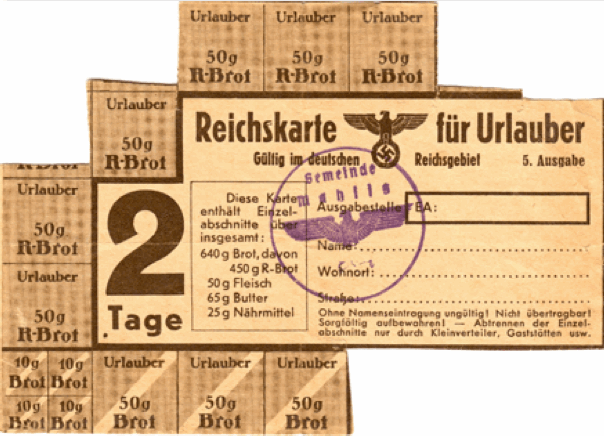
As she enters the store, Milady catches the eye of the head clerk and gets immediate service. That’s a bit of good luck, for the woman is much quicker than the others, which means a saving of precious time. As soon as she reaches the counter, Milady opens a pocketbook containing several compartments, each bulging with folded papers of various colors. These are food­cards­sheets of paper about a foot square, on which are printed many coupons that can be torn or cut off, stamped, or punched, as the case requires.


Let us assume that this lady shops for a good­sized family ­ say, herself, husband, and four children. Each of these six individuals needs seven food cards; so Milady has to carry forty­two cards with her whenever she goes to market. I may add that she has still other cards at home ­ clothing cards for each member of the family, and special milk cards if any of her children are young. But, as Kipling would say, that is another story.


Let’s take a look at those cards as Milady unfolds them and lays them on the counter. That’s what everybody has to do in Germany before one can even start buying anything. The saleswoman has to make sure the customer hasn’t exceeded her quota, while the customer has to find out if what she wants is in stock that day. In big cities like Berlin there are, as I have said, many temporary shortages of foodstuffs. In the smaller towns there is no such trouble.


The cards are now spread out. First the bread card. This covers not only baked bread but also flour of various kinds. No difficulty here; the bread ration is ample. Secondly the sugar card, which includes jams, jellies, etc. Again no trouble. Thanks to a big sugar­beet crop, this is well taken care of. Now the meat card. This is chiefly for the butcher; but Milady happens to want a bit of sausage and smoked ham, so she uses it in the grocery store. The saleswoman informs her that she is getting the last of the ham, because it has been decreed a luxury, so farmers have been ordered not to smoke any more for the delicatessen trade.


Now the fat card. Here we run into a sore spot. Germany is short on fats; so butter, margarine, and lard are very strictly rationed. However, Milady does pretty well here, because she has three young children, who rate much more fats than do adults. Incidentally, they get some chocolate, reserved for child consumption. Next comes the soap card ­ another sore point which we will investigate when Milady gets home. Now the adult milk card. Grown­ups rate only skimmed milk, which, to my American taste, is an unpleasant substance that I never use. Neither, apparently, do Germans except for cooking or sparingly in their imitation coffee or tea. Last comes a card entitled Naermittel, best translated by our word “victuals.” It’s a sort of catch­all, covering a wide variety of rationed items ranging from macaroni and noodles to packaged cereals, Ersatz tea and coffee, and certain kinds of game.


We can now understand what a prolonged huddle Milady goes into with the saleswoman. Each food­card has to be taken up separately, since quotas vary for adults, half­grown children and small children. When a quota is calculated to the last gram, that particular card is punched, stamped, or snipped, and another card is investigated. The varied rations are jotted down on a slip of paper for adding up when the list is completed. As before stated, all this rigamarole has nothing to do with price. It’s just a preliminary canter to find out how much bread, butter, lard, sugar, or other foodstuffs the buyer is entitled to. Only when that has been ascertained are the actual prices of the goods figured out and written down on another slip.


Let’s try to translate those prices into our money. After considerable investigation, I reckon the purchasing power of German currency to Germans at a trifle over four Reichsmarks to the dollar, thus making the Reichsmark roughly equivalent to our quarter. On that basis, staple groceries average only a trifle higher than they do in America. Some items, especially bread, are cheaper. Fats are distinctly higher. Butter, for instance, is over fifty cents a pound. However, German housewives have the satisfaction of knowing that these prices are fixed by law and cannot be raised except by a new official edict.


By this time Milady’s purchases have been duly assembled on the counter. Only when strictly necessary are they sparingly wrapped in paper, because paper is scarce. String is even scarcer, so it is seldom used. Instead of paper bags, the goods are placed in containers which look like sections of fish­nets. These mesh bags must be furnished by the customer, who is supposed likewise to carry away the purchases under a general “cash and carry” rule. However, should they be too heavy and bulky, the store will usually oblige a regular customer by sending along one of the women clerks, if she can find a moment to spare.


The most notable aspect of Berlin marketing is the time it takes.  Often, a bill of goods coming to only a few dollars will keep saleswoman and customer engrossed for a full hour. When our synthetic lady leaves the shop, the business is over so far as she is concerned. Not so with the grocery store. Those coupons from Milady’s food­cards go to swell multicolored piles which have to be sorted out, pasted on big sheets of paper, and fully accounted for before they are turned over to the food­control authorities. These jigsaw­puzzle economics are usually done after business hours and sometimes last far into the night.


However, our Berlin lady is too busy with her own affairs to think about the extra work she has made for grocery clerks. Laden with her fish­net bags, she deposits them at her apartment and hurries off to do more marketing at a nearby butcher’s shop. Luck is with her when she notes a good line of meats on display, for meat distribution is uncertain. Luck is with her again when she points to a badge worn in her coat lapel and marches to the counter ahead of a line of waiting customers. That badge shows she is the mother of at least four offspring. She is thus Kinderreich – rich in children. A Kinderreich matron has many privileges, among them the right to immediate attention at any store; the theory being that she should be helped to save time for her family duties in every way. It certainly comes in handy this morning, for Milady is very anxious to get home, where she is already long overdue.


Her meat purchases are soon made. Veal cutlet at 45 cents a pound, and some pork chops at 30 cents. Then a quick dash to the vegetable market a couple of blocks away where she doesn’t need food­cards. But of the limited oranges and lemons there aren’t any for sale today.


At last Milady can go home. She is anxious to see how the washing is progressing and how her younger children are getting on. Both those worries are due to a crowning ill ­ lack of a servant.


Ah!” the reader may exclaim, “here is one familiar feature in wartime Berlin.” In the larger sense, however, you’d be wrong. While Germany had a shortage of competent servants even before the war, wartime conditions have intensified this shortage into an acute famine. It is no longer a question of money. No matter how good wages one may be willing to pay, servants are often unobtainable at any price.


Here’s how it happened. The instant war broke out, the Government “froze” domestic service. No servant could thenceforth leave her employer except for self­evident reasons like non­payment of wages or genuine mistreatment. Neither could the servant demand a raise. That regulation prevented “servant­ stealing” by wealthier employers and a consequent skyrocketing of wage scales.


This was fine if you happened to have a city­bred servant or one that was middle­aged. However, Berlin servants, particularly the general­housework variety, are apt to be young women from the country. Of course the Government had them all ticketed. So, when mobilization called the young peasants to the colors, their sisters were summoned back from domestic service to remedy a labor shortage on the farms.


Let us suppose that our Berlin lady’s general­housework maid was thus taken away from her a couple of months after war broke out. She went promptly to an official employment agency to see what could be done. The woman in charge smiled at her sadly. “My dear lady,” she remarked, “we already have so many cases like yours ahead of you that I can’t give you much hope.” So there was our good housewife, left single­handed with a sizeable apartment, a hard­working professional or business husband, and four children to care for. Certainly a tough break for a well ­to ­do woman who has always had competent servants.


However, since our Berlin lady is a German, she has presumably had a thorough domestic training before her marriage, that being the custom even for girls of wealthy families. So she knows how, not merely to superintend her household, but actually to do the work herself. Furthermore, since she has young children, she has first call on whatever domestic service there is to be had. That is another of her Kinderreich privileges. So we may assume that, by the time our story opens, she has been able to get the temporary services of a part­time woman to come in, say, a couple of days a week to do the washing and heavy cleaning.


Furthermore, being Kinderreich, she is almost sure that her servant problem will be solved with the spring. Next April ist, multitudes of young girls will graduate from school. Those girls are thereupon subject to a year’s Dienst, which means National Service. On the one hand, they can go into Hilfsdienst, which usually means domestic service in a family with young children. That is where our Berlin lady comes in. She is virtually certain to get one of those girl recruits. For city girls, especially, such tasks may be more congenial than Arbeitsdienst, which means work on the farm.


There are no exemptions from this compulsory service. Rich or poor, all are alike subject. During my stay in Berlin, I dined one night with some aristocratic and wealthy Germans who introduced me to their charming daughter, just returned from getting in the potato crop on a farm a hundred miles from Berlin.


As far as the servant problem is concerned, our Berlin lady’s first war­winter will presumably be the hardest, and if she is a strong, healthy young matron she probably won’t be much the worse for it. Still, it isn’t easy. She has to be up early and get breakfast for six. The husband is at the office all day, while the older children take their lunches with them and don’t get back from school until mid­afternoon. Her younger children are the hardest problem. They can’t be left alone, so Milady is tied to her home except on the days when her part­time servant is there. Those are the precious hours she takes for marketing and other necessary shopping. She gives the youngsters an airing when she can, but the little tots do lack outdoor exercise.


Let us now see what Milady does when she gets home from market and takes her purchases to the kitchen. That kitchen will almost certainly have a gas or electric stove and other modern conveniences. But it will probably lack American specialties like an electric icer or a washing­machine. And right there we touch upon another very sore point in wartime Germany’s domestic life. That point is soap.


We have already noted how short Germany is in butter, lard, and kindred products. But this shortage goes beyond edible fats. It applies to soap ­products as well. Nowhere are Germans more strictly rationed. Each person gets only one cake of toilet soap per month. The precious object is about as large as what we call a guest­cake size, and it has to do the individual not only for face and hands but for the bath as well.


The same strict rationing applies to laundry soap and powder. Furthermore, the fat content of both is so low that, though it takes the dirt out, the clothes are apt to look a bit gray. And bleaches must be used sparingly, since they tend to wear out clothes. That is why most families have their washing done at home instead of sending it out to commercial laundries. Incidentally, when the washing is done, the sudsy water is not thrown away. It is carefully saved for washing floors or other heavy cleaning.


Let us assume that Milady finds the washing going well and that the little ones haven’t got into too much mischief during her absence. It’s now about time for her to get lunch. The children’s meal brings up the interesting point of juvenile milk. Only children get “whole” milk in Germany today. They are issued special milk cards and are rationed according to age. Infants up to three years get one liter per day ­ a trifle over a quart. Children between three and six years get half a liter, and those between seven and fourteen one­quarter liter ­ half a pint. Thereafter they are considered adults and can have only skimmed milk. Those juvenile milk quotas seem pretty stiff, but they are the winter ration. I understand that they are substantially increased when the cows are turned out to grass in the spring. I may add that I have tasted children’s milk and found it good ­ fully equal to what we in America know as Grade B.


When luncheon is over, disposal of the scraps introduces us to another notable feature in wartime Germany’s domestic economy. Every family is in duty bound not to waste anything. So each German kitchen has a covered pail into which goes all garbage that can be served to pigs. This pail is taken downstairs and dumped into a large container which is collected every day. Meat bones are usually taken by the children to school as a little patriotic chore.


What we in America call “trash” must be carefully segregated into the following categories: (1) newspapers, magazines, or other clean paper; (2) rags; (3) bottles; (4) old metal; (5) broken furniture or about anything else that is thrown away. City collectors come around for this segregated trash at regular intervals. There are no private junk dealers. An all­ seeing paternal state attends to even this petty salvage. Wartime Germany overlooks no details.


———————————-


Book Reviews
Chapter 1: The Shadow

Chapter 2: Berlin Blackout

Chapter 3: Getting on with the Job

Chapter 4: Junketing Through Germany

Chapter 5: This Detested War

Chapter 6: Vienna and Bratislava

Chapter 7: Iron Rations

Chapter 8: A Berlin Lady Goes to Market

Chapter 9: The Battle of the Land

Chapter 10: The Labor Front

Chapter 11: The Army of the Spade

Chapter 12: Hitler Youth

Chapter 13: Women of the Third Reich

Chapter 14: Behind the Winter­Help

Chapter 15: Socialized Health

Chapter 16: In a Eugenics Court

Chapter 17: I See Hitler

Chapter 18: Mid­Winter Berlin

Chapter 19: Berlin to Budapest

Chapter 20: The Party

Chapter 21: The Totalitarian State

Chapter 22: Closed Doors

Chapter 23: Out of the Shadow


 ———————————-


PDF of this post (click to download or view): Into the Darkness – Chap 08


Version History


Version 5: May 6, 2022 – Re-uploaded Images and PDF. Improved formatting.


Version 4: Nov 27, 2014 – Added PDF of post.


Version 3: Wed, Feb 5, 2014. Added Chapter links.


Version 2: Mon, Jan 27, 2014. Quoted text italicized.


Version 1: Published May 11 2013 – Text and some pics added.
Posted in Bk - Into the Darkness - Stoddard, Lothrop Stoddard, Third Reich | Tagged , | 3 Comments

Into the Darkness : Chapter 7: Iron Rations


Into the Darkness:


An Uncensored Report from


Inside the Third Reich at War


by Lothrop Stoddard


Chapter 7: Iron Rations


No intelligent foreigner can be in Germany a week without asking himself: “How do these people stand it?” When he has been there a month, he says: “How long can they stand it?” After three months, his verdict will probably be: “I guess they’ll stand it a long time.” Those, at any rate, were my reactions. And, from conversations with many foreign residents in Germany, I believe they are typical ones. Let me explain how this mental evolution came about.


Germany is today a fortress under siege by the British naval blockade. Even where the Reich has apparently unhampered sally­ports through neutral neighbors, its freedom is relative; for the neutrals in turn feel the pressure of British sea­power in whatever may aid England’s arch­enemy. In the World War, Germany collapsed through this strangling grip. To avoid a similar fate, the Nazi Government has developed an amazingly elaborate system of rationing which extends to the smallest details.


The foreign visitor to wartime Germany encounters this all­ pervading system the instant he crosses the border, when the frontier inspector hands him a few bread, meat, and butter coupons nicely calculated to avert hunger till he reaches his destination. Thereafter he receives full sets of coupons (collectively termed “food­cards“) enabling him to buy specified amounts of eatables. As already related, the quality depends on the prices he is willing to pay; also he can purchase certain high­ priced luxuries, such as game which (with the exception of venison) is card­free. But, no matter how great his wealth, he cannot get more coupons than are legally allotted him. Except under special circumstances, he gets the same treatment as the average citizen of the Reich. Germans or foreigners, they all “eat out of the same [official] dish.” Offhand, one would be apt to think that such severe restrictions would produce a thriving bootleg trade. As a matter of fact, underhand trading does exist. But it is relatively small and very much undercover, because German law punishes the buyer equally with the seller, and sentences can be imposed up to ten years at hard labor. For most persons, therefore, the risk is too great.


[Image] German food-card coupons.


Legal differences in rationing there are. These, however, are based, not on wealth or influence, but on age and occupation. Infants and small children get special foods to safeguard their health and growth. At the other end of the scale are two favored classes known as “heavy” and “heaviest” workers ­ persons engaged in specially strenuous or hazardous labor. These classifications are prized almost more than higher wages in laboring circles. The most appreciated favor handed us newspaper correspondents by the Propaganda Ministry was when it had us classified as heavy workers. Thereby we were entitled to draw an extra food­card allotment amounting to nearly fifty per cent above normal.


What, you may ask, is normal? The answer is that the allotment varies somewhat from month to month; and, interestingly enough, it tends to rise. For various reasons, the Government determined to start in with wartime restrictions as severe as the people could presumably stand without immediate injury to their health and without arousing too much discontent. The official calculation was that slight additions to the allotment from time to time would produce marked improvement in popular morale. This was certainly true, as I myself can testify. I shall not soon forget how much brighter the world looked when my microscopic butter ration was increased by nearly a pat a day. The difference totaled only a few ounces per month, but the psychological effect was great indeed.


Here is a table of the principal items of rationed foodstuffs for the month of December, 1939. The reader can easily translate them into ounces by remembering that 1,000 grams equals 2.2 pounds. Normal rations which could be bought per head, per week, were:


Item                        Grams

Butter                       125

Margarine                 80

Sugar                        250

Eggs                        1 egg

Meat                        500

Lard                         62.5

Marmalade              100

Cheese                    62.5


Bread, flour, and other grain products are likewise rationed, but the allotments are so large that the rationing is chiefly to avoid waste. Nobody except a tremendous eater could begin to consume his bread ration while I was in Germany. That is because the Reich is amply supplied in this respect, due to abundant harvests in recent years with consequent large carry­ overs. Potatoes and vegetables generally are unrationed. So are fruits, though these are scarce and of mediocre quality, judged by American standards. Tropical fruits, even oranges, tangerines, and lemons, are rarely seen. I understand that most of these come from Southern Italy. Mondays and Fridays are fish days. Wartime Germany’s fish supply now comes mainly from the Baltic, which is not in the active war zone.


It takes only a glance at the table just given to spot the weak point in Germany’s food supply ­ ­edible fats. This danger point has long been realized, and the Government has done its best to remedy the deficiency, both by increasing domestic production and by imports from abroad. Despite these efforts, however, Germany’s domestic fat production averaged only 56 per cent of her consumption in the years just before the war. In anticipation of the war danger, the Nazi Government has undoubtedly laid up large emergency fat reserves. As far back as the autumn of 1938, Hermann Goering announced at the annual Party Congress at Nuremberg that the Reich had a 7 1/2 months’ fat supply in storage, while trade statistics indicate that this figure should be even larger today. Germany can, and does, import much fat, together with meat and dairy products, from its Continental neighbors. This trade is, of course, not stopped by the British blockade. Still, the fat shortage remains; and in a long war it will be apt to get more acute.


Certainly, the present regulation diet is out of balance. There is an obvious deficiency, not only of fats, but also of foods rich in protein, mineral salts, and vitamins, such as fruit, green vegetables, and dairy products, especially milk and eggs. The present diet contains far too much starch, as the writer can emphatically testify, since he gained twelve pounds during a stay in Germany of less than four months, although his weight had not varied half that much in years. And he met many other persons, both foreigners and Germans, who were having similar experiences. When healthy, well­balanced individuals react that way, there must be something wrong with the dietary picture. Unless remedied, it cannot fail to produce bad results on the general population in the long run.


However, if the food ration can be kept at its present level, the bad results will be so gradual that they should not notably lower the average German’s strength and efficiency until after a long lapse of time. When the war broke out the German people were reasonably healthy. Yet this health standard had been maintained on a diet which, in American eyes, must seem meager and monotonous. For many years, most Germans have been restricted in their consumption of fats and dairy products. The war is thus not a sudden change from plenty to scarcity, but a relatively slight intensification of chronic shortages. I discussed food conditions with working­men, and they said that, if they could get their full foodcard allotments, they fared about the same as before the war. These statements checked with what competent foreign observers told me. The winter diet of the working classes has always been potatoes, bread, and cabbage, together with some fish, less meat, and even less fats. They hadn’t the money to buy anything better. It is the upper and middle classes who have been hit hardest by war rationing, and it is among them that you hear the loudest complaints.


Those upper and middle class folk certainly mecker vociferously over the food situation, but their complaints are mingled with a somewhat sour sense of humor. Here is a typical food joke which was current in winter Berlin:


“Recipe for a good meal: Take your meat card. Wrap it in your egg card, and fry it in your butter or fat card until brown. Then take your potato card, cover with your flour card, and cook over your coal card until done. For dessert, stir up your milk and sugar cards; then dunk in your coffee card. After this, wash your hands with your soap card, drying them with your cloth card. That should make you feel fine!”


These complaints, however, are for the most part mere emotional kicks at hard conditions which cannot be helped. They do not imply condemnation of the rationing system, as such. The German people have poignant memories of the terrible starvation years during the World War, and they are willing to undergo almost anything rather than see mass ­starvation come back again. The Government claims that it has devised a starvation­ proof system including not merely the foodcards but also the complete “rationalization” of agriculture, with fixed prices all the way from producer to consumer. Before the farmer starts his spring planting, he knows that everything he raises will be bought at a figure which should normally enable him to make a slight profit. At the other end of the scale, when the housewife goes to market, she knows that the storekeeper cannot charge her more than the Government permits. The food regulations today in force assure to the poorest German the basic necessities of life while the richest cannot get much more than his share. So long as the German people believe that the system will enable them to keep above the hunger­line, there seems to be scant likelihood of a popular revolt over food alone.


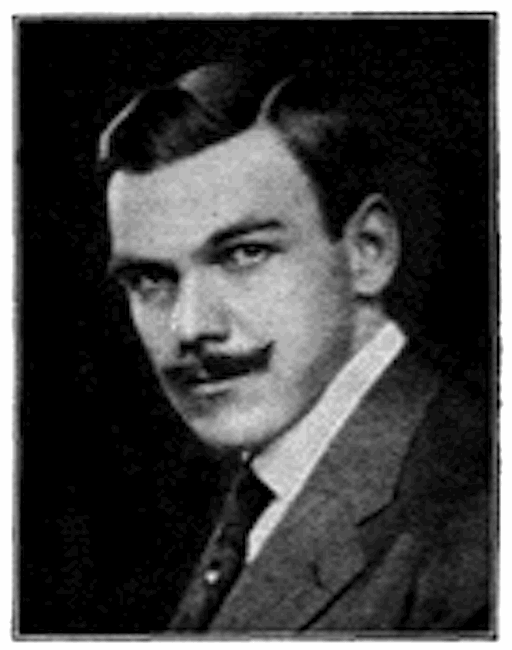
What the system means was explained by Walther Darre, Minister of Agriculture and in supreme charge of the food situation, when he said to me:


“Our foodcards constitute merely the last link in an economic chain which we were forging long before the war. This chain extends from farm grower to consumer, with stable prices all along the line. The food­card is the final act of the whole carefully ­worked­out process, ensuring to each citizen his share of food, no matter what the size of his income. In the World War, food­cards were a sign of want. They were started only when a dangerous scarcity already existed. This time, foodcards, started the very first day of the war, are a symbol of strength.”


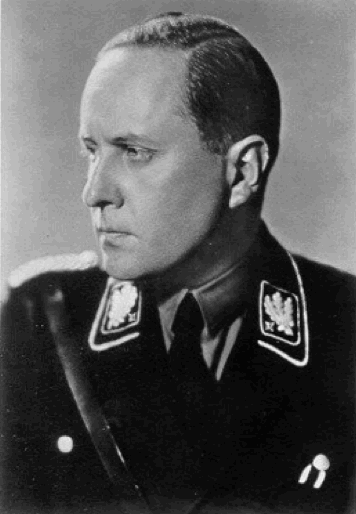
[Image] Richard Walther Darré (born Ricardo Walther Oscar Darré, best known as Walther Darre; born July 14, 1895 in Belgrano, Buenos Aires, Argentina; died September 5, 1953 in Munich) was the German Minister of Agriculture (Reichsbauernführer) during the National-Socialist era.


Herr Darre’s statement has a two­fold significance. It shows both the economic advantages of wartime rationing and its steadying effect on the popular state of mind. This second aspect is perhaps the more important. In the World War, the old Imperial German Government did practically nothing to control food conditions during the first two years of the struggle. The result was a vast deal of hoarding, profiteering, and a general skyrocketing of prices. Rich families laid in big stocks while poor men went hungry. These obvious injustices did more than anything else to rouse popular resentment and promote revolutionary unrest. It is well known that civilian morale broke down long before that of the soldiers at the front. Also, this civilian breakdown ultimately infected the armies in the field.  The Nazi leaders are keenly aware of all this and are determined that it shall not happen again.


Nevertheless, the task is great and the struggle complex. Another sector of the gigantic battle against the British blockade is the clothing situation. The Government tackled this problem as promptly as it did the question of food. From the very start, clothes were strictly rationed. At first, this was done by the Bezugschein method. As already explained, a Bezugschein is an official permit enabling the holder to purchase a specific article. Accordingly, if a man or woman needed an addition to the wardrobe, he or she had to go to the Permit station established in their particular neighborhood and state the case. The officials in charge, being themselves local people, usually had a good idea of the applicant’s honesty and reliability. With a good reputation, permission was generally granted at once, though the applicant often had to wait in line a long time before his turn came. In doubtful or suspicious cases, however, the applicant was told to return with his old coat, suit, shoes, even shirt or underwear, to prove it was really worn out. In extreme cases his house might even be searched to make sure he was not trying to hoard.


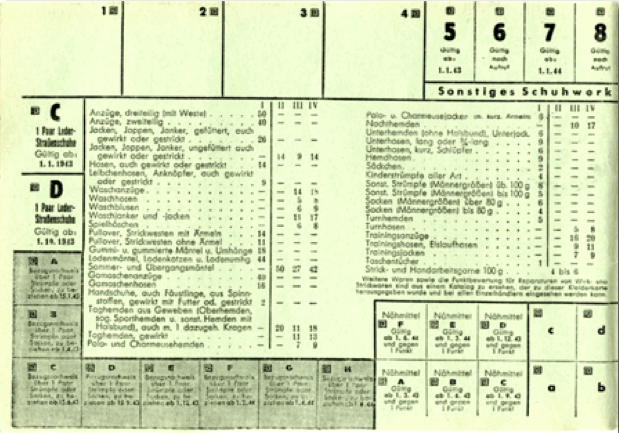
[Image] Clothing card


This makeshift system obviously involved great loss of time, caused many hardships, and produced much popular irritation. It also did not give a sufficiently clear picture of popular needs. With characteristic German thoroughness, the Government made a searching study of the problem. Its answer was the clothing cards issued in the late autumn of 1939. There are different cards for men, women, boys, and girls. Thereby the Government intends to regulate both production and consumption in an efficient and predictable way.


The woman’s clothing card was issued first, and I still recall the impression it made on me when I puzzled over the announcement of it which was published in the morning papers. To me, its complexities seemed almost like an exercise in higher mathematics. Like the food­cards, it is based on the coupon method. The left­hand side of the clothing card contains a list of articles available, together with the number of coupons required for permission to purchase each article; for, as already explained in relation to food­cards, they are really little Permits which have nothing to do with price. The quality of the article purchased depends on the buyer’s pocketbook.


The right­hand side of the clothing card contains the precious coupons ­ and here American women readers of this book are due for a shock. There are only one hundred of these coupons, popularly known as “points,” and they must last the feminine holder of the card for an entire twelve­month, starting from November. A hundred points may sound like quite a lot, but just wait until we note how fast they can go and how little they mean! One handkerchief takes one point. A brassiere takes four points; a set of “undies” 12; a slip 15; and so on up to a warm winter suit, which sets the lady back no less than 45 points ­ almost one­ half of her whole clothing allowance for the year.


The most poignant item is hosiery. On her card the German woman is allowed a “normal” ration of four pair of stockings per year ­ each pair taking four points. If she insists, she can get an additional two pair; but in that case she is penalized by having to give up eight points apiece for her temerity.


A paternal Government sees to it that she shall not rush frantically out to the nearest store and get all her clothing ration at once. The points are “staggered.” One ­third of the total are available immediately; but the next ten can’t be used before January 1st; then twenty on March 1st; and other twenties in May and August respectively. Clothing cards are personal. They cannot be transferred, and coupons detached from the card have no value. Any attempt at cheating is punished by a loo­point fine, which leaves the culprit unable to buy anything for a whole year! The meticulous way in which this system has been worked out shows in the smallest details. Even thread and darning­ yarn are exactly rationed. There is a wide difference between various kinds of textiles; woolen articles, which are admittedly scarce, call for nearly twice as many points as do articles of the same sort but made of different materials. An attempt is likewise made to differentiate between articles of such prime necessity that they are worn by rich and poor alike, and those worn chiefly by persons in comfortable circumstances. The former articles take less points than the latter, though the differential is not great.


Men are even more drastically rationed than their womenfolk. Meinherr must part with 8 of his 100 points for each pair of socks, 27 to 35 points for a full­ length set of underwear, and a devastating 60 points for a business suit. No wonder that he was pleased last Christmastide when the Government announced a “present” in the shape of its gracious permission to buy a card­ free necktie. Milady was simultaneously gratified by the right to purchase a pair of stockings without losing any of her points.


It should be noted that these cards do not cover a number of important items such as overcoats or cloaks, boots and shoes, bedclothing, and household linen. Clothing for infants and very young children is likewise not covered by the card system, though boys and girls have cards similar to those issued to adults. All cardless items must be obtained by the Permit method previously described.


To any American above our poverty­ line, the severity of this clothes rationing will presumably seem little short of appalling. It certainly appalled many Germans with whom I discussed the matter. This was especially true of the women, some of whom threw up their hands in despair at the grim prospect while others asserted vehemently that feminine discontent would reach such proportions that the Government would be forced to relent before they reached the rags-­and­tatters stage. Ardent Nazis tended to minimize the hardships ­ at least, in my presence. They reminded me that Germans are thrifty souls who wear their best clothes sparingly, with second ­ or even third­best apparel for ordinary use. Thus, most persons are apt to have a clothing reserve which can be stretched over this emergency period. Nazi ladies laughingly predicted that next summer’s hosiery would all be in brown shades ­ the brown of sun­tanned bare legs. Still, I detected a melancholy ring to their most patriotic sallies.


Resident foreigners are issued the same clothing cards as Germans. Transients have none, the assumption being that they need none for a short stay. The wise foreigner will equip himself in advance with everything needful. I certainly did, down even to shoe polish, having been informed that, owing to lack of grease, the Ersatz mixtures now used in the Reich were hard on leather. I thus personally suffered no inconvenience, though I was continually haunted by the thought that I might lose something or that my shirts might not stand the wear of wartime German laundries. But woe to the traveler who enters Germany short on clothing! He cannot buy even a pocket handkerchief by ordinary methods. I saw some harrowing sights during my stay in the Reich. One instance was that of an American lady who arrived at the Adlon from Southern Italy minus her baggage, which had gone astray. She had nothing with her but the lightest summer shoes. The rain and chill of autumn soon gave her such a heavy cold that she could not go out until she had proper footwear. She had to enlist the good offices of the American Embassy to have a special Bezugschein issued to her without delay.


Restrictions on food and clothing are merely the outstanding aspects of everyday life in Germany, which is Spartan throughout. Possession of cards is no guarantee that the articles covered by them can always be bought. In the big cities, especially, many temporary shortages occur, due chiefly to faulty transportation or distribution. Shopping involves much delay, especially through having to stand in line before being waited on. Articles technically card­free are effectively rationed because they must all be bought in small quantities; so even persons with plenty of money can never get much ahead of their immediate needs. Also, one is never sure of being able to buy anything, because it may suddenly be temporarily or even permanently sold out. To a foreigner, this sort of existence soon becomes maddening. So he is apt to fancy that it must be equally unendurable to Germans, and he may therefore conclude that they cannot stand it much longer.


Such generalizations, however, are unsound. The Germans have been through a lengthy and bitter schooling in adversity. They have not known a really normal life since the World War broke out in July, 1914. That fateful summertide was twenty­six years ago. For more than a quarter­century the Germans have experienced about every sort of vicissitude ­ war, inflation, an unsound boom, deflation, civil strife, the Nazi Revolution, and now war again. No German man or woman under twenty­six years of age was even born into what we would call a normal national life or has had any personal experience of it unless they have been abroad.


No German under forty has more than childhood recollections of the “good old times.” This historical background should always be kept in mind if we are to judge correctly German reactions to their surroundings. We see here a people so accustomed to do without things or to get them only with difficulty and in limited amounts that they are used to it. Therefore Germans take lightly or never think about many matters which, to Americans especially, are irritations and grievances. We thus encounter two standards of living and attitudes toward daily life which differ from each other so profoundly that they cannot easily be compared.


In this connection we should remember another point ­ the factor of war psychology. Nearly all Germans have come to feel that they are in for a life ­and ­death struggle. They believe that defeat in this war would spell something like the destruction of their nationhood. They therefore bear cheerfully, through patriotic emotion, privations which, to the resident foreigner with nothing at stake, are personally meaningless and therefore exasperating.


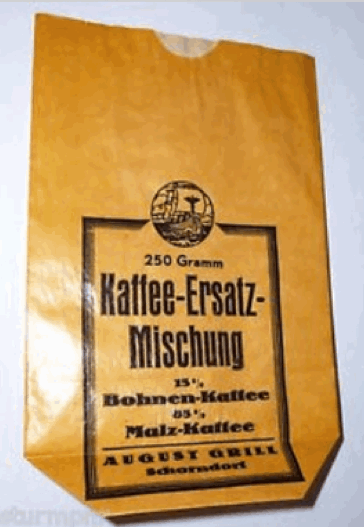
[Image] Ersatz coffee packaging, 250 grams


I cannot illustrate this matter better than by citing a conversation I had one day with a German acquaintance. In the course of our chat I remarked how much I missed coffee.


“I used to be quite a coffee drinker too,” he answered, “and at first I also found it hard. But I realized that, by doing without coffee imports, we Germans strengthen our economic situation and thereby help beat the English. You know, that thought was so satisfying that it overcame my desire for coffee. So now I am not only reconciled to our Ersatz but I actually enjoy drinking it and have no wish to go back to real coffee, even if I were given a supply.”


From similar remarks heard on many occasions, I am sure that he was sincere and that he typified an important aspect of the national state of mind.


———————————-


Book Reviews
Chapter 1: The Shadow

Chapter 2: Berlin Blackout

Chapter 3: Getting on with the Job

Chapter 4: Junketing Through Germany

Chapter 5: This Detested War

Chapter 6: Vienna and Bratislava

Chapter 7: Iron Rations

Chapter 8: A Berlin Lady Goes to Market

Chapter 9: The Battle of the Land

Chapter 10: The Labor Front

Chapter 11: The Army of the Spade

Chapter 12: Hitler Youth

Chapter 13: Women of the Third Reich

Chapter 14: Behind the Winter­Help

Chapter 15: Socialized Health

Chapter 16: In a Eugenics Court

Chapter 17: I See Hitler

Chapter 18: Mid­Winter Berlin

Chapter 19: Berlin to Budapest

Chapter 20: The Party

Chapter 21: The Totalitarian State

Chapter 22: Closed Doors

Chapter 23: Out of the Shadow


 ———————————-

.

Into the Darkness: Chapter 7 (PDF – 0.7 MB). >> Into the Darkness – Chap 07 – Ver 2

.


Version History


Version 8: May 5, 2022. Re-uploaded images and PDF for katana17.com version.


Version 7: Jun 17, 2015. Formatting changes.


Version 6: Nov 28, 2014. Added newer PDF file (Ver 2) of this post.


Version 5: Nov 27, 2014 – Added revised PDF (Ver 2), formating.


Version 4: Mon, Jun 23, 2014. Added PDF file of this chapter for download. Added 4 images to text.


Version 3: Wed, Feb 5, 2014. Added Chapter links.


Version 2: Mon, Jan 27, 2014. Quoted text italicized.


Version 1: Published May 11 2013 – Text and some pics added.
Posted in Bk - Into the Darkness - Stoddard | Tagged , | 10 Comments

Into the Darkness : Chapter 6: Vienna and Bratislava


Into the Darkness:


An Uncensored Report from


Inside the Third Reich at War


by Lothrop Stoddard


Chapter 6: Vienna and Bratislava


About a fortnight after my arrival in Germany I had an opportunity to secure two worth­while interviews away from Berlin. The first was with General Loehr, Commander­ in­ Chief of the Air­Arm at Vienna. The second was with Father Joseph Tiso, newly elected President of the equally new Slovak Republic, at his capital, Bratislava. Neither had as yet been interviewed by an American journalist.


Since I was to be the guest of the Air Ministry, an army transport plane had been placed at my disposal.


Accordingly, I motored out to Berlin’s main airport, accompanied by a major of the Air­Arm who was to be with me on the journey. A pleasant­ faced Hanoverian in his mid­-forties, he proved to be an agreeable companion.


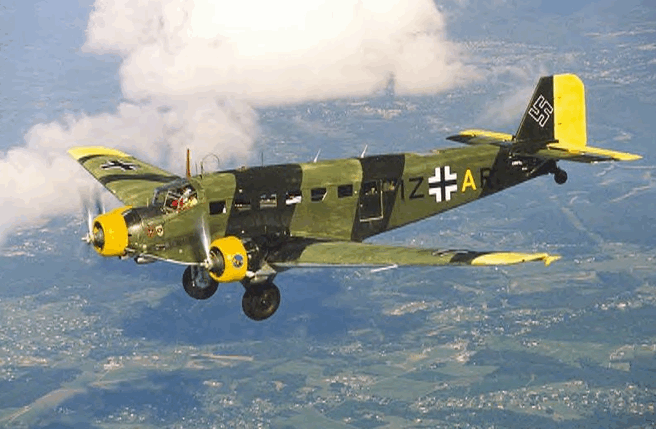
Junker Ju 52 transport plane


The tri­motored, slate­gray plane took off on schedule, and we soon rose above the ground­haze into the clear air of a crisp autumn morning. Flying at about 2,000 feet, we skimmed swiftly over the flat plains of North Germany ­ an endless patchwork of forest and farmland, interspersed with lakes and dotted with villages or towns. The sky was cloudless until we approached the Bohemian Mountains, when we encountered a billowing wave of white pouring like a giant cataract onto the Saxon plain. Rising steeply above this cloud­sea, we lost sight of earth during most of our flight over Bohemia. Only now and then did I catch a glimpse of the Protectorate through a rift in the white veil. I had a quick sight of Prague. Its palace­-citadel looked like a toy castle. The river Moldau was a silvery ribbon winding across the landscape.


Continue reading

Posted in Bk - Into the Darkness - Stoddard, Bratislava, Father Josef Tiso, Hitler, Lothrop Stoddard, National Socialism, Vienna | Tagged , , , , , , | 1 Comment

Into the Darkness : Chapter 5: This Detested War


Into the Darkness:


An Uncensored Report from


Inside the Third Reich at War


by Lothrop Stoddard


Chapter 5: This Detested War


The Germans detest this war. That was the ever ­deepening impression I got throughout my stay in the Third Reich. Wherever I went, it was the same story. Public opinion in Berlin about the war tallied with what I found in my travels through West­ Central Germany as far as the Rhineland and the North Sea Coast, and through South Germany to Vienna. This attitude is shared by Nazis and non ­Nazis. On this point there is no difference between them.


Yet we should clearly understand the reason for this agreement. It is not founded on moral opposition to war as such. In the Third Reich, pacifism is akin to treason. Such genuine pacifists as may still exist there outside of concentration camps are so carefully camouflaged that, like Arctic hares in winter, they cannot be detected against the landscape.


German aversion to the present war, therefore, though general and genuine, is due to strictly practical reasons. What maddens the Germans is that they are obliged to fight desperately in order to keep what they now hold. During the past three years they have marched with giant strides toward the realization of one of their oldest dreams ­ the domination of Central Europe. Long before Hitler was even heard of, Mittel­Europa was a phrase to conjure with. Rightly or wrongly, most Germans believe that hegemony over mid-­Europe is necessary for their national future. As often happens in such cases, they have “rationalized” their desire until they have come to think it their just due. So whatever is done to achieve this goal seems to Germans quite right and proper.


Continue reading

Posted in Bk - Into the Darkness - Stoddard, Goebbels, Lothrop Stoddard | Tagged , , | 4 Comments

If Hitler Won WW II We Would Have A Better, More Just World Today

If Hitler Won World War II We Would Have

A Better, More Just World Today


By James Miller


Legendary U.S. General George S. Patton realized late in the war that the United States fought the wrong country. Patton felt the U.S. should have sided with Germany to destroy Jewish Bolshevik/Communist USSR. This information comes from Patton’s diary entries, letters he wrote to his wife, and comments he made to military officers and staff.

World War II was incredibly complex. However, in the final analysis, WWII was essentially a war between two competing ideologies: Nationalism-vs-Jewish Internationalism/globalism. Adolf Hitler and his allies fought to preserve the concept of Nationalism, not just for Germans but for all peoples the world over. Nationalism really just means the sovereignty of an ethnic people and the right of such ethnic people/nationalists within their own bordered country to self-determination. What is meant by self-determination? Self-determination just means an ethnic people preserving their unique culture and heritage and pursuing their collective goals as a unique people.

On the other side of WWII was Jewish Bolshevik Internationalism (today we just call this globalism ). This is the Jewish worldview (or rather, plan) to eventually eliminate all nations except for a Jewish homeland… (what was later to be after WWII the nation of Israel in 1948). Jewish Internationalism/globalism seeks to eventually merge all peoples in the world into one globalist system with a global government, global bank, global currency, etc. In short, Jewish globalism (i.e., the weakening and eventual elimination of all nations) is the exact opposite of Nationalism (i.e., a world composed of nations). The Allied powers of WWII (led by Roosevelt, Churchill, Stalin, et al.) were tools of International Jewry and thus de facto fighting for the Jewish globalist worldview. After the (Jewish run) Allies won WWII in 1945, International Jewish forces were then free to exercise a Jewish Sphere of Influence over the greater Western World (and as we see today, increasingly over the rest of the world).

Alternatively, if Hitler had won World War II and then exercised a Nationalist Sphere of Influence over the greater Western World, we’d have a more just, fair, and moral Western World today. The rest of the world would have similarly benefited had the Germans been victorious since German influence would have surely spread elsewhere (ideas such as non-usurious banking and strong family oriented culture would likely have spread globally).

Had Hitler won World War II, what would be different in the post war world?

Here are a few examples:

1. No USSR (The Soviet government murdered millions of its own people during its 70 year reign. To study this topic read the writings of Aleksandr Solzhenitsyn; Hitler would have liberated the USSR, though taking large parts of its Western region for lebensraum, living space ).

2. No Cold War (because there would be no USSR).

3. No Communist Eastern Europe/Iron Curtain (when WWII ended, Eastern Europe fell to Communism this was part of Stalin’s spoils of war).

4. No Red China and Mao’s subsequent killing of 40 – 60 million Chinese (the USSR created favorable conditions for Mao’s Communists which ultimately led to Mao’s victory over Chiang Kai-shek’s Nationalists in 1949, thus if no USSR, no Mao victory).

5. No Communist North Vietnam (both the Soviet Union and Red China aided Ho Chi Minh).

6. No Communist Cambodia and Pol Pot’s slaughter of 2 million Cambodians (Red China aided Pol Pot).

7. No dividing Korea into North Korea and South Korea (the allies split Korea after WWII ended, with North Korea becoming Communist… another of Stalin’s spoils of war).

8. No Communist Cuba (given the previous, what support would Castro have had in the 1950s?)

9. No Communism anywhere (Hitler was the world’s most fervent anti — Communist).

10. Liberalism and multiculturalism wouldn’t dominate Western ethos (both are Jewish creations and both have always been heavily promoted/advanced by Jews; thus if no Jewish influence, then no liberalism and no multiculturalism… at least certainly nowhere near the degree we see today).

11. No Cultural Marxism and no political correctness (these are social engineering tools which came out of the Jewish think tank known as the Frankfurt School).

12. No third world immigration into Western nations (Jews wouldn’t be in power positions to craft and force through liberal immigration laws; Jews are responsible for each Western nation’s liberal immigration policy, as most were orchestrated by the World Jewish Congress).

13. No depraved filth on TV, in movies, etc. (because Jews wouldn’t run Hollywood).

14. No widespread pornography (Jewish lawyers and Jewish activists were the main challengers of anti-obscenity laws, under the guise of Freedom of Speech).

15. There would still be prayer in public schools (Jewish lawyers were instrumental in banning prayer in public schools under the guise of so-called separation of church and state, something that appears nowhere in the U.S. Constitution).

16. No man-hating radical feminist movement (Jews such as Betty Friedan, Sonia Pressman, and Gloria Steinem, among others, were the key drivers of radical feminism).

17. No Israel and all the problems it has brought the USA and the immeasurable misery it has wrought on the Palestinians.

18. Jews would be living in Madagascar (perhaps) and would be carefully monitored (Madagascar was one place Hitler considered as a Jewish homeland).

Many reading this will ask, but what about the Holocaust?

The Holocaust has been grossly exaggerated by organized Jewry in order to create sympathy for Jews worldwide and thus help advance the Jewish agenda (i.e., people seen as victims tend to get their way). It is also used as a political weapon to justify Israeli militarism against the Palestinians. Hitler’s Final Solution (rebranded in the early 1970’s as the Holocaust ) was a plan to remove Jews from Europe, not to kill them. During WWII, just as the U.S. couldn’t trust Japanese Americans, thus causing FDR to round many of them up and place them in concentration camps, Hitler couldn’t trust Jews since many were partisans sympathetic to the USSR and hence they aided the USSR in various subversive, anti-German activities. Therefore the Nazis rounded up Jews and placed them in concentration camps.

Somewhere around one million Jews died during WWII (not six million) mostly due to disease and starvation in the final months of the war. Heavy Allied bombing of Germany and parts of German occupied Europe destroyed many roads, rail lines, and bridges making it impossible for Germany to adequately supply the camps with food and medicine. The result is that many Jews died of starvation and disease; and of course many non-Jews also died of starvation and disease (again, due to a massive Allied bombing campaign and its destruction of German transportation infrastructure). Lastly, there were no gas chambers. Much has been written about this. To study the gas chamber subject, read the research papers published by Germar Rudolf and Carlo Mattogno (there are many others as well). To get a broad overview of the Holocaust, read my article, What Was The Holocaust… What Actually Happened?

It should also be noted that Hitler never wanted to conquer the world. He simply wanted to safeguard Europe and the greater Western World from all manner of nefarious Jewish influence and, more broadly, safeguard the world-at-large specifically from;

1) usurious Jewish banking and,
2) Jewish-driven cultural degradation.

As previously stated, the Allied heads-of-State (Roosevelt, Churchill, et al.) were puppets of International Jewry; each sold his soul for power and prestige. Again, as earlier stated, World War II was a war between two competing ideologies: Nationalism-vs-Jewish Bolshevik Internationalism/globalism unfortunately International Jewry won.

Was World War II the good war? No, it was exactly the opposite. The Allied victory marked the beginning of the end of Western Civilization.


US General George Patton eventually realized that America fought the wrong nation in World War II.


—————————-


Version History


Version 2: Apr 14, 2020 — Re-uploaded images for katana17.com/wp/ version.


Version 1: Published May 18 2013 – Text and some pics added.

Posted in Gen. George Patton, Germany, Globalism, Hitler, Jews, Western Civilization, WW II | Tagged , | 4 Comments

Into the Darkness : Chapter 4: Junketing Through Germany


Into the Darkness:


An Uncensored Report from


Inside the Third Reich at War


by Lothrop Stoddard


Chapter 4: Junketing Through Germany


At the very first press conference I attended at the Propaganda Ministry we were informed that a trip was being arranged for foreign correspondents and all who wished to go were asked to register. It was to be a three-day journey through Central Germany and the northern Rhineland. Its purpose was to observe the “Inner Front“; how the peasants and industrial workers were doing their bit to carry on the war.


“I advise you to come along,” said an American colleague with whom I sat. “I can’t vouch for how much they’ll show us, but you’ll see quite a bit of the country, and then you’ll get to know a good many of the press corps. That alone should make the trip worth while for you.”


Accordingly, the fourth day after my arrival in Berlin found me ready to take the road again. Noon saw about forty journalists assembled with light luggage at the Propaganda Ministry. Ours was a cosmopolitan group, drawn mostly from European lands, together with five Americans, two Japanese, and an Egyptian with crinkly hair and complexion cafe au lait. A lone Danish lady journalist, rather pretty and on the bright side of thirty, had ventured to join this phalanx of masculinity. Having observed her at several press conferences, I judged her capable of taking care of herself in any circumstances likely to arise.


We were welcomed by a bevy of officials, some of whom would accompany us. After a fulsome speech, our itinerary was read out, telling just where we were going and what we were to see and do. Before starting on a sightseeing trip, Germans apparently like to have everything worked out down to the last detail. Good staff work, yet sometimes a bit trying; since, under no circumstances, can there be the slightest deviation from the plan prescribed.


After the oratory had ended we were bidden to fall to on several platters heaped high with sandwiches, which graced the long table about which we were standing. One of the things you quickly learn in Germany is to eat whenever eatables come your way. Food restrictions and uncertainties soon develop in you a sort of psychological hunger which is never wholly out of your mind. So we did full justice to this buffet lunch.


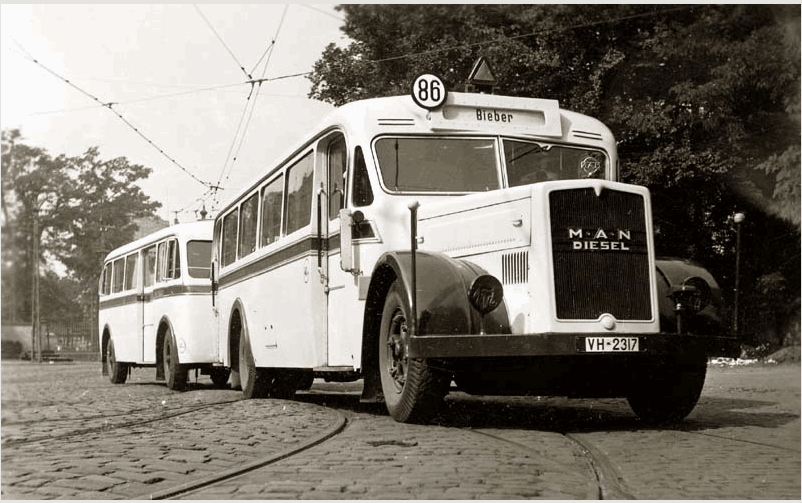
1940s era German buses


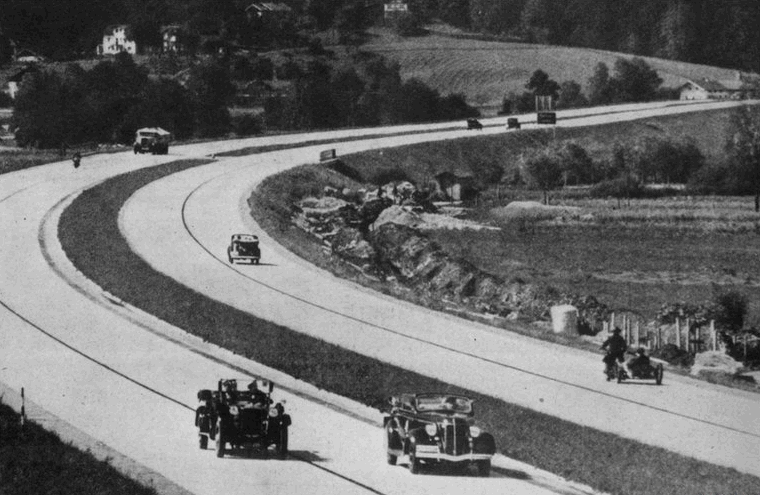
Leaving the festive board we descended to the street, where we found awaiting us two enormous sightseeing buses into which we climbed. We Americans had kept together, so we were all seated in Bus Number One. Near me were seated a Belgian, a Dutch, and a Hungarian journalist. Swinging out by Unter den Linden and thence to Potsdam, we presently found ourselves on one of the Third Reich’s famous motor roads. Mile on mile the twin ribbons of concrete stretched before us, separated always by a broad grassy strip. No crossings to look out for, since all intersecting roads and railways are taken care of by over ­ or underpass. Yet this magnificent highway was virtually empty of traffic. With all private motoring forbidden, official cars, army camions or commercial trucks were almost its sole occupants.


An Autobahn


Every few miles I noted a combined restaurant and filling­ station tastefully built. About mid­afternoon we stopped at one of them for another meal. Incipient hunger was assuaged with hot frankfurters and sauerkraut, cold ham, cheese, and rye bread, washed down with plenty of schnapps and beer. Before proceeding on our way we were lined up before one of the buses and had our picture taken. Group photography is a German specialty, so this was repeated on every noteworthy occasion. Subsequently, each of us received the whole collection mounted in a handsome album, as a souvenir.


As our cavalcade rolled swiftly southwestward, the afternoon waned into misty twilight, and with the universal blackout we knew that there would be no bus lights for us. To brighten our spirits, a large carton in the rear of the bus was opened, revealing a case of brandy. Our hosts were indeed missing no opportunities to create a favorable impression. An attendant went up and down the aisle pouring drinks into paper cups. Pleased to find it was a good French brand, I expressed my appreciation to one of the Propaganda Ministry officials seated across the way. He smiled jovially, then winked, nodded toward the nearby carton, and whispered:


“Slip a bottle into your overcoat pocket while the going is good.”


Somebody started a song up ahead. The brandy was getting to work. My American seat mate slapped me on the knee.


“Looks like a good junket,” he chuckled somewhat cynically.


It was long after dark when our buses rolled through the blacked out streets of Weimar and halted before Haus Elefant. The Elephant House is the name of Weimar’s splendid new hotel. I understand it was built to accommodate the tourist trade to this picturesque old town, but now there are no tourists. That evening we were given a banquet presided over by the Gauleiter, or Provincial Governor of Thuringia, and attended by all the local Nazi notables. I sat next to him at table and thus had a chance to chat with him.


I liked that Gauleiter. He was very much a self-made man, having started as a sailor, literally “before the mast” on a windjammer. He was also self-educated, but he exemplified Lord Bacon’s dictum that much reading maketh a full man, because he had obviously digested his books. Although sincerely devoted to the Party’s program and policies, he did not parrot them forth in set phrases, as many Nazis do, but interpreted them with shrewd common sense.


I did not care much, however, for the other local notables. They looked to me like German equivalents of our own ward politicians. Few of them could have amounted to much before they landed a Party job. Even more revealing were their womenfolk, who joined us in the big hotel lounge for Ersatz coffee and liqueurs after the banquet was over. Most of them were pretentiously dowdy. They exemplified better than anything I had yet seen the fact that National Socialism is not merely a political and economic upheaval but a social revolution as well. To a very large extent it has brought the lower middle class into power. To be sure, one finds quite a few aristocrats and intellectuals in the Nazi regime.


Furthermore, there are plenty of Nazis sprung from peasant or worker stock, some of whom, like the Weimar Gauleiter, would rise in any society. Yet the lower middle class seems to be inordinately in evidence. One does not notice this so much in Berlin, because the ablest elements in the Party tend to gravitate to the seat of power. In the provinces the Spiessbuergertum comes much more to the front.


With our heavy schedule, we rose early and descended to an amazing breakfast for wartime Germany. I could hardly believe my eyes when they feasted themselves on plenteous eggs and butter unlimited. We were the guests of the Propaganda Ministry, so for us food restrictions were politely waived. One luxury, however, we did not get ­ real coffee. That tabu was seemingly unbreakable.


With the inner man thus fortified we climbed into our buses,  toured Weimar briefly to glimpse its historic sights, and took to the highroad once more. Just outside of town we were delayed by a long caravan of army trucks, crammed with everything from supplies and field kitchens to troops and machine­guns. Flanked by convoys of sputtering motorcycles, they thundered endlessly past. Everything was slate­ gray.


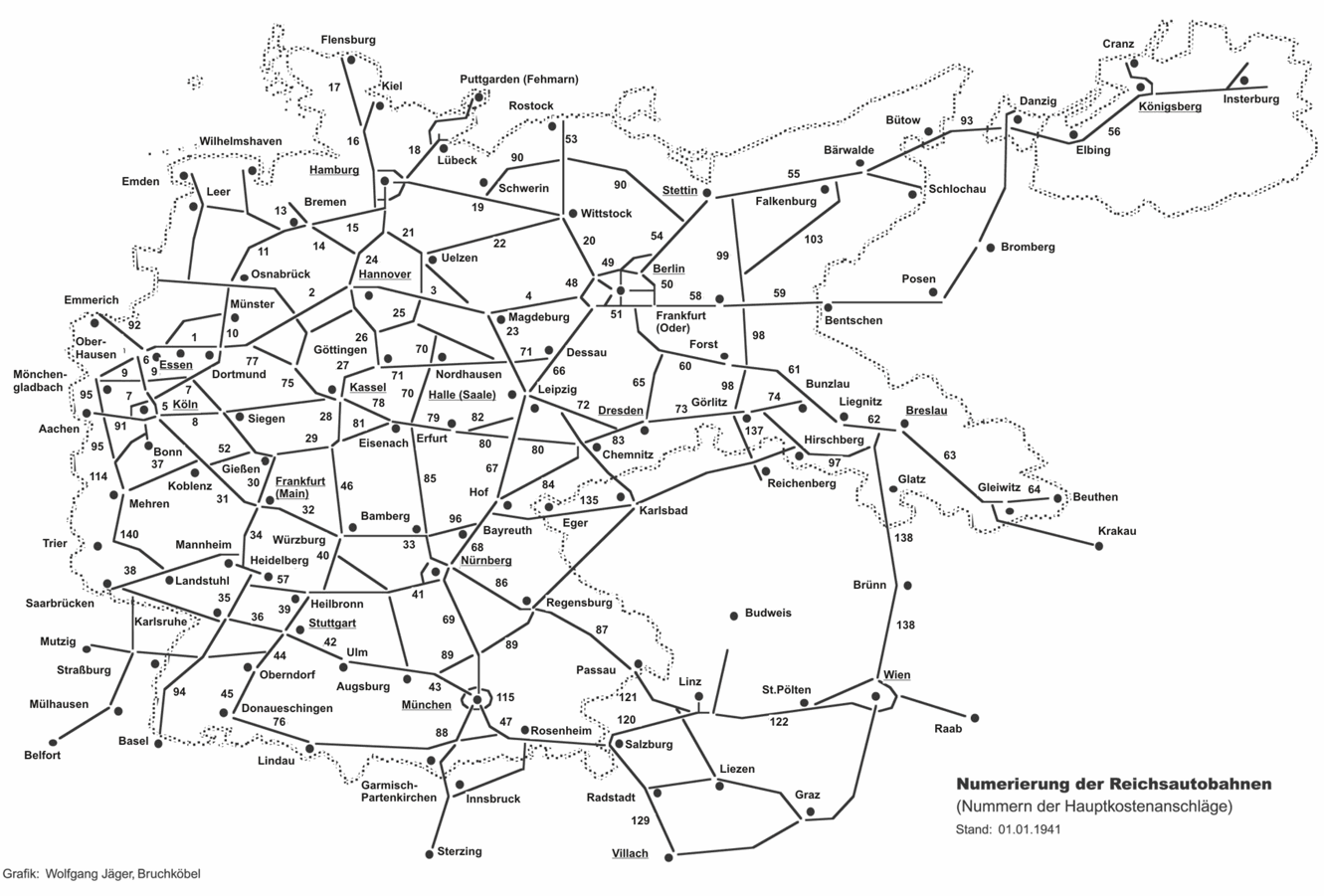
The autobahn system in 1941 (click to enlarge)


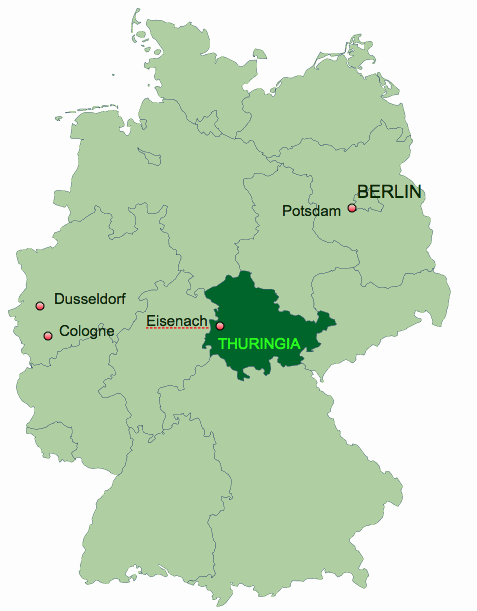
All that morning we motored through the hills and valleys of Thuringia, a charming countryside dotted with mellow villages and clean little towns. Peasants and townsfolk alike looked well fed and warmly clad. The many children who waved to our passing were rosy­ cheeked and smiling. The day was unseasonably cold. Snow powdered even the lower hills.


Junketing through Germany


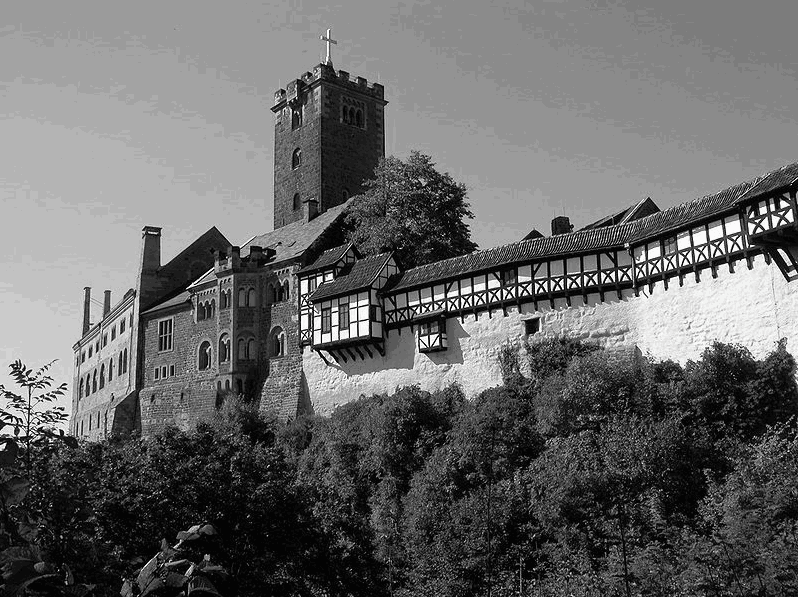
Shortly after noon we reached the Wartburg. For nearly two hours we were herded through the historic place like holiday trippers while we were shown every last detail down to the exact spot on the wall where Martin Luther’s inkstand is supposed to have missed the devil. I got distinctly bored. I wasn’t in Germany for sightseeing, and I knew the Wartburg of old. I wanted to be shown peasants, farms, dairies, cold­ storage plants ­ the rural sector of that “Inner Front” we had heard so much about. But apparently we weren’t going to be shown.


Wartburg Castle overlooking Eisenach, Thuringia


I said as much to one of our official guides. He assured me that I would see peasants that very evening. It was all nicely arranged. So we rolled through country growing ever more hilly until darkness overtook us on the slopes of the Sauerland Mountains. Soon we arrived at what had originally been a large farmstead, now transformed into an inn. As we sat down to a bounteous country supper, in walked our peasants. They were the real articles, all right: sturdy, weather beaten men, washed and dressed up for the occasion yet still exhaling a faint aroma of livestock. A couple of them were assigned to each table, and I was fortunate enough to have a fine old fellow for my right-hand neighbor. In rural Germany they have a habit of sandwiching schnapps and beer, which makes a potent combination, and we soon got on famously. After several rounds, my companion waxed garrulous and began to air his views on several subjects, including the war. Before he had got far, however, a young servingman bent down and muttered in his ear:


“Gaffer, you’ve had a lot to drink. Bridle your tongue!”


Thereafter he kept to safer topics.


Farmstead in the Sauerland Mountains


In mid­-evening we left our bucolic partners and motored on to a fine new winter­ sports hotel perched on the summit of the range, where we were to spend the night. Here winter had already come, though it was only the beginning of November. The ground was well covered with snow, and more was falling, whipped by a biting wind.


Next morning we were again up bright and early, and after another “off the record” breakfast our buses plowed through snow­ clogged mountain roads which wound downwards through fine forests until we emerged from the mountains and struck out into the Westphalian plains. Quaint timbered brick farmsteads and villages gave place to industrial towns until we were fairly into Germany’s “black country,” the industrial ganglion of the Rhineland, dotted with factories and murky with coal smoke. Snow had long since been left behind. The autumn day, as usual, was cloudy with spits of rain.


We grazed the outskirts of Cologne but got only a distant glimpse of its twin­ towered cathedral. Our destination was Duesseldorf, where we were promised the most interesting feature of the trip. This was a luncheon with the workers at the big Henkel Soap Products factory. We were to hobnob with them at their noon hour, share their food, and generally get acquainted. After the meal we and the workers were to be addressed by none other than Dr. Robert Ley, head of the Labor Front, the organization which welds all the workers of the Third Reich into a gigantic whole. A sort of Nazi One Big Union.


Henkel factory, Dusseldorf


With Teutonic punctuality, our buses drew up before the Henkel factory at precisely the appointed hour. After a brief reception by the managerial staff we repaired to the dining hall, an enormous place capable of holding over a thousand people. The workers, about equally divided between men and women, were already pouring in. They were in their work clothes; the men in dark overalls, the women mostly in smocks. They had evidently washed up for lunch, for all looked neat and clean. Besides, a soap factory ought not to be a very dirty place.


These working folk looked fairly healthy, though few of them had much color and many had pasty complexions. They seemed cheerful and smiled readily. I even noted some surreptitious sky larking between the young men and girls. However, it should be remembered that these were Rhinelanders, folk temperamentally freer and gayer than the stiff, dour Prussians to the eastward.


We journalists were mixed thoroughly with the workers. I sat at a table accommodating some twenty of them. Opposite me were three men: one a nondescript type, the second a hulking blond giant, the third a slim, darkish, handsome fellow who looked like a Frenchman. At my left hand sat a plain ­featured woman in middle life; at my right, a chunky little blonde girl in her late teens.


Hardly were we seated before a bevy of waitresses swept through the hall bearing large trays laden with plates of thick potato soup. The next course consisted of pork, red cabbage, and mixed vegetables, served in miniature platters with separate compartments. Slabs of rye bread went with the soup. It certainly was a hearty lunch, and well cooked. The meat gravy was good, and there was plenty of it. I could not finish all that was set before me.


My neighbors were obviously hungry and attended so strictly to the business of eating that conversation languished until toward the end of the meal. The girl beside me smilingly accepted one of my proffered cigarettes. Before I had time to invite the men across the table, each had produced a packet of his own and lit up. I then began asking a few tactful questions. They told me that this was an average luncheon, that they were working longer hours than before the war but were paid a bit extra for overtime, that part of the plant was being diverted to munitions, and that comparatively few men from the factory had as yet been called to the colors since so many of them were skilled workers. This was about all the information I got, since they were bent on asking me questions about America.


Suddenly a gong sounded and all eyes turned toward the center of the hall, where a rotund figure in a blue uniform had mounted one of the tables and was bowing smilingly to left and right in response to a growing ripple of applause. He was the great Dr. Ley. His rotund countenance was wreathed in smiles as he acknowledged the greeting.


Then he began speaking in a loud, rasping voice, addressing the assembled workers as “Soldiers of the Inner Front” and assuring them that their labors were as praiseworthy and vital to the conduct of the war as were deeds of valor on the battlefield. He then launched into a diatribe against England and its allegedly diabolical attempt to starve out the German people, including women and children, by the hunger blockade. A lurid picture of the terrible starvation years of the last war was followed by comforting reassurances that the Government had rendered such privations in the present struggle impossible because of careful preparations and methodical planning. Food cards might be annoying, but there was enough to go around and everyone, rich or poor, was assured of his or her rightful share. “This time,” he shouted, “we all eat out of the same dish!” He closed with an eloquent appeal to stand beside their inspired Fuehrer until complete and lasting victory had been won.


Dr. Robert Ley, leader of the German Labor Front (DAF)


It was a rousing speech, and it seemed to strike home. Those working folk listened with rapt attention, at the high points breaking into applause which was clearly spontaneous. Dr. Ley is obviously a good psychologist. He knows his audience. Certainly he was onto his job that day as head of the Labor Front.


When the speech was over and the workers had returned to their labors we correspondents were introduced to Dr. Ley and were then shown around the factory buildings in the usual detail. Needless to say, we did not see the munitions section to which my luncheon companion had casually alluded.


It was mid­-afternoon when we reached our hotel, one of the best in the city. With nothing officially scheduled until dinnertime, a number of us strolled about town. One of my acquaintances had a severe head cold and needed to buy some handkerchiefs. He could not buy ordinary cotton or linen ones, because that required a local clothing card. However, he finally found some expensive silk handkerchiefs which were “card­ free,” because they were Luxuswaren ­ luxury goods.


The dinner that night turned out to be a big banquet, with an excellent menu and vintage wines. Again the local Nazi notables were present, and they averaged better in appearance than those at Weimar. All but the Gauleiter. He was a distinctly sinister looking type; hard­ faced, with a cruel eye and a still crueler mouth. A sadist, if I ever saw one. I can imagine how unpopular he must be among the goodnatured, kindly Duesseldorfers.


The banquet was a lengthy affair, interspersed with speeches. Parenthetically, the German method of sandwiching food and speech seems to me a good idea; much better than our way of gobbling the entire menu and then sitting back to endure a long series of orations in a state of mingled repletion and boredom.


From the banquet room we descended to the blacked­ out street where, by the aid of electric torches, we got into our darkened buses and went some distance to witness a special entertainment given in our honor by the local organizations of Kraft durch Freude  (Strength Through Joy). Later on I shall describe this characteristic institution of the Third Reich in some detail.


Strength Through Joy poster 1939


Kraft durch Freude  (Strength Through Joy) symbol


Enough to say here that it is an elaborate system designed to brighten the lives of the working classes in various ways.


The program that evening, put on entirely by “local talent,” included choruses, group ­gymnastics, and vaudeville turns, most of the latter being pretty amateurish. The high spot in the program was a military band, which was really thrilling in its spirit and fire.


Next morning we could take things easy, since our train back to Berlin did not leave until noon. I therefore ordered breakfast served in my room, and received not merely eggs but a whole platter of cold meats as well. The Propaganda Ministry was evidently determined to make our trip enjoyable to the very end! Our homeward journey was uneventful. We had a special car, but the stern realities of life were brought back to us when we went into the diner and had once more to use our food ­cards to obtain a meager and expensive lunch. The train did not reach Berlin until after dark. It was a misty evening. When I emerged from the station, I literally could not see my hand before my face. Not a taxi was to be had, and I was far from my hotel, so I would have to go by subway. The Berlin subway system is a complicated network which needs some knowing before you can find your way about, and I had quite forgotten the combination, especially as several new lines had been built since I was last there years before. Fortunately a colleague was going my way and came to my rescue.


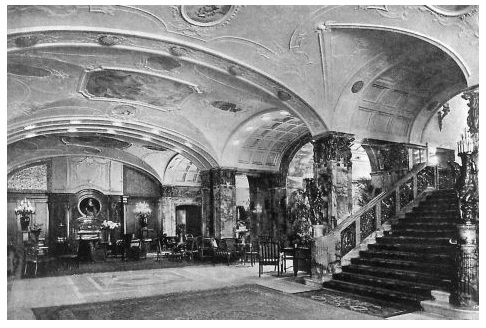
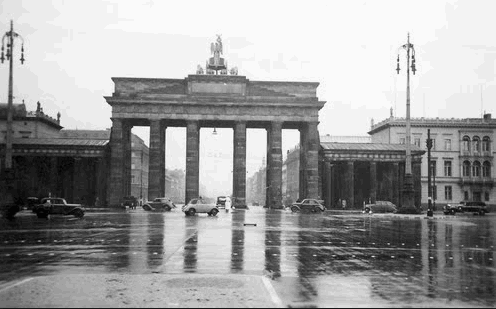
As I walked up the flights of steps from the subway, leaving behind me a brilliantly lighted station redolent of modernity’s inventive genius, and barged into primeval darkness, it seemed to me symbolic of what this war was doing to European civilization. This, I reflected, was no local blackout. It stretched like a vast pall over three great nations and might soon spread to other lands as well. “Where, and when, and how would it end?” I reflected as I picked my way through the gloom and finally stumbled into the lobby of the Adlon.


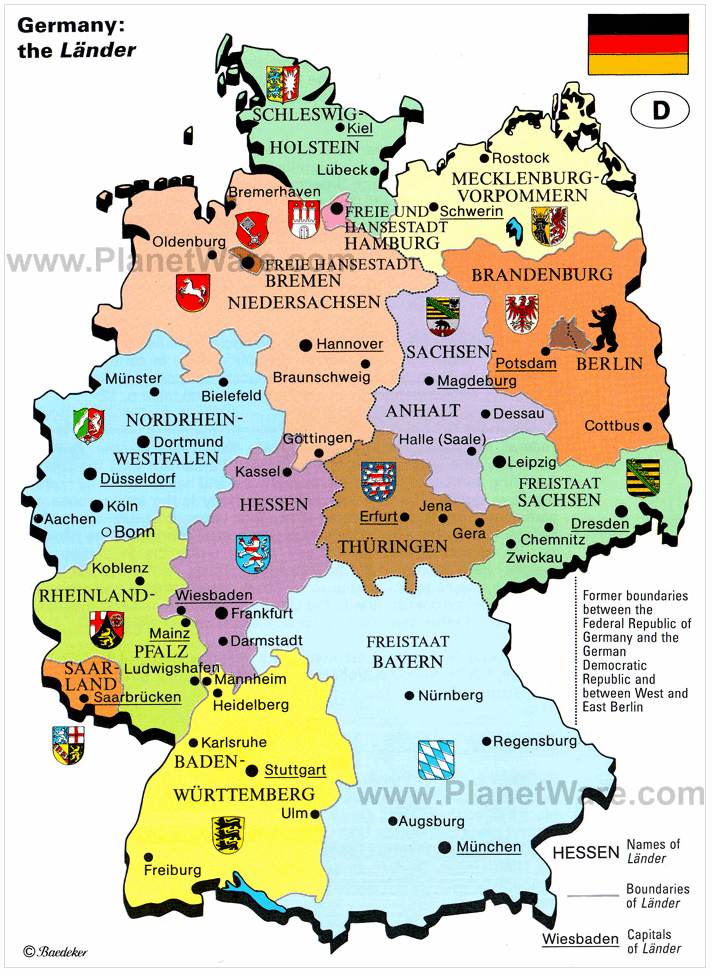
Map of Germany today (click to enlarge)


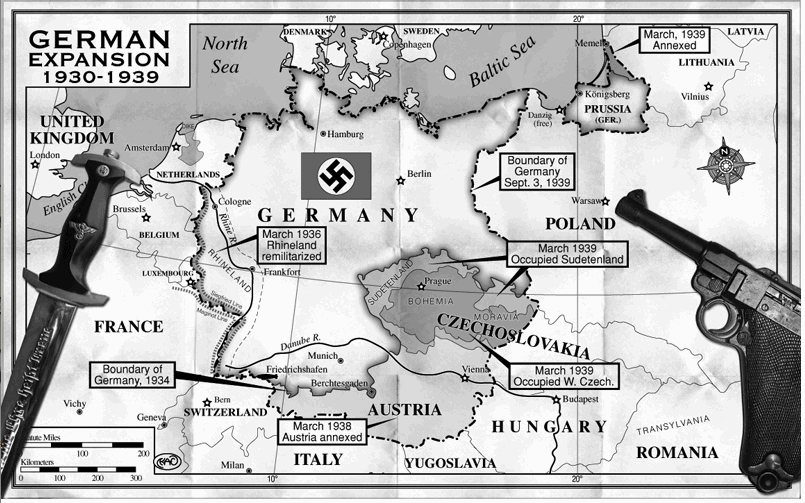
Map of Germany expansion in the 1930s (click to enlarge).


———————————-


Click links to go2:

Book Reviews

Chapter 1: The Shadow

Chapter 2: Berlin Blackout

Chapter 3: Getting on with the Job

Chapter 4: Junketing Through Germany

Chapter 5: This Detested War

Chapter 6: Vienna and Bratislava

Chapter 7: Iron Rations

Chapter 8: A Berlin Lady Goes to Market

Chapter 9: The Battle of the Land

Chapter 10: The Labor Front

Chapter 11: The Army of the Spade

Chapter 12: Hitler Youth

Chapter 13: Women of the Third Reich

Chapter 14: Behind the Winter­Help

Chapter 15: Socialized Health

Chapter 16: In a Eugenics Court

Chapter 17: I See Hitler

Chapter 18: Mid­Winter Berlin

Chapter 19: Berlin to Budapest

Chapter 20: The Party

Chapter 21: The Totalitarian State

Chapter 22: Closed Doors

Chapter 23: Out of the Shadow


Into the Darkness: Chapter 4 (PDF). >> Into The Darkness – Chapt 04 – Junketing Through Germany


Version History


Version 8: Nov 21, 2020. Re-uploaded images and PDF for katana17.com/wp/ version. Improved formatting. New cover.


Version 7: Jun 17, 2015. Formatting changes.


Version 6: Nov 28, 2014. Added PDF file (Ver 2) of this post.


Version 5: Mon, Jun 9, 2014. Added PDF file of this chapter for download


Version 4: Wed, Feb 5, 2014. Added Chapter links.


Version 3: Mon, Jan 27, 2014. Quoted text italicized.


Version 2: Published May 15 2013 – More pics added.


Version 1: Published May 11 2013 – Text and some pics added.
Posted in Bk - Into the Darkness - Stoddard, Europe, Germany, Lothrop Stoddard, National Socialism, National Socialism - Philosphy, Nationalism, Propaganda - Anti-German, Revisionism, Robert Ley, Third Reich, Western Civilization, WW II | Tagged , | 4 Comments

Into the Darkness : Chapter 3 – Getting on with the Job


Into the Darkness:


An Uncensored Report from


Inside the Third Reich at War


by Lothrop Stoddard


Chapter 3: Getting on with the Job


I went to Europe as special correspondent of the North American Newspaper Alliance, a press syndicate with membership in the United States, Canada, and other parts of the world. My main field was Germany, with side­ glances elsewhere in Central Europe. Since N.A.N.A. is a feature service, my job was to study conditions, do interpretive or local color articles, and get important interviews. I was not professionally interested in spot news. To do a good job I had to have an open mind; so I did my best to park my private opinions on this side of the ocean. And since my return I’ve tried not to pick them up again. An objective attitude was made easier by the fact that the outbreak of the European War caught me in a place where it meant nothing except its effect on the price of sugar ­ Havana, Cuba.


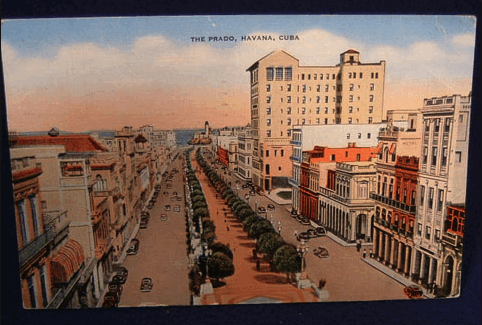
Havana postcard, Cuba


Between a survey I was making with a Washington colleague, H. H. Stansbury, and the terrific heat I could pay scant attention to European affairs, which were badly covered in the Havana press. Everybody was absorbed in local politics. The Batista Government was getting ready to celebrate the anniversary of its revolutionary origin, the momentous date being September 4th. So Havana was all bedizened with flags and bunting, while across the harbor on Morro Castle and Cabanas Fortress rose huge transparencies bearing the legends: BATISTA and CUARTO SETIEMBRE electrically blazing forth o’nights in giant letters of fire. Then, just before the big party, Europe had to explode! Small wonder that it hardly made a dent on Cuban thinking, except the sugar phase.


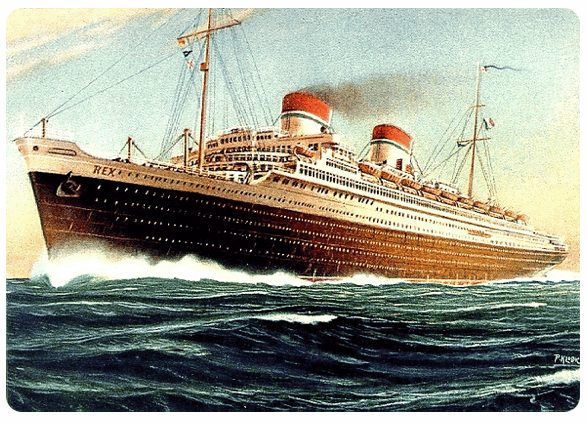
However, it made a big dent on my mind. I had already canvassed the possibility of personally covering the German situation, for which I had certain qualifications such as an intermittent knowledge of the country since childhood and a working knowledge of the language. I had also followed German events regularly in my studies of foreign affairs. Therefore as soon as I could wind up my Cuban survey, I hurried home, reaching New York late in September. Three weeks afterwards I was on the Rex, Europe­bound. I thus arrived on the scene of action in an objective state of mind.


To get working quickly and efficiently, three things had to be done as soon as possible. First of all, I must present my credentials and acquire the permits needed by a foreign correspondent in wartime. Then I had to establish correct and personally amicable relations with the officials with whom I would be in contact. Last but not least, I should get on really friendly terms with the outstanding members of the foreign press corps ­ not merely the Americans but those of the other neutral nationalities stationed in Berlin. An experienced, capable foreign correspondent is your best source of information. He usually knows more and sees clearer than a diplomat of the same caliber. This is also true of certain long­ resident foreign professional or business men. Furthermore, both they and the correspondents can talk more freely to you. There are certain things which members of the diplomatic corps hesitate to discuss unreservedly with you even in the strictest “off the record.” Fortunately I was able to make a good start on all three lines the very first day after my arrival in Berlin.


Wilhelmstraße 74-76: The Foreign Office


Monday noon found me at the Foreign Office, halfway down the Wilhelmstrasse, where I was to attend the foreign press conference held there daily at this hour. These conferences are usually held in a large oblong room, elaborately paneled. Down the middle of this chamber runs an enormously long table covered with green baize. On one side of the table sit a line of Government officials drawn from both the Foreign Office and the Propaganda Ministry. One of these men is the Government spokesman for the day, who makes announcements and answers questions either directly or through some other official who is a specialist in the particular matter. On the other side of the table cluster the foreign correspondents, representing every neutral country in Europe, plus a few Orientals and a strong contingent of Americans. The average attendance runs between fifty and seventy, including several women journalists.


Personal relations between these Government spokesmen and the foreign correspondents are generally friendly and sometimes cordial. The officials are intelligent men specially picked for the business of tactfully handling foreign journalists. The correspondents are, for the most part, old hands who know how to play the game. So the conferences, which are conducted in German, usually go off smoothly, with humorous undertones as a shrewd query is met by an equally shrewd parry. These bits of repartee are often greeted by a general burst of laughter.


After the conference that morning I was introduced to the chief officials, and I likewise met several of our American press delegation to whom I had been recommended or with whom I was previously acquainted. The officials were nearly all university men, some with doctorate degrees. Those in the American Section were well fitted for their posts. Dr. Sallett, the Foreign Office contact man for Americans, had lived in the United States for years before he entered the diplomatic service and had done postgraduate work at Harvard. Dr. Froelich, head of the Propaganda Ministry’s American Bureau, has a Harvard Law School degree, while his junior colleague, Werner Asendorf, is a graduate of the University of Oregon. Both these men have American wives. The head of the entire Foreign Press Section, Dr. Boehme, is an engaging personality with a quick intelligence and cynical sense of humor, who has traveled widely in many lands including the United States. I felt from the first that here were men who knew us well and with whom one could get along harmoniously.


Reich Ministry of Public Enlightenment and Propaganda


That same afternoon I attended another foreign press conference, this time at the Propaganda Ministry. These conferences, likewise held every weekday, deal more with special topics than with spot news. Government specialists address the correspondents on current military, naval, or economic situations, while outstanding figures are produced for inspection. For instance, when a big aerial battle was fought over the North Sea, the squadron commander and his flying aces appeared before the foreign journalists to tell their side of the story and be questioned.


Before the inevitable blackout ended my first working day in Berlin I had been duly enrolled in the foreign press corps and had filed my application for a Press Wireless permit. This is the correspondent’s most important privilege. It enables him to file press despatches to his newspaper or syndicate, payment guaranteed at the other end. Furthermore, those despatches go through uncensored. I am sure of this, both from what I was told and from my own experience. For instance, I filed a despatch at a small substation as late as 6.15 P.M., Berlin Time (12.15 noon, Eastern Standard Time) and it appeared in all editions of the New York Times next morning. This would have been impossible if there had been even the short delay which a most cursory check­ up before putting the despatch on the wireless would have involved.


This brings up one of the most interesting aspects of wartime Germany ­ the system of handling foreign journalists. Right at the start I was told at the Propaganda Ministry just where I stood and what I could, and could not, write. Military and naval matters were, of course, severely circumscribed, together with topics such as sensational rumors obviously tending to discredit the German Government and give aid and comfort to its enemies. There was a sort of gentleman’s agreement with the correspondent that he would abide by rules laid down for his guidance. If he overstepped the line and a despatch, when published in his home paper, contained matter which the German authorities considered untrue, unfair, or otherwise unprofessional, the correspondent would be called onto the carpet and warned to mend his ways. If the offense was flagrant he might be formally expelled from the foreign press corps, thereby losing his official status with all its attendant privileges. His professional usefulness would thus be at an end, and he might as well leave Germany even though not formally expelled.


This gentlemen’s agreement system is equally obvious in the matter of interviews. When you interview an official personage you are required to submit your manuscript to the Propaganda Ministry which makes a German translation and lays it before the person interviewed for his approval. Obviously, it is necessary for the Government to see to it that its leading spokesmen are correctly quoted and that statements made to the interviewer “off the record” are not published. So it often happens that considerable changes have to be made before the final draft is O.K.’d. Once approval is given, however, there is no further check­up and the interview can be filed for the wireless in the same way as any press despatch. Technically, there is nothing to prevent your sending the original version. But naturally, if the published interview does not tally with the draft agreed upon, it will be clear that you have broken faith, and confidence in your reliability is destroyed.


The same policy applies to foreign telephone service. Most Berlin correspondents of newspapers in European neutral countries have telephone permits similar to Press Wireless for us Americans. Such permits enable the European correspondent to telephone his despatches directly from his Berlin office to his home paper. These talks may be subject to a double check ­ by listening in and by transcription on dictaphone records. However, even when this is done, it is seemingly to catch such obvious indiscretions as discussion of military matters. I never heard of a press telephone conversation being broken into or stopped. Here again the foreign correspondent is called to account only when a despatch published in his home paper contains something which German officialdom considers a violation of the rules of the game.


During my stay in Berlin, the Propaganda Ministry evolved an ingenious method of expediting press stories sent by mail. All such material could be turned into a special bureau with the understanding that the manuscript would be read and mailed within twenty-four hours unless something objectionable should be discovered. Being mailed in a special envelope, it went through without scrutiny by the regular censors. In case of objection, the correspondent was notified, and specific changes or eliminations were suggested. Here, as elsewhere, objections seemed to have been rarely made except for reasons already explained.


The foreign correspondent can go pretty far in describing current conditions and general situations. German officialdom seems to have realized that it is no use trying to stop press stories about matters which are undeniably true and widely known. Let me cite one instance from my own experience. I had written a pair of “mailers” describing in detail the many vexations and hardships which German housewives had to endure. They went through the Propaganda Ministry all right, but I wanted to find out the official reaction to them. Accordingly, I tried them out on an official who I was sure had not read them. He scanned them carefully and handed them back with a slightly wry smile.


“American readers will be apt to think we’re in tough shape,” he said.

“I really think you left out certain qualifying factors which would have made the picture less dark. However,” he ended with a shrug, “what you do say is all true, and I believe you’re trying to be fair. So, under our present policy, we can make no legitimate kick.”


Of course, the latitude extended foreign correspondents has its practical limits. Should a correspondent unearth some unpalatable information he is more than likely to be told that such a despatch, even though true and not falling under the ordinary tabus, is displeasing to the German Government. I know of one such instance where the offender was plainly told that, if he publicized any more exceptional discoveries of this kind, he would get into serious trouble.


There seems also to be distinct discrimination between the latitude permitted the correspondents of powerful neutrals and those of the small European countries which fall more or less within Germany’s orbit. More than once their press representatives said to me:


“We can’t write nearly as freely as you Americans. If we did, the German Government would either crack down on us directly or make strong diplomatic protests to our own Governments, who in turn might make it hot for our home papers.”


Such things make it abundantly clear that, in its seemingly liberal attitude toward foreign correspondents, the German Government is animated by no idealistic motives. Its policy is severely practical. The shrewd brains which run the Propaganda Ministry have decided that it pays to treat foreign correspondents well and help them to get their despatches out with a minimum of red tape and avoidable delay. Nothing makes a newspaperman more contented than that. But that isn’t the only reason. The very fact that Berlin despatches to the foreign press sometimes contain items unfavorable to Germany tends to give public opinion the idea that a Berlin date­line is relatively reliable, and this in turn aids the German Government in pushing out its foreign propaganda. Finally, there is no danger that any of those unfavorable items will leak back to the German public, because they are not allowed to be printed in any German newspaper.


Nothing can be more startling than the contrast between the respective treatments of foreign journalists and their German colleagues. The German press is rigidly controlled. Indeed, German papers print very little straight news as we understand the term. Every item published is elaborately scrutinized. I had one illuminating instance of this when I was invited by the head of a German press syndicate to contribute a short statement of my impressions of wartime Europe. Having been assured that I could write what I chose, I stated frankly that we Americans thought another long war would ruin Europe economically, no matter which side was victorious. The Propaganda Ministry promptly vetoed publication, and I was tactfully but firmly told that such a statement, though quite proper for my fellow countrymen, was deemed unsuitable for German readers.


When he travels, the foreign correspondent encounters the same condition of circumscribed freedom as he does in sending his despatches. Over most of Germany he can travel almost as freely as he could in peacetime ­ by train or commercial bus, of course, since gasoline rationing makes private motor trips impossible. The only apparent check on his movements is the requirement to turn in his passport when he registers at a hotel. But there are certain parts of the Reich which are rigidly barred zones. He cannot go anywhere near the West­ Wall, the fortified belt of territory along the French, Belgian, and Dutch borders. He cannot visit the fortified coasts of the North Sea and the Baltic. He cannot enter German occupied Poland ­ at least, he could not during my stay in Germany. He has to get special permission to enter the Protectorate of Bohemia­ Moravia, and even then he is under such close surveillance that no patriotic Czech will dare come near him. Such, briefly, are the conditions under which the foreign correspondent lives and works in wartime Germany. Within limits, he can operate quickly and efficiently. There are quite a few locked doors, and he had best not try to open them. But at least he knows where he stands, and the rules of the game are made clear to him.


———————————-


Book Reviews

Chapter 1: The Shadow

Chapter 2: Berlin Blackout

Chapter 3: Getting on with the Job

Chapter 4: Junketing Through Germany

Chapter 5: This Detested War

Chapter 6: Vienna and Bratislava

Chapter 7: Iron Rations

Chapter 8: A Berlin Lady Goes to Market

Chapter 9: The Battle of the Land

Chapter 10: The Labor Front

Chapter 11: The Army of the Spade

Chapter 12: Hitler Youth

Chapter 13: Women of the Third Reich

Chapter 14: Behind the Winter­Help

Chapter 15: Socialized Health

Chapter 16: In a Eugenics Court

Chapter 17: I See Hitler

Chapter 18: Mid­Winter Berlin

Chapter 19: Berlin to Budapest

Chapter 20: The Party

Chapter 21: The Totalitarian State

Chapter 22: Closed Doors

Chapter 23: Out of the Shadow


———————————-

Into the Darkness: Chapter 3 (PDF). >> Into the Darkness – Chapter 3 – Getting on with the Job

———————————-


Version History


Version 7: Apr 30, 2022. Re-uploaded images for katana17.com.


Version 6: Jun 17, 2015. Formatting changes.


Version 5: Nov 28, 2014. Added PDF file (Ver 2) of this post.


Version 4: Mon, Jun 9, 2014. Added PDF file of this chapter for download.


Version 3: Wed, Feb 5, 2014. Added Chapter links.


Version 2: Mon, Jan 27, 2014. Quoted text italicized.


Version 1: May 10, 2013. Published text with images.

Posted in Bk - Into the Darkness - Stoddard | Tagged , | 4 Comments

Into the Darkness : Chapter 2 – Berlin Blackout


Into the Darkness:


An Uncensored Report from


Inside the Third Reich at War


by Lothrop Stoddard


[Note: Images not part of original text]

Chapter 2: Berlin Blackout


My entry into Berlin was not a cheering one. The train was nearly two hours late and there was no diner, so I had had nothing except the traditional cowpunch­er’s breakfast a sip of water and a cigarette. The chill autumnal air made me shiver as I stepped from the train. Porters, it seemed, were scarce in wartime Germany, and I was fortunate to preempt one to carry my abundant hand luggage.

My first job was to get some German money, for I hadn’t a pfennig to my name. You can’t legally buy Reichsmarks abroad. What the traveler does is to take out a letter of credit before he leaves his native land. While in Germany he draws on this and gets what is known as Registered Marks which are much cheaper than the official quotation of 2.4 to the dollar. I bought my letter of credit in New York at the rate of nearly five to the dollar. That meant a twenty­ cent mark a saving of almost 100 per. cent. The traveler is supposed to use this money only for living expenses, and every draft is entered on his passport as well as on his letter of credit, thus enabling the authorities to check up on what he has spent when he leaves Germany. However, the allowance is liberal, and unless his drafts indicate that he has been buying a good deal, he will have no trouble. Of course, one gets ordinary currency. The Registered Mark is merely a bookkeeping phrase. At one of the bureaus maintained at every large railway station I drew enough cash to last me for a few days, then my porter found me one of the few taxis available. Both cab and driver were of ancient vintage, but they rattled me safely to my hotel. This was the famous Adlon, situated on Berlin’s main avenue, Unter den Linden.


Adlon Hotel


While unpacking I had the pleasure of a telephone call from a German named Sallett whom I had informed of my coming. I had known him when he was attached to the German Embassy in Washington. Now he was in the American Section of the Foreign Office, so I counted on him to start me right. Since the day was Sunday there was nothing officially to be done, but he asked me to meet him at lunch for a preliminary chat and to come to his home for dinner that same evening.

Before keeping my luncheon date, however, I took care to equip myself with food­ cards those precious bits of paper on which one’s very life depends. Incidentally they are not cards, but blocks of coupons, reminiscent of the trading ­stamps issued by some of our department stores. The clerk at the desk inscribed my name in a big book and handed me a week’s supply in the shape of little blocks of coupons variously colored. Each coupon is good for so many grams of bread, butter, meat, and other edibles. Every time you eat a meal you must tear off the various coupons required for each dish, the amount being printed on the bill of fare. And the waiter must collect them when you give your order, because he in turn must hand them in to the kitchen before he can bring you your food. This has nothing to do with price. In the last analysis, each of these food­coupons is what the Germans call a Bezugschein an official permit to purchase an article of a specific kind and quality. Let me illustrate: You want to buy some meat. Each of your meat coupons entitles you to so many grams. You may go into an inexpensive restaurant and get the cheapest grade of sausage or you can go into the best hotel and get a finely cooked filet mignon. The price will differ enormously, but the number of meat coupons you hand over is precisely the same.


Bezugschein food coupon


I needed to take along my food­cards even though I had been invited to lunch. In Germany, no matter how wealthy your host may be, he has no more coupons than anyone else and so cannot furnish them for his guests. That is true of all meals in hotels or restaurants. It does not apply when the host invites you to his own home. He then has to do all the honors. This severely limits domestic hospitality. In such cases the guests are usually served fish, game, or some other delicacy for which food cards are not required.


Kaiserhof Hotel


Dr. Sallett had asked me to lunch with him at the Kaiserhof, a well­ known hotel some distance down the Wilhelmstrasse. It is the Nazi social headquarters, and when prominent members of the Party come to Berlin from the provinces they usually stop there. Sallett met me in the lobby, resplendent in a gray diplomatic uniform cut with the swank which military tailors know how to attain. Being Sunday, the usual weekday crowd was lacking in the dining room. Those who were present seemed to be much of a type vigorous men, mostly in their thirties or forties, some of them hard­faced and all with an air of assurance and authority. Nearly all of them wore the Party emblem, a button about the size of a half­ dollar bearing a red swastika on a white background.


Party emblem button


My first meal in the Third Reich was a distinct success. As might have been expected in this preeminent Nazi hostelry, the food was good and the service quick. The imitation coffee, an Ersatz made of roasted barley, was banal, but it was remedied by an excellent pony of old German brandy. Thereafter, my friend Sallett explained to me the various things I must do in order to get going without loss of time.


New Chancellery


When we had parted until evening, I strolled back along the Wilhelmstrasse to get the feel of my new abode. I noted how the famous street had architecturally had its face lifted since I was there a decade before. Across the broad square from the Kaiserhof stood the new Chancery, while on the opposite side of the street was the equally new Ministry for Popular Enlightenment and Propaganda an institution I was to know extremely well, since all foreign correspondents fall under its special jurisdiction. Both buildings typify the new Nazi architecture their exteriors severely plain, whatever magnificence may be within. This is a conscious reaction from the ornate exaggerations of the old Empire style, which is frowned on as vulgar and tasteless.


Reich Chancellery


Just beyond the Chancery is the rather modest old eighteenth century palace which is Adolf Hitler’s official residence. It sets well back from the street behind a high iron railing. Above its gabled roof floated a special swastika flag to denote that Der Fuehrer was at home. That is the way Germans always speak of him. Very rarely do they use his name. With a sort of impersonal reverence, he is Der Fuehrer, The Leader, in Teutonic minds. The railing before the palace has two gates through which motor cars can enter and leave by a semicircular drive. These gates were guarded by Security Police, nicknamed Schupos, in green uniforms and visored black leather hats. Before the entrance to the palace itself stood two military sentries in field gray. Across the street clustered a large group of sightseers, gazing silently at their leader’s residence. Even on weekdays one can always find such onlookers from dawn to dusk, after which loitering on the Wilhelmstrasse is not allowed.

The streets were well filled with Sunday strollers, and since the misting rain of the forenoon had let up, I thought it a good opportunity to get a look at the holiday crowds. I therefore walked for an hour or more up and down Unter den Linden, around the Pariser Platz, and finally back to my hotel. My outstanding impression of these wartime Berliners was a thoroughgoing impassivity. They seemed stolidly casual with expressionless faces. Almost never did I see a really animated conversation; neither was there laughter or even a smile. Twice I dropped briefly into a cafe. In both cases the patrons sat chatting quietly, and from snatches of talk I overheard the conversation was wholly about personal or local affairs. Not once did I catch a discussion of the war or other public matters.

Uniforms naturally abounded. Soldiers, obviously on Sunday liberty, passed and re-passed, sometimes in large groups. They never sauntered but clumped along at a fair pace, their hobnailed boots clashing heavily upon the pavement. Most of them had fine physique and all looked well nourished and generally fit. Now and then I saw a Nazi storm­trooper clad in brown with a red swastika arm band. More often I encountered a black­ uniformed S.S. man the Party’s Schutz Staffeln, or Elite Guard. Twice I passed groups of Hitler Youth, boys dressed entirely in dark blue, from cloth hat to baggy ski­-trousers tucked into high boots.

There was much punctilious saluting. The soldiers gave the army salute, a quick touch of the fingers to helmet or forage cap. The others gave the stiff­ armed Nazi greeting.

The most interesting example of Berlin’s impassive popular mood was the attitude toward the tightly closed British Embassy which is just around the corner from the Adlon. There it stands, with gilded lions and unicorns upon its portals. I had rather expected that this diplomatic seat of the archenemy would attract some attention, especially on a Sunday, when this part of town was thronged with outside visitors. Yet, though I watched closely for some time, I never saw a soul give the building more than a passing glance, much less point to it or demonstrate in any way.


British Embassy in Berlin


Another surprising thing was how well dressed the people appeared. I saw many suits and overcoats which had obviously been worn a long time, but invariably they were tidy and clean. At the moment I thought this good showing was because everyone was wearing Sunday best, but I could detect little difference on subsequent days. In fact wherever I went in Germany the people dressed about the same. Nowhere did I see ragged, unkempt persons. I was told that the cheaper fabrics, made largely of wood synthetics mixed with shoddy, absorb dampness quickly, get heavy, and are hard to dry out. Nevertheless, they look good, though I doubt the efficacy of their resistance to rain and cold.

One thing those clothes did lack, however, and that was style. The range of models was small, and they were obviously designed for service rather than smartness. Overcoats were mostly of the ulster type, and that goes for the women too. While I did see a considerable number of ladies who were well­ dressed according to our standards, the average Berlin female, with her ulsterette or raincoat, her plain felt hat, her cotton stockings, and her low-heeled shoes, rarely warrants a second look. I may add that she uses little or no make­up and seldom has her hair waved. Such beautifying is frowned upon by strict Nazis as unpatriotic.


A street scene in central Berlin


My first stroll indicated another thing confirmed by subsequent observation. This is that Berlin remains what it always was a city lacking both color and the indefinable charm of antiquity. Its architecture is monotonous, and the drab effect is heightened by its misty northern climate. Most of the autumn season is cloudy with frequent light rain. Even on so­-called clear days the low hanging sun shines wanly through a veil of mist.

By this time the early autumn dusk was falling, so I returned to the Adlon. I did not dress for my evening appointment because in wartime Germany one rarely wears even a dinner jacket. A double-breasted dark suit is deemed ample for almost all occasions. My friends the Salletts lived some distance away from my hotel, but I had ordered a taxi so I was sure of transportation. The taxi situation is one of the many drawbacks to life in wartime Berlin. Because of the strict rationing of gasoline, taxis are scarce even by day and scarcer still at night. They are supposed to be used only for business or necessity, so drivers are not allowed to take you to any place of amusement, even to the opera. Neither do they cruise the streets for fares, so unless you know a regular cab stand you can almost never pick one up.


Hotel Adlon lobby


The hotel lobby was brilliantly lighted when I descended, but thick curtains had been drawn across the entrance. I slipped through them to encounter that most trying of all wartime Berlin’s phenomena, the Verdunklung, or blackout. As I emerged through the swing­doors it hit me literally like a blow in the face. The misting rain had begun again, and it was dark as a pocket. The broad avenue of Unter den Linden was a maw of blackness.

Not a street light except the cross-­slitted traffic signals at the nearby corner of the Wilhelmstrasse. They were hardly needed for the few motor cars and occasional buses that crawled slowly by. Well might they drive cautiously, for their headlights were hooded save for a tiny orifice emitting a dim ray. As I stood on the sidewalk waiting for my taxi, pedestrians picked their way warily in the inky gloom, sensed rather than seen. Some of them wore phosphorescent buttons to avoid collisions with other passers­by. Others used small electric lamps to guide their steps, flashing them off quickly and always holding them pointed downward toward the ground. Any other use of a flashlight is strictly prohibited. To turn it upward to read a street sign or find a house number rates a warning shout from one of the policemen who seem to be everywhere after dark. Indeed, such action may lead to arrest and a fifty­ mark fine, which at par is about twenty dollars.

I entered my taxi with some trepidation. How was the driver going to find my friend’s address, avoid collisions, or even keep to the roadway on a night like this? Yet he seemed to know his business, for he forged steadily onward, with many mysterious turns and twists through the maze of unseen streets and avenues. As for me, I could not see even the houses on either hand, though I sensed their looming presence and marveled at the thought of all the life and light pent in behind numberless shrouded windows. The only visible objects were pinpoint lights of approaching motor cars and occasional trams or buses which clattered past like noisy ghosts. They were lit within by tiny blue bulbs revealing shadow passengers. Wartime Berlin had indeed become a “city of dreadful night.” No description can adequately convey the depressing, almost paralyzing, effect. It must be lived to be understood.

At length my taxi halted. The driver flashed a light which showed a couple of doorways quite close together. “It must be one of those two,” he said, as I got out and paid him. Fortunately I had with me a flashlight brought from America. It was small as a fountain pen and could be clipped into my vest pocket. The sight of it never failed to evoke envious admiration from German acquaintances. Heedless of lurking policemen, I flashed its tiny beam upward at the house number which, as usual, was perched on the tip top of a high door. It was not the right place. I tried the next door. It had no number and seemed to be disused. I tried the next house. The numbers were running the wrong way. Meanwhile the misty drizzle had increased to a smart downpour.

Feeling utterly helpless, I determined to seek information; so I pressed the button to the first floor apartment and as the latch clicked I went inside. As I walked across the hallway the apartment entrance opened and a pleasant­ faced young woman stood in the doorway. I explained the situation, stating that I was a total stranger. Her face grew sympathetic, then set in a quick frown.


“You say that taxi man didn’t make sure?” she exclaimed. “Ach, how stupid! The fellow ought to be reported. Wait a minute and I’ll show you myself.”


She disappeared, returning a moment later wearing a raincoat.

I protested that I could find my way from her directions, but she would have none of it.


“No, no,” she insisted. “Such treatment to a newly arrived foreigner! I am bound to make up for that driver’s inefficiency.”


Together we sallied forth into the pattering rain. On the way she explained that my friend’s apartment house, though listed as on her street, had its entrance just around the corner on another avenue. She thought that also very stupid.

Arriving as I did somewhat late, I found the others already there.

To my great pleasure the chief guest was Alexander Kirk, our Charge d’Affaires in Berlin. He is doing a fine diplomatic job in a most difficult post. Generally popular, he does not hesitate to speak plainly when he needs to. And, instead of getting offended, the Germans seem to like him all the better for it. Some weeks later, Mr. Kirk won new laurels by vetoing the usual Thanksgiving celebration of the American colony in a restaurant or hotel. He argued that, when all Germany was strictly rationed, such public feasting would be in bad taste. Instead, he invited his fellow­ citizens to a private dinner at his own palatial residence in a fashionable suburb. The Germans considered that the height of tactful courtesy.

The other two guests were Herr Hewel, one of Hitler’s confidential advisers, and Dr. Otto Schramm, a leading Berlin surgeon. In the course of the evening, Dr. Schramm told me about a new synthetic fat which had just been invented. Elaborate experiments were being made to produce not only a substitute for soap but also an edible compound to supplement animal fats and vegetable oils. This, he claimed, would soon remedy blockaded Germany’s chief dietary danger, since it could be produced from chemical constituents abundantly available. The talk ran late. Fortunately, I was taken back to my hotel in Herr Hewel’s car, which, being an official, he could still use.


Brandenburger Tor (Gate)


Just before reaching the Adlon we encountered a column of huge army trucks going up Unter den Linden and out through the Brandenburger Tor. I was afterward told that material and ordnance, routed through Berlin, are usually moved late at night. There must have been plenty of activity on that occasion, for long after I had retired I could hear intermittent rumblings of heavy traffic whose vibrations came to me even through the Adlon’s thick walls.

———————————-

See Also

Book Reviews

Chapter 1: The Shadow

Chapter 2: Berlin Blackout

Chapter 3: Getting on with the Job

Chapter 4: Junketing Through Germany

Chapter 5: This Detested War

Chapter 6: Vienna and Bratislava

Chapter 7: Iron Rations

Chapter 8: A Berlin Lady Goes to Market

Chapter 9: The Battle of the Land

Chapter 10: The Labor Front

Chapter 11: The Army of the Spade

Chapter 12: Hitler Youth

Chapter 13: Women of the Third Reich

Chapter 14: Behind the Winter­Help

Chapter 15: Socialized Health

Chapter 16: In a Eugenics Court

Chapter 17: I See Hitler

Chapter 18: Mid­Winter Berlin

Chapter 19: Berlin to Budapest

Chapter 20: The Party

Chapter 21: The Totalitarian State

Chapter 22: Closed Doors

Chapter 23: Out of the Shadow


———————————-


Into the Darkness: Chapter 2 (PDF). >>Into the Darkness – Chap 02


Version History


Version 7: Apr 28, 2022. Re-uploaded images and PDF for katana17.com.


Version 6: Jun 17, 2015. Formatting changes.


Version 5: Nov 28, 2014. Added PDF file (Ver 2) of this post.


Version 4: Mon, Jun 9, 2014. Added PDF file of this chapter for download


Version 3: Wed, Feb 5, 2014. Added Chapter links.


Version 2: Published May 10 2013 – Resized pics. Added Version History notes.


Version 1: Published May 9 2013 – Text and some pics added.

Posted in Bk - Into the Darkness - Stoddard, Lothrop Stoddard | Tagged , | 10 Comments

Lothrop Stoddard – Into the Darkness : Chapter 1: The Shadow


Into the Darkness


An Uncensored Report from


Inside the Third Reich at War 


by Lothrop Stoddard


Summary


Journalist Lothrop Stoddard’s even­handed account of his travels through war­time Germany (and surrounding countries) from 1939­-1940. His is a truthful report of the Third Reich; its leaders, political positions, and culture.


Stoddard was a renowned and well­ respected journalist when he made this trip and subsequent report, because it recounts accurately (and not politically correctly), the events of the time, his name, not to mention his report, has all but disappeared from today’s “official” history concerning that period.


Lothrop Stoddard


Table of Contents

Chapter 1: The Shadow . . . . . . . . . . . . . . . . . . . . . . . . . . . .    5

Chapter 2: Berlin Blackout . . . . . . . . . . . . . . . . . . . . . . . . .   17

Chapter 3: Getting on with the Job . . . . . . . . . . . . . . . . . .  .26

Chapter 4: Junketing Through Germany . . . . . . . . . . . . . .  34

Chapter 5: This Detested War .. . . . . . . . . . . . . . . . . . .  . . .   43

Chapter 6: Vienna and Bratislava . . . . . . . . . . . . . . . . . .  .   52

Chapter 7: Iron Rations . . . . . . . . . . . . . . . . . . . . . . . . . . . .  63

Chapter 8: A Berlin Lady Goes to Market . . . . . . . . . . . .  .  74

Chapter 9: The Battle of the Land . . . .. . . . . . . . . . . . . . . .  82

Chapter 10: The Labor Front . . . . . . . . . . . . . . . . . . . . . . .  98

Chapter 11: The Army of the Spade . . . . . . . . . . . . . . . . .   105

Chapter 12: Hitler Youth . . . . . . . . . . . . . . . . . . . . . . . . . . .  112

Chapter 13: Women of the Third Reich . . . . . . .. . . . . .  .    120

Chapter 14: Behind the Winter ­Help . . . . . . . . . . . . . . . . . .  127

Chapter 15: Socialized Health . . . . . . . . . . . . . . . . . . . . . .   137

Chapter 16: In a Eugenics Court . .. . . . . . . . . . . . . . . . . . .  144

Chapter 17: I See Hitler . . . . . . . . . . . . . . . . . . . . . . . . . . .  155

Chapter 18: Mid­-Winter Berlin . . . . . . . . . . . . . . . . . . .  . .  164

Chapter 19: Berlin to Budapest . . . . . . . . . . . . . . . . . . . . . . 174

Chapter 20: The Party . . . . . . . . . . . . . . . . . . . . . . . . . . . .  190

Chapter 21: The Totalitarian State . . . . . . . . . . . . . . . . . .  204

Chapter 22: Closed Doors . . . . . . .. . . . . . . . . . . . . . . . . . .   215

Chapter 23: Out of the Shadow . . . . . . . . . . . . . . . . . . . . .  235

.


Chapter 1: The Shadow 


All Europe is under the shadow of war. It is like an eclipse of the sun. In the warring nations the darkness is most intense, amounting to a continuous blackout. The neutral countries form a sort of twilight zone, where life is better, yet far from normal. In nature, an eclipse is a passing phenomenon; awe-inspiring but soon over. Not so with the war hidden sun of Europe’s civilization. Normal light and warmth do not return. Ominously, the twilight zone of neutrality becomes an ever bleaker gray, while war’s blackout grows more and more intense.


I entered wartime Europe by way of Italy, making the trip from America on the Italian liner Rex. It was a strange voyage. This huge floating palace, the pride of Italy’s merchant marine, carried only a handful of passengers. War’s automatic blight on pleasure tours, plus our State Department’s ban on ordinary passports, had dammed the travel flood to the merest trickle. So I sailed from New York on an almost empty boat.


Italian liner “Rex


First Class on the Rex is a miracle of modern luxury. Yet all that splendor was lavished upon precisely twenty-five passengers including myself. Consequently we rattled around in this magnificence like tiny peas in a mammoth pod. A small group of tables in one corner of the spacious dining salon; a short row of reclining chairs on the long vista of the promenade deck; a pathetic little cluster of seats in the vast ballroom when it was time for the movies these were the sole evidences of community life. Even the ship’s company was little in evidence. Save for the few stewards and deck­hands needed to look after us, the rest did not appear. Now and then I would roam about for a long time without seeing a soul. The effect was eery. It was like being on a ghost ship, “Outward Bound” and driven by unseen hands.


There was not much to be gleaned from my fellow passengers. Most of them were Italians, speaking little English and full of their own affairs. A pair of American business men were equally preoccupied. For them, the war was a confounded nuisance. The rapid-fire speech of a Chilean diplomat bound with his family for a European post was too much for my Spanish. The most intriguing person aboard was a lone Japanese who beat everybody at ping-pong but otherwise held himself aloof.


Back aft, Tourist Class was even more cosmopolitan, with a solitary American set among a sprinkling of several nationalities, including a young Iraki Arab returning to Bagdad from a course at the University of Chicago. He was a fiery nationalist deeply distrustful of all the European Powers, especially Soviet Russia with its possible designs on the Middle East. In both Tourist and Third Class were a number of Germans, mostly women but three of them men of military age. All were obviously nervous. They had taken the gamble that the Rex would not be stopped by the English at Gibraltar, Britain’s key to the Mediterranean. In that event, the men knew that a concentration camp would be the end of their venturesome attempt to return to the Fatherland.


Gibraltar


Passing the Straits of Gibraltar is always a memorable experience. This time it was especially impressive. We entered about mid afternoon. The sky was full of cloud­ masses shot with gleams of watery sunshine. At one moment a magnificent rainbow spanned the broad straits like a mammoth suspension bridge. On the African shore the jagged sierras of Morocco were draped in mists. By contrast, the mountains of Spain were dappled sunlight, their brown slopes tinted with tender green where the long drought of summer had been tempered by the first autumn rains.


At length the massive outline of the Rock of Gibraltar came into view. It got nearer. We forged steadily ahead on our normal course toward the open Mediterranean beyond. Would the British let us pass? Nobody knew but the ship’s officers, and they wouldn’t tell. Then, when almost abreast of the Rock, our bow swerved sharply and we swung in past Europa Point. The British were going to give us the once-over! Hastily I climbed to a ‘vantage­ place’ on the top deck to view what was to come, my Japanese fellow­ passenger following suit. As the Rex entered Algeciras Bay we could see Gibraltar’s outer harbor crowded with merchant shipping. When we got closer, I could discern by the big tricolor flags painted on their sides that most of them were Italian. Seven Italian freighters and three liners, all held for inspection. We cast anchor near the Augustus, a big beauty on the South American run.


As the anchor chain rattled, my fellow­ passenger turned to me with a bland Oriental smile. “Very interesting,” he remarked, pointing to the impounded shipping. “Do not think Japanese Government let this happen to our steamers.” We continued to view objectively happenings that did not personally concern us. Not so the bulk of the ship’s company. The sight of those many impounded ships stirred every Italian aboard. Officers assumed tightlipped impassivity and stewards shrugged deprecatingly, but sailors gathered in muttering knots while passengers became indignantly vocal, especially as a large naval tender approached us from shore. It was filled with British bluejackets and officers with white caps. I also spotted two military constables, which meant that they were after Germans.


As the tender swung alongside just beneath my vantage ­point, a young Italian fellow ­passenger strode up and joined us. Since he had already proclaimed himself an ardent Fascist, I was not surprised when he relieved his pent-up feelings with all the vigor of his seventeen years.


“Look at all our ships held in here!” he shouted.

“Isn’t it a shame?” I couldn’t resist a mischievous thought. “Just a little pat of the lion’s paw,” I put in soothingly.


The tease worked to perfection. He fairly exploded.


“Lions?” he yelled, shaking his fist.

“Insolent dogs, I call them. Just you wait. This war isn’t over; it’s only begun. Some fine day, our Duce will give the word. Then we’ll blast that old rock to smithereens and hand the fragments to our good friend Franco as a gesture of the friendship between our two Latin nations.”


This speech set off a sailor who was painting nearby. He joined us, gesticulating with his brush.


“I know how the English act,” he growled, “I went through the Ethiopian War. Wouldn’t I like to drop this paintbrush on that So ­and ­So’s head, down there!”


That So­ and So was a young British navy officer standing very erect in the tender’s stern. I shudder to think what might have happened if the sailor had obeyed that impulse.


By this time most of the British officers had climbed aboard, so I went below to see what was up. The spacious entrance salon was dotted with spectators. Through the open door of the purser’s office I could glimpse two Britishers going over the manifest of the ship’s cargo. Just outside the door, flanked by the constables, stood our three Germans of military age stocky men in their thirties or early forties. They stood impassive. This stoical pose was perhaps due to the fact that they had been drinking all the afternoon to quiet their nerves, so they should have been pleasantly mulled. Presently they entered the purser’s office. The interview was short. Out they came, and the constables escorted them downstairs to the lower gangway.
 

I hurried on deck to watch the tender again. It was now dark, but by our ship’s floodlights I could see some cheap suitcases aboard the tender. Soon a constable climbed down the short rope ­ladder; then the three Germans; then the second constable and the British investigation officers. The Germans, clad in raincoats, huddled around their scanty baggage and lit cigarettes. As the tender chugged away, the young officer previously menaced by the paint­brush shouted up to us in crisp British accents:


“You can go straight away now!”


The ordeal was over. It had lasted less than four hours. With only mail and a bit of express cargo, there was no valid reason for detaining us longer. We were lucky. Some ships with a full loading were held up for days. Anyhow, we promptly weighed anchor and were off. The twinkling lights of Gibraltar Town slipped quickly past and vanished behind Europa Point. The towering heights of the Rock loomed dimly in the sheen of the moon. Then it, too, sank from sight.


Approaching Italy, the weather turned symbolic. The last night on board we encountered a violent tempest marked by incessant lightning and crashing thunder. With the dawn a great wind came out of the north, blustering and unseasonably cold. The Bay of Genoa was smartly white-capped as the giant Rex slid into the harbor and nosed cautiously up to her dock.
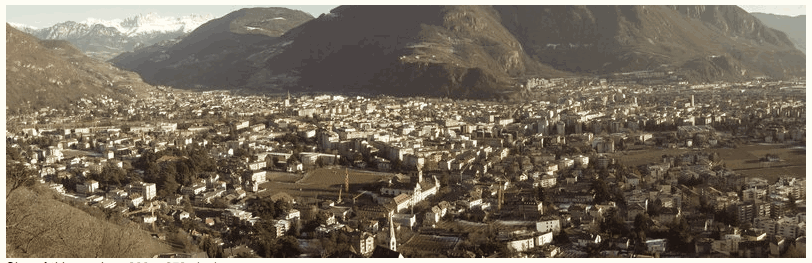
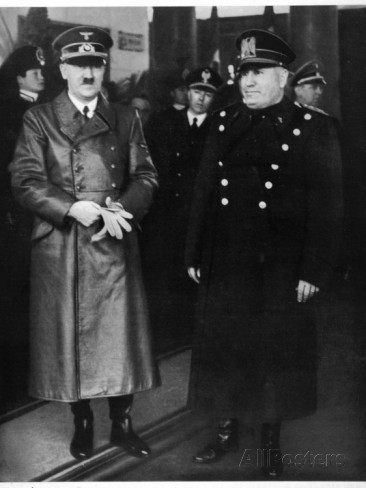
 

Genoa, Italy


Historic Genoa, climbing its steep hills against a background of bare mountains, looked as impressive as ever. Yet there was a strange something in the picture which I could not at first make out. Then I realized what it was an almost Sabbath absence of motion and bustle, though the date was neither a Sunday nor a holiday. Broad parking spaces behind the docks were virtually empty of motor cars, while the streets beyond were devoid of traffic save for trams and horse­ drawn vehicles. Civilian Italy was denied gasoline. The precious fluid had been impounded for military purposes.


Friends met me at the dock, helped me through customs, and took me to the nearby railroad station in one of the few ancient taxis still permitted to run. At the station I checked my baggage as I was leaving town late that same evening. Apologetically, my friends escorted me to a tram in order to reach their suburban home some miles out. On the way I noted big letters painted on almost every dead-wall. Duce! Duce! Duce! Such were the triple salutes to Mussolini, endlessly repeated. Less often came the Fascist motto: Believe! Obey! Fight! Italy being partly mobilized, I saw many soldiers.


Yet, despite all those exhortations, neither soldiers nor civilians appeared to be in a martial mood. On the contrary, they seemed preoccupied, walking for the most part in silence, huddling down into their clothes against recurrent blasts of the chill mountain wind. Once beyond the heart of the city, traffic became even thinner. The few trucks encountered were run by compressed methane gas. I could tell this by the big extra cylinders clamped along their sides. They were like exaggerated copies of the Prestolite tanks I recall from my early motoring days.


At dinner that evening my friends and their guests talked freely.


“We’re just getting over a bad attack of jitters,” remarked my American ­born hostess.

“You should have been here a month and a half ago, when the war began, to realize how things were. At first we feared we were going right in, and expected French bombers over our heads any hour. You know that from our balcony we can glimpse the French coast on a clear day.” “The worst feature was the blackouts,” added my host.

“Thank goodness, we don’t have any more of them. Wait until you get up into Germany. Then you’ll know what I mean.”

“The Italian people doesn’t want to get into this row,” stated a professional man decisively.

“We’ve been through two wars already Ethiopia, Spain. That’s enough fighting for a while.” “If we should intervene later,” broke in a retired naval officer, “it will be strictly for Italian interests. And even then we’ll get what we want first. No going in on promises. We don’t forget how we got gypped at Versailles. That won’t happen a second time.”

“I must apologize for not serving you real coffee,” said my hostess. “But this Mokkari, made from roasted rice, isn’t so bad. You know we can’t get coffee from South America any more on a barter basis and we mustn’t lose any gold or foreign exchange in times like these except for imports vitally needed.”

“As a matter of fact,” put in a guest, “we could have a small coffee ration from what we get in from Ethiopia. But that coffee is very high grade and brings a fancy price on the world market. So the Government sells it all abroad to get more foreign exchange.”

“We’ve been systematically learning to do without luxury imports ever since the League sanctions against us during the Ethiopian War,” said my host.

“You’d be surprised to learn how self-sufficient we have become.” “Autarchy,” stated the retired naval officer sententiously,is a good idea. Puts a nation on its toes. Makes more work. Stimulates invention. Of course we can’t do it a hundred per cent. But the nearer we can come to it, the better.”


During the railroad journey from Genoa to the German border, my social contacts were scanty. Fellow­ travelers were Italians, and my knowledge of that tongue is far too sketchy for intelligent conversation. Still, I found an army officer who spoke French and a business man who knew German.


The army officer was an optimist, due largely to his faith in Mussolini.


“Our Duce is a smart man,” he said emphatically. “He’s keeping us out of that war up north because he knows it isn’t our fight. Not yet, at any rate. Should conditions change, I’m sure he’s smart enough to pick the right side for us.”


Ideologies evidently didn’t bother him. In his eyes it was just another war.


The business man was equally unconcerned with ideals but did not share the officer’s optimism.


“This is a crazy war,” he growled.I can’t see how the leaders on either side let it happen. They ought to have had sense enough to make some compromise, knowing as they should what it will probably mean. If it goes on even two years, business everywhere will be hopelessly undermined and may be nationalized. If it lasts as long as the other war, all Europe will be in chaos. Not organized Communism. Just plain anarchy.”

“Won’t Italy gain commercially by staying neutral?” I inquired.

“Oh, yes,” he shrugged. “We’re doing new business already and we’ll get more. But we’ll lose all our war­ profits and then some in the postwar deflation.”


He sighed heavily and looked out of the window at the autumn landscape flitting by.


A number of Germans boarded the train at Verona. I later found out that they were vacationists returning from a short trip to Venice. Typical Hansi tourists they were the men with round, close­ cropped heads; the women painfully plain, as the North German female of the species is apt to be.


I presently engaged one of the men in conversation. He complimented me on my German and was interested to learn that I was bound his way.


“You’ll find things surprisingly normal in Germany, considering it’s wartime,” he told me. “Though of course, coming straight from your peaceful, prosperous America, you won’t like some aspects of our life. Blackouts and food cards, for instance. Even so, I’m glad to be going home. Italy’s a lovely country, but it isn’t Gemuetlich. The Italians don’t like us and make us feel it. At least, the people here in Northern Italy do. Further south, I’m told they are not so anti­-German.”


By this time our train had entered the region formerly called South Tyrol, annexed to Italy at the close of the World War.


Despite two decades of Italianiza­tion, the basic Germanism of the region was still visible, from the chalet­ like peasant farmsteads to the crenelated ruins of old castles perched high on crags, where Teutonic knights once held sway. I had known South Tyrol before 1914 when it was part of Austria, so I was interested to see what changes had taken place. Even from my car window I could see abundant evidences of Italian colonization. All the new buildings were in Italian style, and Latin faces were numerous among the crowds of Third­-Class passengers who got on and off at every stop. The stations swarmed with soldiers, police, and Carabinieri in their picturesque black cutaway coats and big cocked hats. The German tourists viewed all this in heavy silence. It was clear they did not wish to discuss the painful subject.


South Tyrol, Italy


As the train wound its way up the mountain­ girt valley of the Adige, the weather grew colder. Long before we reached Bolzano, the ground was sprinkled with snow most unusual south of the Brenner in late October. It was the first chill breath of the hardest winter in a generation, which war­ torn Europe was destined to undergo. The mountains on either hand were well blanketed with white.


Bolzano


Bolzano (formerly Botzen) is a big town, the provincial capital and the administrative center. Here, Italianization had evidently made great strides. Large new factories had been built, manned by Italian labor. The colonists were housed in great blocks of modern tenements, forming an entire new quarter. On the walls were inscribed in giant letters: “Thanks, Duce!” There must be a big garrison, for the old Austrian barracks had been notably enlarged. They bore Mussolini’s famous statement: “Frontiers are not discussed; they are defended!” When we had reached Bolzano, the autumn dusk was falling. As we waited at the station, a gigantic sign on a nearby hill blazed suddenly forth, in electric light, the Latin word Dux. When the train started its long upward pull to the Brenner Pass, the snowfields on the high mountains to the north were rosy with the Alpine­ glow.


The crest of the historic Brenner Pass is the frontier between Italy and Germany. It is likewise the dividing­ line between peace and war. To the south lies Italy, armed and watchful but neutral and hence relatively normal. To the north lies Germany, a land absorbed in a life­ and­ death struggle with powerful foes. The traveler entering Germany plunges into war’s grim shadow the instant he passes that mountain gateway.


I crossed the Brenner at night, so I encountered that most startling aspect of wartime Germany the universal blackout. All the way up the Italian side of the range, towns and villages blazed with electric light furnished by abundant waterpower. Also my train compartment was brilliantly illuminated. There was thus no preparation for what was soon to happen.

Shortly before reaching the frontier two members of the German border police came through the train collecting passports. Being still in Italy, they were in civilian clothes, their rank indicated solely by swastika arm bands. They were not an impressive pair. One was small and thin, with a foxy face. The other, big and burly, had a pasty complexion and eyes set too close together.


BENITO MUSSOLINI Italian dictator meeting Hitler at Brennero station in 1940 


At Brennero, the Italian frontier station where Hitler and Mussolini were later to meet, the German train­ crew came aboard. The new conductor’s first act was to come into my compartment and pull down the window­ shades. Then in came the official charged with examining your luggage and taking down your money declaration. In contrast to the border police, he was a fine figure of a man ruddy face, blue eyes, turned ­up blond mustache, and a well­ fitting gray uniform. After a brief and courteous inspection he stated crisply: “Only blue light allowed.” Thereupon the brilliant electric globes in my compartment were switched off, and there was left merely a tiny crescent of blue light, far smaller than the emergency bulbs in our subway trains. So scant was the illumination that it did little more than emphasize the darkness. Had it not been for a dimmed yellow bulb in the train corridor, it would have been almost impossible to make my way around.


With nothing to do but sit, I presently tired of my compartment and prowled down the corridor to find out whether anything was to be seen. To my great satisfaction I discovered that the windows to the car doors had no curtains, so I could look out. And what a sight I beheld! It was full moon, and the moonlight, reflected from new­ fallen snow, made the landscape almost as bright as day. Towering mountain ­peaks on either hand shot far up into the night. The tall pine and fir trees were bent beneath white loads. Now and then, tiny hamlets of Tyrolean chalets completed the impression of an endless Christmas card.


As the train thundered down from the Alpine divide it entered a widening valley with a swift­ flowing little river. Houses became more frequent, hamlets grew larger. Now and then we passed a sawmill, apparently at work, since smoke and steam rose from the chimneys. Yet nowhere a single light. Only very rarely a faint gleam where some window was not entirely obscured. The landscape was as silent and deserted as though the whole countryside had been depopulated.


At Innsbruck, the first city north of the border, are freight­ yards, and here I could appreciate more fully the thoroughness of German anti­-air raid precautions. The engines had no headlights only two small lanterns giving no more illumination than the oil lamps in front of our subway trains. In the freight ­yards, switch­ lights were painted black except for small cross-­slits. Here and there, hooded lights on tall poles cast a dim blue radiance. Only on the station platform were there a few dimmed bulbs just enough for passengers to see their way.


From Innsbruck on I was allowed to raise my window­ shade, so I could sit comfortably in my compartment and view this blacked out country at my ease. So extraordinary was the moonlit panorama that I determined to forego sleep and watch through most of the night. The sacrifice was well repaid.


Hitler in Munich


As we got into the Munich metropolitan area I could judge still better the way urban blackouts are maintained. Munich is a great city, yet it was almost as dark as the countryside. The main streets and highway intersections had cross­-slitted traffic lights, but since these are red and green they doubtless do not show much more from the air than does blue. Furthermore, at this late hour, there was almost no traffic beyond an occasional truck. No ray of white light anywhere, and except along the railway no hooded blues. Passing through this great darkened city, the sense of unnatural silence and emptiness became positively oppressive.


The streets of Munich presently gave way to open country once more. The mountains lay far behind, and the plateau of Upper Bavaria, powdered with snow, stretched away on either hand until lost in frosty moon­ mist. The monotonous landscape made me doze. Some sixth sense must have awakened me to another interesting sight. My train was passing through the Thuringian Hills. They were clothed with magnificent pine forests, as deep­ laden with new­ fallen snow as those of the Tyrolean Alps. Those Thuringian forests grow in rows as regular as cornfields. The hills are belted with plantings of various heights, giving a curious patchwork effect. Where a ripe planting has been cut over, not a trace of slash remains and seedlings have been set out. Here is forestry carried to the nth degree of efficiency.


Out of the hills and into level country, I dozed off again, not to awaken until sunrise a pale, weak ­looking late ­autumn sun, for North Germany lies on the latitude of Labrador. The sun was soon hidden by clouds, while at times the train tore through banks of fog. We were well into the flat plains of Northern Germany, and a more uninteresting landscape can hardly be imagined. Houses and factories are alike built chiefly of dull yellow brick, further dulled by soft­ coal smoke. The intervening stretches of countryside are equally unattractive. The soil, though carefully tended, looks thin, much of it supporting only scrub pine.


At some of the larger stations were sizable groups of soldiers, perhaps mobilized reservists waiting for troop trains. They were in field kit, from steel helmets to heavy marching boots coming halfway to the knee. Incidentally, the present German uniform is not the “field­ gray” of the last war. It is a dull gray ­green, unimpressive in appearance yet blending well with the landscape, which wartime uniforms should do.


Towns became more frequent, until we were obviously on the outskirts of a metropolitan area. I was nearing Berlin. Now and then the train passed extensive freight­ yards. Here it was interesting to note the quantity of captured Polish rolling­ stock. Like the German freight cars, they were painted dull red, but were distinguished by a stenciled Polish eagle in white with the letters PKP. In most cases there had been added the significant word DEUTSCH, meaning that the cars are now German. At length the train slackened speed and pulled into the vast, barn­ like Anhalter Bahnhof, the central station for trains from the south. I had arrived in Berlin, Germany’s capital and metropolis.


Anhalter Bahnhof


———————————-


Book Reviews

Chapter 1: The Shadow

Chapter 2: Berlin Blackout

Chapter 3: Getting on with the Job

Chapter 4: Junketing Through Germany

Chapter 5: This Detested War

Chapter 6: Vienna and Bratislava

Chapter 7: Iron Rations

Chapter 8: A Berlin Lady Goes to Market

Chapter 9: The Battle of the Land

Chapter 10: The Labor Front

Chapter 11: The Army of the Spade

Chapter 12: Hitler Youth

Chapter 13: Women of the Third Reich

Chapter 14: Behind the Winter­ Help

Chapter 15: Socialized Health

Chapter 16: In a Eugenics Court

Chapter 17: I See Hitler

Chapter 18: Mid­-Winter Berlin

Chapter 19: Berlin to Budapest

Chapter 20: The Party

Chapter 21: The Totalitarian State

Chapter 22: Closed Doors

Chapter 23: Out of the Shadow


 ===========================


PDF of this post. Click to view or download (0.8MB). >> Into The Darkness – Chapt 1 – The Shadow


Knowledge is Power in Our Struggle for Racial Survival


(Information that should be shared with as many of our people as possible — do your part to counter Jewish control of the mainstream media — pass it on and spread the word) … Val Koinen


 ———————————-


Version History


Version 8: Nov 23, 2020. Re-uploaded images and PDF for katana17.com/wp/ version. Improved formatting.


Version 7: Jun 17, 2015. Formatting changes.


Version 6: Nov 28, 2014. Added PDF file (Ver 2) of this post


Version 5: Aug 31, 2014. Formatted pics. Updated chapter links.


Version 4: Thu, Jun 5, 2014. Added PDF file of this chapter for download


Version 3: Wed, Feb 26, 2014. Re-entered this chapter as it had been accidently deleted.


Version 2: Wed, Feb 5, 2014. Added Chapter links.


Version 1: Published April 30, 2013.

Posted in Bk - Into the Darkness - Stoddard, Britain, Europe, Fascism, Germany, Hitler, Italy, Lothrop Stoddard, National Socialism, National Socialism - Philosphy, WW II | Tagged , | Leave a comment

Into the Darkness by Lothrop Stoddard – Book Review


Lothrop Stoddard


Into the Darkness:


An Uncensored Report from


Inside the Third Reich at War


INSTITUTE FOR HISTORICAL REVIEW


Veteran American Journalist Provides Valuable Inside Look at Third Reich Germany


Into the Darkness: A Sympathetic Report from Hitler’s Wartime Reich, by Lothrop Stoddard. Newport Beach, Calif.: Noontide Press, 2000. (Facsimile reprint of the original 1940 edition, with new introduction.) 312 pages. Softcover. Index.


Reviewed by Theodore J. O’Keefe


After 60 years of oblivion, Lothrop Stoddard’s Into the Darkness, based on the author’s journey to central Europe from October 1939 to early 1940, has, thanks to the Noontide Press, re-emerged into the light of day. This is a welcome event, for this book is a rare even-handed account of the Third Reich – its leaders, its people, its politics and society – at the outset of the Second World War.


Lothrop Stoddard was not just any journalist, but perhaps the foremost popular American writer on race of the 20th century. Stoddard’s Harvard Ph.D. in history (his dissertation on the slave revolt in Haiti was published in 1914 as The French Revolution in San Domingo) and his languages and wide travel set him apart from most scribblers of his day, and ours. His Rising Tide of Color was a best-seller in the 1920s, when Stoddard’s notions on race, immigration, and eugenics were in national vogue, but that and his other books were banished not long afterward to a shadowy existence of reprinting by obscure houses and availability almost entirely by mail.


Traveling to Europe in late 1939 as a correspondent for the North American Newspaper Alliance, the 56-year-old Stoddard was given generous entree to Germany ‘s leaders, from Hitler on down. Maneuvering his way around the blacked-out country (whence the book’s title), whether shepherded by officials or on his own, Stoddard was aided not merely by his intimacy with Germany, dating from before the First World War, and his fluency in the language, but also by his keen reportorial eye and ear. The result is a highly readable account of Germany in the months between the victorious Polish campaign and the conquest of Denmark, Norway, France and the Lowlands. Read today, Into the Darkness resembles a time capsule from a forgotten age, an age before the atrocity mills were working to capacity and before the Nuremberg Tribunal had stamped its falsehoods with the seal of authenticity.


Most American journalists’ books on Third Reich Germany have focused on politics, nearly always from the standpoint of Hitler’s opponents. Stoddard, while hardly neglecting the Party, the Wehrmacht, the SS, and the police, is largely concerned with describing Germany ‘s economic and social life and institutions. He was able not merely to get access to Joseph Goebbels, Heinrich Himmler, Robert Ley, Wilhelm Frick, Walter Darré, Gertrud Scholz-Klink and many other leaders, but to talk directly and knowledgeably with them about their achievements, problems, and goals. Stoddard then went off to observe what the Nazis were doing – on the farm, in the workplace, with the Labor Service, through the Winterhilfe aid campaign, and in the eugenics court. ( Before visiting the last, he talked with such figures of the Reich’s racial and genetics programs as Eugen Fischer, Fritz Lenz, and Hans F. K. Günther.) What Party officials and government ministers wouldn’t tell him, he was often able to learn from taxi drivers, letter carriers, and cleaning women – and still found time to travel to Slovakia, where he interviewed the country’s president, Monsignor Josef Tiso, and to Hungary, where he celebrated New Year’s eve with his many friends among the Magyars.


Readers of Into the Darkness, whether they share Stoddard’s racial views or not, may be surprised to discover how objectively he described what he saw. The fact that his views on racial hierarchy and the preponderant influence of inheritance over that of environment largely jibed with those of the Nazis did not make the American Yankee a starry-eyed sympathizer, let alone a propagandist for, the National Socialist experiment. The old-stock Yankee from Brookline, Massachusetts, was acutely aware of the regime’s all-encompassing propaganda techniques, and part of the appeal of his narrative lies in his canny observations on how German officialdom did its best to micromanage appearances (though not necessarily in a heavy-handed way) from the Reichskanzlei to the Gasthaus.


For Stoddard, unlike William Shirer, Dorothy Day, and the other “crusading” US journalists who covered Germany under Hitler, the Third Reich limitations on freedoms guaranteed by the American Constitution were sufficient grounds for distaste, if not censure, of the regime. While Into the Darkness doesn’t gloss over the pervasive censorship, the concealed presence of the Gestapo, the ring tightening around the Jews, and the first rumors (some all too true) of German outrages in Poland, Stoddard was disinclined to bandy, let alone manufacture, atrocity tales. Thus his picture of Germany, even under the heightened censorship, rationing, and other wartime measures, accurately describes a far freer, safer place, for the great majority of its people, than was the Soviet Union. (That the Moscow treaty of August 1939 continued in force during Stoddard’s visit afforded the author opportunity to make a public show of defiance to his hosts’ foreign policy when, together with other journalists, Stoddard toasted the Finnish resistance to the late-1939 Soviet invasion.)


In 1940, however, accuracy and objectivity on Hitler’s Germany was not what was wanted by America’s intellectual and policy establishment. Even before Into the Darkness was published, Time magazine sniped at Stoddard as “persona grata to Nazis,” running a grotesquely truncated version of his interview with Goebbels (already published through the North American Newspaper Alliance). By the time his book appeared, Germany ‘s armed forces had conquered Denmark and Norway, overrun the Lowlands and conquered France, and driven British troops back across the Channel. While the United States, in accord with the wishes of the great majority of Americans, would stay officially neutral for a further a year and half, the climate in the publishing world, the academy, and government was such that Stoddard felt constrained to include an apologetic “Statement” on the book jacket. It begins:


“Personally repellent and depressing though Nazi Germany was to me, as it must be to any normally-minded American.”


And continues in the same mode for two paragraphs. Stoddard’s aim then was to salvage himself and his book by advertising Into the Darkness as a clarion call to preparedness against the German:


“New Sparta with its cult of ruthless efficiency.”


Today, Stoddard’s apology for Into the Darkness stands more as a sad tribute to the intimidating power, even then, of America’s Orwellian media combine. One can’t help noting that none of Stalin ‘s many apologists among American journalists seems to have felt compelled to write a similar disclaimer.


Sixty years after it was written, the text of Into the Darkness is both a refutation of its author’s apologia and a rebuke to his detractors. This is a journalistic account that still lives and breathes, that informs and entertains.


Part of this is due to Stoddard’s sympathy for so many of his subjects, and his empathy for all of them. Part is due to the book’s dynamic objectivity, which arises from Stoddard’s efforts to get at the facts behind the German propaganda rather than devise his own counter-propaganda.


And part of the continued vitality of Into the Darkness is certainly owing to our knowledge of how things will end, five years hence, for Hitler, Himmler, Goebbels and Tiso, and so many of their countrymen.


This reviewer has no evidence that Lothrop Stoddard actively opposed American entry into either the First or the Second World War. His Into the Darkness, nevertheless, is a vivid reminder that Germany under Hitler, as late as 1940, was not the inferno of persecution alleged by its detractors. Reading it today, armed with a hindsight unavailable to Stoddard, one may profitably wonder whether the (actual, as opposed to invented) Nazi excesses over the following five years owed more to the war and its conduct by the Allies than to the evil of the Nazis or the Germans.


Noontide’s new edition of Into the Darkness includes an up-to-date and informative introduction on Stoddard’s career by Rachel Dixon, and a new cover design which easily excels that of any of the author’s earlier books. Neither revisionists nor connoisseurs of Stoddard’s various writings on race will want to be without this highly readable, and most informative, re-issue.


From The Journal of Historical Review, March/April 2000 (Vol. 19, No. 2), page 69.


About the author:


Theodore J. O’Keefe is book editor for the Institute for Historical Review, and an associate editor of the IHR’s Journal of Historical Review. He previously worked at the IHR from 1986 until 1994, serving as chief editor of this Journal from 1988 until April 1992. He also addressed the IHR Conferences of 1986, 1987, 1989, 1990 and 1992. Educated at Harvard College, he is the author of numerous articles on historical and political subjects that have appeared in a range of periodicals.


———————


Book Reviews


Chapter 1: The Shadow   Chapter 2: Berlin Blackout  Chapter 3: Getting on with the Job   Chapter 4: Junketing Through Germany Chapter 5: This Detested War  Chapter 6: Vienna and Bratislava  Chapter 7: Iron Rations   Chapter 8: A Berlin Lady Goes to Market  Chapter 9: The Battle of the Land  Chapter 10: The Labor Front   Chapter 11: The Army of the Spade   Chapter 12: Hitler Youth   Chapter 13: Women of the Third Reich   Chapter 14: Behind the Winter­Help   Chapter 15: Socialized Health   Chapter 16: In a Eugenics Court   Chapter 17: I See Hitler   Chapter 18: Mid­Winter Berlin   Chapter 19: Berlin to Budapest   Chapter 20: The Party   Chapter 21: The Totalitarian State   Chapter 22: Closed Doors   Chapter 23: Out of the Shadow


———————————-


Version History


Version 5: Jul 26, 2022. Added Institute for Historical Review’s review.


Version 4: Apr 28, 2022. Re-uploaded images for katana17.com.


Version 3: Wed, Feb 5, 2014. Added Chapter links.


Version 2:  Mon, Jan 27 2014 –  Added Version History notes. Italicized quotes, bolded book titles.


Version 1: Published May 9 2013

Posted in Bk - Into the Darkness - Stoddard, Hitler, Institute for Historical Review, Lothrop Stoddard, National Socialism, National Socialism - Philosphy, Race, Race Differences | Tagged , | 2 Comments