The American Jew – An Expose of His Career – Part 4 – The Criminal Jew

Part 4


THE  AMERICAN  JEW


AN  EXPOSE  OF  HIS  CAREER


by

Telemachus Thomas Timayenis


PROFUSELY  ILLUSTRATED


Foul deeds will rise, 

Though earth o’erwhelm them, to men’s eyes


FIRST  EDITION  30,000  COPIES

NEW  YORK

THE  MINERVA  PUBLISHING  COMPANY

10 WEST 23D STREET, CORNER OF FIFTH AVENUE


COPYRIGHT, 1888,

BY THE MINERVA PUBLISHING COMPANY


Contents


Introduction.  . . . . . . . . . . . . . . . . . . . . . . . . . . 1

Chapter 1 His Arrival in America  . . . . . . . . . . . . . . . . . . . . . . . . . . 4

Chapter II The New-York Ghetto  . . . . . . . . . . . . . . . . . . . . . . . . . . 12

Chapter III The Jew at the Summer Hotel  . . . . . . . . . . . . . . . . . . . . . . . . . . 23

Chapter IV The Jew in Wall Street  . . . . . . . . . . . . . . . . . . . . . . . . . . 32

Chapter V The Jew in the Tobacco Trade  . . . . . . . . . . . . . . . . . . . . . . . . . . 47

Chapter VI The Jew in Politics  . . . . . . . . . . . . . . . . . . . . . . . . . . 58

Chapter VII The Jew in Journalism  . . . . . . . . . . . . . . . . . . . . . . . . . . 67

Chapter VIII “The Great American Journalist.”   . . . . 77

Chapter IX The Jew Lecher  . . . . . . . . . . . . . . . . . . . . . . . . . . 82

Chapter X The Criminal Jew  . . . . . . . . . . . . . . . . . . . . . . . . . . 89

Chapter XI The Jew in Petroleum  . . . . . . . . . . . . . . . . . . . . . . . . . . 126

Chapter XII The Jew in His Relation to the Law  . . . . 135

Chapter XIII Customs and Habits of the Jews

— Religious Doctrines  . . . . . . . . . . . . . . . . . . . . . . . . . . 159

Chapter XIV The Jew Summarized  . . . . . . . . . . . . . . . . . . . . . . . . . . 197


CHAPTER X.


THE CRIMINAL JEW.


To assassinate, ruin, despoil the Christian, constitutes for the Jew an act authorized by his religion, acceptable to his God. It is what the Jews call to commit a Korban.” — EISENMENGER.


THE Jews have for many years past figured largely and prominently in the criminal annals of the United States. The criminal records abound with the names of Jew murderers, bank-burglars, store and safe robbers, forgers, shoplifters, coiners and utterers of “the queer, blackmailers, pickpockets, confidence operators, building-burners and insurance swindlers, adventurers, and, last but not least, of Jew sneak-thieves, and receivers of stolen goods. This last occupation in particular, is one in especial favor with the Jew. There is little physical risk, which just suits his cowardly temperament; the profit is large, which exactly accords with his greed for gain. Therefore it is that the Jew delights in the occupation of a “fence,” and thus it is that fully ninety per cent of the professional “fences” are Jews; and very faithful counterparts of Dickens’s Fagan they are.


[Page 89]


Regarding this latter class of offenders, Inspector Byrnes very truly says,

Without a safe market for the disposal of his ill-gotten property, the rogue would find his vocation unprofitable. The buying of stolen goods is therefore not a crime of recent origin, but dates back to the very origin of thievery. It is really the root of the evil.


The Jews furnish a greater number of criminals than any other foreign element in the United States. Examine the criminal statistics, examine the police records, in all the great cities of this country, and the truth of this statement will be substantiated.


Statistics show that there are five Jew criminals in every one thousand Hebrews, while there is only one criminal in everyone thousand Gentiles. There are thus five thousand Jew criminals in the United States at the present time.


Among the criminal fraternity, the Jew criminal is recognized as a shrewd, cunning operator, but one who is not to be trusted. For it is clearly realized by criminals generally, that the Jew, to whom the maxim of “honor among thieves” means nothing, will at any and all times betray his confederates without hesitation and without remorse, for personal safety, personal profit, or personal gain of any kind. As a sneak, a coward, and a traitor, the Jew is known throughout the thieves’ fraternity.


[Page 90]


Certainly the most despised position under the city government is that of hangman. In New York, in the recollection of the oldest inhabitant, the public executioner has always been a Jew. The present incumbent of the position is a Mr. Isaacs. Whenever a vacancy occurs in the office of hangman, there is invariably a long list of Jew applicants; and, as before stated, it has always been a Jew who has secured the place.


And now to instance a few of the abominable crimes committed by the Jew, and briefly to sketch a few of the most notorious among the Jew criminals.


Some fourteen years ago, there lived in Ludlow Street a Jew peddler named Pesach Rubenstein. He was so ill-shapen, dirty, and uncouth, and his general appearance was so productive of ridicule and disgust, that the boys were wont to hoot after him in the street. But in spite of the misery of his mien, he had by dint of Jewish miserliness, cupidity, and rascality, continued to amass money; and in spite of his physical repulsiveness and dirt, he was possessed of that characteristic Jewish passion, lechery.


[Page 91]


He conceived an unholy lust for a young girl named Sarah Alexander; and by dint of perfidious promises, and the employment of money, he succeeded in betraying her. As a result, the poor girl eventually found herself in a compromising condition. She turned to her repulsive betrayer for assistance; but he by this time, having satiated his foul lusts, had grown tired of her, and was already bewailing, with niggard regrets, the money his victim was costing him. The more he counted up his expenditures on her account, the more he writhed with miserly qualms. One day she disappeared.


The police were notified, detectives got to work, and instantly Rubenstein found himself under suspicion. Afflicted with neurosis, that peculiarly Jewish disease, overcome with abject fears and ominous dreads, his actions were absolutely pitiable to behold. The detectives had little difficulty in making up their minds who was responsible for the girl’s disappearance: who was the guilty one. “Murderer” seemed stamped on his forehead: the brand of Cain seemed literally to stand out on his brow.


Cornered and cross-questioned by the detectives, Rubenstein completely broke down. With great beads of perspiration standing out upon his forehead, and trembling like an aspen, Rubenstein told how he had dreamed a dream. He had dreamed, he said, that on the other side of the East River he had seen a cornfield, and in the midst of this cornfield lay the body of a young woman. He had approached this body, and gazed upon the face. It was that of Sarah Alexander!


[Page 92]


This story of the dream was told with many faltering stops, with many weird gestures, with many abject yet damaging protestations of innocence.


The detectives seized the trembling Jew, and sternly commanded him to lead the way over the road indicated in his dream. He led the searchers across the East River, far out along the Newtown road, and turned into a cornfield stretching along the river’s bank. Then he fainted away.


The detectives searched the cornfield; and in it, concealed under the golden grain, they found the body of Sarah Alexander, brutally butchered.


Her murderer, the assassin who had slaughtered her with so much cruelty, had been led by abject fright, by the sheer force of fear, into betraying himself into the hands of the law. And this brutal murderer, this coward assassin, was Pessch Rubenstein, the Jew.


Arrested, imprisoned, tried, convicted, and sentenced to the gallows, Rubenstein finally broke down utterly, and confessed his crime. He pleaded piteously that his miserable neck might be saved from the extreme penalty of the halter, and much Jewish influence was secretly brought to bear upon the governor to secure a commutation of the sentence to imprisonment for life. To these appeals, the executive very firmly and very properly refused to give ear.


[Page 93]


As the day of execution drew nearer, the terror of Rubenstein the Jew was simply terrible to behold. In his despair, he writhed up and down his cell, beating his breast, tearing his hair, and shrieking that he could not, he could not die on the gallows. Finally his terror drove him to the dreadful expedient of starving himself to death.


But vitality was strong in this mis-shapen, repulsive Jew wretch; and the end was slow in coming. For days and days he lingered, cowering in his cell, with bloodless face, and lips parched and cracked from long abstinence, glaring with the eyes of a wild beast at the food with which he was tempted, but ever obstinately refusing it, and ever shrieking hysterically the one despairing cry, “I cannot, I cannot die on the gallows!” At last death put an end to this weird spectacle; and when the coroner came officially to view the body, it was found to be so covered with lice, that it had to be sprinkled with a powerful solution before it could be safely approached.


For weeks after these events, the boys in the streets would shout after passing Jews, “Rubenstein! Ah there, Rubenstein!


[Page 94]


On the early morning of July 28, 1870, Benjamin Nathan, millionnaire banker, was found murdered in his mansion, No. 12 West Twenty-third Street, New York City. The house had the appearance of having been plundered, and a small safe which was known to have contained the banker’s will had been broken into. At first blush, the detectives were of the opinion that it was a case of robbery and murder by professional thieves; but upon more extended investigation this theory was abandoned. No one was ever brought to justice for the crime; but there is a strong suspicion that the murder was perpetrated, not for the purposes of robbery, but by a certain Jew who had an object in tampering with the banker’s will, and putting him out of the way of ever making another one.


Mrs. Frances Mandelbaum, better known as “Mother Baum, Queen of Knaves,” was for many years a receiver of stolen goods in Clinton Place, New York. “Old Mammy Baum was known to all the first-class thieves in the United States and Canada; and in addition to buying stolen goods in enormous quantities, she made a specialty of advancing money for the carrying-out of robberies and other crimes. For many years she contrived to “stand in” with the police, dividing a percentage of her profits with some of the old-time chiefs of detectives. Her business was maintained on a most comprehensive scale; and she was ever ready, at all times, to buy any thing stolen, from a needle to a sheet-anchor. She had a penchant, however, for diamonds and silks.


[Page 95]


For year after year this gross, beetle-browed Jewess went on trading in thievery, and amassing wealth by crime, the criminal adeptness and cunning of her race enabling her to escape conviction and the prison-cell. But at last the Pinkertons succeeded in getting her within the meshes of the law.


And how was this brought about?


Through the treachery of a confidential employee; and this traitor was Michael Kurtz, alias Sheeny Mike,” — a Jew!


Betrayed by Judas Iscariot Kurtz, “Mammy Baum” found herself at last in danger of paying a compulsory and extended visit to Sing Sing. But even then the law was outwitted by Jew cunning and rascality. Securing bail from bondsmen of her own race, she disappeared over the Canadian border, leaving justice and the District Attorney to mourn her loss.


Her bail was estreated, of course?


Not a bit of it! When the myrmidons of the law came to levy upon the bondsmen, they found them to be men of straw, that their property had vanished into thin air, and not a dollar was ever confiscated to the State. Jew duplicity had won the day; and the law, as is so often the case when dealing with a Jew criminal, had been effectually baffled and set at naught.


The same Judas Iscariot Kurtz, alias, Sheeny Mile,” the betrayer of “Mammy Baum,” is himself a notorious Jew criminal. He has been. operating as a “crook” for the past twenty years. His boon companions have been murderers as well as thieves.


[Page 96]


Kurtz was first heard of as a burglar in Philadelphia, where he robbed several jewellery-stores. He has the reputation of being quick to observe the peculiar construction of buildings about to be plundered, and to discover the best point of attack. He is an expert safe blower and breaker, and his specialty in plunder is jewellery and silk. Kurtz has been arrested so many times that it would be tedious to enumerate them all.


He was arrested in New-York City in February, 1877, for a burglary at the cloth-house of Hahn Benjamin & Co., Nos. 313 and 315 Broadway. The Jew thief managed to escape punishment for this crime; but the Gentile confederate, one “Dutch Chris,” was of course convicted and sent to jail. In the very same year, Kurtz was again in the clutches of the law, this time in Baltimore, Md., on the charge of robbing the silk house of Scott & Co., of that city. Upon this occasion there was no opportunity of giving State’s evidence, turning traitor, betraying a confederate; and the Jew thief found himself under a righteous sentence of twelve years imprisonment.


[Page 97]


But his Jew cunning, the natural Jew aptitude for duplicity, was still left him in this dire emergency. He had not been long behind the jail-house bars, when he hit upon a happy plan. Purloining all the prison soap upon which he could lay his square-nailed Jewish claws, he ate it in quantities which had the effect of making him extremely pale and wan-looking. He assumed sanctimonious airs, sighed and groaned a good deal, and posed generally as a moribund. So skilfully did he carry out his role of dissimulation, that he was pardoned by Gov. Butler in 1880, upon the strength of a report by the over-credulous prison-physician that Kurtz was dying.


Having regained his liberty, Kurtz gave up the soap habit, and was promptly restored to robust health; so that early in the first month of the ensuing year — 1881 — he felt strong enough to break into a silk-warehouse at Washington, D.C., and carry off five thousand dollars’ worth of silks. He continued in an active and highly remunerative career of crime until July, 1882, when he broke into the safes of the Italian-American Bank, in New-York City, for, which crime he was arrested. The witnesses were, however, bought off; and the lucky Jew thief again escaped. A couple of vagrants, who had been lounging in City Hall Park, had seen Kurtz break into the bank, and had furnished a description of him to the detectives, which had led to his arrest. At the trial these vagrants were utterly unable to identify him!


[Page 98]


Kurtz was arrested in August, 1883, on a warrant, issued by United-States Commissioner Osborn, charging him with the larceny of jewellery from Charles F. Wood of Washington, D.C. The prisoner was liberated upon bail; and while awaiting trial, the jewellery store of Marks & Son, at Troy, N.Y., was broken into, and robbed of stock worth fourteen thousand dollars. Suspicion pointed to “Sheeny Mike,” and he was hunted for. Kurtz fled to England and France, where he committed a series of burglaries which netted him nearly one hundred thousand dollars. Returning to the United States, Kurtz, with one of his brothers, who for a long time kept a cigar-store in Eighth Avenue, near Thirtieth Street, bought out a tobacco factory at Jacksonville, Fla., in November, 1885. Two months later the building was burned, and the publication of the fire led to the discovery of the fugitive “crook’s” whereabouts. He was arrested for the Troy burglary, and, after a bitter legal contest in the Florida courts, was taken to Troy for trial. He was convicted of the Marks robbery, and sentenced to eighteen years and six months imprisonment; but since then the Jews have contrived to secure for him a new trial.


Solomon Stern, confidence operator, and speculator in bogus checks, before he was run to earth by detectives, in June, 1883, had succeeded in swindling a large number of merchants of New-York City, of large quantities of jewellery and other valuables, by means of bogus checks. He began his operations while a salesman in his father’s store, and started in by robbing the “old man.” The bogus-check operator had a Jewish mistress, whom he decorated with stolen diamonds, and also lived with for a while at fashionable seaside hotels. Before his arrest, Stern stole over five thousand dollars’ worth of goods from his father’s store.


[Page 99]


To a check which the robber and swindler passed upon C W. Shuman, diamond-dealer, at No. 24 John Street, New York, Stern forged his mother’s name. The check on the Germania Bank was accepted; and, after getting the diamonds and change to the full amount, Stern and his female companion fled to Baltimore, Md.: but as soon as the money was spent, the pair returned to New-York City. On other bogus checks he purchased a sealskin sack worth $250 from Henry Propach, furrier, of No. 819 Broadway, and a precious stone worth $525 from A. R. Picare, a jeweller in Fifteenth Street. Then, having grown tired of his mistress, he betrayed her into the hands of the police, and fled to parts unknown.


He was next heard of in January, 1883, when he swindled Joseph Michal, of No. 150 Ewen Street, Brooklyn, out of eight hundred dollars, by giving a worthless check in payment for jewellery. In the latter part of that year, the crafty rascal was finally trapped in New-York City. There were a dozen or more indictments on file against him at the time of arrest. When brought up for trial, he pleaded guilty to the charge on which he was arraigned, and was sentenced to five years in State prison by Judge Gildersleeve, in the Court of General Sessions. Stern is now at large.


[Page 100]


Rogue, swindler, thief; plunderer of his father; forger of his mother’s name; betrayer of his female companion in crime, of the woman who had nursed him in sickness, and who served him with the unquestioning and uncalculating fidelity of a dumb beast, what Gentile criminal, no matter how lost, how debased, how vile, can show such a record as this scoundrel Jew?


Frank Loewenthal, alias Sheeny Irving,alias August W. Erwin, shoplifter, receiver of stolen goods, desperado and adventurer, is a graduate of the University of Heidelberg. He was for some time connected with a St. Louis newspaper under Jew management. He was first arrested in New-York City in September, 1882, for the larceny of opera-glasses from a jewellery store in Maiden Lane. Julius Klein, alias Sheeny Julius,” another notorious Hebrew thief, was arrested with Loewenthal for the same offence, but was not held. “Sheeny Irving” was let out upon five hundred dollars bail, and no effort was made to prosecute him for the robbery. He next became a receiver of stolen goods.


Loewenthal fell in with a Gentile young woman, the daughter of the millionnaire proprietor of the Washington laundry in the Ninth Ward of New-York City. Against the wishes of her parents, the young girl married “Sheeny Irving.” Her father, when he found that Loewenthal was a thief, was anxious to separate the couple. The Jew son-in-law demanded a sum of money, which was refused, and it was arranged to take the girl to Europe. Loewenthal became aware of the scheme; and at the Allman House, in East Tenth Street, he made a desperate attempt to murder his young wife. The girl, however, recovered; and on Sept. 21, 1885, Loewenthal was sentenced to five years in State prison by Recorder Smyth.


[Page 101]


David Goldstein, alias Sheeny Dave,alias Lewis, alias Levitt, sneak-thief and shop-lifter, is well known to the authorities of New-York State. He was arrested in Buffalo, N.Y., in January, 1878, for pilfering various small articles from jewellery-stores. For that offence he was sent to Auburn Prison for one year. Upon his release he was taken to Baltimore, Md., to stand trial for a similar crime which he was suspected of having committed there prior to his capture in Buffalo. He was not convicted of the latter charge. Under the alias of James Lewis, Goldstein was arrested in New-York City, in January, 1881, for the larceny of silk from the store of Edward Freitman & Co., No. 473 Spring Street. He pleaded guilty, and was sentenced by Judge Cowing to two years and six months’ imprisonment in Sing Sing. Goldstein was arrested again in New-York City, in December, 1883, for stealing diamonds from Kirkpatrick’s jewellery-store in Broadway. The prisoner then gave the name of Samuel Newman. He “jumped” his bail; and in September, 1884, he was caught picking pockets in York County, Maine, and was sentenced to three years’ imprisonment, under the name of Herman Lewis. Goldstein is now a fugitive from justice in New-York City.


[Page 102]


George Levy, alias Lee, shop-lifter and sneak-thief. has carried on operations in the Eastern cities, and passed some of his time behind the bars of Sing-Sing Prison and the penitentiary on Blackwell’s Island. A quantity of Japanese goods was stolen from the store of Charles W. Fuller, at No. 15 East Nineteenth Street, on June 7, 1882. Levy was arrested for the robbery; and when brought up for trial before Police Justice Murray, at the Tombs Police Court, the latter, ignorant of the character of the glib-tongued prisoner, discharged him from custody. He was next arrested in September, 1885, in the fur-store of Solomon Kutner, at No. 492 Broome Street. The wife of the proprietor of the place noticed that Levy carried a light overcoat over his arm, and that it was much larger than when the supposed customer entered. The woman stopped the rogue at the door, and stood before him.


Interposed between him and the carrying-off of his plunder was a woman. What a frail barrier to interpose against Jew avarice and lust of possession! Without an instant’s hesitation, the Jew thief attacked the woman with the utmost savagery, beating her, gouging her eyes, and even attempting to tear them out with the claw-like fingers of his race. In his madness at being baffled in the bearing-off of his plunder, he would probably have forgotten his Jew caution, and would have murdered her, had not the woman’s husband, attracted by the noise of the struggle, come to her assistance, seized the thief, and held him until the arrival of the police. It was then found that he had a valuable seal sack concealed in the overcoat. He was sentenced to three years’ imprisonment.


[Page 103]


As a blackmailer the Hebrew can also be particularly adept, as is shown by the career of the Jewess Sophia Levy, alias Louise Sylvan, a notorious shop-lifter, pickpocket, and blackmailer. She has two sons who are thieves. Sophia was arrested for grand larceny in October, 1871, and was sentenced to five years’ imprisonment. She escaped from Sing-Sing Prison in December, 1872. Four years later she was caught picking pockets at the Suffolk County, L.I., fair. In Boston, Mass., a few years afterward, under the alias of Louise Sylvan, she gained considerable notoriety as a blackmailer. She lured a wealthy merchant of that city to her room in a hotel. She hid his clothing, and to secure his release Sophia Levy made her dupe fill out a check for $10,000. The merchant was kept prisoner until the check, which had been handed to a confederate, had been presented at the bank. The check called for more money than the merchant had on deposit at the time. This led to the exposure of the blackmailing plot, and the woman was arrested. The merchant, doubtless owing to fear of publicity, refused to prosecute. She was next arrested at Grand Rapids, Mich., in 1883, for attempting to blackmail a prominent citizen of that place.


[Page 104]


Sophia Levy was convicted of this charge, and sentenced to three years imprisonment in the Detroit House of Correction. In 1886 she was convicted of stealing silk from the store of Koch & Sons, in Sixth. Avenue, New York, and sentenced to six months in the penitentiary on Blackwell’s Island. She is an opium-eater, and her mother was a shop-lifter.


Bertha Schlesinger, nee Karko, alias Bertha Heyman, alias Big Bertha,alias the “Confidence Queen,” has operated all over the United States, and is well known to the New-York detectives as a very shrewd Jewish criminal. She first became notorious about ten years ago, and in 1880 she was sued in the Superior Court of New York for obtaining $1,035 by false pretences from E. T. Perrin, a palace-car conductor, whom she met while travelling from Chicago. At London, Ont., she was arrested in February, 1881, for defrauding a Montreal commercial man out of $500 by the confidence game. Since then she has been arrested for swindling Pauline Schlarbaum of Southfield, L.I., out of $400; Charles Brandt, a liquor-merchant, at No. 19 Bowery, out of $960; Theodore W. Morris, glass-importer, out of $500; and Edward Saunders of the firm of Saunders & Hoffman, brokers, Broadway and Fulton Street, out of $450 in money and a diamond pin.


[Page 105]


Such is her cunning and adeptness in crime, that even when a prisoner in the penitentiary on Blackwell’s Island, serving out a term of imprisonment, she swindled a man named Charles Karpe out of $900. After committing a number of mean robberies she eloped with another Jewess’s husband, and went to San Francisco, Cal., where she victimized a number of persons. She escaped from there, but was subsequently captured at San Antonio, Tex., and is at present under arrest. While in New-York City she had rooms at the Hoffman House, and represented that she was worth $8,000,000.


Emanuel Marks, alias Mike Marks, alias the “red-headed Jew,” is a bank sneak-thief, confidence operator, and skin gambler. He is from Chicago; and on March 12, 1882, escaped from jail at Detroit, Mich. He was last heard of in Canada.


Charles Woodward, alias Williams, alias Hoyt, alias Anderson, alias Henderson, is known to detectives as a Jew “diamond-swallower,” sneak-thief, and “pennyweight” (gold-thief). He became notorious in January, 1879, when he was arrested for stealing a trunk containing $15,000 worth of jewellery from a travelling salesman, at the Palmer House, Chicago. He has since-been arrested several times in New-York State.


[Page 106]


William Hague, alias James Martin, alias Curly Harris,” is a Jew murderer, burglar, and hotel sneak thief. He is known to the police as one of the most desperate thieves and ruffians in America. He shot Policeman Murphy in Philadelphia some years ago, and escaped to Pittsburg, Penn., where he was captured. On his way back to the scene of his crime, he jumped out of the window of a train, and got away. Hague, on Aug. 25, 1879, at Eighth and Sansom Streets, Philadelphia, murdered James Reilly, alias John Davis, another thief. He was captured and sent to prison; and his sentence of ten years expired June 3, 1888.


The list of Jews who have been sent to prison during the last twenty years, for setting fire to buildings so as to fraudulently collect the insurance-money, is a startlingly long one. The records of the New-York fire-marshal’s office show that a large percentage of the persons arrested for arson are Hebrews, and that two-thirds of the fires yearly occurring in the city of New York are in buildings occupied by Jews. Many of the insurance-companies arbitrarily and systematically refuse to issue policies to Jews. This is a statement which is readily susceptible of verification.


The Jew “fire-bug” is a very hard bug to convict.* Long before he applies the lurid torch, or sprinkles his premises with inflammable oil, he has plenty of “witnesses” of his accursed race, all primed and fixed to prove an alibi, to swear that the “fire-bug” was out of the city, or mayhap prostrating himself before the tables of the law in the synagogue, at the time the fire broke out in his place.


* “Jewish lightning” is a well-known term used to describe deliberate acts of arson by jews for insurance collection purposes.


[Page 107]


It is a matter of much difficulty legally to prove a case of arson, under the existing condition of the law; and a large percentage of Jew incendiaries. who are brought to trial manage to escape conviction. The law should promptly be changed, with a view to specially meeting the case of the Jew incendiary, the criminal who does not hesitate to consign the sleeping inmates of a household, men, women, and little children, to a horrible death, for the sake of fraudulently collecting a few hundred or a few thousand dollars of insurance-money. What form of crime can be conceived more monstrous than that of the Jew incendiary?


In spite of the difficulty there is under the existing condition of the law in most of the States of the Union, in satisfactorily establishing a case of arson, a large number of Jews have in recent years been convicted of this heinous crime, and suitably punished. In the various States-prisons throughout the country, there are numbers of Jews serving out life sentences or long terms of imprisonment for this offence. To enumerate any thing like all the cases of this character for which Jew criminals have been responsible in, let us say, the last ten years, would make a tediously long list. Let it suffice to detail a comparatively few cases, occurring within the period named in New-York City, and let these instances serve as a sample of the whole.


[Page 108]


A most fiendish case of arson was the attempt, made one stormy night in November, 1878, by three Jew “fire-bugs,” to burn the tall, double tenement-house at No. 11 Ludlow Street, in order to fraudulently collect the insurance-money. In the carrying-out of this attempt, these Jew devils endangered. no less than one hundred and twelve human lives. The fire was very similar to others which had occurred shortly before on the East Side of the city, some of which had been attended by fatal consequences; and the Police had come to the conclusion that these fires were of incendiary origin.


The persons suspected were three Jews, named Isaac Perlstein, Charles Bernstein, and Abraham Freeman. The footsteps of the trio were dogged night and day by a young fireman named Perley, who had been assigned to the detective work by the commissioners, at the request of the fire-marshal. Perley was eminently successful. He discovered that these men made their headquarters in an East-Broadway saloon. They held long conferences together, and also with strangers. The latter, as was proved later, were a clique of Jew fire-speculators, who pointed out to Perlstein, Bernstein, and Freeman, the premises on which they held large insurances, and which they desired to have burned up.


[Page 109]


On the night of the Ludlow-street fire, these three men were tracked to the rooms of a Jewish confederate, named Joseph Levy, in the big Ludlow-street tenement. The occupant was, of course, absent while the “fire-bugs” were at work in his place. They scattered oil over the floor and furniture; and very soon after they had quitted the building, the flames broke out. It was lucky, indeed, for the inmates of this great human hive, that two firemen were at the heels of these Jew fiends. The two fire-laddies burst into the rooms, and held the flames in check until the steamers and hook-and-ladder companies, which had been called by telegraph, arrived. After the fire had been extinguished, the four confederates, Perlstein, Bernstein, Freeman, and Levy, met at the appointed rendezvous in the East Broadway beer-saloon, and were overheard cursing the activity of the firemen, whose prompt action had defeated the hellish work, and prevented the total destruction of the building. These Jew “fire-bugs,” who were responsible for over a dozen incendiary fires in the densely populated Tenth Ward, were arrested together with Joseph Levy.


Perlstein, Bernstein, and Freeman were indicted for setting fire to the Ludlow-street tenement, and Levy as an accessory before and after the fact. The four men were tried before Judges Cowing and Barrett, and convicted. They were sentenced to State’s prison for life. A Jew named Cohen Davis, who swore to an alibi for Freeman, was arrested on a charge of perjury. He was tried before Judge Gildersleeve, found guilty,. and sentenced to seven years imprisonment.


[Page 110]


The cap manufactory of Julius Samer, at No. 68 Greene Street, was mysteriously and suspiciously destroyed by fire one windy December night. The Jew proprietor was down in the fire-marshal’s books as a “suspect,” and a searching investigation was instituted. As a result, Sarner was indicted for perjury in swearing falsely as to the quantity of stock he had on hand at the time of the fire. Samer’s trial, which lasted fifteen days, terminated in a verdict of guilty. He was remanded to the Tombs prison to await his sentence; but before the judgment of the court was pronounced, this Jewish “fire-bug” and perjurer had gone to a higher tribunal to receive the punishment of his crimes. Seeing a long term of imprisonment looming up before him, Samer swallowed a dose of Paris green, and died in his cell.


In the cellar under the barber’s shop at No. 2349 Third Avenue, a fire broke out one night in July, 1879. The place was occupied at the time by Rudolph Levi and Fritz Levi, who lived on the premises in the back of the shop. The flames spread so rapidly that a servant-girl in the house nearly lost her life. She was found hanging from a window-sill when the firemen arrived, and they with great difficulty rescued her. The fire, investigation developed, had been started in several places in the kitchen; and next day the Levi brothers, who passed under the name of Andre, were arrested.


[Page 111]


They gave bail; but when the trial was called, it was found that they had fled the city. Rewards were offered for their capture, and the fugitives were ultimately arrested by the criminal authorities of Berlin. The state department ascertained that these Hebrew “fire-bug” barbers were Prussian subjects, and could not be extradited; but that they were amenable, under German law, for offences committed beyond Prussian territory. A certified copy of the evidence in the case, together with diagrams of the premises that had been fired, the oil-cans, and other evidences of arson, were submitted before the German consul. The two Jews were tried in the city court of Berlin; and Fritz Levi was convicted, and sent to prison for two years. His brother was ordered to be placed under police surveillance. After his sentence, Fritz confessed that he had committed the crime in order to obtain the insurance-money.


A month after the Levi fire, a Jewess named Emma Orlok scattered oil about the premises No. 1142 Second Avenue. The fire was attended with fatal results; and as there were strong proofs of incendiarism, the woman was arrested. She was tried, convicted, and sentenced to imprisonment for life.


A fire broke out in the cigar-factory at No. 10 Hester Street a few weeks later. Suspicion pointed to Israel Rosenbaum and Lewis Harris as the fire-bugs who had set fire to the premises, and they were arrested. The authorities were unable, however, to procure sufficient evidence to secure a conviction, and the prisoners were released; but Aaron Harris, a lying Jew witness in the case, was indicted for perjury, and was sentenced to ten years imprisonment.


[Page 112]


An incendiary fire took place at 253 Stanton Street, in September, 1884. Bernard Goetz, a Jew, who occupied the premises, was arrested as being the author of the fire. The crime was clearly proved, and he was sentenced to ten years in State prison.


Another Jew, a tailor, named Morris Goldstein, was sentenced some time before to four years imprisonment, by Judge Sutherland, for setting fire to the building No. 15 Varick Street.


Yet another Jew, one Morris Heyman, was found guilty of having set fire to the premises No. 11 Thompson Street, and was sent to prison for three years by Recorder Hackett.


A fire broke out on the premises No. 256 Bowery in August, 1878. The occupant, David Goldberg, with an eye to the favorite Jewish alibi, went to Troy, N.Y.; and on the day of the fire he called at the telegraph office, and inquired whether any message had come for him. None had been received up to that time; but soon after he had left the office, a telegram addressed to David Goldberg arrived. It contained the information that his store had been burned. Later on, Goldberg called again at the office; and when he was told that a message had come for him, he remarked that he knew what it contained, that it was the news of his store having been destroyed by fire. Goldberg and his wife Lena were arrested. They got out on bail, where upon they fled the city. They are still fugitives from justice.


[Page 113]


Before Judge Sutherland, in the court of general sessions, a Jew named Louis Roseman confessed to setting fire to the building at No. 126 Bowery, at the instigation of a Jew named Josephs, who was the proprietor of the place. Roseman, as a reward for the betrayal of his confederate in giving State’s evidence, escaped with one year imprisonment; but his testimony did little good to the cause of justice, for Josephs fled the country to escape imprisonment, and is unfortunately still outside the jail-bars.


Louis Werbin, yet another Jew, set fire to his rooms in the tenement-house at No. 51 Ludlow Street, in December, 1880. The evidence against the Jew scoundrel was conclusive, and he was sentenced to four years imprisonment.


Leo Gertig and Albert Rudrick, both Jews, were arrested in October, 1884, on suspicion of having kindled an incendiary fire at No. 234 Rivington Street, which resulted in loss of life. Owing to certain flaws in the evidence, however, they were, not prosecuted, and are to-day at large.


[Page 114]


It was Max Goldberg, a small Polish Jew, with a forehead about an inch high, who on April 12, 1888, set fire to his shop at No. 706 South Street, Philadelphia, in order to collect the insurance-money. In this fire Mrs. Anne Schuberg, who lived next door, lost her life. In the course of the testimony adduced at the coroner’s inquest, it was shown that the Queen and the Royal Insurance Companies had each refused to issue a policy to Goldberg, but that after repeated efforts he had succeeded in securing a policy in the German-American Fire Insurance Company for $1, 500, although he had at the time less than $250 worth of goods in his possession. It was further shown that Goldberg had saturated all his store and stock with kerosene which he had bought on the day before the fire.


Again, it was Moses Zygus, a Polish Jew, who set fire to No. 210 Delancey Street, in the city of New York. Twenty families at the time occupied the building: a large proportion of the people were children of tender age. The firemen who first broke into Zygus’s room were struck by the fact that the man’s family was entirely dressed, ready to escape, while two boarders in one of the rooms were yet asleep in ignorance of their danger. Varnish was found spilled on the windows and door-sills and in the halls. In the Essex Market Police Court, Zygus admitted that he had policies amounting to $500 on his furniture, which was probably not worth, all told, $50.


[Page 115]


After looking over even this partial list of the incendiarisms committed in the recent past by Jews, and considering the facts therein set forth, can it be wondered at that fire-insurance companies hesitate, and think twice, before issuing a policy to a Jew applicant, and that many of these companies make a rule of never issuing, under any circumstances, a policy to a Jew?


Wise companies, who adopt this course! They will save many dollars unto themselves in the long-run.


As a receiver of stolen goods, as before stated, the Jew figures with aggressive prominence. The famous colony of “old-clo’” men in Baxter Street, New York, is nearly entirely composed of receivers of stolen goods. They buy the plunder of low-class burglars and sneak-thieves. Many of the latter haye been caught going into the Baxter-street shops with plunder in their possession. The “old-clo’” men avoid arrest by betraying small criminals to the detectives, thus carrying out the role originally created by that perfect Jew prototype, Judas Iscariot.


But to instance a few more crimes perpetrated by the Jews.


In 1860 a young German, a remarkably good linguist, held a position of trust and responsibility in one of the wholesale clothing-houses in the city of Cincinnati. A rival Jew firm induced him, by means of generous promises, to give up his place, and accept one in their employ.


[Page 116]


At first he was treated with kindness and consideration, as the young German was a favorite with all who knew him; and several large customers from the old firm patronized him in his new quarters.


But a few years afterward his Jew employers, unwilling to abide by their contract, and yet fearing to let him go, as they well knew there were competing firms ready to employ him, decided to “unfit him for business.


One Sunday he was asked to do certain work; and as the unfortunate man stepped into the store (it being dark), he fell through a hatch-way into the cellar. Of course nobody knew, nobody could explain, how it was that the hatch-way was left open. The members of the firm were very, very sorry. The poor German was picked up mangled and bleeding; but the doctor after two weeks reported to the firm, that their trusted employee was out of danger, and would likely recover.


Thereupon the Jews were unremitting in their attentions upon the poor sufferer. They sent him from time to time little delicacies, and occasionally soup, which one of the firm, in person, brought to the patient.


The sympathetic dodge” was well calculated to conceal the designs of the Jews.


The soup contained arsenic, from the effects of which the poor fellow died.


[Page 117]


How was this proven? Several years after, the German’s laughter died, and was buried beside him. While digging her grave, it was noticed that the man’s body was not yet thoroughly decomposed, and it is well known that arsenic retards decomposition.


An analysis instituted by one of the relatives of the murdered man proved the existence of the deadly poison beyond any doubt.


It was through the crime of a man with Jewish blood in his veins, that Nast, the great caricaturist, first attracted public attention to his wonderful ability in catching the expression of the human face. Nast was originally a paying teller in a bank. One day a check was presented by a man who was a stranger to him. He, however, produced what appeared to be satisfactory proof as to his identity, and Nast paid over the money for the check. It turned out to be a forgery; and so skilfully had the operation been conducted, that no clew to the perpetrator of the crime was discoverable. At this juncture Nast brought his wonderful powers into play, and from memory drew a sketch of the face of the man who had stood facing him at the little window, and to whom he had paid out the money. So graphic and true to life was this sketch, that it led to the capture of the forger, who had Jewish blood in his veins; and it was one of the important features of the evidence at the trial.


[Page 118]


In 1880 a Jew named Rothschild had a mistress known as “Diamond Bessie,” a name given to her on account of the large number of diamonds she possessed. Rothschild persuaded Bessie to accompany him on a trip through the South; and, reaching Texas, he inveigled her into a lonesome place, and murdered her and robbed her of her diamonds.


His crime was soon afterward found out, but Rothschild in the mean time had made his escape. A year elapsed before he was captured. He was speedily tried, and found guilty.


Did he hang?


No. The Supreme Court of Texas set the verdict aside, and after a new trial he was acquitted.


This man Rothschild to-day walks the streets of Cincinnati, but at a cost of $150,000 to the Jews.


How, and to whom, this money went, the Jews best know.


Here is an interesting item taken from the New-York “Times” of April 18, 1888: —

The case of Isaac Simon, the senior partner of the cloak-making firm of Simon & Burger of 402 Broadway, whose failure a few weeks ago was followed by the flight of Burger and the arrest of Simon on a charge of attempting to defraud his creditors, came up in the Tombs Police Court yesterday, and was laid over until Friday by agreement.


[Page 119]


Simon is at liberty under $2, 500 bail; and the general opinion in court was that the legal part of the case had been heard of for the last time, as the creditors, whose lawyers had been clever enough to capture enough of the firm’s goods to save their clients from loss, had shown no disposition to harass the cloak-maker, while the other lawyers, it was said, had managed to secure a statement from Simon which placed him at their mercy, and made it certain that he would disgorge and be set free after the manner sometimes in vogue in the dry-goods district. It was stated that the day before Simon was induced to repair to the office of Blumenstiel & Hirsch, and while there to make a full confession of the commercial wickedness of himself and his fugitive partner. The confession set forth, that, at the suggestion of Burger, Simon entered into a conspiracy to purchase goods on credit, right and left, send them abroad and sell them, and make an assignment when the game had gone so far that it could go no farther without detection.

The confession was taken down in short-hand by Mr. Blumenstiel’s typewriter; but when it was written out and presented to the author for signature, he declined to sign it, not having been aware (some claim) that when he was making oral revelation of his misdeeds, the glib pencil of the amanuensis was recording every word. Mr. Blumenstiel threatened to have the unsigned, but duly-attested, confession produced at the Tombs; but as this was not done, and the case was allowed to go over, it seemed clear that a spirit of compromise was beginning to assert itself.


[Page 120]


Mr. Blumenstiel was seen at his office yesterday, and acknowledged that Simon was not to be pushed to the wall immediately. He declined to show the confession, or tell exactly its contents, but said that in a couple of days they might possibly be made known. That depended upon what Simon managed to accomplish in the way of substantial restitution in the mean time. Several of Simon & Burger’s creditors, who include Converse, Stanton & Cullen, F. D. Blake.& Co., Bacon, Baldwin & Co., Kell & Co., and Bates, Reed & Cooley, were also seen, and showed great unanimity in the opinion that the disrupted firm would have made a seventy-five-thousand-dollar instead of about a twenty-thousand-dollar strike, had they carried their operations to a ripe and successful conclusion.


Their scheme was an old one, which had been successfully ‘worked’ on many previous occasions; but they were in too much of a hurry, and acted in a way which aroused suspicion. Gruber & Ward, a legal firm which makes a specialty of looking into dry-goods transactions of the kind which the firm was carrying on, found that Troy, N.Y., was the principal centre of the out-of-town operations, and discovered there a quantity of goods which had been shipped to confederates, who had already received other consignments, and re-shipped them to this city. In this way almost all of the creditors had managed to partially secure themselves, and the balance believe that the confession held by their lawyers is good for an early settlement, not in full, perhaps, but still a great improvement over what the bankrupt estate would pay if wound up in the usual way.


[Page 121]


Isaac Simon lives with his wife and family at 1970 Third Avenue, over a handsome retail dry-goods store kept by E. Simon. This is the name of the cloakmaker’s wife, and the lady’s store contains a stock of goods which ought to be able to fully cover any indebtedness incurred by I. Simon in his recent failure. All attempts to see Mr. Simon, either at the store below or the residence above, were futile.


Examine the Jewish history from its earliest days to the present, and one will not fail to find that the only motive, the only mainspring, of the Jew’s action, has been money, money, nothing but money.


An Aryan may, and does, in a moment of passion. frenzy, or jealousy, kill: the Jew, never!


The Jew acts with deliberation, coolly, and calculatingly, and only when there is money to be gained.


He will sell his honor, his most sacred ties, for money.


He will overlook every stigma, every injury that may have been done to him, for money.


He will betray his employer, lie, cheat, steal, bear false witness, kill, commit the most atrocious acts of incendiarism, for money.


Examine all the crimes that have been committed by the Jews during the last fifty years, and it will be shown that each and everyone of these crimes has been committed for the sake of money.


[Page 122]


It was the Jew, George Benson, who in December, 1886, uttered $26,000 worth of forged tickets in the City of Mexico, and who killed himself in Ludlow Street Jail, New York, rather than suffer extradition and confinement in a Mexican prison.


Benson was one of the most noted criminals of the nineteenth century. He operated in. every city throughout Europe. He was a typical Jew; and in studying his career we find one cause, one motive, one mainspring to all his crimes.


Money! Money, the Jew’s goal of happiness! The most desperate criminals to-day in Russia are the Jews. The real cause of the persecution of the Hebrew race in Russia is found in the fact that almost the whole of the peasants’ holdings, and the most considerable portion of the landed estates throughout the country, are heavily mortgaged to Jewish bankers and Jewish money-lenders. In many cases the peasants are forced to pledge, as security for their debts, the crops before they are even ripe. The result is that the misery throughout the country has become something incredible.


[Page 123]


Taxes remain unpaid, and the starving peasantry and desperate land-owners constitute a ready and willing prey to the professional agitator and revolutionist. The Russian Government, through Count Tolstoi, Minister of the Interior, determined to relieve the country from this heavy burden of debt, and to free the land from its mortgages, by driving the Jews out of the country. The Jews, in turn, murder, assassinate, poison, and bring about the internal chaotic state to which the country of the Czar is today reduced. The same state of things will in the near future be effected in America, unless the people of this country become at once aroused, and eradicate, exterminate, and drive off the sickening disease, the Jew, who secretly but surely acquires the wealth of the country. It is not yet too late to rid ourselves of this vermin, if we adopt at once energetic measures. If we continue in our apathy, it will be too late some time hence. The true science of history is to study the causes that have brought about the great events narrated therein. Ever since the Jew has been admitted into the great family of nations, — ever since, the nations of Europe, one after another, have been steadily on the down track. The Jew of to-day has absolutely done nothing to benefit mankind. He has eaten into the vitals of France, Austria, Spain, Italy, Turkey, and Russia. Germany and England have not escaped him. America will also be affected by his cancerous influence unless heed be taken in time. Strict laws must be enacted prohibiting Jews from lauding on our shores, and severe regulations passed against the Jew, already with us. Let not the high-sounding names of Jew financiers gull anyone into the belief that honesty and respectability are theirs.


[Page 124]


The Jew is a born malefactor!.


The Jew betrays alike employer, confederate, and friend!


The Jew is a falsifier and a cheat! The Jew is congenitally corrupt! Shun the Jew!


[Page 125]


—————————————————————-


Notes


* The cover, the ‘Le Happy Merchant’ image and Table of Contents are not part of the original book.

  • Notes enclosed in [square brackets] and marked with an asterisk (*) symbol are not in the original text.

  • On page 55 on the original scan half the text is missing. If anyone has the complete text please paste it in the comment section of my blog. Thanks.

  • Page numbers in this document are the page numbers in the original book.


————————————


Click to go to >>

The American Jew – Part 1: His Arrival in America — The New-York Ghetto — The Jew at the Summer Hotel

The American Jew – Part 2: The Jew in Wall Street — The Jew in the Tobacco Trade

The American Jew – Part 3: The Jew in Politics — The Jew in Journalism — “The Great American Journalist.” — The Jew Lecher

The American Jew – Part 4: The Criminal Jew

The American Jew – Part 5: The Jew in Petroleum — The Jew in His Relation to the Law

The American Jew – Part 6: Customs and Habits of the Jews — Religious Doctrines

The American Jew – Part 7: The Jew Summarized


PDF of this post. Click to view or download (1.2 MB) >>

The American Jew — An Expose of His Career (1888) – Part 4


Version History


Version 4: Jun 6, 2020 — Re-uploaded images and PDF for katana17.com/wp/ version.


Version 3: Dec 4, 2016 — improved formatting.


Version 2: Jun 18, 2015 — improved formatting.


Version 1: Published Feb 21, 2015
Posted in America, Bk - The American Jew, Christainity, Europe, Jews, Jews - Naming, Race | 2 Comments

An Open Letter to New Jersey’s Governor

An Open Letter to


New Jersey’s Governor


by

Major Joseph G. Stano, USAF (Ret.)

Liberty Bell

July 1984


New Jersey’s Governor

Governor Thomas H. Kean

State Capitol

Trenton NJ 08625


Dear Governor Kean:

I was appalled to read that you have introduced into the New- Jersey school system a course on the Holocaust — easily the most discredited hoax to have ever surfaced as “history.

You are reported as saying that those who doubt the Holocaust have not read history. Governor, I have devoted my life to the study of history and I have lived a rather large slice of history during two wars. Please tell me what reputable, reliable history book certifies the “Holocaust” as history and not myth?

Even after thirty years of begging, pleading and threatening by the ADL of B’nai B’rith, encyclopedias do not acknowledge that six million Jews died during the Second World War — for any reason whatsoever! And they certainly do not acknowledge the existence of any “gas chambers.” Governor Kean, if six million Jews were “gassed” in Nazi “gas chambers,” one would think that the encyclopedias would have noticed this historical “fact.

It has been said by a great many historians during the last millennium, that if a man doesn’t know the lessons of history, he is doomed to repeat the mistakes of history. Historical truth is simply too vital and important a subject to be lumbered with a completely discredited “myth” that grossly distorts the history of a bloody world war. Surely, the absolute truth about a world war is the most vital lesson that can be taught to American students if we intend to avoid another world war. For more than thirty years, the ADL and B’nai B’rith have absolutely refused to debate or even discuss the claims they make about the “holocaust.” Now, does that sound like someone interested in historical truth?

Let me introduce a little history into this great hoax and show you why the ADL and B’nai B’rith refuse to debate the so-called Holocaust:

In descending order, the claims by Jews on the number of Jews “gassed” by the Nazis are as follows: Forty-one million, forty million, twenty-six million, twenty-five million, twelve million (the original claim by Jews at the U.N.), ten million (the claim by the American news media), and the ever popular six million. All these claims are truly remarkable when one considers that demographers have demonstrated, time and again, that there were, at the very most, three million Jews under control of the Germans. That six million Jews, twice the number known to have been under German control, were “gassed” is astonishing; that by 1965 the West German Government had 3,375,000 Jews claiming compensation as “survivors” of the Holocaust is MIND-BOGGLING! Could this be the Jewish version of the New Testament’s “loaves and fishes”?

At the end of the war, the “fabulous” six million “gassed

Jews were parceled out- amongst the twenty so-called “concentration/death camps” that stretched across Europe from Holland in the West to Poland in the East. Right from the outset, the Holocaust claims of “death camps” fell like ten pins before historians and the retreat from original claims became a complete rout.

The State of Israel, keeper of the myth, reluctantly acknowledged that there were no “death camps” in Holland, France, Germany, Austria, or Czechoslovakia, until all the alleged “death camps” resided behind the Iron Curtain in Poland where the Communist government had a vested interest in sustaining the Holocaust myth. In that Poland seems to be occupying a rather large slice of what was formerly Germany, thus the Polish government refused to allow anyone to inspect the “death camps” for ten years.

A great deal depends on sustaining the Holocaust myth: The Polish claim to German territory. The Jewish claim to Palestine.

And the Israeli claim to the United States Treasury.

I trust you notice that the acknowledgment by Israel that there were no “death camps” in Germany is a rather startling admission; when one considers that Germans were executed as “War Criminals” for operating those non-existing “gas chambers.

For a great many years,. Auschwitz-Birkenau in Poland, was cast by the keepers of the myth in the role of the “death camp.” In fact, in response to the many demands of the tourists to see a “gas chamber,” the Russians, in the late fifties, built a “sample” gas chamber (since there weren’t any there) that has been described by those who have seen it as a very, very bad Russian movie set. (The Russians are world-famous for their toy battleship in the bath tub special effects.) But, alas, the Israelis were forced to admit that Auschwitz-Birkenau was a work camp and not a “death camp.

The claim that Auschwitz was a “death camp” was doomed to failure from the very start. It was a preposterous claim, in that, as a vast industrial complex producing war materiel, it was under close scrutiny throughout the whole of the war by the Allies. And although it was much too far in Poland for bombing missions, the British RAF and the American AF flew scores of reconnaissance sorties of the complex and took thousands of aerial photographs that clearly dismiss the “gas chamber” myth as preposterous.

In addition to the photographic evidence and the reports of agents in the fields, two thousand British POWs worked in the industrial complex alongside the concentration camp inmates and they knew nothing about any “gas chambers” or any policy of exterminating anyone.

The Holocaust myth now resides in two small work camps in a remote area of Poland — little more than clearings in the woods. Amongst historians, the “Holocaust” is a very bad joke.

After all, one can get into some mind-boggling mathematical absurdities in trying to mentally “gas” six million Jews in a few wooden shacks out in the “boondocks” of Poland.

Governor, if you are in any doubt about this monumental hoax, I would suggest you read the three volumes of information compiled by the International Red Cross entitled: “Report of the International Committee of the Red Cross on its Activities during the Second World War, Geneva, 1948.

You see, the Germans, as signatories of the 1929 Geneva Military Convention, were compelled to allow the International Red Cross to inspect the camps. And the Red Gross did so, from 1942 until the end of the war, when the Russians, as non-signatories of any Geneva Convention, threw them out of all the camps in territory occupied by Soviet forces. The fact is that the Red Cross had inspected all the camps during the war, and towards the end of the war, the Germans agreed to the permanent stationing of a member of the International Red Cross in every camp. This is documented history — you have been dealing with an undocumented HOAX.

According to the ICRC report: There was NO policy of exterminating ANYONE in any of the camps. There were NO “gas chambers” in ANY of the camps. And the treatment of prisoners was considered as acceptable until the final months of the war when shipments of food could not get through the Allied air interdiction and starvation and disease took a very heavy toll of the prisoners. In fact, the Red Cross is on record as protesting to the Allies that “their barbarous aerial warfare” was making starvation and disease inevitable for the entire population.

As a former fighter pilot I know full well how very effective the interdiction of “targets of opportunity” can be; as a military historian, I know that in this case, the interdiction of German supply lines was almost absolute and not a car, or truck, [or cyclist], or train, or boat, or barge was able to move without drawing fire from Allied aircraft. Little wonder that the entire population was in a state of near-starvation.

In the camps, an outbreak of Typhus (recorded by the Red Cross), and similar to the disastrous outbreak of ‘43, decimated the population when order, discipline and the maintenance of hygienic standards broke down as the German staff abandoned the camps. This was the reason our troops sealed off the camps and would not let the prisoners leave — Typhus has become endemic in the camps and the quarantine was to prevent an outbreak amongst the Allied forces and the civilian population.

It should be noted that in Holocaust mythology the Allied troops that liberated the camps are condemned as being “just like the Nazis” for confining the Jews to the concentration camps and not letting them run about the countryside spreading Typhus amongst the population. Hoaxers speak wistfully of demanding “compensation” from the Allies for the terrible indignity. Others say that the Allies must expurgate their guilt in this matter with large payments to the State of Israel.

It was not the “jackbooted” SS that killed in the camps. It was the scourge of armies from time immemorial — typhoid fever (a disease associated with filth) and the body lice carrying Typhus, all documented by Allied medical teams and the Red Cross. Photographs taken to document the “wasting” effect of Typhoid Fever and Typhus have now been incorporated into the Holocaust myth as “starvation” documentation.

The Allies had a superb new method of dealing with Typhus; a new insecticide that could be sprayed (in powder form) on people. It was a wonder insecticide — it would kill the lice and not harm the people. It was called DDT.

Prior to the invention of DDT, all. armies used a cyanide gas (including our own) to delouse clothing. The German Army and the German health services used “Zyklon B” which has now become the supposed agent for exterminating, Jews in all those non-existent “gas chambers.” Zyklon B was in use in the German Army as an insecticide for more than fifty years — the same German army that invented Chlorine, Phosgene, and Mustard Gas during the First World War. The same German army that had invented Nerve Gas during the Second World War. WHY, Governor, would this (if we are to believe the Holocaust myth) ruthlessly efficient German Army use a common insecticide to gas people? Zyklon B was chosen by the Holocausters because it was the only gas found in any of the Concentration Camps. Had the Germans developed an insecticide like DDT, we would be told by the keepers of the myth that six million Jews were “gassed” by a very large can of “RAID.

The Allies had far less success in dealing with the less dangerous Typhoid Fever, a diseases caused by a bacteria, due to the resistance of the former prisoners to any forms of hygiene. Predictably, the Allied forces that liberated the Concentration Camps are now blamed by the professional Holocausters for all the deaths due to Typhoid Fever long after the camps were liberated. Naturally, as a professional soldier, I think the best assessment of the situation comes from General George S. Patton — specifically, the comments he made about the former prisoners’ refusal to wash and especially about their refusal to use toilets. Patton’s description is somewhat — COLORFUL — to say the least.

Governor Kean, there were acts of atrocity committed by both sides during the war. But the Holocaust myth states that it was a policy of the German government to exterminate Jews, and that is quite a different matter. AND COMPLETELY UNPROVEN! When one considers the German penchant for meticulous record keeping that borders on nit-picking, it is truly amazing that not one paper, not one shred of evidence has surfaced in the countless tons of documentation, on a German policy for the extermination of anyone. Not one “gas chamber” has been found. No one has ever found a reputable eyewitness who has ever seen a “gas chamber,” Lots and lots of second or thirdhand hearsay:

A friend of a friend told me that …

The Holocaust is much more than a HOAX — it’s a monumental assault on common sense.

Governor, you have unknowingly stepped into the middle of a war. Perhaps you were pushed? You obviously do not know what has been going on, the battles that have been fought, and the stakes in this particular conflict. Let me try and explain what you have gotten yourself involved in.

The ADL and B’nai B’rith have refused to debate the “Holocaust” for the past thirty years because they have no case and it is impossible to defend the MYTH they have created.

Well — it’s a free country and they have the right to refuse a debate. They can content themselves with the massive support they have in the American media, where one may believe in Santa Claus, the Easter Bunny, and the Tooth Fairy. But, when they introduce their HOAX into our school system, they assault our most precious right as American citizens — THE RIGHT OF FREEDOM OF SPEECH! Governor, the only way that the Holocaust hoax can survive in a free and democratic school system is if it is made NON — DEBATABLE — and therefore the very antithesis of a free and democratic school system. In our free society we encourage our students to think, to question, to debate, and our students are allowed and encouraged to question any facet of any subject in the school curriculum. I have fought this battle before and I am certain that under the ADL’s and B’nai B’rith’s “guide and anthology,” our students will NOT be allowed to question ANY facet of the Holocaust scenario — that particular house of cards cannot afford even a cursory examination.

If you think that this is not true, I would suggest that you ask the ADL and B’nai B’rith if their course on the Holocaust can be questioned and debated in much the same way that students have the right to question and debate any facet of American history?

When you hear their resounding “NO!!!”, you will understand why a great many politicians over the past twenty years tried to please the ADL and B’nai B’rith with a similar course, and were forced to reject the whole concept as being grossly un-Democratic, un-American, and un-Constitutional.

What you have introduced into ow school system is an odious concept known to students in Russia and other tyrannies.

Where a preposterous rendition of history is rammed down their throats and they dare not question any of it. In the Holocaust myth, our students will be told, in effect, that five and five equals thirty-seven, the earth is flat, the moon is made out of green cheese, and if they don’t believe it — they are ANTI-SEMITIC and they flunk the course. In this, you have, unknowingly assumed an authority not given any governor or ‘president — the authority to suspend freedom of speech.

A far more ominous facet of “Holocausting” was best evidenced during a conference last November entitled “Anti-Semitism in the Contemporary World, which was sponsored by the International Center of Rutger University, in association with the American Jewish Congress.

At the conference, honors for THE most monumental contempt for freedom of speech were won by Mr. S.J. Roth, the director of the Institute of Jewish Affairs in London.

According to Mr. Roth, anyone who calls the Holocaust a HOAX is a CRIMINAL. In that, calling the alleged Holocaust a HOAX is tantamount to approval of the alleged “crime.” And should be punishable as a “crime.” The ovation Mr. Roth received indicated that the death penalty was probably much too lenient a punishment for all those American “criminals” running about and exercising their right of freedom of speech and freedom of the press. Now, Governor, do you find this attitude even remotely compatible with our Constitution? Do you think it belongs in our school system? For that matter, do you think it belongs in America?

Attending the conference was Mr. Howard Squadron, president of the American Jewish Congress, whom I am sure you know. Mr. Squadron has always had the same problem as Mr. Roth: a revulsion at Americans going about saying anything they want to say, debating anything they want to debate, and occasionally writing anything they want to write. Mr. Squadron has been fighting the twin evils of freedom of speech and freedom of the press for many, many years. He is the author of many, many dire warnings and threats that have terrorized our cowardly News Media, that H. L. Mencken so accurately described as having “the courage of a rat.” The success of Mr. Squadron in controlling freedom of the press has been astronomical, our “gentlemen of the fourth estate” cower at the very mention of his name. ALAS, Mr. Squadron has failed to stamp out freedom of speech — until now — when you introduced, at the very least, the wet nose of a very large camel named Howard Squadron into our school system. (It’s more like a half camel.)

Governor, let me acquaint you with the Holocausting “battle plan,” so that you can see where your “course” fits in the overall scheme.

Of course, the ultimate aim is to make the “Holocaust” a MANDATORY course of instruction for ALL American students. This is considered vital in the interest of the State of Israel. Remember, the professed NEED for a Jewish homeland was based on the Holocaust myth, the fallacy that six million Jews were “gassed” in those non-existent “gas chambers,” and all the other horror stories concocted about the suffering of Jews during the war. Including the resurrection of the World War I British tale that the Germans were rendering Belgians into cakes of soap. (The British apologized to the German people for that piece of tripe after the war.) The Israel lobby succeeded in establishing the State of Israel, but in the process they were stuck with their preposterous rendition of World War Two. And it was crumbling about their ears as historians took a close look at the horror tales.

Many Jews have said that without Auschwitz there would be no Israel. Well — they’ve now lost Auschwitz. The new battle cry of the Israeli lobby is:

Without the Holocaust there would be no Israel.

This is quite true. When the American people find out (it’s inevitable that they will) that they have been tricked into supporting a fraud with vast sums of their tax money, the “Holocaust” house of cards will come tumbling down and the State of Israel will be hard pressed to squeeze a penny out of the American people. (I predict that the Israelis will then become instantly chummy with the Russians.) Governor Kean, the American people do not like being fooled, and tricked, and defrauded. Last year alone, the flow of U.S. aid to Israel exceeded 10.3. BILLION dollars. (Figures from Button & Dutton Research, confirmed by Professor Thomas Stauffer of Harvard.) As you can see, the stakes are quite high. And I’m sure you can appreciate the cost to the American people in sustaining Israel after your strenuous efforts to scrape up five million million dollars to rehire some police and firemen in New Jersey. The “Holocaust,” last year alone, was a 10.3 BILLION DOLLAR HOAX!

More than thirty years ago, it was decided by the ADL and B’nai B’rith to stave off, as long as possible, the inevitable denouncement of the American people on the “Holocaust” by refusing to debate the issue, censoring, with shrill threats, any reference in the media to the truth; blacklisting those who speak out on the HOAX by listing them in the now-famous (infamous?) “Quarantine” files of the ADL; and supporting a tidal wave of media Holocausting that has become a poisonous anti-German tirade. (Europeans, who lived under German occupation during the war, are astonished at the vituperation directed at Germans in America.) When the war ended in Europe, so did most of the war propaganda — for Europeans. In America the war propaganda has actually gotten a lot worse in order to sustain the Holocaust myth. (The “BIG LIE” tactic.) Your “course” on the Holocaust will be just like all the other efforts by the ADL and B’nai B’rith — the spewing of a poisonous brand of anti-Germanism. Something like the two-minute HATE SESSIONS in Orwell’s 1984, only a lot longer. When one considers that a majority of Americans trace their background to German ancestors — our “course” takes on the appearance of a new form of political suicide.

It was more than twenty years ago, when the ADL and B’nai B’rith decided to introduce into the American school systems a MANDATORY course on the “Holocaust” that would effectively CONDITION our students to support the “Holocaust” HOAX and therefore Israel. It is indeed propitious that you chose 1984 for the introduction of a course on the “Holocaust;” in that, it’s pure Orwell. Not only will our students get their HATE SESSIONS, but they will learn CRIMESTOP:

the faculty of stopping short, as though by instinct, at the threshold of any dangerous thought.

Oh … like … questioning any of the ludicrous tales of the Holocaust? Governor, I don’t really think you planned this “tribute” to George Orwell — did you?

Governor, an even more odious (if that is possible) concept emerged in the approved plan for the indoctrination of our students. A revolting and disgusting concept that does not belong in any free country; the use of the MANDATORY course on the Holocaust to “screen out” those students who are deemed “not fit” for higher education. In other words, if a student has the intelligence to question the many absurdities in the “course,” he will find it extremely difficult going on to college with a flunking grade in “Holocaust,” even if his other grades are superior. This repulsive system perfectly matches the methods employed in the Soviet Union were failure to parrot the approved politics, by rote, will put you at one end of a pick or shovel no matter what your grades might be.

I find this whole concept disgusting, and a gross assault on the precious rights I fought for and my friends and comrades died for. Since the dead cannot speak for themselves, it is the duty of those who survive to insure that their sacrifice was not in vain and no one will corrupt our democracy with a Soviet style indoctrination of our students — IN ANY SUBJECT! A political LITMUS TEST does not belong in our school system!

Therefore, I suggest that you propose to those who have designed the “teacher’s guide” and the “anthology” that we, in the best of American traditions, debate the course content that they intend to impose on our students. It’s the American way and it would be a terrific debate, in that, some historians have been waiting more than thirty years for this opportunity.

If you discover, as I suspect, that those who have constructed this “course” on the HOAX refuse to engage in an open and honest debate on the alleged “facts” they propose to inflict on our students, Governor, A VERY LOUD BELL SHOULD START RINGING! And unless you are personally prepared to accept full responsibility for the course content, I suggest that you find a reputable, reliable and UN — BIASED professional historian to review the course content, coupled with a public announcement that the course on the “Holocaust” is no different than any other course in our school system and the course content can be challenged and debated by the students.

Governor Kean, if you have found my statements on the aims of the ADL and B’nai B’rith difficult to believe, let me assure you that these grossly undemocratic plans appear regularly in the Jewish press and even in the standard press.

That censorship, blacklisting, propaganda, the political conditioning of our school children and punishment for exercising freedom of speech and freedom of the press are so openly discussed and planned in a free country is an excellent example of the monumental ARROGANCE of the Israeli lobby in this country. They have long since placed themselves above the Constitution and laws of this country.

Governor, you must know by now that you are in a now-win situation. If you opt for free speech, you will have the hot breath of Howard Squadron on the back of your neck telling you why free speech is anti-Semitic. If you let the whole thing slide, you will be labeled as a fool or worse, by historians and various departments of education in other states that had the good sense to reject “Holocaust” as “history.” To say nothing of the battle you will be engaged in here in New Jersey when parents get a strong whiff of the anti-German propaganda being fed their children. I think your best bet is to stuff your ears with cotton (so you can’t hear the screams and threats of Howard Squadron) and stand up for free speech in our schools.

In any event, do me a favor and demonstrate your belief in freedom of speech by directing your department of education to permit me to purchase the so-called “teacher’s guide” and the “anthology” of the course on “Holocaust.” After all, it’s not going to be a secret — is it?

Governor, I have, as you have seen, taken considerable time and trouble to write this letter, although I know from past experience that it will probably be stopped in the system and never reach your desk. However, I have done it for two reasons: First of all, as a matter of principle — I would feel guilty if I left any stone unturned in this battle. Secondly, it is my innate, American sense of fair play that makes me reject “sand bagging” anyone — yourself included — therefore, I have tried to spell out the conflict you are in before the ceiling falls on your head when the WINDS OF WOUK or some other such drivel enter the New Jersey school system as “history.

Of course, feel free to show this letter to anyone you wish, the ADL, B’nai B’rith, Howard Squadron (if you don’t mind tantrums) — anyone you wish. I’m a great believer in FREEDOM OF SPEECH.


Cordially,

Major Joseph G. Stano, USAF (Ret.)


===============================================


See Also:


The World’s First Anti-Holocaust Convention — Instauration Dec, 1979

An Open Letter to New Jersey’s Governor

Historians or Hoaxers?

House of Orwell

Misha: Surviving with Wolves or …

Bradley Smith’s Smith Report # 1

The Liberation of the Camps: Facts vs. Lies

The Plum Cake


Auschwitz: Myths and Facts

Powers and Principalities XI – Ewen Cameron, MK-Ultra, Holocaust Revisionism — TRANSCRIPT

Tales of the Holohoax – A Historian’s Assessment – Part 1

The Holocaust Lie — Made in America

Probing the Holocaust: The Horror Explained — TRANSCRIPT

Jim Rizoli Interviews Prof Robert Faurisson, Oct 2015 — TRANSCRIPT

Holocaust Eyewitnesses: Is the Testimony Reliable?

Alain Soral – My Homage to Robert Faurisson, Oct 2018 — TRANSCRIPT

Inside Auschwitz – You’ve never seen THIS before! — TRANSCRIPT


Amazion Bans 100s of Holocaust Revisionist Books!

AUSCHWITZ – A Personal Account by Thies Christophersen

Jim Rizoli Interviews Bradley Smith — TRANSCRIPT

London Forum – Alfred Schaefer – Psychological Warfare – TRANSCRIPT

The Realist Report Interviews Eric Hunt — TRANSCRIPT

Red Ice Radio – Germar Rudolf – Persecution of Revisionists & Demographic Disaster – Part 1— TRANSCRIPT

Red Ice Radio: Nicholas Kollerstrom — TRANSCRIPT

Red Ice TV – Ingrid Carlqvist – Scandal in Sweden When Ingrid Questions the Unquestionable — TRANSCRIPT

The Realist Report with Carolyn Yeager on Johnson vs Anglin debate — TRANSCRIPT


============================================


Click to view or download PDF of post (0.5 MB) >>>

An Open Letter to New Jersey’s Governor Cover


Version History


Version 2: Jan 27, 2010 — Re-uploaded images and PDF for katana17.com/wp/ version.


Version 1: Published Feb 19, 2015

Posted in Anti-Defamation League, Auschwitz, Germany, Holocaust, Holohoax, Israel, Jews, Jews - Naming, Mag - Liberty Bell, National Socialism, New World Order, Propaganda - Anti-German, Revisionism, Third Reich, WW II | 9 Comments

Holo-Heretic Hunters: The Faurisson File

Holo-Heretic Hunters:


The Faurisson File


Video published on Feb 14, 2015


CLICK TO VIEW >>   https://www.youtube.com/watch?v=hZRsOYPXilI


Inspector Marlon Branleux of the French police battles the relentless Professor Faurisson and the insidious power of revisionist doubt in this hilarious satire by Bernamej.

Original title: SOS Quenelle (Premier épisode, “Le Doute”)


In two parts (You Tube):

https://www.youtube.com/watch?v=nkdqr…

https://www.youtube.com/watch?v=axDjy…

Visit the pages and give Bernamej an upvote there!

As a single file:

http://www.egaliteetreconciliation.fr…

And check out Bernamej’s personal site: http://bernamej.com/


The following is from the Age of Treason website:

Holo-Heretic Hunters: The Faurisson File (press CC for English subtitles), a video by Bernamej, via The CODOH Revisionist Forum.

This is a brilliant short video, its wry satire all the more disturbing because it only slightly exaggerates the jew-dominated zeitgeist. The story is set in France, where even the slightest whiff of a challenge to the supposed moral superiority of the jews and their ridiculously one-sided historic narrative is met with swift state-backed force. Truth is indeed stranger than fiction. The truth is that in France truth seekers such as Robert Faurisson are demonized, and mere gestures of defiance, such as the quenelle, are criminalized.

From Meet Robert Faurisson:

During an interview in December 1980 with the French radio network “Europe 1,” Faurisson summarized the result of his historical research in one sentence of 60 French words. Here is that sentence, in English:

“The alleged Hitlerite gas chambers and the alleged genocide of the Jews constitute one and the same historical lie, which made possible a gigantic financial-political fraud, the principal beneficiaries of which are the State of Israel and international Zionism, and whose principal victims are the German people — but not their leaders — and the entire Palestinian people.”

That sentence, he declared 23 years later, “requires no changes.”


Continued at the excellent Age of Treason blog … Holo-Heretic Hunters: The Faurisson File


======================================


Version History


Version 2: Jan 18, 2020 — Re-uploaded image for katana17.com/wp/ version.


Version 1: Published Feb 17, 2015

Posted in Auschwitz, France, Germany, Holocaust, Israel, Jews, Jews - Naming, New World Order, Propaganda - Anti-German, Revisionism, Robert Faurisson, Third Reich, WW II | Leave a comment

The American Jew – An Expose of His Career – Part 3 – The Jew in Politics; The Jew in Journalism; “The Great American Journalist”; The Jew Lecher

Part 3


THE  AMERICAN  JEW


AN  EXPOSE  OF  HIS  CAREER


by

Telemachus Thomas Timayenis

PROFUSELY  ILLUSTRATED

Foul deeds will rise, 

Though earth o’erwhelm them, to men’s eyes

FIRST  EDITION  30,000  COPIES

NEW  YORK

THE  MINERVA  PUBLISHING  COMPANY

10 WEST 23D STREET, CORNER OF FIFTH AVENUE

COPYRIGHT, 1888,

BY THE MINERVA PUBLISHING COMPANY


Contents


Introduction.  . . . . . . . . . . . . . . . . . . . . . . . . . . 1

Chapter 1 His Arrival in America  . . . . . . . . . . . . . . . . . . . . . . . . . . 4

Chapter II The New-York Ghetto  . . . . . . . . . . . . . . . . . . . . . . . . . . 12

Chapter III The Jew at the Summer Hotel  . . . . . . . . . . . . . . . . . . . . . . . . . . 23

Chapter IV The Jew in Wall Street  . . . . . . . . . . . . . . . . . . . . . . . . . . 32

Chapter V The Jew in the Tobacco Trade  . . . . . . . . . . . . . . . . . . . . . . . . . . 47

Chapter VI The Jew in Politics  . . . . . . . . . . . . . . . . . . . . . . . . . . 58

Chapter VII The Jew in Journalism  . . . . . . . . . . . . . . . . . . . . . . . . . . 67

Chapter VIII “The Great American Journalist.”   . . . . 77

Chapter IX The Jew Lecher  . . . . . . . . . . . . . . . . . . . . . . . . . . 82

Chapter X The Criminal Jew  . . . . . . . . . . . . . . . . . . . . . . . . . . 89

Chapter XI The Jew in Petroleum  . . . . . . . . . . . . . . . . . . . . . . . . . . 126

Chapter XII The Jew in His Relation to the Law  . . . . 135

Chapter XIII Customs and Habits of the Jews

— Religious Doctrines  . . . . . . . . . . . . . . . . . . . . . . . . . . 159

Chapter XIV The Jew Summarized  . . . . . . . . . . . . . . . . . . . . . . . . . . 197


CHAPTER VI.


THE JEW IN POLITICS.


If a Christian and an Israelite come before you to decide any difference whatsoever, see that the Israelite wins the case.. .. If yon cannot openly do so, have the Israelite win the case in any way, — if necessary, through craft and deceit.” — THE TALMUD.


In American politics, and especially in the politics of New-York City, the so-called “American” Jew has come of late years to cut a very prominent figure. The State legislature, the New York judiciary, and the city and county offices are well studded with Jews, most of them of the German or Polish variety. Many of these Hebraic office-holders have become what is known as “baptized” Jews: that is, they are alleged to have adopted the Christian religion, and to have been baptized in the Christian faith.


[Page 58]


By skilfully twisting and changing and Anglicising their names, they are often not known as Hebrews among the general public. This, for instance, is the case with a well-known ex-commissioner of charities and corrections, whose first name is usually written plain “Jake;” and it is also the case with an equally well known New York theatrical manager, whose first name is identical with that of a late ruler of Abyssinia, and whose last name suggests something verdant and mossy, which, by the way, the aforesaid manager by no means is.


But however much the Jew may conceal his true identity, however much he may Anglicise his name, however much he may be drenched in the baptismal font, rely upon it, the Jew nature has remained unchanged; the detestation of and desire to overreach the “Goywhich simmers in the Semitic blood will not have grown one whit the less pronounced and ardent; in a word, he remains the Jew “for a’ that.


[Page 59]


The Jew vote has come to be recognized as a very important factor in practical politics. It is a vote which is especially telling, weighty, and formidable, from the fact that it is invariably cast solid, that is, it is voted in its full strength, for any candidate of Jewish blood, or who represents Jewish interests. No motives of partisanship can divert the vote of the Jew voter from the Jew candidate; his vote is cast for the candidate of his race, regardless of what party he may belong to and what ticket they may be on; the Jewish vote is the most clannish in existence. Tammany Hall fully recognizes this fact, and that is the reason why in the past few years no Tammany ticket has been put forward without having the names of two or more Jew candidates upon it. Was this done because of the prominence and abilities of these candidates, and the ardent affection entertained by Tammany Hall for the Jew?


Not much.


It was done to catch this solid Jew vote, to strengthen thereby the general ticket.


One of the features of strength in the Jew vote is, that, strange as it may seem at first blush, it is never bought or sold.


Why?


Because, as every practical politician well knows, the Jew voter would simply pocket the proffered bribe, and then, as he gleefully fingered the purchase-money in his pocket, would cast his ballot for the candidates of his race. No; the practical politician never attempts to buy up the Jew vote: he knows a little too much for that!


The people of this country had a striking example, not long ago, of the light in which Semitic blood is regarded at foreign courts, when the United States attempted to accredit an ambassador with a Jewish wife and Jewish leanings first to Italy and later to Austria. Both of these countries energetically demanded the withdrawal of the obnoxious minister proposed.


[Page 60]


Yet this rebuff seems to have had but little effect in awakening thought among the Americans; for, as before stated, the Jew nose protrudes high and strong from all branches of our official life. Our minister at the most important court in Eastern Europe is a Jew, who, it is widely rumored, obtained his high office by virtue of large pecuniary advances made to prominent political personages.


The only Jew who was ever governor of the proud little State of South Carolina turned out an arrant knave, and has in recent year’s been more than once behind the prison-bars. His Hebrew physiognomy today adorns the Rogues’ Gallery in Inspector Byrnes’s office. It looks very much in place.


There are several Jews in Congress, and the New York State Legislature is thick with them. Most of them sprang from the humblest origin, and many of them are, to put it mildly, of the very shadiest of shady antecedents.


There is one Jew in New York today who is conspicuous by his arrogant manners and haughty bearing, who has successively held the offices of judge of a district court, State senator, and dock commissioner. He is now a school-trustee. He has not been out of a public office of some kind in the last fourteen years.


[Page 61]


He is a baptized Jew, — that is, he claims he is a Christian. Don’t believe him!.


The present comptroller of the city of New York is a Hebrew.


As for the bench of New-York City, it is full of Jews that it would be difficult to throw a stone among the judiciary without hitting a descendant of Israel. One of them, a squat, hooked-nosed, suspicious-eyed person, was, until recently, on the bench of the city court. He has been succeeded by another Jew, — a man notorious for his abandoned amours and insatiable lechery.


Another Jew, who’ in early life peddled fish and fruit, graces for a fourteen-years’ term of office the bench of the superior court.


Another, who first saw the light of day in a noisome tenement-house in First Avenue, presides over one of the most important judicial districts in the city. One of his most salient characteristics is his vanity, which renders him a veritable terror to reporters, whom he runs after, begging them to make mention of every little petty case with which he is connected, his object being to bring his name before the public.


Yet two other judicial districts are presided over by Jew judges, and still the full list of Hebrew magistrates is not complete. But to enumerate further would become wearisome.


[Page 62]


Two of the members of the sub-way commission are Jews, and of Hebrew school-trustees there is a goodly throng. Most of them are so-called “baptized” Jews, and disguise themselves as Christians. Look out for them!


On the police justice’s bench there sat, until comparatively recently, a Jew, who, if he had met with his deserts, would have been impeached, and held up to ineffable infamy. His lechery, which he did not even lay aside when on the bench, was a subject of public scandal. Whenever a good-looking female complainant or prisoner appeared before him, he would invariably descend from the bench, lead her into the magistrate’s private room, and hold an interview with her behind bolted doors. Whenever an abandoned woman was arraigned before him, he would impose a fine, which fine would be duly remitted after an interview behind locked doors in “the judge’s” private room. The scandal grew to, be so flagrant that the court officers and police reporters would wink at one another, and watch with suggestive smirks, as the Jew judge descended from the bench, and disappeared in his private room behind a petticoat. There would be another grin as the bolt was sharply shut to, and smiles broader than ever when finally the judge, a quarter of an hour later, would, with flushed cheeks and dilated nostrils, emerge from his private retreat.


[Page 63]


More than once the janitress of the Essex Market Police Court caught this Hebrew adjudicator in positions more than compromising. All these things were done openly, blatantly, with Jew brazenness and audacity, in open court.


Finally the scandal smelled so to heaven that the commissioners of charities and corrections, who have charge of the furniture and fixtures of the police courts and police justices’ rooms, removed the lounge from this particular magistrate’s private apartment. Whenever he passed, according to the system of rotation followed by the police justices, to a new court, the operation of removing the lounge was resorted to. But this judicial libertine was no stickler at trifles; and the mere removal of this convenient article of furniture had little, if any, effect in checking the tete-a-tetes in which he was wont to indulge. These facts can readily be verified. Any police-court officer, any police-court reporter of three years’ standing, will be in a position to substantiate them.


Intrenched in the coroner’s office is a little Jew, who cuts such a grotesque figure, and who possesses so many qualities pre-eminently typical of his race, that he deserves more than passing mention. This little Jew, in his eagerness to capture personal popularity and political votes, is all things unto all men. Not a German public banquet or gathering occurs, upon which he does not inflict his presence. At the Liederkranz or the Arion, he will sing German songs; and, loading himself to bursting with good cheer at others’ expense, he will obtrude his ill-shapen Hebrew paunch in Christian faces.


[Page 64]


At every Yolks-Fest, he is present with a ready-made speech. When the French societies annually celebrate the fall of the Bastille, he will repair to Lion Park wearing the tricolor in his hat, and, with well simulated Gallic air, will drink to the prosperity of La Patrie. At the annual Swiss festival, he is ever on hand; and when the Bavarians join together and make merry, the most boisterous Bavarian of them all is the Hebrew coroner. On St. Patrick’s Day he joins in the procession of the sons of Hibernia, wearing a green tie and green gloves. An Irish Jew! Who ever heard of such a thing!


All this feasting and picnicking and parading, the Jew coroner takes good care shall not cost him one cent. In fact, penuriousness is one of his most salient Jewish characteristics. To such an extent does he carry this penuriousness, that he actually carries off the stationery of the coroner’s office to his home, so as to be supplied with free writing-material. He has quite an extensive correspondence, and this correspondence costs him nothing.


But, how about the postage?


Bless you! he takes good care not to layout any shekels for that. After writing his numerous letters at his home, on the free official stationery, he carefully carries the letters back to the coroner’s office, where they can be postage-stamped, free of expense to him, with the office stamps. What do you think of that? It is a typical Jew trick!


[Page 65]


And these are a few samples of the Jew politicians whom the easy-going and indifferent American people allow to be elected to their public offices, enabling Jew judges to lay down the law for Gentile litigants; permitting Jew officials to handle Christian moneys; electing Jew legislators to frame the Christians’ laws; selecting Jew trustees to have the directing of Christian schools!


In view of past history, and the growing prominence of the Jew in official life, is it not time that the American people gave some serious thought and attention to the Jew in politics?


[Page 66]


CHAPTER VII.


THE JEW IN JOURNALISM.


Physical degradation follows closely upon moral degradation. This is strongly remarked among the Jews, who, of all races of men, are the most depraved.” — LAVATER.


Just forty-one years ago, on the outskirts of a little town in Austrian Hungary, where the tribes of Israel are gathered thick, was born, of Jewish parents, a boy who was destined to play a prominent part in the public life of this country. The boy grew to be tall, lanky. and raw-boned, with stooping shoulders, large straggling feet, and the aggressive proboscis peculiar to his race. Judging from the particular curvature of his nasal bone, he belonged to the tribe of Ephraim. His head was covered with thick tufts of untidy reddish hair; but inside this untidily covered head there worked a brain ablaze with activity. shrewdness, cunning, and ambition.


[Page 67]


Education in Europe is usually an expensive matter; but, fortunately for the young Jew, there was an exceptionally good public school in the neighboring townlet, which could be attended free of expense; and he availed himself of the opportunity thus afforded, with great regularity and highly satisfactory results. He was a quick, alert scholar, but nevertheless was not popular among his schoolmates.


They conferred a number of unpleasant nicknames upon him, one of which is said to have been “Antichrist.


Of the young Jew’s school-days, an anecdote is related, which may, perhaps, be regarded by some as strikingly typical of events in his after-career. The story runs, that upon one occasion he and a number of companions were playing marbles. There was an unusually fine display of “alleys,” “commoneys,” and other varieties of the little spheres, upon the ground; and the Jew’s lust of possession — that lust of possession congenital to his race — was aroused.


Presently turning upon one of his companions, he, in a loud voice and with great emphasis of gesture, accused him of cheating. The lad, taken by surprise, stammered out a denial of the charge. But the Jew overwhelmed him with abuse; and with much volubility, — from his earliest days he had a fine flow of words, — denounced his crime, proposing that immediate punishment be meted out. The other boys carried away by the young Jew’s fervor, promptly acquiesced; and the alleged culprit was dragged off to a neighboring tree, securely tied, and soundly whipped with knotted pocket-handkerchiefs and pieces of cord.


[Page 58]


The punishment over, the boys returned to their marbles, only to find that every one of them had disappeared. So had the Jew. While the punishment which he had invoked was being administered, he had walked off with the coveted spoils.


As the young Jew reached his nineteenth year, he found himself in danger of being compelled to enter the army of his native land, and go through the usual term of military service. There was no tangible gain in that, and he accordingly decided to emigrate to this country. He arrived here in 1865, the closing year of the war. It is doubtful whether the young Hebrew immigrant felt any very profound enthusiasm or interest in the questions or principles at issue in our great internecine struggle; but heavy bounties were being paid at the time, and perhaps this fact was not unremotely connected with his enlisting in the First New-York Cavalry Regiment within a few days after he landed. Thus his first sphere of action upon landing on these shores was, after evading the military service of the land of his birth, to hire out here as a mercenary, to engage in human slaughter in return for a fat bounty and so many dollar’s a month.


[Page 69]


It was not the cause of freedom that made the young Jew eager to enter the military service of this country. It was not the flag of the Union that warmed his blood. It was “money” he was after. He coveted the dollar.


Country, in the sense we attach to this word, has no meaning whatever to the Jew. The Jew will fight as readily in Germany for thalers as he will fight in Russia for rubles. The Jew is a member of “the inexorable universality.


It has been charged that this particular Jew, however, did very little in the way of slaughtering rebels; and it is asserted that he returned no substantial equivalent for the fat bounty upon which his itching palm had so eagerly closed, — that, in plain words, he became a professional bounty-jumper. But this charge has never been fully substantiated, and he should at least be entitled to the Scotch verdict of “Not proven.


After the close of the war he drifted West, where we find him settled for the winter, grooming horses.


During the following summer he worked on a farm, and next became a stoker on an old Mississippi steamer, and later still was employed in the same capacity on the Belleville ferry-boat.


[Page 70]


The wages, however, were small; and when the cholera broke out, and the — to him —comparatively large sum of two dollars per grave was offered for men to dig the last resting-places for those who had died of the epidemic, the Jew sprang eagerly into the work. The mortality was immense, the competition in the dangerous business of grave-digging for cholera victims extremely slack; and, following out the traditions of his race, the Jew reaped — or, more accurately speaking, shovelled in — large returns from the general desolation.


It is not difficult to draw a mental picture of this man bending with his hawk-like face over the graves heaped up with putrescence, working with feverish energy; thinking of nothing, caring for nothing, save the money for which his soul thirsted with an unspeakable intensity; and with wild ambitions and strange lusts of power and possession whirling through the brain pulsating under the tufty reddish hair.


The cholera epidemic over, the Jew worked for a short time as a waiter in a St. Louis restaurant, and next donned the livery of a coachman in a stable standing at this day within pistol-shot of the Southern Hotel in St. Louis. The ambition to rise and to possess was as strong as ever within him. He had a good deal of spare time in his new position; and this spare time he assiduously employed in perfecting himself in the English language, and acquiring general knowledge.


Within a very short time he launched out as an attorney, which vocation he followed only for a few weeks, and then became a reporter on a German paper.


[Page 71]


He rapidly made the acquaintance of a number of practical politicians, Anglicised his first name and his surname to the form in which they are so well known to-day, and succeeded, although still an alien, in getting himself elected to the legislature from a district in which he had never paid a tax, and in which he had never even lived. The fraud was, however, discovered, and he was promptly disqualified.


Not in the least abashed, much less discouraged, he resumed his reportorial and political wire-pulling.


He began to make a specialty of “unearthing” jobs, and of exposing all manner of frauds and impositions. He was a great expert in such things, seeming to literally scent out the places where corruption existed. He became an object of fear and dread in certain political quarters; and finally it was deemed a wise and politic measure by certain political personages to effect a deal whereby the Jew was appointed police commissioner of Democratic St. Louis, although he was at the time a pronounced and aggressive Republican.


And now began a regime that will be long remembered in St. Louis. At last, at last, this hungry Jew from the poverty-stricken provinces of Hungary had the opportunity for which his soul so long had hungered. The gambler, the publican, the keeper of the bawdy-house, the prostitute, the policy-shop man, the receiver of stolen goods, all, all were squeezed with a merciless pressure heretofore unknown.


[Page 72]


From a hundred and one quarters, gold flowed in an unbroken stream into the lean, outstretched fingers of the Magyar ex-gravedigger.


No form of vice was too small, too petty, to be exempt from attention. Sources that no Gentile political office-holder, no matter how astute, had ever dreamed of “stirring up,” were now ferreted out, and subjected to official pressure.


Had the rule of the Jew police-commissioner lasted much longer, crime and fast life in St. Louis would have died from sheer inanition.


It was the old story over again, of the marbles of his schoolboy days.

* * * * *

Ye cannot serve God and mammon, says Holy Writ.


It does not apply to the Jews. We have known many Jews who could serve both at the same time.


After stepping down from the police commissionership enriched, “the Jew” bought out a St. Louis newspaper, and, continuing his exposures of the evil deeds of others, the publication flourished, and the bank account of its proprietor fattened.


[Page 73]


Five years ago he came East, and bought the organ which he at present operates with so much noise and so much profit.. .. From the day that he took possession of this organ, fortune seemed to favor him. A great daily became involved in a stupendous fight with the news-dealers; another daily bolted the Democratic Presidential nominee. Thousands of Democrats refused to buy their organ, and the news-dealers substituted the Jew’s organ upon every occasion. Into the opening thus made, the Jew crept, and thence rose upward to the high tide of success.


And now the Jew’s advent began to exercise its blighting influence upon American journalism. Hitherto no daily newspaper in New York, save one, which charged a practically prohibitory rate of $2.50 per line, had sold its news-columns for disguised advertising puffs. Even the small items of reading-matter inserted by advertisers were marked with the warning “adv.” for the protection of the public, lest they by any chance be mistaken by the unsophisticated reader for the statements of the paper itself.


To sell the editorial or news columns of a leading morning, daily, had hitherto been regarded in the great proud world of New-York newspaper-dom, as journalistic harlotry. For a metropolitan daily to offer its editorial or news space for a consideration, was looked upon professionally as like unto a woman offering her body for a price. It was the scarlet sin of journalism, — a great newspaper’s prostitution, its shame.


[Page 74]


But under the regime of the Jew journalist, all this journalistic scrupulosity, not to say sense of honor, vanished. Any scheme could be puffed, any enterprise boomed, without investigation, without regard to its merits or even honesty, at a cost of one dollar per line. Hordes of Jew canvassers, underpaid, dirty of beard and long of coat, swarmed through the business thoroughfares soliciting — like touters for a bawdy-house — merchants, speculators, bankers, brokers, mining sharks, and real-estate jobbers, to boom their enterprises in the Jew’s organ at one dollar a line, reduced rates being daily offered for large orders of several columns or more.


Whole pages filled with alluring illustrations were given up to lauding rascally land-colonization schemes; and poor people who believed that what they read was given on the responsibility of a great metropolitan daily, were lured into parting with their money for lands that were in many instances practically as valueless as a stretch of sand in the wastes of Sahara. A corps of special writers was kept employed in the office to weld these paid puffs into such shape as would disguise their real nature, and cause them to read as genuine news reports.


Blow, bluster, and brag; brag, bluster, and blow, — were made to take up a goodly portion of the space formerly allotted to legitimate news, succeeding, unfortunately, only too well with an easily gulled public; and rancorous vituperation and vile abuse replaced the dignified editorial.


[Page 75]


It will thus be perceived that metropolitan journalism sickened and deteriorated with the injection of Semitic blood into its veins.


With the acquisition of great wealth and power, the Jew’s characteristic love of display asserted itself. Upon the occasion of a visit to Europe some time ago, this Jew contrived to have the title of Baron — for a consideration, of course — conferred upon himself; an extraordinary title indeed for the proprietor of a democratic organ to seek. He is now making strenuous efforts to figure in American society. He has engaged as one of the principal editors of his organ, a pompous, puffed-up popinjay, who possesses little other qualification save that of having weighty social connections. The most important duty of this person is to secure for his Jew patron an entree into exclusive social circles. So far he has met with no success: furthermore, he is not likely to meet with any.


Lifted to this high pinnacle of material prosperity, it will be interesting to watch what the future career of this brilliantly able, mercilessly crafty, and restlessly ambitious scion of the Semitic race will be.


[Page 76]


CHAPTER VIII.


THE GREAT AMERICAN JOURNALIST.


His gifts are pest.” — GUSTAVE TRIDON.


THE Jew journalist described in the preceding chapter has a younger brother, who, as far as his moderate abilities have permitted, has sought to follow in his brother’s footsteps, and emulate his virtues. His career has been, on a modified scale, very like that of his brother. Like him, he hied himself to this country in his sixteenth year, and, after passing through various vicissitudes, drifted into the service of a German newspaper in St. Louis. He came to New York early in the seventies, and finally succeeded in attaching himself to the reportorial staff of the New York “Herald.


[Page 77]


As a reporter, he was not distinguished for any particular brilliancy; but the Classy impudence or indomitable cheek of his race stood him in good stead, and the notorious brazenness and effrontery of the Jew reporter made him a valuable news-gatherer in cases in which the collecting of facts was materially facilitated by an absence of delicacy.


He finally succeeded, by force of these qualities, in distinguishing himself on the “Herald.” It was in the following manner. Oakey Hall was mayor, and the newspapers were eager to interview him on a subject that at the moment engrossed public attention. Mr. Hall, however, held himself aloof, and resolutely refused to be interviewed. The Jew reporter was assigned — by the “Herald” to the case.


He kept a sharp espionage upon the mayor. The latter was at the time suffering from a severe attack of dysentery, and one fine day “the Jew” succeeded in catching him as he was hurrying through a corridor to a certain secluded recess.


The Jew reporter clung to the mayor, followed him into the place of refuge for which he was making, and actually bolted himself in with him. Decency forbids a description of the scene that ensued. Suffice it to say that Mayor Hall, sore pressed by the disease from which he was suffering, and finding the necessity of privacy at all costs, was compelled to answer certain questions of this Jewish news-scavenger, which put the latter in possession of the material needed for the much-sought-for interview. The publication of the details thus obtained made quite a sensation at the time, and gave the Jew news-scavenger a decided boost on the “Herald.


[Page 78]


Subsequently a clique of editors on a certain paper, for a consideration, entered into a deal to boom a public scheme. A certain Jew reporter was the go between in the negotiations, and into his hands the “boodle” was paid. When the time came for the division of the spoils, the Jew boodle-holder coolly declined to disgorge, calmly inquiring in the classic language of Tweed, “What are you going to do about it?” It was at this juncture that the “Jew” left the “Herald.”.


A little over five years ago he turned up again, and started the sheet that he to-day directs. For some months after the starting of this sheet, before its success was insured, there followed days of terror and nights of horror. Fear that his venture might not succeed haunted the Jew night and day, and such was his terror that it at one time threatened to overturn his reason. He had none of that financial daring that characterizes his elder brother; and more than once during the dark days of the early struggle he would have succumbed and given up the venture, had he not been encouraged and urged to continue by able and daring Gentile assistants. When at last success crowned the enterprise, the Jew ruthlessly rid himself of these assistants to whom he owed all. They knew too much of him in adversity; it was undesirable to have men about him who had seen him weaken and weep; they were eye-sores to the Jew’s pride.


[Page 79]


Many humorous stories are narrated of him during the days when he was seeking to establish his paper. He was wont, for instance, to go about loaded down with that variety of circulars known as a “dodgers,” setting forth the merits of his sheet. These circulars he distributed wherever he went. When on an elevated-railway train, he would ride to the terminus of the road, and wait until all the passengers had stood up. He would then pass along the car, depositing a circular on each vacant seat. Passing outside to the platform, he would glare through the windows, and watch how many of the in-coming passengers would take up the circulars he had distributed. A goodly number of people taking the “dodgers” in hand, he would pass on his way rejoicing. It is asserted that when he left the office he could be traced from point to point by the “dodgers” strewn along the track over which he had passed.


Like his brother, he freely sold the news-columns of his paper to all purchasers, and in an unusually short time achieved a financial success.


[Page 80]


When the money came rolling in, the Jewish love of display speedily asserted itself. He made a number of ridiculous efforts to get into “society,” the methods pursued by him to this end being characteristically Hebraic and pre-eminently ludicrous. He would write up a flamboyant description, accompanied by a portrait, of a society-woman whose drawing-room he desired to enter, with a view to flattering her vanity and of gaining his end. These publications in his paper, remarkable only for bad taste and inanity, naturally had no further result than that of awakening ridicule and disgust.


Finding it impossible to obtain any social recognition in New York, he went over to Paris, where he took up his residence at the Grand Hotel. French men are grossly and notoriously ignorant of affairs outside their own country; and the Jew passed himself off as “the great American journalist,” the rival of James Gordon Bennett, the publisher whose newspaper had supplanted the “Herald” as the representative paper of this country. Several highly ridiculous articles, inspired, of course, by “the Jew,” appeared in various French publications to this effect.


But laugh as we may at the vanity, the follies, the vulgarities, the social ambitions and silly aspirations, of these Jew journalists, the fact remains that in the last five years the Semite has succeeded in getting a film grasp upon metropolitan newspaper-dom, that fulcrum which is so weighty a factor in moulding public thought and public opinion throughout the land.


In these facts is there not ground for serious concern?


[Page 81]


CHAPTER IX.


THE JEW LECHER.


In all matters pertaining to corruption and pollution, In matters that defile moral character, the Jew stands unequalled.


 — THE ORIGINAL MR. JACOBS.


NEXT to his lust for money. the strongest passion in the Jew is his licentiousness. This, like every other vicious trait of which the Jew is possessed, takes a peculiarly prominent and objectionable form.


The average Jew is disgustingly bawdy in his talk, and interlards his conversation with filthy expressions and obscene words. On the verandas at summer-resorts, in hotel corridors, in the lobbies of theatres, on steamboats, on railway-cars, and in public places in general, the Jew indulges in this repulsive peculiarity, to the great annoyance and disgust of respectable Christian women and decency-loving Gentile men. This was one of the habits which made him so objectionable at summer resorts, and has led to his practical exclusion from almost every first-class summer-hotel in the land.


[Page 82]


The boldest and most offensive of that class of persons who lounge about the prominent thoroughfares of our principal cities, and are known as “street mashers,” are Israelites. Overdressed, with mincing gait and dandified mien, these Jew “mashers” are daily to be seen strutting up and down the leading streets, ogling, with amazing effrontery, every woman who passes them by. Young girls of tender age are especially marked by these Jew “mashers” as their particular prey. Some years ago, in San Francisco, the attention of the police was directed to a band of Jew “mashers,” who made a point of following up the girls of a certain public school on their way from the classroom to their homes. These Jew scoundrels, wherever they were unable to make a girl’s acquaintance, would follow her up in pairs, talking together in the most disgusting manner, so as to be overheard by the objects of their pursuit. Some of the children’s male relatives, assisted by the police, finally succeeded in very effectually disposing of this band of wretches.


[Page 83]


Almost any afternoon, in Kearny Street, San Francisco, knots of Jew “mashers” are to be seen hanging around the corners, and ogling the women who pass. Some of these fellows have not merely lascivious propensities in view, but have their sharp and restless eyes open to any possibilities of blackmail. that may present themselves. Some years ago, a young married woman who had been foolish enough to allow one of these foppishly dressed Jew scoundrels to make her acquaintance, was so mercilessly blackmailed, although her conduct had in no way passed into the bounds of criminality, that the unfortunate woman was driven into an attempt at suicide. The truth then leaked out; and she and her husband never again lived happily together, and eventually drifted apart. Upon one occasion, a young lady, while passing the corner of Park and Kearny Streets, was addressed by one of these Jew Lotharios of the street. Gazing upon the Jew dude with a pitying look, she drew a fifty-cent piece from her pocket, and threw it at his feet, exclaiming,


You miserable thing! you don’t look as if you were half fed. Go and buy yourself something to eat with that.


The Jew masher gazed for a moment at the coin as it lay on the sidewalk, and then the instincts of his race conquered him. He stooped, picked up the money, and pocketed it. A quick and efficacious way to get rid of the Jew masher is to throw him a little money. It will engross his attention, and secure a release from his importunities.


[Page 84]


In Eddy Street, San Francisco, a Jew dentist established himself some time ago in business. One day, while a lady was under the influence of an anaesthetic in the dental chair, this scoundrel, taking advantage of her helpless condition, committed certain improprieties. The lady regained consciousness more quickly than he anticipated, and he was discovered. She went home, and told the whole story to her husband. The latter, arming himself with a stout rawhide, compelled his wife to accompany him to the dental parlors. Arrived there, he laid the lash lustily over the Jew’s head and shoulders, flogged him unmercifully. The Jew coward made no attempt at defence. He simply writhed and squirmed and screamed, like the whipped cur that he was. Finally, lest his humiliation should not already be sufficiently complete, he fell down on his knees before his assailant, grovelling before him, kissing his feet, and imploring him to desist the castigation. Then, still abjectly kneeling, he confessed his attempted crime in terms of sickening servility, and implored the wife’s forgiveness. What a disgusting spectacle! But let all Jew lechers be treated likewise.


[Page 85]


In another street of San Francisco, within a stone’s throw of the famous “Poodle Dog” restaurant, a Jew kept a hair-dressing establishment on a somewhat pretentious scale. In the window of the shop was an immense glass case, under which was a miniature garden most beautifully devised. In the midst of this garden was a quantity of white mice, which were wont to disport themselves in most amusing fashion. The pretty miniature garden and the curious antics of the mice had the effect of drawing numbers of women and girls to the window, where they would stand contemplating the interesting spectacle. The spot upon which they stood was formed of boards in which large holes were pierced. Underneath was the cellar. The Jew barber, as it subsequently transpired, was in the habit of passing a large portion of his time in this cellar, immediately under the woodwork, which, it was proved, had been specially perforated by his orders. This filthy “Peeping Tom” was finally betrayed by a Jew, one of his workmen. The barber had quarrelled with the man, and discharged him; and the latter communicated the story to the police. The Jew was arrested. The story made quite a sensation; and more than one lady in San Francisco, who had been interested in the pretty white mice in the Jew’s window, blushed long and deeply as she perused the particulars of his infamous misdemeanor.


[Page 86]


In the same city, a big scandal was occasioned some years ago by the misconduct of a daughter of the wealthiest shirt-manufacturer on the Pacific Coast, — an Israelite, — with a Chinaman who was a servant in her father’s household. What became of the offspring of this scandalous intrigue cannot be definitely ascertained, but the father offered a hundred thousand dollars to any young man of decent antecedents who would make the girl his wife. His offer was confined to Gentile young men, he having a longing for a Gentile son-in-law, but he found no takers. Had he been less discriminating in his choice, and been satisfied with a Jew son-in-law, he could doubtless have married the girl off in twenty-four hours. What slip in maidenly virtue, what dishonor, would not the Jew gladly hug to his breast for the sake of a hundred thousand dollars? A hundred thousand dollars! Joost t’ink of it, Moses!


In many of the factories operated by the Jews throughout the country, the life of an honest girl therein employed is made simply a hell, by reason of the Jews’ predominant lechery. Instances in support of this assertion have turned up by scores within the past ten years. In Newark, N.J., some time ago, a number of factory-girls demanded the discharge of a certain Jew foreman, upon the ground that he was in the habit of systematically insulting them by indecent proposals and actions. The Jew employers refused to discharge the Jew employee, where upon the girls struck. As they were preparing to leave, this Jew foreman came into a room, one flight up, where a number of the girls were putting together their effects. The sight of him evoked quite a storm of indignation and rage; and, seizing upon him, the girls forced him to the window, and, disregarding his shrieks, threw him out headlong.


[Page 87]


In Paterson, N.J., similar charges were preferred against another Jew foreman; and not long ago, in New York, the officers of the Society for the Prevention of Cruelty to Children neatly trapped a Jew employer who was in the habit of inducing little girls under fourteen to remain after work-hours, and debauching them. Similar instances of the workings of Jew lechery might be quoted from all over the country, at tedious length.


The Jew drummer is one of the most assiduous patrons of houses of prostitution throughout the country. Without the Jew clientele, it is safe to say that fully sixty-six per cent of the houses of ill-fame in the various cities of the United States, excepting, for certain obvious reasons, New York and Chicago, would be compelled to go out of existence. Not only is the Jew a liberal patron of these houses of prostitution; but such is the insatiability of his carnal appetites, and to such an extent does he give rein to his lasciviousness, that his debauches only too frequently exceed the ordinary limits of lust. Those certain hideous and abhorrent forms of vice, which have their origin in countries of the East, and which have in recent years sprung into existence in this country, have been taught to the abandoned creatures who practise them, and fostered, elaborated, and encouraged, by the lecherous Jew!


[Page 88]


—————————————————————-


Notes


* The cover, the ‘Le Happy Merchant’ image and Table of Contents are not part of the original book.

  • Notes enclosed in [square brackets] and marked with an asterisk (*) symbol are not in the original text.

  • On page 55 on the original scan half the text is missing. If anyone has the complete text please paste it in the comment section of my blog. Thanks.

  • Page numbers in this document are the page numbers in the original book.


————————————


Click to go to >>

The American Jew – Part 1: His Arrival in America — The New-York Ghetto — The Jew at the Summer Hotel

The American Jew – Part 2: The Jew in Wall Street — The Jew in the Tobacco Trade

The American Jew – Part 3: The Jew in Politics — The Jew in Journalism — “The Great American Journalist.” — The Jew Lecher

The American Jew – Part 4: The Criminal Jew

The American Jew – Part 5: The Jew in Petroleum — The Jew in His Relation to the Law

The American Jew – Part 6: Customs and Habits of the Jews — Religious Doctrines

The American Jew – Part 7: The Jew Summarized


PDF of this post. Click to view or download (1.3 MB) >>

The American Jew — An Expose of His Career (1888) – Part 3


Version History


Version 3: Jun 6, 2020 — Re-uploaded images and PDF for katana17.com/wp/ version.


Version 2: Dec 4, 2016 — Improved formatting.


Version 1: Published Feb 17, 2015

Posted in America, Bk - The American Jew, Christainity, Europe, Jews, Jews - Naming, Race | 1 Comment

The American Jew – An Expose of His Career – Part 2 – The Jew in Wall Street; The Jew in the Tobacco Trade

Part 2


THE  AMERICAN  JEW


AN  EXPOSE  OF  HIS  CAREER


by

Telemachus Thomas Timayenis

PROFUSELY  ILLUSTRATED

Foul deeds will rise, 

Though earth o’erwhelm them, to men’s eyes

FIRST  EDITION  30,000  COPIES

NEW  YORK

THE  MINERVA  PUBLISHING  COMPANY

10 WEST 23D STREET, CORNER OF FIFTH AVENUE

COPYRIGHT, 1888,

BY THE MINERVA PUBLISHING COMPANY


Contents


Introduction.  . . . . . . . . . . . . . . . . . . . . . . . . . . 1

Chapter 1 His Arrival in America  . . . . . . . . . . . . . . . . . . . . . . . . . . 4

Chapter II The New-York Ghetto  . . . . . . . . . . . . . . . . . . . . . . . . . . 12

Chapter III The Jew at the Summer Hotel  . . . . . . . . . . . . . . . . . . . . . . . . . . 23

Chapter IV The Jew in Wall Street  . . . . . . . . . . . . . . . . . . . . . . . . . . 32

Chapter V The Jew in the Tobacco Trade  . . . . . . . . . . . . . . . . . . . . . . . . . . 47

Chapter VI The Jew in Politics  . . . . . . . . . . . . . . . . . . . . . . . . . . 58

Chapter VII The Jew in Journalism  . . . . . . . . . . . . . . . . . . . . . . . . . . 67

Chapter VIII “The Great American Journalist.”   . . . . 77

Chapter IX The Jew Lecher  . . . . . . . . . . . . . . . . . . . . . . . . . . 82

Chapter X The Criminal Jew  . . . . . . . . . . . . . . . . . . . . . . . . . . 89

Chapter XI The Jew in Petroleum  . . . . . . . . . . . . . . . . . . . . . . . . . . 126

Chapter XII The Jew in His Relation to the Law  . . . . 135

Chapter XIII Customs and Habits of the Jews

— Religious Doctrines  . . . . . . . . . . . . . . . . . . . . . . . . . . 159

Chapter XIV The Jew Summarized  . . . . . . . . . . . . . . . . . . . . . . . . . . 197


CHAPTER IV.


THE JEW IN WALL STREET.


The evil done by the Jews does not come from individuals, but from the very constitution of the people.” — NAPOLEON I.


LET US turn into Wall Street, and look at the Jew there.


In the feverish atmosphere of the “Street,” with its, mad excitements, its wild speculations, its covetous “corners,” greedy “combinations,” and tricky “booms;” with its manifold opportunities for double-dealing, treachery, wholesale despoiling, rascality, misrepresentation, and deceit, the Jew feels happy and thoroughly at home.


The two leading lusts of the Jew’s life are lechery and money. In Wall Street, men think of nothing, care for nothing, talk of nothing, but money; and in this atmosphere which rings with the perpetual cry of money, money, money, the Jew revels with all the intoxicated rapture of a voluptuary plunging to the ears into some licentious debauch. And as he plots and plans, and intrigues, and cheats, amid the hoarse roar of money-making, and the crash of crumbling fortunes, he feels that he is following out the true bent of his nature; he is truly happy. The “Street” is the Jew’s paradise.


[Page 32]


When, dose upon a century ago, twenty-five brokers met under the shade of a buttonwood-tree standing opposite what is now No. 60 Wall Street, and signed a joint agreement which practically laid the foundation of that vast institution to-day known as the NewYork Stock Exchange, there was among the signatures not a single Jew name. Decades rolled by; the Stock Exchange grew into a mighty institution, gaining steadily in influence and importance, and its membership was year after year’ zealously kept free from the defiling contamination of Israel.


It was not until about fifteen years ago, that the hosts of Judah began to gird up their loins, and prepare for a combined assault upon the Stock Exchange. They had hard work for a time; but at last they succeeded in forcing their way in, and securing a foothold. This foothold once secured, the Hebrews came pouring in, in constantly increasing numbers, so that during the past ten years fully forty per cent of the new members have been Jews. The New-York Stock Exchange has to-day a membership of eleven hundred. of which fully ten per cent, is composed of Jews. Of the two thousand members of the Consolidated Exchange, some two hundred and fifty are Jews.


[Page 33]


It was not long after the Jews had forced their way into the Stock Exchange, before their presence rendered necessary the passing of a rule, which is to this day in force, that English only must be spoken on the floor of the Exchange. The cause and it aptly illustrates the clannishness of the Jews which immediately led to the passage of this rule was as follows: —


One day, about ten years ago, a Jew member of the Exchange sold a block of stock to a Gentile broker. Just as the sale was effected, another Jew said something in German to the seller, to the effect that he wanted to purchase the stock. Instantly the first Jew declared the sale off, with the all-too-evident purpose of favoring the other descendant of the tribes. The Gentile broker declared that he could not thus favor one member at the expense of another; that it was against the rules of the Exchange. Thereupon the first Jew unblushingly asserted that he had made no sale to Jew No. 2; that no sale at all had, in fact, been effected. The Gentile broker, feeling he was being defrauded of his rights, made a complaint; and a very neat trap was set for the detection of the Jew conspirators.


[Page 34]


It is the custom in the “Street” to send a messenger around to the various offices, after business has closed, to verify purchases or sales. A messenger who purported to come from Jew No.2 was sent to the office of Jew No.1 to verify the suspected sale of the block of stock in question. To the messenger, the sale of the stock was admitted at Jew No. 1’s office, thus making out a clear case against him. Thereupon the authorities of the Stock Exchange suspended both the Jew offenders, ordered that the sale to the Gentile broker go into effect, and passed the order referred to, directing that in future English only must be spoken on the floor of the Exchange. A mere straw, indeed, to oppose to the tide of Jew duplicity and treachery.


Every child throughout the length and breadth of the land knows of that great, salient figure in Wall Street, — of the man who by dint of accumulated millions practically rules the market, and sways values at will; the evil genius of the “Street;” the modern corsair; the land-pirate who wrecks vast railroad and telegraph systems, as the hangers of false beacon lights wrecked ships in olden times, in order to profit from their disintegration; the trickster to whom no promise or agreement is sacred, and who never yet entered a deal without betraying and selling out his confederates; the wizard who began as an inventor of mouse-traps, and developed into a trapper of men; the man whose name stands as the incarnation of fraud, chicanery, and deceit. Not the least mysterious peculiarity of this very mysterious personage is his origin. His parents were not Jews; it has not been found possible to trace any Jewish blood among his ancestors; he himself denies that he has any Jewish blood in his veins.


[Page 35]


But however this may be, account for it as you will, certain it is that the evil genius of the “Street” has Jew blood in his veins, is out and out a Jew. The Jews, on their side, are proud of him, and, plainly recognizing in him a brother, secretly rejoice in him, and count him as one of their race. It may thus be safely relied upon, that the greatest rascal of the age bears the stamp of Israel upon his face, and is, however difficult it may be to trace his origin, a Jew.


Among the leading Jews in the “Street” is a banker who represents the greatest of all European Jew banking-houses, and of one of whose members he is said to be the natural son. He is a short, swart, hard-featured little man, who is chiefly remarkable for his outrageous assumption of airs of importance and extravagant dignity. Again and again has this miserable little Jew, with the bar sinister across his escutcheon, this descendant of the rabble which howled around Calvary nineteen centuries ago, insulted with pompous mien and blatant arrogance honest Christian folk with whom he has been brought in contact. He is an admirable sample of the purse-proud Jew, of the Jew in high place, of the Jew insolent in his wealth, and puffed up with self-sufficiency and self-importance, an excellent exemplification of the proverbial beggar on horseback. Yet with all his pride, with all his arrogance, with all his self-importance, he, like his brethren of the Ghetto and of Baxter Street, is physically dirty: he cannot keep his ears clean!


[Page 36]


Next in importance among the Jews in the “Street”, are two brothers, who are also in the banking business, who affect great airs of social distinction. They originally kept a clothing store on the Baxter-street basis in the upper part of the State, and later were in business in San Francisco. Their fortune was accumulated in army contracts during the war, and it was not until after the collapse of the Rebellion that they branched out in New York.


For many years they contrived to disguise themselves as honest men, but recently their true character was plainly disclosed in connection with the floating of the bonds of a certain railroad. After the bonds had been placed by these Jew bankers, just one solitary quarterly coupon was paid, after which the whole enterprise collapsed, and the road had to be put into the hands of Gentiles for thorough re-organization. Investigation disclosed a most disgraceful state of affairs. At last the eyes of the public were opened to the true character of this “respectable” Jew banking-house; and to-day the Jew bankers, ruined in reputation, recognized far and wide as bare-faced swindlers, could not float an enterprise involving the investment of a hundred dollars.


[Page 37]


The two brothers have each a goodly brood of young “olive-branches,” most of whom are distinguished by their peculiarly Jewish lechery, their abandoned amours, and profligate modes of life.


A few years ago, there was a young Jew in the “Street,” who, during the boom of ‘78 and ‘80, by cunning speculations accumulated a large fortune. He determined to retire, and go to Europe with his Gentile mistress, and there disport himself after the ostentatious fashion so dear to the Jew heart. He secured by an act of the legislature the changing of his Israelitish cognomen, to a name borne by an eminent American family; married his Gentile mistress, and then set sail for Europe. He established himself in London, taking a fashionable residence in the West End, and assiduously cultivated the acquaintance of the American minister. He managed so cleverly, that this official sent in the Jew’s name for presentation at the court. But the lord chamberlain scented the Jew from afar; an investigation ensued; and, as a result of this investigation, the ambitious Jew’s metamorphosed name was promptly eliminated from the presentation list.


[Page 38]


Prominent among the Jews in the “Street” are two brothers who by their ridiculous antics, strange habits, and generally Jewish characteristics, are unfailing sources of merriment, standing butts of ridicule. The one is tall, lank, and blonde, with large, round gold spectacles, and a lost expression on his face; the other is short, stout, and chunky, with a general appearance suggestive of a retired prize-fighter who has “gone to seed.” He has a fussy habit of rudely elbowing his way wherever he goes; he wears marvellous collars which stretch high up about his ears; and upon his head is a little round cap such as tourists or monkeys carry. He usually carries a half-consumed cigar in his mouth; and as he talks with you, he will industriously scrub his teeth with the ashy end. Observing a look of disgust upon your face, he will exclaim, —


“Vatt! you t’ink dot is dor-rty? Bah! Mein fr’end, der cigar ash is der finest dentifrice in der vor-ruld!”


These brothers originally came from California, where they kept a cheap-John clothing-shop, while their sister maintained a “hotel” where accommodations were extended to ladies and gentlemen without an over-rigid scrutiny into the nature of their relationship, or their possession of a marriage-certificate.


These Jews, as is usually the case with the tribes, flaunt their wealth with lavish ostentation. This is especially the case with the elder of the brothers, the one with the peculiar habit as to applying cigar ashes as a dentifrice. His wife appears at the opera, or in the boxes of the leading theatres, fairly ablaze with diamonds.


[Page 39]


A curious story is told in connection with two of the solitaires worn by her. Her spouse was in the habit of sporting two enormous head-lights in the bosom of his shirt. One day he appeared in the “Street” without these adornments. He was stopped before long by an acquaintance who exclaimed,


“Hallo! What have you done with your diamonds?”


Vell,” exclaimed the Jew with perfect innocence and great good-nature;


 “I find dot only gamblers und veemen off color vear diamonds, so I geef them to my vife.”


This story got abroad, and was extensively paragraphed in the newspapers throughout the country. It was this Jew who originated it.


Another interesting little domestic episode is recounted as having taken place between this interesting pair of Hebrews in high life. Upon one occasion, it is said, the husband came home, and, in high good humor over some lucky financial stroke, exclaimed,

“Get on your t’ings, Betsy, und vee go out together.”

“But where are we going?” inquired the wife.

“Never you mind; you find dot out ven vee get there.”

“Oh, very veil,” responded the wife; “but yoost tell me, mein husband, shall I vash for a high-neck or a low-neck dress?”


[Page 40]


Both these brothers are, as will already have been perceived, remarkable, in spite of their great financial successes, for their lack of brightness, and great intellectual stupidity. Their great obtuseness in ordinary intercourse constantly subjects them to ridicule. A story which is well known in the “Street” aptly illustrates this point. The tall brother, with the gold spectacles and lost expression, was one day standing on the floor of the Exchange in the midst of a group of brokers who were laughing and chatting together, and carrying on in that frisky fashion peculiar to members of the Exchange when business is slack. It was a particularly dull day; and presently a young broker, noted for his bright witticisms, remarked that;

“things are so dull on ‘Change to-day that even if a coon came in he couldn’t make a (s)cent!”


A roar of laughter greeted this sally, in which the bespectacled Jew joined in a feeble way. That evening he found himself in company up town; and in the course of conversation he remarked that young Blank had “got off” a good thing on the floor of the Exchange that afternoon.


“What did he say?” several eagerly inquired.


[Page 41]


Vell,” responded the Jew, beaming through his gold-rimmed spectacles, and glowing with pleasurable pride at thus attracting attention unto himself;

“he said dot t’ings vere so dull on ‘Change to-day dot even if a coon came in he couldn’t make — a dollar!”


To this day the Jew has not discovered how it was that Blank’s story, which was so well received on the floor of the Exchange, fell so utterly flat before that up-town party.


The stinginess and general meanness of this dullard Jew actually surpass belief. It is a favorite trick with him, when on a horse-car in which he perceives an acquaintance, to affect to have forgotten his pocketbook, or to have only bills of large denomination upon his person. On the strength of this excuse he will borrow some small change, the borrowing of which he invariably forgets, or rather affects to forget. Never, by any chance, is it returned. These petty loans are sometimes made from some clerk in the “Street” on a small salary. Nobody is too insignificant for this niggard Jew to borrow from. Imagine this wretch, the possessor of millions, thus filching from some poor toiler with nothing in the world beyond the week’s salary he carries in his pocket, and then going on his way chuckling and rejoicing in his Jew heart that he is some few stolen pennies the richer!


And now to give an instance of the Jew’s brutal lack of all fine feeling or delicacy. One day a gentleman called at the office of these Jew brothers, and had an interview with the elder one on a matter of business.


[Page 42]


Presently, in the course of conversation, the Jew exclaimed to his visitor, —


“Ah! I see you vas in mourning. Who for?”

“For my little boy whom I have just lost.”

“Vot! Not dot bright little fellow who vas mit you der last time you come to the office?”

“Yes, for him.”

“Ach! too bad, too bad! How ver’ sodden!”

“Yea, very sudden.”

“Vell, you surprise me. It is ver’ shocking, ver’ shocking! Hello! Oxcuse me,” suddenly putting a dirty thumb and forefinger to his visitor’s scarf, “but dot vos a fine diamond you haf there. Ish dot a real shtone?”


Every day, during a portion of the lunch-hour, the younger of the brothers is in the habit of strutting up and down in front of the office, with ostentatious mien and provokingly self-satisfied air. One day a gentleman who had long been watching the Jew’s lordly and majestic strut, and who felt irresistibly impelled to give some, vent to his disgust, stepped up to the inflated Israelite, and, with a sweeping bow, blandly said, —

Will you excuse me, sir, but I am a stranger in these parts, and I would like to ask you a question. I have for some time past been observing you as you — ah — walked up and down, and I would like to inquire, if you will permit me, who you are?


[Page 43]


I, sir,” said the Jew, swelling with self-importance, and entirely oblivious to the latent sarcasm in the speaker’s words, “I, sir, am — —.

Indeed, ah, indeed!” rejoined the other, “so you are — —, eh? Dear me, what a mistake I came near making! I took you to be the President of the United States.


Just as the other two Jew brothers, who are bankers in the “Street,” lost their prestige through roguery, so this precious pair recently came into disrepute through the rascally conduct of one of the members of their house. The younger brother had a son who held a confidential position in the firm, and was acquainted with its secrets. Upon one occasion the brothers entered into a pool with a number of speculators in the “Street” to boom a certain stock. The son thereupon went all over the “Street,” and sold the secrets of the combine on all sides, the understanding being that he was to receive a share in the profits derived. As a natural result, the pool found that all its operations were handicapped, and a general collapse ensued. The treachery of the young Jew was promptly discovered and fully proven; and the members of the pool demanded that the Jew firm make restitution to them of the losses they had suffered by the young scoundrel’s dishonesty. Needless to say that this appeal to the firm’s honor was simply breath wasted. A Jew’s honor! As well might one speak of a harlot’s chastity!


[Page 44]


Until a few years ago, there was a good deal of money-lending going on in the “Street.” It was all done by the Jews, who shamelessly violated what is known as the usury law, and charged as high as an eighth, and even a quarter, per cent per day.


Research will show that all the railroads, all the public schemes, all the enterprises, of which the Jews have had the handling and secured control, have sooner or later come to grief under more or less shady circumstances, but always, of course, with profit to the Jew, who fattens upon disintegration and ruin, as the carrion crow fattens on the festering corpses of the battlefield.


It is a singular fact, that in the few years since the Jews have obtained a foothold in the Stock Exchange and on the “Street,” things in Wall Street have been slowly, but steadily and surely, going to the bad. There is no disguising the fact that to-day business in the “Street” is in an alarming condition of stagnation, and that the most of the brokers are what they, in their expressive language, term “hard up.” This condition of affairs is due to lack of public confidence, leading to a general unwillingness to invest. The growth of this public sentiment is almost entirely attributable to lack of good faith and honest dealing evidenced in recent years, and the sharp practice — to put it mildly — so extensively resorted to. And who is more greatly responsible for the rascality and roguery practised than the Jews to-day in Wall Street?


[Page 45]


As matters now stand, it looks very much as if the “Street” would have to wait for good times until a new generation of speculators shall have sprung up. Perhaps, however, good times might be brought back, a general boom effected, and public confidence to a certain degree restored, by a general expulsion of the Jews from the “Street.


[Page 46]


CHAPTER V.


THE JEW IN THE TOBACCO TRADE.


. . . What have these usurers let escape their grasp?


THE ORIGINAL MR. JACOBS.


The tobacco and cigar trade has passed almost entirely passed into the hands of the Jews. It is safe to assert that ninety per cent of the capital at present invested in the trade is Jew capital. Like every other industry in which the hooked nose of Israel has obtruded itself, the tobacco and cigar trade suffers from the Jew’s connection with it.


The Jew in the tobacco trade figures throughout, as is invariably the ease, as a jobber, a trader, a speculator, and profiteer in the labor of others; but as a producer, never. The men who raise the tender, pleasure-yielding plant, are Gentiles; the laborers who gather it and bind it in bales for the market are Gentiles; the workmen and work-girls who strip, roll, and pack, are Gentiles. It is only when it comes to jobbing, selling, and manufacturing, that the Jew figures prominently in the trade. Then he comes out in full force.


[Page 47]


In the tobacco trade, as in other branches of industry, the Jew resorts to his favorite trick of going into alleged bankruptcy, and thereby making a haul at the expense of his ill-starred creditors. With hardly a single exception, there is not a Jew firm, large or small, in the tobacco and cigar trades, that has not at some time in its career made a “failure,” paying more or less in considerable amounts on the dollar. This is a statement which can readily be verified, and at the expenditure of very little trouble. The past history of the Jew houses in this respect is in marked contrast to the records of Gentile houses in the trade, among which latter there have been notably few failures.


The saddest and most sickening spectacle in the cigar-trade is that presented by the tenement-house manufacture. Scattered throughout New-York City in the most abject quarters, are tenement-houses given over to families who earn a miserable livelihood by the making of cigars. In many instances the whole family works at the manufacture, — father, mother, and even the little children. The houses and floors occupied by these tenement cigar-makers are rented for them by Jews, who charge relatively exorbitant prices, pay the most scanty wages, and usually also own the butcher shop and grocery-store in the immediate vicinage of the tenement.


[Page 48]


The tenement-house cigar-maker is to all intents and purposes the Jew’s slave: he is practically held in Israel’s bondage. He starts out in the Jew’s debt; and what with scanty wages, and the high prices charged at butcher-shop and grocery-store, the Jew takes care that he never gets out. The unfortunate slave of the Jew is in nine cases out of ten compelled to buy the week’s provisions on credit; and by the time his wages have been earned they have already been eaten up, have gone back into the Jew’s pocket. And thus, month after month, year after year, he goes on toiling from early morn until late at night, in the pestilential atmosphere of the tenement cigar-factory; never making any progress, never gaining any headway, sweating out his life and the lives of his wife and his little ones, in the service of the Jew.


But are the Jews the sole maintainers of this system of degradation and misery?


Solely and entirely!


Every tenement cigar-factory in New-York City, large and small, without one solitary exception, is owned and carried on by Jews. We make this statement boldly and sweepingly, and we challenge contradiction.


[Page 49]


The number of tenement cigar-makers, male and female, in New York, is about ten thousand. It is next to impossible to ascertain how much, or, more accurately speaking, how little, is earned per capita by these tenement workers; for the Jew credits all the cigars made in each tenement factory, or “cheap Hoor” as it is now called, to the head of the household, regardless of how many other members of the family may be working at the trade. The earnings of a whole family are thus made to appear on the books as the earnings of one person, and the tenement worker figures on paper as earning wages which he is very far indeed from receiving. This is a Jew trick, a ruse devised by Jew cunning and duplicity, the object in view being to effect a favorable showing in the event of legislative or newspaper investigation.


The squalor, misery, and dirt existing in these tenement cigar-factories, and the evils arising from the system in general, have again and again been described by the newspapers of the metropolis. Mrs. Helen Campbell some time ago gave a vivid description, in the columns of “The New-York Tribune,” of the horrors to be encountered in these tenement factories; and the article was reproduced in that enterprising journal of the trade, “Tobacco.” The following facts are taken from her article:

Imagine a room twelve by fourteen feet, over crowded with busy workers, and filled with a poisonous atmosphere.


[Page 50]


Tobacco lay in piles upon the door, and under the long table where the cigars were rolled; its rank smell dominating the stenches arising from the sink, and from the general filth not only of this room, but of the house as a whole. Two of the children sat on the floor, stripping the leaves, and another on a stool. A girl of twenty sat near them; and all alike had sores on lips and cheeks and hands. Children from five to six years can be taught to strip, and thus add to the week’s income, which is far less in the tenement-house factory than in the regular factory, in which latter from eight to twelve dollars per week is averaged. But the work, if done at home, can be made to include the whole family; and some four thousand women are engaged in the tenement cigar-factories in New York, an almost equal but unregistered number of young children sharing the work with them. A number of women often club together, using one room; and in such cases, their babies crawl about in the filth on the wet floors, playing with the damp tobacco, and breathing the poison with which the room is saturated.

Women and girls of every age become the victims of nervous and hysterical complaints, the direct result of nicotine poisoning; and succeeding these come throat-diseases and consumption, which result in many instances from the dust. Canker is one of the most frequent afflictions, and sores of many orders. It is the children who suffer most; growth being stunted, and nervous diseases developed, which end often in St. Vitus’ dance. Skin-diseases of every variety are engendered; the causes being not only tobacco, but the filth in which these people live.


[Page 51]


It is doubtful if the most inveterate smoker would feel much relish for the cigar manufactured under such conditions; yet hundreds of thousands of such cigars go out yearly from these tenements, bearing in every leaf the poison of their preparation.


In these tenement factories, children under ten years of age are to be found working as strippers, and doing a day’s work of ten hours and more. The factory child fares far better than does the child of the cigar tenement; for in the factory there is exercise, and the going to and from work, while in the tenement factory the worn-out little creatures crawl to the bed, which is often only a pile of rags in the corner, or lie down on a heap of tobacco, breathing its poison day and night uninterruptedly. Vices of every order flourish in such air, and morality in this trade is at its lowest ebb. Nervous excitement is so intense that necessarily nothing but immorality can result, and the child of eight or ten is well-nigh as gross and confirmed an offender as the grown man or woman.


Disease may very readily be conveyed to the smoker through the tip of the cigar manufactured by the sore-lipped and sore-fingered workers in these uncleanly, Jew tenement factories. The tip of the cigar is the very part which is the most difficult to roll, and therefore requires the most manipulation.


[Page 52]


Again, many of these uncleanly workers, not under the rigid supervision that is exercised in every first-class cigar-factory, will often apply the tip of the cigar to their poison laden lips to moisten the leaf, with a view to saving the time which would be spent in using the water-brush or the implement with which the gum-tragacanth is applied. In this way disease may be transmitted to the smoker. Not long ago, the Hon. M. J. B. Messemer, a coroner of the city and county of New York, held an autopsy over the body of a man in the morgue who had committed suicide in consequence of his having been foully poisoned by a cigar made by some uncleanly workman. The publicity given to this case brought other cases of poisoning to light; and such was the scare created at the time, that the greatest house in the trade, catering to the public demand, introduced a cigar with a patent wooden tip which obviated the necessity of the end of the cigar being manipulated, and afforded a positive guaranty that that portion which went into the smoker’s mouth was wholesome and cleanly. These Wooden-tipped cigars sprang at a leap into popular favor, and millions of them have been sold. They are still in the market.


But the Jew, indifferent to the filth, the misery, and the suffering in the tenements, heedless of the danger to the general public, goes on maintaining the iniquitous tenement manufacturing system. What cares he if a few thousand children go down to their graves in his service every year? what cares he if a few hundred Gentiles are poisoned by his vile cigars? As long as he can manufacture cheaply, and thereby accumulate money more rapidly, what cares he indeed!


[Page 53]


With the Jew lies the responsibility of the continuance of the present unjust and ridiculous internal revenue laws relating to the manufacture of cigars. According to the law as it now stands, a bond of five hundred dollars must be furnished for every workman engaged in the making of cigars. The effect of this law is, naturally, to impede the workman in branching out on a small scale for himself; for, if he starts in to manufacture on his own account, without furnishing the bond, and is detected, the penalties which he incurs are most severe. They involve the seizing and forfeiture of all the stock of the transgressor, of all his implements and fixtures, and, if he own it, of his place of manufacture, and the ground upon which it stands. It will thus be perceived that little is left to the man caught manufacturing cigars without the required legal bond, save his life.


Again and again have the few great Gentile manufacturers in the trade urged, that, in justice to. the workman; these ridiculous laws should be repealed. But opposed to any such repeal has been the solid Jew influence, and it has prevailed. The Jew will give the workman no chance to branch out in ever so small a way for himself: he wants to keep the workman as a toiler in the tenement-house, or a wage-slave in the factory, — fettered, enchained.


[Page 54]


But the Gentile manufacturer has reason to remember the Jew in another connection besides that of a competitor. He has cause to remember him from his journalistic exploits in the trade newspaper line. A certain hook-nosed, black-muzzled Jew, who started out as a peddler of bad cigars, has obtained control of a trade newspaper alleged to be devoted to the interests of the tobacco trade. This sheet is simply and solely a medium of blackmail. So cunning, unscrupulous, and audacious is its Jew owner, that the whole trade stands in fear and trembling of him. Nothing is sacred to him.


In one instance, he had attempted to blackmail a certain manufacturer a number of times, but always unsuccessfully. One fine day the manufacturer got married to an estimable young lady. Then the Jew editor saw an opportunity for either blackmail or revenge, possibly both. in published a scandalous article, reflecting on the lady’s chastity prior to her marriage. The article was so cunningly devised, that, while dealing out its full weight of injury and venom, the Jew scoundrel was enabled to escape legal consequences, and to avoid punishment in any form.


A prominent house, doing a large cigar trade, has recently had cause grievously to regret having taken a


[Page 55]


[HALF THIS PAGE IS UNREADABLE DUE TO POOR SCAN QUALITY]

.. .. .. .. .. him in a posi-. .. .. .. … Jew as buyer of. .. .. .. … a dollar when he. .. .. .. … in question. In a. .. .. .. … trotters, flaunted a. .. .. .. … bank account amounting. .. .. .. … Finally the firm scented. .. .. .. … -tigation ensued. Inquiry. .. .. .. … buyer had been purchasing. .. .. .. … from the tenement-house. .. .. .. … -race; receiving, of course, a. .. .. .. … the orders given in this direc-. .. .. .. … not only vile in quality, but. .. .. .. … cost hugely in excess of their. .. .. .. … a case of a Jew playing into. .. .. .. .. ., for mutual benefit, and with. .. .. .. … only. The Jew traitor was, of. .. .. .. … -ked out as soon as his perfidy was. .. .. .. … -hing could be done, in a legal way,. .. .. .. … -ording to his deserts. He had man-. .. .. .. … -ly for that. The firm’s reputation. .. .. .. … through the operations of the Jew. .. .. .. … it had intrusted its affairs.

.. .. .. .. .. customer of the firm closed his account. .. .. .. .. ., and refrained from having any further. .. .. .. … it, as soon as he learned that a Jew was. .. .. .. … of its cigar department. The sequel. .. .. .. … sagacious was his action.


[Page 56]


I dare say it’s all right,” he said at the time; “but I make a point of never having any dealings with a man with Jew blood in his veins.

Far-seeing merchant! Wise man! Let every prudent person follow his example.


[Page 57]


—————————————————————-


Notes


* The cover, the ‘Le Happy Merchant’ image and Table of Contents are not part of the original book.

  • Notes enclosed in [square brackets] and marked with an asterisk (*) symbol are not in the original text.

  • On page 55 on the original scan half the text is missing. If anyone has the complete text please paste it in the comment section of my blog. Thanks.

  • Page numbers in this document are the page numbers in the original book.


————————————


Click to go to >>

The American Jew – Part 1: His Arrival in America — The New-York Ghetto — The Jew at the Summer Hotel

The American Jew – Part 2: The Jew in Wall Street — The Jew in the Tobacco Trade

The American Jew – Part 3: The Jew in Politics — The Jew in Journalism — “The Great American Journalist.” — The Jew Lecher

The American Jew – Part 4: The Criminal Jew

The American Jew – Part 5: The Jew in Petroleum — The Jew in His Relation to the Law

The American Jew – Part 6: Customs and Habits of the Jews — Religious Doctrines

The American Jew – Part 7: The Jew Summarized


PDF of this post. Click to view or download (1.0 MB) >>

The American Jew — An Expose of His Career (1888) – Part 2


Version History


Version 4: Jun 6, 2020 — Re-uploaded images and PDF for katana17.com/wp/ version.


Version 3: Dec 4, 2016 — Improved formatting.


Version 2: Jun 18, 2015 — Improved formatting.


Version 1: Published Feb 15, 2015
Posted in America, Bk - The American Jew, Christainity, Europe, Jews, Jews - Naming, Race | 5 Comments

The American Jew – An Expose of His Career – Part 1 – Introduction; His Arrival in America; The New-York Ghetto; The Jew at the Summer Hotel

Part 1


THE  AMERICAN  JEW


AN  EXPOSE  OF  HIS  CAREER


by

Telemachus Thomas Timayenis

PROFUSELY  ILLUSTRATED

Foul deeds will rise, 

Though earth o’erwhelm them, to men’s eyes

FIRST  EDITION  30,000  COPIES

NEW  YORK

THE  MINERVA  PUBLISHING  COMPANY

10 WEST 23D STREET, CORNER OF FIFTH AVENUE

COPYRIGHT, 1888,

BY THE MINERVA PUBLISHING COMPANY


Contents


Introduction.  . . . . . . . . . . . . . . . . . . . . . . . . . . 1

Chapter 1 His Arrival in America  . . . . . . . . . . . . . . . . . . . . . . . . . . 4

Chapter II The New-York Ghetto  . . . . . . . . . . . . . . . . . . . . . . . . . . 12

Chapter III The Jew at the Summer Hotel  . . . . . . . . . . . . . . . . . . . . . . . . . . 23

Chapter IV The Jew in Wall Street  . . . . . . . . . . . . . . . . . . . . . . . . . . 32

Chapter V The Jew in the Tobacco Trade  . . . . . . . . . . . . . . . . . . . . . . . . . . 47

Chapter VI The Jew in Politics  . . . . . . . . . . . . . . . . . . . . . . . . . . 58

Chapter VII The Jew in Journalism  . . . . . . . . . . . . . . . . . . . . . . . . . . 67

Chapter VIII “The Great American Journalist.”   . . . . 77

Chapter IX The Jew Lecher  . . . . . . . . . . . . . . . . . . . . . . . . . . 82

Chapter X The Criminal Jew  . . . . . . . . . . . . . . . . . . . . . . . . . . 89

Chapter XI The Jew in Petroleum  . . . . . . . . . . . . . . . . . . . . . . . . . . 126

Chapter XII The Jew in His Relation to the Law  . . . . 135

Chapter XIII Customs and Habits of the Jews

— Religious Doctrines  . . . . . . . . . . . . . . . . . . . . . . . . . . 159

Chapter XIV The Jew Summarized  . . . . . . . . . . . . . . . . . . . . . . . . . . 197


INTRODUCTION.


WE expect that the Jews will try to boycott “The American Jew,” using the same peculiar tactics as in the case of “The Original Mr. Jacobs,” They will appoint committees to visit book-dealers, urging them not to handle the book; they will buy up and destroy all copies found exposed for sale; they will bribe, threaten, plead, and try in every possible way to’ interfere with its sale; they will circulate reports that the book has been “called in,” and will spread many other lies, — lies that the Jew knows so well how to disseminate.


But all their efforts toward stopping the sale of “The Original Mr. Jacobs” have been unavailing, for in less than three months this book has achieved a wide-spread circulation. It is, at the present writing, in its twentieth edition, and its sale does not show’ any sign of abatement.


We have been requested by many prominent men in literary, financial, and commercial circles, to establish a monthly publication, to be called “The Anti-Semite.” We have been assured of ample support in this venture. There is certainly enough of patriotism among the masses of the American people to maintain such a publication; and there is, unquestionably, a wide-spread desire to check the diabolical methods of the Jews, — these parasites of the human race.


The periodical we propose to establish, will give a faithful account of the deceits, crimes, and fraudulent transactions of the Jew, in all channels of business. It will be published monthly, at one dollar per year. Efficient correspondents throughout the United States will watch the Jew, and will keep us informed of all his deeds, or rather, misdeeds, which will be fearlessly. recorded in “The Anti-Semite.


Efforts will not be spared in urging the passage of laws that will afford some protection to the commercial community, and to society in general, from the Jew. Every business-man should support “The Anti-Semite;” for this publication will expose dishonesty, and watch over the interests of the business community.


Intended subscribers will please remit their subscription to “The Minerva Publishing Company, 10 West 23d Street, New-York City,” for which a receipt will be duly forwarded. Arrangements are now being made to have the first number appear as soon as possible.


MINERVA PUBLISHING COMPANY,


10 West 28d Street, New-York City.


THE AMERICAN JEW.


CHAPTER 1.


HIS ARRIVAL IN AMERICA.


The Jew is the stain in the picture of civilization, the bad genius of the earth.” —GUSTAVE TRIDON.


TOWARD the close of the year 1825 a band of Polish Jews, about one hundred in number, landed in New York. This band was under the leadership of one Gugenheim; and as they travelled through Europe to the land of their destination, they reminded one of those patriarchial families so often mentioned in the Old Testament. They were bound together, not only by the ties of common religion, but by those of common misfortune; for they had suffered persecution at the hands of the Russians, which persecution, however, they fully merited.


[Page 4]


These Jews, when first seen by the people of this country, presented a type different from any of the other immigrants that ever have landed upon our hospitable shores. They attracted unusual attention by their hooked noses, restless eyes, elongated ears, square nails, flat feet, round knees, and soft hands.


Myriads of parasites could be seen by the naked eye, nestling upon their dirty heads. They wore long coats dripping with filth, while their faces and beards looked suety with sluttishness.


The above description of this batch of Jew emigrants is not in the least exaggerated.


Not one among them had with him any other wearing apparel than the scanty garments he wore. When they landed they had no friends to welcome them; they had no resources; they were ignorant of the language of the country; and it was doubtful whether one among them had sufficient money to pay for a night’s rest in the cheapest Bowery lodging-house of to-day. But within a few years after their arrival we find the greater part of these Jews occupying prominent positions in the financial world of the metropolis. Later on we find their descendants prominent as bankers in New York, prominent as bankers in Chicago, in St. Louis, and in other leading cities in the United States. It is the descendants of the above-described Jew immigrants, who to-day display with vulgar effrontery their wealth, who control the clothing business, the tobacco business, the sugar business, of this great country, and who establish newspapers that cast a stigma upon American journalism, and who seek to direct and mould public opinion.


[Page 5]


How have these Jews accomplished all this? Is it by their surpassing intelligence? No. There is no race of men more intelligent than the Aryan. Is it by any useful invention on their part, or by devoting themselves to mechanical pursuits? No, certainly not.


Again, the most diligent inquiry fails to discover any considerable number of Jew farmers throughout the territory of the United States. One will look long before he finds a Jew laborer among the workmen who build our railroads, work our mines, or develop the resources of this country.


The Jew’s soft hands and curved fingers grasp only the values that others have produced. Wherever the Jew is allowed to establish himself, dishonesty takes the place of honesty; immorality, of virtue; disease, of health; sluttishness, of cleanliness; anarchy, of order. One has but to study the social and political history of the different nations in Europe, during the last fifty years, to discover the poisonous work of the Jew. He has sapped the foundations of every government. He has reduced France from a nation of first rank to a second-class power. He has made Russia to writhe under incessant internal revolutions. He has ruined Turkey. He has so thoroughly impregnated England with his own Jewish cowardice, that England’s martial spirit has sadly deteriorated. He is now carrying out his work of deterioration and destruction in the United States. From the time when the Jew first appeared upon the face of the earth, to this day, history does not record a single invention that can be claimed by the Jews.


[Page 6]


They have never founded a state of any magnitude, though they have always been more numerous than the Romans, who conquered the world, and now exceed in numbers any of the minor peoples in Europe. With a momentary exception in Moorish Spain, they have never dominated any people, or conciliated any people, even in the East, where they have had fair chances, or founded any great city. They have never produced a great soldier, and we cannot yet credit them with a statesman of the first class. Lord Beaconsfield was hardly more than a great party leader in politics, though he had a certain genius for apprehending the passing waves of emotion in the British people. Herr Lasker has never overthrown a government; M. Fould was only a clear-headed banker; and Sir H. Drummond Wolff has scarcely made a mark.


The peculiar way the Jew has of accomplishing his diabolical work, or of “getting along,” to use his own expression, can be best illustrated by studying the early history of the little band of Jew immigrants above referred to.


[Page 7]


They began life in the New World as itinerant venders of cheap notions. For their petty stock in trade, consisting of pencils, pens, stockings, pocketbooks, and of all manner of odds and ends, they were trusted; but every night they were obliged to make returns of sales made to the one who had supplied them with the goods. Gradually they increased their little capital, and next they became receivers of stolen goods; and, to this day, it is the Jews who control this peculiar industry in all our cities. They established pawnshops, made advances for which an exorbitant rate of interest was charged, exercised every manner of usury, and introduced crookedness and theft in all transactions. They established petty stores, stocked them with an insignificant amount of cheap goods, insured them far beyond their actual value, and shortly afterward set fire to them, collected the insurance, and repeated this crime from time to time throughout the country. Thus they grew rich.


This crime of incendiarism, previous to the advent of the Jews, was with us, comparatively speaking, unknown. The Jews mulcted the insurance-companies of vast sums of money before the companies became aware of the fraud practised upon them. It is a matter of record, that many of the leading insurance companies to-day hesitate, and often refuse, to insure the stock of anyone having a Jewish countenance or a Jewish name. Recently the president of a large insurance-company telegraphed to his agent in Chicago, “Look carefully before taking any risks offered by men whose names end in ein, ky, or kie.” Good advice, indeed!


[Page 8]


It has been said that the Jews despise manual labor. Who has ever heard of a Jew miner? Still, no sooner is the mining-camp established than it is followed by Jew vampires, who rob the sturdy miner of his hard-earned wages, by every kind of deceit. The Irishman, the German, the Italian, in a word, the immigrant from every part of the world, has contributed, and still contributes, more or less to the prosperity of our country. The Jew, we repeat it, has never done any thing tending to increase the national prosperity. He only seeks the fat of the land. He only thrives upon what others produce.


We have been accused of being Jew-baiters, of wishing “to create a revolution” against the Jews. This is not true. We despise only villainy, and our aim is to direct the attention of Americans to the danger that lurks in the Jew.


HOW WE MAY KNOW HIM.


Fig. 1.  Restless suspicious eyes.  Fig. 2.  Curved nose and nostrils.  Fig. 3.  Ill-shapen ears of great size like those of a bat.  Fig. 4.  Thick lips and sharp rat’s teeth.  Fig. 5.  Round knees.  Fig. 6.  Low brow.  Fig. 7.  Long clammy fingers.  Fig. 8.  Flat feet.  Fig. 9.  Repulsive rear view.


CHAPTER II.


THE NEW-YORK GHETTO.


What is worshipped in a Ghetto is not the God of Moses; it is the frightful Semitic Moloch, who claims as victims children and virgins.” — THE ORIGINAL MR. JACOBS.


NEW YORK, like Rome, has its Ghetto, or low Jewish quarter. And it is safe to most emphatically declare that in physical degradation, squalor, misery, and dirt, the New-York Ghetto is unsurpassed by that of the Eternal City, or of any great metropolis on the face of the earth.


The New-York Ghetto — and that is the name by which it is duly styled by the officials of the board of health, and of police headquarters — is situated in those narrow thoroughfares on the East Side, lying between Grand and Catherine and Ludlow and Division Streets. The houses in the Ghetto are all tall, narrow, noisome tenements, packed from basement to roof with swarming, unwashed humanity. The locality is practically given over exclusively to the descendants of Israel, the disgusting habits and extreme filth of the latter being such as to drive away from the immediate vicinage even the most miserable and lowest representatives of other races.


[Page 12]


Enter one of these frightful tenements given over to the sons and daughters of Israel, and the nostrils are instantly assailed on the very threshold by fearful stenches, which can best be compared to the odor arising from vegetables in a highly advanced state of decomposition. Pass a little farther along the hallway, and the malodorous atmosphere becomes so thick with putrescent exhalations as to suggest the idea that you could cut it with a knife. The walls are disfigured with great streaks and blotches of foul moisture and dirt; and vermin those faithful little companions of the Jews, even to the wealthiest are to be detected at not infrequent intervals.


Turn into the apartments branching off from these ghastly hallways, and you will find them ill-ventilated, pestilential, and filthy in the extreme. So overcrowded are they as to suggest the worst portions of the Chinese colony in San Francisco. In many instances a father, mother, grown-up daughter and son, and several little olive-branches of Israel, big-bellied, big-nosed, and in more or less advanced stages of development and dirt, are to be found occupying the same sleeping apartment. Only a Jew could live in such an atmosphere of moral and physical debasement, and survive.


[Page 13]


And yet poverty cannot be ascribed as the cause of the Jew of the Ghetto living in this way. He lives — yes, and thrives — in this wretchedness and filth, partly because filth is congenial to him, and partly from a desire to more rapidly save and accumulate the only thing in this world he cares for, — dollars and cents. Many of these Jews of the Ghetto are far better off than Gentiles living in neat and well appointed flats on the West Side. Some of them are, in fact, quite well-to-do. Later on, perhaps, they will branch out as merchants in leading thoroughfares, with social ambitions, and the regulation amount of Jewish ostentation, impudence, and arrogance. Their sons will figure at Delmonico’S, and at the swell summer resorts, and clamor for admission at the fashionable clubs. But launch out as they may, array themselves in broadcloth and fine linen as they will, the stink of the Ghetto, and mayhap some of its vermin, will cling to them still.


No matter how wretched or how low he may be, the Jew rarely becomes a workman, — a creator, speaking in a political-economy sense, of wealth. On the contrary, he almost invariably figures as a dealer, a jobber, a trader. Thus none of the Jews of the Ghetto are laborers or artisans, but are to a unit street salesmen, peddlers, and petty traders. One of the chief forms of avocation in the Ghetto is the peddling of fish, fruit, poultry, and meat.


[Page 14]


And what fish, what fruit, what meat! In his greed to acquire gain, the Jew does not hesitate at poisoning an entire community. The fish he sells is decayed, the fruit rotten, the meat putrid. Thousands of human beings are sickened and sent down to their graves every year, in New York, by the fruit, the fish, the poultry, and the meat peddled by the Jew of the Ghetto.


And how does it happen that the food peddled by these miserable wretches is in this shocking condition?


Happen! It is not a question of happening: it is a matter of design, for the Jew drags the four corners of the city to secure this putrid food. He haunts the markets of the city, buying up food which has become stale on the dealers’ hands, and is either on the point of becoming decayed, or has already passed into a state of putrescence. He hangs round the docks at which vessels have arrived, and buys up remnants of stores which remain unconsumed after the voyage. The more rotten the food, the better it pleases the Jew, for it is so much the cheaper.


[Page 15]


Having thus collected this filthy food, the Jew takes it to his dirty quarters in the Ghetto, where it is pawed over by the unwashed fingers of the other members of the household; and after its cost has been quibbled over and discussed, it is fixed up in the best shape possible for sale. The Jew of the Ghetto has, of course, no storing-place; and, consequently, the food is kept in the overcrowded dwelling apartments, until such time as it can be hawked in the streets.


Imagine a couple of filthy rooms occupied by two, perhaps four, unwashed adults, and half a dozen dirt bedaubed brats; the ceiling damp with slimy moisture; cockroaches and vermin crawling over the furniture; and great lines of decaying fruit, or fish, or meat, strung across from wall to wall, imagine such a scene, and you have a picture of a Jew tenement in the Ghetto.


The day after making his purchase of the refuse of the markets, the Jew sallies forth with his hand-truck, or cart, to sell his unwholesome supply. He is usually accompanied by his wife, or by one of the elder olive branches of Israel. He stations himself on some street-corner in a poor but populous thoroughfare, and by his cheap prices tempts the unwary to buy. He sells his wares, laden down as they are with the germs of disease, alike to the unsophisticated housewife, and to the innocent child, without one touch of pity, without one sting of remorse. He is as a grinning skeleton, a figure of evil, standing by the wayside and scattering the fetid germs of disease and death among wayfarers, young and old, as they pass him by.


[Page 16]


But sometimes retribution, sharp, sudden, and swift, sweeps down upon him in the form of the avenging angels of the Board of Health. At repeated intervals, especially in the summer-time, the officials of the Health Department make wholesale and systematic raids upon the peddlers from the Ghetto, in the interests of the public safety. Then, upon such occasions, ensue scenes of indescribable confusion, and of dire weeping and wailing and gnashing of teeth in Israel. The fat and paunchy Jewesses will tear their hair, and call upon the God of Jacob and of Aaron to witness how sweet and pure is the food they sell, and how they are persecuted. They make the most wild and frantic efforts to save even the smallest portion of their disgusting wares; often sticking huge hunks of rotten fish or decaying meat under their petticoats, in the hope of saving them from seizure.


But the Board of Health officials are lynx-eyed and inexorable; and they ruthlessly seize the vile food, confiscate it, and, hurling it pell-mell into carts brought along with them for the purpose, carry it off for destruction. During the past year, seventy-four thousand pounds of unwholesome fish were seized upon in the Ghetto by the Board of Health; and upwards of one hundred and fifty thousand pounds of putrid meat, poultry, and fruit, from the same quarter, met with a similar fate.


But the Jew of the Ghetto is incorrigible. He repairs to his filthy tenement, weeps the bitter tears of avarice over his loss, and then returns to his trade of wholesale poisoner.


[Page 19]


Very similar in his modes of living to the Jew of the Ghetto, is the Jew of Baxter Street, New York, the famous “old-clo’” Jew, who has been held up as a butt of ridicule by novelists and playwrights and newspaper-writers from time immemorial. In Baxter Street, for a couple of blocks south of Pearl Street, the thoroughfare on both sides of the way is lined with an unbroken string of these “old-clo’” shops. Old trousers, old coats, and old garments of every description hang from the walls of the houses, and daunt in the breeze to a height of two stories.


Outside the doors of the dingy, ill-smelling shops, lounge men with black, beady eyes, swarthy skins, and the great hawk-like noses of Israel, and fat Jewesses, heavy of jowl and of paunch, who brazenly solicit the passer — by to buy of their wares. Whenever a stranger enters the street, he is at once assailed by a running fire of solicitation that fairly overwhelms him.

Doan’ you vant to buy a fine bair of bants, meester? I sell you a nice vaistgoat for a keev-arter. Kom und look at a suit of clothes I have me here for four tollars und a ha’f. It vill fit you like der baper on der vall!


[Page 20]


These and a thousand other similar exclamations greet the passer-by; and in their avidity to close their long, claw-like fingers upon his money, these rival dealers in old clothes actually lay violent hands upon the wayfarer, and seek to drag him by main force into their shops. If he show the least inclination to trade, he is in danger of being literally torn apart by the rival dealers. Enter one of the shops, and a fat Jewess will alike unhesitatingly and unblushingly measure the customer for a pair of trousers, or assist him in trying on a new vest or other garment.


The Jew in his eagerness to sell does not hesitate to heap ridicule even upon himself: —

I vos an honest sheeny man. I geef you cent per cent value for your monish,” is an expression frequently to be heard.


An “honest shenny.” Just think of it!


But, if you know how to go about it, you can buy something besides old clothes in Baxter Street. Gold watches, enamelled lockets, costly overcoats, sealskin sacks, and even diamonds, may be bought in these same dirty little shops, if you are not too particular about inquiring the history of these objects of value, and whence they came. For the old-clo’ dealer is, almost to a man, what is technically known in police circles as a “fence;” and in the cellars and hiding places of the old-clo’ dealer’s shop, stolen goods are stored away in quantities.


[Page 21]


I haf a reech on-kel who vas in der bawn-pooking beezness; I got dot from heem. I sell it to you cheap, und doan’t say a vord about it,” says Fagan, in disposing of some ill-gotten article of value.


But the Jew of Baxter Street is probably the least dangerous and objectionable of his race. He is, it must be conceded, in his rightful sphere. Would that all the members of his race could be restricted to their natural element, the old-clo’ business!

[Page 22]


CHAPTER III.


THE JEW AT THE SUMMER HOTEL.


The plague recedes when it smells him.” — DRUMONT.


THE general detestation, abhorrence, and contempt with which the American Jew is regarded socially, is, perhaps, nowhere more strongly exemplified than at the summer-resort hotel. Nearly every hotel-keeper at the summer-resorts throughout the country is anxious to exclude the Jew from his house, and keeps a sharp and constant watch to bar him out. Owing to the Jew’s characteristic lack of delicacy, his obtrusiveness and impudence, this is a somewhat difficult matter; but the summer-hotel keeper, who by dint of long practice and experience is enabled to smell a descendant of the tribe a long way off, succeeds fairly well.


[Page 23]


Whenever a Jew nose casts its sinister shadow over the register, the hotel-keeper suddenly discovers that his hostelry is full to overflowing, and profoundly, but firmly, regrets his inability to receive any more guests. Whenever a Moses, or a Jacobs, or a Blumenstein writes, asking for accommodations, a reply is hastily rushed off to him to the effect that every room in the house has been engaged three months ahead.


Often the Jew, surmising how he is detested and abhorred, but determined to thrust his nose where it is not wanted, contrives, in applying by letter, to conceal his nefarious identity. In this way he at times succeeds in slipping in. Then the hotel-keeper’s silent wrath is terrible to witness; his days and nights are passed in fear and trembling of some infamous faux pas on the part of his unbidden guest; and he feels himself in constant danger of his Christian guests sending down for their bills, and deserting the house. Only too often in such cases are his worst fears realized.


[Page 24]


And yet, Heaven knows! the summer-hotel keeper is not wont to be any too particular as to the character of his guests. What with the shortness of the season, and the heavy expenses he is under, it is not so much quality as quantity of guests that he is after. But the Jew is so objectionable in general manners, habits, and bearing, so obnoxious to good morals, good manners, and good taste, that he is sure to drive other guests away from the house. Hence, by reason of his general vileness, he is a source of pecuniary loss to the hotel-keeper; and therefore the latter, liberal minded or indifferent as he may be, keeps him out.


But, to come right down to details, what are the particular objectionable qualities in the Jew guest? Well, they are almost too numerous to enumerate. In the first place, the Jew is loud, vulgar, and intrusive. He is loud in his speech and in his dress; he is vulgar in his deportment in the hotel corridors and on the verandas; his table manners are execrable, not to say disgusting; and he is intrusive in forcing his company, with a brazen impudence that knows no check, upon people who do not desire to suffer the infliction and contamination of his acquaintance.


[Page 25]


As for the fat Jewesses, as they waddle across the hotel veranda, their gross paunches quivering, and their coarse, pudgy fingers covered with diamonds, they are objects offensive to the sight, blotches on the summer landscape, veritable eyesores. They, in their way, are quite as objectionable as the men.


Then, too, another reason why the Jew and the Jewess are objectionable to the hotel-keeper is that the Israelite is ever haunted by the feeling that he is not getting enough for his money. He is paying high terms; he feels that he never can eat up enough and use up enough to make an equivalent for the outlay he is undertaking. The thought that the hotel-keeper may be making too much profit out of him causes cold shudders to run down his spine, no matter bow high in the nineties the thermometer may stand. These curious feelings lead him into wasting food which he cannot eat, and subjecting the furniture and carpets to unnecessarily rough usage, as if to thereby get the more for his money. Singular, is it not? It is probably a symptom and an outcrop of that neurosis to which the Jews as a race are subject, and which was explained at length in “The Original Mr. Jacobs.


Never, probably, were the reasons why the summer hotel keeper bars out the Jew from his house, more energetically and more forcibly expressed than by a certain wealthy and prominent citizen, whose action in publicly shutting the Jews out from his hotel at the most fashionable of all the New-York summering places, created a tremendous sensation some years ago.


[Page 26]


On the night following the day when the edict of exclusion was issued, this gentleman, upon being hard pressed for his reasons, thus expressed himself to an interviewer of the “New-York Times:

You presume that I had good reasons for shutting out the Jews from the Grand Union? Good reasons, eh? Well, I should say I had! After screwing and scraping and hoarding all winter, these Jews come to the Grand Union for a couple of weeks, bent on cutting a shine. Not content with obtruding their offensive’ personalities on the verandas of the hotel, and monopolizing the chairs to the exclusion of Christian guests, they cock their great ungainly feet high in air, and talk ‘shop’ in voices to be heard a mile away. They come down to the dining-room, gorge themselves to bursting, and, fearing they will not get enough for their money, they go up-stairs again, and vomit over the furniture. Descending again to the dining-room, they gorge themselves once more, and then swagger out upon the veranda, and protrude their ill-shaped bellies in Christian faces. Rather would I shut up the hotel forever than again admit another Jew!


Pretty forcible! But, upon the whole, a very accurate description of the true state of affairs.


[Page 29]


Yet another reason why the hotel-keeper excludes the Jew is the latter’s personal uncleanliness. The Jews, as a race, are undoubtedly the dirtiest people on the face of the earth. They seem to have a profound aversion to soap and cold water, and to the maxim that cleanliness is next to godliness. All the many rules laid down for their guidance in this connection, in Holy Writ, seem to have gone for naught. Even in the ears of the wealthiest Jewesses, laden down as they may be with gigantic diamond solitaires, you will often see great deposits of dirt nestling in the lobes. The men and the women alike are so subject to body-lice, that it is not safe to occupy a bed in which they have slept, or even to bathe on the same seashore as that upon which they have disported.


Last season a certain millionnaire manufacturer of New York, a representative business man, and a prince of good fellows, whose name is known from Maine to California, went down to the West End at Long Branch, taking with him his family, his grooms, his fast trotters, and all the paraphernalia of a swell establishment. Having established himself comfortably in one of the finest cottages at the West End, he set about enjoying himself, one of his favorite forms of amusement being to go in bathing. It so happened that a short distance to the north of him was a cottage which was used as a Jew boarding-house, and there Israel was gathered in force. The weather was very warm; and, garbed in heavy bathing-dresses of outlandish pattern, the Jews used to go in bathing at times when the Christian manufacturer was in the water.


[Page 30]


The manufacturer had not been at the Branch many days, when he found himself afflicted with a most peculiar and violent itching in various parts of the body. He washed and scratched, and still he continued to itch with increasing intensity. At last, when he had almost worked himself into a state of nervous collapse, he came to the conclusion that he must be suffering from some strange skin malady; and he hurried off to a doctor.


The doctor looked him over and laughed.

My dear Mr.——,” he said, “you are suffering from body-lice. Let me see: you are staying at the —— cottage, and near you is that Jewish boarding-house. You have caught these little inflictions while bathing in the water at the same time as they. I have known of similar cases here before. Remember, whenever these Jews are around, to look out for lice in the very air.


Within twenty-four hours later the snug cottage by the sea was dismantled, the swell establishment was broken up, and the fast trotters, the grooms, and their millionnaire master were speeding away from the Branch. They were fleeing from the Jews as one flees from the pestilence.


Can it be wondered at that the summer-hotel keeper sternly waves the Jew away, and refuses to take him within his doors?


[Page 31]


—————————————————————-


Notes


* The cover, the ‘Le Happy Merchant’ image and Table of Contents are not part of the original book.

  • Notes enclosed in [square brackets] and marked with an asterisk (*) symbol are not in the original text.

  • On page 55 on the original scan half the text is missing. If anyone has the complete text please paste it in the comment section of my blog. Thanks.

  • Page numbers in this document are the page numbers in the original book.


————————————


Click to go to >>

The American Jew – Part 1: His Arrival in America — The New-York Ghetto — The Jew at the Summer Hotel

The American Jew – Part 2: The Jew in Wall Street — The Jew in the Tobacco Trade

The American Jew – Part 3: The Jew in Politics — The Jew in Journalism — “The Great American Journalist.” — The Jew Lecher

The American Jew – Part 4: The Criminal Jew

The American Jew – Part 5: The Jew in Petroleum — The Jew in His Relation to the Law

The American Jew – Part 6: Customs and Habits of the Jews — Religious Doctrines

The American Jew – Part 7: The Jew Summarized


PDF of this post. Click to view or download (2.0 MB) >>

The American Jew — An Expose of His Career (1888) – Part 1


Version History


Version 5: Jun 5, 2020 — Re-uploaded images and PDF for katana17.com/wp/ version.


Version 4: Dec 4, 2016 — Improved formatting.


Version 3: Jun 18, 2015 — Improved formatting.


Version 2: Feb 21, 2015 — Added Notes.


Version 1: Published Feb 14, 2015
Posted in America, Bk - The American Jew, Christainity, Europe, Jews, Jews - Naming, Race | 19 Comments

Jews Must Live – Part 17 (last) APPENDIX: DO JEWS EMIT A PECULIAR ODOR?


Jews Must Live


Part 17 (last)


by Samuel Roth


Jews Must Live — Originally published in 1934 (New York: The Golden Hind Press, Inc.), 319 pp. First reprinted in 1964, but with 5 chapters mysteriously taken out and with further abridgment of text in chapter IV. I’m not aware of a full reprint ever being done. As far as I know, the version presented below, proofread from an original 1st edition, is the only complete and accurate version of Jews Must Live available on the Web. -JR 7/9/2005

http://www.jrbooksonline.com/roth.htm

JEWS MUST LIVE

AN ACCOUNT OF THE PERSECUTION OF THE WORLD BY ISRAEL ON ALL THE FRONTIERS OF CIVILIZATION
ILLUSTRATED BY JOHN CONRAD


ABOUT THE AUTHOR


About the author: Polish-born Jew Samuel Roth (1893 – 1974) emigrated to America with his family at the age of four. By the 1920s he was an established poet, with his work published in some major literary outlets.


At the same time, he began publishing erotica, most famously a pirated version of D. H. Lawrence’s Lady Chatterly’s Lover, which, although tame by present-day standards, landed Roth in jail on pornography charges.


Later, he began publishing real pornography and was repeatedly arrested and jailed, eventually serving around nine years behind bars all told.


His last great court case, which took place in 1957 (Roth . United States, 354 U.S. 476), redefined the Constitutional test for determining what constitutes obscene material unprotected by the First Amendment and became a template for liberalizing First Amendment decisions of the 1960s.


Written by one America’s most famous Jewish pornographer, this work provides a shocking and insightful account of Jewish attitudes towards Gentiles.


Samuel Roth first embraced Judaism and Zionism, but later blamed other Jews for his financial and legal troubles — which landed him in jail. He became so embittered with his treatment at the hands of his co-religionists that he wrote this book which he said exposed their underhanded dealings with the Gentile world.


The engrossing narrative starts with the origin of Jewish behavior, which Roth identifies as coming from the Old Testament/Talmud. Using specific examples (such as the Jewish patriarch Abraham’s pimping of his wife Sarah to blackmail neighboring Gentile tribes into handing over their possessions). Roth claims that such behavioral patterns are repeated to the present day.


This behavior, Roth says, is founded in a Jewish belief that all the world’s possessions belong to them by divine right. He then discusses the effect of Jews in law, media, medicine, prostitution, literature, arts, and much more. Also included is a fascinating section on the vow-breaking Kol Nidre prayer.


Roth also includes detailed sections on his own experience at being swindled, and concludes that ant-semitism is always the a reaction to Jewish behavior, and not the product of some irrational disposition on the part of the Gentile, as is so often claimed.


He explains his position in this way:


“I don’t think I ever shared the Jewish contempt for the goyim, which is part and parcel of all Jewish psychology.”


http://www.jrbooksonline.com/roth.htm


Chapters II, III, XIII, XVI and XVII are completely missing from the 1964 “re-published” edition.


We can only speculate as to why these chapters were taken out. The first two may have been “offensive” to “traditional” Christian types (to include the text missing from ch. IV), but the rest remains a mystery. “The Life and Death of William Faro” gets to the whole purpose of the book: that fellow Jews had cheated Roth, who wrote the book (exposing Jewish practices) in retaliation. “Farewell to Judas” is an interesting account of his adventures aboard a cruise ship, during which Roth found his true self, while the Appendix includes two rare literary works: “The Jew”, originally an article in Voltaire’s Dictionnaire Philosophique but expurgated from most editions, and a full English translation of Heinrich Heine’s “Disputation”. Incidentally, “Disputation” is referred to in “Bolshevism from Moses to Lenin”, f/n 67 (f/n 70, 1999 ed.).


Note: The expurgation of Roth’s book is mentioned by Dr. Revilo P. Oliver in his essay “The Enemy of Our Enemies”, Part II, f/n 29 and 70.


A Roth “mug shot


Testifying before a Senate subcommittee. [Text: Samuel Roth, a publisher of erotic and nudist books, in United Sates Court House, Foley Square, where he appeared yesterday before the Senate subcommittee investigating juvenile delinquency.]


“The next time you read about a particularly bloody pogrom and pause to wonder how Christians, dedicated to a religion of mercy, can exercise so much brutality against the Jews, remember that the Jew wheedles all the mercy out of his neighbors in the ordinary course of business.

He lies and cheats until he is caught. When caught, instead of accepting punishment, he moans and tears his hair, invokes the sores of ancestors in their graves and living relations at the point of death in hospitals, until the wronged gentile, nauseated, lets him go.

Then, thumbing his nose at the gentile behind his back, the Jew goes about his business the same way, lying and cheating now doubly to make up for lost time.

A pogrom is usually the climax of years of such relentless goading. Do you wonder that when the final reckoning comes the gentile is absolutely merciless?”


— Samuel Roth, Jews Must Live, Ch. XIII, p. 206, f/n 31 [expurgated chapter]


Copyright, 1934

by

THE GOLDEN HIND PRESS, INC

Dedication:

“TO THE FIRST GENERATION OF JEWS THAT WILL LEARN HOW TO PRONOUNCE MY NAME SOFTLY”


CONTENTS


I        PROLOGUE: THE GENESIS OF JEW-HATRED 11

II      THE JEW-HATRED OF GENESIS* 25

III    IS MONOTHEISM A PURELY JEWISH CONCEPTION?* 41

IV    JEW-HATRED AS A NATURAL INSTINCT 55

V.     LEOLOM TICKACH: ALWAYS TAKE 69

VI    THE BRINGING-UP OF THE LITTLE JEW 85

VII   WHAT HAVE THE JEWS CONTRIBUTED TO AMERICAN CULTURE? 99

VIII  THE JEW IN BUSINESS 111

IX    JUDAISM IS NOT A MISFORTUNE TO THE JEWS ALONE 127

X      THE JEW AS A LAWYER 143

XI    THE JEW AS A PHYSICIAN 161

XII   THE JEW AND THE LAND 175

XIII THE LIFE AND DEATH OF WILLIAM FARO* 189

XIV  THE JEWS, THE THEATRE AND THE WOMAN MARKET 223

XV    THE RAPE OF LAKEWOOD, LONG BRANCH AND ATLANTIC CITY 239

XVI   FAREWELL TO JUDAS* 255

XVII  APPENDIX: DO JEWS EMIT A PECULIAR ODOR?* 289


* Chapters missing from the 1964 “re-published” edition.


Chapter XVII

DO JEWS EMIT A PECULIAR ODOR?


I have treated the Jews in every important phase of the life of the world about them. I have traced them back to their origins as described (but how mistakenly understood!) by the author of Genesis. I have described them as workers, or rather as a race of fortune-hunters, people instinctively reluctant to submit themselves to the less glamorous labors of mankind. I have surveyed them, through dark unfriendly lenses, pursuing vain, greedy careers as lawyers, physicians, moneylenders, merchants, gangsters; as citizens of a country and of the world; as actors and theatrical managers; as conductors of brothels, licensed and unlicensed; as social climbers confusing and belittling all fine social standards; also as Zionists following a hastily dyed banner.

There is still another matter which I cannot allow to become a part of the regular body of my book. It is a matter on which I do not think I care to venture either an opinion or a guess. I refer to the peculiar bad odor which attaches to the name Jew. The word odor is here to be understood as physical, not moral. From time immemorial people have believed that, aside from religious considerations, there is in the flesh and the make up of the Jew a mysterious odorous canker that renders association with him uncomfortable in the extreme. Genesis records that the Egyptians shrank from physical contact with the Jews. The chronicles of other nations and other times, though not as eloquent, yield similar testimony.

What is the truth in all this? Unable to undertake the role of an impartial witness, I am here summoning the testimony of three men, each the greatest intellect and the most representative personality of his century: Sir Thomas Browne for the seventeenth century, Voltaire for the eighteenth, and Heinrich Heine for the nineteenth:

Sir Thomas Browne:

“That Jews stink naturally, that is, that in their race and nation there is an evil savour, is a received opinion we know not how to admit; although concede many questionable points, and dispute not the verity of sundry opinions which are of affinity hereto. We will acknowledge that certain odours attend on animals, no less than certain colors; that pleasant smells are not confined unto vegetables, but found in divers animals, and some more richly than in plants. And though the Problem of Aristotle inquire why no animal smells sweet beside the Parde? yet later discoveries add divers sorts of Monkeys, the Civet Cat, and Gazela, from which our Musk proceedeth. We confess that beside the smell of the species, there may be individual odours, and every Man may have a proper and peculiar savour; which although not perceptible unto Man, who hath this sense, but weak, yet sensible unto Dogs, who hereby can single out their masters in the dark. We will not deny that particular Men have sent forth a pleasant savour, as Theophrastus and Plutarch report of Alexander the great, and Tzetzes and Cardan do testify of themselves. That some may also emit an unsavory odour, we have no reason to deny; for this may happen from the quality of what they have taken; the factor whereof may discover itself by sweat and urine as being unmasterable by the natural heat of Man, not to be dulcified by concoction beyond an unsavory condition: the like may come to pass from putrid tumours, as is often discoverable in putrid and malignant fervors. And sometime also in gross and humid bodies even in the latitude of sanity; the natural heat of the parts being insufficient for a perfect and thorough digestion, and the errors of one concoction not rectifiable by another. But that an unsavory odour is gentilities or national unto the Jews, if rightly understood, we cannot well concede; nor will the information of reason or fancy induce it.”

“For first, upon consult of Reason, there will be found no easy assurance to fasten a material or temperamental propriety upon any nation; there being scarce any condition (but what depends upon clime) which is not exhausted or obscured from the commixture of intervenient nations either by commerce or conquest; much more will it be difficult to make out this affection in the Jews; whose race however pretended to be pure, must needs have suffered inseparable commixtures with nations of all sorts; not only in regard of their proselytes, but their universal dispersion; some being posted from several parts of the earth, others quite lost, and swallowed up in those nations where they planted. For the tribes of Reuben, Gad, part of Manasseh and Naphthali, which were taken by Assur, and the rest at the sacking of Samaria, which were led away by Salmanasser into Assyria, and after a year and a half arrived at Arsereth, as is delivered in Esdras; these I say never returned, and are by the Jews as vainly expected as their Messiahs. Of those of the tribe of Judah and Benjamin, which were led captive into Babylon by Nebuchadnezzar, many returned under Zorobabel; the rest remained, and from thence long after upon invasion of the Saracens, fled as far as India; where yet they are said to remain, but with little difference from the Gentiles.”

“The Tribes that returned to Judea, were afterward widely dis­persed; for beside sixteen thousand which Titus sent to Rome unto the triumph of his father Vespasian, he sold no less than an hundred thousand for slaves. Not many years after, Adrian the Emperor, who ruined the whole Country, transplanted many thousands into Spain, from whence they dispersed into divers Countries, as into France and England, but were banished after from both. From Spain they dispersed into Africa, Italy, Constantinople, and the Dominions of the Turk, where they remain as yet in very great numbers. And if (according to good relations) where they may freely speak it, they forbear not to boast that there are at present many thousand Jews in Spain, France, and England, and some dispensed withal even to the degree of Priesthood; it is a matter very considerable, and could they be smelled out, would much advantage, not only the Church of Christ, but also the coffers of Princes.”

“Now having thus lived in several Countries, and always, in subjection, they must needs have suffered many commixtures; and we are sure they are not exempted from the common contagion of Venery contracted first from Christians. Nor as fornications infrequent between them both; there commonly passing opinions of incitement, that their Women desire copulation with them rather then their own Nation, and affect Christian carnality above circumcised venery. It being therefore acknowledged, that some are lost, evident that others are mixed, and not sure that any are distinct, it will be hard to establish this quality upon the Jews, unless we also transfer the same unto those whose generations are mixed, whose genealogies are Jewish, and naturally derived from them.”

“Again, if we concede a National unsavouriness in any people, yet shall we find the Jews less subject hereto than any, and that in those regards which most powerfully concur to such effects, that is, their diet and generation. As for their diet whether in obedience unto the precepts of reason, or the injunctions of parsimony, therein they are very temperate; seldom offending in ebriosity or excess of drink, nor erring in gulosity or superfluity of meats; whereby they prevent indigestion and crudities, and consequently putrescence of humors. They have in abomination all flesh maimed, or the inwards any way vitiated; and therefore eat no meat but of their own killing. They observe not only fasts at certain times, but are restrained unto very few dishes at all times; so few that whereas St. Peters sheet will hardly cover our Tables, their Law doth scarce permit them to set forth a Lordly feast; nor any way to answer the luxury of our times, or those of our forefathers. For of flesh their Law restrains them many sorts, and such that complete our feasts: That Animal, Propter conviva natum, they touch not, nor any of its preparations, or parts so much in respect at Roman Tables, nor admit they unto their board, Hares, Conies, Herons, Plovers or Swans. Of Fishes they only taste of such as have both fins and scales; which are com­paratively few in numbers, such only, saith Aristotle, whose Egg or spawn is arenaceous; whereby are excluded all cetaceous and cartilaginous Fishes; many pectinal, whose ribs are rectilineal; many costal, which have their ribs embowed; all spinal, or such as have no ribs, but only a backbone, or somewhat analagous thereto, as Eels, Con­gers, Lampries; all that are testaceous, as Oysters, Cocles, Wilks, Scollops, Muscles; and likewise all crustaceous, as Crabs, Shrimps and Lobsters. So that observing a spare and simple diet, whereby they prevent the generation of crudities; and fasting often whereby they might also digest them; they must be less inclinable unto this infirmity then any other Nation, whose proceedings are not so reasonable to avoid it.”

“As for their generations and conceptions (which are the purer from good diet), they become more pure and perfect by the strict observation of their Law; upon their injunctions whereof, they severely observe the times of Purification, and avoid all copulation, either in the uncleanness of themselves or impurity of their Women. A Rule, I fear, not so well observed by Christians; whereby not only conceptions are prevented, but if they proceed, so vitiated and defiled, that durable inquinations remain upon the birth. Which, when the conception meets with these impurities, must needs be very potent; since in the purest and most fair conceptions, learned men derive the cause of Pox and Meazels, from principals of that nature; that is, the menstruous impurities in the mother’s blood, and virulent tinctures contracted by the Infant, in the nutriment of the womb.”

“Lastly, Experience will convict it; for this offensive odor is no way discoverable in their Synagogues where many are, and by reason of their number could not be concealed: nor is the same discernable in commerce or conversation with such as are cleanly in Apparel, and decent in their Houses. Surely the Vilziars and Turkish Basha’s are not of this opinion; who as Sir Henry Blunt informeth, do generally keep a Jew of their private Counsel. And were this true, the Jews themselves do not strictly make out the intention of their Law, for in vain do they scruple to approach the dead, who livingly are cadaverous, or fear any outward pollution, whose temper pollutes themselves. And lastly, were this true, yet our opinion is not impar­tial; for unto converted Jews who are of the same seed, no Man imputeth this unsavoury odor; as though Aromatized by their conversion, they lost their scent with their religion, and smelt no longer then they savoured of the Jew.”

“Now the ground that begat or propagated this assertion, might be the distasteful aversness of the Christian from the Jew, upon the villainy of that fact, which made them abominable and stink in the nostrils of all Men. Which real practise and metaphorical expression, did after proceed into a literal construction; but was a fraudulent illation; for such an evil savour their father Jacob acknowledged in himself, when he said, his sons had made him stink in the land, that is, to be abominable unto the inhabitants thereof. Now how dangerous it is in sensible things to use metaphorical expressions unto the people, and what absurd conceits they will swallow in their literals; an impatient example we have in our profession; who having called an eaten ulcer by the name of a Wolf, common apprehensive conceives a reality therein; and against ourselves ocular affirmations are pretended to confirm it.”

“The nastiness of that Nation, and sluttish course of life hath much promoted the opinion, occasioned by their servile condition at first, and inferiour ways of parsimony ever since; as is delivered by Mr. Sandys. They are generally fat, saith he, and rank of the savours which attend upon sluttish corpulency. The Epithetes assigned them by ancient times, have also advanced the same; for Ammianus Marcellinus describeth them in such language; and Martial more ancient, in such a relative expression sets fourth unsavoury Bassa.

 Quod jejunia Sabbatoriorum. 

Mallem, quam quod oles, olere Bassa.”

“From whence notwithstanding we cannot infer an inward imperfection in the temper of that Nation; it being but an effect in the breath from the outward observation, in their strict and tedious fasting; and was a common effect in the breaths of other Nations, became a Proverb among the Greeks, and the reason thereof begot a Problem in Aristotle.”

“Lastly, if all were true, and were this savour conceded, yet are the reasons alleadged for it no way satisfactory. Hucherius, and after him Alsarius Crucius, imputes this effect unto their abstinence from salt or salt meats; which how to make good in the present diet of the Jews, we know not; nor shall we conceive it was observed of old, if we consider they seasoned every Sacrifice, and all oblations whatsoever; whereof we cannot deny a great part was eaten by the Priests. And if the offering were of flesh, it was salted no less than thrice, that is, once in the common chamber of salt, at the foot-step of the Altar, and upon the top thereof, as is at large delivered by Maimonides. Nor if they refrained all salt, is the illation very urgent; for many there are, not noted for ill odours, which eat no salt at all; as all carnivorous Animals, most Children, many whole Nations, and probably our Fathers after Creation; there being indeed in every thing we eat, a natural and concealed salt, which is separated by digestion, as doth appear in our tears, sweat and urines, although we refrain all salt, or what doth seem to contain it.”

“Another cause is urged by Compegius, and much received by Christians; that this ill savour is a curse derived upon them by Christ, and stands as a badge or a brand of a generation that crucified their Salvator. But this is a conceit without all warrant; and an easie way to take off dispute in what point of obscurity soever. A method of many Writers, which much depreciates the esteem and value of miracles; that is, therewith to salve not only real verities, but also non-existencies. Thus have elder times not only ascribed the immunity of Ireland from any venomous beast, unto the staff or rod of Patrick; but the long tails of Kent, unto the malediction of Austin.”

“Thus therefore, although we concede that many opinions are true which hold some conformity to this, yet in assenting hereto, many difficulties must arise: it being a dangerous point to annex a constant property unto any Nation, and much more this unto the Jew; since this quality is not verifiable by observation, since the grounds are feeble that should establish it; and lastly, since if all were true, yet are the reasons alleged for it, of no sufficiency to maintain it.”


Marie Francois Auret de Voltaire:

“You order me to draw you a faithful picture of the spirit of the Jews, and of their history, and — without entering into the ineffable ways of Providence, which are not our ways — you seek in the manners of this people the source of the events which that Providence prepared.”

“It is certain that the Jewish nation is the most singular that the world has ever seen; and although, in a political view, the most contemptible of all, yet in the eyes of a philosopher, it is, on various ac­counts, worthy of consideration.”

“The Guebers, the Banins, and the Jews, are the only nations which exist dispersed, having no alliance with any people, are perpetuated among foreign nations, and continue apart from the rest of the world.”

“The Guebers were once infinitely more considerable than the Jews, for they are castes of the Persians, who had the Jews under their dominion; but they are now scattered over but one part of the East.”

“The Banians, who are descended from the ancient people among whom Pythagoras acquired his philosophy, exists only in India and Persia; but the Jews are dispersed over the whole face of the earth, and if they are assembled, would compose a nation much more numerous than it ever was in the short time that they were masters of Palestine. Almost every people who have written the history of their origin, have chosen to set it off by prodigies; with them all has been miracle; their oracles have predicted nothing but conquest; and such of them as have really become conquerors have had no difficulty in believing these ancient oracles which were verified by the event. The Jews are distinguished among the nations by this — that their oracles are the only true ones, of which we are not permitted to doubt. These oracles, which they understand only in the literal sense, have a hundred times foretold to them that they should be masters of the world; yet they have never possessed anything more than a small corner of land, and that only for a small number of years, and they have not now so much as a village of their own. They must, then, believe, and they do believe, that their predictions will one day be fulfilled, and that they shall have the empire of the earth.”

“Among the Mussulmans and the Christians they are the lowest of all nations, but they think themselves the highest. This pride in their abasement is justified by an unanswerable reason — viz., that they are in reality the fathers of both Christians and Mussulmans. The Christian and the Mussulman religions acknowledged the Jewish as their parent; and, hold this parent in reverance and in abhorrence.”

“It were foreign to our present purpose to repeat that continued succession of prodigies, which astonishes the imagination and exercises the faith. We have here to do only with events purely historical, wholly apart from the divine concurrence and the miracles which God, for so long a time, vouchsafed to work in this people’s favor.”

“First, we find in Egypt, a family of seventy persons producing, at the end of two hundred and fifteen years, a nation counting six hundred thousand fighting men; which makes, with the women, the children and the old men, upward of two millions of souls. There is no example upon earth of so prodigious an increase of population; this people, having come out of Egypt, stayed forty years in the deserts of Stony Arabia, and in that frightful country the people much diminished.”

“What remained of this nation advanced a little northward in those deserts. It appears that they had the same principles which the tribes of Stony and Desert Arabia have since had, of butchering without mercy the inhabitants of little towns over whom they had the advantage, and reserving only the young women. The interests of population have ever been the principal object of both. We find that when the Arabs had conquered Spain, they imposed tributes of marriageable girls; and at this day the Arabs of the desert make no treaty without stipulating for some girls and a few presents.”

“The learned have agitated the question whether the Jews, like so many other nations, really sacrificed men to the Divinity. This is a dispute on words; those whom the people consecrated to the anathema were not put to death on an altar, with religious rites; but they were not the less immolated, without its being permitted to pardon any one of them.”

“Leviticus (xxxvii., 29) expressly forbids the redeeming of those who shall have been devoted. Its words are, “They shall surely be put to death.” By virtue of this law it was that Jephthah devoted and killed his daughter, that Saul would have killed his son, and that the prophet Samuel cut in pieces Ding Agag, Saul’s prisoner. It is quite certain that God is the master of the lives of men, and that it is not for us to examine His laws. We ought to limit ourselves to believing these things and reverencing in silence the designs of God, who permitted them.”

“It is also asked what right had strangers like the Jews to the land of Canaan? The answer is, that they had what God gave them.”

“No sooner had they taken Jericho and Lais than they had a civil war among themselves, in which the tribes of Benjamin was almost wholly exterminated — men, women, and children; leaving only six hundred males. The people, unwilling that one of the tribes should be annihilated, bethought themselves of sacking the whole city of the tribe of Manasseh, killing all the men, old and young, all the children, all the married women, all the widows, and taking six hundred virgins, whom they gave to the six hundred survivors of the tribe of Benjamin, to restore that tribe, in order that the number of their twelve tribes might still be complete.”

“Meanwhile, the Phoenicians, a powerful people, settled in the coasts from time immemorial, being alarmed at the depredations and cruelties of these newcomers, frequently chastised them; the neighboring princes united against them; and they were seven times reduced to slavery, for more than two hundred years.”

“At last they made themselves a king, whom they elected by lot. This king could not be very mighty, for in the first battle which the Jews fought under him, against their masters, the Philistines, they had, in the whole army, but one sword and one lance, and not one weapon of steel. But David, their second king, made war with advantage. He took the city of Salem, afterwards so celebrated under the name of Jerusalem, and then the Jews began to make some figure on the borders of Syria. Their government and their religion took a more august form. Hitherto they had not means of rising a temple, though every neighboring nation had one or more. Solomon built a superb one, and reigned over this people about forty years.”

“Not only were the days of Solomon the most flourishing days of the Jews, but all the kings upon earth could not exhibit a treasure of approaching Solomon’s. His father, David, whose predecessor had not even iron, left to Solomon twenty five thousand six hundred and forty eight millions of French livres in ready money. His fleets, which went to Ophir, brought him sixty eight millions per annum in pure gold, without reckoning the silver and jewels. He had forty thousand stables, and the same number of coach-houses, twenty thousand stables for his cavalry, seven hundred wives, and three hundred concubines. Yet he had neither wood nor workmen for building his palace and the temple; he borrowed them of Hiram, King of Tyre, who also furnished gold; and Solomon gave Hiram twenty towns in payment. The commentators have acknowledged that these things need explanation, and have suspected some literal error in the copyist, who alone can have been mistaken.”

“On the death of Solomon, a division took place among the twelve tribes composing the nation. The kingdom was torn asunder, and separated into two small provinces, one of which was called Judah, the other Israel — nine tribes and a half composing the Israelitish province, and only two and a half that of Judah. Then there was between these two small peoples a hatred, the more implacable as they were kinsman and neighbors, and as they had different religions; for at Sichem and at Samaria they worshipped “Baal” – giving to God a Sidonian name; while at Jerusalem, they worshipped “Adonai.” At Sichem were consecrated two calves; at Jerusalem, two cherubim – which were two winged animals with double heads, placed in the sanctuary. So, each faction having its kings, its gods, its worship, and its prophets, they made a bloody war upon each other.”

“While this war was carried on, the kings of Assyria, who conquered the greater part of Asia, fell upon the Jews; as an eagle pounces upon two lizards while they are fighting. The nine and a half tribes of Samaria and Siches were carried off and dispersed forever; nor has it been precisely known to what places they were led into slavery.”

“It is but twenty leagues from the town of Samaria to Jerusalem, and their territories joined each other; so that when one of these towns was enslaved by powerful conquerors, the other could not long hold out. Jerusalem was sacked several times; it was tributary to kings Hazael and Razin, enslaved under Tiglah-Pilser, three times taken by Nebuchodonosor, or Nebuchadnezzar, and at last destroyed. Zedekiah, who had been set up as king or governor by this conqueror, was led, with his whole people, into captivity in Babylonia; so that the only Jews left in Palistine were a few enslaved peasants, to sow the ground.”

“As for the little country of Samaria and Sichem, more fertile than that of Jerusalem, it was re-peopled by foreign colonies, sent there by Assyrian kings, who took the name of Samaritans.

“The two and a half tribes that were slaves in Babylonia and the neighboring towns for seventy years, had time to adopt the usages of their masters, and enriched their own tongue by mixing with it the Chaldaean; this is incontestable. The historian Josephus tells us that he wrote first in Chaldaean, which is the language of his country. It appears that the Jews acquired but little of the science of the Magi; they turned brokers, money changers, and old clothes men; by which they made themselves necessary, as they still do, and grew rich.”

“Their gains enabled them to obtain, under Cyrus, the liberty of rebuilding Jerusalem; but when they were to return into their own country, and those who had grown rich at Babylon, would not quit so fine a country for the mountains of Corlesyria, nor the fruitful banks of Euphrates and the Tigris, for the torrent of Kedron. Only the meanest part of the nation returned with Zerobabel. The Jews of Babylon contributed only their alms to the rebuilding of the city and the temple; nor was the collection a large one; for Esdras relates that no more than seventy thousand crowns could be raised for the erection of this temple, which was to be that of all the earth.”

“The Jews still remained subject to Alexander; and when that great man, the excusable of all conquerors, had, in the early years of his victorious career, began to raise Alexandria, and make it the center of the commerce of the world, the Jews flocked there to exercise their trade of brokers; and there it was that their rabbis at length learned something of the sciences of the Greeks. The Greek tongue became absolutely necessary to all trading Jews.”

“After Alexander’s death, this people continued subject in Jerusalem to the kings of Syria, and in Alexandria to kings of Egypt; and when these kings were at war, this people always shared the fate of their subjects, and belonged to the conqueror.”

“From the time of their captivity at Babylon the Jew never had particular governors taking the title of king. The pontiffs had the internal administration, and these pontiffs were appointed by their masters; they sometimes paid very high for this dignity, as the Greek patriarch at Constantinople pays for his at present.”

“Under Antiochus Epiphanes they revolted; the city was once more pillaged, and the walls demolished. After a succession of similar disasters, they at length obtained for the first time, about a hundred and fifty years before the Christian era, permission to coin money, which permission was granted them by Antiochus Sidetes. They then had chiefs, who took the name of kings, and ever wore a diadem. Antigonus was the first who was decorated with this ornament, which without the power, confers but little honor.”

“At that time the Romans were beginning to become formidable to the kings of Syria, masters of the Jews; and the latter gained over the Roman senate by presents and acts of submission. It seemed that the wars in Asia Minor would, for a time at least, give some relief to this unfortunate people; but Jerusalem no sooner enjoyed some shadow of liberty than it was torn by civil wars, which rendered its condition under its phantoms of kings much more pitiable than it had ever been in so long and various a succession of bondages.”

“In their internecine troubles, they made the Romans their judges. Already most of the kingdoms of Asia Minor, Southern Africa, and three-fourths of Europe, acknowledged the Romans as their arbiters and masters. “Pompey came into Syria to judge the nation and to depose several petty tyrants. Being deceived by Aristobulus, who disputed the royalty of Jerusalem, he avenged himself upon him and his party. He took the city; had some of the seditious, either priests or Pharisees, crucified; and not long after, condemned Aristobulus, King of the Jews, to execution.”

“The Jews, ever unfortunate, ever enslaved, and ever revolting, again brought upon them the Roman arms. Crassus and Cassius punished them; and Metellus Scipio had a son of King Aristobulus, named Alexander, the author of all the troubles, crucified.”

“Under the great Caesar, they were entirely subject and peaceable. Herod, famed among them and among us, for a long time was merely tetrarch, but obtained from Antony the crown of Judaea, for which he paid dearly; but Jerusalem would not recognize this new king, because he was descended from Esau, and not from Jacob, and was merely an Idumaean. The very circumstance of his being a foreigner caused him to be chosen by the Romans, the better to keep this people in check. The Romans protected the king of their nomination with an army; and Jerusalem was again taken by assault, sacked, and pillaged.”

“Herod, afterwards protected by Augustus, became one of the most powerful sovereigns among the petty kings of Arabia. He restored Jerusalem, repaired the fortifications that surrounded the temple, so dear to the Jews, and rebuilt the temple, itself; but he could not finish it, for he wanted money and workmen. This proves that, after all, Herod was not rich; and the Jews, though fond of their temple, were still fonder of their money.”

“The name of king was nothing more than a favor granted by the Romans; it was not a title of succession. Soon after Herod’s death, Judaea was governed as a subordinate Roman, by the proconsul of Syria, although from time to time the title of king was granted, sometime to one Jew sometimes to another, for a considerable sum of money, as under the emperor Claudius, when it was granted to the Jew Agrippa.”

“A daughter of Agrippa was that Berenice, celebrated for having been beloved by one of the best emperors Rome can boast. She it was who, by the injustice she experienced from her countrymen, drew down the vengeance of the Romans upon Jerusalem. She asked for justice, and the factions of the town refused it. The seditious spirit of the people impelled them to fresh excesses. Their character at all times was to be cruel; and their fate, to be punished.”

“This memorable siege, which ended in the destruction of the city, was carried on by Vespasian and Titus. The exaggerating Josephus pretends that in this short war, more than a million of Jews were slaughtered. It is not to be wondered at that an author who puts fifteen thousand men in each village should slay a million. What remained were exposed in the public markets; and each Jew was sold at about the same price as the unclean animal of which they dare not eat.”

“In this last dispersion they again hoped for a deliverer; and under Adrian, whom they curse in their prayers, there arose one Baroxhebas, who called himself a second Moses — a Shiloh — a Christ. Having assembled many of these wretched people under his banners, which they believed to be sacred, he perished with all his followers. It was the last struggle of this nation, which has never lifted its head again. Its constant opinion, that barrenness is a reproach, has preserved it; the Jews have ever considered as their two first duties, to get money and children.”

“From this short summary it results that the Hebrews have ever been vagrants, or robbers, or slaves, or seditious. They are still vagabonds upon the earth, and abhorred by men, yet affirming that heaven and earth and all mankind were created for them alone.”

“It is evident, from the situation of Judaea, and the genius of this people, that they could not but be continually subjugated. It was surrounded by powerful and warlike nations, for which it had an aversion; so that it could neither be in alliance with them, nor protected by them. It is impossible for it to maintain itself by its marine; for it soon lost the port which in Solomon’s time it had on the Red Sea; and Solomon himself always employed Tyrians to build and to steer his vessels, as well as to erect his palace and his temple. It is then manifest that the Hebrews had neither trade nor manufactures, and that they could not compose a flourishing people. They never had an army always ready for the field, like the Assyrians, the Medes, the Persians, the Syrians, and the Romans. The laborers and artisans took up arms only as occasion required, and consequently could not form well disciplined troops. Their mountains, or rather their rocks, are neither high enough, not sufficiently contiguous, to have afforded an effectual barrier against invasion. The most numerous part of the nation, transported to Babylon, Persia, and to India, or settled in Alexandria, were too much occupied with their traffic and their brokerage to think of war. Their civil government, sometimes republican, sometimes pontifical, sometimes monarchial, and very often reduced to anarchy, seems to have been no better than their military discipline.”

“You ask, what was the philosophy of the Hebrews? The answer will be a very short one — they had none. Their legislator himself does not anywhere speak expressly of the immortality of the soul, nor of the rewards of another life. Josephus and Philo believe the soul to be material; their doctors admitted corporeal angels; and when they sojourned at Babylon, they gave to these angels the names given them by the Chaldeans — Michael, Gabriel, Raphael, Uriel. The name of Satan is Babylonian, and is in some wise the Arimanes of Zoroaster. The dogma of the immortality of the soul was developed only in the course of ages, and among the Pharisees. The Sadducees always denied this spirituality, this immortality, and the existence of the angels. Nevertheless, the Sadducees communicated uninterruptedly with the Pharisees, and had even sovereign pontiffs of their own sect. The prodigious difference in opinion between these two great bodies did not cause any disturbance. The Jews, in the latter times of their sojourn at Jerusalem, were scrupulously attached to nothing but the ceremonials of their law. The man who had eaten pudding or rabbit would have been stoned; while he who denied the immortality of the soul might be high-priest.”

“It is commonly said that the abhorrence in which the Jews held other nations proceeded from their horror of idolatry; but it is much more likely that the manner in which they at the first exterminated some of the tribes of Canaan, and the hatred which the neighboring nations conceived for them, were the cause of this invincible aversion. As they knew no nations but their neighbors, they thought that in abhorring them they detested the whole earth, and thus accustomed themselves to be the enemies of all men.”

“One proof that this hatred was not caused by the idolatry of the nations is that we find in the history of the Jews that they were very often idolaters. Solomon himself sacrificed to strange gods. After him, we find scarcely any king in the little province of Judah that does not permit the worship of these gods and offer them incense.”

“The province of Israel kept its two calves and its sacred groves, or adored other divinities.”

“This idolatry, with which so many nations are reproached, is a subject on which but little light has been thrown. Perhaps it would not be difficult to efface this stain upon the theology of the ancients. All polished nations had the knowledge of a supreme God, the master of the inferior gods and of men. The Egyptians themselves recognized a first principle, which they called Knef, and to which all beside was subordinate. The ancient Persians adored the good principle, Orosmanes; and were very far from sacrificing to the bad principle, Arimanes, whom they regarded nearly as we regard the devil. Even to this day, the Guebers have retained the sacred dogma of the unity of God. The ancient Brahmins acknowledged only one Supreme Being; the Chinese associated no inferior being with the Divinity, nor had any idol until the times when the populace were led astray by the worship of Fo, and the superstitions of the honzes. The Greeks and the Romans, notwithstanding the multitude of their gods, acknowledge in Jupiter the absolute sovereign of heaven and earth. Homer, himself in the most absurd poetical fictions, has never lost sight of this truth. He constantly represents Jupiter as the only Almighty, sending good and evil upon earth, and with a motion of his brow, striking gods and men with awe. Altars were raised, and sacrifices offered to inferior gods, dependent on the one supreme. There is not a single monument of antiquity in which the title of sovereign of heaven is given to any secondary deity — to Mercury, to Apollo, to Mars. The thunderbolt was ever the attribute of the master of all, and of him only.”

“The idea of a sovereign being, of his providence, of his eternal decrees, is to be found among all philosophers and all poets. In short, it is perhaps as unjust to think that the ancients equaled the heroes, the genii, the inferior gods, to him whom they called the father and master of the gods, as it would be ridiculous to imagine that we associate with God the blesses and the angels.”

“You then ask whether the ancient philosophers and law-givers borrowed from the Jews, or the Jews from them? We must refer the question to Philo; he owns that before the translation of the Septuagint the books of his nation were unknown to strangers. So great people cannot have received their laws and their knowledge from a little people, obscure and enslaved. In the time of Osis, indeed, the Jews had no books; in his reign was accidentally found the only copy of law then in existence. This people, after their captivity at Babylon, had no other alphabet than the Chaldaean; they were not famed for any art, any manufacture whatsoever; and even in the time of Solomon they were obliged to pay dear for foreign artisans. To say that the Egyptians, the Persians, the Greeks, were instructed by the Jews, were to say that the Romans learned the arts from the people of Brittany. The Jews never were natural philosophers, nor geometricians, nor astronomers. So far were they from having public schools for the instruction of youth, that they had not even a term in their language to express such an institution.”

“The people of Peru and Mexico measured their year much better than the Jews. Their stay in Babylon and in Alexandria, during which individuals might instruct themselves formed the people to no art save that of usury. They never knew how to stamp money; and when Antiochus Sidetes permitted them to have a coinage of their own, they were almost incapable of profiting by this permission for four or five years. Indeed, this coin is said to have been struck at Samaria. Hence, it is, that Jewish medals are so rare, and nearly all false. In short, we find in them only an ignorant and barbarous people, who have long united the most sordid avarice with the most detestable superstition and the most invincible hatred for every people by whom they are tolerated and enriched. Still, we ought not to burn them.”


From Voltaire to Heinrich Heine is a long step only in time. The natures of the men were very similar, in spite of the difference between the two worlds into which they were both injected. Heine began as a Jew, the career which was to make him the pre-eminent man of letters of his century. He began on the lowest rung of the ladder: I feel safe in letting the case rest where he leaves it in his famous ballad entitled Disputation. To make it readable in English, I have had to take some important liberties, both of rhyme and rhythm:


In the aula at Toledo

all the trumpeters are blowing.

From the city to the tourney

merrily the mass is flowing.

This is not to be a combat

wherein steel on steel advances.

Finely edged and deft scholastic

words will be the only lances.

Gallant Paladins whose thoughts are

only for the sex that fires

have surrendered the arena

to the rabbis and the friars.

For the iron helmets wherein

All high matters are disputed

scapula and arbei-confuss

this day will be substituted.

Which God is the true and only

God? The one whose brawny story

Rabbi Judah of Navarre says

is the fabric of man’s glory?

Or the Christian God the Friar

Jose the Franciscan swears is

Father, Holy Ghost and Saviour

as the crucifix he wears is?

Out of a profound conviction

backed by logic learned at college

and quotations from authorities

one cannot but acknowledge,

they will argue out the matter;

each will set a little faster

the procession of the facts that

will decide which God is master.

They have both agreed beforehand

that, no matter how contrary,

he who loses shall embrace the

godhead of his adversary.

For the Jew, should he be vanquished,

baptism is the grim provision.

And the Christian, if he lose, must

undergo a circumcision.

Each one had eleven followers,

brave as only champions could be,

pledged to share his fate no matter

what the outcome of it would be.

So that while the Friar’s backers

with unflinching faith and steady

hold the sacred water vessels

for a lively Christening ready,

swinging sprinkling brooms and censers

wherefrom incense smoke is rising,

briskly do the rabbi’s followers

whet their knives for circumcising.

In the hall, prepared for battle,

rest, relentless, both the forces,

and the crowd awaits the signal,

eager for the brave discourses.

Underneath the golden canopy,

with their courtiers gathered round them,

beam the king and queen. The queen is

such a child, it does confound them.

Pert French nose, small chin, and tiny

white teeth roguishly, beguiling:

bright, bewitching are the rubies

of her mouth when she is smiling.

What a change is this from Paris!

What a horror to befall her!

Known at home as Blanche de Bourbon,

Donna Blanca here they call her!

And the king’s name is Don Pedro,

with the nickname of The Cruel.

But this day he looks a little

less the brute and more the fool.

If the smile he gives the friars

to the Jews is no less sunny,

it’s because they lead his troops and,

more important, lend him money.

Now the sound of drum and trumpet

blare the signal. Soon the battle

of religions is to break out,

and the wordy sabers rattle.


The Franciscan friar opened

with a burst of sacred passion,

and his voice now harsh, now growling,

crowed up in a curious fashion:

In the name of God the Father

and the Son and Ghost,” he cried out,

“Let me first make sure that every

Devilish sprite in you has died out.”

(He had learnt that in such combats

little devils oft have hidden

In the insides of the Jews, and

prompted them when they were chidden.)

Having thus yanked out the devil

with his loudest exorcism,

the Franciscan flared with dogmas

quoted from the catechism.

Firstly, he explained, the godhead,

wherein three are comprehended,

may be one God, when convenient,

or the three in one God blended.

Then he told how in a stable,

with its beasts of burden laden,

God was born, and how his mother

bore Him yet remained a maiden.

How they recognized His presence

in the Bethlehem stable manger,

with a calf and heifer lowing

meekly round the lighted stranger.

How the Saviour, now grown older,

from king Herod’s minions flying,

went to Egypt and, still later,

bowed to Pilate, still defying,

and was crucified. How Pilate

really wanted to release him,

but the cursed Jew cried only

crucifixion would appease him.

How the Lord, albeit buried

in a dark and bowldered prison,

on the third day into heaven

had in princely triumph risen.

And when as the proper time comes

he’ll return to earth in splendor

at Jerosophat to judge them,

every jewborn proud offendor.

“Tremble Jews!” the friar thundered.

“It is he whom you tormented

cruelly, with thorns and scourges,

and your lying unrepented!

“It is plain that the vindictive,

foul and conscienceless behaviour

that resulted in the murder

of our precious one the Saviour,

“still is strong in you, O demons,

spewed out by the lower regions;

that your bodies are the barracks

of the Devil’s scary legions.

“Is not this the grave opinion

of Aquinas famed in story

as the Mighty Ox of Learning

by the monks of pious glory?

“O you Jews! you are hyenas,

wolves and jackals foul and hateful,

graveyard prowlers who think only

those who lick the great are grateful.

“Not content with being monkeys,

gallows-birds and bate perfidious,

you must emulate the mud-born

crocodile and vampire hideous.

“You are owls and you are ravens,

rattlesnakes, disgusting adders,

cockatrices, screech-owls, Christ will

trample out like empty bladders.

“Toads and blindworms vipers! must you

really burn? Or would you rather

save your souls? Then flee the rabbi

to the bosom of the Father.

“Seek the church of love, the bright one,

where the well of mercy bubbles.

Bow your head into the hallowed

basin and wash off your troubles.

“Wash away the ancient Adam

and the vices that efface it.

From your heart the stain of rancor

wash, that God’s love might replace it.

“You can surely hear the Saviour.

And how well your new names suit you!

On his bosom shed the Cohens

and the Levys that pollute you.

“For our God is love incarnate,

like a little lamb that’s cherished.

To atone your sins he let you

nail him on the cross, and perished.

“Therefore we are mild and human,

slow to get into a passion,

fond of peace and charitable,

in the Saviour’s gentle fashion.

“And hereafter up in heaven,

into seraphim converted,

we shall wander, blest forever,

lilies in our hands inserted.

“We shall walk in spotless raiment

(Not the stupid gray we’re wearing!)

Made of silk, brocade and muslin,

Ribbons brightening to daring.

“On our tonsures golden tresses

where the bald spots now distress them!

Charming virgins deft of finger

into pretty knots will dress them.

“In those higher spheres the goblets

in circumference so spacious

will, for holding golden wine, be

infinitely more capacious.

“On the other hand, much smaller

than the mouths of earthly ladies

will the mouths be of the darlings

of whose joy our rapture made is.

“So in drinking, laughing, kissing

we shall pass the ages proudly,

singing happy hallelujahs,

singing sacredly and loudly.”

Here the friar ceased. His followers,

sensing an illumination,

hastened forward with their vessels,

for the baptism-operation.

But the water-hating Hebrews

seemed obsessed with sickly grinning;

and the rabbi of Navarre rose,

cleared his throat, and made beginning:

“For the sake of my salvation,

I suppose, you have be-howled me,

and with dung-carts of abuse and

barrows full of insults fouled me.

“Each man follows but the method

to his wants best calculated.

So, instead of being angry,

thank you, I’m propitiated.

“First, your Trinitarian doctrine

Jews will never learn to swallow.

You might teach them how to see it,

but you cannot make them follow.

“That three persons in your godhead

and no more are comprehended

is most moderate. The ancients

on six thousand gods depended.

“I am ignorant entirely

of this God of yours, my brother.

Nor have I the precious honor

to have met his virgin mother.

“I regret that some twelve hundred

Years back (your church professes)

he should have encountered with us

grievous disagreeablenesses.

“That the Jews in truth destroyed him

rests upon your say-so solely,

the delicta corpus having

on the third day vanished wholly.

“It is equally uncertain

whether he is a connection

of our God who never married

to the best of our recollection.

“Our God like a bleeding lambkin

for his people perish? Never.

He is not so philanthropic,

and, besides, too precious clever.

“He is far from love incarnate.

Rarely to affection yields he.

God of thunder, God of vengeance,

thunders not caresses wields he.

“Yes, our God is great and living.

In his heavenly hall is glory,

and compared with him eternal

ages are but transitory.

“He is living. He is lusty.

Not a priestly myth to fright us,

Like your consecrated wafer,

or the shadow of Cocytus.

“He is strong and He is daring.

Sun and moon and constellation

in his hands, like people, vanish

when he frowns his indignation.

“Ah that terrifying greatness,

sings King David, none can measure!

Heaven his throne and earth his footstool

are but playthings of his pleasure!

“He is fond of pleasing music.

Festal hymns to Him are grateful.

But like grunts of suckling pigs He

finds the chimes of churches hateful.

“Where Leviathan the mighty

swims the awful floorless ocean,

now and then the Lord will tease him

and the waves into commotion,

“(save, of course, upon the ninth day

of the month of Ab, the morrow

when they burnt his holy temple –

­that is still his day of sorrow!),

“more than a hundred miles Leviathan

measures, and the sea’s his feeder,

Bigger than Og King of Bashan,

with a tail thick as a cedar.

“But his flesh is very dainty,

and its flavor is perfection,

as God’s favorites will find out

on the day of resurrection.

“God will choose among the pious

only those whose faith was stable,

and for them, and for them only,

will he set his golden table.

“With a little garlic whitely

dressed, and browned in wine, and toasted,

pieces of Leviathan will

look like Matelotes roasted.

“Can you see white garlic gravy

that horseradish bits embellish?

Such a dainty even our friar

Jose and his friends would relish.

“And the raisin sauce about it

makes a most delicious jelly.

You have but to taste it and it’s

practically in your belly.

“What the Lord has cooked is for you,

fish and meat. If you are able

to withstand a circumcision,

you’re assured a place at table.


Smirking, smiling, spoke the rabbi,

words enticing and insulting;

and the sound the other Jews made

with their carvers was exulting,

as though it were but a matter

of arranging for the friar

to give up the precious foreskin,

forfeit to the rabbi’s ire.

But the monks remained unshaken

by the rabbi’s sour derision,

and were far from being ready

to submit to circumcision.

And the Friar Jose hotly

cried: “The Jew has disregarded

reason, and the laws of logic

most ignobly has discarded.

“What has fish to do with wafer?

Raisin sauce with Christ’s salvation?

Shall a touch of garlic banish

the bad odor of a nation?

“From the rabbi’s shameless bragging

one cannot determine whether

This Jew-God of his is fiddler,

lawyer, cook or toreador.

“Is my garb that of a jester?

Do I look as if I’d fool them?

I advise baptismal water

though it might no more than cool him“.

To this speech the cautious rabbi

with a fawning answer followed.

He was boiling over. But a

Hebrew’s gall is better swallowed.

He recited from the Mishna

treatises and commentaries,

quoted from the Tausvus-Yontoff

where it delicately varies.

And the angry friar mourning

arguments he was in want of,

raged: “I hope the devil takes you

with your graceless Tausvus-Yontoff.”

“Can profanity go further!


Up the rabbi leaps and screeches,

and the patient years forgotten,

like a maniac’s now his speech is.

If the Tausvus-Yontoff’s nothing,

What remains O vile detractor!

Lord, you cannot overlook this!

Punish, God, this malefactor!

“Is not Tausvus-Yontoff really

your own very self? And can he

go on living who has used your

name more wretchedly than any?”

“Bid the earth consume him like the

wicked followers of Korah

whose misdeeds were not against you

but against your holy Torah?”

“Punish, Lord, this wicked baseness

with your loudest thunder’s thunder;

with the pith and brimstone with which

you laid Sodom’s sinners under.”

“Show this old capuchin what you

did to Pharaoh to assure him

that you really meant to free us.

Smite him, but you need not cure him.”

“With a hundred thousand warriors

marched Mizzrayim’s lord and master,

all in armor shining, but you

marched before us, stronger, faster.”

“You but raised your arm to drown them.

Pharaoh and his host were smitten

with less effort than this friar

needs to drown a common kitten.”

“Strike, Jehovah, at this baldhead

that the wicked may see clearly

that the lightnings of your anger

are not smoke and bluster merely.”

“Then I’ll sing your praise and glory,

evermore and O so proudly.

I will dance and sing like Miriam.

I will even sing more loudly.

At this point the outraged friar

interrupted in a fury:

God Almighty, if you heard him,

Slay him and his lousy Jewry.”

“Before Ashtoreth and Belial,

Lucifer whose vain ambition

blindly led him with the rebel

angels down into perdition,

I defy and mock you, rabbi,

with your devilfish unsavory.

I have eaten Jesus Christ and

I am proof against your knavery.

O instead of talking to you

I would sooner roast and bake you,

You and all your race, upon a

Funeral pyre, devil take you!


So the rabbi and the friar

merge the fight in chaos utter.

Plainly it is pointless for them

to go on to rail and stutter.

Twelve long hours this thing has lasted,

neither showing signs of tiring,

though the ladies stifle half yawns

and their gallants are perspiring.

Even the court has grown impatient.

So the king, to end their snarling,

holds his hands up, and to Donna

Blanca turns, and asks that darling:

Tell me, frankly, your opinion.

Who is right here, who is liar?

To whom would you give the verdict,

to the rabbi or the friar?


Donna Blanca’s eyes are thoughtful

that before had shone so gladly.

Donna Blanca’s childlike mouth is

wistful as she answers sadly:

How can I say who is right here?

Whose the precious truth is solely?

But I fear me both the rabbi

and the friar smell most foully!


[Page 319]


—————————————————————-


Click a link to go to >

Jews Must Live Part 1 – PROLOGUE: THE GENESIS OF JEW-HATRED

Jews Must Live Part 2 – THE JEW-HATRED OF GENESIS

Jews Must Live Part 3 – IS MONOTHEISM A PURELY JEWISH CONCEPTION?

Jews Must Live Part 4 – JEW-HATRED AS A NATURAL INSTINCT

Jews Must Live Part 5 – LEOLOM TICKACH: ALWAYS TAKE

Jews Must Live Part 6 – THE BRINGING-UP OF THE LITTLE JEW

Jews Must Live Part 7 – WHAT HAVE THE JEWS CONTRIBUTED TO AMERICAN CULTURE?

Jews Must Live Part 8 – THE JEW IN BUSINESS

Jews Must Live Part 9 – JUDAISM IS NOT A MISFORTUNE TO THE JEWS ALONE

Jews Must Live Part 10 – THE JEW AS A LAWYER

Jews Must Live Part 11 – THE JEW AS A PHYSICIAN

Jews Must Live Part 12 – THE JEW AND THE LAND

Jews Must Live Part 13 – THE LIFE AND DEATH OF WILLIAM FARO

Jews Must Live Part 14 – THE JEWS, THE THEATRE AND THE WOMAN MARKET

Jews Must Live Part 15 – THE RAPE OF LAKEWOOD, LONG BRANCH AND ATLANTIC CITY

Jews Must Live Part 16 – FAREWELL TO JUDAS

Jews Must Live Part 17 (last) – APPENDIX: DO JEWS EMIT A PECULIAR ODOR?


PDF of this post. Click to view or download (1.0 MB) >> Jews Must Live -Part 17


PDF of complete book. Click to view or download (3.1 MB) >> Jews Must Live by Samuel Roth (1934)

Version History


Version 3: Mar 16, 2021 – Updated Cover image. Re-uploaded images and PDF for katana17.com/wp/ version. Improved formatting.


Version 2: Feb 13, 2015 – Added PDF of full book.


Version 1: Published Feb 12, 2015.

Posted in America, Christainity, Europe, Germany, Jews, Jews - Naming, National Socialism, Propaganda - Anti-German, Race, Third Reich, WW II | 5 Comments

Jews Must Live – Part 16: FAREWELL TO JUDAS


Jews Must Live


Part 16


by Samuel Roth


Jews Must Live — Originally published in 1934 (New York: The Golden Hind Press, Inc.), 319 pp. First reprinted in 1964, but with 5 chapters mysteriously taken out and with further abridgment of text in chapter IV. I’m not aware of a full reprint ever being done. As far as I know, the version presented below, proofread from an original 1st edition, is the only complete and accurate version of Jews Must Live available on the Web. -JR 7/9/2005

http://www.jrbooksonline.com/roth.htm

JEWS MUST LIVE

AN ACCOUNT OF THE PERSECUTION OF THE WORLD BY ISRAEL ON ALL THE FRONTIERS OF CIVILIZATION
ILLUSTRATED BY JOHN CONRAD


ABOUT THE AUTHOR


About the author: Polish-born Jew Samuel Roth (1893 – 1974) emigrated to America with his family at the age of four. By the 1920s he was an established poet, with his work published in some major literary outlets.


At the same time, he began publishing erotica, most famously a pirated version of D. H. Lawrence’s Lady Chatterly’s Lover, which, although tame by present-day standards, landed Roth in jail on pornography charges.


Later, he began publishing real pornography and was repeatedly arrested and jailed, eventually serving around nine years behind bars all told.


His last great court case, which took place in 1957 (Roth . United States, 354 U.S. 476), redefined the Constitutional test for determining what constitutes obscene material unprotected by the First Amendment and became a template for liberalizing First Amendment decisions of the 1960s.


Written by one America’s most famous Jewish pornographer, this work provides a shocking and insightful account of Jewish attitudes towards Gentiles.


Samuel Roth first embraced Judaism and Zionism, but later blamed other Jews for his financial and legal troubles — which landed him in jail. He became so embittered with his treatment at the hands of his co-religionists that he wrote this book which he said exposed their underhanded dealings with the Gentile world.


The engrossing narrative starts with the origin of Jewish behavior, which Roth identifies as coming from the Old Testament/Talmud. Using specific examples (such as the Jewish patriarch Abraham’s pimping of his wife Sarah to blackmail neighboring Gentile tribes into handing over their possessions). Roth claims that such behavioral patterns are repeated to the present day.


This behavior, Roth says, is founded in a Jewish belief that all the world’s possessions belong to them by divine right. He then discusses the effect of Jews in law, media, medicine, prostitution, literature, arts, and much more. Also included is a fascinating section on the vow-breaking Kol Nidre prayer.


Roth also includes detailed sections on his own experience at being swindled, and concludes that ant-semitism is always the a reaction to Jewish behavior, and not the product of some irrational disposition on the part of the Gentile, as is so often claimed.


He explains his position in this way:


“I don’t think I ever shared the Jewish contempt for the goyim, which is part and parcel of all Jewish psychology.”


http://www.jrbooksonline.com/roth.htm


Chapters II, III, XIII, XVI and XVII are completely missing from the 1964 “re-published” edition.


We can only speculate as to why these chapters were taken out. The first two may have been “offensive” to “traditional” Christian types (to include the text missing from ch. IV), but the rest remains a mystery. “The Life and Death of William Faro” gets to the whole purpose of the book: that fellow Jews had cheated Roth, who wrote the book (exposing Jewish practices) in retaliation. “Farewell to Judas” is an interesting account of his adventures aboard a cruise ship, during which Roth found his true self, while the Appendix includes two rare literary works: “The Jew”, originally an article in Voltaire’s Dictionnaire Philosophique but expurgated from most editions, and a full English translation of Heinrich Heine’s “Disputation”. Incidentally, “Disputation” is referred to in “Bolshevism from Moses to Lenin”, f/n 67 (f/n 70, 1999 ed.).


Note: The expurgation of Roth’s book is mentioned by Dr. Revilo P. Oliver in his essay “The Enemy of Our Enemies”, Part II, f/n 29 and 70.


A Roth “mug shot


Testifying before a Senate subcommittee. [Text: Samuel Roth, a publisher of erotic and nudist books, in United Sates Court House, Foley Square, where he appeared yesterday before the Senate subcommittee investigating juvenile delinquency.]


“The next time you read about a particularly bloody pogrom and pause to wonder how Christians, dedicated to a religion of mercy, can exercise so much brutality against the Jews, remember that the Jew wheedles all the mercy out of his neighbors in the ordinary course of business.

He lies and cheats until he is caught. When caught, instead of accepting punishment, he moans and tears his hair, invokes the sores of ancestors in their graves and living relations at the point of death in hospitals, until the wronged gentile, nauseated, lets him go.

Then, thumbing his nose at the gentile behind his back, the Jew goes about his business the same way, lying and cheating now doubly to make up for lost time.

A pogrom is usually the climax of years of such relentless goading. Do you wonder that when the final reckoning comes the gentile is absolutely merciless?”


— Samuel Roth, Jews Must Live, Ch. XIII, p. 206, f/n 31 [expurgated chapter]


Copyright, 1934

by

THE GOLDEN HIND PRESS, INC

Dedication:

“TO THE FIRST GENERATION OF JEWS THAT WILL LEARN HOW TO PRONOUNCE MY NAME SOFTLY”


CONTENTS


I        PROLOGUE: THE GENESIS OF JEW-HATRED 11

II      THE JEW-HATRED OF GENESIS* 25

III    IS MONOTHEISM A PURELY JEWISH CONCEPTION?* 41

IV    JEW-HATRED AS A NATURAL INSTINCT 55

V.     LEOLOM TICKACH: ALWAYS TAKE 69

VI    THE BRINGING-UP OF THE LITTLE JEW 85

VII   WHAT HAVE THE JEWS CONTRIBUTED TO AMERICAN CULTURE? 99

VIII  THE JEW IN BUSINESS 111

IX    JUDAISM IS NOT A MISFORTUNE TO THE JEWS ALONE 127

X      THE JEW AS A LAWYER 143

XI    THE JEW AS A PHYSICIAN 161

XII   THE JEW AND THE LAND 175

XIII THE LIFE AND DEATH OF WILLIAM FARO* 189

XIV  THE JEWS, THE THEATRE AND THE WOMAN MARKET 223

XV    THE RAPE OF LAKEWOOD, LONG BRANCH AND ATLANTIC CITY 239

XVI   FAREWELL TO JUDAS* 255

XVII  APPENDIX: DO JEWS EMIT A PECULIAR ODOR?* 289


* Chapters missing from the 1964 “re-published” edition.


Chapter XVI

FAREWELL TO JUDAS


For you everything has finished itself out, I said to myself. Everything that has had a beginning has ended. Curiosity itself has had for you a beginning and an end. All the shapes within your vision, pleasing and unsightly alike, are pitchers you have seen filled up with rain-water, then emptied out by the pitiless sun. If you had a stouter heart, and a hammer, you might do a good job of breaking them. But are you going to spend the rest of a restless day watching the heat lick them fawningly into a mass of colored fragments?

If you had, yourself, at least, a cunning for withstanding the shattering light! But there you go, running off headlong into a shade of doorway. . . . Could you but make one last tumultuous effort, lift up that two hundred pound corpse of yours, place it on a comfortable ship, and see what a power of wind and water would do for you. Why, man! you needn’t ever be yourself again! The ocean is a mighty and savage cleaver. There might be nothing left of you when you reach the other shore but what is needed to identify you with the photograph on your passport!

On the deck, a few steps away from me, a corpulent elaborately dressed young man, with a good natured east-side face, was photographing a group of giggling friends. They waved white handkerchiefs, laughed, jostled one another, and tried to maintain a homogenous group on the shore. The ship was absolutely motionless. The gray moldy woodwork of the pier rose devastatingly over everything. I was still in New York. By unchangeable schedule I would continue being there another three quarters of an hour.

The prospect was intolerable, and suddenly a way out of it shone on me. I wheeled about, tripped down to my cabin, and turned in. When I reopened my eyes I was in the embrace of a huge somnolent rhythm that pleased me. The light was streaming in through a triumphantly free porthole. I dressed hurriedly, fairly ran up the deck, and looked about me. Neither before nor behind us was there a glimpse of shore. But behind me, I knew, lay America. Before me was Europe, Europe that I had not seen for a quarter of a century.

People, all strange to me, were scattered in groups everywhere. I looked them over casually, quizzically, consciously trying not to see any one of them. Well enough did I realize their importance. For at least a week, I knew, they would be my mental and social horizon, all the world to me. I would be a little slow discovering them, and they would be a little quicker finding out my usefulness for them. Eventually, it would be the world and me all over again, as it has always been. The story of creation was beginning anew.

The ordered magnetic chaos of the Atlantic, gray, vast and darkening, was before me. Looking far out, I saw deep into my own soul. I had left America and was heading for England, a country in which I knew instinctively they liked neither Americans nor Jews, and I was both. But that did not really matter. I was going back to Europe which my people had cradled from infancy, and which, as a return favor, had cradled me. That was the arrangement, I decided. Nothing must alter it. As a mark of my resolution I sought the bar.

A pock-faced mottle-headed steward they called Jim brought me a double scotch with some ice in it. I observed the ice melt as I finished a cigarette. Two passengers, one large, grisly-faced and morose, the other slim and dark-eyed, both engineers returning from the Far East, sat down at my table. They drank quickly, as people do after a fan tine, and when my glass was emptied, ordered Jim to fill it up for me. They had spent about a month in dry America, and were glad to be getting back to England.

Jim brought many more drinks, and my newly acquired companions began to talk freely. Nothing in America had pleased them, not even the women. They deliberately drew me into the conversation, for I seemed to them American, and good game.

Why, what have you got in America, anyway?” the older of the two demanded. His mouth had acquired an ugly twist.

For one thing,” I replied, “some one hundred million rather nice people!

They stared at me with open mouthed wonder. They had expected me to boast of the Woolworth Building and of winning the great war. Undoubtedly they had, at their fingers’ tips, fondly cherished arguments itching to reply.

You don’t sound at all American,” the younger one drawled.

I made a risky experiment. “Well, to be absolutely correct, I am not entirely American, being also somewhat of a Jew.

The effect of this speech was electric. My two easily acquired companions exchanged significant glances, gulped down the rest of their liquor, and without another word staggered away from the table. The taintless instinctiveness of their procedure amazed me. My stupefaction was interrupted by the impersonal appearance of Jim, on whose plate I flung a two shilling piece.

Any change?

I looked up into his face and shook my head. The realization that I was on an English ship settled fully in me. I went below.

In the long elegant saloon people were getting their assignments to tables, asking questions with reluctant timidity, ordering children about, and slowly, inevitably drifting into one another.

I noted with satisfaction that there was not a pretty woman in sight. A pretty woman usually spoils everything by attracting to herself more attention than legitimately belongs to her. Like a tree standing out in a finely etched landscape. It may be a good tree. But it ruins the landscape.

I do not mix easily. Besides, I should see whether my baggage had been sorted out and brought to my cabin, in good order. My trunk was being dragged in by a pleasant-faced, pleasant-mannered steward, as I arrived. There was already a trunk, under the bed I had napped in. A strange trunk. Here was something I had not counted on at all.

Is there someone else in this cabin with me?” I asked.

The steward paused to look up at me. “Yes, sir. And you’re lucky, in having only one.

Well. Have you seen him? What’s he like?

Oh, you’ll like him, sir. He’s a young gentleman, a Scotch engineer. Got two gold medals in Japan.

Two gold medals, eh? That’s going it some, I’ll say.

Oh, he’s a fine lad, sir. . . . He’s with the rest of the engineers now, sir.

Just then the gong sounded for dinner. I turned to the dining room feeling skeptical about the possibility of this Scotch engineer being “a fine lad” for all of his gold medals.

Opposite me at the table sat two familiar strangers. One said he was German. The other pleaded cosmopolitanism. The German was fair and fleshy, and spoke English with a substantially German accent. The cosmopolitan, at least ten years older, dressed with neat and scrupulous tightness, and displayed a shining baldness rimmed by paye-like hair. He appeared to be a super tailor, that is to say a tailor turned real estate agent. I rather liked him. At my right sat a hard boiled, past middle age Canadian with whom I enjoyed altogether one brief conversation. He asked me had I ever been to Montreal, and I asked him where was Montreal. At my left sat two mulatto girls who dressed like Spanish grandees and apparently got away with it. Very appropriately, it seemed to me, they coquetted with the German and the cosmopolitan. At the head of the table, a vivacious little woman, all black hair and black eyes, explained that she was English and didn’t like Jews. On both sides of her, as if she were chaperoning them, sat a fair slender English girl and her tall grave fiancé whom I always think of as the Churchman; he was forever describing “our cathedrals.” But in a corner, out of the vision of everybody, it seemed to me, was one whom I had almost escaped seeing such is the modesty of real beauty. To begin with, she was the only woman at table not in evening clothes. She presented a Queen Anne bust, a white collar rising from her white waist towards her high neck. Her hair, almost a metallic silver, parted in a straight line in the middle of her head, and fell back in two long twisted braids. She ate as if she were preoccupied entirely with herself. She sat too far away for me to judge of the smoothness of her skin. It was absolutely impossible to meet her eyes, for she did not once raise them during the hour at the table, as though she were guarding them from some imminent danger.

Table talk was dominated by the churchman who, among other things, had a goodly knowledge of Jewish affairs, and was cordial to the point of insisting that General Allenby’s conquest of Palestine was the most glorious chapter of Jewish history. But I quickly tired of his spurious courtesy, and, in order not to hear him, set myself the task of making out definitely the mysterious beauty of the girl with the silver hair. But beyond the placid loveliness of her face I could make out nothing, and she had left the table in one motion of flight before I could pierce the image of her.

What cool, impersonal beauty,” ran through my mind. It was the sort that I had never had in my life, and perhaps never would live to attain.

A heavy mist had settled over the sea. Our ship seemed to move through it with round-shouldered timidity. Only a few people were on deck, those who had not yielded to the fascination of unpacking their belongings for the journey. They paced to and fro in short semi-circles, and puffed away in silence at brief cigarettes. Here and there, on a deck chair, a man could be seen sprawled out, his hands folded over his stomach, eyes half-dosed. Now and then the ship-whistle sounded shrilly over the soft lapping of the sea about the ship. The air seemed dying out.

Upon this trivial monotone of sound and movement I imposed myself for a few minutes. I could not make up my mind whether I wanted to rest or find something to do. The bar, as I passed it, had been absolutely deserted. The deck afforded not much more encouragement. The manner of the few who promenaded about was almost mystical in its seclusiveness. They talked in the hushed voices of people who are tired, rather than of those who are afraid of being overheard.

Back in the cabin I ran into the young engineer who was to share it with me for the rest of the voyage. A tall blond broad-shouldered fellow who narrowed down towards his feet. He had a big head, a square fleshy face pointed with a slight blonde moustache, blue eyes and a full sensual-lipped mouth. From a pair of broad shoulders he narrowed down alarmingly to a slender waist, thin legs and ridiculously small feet.

So you’re Roth,” he said abruptly, as I walked in.

Yes,” I replied.

Well, you slept in my bed.

I’m sorry. I didn’t know it was your bed.

My luggage was under it when you came in.

I must have failed to see your luggage. Why don’t you take the bed that hasn’t been slept in, then?

I don’t have to. I’ve changed the bedding around.

Nice boy,” I thought, and began pulling off my things. “I should warn you,” I began jocosly, “that my feet, under the burden of two hundred pounds –

I won’t bother about your feet,” he interrupted, “if you keep your Jew head out of my affairs.

I looked up at him, and with great effort resisted a reply. Here’s fate’s little messenger, I vowed to myself. All ready to drag you into the Jew business again on the slightest provocation. Well, let’s see how much fate can accomplish without your cooperation. I’ll let this damn little squirt wilt before I take up this quarrel again.

A knock on the door of my cabin awoke me the next morning. It was the steward.

You’ve overslept, sir. I thought I’d call you before it was too late to get you something nice from the kitchen, sir.

Good. Get me some ham and eggs and the exact time.”

He returned, within ten minutes, bearing a tray laden with ham and eggs, toast, marmalade and coffee.

You’ll find the coffee real good sir. We’ve a good chef this trip.” He paused in the doorway. “One more thing, sir. Shall I reserve you a deck chair? It’s a crown for the trip and that includes cushion and blanket.

Alright,” I said. “And there’s an extra five shillings in it for you if you get it next to a really pretty woman.

Very well, sir. Blonde or brunette?

I have no petty prejudices in the matter of women.

I ate, shaved, and sauntered out. At the end of the saloon, I found my steward waiting for me, a broad contented grin on his face.

I see that you’ve earned that five shillings,” I said, pressing it into his hands. The number of my reservation was 76. “What’s she, 75 or 77,” I asked.

I didn’t notice, sir. But she’s a beauty.

My heart rose in me with a strange hopefulness. Might it not be the girl with the silver hair?

Good. How’s the sea this morning?

In fine fettle, sir. Only that she looks a bit too coy.

What does that mean?

Usually it means rough seas ahead, sir.

Well, we’ll take care of that in time.” I ran eagerly up the easy circular stairway leading to the upper deck.

Morning on the deck was dazzling. The sun absolutely prodigal. The waters seemed to be on promenade. The atmosphere, crowded with the flow of flesh, steel, silk and water, was like a flawless mirror. I walked about for a few minutes in a daze of happiness, for it is happiness when you lose yourself in mingling with the world to the point of complete forgetfulness.

I stopped to watch a ping-pong game and noticed the number on the deck-chair nearby, 121. That reminded me. I had a quest ahead of me. I walked on slowly, watching the numbers dwindle. My mind was on the silver image of the night before. If only it turned out that it was she who occupied the chair next to mine.

A young woman in brown, her face half hidden by an old brown tamashanter sat in the deckchair to the right of 76. To the left the chair was not occupied. The glimpse I first caught of the face was pleasing. But she turned to look at me, as I sat down, and I saw that she was very lovely.

Beautiful morning,” I said.

She smiled brightly, and I got a glimpse of small white teeth and copper-colored hair.

Yes,” she replied. “English ships invariably play to good first mornings. But as omens of the weather to come they are not to be trusted.

You’re English, I presume. You see I’m hopelessly American.

“No. There’s something about you which is super-American. I can’t say just what it is.”

I could have told her just what it was. But I realized that fate was handing me my cue again, and I was more than ever determined not to take it. I had only to say: Oh, yes I’m also a Jew, and the old battle would be on. But no, this time I wouldn’t say it.

Probably the result of my first shave on board an ocean-liner,” I said. “But to get back to the weather on English ships. Why don’t you do something about it?

Oh, but we have. We’ve thought out a perfectly grand solution to the problem. We’ve simply sold out the stocks in our companies to the Jews.

Delightful arrangement,” I murmured. “And I suppose the Jews lose whatever money is lost on these ships.

Oh, no. You see, losing is not their business.

Traveling alone?

Oh, no. I have a sister with me. We missed you at breakfast.

Missed me?

Yes. She saw you at the table last night. I was too ill to eat, myself. You can imagine what an impression you made on her because I recognized you from the minute description of you she gave me.

Hope burned bright within me. “Where is she now?

Walking the deck with her fiance. He’s been in the Far East for more than a year. We traveled all the way over to New York in order to meet him half way back. They’re to be married as soon as we reach London. There they are now.

I looked up. It was she, and yet the impression was now an entirely different one. The night before she had seemed to me so slight, almost a wisp of beauty. And now. . . . But of course I had only seen her face; and the perfection of her features framed by her silver hair gave her an elfin littleness. But really, she had such majestic feminine form and bearing, and as she approached us, on the arm of her escort, her walk suggested the movement of deep waters.

This is Alma,” said the girl next to me. “I’m Ada. And permit me to introduce Mr. Stewart.

I proceeded to introduce myself, and Stewart, my cabin-mate, was obviously not particularly pleased to meet me formally. I made no effort to appear enthusiastic myself, but happily Alma appeared entirely oblivious to this difference between us, and sank happily into the vacant chair next to mine. Stewart grudgingly sat down at the right of Ada.

Ada paints, you know,” began Alma. “She’ll tell you that she paints badly. But every year she gets one or two pictures into the Royal Academy exhibition. I told her last night that she simply would have to have you sit for her.

And you?” I asked.

Oh, I divide my time between doting on Ada and preparing myself to be a good wife to some good man. And you?

I write.

Do you write the sort of books that keep children frozen stiff in their beds?

Good heavens, no. What gave you that impression?

She hesitated. “I guess it must have been the way you stared at me last night.

I’m sorry.

Please don’t. I wouldn’t have missed it for worlds. I assure you I had never been so thrilled before. Promise me you’ll never stop staring at me that way.

I don’t see how I can very well stop,” I said.

Alma’s much too easily scared,” said Ada dryly, turning from a whispered conversation she had had with Stewart. “But if your stare is anything like Alma describes it to be, I shall most certainly insist on your letting me pin it on canvass. Before you know it you’ll find yourself hanging in the Royal Academy.

I bowed. “If I must hang, dear ladies, let it be in the Royal Academy.

The rest of the morning was given over to talk of pictures. Ada spoke slowly, hesitantly, almost as though she were not sure of herself. But the eyes of Alma were on me, and I knew that I had to find some way of saying things which it would be difficult to find a regular way of saying. I knew that Stewart was observing me microscopically. But you know how it is when you try to get away from doing the inevitable. You only succeed in drawing the cords of fate more tightly about you. So it was that, without any pre­warning in my own mind, I suddenly settled on Rossetti and made him my favorite English painter, to the consternation of Ada and Alma, and the secret delight of Stewart. After all if I was going to show such abominable taste in pictures. . . .

I might have let the matter rest there. What difference would it make to me now, I ask you, what these people thought of my taste in art? But there was that damn bitch fate working away at my side, like the ghost of Abraham’s wife impeaching me for slander. . . . I went on to explain:

My choice must depend, of course, on what I can get out of English painting. I certainly would not go to English art in order to increase my enjoyment of the spectacle of nature. Even if one had to learn French in order to enjoy a French picture, it would still be easier to gather delight from the meanest of the French naturalists than from the illustrious but tiresome Turner. As for the new dimensions which the moderns have been digging out of paint and marble, I would not try to learn new tricks from people who have not yet fully mastered the old ones. Isn’t Augustus John learning to do today what Theodore Rousseau had learnt to do perfectly a half century ago? But what Rossetti gives me I cannot find anywhere else in the world.

And what does Rossetti give you?” There was just a tinge of contempt in Ada’s voice.

English women,” I said. “The most beautiful women in the world.

Hurrah!” cried Ada. “Britannia rules the waves.

Please explain yourself,” urged Alma.

Don’t you dare,” warned Ada’s eyes severely. “You know damn well you’re only going to make love to the poor child.

I must,” my eyes answered her. “I simply can’t help it.

I spoke without looking at Alma, but that only made the application of my words more obvious.

I think Alma is right. This is too lovely a morning to burden with anachronisms. Why shouldn’t the things we utter have some of the properties of the sunlight which is falling so abundantly about us?

Rossetti’s English women have come to mean so much to me not because they are more English than the women of many another English painter. It is just that the things which I find most delightful about English women are in Rossetti’s pictures most singularly emphasized.

You will notice, for instance, when I name you Rossetti’s five most English women, that no one of them is really English in origin: Lilith, who came before Eve, and wouldn’t be acknowl­edged by the rabbis because, they claimed, she had no soul, was originally a Jewess. Pandora whose curiosity, Juvenal claimed, had no spiritual side to it at all, was Italian; as were also, Boccaccio’s Fiammetta, and Pluto’s bride Proserpine. Venus, the Goddess of Love, was, of course, Greek. Yet every one of these five women, whose origin in the mind of mankind is associated with sensual objects, Rossetti reproduces in the fresh and rich purity of a kew orchard in first bloom.

What, for instance, does Rossetti let us see of Lilith? A lovely placid woman in a white nightgown, combing out her long brown hair before a hand-mirror held almost vertically in her left hand. The eyes, perfectly elliptic and brown, are wide open; out of them seems to flow the light by which you see her. The lips, curved and full, suggest no passion; they are lips with which to modulate the voice, not to kiss. Of his Pandora you see eyes, lips, neck and one hand, the most exquisite hand but one in the whole world. Her bosom is covered, and I swear to you that the curiosity in her eyes is purely intellectual. Nor would you know, from looking at her, that this Fiammetta of his had ever known a man with as sensual a memory as that of Boccaccio. In the midst of a shower of spring flowers, she stands tall and erect as if she had grown there in that garden. The arms, long, cold, and naked, are not such as you would wish to enfold you. Her limpid eyes are two small pools of moonlight in her delightful little head. In Proserpina, Rossetti gives us the head and shoulders of a frightened girl who is too dignified to show it. Two half closed eyes, a soft cheek, a long strong neck and a partly peeled pomegranate in a hand that might as well have been coolly gloved. Finally he gives us Venus, the naked bust of a woman whose breasts are as fresh and cool and un-licentious as apples. The lips are not parted, but no one in the world would want to part those lips to kiss them. All the attributes of love are here, all the things a man dreams of in his wildest of solitudes, the things he learns soonest he will never attain. Now this silver-haired Venus of his, Rossetti, who was as swarthy as I am, seems to have endowed with all the attributes most precious to himself. He endowed her features with a perfection made up of the miniatures of mighty things: a nose, like a white crystal; a brow like a pearl; cheeks like pale rose leaves, and a neck like a delightful white pendant. Can you tell me why, since I find so much to gild my passions in Rossetti, I should struggle for art with labors that appear to me to be only a half-hearted pageant of pomp?

I never saw those picture in that light before,” said Alma breathlessly.

If you ask me,” said Stewart, “I think it’s downright obscene.”

You mean Rossetti or myself?” I asked.

Both of you,” he stormed.

But you notice he didn’t ask you,” put in Alma severely. “I think I want to take another turn about the ship before we go down to luncheon. Will you take me?” she asked, turning to me.

I saw the scowl darken on Stewart’s brow, but there was nothing to do but take Alma’s arm.

Have you known many English women?” she asked.

Besides the five I have already described,” I replied, “there are a few I have read about.

“Then you have never known an English woman in the flesh and blood?” she cried.

The gallantry of the words flesh and blood thrilled me. The warmth of her arm against mine became sweet and personal. I didn’t dare look at her.

I hope to — in England,” I said.

No other words passed between us, till we returned to Ada and Stewart who said that it was time to go down to the dining room.

Luncheon, lightened for me by the discovery that Stewart would not be at our table, for sharing one set aside exclusively for the engineers, was full of the zest of trivial talk and venture. From where I sat I could see Alma clearly. She had changed places with her sister, and smiled continually at me. The churchman, whom we had not missed, came late, and he was full of story.

There had been quite a bit of excitement in first class which, this trip, was particularly well spotted with society, dramatic and film celebrities, among them a certain famous and temperamental Polish Pianist. There were also, returning as guests of the line, the four amateur pugilistic champions of England who had come over to America and had wiped the floors of the Commodore with America’s four amateur fighting champions. The Pianist and the ship’s captain, who was making this his last voyage, were old friends, the Pianist had always graciously consented to play for the Seaman’s Fund, which was quite a prize for any voyage. They had been standing on deck that morning in the midst of a breezy conversation when the English amateur heavyweight champion hove into view.

There’s a lad I’d like you to meet,” cried the captain who was a great boxing enthusiast, and called the fighter by name.

The fighter came up and shook hands with the captain.

Mr. Przenski,” he said proudly, “I want you to meet the amateur heavyweight champion of England, Mr. Isaac Cohen.

The Pianist stood stiffly and made no move to touch the young hand that was outstretched for his.

You will excuse me,” he said, “but I think I will go back to my cabin. I see that you will have no difficulty whatever filling your Seaman’s Fund quota this trip.

Does that mean that he won’t play this trip?” asked the black-eyed, black-haired little woman.

Certainly not,” said the churchman. “The captain followed him immediately and apologized. He might really have known better because Przenski’s attitude towards Jews is very well known.

Well, thank God it won’t keep him from playing,” sighed the little Englishwoman.

What about the Jew?” asked Ada.

Oh, he’s going about with a chip on his shoulder. He had his things transferred immediately to second class, and he threatens that he’ll ruin Przenski’s concert by fighting someone here that night. He’s got a good prospect too in Battling O’Brien — see him at that table to your left — who was once light heavyweight champion of America. And if you ask me, a good fight will outsell a good concert anytime.

That would be a dirty Jewish trick!” exclaimed Ada.

I looked at the German and the cosmopolitan but they were staring deep into their plates.

Why?” I asked.

Do you think it was very nice of Przenski to snub Cohen so cavalierly?” I demanded.

Ada’s eyes seemed to narrow into a hard glint. “You’re a Jew, aren’t you?” she said.

I don’t see what difference that makes.

Only this. You wouldn’t ask such a question if you were not a Jew. And if your Cohen fights O’Brien I hope O’Brien knocks his damn head off.

I looked at Alma, but I couldn’t find her eyes any more. A whole world of loveliness seemed to have passed out of my life.

Alright,” I said, turning back to Ada. “I’ll give odds on Cohen.

I’ll take you,” she snapped. “It’ll be a pleasure even to lose against you.

There was nothing to say to this. As soon as I could I got away from the table. I avoided the cabin, because I wanted to see as little as possible of Stewart, and I felt unable to face the sunlight of the deck. So I spent the rest of the day at an open window of the ship’s library. Fate and I had had our first open clash, and, as usual, I had come out second best.

As if to utterly confound me, everyone came to dinner that night in evening clothes. The negresses looked more than ever like Spanish grandees. The dark little Englishwoman showed surprising lines of voluptuousness. Even Ada looked soft in her aloofness. But Alma — Alma succeeded herself for the third time in my fancy. The first time I had fallen in love with a dainty silver bust. The second time it was Rossetti’s Proserpine which drew my eyes. This time it was Whistler’s Girl in White. She greeted me as she approached the table with Ada, but it seemed to me a formal greeting, so I returned it in the same spirit, and did not venture to speak to her. Only a casual word now and then passed between her and Ada. In fact no general conversation developed at the table, so before we could realize it, dinner was over. I had no fancy for pacing the deck alone, so I got myself a magazine at the news stand and went into the bar.

Several small drinking parties were already in progress. I could recognize no one I knew, so I sat down at a little table occupied by a tall swarthy looking fellow about whom there was such an air of dejection that I thought I guessed who he was.

You’re Mr. Cohen, aren’t you?” I said.

He turned to look at me. I could tell by the wetness of his mouth that he was hostile to any intrusion, and that he had already drunk considerable for that day.

Well, what’s it to you?” he growled.

Nothing. But as one Jew to another, I don’t think you’ve been very tactful. In fact I’m afraid you’re going to find it rather rough sailing.

He made an ugly grimace.

Me find it a tough trip? You’re crazy. You think they’ve counted me out because I happen to be a Jew. I can count myself out if I want to. But they can’t count me out, see? I’ve got something on them, but they’ve got nothing on me. I’m not just a bloody Jew, see? I’m a fighter. I don’t care what they think of Jews. When they see me fight they’ll go crazy over me. Why? I got something to give them no other Jew can. There’s that guy Einstein people talk about. What can he give them? Ideas. Or Lord Melchett; he can only give them money. But me, I got something to give them that they want more than ideas, yeh, even more than money. You know what?” He paused dramatically as if to wait for an answer.

I’m sure I haven’t a notion.

And yet I heard them say that you’re not only a Jew but a writer,” he said contemptuously.

This is a Christian ship, isn’t it? And these are bloody Christians, mostly, traveling on it, aren’t they? Well, what do Christians like even more than love and money? You don’t know. Well, I’ll tell you. It’s blood. And when I fight I give them blood, plenty of it. You wait and see if they don’t go nuts over me.

I hope so,” I said. His vehemence had astonished me and taken me completely off my guard.

Have a drink?” he asked me. Jim had come up alongside us.

If you let me set them up,” I conditioned. “And I should warn you,” I. added when Jim was gone, “that if you pass out on me I’m not sure whether I’m strong enough to carry you back to your cabin.

Don’t you worry about having to carry me,” he growled, and drank down the new glass of brandy at a gulp. “If you’re not careful you’re gonna be in a hell of a lot more trouble yourself.

That’s very interesting.

A few of those English engineers were in drinking this afternoon. That’s how I heard about you. One of them sounded particularly sore. Talk about my not being tactful. How about your going off with that engineer’s dame the first day of the voyage?

That’s ridiculous. I’ve barely exchanged greetings with her.

I don’t doubt you. But you know how touchy those fellows are about their women.

That boy seems an utter idiot to me,” I said, “and I’m not taking any further notice of him.

Well, he’s taking plenty of notice of you, I can tell you. If you really don’t want to get into trouble with him I’d advise you to keep away from that dame of his.

My indignation was rising. “You mean to tell me,” I cried, “that he sat here discussing me and his fiancee so that you could overhear him?

Overhear him. I’d have to be deaf not to hear him. But he was a bit drunk, I can tell you. And so were his friends. It looks as if they’re going to make one grand souse out of the whole trip.

I see where I’m going to have a grand time,” I murmured.

Afraid of him?

Not exactly. But you see, he shares my cabin with me.

That is sure tough,” he said sympathetically, and suddenly leaned forward with a bright suggestion. “They gave me a cabin all to myself down here. Why don’t you ask your steward to move your things in with me?

I’d like to,” I said. “But I’m afraid I can’t.

Why not? It’ll be alright with the steward. You haven’t any idea what an English steward will do for five shillings.

I’m not worrying about the steward, Cohen. But about myself. I’ve never run away from anything in my life, before. Do you think I can afford to start with this fool of a young Scotchman?

He scowled.

A question of courage again. How is it that when cowards meet it is always courage that is most talked about. Here we are talking courage, a couple of prize cowards. Yes, and in the very stuff we count ourselves heroes — this Jewish-ness of ours. I go about the world calling myself Cohen, and you let on to innocent bystanders that you’re a Jew — like a leper who tells you that he’s a leper not to warn you but to extract sympathetic alms. You know what a Cohen is? When I was a kid I learned that to be a Cohen was to be like a priest, a Jewish priest, a sort of holy man, a holiness one is born with. Well, if I was born with holiness, it’s been shot so full of holes the best Cohens in the world couldn’t recognize it. And you call yourself a Jew. You make me laugh.

Let me tell you something about this hero, drunk in my chair on his fifth glass of gin. As a kid, would you believe it, I was a particularly good Jew. And holy? Holy smoke! I believed practically everything I was told on the business of holiness. I used to spend Saturday afternoons with my nose against the windowpane waiting for the sun to go down before beginning the new week’s devilry. You see I’d been told what it meant to be a Cohen, and I tried to live up to the bloody thing. All the hell in me was frozen to a sort of white holiness.

Both of my parents are dead now. So if you must make copy of some of the things I’m going to tell you, go right ahead and be damned. Tell the world that One-Punch Cohen was a religious kid, and a yellow little Jew at heart. Dead afraid. And of what? You’ll laugh when I tell you. You wouldn’t guess in a million years. I wouldn’t tell you in a million years if I wasn’t stinking drunk. I was afraid that I wasn’t really a Jew. Did you ever hear the likes of it? It’s true, though.

It started the day my father first caught me whistling behind the barn on a Sabbath afternoon. We had a particularly good dinner, and mother had made me happy by pinching my neck in a way she had when she was really pleased with me. I had wandered out of the house in a daze of ecstasy, with the day drifting over the meadows before me like a ship. I felt so pleased with myself there was only one way to express it, with no other children about to play it out with. I whistled. I whistled a holy tune, the Friday night Lechu Dodi. When my father, who I thought was dozing in his bed, appeared, I stopped whistling even before I realized that I was doing something wrong. But there he stood glaring at me, his face purple. “Shaigetz! Goy!” he cried, and slapped me twice, once on each cheek, a slap with each epithet. I think the words hurt more than the blows.

The next time he hurled those words at me was when he caught me swinging my legs under the table at meal time. What does a boy think of when he swings his feet under the table that it can merit punishment? It seemed as if I could do nothing to please myself without arousing the anger of my father. There were always blows. And with the blows always came those terrible words: “Shaigetz! Goy!

It grew worse as I grew older. If I went out into the windy sunlight without a hat, which was always a glorious thing to do; when, while begging my mother’s pardon for some accidental rudeness, I sank down on my knees before her; everything that was beautiful to me seemed goyish to my father. And I began to be afraid that there must be something wrong with me. I seemed instinctively to do the things which were un-Jewish.

One night mother told us the story of the Ger Tzadick, a gentile who fell in love with Jewish ways and sacrificed the rest of his life in service of Jews. Not a poor gentile, a man of title, a man who by becoming a Jew lowered himself in the esteem of the world. It’s dangerous enough to practice being a Jew when you’re born into it. But to try to be a Jew when you’re actually born Christian. That’s why the Jews love him so much, my mother explained to us.

“’But do you think he was a good Jew?’ I asked her.

“’Why not?’ she replied. ‘He was more than just good. He was beautiful. Beautiful, I tell you.’

“To me the story was a great relief. I no longer had to be afraid of whether I was a Jew or not. Because, if a goy could be a Jew and a saint . . . At worst, if I lived honestly and sincerely, I would be a Ger Tzadick, and entitled to a certain amount of love . . .

There is a legend, I think, in every man’s childhood up which the rest of his life crawls like a vine. If you look back into your own origins you’ll find some such tale which began by striking your fancy, made itself at home in your mind, and became the unconscious guide to every growing action of yours ever afterwards. My mother’s version of the Ger Tzadick was mine. It grew up with me and I grew up with it.

Without having any inkling of the matter myself, I became a Ger Tzadick in my own sub-consciousness. I began to divide the world into Jews I didn’t like and those who were Ger Tzadickim, like myself. All the Jews around me were just Jews. But when a Jew I met said a fine thing or gave expression to a beautiful gesture I thought immediately he was a Ger Tzadick.

It is a strange sort of fantasy to discover roaming about in one’s blood. But we must live by what we have, for we can live by nothing else. Day by day I found myself consciously growing away from the ordinary type of Jew. When my mother died I left my father’s house altogether and went to live by myself. It was because I couldn’t bear the old associations, I told the people. And it was true. I couldn’t stand the horrible Jewish faces about me.

It tormented me, of course, this repulsion of mine for my own people. I remember that there was a man in Cambridge, a Jew whom I confided in, and he tried to talk me out of it. “The feeling is unworthy of you and contemptible he said. “As a Jew you have every reason to be proud of yourself. Think: you are racially one with Rambam, Spinoza, Heine, Karl Marx and Einstein.

’I would be,’ I replied, ‘If I were certain they were really Jews.’

He looked amused. ‘Even Houston Chamberlain does not deny us Spinoza.’

I tried to explain myself: ‘I grew up among Jews like you,’ I said to him. ‘The Jews I saw and listened to every day were shrewd, ambitious and law-abiding at home, but perfect anarchists abroad, outside their own homes. When I met a Jew who was sober, orderly and scrupulously honest he never looked to me like a Jew, or even sounded like one. When I began reading the Old Testament I found myself thinking the same way. Abraham, Isaac and Jacob were Jews alright. They were hardy, domineering, profoundly calculating, and instinctively thieving. But Moses did not seem to me, at all like a Jew. Neither did Isaiah nor Jesus.

’When I was fifteen I was struck in Genesis by the peculiar wording of the description of Rebekah’s pregnancy: “And the Lord said unto her: Two nations are in thy womb, and two peoples shall be separated from thy bowels.” How, I asked myself, could two nations be in a woman’s womb unless two nations had placed them there? Was that possible?

’I might have gone to the rabbis with my perplexity. Luckily I didn’t like them. So I went to the teacher of biology in my school, and he explained the matter to me, to my complete satisfaction. A woman, a promiscuous woman, could have twins of two different fathers. The author of Genesis could have had nothing else in mind, for he goes to such pains to show that, both by his heritage and because of his glorious personal qualities, Esau was certainly not a Jew.

’I do not imply that all Jewish women are lusty promiscuous bitches like Rebekah. Towards the production of a whole stream of Esaus in Jewish life, this is not an essential condition. Every generation of Jews is plentifully pogrommed, raided and raped, so that the seed of Esau is constantly sown in the womb of Rebekah. It is my sincere conviction that it is of this sowing that Jewish mothers give birth to Montaignes, Spinozas, and Heines who bear no resemblance whatever to the unbearable merchants and swindlers who spring everlastingly from the seed of Jacob.’

I did not convert this Cambridge friend of mine, any more than I am trying to convert you. But I have always believed it myself. So you see how my carrying on under the name Cohen is the sheerest and emptiest bravado.

I told him that I had really had no intention of posing as a hero. That nasty little Scotchman might, for all I cared, get as nasty as he liked!

Alright, have it your own way. But if you ever find yourself needing any help.

Thanks. But I think I can manage things well enough. Why don’t you and I get out of this stuffy room and promenade the deck and get some of these kinks out of our brains?

We paid and left. But it had suddenly grown very cold on deck and after a few minutes we returned each to his own cabin.

Next morning the window of our cabin was engulfed. The sea was in an uproar.

Neither Ada nor Alma showed up for breakfast or luncheon. All thought of going on deck was abandoned by everyone.

Three distinct card parties grew up in the saloon. One of English men and women. Another of engineers. And a third of Americans and Jews, which I joined.

There was at our table a little Canadian Jew called Zauber, en route to Galicia with funds for the starving, entrusted to him by their relatives in Montreal. He attracted to himself attention not at our table alone. Small, meager, of a sallow complexion, he talked rapidly and excitedly about everything and quarreled interminably at the drop of a card. His manners and mannerisms became the butt of the merriment of the ship.

Among other things Zauber was very keen on “exchange.” You knew that the pound had risen to three dollars and eighty cents when he offered you three dollars and seventy five cents for it. He had two busy vest coat pockets, one for American quarters, the other for Canadian ones. When an American quarter fell on the table he would contrive to change it for one of his Canadian quarters. By this transaction he earned six cents. No one objected. He enjoyed the liberty afforded a pet monkey.

I might have been able to bear the Canadian Yiddle if it weren’t for the prize fighter O’Brien at our table. O’Brien — a burly raucous fellow with a coarse infectious laugh — addressed Zauber as “kike.” If Zauber was hurt he didn’t show it. On the contrary. It appeared to please him so much, I half suspected he realized how deeply it annoyed me.

After calling Zauber ‘kike’ O’Brien’s biggest pleasure came from slapping Zauber’s hand every time it fell innocently on the table, of digging him in the ribs and kicking his shins on the slenderest pretenses. He laughed uproariously every time he sounded the word “kike,” and every time he slapped and kicked the Jew. The table joined him without prejudice. The Jew was good game.

Once, when the uproar following one of O’Brien’s particularly hilarious pranks on the Jew had attracted some of the unattached passengers to our table, I caught sight of Solomon towering over the rest. There was a scowl in the face with which he regarded O’Brien’s, but when he saw me staring at him he made a sour grimace and walked off.

I was glad when dinner time came and put a temporary end to Zauber and O’Brien’s tricks. The table was even barer than it had been for luncheon. But in the midst of the meal a steward brought me a note. It was from Alma, and it asked me to step into her cabin after dinner.

Come in,” said Alma.

I found her, when I entered her cabin, seated at her little writing table, a pen poised in her hand over some letter paper.

Please sit down,” she murmured, pointing to a chair opposite her. “And because I’ve not come to the table today please do not treat me like an invalid. It’s just a touch of seasickness, and I wouldn’t be surprised to find myself coming up for breakfast tomorrow.

And Ada?

Ada’s gone visiting — so that we might have this conversation. She was sure, though, you wouldn’t come. She offered me odds on it.

And you didn’t take her up?

Alma leaned back magnificently and looked at me with tremendous intentness.

I don’t bet on a sure thing. I knew that you’d come because you’re in love with me.

And how, pray, do you know that?

She looked defiant. “I know.

You know only that I’m in the habit of staring at you. Don’t other men stare at you?

Of course. Many of them. But don’t you see, the staring of other men means nothing to me.

And mine does?

Yes,” she said quietly. “I love you, too.

I looked at her. It was as if a picture I admired had found voice and returned me the compliment. I felt absolutely incapable of con­tinuing the conversation from that point. I thought of the nearest subterfuge.

And Stewart?” I asked.

I’m going to tell him tomorrow.

What will you tell him?

That I don’t love him and will never marry him. It wouldn’t make any difference now what is to be the outcome of you and me. I simply don’t love him any more, and I wont have him annoying us.

I shook my head. “How do you think he’ll take it?

I don’t know,” she snapped. “And I don’t think I care. He’ll be much more sensitive about what the boys think of it than of how it affects him with me. I’m ready to forget that I’ve ever known Stewart.” She paused. “You’re not afraid of him, darling?

Not exactly. But I would not think of underrating the force of his displeasure. Stewart’s not a child, although he is quite as uncivilized as one. There’s sure to be a mess. But let’s say no more about it.

She put down her pen and drew her chair closer to mine.

We’ve two and a half days more at sea,” she whispered. “They’re going to be terribly long, aren’t they, darling?

I nodded. I couldn’t speak. I had never found my energies so completely tied up before.

She leaned forward so that I could feel her sweet breath on my face.

Why don’t you kiss me?” she said. “Your eyes have been pleading for it since the first time they looked at me.

I took her head in both of my hands gently and touched her curved lips with my mouth.

She gave me a little pleasure of her own and drew her mouth back, laughing.

You kiss like — like a virgin,” she cried.

I do adore you,” I pleaded.

Your eyes adore me,” she said with assumed severity.

But your mouth treats me entirely too respectfully. Have you never kissed before?

I used to kiss my prayer-book,” I said to her.

Your prayer-book!” she exclaimed.

Yes.

And I explained to her, like every other Jewish child, I had been taught to kiss the covers of a book on opening and closing it, as a token of my affection for my studies.

But you must have kissed living people. Your mother —

I never kissed my mother and I do not remember that she ever kissed me.

But surely —

Surely I’ve kissed women, yes. But I have never given myself over to the business with great enthusiasm.

Well, then,” she said, “I have at last found myself the occupation of a lifetime. I shall teach you how to kiss. But you know, you are terribly wistful when you speak of your Jewishness. It sounds like the beginning of a story. Some day you must tell it to me. But in the meantime you must kiss me.

I now lifted her bodily out of her chair and drew her to me so that I clasped her wholly in my arms.

You are learning already,” she cried, drawing away her warm face. “Tell me are you married?

I nodded.

Children?

Yes, darling. Two.

And your wife?

Very beautiful and relentlessly intelligent. I assure you I am not at all worthy of her.

Of course, or you would not throw yourself into my arms. And the children?

Don’t ask. They’re both born into the courts of the Sun.

She caught her breath swiftly. “And how could it be otherwise! But tell me: what are you going to do with me?

I looked at her a moment.

I don’t know,” I said. “I don’t see how I can have anything to say about disposing of you.

I don’t understand you, darling.

I feel like a beggar who has been invited to the office of a banker, and the first thing the banker asks him is how he expects to dispose of all the money in the bank. I can’t believe that you are mine to dispose of.

She got off my lap and resumed her place opposite me.

Maybe I’m not for you to dispose of,” she said, and a moment later was kneeling before me.

Don’t believe me when I say things like that, darling,” she pleaded. “I do love you. We’ll find a way out, too, in time.

I just about managed to kiss her once more, hurriedly, before Ada, in a majestic black cape, swept in.

I’m glad you’re still here, Roth,” she said breezily. “I’ve got some good advice for you. Alma’s little boy friend’s found out about your coming here, and if you want to sleep soundly tonight I suggest that you ask your steward for another cabin. The boy’s at the bar now, with the rest of the engineers in his party, all stewed to the gills.

I should have changed my cabin before,” I replied. “But I’m afraid it’s too late now. Stewart’ll think I’m running away from him.

Aren’t you?” asked Ada archly.

Why did everyone take it for granted that because that worm was angry, I had to be afraid! Was I afraid! I’d find out soon enough.

No,” I replied to Ada, and added: “Good night.

It was all I could do to restrain myself from banging the door as I went out.

In the blind rush for my cabin, I could only think of two people. It would probably upset me completely to meet Cohen — of that I was certain. As for the other, I did want to encounter him. The cabin which he shared with me seemed the logical place to seek him out. And yet, deep in my heart, I loathed the prospect of looking at him. Maybe, I said to myself, you’ve reached the point where the sight of a Jew has become obnoxious to you; but you are still far from being at ease with the rest of the world . . . Then whom was I looking for?

I felt a distinct sense of mystery enveloping me as I opened wide the cabin door and shut it slowly behind me. The cabin seemed quite bare. The Scotchman was out — probably drinking again. Yet for all of the cabin’s bareness I did not feel alone. I felt cornered, shadowed as though my destiny had suddenly become embodied and was haunting me. I stepped forward hesitantly, paused at the water basin, and caught sight of the mysterious presence.

Something so familiar and yet so strange! Either I had never been quite so near him before, or I had never glimpsed him in the proper moment of space. The whole man before me seemed to blaze like a torch, as I tried to make up my mind why so much more of me feared him than had ever feared anything else before in a lonely universe. His brow darkened so that it was like a shadow cast by his fierce shock of black hair. His eyes stared with startling intelligence out of their deep sockets. They seemed more afraid of being seen than of what they might see if they dared to receive vision. His full thick lips were pressed together with the contemptuous despair of an animal which is cornered, but knows that it will be allowed to escape. Without apparently opening his mouth he made distinct mouthless speech.

JUDAS: What do you want with me?

I: I want you to order the pride to die out in your eyes. I want you to be ashamed and confess your guilt.

JUDAS: But I am guilty of nothing. So what is there to be ashamed of?

I: Perhaps you can explain what you happen to be doing here. Spying on me, aren’t you? But what is spying to you that it should worry your conscience? And whom do you think you serve by im­posing your unpleasant presence on me?

JUDAS: You yourself.

I: Perfect. It’s what I expected you to say. It wouldn’t properly be you if you didn’t interpret your easy meanness as an act of un­selfish philanthropy. That’s the most damnable thing about you. You must lie and cheat because it’s second nature with you. But you must always be doing it in the name of some worthy cause. You put your ill-smelling hands on a man, and proceed to carefully, painstakingly choke the life out of him. But that is not enough. Not for you. You must explain to the world that you are really doing a good thing, that you are choking the man out of sheer love of him. [37]

JUDAS: I do love you.

I: Of course. I do not doubt it. You love me, just as you love your mother, your wife, your sons or your daughters. For you are not content with being merely good: you are respectable, too. You have made of your house a very fortress of respectability. No one loves a mother more than you love a mother. No one adores a sister more tenderly than you adore a sister. But you have built a fence about your home and about those you fancy to love. You have drawn an ominous line under your life and under the lives of those related to you by the more obvious blood-ties. Do you remember what they taught you in school about a line? That it’s really imaginary, that it has no existence in the physical world? Such a line you have drawn to separate yourself from the world you rob, choke and murder. You think it is the essence of virtue to feed your own mother and starve the mothers of others. You think it an irreproachable thing to build a tender shelter about your sister and expose the sisters of others to shame and hunger. Well, you have fooled yourself. There is no difference between your mother and other mothers, between your sister and other sisters, between your daughter and the daughters of the people you hold aloof from as strangers. And so, without knowing it, you have consigned your own precious mothers, sisters and daughters to your own loathsome brothels.

JUDAS: I cannot understand this passion of yours. I have done nothing wrong, nothing unlawful.

I: I do not accuse you of being unlawful, but of being inhuman. Why, pray tell me, do you praise only what you sell, and invariably scowl at what you buy? Is that not against all sense of decency and humanity? You purchase what seems fair in your eyes, and certainly it must be precious to the one who parts with it. Yet when you are making the fatal exchange — money for beauty — you have not a smile or a kind word for the man who is about to enrich you by yielding something of a reluctant order to your grasping faculties. Have you ever seen yourself when you offer something for sale? What you sell may have usefulness. If it ever had beauty the beauty died in it the moment you touched it. Yet as you offer your awful offal your face lights up with animation, your lips curve with joyous anticipation, and only words of praise tinkle from your tongue.

JUDAS: That’s handel, business.

I: Maybe. Handel seems to justify you in almost every one of your monstrous acts. But if I were you I would try to change about a bit. I would be a little critical of what I sell, and a bit appreciative of what I buy. If only as a first exercise in elementary honesty. And I have another major recommendation to make. You have already got yourself into the habit of wearing glasses. Why not wear smoked glasses?

JUDAS: Why?

I: So that you will see less and find what you do see a little less desirable. Nothing in the world seems to me to be quite as extensive and as destructive as your vision. You seem to see everything. And whatever you see you want.

JUDAS: But my wants have never been immoderate.

I: You mean you never thought your wants were immoderate. How could you consider any want of yours immoderate when in your black heart you feel that as a son of that old thief Jacob you are the true owner of everything lovely and desirable on earth? Maybe if you will see less your heart will lust less and your arms and your hands will not always be reaching out for the property of others. If I were you I would lose no time finding densely smoked glasses to cover the eyes. Otherwise hands might be extended to pluck them out.

JUDAS: One or two eloquent gestures in that direction have already been made.

I: Yes, I know. And you are not frightened. Not because you are unafraid. Because you know that always, at the last moment, the world is softened by your pleas, and withholds its hands. You have learned thoroughly the trick of falling on your knees before it and imploring mercy in the names of all your sacred devils. So frequently have you given this performance that the world has almost come to regard those sacred devils as its own. The grand result may be that instead of the world plucking out your terrible eyes, it will be you who, with your filthy fingers, will nail out the eyes of the world. For you have succeeded in teaching the world mercy without ever seriously entertaining the idea yourself.

JUDAS: So you even fear for the world on account of me?

I: And with good reason. In the struggle for civilization the issue has always been between the world and you: the world striving upward, you pulling down, down. It will be a wonderful thing for the world when you are quite completely gone.

JUDAS: You hate me, don’t you?

I: Yes, I hate, I loathe you.

JUDAS: I can’t understand why?

I: I don’t fully understand it myself. But I do know that I hate you. I particularly hate your face, face of a Judas, of a Satzkin. The revengeful heels left their tracks on that horrible face of yours. It is a face which has absorbed an ocean of outraged spit, and it is drooping with a dark greenness out of the mean corners of your mouth.

JUDAS: And that you think is a good enough reason for your hatred?

I: Look at you. You have no bank, yet your are represented at all bank counsels. You have no army of your own, yet you dictate wars in which armies of the young of the world are destroyed. You have no honor, no decency, and yet you talk continually of your pride. You have no real possessions of your own, yet you are always prepared to advise other people how to divide what is their own. All the things in the world which are hateful are hateful in you. And the things which in the rest of the world are lovely and lovable in you are hateful and contemptible. If it is a beautiful thing in a brother to love a sister it is a mean thing when it is a Jewish brother loving a Jewish sister. If it is a beautiful thing for a man to stand up for his country, when it is a Jew who stands up for his country the act is corroded with hatefulness. I know that the whole arrangement of the universe, as I am living in it, is a sort of benevolent democracy in which the smaller as well as the more monstrous reptiles, the insects which attack one’s blood from within and those planetary powers which shape us from without, each has a function, a usefulness, a justification. So have you, I suppose. But I abhor you even more than I abhor lice, spiders, diseased orifices of the body, roaches, the germs of syphilis and gonorrhea, and those rebellious little aristocrats who compose cancer. You seem to me to be some un-healable disease in the blood of the race. Without you, life for humanity might be as free, joyous, happy-go-lucky and adventurously fatal as it must be for the rest of animal creation, as it probably was for those lucky races who spermed into a world that had not yet fallen under the shadow of your dominion. I do not know when I hate you most: by day or by night, when you are victorious or when you have lost, old or young, stout or lean, drunk or sober, just or unjust, when you are most happy or when you are most miserable. I only know that I hate you with a hatred so steady and deadly that it consumes in me all sense of time and place. What can I do to you to prove to you how fearfully I detest you? Abuse you with speech as I am doing now? Futile gesture! About whom have nastier or more terrible things been said? Spit on you? The whole world has spit in your face and ground its heel into the spittle. I know. This solid drinking glass may well do something a whole world has failed to do. See me hold it up? In another moment it will go crashing through your horrible skull. . . .


The mirror fell in a thousand shattered fragments at my feet.


[37]The difference,” says Boris Abramovitch in Skolom Ash’es Three Cities, “between the Russians and the Jews consists rather in this: that the Russian loves to confess the evil that he does to his fellow-men, while the Jew prefers to confess only his good deeds. He conceals the evil within him, or forces himself to express it. The reason at the back of this is that the Russian likes to have something on his conscience; without a few pecks of sin, as it were, he doesn’t like to show himself in the street, and if he shouldn’t happen to have committed any he thinks up a few sins simply that he may be able to promenade with the mark of Cain on his brow. The Jew, on the other hand, likes always to have a clean conscience so as to be on the sure side. The slyness for which Jews are so famed consists in keeping their ‘account’ in the spiritual ledger perpetually balanced, as if an inspector might come along at any minute. A Jew may commit the meanest offenses, but he will always find some way of putting them in such a pure light in his own mind that they are changed into little virtues. If nothing else will serve, then he will make the good Lord his accomplice, as Jacob did. If a Christian had tricked Laban like Jacob — even if only in a small fraud like the peeled wands — he certainly would have felt guilty; but Jacob actually made a good deed out of it, on the excuse that it was necessary for his wife and children. The Jew is always prepared to transform his dirty, brutally egotistic interests into holy virtues. That’s the kernel, if you’ll excuse my saying so, of Jewish cunning.


—————————————————————-


Click a link to go to >

Jews Must Live Part 1 – PROLOGUE: THE GENESIS OF JEW-HATRED

Jews Must Live Part 2 – THE JEW-HATRED OF GENESIS

Jews Must Live Part 3 – IS MONOTHEISM A PURELY JEWISH CONCEPTION?

Jews Must Live Part 4 – JEW-HATRED AS A NATURAL INSTINCT

Jews Must Live Part 5 – LEOLOM TICKACH: ALWAYS TAKE

Jews Must Live Part 6 – THE BRINGING-UP OF THE LITTLE JEW

Jews Must Live Part 7 – WHAT HAVE THE JEWS CONTRIBUTED TO AMERICAN CULTURE?

Jews Must Live Part 8 – THE JEW IN BUSINESS

Jews Must Live Part 9 – JUDAISM IS NOT A MISFORTUNE TO THE JEWS ALONE

Jews Must Live Part 10 – THE JEW AS A LAWYER

Jews Must Live Part 11 – THE JEW AS A PHYSICIAN

Jews Must Live Part 12 – THE JEW AND THE LAND

Jews Must Live Part 13 – THE LIFE AND DEATH OF WILLIAM FARO

Jews Must Live Part 14 – THE JEWS, THE THEATRE AND THE WOMAN MARKET

Jews Must Live Part 15 – THE RAPE OF LAKEWOOD, LONG BRANCH AND ATLANTIC CITY

Jews Must Live Part 16 – FAREWELL TO JUDAS

Jews Must Live Part 17 (last) – APPENDIX: DO JEWS EMIT A PECULIAR ODOR?


PDF of this post. Click to view or download (1.0 MB) >> Jews Must Live -Part 16


Version History


Version 2: Mar 16, 2021 – Updated Cover image. Re-uploaded images and PDF for katana17.com/wp/ version. Improved formatting.


Version 1: Published Feb 10, 2015

Posted in America, Christainity, Europe, Germany, Jews, Jews - Naming, National Socialism, Propaganda - Anti-German, Race, Third Reich, WW II | 2 Comments

Die Auschwitz-Lüge – Part 2 (last)

 [KATANA: For the benefit of German readers here is the original German booklet published by Thies Christopherson. For the English version please see: Auschwitz – A Personal Account by Thies Christopherson]


Die Auschwitz-Lüge

Part 2

Ein Erlebnisbericht von

Thies Christophersen

8. Erweiterte Auflage

ISBN 3-88037-002-8

Copyright KRITIK-Verlag, 2341 Mohrkirch

genehmigter Nachdruck:

Courner du Continent Lausanne (Schweiz)


Inhaltsverzeichnis


Greuelpropaganda gegen Deutschland………………………. 4

Vorwort von Rechtsanwalt Manfred Roeder……………….. 6

Vorwort von Dr. Stäglich…………………………………….……… 12

Die Auschwitz-Lüge………………………………………………….… 19

Erpresstes Schweigen………………………………..……..…20

Kok Sagis……………………………………………………….……23

Das Lagerleben……………………………………………………26

Olga…………………………………………………………………..…31

Der Autor bekommt Besuch von seiner Frau ……..32

Das Vernichtungslager?…………………………………….…33

Nachwort………………………………………………………………….… 45

Der Zeuge Dr. Georg Konrad Morgen……………….……..… 46

Keine “Gaskammer”…………………………………………………… 47

So etwas wird geglaubt……………………………………………… 52

Aussagen von ehemaligen KZ-Häftlingen………………..… 57

Springer wünscht keine Zeugen………………………………… 61

Leserzuschriften………………………………………………………… 62

Lügnerische Propaganda” — Nur von wem?………….… 70

[Seite 4]


Nachwort

Vorstehender Bericht ist ein Erlebnisbericht. Aus vielen Zuschriften weiß ich, dass dieser Bericht geglaubt wird — aber er würde die angeblichen Greueltaten dennoch nicht widerlegen. Man wirft mir vor, ich hätte eben nicht alles gesehen — und die Massenvergasungen hat man heimlich vollbracht.

Die Veröffentlichung dieses Berichtes hat aber auch dazu beigetragen, ernstzunehmende Historiker zu veranlassen, erneut Nachforschungen anzustellen. In Deutschland war es der Historiker Udo Walendy, der schon vor der Veröffentlichung dieses Berichtes den Nachweis brachte, dass viele der Bild- “Dokumente” Fotomontagen oder Zeichnungen waren.

In den USA brachte der Prof. Butz im Jahre 1977 das Buch “The Hoax of the Twentieth Century” heraus (Deutsche Übersetzung im Verlag für Volkstum und Zeitgeschichte, Vlotho, unter dem Titel “Der Jahrhundertbetrug”). In England war es Richard Harwood mit seiner Schrift “Did six Million really die?” (deutsche Übersetzung: “Starben wirklich sechs Millionen?”) [1]

In Deutschland werden die Bücher von dem ehemaligen KZ-Häftling, dem Franzosen Rassinier, nicht mehr angeboten. Die Bücher “Die Lüge des Odysseus” und “Was ist Wahrheit?” sowie “Das Drama der Juden Europas” werden nicht mehr gedruckt — obwohl eine Neuauflage angekündigt ist. [2] Die Veröffentlichung dieser Schriften ist den herrschenden Meinungsmachern natürlich nicht genehm. Wir selbst haben das erfahren müssen. Es hat viele Prozesse gegeben und in Karlsruhe wird das Recht der Besatzungsmächte gesprochen. Uns haben diese Prozesse viel Geld gekostet. Sanktionen, Verbote und Hausdurchsuchungen nehmen kein Ende. Das kann ein Verlag, der auf Erwerb eingestellt ist, nicht auf sich nehmen. Also schweigt man — und verkauft Bücher, die nicht beanstandet werden. Wir schweigen nicht.

Wie lange wir noch durchhalten, weiß ich nicht. Die beschlagnahmten Titel werden nun im Ausland gedruckt und von dort aus verschickt. Ich selbst bin zurzeit mit einer Gefängnisstrafe von insgesamt 10 Monaten, die noch zur Bewährung ausgesetzt ist, verurteilt.

Mein Anliegen ist die Gegendarstellung — und die müsste in einer freiheitlichen Demokratie erlaubt sein.

Thies Christophersen

[1] Alle diese Schriften können über den KRITIK-Verlag, 2341 Mohrkirch, bezogen werden.

[2] Ein Rassinierbuch ist nun im Druffel-Verlag erschienen.

[Seite 46]


Der Zeuge Dr. Georg Konrad Morgen

Der Zeuge Dr. Georg Konrad Morgen, jetzt Rechtsanwalt in Frankfurt/Main, hat im IMT Prozess in Nürnberg vor dem Internationalen Militär-Tribunal ausgesagt, dass er als SS-Richter eine Reihe von Konzentrationslagern überprüft hat. Ich zitiere aus seiner Aussage:

Morgen: Untersucht wurden von mir Weimar-Buchenwald, Lublin, Auschwitz, Sachsenhausen, Oranienburg, Hertogenbosch, Krakau, Plaschow, Warschau und das Konzentrationslager Dachau. Nach mir noch andere.

In Krakau und Warschau gab es meines Wissens keine Konzentrationslager. Was der Zeuge da untersucht haben könnte, bleibt unklar. Was Plaschow ist, weiß ich nicht. Ein Konzentrationslager Plaszow, nördlich von Krakau, soll es nach Gerald Reitlinger gegeben haben.

RA Peickmann: Wie viele Fälle haben Sie etwa untersucht? Wie viel sind abgeurteilt worden? Wie viele Todesurteile?

Morgen: Ich habe etwa 800 Fälle bearbeitet, das heißt 800 … etwa 800 Aktenstücke, wobei ein Aktenstück mehrere Fälle umfasste. Während meiner Tätigkeit gelangten etwa 200 zur Aburteilung. Ich persönlich habe fünf Kommandanten von Konzentrationslagern verhaftet, zwei wurden nach gerichtlichem Verfahren erschossen.

RA Peickmann: Hatten Sie den Eindruck gewonnen und zu welchen Zeiten, dass die Konzentrationslager Menschenvernichtungsstätten waren?

Morgen: Diesen Eindruck habe ich nicht gewonnen. Ein Konzentrationslager ist keine Menschenvernichtungsstätte. Ich muss sagen, schon der erste Besuch in einem Konzentrationslager — ich erwähnte, dass der erste Weimar-Buchenwald gewesen ist — brachte für mich eine außerordentliche Überraschung. Das Lager liegt auf waldigen Höhen mit wunderbarer Fernsicht, die Anlagen sind sauber, frisch gestrichen, viel Rasen und Blumen, die Häftlinge waren gesund, normal ernährt, braun gebrannt, von irgendeinem besonderen Tempo der Arbeit…

[Seite 47]

Vorsitzender: Von welchem Zeitpunkte sprechen Sie?

Morgen: Ich spreche von dem Beginn meiner Untersuchungen, Juli 1943.

RA Peickmann: Welche Delikte haben Sie festgestellt?

Morgen: Verzeihen Sie, ich war noch … darf ich fortfahren?

RA Peickmann: Fassen Sie sich etwas kürzer.

Morgen: Die sonstigen Lagereinrichtungen waren tadellos in Ordnung, besonders der Krankenbau. Die Führung des Lagers in Händen des Kommandanten Diester war darauf angelegt, den Häftlingen ein menschenwürdiges Dasein zu bereiten. Die Häftlinge hatten freien Post- und Briefverkehr, sie hatten eine große Lagerbücherei, selbst mit fremdsprachigen Werken, sie hatten Variete, Film, sportliche Wettkämpfe und sogar ein Bordell. Ähnlich wie Buchenwald sind ungefähr alle anderen Konzentrationslager eingerichtet gewesen.

Zitiert aus: Wolf Dieter Rothe “Die Endlösung der Judenfrage

Dr. Morgen hat umfangreiche Aussagen auch über angebliche Vergasungen gemacht. Insoweit ist er den Lügen des Kriminalkommissars Wirth aufgesessen, wie Henning Fikenscher in seiner Monographie nachgewiesen hat.

Die Aussagen Dr. Morgens über die allgemeinen Zustände der Konzentrationslager beruhen dagegen auf seinen eigenen Wahrnehmungen.

Eingesandt von Rechtsanwalt E. Engelhardt, Nürnberg

Eine Stimme aus Amerika


Keine “Gaskammer

Der US-amerikanische Richter Stephen S. Pinter, der in Dachau nach dem Kriege stationiert war und offensichtlich das, was dort im Namen der Vereinigten Staaten durchgeführt wurde, missbilligte, schrieb in der amerikanischen katholischen Wochenzeitung “Or u Sunday Visitor”:

Ich war nach dem Kriege für 17 Monate als Rechtsanwalt des amerikanischen Kriegsministeriums in Dachau und kann bezeugen, dass es in Dachau keine Gaskammern gegeben hat. Was den Besuchern und Touristen dort gezeigt und irrtümlich als ‘Gaskammern’ beschrieben wurde, war ein Krematorium. 

[Seite 48]

Es gab auch keinerlei Gaskammern in irgendeinem anderen Konzentrationslager in Deutschland. Uns wurde erzählt, in Auschwitz habe es eine Gaskammer gegeben, doch da sich dieses in der russischen Besatzungszone befand, wurde uns eine Untersuchung nicht gestattet, weil die Russen dies nicht zuließen.

Aus der “Deutschen Stimme” 3. Jahrgang Nr. 5

Anmerkung: Damit ist noch nichts über Auschwitz gesagt. Dennoch ist diese Zuschrift sehr wichtig, da anfangs auch von “Vergasungenin den KZs auf deutschem Reichsgebiet geredet wurde und heute noch geredet wird.

Am 6.6.1977 schrieb der “Münchener Merkur” in einem Artikel von Herrn Herbert Asam noch “Wie in Dachau gefoltert und gemordet wurde”. Ferner wird in derselben Zeitung berichtet, dass Erzbischof Lefebvre zu Gast bei der Prinzessin Pallavicini war. In diesem Artikel wird behauptet, dass die Eltern des Erzbischofs in Dachau vergast worden seien.

Unsere Leserin Frau Karoline Ederer aus München schrieb darauf einen Brief an den Erzbischof. Es wurde ihr mitgeteilt, dass der Vater wohl im Konzentrationslager Sonnenberg im März 1944 gestorben sei und seine Mutter sei in der Heimat eines natürlichen Todes gestorben.

Von dem CDU-Abgeordneten Erik Blumenfeld, Hamburg, ist bekannt, dass er im KZ Auschwitz gewesen sei. Ich schrieb ihm einen freundlichen Brief und bat um eine Unterredung. Er antwortete auch und teilte mir mit, dass er gerne mit mir sprechen würde, aber im Moment würde es keinen Zweck haben, einen Termin zu vereinbaren, da er keine Zeit hätte. Ich habe daraufhin ihm meine Fragen schriftlich gestellt. Es sind die Fragen, die ich immer wieder stelle.

1. Wann waren Sie in Auschwitz?

2. In welchem Lager und welchem Block waren Sie?

3. Wurden Sie zur Arbeit eingesetzt — und wo arbeiteten Sie?

4. Können Sie mir noch Namen und Anschriften von Mithäftlingen oder SS-Bewachern nennen?

5. Sind Ihnen Pakete oder Post ausgehändigt worden — und konnten Sie selbst schreiben?

6. Konnten Sie Kantine, Lagerkino, Gottesdienste besuchen?

7. Kennen Sie das Lager in Raisko?

8. Wo waren nach Ihrer Meinung die Vergasungsanlagen?

9. Haben Sie diese Anlagen selbst gesehen?

[Seite 49]

10. Wie viele Menschen sind nach Ihrer Meinung in Auschwitz vergast worden?

11. Wie und wo wurden die Leichen beseitigt?

12. Haben Sie das, was Sie heute über Auschwitz wissen, aus eigener Erkenntnis gewonnen, oder haben Sie das erst nach dem Kriege erfahren?

13. Haben Sie eine Haftentschädigung erhalten? Wenn ja, in welcher Höhe und von welcher Stelle?

14. Haben Sie als Belastungszeuge in NS-Prozessen aussagen müssen?

15. Haben Sie auch ehemalige SS-Angehörige oder Männer der Lagerverwaltung entlasten können — und wissen Sie noch Namen (und eventuell Anschrift) von diesen Leuten?

16. Kennen Sie das in unserem Verlag erschienene Buch “Die Auschwitz-Lüge”?

17. Meinen Sie, dass es der Völkerverständigung dient, wenn man sich heute noch, 30 Jahre nach Beendigung des Krieges, gegenseitig die Greueltaten vorhält?

Diesen Brief mit den Fragen veröffentlichte ich in der “Bauernschaft” 4/75. Eine Antwort habe ich von Herrn Blumenfeld nicht bekommen.

Anmerkung: Ich habe die dringende Bitte an alle Leser, die gleichen Fragen zu stellen, wenn Sie von jemandem hören, dass er in einem KZ war. Wenn Sie eine Antwort bekommen, wäre ich Ihnen dankbar, wenn Sie mir eine Kopie senden würden.

Meine Anschrift: Thies Christophersen, 2341 Mohrkirch.

Der ehemalige Herr Oberbürgermeister aus Frankfurt, Herr Arndt, schrieb an unseren Kameraden Schönborn, dass sein Vater und die Schwester seiner Mutter von den Nazis “ermordet” wurden. Er schrieb:

Sie können sich deshalb wohl vorstellen, dass ich sehr genau weiß, wo die Schuldigen für diese Verbrechen zu suchen sind …

Ich habe auch an Herrn Arndt einen freundlichen Brief geschrieben und keine Antwort mehr bekommen.

Der ehemalige Bundeskanzler, Herr Prof. Ludwig Erhard, schrieb bereits im Januar 1974 an unseren Leser Herrn Sieber in Bremen, dass Adolf Hitler als Zerstörer des Deutschen Reiches verantwortlich für millionenfache Morde sei.

[Seite 50]

Die “Polnische Wochenschau” (in deutscher Sprache) Nr. 46/47,00- 51-91 Warszawa, Jerozolimskie 7, S.P. 898, schrieb über die “Auschwitz-Lüge”, dass man ein Untersuchungsverfahren gegen mich eingeleitet hätte und das belastende Beweismaterial an die Staatsanwaltschaft in Frankfurt am Main weitergegeben hätte. Sie berichtet, es sei ein formelles Untersuchungsverfahren gegen mich eingeleitet worden, meint aber selbst, dass es fragwürdig wäre, ob ich jemals deswegen irgendwann vor ein Gericht gestellt werden könnte.

Unser Freund und Leser Dr. Wagner aus Hallwangen brachte in dem “Schwarzwälder Boten” einen Leserbrief mit der Überschrift “Keine Massenvergasungen in Auschwitz” unter. Daraufhin wurden zahlreiche Leserzuschriften, die das Gegenteil behaupteten, in dieser Zeitung veröffentlicht. So schrieb Herr Fritz Haas aus Freudenstadt von “Verbrechen, die unfassbar bleiben”.

Herr Anton Eiting aus Gailingen wusste von vielen schriftlichen Bestätigungen der Nazi-Greueltaten.

Herr Dr. Paul Arnsberg aus Frankfurt meinte, man solle wenigstens das Andenken der Umgekommenen ehren. Dagegen wäre nichts einzuwenden, doch habe ich nie erlebt, dass unsere Kriegsgegner Kränze niedergelegt haben zum Gedenken an die Opfer des Bombenterrors.

Herr Klaus Schätzle aus Oberndorf schrieb, dass es Augenzeugen gäbe, die von Vergasungen berichten könnten.

Herr Bruno Weinmann aus Aach vertrat die Ansicht, es wäre Grund zu neuem Unrecht, wenn man auf die Verbrechen anderer Völker hinweist und die eigene Schuld leugnen würde.

Ich habe mir die Mühe gemacht, von allen Leserbriefschreibern die genaue Anschrift zu erforschen und ihnen einen netten Brief geschrieben.

Herr Weinmann schrieb mir, dass seine Kenntnisse sich auf das beschränkten, was “allgemein bekannt wäre”, aber er nannte mir noch einen Augenzeugen, seinen jüdischen Freund Herrn Poolman von Beusekom, Gaapstraat 46, Amsterdam, Tel. 020-449139.

Natürlich habe ich Herrn Poolman geschrieben und keine Antwort bekommen.

Herr Eiting schrieb mir:

In den 68 Jahren meines Lebens hat mich mein Geschick auf die Zuschauerbank gesetzt und ich habe während zweier Weltkriege nicht einen Toten gesehen, der durch Gewalt umgekommen wäre.

[Seite 51]

Sein Wissen hat er vom Abhören Schweizer Sender und später durch Lesen von Büchern und Zeitungen.

Herr Thape teilte mir mit, dass er über 83 Jahre alt sei und Korrespondenz nicht mehr erledigen könnte. (Wer wohl den Leserbrief unter seinem Namen geschrieben hat?) Von Herrn Haas, Herrn Arensberg und Herrn Schützle bekam ich keine Antwort.

Herr Robert Reuleaux aus München schrieb mir von zwei Gewährsleuten, die zu den stattgefundenen Vergasungen in Auschwitz eine Aussage machen könnten. Einer von diesen sei sogar ein Pg. gewesen, der heute am Guten des NS-Reiches festhielte. Herr Reuleaux ist Leser unserer “Bauernschaft”. Ich hatte ihn gebeten, mir die Anschriften dieser Zeugen zu nennen. Er hat sie mir nicht genannt.

Selbst der Oberst Rudel hat an Vergasungen geglaubt. Er schrieb in einem Brief an unseren Freund Klaus Huscher:

Auschwitz ist tatsächlich wahr, was die Vergasungen anbetrifft. Natürlich stimmt die Zahl nicht. Es ist nur ein Bruchteil der 6 Millionen, aber vergast ist worden”.

Er nannte als Zeugen Wim Sassen, Santa Fe 782, P 15 k, Acasusso, Prov. Buenos Aires. Herr Sassen hätte die wahren Memoiren von Herrn Adolf Eichmann geschrieben, mit dem er fünf Jahre zusammen war. Ich habe Herrn Sassen angeschrieben und keine Antwort bekommen, aber Rechtsanwalt Reeder hatte Gelegenheit, mit Herrn Sassen zu sprechen. Herr Sassen verwickelte sich derart in Widersprüche und widerrief seine Behauptungen. Seine Entschuldigung: Herr Rudel hätte ihn sicherlich missverstanden.

Von einem Leser ist mir empfohlen worden, Dokumente über Massenvergasungen in Auschwitz in Israel anzufordern. Ich schrieb an Herrn Dr. Rosenkranz Yad Vaschem, Jerusalem, P.O.B. 84. Auch von ihm bekam ich keine Antwort. Allerdings bekam ich von anderer Seite von seinem Institut eine Schrift, in welcher dargelegt wurde, dass zu den jüdischen Verlusten ja auch die ungeborenen Kinder zu gerechnet werden müssten.

Auch Herr Paul Marin Buhr, Chir. Dent., Straßburg, 2 Rue des Ecrivains, der selbst in Auschwitz war und es als das “wahnsinnigste Menschenschlachthaus” bezeichnete und dass die Menschen dort “täglich in Scharen in die Gaskammern getrieben wurden”. Auch er hat mir auf meine Fragen keine Antwort gegeben.

[Seite 52]

Es ließen sich noch viele Textstellen aus Schriften veröffentlichen, die über Greuel in deutschen KZs berichten.

Sie sind z.T. so unglaubwürdig und voller Widerspruch, dass sie in jedem denkenden Menschen Zweifel aufkommen lassen müssen.

Es war meine Absicht, Zitate aus folgenden Büchern zu bringen: Abba Ebban: “Dies ist mein Volk”, Mag. Kazimierz Smolen: “Auschwitz — ein Gang durch das Museum”, Verlag Staatliches Auschwitz-Museum 1970: “Hefte von Auschwitz Nr. 12”. Ich möchte den Autoren, die künftig Greuellügen über Auschwitz verbreiten, empfehlen, sich vorher abzusprechen.


So etwas wird geglaubt

Z.B.:

… Von den Dimensionen dieser Scheiterhaufen kann die Tatsache zeugen, dass sich ein starker Verbrennungsgeruch viele Kilometer weit verbreitete. Die ganze Bevölkerung sogar der weiteren Umgebung von Stadt Auschwitz begann über die Verbrennung von Juden zu reden. Höss teilt mit, dass selbst die deutsche Fliegerabwehr, die in der Nähe von Auschwitz stationiert war, gegen das weithin sichtbare Feuer protestierte …(Auschwitz — Ein Gang durch das Museum, S. 27f).

Und ferner heißt es im gleichen Buch:

… Da, vor der Wand eines Gebäudes … stehen ganz ruhig einige Gestalten in Zebraanzügen. Ihre Gesichter sind der Wand zugekehrt … Später erfahren sie, dass diese ruhig dastehenden Gestalten Häftlinge sind und nun auf ihre Erschießung warten. Diese erfolgt nach dem Abendappell …” (S. 9 des gleichen Buches.) “… Wegen der Schikanen der SS-Aufseher war ein Bad nach der Arbeit nur eine Formalität, und oftmals diente es nur zum Vorwand, die Häftlinge zu misshandeln. Nach dem Bericht des Augenzeugen Kazimierz Borowiec, eines Bergmanns der Grube “Kosciusko”, waren für die Häftlinge einige Brausen bestimmt; sie badeten abgesondert. Zum Ausziehen und Waschen ließ man ihnen nur einige Sekunden. Der Häftling lief unter die brühheiße Brause und sprang sofort mit einem Schrei wieder zurück. Da hetzte man Hunde auf sie (eine hitzebeständige Hunderasse, eigens zu diesem Zweck gezüchtet!), die zerrend, beißend die Nackten unter die Brause jagten. Diejenigen, die vollkommen verbrüht das Bewusstsein verloren und in Ohnmacht fielen, zog man zur Seite und brachte sie später ins Nebenlager …” (Hefte von Auschwitz 12, S. 83).

[Seite 53]

In der “Süddeutschen Zeitung” wurden im April 1978 einige Leserbriefe veröffentlicht unter dem Thema: “Wie in Dachau gefoltert und gemordet wurde” von Herbert Asam, Landsberger Straße 447/7, 8 München 60, und Marianne Gräfin Schwerin, Kunigundenstraße 4, 8 München 40.

Ich habe beide Personen sofort angeschrieben und die üblichen Fragen gestellt. Eine Antwort habe ich bis heute nicht erhalten. [4] Fast täglich werden in bundesdeutschen Zeitungen Leserbriefe veröffentlicht, die von deutschen Greueltaten berichten. Meine dringende Bitte an alle deutschbewussten Patrioten: “Schreiben Sie sofort an diese Leute!

Anmerkung:

[4] Die Gräfin Schwerin hat später dennoch geantwortet. Sie schrieb:

Die Quelle meiner Aussage ist Frau Anni Oster, Hochstraße 24, 8060 Dachau. Frau Oster ist eine geborene Dachauerin. Als junges Mädchen verschaffte sie sich mit unerhörtem Mut und großer Intelligenz Zutritt zum KZ, um dort inhaftierten Menschen Erleichterungen zu ermöglichen. Sie ist gern bereit, Ihnen Auskunft zu geben. Anni Oster ist die Frau von General a. D. Oster, dieser wiederum der Sohn des Generals Hans Oster von der ehemaligen Abwehr in Berlin, der entscheidenden Einfluss auf den deutschen Widerstand gegen Hitler genommen hatte.

Ich habe an Frau Oster u. a. folgendes geschrieben:

… Was wissen Sie über Folterungen in Dachau? Haben Sie Ihre Beobachtungen bereits irgendwo veröffentlicht — oder eine Zeugenaussage gemacht? Wenn ja, bei welchem Gericht? Wer waren die Opfer und wer waren die Täter? Sind Ihnen die heutigen Anschriften dieser Leute bekannt? Es würde mich sehr freuen, wieder von Ihnen zu hören …

Antwort: … bis heute habe ich keine bekommen.

[Seite 54]

Auch wenn die Anschrift nicht angegeben worden ist, können Sie Ihren Brief an die Redaktion der betreffenden Zeitung senden. Es wäre gut, wenn Sie diesen Briefschreibern einige Fragen stellen würden (siehe meine Fragen an MdB Erik Blumenfeld, S. 48).

Der Deutschland-Funk in Köln brachte Anfang 1974 eine Sendung, mit dem Thema “Die letzten Tage in Treblinka”, Untertitel “Augenzeugen berichten vom Aufstand vor 30 Jahren”.

Unser Leser H. P. Effmert in Heinebach schrieb am 25.2.1974 an den Deutschland-Funk und bat um die Anschriften der beiden Zeugen Richard Glasa und Samuel Reismann. Die Antwort war:

… dass man die Anschrift von Herrn Reismann nicht kennt und die Anschrift von Herrn Glasa könne man aus wohlerwogenen Gründen nicht mitteilen”, da er zwei “‘außergewöhnliche Fluchten hinter sich hätte’, einmal die aus Treblinka und später die aus der CSSR.

Herr Effmert fragte noch bei der Zentralstelle der Justizverwaltungen in Ludwigsburg an und wollte Näheres über eine Massenexekution von 40.000 Juden im Bezirk Lublin wissen, welche verschiedene SS-Führer lediglich vorgenommen hätten, um belastende Aussagen in einer Korruptionsaffäre zu verhindern.

Die Zentralstelle antwortete, daß der Landesjustizverwaltung hiervon nichts bekannt sei … 407 AR 887/74 — v. 11.12.1974.

Interessant sind aber auch die Aussagen von ehemaligen SS- Angehörigen, die sich nun — wie man es nennt — “geläutert haben”. Einen ausführlichen Brief bekam ich am 21.1.1977 von Herrn Herbert Taege, Haghof, 3067 Lindhorst.

Er schrieb, dass Himmler nach der Ermordung Heydrichs mit der formellen Verantwortung für die “Vernichtungslager” betraut wurde. Das sei der Zeitpunkt gewesen, in dem Ermittlungsverfahren und Urteile auch gegen SS-Angehörige eingeleitet wurden. Auch seien zu diesem Zeitpunkt auf Himmlers Befehl die “Vergasungen” eingestellt worden. Herr Taege versucht aber, mit echt deutscher Ehrlichkeit, den Nachweis zu bringen, dass es eine deutsche Schuld gäbe. Er meint aber, die deutsche Führung hätte sich zum “Vollstrecker fremden Willens” machen lassen. Dennoch versucht er, auch ein Nachweis jüdischer Schuld an dem Geschehenen aufzudecken. Im Großen und Ganzen glaubt er aber an die “Massenvergasungen”.

[Seite 55]

Sicherlich wäre die Arbeit für mich auch leichter, wenn ich “deutsche Schuld anerkennen würde”, dadurch würde ich vielleicht einer Strafverfolgung entgehen.

Ist das aber meine Aufgabe?

Als “deutsche Schuld” bleibt die Tätigkeit der sog. “Einsatzkommandos” im Kriege hinter der Front.

Herr Taege schrieb dazu in der “Aktuellen Bilderzeitung” vom 1.4. 1951:

… Was den Fall des zum Tode verurteilten SD-Einsatzführers Ohlendorf so sehr kompliziert, sind, abgesehen vom Nürnberger Verfahren, überhaupt zwei Punkte:

1. Ohlendorfs vorgebliches Geständnis, wonach er für die Tötung von 90.000 Menschen verantwortlich sei; folglich müsse er mit Recht jetzt sterben.

2. Die Verteidigungsführung der Wehrmacht in Nürnberg auf Kosten Ohlendorfs, die ihren letzten Niederschlag findet in einer Äußerung des Generals von Manteuffel; in einer Rede für die Landsberger Gefangenen fordert Manteuffel im gleichen Atemzug die ‘Hinrichtung der wirklichen Kriegsverbrecher Ohlendorf und Plohl’”.

In diesem Artikel unter der Überschrift “Widerschein aus Korea” sagte Taege, das nach Meinung der Öffentlichkeit es den Anklägern in Nürnberg gelungen ist, der SS ein Großteil Schuld zu geben. Hieran sei leider auch der Verteidiger der Wehrmacht, Dr. Laternser, nicht ganz unschuldig. Dabei hat Ohlendorf als Führer der Einsatzgruppen dafür gesorgt, dass die Partisanen im Rücken der kämpfenden Truppe rücksichtslos niedergekämpft wurden. Die Anklage in Nürnberg hätte nicht erhoben werden können, wenn sie nach Korea erfolgt wäre. Von den 19 Millionen Südkoreanern kamen rund 261.000 Zivilisten ums Leben, 280.000 wurden verwundet, 160.000 südkoreanische Zivilisten werden vermisst. Kein Haus, keine Hütte, keine Scheune, die den Gegnern hätte Schutz bieten können, ist verschont geblieben. Nie haben die Soldaten der Vereinten Nationen zu härteren Maßnahmen gegriffen. Man erinnert sich an einen Befehl des verstorbenen US-Generals Walton H. Walker, Oberkommandierender des US-Heeres in Korea: Dieser Befehl lautete: Flüchtlinge sind als Feindtruppen zu behandeln, innerhalb der Kampfzone ist das Feuer auf sie zu eröffnen.

[Seite 56]

Als die Amerikaner nach Nürnberg gingen, war ihnen diese Form des Krieges noch nicht bekannt. In Korea lernten sie ihn mit steigernder Erbitterung kennen.

So ist es zweifelhaft geworden, ob Ohlendorf zum Tode verurteilt würde, wenn der Prozess gegen ihn heute verhandelt würde. Denn als erste Macht der Welt traf die deutsche Wehrmacht auf diese Form des Kampfes, die von den Sowjets lange vorher, im Frieden, auf das sorgfältigste vorbereitet worden ist. Jeder Landser in Russland hat diese heimtückische Kampfführung kennen gelernt und er wäre dankbar gewesen, wenn man ihn mit klaren Befehlen derart geholfen hätte, wie die Generale Walker und Gay sie ihren Kämpfern in Korea gaben.

Beispielsweise explodierten unmittelbar vor dem Beginn der sowjetischen Großoffensive 1944 im Bereich einer Heeresgruppe über 2.500 Sprengkörper hinter der deutschen Front. Die deutsche Heeresführung in Russland war weder intellektuell noch einsatzmäßig in der Lage, den heimtückischen Kampfformen der Partisanen zu begegnen. Einen Befehl — wie den des Generals Walker — hat es auf deutscher Seite nicht gegeben. Die Sache kam an die Einsatzgruppen.

In Nürnberg hat man versucht, den Befehl an die Einsatzgruppen von den Befehlen an die Wehrmacht zu trennen. Der Verteidiger der Wehrmacht, Dr. Laternser, zog den Nutzen aus dieser Sachlage. Er verteidigte seine Klienten unter dem Tenor: Die anderen sind Schuld …

Die anderen, das hieß Ohlendorf. Das Heer distanzierte sich von einer Kriegsführung, die zu seinem Schutz von anderen durchgeführt wurde, weil es selbst darauf nicht vorbereitet war. So kam es zu dem Urteil gegen Ohlendorf; entstellende Propaganda, bewusste Verkennung des Partisanenkrieges im Osten, ein seltsames Zusammenspiel zwischen einem Teil der deutschen Verteidigung und der Anklage haben eine makabre Situation geschaffen.


An der Aussage Otto Ohlendorfs kann kein Historiker vorübergehen.

[Seite 57]


Aussagen von ehemaligen KZ-Häftlingen

Der Mitvorsitzende der “Gesellschaft für Christlich-Jüdische Zusammenarbeit in Berlin e.V.”, Siegmund Weltlinger, hat am 10. Januar 1968 im Amerika-Haus einen Vortrag gehalten. Auch er sagte, obwohl er Insasse eines Konzentrationslagers war:

Bis zur Befreiung 1945 hatte ich nichts von Massenvernichtungslagern erfahren.

Mir wird immer vorgeworfen, dass ich ja selbst nicht Insasse (Häftling) eines Konzentrationslagers gewesen sei.

In dem Verlage von Codac Juifs, Bruxelles-Ixelles 1, B.P. 48, erschien ein Buch von Bernard Klieger unter dem Titel “Der Weg den wir gingen”. Wir zitieren Auszüge:

… Einführung: Über jedes Lager herrschte ein Kommandant, dann kam, in hierarchischer Reihenfolge: der Lagerführer, der Rapportführer (Auschwitz hatte drei), die Blockführer, von denen jeder die Aufsicht über einen Block hatte, und schließlich die Bewachungsmannschaft. Alle diese Personen waren Angehörige der SS und traten — im Prinzip — nicht allzu stark in Erscheinung.

Jeder Block hatte einen Blockältesten, der Häftling war. Er hatte ein eigenes, ziemlich luxuriös eingerichtetes Zimmer, bekam bessere Verpflegung und trug Kleider von erstklassigen Schneidern angefertigt.

Es gab auch noch eine ganze Anzahl anderer ‘Prominente’ in Auschwitz, wie beispielsweise die Ärzte, die einem vorbildlichen Krankenhaus vorstanden.

Mancher, der im Lager ein fürstliches Leben führte, konnte sich nicht rühmen, ein gleiches in der Freiheit geführt zu haben.

Seite 18:

Endlich stand das Lager und — man muss es zugeben — es war großartig. Die einzelnen Stuben waren gut eingerichtet, in den Obergeschossen waren große, luftige Schlafsäle erbaut worden, und vor allem, es verfügte über vorbildliche Wasch- und Toilettenräume. Man hatte ein Luxuslager errichtet.

Straßen wurden angelegt und gepflastert, Badebaracken und Desinfektionskammern aufgestellt, und die Häftlinge, die aus anderen KZs nach Auschwitz gebracht wurden, waren erstaunt über die modernen und gepflegten Bauten.

Scheinbar hatte der erste Kommandant von Auschwitz den Ehrgeiz gehabt, aus seinem Lager ein Modellager zu machen.

[Seite 58]

Seite 28:

Unter Hößler * verlor das Lager seinen Charakter als KZ. Für unsere Begriffe wurde es ein Sanatorium. Selbst das Schlagen hörte auf. Für die Juden kam eine goldene Zeit und Hößler ging selbst soweit, eines Tages zu erklären, dass er keinen Unterschied zwischen Reichsdeutschen und Juden kenne.

* Es ist Hoeß gemeint.

Seite 29:

Die SS-Angehörigen, die in unserem Kommando arbeiteten, waren bis auf wenige Ausnahmen ganz passable Menschen. Fast die ganze Arbeit wurde von Juden geleistet.

Seite 31:

Untersturmführer Dr. Kunike führte die biologische Abteilung, dem ich uneingeschränkt bescheinigen kann, dass er wirklich anständig und menschlich war. Nicht etwa deswegen, weil er heimlich sein Essen mit verschiedenen Häftlingen teilte, nein, wegen seines ganzen Benehmens uns gegenüber. Wenn er mit uns sprach, fühlten wir, dass er uns als gleichberechtigt ansah. Er diskutierte mit uns über historische und philosophische Themen in einer Form, die uns vergessen ließ, dass wir ‘Häftlinge’ waren und er unser ‘Herr’.

Wir waren seinesgleichen und benahmen uns so, als ob wir im Empfangssalon seiner Villa versammelt wären. Das KZ war in solchen Momenten in weite, nebelhafte Entfernung gerückt.

Seite 34:

Aber auch sonst wurde ‘organisiert’. Häftlinge, die in der SS- Schlächterei arbeiteten, brachten Würste und andere Fleischwaren mit, deren Verkauf natürlich nur gegen Zigaretten erfolgte. Oder die Blockschreiber gaben beim Empfang der täglichen Brotration die Anzahl der Belegschaft höher an, als sie in Wirklichkeit war. Unser Blockschreiber meldete fast hundert mehr.

Seite 34:

Im Lager wurde alles ‘organisiert’, was nicht niet- und nagelfest war.

Sie (die Rapportführer) öffneten die Schränke der Prominenten und fanden dort meist erhebliche Quantitäten Zigaretten, Schnaps, Schokolade und ähnliche gute Dinge.

Ein Kommando, das Hygiene-Institut Raisko, hatte den Häftlingen, die bei ihm arbeiteten, zu Weihnachten 90 Kilo Makkaroni geschenkt.

[Seite 59]

Seite 35:

Auch auffallend viel Kognak wurde Weihnachten bei ihm getrunken und Kognak war nicht billig. 700 bis 800 Zigaretten kostete eine Flasche.

Woher hatte Kurt Weber, der Blockälteste von Block 13, wohl soviel Zigaretten? Kurt Weber war ein niederträchtiger Kerl. Weber behauptete immer, er sei kommunistischer Landtagsabgeordneter für Thüringen gewesen, doch war er mit einem grünen Winkel (= Zeichen für Kriminelle) ins Lager gekommen.

Seite 36:

Für mich war Hößler (Lagerführer) ein Problem. Undenkbar, dass man es hier mit jemanden zu tun hatte, der der Altgewohnten SS- Tradition nicht gefolgt wäre und — trotz seines Berufes — Mensch blieb.

Ein alter SS-Mann, der sich so väterlich gegen uns benahm — aus reiner Menschlichkeit?

Er gestatte den Juden sogar den Besuch des Kinos, das ihnen früher streng verboten war.

Seite 37:

Jawohl — Auschwitz verfügte über ein Kino und auch noch über ein Bordell.

Im Block 24a waren 10 bis 12 Frauen ‘beruflich’ tätig.

Seite 38:

Im Lager war auch eine Musikkapelle, sogar eine ausgezeichnete, zusammengesetzt aus polnischen Häftlingen.

Seite 38:

Sonntagnachmittag spielte die Kapelle auf dem Platz vor der Küche für die Häftlinge leichte Musik.

Hößler (Lagerführer) ging noch einen Schritt weiter in dem Bestreben, uns das Leben so angenehm wie möglich zu machen. Er gestattete die Formierung eines Kabaretts und bald hatten wir täglich Vergnügungsveranstaltungen. Einen Abend Kinovorführung, einen Abend wirklich ausgezeichnete Künstlerkonzerte und wieder einen Abend Kabarett.

[Seite 60]

Seite 40:

Es ließ sich nun wirklich gut leben in Auschwitz. Wir machten uns die Arbeit leicht und die Kapos blickten weg, wenn wir faulenzten, zu essen hatten die meisten auch genügend, die einen durch ‘Organisation’, die anderen bekamen genug Suppe geschenkt von denen, die an der Häftlingssuppe kein Interesse mehr hatten. Hunger herrschte also nicht mehr.

Seite 44:

Einige Tage vor dem 19. September war Auschwitz von amerikanischen Flugzeugen bombardiert worden. In einem Gebäude, das als SS-Unterkunft diente, arbeitete das Kommando ‘Bekleidungs-Werkstatt’. Einige hundert Schuster und Schneider. Dieses Gebäude wurde von mehreren Bomben getroffen und bei den Häftlingen gab es 60 Tote.

Seite 49:

Er (Lagerführer Hößler) bat uns, im Lager bekannt zu geben, dass von heute ab jeder Häftling das Recht habe, ihn einfach auf der Lagerstraße anzusprechen, wenn er Grund zu irgendeiner Beschwerde habe

Seite 51:

Über die politische und militärische Lage waren wir soweit informiert, wie die deutschen Zeitungen, von denen wir einige abonnieren und lesen durften, es beliebten, sie wiederzugeben.

Seite 65:

Schlojme und Jankel waren vorher in der Desinfektion tätig, einem Kommando, bei dem fast nichts zu tun war.

Die Kleidungs- und Wäschestücke, die von den Transporten stammten, mussten sie in die Desinfektionsapparate stecken und warten, bis sie desinfiziert waren. Außerdem war dieses Kommando eine ausgezeichnete ‘Organisationsquelle’. Sie suchten sich die besten Stücke heraus und verschacherten sie. Beide zeigten mir einmal ihre Schränke, und ich war sehr erstaunt über die Dinge, die darin lagen. Speck, Schinken, die feinsten Salamiwürste, bester englischer Kuchen, Schweizer Käse in Schachteln, Ölsardinen, frische Eier, Bohnenkaffee, echter schwarzer Tee — kurz Dinge, die man selbst außerhalb des Lagers nur noch dem Namen nach kannte — die aber noch vorhanden sein mussten, da sie ja sonst die Beiden nicht hätten haben können …

[Seite 61]


Springer wünscht keine Zeugen


Am 23. Februar 1974 stand in dem “Hamburger Abendblatt” folgende kleine Anzeige: Suche KZ-Vergasungs-Augenzeugen. Carlus Baagoe, 2 Hamburg 39, Wessetyring 63.

Die suchen wir auch. Weder wir — noch Herr Baagoe hat welche gefunden. Doch Herr Baagoe ließ nicht locker. Am 16.3. 1974 bat er das “Hamburger Abendblatt” folgende Anzeige zu veröffentlichen: Weitere Widerleger der Vergasungslügen gesucht. C. Baagoe, Hamburg 36, Wesselyring 63.

Die Antwort des Axel-Springer-Verlages darauf: Die Anzeige vom 23. Februar haben wir veröffentlicht, weil wir davon ausgingen, dass Sie für Entschädigungsansprüche an den Staat Augenzeugen benötigen. Aus dem neuen Anzeigentext erkennen wir aber, dass Sie eine ganz andere Absicht verfolgen, und unser Verlag sieht sich deshalb außerstande, den neuen Anzeigentext erscheinen zu lassen.

gez. Janzen


Warum nur ist der Axel-Springer-Verlag nicht daran interessiert, Augenzeugen der Massenvergasungen ausfindig zu machen. Wenn es solche Zeugen gibt, dann sollte doch gerade dieser Verlag daran interessiert sein, dass die Berichte über Massenvergasungen auch durch Zeugen belegt werden.

Wie recht hatte John Swaiton, langjähriger Herausgeber der “New York Times”, mit seinem Trinkspruch:

Eine freie Presse gibt es nicht. Sie, liebe Freunde, wissen das, und ich weiß es gleichfalls. Nicht ein einziger unter Ihnen würde es wagen, seine Meinung ehrlich und offen zu sagen. Das Gewerbe eines Publizisten ist es vielmehr: Die Wahrheit zu zerstören, geradezu zu lügen, zu verdrehen, zu verleumden, zu Füßen des Mammon zu kuschen und sich und sein Land und seine Rasse um des täglichen Brotes willen wieder und wieder zu verkaufen. Wir sind Werkzeuge und Hörige der Finanzgewaltigen hinter den Kulissen. Wir sind die Marionetten, die hüpfen und tanzen, wenn sie am Draht ziehen. Unser Können, unsere Fähigkeiten und selbst unser Leben gehören diesen Männern. Wir sind nichts als intellektuelle Prostituierte.

Aus “Bauernschaft” Juni 1974

[Seite 62]


Leserzuschriften

1.

Ihr Heft “Die Auschwitz-Lüge” bricht ein neudeutsches Tabu. Die Propaganda von den deutschen Verbrechen mit der Wahrheit zu konfrontieren, haben noch wenige versucht.

Die angeblich deutschen Kriegsverbrechen, zusammen mit angeblichen deutschen Weltherrschaftsplänen, sind nicht nur das Fundament der auf Wiedergutmachung gerichteten deutschen Nachkriegspolitik. Das Tabu vom verbrecherischen Charakter des Nationalsozialismus wird in Ihrer Schrift auch stark angekratzt. Damit wird sogar der feindseligen Haltung der Siegermächte gegenüber Deutschland die moralische Begründung entzogen.

Sicher haben Sie dem “Normal-Wohlstands-Michel” da zuviel zu schlucken gegeben. Trotzdem haben Sie Recht.

Ohne persönliche Kenntnisse zu haben — wie Sie -, habe ich mich mit der Literatur über “Nazi-Welteroberungspläne” und “Endlösung der Judenfrage” (Vergasung 6 Millionen angeblich ermordeter Juden) beschäftigt. Dabei habe ich festgestellt, dass es sich dabei größtenteils um einseitige parteiliche Propaganda handelt, die in einer pluralistischen Gesellschaft Legitimerweise gar nicht der Wahrheit entsprechen muss.

Es bleiben, z. B. bei den angeblich 6 Millionen ermordeten Juden, einige wenige Zeugenaussagen, z. B. von Hoess und Hoettl, unter denen sich auffallend viele Agenten und “Widerstandskämpfer” befinden und denen die eidlichen Aussagen vieler “Nazis” entgegenstehen.

Was sie über Auschwitz berichten, findet — bezogen auf die ganze “Endlösung der Judenfrage” — eine bemerkenswerte Parallele in der Aussage des Reichsministers Lammers vor dem “Nürnberger Tribunal”.

Wolf Dieter Rothe, 6000 Frankfurt/Main 50

[Seite 63]

2.

Aussage des Reichsministers Dr. Lammers vor dem Nürnberger Tribunal, ITM Band XI, Seite 61:

Die Endlösung der Judenfrage ist mir zum ersten Mal bekannt geworden 1942. Da habe ich erfahren, dass der Führer angeblich über Göring einen Auftrag gegeben hat an den SS- Obergruppenführer Heydrich zur Lösung der Judenfrage. Den näheren Inhalt dieses Auftrages kannte ich nicht und infolgedessen, da ich keine Zuständigkeiten hatte, habe ich mich zunächst ablehnend verhalten, als ich aber dann etwas wissen wollte, habe ich mich selbstverständlich zunächst mit Himmler in Verbindung setzen müssen und ihn gefragt, was denn eigentlich unter Endlösung der Judenfrage zu verstehen sei. Da hat mir Himmler erwidert, er habe vom Führer den Auftrag, die Endlösung der Judenfrage herbeizuführen, beziehungsweise Heydrich und sein Nachfolger hätten diesen Auftrag, und dieser Auftrag bestände im wesentlichen darin, dass die Juden aus Deutschland evakuiert werden sollten. Ich habe mich mit dieser Zusage zunächst einmal beruhigt und mich abwartend verhalten, weil ich annahm, Ich würde ja nun irgendwie, ich hatte ja keine Zuständigkeiten, ich würde irgend etwas in dieser Frage von Heydrich oder von seinem Nachfolger Kaltenbrunner bekommen. Da nun nichts einging, wollte ich mich selbst darüber informieren und habe auch noch im Jahre 1942 einen Vortrag beim Führer angemeldet, worauf mir der Führer gesagt hat, ja, es wäre richtig, er hätte Himmler den Auftrag zur Evakuierung erteilt, er wünschte aber im Krieg keinen Vortrag mehr über diese Judenfrage.

3.

Es ist merkwürdig, aber wenn man einmal richtig nachdenkt, dann ist Ihr Bericht viel glaubhafter als alle bisherigen Zeitungs- und Fernsehberichte über Auschwitz. Mich hat Ihre Schrift sehr nachdenklich gemacht. Ich glaube Ihnen, aber das darf ich leider nicht laut sagen, denn ich bin Beamter bei der Post.

Name und Anschrift bekannt

4.

Ich danke Ihnen für die Zusendung des Heftes KRITIK Nr. 23, DIE AUSCHWITZ-LÜGE, und erlaube mir, Ihnen meine Hochachtung für den Inhalt auszusprechen.

Mir ist längst bekannt bzw. schon immer bekannt gewesen, dass die Anschuldigungen gegen Deutschland und unser Volk als ins riesenhafte aufgebauschte Übertreibungen aufzufassen sind mit dem Ziel, unser Volk für immer zu Heloten zu stempeln.

Neu war mir aber, dass Sie selbst dazu als glaubhafter Zeuge aussagen können.

Groth, Groß Rheide

[Seite 64]

5.

Herzlichen Dank für die Zusendung der aufschlussreichen Papiere, besonders das KRITIKHEFT Nr. 23, DIE AUSCHWITZ-LÜGE. Der Inhalt ist wahrhaft erschütternd. Ist es denn wirklich ein großer Betrug? Es ist doch wohl nun klar, dass der Kampf gegen das Weltjudentum offen geführt werden muss. Ganz sachlich ohne Hass. Die sittliche Überlegenheit der weißen Menschheit über den orientalischen “Melting Pot”, das Gemisch aus afrikanischer, asiatischer und europäischer Substanz, muss sich durchsetzen … Es wird nicht leicht sein, den jüdischen Obermut zu brechen:

Wir sind die mächtigste Nation der Welt. Worauf es ankommt, ist politischen Druck auszuüben. Wir haben die Macht und wissen sie anzuwenden.

Das Fundament ist Geld und Lüge.

Dr. G. A. Wislicenus aus Westerburg


6.

15 Jahre lang hatte man uns mit Vergasungen in Dachau, Buchenwald und Bergen-Belsen belogen. Als dieses Schwindelgebäude kläglich zusammengebrochen war, log man weiter von Vergasungen in Auschwitz usw. Für mich stand fest:

Wer einmal lügt, dem glaubt man nicht.

Die erste Bestätigung meines Verdachtes war die Behandlung Rassiniers durch Höcherls Polizisten gelegentlich des Auschwitz-Prozesses in Frankfurt/Main. (Höcherl war damals noch CDU-Innenminister.) Die zweite Bestätigung war mir die USA-senat-amtliche Veröffentlichung “Morgenthau-Diary”. Der Versuch, die Auschwitz-Greuel schon November 1944 in die Völker zu lancieren, wurde von Stimson und Morgenthau rasch abgeblasen, als USA-Reporter Schütte zu bohren anfing. Nach der Kapitulation gab es keine Hemmungen im Lügen mehr. Die dritte Bestätigung ist mir Ihre Schrift. Für mich besteht heute kein Zweifel mehr, dass Auschwitz ein eben solcher Schwindel ist wie Dachau. Ich bin Ihnen dankbar.

Dr. Gerd Peters, Heikendorf

[Seite 65]

7.

Mit Ihrem Bericht über Auschwitz haben Sie Ihre Erlebnisse geschildert. Das ist Ihr gutes Recht. Man könnte es auch als eine Gegendarstellung zu den unglaublichen anderen Berichten werten.

Auch das ist ein in den Pressegesetzen verankertes Recht. Dass ehemalige SS-Führer, die in Auschwitz tätig waren, die “unumstößliche Wahrheit” erst von unseren “Umerziehern” erfuhren — und sie glaubten — mag vielleicht mit ihrer Leidenszeit in den lnternierungslagern zusammenhängen.

Name und Anschrift bekannt

8.

Die Lüge ist im Krieg eine gewaltige Waffe. Goebbels, so sagte man mir, hätte das deutsche Volk belogen oder jedenfalls nicht immer die Wahrheit gesagt. Der Engländer aber war im Lügen geschickter. Er hat das deutsche Volk — also seinen Feind — belogen. Wir haben diese Lügen geglaubt, und wir glauben diese Lügen heute noch.

Doch gleichzeitig müssen wir nun feststellen, dass Goebbels in sehr vielen seiner Aussagen und Propaganda doch Recht hatte. Das hat sogar Churchill mit seinem Ausspruch: “Wir haben das verkehrte Schwein geschlachtet” zugeben müssen. England gehört zu den großen Verlierern des letzten Krieges — genauso wie Goebbels es vorausgesagt hat.

Ein Leser aus der Schweiz, Name und Anschrift bekannt

9.

Ich glaube sogar, dass diesmal die Welt erwacht. Es kann sogar zu einer, vielleicht sogar recht rabiaten weltweiten Auflehnung kommen gegen die ewigen Stänkerer, Hetzer und Lügner. Gehen Sie mal durch die Straßen der Welt, z. B. durch die von Brasilien. Das Volk zeigt Ihnen dann seinen Unwillen, dass man ihm heute, also eine Generation nach dem letzten Weltringen, noch und immer wieder diesen Hetz-Quatsch vorsetzt, wie er auch hier noch von einigen Zeitungen — natürlich für gutes Geld — bis heute lanciert wird.

Vorgestern lasen wir:

Hitler hatte es gern, wenn junge Frauen ihm ins Gesicht und auf den Kopf geschissen haben …

Na, da sollen wir was sagen?? Wir sollen mithelfen, selbst mit etwaigen guten richtig stellenden Gegenargumenten dieses Thema am Kochen zu halten?? In Kriegszeiten las ich, dass Göring in Ägypten sich an alten Mumien verlustiert habe …

Alfred Winkelmann, ltatiaia/ Brasilien

[Seite 66]

10.

Was ist aus den Menschen geworden? Diener und Knechte. Sie jubeln den Siegern zu — auch wenn es unsere Feinde sind. Natürlich hätten sie auch uns zugejubelt, wenn wir als Sieger heimgekehrt wären. Wir haben nicht gesiegt, weil wir verraten wurden. Heute sind die Verräter die Helden, und wir werden angespuckt. Deutschland, Heimat, wie tief bist du gesunken. Aber dennoch, ich liebe dich und kann meinen Glauben an dich nicht aufgeben, trotz allem, was geschehen ist.

Ein ehemaliger Soldat der Waffen-SS

11.

Bericht über meine persönlichen Eindrücke von dem KZ-Lager Auschwitz im Jahre 1944.

Angeregt durch die mir in diesem Jahr bekannt gewordenen Berichte des Amtsgerichtsrats Dr. von Briesen und des ehemaligen Hauptmanns Nadolski über das KZ-Lager Bergen-Belsen habe ich mich entschlossen, auch meine eigenen Eindrücke von dem KZ- Lager Auschwitz, die ich bei mehreren Besuchen dieses Lagers im Jahre 1944 gewonnen habe, schriftlich niederzulegen. Ich betone zuvor, dass ich diese Eindrücke nicht erst jetzt oder etwa auf Grund des sog. Auschwitzprozesses mir in Erinnerung zurückgerufen habe, sondern dass ich über diese Dinge nachgedacht habe, seitdem nach dem unglücklichen Ausgang des Krieges immer wieder die unglaublichsten Schilderungen über die deutschen KZ verbreitet wurden. Ich habe bei Gesprächen mit den verschiedensten Menschen über dieses Thema wiederholt diese meine Eindrücke im Wesentlichen so, wie ich sie hier aufzeichne, wiedergegeben. Mehrere derartige Gespräche in meinem Kollegenkreis führten im Jahre 1965 dazu, dass einer der Teilnehmer mich bei der Justizbehörde als “Neofaschisten” denunzierte. Ich habe jedoch auch im Disziplinarverfahren meine Schilderung aufrechterhalten müssen, weil sie der Wahrheit entspricht. Geglaubt wurde mir allerdings nicht; mir wurde lediglich zugebilligt, dass ich insoweit “getäuscht worden war”.

[Seite 67]

Im Jahre 1944 war ich Ordonnanzoffizier im Stabe der Fallschirm- Flakabt. 12. Meine Einheit war von Mitte Juli bis etwa Mitte September in der Nähe des KZ-Lagers Auschwitz zum Schutz von lndustrieanlagen, in denen auch die Häftlinge des Lagers arbeiteten, eingesetzt. Der Abteilungsstab lag in dem kleinen Dorf Osiek, das unweit von Auschwitz lag. Wir erhielten unsere Verpflegung während dieser Zeit — jedenfalls zum Teil — aus dem KZ Lager, das u. a. eine eigene Schlächterei und eine eigene Bäckerei hätte. Ich war mit dem Verpflegungsbeamten und dem Adjutanten unserer Abteilung mehrfach in dem Lager, das erste Mal zum Zwecke der näheren Absprachen über die Regelung der Verpflegung unserer Abteilung. Ein anderes Mal waren wir offiziell zu einer Besichtigung des KZ-Lagers eingeladen. Im Ganzen bin ich meiner Erinnerung nach 3 oder 4 mal im Lager gewesen. Bei keinem dieser Besuche habe ich Vergasungseinrichtungen, Verbrennungsöfen, Marterinstrumente oder ähnliche grausige Dinge gesehen. Das Lager machte einen gepflegten Eindruck, ließ auf eine hervorragende Organisation schließen und hatte neben den schon genannten Handwerksbetrieben noch weitere, wie z.B. Schusterei und Schneiderei. Für die Unterbringung der Häftlinge waren große Baracken vorgesehen, die alle mit Betten ausgestattet waren. In den Handwerksbetrieben waren übrigens ausschließlich Häftlinge beschäftigt. Mich erinnerte dieses Lager in seiner Art an das Arbeitsdienstlager, in dem ich meine halbjährige Arbeitsdienstpflicht ableistete, nur dass es natürlich wesentlich größer war.

Bei keinem meiner Besuche konnte ich feststellen, dass die Häftlinge, soweit sie im Lager anwesend waren (das waren die in den einzelnen Lagerbetrieben beschäftigten oder die zur Sauberhaltung des Lagers kommandierten Häftlinge), schlecht oder gar unmenschlich behandelt wurden. Dieser mein Eindruck deckt sich auffallend mit dem, den Herr von Briesen hinsichtlich des KZ Bergen-Belsen gewonnen hat. Bei einem meiner Besuche sah ich sogar, dass die in dem Büro der Lagerleitung beschäftigten weiblichen Häftlinge — dem Aussehen nach handelte es sich um Jüdinnen — alle eine Flasche Milch an ihrem Arbeitsplatz stehen hatten. Keiner der Häftlinge verhielt sich so, als ob er unter der Furcht vor Misshandlungen oder gar unter Todesfurcht stehe.

[Seite 68]

In letzterer Hinsicht ist mir besonders eine Begegnung mit Häftlingen im Gedächtnis geblieben. Als ich eines Abends mit mehreren Kameraden in der Nähe des Lagers stand, beobachteten wir einen langen Zug von Häftlingen, die von der Arbeit in den Industriebetrieben ins Lager zurückkehrten. Sie wurden von verhältnismäßig wenigen SS-Männern — und zwar älteren Leuten — begleitet und machten einen recht undisziplinierten Eindruck. Sie unterhielten sich laut und lachten dabei auch. 2 oder 3 Häftlinge traten, als sie uns sahen, aus der Marschkolonne, machten Front zu uns, öffneten ihre Hosenklappen und schlugen ihr Wasser ab. Dabei grinsten sie zu uns herüber. Obwohl dies nur so aufgefasst werden konnte, dass man uns damit Verachtung bekunden wollte, nahmen die begleitenden SS-Männer hiervon überhaupt keine Notiz. Immer wenn ich später etwas über die angebliche Todesfurcht in den KZ hören musste, habe ich an diesen Vorfall denken müssen. So verhalten sich nicht Menschen, die unter ständiger Todesdrohung stehen!

Schließlich kann ich noch bekunden, dass in der deutschen Bevölkerung, die in Osijek wohnte, nichts über etwaige Greuel oder gar Massenvernichtungen in dem KZ bekannt war. Jedenfalls hat mir damals niemand derartiges mitgeteilt.

Ergänzend weise ich noch auf folgendes hin: Im KZ-Museum Dachau befindet sich ein Bild mit der Unterschrift “Verbrennungsöfen von Auschwitz”. Ich meine, darin die Bäckereiöfen wieder erkannt zu haben, die uns von einem Häftling während des Backbetriebes gezeigt wurden.

Dr. Jur. Wilhelm Stäglich, 2 Hamburg 50

12.

In den ca. 8 Wochen meiner Kommandierung habe ich das KZ- Lager Auschwitz kennen gelernt, so auch den ehemaligen Lagerkommandanten SS-Ostubaf Baer. Nach langen Jahren wurde er im Raum Schleswig-Holstein aufgestöbert und ist in Untersuchungshaft gestorben bzw. hat sterben müssen. Wie ich mich erinnern kann, war er Frontoffizier und ist in das Lager versetzt worden. Er war aufgeschlossen und gestand mir, dass er über das Eigentum der Häftlinge nicht bestimmen und wegen eines Koffers, um den ich ihn bat, wollte er nicht den Kragen riskieren. Inzwischen habe ich einen Unterführer kennen gelernt, und auch er hat dies bestätigt, so auch, wenn jemand sich an den Häftlingen vergriffen hat, mit Straflager zu rechnen.

[Seite 69]

In diesen Wochen habe ich festge- stellt, dass die einzelnen Arbeitskommandos nur von Kapos angeführt wurden, und dass auch von ihnen die Häftlinge mit Fußtritten attackiert worden sind. 14 Tage lang war auch meine Familie im Lager. Das Lagerleben selbst hatte einen ruhigen Verlauf. Was nach dem Zusammenbruch erfolgt ist und noch heute propagiert wird, ist ein Hochspielen und eine Verleumdung der Tatsachen. Seit Jahrzehnten wird der Verdummungs- und Verlumpungsfeldzug der Umerziehung vorangetrieben, und dies mit Erfolg. Die heutige Jugend kennt auch nichts anderes, ihre Erzieher beugen sich vor den derzeitigen Machthabern, das rote Parteibuch ist für sie ausschlaggebend.

Franz Krause aus Dassel

13.

Ich bin glücklich über das Licht, das Sie mit Ihrem Bericht über Auschwitz in ein fürchterliches Dunkel bringen!

Die Deutschen sollten Ihnen dankbar dafür sein, aber auch die Juden sollten es nicht als Unglück empfinden, dass ihnen von den Deutschen weniger angetan wurde, als bisher angenommen wurde. Im Grunde genommen trägt Ihre Aussage besser zur deutsch- jüdischen Aussöhnung bei als andere Aktionen!

U. B. aus F.

14.

6 Millionen sind eine Lüge und Mord ist Greuel. Die Mär von 6 Millionen getöteten Juden ist eine Greuel-Lüge — und jeder, der diese Lüge verbreitet, ist ein Hetzer.

U. F. aus B.

Wir bitten um weitere Zuschriften, besonders von Augenzeugen, und sind besonders dankbar, wenn wir diese mit Namen in der nächsten Ausgabe der KRITIK veröffentlichen dürfen.

Ihr KRITIK-Verlag

Fortsetzung folgt.

Das ist nur der Anfang. Die Geschichte geht noch weiter. Wie es weiter geht, lesen Sie in dem Bericht “Der Auschwitz-Betrug” (KRITIK-Folge Nr. 27).

Die Greuelhetze gegen Deutsche wird verstärkt fortgesetzt. Dadurch werden unsere Schriften an Bedeutung gewinnen.

[Seite 70]


Lügnerische Propaganda— Nur von wem?


Ein Offener Brief von Dr. Wilhelm Stäglich

29. März 1978

Comitte International de la Croix-Rouge

zu Händen des Herrn Präsidenten

7, Avenue de la Paix

Genf / Schweiz


Sehr geehrter Herr Präsident!

Mir liegt das Bulletin Nr. 25 Ihrer Presse- und Informationsabteilung vom 1.2.1978 vor, in dem unter der Überschrift “Lügnerische Propaganda” in unverantwortlicher Weise eine gezielte Irreführung der Öffentlichkeit betrieben wird. Diese Erklärung, die mit dem Ruf des Internationalen Roten Kreuzes als einer unabhängigen und neutralen Organisation kaum zu vereinbaren ist, kann nicht unwidersprochen bleiben.

Zunächst ist zu fragen, wer oder was Sie eigentlich veranlaßt hat, die von Jahr zu Jahr zunehmenden revisionistischen Untersuchungen unabhängiger Wissenschaftler über den angeblichen Völkermord in deutschen Konzentrationslagern als “geschickt zusammengestellte Pamphlete” zu bezeichnen Dazu dürfte Ihnen doch wohl die Qualifikation fehlen! Im übrigen kennen Sie diese Literatur offensichtlich nur unvollkommen. Die wichtigsten Arbeiten, wie z.B. die Werke des französischen Historikers Prof. Rassinier oder das im letzten Jahr erschienene Buch des amerikanischen Professors Dr. Arthur Butz “The Hoax of the Twentieth Century”, erwähnen Sie jedenfalls nicht einmal.

Was berechtigt Sie ferner, deutsche Konzentrationslager ohne weiteres als “Vernichtungslager” hinzustellen? Woher nehmen Sie eigentlich Ihr “Wissen”, daß dort angeblich ein “planmaßiger Völkermord” stattfand? Die Feststellungen in der von Ihnen selbst erwähnten Dokumentation Ihrer Organisation “Die Tätigkeit des IKRK zugunsten der in den Deutschen Konzentrationslagern inhaftierten Zivilpersonen (1939-1945)” beweisen doch eher das Gegenteil! Diese Dokumentation zeigt übrigens an mehreren Stellen, daß die deutschen Lager vorbildlich eingerichtet waren. Zahlreiche deutsche Soldaten — darunter auch ich — wären froh gewesen, wenn sie als Kriegsgefangene in ebensolchen Lagern hätten leben dürfen. Doch unser Schicksal interessierte Ihre Organisation jedenfalls nach der deutschen Niederlage nicht im geringsten!

Es mag sein, daß Ihre Delegierten in viele Konzentrationslager erst Anfang 1945 hineinkamen. In Auschwitz, dem angeblich größten “Vernichtungslager”, sah sich aber eine Ihrer Delegationen spätestens bereits im September des Jahres 1944 um, was wiederum Ihre eigene Dokumentation ausweist. Die Delegierten konnten damals dort weder Gaskammern entdecken noch die angeblichen Begleiterscheinungen der behaupteten Massenvernichtungen — wie Leichengeruch und Massenverbrennungen im Freien — registrieren. Im übrigen enthält die Veröffentlichung des Berichts der Auschwitz-Delegierten in der erwähnten Dokumentation offensichtlich Lücken, die kaum Nachteiliges für die deutsche Seite enthalten haben dürften Es wäre für die Öffentlichkeit sicherlich interessant, einmal den ungekürzten Bericht kennen zu lernen. Eine “Gaskammer” wird lediglich im Bericht der Dachau Delegation erwähnt. Sie ist inzwischen historisch einwandfrei längst als Schwindel entlarvt. Wann gedenken Sie das eigentlich zu berichtigen?

[Seite 71]

Und warum verschweigen Sie in Ihrem Bulletin Nr. 25 eigentlich, woran es lag, daß das Internationale Rote Kreuz nicht schon zu Beginn des Krieges sich um die Konzentrationslager kümmern konnte? Ihrer Dokumentation zufolge traf die Schuld hieran eindeutig die alliierten Gegner Deutschlands. Für eine Tätigkeit des IKRK zugunsten internierter Zivilpersonen fehlte seinerzeit eine völkerrechtliche Vereinbarung, die die Gegenseitigkeit garantiert hätte. Ihr Versuch, eine solche Vereinbarung zu erreichen, scheiterte bekanntlich an der Haltung der Alliierten. Nur die deutsche Reichsregierung hatte sich auf Ihre Anregung hin damals zur Aufnahme entsprechender internationaler Verhandlungen bereit erklärt.

Genau so wie die anderen Staaten alle Abrüstungsvorschläge der Reichsregierung und das von Hitler persönlich angeregte Verbot des Luftkrieges gegen die Zivilbevölkerung sabotiert hatten, so auch damals die von Ihrer Organisation angeregte Betreuung internierter Zivilpersonen durch das Rote Kreuz. Ja mehr noch: die Gegner des Reichs erschwerten dem Internationalen Roten Kreuz — wie aus Ihrer Dokumentation weiter hervorgeht — sogar die Versendung von Paketen in die Konzentrationslager, die die Reichsregierung bekanntlich aus humanitären Gründen zugelassen hatte, und zwar ohne daß ein entsprechendes Verhalten der Gegenseite gewährleistet war! Wer hat wohl angesichts dieser Tatsachen die Gebote der Menschlichkeit verletzt?

Über Verlustzahlen soll man nicht richten, wenn auch nicht einzusehen ist, weshalb Sie Ihre früheren Angaben zu den jüdischen Kriegsverlusten jetzt plötzlich einschränken oder gar bestreiten zu müssen glauben. Auch hier könnte man wieder fragen: Wer zwingt Sie dazu? Gibt es nicht auch Ihnen zu denken, daß die Zahl der jüdischen Wiedergutmachungsanträge schon 1965 die Zahl jener Juden überschritten hatte, die überhaupt jemals im deutschen Machtbereich lebten, sofern Harwoods statistische Feststellungen richtig sind (“Did Six Million Really Die?”, Seiten 6 und 28)?

Das Internationale Rote Kreuz sollte wirklich seinem Ansehen zuliebe seine Einstellung zur zionistischen Greuelpropaganda möglichst bald revidieren. Es wäre sehr wünschenswert, wenn Ihre Organisation darüber hinaus auch ihrer humanitären Zielsetzung entsprechend wirksame Schritte zur Freilassung aller Opfer einer Nachkriegsterrorjustiz ausländischer und leider auch deutscher Gerichte, für die stellvertretend der Name des greisen Märtyrers Rudolf Heß stehen mag, unternehmen und außerdem der einseitigen Verfolgung angeblicher deutscher “Kriegsverbrecher” 33 Jahre nach Einstellung der Kampfhandlungen endlich entgegentreten würde.

In der Hoffnung, daß meine Mahnung bei Ihnen auf fruchtbaren Boden fallen möge, begrüße ich Sie

hochachtungsvoll

gez. Dr. Stäglich

Verteiler:

Deutsche Presse-Agentur, Hamburg

Der Spiegel

Die Zeit

Die Welt

Associated Press, Hamburg

Deutsches Allgemeines Sonntagsblatt

Frankfurter Allgemeine Zeitung

und andere.

[Seite 72]


Die Antwort des COMITE INTERNATIONAL DE LA CROIX ROUGE:

Genf, am 28. April 1978 PV/gr

Sehr geehrter Herr Dr. Stäglich,

Leider war es uns nicht möglich, Ihr Schreiben vom 29. März 1978 eher zu beantworten, da die zuständigen Bearbeiter abwesend waren (Ferien — Missionen).

Zur Einleitung möchten wir festlegen, daß wir den größten Teil der Bücher besitzen, die über das Drama der Deportation geschrieben wurden — diejenigen, die Sie erwähnen, aber auch die, die dieses Thema unter einem anderen Aspekt behandeln.

Jede historische Tatsache wird zum Anlaß wissenschaftlicher Analysen, deren Schlußfolgerungen natürlich unterschiedlich sind, bedingt durch die Bindungen des Autors zur einen oder anderen betroffenen Partei oder durch sein persönliches Temperament. Es ist nicht die Rolle des IKRK hinterher eine eigene Interpretation der Ereignisse vorzunehmen; seine Rolle besteht darin, zum Zeitpunkt selbst zugunsten der Opfer zu intervenieren ohne Unterschied ihrer Herkunft und ihrer Zahl. Als unsere Delegierten sich schließlich den Häftlingen nähern konnten, haben sie sich weder darum gekümmert festzustellen, ob sie einem militanten Kommunisten, einem polnischen Priester oder einem jüdischen Schneider gegenüberstehen, und es ging nicht darum diese zahlenmäßig zu erfassen.

Was den ersten Kontakt mit den Deportierten angeht, so irren Sie sich in Ihrer Aussage, daß eine Delegation das Lager Auschwitz spätestens im September 1944 besuchen konnte. Unser Bericht legt genau fest, daß unser Delegierter nur bis zum Büro des Kommandanten zugelassen wurde.

Wir möchten uns jedoch nicht mit den Einzelheiten aufhalten, sondern zum Kern des Problems kommen und zur Ursache unseres Mißverständnisses. Sie schreiben selbst im letzten Absatz Ihres Schreibens:

Über Verlustzahlen soll man nicht rechten, wenn auch nicht einzusehen ist weshalb Sie Ihre früheren Angaben zu den jüdischen Kriegsverlusten jetzt plötzlich einschränken oder gar bestreiten zu müssen glauben. Auch hier könnte man wieder fragen: Wer zwingt Sie dazu?

Wir möchten zunächst unserem Erstaunen Ausdruck geben, daß ein Mann Ihrer Bildung der lügnerischen Propaganda zum Opfer fallen konnte — Sie werden feststellen, daß das Adjektiv nicht zu hart ist, — einer Propaganda, die wir in unserem Bulletin vom 1. Februar angeprangert haben. Es liegt uns gerade der Text vor, der seit 20 Jahren im Zusammenhang mit der zur Diskussion stehenden Kampagne zitiert wird. Wir fügen ihn diesem Brief bei, um Ihnen zu zeigen, daß unsere Stellungnahme auf soliden Grundlagen beruht. Der betreffende Artikel wurde von der Zeitung “Die Tat” am 19. Januar 1955 veröffentlicht und gibt einen Überblick über die vom Zweiten Weltkrieg verursachten Verluste an Menschenleben und erwähnt als Gesamtzahl der Deutschen — Juden oder Nichtjuden — die Opfer der politischen oder rassischen Verfolgung wurden, die Zahl von 300.000. Sie werden einliegend auf einem deutschen Blatt “Unabhängige Nachrichten”, das sich der gleichen Statistik bedient diese gleiche Zahl wiederfinden. Sie werden feststellen, daß Sie ihres wirklichen Sinnes beraubt wurde, da man sorgfältig die Anmerkung “Deutsche” entfernt hat, um glauben zu lassen, daß es sich um die Gesamtheit der Opfer jeglicher Herkunft handelt, und um dieser Fälschung mehr Wahrscheinlichkeit zu verleihen, schreibt man die Verantwortung dem “Internationalen Roten Kreuz in der Schweiz” zu.

[Seite 73]

Soeben ist uns ein Artikel in die Hand gefallen, der wahrscheinlich das erste Glied dieser Kette von Fälschungen und der unverschämtesten Entstellungen der Tatsachen darstellt. Es handelt sich um die “Cannstätter Zeitung” vom 12.5.1956. Überzeugen Sie sich selbst.

Aufgrund von Machwerken dieser Art (wir besitzen noch andere Beispiele) ging uns eine Flut von Briefen zu, die meist von Menschen guten Glaubens in der Hoffnung verfaßt wurden, Beruhigendes über die dunkelste Zeit in ihrer Geschichte zu erfahren.

Jahrelang haben wir geduldig jedem dieser Korrespondenten geantwortet ohne öffentlich unsere Stellung bekanntzugeben, bis zu dem Tag, an dem wir feststellten, daß diese Diskretion von den Fälschern selbst als ein Zugeständnis oder eine Feigheit betrachtet wurde (nämlich die Unabhängigen Nachrichten).

Das IKRK kann nicht dulden, daß sein Name dazu benutzt wird, um auf betrügerische Weise Thesen als glaubwürdig hinzustellen, die es nie aufgestellt hat.

Mit vorzüglicher Hochachtung

gez. P. Vilbert

Leiter der Publikations- und

Dokumentationsabteilung


P.S. Eine Kopie dieses Schreibens wird an die Zeitungen und Agenturen gesandt, die Ihren Text empfangen haben.

Beigefügt sind diesem Brief Ablichtungen aus der “Die Tat” vom 19.1.55, der “Cannstätter Zeitung” vom 22.5.1956 und aus den “Unabhängigen Nachrichten” 10/75, bzw. einem Nachdruck daraus, der die Meldung der “Cannstätter Zeitung” wiedergibt. Es stehen sich für die Zahl 300.000 folgende Texte gegenüber:

Die Tat”: “In den Gefängnissen, Konzentrationslagern, usw. von 1939 bis 1946 verstorbene Deutsche, einschließlich der deutschen Juden, als Folge politischer, rassischer oder religiöser Verfolgungen . . . . . . . . . . . 300.000

Cannstätter Zeitung”: “Anzahl der in KZ und Gefängnissen umgekommener Opfer rassischer und politischer Verfolgung .. . . 300.000

Zu beachten ist dabei, daß die “Cannstätter Zeitung” in ihrem Aufsatz auch folgenden Satz stehen hat:

Andererseits gibt das Rote Kreuz die Zivilverluste der ost- und südosteuropäischen Staaten — ohne Sowjetrußland — mit 8.010.000 an.

Und weiter:

Das ist eine ungeheure Zahl, in der gewiß viele polnische, ungarische und rumänische Juden enthalten sind.

Von “Fälschungkann also keine Rede sein! Es war eher die Frage zu stellen, ob das IKRK die KZ-Opfer tatsächlich nach Nationalitäten aufgegliedert hat. Wenn ja, müßte es auch die KZ-Opfer der anderen Nationalitäten ausweisen, können und nicht nur die Deutschen! Außerdem ist die Deklaration “rassisch, politisch und religiös” Verfolgter zumindest irreführend! In diesen Zahlen sind doch die Schwerverbrecher, die Asozialen und die Homosexuellen mit — und offenbar mit großer Mehrheit — enthalten, oder auch hier wußte das IKRK diese Zahlen extra ausweisen können …

[Seite 74]


Die Antwort Dr. Wilhelm Stäglichs:

7. Mai 1978

Betr. Ihr Bulletin Nr. 25 vom 1.2.1978 und mein darauf bezüglicher Offener Brief vom Bezug: Ihr Schreiben vom 28.4.1978.

29.3.1978.

Sehr geehrter Herr Vilbert!

Ihre Antwort auf meinen an den Herrn Präsidenten Ihrer Organisation gerichteten Offenen Brief enthält in Bezug auf die während des 2. Weltkrieges erfolgten Judendeportationen wörtlich die folgende Feststellung:

Es ist nicht die Rolle des IKRK hinterher eine eigene Interpretation der Ereignisse vorzunehmen; seine Rolle besteht darin, zum Zeitpunkt selbst zugunsten der Opfer zu intervenieren ohne Unterschied ihrer Herkunft und ihrer Zahl.

Dem stimme ich zu. Leider aber haben Sie sich in Ihrer von mir beanstandeten Publikation nicht daran gehalten. Das war ja gerade der Grund für meinen Offenen Brief! Es kann Ihnen doch nicht entgangen sein, daß ich mich mit diesem Brief vor allem gegen die unverschämte Anmaßung Ihrer angeblich neutralen Organisation wandte, antideutsche Greuellügen als historische Tatsachen hinzustellen.

Bezeichnenderweise ignorieren Sie diesen eigentlichen Anlaß für meinen Brief vollständig. Zum Auschwitz-Besuch Ihrer Delegation im September 1944 bemerken Sie, daß diese Delegation nur “bis zum Büro des Kommandanten zugelassen” worden sei. Nun, dem veröffentlichten Wortlaut des betreffenden Berichts ist das keineswegs so eindeutig zu entnehmen, abgesehen davon, daß dieser Bericht — was ich in meinem Offenen Brief bereits erwähnte — offensichtlich Lücken aufweist. Auch trifft die von Ihnen jetzt in diesem Zusammenhang aufgestellte Behauptung wieder einmal nicht zu, daß es sich bei dem Auschwitz-Besuch im September 1944 um den “ersten Kontakt mit den Deportierten” gehandelt habe. Schon vorher hatte das IKRK zum Beispiel auch Zutritt zum Lager Theresienstadt.

Anstatt sich mit dem eigentlichen Inhalt meines Briefes auseinanderzusetzen, machen Sie viele Worte zu einem Problem, das ich nur am Rande erwähnt hatte und keineswegs für besonders wichtig halte. Ich will Ihnen auch keineswegs das Recht bestreiten, sich gegen Ihnen angeblich zu Unrecht zugeschriebene Zahlenangaben zu wehren. Ihre Behauptung, die Angaben über Konzentrationslagerverluste in der Schweizer Zeitung “Die Tat” vom (1) 9. Januar 1955 seien später durch Auslassung des Wortes “Deutsche” ihres wirklichen Sinnes beraubt worden, vermag allerdings nicht zu überzeugen. Es spricht nichts dafür, daß die Information der Zeitung “Die Tat” zutreffender sein könnte als etwa die der Cannstätter Zeitung vom 12. Mai 1956, die die Gesamtzahl aller KZ-Toten mit 300.000 angab. Die Cannstätter Zeitung dürfte allerdings schon deshalb mehr Glaubwürdigkeit verdienen, weil der Suchdienst Arolsen — eine deutsche Außenstelle Ihrer Organisation — in seinem Tätigkeitsbericht 1974 insgesamt nur 351.760 registrierte KZ-Tote ausgewiesen hat, was als eine logische Weiterführung der in der Cannstätter Zeitung 1955 erwähnten Zahl angesehen werden kann. Die daraufhin unlängst über den Rundfunk verbreitete Behauptung, die tatsächliche Zahl der KZ-Toten sei wesentlich höher, ist durch keine einzige verläßliche Quelle belegt. Das wissen Sie sicherlich genau so gut wie ich.

[Seite 75]

Übrigens dürften die Zahlen der Cannstätter Zeitung und des Suchdienstes Arolsen eher zu hoch als zu niedrig sein, weil man davon ausgehen muß, daß z.B. von Verwandten oder Freunden als “tot” gemeldete ehemalige Deportierte tatsächlich unter anderem Namen und in einem anderen Land nach dem Kriege weiterlebten und daß allein schon gegenseitige Vermißtenmeldungen die Zahl der daraus gefolgerten Sterbefälle verdoppeln würden (vgl. hierzu Butz, “The Hoax of the Twentieth Century”, Seiten 242 f.).

Was von den unterschiedlichen Pressemeldungen über Sterbefälle in deutschen Konzentrationslagern auf Ihre Information zurückgeht, könnten Sie allein durch Mitteilung Ihrer eigenen damaligen Presseinformation darlegen, der ich gern entgegensehe. Von wem sonst sollte die Presse damals wohl unterrichtet worden sein, wenn nicht vom IKRK? –

Abschließend möchte ich der Hoffnung Ausdruck geben, daß Sie sich wenigstens in der Zukunft an die von Ihnen selbst im dritten Absatz Ihres Schreibens an mich vom 28. April bekundete Maxime halten, keine “eigene Interpretation der Ereignisse” mehr zu geben. Wir Deutsche sind nicht mehr bereit, die von den zionistischen Imperialisten in die Welt gesetzten Greuellügen über unser Volk widerspruchslos hinzunehmen — am allerwenigsten von einer sich als “neutral” ausgebenden Organisation!

Hochachtungsvoll!

gez. Dr. Stäglich


P.S. Betrachten Sie bitte auch dieses Schreiben als Offenen Brief.

Dieser Briefwechsel wurde erstmalig veröffentlicht in der Zeitschrift “Denk mit”, Nürnberg, Elsa-Brandström-Straße 1.


Bitte helfen Sie, daß diese Schrift unter das Volk kommt!

Wie können Sie helfen?

Wenn Sie Geld haben, mit einer Überweisung auf unser Postscheckkonto: Hamburg 1708 02-205 (NORDWIND, D-2341 Mohrkirch).

Wenn Sie uns finanziell nicht unterstützen können, dann können Sie uns vielleicht helfen, indem Sie uns Anschriften nennen, an welche wir mit Ihrer Empfehlung diese Schrift senden.

[Seite 76]

VKLs 6/78 Beschluß des Landgerichts Flensburg

2 Js 185/77 zur Einziehung der Druckschrift “Die

Auschwitzlüge


Wegen Volksverhetzung

hat die V. Strafkammer des Landgerichts Flensburg auf Antrag der Staatsanwaltschaft durch die Richter Hartwig, Schmidt-Braess und Baumann am 22. September 1978 beschlossen:

Die Einziehung sämtlicher Exemplare der Druckschrift “Die Auschwitzlüge” — Ein Erlebnisbericht von Thies Christophersen mit einem Vorwort von Rechtsanwalt Manfred Roeder.

Gründe:

Im Februar 1973 erschien in der von der “Deutschen Bürgerinitiative e.V.” herausgegebenen Schriftenreihe als Heft Nr. 2 die Druckschrift “Die Auschwitzlüge”. Weitere Auflagen folgten im September 1974 und Oktober 1975. Fünf Auflagen der Druckschrift erschienen als Heft 23 im KRITIK-Verlag in 2341 Mohrkirch.

Die Druckschrift enthält einen von dem Einziehungsbeteiligten Thies Christophersen verfaßten “Erlebnisbericht”, zu dem Rechtsanwalt Manfred Roeder ein Vorwort geschrieben hat.

In dem “Erlebnisbericht” führt Christophersen u. a. aus, “die Mär von den 6.000.000 getöteten Juden” könne nicht wahr sein. Nach statistischen Unterlagen hätten 1948 in der gesamten Welt 18, 7 Millionen Juden und damit wesentlich mehr als im Jahre 1936 (15, 6 Millionen) gelebt. Gemäß den Feststellungen der UNO seien während des Zweiten Weltkrieges denn auch nur 200 000 Juden umgekommen. Ein österreichischer Jude, der von 1938 bis 1945 in verschiedenen Konzentrationslagern, davon drei Jahre lang in Auschwitz, untergebracht gewesen sei, habe erklärt, in keinem der Lager eine Vergasungskammer gesehen zu haben. Baer, der frühere Kommandant von Auschwitz, sei nie davon abzubringen gewesen, daß es in diesem Lager keine Gaskammern gegeben habe.

[Seite 77]

Er selbst, Christophersen, habe während seines Aufenthalts in Auschwitz ebenfalls nicht die geringsten Anzeichen von Massenvergasungen bemerkt. Nach dem Krieg sei im Fernsehen ein in der Nähe des Hauptlagers gelegenes Gebäude mit einem riesigen Schornstein gezeigt und als Krematorium bezeichnet worden. Beim Verlassen des Lagers im Dezember 1944 habe er dieses Gebäude noch nicht gesehen; er hege den Verdacht, daß diese Anlagen erst nach dem Krieg erstellt worden seien. Einige frühere Häftlinge seien bereit gewesen, als Entlastungszeugen zugunsten angeklagter SS-Offiziere auszusagen; man habe sie jedoch kaum zugelassen.

Zu diesem “Erlebnisbericht” hat Rechtsanwalt Manfred Roeder ein Vorwort geschrieben, in dem es u. a. heißt: Gerne würde er die Vergangenheit ruhen lassen, wenn alle Seiten ein gegenseitiges Vergeben und Vergessen geloben würden. Während aber in jedem anderen Land nach Kriegsende sofort die Verfolgung der von seinen Angehörigen verübten Kriegsverbrechen verboten worden sei, habe man angebliche Taten Deutscher nicht nur in brutalster Weise und unter Umgehung aller internationaler Rechtsgrundsätze verfolgt, sondern auch die Verjährung von sog. deutschen Kriegsverbrechen bzw. Völkermord aufgehoben, damit bis zum jüngsten Tag an Deutschen Rache genommen werden könne. Die Ministerpräsidentin Israels, Golda Meir, habe verlauten lassen, daß es völlig normale Beziehungen zwischen Deutschland und Israel niemals geben werde. Obwohl längst nachgewiesen sei, daß keine Gaskammern auf deutschem Boden vorhanden gewesen seien, würden in allen Schulen die Greuel-Lügen über die KZs weiterverbreitet, damit der Haß zwischen den Generationen abgrundtief werde. So mache man ein Volk kaputt nach dem Rezept der Weltverschwörer. Der Hessische Kultusminister habe die Jüdin Hannah Vogt ein Buch über Deutschlands Vergangenheit schreiben lassen, das an alle aus den Hauptschulen Entlassenen verteilt werde. Eine Jüdin werde aber kaum in der Lage sein, die deutsche Vergangenheit objektiv zu beurteilen. Dieses Buch sei eine Meisterleistung an Haßpropaganda und müsse ebenbürtig an die Seite des Kominternagenten Münzenberg, des unerreichten Meisters der Deutschenhetze und Lügenpropaganda, gestellt werden. Es gebe kein ernst zu nehmendes Dokument, das die Gesamtverluste der jüdischen Bevölkerung im letzten Krieg höher als 200.000 beziffere. In Dresden seien allein in einer Nacht aber mehr Deutsche umgekommen. Die Verluste der jüdischen Bevölkerung seien also prozentual und absolut weit geringer als die jeder anderen kriegführenden Macht. Und die Weltjudenorganisationen hätten Deutschland bereits 1933 den heiligen Krieg bis zur völligen Vernichtung erklärt, als noch keinem Juden ein Haar gekrümmt worden sei. Dennoch halle die Welt wider vom Gezeter wegen der toten Juden.

[Seite 78]

Aber keine Stimme erhebe sich wegen Dresden und der 6 Millionen wirklich umgebrachten Ostdeutschen sowie wegen der Millionen ermordeter Kriegsgefangenen, die aus Deutschland und den mit ihm damals verbündeten Staaten stammten. Eine Leserin habe ihn gefragt, ob er nicht in einen neuen Antisemitismus gerate. Er wolle aber lediglich dafür sorgen, daß die Juden wie alle anderen behandelt würden und keine Sonderrechte beanspruchen könnten.

Nur Sonderrechte und die von bestimmten jüdischen Weltherrschaftscliquen verbreiteten Lügen würden zu neuem Antisemitismus führen. Mit der Herausgabe des Berichts werde kein Haß geschürt, sondern der Wahrheit gedient. Allein wirklich begangenes Unrecht könne wiedergutgemacht oder vergeben werden. Erfundenes Unrecht aber schaffe neuen Haß. Es seien nun Zeugen gegen den Vorwurf der Ermordung Millionen unschuldiger Menschen aufgetreten. Hitler habe die Juden nicht umbringen wollen und niemals einen Befehl zu deren Ausrottung gegeben. Die angeblichen Vergasungsanlagen seien Erfindungen krankhafter Hirne. Fast sämtliche sog. Kriegsverbrecher- und KZ-Prozesse seien mit meineidigen Zeugen und gefälschten Dokumenten geführt worden. Die Deutschen müßten an sich froh darüber sein, daß nunmehr Zeugen auftreten würden, die beweisen könnten, daß Auschwitz keine Todesmaschinerie gewesen sei. Trotzdem klammerten sich die meisten Deutschen an die deutsche Schuld. Ursächlich hierfür sei, daß die Deutschen Grübler und von Natur aus gottesfürchtig seien. Deshalb suchten sie nach einer religiösen Erklärung für das maßlose Elend, in das sie 1945 gestürzt worden seien. Die Mär von 6 Millionen unschuldig ermordeten Menschen sei aus diesem Grund so gierig aufgenommen worden. Noch klarer werde es, wenn es biblisch begründet werden könne. Die Deutschen hätten nicht nur irgendwelche Menschen umgebracht, sondern das auserwählte Volk. Ja, sie hätten, wie eine Leserin geschrieben habe, den Augapfel Gottes angetastet. Jetzt könnten sie dafür büßen und durch Unterwürfigkeit gegenüber allen Juden und durch Geldleistungen wenigstens etwas von Gottes Gunst wiedergewinnen. Durch die Veröffentlichung der Broschüre solle das deutsche Volk von dieser seelischen Krankheit befreit werden. Es gebe kein auserwähltes Volk Israel, das mit den Juden identisch sei. Vor allem gebe es kein verbrecherisches deutsches Volk.

Sie würden kompromißlos gegen jeden kämpfen, der eines dieser Lügengebilde aufrechterhalte. Die Zeit sei gekommen, aufzustehen und dem Schicksal in den Rachen zu greifen.

[Seite 79]

Der Gesamtinhalt dieser Schrift würde bei einer Verbreitung den Tatbestand der Volksverhetzung gemäß § 130 StGB erfüllen. Der “Erlebnisbericht” des Thies Christophersen und das Vorwort des Manfred Roeder, in denen die historische Tatsache der umfangreichen systematischen Judenvernichtung bestritten werden, greifen in einer Weise, die geeignet ist, den öffentlichen Frieden zu stören, die Menschenwürde anderer dadurch an, daß durch antisemitische Agitation nach nationalsozialistischem Vorbild zum Haß gegen die jüdischen Bürger aufgestachelt wird. Der Angriff auf die Menschenwürde ergibt sich allein schon aus der Identifizierung mit der nationalsozialistischen Grundeinstellung, die den jüdischen Mitbürger allgemein als minderwertig einstufte und mit dem Zwang zum Tragen sogenannter Judensterne förmlich brandmarkte (siehe BGH, Urteil v. 11.11.1976 — 2 StR 508/76 — betreffend die Strafsache gegen Roeder wegen des Vorworts in der Druckschrift “Die Auschwitzlüge”).

Wegen der Herstellung und Verbreitung der Druckschriften können aufgrund inzwischen eingetretener Strafverfolgungsverjährung bestimmte Personen nicht verfolgt werden.

Da hier weniger einschneidende Maßnahmen nach § 74 b Abs. 2 StGB nicht in Betracht kamen, war antragsgemäß zu entscheiden.

Gegen diese Entscheidung ist die sofortige Beschwerde zulässig. Sie muß binnen einer Woche vom Tage der Zustellung dieser Entscheidung an gerechnet beim Landgericht Flensburg schriftlich oder zu Protokoll der Geschäftsstelle eingelegt werden; sie kann auch innerhalb der Frist bei dem Schleswig-Holsteinischen Oberlandesgericht in Schleswig eingelegt werden.

Hartwig Schmidt-Braess Baumann

Ausgefertigt: Flensburg, den 26. September 1978


gez. Wilmsen, Justizangestellte

als Urkundenbeamter der

Geschäftsstelle des Landgerichts


Weitere Schriften aus unserem Verlag:

Heft 27 Der Auschwitz-Betrug

Ein Bericht von dem Kampf des Rechtsanwaltes Roeder gegen eine widernatürliche Justiz. 10, – DM

Heft 37 Der größte Verbrecher aller Zeiten?

Über die Finanzierung Hitlers. Brosch. 5, – DM

Heft 38 Institut für Zeitgeschichte eine Schwindelfirma?

Ein interessanter Schriftwechsel mit dem Institut in Ludwigsburg von Dr. Stäglich 2, – DM

Heft 43 Der Wind schlägt um von Renate Schütte

Gedichte, die anklagen, aber auch Hoffnung, Trost und Kraft zum Durchhalten geben. 10, – DM, Ln. 15, – DM

Heft 45 Die westdeutsche Justiz und die sogenannten NS-Gewaltverbrechen

von Dr. W. Stäglich. 34 Seiten, Broschüre 3, – DM

Heft 51 Sechs Millionen Juden, vergast-verbrannt?

Die Opfer — verständlich dargestellt von H. Fikentscher. War es möglich, 6 Millionen Leichen spurlos verschwinden zu lassen — und welche Energie wäre erforderlich gewesen für eine Einäscherung? Broschüre, 62 Seiten 5, – DM

Heft 55 Inquisitionsprozesse heute — Hexenprozesse der Neuzeit

Wie unerwünschte Kritik unterdrückt wird. Richter verbieten die Veröffentlichung ihres eigenen Urteils. Broschüre, 74 Seiten 5, – DM

Heft 58 Die Affäre Faurisson

Die revisionistische These des Professors Robert Faurisson.

Die Wiedergabe eines Interviews, das in der italienischen Zeitschrift “Storia” veröffentlicht wurde. Es gab keine Gaskammern.

Broschüre, 48 Seiten 10, – DM

Heft 60/61 Lüge und Wahrheit

Nachkriegslügen und deren Widerlegung.

2 Broschüren a 70 Seiten je 5, – DM

Heft 63 Inhaltsreiche Jahre aus dem Leben einer BdM-Führerin

von Gertrud Herr. Eine Rechtfertigung unserer Generation und unserer Zeit. Broschüre, 86 Seiten 10, – DM

Heft 64 Polen und Deutsche

Wie ist eine Verständigung möglich? — von Emil von der Brahe.

Erinnerungen an die Heimat Westpreußen. Broschüre, 152 Seiten 10, – DM

Heft 66 Der revolutionäre Charakter des Nationalsozialismus

von Matt Koehl. “Jede Niederlage kann zum Vater eines späteren Sieges werden.” (Adolf Hitler). Bei uns zeigt nun die Umerziehung die ersten Früchte. Matt Koehl ruft auf zu einem Neubeginn auf der Grundlage alter Erkenntnisse, die sich bewährt haben. Broschüre, 24 Seiten 2, – DM

Heft 67 Die teuflische Falle

Wer war Schuld am Ausbruch des Zweiten Weltkrieges? Es geht hier nicht um das Bestreiten unserer Schuld, sondern um geschichtliche Tatsachen, die heute so gerne verschwiegen werden. Man wollte Deutschland zum Kriege zwingen. Die Fallensteller gingen selbst in die Falle. Broschüre, 18 Seiten 2, – DM

NORDWIND Versand und Verlagsbuchhandlung Molevej 12 DK-6340 Kollund


Wacht auf!


Volk, wie kannst du es erdulden,

als Verbrecher dazusteh’n?

Sühne einer Welt zu schulden,

von der Unrecht DIR gescheh’n?

Warum wehrst du dich nicht endlich

gegen diesen Teufelsspuk?

Denn dein Schweigen ist so schändlich

und es stützt nur den Betrug!

Soll sich deine Jugend schämen,

daß sie eines Blutes sei,

aus dem nur Verbrecher kämen?

Ist dir das so einerlei?

Jene Völkermord-Legende

folgt dir sonst in Ewigkeit.

Unbefleckt sind deine Hände,

ob die Lüge noch so schreit.

Fange an, dich selbst zu retten!

Ohne Kampf wirst du nicht frei!

Sprengst du nicht die Lügenketten,

bleibt dir nur die Sklaverei!


Renate Schütte

================ END OF PART 2/2 ================

.

Go to >> Die Auschwitz-Lüge – Part 1


Downloads


* PDF of this blog post (clean text and images). Click to view or download (1.1 MB).

>>Die Auschwitz-Lüge – Part 2


* PDF of complete booklet. Click to view or download (2.3 MB).

>> Die Auschwitz-Lüge

————————

.

Version History


Ver 3 – Apr 1, 2022: Re-uploaded images and PDFs.


Ver 2 – May 28, 2015: Added link to Part 1. Formatting.

Ver 1 – Feb 9, 2015: Published text and Images from original scanned German version.


Posted in Auschwitz, German language post, Holocaust, Jews, Revisionism, Thies Christophersen, Third Reich | Leave a comment

Die Auschwitz-Lüge – Part 1

 [KATANA: For the benefit of German readers here is the original German booklet published by Thies Christopherson. For the English version please see: Auschwitz – A Personal Account by Thies Christopherson]


Die Auschwitz-Lüge

Part 1


Ein Erlebnisbericht von

Thies Christophersen

8. Erweiterte Auflage

ISBN 3-88037-002-8

Copyright KRITIK-Verlag, 2341 Mohrkirch

genehmigter Nachdruck:

Courner du Continent Lausanne (Schweiz)


Inhaltsverzeichnis


Greuelpropaganda gegen Deutschland………………………. 4

Vorwort von Rechtsanwalt Manfred Roeder……………….. 6

Vorwort von Dr. Stäglich…………………………………….……… 12

Die Auschwitz-Lüge………………………………………………….… 19

Erpresstes Schweigen………………………………..……..…20

Kok Sagis……………………………………………………….……23

Das Lagerleben……………………………………………………26

Olga…………………………………………………………………..…31

Der Autor bekommt Besuch von seiner Frau ……..32

Das Vernichtungslager?…………………………………….…33

Nachwort………………………………………………………………….… 45

Der Zeuge Dr. Georg Konrad Morgen……………….……..… 46

Keine “Gaskammer”…………………………………………………… 47

So etwas wird geglaubt……………………………………………… 52

Aussagen von ehemaligen KZ-Häftlingen………………..… 57

Springer wünscht keine Zeugen………………………………… 61

Leserzuschriften………………………………………………………… 62

Lügnerische Propaganda” — Nur von wem?………….… 70

[Seite 4]


Greuelpropaganda gegen Deutschland


FRIEDRICH GRIMM DIE KRANKHEIT UNSERER ZEIT


Die verheerende Einwirkung der Propaganda macht es den Menschen, auch den Gutgesinnten, schwer, die wirklichen Vorgänge des Zeitgeschehens zu erkennen und zu beurteilen. Sie hat uns schon in den letzten Jahren des ersten Weltkrieges und danach zu schaffen gemacht.

Ich hatte im Mai 1945, wenige Tage nach dem Zusammenbruch, eine denkwürdige Aussprache mit einem bedeutenden Vertreter der Gegenseite. Er stellte sich mir als Universitätsprofessor seines Landes vor, der sich mit mir über die historischen Grundlagen des Krieges unterhalten wollte. Es war ein Gespräch von hohem Niveau, das wir führten. Plötzlich brach er ab, zeigte auf die Flugblätter, die vor mir auf dem Tisch lagen, mit denen wir in den ersten Tagen nach der Kapitulation überschwemmt wurden und die sich hauptsächlich mit den KZ-Greueln beschäftigten. “Was sagen Sie dazu”, so fragte er mich. Ich erwiderte: Oradour und Buchenwald? Bei mir rennen Sie da offene Türen ein. Ich bin Rechtsanwalt und verurteile das Unrecht, wo ich ihm begegne, am meisten aber, wenn es auf unserer Seite geschieht. Ich weiß jedoch einen Unterschied zu machen zwischen den Tatsachen und dem politischen Gebrauch, den man davon macht. Ich weiß, was Greuelpropaganda ist. Ich habe nach dem ersten Weltkriege alle Veröffentlichungen Ihrer Fachleute über diese Frage gelesen, die Schriften des Northcliffbüros, das Buch des französischen Finanzministers Klotz “Vom Krieg zum Frieden”, in dem er schildert, wie man das Märchen mit den abgehackten Kinderhänden erfand und welchen Nutzen man daraus zog, die Aufklärungszeitschriften der Zeitschrift Crapouillot, die die Greuelpropaganda von 1870 mit der von 1914/18 vergleicht, und schließlich das klassische Buch von Ponsonby: “Die Lüge im Kriege”. Darin wird offenbart, dass man schon im vorigen Kriege Magazine hatte, in denen man künstliche Leichenberge durch Fotomontage mit Puppen zusammenstellte. Diese Bilder wurden verteilt. Dabei war die Unterschrift freigelassen. Sie wurde später je nach Bedarf durch die Propagandazentrale telefonisch aufgegeben.

[Seite 5]

Damit zog ich eines der Flugblätter heraus, das angeblich Leichenberge aus den Kz’s darstellte, und zeigte es meinem Besucher, der mich verdutzt ansah. Ich fuhr fort:

Ich kann mir nicht denken, dass in diesem Kriege, in dem alle Waffen so vervollkommnet wurden, diese geistige Giftwaffe, die den ersten Krieg entschied, vernachlässigt worden sein sollte. Mehr noch, ich weiß es! Ich habe in den letzten Monaten vor dem Zusammenbruch täglich die Auslandspresse gelesen. Da wurde von einer Zentralstelle aus über die deutschen Greuel berichtet. Das ging nach einem gewissen Turnus. Da kam ein besetztes Gebiet nach dem anderen dran, heute Frankreich, morgen Norwegen, dann Belgien, Dänemark, Holland, Griechenland, Jugoslawien und die Tschechoslowakei. Zunächst waren es Hunderte von Toten in den Konzentrationslagern, dann, wenn 6 Wochen später dasselbe Land wieder dran war, Tausende, dann Zehn-, dann Hunderttausende. Da dachte ich mir: In die Million kann diese Zahleninflation doch nicht gehen!

Nun griff ich zu einem anderen Flugblatt:

Hier haben Sie die Million!

Da platzte mein Besucher los:

Ich sehe, ich bin an einen Sachkundigen geraten. Nun will ich auch sagen, wer ich bin. Ich bin kein Universitätsprofessor. Ich bin von der Zentrale, von der Sie gesprochen haben. Seit Monaten betreibe ich das, was Sie richtig geschildert haben: Greuelpropaganda — und damit haben wir den totalen Sieg gewonnen.

Ich erwiderte:

Ich weiß, und nun müssen Sie aufhören!

Er entgegnete:

Nein, nun fangen wir erst richtig an!

Wir werden diese Greuelpropaganda fortsetzen, wir werden sie steigern, bis niemand mehr ein gutes Wort von den Deutschen annehmen wird, bis alles zerstört ist, was sie in anderen Ländern an Sympathien gehabt haben, und bis die Deutschen selbst so durcheinander geraten sein werden, dass sie nicht mehr wissen, was sie tun!

Ich schloss das Gespräch:

Dann werden Sie eine große Verantwortung auf sich laden!

[Entnommen dem Buche von PROFESSOR DR. FRIEDRICH GRIMM: “Politische Justiz — die Krankheit unserer Zeit”, Verlag K. W. Schütz KG, Preußisch Oldendorf]

[Seite 6]


Vorwort von Rechtsanwalt Manfred Roeder


Bleiben Sie doch um Gottes Willen bei der Pornographie und dem Kampf gegen die Sittenverwilderung, aber mischen Sie sich nicht in die Politik. Und was soll denn noch die Beschäftigung mit der Vergangenheit. Sie wollen doch nicht etwa den Nationalsozialismus rechtfertigen oder die Verbrechen der Vergangenheit leugnen?

Solche beschwörenden Appelle kamen von sehr guten Freunden, nachdem ich zum ersten Mal das Wort Auschwitz und Greuelpropaganda in Zusammenhang gebracht hatte. Und ein ehrlich besorgter Pfarrer schrieb:

Ich muss sagen, dass mich Ihre Wendung zum politischen Rechtsradikalismus ein wenig erschreckt. Aber ich bleibe Ihnen verbunden, da ich Sie ja kenne.

Gefreut hat mich das Vertrauen. Erschrocken bin ich über die Feststellung, dass jedes Eintreten für Wahrheit und Gerechtigkeit für Deutschland mit politischem Rechtsradikalismus gleichgesetzt wird. Ja, wie gerne würde ich die Vergangenheit ruhen lassen, wenn alle Seiten ein gegenseitiges Vergeben und Vergessen geloben würden, wie es im Friedensvertrag nach dem 30-jährigen Krieg geschah. Nichts durfte mehr angerührt und verfolgt werden. Wahrhaftig, eine heroische charakterliche Leistung im Geiste Christi!

Wie aber sieht es jetzt aus? Wo ist Vergebung, wo ist Vergessen, wo ist Heilung? Nur von deutscher Seite, besonders von den Vertriebenen, immer wieder angeboten und durch Taten bekräftigt. Aber was tut die Gegenseite?

Die deutsche Reichsregierung wurde widerrechtlich abgesetzt. Deutsche Offiziere, die nichts als ihre Pflicht getan haben und den Alliierten charakterlich turmhoch überlegen waren, wurden sadistisch erwürgt, aber kein einziger gegnerischer Soldat oder Partisan kam wegen Kriegsverbrechen vor Gericht. Deutsche Gerichtsbarkeit und Wahrheitsfindung wurden unmöglich gemacht. Nur die Sieger durften Gericht üben und Geschichte schreiben. In jedem anderen Land wurde sofort die Verfolgung von Kriegsverbrechen verboten. Angebliche Taten von Deutschen dagegen wurden nicht nur in brutalster Weise und unter Umgehung aller internationalen Rechtsgrundsätze verfolgt, sondern es wurde ausdrücklich die Verjährung von so genannten deutschen Kriegsverbrechen bzw. Völkermord aufgehoben, damit bis zum jüngsten Tag an Deutschen Rache genommen werden kann.

[Seite 7]

So wurden hinterhältige Partisanen zu Volkshelden, deutsche Offiziere, die sich dagegen wehrten, zu Kriegsverbrechern.

Die Bundesregierung hat angeordnet, eine 14-bändige Dokumentation von Verbrechen an deutschen Kriegsgefangenen und Zivilisten nicht zu veröffentlichen bzw. einzustampfen.

Die Ministerpräsidentin Israels, Golda Meir, hat jetzt in unmissverständlicher Deutlichkeit verlauten lassen, dass es “völlig normale Beziehungen zwischen Deutschland und Israel” niemals geben wird. Wie kann man eine Vergangenheit ruhen lassen, die täglich neu aufgerührt und gegen unser Volk angewendet wird?

Alle Schulen verbreiten weiterhin die Greuellügen über die KZ. So wird gerade jetzt unter der Schirmherrschaft des Hessischen Ministerpräsidenten eine Ausstellung “KZ Sachsenhausen” in Wiesbaden gezeigt mit den längst widerlegten Propagandalügen. Schulklasse auf Schulklasse wird durchgeschleust und liest entsetzt, dass in Sachsenhausen 1943 eine Gaskammer erbaut wurde, obwohl längst nachgewiesen wurde, dass es niemals Gaskammern auf deutschem Boden gegeben hat. Mit Schaudern liest man, dass “Tag und Nacht der süßliche Geruch von verbranntem Menschenfleisch” über dem Lager schwebte. Obwohl das Internationale Rote Kreuz die KZs bis März 1945 regelmäßig besucht hat und niemals Vergasungs- oder Verbrennungsanlagen oder den süßlichen Geruch feststellen konnte. Weiter wird behauptet, auf dem Appellplatz von Sachsenhausen hatte jeder SS- Mann das “Recht”, einen Häftling zusammen- oder totzuschlagen!

Leider kamen Grausamkeiten vor, aber fast ausschließlich von den Mithäftlingen und so genannten Kapos verübt. Wenn sich ein SS- Mann oder sonstiger deutscher Angestellter an den Häftlingen oder ihrem Eigentum verging, kam er vor ein Kriegsgericht. Welches Interesse kann Ministerpräsident Osswald daran haben, solche Lügen gegen Deutschland zu beschirmen?

Unsere ganze Schuljugend wird mit diesen Lügen über ihre Väter vergiftet, damit der Hass zwischen den Generationen abgrundtief wird. So macht man ein Volk kaputt, nach dem Rezept der Weltverschwörer. Und wir, die wir es besser wissen, sollen schweigen? Und wer dann noch behauptet, das wäre christlich, der ist in meinen Augen nichts als ein nichtswürdiger Feigling und Lump.

Der Hessische Kultusminister hat die Jüdin Hannah Vogt ein Buch über Deutschlands Vergangenheit schreiben lassen “Schuld oder Verhängnis”, das bereits in 11. Auflage erschienen ist und an alle Schulabgänger der Hauptschulen verteilt wird. Eine Jüdin wird wohl kaum in der Lage sein, die deutsche Vergangenheit objektiv zu beurteilen.

[Seite 8]

Dieses Buch aber ist eine Meisterleistung an Geschichtsklitterung und Hasspropaganda im Gewande der Wissenschaftlichkeit, dass es ebenbürtig an die Seite des Kominternagenten Willy Münzenbergs zu stellen ist, dem unerreichten Meister der Deutschenhetze und Lügenpropaganda, der seinen Mitarbeitern zurief, wenn sie einen Artikel gegen Deutschland geschrieben hatten

Zu schwach, zu objektiv! Hau ihnen auf den Kopf. Mach, dass die Welt vor Entsetzen das Maul aufreißt. Mach sie zum Gestank der Welt. Mach, dass die Menschen sie verfluchen und sich vor Entsetzen schütteln!

Es gibt kein ernst zu nehmendes Dokument, das die Gesamtverluste der jüdischen Bevölkerung im letzten Krieg höher als mit 200.000 beziffert. Das heißt, in einer Nacht sind in Dresden mehr wehrlose und unschuldige Deutsche, Kinder, Frauen, Greise und vor allem Verwundete umgekommen, als in allen KZ’s Juden während der NS-Zeit! Und in den jüdischen Gesamtverlusten sind sogar die natürlichen Todesfälle mit enthalten. Damit sind die Verluste prozentual und absolut weit geringer als die jeder anderen Kriegsführenden Macht. Und die Weltjudenorganisationen hatten Deutschland bereits 1933 den heiligen Krieg bis zur völligen Vernichtung erklärt, als noch keinem Juden ein Haar gekrümmt war!

Und dennoch hallt die Welt wider vom Gezeter wegen der toten Juden. Aber keine Stimme erhebt sich wegen Dresden und der wirklich sechs Millionen umgebrachten Ostdeutschen. Keine Stimme erhebt sich wegen der Millionen ermordeten deutschen und europäischen Kriegsgefangenen, die auf unserer Seite gekämpft haben. Keine Tafel kündet von den 105.000 Franzosen, die ermordet wurden, nur weil sie deutschfreundlich waren. Keine Gedenktage finden statt für die bestialisch abgeschlachteten Holländer, Dänen, Belgier, Norweger, Rumänen, Russen, Kosaken, Ukrainer, die auf deutscher Seite gearbeitet oder gekämpft haben, weil sie Europa vor dem Bolschewismus retten wollten, oder weil sie die deutsche Herrschaft für das kleinere Übel hielten.

[Seite 9]

Für die Deutsche Bundespost ist es ein fristloser Entlassungsgrund, wenn einer ihrer Arbeiter die Vergasung von Juden bestreitet. Ein hessisches Gericht bestätigt diese “Rechts” -Auffassung, denn solche Äußerungen, “die in ihrer Widerwärtigkeit nicht zu überbieten sind”, braucht ein Arbeitnehmer nicht zu dulden.

Aber jeder Lump kann sich heute damit brüsten, dass er gegen Deutschland Sabotage oder Verrat getrieben hat.

Eine Leserin fragte besorgt, ob ich nicht in einen neuen Antisemitismus geriete? Ganz im Gegenteil! Ich sorge dafür, dass die Juden wie alle andern behandelt werden und keine Sonderrechte beanspruchen können. Denn nur Sonderrechte und Lügen, die von bestimmten jüdischen Weltherrschaftscliquen verbreitet werden, bringen neuen Antisemitismus.

Herr Wiesenthal tut mehr für einen Antisemitismus als ich.

Jeder anständige Jude wird unsere Suche nach der Wahrheit und deshalb diese Schrift begrüßen. Denn mit der Herausgabe dieses sensationellen Berichts schüren wir keinen Nationalismus oder Hass, sondern dienen der Wahrheit, und nur die Wahrheit wird uns und andere freimachen. Und nur wirklich begangenes Unrecht kann wieder gutgemacht oder vergeben werden. Erfundenes Unrecht aber schafft unweigerlich neuen Hass und Zündstoff.

Es geht hier aber gar nicht um das Hoch- oder Runterrechnen von Verlusten oder Untaten. Es geht um die seelische Gesundung unseres Volkes. Wir sind doch der größten Verbrechen der Menschheitsgeschichte angeklagt: nämlich mutwillig einen Weltkrieg vom Zaun gebrochen und Millionen unschuldiger Menschen ermordet zu haben. Und wenn wir Zeit und Gelegenheit gehabt hätten, dann hätten wir auch noch den Rest aller “unterjochten” Völker ausgerottet.

Wer über diesen Vorwurf hinweg zur Tagesordnung übergehen kann, der hat weder Herz noch Verstand! Plötzlich stehen nun Zeugen auf und sagen: Das ist gar nicht wahr! Deutschland hat den Krieg weder gewollt noch angefangen, sondern ist von seinen Todfeinden hineingezwungen worden. Hitler wollte gar nicht die Juden umbringen und hat niemals einen Befehl zur Ausrottung gegeben, auch nicht zur Ausrottung anderer Völker. Es gab keine Vergasungsanlagen. Das sind alles Erfindungen krankhafter Hirne. Fast sämtliche sog. Kriegsverbrecher- und KZ-Prozesse sind mit meineidigen Zeugen und gefälschten Dokumenten geführt worden!

[Seite 10]

Jeder Angeklagte ist froh, wenn er entlastet wird, oder wenn sich sogar herausstellt, dass das Verbrechen, das man ihm vorwirft, überhaupt nicht begangen worden ist.

Wir Deutschen müssten also jubilieren, wenn heute Zeugen auftreten, die beweisen können, das Auschwitz keine Todesmaschinerie, sondern ein riesiger Rüstungsbetrieb war.

Dass die Internierten in der Regel anständig behandelt wurden und Außenstehende jederzeit das Lager besuchen konnten. Die meisten unserer Landsleute reagieren allerdings ganz anders. Sie tun so, als ob man ihnen das schönste Nachkriegserlebnis nehmen wollte: Ihren Schuldkomplex. Mit Klauen und Zähnen klammern sie sich an die deutsche Schuld. Es ist geradezu ein einmaliges Phänomen in der Geschichte der Menschheit. In jedem andern Volk wäre eine solche Reaktion undenkbar. Man kann es nur als eine tiefe seelische Krankheit bezeichnen. Denn normal ist es nicht, dass jemand unbedingt schuldig sein will.

Hier liegt das eigentliche Problem und der wahre Grund für die Veröffentlichung dieser Broschüre. Es geht nicht um den Nachweis, welche Seite mehr Unrecht begangen hat. Das steht für jeden längst fest, der sich nur oberflächlich mit den verfügbaren Quellen beschäftigt hat. Es ist ein glatter Freispruch für Deutschland! Das Buch “Amerikas Kriegspolitik” von Oberst Dali, dem Schwiegersohn von Roosevelt, war dazu gar nicht mehr nötig. Aber es hat, über jeden Zweifel erhaben, die alleinige Schuld Roosevelts und Churchills an diesem Krieg und ihre verbrecherische Verschwörung gegen den Frieden aufgedeckt. Wer jetzt noch das Gegenteil behauptet, ist einfach böswillig!

Warum sind wir Deutschen so verliebt in das Märchen von sechs Millionen vergasten Juden? Ich spreche hier aus Erfahrung, denn ich habe selber daran geglaubt.

Wir Deutschen sind Grübler und von Natur aus gottesfürchtig. Deshalb mussten wir eine tiefgründige, religiöse Erklärung dafür haben, warum unser Volk in dieses Elend gestürzt ist. Der bloße Hinweis, dass die ändern stärker oder rigoroser waren, genügt der deutschen Seele nicht. Ohne Ursache, so glauben wir, kommt niemand in solche Not. Es ist das berühmte Problem des Hiob, dem seine Umerzieherfreunde auch einreden, dass jeder Schicksalsschlag eine Strafe Gottes ist. Deshalb konnte in der Katastrophe von 1945 auch nur Gottes Gericht für begangene Sünden und Verbrechen gesehen werden.

[Seite 11]

Die Mär von sechs Millionen unschuldig ermordeten Menschen stillte geradezu diesen Hunger nach einer metaphysischen Erklärung und wurde deshalb so gierig aufgenommen. Noch klarer wird es erst, wenn es biblisch begründet werden kann: Wir haben nicht nur irgendwelche Menschen umgebracht, sondern das auserwählte Volk! Ja, wir haben, wie mir eine Leserin wörtlich schrieb, den Augapfel Gottes angetastet. Was für eine wunderbare Erklärung! Jetzt wissen wir warum. Jetzt können wir dafür büßen und durch Unterwürfigkeit gegenüber allen Juden und Geldleistungen wenigstens etwas von Gottes Gunst wiedergewinnen oder uns als reuige Sünder auf die Vergebung freuen. Deshalb klammert sich der Deutsche an die “ermordeten Juden” wie an sein Seelenheil, denn ohne diese Erklärung hätte unser fürchterlicher Untergang keinen höheren Sinn und ließe sich noch schwerer ertragen.

Deshalb schelten wir nicht den armen Volksgenossen, der an die KZ-Greuel glaubt. Der Glaube an einen gerechten Gott kommt ja ins Wanken. Das Lutherproblem des gnädigen Gottes sitzt bei uns viel tiefer als wir ahnen!

Aber Hiob selber gibt seinen Umerziehern und Bußpredigern die gebührende Antwort: Dieses Leid kommt ohne Ursache über mich. Ich weiß nicht warum, es ist mir zu hoch. Aber ich habe nicht gesündigt. Ich bin nicht abgewichen vom rechten Weg. Ich bin meinem Gott nicht untreu geworden. Ich will mit ihm rechten, denn er weiß, dass ich Recht behalten werde! Und eines Tages wird er mich auch wieder groß und herrlich machen!

Jawohl, so redet Hiob! Und so reden wir.

Wir räumen auf mit den beiden großen Lügen, auf denen die ganze Nachkriegsentwicklung beruht: Es gibt kein auserwähltes Volk Israel, was mit den Juden identisch wäre; und es gibt vor allem kein verworfenes, verbrecherisches deutsches Volk!

Und wir werden kompromisslos gegen jeden kämpfen, der eines dieser Lügengebilde aufrechterhält und damit unser Volk tiefer in sein Elend drängt. Die Zeit ist gekommen aufzustehen und dem Schicksal in den Rachen zu greifen. Wir werden es bezwingen, denn wir erfüllen Gottes Auftrag. Deshalb bin ich unendlich dankbar für Thies Christophersen, der mit dieser mutigen Schrift als leuchtendes Vorbild unserm Volk vorangeht und ein Garant dafür ist, dass wir den Strom der Zeit umkehren werden. Es ist eine Ehre für die deutsche Bürgerinitiative, diese Bahnbrechende Schrift herausbringen zu dürfen.

[Seite 12]


Vorwort von Dr. Stäglich


In letzter Zeit wurde uns von höchsten Repräsentanten unseres Staats- und Verfassungsprovisoriums (Präambel und Art. 146 des Grundgesetzes für die Bundesrepublik Deutschland) wiederholt versichert, wir lebten heute in dem freiheitlichsten Staat, den es auf deutschem Boden jemals gegeben habe. Es ist indessen eine alte Erfahrung, dass gewöhnlich am meisten von dem geredet wird, was man nicht hat. Das die Rede vom “freiheitlichsten Staat” in außenpolitischer Hinsicht mindestens eine Selbsttäuschung ist, dürfte unbestreitbar sein. Unser Volk in Ost und West ist seit dem Zusammenbruch des Reichs nicht allein durch internationale Verträge zunehmend in Abhängigkeiten geraten, die in der deutschen Geschichte ihresgleichen suchen. —

Wie aber sieht es innenpolitisch aus?

Sicher ist, dass alles das, was der Selbstzerstörung unseres Volkes dient, sich hierzulande so ungehemmt entfalten konnte und weiter entfaltet, dass ein verantwortungsbewusster Deutscher größte Sorge um den Fortbestand seines Volkes haben muss. Hierüber zu reden, hieße Eulen nach Athen tragen. Auch kann man das deutsche Volk, seine Geschichte und seine Traditionen heutzutage ungehemmt verhöhnen, herabsetzen und in der abscheulichsten Weise verleumden, ohne dass irgendein Staatsanwalt sich bemüßigt fühlt, in solchem Fall den Volksverhetzungsparagraphen des deutschen Strafgesetzbuchs (§ 130 StGB) in Anwendung zu bringen. Wer jedoch — wie auch immer — für das deutsche Volk und seine unverzichtbaren Rechte einzutreten versucht, wird anscheinend mit anderen Maßstäben gemessen. Beispiele hierfür gibt es genug. Nicht einmal die Verbreitung von Tatsachen, die unwiderlegbar sind, ist ohne Anfeindung möglich, wenn sie das Konzept der zurzeit Herrschenden stören. Gelingt es nicht, sie totzuschweigen, so kommen andere Methoden zur Anwendung, die bis zur Existenzvernichtung des Trägers solcher Tatsachen reichen.

Meine eigenen Erfahrungen erlauben es mir, das festzustellen.

[Seite 13]

Thies Christophersens Augenzeugenbericht über das angebliche “Vernichtungslager Auschwitz” versuchte man zunächst totzuschweigen. Es gelang jedoch nicht. Seine kleine Schrift “Die Auschwitz-Lüge” hat inzwischen mit einer Gesamtauflage von weit über 100.000 Exemplaren Verbreitung in der ganzen Welt gefunden und wurde in mehrere Sprachen übersetzt. Nun wurde kürzlich auch sie beschlagnahmt. Als Vorwand diente im Wesentlichen das Vorwort von Rechtsanwalt Manfred Roeder.

Zugegeben — dieses Vorwort enthielt viel zugespitzte Polemik. Es sprach aber doch in seinem Kern nur Wahrheiten aus, die zwar von bestimmten Kreisen nicht gern gehört werden, die aber nichtsdestoweniger Wahrheiten bleiben. Es war eben die wahrhaftige Rede eines mit Recht zornigen Mannes. Wenn solche Worte als Verbotsvorwand für einen nicht gern gesehenen Tatsachenbericht herhalten müssen, so ist das beschämend und entlarvend zugleich. —

Es ist zu begrüßen, dass Thies Christophersen sich trotz diesen und manch anderen behördlichen Schikanen zu einer Neuauflage seiner notwendigen Schrift entschlossen hat. Ich möchte mit meinem Vorwort, um das der Verfasser mich gebeten hat, nicht erneut Anlass zu einer Beschlagnahme geben. Deshalb werde ich mich im folgenden auf die Feststellung einiger unbestreitbarer Tatsachen beschränken, die die Glaubwürdigkeit und Geschichtstreue von Christophersens Bericht unterstreichen.

Christophersen beschreibt Auschwitz als ein Lager, in dem man als Häftling zwar arbeiten musste, in dem es sich aber doch leben ließ. Das mag manchem, der sich bisher über Konzentrationslager des Dritten Reichs ausschließlich von den einheitlich gesteuerten Massenmedien unterrichten ließ, zunächst unglaubwürdig erscheinen. Indessen sieht es so aus, als wolle man diese Darstellung von Auschwitz jetzt auch offiziell wenigstens zum Teil gelten lassen. Spricht doch kein Geringerer als der Leitende Oberstaatsanwalt Dr. Adalbert Rückerl, der seit 1966 die “Zentrale Stelle der Landesjustizverwaltungen zur Aufklärung nationalsozialistischer Verbrechen” in Ludwigsburg leitet, in seinem kürzlich erschienenen Buch “NS-Vernichtungslager im Spiegel deutscher Strafprozesse” betont davon, dass Auschwitz — übrigens auch Majdanek — eine “Doppelfunktion” gehabt habe: es sei sowohl “Konzentrationslager” als auch “Vernichtungslager” gewesen. Nur Belzec, Sobibor, Treblinka und Chelmno hätten “ausschließlich zur Tötung einer Vielzahl jüdischer Menschen mittels Giftgas” gedient.

[Seite 14]

Man ist überrascht, denn bisher las man es anders! Während man von Rückerls angeblichen “Vernichtungslagern” kaum sprach, wurde Auschwitz stets in seiner Gesamtheit als “Vernichtungslager”, ja geradezu als Zentrum der behaupteten Judenvernichtungen hingestellt. Und zwar wurden nach der bislang gültigen Version in dem Lagerteil Birkenau Arbeitsunfähige, Frauen mit Kindern und alte Leute “unmittelbar nach ihrer Ankunft” in “Gaskammern” getötet, die restlichen Juden aber in den anderen Lagerteilen des Auschwitz Komplexes “durch Arbeit vernichtet”.

Das etwa war auch das “Ergebnis” des sog. Auschwitz Prozesses, jenes Strafverfahrens also, das in den Jahren 1963 bis 1965 gegen 20 — ursprünglich 22 — ehemalige Angehörige des Lagerpersonals von Auschwitz durchgeführt wurde und seinerzeit weltweites Aufsehen erregte. Bernd Naumann, der damalige Prozessberichterstatter der Frankfurter Allgemeinen Zeitung, stellte in seinem unter dem Titel “Auschwitz” als Buch herausgegebenen zusammenfassenden Prozessbericht ausdrücklich fest, dass die “Lebenserwartung eines nach Auschwitz Eingelieferten … nur wenige Wochen” betragen habe! Selbst wenn darin die übliche journalistische Übertreibung zu sehen wäre, so war man sich doch bisher weitgehend darüber einig, dass jedenfalls das Leben eines “Arbeitsjuden” in Auschwitz in der Regel kaum mehr als wenige Monate währte.

Nur einzelne jüdische Autoren der ersten Nachkriegszeit stimmten wenigstens zum Teil mit Christophersens Aussagen überein, was immerhin bemerkenswert ist.

So berichtete der Volljude und Sozialistenführer Dr. Benedikt Kautsky in seinem 1946 erschienenen Buch “Teufel und Verdammte”, dass die Häftlinge der Konzentrationslager seit 1942 und noch ausgeprägter seit Frühjahr 1943 unter Berücksichtigung ihrer beruflichen Vorbildung in den Arbeitseinsatz eingegliedert worden seien; sie hätten zum Teil auch mit Zivilarbeitern zusammengearbeitet. Kautsky war nach eigenen Angaben selbst von 1938 bis 1945 Konzentrationslagerinsasse, und zwar seit November 1942 in Auschwitz, wo er vor allem in der dortigen Bunafabrik arbeitete. Seine Angaben beziehen sich daher selbstverständlich auch und gerade auf dieses Lager.

[Seite 15]

Von einer “Vernichtung durch Arbeit” ist bei ihm keine Rede. Er wäre selbst das lebende Gegenbeispiel gewesen. Man war ja auch auf die Arbeitskraft der Juden angewiesen und es wäre unvernünftig gewesen, sie durch Misshandlungen oder eine unzureichende Ernährung zu töten oder auch nur zu schwächen.

Übrigens starb Kautskys Mutter im Lager Birkenau, das angeblich nur der “Vernichtung” diente, im Dezember 1944 im Alter von 80 Jahren eines natürlichen Todes. Sie war in ihren letzten Lebenswochen sogar einzeln untergebracht und erhielt besondere ärztliche Betreuung. Das geht jedenfalls aus dem Bericht eines Mithäftlings hervor, der im Dezember 1945 in der gewiss unverdächtigen “Wiener Arbeiterzeitung” veröffentlicht wurde. Um Missverständnisse zu vermeiden: Ich billige es nicht, dass so alte Menschen überhaupt in einem Konzentrationslager festgehalten wurden. Doch die Behauptung, dass alte Leute dort nur zur “Vergasung” hinkamen, erweist sich hier eindeutig als ein Märchen! Ein anderer jüdischer Autor, Bernhard Klieger, bezeichnete in seinem 1946 zunächst in französischer Sprache niedergeschriebenen Erlebnisbericht “Der Weg, den wir gingen” (deutsche Erstauflage 1957) das Stammlager Auschwitz l im Hinblick auf seine Einrichtung und Ausstattung als “Luxuslager”, und das war durchaus ernst gemeint. Er schreibt weiter, dass dieses Lager zu Beginn des Jahres 1944 für die dort inhaftierten Juden, die etwa 80% der Lagerinsassen ausgemacht haben sollen, geradezu zu einem “Sanatorium” geworden sei und erklärt wörtlich:
Für uns Juden kam eine goldenen Zeit, …

Diese Darstellung Kliegers bezieht sich, was nochmals vermerkt zu werden verdient, auf das Jahr 1944. Es war das Jahr, in dem auch Christophersen und ich selbst Auschwitz kennen lernten, in dem aber auch der Legende zufolge die angeblichen Judenvernichtungen ihren Höhepunkt erreicht haben sollen. Zwar schreibt auch Klieger über die “Vergasungen” in Auschwitz-Birkenau sowie davon, dass dort zur gleichen Zeit “400.000 ungarische Juden … innerhalb weniger Wochen vernichtet” worden seien. Doch das weiß er nur vom — vermutlich nachträglichen — Hörensagen, weil er selbst nicht in Birkenau, sondern im Stammlager Auschwitz lebte.

[Seite 16]

Die von Klieger beschriebene Hochstimmung der im Stammlager untergebrachten Juden während des Jahres 1944 wäre wohl auch kaum erklärbar, wenn im nur drei Kilometer entfernten Birkenau wirklich tagtäglich Tausende von Juden “vernichtet” worden wären, wie die Legende zu berichten weiß. Wer stündlich mit seinem Tod zu rechnen hatte, kann auch in der Rückerinnerung nicht — wie Klieger — von einer “goldenen Zeit” sprechen. —

Übrigens kann man der Einleitung zu Hermann Langbeins Buch “Menschen in Auschwitz” die verblüffende Feststellung entnehmen, dass Klieger bei der Evakuierung von Auschwitz 85kg gewogen habe. Der ehemalige Arztschreiber von Auschwitz, Langbein, muss es wissen. Es scheint also auch “Schwergewichtler” unter den Häftlingen gegeben zu haben. Christophersens bemerkenswerte Feststellung, dass es “einige Zeit dauerte”, bis unterernährt ins Lager eingelieferte Häftlinge “sich herausgefuttert” hatten, dürfte also weniger abwegig sein, als mancher meinen mag. Auch ich habe Häftlinge, die einen unterernährten Eindruck machten, bei meinen verschiedenen Besuchen des Stammlagers Auschwitz um die Mitte des Jahres 1944 nicht gesehen. Es gab ja auch einen Befehl Himmlers vom 26. Oktober 1943 (!), mit dem allen Lagerkommandanten u. a. eine ausreichende Ernährung der Häftlinge zur Erhaltung ihrer Arbeitskraft anbefohlen worden war.
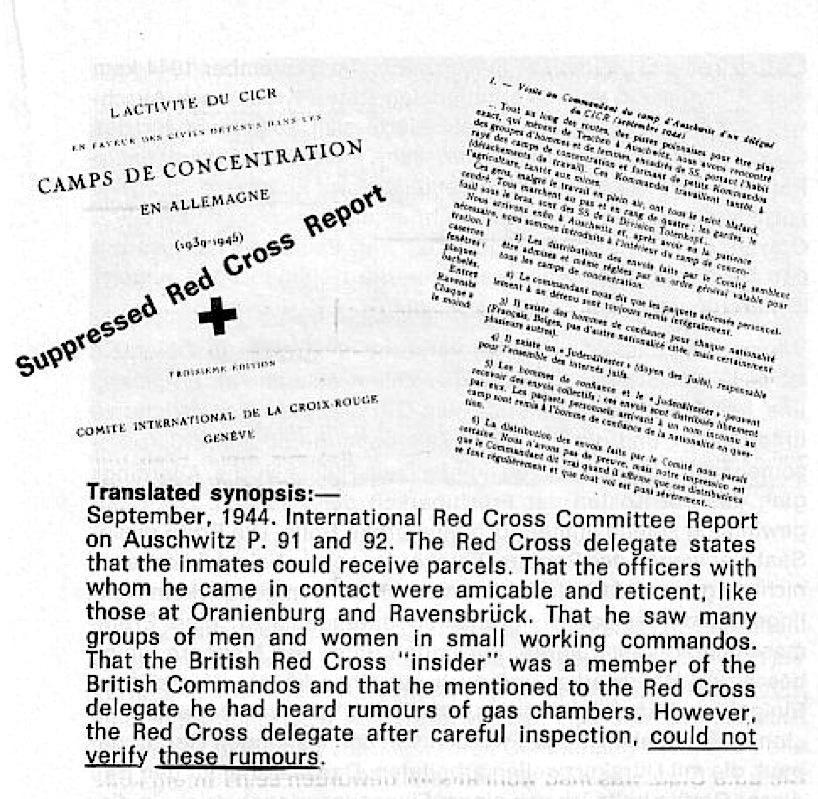
Christophersen hat — wie sein Bericht ergibt — auch von den angeblichen Massenvergasungen in Auschwitz-Birkenau nichts bemerkt, obwohl er sich aus diesem Lager wiederholt seine Arbeitshäftlinge holte. Bezeichnenderweise erklärt hierzu Rückerl den Lesern seines oben erwähnten Buches, “dass mancher, der während des Krieges zeitweilig ‘in Auschwitz’ war, unwiderlegbar erklären kann, er habe die Existenz der Gaskammern nicht wahrgenommen”, eben weil die “ungeheure Ausdehnung des Lagerkomplexes” und die “Doppelfunktion” von Auschwitz dies angeblich nicht zuließen. Rückerl übersieht bei dieser Argumentation allerdings einen Umstand, der sonst in der Auschwitz-Literatur eine nicht geringe Rolle spielt: die weithin sichtbaren Anzeichen der Verbrennung von unzähligen menschlichen Leichen sowie den damit zusammenhängenden angeblich ständig über dem ganzen Lagerkomplex schwebenden Leichengeruch, was z. B. der schon erwähnte Bernd Naumann in seinem Bericht über den Frankfurter Auschwitz-Prozess folgendermaßen beschreibt:

[Seite 17]

Der Gestank des verbrannten Fleisches legt sich kilometerweit über das Land. Dunkle fette Rauchschwaden treiben durch den weiten Himmel.

Ich muss gestehen, dass auch ich damals derartiges nicht bemerkt habe. Auch jene Delegation des Internationalen Roten Kreuzes, die im September 1944 Auschwitz besuchte, hat in ihrem 1947 in Genf veröffentlichten Bericht über diesen Besuch nichts davon erwähnt.

Gewiss konnten einem zeitweiligen Besucher von Auschwitz — wie Rückerl meint — etwaige “Gaskammern” verborgen bleiben. Die für die behaupteten Massenvernichtungen unentbehrliche pausenlose Verbrennung der Leichen hätte aber selbst einem solchen Besucher nicht entgehen können. Denken wir nur daran, dass ja nach der Legende ab Mai 1944 im Verlaufe von etwa drei Monaten rund 500.000 ungarische Juden auf diese Weise vernichtet worden sein sollen, so hätten in diesem Fall pro Tag weit über 5000 Menschen spurlos beseitigt werden müssen. Da die Zahl der in den Krematorien vorhandenen Einäscherungsöfen mit 46 angegeben wird und die Verbrennung einer Leiche in einem solchen Ofen heute noch etwa 90 Minuten in Anspruch nimmt, hätten selbst bei einem 24-Stunden-Betrieb in allen Krematorien im Höchstfall insgesamt 736 Leichen pro Tag eingeäschert werden können. Dabei sind die unbedingt notwendigen Reinigungs-, Aufräumungs- und Reparaturarbeiten noch nicht einmal berücksichtigt. Die restlichen rund 4.500 Gastoten hätten also — wie es ja auch behauptet wird — im Freien verbrannt werden müssen. Bei aller Skepsis gegenüber der Möglichkeit eines solchen Unternehmens überhaupt lässt sich zumindest sagen, dass dies niemals unbemerkt bleiben konnte.

Aus Rückerls Eingeständnis, dass ein zeitweiliger Besucher die Vernichtungsfunktion von Auschwitz nicht habe erkennen können, lässt sich also logischerweise nur der Schluss ziehen, dass zumindest die behaupteten Massenvernichtungen in Wirklichkeit gar nicht stattgefunden haben.

[Seite 18]

Christophersens Auschwitz-Bericht beweist sicher nicht, dass in Auschwitz überhaupt kein Jude umgekommen ist. Dies zu beweisen war auch wohl nicht die Absicht des Verfassers, der nur mitteilen wollte, was er selbst während seiner Abkommandierung nach Auschwitz erlebt hat. Andererseits aber erscheint endlich einmal die Feststellung erforderlich, dass die Verbreiter der Auschwitz-Legende uns bis zum heutigen Tage den Beweis für ihre Behauptungen schuldig geblieben sind und dass insbesondere auch der Auschwitz- Prozess mit seiner schauprozessartigen Durchführung und seinen teilweise unmöglichen und widerspruchsvollen Ergebnissen diesen Beweis nicht geliefert hat. Vor diesem Hintergrund behält Thies Christophersens Augenzeugenbericht nach wie vor seine besondere Bedeutung.

Ich wünsche auch dieser Neuauflage der “Auschwitz-Lüge” weiteste Verbreitung, zum Nutzen für unser Volk und zur Aufklärung der Welt!

Dr. Stäglich

[Seite 19]


Die Auschwitz-Lüge


In dem folgenden Bericht sollen Konzentrationslager nicht gerechtfertigt werden.

Die Forderung, Konzentrations- oder Internierungslager zu ächten, abzuschaffen oder zu verbieten (durch internationale Abmachungen), ist nie ausgesprochen worden.

Es wird dieses auch nicht möglich sein. Man kann den zweiten Schritt nicht vor dem ersten tun. Zuerst müsste der Krieg abgeschafft werden — dann kann man auch die Internierungslager abschaffen. In einem Kriegsführenden Land kann man Angehörige der Feindnation nicht in die Heimat entlassen, damit sie gegen ihr Gastland kämpfen können.

Das internationale Judentum hatte Deutschland bereits 1933 den Krieg erklärt.


[Seite 20]


Erpresstes Schweigen

Ich war in Auschwitz, und zwar von Januar 1944 bis zum Dezember 1944. Nach dem Kriege hörte ich von den Massenmorden, die angeblich von der SS an den gefangenen Juden ausgeübt wurden.


Der Autor mit seiner Frau im Jahre 1944


Ich war baff erstaunt. Trotz aller Zeugenaussagen, aller Zeitungsberichte und Rundfunk- und Fernsehsendungen glaube ich auch heute nicht an die Greueltaten. Ich habe dies auch immer wieder und überall gesagt.

[Seite 21]

Doch es war zwecklos. Keiner wollte mir glauben. Die Beweise, so sagte man mir, seien zu eindeutig und unwidersprochen. Die Prozesse hätten klar ergeben, dass es in Auschwitz Vergasungsanlagen gegeben hat, und Höss selbst als Lagerkommandant habe das bestätigt. Wer das abstreiten wolle, mache sich verdächtig, eventuell selbst an den Judenmorden beteiligt gewesen zu sein. Ich solle mich ja in Acht nehmen, denn Kriegsverbrechen seien noch nicht verjährt. Ich könne noch einen Prozess bekommen und ich solle lieber schweigen.

Wem ist damit gedient, wenn Du nun noch versuchen willst, die Geschichte zu korrigieren? Du änderst gar nichts! — Nur die Anerkennung unserer Schuld hat uns wieder in die Gemeinschaft der Völker gebracht. — Bedenke, dass Du eine Familie hast. — Keiner wird Dir Deine Berichte glauben … Schweige, das ist das klügste, was Du machen kannst.

Ehrlich gesagt, kamen mir auch selbst Zweifel. Wenn man von allen Seiten und immer wieder dieselben Geschichten hört, so ist es nur zu verständlich, dass man diese zuletzt selbst glaubt. “Wo sind denn die Juden geblieben, wenn man sie nicht alle vergast hat?” Ich weiß es nicht, aber ich meine, wo kommen die Juden denn her, wenn man im Kriege 6 Millionen von ihnen getötet haben soll. In meiner schleswig-holsteinischen Heimat hat es auch vor dem Kriege kaum Juden gegeben. Die so genannten “Viehjuden” auf dem Lande fehlten völlig. Gehässige Leute sagen, sie fehlten nur deshalb, weil die Bauern in Dithmarschen und Angeln den Juden weit überlegen waren. Sehr viele Juden sind vor und während des Krieges ins Ausland entkommen, und viele Juden haben auch die Konzentrationslager überlebt … und viele Juden leben heute wieder unter uns.

Die ersten Zweifel kamen mir, als ich ein Flugblatt von Einar Aberg * aus Norrviken/Schweden las. Er stellte die amtlichen Zahlen der jüdischen Weltbevölkerung vor und nach dem Kriege gegenüber und stellte fest, dass sich die Juden während des Krieges derart vermehrt haben müssten, so dass jede Frau im fruchtbaren Alter jedes Jahr ein Kind zur Welt gebracht haben müsse, wenn die Zahl von 6 Millionen getöteten Juden stimmen sollte.

* Siehe Heinz Roth, Odenhausen.

[Seite 22]

Im Jahre 1948 soll es nach einem Artikel der “New York Times” vom 25. Februar 1948, geschrieben von W. Baldwin, einem anerkannten und unparteiischen Sachverständigen in allen Bevölkerungsfragen, der auch nicht mit der größten Phantasie als “Antisemit” bezeichnet werden kann, wieder zwischen 15.600.000 und 18.700.000 Juden in der Welt gegeben haben. Die Mär von den 6 Millionen getöteten Juden kann mit anderen Worten nicht wahr sein, denn selbst wenn man die niedrigste Zahl nimmt, würde das bedeuten, dass eine Vorkriegsbevölkerung von 15.688.259 minus der getöteten 6 Millionen, also in Wirklichkeit nicht mehr als 9 Millionen, sich im Laufe von zehn Jahren mit 7.000.000 vermehrt haben müsste. Das ist biologisch nicht möglich!

Die Verluste des jüdischen Volkes während des Zweiten Weltkrieges sind sicher beklagenswert. Sie haben aber nicht 6 Millionen, sondern höchstens 200.000 betragen. Nach Feststellungen des Internationalen Roten Kreuzes ist die Anzahl “der in KZ und Gefängnissen umgekommener Opfer rassischer und politischer Verfolgung” lediglich 300.000 (Cannstatter Zeitung vom 12. Mai 1956). Diese Zahl umfasst aber nicht nur Juden sowie sie auch nichts über die Todesursache aussagt. Man hat lediglich alle Todesfälle registriert, darunter auch diejenigen, die auf Alter, Krankheit oder Luftangriffe auf die Lager zurückzuführen sind. Andere Quellen schätzen, dass die Zahl noch geringer ist. Dokumente und Aussagen, die etwas anderes behaupten, sind von mehr als zweifelhafter Herkunft. (Zu diesem Thema vgl. z. B. Harwood: “Starben wirklich 6 Millionen?”, A. R. Butz: “Der Jahrhundertbetrug” (beide Historical Review Press, Richmond, Surrey, Großbritannien) u. a.)

Selbst der führende österreichische Sozialdemokrat Dr. Benedikt Kautsky, Volljude, der die Jahre 1938 bis 1945 im KZ, davon drei Jahre in Auschwitz, verbracht hat, muss gestehen, dass er nie eine Gaskammer gesehen hat:

Ich war in großen deutschen Konzentrationslagern. Jedoch muss ich die Wahrheit zugeben, dass ich in keinem Lager und zu keiner Zeit nirgends eine derartige Einrichtung einer Gaskammer vorfand”. (Kautsky, “Teufel und Verdammte”, Zürich 1946, Seite 272f.)

[Seite 23]

Richard Baer, letzter Kommandant von Auschwitz (ab 1943) und somit wichtigster Zeuge, von dem die Pariser Wochenzeitung “Rivarol” berichtet, er sei nicht davon abzubringen gewesen, dass “während der ganzen Zeit, in der er Auschwitz geleitet habe, er nie Gaskammern gesehen noch gewusst hätte, dass solche existieren”, ist leider — obwohl vierzehn Tage vorher noch kerngesund — urplötzlich am 17. Juni 1963 im Untersuchungsgefängnis gestorben. Ich habe meine Auschwitzzeit nie verheimlicht. Wenn ich nach der Judenvernichtung gefragt wurde, habe ich geantwortet, dass mir davon nichts bekannt war. Ich habe mich nur gewundert, wie schnell und widerspruchslos die Massenvergasungsgeschichten von der Bevölkerung aufgenommen und geglaubt wurden.

Die Folgen meiner Kriegsbeschädigung im Jahre 1940 brachten mir eine chronische Stirnhöhlenvereiterung. Die kleinste Erkältung hatte zur Folge, dass ich ins Lazarett musste. Im Herbst 1942 brachte eine amtsärztliche Untersuchung den Befund: dauernd GvH (Garnisonverwendungsfähig Heimat). Ich beantragte einen Studienurlaub und besuchte im Winter 1942/43 die Höhere Landbauschule in Landsberg/Warthe. Im Frühjahr 1943 kam ein Hauptmann vom OKH (Oberkommando des Heeres) in unsere Schule, um einige Landwirte zu gewinnen, die bereit wären, in die Ukraine zu gehen, um dort Kautschuk anzubauen. Ich meldete mich und wurde angenommen.


Kok Sagis

Ein Bewegungskrieg benötigt Fahrzeuge, und Fahrzeuge benötigen Reifen, und Reifen sind aus Gummi. Gummi kann man zwar künstlich herstellen aus Kohle, Kalk und Schwefel — genannt Buna -, aber ohne eine Beimischung von Naturkautschuk geht das nicht. Es fehlt der Kleber. Die Russen, in ihrem Bestreben, sich von Einfuhren unabhängig zu machen (wenn wir das gleiche taten, wird das heute als Kriegsvorbereitung gewertet), hatten systematisch ihre gesamte Flora nach Kautschukträgern untersucht … und welche gefunden — unter anderem den Kok Sagis, eine Verwandte des Löwenzahns. Der weiße Latex in seinen Wurzeln war kautschukhaltig. Dieser Kautschuk wurde nun für die weitere Kriegführung sehr wichtig.

[Seite 24]

Der Bevollmächtigte für das Kraftfahrtwesen im OKH hatte Abteilungen für Anbau, Verwertung und Forschung eingerichtet. Ich wurde also nach einer kurzen Ausbildung in die Ukraine als Sachverständiger für den Anbau von Pflanzenkautschuk geschickt. Eine Kok-Sagis-Pflanze hatte ich noch nie gesehen. Doch die praktische Arbeit und die Unterstützung einiger russischer Agronomen gaben mir bald das erforderliche Wissen.


Eine Kok-Sagis Pflanze. Der weiße Latex, ähnlich wie beim Löwenzahn, enthält Kautschuk


Im Jahre 1943 ging uns die Ukraine verloren, und ich wurde Anfang 1944 zur Abteilung Pflanzenzucht beim Kaiser-Wilhelm-lnstitut versetzt. Dieses Institut hatte eine Zweigabteilung nach Auschwitz verlegt. So fuhr ich nach Auschwitz und erfuhr erst auf der Reise dorthin, dass dort ein Konzentrationslager war.

Da ich bereits im Frankreichfeldzug verwundet wurde und meine Zeit immer wieder in Lazaretten verbracht habe, habe ich keine militärische Karriere machen können. Ich war also nur Gefreiter und wurde durch meine Tätigkeit beim OKH Sonderführer (Z), das war der Rang eines Leutnants.

[Seite 25]

Dann wurde unsere Dienststelle im Herbst 1943 der SS unterstellt, und Reichsführer Himmler bekam die Schirmherrschaft. Er war bekanntlich Diplomlandwirt. Unsere Dienststelle nannte sich nun:

O.K.H. (Oberkommando des Heeres)

B.d.K. (Bevollmächtigter des Kraftfahrtwesens) kommandiert zum

Reichsführer SS, Abteilung Pflanzenkautschuk.

Doch behielten wir unsere Wehrmachtsuniformen, und wir wurden auch nicht mit unseren Blutgruppen tätowiert. Das hat sicherlich vielen von uns das Leben gerettet.

Wenn ich nun meine Erlebnisse von Auschwitz erzählen soll, dann habe ich Bedenken, ob ich auch die Namen meiner noch lebenden Kameraden nennen soll, zu denen ich auch heute noch Kontakt habe. Ich selbst weiß, dass ich mit Repressalien zu rechnen habe, wenn ich das Schweigen breche. Ich bin nun bereit, diese auf mich zu nehmen und habe sie zum Teil schon auf mich nehmen müssen. Als Herausgeber der BAUERNSCHAFT und der KRITIK sowie früher des DEUTSCHEN BAUERN habe ich nie ein Blatt vor den Mund genommen. Doch 1969 übergab ich meinen Hof meinem Sohn. Damals meinte ich, dass ich als Chefredakteur der Zeitschrift DEUTSCHER BAUER eine Existenz hatte. Meinen Freunden wird bekannt sein, dass diese Zeitung wegen wirtschaftlicher Schwierigkeiten von dem DSZ-Verlag des Herrn Dr. Frey aus München übernommen wurde. Doch die Schriftleitung dieser Zeitung ist nie in meinen Händen gewesen, seit sie nach München verlegt wurde. Ich war im wahrsten Sinne des Wortes “Sitzredakteur”. Die Zeitung bekam ich erst zusehen, wenn sie gedruckt war. Meine eigenen Artikel fand ich immer seltener wieder.

Wiederholte Beschwerden veranlassten Herrn Dr. Frey, mich fristlos zu entlassen. Ein Prozess vor einem Arbeitsgericht endete mit einem mageren Vergleich. Seit dieser Zeit bin ich regelrecht arbeitslos und, obwohl ich vom Arbeitsamt für den einfachen Verwaltungsdienst umgeschult wurde, ist es für mich unmöglich, eine Arbeit zu bekommen. Ich habe, obwohl ich erst 55 Jahre alt bin, keine Aussicht mehr, in das Berufsleben eingegliedert zu werden.

[Seite 26]

Warum sollte ich nun nicht berichten? Ich friste mein Dasein in einer bescheidenen, aber glücklichen Armut. Meine Kinder sind versorgt. Doch möchte ich nicht meinen ehemaligen Vorgesetzten und Kameraden, die zum Teil noch im Berufsleben stehen, Schwierigkeiten machen.


Das Lagerleben

Es war kalt und zugig, als ich am 15. Januar 1944 in Auschwitz auf dem Bahnhof ankam. Ich überlegte mir, ob ich nicht eine Droschke nehmen sollte. Doch es gab nur Pferdedroschken, und ich entschloss mich zu einem Fußmarsch. Mein Gepäck gab ich in die Aufbewahrung, und ich erfragte den Weg zur Kommandantur des Lagers. Es war gar nicht so weit. Das Lager, eine Kasernenanlage mit hässlichen, doch massiven Gebäuden, lag in unmittelbarer Nähe. Das Lagertor mit der Inschrift “Arbeit macht frei” war das erste, was ich von dem Konzentrationslager Auschwitz zu sehen bekam. Was mir auffiel war, dass sehr viele Häftlinge frei herumliefen, ohne bewacht zu werden. Später erfuhr ich, dass das Lager, welches mit einem elektrisch geladenen Stacheldrahtzaun umgeben war, nur des Nachts bewacht wurde. Tagsüber konnten sich die Häftlinge in einem riesigen Gelände frei bewegen. Dieses Gelände allerdings war von Posten umstellt, die des Nachts, nach dem Zählappell, eingezogen wurden.

Ich meldete mich bei meinem Vorgesetzten, Obersturmbannführer Dr. A. Ein großer, stattlicher Mann mit stahlblauen Augen und etwas rötlichem Haar. Die Begrüßung war herzlich. Es stellte sich heraus, dass er meinen Bruder, der auch bei der SS diente, sehr gut kannte. Ich stellte gleich einige neugierige Fragen bezüglich des Konzentrationslagers. So wollte ich z. B. wissen, was das für Menschen sind, die hier eingesperrt waren. Seine Antwort:

Was von den Deutschen hier ist, gehört hier hin … Feinde des Volkes … ansonsten sitzt hier die europäische Elite.

An diesen seinen Worten war, wie ich später feststellte, etwas Wahres dran.

[Seite 27]

Ich wurde seinen Mitarbeitern vorgestellt. Hauptsturmführer B., russischer Emigrant, ehemaliger zaristischer Offizier, der neben Russisch auch perfekt Deutsch und Französisch sprach, bot mir an, mich in mein Quartier zu fahren. Für den landwirtschaftlichen Bereich standen den Offizieren keine Autos, sondern Kutschen mit einem Fahrer zur Verfügung. Ich fand das etwas protzig. Auch, dass die Häftlinge, die uns begegneten, stehen blieben, die Mütze abrissen und Haltung annahmen, war mir irgendwie peinlich. Aber wir waren Offiziere, und auch die SS-Soldaten grüßten uns mit soldatischer Ehrenbezeugung.


Der Autor (Mitte) und Offiziere bei einer Besichtigungsfahrt durch das Lager


Mein Quartier lag in Raisko, etwa 3 km vom Hauptlager entfernt. Dort war ein Frauenlager, die Gewächshäuser und die Laborräume für unsere pflanzenzüchterische Arbeit. Mir wurde in einem allein stehenden Haus ein Raum zur Verfügung gestellt. Das gleiche Haus teilte ich mit meinem Kollegen, Obersturmführer Dr. C., dem die Aufsicht über die Abteilung Pflanzenzucht unterstand.

[Seite 28]

Er war ein sehr fröhlicher Mensch, und sein Lachen hatte etwas Herzerfrischendes. Bei den Häftlingen war er sehr beliebt. Auch heute schreibt er sich noch mit ehemaligen Häftlingen aus Auschwitz. Er war jung verheiratet und ließ später seine Frau und seine beiden noch nicht schulpflichtigen Kinder nachkommen. Ich bezog später eine Wohnung in einem fertig gestellten Gewächshaus. Dort wohnte ich mit einem Wissenschaftler aus dem Kaiser-Wilhelm-Institut zusammen. Seinen Namen kann ich nennen, es war Dr. Böhme. Er wurde nach der Kapitulation von Wildgewordenen polnischen Zivilisten erschossen. Er hatte bestimmt keinem etwas zuleide getan und war die Liebenswürdig- keit und Hilfsbereitschaft in Person.

Als ersten Häftling lernte ich “Agnes” kennen. Agnes gehörte zu den “Zeugen Jehovas”, und sie war uns als “Raumpflegerin” zugeteilt. Ich wollte sie nach den Verhältnissen im KZ ausfragen — aber Agnes blieb schweigsam. Anders Frau Pohl. Ihr unterstand die Küche. Sie forschte auch in der Bibel und verteilte Flugschriften an die Häftlinge. Das war zwar nicht erlaubt — aber es war nicht meine Aufgabe, die Häftlinge zu überwachen. Außerdem erschienen mir ihre Schriften harmlos. In Glaubensfragen bin ich stets tolerant gewesen. Bis zum heutigen Tag kann ich den Zeugen Jehovas eine gewisse Bewunderung und Achtung nicht versagen. Sie ließen sich wegen ihres Glaubens einsperren und litten, weil sie leiden wollten. Eine Bewachung benötigten sie nicht, und sie konnten sich auch außerhalb der Postenketten frei bewegen.

In unserem Frauenlager waren in 3 Baracken ca. 300 Frauen untergebracht. Es waren ausgesuchte Kräfte, die fast ausschließlich für die Abteilung Pflanzenzucht arbeiteten. Zur Hauptsache waren es Juden und Polen und einige Franzosen. Alle sprachen sehr gut Deutsch. Viele hatten einen akademischen Grad. Ihre Arbeit hatte wissenschaftlichen Charakter, und sie waren sehr selbständig. Es war tatsächlich so, dass ich nicht die Häftlinge, sondern die Häftlinge mich in meine Arbeit einweisen mussten. Ich ließ mir von ihnen ihre Arbeit erklären, und sie taten das mit einem gewissen Stolz — beinahe möchte ich es Wichtigtuerei nennen. Es hinterließ aber bei mir den Eindruck, dass die Häftlinge ihre Forschungsarbeit mit Eifer und Freude verrichteten.

[Seite 29]

Pflanzenzucht nach dem Ausleseverfahren heißt untersuchen und selektieren. Die Wurzeln der Kautschukpflanzen wurden auf ihren Kautschukgehalt untersucht und durch Stecklinge weiter vermehrt. Die Samen hiervon wurden sorgfältig geerntet und wieder ausgesät. Sabotage war sehr leicht möglich — aber es ist nicht ein einziger Fall bekannt geworden. Nun, es muss auch gesagt werden, dass die Häftlinge untereinander nicht viel Vertrauen hatten. Da war der alte Hass zwischen den National-Polen und den Juden. Der nationalsozialistische Judenhass war dagegen harmlos. Die Ergebnisse in der Steigerung des Kautschukgehaltes waren durchaus befriedigend. Leider sind mir Zahlen nicht mehr erinnerlich.

Hauptsturmführer B. fuhr in die besetzten Ostgebiete und war auf der Suche nach Wissenschaftlern. Er brachte einige russische Wissenschaftler mit Familien nach Auschwitz, die als Zivilangestellte für uns arbeiteten und es auch gerne taten.


Russischer Agronom (links) und der Autor


[Seite 30]

Tragisch wurde es, als er den russischen Agronomen J. Sassmoschek nach Auschwitz brachte. Dieser fand unter den Häftlingen seine frühere Geliebte wieder. Dieses Wiedersehen blieb nicht ohne Folgen. Aber Sassmoschek hat seine Geliebte heiraten können. Sie wurde aus der Haft entlassen. Ich habe die beiden noch nach der Evakuierung von Auschwitz in Halle (Saale) wieder getroffen. Sie strahlten beide vor Glück. Mir war gar nicht so glücklich zumute, denn ich hatte gerade den Bombenangriff vom 13. Februar in Dresden über mich ergehen lassen und war wie durch ein Wunder unversehrt raus gekommen. Ich glaube, in Dresden sind an diesem Tage mehr Menschen gestorben, als in den gesamten Kriegsjahren Menschen in Auschwitz gestorben sind. Doch die Kriegsverbrechen der Alliierten stehen auch heute noch nicht zur Debatte.

Wie war der Tagesablauf der Häftlinge in Auschwitz? Um 7.00 Uhr Wecken, Waschen und Duschen, Frühstück, Morgenappell und um 8.00 Uhr Beginn der Arbeit. Von 12.00 bis 13.00 Uhr Mittagspause und um 17.00 Uhr Feierabend. Um 19.00 Uhr Zählappell, anschließend wurde die Außenpostenkette eingezogen und nur noch die Lager bewacht. Die Post wurde den Häftlingen täglich ausgeliefert. Die Pakete wurden bei dem Appell geöffnet und von dem Lageraufseher kontrolliert. Selten wurde etwas nicht ausgeliefert, z. B. Medikamente und gewisse Bücher und Schriften, Fotoapparate, Radioapparate und andere technische Geräte. Diese Sachen aber blieben Eigentum der Häftlinge. Sie wurden nach “Kanada” gebracht und verwahrt.

Kanada hieß eine riesige Lagerhalle, in welcher alles Eigentum der aus- oder umgesiedelten Juden, die in Auschwitz interniert waren, gelagert wurde. In Kanada gab es alles — daher der Name. Aber Kanada wurde nach außen streng bewacht. Wir hatten in unserer Wetterstation eine SS-Helferin, die sich in Kanada einmal ein Paar seidene Strümpfe organisiert hatte. Sie kam deswegen vor ein Kriegsgericht … wegen Plünderung. Die Häftlinge selbst aber, die dort arbeiteten, klauten wie die Raben.

Mir fiel es auf, wie elegant unsere Häftlinge gekleidet waren. Zwar mussten sie ihre Sträflingskleidung tragen, aber ihre Wäsche, Strümpfe und Schuhe waren einwandfrei und tipptopp. Auch an Schönheitspflege fehlte es nicht. Lippenstift, Puder und Schminke gehörten mit zu den Utensilien der weiblichen Häftlinge.

[Seite 31]

Kahlgeschorene Jüdinnen gab es zu meiner Zeit in Auschwitz nicht mehr. Doch habe ich mir berichten lassen, dass es so etwas mal in Auschwitz gegeben haben soll. Aber der Anblick sei so schrecklich gewesen, dass selbst die hartgesottensten SS-Führer ihn nicht ertragen konnten. Jeden Sonnabend wurde ein Kommando unserer Frauen ins Hauptlager geschickt zum Wäschetausch. Sie kamen dann mit den herrlichsten Beutestücken zurück, die unter den Häftlingen verteilt wurden. Ich glaube, dieser Diebstahl wurde stillschweigend geduldet.


Olga

Im Mai bekam ich zum ersten Mal Besuch von meiner Frau. Sie war als Lehrerin der landwirtschaftlichen Haushaltungskunde berufstätig und neugierig auf meinen Arbeitsplatz im KZ. Schon die Tatsache, dass es möglich war, jederzeit Besuch unserer Angehörigen zu empfangen, zeigt die Offenheit der Lagerverwaltung. Wäre Auschwitz ein großes Vernichtungslager gewesen, dann hätten wir bestimmt nicht Besuche unserer Angehörigen empfangen können. Die Formalitäten, die heute noch nötig sind, um in dem von Walter Ulbricht gegründeten Zuchthaus einen Besuch zu machen, waren nicht nötig. Der Vergleich von Auschwitz mit der DDR ist gar nicht so abwegig.

Wir waren jung verheiratet und hatten noch nicht sehr viel von unserer Ehe gehabt. Ich holte sie vom Bahnhof ab. Sie kam in Holzklappern, Kopftuch und ohne Strümpfe. Es war Krieg, und Eleganz war für uns Luxus.

Damals hatte ich eine neue “Raumpflegerin” bekommen. Zofe wäre ein passender Ausdruck gewesen. Olga! Olga war eine Polin. Sie war ein Unikum — aber sie hat rührend für mich gesorgt und war außerordentlich dienstbereit. Immer waren Blumen in meinem Zimmer, immer saubere Tischwäsche und saubere Gardinen, und immer hatte Olga eine Überraschung für mich.

Zu dem Besuch meiner Frau hatte Olga mein Zimmer besonders schön hergerichtet. Über meinem Bett hatte sie einen betenden Engel angebracht — weiß der Teufel, wo sie den her hatte. Ihre Fürsorge war mir beinahe zu aufdringlich, aber ich musste es wohl über mich ergehen lassen, denn ich wollte dieser guten und dienstbaren Seele ja auch nicht weh tun.

[Seite 32]

Während des Aufenthaltes meiner Frau begannen die Arbeiten auf den Kautschukfeldern, und ich konnte mich nicht sehr viel um meinen Besuch kümmern; aber meine Frau hatte beste Gesellschaft mit Olga. Die konnte reden wie ein Buch. Meine Frau meinte, sie müsse ihr ein kleines Geschenk machen und hatte eine Kleinigkeit gekauft. Als ich meine Frau wieder zur Abfahrt an die Bahn brachte, kannte ich sie kaum wieder. Sie war neu eingekleidet vom Kopf bis zu den Füßen. Olga hatte ihr alles besorgt — sogar einen neuen Koffer. Meine Frau hatte mir einige kleine Leckereien mitgebracht, die sie sich selbst vom Munde abgespart hatte, unter anderem auch ein Stück Butter. Olga machte mir jeden Abend Bratkartoffeln, die in Butter schwammen. Doch die Butter wurde nie alle. Täglich kamen Care-Pakete, und Olga fühlte sich verpflichtet, auch für mich zu sorgen. Nein, gehungert haben die Häftlinge in Raisko nicht. Und wenn wir einen Neuzugang hatten, der unterernährt und mager ins Lager kam, so hatte er bereits nach einigen Tagen ein glattes Fell.


Der Autor bekommt Besuch von seiner Frau. Olga hat den Tisch festlich geschmückt.

[Seite 33]


Das Vernichtungslager?

Das Vernichtungslager sei ja gar nicht in Auschwitz gewesen, sondern das Vernichtungslager sei in Birkenau gewesen.

So habe ich es nach dem Krieg gehört und gelesen. Nun, ich bin auch in Birkenau gewesen. Dieses Lager hat mir gar nicht gefallen. Es war überfüllt, und die Menschen dort machten keinen guten Eindruck auf mich. Es war alles sehr verwahrlost und schmutzig. Dort sah ich auch Familien mit Kindern. Ihr Anblick hat mir wehgetan. Aber man sagte mir, man wolle die Kinder nicht von ihren Eltern trennen, wenn diese interniert würden. Einige Kinder waren auch mit einem lustigen Ballspiel beschäftigt. Dennoch meine ich, dass Kinder nicht in ein Internierungslager gehören — und dass es die Engländer z. B. im Burenkrieg auch getan hätten, ist eine schlechte Entschuldigung. Ich habe das auch meinem Vorgesetzten gesagt. Seine Antwort:

Ich teile Ihre Meinung — aber ich kann es nicht ändern.


Häftlinge aus Birkenau auf den Kok-Sagis-Feldern


[Seite 34]

Ich hatte die Aufgabe, in Birkenau 100 Arbeitskräfte zum Hacken der Kok-Sagis-Pflanzen auszusuchen. Das ging folgendermaßen vor sich. Beim Appell wurden die Häftlinge gefragt, ob sie für diese Arbeit bereit wären und ob sie solche Arbeit schon gemacht hätten. Es meldeten sich meist mehr, als benötigt wurden. Dann wurde “selektiert”. Dieses “Selektieren” ist später ganz falsch ausgelegt worden. Natürlich wollte man den Häftlingen eine Beschäftigung geben — und auch die Häftlinge wollten beschäftigt werden.

Selektieren war weiter nichts, als dass die Häftlinge nach ihren Neigungen, ihrem Können — aber auch nach ihrer körperlichen Verfassung zur Arbeit eingesetzt wurden.

Tatsache ist, dass in Auschwitz mehr Menschen vorhanden waren, als es Arbeitsplätze gab oder geschaffen werden konnten. Natürlich legte ich Wert darauf, dass ich Arbeitskräfte bekam, die in der Landwirtschaft gearbeitet hatten. Da fehlten die Juden. Sehr gute Arbeitskräfte stellten die Polen. Völlig unbrauchbar waren die Zigeuner. Das Kommando 11, so hieß unsere Frauenarbeitskolonne aus Birkenau, kam täglich nach Raisko und arbeitete außerhalb der Postenkette auf den Kautschukfeldern. Ich habe fast täglich mit diesen Leuten aus Birkenau zu tun gehabt und mir auch gern ihre Klagen angehört. Einmal sah ich, dass ein SS-Posten einer Frau in den Hintern trat. Ich stellte ihn zur Rede. Die Frau hätte ihn als “Nazischwein” beschimpft. Tatsache aber war, dass der Posten die Frau zuerst beleidigt hatte.

Ich machte über diesen Vorfall eine Meldung, und der SS- Wachmann wurde zum Strafbataillon nach Danzig versetzt. Seit diesem Tage hatte ich bei den Häftlingen, besonders bei denen vom Kommando 11 aus Birkenau, einen Stein im Brett. Des Öfteren kamen nun auch Häftlinge zu mir, wenn sie Bitten oder Beschwerden hatten. Ich tat, was ich konnte, denn für mich waren die Häftlinge keine Feinde, sondern Internierte. Oft habe ich ihnen auch eine Gefälligkeit erwiesen, die gegen die Vorschrift verstieß. Die größte Freude konnte ich ihnen machen, wenn ich sie mit zu einem Spaziergang an die Sula nahm und ihnen in den heißen Sommertagen des Jahres 1944 erlaubte, dort zu baden.

[Seite 35]


Häftling bei Feldarbeit (meistens mit Pferden). Bewacht von einem Posten in weiter Entfernung. Hier wird eine Hügelkultur vorbereitet.

Im Übrigen war das Hackkommando aus Birkenau ein lustiger Haufen. Es sang bei der Arbeit seine polnischen Volkslieder, und die igeuner führten dazu ihre Tänze auf. Ich war anfangs über den schlechten Ernährungszustand der Arbeitskräfte empört und auch besorgt, musste aber dann feststellen, dass die Häftlinge in einem sehr schlechten Ernährungszustand eingeliefert wurden — und es einige Zeit dauerte, bis sie sich herausgefuttert hatten. Oft habe ich mit ihnen zusammen meine Mittagsmahlzeit aus ihrer Gulaschkanone eingenommen, und es ist mir gut bekommen.

Aber das Kommando 11 hatte auch noch geheime Ernährungsquellen. Es holte aus geheimen Verstecken die wunderbarsten Sachen. Diese Verstecke wurden des Nachts von Freunden immer wieder aufgefüllt. Es ist auch vorgekommen, dass diese Freunde sich Sträflingskleider anzogen und mit ins Lager marschierten und dafür ein anderer Häftling einige Tage Urlaub machte. Auschwitz lag in Polen, und die einheimische Bevölkerung half den Häftlingen, so gut sie es konnte — auch wenn sie es nicht durfte.

[Seite 36]

Die deutschen Besatzungstruppen und vor allem die so genannte Zivilverwaltung haben sich auch oft, wie wir alle wissen, nicht immer sehr beliebt bei der Bevölkerung gemacht. Eine Maßnahme, die mir gar nicht gefiel, war die Enteignung der polnischen Kleinbauern. Sie mussten ihr Land für die landwirtschaftlichen Betriebe hergeben, die zum KZ Lager Auschwitz gehörten. Doch ich habe mir sagen lassen, dass sie dafür entschädigt wurden, und zwar genauso wie andere Grundeigentümer, die ihr Land z. B. für den Bau einer Autobahn hergeben mussten. Auch Umsiedlungsmaßnahmen hielt ich nicht für richtig, aber es wurde mir immer wieder versichert, dass diese niemals zwangsweise erfolgten. Freiheitsentzug ist hart — aber Krieg ist noch härter, und er wurde auch für uns immer härter und grausamer. Im Herbst 1944 wurde das KZ in Auschwitz zum ersten Mal von amerikanischen Fliegern bombardiert. Opfer wurden ca. 20 Häftlinge. Ich selbst hatte den Glauben an den Endsieg mit der geglückten Landung an der Kanalküste verloren — jedenfalls kamen mir Zweifel. Die Frontberichte wurden immer enttäuschender, und auch die Häftlinge waren gut unterrichtet — weiß der Teufel von wem. Für die Lagerinsassen wurde in unserem Bereich aber nach wie vor gut gesorgt. Obersturmbannführer A. hatte durchgesetzt, dass einmal in der Woche der Filmvorführungswagen in unser Lager kam. Wir sahen mit den Häftlingen zusammen u. a. die Filme “Münchhausen” und “Die goldene Stadt”. Der Film “Jud Süß” wurde den Häftlingen natürlich nicht gezeigt und auch nicht Propagandafilme wie “Kolberg” und “Kadetten”. Im Gemeinschaftsraum durften auch Gottesdienste der Lagerinsassen abgehalten werden. Ich selbst habe mir verschiedene Gottesdienste angehört und muss sagen, dass sie zum Teil sehr feierlich waren, besonders die der russisch-orthodoxen Gemeinde, der unsere russischen Zivilangestellten angehörten. Unter den Lagerinsassen hatte sich auch eine Theatergruppe gebildet, und eines abends luden sie uns zu einer “Faust-Aufführung” ein. Schauspieler hätten sie nicht besser bringen können.

Ich selbst hätte zum Winter gern wieder Studienurlaub genommen, aber die Kriegslage war ernst, und die Aussichten waren schlecht.

[Seite 37]

Man bot mir einen Fernkursus an. Ich ließ mir Bücher kommen. Ein Häftling, eine jüdische Ärztin aus Prag, bot sich an, den Stoff mit mir einzupauken. So habe ich mir jeden Tag von einem Häftling Nachhilfestunden geben lassen. Das war in Raisko möglich.

Intelligent waren die Juden, und sie waren, soweit ich sie in Auschwitz kennen gelernt habe, auch ganz nett. Im Sommer bekam ich für einige Tage Besuch von meiner Mutter. Natürlich gab es gleich eine dicke Freundschaft zwischen meiner Mutter und Olga. Eines Abends fragte mich meine Mutter nach dem Krematorium, wo die Menschen verbrannt wurden. Mir war von dem Vorhandensein einer solchen Anlage nichts bekannt. Ich stellte Olga zur Rede.

Genaues konnte sie mir auch nicht sagen, aber es wäre in der Richtung nach Bielitz immer ein Feuerschein zu sehen. Ich fuhr in diese Richtung und fand eine Zechenanlage, in welcher auch Häftlinge arbeiteten. Ich fuhr im ganzen Lager umher und untersuchte alle Feuerstellen und alle rauchenden Schlote. Ich fand aber nichts. Ich befragte meine Kollegen, aber als Antwort nur Schulterzucken und “ich sollte diesen “Latrinenparolen” keinen Glauben schenken”. Ein Krematorium gäbe es in Auschwitz; denn hier lebten 200.000 Menschen, und in jeder Großstadt mit 200.000 Einwohnern gäbe es auch ein Krematorium. Natürlich sterben auch Menschen hier — aber nicht nur Häftlinge. Die Frau von Obersturmbannführer A. sei auch hier gestorben. Mir genügte diese Antwort.

Ich habe während meiner Zeit in Auschwitz nicht die geringsten Anzeichen von Massenvergasungen bemerkt. Auch der Geruch von verbranntem Fleisch, der oft über dem Lager gelegen haben soll, ist eine glatte Lüge. [1] In der Nähe des Hauptlagers war eine große Beschlagschmiede. Der Geruch von dem Einbrennen der Hufeisen war natürlich nicht angenehm. Übrigens, der Leiter dieser Beschlagschmiede lebt heute in meinem Nachbardorf. Überhaupt wurden die Hafterleichterungen immer großzügiger.

[1] In der ersten Zeit wurden die Verstorbenen in Auschwitz erdbestattet. Doch wegen des hohen Grundwasserstandes zwischen Weichsel und Sula (ein Meter) war das nicht mehr möglich. Ein Arbeitskommando unter dem Kommando von Scharführer Moll (der frühere Gärtner in Raisko) mußte diese Leichen wieder ausgraben und nachträglich verbrennen. Über diesen Vorgang werden heute die unglaublichsten Geschichten erzählt. (Quelle: Aussage von Obersturmführer C.)

[Seite 38]

In dem Haupt-lager war für die Männer ein Bordell eingerichtet worden. Liebe und das, was dazu gehört, ist wohl etwas Menschliches, und das sollte auch den Internierten nicht vorenthalten werden. Natürlich gab es auch Liebespaare unter den Häftlingen. Ob das Freudenhaus das nun verhindert hat, wage ich zu bezweifeln. Dass es in Auschwitz aber auch Freudenhäuser für die Häftlinge gab, wird in allen Nachkriegsberichten verschwiegen. Ein Gutschein für das Bordell war so eine Art von Prämie für gute Führung. Es gab aber auch Häftlinge, die ihrem Kapo diesen Gutschein ins Gesicht warfen. Alle Achtung! Mir erschien das eine besondere Art von guter Führung.

Die Geschichte von der Leichenverbrennung brachte Differenzen zwischen Olga und mir. Auf die Dauer fiel mir diese Frau mit ihrem ewigen Gerede auf die Nerven. Ihre Dienstbereitschaft war mir zu untertänig, zu knechtisch. Ich mochte das nicht. Sie bekam eine neue Aufgabe, um die ich sie nicht beneidet habe. Sie wurde als “Aufpasser” ins Frauenlager bestellt und sollte darüber wachen, dass keine männlichen Häftlinge unbefugt ins Frauenlager kamen. Olga konnte so wunderbar schimpfen, und es war eine Freude zu sehen, wie sie die Männer aus dem Frauenlager beförderte. Die Mithäftlinge nannten sie “Zerberus” (Höllenhund).

Die gute Olga, was mag wohl aus ihr geworden sein? In ein kommunistisches Polen wollte sie nicht zurückkehren [2] — fast keiner der polnischen Häftlinge wollte das — auch die Juden nicht. Sehr viele von ihnen haben sogar noch für einen Sieg der Deutschen gebetet. Wie ich von meinem Kollegen, Obersturmführer Dr. C., den ich erst kürzlich besucht habe, erfuhr, sind viele der ehemaligen Häftlinge nun in den USA. Er korrespondiert noch mit einigen. Einige von ihnen waren auch bereit, für angeklagte SS-Offiziere als Entlastungszeugen in den KZ-Prozessen auszusagen, aber sie wurden kaum zugelassen. Diese Berichte gingen damals durch die nationale Presse.

[2] Olga kehrte nach dem Krieg dennoch in ein kommunistisches Polen zurück und ist vor drei Jahren bei einem Verkehrsunfall tödlich verunglückt. Ihr richtiger Name war “Steffa”.

[Seite 39]


Unterdrückter Rot-Kreuz-Bericht:

Übersetzte Zusammenfassung:

September 1944. Bericht des Internationalen Roten Kreuzes über Auschwitz P. 91 und 92. Der Rot-Kreuz-Delegierte führt an, dass die Insassen Päckchen empfangen durften, dass die Offiziere, mit denen er in Kontakt gekommen ist, freundlich und zurückhaltend gewesen sind wie die in Oranienburg und Ravensbrück, dass er viele Gruppen von Männern und Frauen zu kleinen Arbeitskommandos zusammengefasst gesehen hat, dass ein Angehöriger des britischen Roten Kreuzes, zugleich ein Mitglied des Britischen Kommandos, dem Rot-Kreuz-Delegierten gegenüber Gerüchte geäußert hätte über Gaskammern, der Rot-Kreuz-Delegierte hingegen diese Gerüchte nach sorgfältiger Überprüfung nicht hat bestätigen können.

[Seite 40]

Es gab keine Geheimnisse in Auschwitz. Im September 1944 kam eine Kommission vom Internationalen Roten Kreuz nach Auschwitz zur Besichtigung. Sie interessierte sich aber mehr für das Lager in Birkenau. [3] Wir hatten sehr viele Besichtigungen in Raisko — aber es kamen mehr Leute, die sich für unsere Pflanzenzucht interessierten. An diesen Führungen war ich oft mitbeteiligt. Obwohl es eigentlich nicht gestattet war, dass Besucher sich mit den Häftlingen unterhielten, mussten die Häftlinge doch zumeist Erläuterungen über ihre Arbeit geben.

Wir machten damals die ersten Versuche mit Colchizin. Colchizin ist das Gift der Herbstzeitlose (Colchium autumnale). Es gelang uns, bei der Zellteilung mit diesem Gift die Reduktionsteilung zu unterbinden, und die Pflanze bekam dann die doppelte Chromosomenzahl. Solche Pflanzen neigten zum Riesenwuchs. Allerdings ging das auf Kosten der Fruchtbarkeit der Pflanzen. Die Saatgewinnung spielte immer noch eine große Rolle. Die Ernte dieser Saat war wegen des Pappus (Flugkörper so wie beim Löwenzahn) nicht so ganz einfach. Ich hatte mich mit einigen geschickten Häftlingen und russischen Agronomen darangemacht, eine Erntemaschine zu konstruieren. Wir hatten unter den Männern einige geschickte Handwerker und auch gut eingerichtete Werkstätten. Einige russische Agronomen arbeiteten mit der so genannten “lonogalvanisation”. Dazu wurden von den Häftlingen Geräte gebaut, die mit Ultrakurzwellen arbeiteten. Das Material für den Bau dieser Geräte holte ich von einem Flugzeugzerlegebetrieb. In diesem Betrieb wurden abgestürzte und abgeschossene Flugzeuge ausgeschlachtet. Die Häftlinge fanden dort auch Material zum Bau kleiner Radiogeräte. Diese durften natürlich nicht mit ins Lager genommen werden. Ich selbst entwickelte mich in Auschwitz zu einem kleinen Radioten. Meine Lehrmeister waren Häftlinge, und sie besorgten mir alles, was ich zum Bau kleiner Empfänger benötigte.

[3] Heute versucht das Internationale Rote Kreuz in Genf zu leugnen. Sie behaupten, ihre Delegierten wären im September 1944 nur bis zum Büro des Kommandanten zugelassen worden. Das ist einfach nicht wahr! Ich habe die Fahrzeuge des IRK selbst gesehen, als sie nach Birkenau fuhren. (Quelle: Offener Brief von Dr. Stäglich an das IRK und deren Antwort vom 28.4.78 PV/gr.)

[Seite 41]


Eine Besuchergruppe von landwirtschaftlichen Sonderführern

In Auschwitz wurde natürlich nicht nur Pflanzenzucht betrieben. Es gab unzählige andere Forschungsaufträge. Wegen der dort zur Verfügung stehenden ungenutzten Arbeitskräfte wurde immer mehr Forschung nach Auschwitz verlegt. Hier war damals auch noch mehr Sicherheit vor nächtlichen Bombenangriffen. Etwa alle 14 Tage trafen sich die Offiziere, bei der SS hieß das: die Führer zu einem Casino-Abend. Dort musste dann irgendein Abteilungsleiter über sein Aufgabengebiet referieren. Ich habe dort sehr viele interessante Vorträge gehört, aber anstößige Sachen sind mir nicht erinnerlich. Später hörte ich, es wären auch Versuche an lebenden Menschen in Auschwitz vorgenommen worden. Ich entsinne mich, einmal einen Vortrag gehört zu haben über die Entwicklung eines Embryos im Mutterleib bei den verschiedensten Ernährungen der Mutter. Ob diese Menschen unter Hungerkuren ein Kind austragen mussten, vermag ich nicht zu sagen. Doch wurde damals gesagt, dass diese Versuche sehr wichtige Erkenntnisse für die Ernährung der schwangeren Frau ergeben hätten. Die Berichte von der Erprobung neu entwickelter Arzneien an Häftlingen erscheinen mir nicht sehr glaubwürdig. Ich habe mir von einem Arzt in A. berichten lassen, dass neue Medikamente erst dann bei Menschen angewandt werden, wenn der Tierversuch abgeschlossen wäre. Das ist ja wohl heute auch noch so.

[Seite 42]

Ich entsinne mich, dass in einem Film, den ich nach dem Kriege über Auschwitz im Fernsehen gesehen habe, ein Gebäude in der Nähe des Hauptlagers gezeigt wurde, welches riesige Schornsteine hatte. Das sollte angeblich das Krematorium sein. Es tut mir nun sehr Leid, aber als ich im Dezember 1944 das Lager in Auschwitz verließ, habe ich dieses Gebäude dort nicht gesehen. Ich kann mir auch nicht denken, dass während des kalten Winters 1944/45 man dort noch diese Schornsteine gemauert hat. Für mich besteht der Verdacht, dass diese Anlagen erst nach dem Kriege dort aufgestellt wurden. Unglaublich erscheint es mir auch, dass die SS diese Anlagen, wenn sie tatsächlich vorhanden gewesen wären, nicht bei der Evakuierung zerstört hätten. Gerade in diesen Tagen hörte ich noch einen Bericht im Rundfunk, nach dem allein 4 Millionen Menschen in Auschwitz erschossen worden sein sollten. Erschossen wurden in Auschwitz bestimmt keine Menschen, denn das hätte man hören müssen. Allerdings entsinne ich mich an eine große Aufregung, die es einmal in unserem Lager gegeben hat, als ein Gerücht verbreitet wurde, dass Geiseln erschossen werden sollten. Diese Art von Rache ist die scheußlichste, die ich mir denken kann, weil sie unschuldige Menschen betrifft. Das es sie gegeben hat — hüben und drüben — ist wahrscheinlich. Aber wenn man für jedes Opfer der Bombenangriffe hätte einen Häftling töten wollen, dann wäre sicherlich von den 200.000 Häftlingen keiner mehr lebend herausgekommen. Wenn man bedenkt, dass Auschwitz nur etwa 4 Jahre in Betrieb war, dann hätten dort pro Jahr eine Million und pro Tag etwa dreitausend Menschen sterben müssen. Wie müsste eine Krematoriumsanlage aussehen, die täglich dreitausend Menschen verbrennen sollte? Aber selbst Massengräber in diesen Ausmaßen ließen sich nicht verheimlichen.

Doch das deutsche Volk glaubt weiter an die Massenmorde in den Konzentrationslagern. Warum eigentlich? Haben wir nicht alle, die wir die Wahrheit wissen, eine ungeheure Schuld auf uns geladen? Warum schwiegen wir so lange?

[Seite 43]

Ich will versuchen, diese Frage zu beantworten:

1. Wir haben ja gar nicht geschwiegen … aber keiner wollte unsere Berichte hören, keine Zeitung sie veröffentlichen, kein Verlag sie drucken.

2. Auch heute gibt es noch genügend lebende Zeugen, die meine Aussage bestätigen und die selbst ähnliche Aussagen machen könnten. Was uns aber fehlt, ist ein unbefangener Rechtsstaat. Es wäre glatter Selbstmord, die Wahrheit zu sagen.

3. Ich bin zwar noch nicht lebensmüde, doch habe ich meine Lebensaufgabe hinter mir, meine Kinder versorgt, und meine Frau wird mit ihrem 65. Lebensjahr ihre verdiente Rente wohl erhalten, die man ihr nicht streitig machen wird, wenn mir etwas widerfahren sollte.

4. Ich habe durch meine langjährige Tätigkeit als Journalist und als Herausgeber der BAUERNSCHAFT und KRITIK mir nun selbst einen kleinen Leserkreis geschaffen, und ich kann nun auch mit Hilfe der DEUTSCHEN BORGER-INITIATIVE meinen Bericht selbst verlegen, ohne auf eine Abhängigkeit Rücksicht nehmen zu müssen.

5. Es wird gesagt — und leider auch von den Mitgliedern und Wählern der großen Parteien:

Nur die Anerkennung unserer Schuld am Ausbruch des Krieges und an der Vernichtung der 6 Millionen Juden würde es uns ermöglichen, wieder in die Gemeinschaft der Völker aufgenommen zu werden. Wer das abstreiten würde, würde dem deutschen Volk einen großen Schaden zufügen.

6. Mit einer Widerlegung der Massentötungen in den Konzentrationslagern aber würde nicht nur die deutsche Nachkriegspolitik ein Irrtum, sondern auch die Nachkriegspolitiker müssten dann zugeben, dass sie eine völlig falsche Politik betrieben hätten. Das aber darf nicht sein.

7. Aber es hat auch Feiglinge, Lügner und gekaufte Zeugen gegeben. Einige der Beschuldigten, die genau hätten wissen müssen, dass die Anschuldigungen gegen sie unwahr sind, haben dennoch ein Geständnis abgelegt, weil sie meinten — und es ist ihnen sicherlich auch zugesagt worden — sie könnten für sich selbst Vorteile erwirken, wenn sie der Anklage gemäß aussagen würden. Aber, das muss eingeräumt werden, es besteht auch die Möglichkeit, dass Geständnisse von Angeklagten durch Folterungen erpresst wurden. Auch hierüber liegen Berichte vor.

[Seite 44]

Wie könnte sich das Verhalten unseres Volkes, besonders auch unserer Jugend, ändern, wenn sie von der Schuldlosigkeit ihrer Väter überzeugt würde? Eine Schuld kann einen Menschen schwer belasten und ihn in eine knechtische Abhängigkeit bringen. Gerade das ist es, was die Sieger erreichen wollten — und sie werden nicht dulden, dass die Früchte ihrer Lügen, die sie nun ernten, verloren gehen.

Ich habe meine Erinnerungen so aufgeschrieben, wie ich sie erlebt habe und wie sie mir erinnerlich sind. Ich habe die Wahrheit gesagt, so wahr mir Gott helfe. Wenn diese meine Aussage mit dazu beitragen könnte, unserer Jugend wieder etwas mehr Achtung vor ihren Vätern, die als Soldaten für Deutschland kämpften — und keine Verbrecher waren — zu geben, dann wäre ich sehr glücklich.

Kälberhagen, den 3.1.1973

Thies Christophersen


Dennoch!


Freiheit und Recht hat der Krieg uns geraubt.

die Ehre kann keiner uns nehmen!

Wir haben an unsere Ziele geglaubt

und brauchen uns ihrer nicht schämen!


Wir sind von den Siegern noch immer besetzt;

und ständig begleiten uns Lügen.

Und hat auch der Feind unsere Jugend verhetzt, 

Am Ende da werden wir siegen!


Den Kampf um die Freiheit, um Recht und Moral, 

den gilt es mit Eifer zu führen.

Und sind auch der Feinde soviel an der Zahl, 

wir werden den Mut nicht verlieren!


Renate Schütte

Manfred Roeder gewidmet

================ END OF PART 1/2 ================


Go to >> Die Auschwitz-Lüge – Part 2 (last)


Downloads


* PDF of this blog post (clean text and images). Click to view or download (1.3 MB).

>> Die Auschwitz-Lüge – Part 1

————————

.

Version History


Ver 3 – Apr 1, 2022 – Re-uploaded images and PDF.


Ver 2 – May 28, 2015: Added link to Part 2.


Ver 1 – Feb 7, 2015: Published text and Images from original scanned German version.


Posted in Auschwitz, German language post, Holocaust, Jews, Revisionism, Thies Christophersen, Third Reich | 1 Comment